WHATS INSIDE: Nine new teachers Pgs. 5-7/ Iran deal heats up summer conversations Pgs. 8 and 15 / 62 freshmen at orientation on the roof Pg. 4
SHALHEVET HIGH SCHOOL • Los Angeles, CA September 2015 - Elul 5775 Volume 16, Issue 1 shalhevetboilingpoint.com
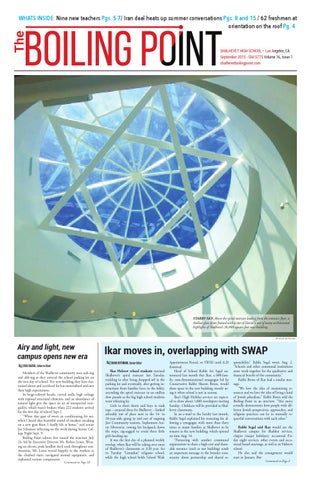
STARRY SKY: Above the spiral staircase leading from the entrance foyer, a shallow glass dome framed with a star of David is one of many architectural highlights of Shalhevet’s 36,000-square-foot new building. BP Photo By Gaby Benelyahu
Airy and light, new campus opens new era By Eric bazak, Editor-in-Chief Members of the Shalhevet community were ooh-ing and ahh-ing as they entered the school parking lot on the first day of school. The new building they have fantasized about and sacrificed for has materialized and met their high expectations. Its beige-colored facade, curved walls, high ceilings with exposed structural elements, and an abundance of natural light give the space an air of unexpected tranquility, which wasn’t broken when 222 students arrived for the first day of school Sept 2. “When that gust of sweet air conditioning hit me, when I heard that beautiful sound of sneakers sneaking on a new gym floor, I finally felt at home,” said senior Joe Schnitzer reflecting on the week during Senior College Night Sept. 9. Boiling Point editors first toured the structure July 24, led by Executive Director Ms. Robyn Lewis. Wearing an electric pink hardhat she’d used throughout construction, Ms. Lewis waved happily to the workers as she climbed stairs, navigated around equipment, and explained various components Continued on Page 10
Ikar moves in, overlapping with SWAP By Noah rothman, Senior Editor Ikar Hebrew school students stormed Shalhevet’s spiral staircase last Tuesday, trickling in after being dropped off in the parking lot and eventually, after getting instructions from familiar faces in the lobby, ascending the spiral staircase in an endless slow parade as the big high school students went whizzing by. Girls in short shorts and boys in tank tops -- unusual dress for Shalhevet -- looked adorably out of place next to the 14- to 18-year-olds going in and out of ongoing Just Community sessions. Sophomore Aaron Silverstein, towing his backpack down the steps, zig-zagged to avoid three little girls heading up. It was the first day of a planned weekly overlap, when Ikar will be taking over most of Shalhevet’s classrooms at 3:20 p.m. for its Tuesday “Limudim” religious school, while the high school holds School Wide
Appointment Period, or SWAP, until 4:20 dismissal. Head of School Rabbi Ari Segal announced last month that Ikar, a 600-family, non-denominational synagogue led by Conservative Rabbi Sharon Brous, would share space in the new building, mostly using it when school is not in session. Ikar’s High Holiday services are expected to draw about 1,800 worshipers starting Sunday. Childcare will be provided in Shalhevet classrooms. In an e-mail to the faculty last month, Rabbi Segal explained his reasoning for allowing a synagogue with more than three times as many families as Shalhevet to be tenants in the new building, which opened on time Aug. 14. “Partnering with another communal organization to share a high-cost and shareable resource (such as our building) sends an important message to the broader community about partnership and shared re-
sponsibility,” Rabbi Segal wrote Aug. 2. “Schools and other communal institutions must work together for the qualitative and financial benefit of the community.” Rabbi Brous of Ikar had a similar message. “We love the idea of maximizing resources and we love the idea of living a kind of Jewish pluralism,” Rabbi Brous told the Boiling Point in an inteview. “This move actually demonstrates how people with different Jewish perspectives, approaches, and religious practices can be in mutually respectful conversations with each other.” Rabbi Segal said Ikar would use the Shalhevet campus for Shabbat services, chagim (major holidays), occasional Friday night services, other events and occasional board meetings, as well as its Hebrew school. He also said the arrangement would start in January. But Continued on Page 2
The Boiling Point • September 2015 • Community
2
September Mon.
7
Labor Day (no school)
Wed.
8
Tues.
Picture Day
9
2
Wed.
First Day of School
12th Grade College Night
13
Mon.
SUn.
Erev Rosh Hashanah
14-15 Rosh Hashanah (no school)
Sun.
Tues.
Thurs.
Mon.
Wed.
23
Late Start Erev Sukkot
28-30
16
Erev Yom Kippur
Yom Kippur (no school)
24
Wed.
Tzom Gedaliah (early dismissal)
22
27
Sukkot (no school)
October Thurs.
1-6
Sukkot (no school)
Wed.
10th and 11th PSAT Back-to-School Night
Thurs.
11th Grade College Night
Fri.
29
Thurs.
Picture Make up Day
30
15
Thurs.
Phone-A-Thon
22
7
Wed.
Travel Day (no school)
14
THROWBACK: Ikar’s Hebrew school tried out the Shalhevet building for the first time Sept. 7. Just like last year, they will occupy many classrooms on Tuesday afternoons starting at 3:20.
Teacher Yom lyun (no school)
Ikar synagogue moves in, overlapping with SWAP
BP Photo By Michelle Hirschhorn
Continued from Page 1
lock regardless,” he said. “You could certainly just use it Friday afternoon through Monday morning.” Senior Daniel Soroudi said that would threaten the spirit of Shalhevet. “Never once since I enrolled at Shalhevet have I even considered putting a lock on my locker,” Daniel told the Boiling Point. “I see Shalhevet as a very safe and open high school. That’s always been a defining characteristic of our school... BP Photo By Michelle Hirschhorn “Changing that safe space in any way READY: Ikar officials plan their first Shabchanges how I look at Shalhevet, even if bat services, above. Below, Ikar member Jenny just a little bit.” Coin kashers cookwear in the dairy kitchen. Although students must clear the classrooms early on Tuesday afternoons, little potential room for conflict here.” co-curriculars will still take place. Rabbi SeRabbi Brous said renting space at Shalgal said the goal is for Ikar to not interfere. hevet would cost the shul more than being “Obviously, we are the landlord and at the JCC, because Ikar would still be paythey are the tenant so we would probably ing the JCC to house its offices. take first priority” if there was a conflict, “However, my board and staff have been he said. very supportive of the idea, even before we He said he’d already told Ikar that there saw how beautiful the space was,” Rabbi would be times when the Wildfire Theater Brous said. While Rabbi Segal wouldn’t say -- whose stage is also the stage for the gym how much Ikar was paying, he said it was -- would not be available, for example. enough for “about 15 to 20 average scholIkar will never use offices, the teacher arships” for students in need. room, or the Student Activities office. The He also said the money would be spent group’s offices will remain at the JCC, anywhere it was needed, including for new where they have been since the shul was programs and the school’s endowment founded 11 years ago. fund. The synagogue has been given its own storage space in Board President Larry Gill called the the Shalhevet basement, how- lease “another revenue source.” ever, and was busy moving “They are giving us a nice sum of annual boxes in last weekend. rent,” said Mr. Gill. The lease is for two years with an option This past Tuesday, Ikar to renew, Rabbi Segal said, and was signed used every classroom, includ- by Mr. Gill and the President of Ikar, Karen ing the Science Labs and the Hogan. Music Room, for Limudim. Meanwhile, in case anyone worries Ikar students were eating in whether it’s halachically acceptable to use a every room -- unlike Shalhevet kosher building in a less halachically obserBP Photo By Michelle Hirschhorn students, who have been told vant way, Rabbi Segal said that he had yet it has been a free period, used for home- not to so the building can stay clean. to receive any such criticism for sharing the Ikar will also be using Shalhevet’s new building with Ikar. work and co-curriculars. This week it was used for Just Commu- kitchen, a sensitive area because Ikar does “I made sure to consult the rabbis who nity Re-Orientation, so only a few rooms not observe kashrut the same way Shalhe- we consult with before making the deciwere needed and Ikar’s program did not vet does. Rabbi Segal said this was solved sion,” Rabbi Segal said, “and so we worked by requiring that Ikar use agreed-upon through whatever halachic and hashgafic conflict. It’s not clear what will happen after the hashgachot – that is, kashrut supervising (ideological) issues there may be.” agencies -- to certify its pots and food, and holidays. Rabbi Brous said there had been no When asked where teachers would meet that checks would be made at appropriate negative reaction in her community either. with students or give makeup exams, Rabbi intervals. “I think there were a couple of people “We’ve made clear that they have to who wondered what it would be like to Segal, General Studies Principal Daniel Weslow, and Dean of Students Jason Feld use one of the major hashgachas here in share space with an Orthodox communitown, or they can have a Shalhevet faculty ty,” she said. “Rabbi Segal has assured us were all unsure. Mr. Weslow speculated that SWAP member supervise them,” said Rabbi Segal. that he has only the most respectful and would most likely take place in the theater, “That was a non-issue. They have been very compassionate and kind approach to Jews conference room, Beit Midrash, and pos- responsive to what we need.” of all stripes and so our people were very Ikar officials, including Rabbi Brous, affirmed by that.” sibly the gym. For Shabbat and holidays, the entire confirmed this. “We are also a halachically serious com“Rabbi Segal certainly knows who we munity so let’s just say, we aren’t building building except for offices will be used by are halachically,” Rabbi Brous told the Boil- bonfires on the rooftops on Shabbos,” she Ikar. There were 1,800 people at Ikar’s High ing Point in a phone interview. added. “Because of the religious diversity “Our approach to kashrut is very simi- within in our own community we already Holiday services last year, Ms. Balaban told lar to Shalhevet’s and we are happy to abide have a lot of approaches to making the the Boiling Point. Rabbi Segal said students may want to by their standards. space one that really respects people of “We are a community that takes daven- all spectrums and those who are shomrei start locking their lockers. “I know that Ikar shares our values of ing and learning and justice really seriously. Shabbat.” community and trust, but I would use a I think that there is a lot of overlap and very according to Ikar’s executive director, Ms. Melissa Balaban, Rabbi Segal and Shalhevet Executive Director Robyn Lewis expanded the offer. “Our original idea was we wanted to make sure that you all could move in and have a chance to settle,” Ms. Balaban told the Boiling Point in a phone interview. “When we said that to Robyn and Rabbi Segal, they said that we could come earlier and it’s a nice space, and as long as Shalhevet was ready, we were game.” Rabbi Segal said there wasn’t any talk of pushing the start of Ikar’s Limudim program to after Shalhevet ended on Tuesdays. “This was much more of a collaborative discussion and less of a negotiation,” he said. “It was pretty clear to us that based on their demographics, they really needed to start their Hebrew school earlier.” On Tuesdays, Ikar will not use the gym, theater or third-floor prayer spaces. Shalhevet adjusted its block scheduling to move SWAP, which used to alternate with Advisory on Thursdays before Mincha, to a weekly slot at the end of Tuesday afternoon. SWAP is a time designated for students and teachers to have office hours for extra help and makeup tests. For some students
The Boiling Point • September 2015 • Community
Column Three
COLUMN THREE
3
Despite delays at the start, new campus opens on time
Cancelling class to build a utopia By WILL BERNSTEIN, 12th Grade
At face value, it seems to make little to no sense that the school would cancel 10 periods of class time for hour-long discussions on what the Just Community is supposed to look like. Is this really worth the time we are investing? Class time is precious at Shalhevet. We have a dual curriculum, chagim, davening, holidays, assemblies, co-curricular trips, class trips and Shabbatonim, not to mention Color War. Canceling class puts additional pressure on students and teachers trying to get through course material. Aren’t we missing out on learning opportunities? I enjoy my Judaic courses. When they get canceled for a discussion about the Just Community I can’t help but think this might be bitul Torah -- wasting time that could be spent studying Torah. From a parent’s perspective, why send your student to a private institution just so a class can be canceled each day for two weeks straight to talk about the Just Community? Parents want their children to learn algebra, chemistry, world history, Torah -- not how to create a semi-utopian school culture. Last year was a year of transition. Reb Weissman teaches us a core concept about transition: transition is the ultimate indicator of maturity. We’ve gone through a transition phase and now we are saying hello to a new era. Walking into the new building offers an obvious indicator of this. But under the surface lies something much more abstract, expressed by a newfound maturity, a result of our transition year. The transition left us with many open-ended questions about the Just Community that will give us the opportunity to further define who we are. It is in our hands to set new precedents, create new standards, and forge a new path, all while clinging to tradition. Nearly all the challenges faced will be encompassed in a meta-topic - the Just Community. We first need to define, as a collective whole, what is the Just Community? Stripped to its most basic form, the Just Community is about doing the common good. The common good can be picking up trash, cleaning white boards, not talking during davening, etc. Each deed, no matter how small, adds to the common good of the community. If we dig a little deeper, the common good can be explained as a mindset. Mindsets penetrate the character of a person. In this regard, the good deed is a reflection of who that person is. Thought, speech, and action are now directed at the betterment of our community.
We must force ourselves to be conscious about our decisions, that what we are doing is for the common good. Start with our actions. Do the good deed. Take it one step further and open yourself to the world of halacha, Jewish Law. Learn a mitzvah, take on that mitzvah. Torah wasn’t meant to be left in the classroom. We learn Torah to do Torah. Second is our speech. Not just in how we speak to one another but in how we speak of one another. In that regard, speech plays a role in our relationships. And close student-teacher relationships are pivotal to our school’s culture. Naturally, to speak like this, and act like this, we must think like this. We must force ourselves to be conscious about our decisions, that what we are doing is for the common good. The priority set out by the school, to cancel 10 class periods, speaks volumes to how much the administration believes in this mission. If one wants to create change and see positive results, don’t expect to see any unless full energy and resources are committed. I urge all of you to commit and contribute to the effort of transforming the culture of Shalhevet.
SPEEDY: Looking north on Fairfax, new three-story Shalhevet stands just the Alliance Residential construction construction site. After conferring with other rabbis, Rabbi Segal permitted limited construction on Shabbat at builders’ discretion to speed up the process. BP Photos By Gaby Benelyahu
By ERIC BAZAK,
signed many other schools and structures Editor-in-Chief -- teamed up with Mr. Grush to submit their bid together. “When the board saw the Ward/Grush It took a year longer than expected to design, they instantly loved it,” Rabbi Segal get the required permits, but once the first said. “The icing on the cake was that it was bulldozer clawed into the roof of the old also the lowest priced design. It made the building on June 6, 2014, construction decision very easy.” never stopped. As expected, things went very smoothly From start to the day faculty was able during the construction itself. to move in, Shalhevet’s new three-story, “There were no surprises in the design,” 36.000-square-foot, $12-million building Rabbi Segal said. “Chris worked with us project took exactly one year, two months, every step of the way and all of the features and one week. were a part of the design. Of course things “It was full steam ahead – I don’t think change along the way but there were no they wasted one day here,” said Executive surprises.” Director Mrs. Robyn Lewis, beaming as Project Superintendent Don Tinkley she watched workers whacking and sawing of Ed Grush General Contractor Inc. said from the new school parking lot on a respeed had been a priority all along. cent afternoon. “By the time we could start “We worked construction, everything seven days a week, was in place.” which made the Move-in started process much Aug. 14 and by the folquicker,” Mr. Tinlowing Tuesday Muriel kley said. “We just Ohana was taking calls really put a lot of from the new recephours in.” tion booth by the main Constr uction doors. on Shabbat might Students were alhave been a problowed in Aug. 24 for the lem, but Rabbi Sestart of AP bootcamp, gal conferred with but recent years’ alumni other rabbis about saw the building at a it and concluded preview reception Aug. that it was halachic19, touring all three ly permissible if the floors and eating on the contractor felt that rooftop grass turf. Mrs. he needed to work Lewis had promised reon that day. cent grads disappointed Therefore Rabbi by permit delays that Segal asked Mr. they would see it before BP Photo By Michelle Hirschhorn Grush to limit they left for college and COMPLETE: Workers from Ed Grush General Contractor Inc. laid down tiling on the work on Shabbat Israel gap years. 3rd-floor rooftop patio July 24. Many were surprised it finished on time. unless it was some“I was just flabberthing pressing, gasted that they pulled it “We actually looked into moving into which the construction team decided for off in just a year,” said alumna Tamar Willis ‘14. “The building itself is so beautiful. an entirely new location before ultimately themselves. Mr. Tinkley said that the construction Walking around it was kind of surreal and deciding, with the invaluable help of SteI think me and all my friends were a bit ven Stogel, that selling a portion of our ex- team was very cost efficient when designing jealous that we missed the window, but I’m isting lot not only gave us the proceeds we the building by using the least expensive really excited for everyone else to experi- needed but also left us enough space and methods without lowering functionality. “The greatest challenge was managing capital (along with fundraising) to build a ence it.” Head of School Rabbi Ari Segal, who beautiful campus on our existing site,” he the budget,” he said. “We had to cut a lot of things, but we also ‘valuearrived in 2011, said that initially engineered’ a lot of stuff.” he was fine with using the existing The school has not yet building. Additionally a basic reRabbi Segal said one reason construction went so smoothly received a Certificate of Ocmodel to bring the former convacpancy (COO), a requirelescent hospital up to date turned was that the school hired the contractor and architect as a ment of permanent legal perout to be out of the question, he pair so that they would work more harmoniously togethor. mission to occupy a building. found, and the school was heavily Rabbi Segal said the delay was in debt. caused by the gas company, Less than two years later, he which took a long time to reand the board had arranged to sell spond to the school’s request for an inspecabout two-thirds of the old lot to Alliance wrote. Rabbi Segal said one reason construc- tion, and because a certain sidewalk needs Residential for $14 million, and hired architect Chris Ward to design the new cam- tion went smoothly was that the school updating. However, the school received a hired the contractor and architect as a pair Temporary Certificate of Occpancy in Aupus. “The new building was the furthest so that they would work more harmoni- gust, and anticipates getting the permanent thing from an expensive vanity project for ously together. Mr. Ward, of Christopher document in a few months. us,” Rabbi Segal said in an e-mail interview V Ward AIA Architects -- who had dewith The Boiling Point. “I have always believed that Shalhevet’s unique culture transcends our physical space.” School Board President Mr. Larry Gill said selling that piece – everything from the Annex building on San Vicente to the old down-sloping foyer and including the food-service part of the old cafeteria -- effectively diminished the debt while providing the opportunity for something new. “After we closed the middle school, we made the assessment that we had more real estate that we needed,” Mr. Gill told the Boiling Point via e-mail, “and that a sale of a portion of the property would allow us to refinance our debt obligations in a way that left a sustainable business model.” He said the board had also considered moving.
The Boiling Point • September 2015 • Community
4
Accident shines light on dangerous intersections By MAAYAN WAlDMAN, Community Editor This past July, a member of the Shalhevet community was involved in a serious pedestrian accident on Gregory Way and La Cienega Boulevard. It was an accident – by definition, “an undesirable or unfortunate happening that occurs unintentionally and usually results in harm or loss.” But according to the Los Angeles Times, though clearly unintentional, this accident was not entirely surprising. A few days later, on July 12th, The Times published an analysis on page one of its Sunday paper which showed La Cienega and Gregory is was among L.A. County’s more dangerous intersections for pedestrians – even though it has crosswalks and a traffic light. Using a complex statistical formula that analyzed many factors, the Times analyzed police accident reports from 2002 to 2013 covering 25,821 intersections where pedestrian-involved accidents had occurred. Gregory and La Cienega ranked No. 316, meaning it is the 316th-worst such intersection in Los Angeles County, with 13 pedestrians hit there between 2002 and 2013. That placed it among the worst 10 or 15 intersections on the West side, but several are worse. One block to the north, the corner of La Cienega and Wilshire Boulevard is ranked 225th. By far the most dangerous intersection near Shalhevet is the corner of Pico Boulevard and Wooster Street, ranked No. 19, with 17 pedestrian accidents recorded. That’s the corner where Elat Market is located. Pico and Wooster has no traffic light and only one crosswalk, going north-south across Pico on the western side. L.A. City Councilman Paul Koretz,, who represents the area, told the Boiling Point the Department of Transportation probably hasn’t put traffic lights there because it is just one block away from Pico and Robertson, which has lights and four crosswalks. “The DOT doesn’t like putting in a signal that’s close to another signal, but I don’t buy it,” Councilman Koretz said. “I think there’s a way to coordinate timing so that it doesn’t affect traffic, maybe by timing it so that both lights [on Wooster and on Robertson] turn green and red at the same time.” Los Angeles Police Sergeant Javier Lara, a 21year veteran who was worked on assignments including traffic enforcement and collision investigation, offered another possible solution for Pico and Wooster. “It could be improved with a crosswalk that had high-visibility signs,” Sgt. Lara said, “and overhead warning lights activated by motion sensors or manually activated when pedestrians are ready to cross.” But he agreed that the optimum solution
would be a traffic light. By contrast, La Cienega and Gregory, located in Beverly Hills, already has crosswalks and a traffic light, even though it’s just south of Wilshire Boulevard. “It’s a difficult intersection,” Mr. Koretz said, who was familiar with it even though it’s in Beverly Hills and not in his district. “I’m not sure what else they can do. They could put a crossing guard there. They could also put a little more time [in the lights] heading east-west. I’m not sure if adding anything besides timing would be logical.” Los Angeles tries not to wait for an accident to improve safety, Mr. Koretz said, so constituent concerns are taken seriously.
The three-way intersection closest to Shalhevet – Fairfax, Olympic and San Vicente – is not on the list, meaning there have been no pedestrianinvolved accidents there at all at least since 2002. LAPD Wilshire Division Officer Ivan Wolkind said it could be that pedestrians are extra cautious there because the intersection looks so intimidating. “It is dangerous and it looks dangerous,” said Officer Wolkind, who is the father of sophomore Rosie Wolkind. “When people get complacent being at the same intersections many times, maybe that is when they are more prone to getting in an accident.” Junior Adam Taryle said that he usually waits
benchmark goals beginning this year and in 2017. According to the vice mayor of Beverly Hills, John Mirisch, Mayor Garcetti’s undertaking is based on a Swedish project called “Vision Zero.” Developed in 1995, the program was designed to radically change the traffic system in order to eliminate fatalities and serious injuries due to road accidents by 2020. “It’s difficult to say it is realistic to get something down to zero, but certainly in Sweden they have had a lot of success with significantly reducing the number of deaths in traffic,” Mr. Mirisch said. Measures taken in Sweden have included redesigning roads, reducing speed limits, and extensively analyzing highway safety. “Is zero realistic? Maybe not,” Deputy Mayor Mirisch said. “But I do think that you’re going to save a significant number of lives, which means that it’s worthwhile.” Mayor Garcetti proposed several improvements in his report, including thorough reviews of traffic conditions around schools, new crosswalks and traffic signs, and more convenient time signals on crosswalks for pedestrians. “The goal of ending pedestrian deaths,” he wrote in a forward to the project report, “will be met in stages by studying where each fatal collision occurred and if anything could have been done to prevent it.” Beverly Hills is working on something called the Complete Streets model, said Mr. Mirisch. It does not have a specific current focus because many of the city’s traffic problems were fixed decades ago, according to the deputy mayor. For instance, he said, the city of Beverly Hills made diagonal crosswalks that reduce pedestrian accidents in those intersections. La Cienega and BP Photos By Ezra Fax Gregory does not have one, however. PICO: The intersection of Pico Blvd, and Wooster, where Elat Market is located, was ranked No. 19 in a Los Angeles Times study of The Shalhevet accident was in Beverly the most accident-prone intersections for pedestrians in L.A. County. Seventeen people were injured there between 2002 and 2013. Hills, but the Boiling Point was not able to reach anyone at the Beverly Hills Police Department to discuss the La Cienega and Gregory “We try to be proactive,” said the councilman. for the walk sign to light up before crossing the intersection. “When we identify an intersection where some- intersection by Shalhevet. What everyone agrees on is that pedestrians thing needs to be done, we push for it.” “If I saw a green but no walk sign, I wouldn’t should always be aware on the streets and cross But he said sometimes it takes time to get the cross in a big street like the one here [by Shal- at the crossing. funding for those changes. At $150,000 per in- hevet],” said Adam. “But if it is a small street I “Cross at the crossing, even if you have to walk tersection, traffic lights must be approved by the would cross without one.” up the street a little bit,” said Mr. Wolkind. “The City Council. Other areas have because pedestrians are frus- majority of accidents that I have been involved If there’s already a light there, though, he said, trated when lights are too long and so they try to in is when a pedestrian has tried to cross outside adding just a half of or a complete second to the skip lights, Mr. Wolkind said. the crossing.” yellow and red lights usually fixes the problem. According to a 2007 report by the Center And then there’s simple negligence on the part “We need to do that on our most dangerous for Problem-Oriented Policing, problems that of both pedestrians and drivers. intersections,” said the councilman. “That will increase the likelihood of pedestrian accidents “It’s hard to educate people on better pedeshelp a lot in terms of driver safety.” include the lack of a proper crossing time for trian practices but maybe we should do more of Sgt. Lara said that sometimes, an intersection pedestrians, poor sidewalk conditions that may that,” said Councilman Koretz. can be fixed as easily as adding as adding a clearly induce crossers to seek better walking conditions “Driving today, people have so many distracmarked crosswalk. Other times, adding warning along the street, and the absence of sidewalks in tions and they need to pay more attention to what lights to a crosswalk or a traffic light is necessary. certain areas, they are doing. People are drinking coffee, fidFalling just a bit lower on the rankings of danTo reduce pedestrian accidents, Mayor Garcet- dling with the radio, looking at the screen- those gerous intersections are Pico and Robertson, with ti last year proposed a far-reaching safe streets ini- things still affect the driving.” 11 recorded pedestrian accidents, and Fairfax Av- tiative. His goal is to have zero pedestrian-related enue and Third Street, with 12 recorded. deaths in Los Angeles per year by 2020, with
Up on the roof, 62 freshmen get lesson in Shalhevet culture at orientation By eva suissa, Ninth Grade “It’s not about rules, it’s about values,” said Principal Reb Noam Weissman at Freshman Orientation on Aug. 26. Although the new facility was the star of the evening, introducing the students to Shalhevet culture was the real focus of the night. “The heart and soul is what matters,” said Judaics teacher Rabbi Stein, reflecting on how the school had held together even while renting space at the JCC last year. Though the new building is amazing, he said, the people in the Shalhevet community are the heart and soul. With their parents and the entire faculty, the 62 members of the class of 2019 arrived at 7 p.m. and were greeted by students from different grades in the echoey main entrance of new building. They were given name tags and directed up the spiral staircase to the roof. There, they met on the Astroturf patio with white Chinese lanterns hanging overhead. There was excitement in the air. Students laughed, met new people, recounted their summers and enjoyed tours of the new building with groups led by older students. Reb Weissman told the incoming class that in the new school culture they would be joining, the “why” is important as the “what,” with examples ranging from Just Community procedures
to dress code. The program began with an exercise, led by Head of School Rabbi Ari Segal, where people were encouraged to learn from others and from their past. Listening silently, freshmen heard parents share what they liked most about high school. Then the parents were silent as students shared their aspirations for the next four years. After that, freshmen and parents went into separate rooms, led by students and faculty members. In the new Beit Midrash, Reb Weissman told parents BP Photos By Ezra Fax the school’s philosophy towards extracurricular activities. TOUR: Members of the class of 2019 head for the spiral staircase to find their Since these activities are important to building character, lockers and tour the new building Aug. 26, led by upperclasssmen. Earlier they the school has renamed them “co-curricular” activities, he heard speeches on the patio. explained. Later, Dean of Students Jason Feld led the parents in a The topic of tzniut, or modesty, was brought up in the context mock Town Hall. of the dress code, which Reb Weissman and General Studies PrinMeanwhile in the Beit Knesset, upperclassmen told the cipal Daniel Weslow said was an especially sensitive issue that will newcomers about the Just Community, a Shalhevet tradition that always be a work in progress. works to ensure that students are treated fairly and have a say in Reb Weissman even discussed slouching, saying it is important how the school is run. that students should instead sit forward and always be engaged in “I feel like I have a voice,” said freshman Hannah Merritt, the topic at hand. after hearing from the leaders of the Agenda, Fairness and Student At the end of the evening, as much as everyone was excited Activities committees. about the fabulous new facility, it was the discussion of Shalhevet There were also discussions of academic integrity and why values that inspired students and parents to keep sitting forward. plagiarism is so important to define and avoid.
The Boiling Point • September 2015 • Community
By Hannah Jannol, Staff Writer
American & Brit Lit
New English teacher makes crosstown leap
5
School in Boston, where she taught English, History and Tzelem to 6th- and 7thWhile Na’amit Nagel may be new to Shalhe- graders. vet, Shalhevet is not entirely new to her. And after arriving in Los Angeles, she Ms. Nagel, Shalhevet’s new 11th grade Eng- taught English and History for three years lish teacher, has many close ties with Shalhevet. at YULA Girls High School. As a teenager, she went to camp TVI Moshava YULA sophomore, Daniella Hatanian, with Rabbi Stein. She became good friends with who had Ms. Nagel for 9th grade English Rabbi Schwarzberg while they were both getting last year, said Ms. Nagel was “always very their masters, and excited to teach us and met in Cambridge always found a way to BP Photo By Gaby Benelyahu at the Harvard Hilconnect her lessons to CONNECTED: Ms. Nagel taught at YULA before Shalhevet and is the sister of Judaic Studies Most of her students said she is a hard but lel through mutual everyday life.” teacher Noey Jacobson’s new wife. YULA students said she was one of their hardest teachers. friends. fair teacher who thinks outside of the box. “She was hard in Over the sumclass, but at the end -Ms. Na’amit Nagel said. She said most of her students have said she lish Literature. mer, Judaic Studies of the year I was so She has also lived outside the United States. teacher Noey Jacobthankful that she was,” said is a hard but fair teacher who thinks outside of the box and pushes her students to do the same. After teaching at Maimonides, Ms. Nagel travson became her brother-in-law, when he married Daniella in an interview. She said she wants her students this year to do eled to Budapest, Hungary for five months. Ms. Nagel’s sister. Teaching English in a Jewish school for her Ms. Nagel has one and three-year-old chilIn addition, Ms. Nagel commenced her teach- fourth time, Ms. Nagel thus arrives at Shalhevet the work and reading on time. She expects them ing career the same year as Student Activities with plenty of experience. She says she tries to to “give my class their best shot, and most impor- dren named Leela and Dael. Before having kids, Ms. Nagel says she enjoyed yoga; now, she likes leader Raizie and Principal Noam Weissman, as learn a lot from her students, primarily by taking tantly, to show effort.” Hailing from Toronto, Canada, Ms. Nagel cooking and being part of a book club. a part of a Yeshiva University teaching fellowship surveys from them at the end of the year. majored in English at Toronto University, then they were all a part of. She jokes about the results of the surveys. She began teaching at Maimonides High “No one has ever said I am easy,” Ms. Nagel earned a masters at Brandeis University in Eng-
By rOSE lIPNER, Deputy Editor in Chief
Computer science
Former USC professor teaches new AP class
way people abide by contracts. There are 17 students enrolled. Even though Shalhevet is cutting down on AP “I’m looking forward to learning the ins classes, new teacher Dr. Josh Sharfman is intro- and outs of Java,” said junior Noah Suissa. Afducing a new one: AP Computer Science. ter reading the class’s summer book, Blown to But Dr. Sharfman, parent of alumni Noah Bits, Noah discovered he knew little about the Sharfman ’05 and Erin Sharfman ’13 and for- impact technology has on society. He hopes to merly a professor at USC, is adding a Shalhevet learn more about this and also develop his computer science knowledge. “This class also comes with a lot of useful skills,” said Being able to have an AP option in addition to CIJE and robotics Noah, “such as attention to BP Photo By Gaby Benelyahu felt like a solid balance for the ‘15-’16 school year. detail and problem solving.” Dr. Sharfman earned his VIRTUAL: Dr. Josh Sharfman is also the creator of Virtual Cantor, a website of parsha and dav- General Studies Principal Mr. Daniel Weslow bachelors degree at UCLA, his ening music. He will lead High Holy Day services at B’nai David and Beth Jacob next week. masters at USC and his doctorate in business at Capella provide a framework for a future, non-AP course. voice recordings of Shabbat and holiday davening twist to the curriculum: ethics and Judaic studies. University. For 19 years, he was an adjunct pro“Being able to have an AP option in addition and laining. The site is a teaching tool so people “This will be uniquely a Shalhevet course, not fessor of engineering at USC and also taught as a to CIJE and robotics felt like a solid balance for can learn for free, and since its founding in 2003 something stamped out of the books,” Dr. Sharf- teacher’s assistant at UCLA. He currently works the ‘15-16 school year,” said General Studies Prin- has had 352,410 different visitors, according to man said in an interview. as Chief Technology Officer at California Associa- cipal Mr. Daniel Weslow via e-mail. Google Analytics. Dr. Sharfman assigned a summer essay analyz- tion of Realtors. Dr. Sharfman also is a lay cantor himself, and In addition to loving science and technoling the implications technology has for copyright Although Shalhevet is slowly getting rid of AP ogy, Dr. Sharfman is the founder and creator of will be leading High Holy Day services at Bnai and privacy laws. Later this year, the course will classes, the administration made an exception and Virtual Cantor, where he has uploaded his own David-Judea and Beth Jacob later this month. examine the impact digital signatures have on the added AP Computer Science to the curriculum to
Student Support
A change of demographic for student support leader
would one day like to become a child advocate -- someone who helps children with Ms. Ashley Evins, the new Educational Sup- a wide range of special needs connect with port Director, has plenty of experience with stu- the various government and social services that comprise the so-called “safety net.” Ms. dents who may need a little bit of extra help. Not only has she taught humanities to stu- Evins describes this as “helping families supdents with learning disabilities and special needs port their children.” She also volunteers at two different at Westview School, a private high school in San Diego, but she has also taught very challenged homeless shelters, called Daybreak and Safe BP Photos By Ezra Fax students at Alliance College-Ready Middle Acad- Haven, in Santa Monica. She hopes that Shalhevet students will come by the shelter emy No. 8, a middle school in East L.A. BP Photo By Gaby Benelyahu to volunteer as well. HELPER: Ms. Ashley Evins is interested in making school work for all kinds of learners. Born in Orange County, Ms. Evins has been teaching fell in love with it,” she said. said. “It could be a test, quiz or even I want to help students find their academic success. for four years. She first heard As education support coordinator, she will a conversation. It has to fit the stu-Ms. Ashley Evins, Director of Student Support about Shalhevet when her previ- help students with homework, study for tests, and dent.” ous school’s basketball team, the review lessons learned in class. Besides helping kids with their studies, Evins Westview Werewolves, played the “I want to help students find their academic is also a yoga instructor, likes running for exercise “The kids had learning disabilities -- some Firehawks in basketball. success,” says Ms. Evins. “That would be one of and enjoys playing video games -- she owns an Additionally, she is enrolled in the same doc- my main goals in this position.” with autism, others had behavior issues, and a few old-school Nntendo gaming system at home. have experienced emotional and family trauma,” toral program at USC as Principal Reb Noam She hopes to give teachers techniques to assess Weissman, who brought her to Shalhevet. Ms. Evins said in an interview. students’ knowledge in ways other than exams. “Noam talked so highly of the school, I just From that experience, Ms. Evins decided she “Assessments come in different forms,” she
By Will Kasdan, Staff Writer
The Boiling Point • September 2015 • Community
A return trip to classroom for new math teacher
BP Photo By Gaby Benelyahu
ANTICIPATION: Ms. Ilana Wilner, who taught last year at SAR High School in New York, is the second woman ever to teach Talmud at Shalhevet.
New Judaics teacher views text from the inside out By Alec Fields,
By Will Kasdan,
for a downtown Los Angeles firm that built ofStaff Writer fice buildings, public parks, residential buildings and even some schools. The job included A familiar face from Shalhevet’s Student planning and some legal work, in addition to Support department, Ms. Ellen Greenman, has design. Eventually, Ms. Greenman moved on to a joined the math faculty and will be teaching part time job as a Title 1 math teacher, where Algebra and Pre-calculus. An experienced teacher who has also worked she tutored students one-on-one. TItle 1 is a in ceramics and landscape design, she hopes to federally funded program that helps students who are having trouble understanding core make math fun for a wide range of students. “It’s never the same -- you need to get used subjects, or have learning disabilities. She has to the students and the way they learn,” Ms. been with Shalhevet for two-and-a-half years. As a classroom teacher, she still plans to Greenman said. Born in Santa Barbara, California, Ms. work hard get to know each student individuGreenman taught math for 18 years at Hol- ally. She views herself, she said, as a “facilitator for learning.” lywood High “Teaching is a coSchool, where she operative experience,” taught all kinds of Teaching is a cooperative experience. The says Greenman. “The math, from preteacher can’t just do it by themselves. Evteacher can’t just do algebra to pre-calit by themselves. Evculus. erything must work together erything must work She then took -Ellen Greeman together.” In her free a four-year college time, Greenman encourse at a UCLA joys ceramics, and has extension for architectural landscaping, which is designing even worked at a ceramics studio for a couple attractions for public spaces. She then worked of years.
BP Photo By Rose Lipner
IT’S A GIRL: Reb Noam and Raizie Weissman davened, noshed and celebrated the naming of their daughter, Liana Sophie - in Hebrew, Liana Tsophia - with friends and familiy on the rooftop patio Monday morning, along with many students and faculty. It was Labor Day so there was no school. Around 150 people gathered in the Beit Midrash to learn the baby’s name and enjoy breakfast catered by Schwartz’s bakery. Liana translates to “my God has answered,” while Tsophia means “hope for it,” in addition to being in memory of Raizie’s grandmother, Sophia Erreich. Mazal Tov!
Tanach & Gemara
BP Photo By Gaby Benelyahu
COLLABORATION: Another teacher with a lot of experience, Ms. Greeman adjusts her teaching style depending on her class and students.
Algebra & Pre-Calc
6
Torah Editor
With years of Gemara study and two Master’s degrees from YU, Ms. Ilana Wilner brings a love for Jewish learning to school as she becomes the second woman to teach Talmud at Shalhevet. Ms. Wilner, who formerly taught middle school at SAR in Riverdale, N.Y., will be teaching 10th-grade Tanach, two 11th-grade Talmud classes and 12th-grade Talmud. What she likes best is to look at sacred text from the inside out. For example, she likes to
It’s very trivial, but no one here walks and I like to walk. -Ms Wilner
find chiastic structures, which are reverse repetitions that highlight certain themes or ideas. She also likes to anticipate the sages’ opinions. “I love when … you see everything falling together,” said Ms. Wilner. “I also enjoy finding
challenges and what can be wrong and jumping ahead to what the Gemara could say.” Ms. Wilner earned a master’s in Gemara by completing the Graduate Program for Advanced Talmudic Studies at Yeshiva University. She also received a Master’s in Education there, and heard about Shalhevet’s new Judaic Studies curriculum. She saw the new curriculum in action when she came to interview. “The Talmud curriculum is really amazing and innovative,” said Ms. Wilner. “I was very interested in how it works and I loved seeing it put into practice.” Ms. Wilner enjoys reading, listening to country music, and walking, which is harder to do in her new home of Los Angeles than it was in New York. “It’s very trivial, but no one here walks and I like to walk,” said Ms. Wilner. “That’s one thing I’ll miss.” Principal Reb Noam Weissman said that Ms. Wilner would make an important contribution. “That sort of role model is exactly what we’re looking for,” said Reb Weissman. “She has a real skill set and she is going to be a great team player and a great addition to the Judaic staff.”
The Boiling Point • September 2015 • Community
7
By Benjamin Zaghi, Staff Writer Watch out! New science teacher Ms. Amy Sirkis considers herself to be a hard teacher. And make sure to walk fast, because slow walkers are one of her pet peeves. Ms. Sirkis, who taught at Pilgrim School in Koreatown until now, will teach Chemistry, AP Chemistry, Physics and CIJE (robotics) this year. “I think of myself as a hard teacher,” Ms. Sirkis said in an interview. “Chemistry and Physics are hard. But if you stay on top of the material and you are not afraid to ask questions, you guys will be fine.” Although she is a new teacher, it is not Ms. Sirkis’s first encounter with the school. She helped two Shalhevet students get through AP Chem in previous years. One was then-junior Elon Glouberman, whose mom suggested she apply for an open science position. “With the AP exam right around the corner, we pounded out the material,” said Elon. “She was very helpful in prepping me for the exam and pushing me to know the information inside out.”
Chem & Physics
Ms. Sirkis juggles many Science positions
At Pilgrim, Ms. Sirkis taught Chemistry, AP Chemisty, Physics and AP Physics. Before that, she taught chemistry and physics at Renaissance Arts Academy, a public charter school in Los Angeles that challenges the traditional education model. There are no tests, textbooks, or even grade levels or classrooms at Renaissance, Ms. Sirkis told the Boiling Point. And although she does plan on giving tests and homework at Shalhevet. Ms. Sirkis will use note packets instead of textBP Photo By Gaby Benelyahu books. CHALLENGING: Ms. Sirkis, who taught at two different schools and also tutored chemistry, posed last “This allows me to combine informaweek in the brand new science lab. She will be teaching Chemistry, AP Chemistry, Physics, and CIJE. tion from several books and present the students with the most important consophomore Organic Chemistry lab. When Ms. Sirkis is not teaching, she loves cepts,” Ms. Sirkis said. She said she was inspired by one of her teach- spending time with her two rescued terriers, BaiSome of her students were asked to purchase ley and Rockey. She also loves to quilt, and she is textbooks, she added, but only to use as helpful ers. “You could be interested in a subject,” she engaged and plans to be married in November, references if they are struggling with a particular said, “but I think what really pushes you over the 2016. topic. Her fiancé, Alex Dollins, is a production ediOriginally from Pennsylvania, Ms. Sirkis came top is whether you have a teacher that presents to Los Angeles to attend UCLA, where she dis- the material in an interesting way and really gets tor on the National Geographic Network show The Dog Whisperer with Cesar Millan. covered a passion for teaching as an assistant in a students involved in it.”
English & AP Lit
Lively work history for new English teacher Ms. O’Brien
part of some alien and distant race.” Ms. O’Brien’s play, American Portraits, A bicoastal playwright, Brown alumna, and was performed by the Antaeus Theater former fitting and runway model for Pauline Company last October. Although passionate Trigère, Ms. Devon O’Brien — one of Shalhevet’s about Shakespeare, she said picking a favortwo new English teachers — brings some unique ite literary work or author was like asking a chef about his favorite food. experiences to her classrooms. “When he goes in to the market Sunday She has interviewed celebrities for the Los Angeles Times, including Emma Thompson and morning, he says look at this beautiful letNicole Kidman. She has blogged for the Huffing- tuce, this beautiful chicken,’ she explained. Earlier in her life, Ms. O’Brien wrote ton Post, written a play that was performed at the articles about ceNational Portrait lebrites for the “At gallery this spring, Home Abroad” and appeared in To be a fine reader is probably three-quarters of BP Photo By Gaby Benelyahu column of the Los the several movies VERSATILE: English teacher Ms. Devon O’Brien with senior Laly Chriki during the college essay Angeles Times. the way to being a good writer. including 1983’s workshop last month. Ms. O’Brien has been a fashion model, blogger and teacher and interviewed Before that, she Terms of Endear-Ms. Devon O’Brien was a model for celebrities including Emma Thompson and Nicole Kidman for the Los Angeles Times. ment. legendary designer Her life and vitch while he was on the senior Poland-Israel trip “I felt a mutual sympathy between myself and Pauline Trigère, who writing career have in May, leading a 12-day unit on sonnets for the Shalhevet,” she said. “There was this palpable feeldied in 2002. been a conglomer10th grade. ing of warmth, dedication, and excitement.” “Standing side by side with Miss Trigère, I saw ate of cool-sounding enterprises. At Shalhevet she “I could easily tell she was passionate about Over the summer, she prepared for her Ameriwill be teaching mostly literature — two 10th- all that it took to be an artist,” Ms. O’Brien wrote the literature,” said junior Maayan Waldman. can literature classes by reading The Chosen, by grade American Literature classes, a 9th-grade in the 2011 anthology, Nostalgia in Vogue. “I did Ms. O’Brien earlier worked as a permanent Chaim Potok, for the first time, and said it gave Composition class and one section of AP English. not learn this at college — or in acting class … I substitute at Crossroads School in Santa Monica, her an introduction to Jewish culture and aca“To be a fine reader is probably three-quarters learned it through observation, while playing the and before that taught writing workshops. demics. of the way to being a good writer,” Ms. O’Brien mannequin of Miss Pauline Trigère.” Ms. O’Brien has not worked in a Jewish school It left her feeling astonished and impressed Last spring, Ms. O’Brien took over the classes said in an interview. She wants students to think before and said she is excited about joining “the by “the sort of intellectual study” that goes along of great writers as people like themselves, “not a of then-General Studies Principal Mr. Roy Danobubble.” Her stint as a substitute got her hooked. with Jewish subjects, such as Talmud, she said. By Hannah Jannol, Staff Writer
By Nicole Soussana, Staff Writer Remember when math teacher Ms. Katia Malikov won the Milken Jewish Educator Award last year? Well, Shalhevet’s newest Hebrew teacher, Ms. Mickey Rabinov, won it in 2013 while teaching at Beth Hillel Day School in Valley Village. Ms. Rabinov, who will also serve as Hebrew language coordinator, has been working as an educator for 30 years and will be teaching students in grades nine, 10 and 11. She was just as surprised as Ms. Malikov was when the award was presented. “When my name was mentioned I was totally in shock,” Ms. Rabinov said in an interview. “I couldn’t move and I started to cry. I was lucky to be surrounded by my students who I love and without whom I would not get the award.” “This is a moment that I’ll carry with me for the rest of my life,” she added. Originally from Haifa, Ms. Rabinov moved to Los Angeles when she was 25 and has been living
here ever since. At Shalhsevet she plans to start a group for juniors and seniors called “Moadon Yisrael,” to bring more Israeli culture to the school. Activities will include Israeli dancing, cooking, and overall cultural awareness. At the time of receiving her award, Rabinov was working as sixth-grade Hebrew teacher and Jewish and Hebrew coordinator in the day school of Temple Beth Hillel. She had been teaching there for 5 years. Before that, she worked as the Jewish and Hebrew coordinator and eighth-grade Hebrew teacher at Kadima Day School for 13 years. With so much experience as an educator, she said, comes an abundance of love for her students. “I care a lot about my students,” Rabinov said, “They come first. I respect them and I always give them space and I love to hear their voices. I really care what the students think.” Ms. Rabinov views herself as an easy teacher and only wants to see her students succeed. Her outside hobbies include skiing, art, con-
BP Photo by Gaby Benelyahu
IVRIT: Haifa native Ms. Rabinov has been a teacher for 30 years and hopes to bring more Israeli culture to the school. The Hebrew department now has four teachers. certs, and listening to music, including classical music. She will be the fourth Hebrew teacher, making the Hebrew department the largest at school, along with math. “Our goal was to find someone who is going to continue to energize this department,” said Principal Reb Noam Weissman. “To create a culture of Hebrew and an Israeli feel to the school because having access to the language will grant
Hebrew Language
Ms. Rabinov brings 30 years of award-winning experience
students access to their religion.” Ms. Rabinov has three children, two boys and one girl. The eldest son, Leeron, is currently working on his PhD. in neuroscience at Tel Aviv University. Her daughter, Lihi, received her masters degree in organizational behavior and is currently working for HSBC Israel. Ms. Rabinov’s youngest, Daniel, served in an elite unit in the IDF and is planning to continue his studies in the near future.
8
Outside News SEPTEMBER 2015
Summer of argument as Iran deal polarizes community By elon glouberman, Outside News Editor Handshakes in Vienna, cheers in Tehran, disappointment in Israel, ambivalence in the U.S; -- diverse emotions and reactions burst into view after the announcement of one of the more historic diplomatic deals in U.S history on July 14. Closer to home, debates stirred in the summertime heat as members of the Modern Orthodox community engaged in endless discussion about whether the deal should be rejected by the U.S. Congress, which will vote Sept. 17. “In between those two views, there are people like me,” said Rabbi Yosef Kanefsky of B’nai David-Judea at a four-synagogue community forum Aug. 15. “People who change their minds multiple times each day, depending what analysis I’m reading, what commentary I’m reading. I literally change my mind multiple times over the course of the day.” After meeting for months in Vienna, Austria, the United States and a group of six nations reached an agreement with Iran, called the ‘Joint Comprehensive Plan of Action.” The agreement tightly restricts Tehran’s nuclear development for 15 years in return for lifting international oil and economic sanctions. If the Republican-led Congress passes a resolution disapproving the deal, President Obama has promised to veto it. Thus it would take a twothirds majority of both houses -- an override of his veto -- for the U.S. to reject the deal. Samantha Bernstein. By the first week of school, that possibility Jake wrote an e-mail to the Shalhevet commuseemed to have evaporated, as enough congressnity, which was sent out by Rabbi Segal with his. men and senators had declared support for the “I admire the efforts by America’s negotiating agreement so that a veto would not be sustained. team but the deal announced this week falls short While some members of the local communiof its intentions to make the US and our friends ty may have been ambivalent, many more held safer,” Jake wrote. “This deal is not good for the passionate opinions on one side of the debate or US, Israel and really the entire world.” the other. Many in opposition took their cues from mass e-mails and other announcements sent I literally change my mind multiple times over the by the Jewish Federation of Greater Los Angeles, AIPAC, Stand With Us, and people course of the day. they personally knew – including Head of -Rabbi Yosef Kanefsky School Rabbi Ari Segal and student activists like senior Jake Benyowitz. Though agreeing with AIPAC and other anti-deal groups, Rabbi Ari Segal tried to lower In an interview later, Jake said that he learned the temperature of the debate. about the deal while attending AIPAC’s Saban “I know the vast majority of our school comLeadership Seminar in Washington D.C., munity believes strongly in the position and strat“When I first heard there was a deal I was like egy that AIPAC and other national organizations ‘awesome, they finally reached a deal,’” said Jake. are taking,” he wrote July 21. “I know that there “But when I actually saw the deal I was not happy. may be others who feel that it is too knee-jerk We’re giving Iran $150 billion, giving them that of a reaction. While I personally agree with the money to support terrorism and Hamas, we can’t former, I acknowledge that people can disagree on go to the nuclear facilities that we don’t know this issue.” about, and the deal is only for 15 years.” While most students asked by the Boiling Jake also said students and teenagers should Point said they didn’t have an opinion, those who get involved. did held their views strongly – and most opposed “We should be emailing Congress every day, the deal. Among them were seniors Jake Benyowemailing the senators, educating people, reading itz, chairman of Firehawks for Israel, and senior articles, and staying updated,” Jake said. “You
CROWD: Middle East expert Dr. Dalia Kaye of the Rand Corporation answers questions about the Iran Deal for about 150 people at B’nai David-Judea Aug. 16.
should do whatever you need to do to support Israel at this moment.” Samantha attended an anti-deal rally July 26 outside the Federal Building in Westwood. “It was a smaller turn out than I expected, very few young people and few people from our Shalhevet community,” Samantha said later. “It was low key and not as well attended as other rallies I’ve been to. “I learned that the younger generation is uninvolved and uninformed on what is going on currently with Iran.” According to the website Observer/News, more than 1,000 people where there, including Christians and Muslims. “People were very vocal against the deal,” Samantha told the Boiling Point. “They felt that the deal was very dangerous not only for Israel but for the United States. There was a big support from non-Jewish communities, which helps because a lot of people from the Jewish community didn’t show up.” One student who favored the deal was senior Henry Wineburgh. Henry thought the strong opposition in the Los Angeles Jewish community was intimidating to those who might have supported the deal. “I don’t think my pro-deal stance somehow makes me foolish, stupid or anti-Israel,” Henry said in an interview. “It’s an opinion that I’ve carved out for myself through individual thought, not via blind support of Obama, like some would
BP Photo by Rose Lipner
make you think.” Henry said American diplomats negotiating in Vienna obviously opted for the best deal possible and that at the very least, the deal keeps a nuclear bomb out of Iranian hands for a long time. “There’s absolutely nothing worse than letting Iran get nuclear capabilities, and even the most hardline opposers of the deal would probably agree that they’re currently very close to getting one,” Henry said. “Of course it’s not ideal to lift sanctions and subsidize a proven terrorist-supporter, but simply opposing the deal because we should have a better deal is ridiculous.” Still, he was reluctant to discuss his views with the Boiling Point. “It’s actually kind of intimidating to provide a pro-deal quote, since the vast majority of people in this community seem to be vehemently opposed to it,” Henry said. “There is a very real possibility that I may be wrong. It may turn out badly. But after a lot of thought, I’ve decided that I think it bodes better than no deal.” Rabbi Segal said the most important thing to do was to get involved – on either side. “The only thing we can’t do is nothing,” Rabbi Segal wrote in his e-mail. “Everyone should be doing something to support Israel at this time. If you believe this deal is best for Israel then find other ways of supporting our brothers and sisters in Israel as they fear for the future of the country.”
Local experts read the same words, draw different conclusions By elon glouberman, Outside News Editor Mr. Yaki Lopez, Consul for Political Affairs at the Consulate General of Israel in Los Angeles, said the Iran deal will not work because the Iranians will not follow it. “The agreement at this point does not prevent Iran from gaining a nuclear weapon,” Mr. Lopez said in an interview with the Boiling Point. “It paves the way towards a nuclear weapon.” Mr. Lopez said the deal’s 24-day window before inspections of previously unknown sites was a particular problem. “That would be the same as giving a suspected drug lab 24 days notice before a police raid,” Mr. Lopez said. But Dr. Dalia Dassa Kaye, who serves as director of the Center for Middle East Public Policy at the RAND Corporation in Santa Monica, said properties of nuclear materials make it unlikely Iranians could really make it disappear. “You cannot get rid of that in 24 days, because uranium leaves traces,” said Dr. Kaye, addressing four local synagogues at B’nai
David-Judea Aug. 16. “As soon there is a concern about an undeclared site, there will be a lot of eyeballs on that site.” RAND is a think tank that offers research and analysis to the United States Armed Forces. The Israeli Consulate followed the opinion of Prime Minister Benjamin Netanyahu, who on July 14 called the deal “a historic mistake.” Mr. Lopez also argued that Iran’s regime cannot be trusted, given their many offenses in the past, especially towards Israel. “This deal will give them an additional lifeline, in terms of hundreds of billions of dollars over the next 10 years,” Mr. Lopez said. Dr. Kaye agreed but said it would be easier to counter those things if Iran does not have a nuclear weapon. She called the inspection and limitations in the deal “very robust,” with “unprecedented” verification requirements. Even though the agreement “sunsets” after 15 years, she said,
it’s better than Iran possessing nuclear weapons by next year. “If we end the deal right now,” said Dr. Kaye, “Iran tomorrow could go back to the enriching the levels it was enriching before 2013 and we’d be in a position where today Iran would be three months away from building a bomb.” Mr. Lopez said negotiators should have asked for more. “They should have insisted that Iran doesn’t obtain nuclear weapons ever-- not in three years, not in three months, not in 10 years,” he said. “The way to do that was actually to strengthen the sanctions regime, to enforce them more harshly.” But Dr. Kaye said that most counties would drop their sanctions if the deal fell apart, leaving Iran with no incentive to negotiate a new, tougher deal. “I’ve never seen an argument so detached from reality to suggest that there’s a better deal out there,” she said. “If you reject this deal there will be no restraints on the Iranian nuclear program. Rejecting it at this stage, you come out with nothing.”
The Boiling Point • September 2015 • Outside News
9
Rain may be coming -- or not
Table Talk
News to Help You Schmooze
Trump, Sanders shake things up in 2016 race How could a billionaire businessman and reality TV star with no government experience be the leading Republican candidate for president of the United States? And how could a Jewish, Brooklyn-born senator from a tiny state be within four percentage points of former Secretary of State Hillary Rodham Clinton in the early primary state of New Hampshire? According to an average of all polls on RealClearPolitics.com, Donald Trump had 26 percent of the Republican vote nationally, by far the most in a field of 16 candidates. And according to the same site, as of Aug. 31, Sen. Clinton led Sen. Sanders 41.7 percent to 38.3 percent in New Hampshire. Even though Mr. Trump is becoming known for his unfiltered comments, over the summer he became increasingly dominant in the polls for the Republican nomination. In August, Mr. Trump bashed popular Fox news host Megyn Kelly on his Twitter Feed, saying The Kelly Show was only good when she was on vacation. In July he said most illegal immigrants from Mexico were criminals and rapists. Mr. Trump also took sharp jabs at the 15 other Republican candidates. Brash, blunt, politically incorrect but also genuine, Mr. Trump has said his popularity is rising because people find him a refreshing change from the establishment and status quo. “We’re getting the biggest crowds and by far the biggest ovations,” Mr. Trump said last week. “These are great people and they want to see this country turned around. Our country is going -- I want to be nice by saying -- in the wrong direction, but much worse than that.” Second place nationally in the Republican race is Dr. Ben Carson -- a neurosurgeon who
was the first to successfully separate conjoined twins joined at the head -- with 12 percent, followed by former Florida BP Drawings by Gov. Jeb Bush Shannon Assis with 10 percent. On the Democratic side, nationally Mrs. Clinton leads Sanders 49 to 25 percent. Sen. Sanders has been active in liberal and civil rights causes throughout his life. At a press breakfast sponsored by the Christian Science Monitor last June, Sen. Sanders said: “A guy named Adolf Hitler won an election in 1932. He won an election, and 50 million people died as a result of that election in World War II, including six million Jews. So what I learned as a little kid is that politics is, in fact, very important.” The Israeli newspaper Haaretz has called him “critical but supportive” of Israel, and his best friends are reportedly vocal Israel supporters. “We are pouring billions of dollars in arms into Arab countries,” Haaretz quotes Sen. Sanders as saying. “We have the clout to demand they and Israel, who we’re also heavily financing, to begin to sit down and work out a sensible solution to the problem which would guarantee the existence of the State of Israel and which would also protect Palestinian rights.” Despite her steady lead, Mrs. Clinton has been under fire for creating a private e-mail server and sending e-mails containing information that later became classified. - Rebecca Navon, Staff Writer
In the current drought, residents of California have had to reduce their water usage by 25 percent. Relief may come this winter, in the form of a weather condition called El Niño -- or it may not. An El Niño – Spanish for “the little boy” -- occurs in the Pacific Ocean when sea temperature rises but the weather is still cold. It generally brings very wet winters to California and the southwest, while leaving the northern part of the country dry. Over the past few months, the Pacific Ocean has been warming up, and forecasters have said that there is a 90 percent chance that a major El Niño will affect the United States. The national Climate Prediction Center states on its website that this winter could bring in one of the strongest El Niños on record. But that’s only part of the recipe for rain in Los Angeles. Even if the current is very warm, there needs to be major contrast between the temperature of the northern and southern Pacific for the El Niño to bring the desired effect to California. This year, the whole Pacific Ocean is warm, and this may take some of the sting out of the El Niño, according to accuweather.com. That would mean less rain than hoped. Even if the El Niño continues to swell and cause storms as it has been across the Pacific Ocean over the past few months, and California does indeed receive a lot of water, drought relief will not be complete, according to ABC News. The El Nino would have to stretch out over multiple months to bring enough water into California to make up for the severity of the current drought. And while this El Niño may or may not help California, it will almost certainly have a negative effect on other places around the world. El Niños generally bring heavy flooding to Peru and severe drought to Australia. Along with that, El Niño brings warm temperatures across the world, and with 2014 being the hottest year ever, 2015 could continue to cycle of rising global temperatures. - Zev Kent, Sports Editor
Big step for malaria vaccine The process of solving the malaria endemic, which according to the World Health Organization (WHO) endangers half the world’s population, took a limited but important step forward last July when the most advanced vaccine currently in development, called Mosquirix, won a positive review from the European Medicines Agency (EMA). The vaccine’s protection is inconsistent and incomplete. Trial results published in The Lancet medical journal show a 36 percent reduction in cases of clinical malaria among children five to seven months old, and a 26 percent reduction among infants six to 12 weeks old. That means fewer than half of those vaccinated would be protected from malaria. However, the vaccine could still make a significant difference. According to the WHO, malaria killed an estimated 584,000 people in 2013. A 30 percent reduction would have cut that number to 408,800 – a reduction of 175,200 cases. Mosquirix was specifically designed to prevent cases generated by the type of malaria-causing parasite that is most common in Africa, where the WHO estimates 90 percent of deaths from the disease take place. The EMA’s review is important for obtaining a recommendation from the WHO, which will advise how and where the vaccine should be used in Africa. Once the WHO delivers its recommendation, it will be up to the regulatory agencies of individual African countries to develop use of the vaccine. Other obstacles remain. The vaccine will be expensive, and cannot be conveniently administered with the other standard vaccines that infants receive. Still, Mosquirix has the potential to reduce death by the millions, and its creators are continuing to work on improving it. - Mark Miller, Staff Writer
Need help writing your college essay? Want to perfect your supplementary essays? Looking to improve your writing skills? Lynn Rohatiner 310.562.7778 zalissue@gmail.com
The Boiling Point • September 2015 • Features
10
ZEH SHELANU זה שלנו THIS IS OURS
Airy, light and on time, new building opens a new era f Continued from Page 1
of the three-story, 36,000-square-foot structure. Everything about its design, she said, reflects the mission of the school. “On the first floor there are all the things that a school needs to run — a cafeteria, gym, admin offices,” Ms. Lewis said. “But as you go up you’ll notice it becomes more spiritual. “In the second floor there are the classrooms, a place of higher learning. And the third floor has the Beit Midrash, the Beit Knesset and the music and art rooms, and that is where we are elevating ourselves to.” So how does the building look and which rooms are where? Although construction was not quite complete at the time, the tour answered those questions and gave Boiling Point staff a detailed view of the new building, from the entrance to the third floor. Including the prayer spaces, there are 17 rooms which can be used as classrooms: one — which is also the theater — on the first floor, nine on the second, and seven on the third. There were 17 classrooms in the old building, not counting the Beit Midrash. The floors are connected by three staircases, most notably the white spiral staircase that rises up from the lobby at the entrance to the school. A Shalhevet flame is stenciled into the polished concrete floor, and a shallow glass dome — Mrs. Lewis called it a “kippah” — framed with metal bars in the shape of a star of David gleams atop the three-story space. A flat rectangular roof covers only a portion of the building, leaving most of the third floor open and in the sun.
Security is everywhere and environmental considerations are also in evidence. Huge, electronically controlled gates guard the driveway. In most rooms, L.E.D. lights go on automatically when you enter and off when you leave. Water-wise plantings surround the parking lot and line the Fairfax side of the building. On the first floor are the administrative offices, cafeteria, meat and dairy kitchens and especially the new gym. Picture the gym at the JCC., where classes were held last year while all this was being built. Now cross that out of your mind. Shalhevet’s new gym has air conditioning, light wood modern floors, L.E.D lights, and a new Firehawk sports logo in the center of the court. The ceiling is more than two stories high and lit by a huge frosted-glass window that runs the length of the room. Fold-down bleachers line the walls in anticipation of cheering fans. In fact, it’s so state-of-the-art that until the school year starts, members of the NBA — including Seth Curry of the Sacramento Kings – have been practicing there in the mornings. The new gym is also where Town Hall, assemblies, school-wide davening and graduation are expected to take place. To prevent chairs from damaging the floors, the gym will be covered on those occasions, though Mrs. Lewis said the administration has not yet decided what type of covering to use. At the north end of the gym is a roll-up metal curtain that can separate it from a reversible, two-foot-high stage. With the curtain down, the stage adjoins a black-walled space behind it – the new
Wildfire Theater. With the curtain up, the stage faces the gym for activities like graduation. The new theater should fit 100 people, about 30 more than the old theater held in the Annex of the old building. Although the school hopes to purchase stadium seating in the future, for now the plan is to rent it for plays. Just outside the other end of the gym, a full-sized pizza oven (yes, an actual pizza oven) highlights the cafeteria, where side-byside meat and dairy kitchens contain modern refrigerators, grills and other amenities. However, the school this year plans a similar lunch program to last year’s, with kosher restaurants on Pico catering lunch for students who must order in advance. This year’s lineup is Schnitzly, Meshuga4Sushi, Shanghai, L.A Burger Bar, and Nagilla Dairy, in that order for the five days of the week. Mrs. Lewis said one potential use for the kitchens would be for students to cook meals and deliver them to homeless shelters. On the second floor, students will probably be spending most of their time along what Mrs. Lewis called “Main Street,” a large, angular corridor hosting seven ordinary classrooms, two science labs and a lot of open space to be furnished with couches. The labs, both similar in size to the science lab in the old building’s basement, can be used as classrooms as well, though they are full of safety equipment including fume hoods, shower-heads, and bright orange eye-wash stations. A prep room separates the two labs, and chemicals, beakers, ovens, sinks and dozens of goggles are all in place.
The Boiling Point • September 2015 • Features
11
BP Photo By: Noa Segal
for school after two decades of improvised space Additionally the labs have linoleum floors, which are chemical resistant. Most floors in the rest of the building are carpet or polished concrete. Students in the JCC last year managed without air conditioning or lockers. But the new building’s largest rooms were chilly with air-conditioning on the July tour, and bright red and larger lockers lined hallways on Main Street and on the roof. Mrs. Lewis said a large open section of Main Street would host an Apple Store-style “Genius Bar,” with couches, charging stations, printers and the school’s tech team led by Mr. Yossie Frankel and newcomer Robie (rhymes with Coby) Meszaros. This way any technology assistance is a short distance away from the classrooms, saving time for both students and teachers. The idea was Mr. Frankel’s, Mrs. Lewis said. Up on the mostly unroofed third floor, where tables and chairs will invite students to eat lunch, a large swathe of artificial grass can be used to relax or even to hold soccer practice. Surrounding it are regular classrooms, large rooms for music and art, a curved art gallery that will double as the Student Activities office, a large teacher work space, a davening space called a Beit Midrash, and a Beit Knesset. Except for the gym, the new Beit Midrash, is the largest room in the school and will host the Hashkama and the underclassmen minyan, as well as Shalhevet’s grand piano. The Beit Knesset, with its 12 windows signifying the 12 tribes of Jacob, will be used for upperclassmen minyan and Judaic Studies classes. Mrs. Lewis said the Beit Midrash is her favorite room in the
building. “It’s a very spiritual room, and I love the high ceilings,” she said during the tour. “I could feel Hashem in that room.” However, it is not large enough to fit the entire student body, so davening will be divided among three prayer spaces, including the Wildfire Theater. The teacher room has lockers for all the faculty, along with small conference rooms for privacy and a huge central table and chairs. Parking, meanwhile, is still a work in progress. A faculty-staff lot on the building’s east side has exactly 45 parking places, including two that must be reserved for those with physical handicaps and three more reserved for “energy friendly vehicles.” About 60 people work at the school, and so far security staff has been letting teachers double park and leave their keys in the ignition. There is no student parking lot, at least for a year or two, because Alliance Residential is using the Fairfax lot for construction trailers while it builds apartments on the part of the lot Shalhevet sold. All student parking will be off campus for now. The new security booth is in front of the school gates – not behind it, as at the old building — and there is no glass on the Fairfax side of the building except for the high gym windows. Mrs. Lewis said a “buffer fund” set aside for last-minute additions was primarily used to upgrade the security system, to be led by Mr. Manny Fernandez, who was head of the security team in the JCC. Mr. Fernandez said the guards from the old building will not be returning. He also said that earthquake supplies will be
stored in a shack in the parking lot. It’s a far cry from last fall when students headed back to school at the JCC — where there were no lockers, air conditioning, theater or science labs, and Shalhevet shared the building with the myriad of activities at the JCC, from preschool and senior aerobics classes and to a swim school and YULA basketball. The offices of Ikar took up most of the first floor, all parking was reserved for JCC staff, and Shalhevet had to vacate the building completely on Tuesday afternoons. Then there was the building school occupied for more than a decade before that — a sprawling former convalescent hospital retrofitted for school. Until the Sport Court was added a few years ago, even the outdoor gym was a bumpy parking lot. All that ends this school year with the new building completed and ready to go. Head of School Rabbi Ari Segal, who has been conducting tours for parents, donors and others since construction began 14 months ago, said he couldn’t be more pleased with the results. “The building exceeds any dreams that I had about the building,” Rabbi Segal said. “Literally every area turned out better than I could have hoped.” Student reaction during AP Bootcamp and Freshman Orientation last week was similar. “Everything about the building is new and improved,” said senior Jacob Dauer. “But it still has that Shalhevet vibe we strive for. It’s an extremely nice school, but at the same time it feels like home when I’m in there.”
Page Design by Michelle Hirschhorn
REALITY: All entrances to the new building are from the parking lot. Outdoor stairway at right leads to third floor patio, classrooms, teacher workroom and prayer spaces. Second-floor hosts the most classrooms, including science labs. At ground level, Jerusalem stone facade surrounds main entry doors. Windows face east. For most of Shalhevet’s history, a new school building was just a dream.
The Boiling Point • September 2015 • Features
12
GET SETTLED: From top to bottom: Students began the first day Sept. 2 with a school-wide assembly in the gym mainly led by Principal Reb Noam Weissman; I.T head Yossie Frankel blew the shofar during the first davening of the year; Teacher cubicles set up in the third-floor faculty lounge; Cafeteria, furnished with white tables and multi-colored chairs, is situated right next to the kitchens and has windows overlooking the gym; one of two fully equipped science labs; the Art room.
Opening Day Our new and improved school offers many possibilities. With all the schoolwork, don’t forget to explore some great building features. Here are some tips. By Rose lipner, Deputy Editor-in-Chief
1. When your iPhone dies…
Make your way to Yossie and Robby’s open-space office—the Genius Bar— on the second floor to charge your electronics, print papers, and ask them tech questions. 2. When you can’t find your friends… Check out Main Street—
AKA the second floor. It has basically everything students need: the student nook, labs, several classrooms, bathrooms, principal’s offices, the Genius Bar and lockers. 3. When, or if, it ever rains… Bring an
umbrella. To get to the Beit Knesset, Beit Midrash and some of your classes, you’ll need to cross through the outdoor yard on the third floor roof.
4. When you’re still hungry after lunch… Go to the parent-run student store near the
cafeteria, or grab a Starbucks drink right across the street. 5. When you’re late to Hashkama… Use the outside stairs,
which are only open for students going to Hashkama. Otherwise, they’re emergency stairs. 6. When you’re conflicted between watching the lunchtime basketball game or doing homework…
Do your work right near the cafeteria or on the second floor, where windows look out on to the gym. 7. When your backpack gets really heavy… Take advan-
tage of the lockers! Store books that you don’t need in your locker.
8. When you need a space to work with your chevruta… Go to the Beit Midrash on the
third floor—an area specifically hoping to promote chevruta-style learning.
9. When you want to catch some sun…
Lie down on the rooftop’s turf grass or kick a soccer ball around.
13
Torah SEPTEMBER 2015
TRIBES: Above, the Beit Midrash hosts Hashkama minyan and a 9th-10th grade minyan, while the 11th-12th grade minyan is in the Beit Knesset next door. Twelve small windows represent the 12 tribes Below, the wooden Aron in the Beit Midrash.
Just Community to take up davening By ALEC FIELDS,
particular, to figure out avenues for tefillah (prayer) at Shalhevet to be both more meaningful, more effective and more disIn meetings planned for the first two ciplined,” Rabbi Schwarzberg said in an weeks of school, Shalhevet students will interview. Smaller, more tailored minyanim and help develop ideas for davening options this year in the administration’s latest attempt to even discussions are possible ways that he and other Judaic studies faculty will try to crack the code of student spirituality. Dress code and other school challenges enhance students’ davening experiences, he will be considered as well in the meetings, said. “We really would like to focus on workwhich will be led by the Agenda Committee ing in small as part of what is called the groups with “Just Community Reorienstudents who tation.” [We will] talk about tefillah and get truly find the But talking, quiet texa better understanding of the purtefillah exting, extended bathroom pose, the text and the ways to deal perience to breaks and ditching have be uninspirall been signs of students’ with an unmotivating experience. ing to them,” not relating to the twice-- Rabbi Schwarzberg said Rabbi a-day requirement for Schwarzberg. prayer. Agenda leaders and “[We will] talk administration hope the community will formulate ideas to enhance about tefillah and get a better understanding of the purpose, the text and the ways davening. “We’re trying to make students know to deal with an unmotivating experience.” In addition, the arrangement of space in that part of being a Shalhevet student is going to davening,” said Agenda Commit- the new building, combined with rising entee Chair Micah Gill, “and once we accept rollment, means prayer will usually be more this, how can we work together, faculty and divided. Enrollment this year is expected students, to create davening in a much bet- to be 227 students, and the Beit Midrash ter environment and a much better atmo- holds only 110 students and the Beit Knesset just 60. sphere?” Instead of one main Shacharit minyan “We’re not trying to redefine davening,” Micah said. “We’re trying to redefine how as in past years, there will be a joint 9th10th grade minyan in the Beit Midrash and we approach davening.” Rabbi Ari Schwarzberg will be in charge a joint 11th-12th grade minyan in the Beit Knesset. Both are located on the third floor. this process. For Mincha, every grade will have its “I’ll be working on trying to work with the students, and the Just Community in own minyan. Torah Editor
A new biyur tefillah, or explanatory minyan, led by different Judaic Studies teachers, will also be offered, along with a Girls Singing minyan and Meditation minyan, as in previous years. Hashkama Minyan, which starts at 7:25 a.m. and gives students a free period during school-wide morning davening, will be held in the third-floor Beit Midrash. For community wide prayer on holidays like Yom Ha’atzmaut or Yom Yerushalayim, said Principal Reb Noam Weissman, davening will be held in the gym, which can accommodate all students. “The Beit Midrash and Beit Knesset are both amazing places to connect,” said Reb Weissman. “They’re opportunities both to connect in tefilla and talmud torah and it’s going to allow the learning and the davening to really have the opportunity for the students to experience them in the fullest.” Rabbi Schwarzberg would prefer not to rely on his ideas alone. “My hope is that the ideas are mostly from the student body or the student leaders,” said Rabbi Schwarzberg. “The idea is to involve the just community and student leadership in this process, hopefully more so than in the past, and the number one goal is for it to be beneficial for the students.”
Campaign started to purchase new Torah Parents, faculty, and even students will hopefully be joining together to dedicate a second school Torah, to be housed in the new Beit Midrash or Beit Knesset, school officials say. In an email to the community July 13, Head of School Rabbi Ari Segal said people could choose which parsha to dedicate in the new scroll by donating $2500, dedicate a parsha chosen at random by donating $1800, or donate $18 to contribute to the Torah’s mantel cover. “When a Jew, young or old, contributes to the creation and dedication of a new Sefer Torah, that person becomes an invaluable link in the eternal chain of endurance and sacred immortality of the Torah and all it represents,” Rabbi Segal said in the email. Shalhevet board member David Lunzer was also involved in the project. “We wanted to be able to see those who were not able to participate in the capital campaign be able to participate in something meaningful for the new building, and this was a somewhat less costly way of doing so,” said David Lunzer. “Our hope is that we can still get a lot of those parents and community involved.” Mr. Lunzer said faculty would also be involved by contributing to the Torah’s wooden rollers. “That way the entire school and community are coming together for a meaningful project,” said Mr. Lunzer. Mr. Lunzer said that a mailing is being put together and more information about the dedication of the Torah will be coming soon. -- Alec Fields, Torah Editor
BP Photos by Gabby Benelyahu
Dvar Torah: Rosh Hashanah lessons from baseball By Jordan fields, Staff Writer In the movie, Field of Dreams, Iowa farmer Ray Kinsella hears the words, “If you build it, he will come,” accompanied by a vision of a baseball diamond. Skeptics doubt his dream, but with hard work and patience, Kinsella realizes his mission to build a baseball field in his cornfield, which ultimately leads him to renew his relationship with his estranged father. The movie comes to mind as we move into our new school after many years of planning, development, fundraising and construction. Kinsella changed his destiny by following his dream to build a baseball field on his farm. Will our lives be altered with the transition to our new school home? If so, how will we change, and who is the “he” who will come? Change will depend on us as individuals, and the extent to which we, as students, utilize to the
we expect everything to happen at once. We fullest the school we are lucky enough to attend. receive our information instantly, we communiAs we shape our identities through our studies cate with our friends within seconds on our cell and experiences, we will discover the “he” or phones, or change channels with the push of a “she” who will come -- our future selves. button. However, when it comes to changing In the new campus, we should establish personal goals. Setting and attempting to meet goals ourselves we should not expect results immediately. Change requires is particularly importime and patience. tant as Rosh Hashanah At Rosh Hashanah we must vow to The fictional Ray approaches. To make Kinsella did not build real change, however, improve ourselves, but do so patiently his baseball field overwe should set manageand with purpose. night, and as all who able goals for ourselves. were at the JCC last year As Emuna Braverman certainly know, Shalhevet’s new building took of Aish Hatorah writes in her article, “The New New Year,” change happens slowly, incrementally more than one year to build and several years to plan. However, Kinsella’s ball field and our over long periods of time. The accomplishment new campus are beautiful and meaningful. We is in the persistence, in the ability to continue to should learn from these examples and realize that look ahead, to keep putting one foot in front of we must be thoughtful and persistent as we work the other.” hard to achieve our goals. Studying for an extra Today, in an age of immediate gratification,
hour or two for a test, reading for 10 more minutes each night, challenging ourselves to try out for a co-curricular, or participating in a chesed project can build confidence and help turn our own dreams into realities. Choosing a particular prayer to focus on during davening can improve our spirituality. With patience and consistency, taking small steps can lead to real growth and lasting change. As we walk the halls of Shalhevet admiring this new creation, we should remember the steady and hard work that made this structure a reality. At Rosh Hashanah we must vow to improve ourselves, but do so patiently and with purpose. As Ms. Braverman writes in her article, “True growth and change, true closeness to the Almighty comes about in those small, consistent steps.”
14
Opinion
UNSIGNED EDITORIALS
Safety is everyone’s responsibility By The Boiling point editorial board
You’re parked on Barrows Drive and it’s two minutes before class. You make some mental calculations: it would take four minutes to run up to Fairfax and cross at the light, or it would take one minute to simply dash across the street while traffic is stopped. It’s clear which one is faster, but it’s also clear which one is right. According to the National Safety Council, jaywalking accounts for approximately 6,000 pedestrian accidents each year. As pedestrians, we have a legal and moral obligation to follow traffic signs and laws set by the government to ensure our own safety and the safety of others. Everyone should take caution and be in-
credibly aware of their surroundings. Drivers hit pedestrians not only because they’re drunk or on their phone, but also because of simple carelessness and lack of caution. All of us who drive -- and who distract drivers – can do better. Additionally, Los Angeles, Beverly Hills and other local governments must enforce all rules and act to protect pedestrians, especially in the most hazardous areas. A Los Angeles Times study last summer ranked the worst 817 intersections according to how precarious they are. Several problem corners are located in the vicinity of Shalhevet, the worst being Pico and Wooster, ranked number 19. Cities must identify these places and use state-ofthe-art technology and best practices to prevent further accidents from happening there.
But we must recognize that the city can only do so much and, therefore, a lot of the responsibility lies in our hands. Traffic laws are set in place to form an organized system for pedestrians and drivers to coexist in harmony. In other terms, for the common good. The system manifests itself in stop signs, traffic lights, and walking signals. Drivers must trust that pedestrians will obey these traffic laws and vise versa. This past summer, a member of our community was seriously injured at an intersection ranked number 316. It was one accident too many. All of us -- walkers, drivers, elected representatives and those of us who vote for them -- have a part to play in preventing the next one.
Sharing the building, but not the decision By The Boiling point editorial board
When news came that Ikar would be using our new building forTuesday afternoon Hebrew school and religious services, it was only natural to cringe. Ikar is associated with our dreadful days spent at the cramped, hot, and locker-less JCC. Because of Ikar, Town Hall was last period, the CIJE class had trouble functioning on Tuesdays, and no student was allowed to be upstairs with Ikar there even to just quickly retrieve a binder from a classroom. But we mainly cringed because, while it is great to share our amazing facility, it is tough to predict how much Ikar will inter-
The Boiling Point
fere with the school. The answer could be very little. After all, Rabbi Segal said that as owners we have priority over them. But when Ikar started moving in Sep. 1, they were extremely noticeable. They used our kitchens to kasher their pots, installed temporary speakers in the gym. There’s even talk of their getting a temporary sign in the parking lot. Then comes the concern of Ikar making a mess of the brand new building. There is more than one way 180 kids occupying most of our classrooms could go wrong. And finally, it’s the Shalhevet community who spent so much money and time to build this magnificent edifice. Don’t we deserve to have our own space, at
least for the first year? Of course, we may just be overreacting and being selfish. Ikar is bringing in more income -- perhaps enough to make a difference, through scholarships, in who can attend our school.This is also not the JCC where Ikar could prevent us from entering a classroom. As the owners, we are the ones making the rules, and we can ensure Ikar cleans up. too. Still, we wish students, parents and the Just Community could have at least been consulted on such an important matter. It also may have been better to wait for school to settle, as Rabbi Segal had initially planned. The opening week of school provided all types of unanticipat-
ed questions. How can SWAP and Ikar run simultaneously? Should students now lock their lockers? Is it a safety issue for so many little, adorable kids to climb up stairs while teenagers go down? There may be answers for these particulars, but several other issues could arise as well. Had we been consulted, most likely we would have reached the same conclusion Rabbi Segal did -- that this was an opportunity to do good and make an important statement. Maybe we wouldn’t be feeling as selfish if we had a chance to think it through in advance as Rabbi Segal himself did. It’s hard to tell if this was a good deal--which is exactly why rushing into it was a bad idea.
National Scholastic Press Association Pacemaker Finalist 2015, 2014, 2012 Online Pacemaker Finalist 2015
Editor-in-Chief Eric Bazak
Managing Editor Michelle Hirschhorn
Deputy Editor-in-Chief Rose Lipner
Senior Editor Noah Rothman
Community Editor Maayan Waldman
Chief Layout Editor Michelle Hirschhorn
Outside News Editor Elon Glouberman
Layout Editors Noa Segal Michelle Greenberg Hannah Diamond
Torah Editor Alec Fields Opinion Editor Noah Rothman Features Editor Rose Lipner Arts & Culture Editor Mati Davis Sports Editor Zev Kent
2015 THE BOILING POINT
Photography Editor Gaby Benelyahu Advertising Editor Rebecca Sentchuk Graphic Design Editor Gabe Silverstein Website Editor-in-Chief Jordan Levine Faculty Advisor Mrs. Joelle Keene
Story of the Year Awards 2014, 2012, 2011, 2010 All-American 2009, 2012, 2014
Simon J. Rockower Awards 2013, 2014, 2015
International First Place Award 2014, 2012, 2011 First Place Awards in Jewish Scholastic Journalism
Know it when we do.
National Award Winner 2007-2014
Gold Crown Award 2013, 2014, 2015 Gold Circle Awards 2011-2014 Columbia Scholastic Press Association
2014 and 2013
The Boiling Point is the student-produced newspaper of Shalhevet High School and is published 6-8 times yearly. Unsigned ditorials represent the majority view of the members of the Editorial Board, which consists of the Editor-in-Chief, Deputy Editor-In-Chief, Managing Editor, Senior Editor, Web Editor, Opinion Editor, Community Editor and Faculty Advisor. The Boiling Point welcomes submissions for signed editorials from members of the Shalhevet Community, and the final decision about print-
ing them is made by the Editorial Board. Letters to the Editor may be submitted via e-mail to shalhevetboilingpoint@gmail.com. The Boiling Point reserves the right to edit letters and opinion submissions and all become the property of The Boiling Point. Signed editorials and advertisements in The Boiling Point purchased by third-party organizations do not necessarily reflect the opinions of the Editorial Board or The Boiling Point as a whole. For information on advertising, please
write to Advertising Editor Rebecca Sentchuk at b.sentchuk@gmail.com The Boiling Point encourages readers to inform the newspaper regarding any possible factual errors found in print or online by emailing us as at shalhevetboilingpoint@gmail.com. When appropriate, we will fix the story online, and correct the error on Page 2 or on this page in the next print edition.
shalhevet boilingpoint. com
When we know it, you’ll know it.
The Boiling Point • September 2015 • Opinion
15 TWO BOILING POINTS OF VIEW:
Should the U.S. Congress approve the deal with Iran? No: Too many flaws invite a mushroom cloud By nICOLE neWMAN, 12th Grade After missing deadline after deadline, by mid-July there was finally a real deal on the table between the U.S., various other countries, and Iran. Senators and congressmen worried and delayed and very gradually announced their decisions. By last weekend, it appeared that the treaty will not be prevented by Congress, There is no question that this has been a terribly difficult decision: whether to sign a deal which everyone agrees is not perfect or to maintain the status quo. We are not simply debating something as mundane as whether to order a mushroom pizza for dinner. Rather, the question is whether or not we want to see a mushroom cloud rising over Israel or the U.S. Proponents of the deal fail to comprehend how deeply flawed it is. A country that supports terror throughout the Middle East has just gained minimally restricted nuclear power in 15 years, along with billions of dollars and the lifting of what had been a very effective arms embargo in the near term. The present is not much brighter than the future, as there are still gray areas in the inspection procedures meant to assure a nuclear delay. By lifting financial sanctions, the world will hand Iran $100-$150 billion in assets that had been frozen by the U.S. Congress because of Iran’s bad behavior in the past. This will allow them to start doing business with other countries. But where will that money go, really? To businessmen? Most likely Iran will not suddenly demonstrate concern for its own citizens’ well-being. Do their leaders care, or will their money go to arming their
allies, such as Hezbollah — our enemies? Even if we can monitor some of their nuclear activities, we cannot monitor how they spend their money. These funds will increase Iran’s support of terrorism, fund the path to nuclear weapons more speedily, expand the range of its rockets and augment control over its own people. The United States gives Israel around $3 billion a year in foreign aid, a substantial sum of money. But if Israel is able to create the best technology possible, what will Iran do with $150 billion? Now imagine what just 10 percent of $150 billion can do for Hezbollah or Hamas, should Iran send a tithe or so their way. Imagine rockets raining down on Tel Aviv, looking like a 4th of July spectacular, with sirens erupting, shattering the night. Even if foreign aid is increased to Israel 10-fold, it would not come close to what Iran is about to receive. There are those who believe 15 years is a reasonable amount of time. If you are a Monarch butterfly, 15 years is certainly a long time -- butterflies only live an average of 12 months. But if you look at the Middle East, the pyramids of Egypt were created shortly after 2700 B.C.E. The destruction of the Second Temple happened around 2,000 years ago. The Crusades happened a little less than 1,000 years ago. Fifteen years is the blink of an eye in the Middle East. For Iran, a wait of 15 years is insignificant. Jews throughout the world, along with supporters of Israel and many others, fought this deal as hard as they could. Since it is going through, we must find a way to salvage the situation. Congress should pass a law that says we will take Iran for its Fifteen years is the blink of an eye word and trust that they will never, under any circumstances, seek to develop nuclear weapons. Conin the Middle East. For Iran, a wait gress should seek to adopt this as the official enduring of 15 years is insignificant. policy of the U.S. Then, it should immediately authorize the president to take whatever military action is necessary to prevent Iran from breaking its promise of never developing a nuclear weapon. Without such additional legislation, the new deal that will go into effect has no gain. With such an action, then there is a net gain, because it provides us some benefits and securities while eliminating the worst-case scenario. Mushroom clouds.
Yes: Better a rich Iran than a nuclear one By noah rothman, Senior Editor The debate around the Iran deal now appears to have been resolved: the deal will not be stopped by the U.S. Congress. This is good news for the world. Though many who worry about Israel believe otherwise, for Israel and the U.S., this was a must-sign deal. It was a must-sign because it ensures that for 15 years, Iran will not have a nuclear bomb. No matter what else happens, it thus ensures nuclear safety for all countries within reach of Iranian missiles. It was a must-sign because it allows the U.S. to learn more about Iran and its military and nuclear program than it could in any other way. For 15 years, inspectors from outside Iran will have access to all of the country’s nuclear sites, known and unknown. Whatever else happens, we will know more than we knew before. If Iran breaks the deal and a military strike is needed, we’ll know much more about what is where. Above all else, it was a mustsign because whatever its flaws, without it, America and its allies would be facing a nuclear Iran almost immediately. No deal is perfect. This one is infinitely better than the alternative, which was no deal at all. Now, Iran will have to cut back its enrichment of uranium by 98 percent. Uranium by itself cannot be used in weapons; it must be spun down in centrifuges for years and in great amounts before enough weapon material can be created. Stopping nearly all enrichment ensures
that this cannot happen during the term of the agreement. Meanwhile, the deal allows for 24-hours-a-day, seven-days-a-week surveillance of all the country’s known nuclear sites, civilian or military. These inspections will carry on beyond just 15 years and for up to 25 years. If inspectors have reason to believe another site has been open, they may request to thoroughly inspect the site within 24 days. Some believe that 24 days is a long time and nuclear materials could be removed. But scientists know -– and have stated often recently -- that nuclear materials leave traces that 24 days could not possibly erase. It is true that with sanctions lifted, Iran will access $100-$150 billion, mostly assets frozen when Iran got close to building a bomb before. The deal will also enable Iran to start exporting oil and to do business with all the countries listed above. Many fear that Iran will now be able to fund major terrorist organizations, and that the term of the deal is too short. They are certain that Iran – not one of the most reliable players on the world stage – will cheat. It is true that Iran will now have more money to send to terrorist organizations like Hezbollah. However, the previous years’ sanctions have impoverished the country. Spending most of the new money domestically on infrastructure and their own people is something that the Iranian government must do to survive. In terms of the length of the deal, 15 years is a long amount of time, especially in the Middle East. So much happens day to day that the next 15 years may see much positive change, especially if Iranian society becomes more open to the world, as this deal will facilitate. Who can say for certain what will happen to the government there? Last time there was an election, Ahmadenajad was thrown out and a more liberal reformer, Hassan Rouhani, successfully elected in his place. Iran may cheat. But with 24/7 surveillance and steady inspections, it would be really hard to cheat enough to build a nuclear bomb. It comes down to this: what would the US, Israel, and the world rather have? Iran with a bomb and no deal, or Iran without a bomb, more money, and no Iran may cheat. But with 24/7 surchance of a bomb any time soon? veillance and steady inspections, If the U.S. withdrew from this deal, Iran would have gotten a bomb immediately. Russia and China it would be really hard to cheat would still have lifted their sanctions, essentially letenough to build a nuclear bomb. ting Iran start doing business on a world market level anyway. That would have undermined all that the world community had achieved by agreeing to work together to prevent Iran from getting a nuclear bomb. A nuclear Iran would have been more dangerous to everyone than a wealthy Iran. Never let perfect get in the way of progress. If the deal had failed, we would have had much more to lose – and so would have Israel.
The Boiling Point • September 2015 • Opinion
16 REPRINT:
StockTalk
In all that’s new, a strong echo of 1999 ‘A new year brings a new building. New beginnings. New hopes,” wrote the BP’s first editors in first issue founders of the newspaper explain that they called it The Boiling Point because “Shalhevet is an environment under pressure”-- which My classmates and teachers conhas always been the case. For such sistently talk about how Shalhevet a small school, Shalhevet has faced so drastically changed over the its fair share of controversy and years. In many ways, they’re right. high-stake decisions. However, hisNaturally teachers come and go, torically we have always managed rules change, curriculums mature, to push through immense pressure, and buildings are remodeled. But and The Boiling Point has reported scrape off all the added detail and Photo Illustration by Gabe Silverstein every step. what remains is a core impressively Sure, in the beginning The untainted by time. MEMORY LANE: Outside view of the old Shalhevet building. Boiling Point needed work. There I say that with confidence The school moved there the year the Boiling Point was founded. were no photos or color, layout having just read the first-ever was atrocious, and the paper issue of The Boiling Point, which We are still being pushed to our “intelleclooked more like a pamphlet than a newswas printed on the occasion of Shalhevet’s tual, moral, and physical [well perhaps not paper. Plans to switch to newsprint didn’t first move from the JCC to the building physical] limits.” materialize until Mrs. Keene became adviser on Fairfax in the fall of 1999. Here we are School spirit? Check. Heated Debates? in 2003. re-moving to this location 16 years later, and Absolutely. But the ideas expressed on that first front the first page editorial, depicting our school Could you not picture Rabbi Segal or page are the cornerstones of what guides our on the first issue of volume one, signed by Reb Weissman enthusing something like school today. It looks like those words will Tzvika Krieger and Natalie Neumann, is still “our explosive fervor for learning definitely live as long as Shalhevet does. applicable today. raise the temperature in our new building”? Read it for yourself and see if you agree. Students’ and teachers’ minds are still And case you’ve always wondered, the intricate, intelligent and often deranged.
By Eric Bazak,
Editor-in-Chief
Will Christmas turn into Hannukah? By boaz willis, Staff Columnist Lately the market has been all over the place. If you’ve been paying attention to your portfolio, it might have seemed as though Christmas (yes, Christmas) was coming around earlier than usual with all the green and red. So the question is why? And what? Over the past year, large and enthusiastic investors inflated the Chinese stock market by purchasing large shares of stock on margin -- that is, by taking out a loan proportional to the amount of money in their accounts in order to purchase more stock. When margin calls were issued -- when lenders required the account holders to bring the margin back in line with the value of their accounts -- many investors with large stakes were forced to sell off, which is why the market sank. Many had argued that the Dow Jones Industrial Average was in need of a correction; the instability in China happened to be the trigger. Another factor in the situation was the prospect of continuing falling global demand for oil, which led oil prices straight down the toilet. The price of a barrel of West Texas Intermediate crude dropped below $40 for the first time since 2009. Oil and energy concerns likewise have affected the stock exchange of Israel. Amidst these troubles, Tel Aviv’s TLV 25 index has fallen off roughly 7.5 percent in the past month -- only slightly less than the Dow. This tumble occurred both as a result of worldwide economic panic and political instability in the Mediterranean. Israel’s $148-billion dollar stock market took a particular hit Aug.31, after it was reported that Egypt had found possibly the biggest oil reserve in the Mediterranean. This brought plans for Israel to export gas to Egypt into question, while also bringing down shares of Israel’s own Delek Group Ltd., which experienced a loss of over 12 percent in just two days. What does it all mean? There is a clear buying opportunity here. As stocks and oil prices are dropping, great entry points are presented. I myself have already purchased shares of BP, and I remain bullish. BP maintains a six- to seven-percent yield, and the company has reiterated that maintaining its dividend is the number one priority. The immediate future for China doesn’t look bright. Nor does the future for the American stock exchanges. But don’t panic through the turbulence, and hopefully by the time Hannukkah comes around we’ll get the gift of a market turnaround.
Letter to the Editor: Respect JCC aerobics Dear Editor, The Boiling Point is informative, professional, well-written and edited, and deserves the awards it has received. A comment in “The Year of Living Dangerously” column in the April 2015 issue was, however, less than sensitive. In addition to noting the other inconveniences suffered by the Shalhevet students
having their classes meet at the Westside Jewish Community Center, columnist Sigal Spitzer includes “and no more senior citizen aerobic classes.” I am one of the (very) senior citizens who enjoys and benefits from these aerobics classes. Just last week, the great improvement in the speed of my reflexes prevented very serious injury as a result of a car suddenly backing out of an alley next to Beth Jacob Synagogue, (where I attend a number of Torah study classes,) missing
me by inches. I hope that some day, when Ms. Spitzer becomes “a senior citizen,” she will be in good enough shape to participate in such classes. Sincerely yours, Anita M. Wincelberg Licensed Marriage and Family Therapist
The Boiling Point • September 2015 • Opinion
17 On
It Took a Village
b
e
-
half of everyone at Shalhevet, The Boiling Point thanks everyone who made our new building possible:
Rabbi Ari Segal,
Head of School - Overseer, led everything about the projLarry Gill,
ect from vision to fundraising to choosing design team.
School Board President - Dealt with all finanicial issues, produced repor ts to banks Robyn
and took par t in all financial decisions, also attended some design meetings.
Lewis, Executive Director - School liaison with all contractors and construction personnel, was on site regularly on behalf of the school, chose colors, flooring, wall materials and most of the furniture, planned and supervised move-in.
Chris Ward, Architect - Designed the building
and worked with the contractor to make sure that everything was manageable and understood.
Steve Stogel, Owners Rep - Helped with sale of land, permitting, financing, building
the endowment, building, and more.
Al Fadel, Owner’s Rep - Was on the site regularly
interfacing with the contractor on school’s behalf in terms of change orders, finances, timeline, etc.
All of the donors, from the largest to the smallest.
Ed Grush, Contractor -
Developed project schedule, hired employees and sub-contractors, and was ultimately responDon Tinkley,
sible for meeting the deadline, managing the budget and quality of the work.
Project Superintendent - Supervised and ran the day-to-day constructions tasks; making sure work was on pace and within the budget.
Noam Weissman, Principal - Kept school run-
ning at the JCC last year while most of the administration was in another building. Construction workers - Worked daily on the building.
75-100
Yossie Frankel - I.T. director - Had
the idea of placing Genius Bar in the hear t of Main Street, had internet networks, telephones and who knows what else up and running for students, faculty, administration, Ikar and Boiling Point by the middle of August. tech in every room.
Robi Meszaros, I.T- Installed computers, wires and other
Manny Fernandez, Director of Security - On site all summer
Lili
Einalhori, Registrar - Was in charge of packing school boxes and storing them in rented garages. Then moved boxes back to school.
Jose Flores, Naftali Gualberto and Ruben More-
no - custodians: Helped pack, store, and deliver boxes, while also providing maintennance Muriel Ohana, Administrative Assistant - Set up the supply rooms to make sure all the teachers have supplies.
Jason Feld, Dean of Students - Assigned rooms
to teachers and decided which courses will be where. itz- Gave many tours to families and potential donors.
Claire BenyowBut everyone
must have done something! We thank you too!
Thank you!.from Shalhevet and The Boiling Point!
18
Arts & Culture
SEPTEMBER 2015
LAYERS: Jewish-infused mural near Venice Beach is painted on a multilayered construction of wood. Courtesy of Hillel Smith
Hebrew letters on L.A. walls bring color to street scenes By mati davis, Arts & Culture Editor
“This is a hip neighborhood covered in street art,” the artists created a multi-layered Smith said. “The idea here was, here people are sursurface of wood and other marounded by incredible art everyday, let’s show that art What does a medieval illuminated manuscript have to do with terials, and on this background can really have a Jewish bend to it and that Jewish art can painted an amalgam of letters modern street art? fit into this bigger context’” The Illuminated Streets project, conceived and carried out by and shapes was painted in blue, Avana Morse, executive director of the Silverlake Shalhevet alumnus Hillel Smith ’02 and Israeli artist Itamar Paloge, gold, and red. JCC, feels the mural has added a lot to the area. Smith, 30, took AP Studio is a series of murals based on the art of illuminated manuscripts us“People really responded to it from the beginning,” Art at Shalhevet and went on to ing Jewish writings, lettering and themes. Ms. Morse said. “I think it really changed the face of our The project’s purpose is “to express Jewish identity through un- study art at Penn. entryway. It’s really become part of the center in a really “He was extremely memoralikely media,” according to its website. Its name revives of the idea seamless way.” of illuminated manuscripts, elaborately decorated books written ble,” said art teacher Mrs. Roen Jason Feldman, the AJU’s Director of Institute for Salem. “Had extremely good before the invention of the printing press. Jewish Creativity, said the Mishlei mural is popular on “We thought that was kind of a fitting metaphor -- that we’re drawing skills, stayed after class, campus. not making books beautiful, but we’re actually putting the words up and worked outside the box.” Courtesy of Hillel Smith “Students have taken selfies and made it their FacePaloge, 32, and also known BRIGHT: A outdoor mural of blue, red in the streets and illuminating them, and we are very literally bringbook profile pictures,” Mr. Feldman said. “Other instituing color into the streets”, said Smith, 30, paintbrush in hand as as Faluja, is a street artist in Is- and gold letters at the JCC in Silverlake. tions have been excited about the piece as a demonstrarael, coloring up underserved he worked on an unrelated mural at Westwood Kehilla synagogue. tion of Jewish mural culture. “Even within the Jewish tradition, if you look at Torah covers, neighborhoods. His work has To create their murals, the two artists had to create artistic styles and Aron covers -- I thought it was really cool, that we have this been exhibited at Shodedey Yam gallery and Machane Yehuda in they both agreed would represent the messages that were central Jewish art out of words that goes back hundreds and hundreds of Jerusalem. Smith says L.A. is artistically significant for two reasons. The to the theme of the project. Then they met with the head of each years.” The idea was born when the two artists met at an Asylum Arts entertainment industry brings high caliber creativity to town and institution to agree on the concept. Paloge and Smith have different artistic styles, but Smith says retreat in New York in last March. Founded in 2013, Asylum Arts with it, high expectations. that worked to their advantage. In addition, the city’s cultural diversity livens things up. is an organization based in New York aimed at supporting young “You can see some of the digital nature reflected particularly “In the street art community, a lot of it is tied to where people Jewish artists. At the gathering of around 60 Jewish artists, Paloge and Smith come from,” says Smith. “Illuminated Streets adds Judaism to the in my contributions to it, which is angular, because Itamar works more organically in his art,” Smith said. “His contributions have a mix.” looked over each other’s portfolios and realWith funding from Asylum Arts and lot of a more spontaneous organic look to it and I think the juxtaized they had similar interests and styles. Tothe NextGen Engagement Initiative at the position of those two styles works really well.” gether, they applied for a grant to introduce We thought this was a great oppurtunity to Both use Hebrew typography throughout, and Smith believes Jewish Federation, the pair chose their muJewish content into L.A’s art scene. bring a way of looking at Jewish life that’s ral sites based on the effect they hoped to that lettering is essential to the Jewish nature of their art. At the Silverlake Independent Jewish bright and bold and innovative. Now that the L.A. project in L.A. has ended, the pair of artists have on neighborhood and audience. The Community Center, Smith and Paloge paint- Hillel Smith JCC and AJU were a chance to influence is heading to Israel later this month to start work on part two. Posed a giant, vibrant letter Aleph lightly veiled sible locations include Tachana Rishona, a village in the Negev, and the mood of important civic spaces. by small blue Hebrew letters, which spread “Those two were important, to me at Tel Aviv. out to cover the rest of the wall. Their hope, Smith said, is for the next phase of the project to At the American Jewish University, they painted a quote from least, because they were big institutions, and we brought a different “Illuminate the streets of [Israeli] communities by infusing them Mishlei on a long wall of the student union. In large, blue, angular kind of look at Judaism to these places,” Smith said. “AJU has a reputation… as a little bit strict, and we thought this with color and meaning.” letters, it announces in Hebrew, “Happy is the person who finds Perhaps that would combine what’s new with what’s most anwas a great opportunity to bring a way of looking at Jewish life that’s wisdom” -- Mishlei 3:13. cient of all. The most unique mural of the project is at the Venice Love bright and bold and innovative.” Silver Lake called for a different mood. Shack, an eclectic art and furniture shop near Venice Beach There,
Drama, music have new homes PERFORMERS: Below, choir director Mrs. Joelle Keene leads auditions in the Music Room. The third-floor classroom has a grand piano and will be used for 9th grade Music Appreciation, choir practices and History and Judaic Studies classes. At right,the Wildfire Theater is separated from the gym by a white metal curtain which also creates a separate room for classes and davening. Drama had no stage at all at school last year.
The Boiling Point • September 2015 • Arts & Culture
19
PRINCETON EDUCATION NETWORK
Innovation in the Art of Teaching and Learning
ON THE CAMPUSES OF NEW YORK & NEW JERSEY’S ELITE PRIVATE & PUBLIC SCHOOLS SINCE 1995 A SOLID ACADEMIC APPROACH WORKING EXCLUSIVELY WITH AUTHENTIC COLLEGE BOARD and ACT MATERIAL
WHY PEN? NO TRICKS
NO GIMMICKS
NO GUESSING
THE FIRST LESSON IS FREE! www.princetoned.com
609-915-9997
info@princetoned.com
20
Sports SEPTEMBER 2015
Kian’s Calls
c
STARSTRUCK: Sacramento Kings’ Seth Curry, left, and Clippers’ Blake Griffin were the first to practice in the new gym. Youtube.com/watch?v=EDXz3yW0onw
NBA Preview: who’s in, who’s out, who’s tanking By KIAN MARGHZAR, Staff Columnist Shalhevet students are so swamped with homework and cocurriculars, they forget what really matters: sports! That’s what I’m here for: to give you all the information that you need to qualify as a sports fan. In this first column, I offer a quick review of what you missed during the NBA free agency period while you were away – a time of trades and strategy -- and a few games to save in your calendar for when the season begins. LA team with a chance: Clippers The Clippers look to get past the second round of the playoffs this year for the first time in franchise history. Their depth, which was a clear issue in last year’s playoffs, has been bolstered with the addition of Paul Pierce, Josh Smith, and Lance Stephenson. Pierce, 37 and a former NBA Finals MVP, will assume the veteran’s role. Josh Smith, formerly of the Rockets, will be another athletic big and a solid backup for Blake Griffin. Stephenson’s versatility on offense and defense will also be key. But even though the Clippers kept their core intact and made vital additions, it will be hard to compete in a stacked Western Conference. Their old rivals the Memphis Grizzlies, along with the Oklahoma CityThunder and the Golden State Warriors, will be very tough competition to beat. Game to watch: Rockets at Clippers on Jan. 18 on TNT (Rockets came back from 3-1 to get to the WCF). A back-stabber: DeAndre Jordan. A story that made headlines over the summer was what happened to the Dallas Mavericks in what came to be known as the Jordan saga. Basically, the star Clipper made a verbal agreement to sign with Dallas before the free agency period started (meaning he couldn’t actually sign the contract, just agree to it), then started a Twitter feud with players from the Clippers and Mavericks by posting emojis of modes of transportations showing that they were determined to visit his house, no matter how far away it was, and convince him to sign with their respective team. Later that same day, reports said that Clippers players had locked him in his house and weren’t letting him leave. Jordan eventually re-signed with the Clippers without even calling his agent or Mavericks owner Mark Cuban. Game to watch: Clippers at Mavericks is Nov. 11 at 5:00 on ESPN. A team destined to plummet: the Portland Trail Blazers Arguably the team that was affected the most by free agency this year, the Trail Blazers lost four starters, including four time All-Star LaMarcus Aldridge. The only current recognizable player on their roster is Damian Lillard. Since Lillard has no real support, Portland will miss the playoffs this season. The Western Conference is just too strong. If I were them, I’d already be scouting top lottery picks for the next draft. Game to watch: November 5th, Grizzlies at Portland on TNT. For the bandwagoner fans reading this, here’s the big-stack bully once again: San Antonio Spurs Aldridge left Portland to join the Western Conference super-team. With the addition of Aldridge and David West, and the retaining of Tim Duncan, Manu Ginobili and Kawhi Leonard, the Spurs are top candidates for winning the title once more. Now that Duncan, who is 39, has teammates with All-Star experience in West and Aldridge, he can rest even more than he did last season. Watch out for the Spurs to give the defending champion Warriors a run for their money in the West. Game to watch: Spurs at Trail Blazers Nov. 11 at 7:30 on ESPN, Aldridge’s first visit to Portland since leaving. To conclude, here’s some advice to that person who wants to follow the NBA but simply does not have the time. Spare 10 minutes every day of the NBA season to log on to NBA.com and watch two videos. The Daily Zap. It recaps all the action from the night in the league, highlighting any big performances, win-streaks, and all notable news. The Top Plays. You gotta watch the crazy alley-oops, ankle-breakers, or buzzer beaters of the night. It’s a must.
NBA athletes play ball on new court By Zev KENT, Sports Editor For several weeks in August, NBA stars Blake Griffin and Seth Curry trained in Shalhevet’s brand new gym. According to Head of School Rabbi Ari Segal, a contact who wished to remain anonymous connected Griffin to Shalhevet. The star power forward for the Los Angeles Clippers was looking for someplace quiet to train on his own. “It all started a few weeks ago when we got a call from someone, who got a call from Blake Griffin’s trainer, looking for a gymnasium for him to practice,” Rabbi Segal said. “He wanted something a little more convenient and he wanted to have his own private, quiet space.” The caller said only that he was looking on behalf of one of the Clippers’ top two players. “So I figured that it was either Chris Paul or Blake Griffin,” Rabbi Segal said. “I asked if Griffin needs anything and the person said all he wants is privacy.” Rabbi Segal said that Griffin was surprised when he came into the gym. “He walked in and was blown away,” said Rabbi Segal, who was there at the time. “He said that the gym was really nice. “He was the first person to really use the gym, and when he walked in, you could see he was impressed.” Mr. Griffin talked with Rabbi Segal, Principal Reb Noam Weissman and Board President Larry Gill, and agreed to shoot a video, later e-mailed to the community. “I got a chance to break in the new gym and see how it is,” Mr. Griffin said in the video. “It’s amazing so far.” According to Rabbi Segal, Mr. Griffin practiced in the gym for a few days, and then left. A few weeks later, Rabbi Segal received a call from a different person, who had seen the video of Griffin, saying that Seth Curry was looking for a gym to practice. Curry plays for the Sacramento Kings, and is the brother of Golden State Warriors star, Stephen Curry. This person, who also wished to remain anonymous, worked for a company called HandleLife, an organization
that trains basketball players— and manages Seth Curry’s training. Mr. Curry came and tried the gym out for a day. “I got a chance to check out this gym,” said Mr. Curry. “Blake Griffin told me about it—Shalhevet 2015!” Joined by other players from HandleLife, Mr. Curry continued to use the gym until the week before school, when students came in for AP Bootcamp and saw him there. “Until school formally starts and we need the gym, I’ve got no problem with NBA players wanting to use it,” said Rabbi Segal. “It’s fun, it brings recognition to the school, and it confirms the quality of our facility.” But he said the school wouldn’t continue to do this unless it became a source of revenue. “The fact that NBA players are interested in our facility is awesome, and could maybe generate some income,” said Rabbi Segal. “We will only do that during the free time when students aren’t around and using the gym.” “We are looking mainly for summer and other breaks during the school year,” said Rabbi Segal. “Our number one priority is students using the facility — we didn’t build the gym to be an NBA training facility. NBA players are not getting priority over students.” Even though two videos were posted with the NBA players in the gym, Shalhevet isn’t making such a big deal out of the situation. Rabbi Segal says that this is to respect the players’ privacy. “That’s one of the things they like about this,” said Rabbi Segal. “They keep on commenting on how amazing our security is. Not just the building, but the people as well.” Rabbi Segal said the NBA stars complimented Shalhevet students on how they have dealt with the visitors in the gym. “Our students are very respectful, and they love that,” Rabbi Segal said. “They think it’s the coolest thing in the world that our students are looking in, smiling and then going to class. They think that’s crazy compared to their other experiences.”
For sports, new gym is a game-changer leyball court. But it was slippery when wet, and it wasn’t always available. When the Sport Court wasn’t availDirectly beyond the foyer at the enable, she would have students run in trance to the new building is Shalhevet’s circles around the faculty parking lot new gym: a full, CIF regulation-size or take them on neighborhood runs basketball court with two scoreboards. and make do with what she was given. Three rows of stands that can seat 171 “That’s how I exercise as well,” said fans line the far wall. The other walls Coach Bieda. “I use whatever is around are padded so players won’t get injured me. It could be a park bench. That is flying into them. what I try to teach to my students, Two stories high and with a floor that anything can be used for exercise. capacity of 600 people, the gym is the “You don’t need special equipcenter of the school and will also host ment to get a great workout.” Town Hall and graduation. But for Mrs. Bieda said that the fitness athletes, it’s a game-changer. aspect of PE would not change very The Firehawks finally have a home much even in the new gym. But she court, Athletic Director Mr. Eli Schiff does plan to have more sports – actual can schedule practices and not spend game-playing time – because of the all his time competing for space with gym. YULA or trekking to Ohr Eliyahu near “The sports aspect of PE will open Third and La Brea. up a lot more,” she said “I’ll be able PE teacher Coach Raelyn Bieda BP Photo by Gabby Benelyahu to grow that aspect of PE now that I can teach actual sports and kids can SHINY: Shalhevet’s gym will hold basketball have more options.” play real games in PE, along with and vollyeball practices, as well as PE classes. Upperclassmen and others who running and exercise. want to see the new gym in action “Coach Colin said we can use the can watch from indoor windows, gym whenever we want and we don’t need to work around anybody else’s Bieda. “This year, not only do I have located in the cafeteria and the secondschedule,” said Firehawk basketball star the gym, but I plan on utilizing the out- floor hallway. “There will be a strict no food or Eitan Halpert. “We have a real gym door Astroturf field on the roof.” This is Mrs. Bieda’s 10th year coach- drink policy in the gym,” said Mr. to practice in, versus the Ohr Eliyahu ing PE at Shalhevet. In the old build- Schiff. “The window is so no one will gym, which was really bad for us.” There is additional, smaller sports ing, PE used the outdoor Sport Court, feel left out. We need every student, space on the roof – a room-sized rect- which contained several basketball staff, and parent there to cheer on our angle for soccer or football drills – hoops and could also convert to a vol- Firehawks.” By Zev KENT, Sports Editor
though that will be used less often. All boys and girls basketball and volleyball practices will be held in the new gym. Those practices are held after school. But its main, day-to-day usage will be the two years of required PE for underclassmen. “The new building opens up a lot of different possibilities,” said Coach