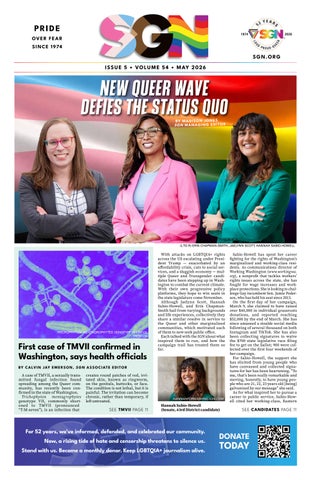
NEW QUEER WAVE DEFIES THE STATUS QUO


![]()


BY CALVIN JAY EMERSON, SGN ASSOCIATE EDITOR
A case of TMVII, a sexually transmitted fungal infection found spreading among the Queer community, has recently been confirmed in the state of Washington. Trichophyton mentagrophytes genotype VII, commonly shortened to TMVII (pronounced “T-M-seven”), is an infection that
creates round patches of red, irritated skin, known as ringworm, on the genitals, buttocks, or face. The condition is not lethal, but it is painful. The irritation can become chronic, rather than temporary, if left untreated.

With attacks on LGBTQIA+ rights across the US escalating under President Trump — exacerbated by an affordability crisis, cuts to social services, and a sluggish economy — multiple Queer and Transgender candidates have been stepping up in Washington to combat the current climate. With their own progressive policy platforms, they hope to win seats in the state legislature come November.
Although Jaelynn Scott, Hannah Sabio-Howell, and Erin ChapmanSmith hail from varying backgrounds and life experiences, collectively they share a similar resolve in service to the Queer and other marginalized communities, which motivated each of them to now seek public office.
Each talked with the SGN about what inspired them to run, and how the campaign trail has treated them so far.

Sabio-Howell has spent her career fighting for the rights of Washington’s marginalized and working-class residents. As communications director of Working Washington (www.workingwa. org), a nonprofit that tackles workers’ rights issues across the state, she has fought for wage increases and workplace protections. She is looking to challenge Gay incumbent Sen. Jamie Pedersen, who has held his seat since 2013.
On the first day of her campaign, March 9, she claimed to have raised over $40,000 in individual grassroots donations, and reported reaching $52,000 by the end of March. She has since amassed a sizable social media following of several thousand on both Instagram and TikTok. She has also been collecting signatures to waive the $700 state legislative race filing fee to get on the ballot; 900 were collected over the first four weekends of her campaign.
For Sabio-Howell, the support she has elicited from young people who have canvassed and collected signatures for her has been heartening. “To me, that’s been really remarkable and moving, honestly, to have young people who are 21, 22, 23 years old [being] galvanized by our message” she said.
As for what inspired her to pursue a career in public service, Sabio-Howell cited her working-class, Eastern


By Tucker Cholvin


Madison
(509) 827-7601


Calvin
(503) 915-5268
By Tucker Cholvin - Published


Anne of Green Gables
Nickname for Aretha
The Supremes hit, "Come ___ About Me"
Garfunkel go-with
Stock return fig.
Some foreign trade?
2D to get there 8 Grape varietal with 3,100 acres of cultivation in WA
A terrible mother-in-law, e.g.
"2001: A Space Odyssey" appearances
Ruckus
State of India
Rowing machine, for short
Ferber and Dame?

Lucía Yvette Moliné-Gonzalez’s scorching review of the Seattle Art Museum’s latest iteration of its permanent collection of Northwest art, “Beyond Mysticism,” fails in its background research on Gay Northwest artists omitting that I was the first art critic to out the Northwest School in an earlier article, “Prometheus Ascending: Homoerotic Imagery of the Northwest School,” published
in New York in Art Criticism in 1981, edited by Donald Kuspit. The article which blew open the closet door was reprinted not long after in the local art monthly, Reflex, as “The Gay Erotics of Painting.” It was also reprinted in the anthology, Homosexuality and Homosexuals in the Arts, Dynes and Donaldson, eds. (Garland, 1992). In addition, other art-historical monographs and documents by other authors note my
pioneering role in Queer theory about American artists. I refer readers and visitors to the exhibition to my writings on the topic for a more thorough and definitive examination, far in advance of my colleagues Jen Graves and David Martin. They can find the essay in my anthology, Epicenter: Essays on North American Art (Midmarch Arts, 2004). The risks I took at the time resulted in anony-
mous death threats and establishment blacklisting of me for some time. Fortunately, today it is easier to discuss these issues and for MolinéGonzalez to express such warranted but under-informed outrage without fear of persecution. I continue to write extensively at visualartsource.com.
Sincerely, Matthew Kangas
BY GUY ANTHONY

Black Americans are more likely than Americans of other races to live with chronic conditions like HIV. They also disproportionately struggle to afford the often expensive treatments needed to manage those conditions.
So it’s hardly surprising that Black voters care about politicians’ proposals to bring down healthcare costs more than any other group. Most of those proposals are well-intentioned. But they are not all equally beneficial. Recent efforts to impose price controls on prescription drugs threaten to harm the very patients they are meant to help.
Consider former President Biden’s signature Inflation Reduction Act,
which gave Medicare the power to set prices on brand-name medicines for chronic conditions like diabetes, autoimmune disease, or cancer — all diseases that Black patients disproportionately struggle with.
These price controls promise shortterm cost savings. But they threaten to erase the much larger savings that patients with chronic illness would otherwise see over their lifetimes. That’s because price controls disincentivize companies from developing new medicines to compete against existing popular treatments for serious conditions.
Consider HIV: According to the CDC, more than 1.2 million people in the United States are living with HIV, and roughly 31,000 new infections still occur each year. In the 1980s, these diagnoses would have been a death sentence. Today, they represent a manageable chronic illness — a direct result of decades of sustained research and investment in antiretroviral development, long-acting injectables, and prevention tools like PrEP. HIV treatments are cheaper and more accessible now than ever. That’s not because of government interven-

tion, but because of the price wars that resulted as companies introduced competing therapies and battled for market share. In fact, had the government prematurely intervened, those competing treatments might never have reached patients, who would still be stuck paying vastly higher prices.
That is precisely the risk our leaders are now taking. Many companies are already scaling back research because of the IRA’s price controls. Since the law’s passage in 2022, biotech firms have canceled at least 55 research programs.
That is especially dangerous for the Black community. Black patients have historically been overlooked by the research establishment. If companies are forced to scale back research, it is likely that treatments for smaller and more marginalized patient populations will face the greatest risks of being cut.
The Trump administration, meanwhile, continues to push for its socalled “Most Favored Nation” policy, which would tie US drug prices to the lower prices arbitrarily set by foreign governments.
The consequences could be severe.
“Most Favored Nation” pricing would dramatically reduce companies’ revenues on both new and existing medicines, decimating resources for future research and development. Researchers project that, if imposed on Medicare and Medicaid alone, such policies could cut research spending nearly in half, leading to over 200 fewer new medicines over the coming decade. And there are also access risks. In countries that rely heavily on price controls, patients often face delayed and restricted access to drugs. Black communities in the United States already face barriers to consistent care and adherence to treatment. Importing foreign countries’ price controls would inevitably have ripple effects across our healthcare system, worsening these disparities.
Health equity is not just about lowering today’s price tag. It is also about protecting tomorrow’s cures. Black communities deserve reforms that do both, not price controls that promise cost relief while sacrificing future breakthroughs.
Guy Anthony is the president and CEO of Black, Gifted & Whole.


BY MK SCOTT AND MADISON JONES, SGN MANAGING EDITOR
On a rainy evening, while ensconced within his I-5 adjacent Eastlake mansion, 87-year-old George Freeman got serious about an issue that has been negatively impacting him and other Capitol Hill seniors for years.
“The bathrooms were fine until about 2020,” he said, while leaning forward. “Then they locked them. And that changed everything.”
Freeman, a longtime figure of the Capitol Hill and Gay communities, is these days best known for being the founder and presiding chaplain of the Universal Life Church Monastery. However, after his much-reported tribulations in attempting to restore restroom access at the Quality Food Center stores near his home, he has filed a lawsuit in the King County Superior Court against the company, the owners of a Capitol Hill QFC building, and local government agencies. At its core, the complaint argues a simple notion: that access to a restroom is not just a convenience but a civil right.
According to the filing, Freeman alleges that the QFC store on Broadway Ave. and E. Pike St. in Seattle systematically denied customers access to restrooms, even when those customers disclosed medical conditions requiring urgent use. The filing also alleges that QFC has been derelict in its obligations to follow federal and state laws, as well as city municipal code that requires commercial buildings over a certain square footage to provide restroom access.
From complaint to courtroom
Freeman told the SGN how this issue has been deeply personal for him because of a medical condition that he described as a “non-negotiable need” for immediate restroom access. In his lawsuit, he claims that repeated denials had left him in situations of “humiliation and physical distress.”
“It’s not theoretical. This is something that happens in real time to real
people,” he argued.
He recounted visiting the multiple QFC locations on Capitol Hill, where he claimed employees have consistently refused him access to restroom facilities — even after he explained his condition. In one encounter, he alleged that staff cited it was corporate policy. Those experiences are what form the backbone of his lawsuit.
Freeman’s legal argument is expansive. His complaint cites the Americans with Disabilities Act, Washington’s Law Against Discrimination, and its retail restroom access law, which requires businesses to allow customers to use employee restrooms under certain conditions. But he also takes aim at what he sees as a broader policymaking failure.
“They knew,” Freeman noted, in reference to city and county agencies.
“We told them and nothing happened.”
The lawsuit alleges that public health officials and city inspectors were notified of the problem but failed to enforce existing rules. Freeman also argued that grocery stores — classified as places of public accommodation — are required to provide restroom facilities based on occupancy and square footage.
“If you can hold 300 people in a store, you’re supposed to have bathrooms for them. That’s the code,” he asserted.
A community impacted
But for Freeman, this issue extends beyond his own experiences. Within a few blocks of the QFC stores in question, he pointed out, there are multiple senior housing facilities. He explained how much older residents rely on those grocery stores for their daily needs.
“That’s hundreds of people,” he pointed out. His lawsuit argues restroom restrictions disproportionately effect vulnerable populations, especially older adults and people with disabilities.
Freeman also described the downstream effects of restricted restroom access: unsanitary conditions in and around store properties.
“If people can’t go inside, they go outside, and then the whole area becomes a problem,” he observed.
He even said that the bodily waste that people leave behind accumulates in some locations — such as entryways and a basement parking garage — to the point that it creates what he called “toxic” conditions. And so the lawsuit frames the problem not only as a disability issue and a seniors’ rights issue but also as a matter of public safety and sanitation.
The SGN reached out to the Seattle Department of Construction and Inspections but did not receive a response as of press time.
The public health department for King County responded to an inquiry from the SGN and said: “We recognize the importance of public restroom access, and we are sorry to hear about the issues Mr. Freeman and others have faced. We believe that including Public Health – Seattle & King County in this lawsuit is misplaced and we have filed a motion with the court accordingly.”
One central question of the case is whether restroom restrictions stem from corporate policy or individual store management. But Freeman believes the answer is clear.
“This isn’t random,” he insisted. “This is systematic.”
His complaint points to repeated denials across multiple locations, and it references statements from employees citing company rules.
QFC has not publicly responded in detail to the allegations, but Freeman noted the company has moved to dismiss the case on procedural grounds. “They want it thrown out, not because it’s wrong, but because of technicali-
ties,” he posited.
The SGN reached out to the head of public affairs for Kroger’s QFC and Fred Meyer divisions, Tiffany Sanders, who responded that they “are unable to comment on active litigation.”
Despite the scope of the lawsuit, Freeman insisted his decision to take this action wasn’t motivated by money. “I don’t need the money,” he said. “What I want is compliance.”
The complaint seeks a court order from a judge that will require QFC to:
• Keep restrooms open during business hours
• Provide access to employee restrooms when public ones are unavailable
• Train staff on accessibility laws
• Post clear policies for customers
And if any financial damages are paid out, Freeman says they should benefit those who were most affected.
For Freeman, the lawsuit is ultimately a part of a broader vision of accountability — one that extends beyond a single grocery chain.
“This city belongs to the people,” he said. “Not the corporations.”
He framed the situation as a case study of how far corporations can go when prioritizing efficiency and profit over public obligation.
He told the SGN that the case is heading toward an early hearing, where the defendants are expected to push for a dismissal. Freeman, however, is confident.
“I think we’re going to win,” he said. If he does, the outcome could ripple beyond QFC, potentially reshaping how retailers around Seattle and King County approach restroom access (or a lack thereof). Because, as Freeman puts it: “This is about dignity. And dignity shouldn’t be locked behind a door.”
BY LINDSEY ANDERSON, SGN STAFF WRITER

On Saturday, March 28, 2026, Seattleites returned to the streets for the third “No Kings” protest since the reelection of President Donald Trump. According to organizers, protesters numbering around 100,000 flooded the streets around Cal Anderson Park in Capitol Hill. After riveting speeches from community organizers, local politicians, and enraged citizens, the march proceeded down Pike Street toward the Space Needle.
Speaking out Protesters, young and old, showed up to voice their concerns regarding the administration, citing a myriad of reasons for their outrage, including the treatment of immigrants housed in ICE detention centers without due process.
“I think it’s the thing I can do today to try and raise people’s awareness of what’s going on,” one protester dubbed “The Axolotl” said. For him, the most egregious offense was “the transport of innocent men to El Salvador to be in a gulag with no due process whatsoever.”
“I’m here to give my voice against Trump and his tyranny,” Darren, another protester added, repeating a sentiment expressed by many. “We’re ordinary people, and we’re not criminals. We are not the enemy. We are the people, the protectors fighting for everyone’s rights: the right to democracy, free speech, the right to vote, the right to exist.”
For some marching in the streets, the effect of the administration’s policies
has already hit home. Drag performer Electra Fie donned her horns and heels — a look about more than just stunning those around her with her exquisitely morbid eye makeup. “All the real demons and crazy evil people out there are disguised as, you know, the good people that run this country or the schools or the churches,” she explained. “But I look like this, but I’m the sweetest, most caring, and accepting of anybody.”
ICE activity
Electra Fie’s presence wasn’t just to stand with her fellow drag performers who are facing discriminatory bills across the country. “I met a friend who got me a job last December, but last June he went to immigration court and then was taken by ICE and deported back to Venezuela,” she said.
The disappearance of friends, coworkers, and neighbors due to amped-up ICE policies is becoming more and more commonplace here in Washington. Data released by the Department of Homeland Security at the beginning of April indicate that over 2,100 people have been taken by ICE in the state since October. The number of people arrested by ICE in the state over the last six months nearly matches that of the last four years of the Biden administration.
While Trump was adamant on the campaign trail that his immigration enforcement policies would only target “the worst of the worst,” three-
fourths of those arrested by ICE in Washington state have no criminal convictions. The monumental uptick in arrests has led to an unprecedented caseload for pro bono immigrant rights lawyers in the state.
Lawyers weren’t able to help Electra Fie’s friend, though. “He got deported back to Venezuela,” she said. “He couldn’t find work there, so he’s in Lima, Peru, and he has a job there. But it’s been quite traumatizing for him.”
Deportations are becoming more common and happening in plain sight now. Footage released by SeaTac Airport this week showed a University of Washington student and his son being led by ICE agents to a commercial flight, which was set to deport them, on April 8. The increase in commercial flight deportations has caused concern among many that these events are continuing to happen right under their noses.
Electra Fie’s main concern about the administration’s deportation policies was the way her friend was treated while in detention. “He was down in the ICE center for a month and a half,” she said. “I went and saw him right before he got his court date, before leaving there, and he’d lost a lot of weight there.”
Ten days before the No Kings protest, ICE reported that 46 people had died while in custody or in detention centers since the start of the second Trump administration. Thirty-six
of those deaths came within three months of arrest. Most were due to the conditions in the facilities. People have reported being unable to access their daily medications, while others mentioned food scarcity and unsanitary conditions due to overcrowding.
We are not alone
Despite the serious concerns top of mind for many Seattle protesters, the event didn’t feel somber. People danced to music, came dressed in costume — from blow-up animals to several in Mrs. Doubtfire -inspired drag to channel “Aunt Tifa” — and celebrated being in community with so many others voicing the same frustrations.
“I’m here to give my voice and resist,” Electra Fie said. “And down with the patriarchy!”
Amid the constant barrage of news coming out of the administration, it can be hard to believe it’s only been one year since Trump took office. It can also be hard to believe that those around us are feeling the same anger, sadness, fear, and burnout. With internet algorithms feeding us appalling news and hateful legislation continuing to pass, it can feel like we’re alone, that everyone else in the world is just okay with what’s happening. But the No Kings protest was a great reminder that none of this is normal. The anger, the outrage, the fear that we are all feeling just means we are paying attention.

BY LINDSEY ANDERSON, SGN STAFF WRITER
How much power do our dreams have? For one young woman living in the American South, dreams had the power to take her far away, into the new life she’d longed for. After a year of manifesting new possibilities, Madeline Clere found that maybe dreams can have as much power as we’re willing to give them.
One year ago, Clere was living right on the border of Indiana and Kentucky, sandwiched between “Don’t Say Gay” bills and bans on genderaffirming care. She knew she needed a change in her life, especially as she began to seriously consider transitioning. Friends had sent her pictures of Seattle, and the city lingered like a flashing buoy in the deepest parts of her mind.
“I didn’t know anything about Seattle, other than it’s in the corner of the country,” she admitted with a laugh. “I googled ‘Seattle,’ and a big picture popped up, and it was of this market, and it was nighttime, and you could see the neon sign. I thought, ‘Wow, that’s really cute.’”
Clere saved the photo on her phone and set it as the cover image for a “Seattle playlist,” tracks she felt encapsulated her growing dream of one day making it to this far-off place. When she was having a bad day or felt like she might never get out of the South, she’d sit in her car and listen to her Seattle playlist to feel better. “There were some moments where I was feeling discouraged, and I was like, ‘We’re dreaming too big. This is not going to happen,” she remembered.
Not knowing much about Seattle, Clere’s playlist didn’t include any of the city’s local artists: no Macklemore, no Nirvana, no Pearl Jam. She did, however, include “Roslyn” by Bon Iver and St. Vincent, because even in the South, everyone knows Twilight
Helping Trans people find their voice
As she got more interested in what life is like for Queer people in Seattle, Clere discovered Seattle Voice Lab.
“The first step of transition for me was actually meeting them,” she told the SGN. “I did that a week before I met with the doctor.”
SVL is dedicated to helping Trans people find the voice they’ve always wanted. “People come to Seattle Voice Lab for all sorts of reasons,” CEO and founder Claire Burgess said. “We are known for being patient, kind, and empathetic, and provide a safe, nonjudgmental place where students can process deep-seated fears in their transition while working on their voices.”
The lab strives to make its services as accessible as possible. It offers sliding-scale payment options, because the staff understand that the financial cost of transitioning can often prevent people from seeking services such as voice training. “We provide a high quality of instruction at a variety of price points,” Burgess added, “because we know exactly what transition is like. We’ve been there ourselves, and we want to make it as accessible as possible.”
Burgess understands the struggles Trans people can face. It was through her own journey that she found the inspiration to open SVL back in 2014. “My transition was rough: I spent the first year struggling with housing and immense food insecurity,” Burgess recalled. “I had come from Michi-
gan, where I was studying vocal performance and education, [so] when I moved to Seattle, I took it upon myself to teach others how to find their own voice.”
Originally from the Midwest, Burgess knew that making the company accessible to Trans people around the country would be an essential part of her business model. Today, Seattle Voice Lab offers online classes and free lessons on Discord, which has helped it connect with Trans people across the US, including Clere.
“I used to talk very differently,” Clere admitted, though it’s hard to tell. SVL helped her settle into a voice she enjoys, but it did much more than that. It helped Clere connect with a community of other Trans people who had once been in her shoes, gain confidence, and embrace her identity. “It was eye-opening that the voice was like an instrument you could play, that you could enjoy that, and that it could be fun,” Clere said. “It’s not some abstract thing — it’s something you can actually modulate and change. Immediately, I fell in love with that.”
Learning to teach
While voice lessons were helping Clere start to feel more like herself, the weight of anti-Trans sentiment growing around the world continued to pile onto her shoulders. Though starting her transition helped her learn how to breathe, the Bible Belt still felt like a suffocating cloud of smoke lingering in the air around her.
“One day, I had a really hard day, and I said out loud in the car on my way home, ‘I need a big change,’” she recalled. When she got home, Clere saw a newsletter in her inbox. It was from Seattle Voice Lab. The email was simple: a general call for speech pathologists looking for work. Though Clere had worked enough odd jobs to fill an encyclopedia, she had no experience in voice pathology. The more she stared at the email, however, the more Clere could feel that change she’d beckoned the universe to send her.
“I was instantly like, ‘I want to do that so much. That sounds amazing.’ So, I reached out to them,” Clere said. “I was like, ‘Hey, I’m not qualified, but I really enjoyed the other side of that, and if you show me how to do it, I’d really love to do it.’” The email was a long shot, and she didn’t expect anything to come of it.
On the other end, Burgess was frantically trying to grow SVL to meet the community’s needs. Over the last ten years, the company has grown immensely, thanks to Burgess’ determination and a dedicated team. “During my own transition, I worked out what needed to happen on my own, and I quickly realized that voice training is as much mental as it is physical,” Burgess explained. “Because open-source voice training resources weren’t available like they are today with social media, I was left to figure out the techniques on my own. Once I began putting the puzzle together, I began to transform these techniques into digestible curricula that cater to beginner vocalists.”
SVL revolutionized voice therapy for Transgender people. Thanks to Trans voice researcher Zheanna Erose and the cultural shift toward online classes after the COVID-19 pandemic, Burgess suddenly had hundreds of clients signing up for services, seem-


ingly overnight. Hundreds turned to a waitlist of 800, and though SVL had a qualified roster of professional speech pathologists, it wasn’t enough to meet demand.
“They were debating, ‘Can we teach people how to teach this? Is this a transferable skill?” Clere recalled. “They were thinking about starting a mentorship program, and then I came along and was like, ‘Can you show me how to do this?’” The team at SVL agreed to teach Clere vocal training but made no promises about hiring her after it was complete.
Clere trained with SVL for eight months, at which point it was suggested that she find a student and put her new teaching skills to the test. She would record her lessons, then send them to the SVL team, which evaluated her teaching as well as her students’ work.
Clere really bonded with the team at SVL. “We got to the point sometimes we would just video call, me and my mentors, just to chat,” she said. After a while, it was clear that Clere had learned everything she needed to start freelance voice training her own students.
New job, new city
“Then in September, I randomly got an email from [my mentor], and it cc’ed the founder of the company,” Clere recalled. “They said, ‘Hey, I’ve been talking about you, Claire really wants to meet you,’ so they set up this [Zoom call].”
The meeting was only titled “Madeline Chat,” so when Clere got on the line with Burgess, she had no idea she had just sat down to interview for her dream job. At the end of the call, she was shocked when Burgess offered her a position with the company. There was one catch, though. If Clere was going to work with Seattle Voice Lab, she’d have to leave the South and move to Seattle.
In November, she scheduled a trip out to Seattle for the first time in her life, just to get an idea of the city she’d soon be moving to. She decided to take a walk down to Pike Place Market and look for a snack.
As she perused the market, she saw a woman handing out free samples of fresh Pacific salmon. After just one bite, Clere was giddy with the realization that she could now eat it every day if she wanted to. Her head was still buzzing about the salmon when she walked out the door to get some fresh air. “I was out in front of City Fish, and I turned around, and there was the picture,” she said: the image of a neon sign at Pike Place Market that she had stared at every time she cued up her Seattle playlist, every time her dream of making it out of Kentucky felt just too out of reach.
“I was standing in the picture. And I just started crying on the street,” Clere said.
“It was this big dream, and it didn’t feel real. It felt like a pretty picture that didn’t exist. Then I found myself standing in the picture, and I was like, ‘This is the best day.’ I will remember that for a long time. As I get old and my memories fall out, one by one, I really do think that’s the last one I’ll hold on to.”
Hope and courage
Looking back, Clere realizes that the optimism she held onto, that she could create a better life for herself, is what got her out of Kentucky. “Manifesting was so important to me that I used to think it was silly,” she said. “It’s crazy to dream that you can do a 180 with your career, go do a job that not only do you not yet know how to do but is on the exact opposite side of the country, with people you’ve never really met, and you know, who are wildly qualified.”
Now, Clere has been working with Seattle Voice Lab for two months. She’s still new on the team and getting used to her place in a new city, but she already feels like Seattle — and SVL — is where she’s always meant to be.
“I get to help Trans people every day, and that is even more fulfilling than I thought it would be,” Clere said. “Helping people love the part of themselves that they haven’t gotten to before, or just helping people be safe — sometimes blending in, not turning heads at the coffee shop — is a big deal... The work itself is remarkable.”
Seattle Voice Lab’s ASHA-accredited program can help clients achieve a passing voice within 6-8 weeks, but for Burgess, the program is more about helping people find the hope they need to believe in themselves.
“The thing that holds most people back, though, isn’t actually the voice; it’s overcoming the shame or ‘cringe’ that voice training brings,” Burgess explained. “Voice training is incredibly vulnerable, and it takes a lot of courage to overcome the fear of communicating with a new voice. People treat you differently, and there are risks involved when it comes to family and work, but once a student can overcome those [obstacles], the fog lifts and your voice becomes truly, authentically you.”
“As my team has grown, I’m grateful to have chosen people who recognize that the work we do is far greater than ourselves,” she added.
It takes a lot of hope to envision a different life: to stare at a picture and know you can get yourself there, or build a company from the ground up with the goal of making life easier for those in your community who come after you. For Burgess and Clere — and the many other dedicated coaches at Seattle Voice Lab — this level of hope is what unites them to the work they do.
“There’s a lot of hope in this city. It’s a really special place,” Clere said.
BY FAITH ELLIS, UW NEWS LAB
As lawmakers across the country continue to advance legislation targeting the LGBTQIA+ community, Washington state ended its 2025-26 legislative session by reinforcing its reputation as one of the nation’s most protective states for Queer communities.
This year’s session delivered new safeguards in health care access, student privacy, antidiscrimination policy, and criminal justice. Washington state Senate Majority Leader Jamie Pedersen says the state is fighting back and advancing measures to expand rights and improve daily life for LGBTQIA+ Washingtonians.
“We have, over the last 20 years, really built sort of a sanctuary place for LGBTQ+ people,” said Sen. Pedersen, a member of the legislature’s LGBTQ Caucus. “We’re working to hold onto that status in light of the federal administration.”
Across the nation, state legislatures have played a crucial role in fighting for LGBTQIA+ rights. Since 2021, however, lawmakers in many states have introduced or passed measures restricting gender-affirming care for minors, banning discussion of LGBTQIA+ identities in classrooms, and narrowing nondiscrimination practices. Most of those efforts gained traction in 2022 after the U.S. Supreme Court overturned Roe v. Wade. By con-
trast, Washington’s 2025-26 legislative session expanded privacy, health care, and legal safeguards rather than rolling them back.
Legislation passed during this session
In a win for privacy, lawmakers passed SB 6081, spearheaded by Pedersen, which protects residents from unauthorized disclosure of information, including sex designation information and historical sex designation changes in official government records.
“People are using these records to harass Trans folks,” Pedersen said. “Other states are searching out records of Transgender folks to try to enforce their bad law[s] on people who are refugees from those bad laws.”
Health care was a major theme of this session. Under HB 1971, health plans are required to enable an option for 12-month prescriptions for hormone therapy, which helps patients avoid gaps in treatment due to frequent renewals or insurance hurdles.
HB 6183 addresses insurance coverage for HIV antivirals. The bill expands access to prevention and treatment, ensuring that insurance companies do not impose unnecessary barriers to obtaining the medications people need.

“We were able to enact that for all folks with state-regulated insurance,” said Washington state Rep. Nicole Macri. “So folks could get HIV prevention and treatment drugs without any prior authorization or [being] required to go through several steps before they can get the medication that works best for them.”
A bill focused on Washington’s youth, HB 1296, increases protections for LGBTQIA+ students and limits forced outing policies that expose a student’s sexual orientation or gender identity without their consent.
For incarcerated individuals, HB 1604 mandates that jails within Washington state implement policies for respectful treatment of Transgender and Intersex people who are undergoing searches. The bill allows for Transgender and Intersex individuals to request that a strip search be conducted by staff of a particular gender.
With the legislative session closed, some initiatives moved from the floor to the ballot, putting these decisions directly in the hands of Washington voters. Not all of these bills are friendly to LGBTQIA+ people.
Sponsored by Let’s Go Washington, IL26-638 aims to restrict Transgender athletes from competing in girls interscholastic sports. The initiative would be enforced by requiring verification of students’ sex through routine physical examinations and forcing school districts to prohibit students assigned male at birth from participating in athletic activities intended for female students.
“We are such an important bulwark in the country,” Pedersen said, referring to Washington state. “If they can pass anti-Trans initiatives at the ballot in Washington, then they’re going to be emboldened to do that everywhere across the country.”


CONTINUED FROM COVER
Washington upbringing as informing her values. As a Queer woman of a Filipina immigrant mother and a father whose family has lived in Walla Walla for generations, Sabio-Howell explained, “my family raised me with the unshakable value of fighting for one another, and for uplifting and championing working people’s needs: immigrants, teachers, farmers, and farm workers.”
After she received her bachelor’s degree in political science from Whitworth University in Spokane, she served multiple years as a legislative assistant in both chambers in Olympia. She told the SGN that while there, she was a part of an organizing effort to win collective bargaining for legislative staff, who had been prevented from forming a union.
“That was an experience that taught me the value of one-on-ones, stress tests, building solidarity across a work group, and bringing other people in through our shared values around economic fairness,” Sabio-Howell said.
However, it was during her tenure as communications director of Working Washington that she notched her greatest accomplishments in advocating for workers’ rights. One key moment was in 2024, when the Seattle City Council under then council president Sara Nelson sought to undo protections for food delivery gig workers.
“By the end of this lobbying effort, over $1,000,000 was spent by DoorDash alone. And we won, because workers showed up every day to tell the Seattle City Council that this is the home of the ‘fight for 15.’ We don’t roll back workers’ minimum wage rights here,” she asserted.
Another accomplishment SabioHowell noted was the statewide domestic workers’ bill of rights that passed in March. “Something really appalling about our labor laws is that many of them were founded on the labor standards that came out of the New Deal, which at the time very deliberately excluded predominantly Black industries [like] domestic work and agriculture,” she said, adding that “Working Washington led a ton of the work in the coalition to correct that shameful legacy. We [alongside workers] won the right to a minimum wage, written contracts, and protections from discrimination.”
Challenging an incumbent
Asked what she hoped to bring to the table for voters that will be new or different from Sen. Pedersen if elected, Sabio-Howell responded that the 43rd District is the most progressive in the state, and that voters have time and again proven their support for politicians with strongly progressive policy stances.
“I think what our district is hungry for is someone who’s going to fight for us. A new generation of leadership that is going to fight for us and stand up to corporations rather than work to give them carve-outs, or roll back taxes on the ultrawealthy,” she said. She also shared her own experience of moving to Capitol Hill as a young Queer woman in 2018. “I’m very proud
CONTINUED FROM COVER
TMVII spreads primarily through sexual contact, but transmission can occur from any skin-to-skin contact with an afflicted person’s rash. Those who have TMVII — or who may have been exposed to it — are advised to talk to their doctor about treatment, to temporarily avoid skin-to-skin contact, and to rethink how they share
of being queer,” she said. “It’s actually the reason why I moved to Capitol Hill in the first place. I was dating a woman who lived on Melrose Avenue, right next to the Pine Box. And I felt the most seen [and] safe, and a sense of belonging that was unlike any place I had ever lived.”
Sabio-Howell, now out for over 10 years, additionally showed appreciation for what her opponent has done for the LGBTQIA+ community while in office, saying, “I am so grateful for the work that Sen. Pedersen has done to win marriage equality, and make it possible for Gay and Queer families to build their lives.”
But she drew a distinction between them: “I think there are new things that we need fighters to defend in advance... I’m excited about presenting a new chance we haven’t had in 20 years to choose our fighter.”

Jaelynn Scott (House of Representatives, 37th District Pos. 2 candidate)
Scott announced her run for the state legislature at the beginning of March. As executive director of the Lavender Rights Project, she has spearheaded numerous projects to tackle issues that disproportionately impact both local BIPOC and LGBTQIA+ communities — from surveillance to public safety to providing culturally sensitive and informed social services.
Asked how the campaign had been going so far, she said, “You never know when you decide to lean in and to step up if people are actually going to show up for you. But there seems to be a lot of energy in the 37th and across Seattle and really across the country for our campaign. We’re receiving phone calls, donations, endorsements, lots of care. It’s going very good, and it’s [still] really early.”
To Scott, the Trump administration’s policies are not just relevant to certain marginalized groups but impact everybody. “…The federal government is coming after so many of our communities…,” she said. “We’re seeing cuts and restrictions that are either happening now — not just cuts in funding but pending and threatened cuts to gender-affirming care access, access to abortion, a number of pieces. So this is an issue for all of us... So the question for us here in Washington is: what do we do now?”
Scott’s response to the problem is for the state to step up more to provide these essential services to residents. One core tenet of her platform is universal healthcare and childcare. Asked what she thought of Whole Washington (an organization looking to pass universal healthcare), she said it “has a fantastic approach, and we’re in conversations as we work through whether we have a federal funding stream or not.”
Safety and surveillance was another
personal items, including razors, towels, and bedding.
Following outbreaks in New York and Minnesota, Public Health – Seattle & King County reported knowledge of the first confirmed case of TMVII somewhere in King County as of March 30. The department acknowledged other cases where TMVII was presumed and subsequently treated as such, but the actual diagnosis was never settled.
Treatment for TMVII is readily
topic of concern, especially in terms of ICE activity and federal government incursions. “I did a lot of advocacy around surveillance,” Scott said, “and I think it’s really important for us to be extra careful, and hold extra scrutiny to surveillance systems that are in play right now, considering the federal threats.” She stated that although the new automatic license plate reader bill signed into law on March 30 added some regulations, it was still not nearly enough protection compared to the risks communities now face.
“And this is why we need representation from our community,” Scott said, “because we need legislators who are in the thick of it, who can tell you that the threat to our community is at a crisis point, and that we cannot take any risks right now.”
Scott shared with the SGN the importance of having a strong social safety net, and used her own life as an example. She explained that when “it was 9/11, and I was a flight attendant at the time, I was laid off… [and] the airline I was working for was bailed out by the government… but there was not a whole lot of care for our … union employees.”
She went on to describe how losing her first real job with the airline led her to face houselessness as she struggled to recuperate. “I lost, really, inspiration to continue” she admitted.
But in that moment of difficulty, a social worker that was the catalyst that helped her turn things around. “I could have easily fallen into the criminal justice system,” she acknowledged, “but it was a social worker that saved my life.”
Scott admitted that since then, it has taken years to gain the confidence to be who she has become today and that it was her conviction that others deserve the same support she received during those hard times.
“I want that for all Washingtonians. I want that for everyone in the 37th,” she said.

Erin Chapman-Smith (House of Representatives, 29th District Pos. 2 candidate)
For Chapman-Smith, who is looking to represent a district that encompasses the southern part of Tacoma and its suburbs, watching her fellow residents face increasing costs for housing and daily necessities has been the primary motivator for seeking public office.
“The affordability crisis and housing crisis are just as real down here as they are in Seattle,” she opined. “Since 2025, we’ve had about a 78% increase in overall rent costs, but in the same time frame, only about a 25-30% increase in wages.”
Chapman-Smith spent over nine years working with homeless youth and in housing advocacy at YouthCare Seattle before becoming executive director of the ROOTS Young Adult
available, but unlike other forms of athlete’s foot or ringworm, TMVII is not typically cured by over-thecounter topical treatments. Instead, patients with confirmed or suspected TVMII should be treated with oral terbinafine, an antifungal medication, to be taken daily for six to eight weeks.
Those confirmed to have TMVII or who are suspected of having it should encourage their sexual partners to seek testing. Pets can also catch
Shelter in 2024. She explained that “it’s actually cheaper for the community to support programs like rental assistance or rapid rehousing than it is for someone to be staying in a shelter, accessing the emergency room consistently” and that “not only is it equitable and morally aligned with me and my campaign but also fiscally sound.”
Chapman-Smith has also noticed in that time how the number of Trans people who face houselessness continues to increase.“I absolutely see that every day,” she said. “We see that at shelters. We see that across the system… There’s a huge disproportionality of Trans folks that [has been] increasing over the last few years.”
In addition, Chapman-Smith said that the situation for Trans people in general has been dire politically. “The Trump administration has made it very clear their priorities [are geared toward] limiting access for Queer folks across all of their needs,” she said, “not just housing, healthcare, military access — like everything, right?”
Chapman-Smith shared her own transition journey with the SGN. She noted that she came out while studying at Central Washington University in Ellensburg in the late 2000s and early 2010s. Since the campus was in a small, conservative town, she had to overcome obstacles to accessing gender-affirming care.
“I was doing the fun thing of driving across [Snoqualmie Pass] multiple times a week to meet with a therapist that specialized in gender identity,” Chapman-Smith recalled, “so I could get my hormone letter and bring that back to the [on-campus] health clinic,” and remembered being one of the first Trans people at the university to access HRT from the campus clinic. But housing and Queer rights are not the only issues Chapman-Smith has concerns about. As for other struggles her constituents face that she plans to address if elected, she explained how the 29th District is a unique combination of families, military servicemembers, and healthcare workers, among others, and that she hoped to change the narrative that state government can build more sustainable and accessible systems for regular people, not corporations.
As examples, she mentioned a national grocery chain that recently had left a food desert in her district, as well as the lack of wage increases for frontline healthcare workers.
The cost of healthcare also came up, and she shared what the expenses for her nine-year-old-son diagnosed with autism had been like. “The amount of money we pay in healthcare is astronomical,” she admitted, adding that “people are literally making choices between taking care of family members’ health and food.”
She also complimented the incumbent (who is running for a Senate seat): “Sharlett Mena has introduced many state bills that are really focused on workers’ rights, and I hope to continue that work.”
At the end of the conversation, Chapman-Smith said, “My hope with this campaign is that if we can move from crisis response to actually preventing things upstream, it’s [going to be] more affordable for the community [overall].”
TMVII, leading to irritated skin and hair loss, and should be immediately treated by a vet.
This is a developing public health story, so we recommend staying tuned to www. sgn.org for future updates and visiting Public Health – Seattle & King County’s TMVII webpage for the most up-to-date medical advice. (https://kingcounty. gov/en/dept/dph/health-safety/diseaseillness/health-advisories/2026/03-30tmvii)
BY CALVIN JAY EMERSON, SGN ASSOCIATE EDITOR

The Seattle Storm are officially in “rebuild mode” after the loss of multiple superstars and the acquisition of a sought-after international phenom altered the team’s roster in dramatic fashion.
During the off-season, Storm fans began seeing hints of a potential change-up in the tea leaves. Just a day into free agency, the party company Amazing Balloons accidentally leaked that star forward Nneka Ogwumike was considering joining the Minnesota Lynx. That news never amounted to much, yet it still suggested that Seattle’s free agents were looking elsewhere for their well-earned checks.
Once Ogwumike confirmed she was moving back to her original team, the Los Angeles Sparks, she became the first domino. Just a day later, Seattle’s starting guard Skyler-Diggins Smith agreed to sign with the Chicago Sky. Breakout ball stealer Gabby Williams, alongside two-way personality Brit-
tany Sykes, made deals with Golden State and Toronto, respectively. Suddenly, four of the Storm’s “starting five” had disappeared from the roster. The team is now forced to look dramatically different next year. They barely had time to fill the gaps with a few second-tier players, like Australian guard Jade Melbourne, before the WNBA draft began.
The Storm were widely predicted to take Olivia Miles, the savvy point guard from TCU, with their third pick in the draft. Instead, Miles was taken a spot ahead by the Minnesota Lynx, so the Storm went with the next best option: the Spanish sensation Awa Fam Thiam.
At just 19 years old, Fam is a EuroBasket phenom from España, able to crush other players while in the paint. She moves fluidly and strikes quickly, and her speed isn’t stopped by her size. At 6’6”, she uses her height advantage to swat balls away from
those who dare to go for an easy layup.
Feeling déjà vu? That’s because Dominique Malonga, a uniquely tall center from a European nation, was also drafted as a teenager by Seattle just last year. With Fam and Malonga alongside backup veteran Stephanie Dolson and Australian all-star Ezi Magbegor (the only starter set to return from last year), the Storm will have an unusually large number of “big women” centers on their roster.
That raises the question: Will Seattle players compete over a singular role, or encourage them to adapt into new positions? While technically a center, the versatile Fam has shown the ability to be a power forward. With her fancy footwork and aggressive pick-and-roll, she has the potential to replace Ogwumike as the Storm’s signature offensive menace over the next decade.
“[Fam] has such a high ceiling going to Seattle,” said ESPN analyst Andraya
BY CALVIN JAY EMERSON, SGN ASSOCIATE EDITOR
For a brief time before the season began, the national media were viewing the Seattle Mariners through rosecolored glasses. Power rankings from ESPN, the Bleacher Report, and The Ringer all had the Mariners in the top five, far ahead of their AL West rivals. Critics, analysts, and prediction markets alike saw the team as a potential World Series contender.
“Could you imagine two, three years ago, us saying this team is ‘World Series or Bust?’” said sports radio personality Dave Wyman. “It happened fast, but yeah, I have those expectations.”
Those red-hot expectations were quickly doused with cold water. In their first few weeks, the Mariners have struggled to find their rhythm. The defense has allowed easy mis -
takes, and the offensive superstars had their lights dimmed. Cal Raleigh, coming off his breakout season, has already struck out 21 times. Nobody across entire rosters, like those of the Dodgers and Yankees, have allowed their number of poor plate appearances to reach drinking age.
After being brutally swept while away from home, Seattle had sunk to 6-9 in the AL West. They were now looking up at four teams they were predicted to breeze past. The Mariners needed new life. At home against their longtime divisional rivals, the Houston Astros, they needed it more than ever.
Thankfully, some unsung heroes stepped up to the plate. Randy Arozarena recently lost his spot at the top of the batting lineup, after failing to deliver in the playoffs. On Friday, he
demolished a curveball into left field, breaking the team’s five-game losing streak. Luke Raley, who has regularly struggled with injuries, gave a healthy run of dingers on Sunday. His stellar batting helped secure a dominant, 6-1 victory.
Amid a long weekend of redemption stories, Julio Rodriguez finally broke out of his shell. Often criticized for being a “slow starter,” he didn’t prove anyone wrong when he couldn’t reach second base for 62 plate appearances, the longest drought of any player in the game. Yet, after landing his first home run on Saturday night, leading his team out of an 8-7 gauntlet, Rodriguez believes he’s set for better days ahead, “I know I prepared myself. I know I put the work in. I know I’m not cutting corners anywhere,” he said after
Carter in reaction to Fam’s pick in the draft. “My mind is already thinking, Seattle could have a line-up of 6’4”, 6’4”, and 6’6” out on the court at some point?”
While entering what sports fans call a “rebuild” always brings uncertainty, one thing is for sure after last night: Seattle will be tall, menacing, and imposing. Do you love watching gigantic, Shaq-like figures barrel through defenders, pull off insane blocks, or dunk with enough strength to bend the hoop? If so, then you’re going to love the next few years of Storm basketball.
Meanwhile, across the Columbia River, the Portland Fire have made their WNBA debut with their own Spanish star: #7 draft pick and point guard Iyana Martín Carrión. When they play against Seattle at the Moda Center on June 17, it’ll end an 18-year drought of professional basketball between the two cities.

the game. “That’s why I’m always so confident that things are going to show.”
To be fair to everyone in this story, it’s still ridiculously early to suggest where the winds will blow. The Mariners still have 146 games ahead of them, and baseball fans know that a season is like a marathon. There’ll be winning streaks ahead, and the same goes for losing streaks. If you look at the bigger picture, the Mariners still have plenty of time to make their firstever Fall Classic.
“We can’t get into the playoffs with 15 games played. That’s the perspective we always want to remember,” Rodriguez said. “It’s how you navigate the ups and downs. It’s how you brush off a tough road trip and continue to be in the present moment.”


55TH ANNUAL NORTHWEST
MAY 22ND - 25TH | SEA LE CENTER
$20 SUGGESTED DONATION

Lady Bunny is a name synonymous with the glittering, unapologetic world of drag. With her towering blonde wigs, double-stacked lashes, and razor-sharp humor, she has been a force in the scene for decades. But this legendary performer isn’t just a drag queen — she’s a comedian, DJ, and cultural trailblazer who has helped shape Queer history and nightlife as we know it. She’s living proof that drag is more than just sequins and sass — it’s artistry, activism, and a celebration of individuality.
Born Jon Ingle in Chattanooga, Tennessee, Lady Bunny began her drag journey in Atlanta, where she shared an apartment with none other than RuPaul. Yes, that RuPaul. The two future icons cut their teeth performing in clubs and honing their craft before Lady Bunny made her way to Manhattan in the early 1980s. New York City’s gritty, electric club scene became her stage, and her larger-than-life persona made her a standout. She wasn’t just the life of the party — she was the party.
One of her most enduring contributions to Queer culture is Wigstock, the outdoor drag festival she co-founded in 1984. For nearly 20 years, it transformed New York City into a Queer utopia every Labor Day, drawing thousands of attendees and featuring performances by underground legends and mainstream stars like Debbie Harry, Boy George, and Neil Patrick Harris. Wigstock wasn’t just a festival; it was a lifeline for the LGBTQIA+ community — a space to celebrate openly and unapologetically.
In addition, her one-woman shows have become legendary. With cheeky titles like Trans-Jester and Cuntageous, her performances are a whirlwind of rapid-fire jokes, biting social commentary, and hilarious pop-song parodies, all delivered in her signature Southern drawl. The New York Times once described her shows as making audiences “weep with laughter while groaning with disgust,” a testament to her unique blend of high camp and low comedy. Her humor is outrageous, unfiltered, and unapologetically risqué — but it’s also clever, timely, and packed with heart.
And then there’s her DJ career. Lady Bunny has spun at some of the world’s most iconic venues, from the Eiffel Tower to the Paris Opera Garnier. Her sets are renowned for their infectious
BY FRANK GAIMARI
energy, often featuring impromptu lip-sync performances that turn any event into an unforgettable experience. Whether she’s headlining a Pride event or DJing a chic corporate party, she knows how to get a crowd moving. Her influence doesn’t stop there, though. She has left her mark on film, television, and even the art world. Lady Bunny starred in the HBO documentary Wig, chronicling the history and revival of Wigstock, and appeared as the “Dean of Drag” on RuPaul’s Drag U. She also had a memorable role in the 2008 comedy Another Gay Sequel: Gays Gone Wild , further cementing her status as a Queer cultural icon. Her striking, cartoonish glamour has graced the pages of Vogue and V Magazine, and she’s collaborated with legends like Andy Warhol and Mario Testino. Oh, and her music? It’s even charted on Billboard.
Her career is a testament to fearless self-expression. She has paved the way for today’s drag artists, proving you can be smart, successful, and completely outrageous all at once. Her humor is filthy, her look is over the top, and her politics are unapologetically in your face.

Frank Gaimari: What inspired you to start your journey in drag?
Lady Bunny: My journey into drag began with my first-grade school play, but the inspiration had taken root long before that, thanks to Barbara Eden in I Dream of Jeannie. I absolutely adored her — there was something about her glamorous, slightly overthe-top aesthetic that completely captivated me. So, when the school play came around, dressed in the harem outfit my mother made me, I jumped at the chance to channel Barbara Eden’s iconic look with makeup. I’m pretty sure that was the spark that set me on this path.
As I grew up, my identity became deeply tied to my hair. While most people saw it as a fashion statement, for me, it was something more. It made me feel connected to myself. When I was feeling alone or underappreciated, my hair became a source of recognition. I had this Kristy McNicholinspired haircut — parted down the middle and layered on the sides — and people would constantly stop me to ask where I got it done. I’d always reply, “It’s not the cut, it’s the hair!”

Those little moments of acknowledgment meant so much to me. They made me feel seen and appreciated in a way I hadn’t experienced before. Later, when I went to school in England from 1978 to 1980, I found myself immersed in the New Wave scene. Androgynous icons like Adam Ant were everywhere, and I was completely drawn to that world. It felt like a natural extension of who I was — bold, expressive, and unapologetically unique. That time in my life helped solidify my sense of self and my love for creative expression.
FG: How did your early days with RuPaul influence your career?
LB: I remember early in my drag journey, Ru put me in a Boy Georgeinspired drag look for a competition. That look earned me third place and $50 — a small but meaningful milestone I’ll always remember. Looking back, I realize it wasn’t just Ru’s sense of style that influenced me but also his relentless drive and ambition. He had a fearless “go-get-them” attitude, fueled by courage and determination. Ru was charismatic [and] stunningly gorgeous, and had this undeniable magnetism that drew people in. Like me, he never saw the traditional nineto-five life as his path, and that shared mindset created a strong connection between us.
FG: What was the most memorable moment from Wigstock?
LB: One of the most unforgettable moments from Wigstock was Leigh Bowery’s jaw-dropping performance, where he gave birth to his actual wife. Yes, you heard that right — his wife was hidden inside an elaborate, oversized costume. He strutted onto the stage, lowered himself to the floor, lifted his legs, and out she emerged — attached with a sausage as an umbilical cord, accompanied by some fluids for dramatic flair, all set to a Beatles song. It was outrageous, memorable, and quintessential Leigh Bowery. He was truly one of a kind. He was the ultimate club kid, an exhibitionist, and a performance artist like no other. Originally from Australia, he gained fame in the UK and left an indelible mark on the art and club scenes. There was really nothing like him, and that
performance at Wigstock was a perfect example of his genius.
FG: How do you balance humor with social commentary in your performances?
LB: Balancing humor with social commentary is all about authenticity and pushing boundaries. There’s a lot of discussion about how comedians should “punch down” or “punch up,” but honestly, for comedians trying to make a living, the goal is simple: you punch wherever you can to get laughs. The more laughs you get, the more gigs you book, and the more money you make. That’s the reality of the job. I’m not a fan of political correctness — it’s full of contradictions and often doesn’t make sense in practice.
Take, for example, the term “Latinx.” A few years ago, we were told to use it instead of Latina or Latino to avoid gender constructs. But here’s the thing: surveys show that over 90% of Latinos don’t like the term. So, as a white drag queen, am I supposed to approach Latino people — who are such a vital part of New York City’s club culture — and use a term they don’t even identify with? Get real! Political correctness often feels like it’s more about appearances than actual connection.
For me, the funniest moments are often the ones we’re not supposed to laugh at, and I embrace that fully. My shows have been described as the kind where you feel guilty for laughing — and I absolutely love that. I enjoy pushing boundaries and tackling the kinds of topics I’d joke about with my friends. That’s just who I am.
I’m always up-front with what my shows entail. I make it clear in the ticket link: this is not a politically correct show. It’s dirty, it’s inappropriate,
and if you’re prudish, this isn’t the show for you. I don’t believe in forcing my humor on anyone who isn’t ready for it.
FG: What has been your most challenging role in film or TV?
LB: The most challenging role I’ve ever taken on was about four years ago for an independent film called Playland . The film explored the decline of a Gay club in Boston that operated from the 1940s through the 1990s. It was an experimental film, and while the project itself was fascinating, one part really pushed me to my limits: I had to lip-sync to an opera song in German.
Let me tell you, that was no easy feat. The filmmakers were incredibly thoughtful and even hired an operatic singing coach to help me nail the breathing and timing. But the words? Oh, the words! I mean, I can barely remember my own lyrics sometimes, so trying to lip-sync in German was a whole new level of challenge.
FG: How do you see the future of drag evolving?
LB: The future of drag is evolving, but let’s be real — Drag Race has had a huge impact, for better or worse. Sure, the queens on the show are polished, creative, and look incredible, but sometimes it feels like that’s where it stops. You can come out in a stunning outfit, with flawless makeup and hair, and I’ll cheer for that — but you’ve got five more minutes, bitch. What else are you bringing?
A lot of Drag Race queens seem to be cast more for their personal drama than their talent. It’s reality TV, and reality TV isn’t real. The sob stories can feel overproduced, and the editing is so heavy-handed it’s almost laugh-
BY ARUL GNANASIVAM
The sun’s peeking out, and summer is around the corner. To celebrate the joy in the air that this bring, the Seattle Men’s Chorus is taking its latest show, Wicked Wiz of Oz — featuring a mashup of musical numbers from The Wizard of Oz, The Wiz, and Wicked — all across Washington from April 19 to May 16, with stops in Seattle, Everett, Bellingham, and Tacoma .
“It is absolute unbounded joy,” said Artistic Director Paul Caldwell. “It’s just a happy, happy, happy, feel-good spectacle.”
With the recent releases of the Wicked movies, the Oz universe was the perfect material for a spring show. “The Wizard of Oz is a perennial Gay favorite,” Caldwell said. “[Then] 20 years ago, we fell in love with Kristin Chenoweth and Adina Menzel singing [in Wicked ] on Broadway, and now you have the movies with Ariana Grande and Cynthia Erivo.”
Rather than just featuring songs from the Broadway show or one movie, the chorus is embracing all of the songs and storylines, including mashing up certain connecting parts. For example, Scarecrow and Prince Fiyero’s songs are combined into a new musical number.
The Wizard of Oz in particular resonates with themes of queerness and acceptance. “It’s the story of someone who lands in a place where she doesn’t really fit in, and she’s
able. Like, when Ru meets the cast in the first episode, they’re acting so over-the-top thrilled, you know, some producer told them to crank it up. It’s entertaining, sure, but it’s not the whole world of drag.
There are so many incredible performers outside of the Drag Race machine. Dina Martina from Seattle is hilarious. Alex Newell, who was on Glee, is killing it on Broadway every season. And then there’s stuff like Oh Mary! in NYC — maybe not traditional drag, but it’s smart, funny, and so good. That’s the kind of drag that excites me — drag that’s more than just a look or a sob story. It’s about being a true entertainer.
FG: What’s one thing about you that fans might not know?
LB: I’m not a bitch! There’s a misconception that I am because of my jokes and my honest takes on politics, but I’m actually very polite. Out of drag, I wouldn’t say I’m shy, but I’m a lot less outgoing. The truth is, the things I can get away with in drag are pretty wild. Demanding free drinks? Totally fine. But walking into a club out of drag and fondling the go-go boys? Yeah, that’s not going to happen. Drag gives me the freedom to do things I could never get away with otherwise.
FG: How do you stay relevant in an ever-evolving entertainment industry?
LB: [It] is all about adapting and knowing your audience. For me, parodies are a big part of that — taking popular songs, rewriting the lyrics, and making them funny or relatable. As a DJ, I stay on top of what’s trending, which helps me connect with younger audiences. The key to a great parody is that people need to know the original song, so I make sure to stay
current with what’s popular. That way, younger folks get the joke, even if it might go over the heads of some older audiences. I also tailor my act depending on where I’m performing. If I’m in Palm Springs, the vibe might be different than at a young, hip dance party in Brooklyn. Sometimes I’m performing at a Pride event where families bring their kids, so I adjust my material accordingly — maybe warn parents to take a break if they don’t want their kids hearing certain jokes. It’s all about reading the room and making sure the act fits the crowd.
The other big thing is keeping your material fresh and putting yourself out there. You have to stay visible — whether that’s through interviews, group shows, or just staying active in the scene. If people stop asking you to be part of things, that’s a sign you’re slipping. So, I keep updating my stuff, staying connected, and making sure I’m still doing it — and doing it well.
Lady Bunny’s legacy is all about pushing boundaries and celebrating fearless individuality. She has shown everyone that drag isn’t just a performance — it’s also a form of protest, a way to build community, and a joyful celebration of life in all its sparkling, outrageous glory. Because of her wild spirit and unstoppable drive, both the drag world and Queer culture shine a little brighter.
Lady Bunny is currently touring comedy clubs across the country with her hilarious and unapologetically outrageous shows. Her latest tour includes the highly anticipated “Bunny Butchers Broadway” and the delightfully risqué “Don’t Bring the Kids.” For tickets and more information, visit her official website, www.ladybunny.net.
struggling to figure that out, and along the way she assembles her chosen family,” Caldwell said.
In fact, in the late 1980s, the phrase “friend of Dorothy” was a hidden way for Queer people to identify each other.
“It’s a historic part of our story,” Caldwell said. “The release of the Wicked movie reminded us just how meaningful the story is, and it’s time to celebrate it all over again.”
The Seattle Men’s Chorus is coming up on nearly 50 years of performing. During the AIDS crisis in the late 1980s, Gay choruses began to appear in various cities. “It was a chance for Gay people to be together and create something beautiful,” Caldwell said.
“Seattle was one of the very first.”
The chorus became a safe space for Queer people to form community, but also a way for audiences to learn more about them. “If you need to access the Gay community for any reason, the chorus is here for you,” Caldwell said.
“But also if you just need to access happiness, that’s what the chorus is all about.”
Apart from the upcoming performances, the chorus also presents a huge holiday show, and is producing a sing-along event in June.
The Seattle show will be at Benaroya Hall on May 9. More information can be found at https://www.seattlechoruses. org/2025/12/01/wicked-wiz-of-oz/.


BY SARA MICHELLE FETTERS, SGN STAFF WRITER

The 10th annual CASCADIA International Women’s Film Festival in Bellingham returns on April 30 with a gala screening of the New Zealand documentary TENOR: My Name Is Pati, written and directed by Rebecca Tansley. The fest’s in-theater component continues through May 3, while a subsequent virtual festival runs May 7 thru 17. Award-winning filmmaker Ondi Timoner (Dig!, We Live in Public, Last Flight Home) will attend the festival as an honored guest. As part of a salute to her work, she’ll present her workshop program “How to Make a Great Documentary,” along with a screening of her 2025 short All the Walls Came Down , which chronicles the almost total destruction of her neighborhood, including her Altadena home, in the 2025 Los Angeles fires and how residents came together in the aftermath. “I made a deal with IndieWire that I’d give them my photos of myself in the ruins of my home if they wrote me a little letter saying I was a journalist,” Timoner told the SGN. “We put together these fake media passes for Interloper Films to flash at the National Guard, and this meant we were the first cameras on the ground documenting the aftermath. But what started as a very personal story became so much more.
“When my house burned down, I didn’t know that I lived in a predominately Black community,” she explained. “I knew that I lived in a wonderfully diverse town in Altadena. I knew that I loved raising my son there for 15 years. I knew that I was the most accomplished documentary filmmaker in the town who had lost their home. It’s what I didn’t know that made this story so personal.
“How was it possible that no firetrucks showed up and no one had any evacuation orders? What happened here? What I discovered was that 80% of Black families in Altadena owned their own homes until this disaster.
It’s the second-largest Black homeownership in the entire country, and now the vultures are coming and trying to push them off their land. So this film has become this anthem and this shield for the community. These stories are important. It’s an example of something you can do if you pick up a camera and you don’t just sit there.”
Driven to tell stories
The filmmaker has been picking up that camera from an early age, and it is exactly this resourcefulness, courage, and resolve that Cascadia wanted to honor. “It’s always just so impactful to me and touching when my body


of work is acknowledged,” said Timoner. “I’ve been making films now for 33 years, since I was 19. It’s been the greatest, but also life-defining, decision I ever made, to become a documentary filmmaker. This work has kept me learning endlessly, and sharing what I learn with audiences is a privilege. The best absolute best part is when the film moves a person to think deeper, to accept death or life or loss. Or when the work that I’m making helps to transmute life for other people. That’s why I do it.”
For Timoner, it is as if she is driven by an impossible force to step behind the camera and keep telling stories of human perseverance and triumph in the face of seemingly insurmountable odds. “I can’t help but do what I do, and most of my films are about people who can’t help but do what they do,” she said. “I call them impossible visionaries. (I’m actually writing a memoir now of the same name…) People who take on the impossible because they have a vision that others might not [share]. Like with Mapplethorpe, my scripted film, which is not showing at the festival, or with Dig!, which is. Last Flight Home is about my father, and he is my original impossible visionary. It’s also showing.”
Timoner grew quiet for a moment
before finishing her thought. “When Claudia Puig, the director of the festival, said, ‘Some filmmakers document the world, Ondi Timoner changes how we see it,’ that was the ultimate compliment. To know that and feel that my work has the kind of impact on other people is really … the greatest reward. Heading to Cascadia, sharing [these films] with an audience that’s dedicated to the work of women directors, teaching my master class and mentoring, that’s what it’s all about.”
It’s a career worthy of celebration. Timoner is the only director to have won the prestigious US Grand Jury Prize at Sundance twice: for Dig! in 2004 and We Live in Public in 2009. Locally, her film Library of Dust took home the Grand Jury Prize for best documentary at the 2011 Seattle International Film Festival. Timoner has also had several of her documentaries make the short list for a potential Academy Award nomination, most recently Last Flight Home, about the final days of her father, Eli Timoner.
“It’s surreal,” Timoner admitted when asked to reflect on her career. “It’s moments like this where you think, ‘How did I get here?’ Then you remember all of the many hundreds of

all-nighters. When I came up, I was at Yale [working] at a public access station, because Yale University didn’t have any production facilities at that point. Filmmaking classes were sort of studying the tropes of the Western, John Ford, B&W, all of that. It was like cocktail party conversation. But there was one class called American Documentary Film that was really impactful. I saw the movie Titicut Follies in that class, [directed] by Frederick Wiseman, and I realized that life could be this. I realized that this work could be a powerful observational medium in which you get to be inside a world you could never otherwise enter.
“So, I was at this public access station with my brother, David, learning how to edit on these shuttle editing systems and out there with a little consumer video camera that I asked my parents to get for the holidays,”
she recollected. “That was what I wanted, and when I got it, I went and interviewed people and asked them to tell stories about what made them happy, what they thought of Gays in the military, and what they feared the most. That was my first film. This one truck driver at this gas station, I asked him what he feared the most. He said, ‘Women with video cameras,’ so that was the name of the movie: 3000 Miles and a Woman with a Video Camera.”
Latest film
One of Timoner’s earliest projects is also one of her least accessible: The Purple Horizon, a 60-minute chronicle of the April 1993 March on Washington for Lesbian, Gay, and Bi Equal Rights and Liberation. It isn’t lost on the director that, over 30 years later, the themes, topics, and concerns outlined there have sadly risen once again to

the top of the cultural zeitgeist.
“I think the world works in a cycle,” Timoner stated. “The pendulum swings, and here we are back with fascism and with Gay marriage being threatened. It’s really disturbing. But my new film is called The Secretary of Evil … for Legendary Pictures, so it’s been well funded and is hauntingly beautiful. It’s about the last Nazi to stand trial, and it’s powerful, because she is met in court face-to-face with a once six-year-old survivor who’s now 86, and she’s 96 or 97 at the time she goes to trial. She was 17 when she took the job for the commandant of the Stutthof concentration camp, and she made a choice back then, a choice that she was indoctrinated to make.”
Timoner paused. “I can’t tell you more now,” she candidly admitted, “but that’s the film I’m wrapping. We have to keep telling these stories, all of
these stories, no matter how painful. We can never forget what happened in the Holocaust, especially right now. The pendulum is swinging and, by telling these stories, maybe we can get it to swing back the other way.”
As for her time at Cascadia, the filmmaker knows what she wants attendees to take away from their time at the festival. “I want them to be inspired to go and do whatever it is that they feel like they need to do to get up and to be active in voicing their concerns, not to be passively complicit with what is happening right now. That’s important.”
Bellingham’s CASCADIA International Women’s Film Festival runs April 30 thru May 3, with a subsequent virtual component running from May 7 to 17. For more information, including locations, tickets, and festival passes, go to https:// ciwff2026.eventive.org/welcome


BY SARA MICHELLE FETTERS, SGN

The 52nd annual Seattle International Film Festival kicks things off on May 7 with a gala screening of Boots Riley’s anarchic I Love Boosters at downtown’s Paramount Theatre and concludes on May 17 at SIFF Downtown with a special presentation of Olivia Wilde’s breakout Sundance hit The Invite. In between, there will be just over 200 features, documentaries, and shorts from 71 countries, screening at locations in Queen Anne, Seattle Center, and Downtown, with multiple actors, filmmakers, and other assorted cinematic technicians scheduled to attend.
Once again, I had the pleasure to sit down with SIFF Artistic Director Beth Barrett to discuss this year’s festival, why she keeps coming back year after, and other issues affecting SIFF at this moment. Here are the edited transcripts of our wide-ranging conversation:
Sara Michelle Fetters: As has been widely reported, SIFF has been having to make some tough decisions regarding staffing, theaters, yearround programming, etc. I know it hasn’t been easy. But I do imagine this has made programming the festival under these constraints a bit more difficult. How that has been for you, your team, and your programmers?
Beth Barrett: Thank you for asking. The days when we had 400 films [at the festival], there were very few arguments, because we could find space for almost everything. And while it was great to not have to worry really about some of those constraints, other departments, like marketing, would often say, “You could have worried a little more and tightened [the festival lineup] in a little bit.” [laughs]
But working within a much smaller basic footprint, we only have 203 films this year. This has really allowed the various committees to have amazing, in-depth discussions about their films and about how they want their genre or region or section presented, and it’s all consensus. The committee has to all agree.
There’s still lots of individual voices, but there’s also this collective voice of programmers who are watching and talking about films in ways that we didn’t necessarily have before. Previously everyone was could be like, “We’ll have 14 films from France, and then just leave things there.” That couldn’t be the case now...
And Justine [Barda]’s like, “This was not the best year for French films.” So, we’ve got these couple that are really, truly representative of what’s happening and [have] allowed us to [home] in a little bit on the stories that we’re telling… and allowed us to really have fascinating discussions…
So, I think, [the restraints] are kind of forcing us to do our jobs better, I suppose. We needed to strike a balance. We have a balance of female and Nonbinary-identifying directors with male directors. We have this balance across the world. We have a balance of storytelling.
SMF: Festival attendance has been solid and has even been starting to grow — not necessarily to prepandemic levels but still to levels that have to make you happy. Is it hard to have to be hamstrung by the other aspects of the marketplace — like attendance being down during other parts of the year, not being able to keep the lease on the Egyptian because of budget constraints, SIFF Downtown not necessarily doing as well as the projections before reopening?
BB: Yeah. It’s a really interesting thing, because for me, it’s almost impossible to compare pre-pandemic to now. Everything is so different. Seattle is different. The world is different. The cultural consumption of people is different. The [number] of films that are available is different. Everything is just so different. Pre-pandemic, we were working on
the assumption that this was the standard model. This is what we do. The festival is this long. It has 400 films. We have venues all across the city. While it was not rinse and repeat… the basic structure still hadn’t changed in 30 years… Some years, great, it was gangbusters; other years, no, it really didn’t. None of that really mattered.
These last six years, we’ve been able to take a step back and look at the service that we provide as a nonprofit arts organization in combination with the city that we live in, and we’ve discovered this is a particularly digital city. Especially in the last six years. But it’s also a city also that has a lot of competition for eyeballs, for money, and for your attention. There are also a lot of people that are just like, I’d rather just be home, thank you very much.
Looking at the landscape of who we are as a city and the ways that we interact with our arts and cultural institutions — including the Rep and the ballet and the opera and SAM, learning how we as Seattleites consume art — that has changed 180 degrees in the last six years. We’re just now refiguring out how the thing that we do works within the puzzle pieces of how to make Seattle an incredible place to live.
SMF: As part of that puzzle, you do get to program one of the coolest film festivals anywhere, so that has to be nice.
BB: I think so. Yes.
SMF: Is that why you keep coming back to do it every year? Even with all of these hardships? What has this period been like for you? You’ve seen so much change. Why are you so determined and excited to come back each year and captain this ship?
BB: Because there is nothing like watching people discover a film. There is no feeling that is as powerful as watching people engage with storytelling. I think it’s that combination of understanding why, as an audience member, people would choose to come see and engage with stories in film form on so many different levels. It’s the dark room, it’s the community, it’s the immersive nature of it. It’s a way to
understand the films I’ve watched to get here. I’ve learned… about things that I did not know existed and people that now I’m fascinated with. I’ve discovered ways of telling stories that are just unlike anything else. That’s always exciting.
SMF: Let’s talk about the opener. You somehow managed to snag the knockout film from Sundance and are bringing Boots Riley back to Seattle for I Love Boosters
BB: I think that one of the things that is most exciting to me about opening night is that [Riley] is using the language of film to really say important things about the world we live in, yet also making us laugh and making us ask, “What is happening?” all through it at the same time. It’s a terrific and timely film.
Sometimes, when people think about film festivals, they think about French comedy and hard Romanian dramas. I love French comedies and hard Romanian dramas. Nobody loves a Scandinavian family drama like I do. However, you also need to be pushing that envelope, and you need to be watching these directors from all over the world that are saying things important for right this second [and] films that are challenging us through the way they put things on screen, through their screenplays and through their storytelling. The more that they’re challenging us, the way that they’re making us look inside of ourselves and really see what’s there, the better I think it is.
What are we afraid of? What do we really want? What’s happening? Nobody asks those questions quite like Boots does in that kinetic, frenetic sense. and I Love Boosters is definitely kinetic and frenetic. It’s perfect for opening night.
SMF: It’s not going to be the only film that is timely, that is about what is happening in the world right now. What is it about social upheaval that triggers the best in these filmmakers, who examine the human condition in so many interesting ways? How can film help us have broader discussion that hopefully puts what’s going on in perspective?


BB: I think… film reflects the change that is going on in a culture around filmmakers who are telling those stories. I think with the tools that are now at hand, filmmakers are able to push things out much, much quicker, than they could previously. One of our films is called The Seoul Guardians, and it’s about the democratic upheaval in Korea in December of 2024. This was a year and a half ago! And now it is on film, and it is out in the world for all to see.
Another great, great film that we have came out of Sundance: The Friend’s House Is Here, a terrific Iranian film about the underground art scene in Tehran. It’s about some of the struggles that [the Iranians] go through to do their art and to challenge the culture, the status quo, and the religious government — all of those things. And as we fight fascism around the world, and as we fight governments that don’t necessarily have the people’s best interest at mind, we do it through art, and art is one of the most successful ways of challenging the status quo.
SMF: Talk to me more about the journey through the world that we’re going to take this year. How many countries are represented?
BB: We’re really looking at the broader spectrum. So, 71 countries and regions are presented in 59 languages. Some films have multiple languages, and some of our sections, like African Pictures or Ibero-American, [and] especially our cINeDIGENOUS program this year, are incredibly strong. We really tried — and again, this goes back to the programmingby-committee concept — to present films from across regions, especially within those world cinema parts that represent stories that are being told in every way imaginable — on a very small drama level or on a high-intensity level of a Hong Kong action films, like with Sons of the Neon Night or The Furious. These are the stories that are being told in Hong Kong, and this is how Hong Kong is expressing itself [to] the world. We want to showcase that.
SMF: cINeDIGENOUS is, I think, one of the more popular subsections that you present. What can you tell us about this year’s lineup?
BB: Once again programmed by Tracy Rector, cINeDIGENOUS has six different features, including a freeto-the-public screening at Seattle Public Library on May 9 of Reservation Redemption with a panel discussion. But they’re all really interesting films. One of them, Mārama , from New Zealand, is a gothic, bloody horror, anticolonialism, Māori explosion. That’s balanced with Powwow People, Sky Hopinka’s documentary about the powwow at Daybreak Star last year, which is really vérité, very thoughtful, very quiet, very community-based, and a way for non-Indigenous people to have that one-of-a-kind cultural experience. So the program is all over the board, all over the world, with some really terrific offerings.
SMF: We have to talk about the Pacific Northwest films. What’s happening this year with those selections?
BB: We have six features, four documentaries, two narratives, and a short film program. The documentaries are incredibly strong. Two premiered at South by Southwest: JJ Gerber’s The Life We Leave, about green death, making our funerals and end of life a little bit nicer to the planet; and then there’s Phoenix Jones: The Rise and Fall of a Real Life Superhero, about everyone’s favorite superhero. We also have a world premiere of a documentary called Under a Million Stars that is looking at

homeless crisis in Seattle and the South Sound/North Tacoma area. There’s RADIOHEART: The Drive and Times of DJ Kevin Cole, a true legend here in Seattle. This will premiere in Minneapolis in late April, which makes sense, since that’s where he got his start. But it’s a really well-made look at his work and the things that he’s been able to accomplish. We also have two different narratives, Zach Weintraub’s Assets & Liabilities, which is a terrific story of a middle-aged skater man, and then Mia Moore’s world premiere of a film called Again Again. Mia is from Aberdeen. It’s set there and is about a Trans woman who experiences the same day over and over and over again for 10 years, only to have to deal with what happens when it’s actually finally the next day and they have to go forth in their life. This is also a world premiere.
SMF: This leads me to this year’s LGBTQ+/Queer films. What can we expect? What are you excited about?
BB: Our Queer films this year, they’re from all over the world. They’re in all different sections. There’s a lot of naked people in our Queer films this year. Don’t know how that happened, because everybody is doing something completely different from [everyone] else. [laughs] …
In the documentaries we have Barbara Forever, a great look at the legend-

ary director, cinematographer, editor, etc. Barbara Hammer. In the New American Cinema section, there’s Drunken Noodles, Lucio Castro’s Gay erotic — very, very erotic — drama. There’s Camp from Avalon Fast, which is very witchy and very Queer. From Australia we have Body Blow, which is an erotic thriller. Think of it is like it’s a throwback to the Brian De Palma era of erotic thrillers. This one about a Sydney-based Gay man on the downlow running around and getting into all sorts of trouble.
SMF: How do you want audiences to SIFF? What do you hope they take away from their SIFF experience?
BB: I want them to challenge themselves to see something new. One of the great advantages to being at the PACCAR Theater and Pacific Science Center is that all of our venues are within walking distance, or at least easy transit of each other. This makes it very easy to go see something at the SIFF Uptown then maybe wander over to the Pacific Science Center and see something next there. Maybe you walk the SIFF Film Center right next to Climate Pledge Arena.
But it’s really easy to just hop from one venue to another. SIFF Downtown. Pacific Place. All of the venues.
I was talking earlier to folks about missing that experience [of going] between the Egyptian, the Broadway Performance Hall, and the Harvard Exit. You would often see the same people walking up and down Broadway, going from one theater to the other. That was great. It had a campus feeling.
With the way the venues are located this year, I think we get to re-create that feeling. I’ve met lots of friends over the years where it was just like, “I saw you at that last film, and now we’re walking at the same time to this other venue! I’ll see you there!” Those are the short conversations that then allow people to have that deeper experience. To make a connection. Maybe even make a lasting friendship. Anytime that happens, that’s a great SIFF experience, because it can last a lifetime.
Find more information at https://www.siff.net/festival
BY TERRI SCHLICHENMEYER
THE REMARKABLE LIFE OF REED PEGGRAM: THE MAN WHO STARED DOWN WORLD WAR II IN THE NAME OF LOVE
ETHELENE WHITMIRE
© 2026 Viking
$30.00
308 pages
On August 28, 1938, Reed Peggram boarded a ship from Hoboken, New Jersey, hoping to “become a proper gentleman” and fulfill his dreams. A prolific writer and Harvard scholar of comparative literature, he’d recently been awarded the Rosenwald Fellowship, which put him in the company of literary stars like Du Bois, Hurston, and Hughes.
Both Peggram’s mother and grandmother were then domestic workers, and they had big expectations for him. Reed himself was eager to study abroad, for professional and personal reasons; he was “determined
to become a French professor and an accomplished linguist” — and he also hoped to find love.
What better place to do it than in Paris?
Outgoing and confident, Peggram made friends easily and had no trouble moving “through the world of his white male peers.” Where he faltered was in his lack of funds. He relied on the kindness of his many friends — one of whom introduced Peggram to a “man who would become so pivotal in his life,” a Danish man named Arne.
Peggram and Arne had a lot in common, and they began to enmesh their lives and dreams of living in the United States. But there were complications: homosexuality was largely forbidden, World War II was in its early stages, and it quickly became apparent that it was dangerous to stay in Europe.
And yet, Peggram loved Arne. He
BY TERRI SCHLICHENMEYER
DEVOUT: LOSING MY FAITH TO FIND
MYSELF
DAVID ARCHULETA
© 2026 Gallery Books
$29.00
290 pages
Born to parents who both had musical careers before they wed, David Archuleta remembers an early childhood, growing up in a Hispanic Mormon community in Florida, where kin were always nearby. He was six when his parents moved the immediate family to Utah; the first thing he remembers about that is the snow — and how

it was so cold, it burned.
Because music was in his blood, Archuleta grew up singing and dancing, often with his mother, whom he calls “my rock.” It was his father, however, who encouraged him to perform: first, with a gentle push, then a shove toward a career Archuleta didn’t really want.
But he did want to make his father happy, so he went along with the contests, embarrassing meet-andgreets with stars, and uncomfortable introductions. Slowly, though, performing became more fun, and Archuleta made friends.
Meanwhile, back home, everything was breaking apart. A “family friend” whom Archuleta refuses to name accused his father of abuse. He was exonerated, but it affected the family’s closeness, and they stopped being affectionate.
That was a painful backdrop to Archuleta’s soaring career, his appearances on Star Search, friendships with other rising stars, his runner-up spot on American Idol , tours, and recording contracts. His father kept pushing him.
But there was one thing missing.
Since he was a boy, Archuleta had known that he was attracted to men, but his Mormon faith taught him that that was unacceptable. Kissing, his abuelita said, was wrong. He tried hard to date girls, in the most chaste way. Anything past that was against God — and anything at all with a man was unthinkable…
refused to leave without him. And so, while most visiting Black Americans fled the war in Europe, Reed wanted to stay.
There’s so much more to the story the new biography The Remarkable Life of Reed Peggram, so much to know about Reed himself. Problem is: it’s a long haul to get to the good stuff.
In her introduction, author Ethelene Whitmire explains how she came to this tale — and yes, it needs telling, but probably not with the staggering number of inconsequential details here. Peggram moved homes a lot, and many people were involved in keeping him in Europe. That alone can be overwhelming; add the fact that costs and other monetary issues are mentioned on what seems like nearly every page, and you may wonder if you’ll ever find the reason for the book’s subtitle.
It is there, nearly halfway through the book, which is when the tale takes

a tender, urgent turn — albeit one with determination, rashness, and a dash of faux nonchalance. Also, if you’re expecting an unhappily-ever-after — because, after all, it’s a World War II tale — don’t assume anything…
Reading this book will take a certain amount of patience, so skip it if you don’t have that fortitude. If you’re okay with minuscule details and want a heart-pounder, though, The Remarkable Life of Reed Peggram might be a good escape.

Though it dwells on his personal life a bit too much, the new autobiography Devout strikes an otherwise nice balance between that, Archuleta’s career, his sexuality, and his faith. The latter two are loaded with controversy.
You don’t need to be Mormon to fully understand the faith part; Archuleta offers non-Mormons a brief education, so readers can see the importance of the church’s teachings in his life and why he felt the need to abandon it as
his understanding of his bisexuality grew. It’s emotionally raw and honest, but also so respectful that it almost bears rereading. Such candor and the heart-on-his-sleeve tone are features of the book, in which he relates family struggles and learning to strike out alone.
It’s harmonious in more ways than one, and fans will be happy. So, too, will anyone who wants a unique memoir with a dose of faith, or someone who’s an American Idol watcher.
BY FRANK GAIMARI
THE UNFROZEN FEW
RANDY BOYD
© 2026 West Beach Books
598 pages
$20.95
Randy Boyd’s The Unfrozen Few: Book One: Welcome to the Future is a bold and

imaginative work of speculative fiction that combines a gripping premise with emotional depth. The story follows eleven AIDS patients from the 1980s who, after being frozen in a controversial medical experiment, awaken decades later in a world that has moved on without them. This unique concept sets the stage for a narrative that is both thought-provoking and deeply human.
At the heart of the story is Dr. Nathan Black, a Black Gay man navigating the challenges of reintegration while uncovering the secrets of his family’s biotech empire, which orchestrated the cryogenic experiment. Boyd crafts Nathan’s character with care, exploring themes of resilience, identity, and the lingering impact of illness. The novel also delves into complex issues such as survivor’s guilt, Queer identity, and societal shifts over time.
The story unfolds at a deliberate, thoughtful pace, allowing readers to fully immerse themselves in the characters’ experiences and the intricacies of their world. Boyd skillfully balances a large cast of characters, each with their own motivations and struggles, creating a rich and layered


narrative. The interactions between the “unfrozen few” and the modern world are particularly compelling, offering moments of humor, heartbreak, and reflection.
What sets The Unfrozen Few apart is its ability to tackle heavy themes with empathy and depth. Boyd’s exploration of illness, time, and human connection resonates throughout the story, making it as emotionally impactful as it is entertaining.
Boyd, a five-time Lambda Literary Award finalist, is known for his powerful explorations of race, sexuality, and survival in his fiction. His latest novel marks his return to longform storytelling after more than
two decades. His previous works, including Walt Loves the Bearcat and Bridge Across the Ocean, have earned him critical acclaim and a dedicated readership. Born in Indianapolis and a graduate of UCLA, Boyd has had a career that spans decades of writing fiction and nonfiction that amplifies Black and Queer voices.
For those eager to explore this compelling story, The Unfrozen Few is available for purchase on Amazon It is offered in both paperback and e-book formats to suit your reading preference.
To learn more about the author and his work, visit Randy Boyd’s official website at http://randyboydauthor.com


GRINDHAUS with Bosco, Naomi Smalls, Aja, King Molasses, & Special Guests
Date: Friday, May 1-2
Time: 10:30 p.m.
Venue: The Crocodile, 2505 1st Avenue, Seattle, WA
This May 1-2, join the action with another double-feature installment of Seattles best drag and performance art showcase. International woman of mystery, showgirl, producer, and star of RuPauls Drag Race All Stars 10, Bosco, invites you into a world of drag excellence. You know the name, you know the number... Welcome to GRINDHAUS.Joined by Drag Race legends Naomi Smalls (RPDR S8, AS4) and Aja (RPDR S9, AS3, AS10), and Drag King royalty King Molasses (Winner of RevryTVs King of Drag S1), plus a dynamite cast of Seattle stars... Our hometown heroine, Bosco, presents two nights of electrifying stunts, explosive glamour, and high-octane thrills. The world is not enough, but Seattle is! Merging the raw excitement and hilarity of classic Drag revues, the glamour of burlesque and cabaret shows, and a bit of performance art for your nerves, GRINDHAUS is an unforgettable experience with your host Bosco at the wheel.
Sasha Colby
Date:Friday,May1
Time: 9-11:30 p.m.
Venue: Queer Bar, 1518 11th Ave, Seattle, WA
Sasha Colby returns with your host Norvina Dubois and the MX Cast! 8:30 PM Meet & Greet 9 PM, Show 11 PM Dance Floor
Seattle Erotic Art Festival
Date: May 1-3
Time: 6 p.m.-12 a.m.
Venue: Seattle Center Exhibition Hall, 301 Mercer Street, Seattle, WA
Admissions: $19.00 - $360.00
The Seattle Erotic Art Festival (SEAF) is an unparalleled celebration of erotic art, inviting you to explore sensuality, creativity, and human connection in an immersive, multi-sensory experience. Over three unforgettable days, SEAF transforms the Seattle Center's Exhibition Hall into a vibrant showcase of world-class erotic art spanning visual, literary, and performance mediums. Every piece is curated to spark conversation, ignite desire, and challenge perceptions.
During festival hours, engage with poetry readings, interactive installations, short films, and dynamic performances. The Festival Store offers
unique prints, original works, and exclusive SEAF merchandise. As night falls, the Late Night Festival brings an electrifying energy with DJs, performances, and a sensuous, welcoming crowd.
For those seeking a deeper connection with their bodies, SEAF presents the Erotic Movement Lab—interactive workshops blending dance, mindfulness, and somatic exploration in a safe and supportive space. Open to all experience levels, these workshops offer a unique opportunity for sensual self-expression.
SEAF is more than an art festival, it's a space to celebrate and redefine erotic expression. Whether you're new to sex-positive art or a longtime enthusiast, SEAF invites you to explore, connect, and indulge. Get tickets and learn more at seaf.art.
Bad Girls Brunch
Date: Saturdays, May 2-31
Time: 1-2:30 p.m.
Venue: Julia's on Broadway, 300 Broadway E, Seattle, WA Ages: Doors: 12pm | Show: 1pm
PanEros FilmFestival
Date: Saturday, May 2-3
Time:4p.m.
Venue: SIFF Film Center, 305 Harrison Street, Seattle, WA
Admissions: $20.00 - $30.00
The Seattle Erotic Art Festival, along with its parent organization the Pan Eros Foundation, is excited to present the fourth annual Pan Eros Film Festival at the SIFF Film Center in the Seattle Center. Pan Eros Film Festival showcases a 90 minute program of short erotic art films that will engage you, titillate you, and make you think. Please note that while Film screening attendees only need to be 18+ to attend a film screening, if you purchase a bundled tickets with SEAF 2026 admission for either the Festival Pass or Saturday Pass, the age restriction for SEAF is 21+ on those days.
Queer History Walking Tour
Date: Saturday, May 2
Time: 10 a.m.
Venue: Cal Anderson Park, 1635 11th Ave, Seattle, WA
Admissions: $9.00 - $21.00
Discover the hidden queer history of Seattle’s Capitol Hill neighborhood on a one-and-a-halfhour walking tour with experienced guide, Michael Langberg. As we stroll through the streets, we will explore the landmarks, From the early days of Seattle to the present day, we will
uncover the rich history of Seattle’s queer community and the import
Mimosas Cabaret ft. Death Becomes They/Them
Date: Sundays, May 3-31
Time: 1-4 p.m.
Venue: The Mountain Room: Bar at the R, 3100 Airport Way South, Seattle, WA
Mimosas Cabaret serves up a fierce drag and burlesque brunch, at The Mountain Room, featuring "Death Becomes They/Them", a parody minimusical packed with camp, glamour, and laughs. Sip cocktails while the stunning cast of Mimosas Cabaret deliver high energy performances inspired by the cult classic! Equal parts fabulous and unhinged, this brunch is your excuse to drink early, tip generously, and live forever! Siempre Viva!
Big Gay Trivia
Date: Tuesday, May 5
Time: 7p.m.
Venue: Stoup Capitol Hill, 1158 Broadway, Seattle, WA
Admissions: $10.00
Join Camp Ten Trees for an extra special, delightfully queer trivia night! Hosted by Freeze Tag Events, you can expect a variety of categories, playful questions, and lots (and lots) of gay stuff.
Doors at 7pm and Trivia at 7:30pm
Tickets are pay what you wish! We recommend a donation of at least $20 to help support bringing queer kids to camp! Tickets are limited.
Camp Ten Trees is a nonprofit residential camp in Washington State. Offering a classic camp experience for queer kids and the children from queer families. With tiered pricing so no camper is ever (ever!) turned away based on cost, CTT relies on the generosity of our queer peers to create opportunities for kids ages 8-17 to escape the world and play together in an extra-queer community.
The Queer Agenda: a live comedy/ dating show
Date: Wednesday, May 6
Time: 8-10:30 p.m.
Venue: Chop Suey, 1325 E Madison St, Seattle, WA
Admissions: $18.00 - $22.00
Seattle’s hottest queer dating show is live at Chop Suey! Part comedy show, part gay game night, part sapphic social experiment: The Queer Agenda is a wildly entertaining night of live dating games, audience participation, and unhinged queer chaos hosted by Jaleesa Johnson & Raven McIntosh.
Whether you’re single, taken, poly, or just here for the spectacle, you’re invited! Come for the laughs, stay for the love (or the drama).
PRICE: $18 online / $22 at the door
START TIME: 8:00PM
Pretty Gay Live! with Catherine McCafferty @ Woodlawn Hall
Date: Saturday, May 9
Venue: Fremont Abbey Arts Center, 4272 Fremont Ave North, Seattle, WA
Mother's Day Drag Brunch
Date: Sunday, May 10-10
Time: 12-2 p.m.
Venue: Stoup Brewing - Capitol Hill, 1158 Broadway, Seattle, WA
Admissions: $25.00 - $30.00
Celebrate mom with fierce performances, tasty brunch bites, and a whole lot of sparkle and sass! Mother's Day is for everyone. Bring your favorite plant mom, grandmother, mom boss or any other mother figure to a drag show to remembeer.
Figure.It.OutQueer Lifedrawing
Date: Tuesday, May 12
Time: 6-10 p.m.
Venue: Vermillion, 1508 11th Ave, Seattle, WA
Monthly Queer Figure Drawing, every second Tuesday. $15 suggested donation paid to the model. All skill levels welcome.
More info here:https://www.instagram.com/figureitout.art/
GSBA Prefunk to Pride at weRISE Wines
Date: Tuesday, May 12
Time: 4-7 p.m.
Venue: WeRise Wine Bar, 1913 2nd AVE, Seattle, Wa


YOU’VE NEVER SEEN AN ART FESTIVAL LIKE THIS MAY 1 – 3, 2026 • SEATTLE CENTER • SEAF.ART/TICKETS ADDITIONAL TICKETED EXPERIENCES: PAN EROS FILM FESTIVAL &


