
SGN March 1, 2026

Page 1


SPD tumbles with "Transtifa": the Mayday USA report pg. 6

cOming to Seattle... Sapphira Cristál! pg. 14

SGN at Emerald City Comic Con pg. 15
I recently testified before the Washington House Appropriations Committee in opposition to HB 1834. I shared concerns about online harms — but good intentions aren’t enough. We can’t pass policies that hurt the very kids we’re trying to protect.

For LGBTQ+ youth in unsupportive homes, online tools are lifelines, connecting them to crisis support, trusted health

SGN Feb 2026 Puzzle

SGN Feb 2026 Puzzle

information, and affirming communities. Limiting recommendations doesn’t make them safer. It isolates them.

As a patient advocate, I also worry about restricting access to reliable health information. Families rely on online resources to recognize symptoms and seek care. Delays will have real consequences for vulnerable youth communities.

SGN Feb 2026 Puzzle

Lastly, age verification requirements raise serious privacy risks by collecting sensitive data from minors. We need online safety solutions that protect kids — without cutting them off from support and care.

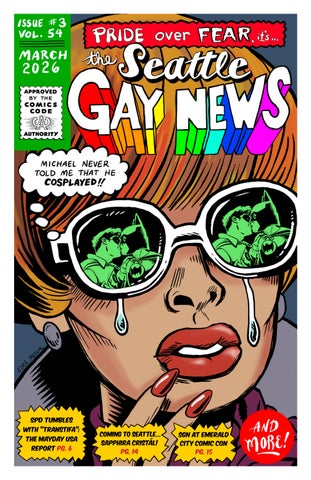
Cover art by Ezra Mezcal Comics Code Authority Seal of Approval ® CBLDF

OP-ED

Helen Lewis’s depiction of Trans youth healthcare in The Atlantic is deceitful and harmful

Helen Lewis, a staff writer at The Atlantic, has been no stranger to Trans rights criticism over the years. Although her Wikipedia page seems to portray her as an ally of Trans people, once you look into the dozens of pieces she has penned on Trans issues, her writing tells a vastly different story.

In a June 2025 article, she attempted to argue that her position was the middle ground between the Trump administration’s complete erasure of Trans people and that of “Transgender advocates.” She expressed that even though she has several concerns about “males who identify as women,” it doesn’t mean she believes they are “innately predatory or degenerate.” And yet, in the same article, she admits to supporting much of MAGA’s anti-Trans platform, including President Trump’s executive orders. Overall, her supposed calls for moderation on Trans issues come off as completely disingenuous.

And now in her most recent article, “The Tide Goes Out on Youth Gender Medicine,” she has once again decided to put her biases against Trans people — and faulty reasoning — on full display.

Dispelling myths

Not only is Lewis’s new article inaccurate regarding the facts but also, I believe, immensely harmful in its depiction of Transgender healthcare as somehow “shaky” and lacking evidence. She cites several biased sources of information to support her claims, including from the anti-Trans organization Our Duty, which believes that “sex is determined at fertilisation and is immutable — it cannot be changed.”

Her argument, like that of many who oppose what they see as “gender ideology,” is that confused children are being misled into believing they are Trans, and parents are being coerced by schools and the medical system to go along with it. In addition, all this newfangled “gender” stuff is not backed by scientific research, and is only peddled by the left-wing zealots who want children to engage in acts of “genital mutilation” that they will likely regret for the rest of their lives.

The reality is that Transgender, gendernonconforming, and Intersex people have existed all throughout history, and more often than not, Trans people realize that

something is different about themselves from a young age. Whether they are taught about the possibility of being Trans in a nonjudgmental environment — and that everything will be okay if they are — is an entirely different story. The findings of several medical studies suggest that Transgender surgery satisfaction rates are actually higher than for most other procedures, including hip replacements. And one of the main risk factors for predicting surgery regret was “poor support from the family.”

Lewis also cites a report that indicates that puberty blockers alone may not necessarily improve mental health outcomes, and suggests that some youth were put on a medical pathway too soon — after just one appointment. But when non-Trans youth are given the same kind of gender-affirming care, such as teenage girls who are prescribed estrogen therapy for polycystic ovary syndrome or boys with gynecomastia who get their breasts removed, there is no public outcry or doubt cast on these treatments’ safety and efficacy, precisely because they are used in a manner that aligns with the child’s gender assigned at birth.

Rising Together!

Good Friday Service

April 3 | 7pm In person and online

Easter Sunday Service

April 5 | 9 & 11am In person and online

The Power of Sacred Story

Unveil the Easter story’s timeless wisdom! At Center for Spiritual Living Seattle we teach that Easter is not just about the man Jesus but a celebration of the triumph of spirit within. Join us for a metaphysical interpretation and discover a deeper meaning this season.

CSL Seattle is a welcoming, inclusive spiritual community where people come to grow, connect, and belong. We honor all spiritual traditions and every path to the divine. Join in!

Conclusion

But Lewis’s claims do make perfect sense if you come at it from a standpoint of: Transgender people are not a legitimate category of human beings, and it is neither possible nor advisable for somebody assigned male or female at birth to be recognized as a woman, man, or nonbinary, whether medically, legally, or socially.

Right now, it is an incredibly difficult and stigmatizing time to be a Trans person in the US. Every day there are more politicians, news outlets, public figures, and social media influencers who look to stoke the flames of manufactured outrage on culture-war issues around Trans people to get more clicks, views, and ad sponsorships. But what seems to ultimately inform Lewis and other opponents’ reasoning on Trans youth care is not logic or concern for children’s safety and well-being but rather an abject disgust for Transgender bodies as an irredeemable form of “genital mutilation.”

SEATTLE NEWS

Balloons, barricades, and “Transtifa”:

Seattle’s

OIG report on the Mayday USA rally emerges

After the Mayday USA rally in Cal Anderson Park last spring, Seattle’s Office of Inspector General (OIG) attempted to piece together a comprehensive story of why things went so wrong. The OIG assembled a panel of LGBTQIA+ community members and Seattle Police Department (SPD) officers to investigate and come to a definitive conclusion on how relations had devolved so badly between the groups. By the third day of discussions, however, one of the panelists had leaked information to Divest SPD about the private meetings, which ultimately led the OIG to cancel further discussions.

Despite this abrupt ending, the OIG was still able to gather a significant amount of information on the SPD’s management of the event. Now those findings have been finally released publicly in a report entitled “Sentinel Event Review of the Police Response to the Mayday USA Rally in Cal Anderson.”

Parks and Rec and right-wing rallies

While some officers from other precincts were reportedly unaware of the “cultural context” they entered, the SPD as a whole seemed to have been fully aware of Mayday USA’s intent to target Seattle’s LGBTQIA+ community and historic neighborhood.

The OIG report reveals that, in a last-ditch effort, the SPD called Mayday organizers and asked them to move the rally out of Cal Anderson and into Westlake Park downtown, but the organizers refused.

When discussing the days, weeks, and even months before the rally, panelists agreed that Seattle Parks and Recreation failed to properly vet Mayday USA before offering it Cal Anderson as a venue. Panelists from the SPD, specifically, expressed frustration over how Parks and Rec didn’t notify their intelligence team or the City Attorney’s office once it approved Mayday’s permit.

There was also disappointment among the panelists regarding the parks department’s lack of awareness and inability to communicate. When Christian supremacist Sean Feucht requested to hold another rally

in Cal Anderson Park, the OIG actually stepped in to assist Parks and Rec, negotiating a deal with Feucht to hold his event in Gas Works Park instead.

“Transtifa” and POETs

Once police finally caught wind of the rally and its potential for conflict on May 14, they only had 10 days to prepare. At that day’s intelligence briefing, the SPD decided it would deploy POETs (officers who conduct outreach before and during crowdheavy events to keep the peace, ideally forming relationships with both sides of a protest), CRGs (who manage and/or arrest demonstrators), and SATs (plain-clothes officers who watch crowds and provide information).

One of the report’s biggest conclusions is that the POETs failed horribly at ensuring peaceful relations between police and Queer protesters, due to both the SPD’s lack of concrete support and its officers’ own poor behavior. According to the panelists, they “identified differences in POET officers’ communication with counterdemonstrators, rally security liaisons, and rally attendees. POET officers frequently spoke with the Mayday USA security liaison, sharing Mayday USA intelligence with SPD leadership on-scene. After hearing the Mayday USA security liaison refer to counterdemonstrators as “transtifa,” POET officers adopted the term, which spread to other SPD personnel.”

The report also found that, once the rally began, the POETs were grossly understaffed and underprepared. They were told to make a barricade with their bicycles, yet had no information on where it should be placed. And their communication with the LGBTQIA+ community before the event — something that would understandably be expected of a POET — was described by one panelist as “nonexistent.”

When the POETs were eventually asked to explain the barricade’s location, and if the restrooms behind the rally stage were available, they had no answers. Instead, according to witnesses, the POETs were dismissive and easily angered. They often

minimized the concerns of counterprotesters, and when their authority was challenged, they grew frustrated and lashed out.

Balloon incident

According to the OIG report, a couple

of balloons are what ultimately provoked police to arrest 23 people. Sixteen others were also reportedly injured by the use of force. Yet the report finds that those balloons were never actually popped. Instead, counterprotesters removed three balloons from one of Mayday USA’s fences, then an

JAMES ANDERSON

Potluck and rally spotlights

Trans refugees and their stories

On Sunday, February 15, a rally and potluck were held at Cal Anderson Park, organized by the Mutual Aid Network for Trans & Intersex Individuals in Seattle (MANTIS) in collaboration with other Trans rights groups, including TRACTION. It was mainly a speaking event to provide a voice for an increasing number of transplants who fled to Seattle to escape hostile legislation in other states.

Notable speakers included Councilmembers Alexis Mercedes Rinck and Joy Hollingsworth, KOI cofounder Violet Kawaguchi, and TRACTION program manager Aspen Coyle. In Kawaguchi’s speech, she discussed how over 400,000 Transgender Americans have fled their home states in the past year due to hostile legislation,

including bathroom bills, and healthcare discrimination. She stated that Seattle has taken in over 20,000 Trans refugees in the last year and lamented how this number is greater than any program in Seattle is equipped to handle. Despite this, the number is expected to increase by upwards of 50,000 within months, according to Kawaguchi.

She further scolded the City for its lack of public support in handling this crisis, demanding that it do something since Trans relocation networks are pushed to their limits and warning that the current infrastructure to support these refugees faces imminent collapse.

In addressing these issues, Councilmember Hollingsworth expressed a desire

“individual released the [balloons] into the air, and the CRG commander immediately ordered their arrest for property destruction.”

This is what led CRG bicycle officers to begin to pursue the suspect into the counterdemonstration zone. Two other suspects were also pursued by CRGs, who knocked people over in the chaotic process. The report found that “the three CRG units converged in an uncoordinated manner on the counterdemonstration zone, knocking people to the ground, yelling commands, and ultimately arresting 11 counterdemonstrators.”

Those moments are what produced the harrowing body cam footage of an officer who said, “We’re past talking to people, we’re here to fuck people up now,” as well as the images on social media and news outlets across Seattle of counterprotesters who were shoved, beaten, and peppersprayed.

“Antifa” vs. police

OIG panelists reportedly held vastly different understandings of the word “antifa.” For the community panelists, it was nuanced term, representing a variety of political positions united by a shared resistance against oppressive, authoritarian systems or “fascism.” On the other hand, one SPD officer explained that it simply meant “anyone that’s going to throw a rock at them.”

Antifa is a political philosophy shared across movements, and is not an actual organization.

SPD panelists said the department has used the term “antifa” internally for decades, since the 1999 “Battle of Seattle” WTO protests, and its use has become less nuanced and more negative with time.

The lack of nuance in labeling the groups involved at the rally also extended to May-

day USA, which the police simply called a “church group,” despite having knowledge that it claimed to be “saving the children” from the LGBTQIA+ community.

The report also stated that “SPD panelists described the [Police] Department’s concern that the ‘antifa’ and ‘pro trans’ groups would attract ‘bad actors,’ which became a key factor in SPD planning.”

Recommendations

The OIG report ends by giving the SPD a set of 24 recommendations on how it can improve its situation awareness, tactics, communications, and community legitimacy, including how to better engage with the LGBTQIA+ community.

Several recommendations advise that officers have more regular training on cultural history and social differences, and when planning protest coverage, include the location’s cultural context. Other recommendations encourage the SPD to form more consistent and friendlier community relations, such as wearing civilian clothing instead of being armed and in uniform during community outreach events, as well as making the LGBTQ+ liaison position full-time.

The intention of building these stronger relations, according to the report, would ultimately be for the SPD to consult community organizations and members more regularly around sensitive situations like Mayday, so that they may be able to understand the context better and receive guidance on how not to needlessly antagonize people who simply want the right to exist peacefully in their own neighborhood.

The OIG report can be found at https:// www.seattle.gov/documents/Departments/OIG/Sentinel%20Event%20Review/ SER%20of%20May%2024th%20Cal%20 Anderson%20Event.pdf

to listen to the concerns of Trans speakers and get a clearer picture of the needs of the community. Councilmember Rinck reflected on Cal Anderson Park’s history in the past year, acknowledging that many homeless Trans refugees reside in the park, and mentioning the Mayday counterprotest, which saw the Seattle Police Department attack Trans and Queer people.

As part of her work in Position 8, Rinck has taken steps to address the housing crisis and pushed for the Seattle Shield Initiative, to shift business taxes so Seattle’s top 10% businesses pay more of what they owe to social services, hoping that this can then be used to provide funding for housing programs and alleviate Trans homelessness.

Speakers’ stories

Morgan, an organizer with MANTIS, shared a story of a homeless Transgender woman she met the weekend after Pride. This girl had been living in a tent in the park, hadn’t been able to shave in days, and went months without HRT. Morgan, along with her friend, took an interest in her and tried to help her. They discovered that she had staph infections on her legs and needed medical treatment, but she couldn’t afford healthcare and didn’t have valid medical insurance. Despite offering various resources, such as help her to apply for Medicaid, the girl made it very clear that she didn’t want handouts but instead to find

a job so that she could pay for her healthcare. Morgan talked to a case manager about resources for her, but soon she was gone, and Morgan has not seen her again.

This sad story highlights the social struggle homeless people face in the capitalist system. We are taught to believe that asking for help or assistance is socially unacceptable, so most homeless people struggle in silence.

Other speeches include those by Ellie and Rose, two Trans refugees from Utah. In 2025, that state passed legislation preventing Trans people from using gendered facilities that aligned with their gender identity, denying access to HRT on Medicaid, and prohibiting LGBTQ+ Pride flags from being displayed in government buildings. Ellie shared her experience as a federal employee there, describing the legal battle that cost a lot of time and money so she could use the restroom at her place of work. Though she was lucky to have the financial means and necessary legal advisors, many Trans people do not have access to these resources.

Rose detailed on a larger scale the ways Trans people are discriminated against in red states. For example, she pointed out that the Equal Employment Opportunity Commission, which is the agency that handles workplace discrimination, does not list Transgender discrimination as a reportable claim.

TRACTION PROGRAM MANAGER ASPEN COYLE ARIN WALLER
JAMES ANDERSON
JAMES ANDERSON

Student demonstrators defy Trump's America

A Seattle Schools Against ICE protest at City Hall

On Thursday February 5, a rare event occurred: Several hundred young people from high schools across the city temporarily left their classrooms and teachers behind to congregate in front of Seattle City Hall in solidarity with their immigrant classmates and their families. They chanted and held signs that expressed their collective disapproval of the mistreatment of immigrants and US citizens by ICE under President Trump. Their slogans included “No justice, no peace — Get ICE off our streets” and “Say it once, say it twice, Seattle doesn’t fuck with ICE.”

The crowd was demographically diverse, reflecting Seattle’s growth over recent years. Several students carried Mexican, Puerto Rican, and other Latin American flags, and some wore Pride-related clothing or hijabs. Although they came from different background and life experiences, they assembled peacefully in an act of community love and youthful defiance toward a system that unfairly targets the most marginalized among them.

The protesters also utilized their artistic creativity as an outlet for their frustrations. The hundreds of signs they brought along

with them displayed various themes and plays-on-words: “The wrong ICE is melting” (with an iceberg motif) and “No one is illegal on stolen land.” Others used memes and pop culture references: one wrote “If you work for ICE, your mom’s a ho” and another drew the character All Might from the popular anime show My Hero Academia along with “Have no fear, let’s get ICE out of here.”

One young man told the SGN he had assembled his large “GET ICE OUT” banner on a long pole with $40 of materials from Home Depot. A group of teenage boys went shirtless, having written “Fuck ICE” with sharpie markers across their chests, akin to sports fans that paint themselves at football games.

Marching in the streets

Around 30 minutes into the demonstration, students began to fill into the section of Fourth Avenue in front of City Hall. Not long after, the crowd began to spontaneously march toward oncoming traffic and Pioneer Square at first, then turned and proceeded up Third Avenue before wrapping back around near University Street

and down Fourth toward Seattle City Hall once again.

Passing cars and onlooking pedestrians were generally supportive of the protesting students, as they honked and cheered them on. One man in a parked SUV with his family fist-bumped a group of teenage boys as they made their way past.

On the return to City Hall, a young man named Timothy approached the SGN and said he was the editor of the newspaper at Lakeside School. He shared that he had been interviewing adults who were there to show their support for the students, and was working on his own story about the day’s events.

Speakers and organizers

As student demonstrators steadily filed back into the courtyard and steps of City Hall, several climbed onto the ledge to give speeches through a megaphone. They took turns in sharing their critiques of and grievances against the current political climate in America.

“Who here is an immigrant, or the child or grandchild of an immigrant?” asked one student from the Northwest School. After

sharing her experiences of being raised in an immigrant household, she added, “We need to be brave enough to follow in the footsteps of those before us who stood up.”

A young man had wider systemic criticisms of economic hardships, saying, “We are dealing with an issue of capital and capitalism.” He also called out US foreign policy on Gaza, and also the Seattle Police Department’s previous cooperation and trainings with Israeli security forces, shouting “Shame!,” to which the crowd enthusiastically joined in.

Another student, from Franklin High School, pointed how the Trump administration’s use of ICE as a tool to target communities of color was both historical and by design, saying, “Racial profiling is built into our system in America… These are political choices.”

At the end of the event, the SGN met with one of the student organizers of the demonstration, Amara Aalfs-Weinbaum, who shared how pleasantly unexpected the large turnout had been and the group was planning to organize more events.

SEATTLE SCHOOLS AGAINST ICE PROTEST AT SEATTLE CITY HALL ON FEB. 5, 2026. MADISON JONES

SPD Chief Barnes discusses Mayday USA, FIFA, and ICE at the LGBTQ Advisory Council meeting

No chief of the Seattle Police Department had stepped foot inside one of the SPD’s LGBTQ Advisory Council meetings before — until Chief Shon Barnes accepted an invitation to attend on February 11. Attendees for the first time were finally able to hold the city’s highest law enforcement official to task on the issues most concerning them at the council, formed by and for Queer community members to voice their concerns directly to the department that for decades has faced heavy criticism for how it has treated LGBTQIA+ people.

The conference room at Community Roots Housing in the 12th Avenue Arts building on Capitol Hill was packed in with SPD officials, city employees, community groups, and other attendees. Deputy Chief Andre Sayles, Director of Communications Barbara DeLollis, East Precinct Lt. Jeff Hagen, East Precinct Capt. Jim Britt, and LGBTQ liaison Haden Barton were among those present. Other notable people included Lisa Judge of Seattle’s Office of Inspector General, Mario Teulilo of Seattle’s Community Police Commission, and Chris Curia of the Seattle LGBTQ Commission.

Everyone introduced themselves in a circle, then Chief Barnes started off the meeting by stating that he came to gain a greater understanding of the Seattle community. He also described himself as still being new to the city, despite living here a year.

Advisory Council Chair Mac McGregor also addressed the group, saying, “We’re all here because we want to live in a safe community together… Just keep that in mind with your questions tonight.”

Mayday OIG report

After Chief Barnes briefly shared his background of growing up in Murfreesboro, NC, and why he decided to join law enforcement, he was asked about the Mayday USA event and the police crackdown on counterprotesters. He stated that having the event at Cal Anderson Park was “one of the worst decisions we have had in a while” and that it was “a flashpoint.”

An attendee asked about the use of pepper spray on counterprotesters, to which Chief Barnes and other SPD staff replied that what was used at the Mayday event was technically “pepper balls,” not pepper spray. Inspector General Judge stepped in to explain the difference, and the SPD personnel nodded in agreement.

However, the distinction did not appease an attendee, who claimed to have been a medic at the event and reported treating dozens of people affected by those pepper balls. The first attendee then pressed the chief about the instances in which the department finds it appropriate to use these pepper balls. “It just depends,” Barnes said with a shrug.

He also declined to share any further thoughts on the event in anticipation of the OIG seminal event review, which came out the next day.

FIFA concerns

Concerns were also raised about the safety of LGBTQIA+ people in Seattle during FIFA’s World Cup games and its Pride match between Iran and Egypt. The tournament will also coincide with Seattle’s Pride celebrations in June. One

attendee feared that because persecution of Queer people in these nations is still prevalent, it may result in conflict and cultural misunderstandings.

“Do we know that that is going to be the case?,” Chief Barnes responded, adding that “sometimes you set the behavior for how guests should act.”

He brought up that FIFA holds classes for incoming teams and delegations on the cultural differences of the host country, and mentioned that Qatar had sent people over to collaborate with the City. He also emphasized that if there were to be an instance of hate, those who would lash out would have to face consequences.

“I’m soft on crime, except for when there’s prejudice-informed crime,” he said.

ICE and elections

The SPD’s response to ICE was another major point of concern for community members at the meeting. One person had a question about Mayor Katie Wilson’s recent executive order that would have officers document ICE activity, and what Chief Barnes thought of Seattle Police Officers Guild (SPOG) President Mike Solan’s response that he would not allow “[his] members to be used as political pawns.”

Chief Barnes said he’d leave it up to the mayor’s office to decide how the SPD should implement the new directives, and noted that Washington state law already prevents local law enforcement from giving assistance to federal immigration officials. As for Solan’s comments, Barnes told the group that “the union president was not

making policy, just giving his opinion.”

In response, an attendee pointed out that SPOG culture, much like a lot of other police departments across the country, tends to align with pro-ICE, anti-Trans, and anti-Black sentiments.

The chief later did express his doubts about the feasibility of officers documenting ICE activities in Seattle. He gave the example of Minneapolis and how its 3-to-1 ratio of federal immigration officers to local law enforcement meant police weren’t able to go to every call due to lack of numbers.

Another question came from drag queen and community activist Harper Bizzarre, who asked what the SPD would do if the Trump administration nationalized the vote and tried to use ICE officers to monitor local elections in Seattle.

“That is something I would never allow,” Chief Barnes stated. He noted that officers will not even do traffic enforcement around polling places in order to rule out all possibility of election interference. The chief then spoke of his commitment to democracy, and how he understood the importance of free and fair elections as a Black man who grew up in the American South. He posited that “this country is a democracy, and it should stay that way.”

He also stressed that in the face of Trump’s attacks on election integrity, everyone in the community has a role to play in ensuring that those rights are maintained. “History is made every day… and if we can’t find a way to come together, they will take advantage of it,” he said.

BIRD'S EYE VIEW OF SEATTLE SCHOOLS AGAINST ICE PROTEST MADISON JONES
ICE PROTEST SIGN
MADISON JONES
MADISON JONES

Broadway Veterinary Hospital celebrates 40 years

Capitol Hill is a neighborhood constantly in change. For decades, long-term residents have complained about gentrification, small businesses have come and gone, and generations of twentysomething Queer people have grown up, rented their first crappy apartments, and discovered themselves as young adults in the district. Throughout, one place has withstood the test of time: Broadway Veterinary Hospital.

“We are the clinic people know — whether through word of mouth, by driving down 12th and spotting our iconic round street sign rising above the cars, or because generations of families have trusted us with their pets,” said Practice Manager Ashley Maurer. “We are proud of the vibrant, diverse neighborhood we call home and the unique businesses and people who have supported one another for generations.”

The hospital is a clinic like no other, something licensed veterinary technician Jenna Harken learned as soon as she started working there. “When I was 23 years old and new to Broadway and veterinary medicine, I was greeting a man with his two Labrador retrievers who were there for a wellness appointment,” Harken recalled. “I grew up in North Seattle in a more rural area, so I (naively) asked him if he used the dogs for hunting. He laughed loudly and exclaimed, ‘Hunting! Honey, hunting for men!”

Background

Forty years ago, Dr. Mike Desrosier saw the need for a community-based animal hospital in Seattle’s Queer neighborhood. Back in 1986, most Americans treated their pets very differently from the way they do today. While it’s pretty common today for dog and cat owners to spend up over $2,000 a year on their pet, that’s not how it was in the ’80s. Then, it was typical to see dogs tied up to a tree or left outside in a backyard all day and night. Cats were usually let loose to wander around neighborhoods, and often disappeared, never to be seen again.

As a Queer person, Dr. Desrosier understood that for many members of the LGBTQIA+ community, our pets are more

than just dogs and cats; they’re our babies, our closest friends, and sometimes our only family. So he decided to open the doors of Broadway Veterinary Hospital to give Queer pet owners a place where their pets would be treated with the same care they received at home. At first, the clinic was operated from Dr. Desrosier’s home. Clients would have their pets treated in his living room!

Dr. Desrosier was a champion of Queer rights. Having opened the clinic at the height of the AIDS epidemic, he recognized that people with HIV/AIDS often struggled to care for their beloved pets while balancing their own care. Often, as

their health declined, people living with AIDS would be forced to give away their precious animals. Aiming to lower some of the hurdles they faced, Dr. Desrosier founded the Pet Support Network, a program that provided people with AIDS free vet care. The program was incredibly successful and helped those in the last stages of disease find comfort in their animal companions.

Dr. Desrosier knew the struggle his sick patients faced all too well. In 1993, he lost his own battle with the disease. The hospital was devastated by the loss but kept its doors open to continue Dr. Desrosier’s legacy of providing excellent care for the pets

of Seattle’s LGBTQIA+ community.

According to Harken, roughly 60% of the hospital’s clientele identify as Queer. “I have always said that people who identify as LGBTQ+ are very dedicated pet parents,” she said. “Some people within this community may never have human children, and their pets truly are their ‘fur babies,’ which is why they are so deeply committed to them. Others move to Capitol Hill to live as their true, authentic selves for the first time in their lives, and the only connection they have is their pet.”

Care and compassion

Over the last four decades, the facility has pioneered progressive veterinary care. “Broadway Veterinary Hospital is set apart from other hospitals, as we have a very holistic approach to medicine in that we focus on the big picture of wellness and the balance of quantity and quality of life,” Harken said. The vets there work collaboratively with clients to help educate them on the best ways to care for their pets.

“I want all our clients to leave their appointments feeling more empowered as a pet parent to take care of their pet’s physical and psychological well-being,” Harken said. “There are no such things as ‘stupid questions’ for our pet parents to ask us!”

“We focus on a team-based approach to pet care,” Dr. Angela Rawlings added. “Clients partner with our medical staff, and our doctors and support team collaborate closely to provide thoughtful, accessible care — something that is especially important in modern times.”

Broadway Veterinary Hospital is more than just a clinic; it’s a part of the Capitol Hill community. During the 2020 Capitol Hill Organized Protest (CHOP), the hospital once again saw an unmet need for pets in the neighborhood. “We navigated the respiratory symptoms neighboring pets experienced when tear gas was used during CHOP protests, while also ensuring our staff could leave safely before curfew,” Dr. Rawlings recalled.

The clinic has always understood the deep bond people have with their pets. “During COVID, we didn’t have the blueprint to go

LINDSEY ANDERSON
LINDSEY ANDERSON

‘curbside’ the way many veterinary hospitals did to limit exposure,” Dr. Rawlings said. “At the same time, we were committed to making sure our patients continued to receive care.”

During the pandemic, one family had to make the most difficult decision about their elderly dog. “I couldn’t bring myself to prevent a family from being with their aging dog during euthanasia,” Dr. Rawlings admitted. “I donned a mask, face shield, and gloves, and placed an extension line on the IV catheter, so I could stand two feet away while the family held and comforted their beloved companion. Moments like that reaffirm why we do this work.”

Anniversary

Now, Broadway Veterinary Hospital is celebrating its milestone 40th anniversary with an extravaganza. On Saturday, March

7, members of the community are invited to stop by — preferably with their pets — for food, refreshments, giveaway prizes, and pet health–themed raffles. “[The celebration] is about honoring the oldest veterinary clinic on Capitol Hill — but it is equally about celebrating the vibrant people of our community and the incredible local businesses that make this neighborhood what it is today,” Maurer said. “We want our clients to walk through our doors and truly feel how special this milestone is — because it is thanks to them and our dedicated team that we have reached 40 years.”

The hospital has provided Capitol Hill’s residents with thoughtful care and empathy longer than any other clinic in the neighborhood. It is a space where people have found hope and relief, learned to be better pet parents, and spent their hardest days surrounded by compassion.

Holistic Children and Family:

“We deserve therapists who understand”

As a parent, Marie Loeb (they/them) quickly learned that many institutions are not equipped to work with neurodivergent children, often due to the fact that they are run by neurotypical people who cannot understand their specific needs. Through seeking diagnoses for their two autistic children, Loeb also discovered that they are on the spectrum as well. “My son was delayed in speech and had a lot of eloping behaviors,” Loeb said. “My other child is AFAB [assigned female at birth], and I had been trying to get them assessed as autistic since they were two years old, and they were not able to actually get an assessment and diagnosis until about nine months ago, at the age of 17.”

Loeb experienced several disappointing encounters, from preschool teachers who brushed off the son’s elopement (leaving facility without permission or authorization) as typical “boy things” to family members who referred to the Nonbinary child as “it.” Loeb saw the hesitation the latter child felt when asking people to use their pronouns, and ultimately, Loeb had to learn how to become the fierce advocate the children needed, cutting out toxic family members unwilling to treat them with love and respect.

After years advocating for their children, Loeb founded Holistic Child and Family to support neurodivergent, Transgender, polyamorous, and kink community members. “I started with neurodivergent children and families because of the great need. Adults soon reached out for support, too,” Loeb said.

HCF offers clients a variety of therapy services, support groups, and parent coaching to help anyone who may want to advocate better — whether for themselves, a partner, a child, or a sibling. The organization also works with patients to set up Individualized Education Plans and 504 plans (which helps ensure that students with disabilities have equal access to educational opportunities), provide emotional support animals, and write letters of recommendation for gender-affirming care.

“We deserve to have therapists that can do more than sympathize with our pain,” Loeb said. “We deserve therapists who understand.”

Approach

The professionals at HCF take a “practice-based evidence” approach to therapy and avoid placing moral value on behaviors. “We take a holistic, systems approach to care, so while therapy sessions form the foundation of the work we do with clients, we take into account the whole picture of their experiences,” said HCF administrator Emily East.

HCF takes into account that for most therapists, traditional education primarily uses studies and evidence gathered by majority–white male patients.

“With autism, for example, you have years of research and cultural understanding… that centers around the presentation of autism in young white boys with externalizing behaviors,” East explained. “That’s why you hear about so many girls and non-men going undiagnosed and missed by the system.”

One of the biggest gaps HCF aims to fill is between therapists and Queer clients. Too often, young people seek out counseling to understand their gender and sexual identities but struggle when matched with a cishet therapist who lacks the lived experience and may not have studied how to properly treat LGBTQIA+ clients. But they can feel at ease with the HCF team, knowing that the professionals they are working with have experienced what they are facing.

“We’re trying to fill in these gaps as a community of practitioners,” East explained. “To start with, our entire team holds some of the identities of the populations we serve — we are all neurodivergent and diverse in gender and sexuality. Our lived experience doesn’t just inform our work with clients either — it is a big part of how our team works and changes as a community, like a living organism.

“We are radically Queer and try to make it known. Clients will find a team that already understands Queer identities and Queer culture. They won’t be subject to well-meaning microaggressions. Their identities will never be doubted; they won’t have to prove anything.”

“We live in a society where people follow traditions based on heteronormativity,” Loeb added, “and often imagine Queer relationships are just like straight relationships but with slightly different changes — when in fact there is a different, robust, and beautiful culture. Therapists should be able to see us without making assumptions of how we feel and behave in our communi-

“Broadway Veterinary Hospital is not just a clinic; it is a home for pets and for the people who love them,” Maurer said. “We

are incredibly grateful for 40 years of trust, connection, and community — and we look forward to many more.”

riences.”

Access

For many LGBTQIA+ and neurodivergent people, cost can be the biggest barrier to seeking professional mental healthcare. For that reason, HCF works hard to ensure that its services remain affordable, and when clients are unable to pay their bills, it works with them to find a solution that benefits everyone.

Access to mental health providers is essential for many LGBTQIA+ people.

While the Diagnostic and Statistical Manual of Mental Disorders no longer classifies homosexuality as a mental disorder, many important legal and medical decisions are withheld from Transgender people until they can provide documentation from a

medical or mental health professional.

“My child was able to have their name changed in the courts and on their birth certificate without permission from anyone but the appropriate offices,” Loeb said, “but to change their gender marker, they needed a sign-off from a mental health provider.” Luckily, Loeb was able to make the proper arrangements, but for too many, this barrier becomes insurmountable.

Loeb hopes that marginalized Seattleites will take advantage of the opportunities HCF offers. “Come to our free community consult group to better understand how to support us, and do your work,” Loeb said. “We cannot just try to be not racist, ableist, etc., because we exist in these systems and cannot help but absorb the systemic oppression that can cause us to inadvertently perpetuate harm on others as well as ourselves through internalized oppression.”

Loeb also advises those in search of a therapist to “be picky” and understand that not all therapists who say they can work with LGBTQ+ and neurodivergent clients should work with them. “Meeting with a therapist is just like a first date, and not a marriage,” Loeb said. “Sometimes we choose therapists because they have all of the same intersecting identities and find that we are still not a good match. Don’t waste your time — just try someone new, and you do not have to give them an explanation.”

“What you are asking for in a therapist is not ‘too much,’” East added. “You deserve to receive quality, affirming care from providers who understand your identity or are actively working to understand it. Your identities are a critical part of your mental health.”

More information is available at https:// www.holisticchildandfamily.org

ties — we are the experts of our own expe-
MARIE LOEB
COURTESY HOLISTIC CHILD AND FAMILY

House

passes

elections-overhaul

bill that could make it harder for married women and LGBTQ+ people to vote

Reprinted with permission from The 19th : https://19thnews.org/2026/02/ house-passes-save-america-act-marriedwomen-vote

The House on Wednesday [Feb. 11] passed the SAVE America Act, which would implement strict limitations on voter registration and casting a ballot — including new rules that could make it more difficult for married women or LGBTQ+ people to register if they’ve changed their names.

The vote passed on partisan lines, with [Texas’s Henry Cuellar being the only Democrat to vote] for the legislation, and [the bill] will face an uphill battle in the Senate.

Stricter voter ID requirements are part of a more aggressive GOP strategy to question the validity of elections. The vote [on the bill] comes after the White House reopened investigations [into] an election office in Fulton County, Georgia, one of the central sites in President Donald Trump’s unfounded concerns [about] election fraud in 2020. Trump also recently said he wanted to “nationalize” voting, and while he has been vague on what that means, it could include a federal override on states’ abilities to run their own elections — particularly in places where he lost to former President Joe Biden.

While voter ID requirements are popular among Americans across the political spectrum, critics say the provisions in the SAVE America Act would be overly burdensome on already eligible voters and dissuade new registrations, particularly in rural areas.

Voting rights groups have said the bill would pose a barrier for millions of American women and others who have changed their legal names because of marriage [or] assimilation or to better align with their gender identity. An estimated 69 million

American women and 4 million men do not have a birth certificate that matches their current legal name.

The SAVE America Act requires voters to provide documents proving their citizenship at the time of registration. Many otherwise eligible citizens do not have access to the required documents, such as an unexpired passport. Birth certificates are also one of the few options to prove a registrant’s identity, but they often do not reflect a married person’s or LGBTQ+ individual’s current legal name once they have changed it. While there are ways to further corroborate one’s identity, some experts warn the bureaucratic burden may turn people off registering altogether due to complications — preventing citizens from being able to cast a ballot.

“A real solution would eliminate the provision that requires women to go around and gather all these documents only to then affirm their own identity,” said New Mexico Rep. Teresa Leger Fernandez, who chairs the Democratic Women’s Caucus, during a press conference.

She added that as a Latina, she and others often have multiple documents with different legal names, which would add to confusion when registering: “This bill will make it harder, more expensive, for you to register and vote.”

Proponents of the bill have scoffed at the idea that the act would meaningfully affect married people who have changed their names.

GOP Rep. Tim Burchett, a vocal advocate of the bill from Tennessee, said the concept of married women not being able to vote under the act was “ridiculous.”

“It’s an easy change — there’s no problem with that at all,” Burchett told The 19th. “That’s just like saying it’s Jim Crow. That’s an antiquated argument that nobody buys.”

Republicans introduced its predecessor,

the Safeguard American Voter Eligibility (SAVE) Act, last year to purportedly block noncitizens from voting — something that is already illegal. That House-passed version still hasn’t been taken up in the Senate.

Between the new SAVE America Act and its amendments, passed in the House Rules Committee on Tuesday, the new version would have individuals present an eligible photo ID before voting, in addition to the former version’s requirement of proof of citizenship while registering. Mail-in ballots would also require voters to include a scanned copy of their identification, even in states that automatically send ballots to eligible individuals.

The bill also mandates [that] states remove noncitizens from existing voter rolls — already an extremely rare occurrence — after submitting those logs to the Department of Homeland Security for review. Critics say [that] on the state level, such voter roll reviews have in the past erroneously purged legal citizen voters.

The voter ID provisions would be effective immediately, potentially affecting those who have already cast mail-in ballots for their primary elections, as well as the millions of people who would want to register to vote for the upcoming midterms. [Logistical delays have been] seen with voter overhauls over the last decade in states such as Texas or Kansas, when election officials and administrators faced confusing or conflicting information [about] the changes.

“There’s absolutely no runway for this bill,” said Gréta Bedekovics, director of democracy policy at the left-leaning Center for American Progress. “Overnight, you would be changing the way that every single American registers to vote, and how millions of people actually vote at the ballot box, and elected officials would have to be doing all this education in real time.”

Key Republican sponsors had gotten antsy about the delay in passing this voter legislation, going so far as to try to connect the measure to the wider spending package required for the government to run. That spending package already had been sidelined by debates over reforming and further funding the Department of Homeland Security (DHS) after federal officers killed two people during its ongoing anti-immigrant campaign in Minneapolis.

To the chagrin of the bill’s staunchest advocates, House Speaker Mike Johnson and Senate Majority Leader John Thune punted on the issue, [separating] it from DHS funding last week, with Johnson saying, “I don’t think we need to be playing games with government funding.”

Trying to find a guaranteed vehicle to force a Senate vote on the provisions didn’t work, showing that the GOP is still [straining] to pass the controversial SAVE [America] Act and get it to President Trump’s desk before midterm primary voting begins in earnest.

While the majority of Republican senators are listed as co-sponsors, the bill would likely need 60 votes to overcome a filibuster, and House lawmakers are concerned that Democrats in the upper chamber would not be easy to divide over voting rights.

Some Senate Republicans have also expressed hesitancy. Among them is Alaska’s Lisa Murkowski, who said the voter ID push is “not how we build trust.”

“When Democrats attempted to advance sweeping election reform legislation in 2021, Republicans were unanimous in opposition, because it would have federalized elections, something we have long opposed,” she said in a statement. “One-size-fits-all mandates from Washington, DC, seldom work in places like Alaska.”

ADOBE STOCK

Rep. Pramila Jayapal and Sen. Ed Markey reintroduce the Transgender Bill of Rights

On Feb. 11, US Rep. Pramila Jayapal (D-7), alongside Massachusetts Sen. Ed Markey and California Reps. Mark Takano (D-49) and Sara Jacobs (D-51), reintroduced legislation that would affirm federal protections for Trans and Nonbinary people, aptly named “the Transgender Bill of Rights.” Rep. Jayapal is also co-chair of the Transgender Equality Task Force and has a Trans child.

The bill, first introduced by Rep. Jayapal and Sen Markey in March 2023, would seek to codify the federal government’s role in ensuring that Trans and Nonbinary Americans have equal access to housing, employment, education, and medical care, among other essential services.

In a recent statement released by Sen.

Markey’s office, the bill is summarized as “a comprehensive framework to protect trans and nonbinary Americans from discrimination on the basis of gender identity or expression.” The bill states that “the Federal Government has a duty to protect the rights of transgender and nonbinary people.”

In a joint press conference Wednesday morning, Rep. Jayapal stood outside alongside Sen. Markey and Rep. Jacobs with their supporters to speak on the difficulties Trans and Nonbinary Americans continue to face under the Trump presidency.

“We have seen so much horror, from hateful language at the highest levels of our government to discriminatory legislation popping up in states across the country, and

that means that too often, when we discuss Trans rights, we’re on the defensive,” she keenly pointed out.

“This bill supports amending the [1964 Civil Rights Act],” she explained, “to ensure Trans people have the same rights and protections as all other Americans. It creates a level playing field where Trans people no longer have to fight tooth and nail to get the same treatment as their cisgender friends.”

During the press conference, Rep. Jayapal also quoted her Trans daughter, who said of people that attack Trans rights, “[They] are just jealous of the freedom that [Trans people] have taken to be fully who they are. Those people just want to destroy that, rather than imagine what it would be

ARTS & ENTERTAINMENT

“Somebody
is a

like to be fully who they are.”

Sen. Markey, sporting a Trans flag–colored tie and heart-shaped pin, said of the timing of the bill’s reintroduction, “It is absolutely at this time necessary for us to do this.” He thanked members of the ACLU and Advocates for Trans Equality (A4TE) in attendance for their work.

“We need to say it loud enough for every American to hear: that Trans rights are human rights, and they must be protected every single day of every single year,” he proclaimed.

“We are here today to ensure that every Trans and gender-diverse person in America can live freely and safely and authentically,” he added. “That’s what the Transgender Bill of Rights is all about.”

Valentine’s Day is often a time to celebrate love. Many, however, share complicated views on it. Pop singer and songwriter Envi Jordan explores this through his newly released single “Somebody to Love” (not to be confused with the song by Queen, a soul-searching piece about Freddie Mercury’s own struggles with love as a Gay man in the 1970s). Envi’s single could almost be seen as a modern version of the famous A Day at the Races track, however. But in today’s world, where queerness is more normalized and accepted, there are fewer barriers to finding love, but for those Queer people who still struggle to connect with others, it can feel alienating to fall behind their peers.

to Love” by Envi Jordan

Valentine’s Day track for those with a lonely soul

Envi’s single encapsulates how one’s search for their other half can lead many to feel self-doubt, especially those who have invested time into someone, only for things to not work out in the end. The single is a departure from his others lately, which can be grouped as being more upbeat and cheerful, and shying away from darker topics. However, Envi explored darker and more personal themes in his first mixtape, Secrets Vol. 1, in which he explores his early life and how it shaped who he is. In a way, “Somebody to Love” is almost a return to Envi’s roots exploring introspective topics through his music.

While listening to this track, I couldn’t help but notice that the chorus shares simi-

larities to that of a recognizable pop song from the early 2000s. If you listen closely, you can hear Envi’s rendition of the first three notes of “Around the World (La La La La La)” by ATC (A Touch of Class), a Eurodance group from Germany. It is not unheard of for pop musicians to sample and incorporate other songs into their work, but for Envi to take a track from a genre associated with feelings of high-energy and repurpose it for a song with such a raw, melancholy vibe is an interesting choice.

In Envi’s own words, “it is a song made for crying on the dance floor.” This leads me to believe his choice to reference a hit song that many hold nostalgia for was intentional, to create something that evokes

feelings of ease and familiarity while expressing a core message that many can relate to, so as to create a jam that connects to the audience.

Last year, Envi opened up to the SGN about his creative process, which he described as an organic approach to writing, stating that his songs are influenced by “whatever is happening in my life or whatever is going on in my head.” With this in mind and Valentine’s Day around the corner, it wouldn’t be too difficult to speculate on how he has reflected on his views of love and what it means to be Queer in the present day. My overall opinion is that “Somebody to Love” is a deeply personal and relatable track that is easy to listen and dance to.

PRAMILA JAYAPAL AND ED MARKEY SPEAK AT A PRESS CONFERENCE OUTSIDE THE U.S. CAPITOL ON FEB. 11, 2026. JOE REBERKENNY / WASHINGTON BLADE
COURTESY ENVI JORDAN

Sapphira Cristál’s stand-up tour is coming to Seattle

Brace yourself, Seattle! This March, drag superstar and comedy powerhouse Sapphira Cristál will bring her sensational new stand-up tour, One Slue over the Cuckoo’s Nest, to the Emerald City. A fan favorite from RuPaul’s Drag Race season 16, Sapphira is ready to deliver a night of outrageous humor, heartfelt moments, and dazzling drag you won’t soon forget.

Known for her incisive wit, magnetic presence, and operatic voice, Sapphira Cristál is a true original. Her latest show dives headfirst into the absurdities of modern life — from travel mishaps and weight fluctuations to the worldwide K-pop craze. With her signature slue-footed charm and impeccable comedic timing, Sapphira transforms chaos into comedy and invites audiences to laugh at the madness we all share.

“One Slue over the Cuckoo’s Nest is what happens when you’re locked in a room with high comedy, low patience, and impeccable wigs for drag therapy with me. And I’m both the doctor and a patient,” she said teasingly.

Sapphira’s journey is as impressive as her performances. She’s graced legendary venues like Lincoln Center, performed alongside Madonna on the Celebration Tour, and wowed audiences worldwide with her theatrical productions. Now, she’s channeling that star quality into stand-up, bringing a fresh perspective — and plenty of glamour — to the comedy circuit.

Frank Gaimari: You’ve been known for your theatrical performances and operatic productions. What made you decide to dive into stand-up comedy?

Sapphira Cristál: Comedy has always been a subtle thread woven into everything I do. Even in my theatrical and operatic performances, there’s always been a touch of humor. Stand-up, though, has been a love of mine since childhood.

During my 2024 debut solo tour, The Cristál Ball, I discovered just how much I enjoyed the stand-up and storytelling aspects of the show. It was such a thrill to connect with the audience in that way, and I remember thinking, “What if I created an entire show centered around this?” That realization sparked something in me. Since then, I’ve been diving deeper into writing comedic material, and now I’m ready to share it. I know I’m funny, and I can’t wait to bring that side of me to my wonderful fans and, hopefully, to some new friends along the way!

FG: How does your drag persona influence your comedy style?

SC: My drag persona is all about being

BIG — big hair, big lashes, big looks, and a big ol’ booty! And, of course, a big mouth to share everything I’ve seen and exactly what I think about it. I’m a little off the wall, so my perspective tends to be delightfully skewed. That larger-than-life energy naturally spills into my comedy. Whether I’m serving a look or serving a punchline, it’s all about going bold, being unapologetically me, and making sure everyone is having a good time.

FG: You’ve performed on some of the world’s biggest stages, including Lincoln Center and Madonna’s tour. How does performing in comedy clubs compare?

SC: Out of all the stages I’ve performed on — whether it’s Lincoln Center or Madonna’s tour — comedy clubs are by far the most terrifying. Usually, I’m performing other people’s work, whether it’s singing opera, lip-syncing, or dancing. But with stand-up comedy, it’s just me — raw and unfiltered — sharing what I think is funny and hoping the audience agrees. It’s vulnerable, nerve-racking, and completely thrilling. I love making people laugh at things they might not normally find funny — it’s such a unique challenge. And as

scary as it is, it’s also the most fun I’ve ever had on stage.

FG: Drag and comedy both require a lot of vulnerability. How do you balance being open and staying true to yourself while making people laugh?

SC: I have a self-love practice that I take with me everywhere I go — it’s become a bit of a signature for me. I raise my arms in the air, wave my hands, wrap my arms around myself, take a deep breath, and say, “I truly love and accept myself.” I repeat it a few times, and it grounds me. It’s a reminder that I’m loved, I’m enough just as I am today, and I’m fully present in the moment.

Being present is, in my opinion, one of the most important habits to maintain in standup. It allows you to be both vulnerable and funny while connecting with the audience in a real way. It also gives you the freedom to make spur-of-the-moment observations that complement your prepared material. When you’re present, the audience feels safe in your care, and that’s when the magic happens.

FG: You’ve been a mentor and teacher in the drag and performance world. How

do you hope your comedy inspires your audience?

SC: I hope my comedy inspires my audience to laugh more — even at the things we usually see as sad or heavy. When you can laugh at something, it takes away some of its power. It feels a little less scary, a little less overwhelming. And in that moment of laughter, you’re not just finding relief — you’re also empowering yourself to face it and maybe even do something about it.

FG: What’s one thing you hope audiences take away from One Slue over the Cuckoo’s Nest?

SC: If there’s one thing I hope audiences take away from One Slue over the Cuckoo’s Nest, it’s that life is funny. No matter how wild, chaotic, or unexpected it gets, there’s always humor to be found if you’re willing to look for it.

FG: Looking back at your time on RuPaul’s Drag Race, what was the most surprising lesson you learned?

SC: The biggest lesson I learned on RuPaul’s Drag Race is that you can be the best and still lose — and that’s okay! Losing a competition doesn’t define you or make you a loser in life. What matters is how hard you’re willing to work to chase your dreams.

I’m living proof of that. Since Drag Race, I’ve headlined five national and international tours, I’ve shared the stage with Madonna three times, and now I’m embarking on my first solo comedy tour. None of that would’ve been possible if I had ever entertained the thought of giving up on myself. When I want something, I go after it with everything I’ve got. Because at the end of the day, a girl who fights for what she wants is always a winner, baby!

Sapphira Cristál’s One Slue Over the Cuckoo’s Nest is more than just stand-up — it’s a celebration of resilience, authenticity, and joy. With her razor-sharp humor and larger-than-life charisma, she delivers an experience that is as inspiring as it is hilarious.Whether you’re a devoted fan or new to her world, this is a night of comedy and drag excellence you won’t want to miss.

Tickets for the March 29 show at the Emerald City Comedy Club are now on sale at https://www.sapphiracristal.com/ tour.

COURTESY SAPPHIRA CRISTÁL

Welcome to Emerald City Comic Con: How we’re supporting LGBTQ+ artists this year!

It’s easy to lament that comics conventions aren’t “really about comics anymore,” but why have that pessimistic outlook? The Emerald City has always opened its arms to new artforms, stories, and mediums, and I like to think it’s been for the better. Today, no matter which fandoms you love, you can find a place here and at events like Emerald City Comic Con!

You can save the honmoon with K-pop cosplayers on Saturday, then slay the dance floor with geeky drag queens on Sunday. You can get a tattoo that’ll last forever, or enjoy a brief, “could go for another” pint with friends at the Kraken’s Keep tavern. If this is your first convention, don’t fret about trying to do it all, and definitely don’t let your FOMO burn you out by Friday. There’s no right way to experience Comic Con. There’s only the way that brings you, personally, the most joy.

Artists and the SGN

However, through all the year-over-year changes, there’s always been the Artists’ Alley. Since the first convention in 2003, you’ve been able to travel from booth to booth, meeting talented local artists along the way and going home with a keepsake you’ll love for decades to come.

It’s easier than ever to buy handmade goods, but you can’t buy human connection. You can’t be certain, especially in today’s AI age, that your hard-earned money is going directly to an equally hardworking artist. Having spaces like the Alley, where you can directly, financially

support small-scale artistry, will always be important. Unfortunately, they’re also few and far between.

That’s why, in collaboration with the Seattle Office of Arts & Culture, the SGN is going to be promoting and properly paying LGBTQIA+ comics creators across the city! You’ve already seen our amazing cover designed by Ezra Mezcal, a Seattle cartoonist with a pulpy, old-school style that we can’t get enough of. Expect to see more zany characters of his on our pages, including “Platrick,” a Queer-coded platypus who wants to go to therapy and get their mojo back!

At coffee shops around downtown, you’ll also find our posters for an original comic series called “Iced Matcha Latte”! Drawn by the talented (and brazenly butch) Kelsey Suit, the series stars two Queer friends catching up over lattes — only for one of them to come clean about a bizarre secret…

If you want to see what Kelsey’s hiding, check out our official Instagram @seattlegaynews_ for all that juicy, supernatural gossip. In the months to come, between conventions, we hope to continually work with Kelsey, Ezra, artists, athletes, and activists alike, keeping you in touch with our city’s ever-active, ever-partying Queer community!

If you can’t afford a knitted Totoro plushie or Hatsune Miku light stick from your favorite creator this year, consider supporting them by reading what our talented artists have to offer you. Alright, enough gabbing. Go have a blast out there already!

EZRA MEZCAL / KELSEY SUIT COLLAGE ARTIST
CITY COMIC CON

Another Gay Sequel: The cult classic returns

On March 3, Breaking Glass Pictures is set to re-release the Queer comedy Another Gay Sequel: Gays Gone Wild! This campy, outrageous sequel from 2008 has cemented its place in LGBTQIA+ pop culture, celebrated for its fearless humor, star-studded cameos, and vibrant portrayal of the late 2000s.

Rich Wolf, founder of Breaking Glass Pictures and an executive producer on the film, reflected on its enduring appeal. “The Gay community has come so far in the last two decades,” he said. “This film is a joyful time capsule of a pre-Grindr, preinfluencer era — when spring break was all about freedom, friendship, and living in the moment.”

Written and directed by Todd Stephens, Another Gay Sequel picks up where the 2006 cult hit Another Gay Movie left off, following the beloved quartet of Andy, Nico, Jarod, and Griff. This time, the gang trades their college antics for a wild spring break in Fort Lauderdale, diving headfirst into a chaotic competition called “Gays Gone Wild!” The goal? Hook up with as many guys as possible to win the absurdly coveted title of “Miss Gay Gone Wild.”

The film doubles down on its campy, comedic roots, delivering a sun-soaked spectacle of love, lust, and hilarity. Andy (Jake Mosser), no longer the awkward underdog, finds himself the center of attention — until he meets Luis (Euriamis Losada), a charming virgin who challenges his views on love and intimacy. Meanwhile, Nico (Jonah Blechman) faces his own crisis of confidence, escaping into a fantasy involving a shirtless merman played by adult film star Brent Corrigan.

Jarod (Jimmy Clabots) and Griff (Aaron Michael Davies), now a committed couple, grapple with whether competing together will strain their relationship. Adding to the chaos is a scheming trio of competitors — all named Jasper — played by Will Wikle, Brand Lim, and Isaac Webster, who are determined to rig the contest in their favor.

The film’s over-the-top celebrity cameos remain a highlight, featuring appearances by RuPaul, Scott Thompson, Willam Belli, and adult entertainment icons Michael

Lucas and the late Colton Ford. One particularly memorable subplot involves gossip blogger Perez Hilton, who plays himself in a surreal storyline in which a head injury transforms him into a fire-and-brimstone zealot — only for another blow to the head to revert him to his old self.

Upon its initial release, Another Gay Sequel was embraced by audiences for its raunchy humor, unapologetic queerness, and refusal to tone down Gay sexuality for mainstream comfort. Over the years, it has achieved cult status, celebrated as a snapshot of a moment in Queer media when camp, controversy, and sex positivity collided without restraint.

To explore the film’s legacy and impact, I spoke with Todd Stephens, the creative force behind this beloved franchise.

Frank Gaimari: Looking back, why do you think Another Gay Sequel has maintained its cult status and remained relevant nearly two decades later?

Todd Stephens: The reason it achieved cult status and stayed relevant is pretty simple: it’s the kind of outrageous, overthe-top comedy that just doesn’t get made anymore. The film wasn’t afraid to push

boundaries or even cross the line, all in the name of making people laugh. These days, comedies like that are rare, because so many filmmakers and comedians are worried about backlash or getting canceled. It’s a reminder of a time when people were bold — or maybe just wild enough — to be unapologetically themselves.

Another big reason is the film’s sense of Queer joy and shamelessness. It wasn’t about the struggle of coming out or questioning your identity. The characters weren’t ashamed of who they were — they were just like any other teens in a comedy, trying to have fun and get laid. That kind of carefree, unapologetic portrayal of Queer life still feels refreshing today.

And honestly, the film’s charm comes from its ability to laugh at itself and the community it represents, while still celebrating it. It doesn’t take itself too seriously, but it’s full of joy and authenticity. That mix of fearless humor and shameless celebration is what’s kept Another Gay Sequel alive as a cult classic all these years later.

FG: How do you feel the landscape of Queer cinema has changed since the film’s original release in 2008, and where do you see it heading?

TS: The landscape has changed in fascinating ways since the release of Another Gay Sequel. Back then, when Queer content was being made, the hope was always that it could cross over and reach audiences beyond the LGBTQ+ community. That was the goal: to create something that resonated universally while still being rooted in Queer experiences.

Now, we’re seeing a shift in which Queer stories are not only crossing over but also becoming mainstream cultural phenomena. A great example is Heated Rivalry, a TV series that features graphic sex scenes and has become the talk of the nation. The fact that something so unapologetically Queer can spark such widespread attention and conversation is a huge step forward. It shows that audiences are ready for more bold, authentic Queer content.

Looking ahead, this kind of success opens the door to more Queer stories being told, hopefully with larger budgets and greater resources. It’s an exciting time, and the future of LGBTQ+ cinema looks brighter than ever.

FG: What was it like for you to revisit this film for the re-release? Did it bring back any specific memories or emotions from when you first made it?

TS: Revisiting Another Gay Sequel for the re-release was both surprising and emotional. I hadn’t watched it in a long time, and when I did, I was shocked — I really liked it! It brought back a lot of memories, some tough ones included. The shoot was challenging, because we lost three of our lead actors right before filming started. But once we got into it, it became so much fun. Watching it now, I see the sense of freedom we had while making it. I’ve never had more fun making a film. Creating this magical, Queer, crazy world and living in it for three or four weeks was an absolute joy. That’s the main memory it brings back — just how much fun it was. When I watch it now, I can’t help but smile.

FG: What message do you hope a new generation of viewers will take away from Another Gay Sequel?

ANOTHER GAY SEQUEL (2026)
TODD STEPHENS IMDB

TS: The message I hope they take away is the importance of community and of real, in-person connection. When I watched the credits recently, I realized that all the Queer resorts we filmed at are now gone. It hit me how much has changed since we made the movie. Back then, the iPhone had just come out, and now we’re so glued to our phones and the digital world that we’ve lost some of that sense of community.

I want people to step away from their screens and go support Queer spaces — whether it’s a local resort, bar, or any place where the community gathers. There’s something so special about meeting people face-to-face and connecting in real life.

I know younger people crave that too. My students talk about wanting those kinds of experiences, even if it’s hard to break the habit of being online all the time. There’s nothing like being with your community in person, and I hope this film reminds people of how important that is.

FG: The film is unapologetically campy and raunchy. What inspired you to lean so heavily into those elements, and how did you balance humor with meaningful storytelling?

TS: The films were heavily inspired by one of my filmmaking idols, John Waters, who had a big influence on me with his campy and raunchy style. I also drew inspiration from the movies I loved growing up, especially the raunchy teen comedies like Porky’s and parts of Fast Times at Ridgemont High. Those kinds of films were a big part of my coming-of-age, but they never represented us. I always thought, if straight people can have raunchy sex comedies,

why can’t Gay people? That idea really drove me. I wanted to make movies for the younger generation — films I would’ve loved to sneak into or discover when I was a kid.

As for balancing humor with meaningful storytelling, I think it comes down to this: underneath all the laughs and outrageousness, there’s always a deeper layer. The characters in these films aren’t struggling with their sexuality — they know they’re Queer — but they’re trying to figure out what that means for their relationships. Are they monogamous? Promiscuous? Where do they go from here? Those were questions I was grappling with myself at the time, and some of that realness naturally found its way into the stories. So, while

the films are campy and raunchy on the surface, they also explore identity and relationships, giving them depth.

FG: The characters in the film each have distinct, memorable arcs. Were any of their storylines inspired by personal experiences or people you’ve known?

TS: As the writer, I’d say there’s a part of me in all the main characters. I’ve been in a relationship for 40 years, and at the time, I was trying to figure out what that meant — working through questions about the rules of our relationship and how to navigate it. Those were things I was personally dealing with, and as writers often do, I used my work to process those conflicts. So yes,

many of the film’s themes and storylines were influenced by my own experiences.

FG: Final question: How would you describe the film, and what makes it a must-watch for audiences today?

TS: I’d describe Another Gay Sequel as a joyful, unapologetically ridiculous escape. The film was made during the conservative Bush era, making it feel like a bold act of resistance against that political climate. Looking back, that time seems almost tame compared to what we’re dealing with now, but the message still resonates. In this world of darkness we live in, I’d invite people to take an hour and a half to just laugh, have fun, and embrace silliness.

The film is a reminder that we, as a community, can be crazy, dramatic, and ridiculous and still find joy in it all. Laughter is healing, and there’s not enough of it in the world right now. That’s what makes this film a mustwatch today — it’s an escape, a celebration, and a reminder of the power of humor.

As for the future, people have been asking for years about a third installment. Interestingly, I recently had dinner with three of the original cast members, and we started brainstorming. Maybe now, in this dark Trump era, is the perfect time to bring it back. I’ve got my thinking cap on, and I’m working on some ideas. Who knows? Maybe there will be Part 3 someday.

Mark your calendars: Another Gay Sequel: Gays Gone Wild! will be available on all major streaming platforms starting March 3. Whether you’re revisiting the chaos or experiencing it for the first time, this cult classic promises a wild ride you won’t forget.

CACTUS PEARS Streaming

A slow and sweet Queer love story, draped in the fabric of India

Indian films have long avoided discussions of sexuality and sex. Unlike Western movies, early works never portrayed intimacy or nudity on camera, instead treating the subject as taboo. However, recent ones have begun to embrace the open depiction of these issues. Cactus Pears is the latest out of India to proudly center around a Queer romance. The result is a melancholy and tender love story between two men, intertwined with themes of loss and silent grief. It is an important and refreshing representation of Indian romance, which also recently gained recognition for being the first Marathi film to premiere at Sundance, before going on to win the Grand Jury Prize in 2025.

Directed by Rohan Kanawade, the film follows Anand (Bushaan Manoj), a young man returning to his hometown after the death of his father. While there, he romantically reconnects with his childhood friend Balya (Suraaj Suman). From the first frame, the tone and pacing are immediately established, with slow shots, minimal dialogue, and no soundtrack, letting the viewer sink deeply into the subtle sounds and details of each scene. The composition and blocking of each second is sublime, cleverly using depth to pull the audience into intimate moments and send them back for others. Wind rustling, water splashing, and birds singing are all main elements of the film’s sound design, and they give a real sense of stillness, allowing for the interaction of the actors to shine through.

Manoj commands the screen, transmitting a deep grief to the audience despite minimal dialogue. Suman shares great chemistry with him, and together they’re the beating heart of the film. In particular, their moments of rare intimacy feel deeply emotional, and are some of the most radical and refreshing scenes of Queer love to come out of Indian cinema. Stolen glances, thousand-yard stares, and small movements tell the story of Anand’s longing and pain in the wake of his father’s death.

The film does a fantastic job of weaving three elements together: the societal pressures of marriage in India, grief due to the death of a loved one, and the experience of being a closeted Gay man. These elements build incredibly slowly, however, which was one of the few drawbacks of the film.

A major section is also dedicated to portraying the ritualistic process in which Anand has to grieve for his father. As the son, tradition dictates that there are certain customs he must follow, such as not washing his hair and not wearing shoes, among many more. The depiction here offers a fascinating insight into an extremely old tradition.

In the canon of Indian cinema, a film with this attention to detail and care for its Queer subject matter is extremely special. Radical not only in its storytelling but also in its cultural message, Cactus Pears is a brilliant movie worthy of its Sundance prize, and a must-watch for anyone interested in Queerness in the context of Indian culture.

CACTUS PEARS (2025)
ANOTHER GAY SEQUEL (2026)

Filmmaker Sophie Hyde on her highly personal, multigenerational family drama Jimpa

After her triumphant 2022 drama Good Luck to You, Leo Grande with Emma Thompson, writer-director Sophie Hyde dug into her own complicated family history, as well as her close relationship with Nonbinary child Aud Mason-Hyde, for Jimpa, an emotionally complex, triumphantly Queer, multigenerational family saga.

In the film, Hannah, a filmmaker, makes a holiday visit to her Gay activist father at his Amsterdam home as she attempts to flesh out a script. Past and present collide as memories of her own childhood crash into current events, but she also worries that her Nonbinary child, who idolizes her grandfather, will be crushed when they finally see him as a complete human being, flaws and all.

A pitch-perfect Olivia Colman stars as Hannah, while John Lithgow effortlessly slips into the skin of her father, Jim, a college professor and amateur societal agitator. Aud plays a variation of themselves as Frances, a gender explorer who, thanks to countless stories of fights for Queer rights in the 1980s and ’90s, has built up their grandfather into something of a superhero and, much to Hannah’s horror, now wants to spend the next year living with him in Amsterdam.

Everything plays out over a few breathless days, with Hyde creating an almost stream-of-consciousness atmosphere, filled with sudden flashbacks to Hannah’s youth and chaotic fragments of the here and now. She allows the characters to live their lives at their most mundane and most extravagant, never apologizing for their failings or overly celebrating their various successes. She lets them be people, nothing more and certainly nothing less, which gives the film an intimate immediacy that, at least for Queer audiences, will hit home in unexpectedly personal ways.

I sat down to speak with Hyde over Zoom about her latest endeavor. Here’s what her had to say:

Sara Michelle Fetters: How difficult was it to assemble the building blocks of this script, especially considering how much of this is inspired by your own family’s journey?

Sophie Hyde: At the start, I was ignorant to some of the weight of that, to be honest. It didn’t feel difficult at the start. I’d been buoyed by some really amazing films that

I had found to be really personally connected... like the work of Mike Mills... like The Farewell. There were a bunch of films that felt like they had come from something explicitly personal, and I loved them...

I like people that put themselves in their work. It’s just [that] some people are really open about it and others aren’t. So, in so many ways, this was gorgeous to do. I sat with one of my best friends that I grew up with [co-writer Matthew Cormack], and we talked about ideas and how to fictionalize, and that fictionalization of the characters came really early on. In fact, it became more and more closely connected to us personally over time, so it was kind of like it was only as we were making it that I think I was like, “This looks like us on screen.”

And, of course, because Aud, my own child, is in the film playing a fictionalized version of themselves, I think the lines blur a lot for everybody. We know which bits they are, but there were still times where I think we were all confused. [laughs]

SMF: How surreal was that to have your own child portraying a version of themselves up against a pair of living legends that are playing versions of either you or other members of your own family? I imagine there are moments where that is invigorating and euphoric, and then there are others where this had to be fantastically difficult on a level that I can’t even imagine.

SH: Yeah. Invigorating and euphoric is a beautiful way of saying it, because there are moments where you look around and you wonder: how are we doing this? But then those people become very normal to you. You don’t look at them as legends anymore. You’re like, that’s just Olivia and John. They become fellow actors, so that kind of legendary status becomes present only when you’re not with them.

As for my child, there were moments where I felt also euphoric at the idea of working with Aud. We would be in a room and I would just think, my gosh, we’re getting to do this and explore something that we care about. We work really beautifully together...

There are certainly moments where you’re like, “Is this too much? Am I asking too much of my own child? And am I putting too much pressure on our relationship and revealing things that are going to be difficult?” And, certainly we’ve had a weird art-meets-life-meets-art happening here, where I felt like Aud was younger than the character when we started writing [it] and then they became older than the character as we went along. It’s like the character and Aud diverged.

But mostly I just was worried. Worried that Aud knew me so well that I couldn’t protect them from anything as an actor. Normally I’m very honest with my actors, but there are also things that I am just carrying without them. But Aud knows me,

and so they know when something’s going wrong. But, we’ve always been a family where our work has been very entwined with what we’re doing. Aud’s grown up around films and writing, so that feels insanely normal.

SMF: I do love that you say “insanely normal” because there are aspects of Aud’s journey in the film that I just imagine at a certain point, as a mother, you have to say, “Oh my gosh. I am directing my child in a love scene.” Did that happen?

SH: That felt okay for us.

SMF: It did?

SH: Yes. For Aud and [me], physicality and sexuality have always been really open. We wouldn’t necessarily talk about sex, like the physicality of it, but we’ve always been very open with each other about these ideas. ... I love doing sex scenes. it’s one of my favorite things to direct. For me, it’s like everyone’s really open and honest and clear with each other. You suddenly become this insanely frank person.

Aud and I are able to really talk about that character and what was going on for them. Therefore, what they were doing in the scenes — which isn’t a very explicit scene, although it can feel more explicit than it is — it just felt very clear to us. It didn’t feel like a blurry line. I didn’t feel like I was directing Aud; I felt like I was directing an actor and a character at that point.

We also had a great intimacy coordinator who really worked with us on that. Sex scenes are always so choreographed, so talked about, that they become almost tedious. There were other scenes that were actually harder. Things that were emotional about parent and child — that felt more tricky, because I was like, “Am I projecting my feelings about what Aud feels onto this character?”

SMF: I would imagine that a great of deal that had to do just with trying to separate Aud from the character, specifically the character’s gender journey. This is where I would think you would have had to rely a lot on Aud to get that authenticity, that realism, that naturalism as to what that character was going through. Do I have that correct?

SH: You do. It was a huge thing for us. We bought Aud into the writing of the film quite early on. Even before they were going

JIMPA Theaters
JIMPA (2025) KINO LORBER
SOPHIE HYDE

to play the role, they were in conversation with us about the character. They have an executive producer credit because of that contribution to the work. Being a parent of a Trans, Nonbinary teenager, we’ve gone through a lot of this together. We’ve been through a lot of conversations and experiences.

We were trying to put into the film moments from all of that time, but dramatized. The creative work was a constant conversation between us about things we had gone through. Like I always would with any actor who has a lived experience that I am asking them to draw on, I’d ask, “At this moment, how does that feel? Because I don’t actually know how I’d feel about this.” And actors are always amazingly surprising, all of them. Particularly someone like Aud, who has a very unique experience of gender. But Olivia would be amazing at times, too, showing us something I wasn’t seeing as well.

Actors, they feel right inside that character in a way that I’m always trying to do. But I’m always seeing it for the story as well, while they’re seeing everything from their character’s point of view. I love having people on a set that do bring their own lived experience in, whether or not that’s being explicitly drawn on or it’s just influencing the tone. I think listening to them and asking them to be part of the creation is really exciting.

SMF: Of all of the pictures you’ve made to this point, this one does feel the most adventurously cinematic in the ways that you did the edit and presented the story, the time-looping, popping those images from the past and having

them cycle through what’s happening in the present. Did you feel you were taking some big risks? Were you ever worried how the audience was going to react?

SH: I always knew I wanted those kind of flashbacks or memories or imaginings, whatever they are. They felt important to me as part of it, but we weren’t always sure how they were going to work. They were a big swing, because they took a lot of time to make. Our production designer and costume designer had to do, at one point, 70 scenes in five days. Like 70 little flashback moments.

We did a lot of them back in Australia, after we’d already shot in Amsterdam. We went back home and cast all the young characters. I loved making them, but they were still a challenge. But I always felt that they were really crucial.

I think about photographers like Nan Goldin, who finds really authentic, really captured moments with her camera. But they feel stylized, too, and that’s how memory feels to me. It’s like these moments that are just off-center or just out of frame, but also quite luscious or something similar. It’s about trying to find those feelings, but I don’t want them to feel like I just put up a camera. I want them to feel like they’re a figment of a memory [as] you’d see them inside your head.

SMF: I do think, right now, in this moment, a story like this that is so open and natural and honest about Trans and Nonbinary stories is so very important. Is that something that you were cognizant of when you were trying to put the film together? And what do you want

audiences to hopefully take away from seeing a story like this one?

SH: So much to say about this. When we wanted to make this film, we wanted to think about the joy that existed in our life, and also the kind of conversations that we could have [in] a room of Queer people about our lives. It felt like we started that conversation at a time [when] that was really possible, that it could even be taken a bit more public than it had been before and be more nuanced and even critical than it had been previously.

Then, as we met the world, as we were finally making [the film], we were reconfronted with something I think we all know, which is that Queer stories are still largely judged in a very, very different way — and dismissed — than similar stories are.

We know this and yet we still really wanted this story to be joyful. We wanted it to be a celebration... The people in my life that [had] to come out as Gay, Lesbian, Queer, Trans when they were young, they couldn’t be invisible like everyone. … There was no choice. They were forced to be visible whether they wanted to or not.

These are my favorite people in the world. They had to have this reckoning with the world. As someone who’s been able to have the freedom to hide away much more in my life at times, to just be myself, I want to celebrate these people who could not do that.

This is a long-winded way of saying that I thought we were making something about love and family that was very gorgeous and life-affirming and that could come to a world in a certain celebratory way. But what I found was a world that wanted us to

argue about things, that wanted us to present and take a very opinionated stance, that was judging us.

Yet here we are saying almost the opposite, that there is more nuance to life. That there is more for us to converse about, even civilly disagree, all while working together to try to find a common place. It’s been such a wild thing, to put that in the world, especially right now. We made a film where we brought a lot of Queer cast and crew together, and that was an incredible feeling that nothing can change.

But [we’re] watching our world be so aggressive toward Queer and Trans stories. Aud doesn’t want to go to the US for the release, and I understand why. It’s scary. I thought I was ready for this stuff, only to be surprised and shocked, and even devastated, like all of us have.

Still, it was my choice to make this film and to be very sincere. To put my heart on my sleeve and be really honest and emotional. I hope that people see that and feel that, and that they are given a space and allowed to disagree with each other but also allowed to feel things... Those are big questions, but that’s what I think.

SMF: I think stories like this that have the courage to be at times mundane, that celebrate our flaws and much as they do our attributes, are more important than ever. They allow the greater world to just see everyone, specifically Trans individuals, as people. Nothing more, certainly nothing less. Does that make sense?

SH: As humans. Yes. It does. Not just in these moments of extreme violence but always. We’re also here just living, right?

Pillion is a bold cinematic exploration of Gay BDSM

PILLION Theaters

The film’s title, Pillion, can be interpreted in several ways. On one hand, it refers to the passenger seat on a motorcycle — a powerful symbol of vulnerability and reliance on the driver. On the other, it suggests being carried through life, dependent on the choices and control of others. In both interpretations, the meaning is clear: this film is about dominance and submission.

Directed by Harry Lighton and based on Adam Mars-Jones’s novel Box Hill, the film stars Alexander Skarsgård as Ray, a brooding biker, and Harry Melling as Colin, a timid Gay man who becomes Ray’s submissive. Their relationship unfolds in the gritty streets of Bromley, London, where Colin, a barbershop singer living with his parents, is drawn into Ray’s world of leather, motorcycles, and BDSM.

The plot is as much about power dynamics as about intimacy. Colin meets Ray at a pub, and their connection is immediate and

electric. What begins as a sexual encounter in a back alley evolves into a complex connection. Colin becomes Ray’s submissive, cooking, cleaning, and sleeping on the floor at Ray’s command. Yet, amid the strict rules and rituals, Colin finds a sense of belonging and exhilaration he’s never known before.

Melling delivers a deeply heartfelt performance, capturing Colin’s vulnerability and quiet strength. The character’s journey from naivety to self-awareness is both heartbreaking and inspiring. Melling’s portrayal is layered, showing Colin’s longing for love and his struggle to assert his own needs within the confines of their relationship. Skarsgård is magnetic. His physicality — tall, chiseled, and commanding — makes him the perfect embodiment of a dominant figure. But he doesn’t rely solely on his looks; he brings depth to Ray, revealing glimpses of insecurity and tenderness beneath his stoic exterior. His chemistry with Melling is undeniable, making their interaction both compelling and unsettling.

The film doesn’t shy away from nudity or

explicit scenes, but these moments are never gratuitous. They serve to deepen our understanding of the characters and their connection. And yes, we see Alexander’s butt — no prosthetics there, that’s real. However, the film makes use of a prosthetic penis, which has sparked plenty of conversation.

One of the film’s strengths is its refusal to judge its characters. Lighton presents their relationship with honesty, allowing the audience to see the humanity in their choices. Yes, some scenes are shocking, but they are grounded in the characters’ realities. The film invites us to empathize with Colin’s loneliness and his desire to be seen and valued.

But as events unfold, the question lingers: Is it too much? Colin’s devotion to Ray is unwavering, but at what cost? And what about Ray — does he truly care for Colin, or is he simply taking advantage of his submission? The film doesn’t offer easy answers, leaving the audience to grapple with the complexities of their dynamic.

The supporting cast also shines, particu-

larly Lesley Sharp as Colin’s mother, Peggy. Her concern for her son adds another layer of tension to the story, highlighting the generational and cultural gaps in understanding Queer relationships. Jake Shears, the lead singer of Scissor Sisters, also appears in a supporting role as part of Ray’s biker gang, adding to the film’s strange and unsettling atmosphere.

Visually, Pillion is stunning. The cinematography captures the gritty beauty of London’s streets and the intimate moments between Colin and Ray. The scenes of Colin riding pillion on Ray’s motorcycle are particularly striking, symbolizing both his submission and his liberation. At just an hour and 47 minutes, the film flies by. Every moment feels purposeful, and every scene is charged with emotion and meaning. Pillion is not just a film — it’s an experience. It’s a bold and refreshing exploration of Queer relationships that doesn’t shy away from the complexities of desire and power. Watch it. You’ll leave the theater with questions — and that’s exactly the point.

BOOKS

Frank Gaimari: Conversations with Legends

Reprinted with permission from Stonewall News Northwest (www.stonewallnews. net/articles/frank-gaimari-conversationswith-legends/24667/)

Frank Gaimari doesn’t just tell stories, he brings them to life. At 64, this Seattle-based writer and storyteller has turned a lifetime of experiences into narratives that entertain, inspire, and connect with people on a real, personal level. After a 36-year career in the federal government, Gaimari has fully embraced his love for writing, and the results are nothing short of amazing.

His latest book, Conversations with Legends: The Interview Articles, is a celebration of curiosity, connection, and compassion. This collection of 24-in-depth interviews goes beyond the surface of fame, giving readers an honest, behind-the-scenes look at the lives of some of the most interesting people in entertainment. From the vibrant Kate Pierson of The B-52s and the heartfelt David Archuleta to the bold Margaret Cho and the visionary filmmaker Todd Stephens, Gaimari’s interviews aren’t just Q&As, they’re meaningful conversations full of wit, wisdom, and real emotion. Through his thoughtful questions and engaging style, Gaimari doesn’t just interview his subjects, he brings readers into their world and uncovers the stories that shaped them. (And yes, I’m honored to be one of the voices featured in his book.) Whether it’s the creative mind of Craig Chester or the artistic talent of Richard Vyse, Gaimari’s ability to connect with people on a genuine level makes each interview unforgettable. Conversations with Legends isn’t just a book, it’s an invitation to explore creativity, fame, and the shared experiences that connect us all.

But Gaimari’s talent for storytelling doesn’t stop with books. He’s also a skilled screenwriter with a knack for bringing history and relationships to life. His screenplay Vincent and Paul: Unspoken Brotherhood — a dramatized look at the complicated friendship between Vincent van Gogh and Paul Gauguin — has earned high praise. Another screenplay, La Famiglia, stood out in the prestigious Nicholl Fellowship contest, placing in the top 15% in 2019. These achievements highlight Gaimari’s unique

gift for creating stories that truly resonate with people.

Curious to learn more about the man behind these stories, I had the chance to talk with Gaimari about the inspiration, challenges, and insights that drive his incredible work.

Lyndal Simpson: What inspired you to write Conversations with Legends?

Frank Gaimari: Conversations with Legends was born out of a moment that changed everything — a moment that made it necessary to pause, reflect, and refocus.

Let me explain. Just recently, I was diagnosed with leukemia. The doctors are hopeful, and my prognosis is good, but hearing those words — “You have cancer” — stopped me in my tracks. It’s the kind of moment that forces you to take stock of your life. I found myself asking questions I’d never really faced before: What truly matters? What have I done with my time? What will I leave behind?

The answer came to me almost instantly: my interviews. These conversations with some of the most fascinating, creative, and inspiring people are what I’m most proud of. I wanted to bring them together, not just for myself but for anyone who might find meaning in them. Conversations with Legends became my way of holding onto what matters most and making sure these voices and their stories are never forgotten.

A diagnosis like this changes everything. It strips life down to what’s essential. It forces you to focus on what gives you purpose and keeps you going. For me, this book became that purpose. It gave me something to hold onto, something to look forward to — something bigger than the recurring tests, doctors’ appointments, and the uncertainty. It reminded me of the beauty of connection, the power of storytelling, and the importance of leaving something behind that matters.

LS: How did you choose the 24 celebrities featured in the book?

FG: When it came to choosing the 24 celebrities for the book, I simply picked people I was genuinely curious about — people

whose stories I thought would interest me and, hopefully, the readers as well. My thinking is, if I find someone fascinating or their journey inspiring, chances are others will too. That’s always been my approach: follow my own curiosity and let that guide my interviews.

I feel fortunate: About eight out of ten times, the people I reach out to are open to talking. I’m not sure if it’s because of my previous work or just the way I approach them, but I’m always grateful when someone says yes. It means a lot to have them share their time and experiences, and I think a relaxed, genuine approach helps set the tone for a good conversation.

LS: Was there a particular interview that stood out to you as especially memorable?

FG: While no single interview stood out above the rest, what truly left an impression on me was how genuinely kind and grounded these celebrities were. Going into these conversations, you never really know what to expect, but time and again, I was pleasantly surprised by their warmth, sincerity, and approachability. There was only one instance in which someone came across as a bit distant, but that was the exception. What made these interviews so memorable wasn’t just the stories they shared but the authenticity behind them. Getting to know the real, unfiltered people behind the public personas was both refreshing and deeply rewarding.

LS: Your screenplay, Vincent and Paul: Unspoken Brotherhood , has received significant recognition. How does your screenwriting process differ from writing a book?

FG: Writing a book like Conversations with Legends is a much more interactive process, because I get to engage directly with people. The interviews are conversations, full of energy and connection, which makes the process feel dynamic and collaborative. Screenwriting, on the other hand, is a solitary experience — just me and the computer, crafting the story on my own. While they’re very different approaches,

I enjoy both mediums. Each offers its own unique challenges and rewards, and I find fulfillment in both.

LS: What advice would you give to aspiring writers who want to explore both screenwriting and book writing?

FG: My biggest advice is to never tell yourself, “I can’t do this.” If writing is your dream, commit to making it happen. The most important step is simply starting — get something, anything, down on the page. It doesn’t have to be perfect; everything you create can be refined or edited later. The key is to overcome the fear of imperfection and take that first step. Discipline is just as important as inspiration. Sometimes, you must push yourself to keep moving forward. Writing isn’t always easy, but the satisfaction of seeing your ideas come to life is worth the effort. Believe in your ability to grow, and don’t let selfdoubt hold you back. Dreams only become reality when you act, so start writing and keep going.

LS: Do you have any upcoming projects or books in the works that you’re excited to share?

FG: Absolutely! After turning my screenplay Circus Animals into a novel and seeing the incredible response it received, I felt inspired to do the same for La Famiglia. It’s such a beautiful story, and I truly believe it deserves to be told in novel form.

I started working on it before my diagnosis, but when I received the news, I set it aside and focused on completing Conversations with Legends. Now that this book is complete, I’m ready to return to La Famiglia and bring it to life.

The story is about two Italian men who fall in love. It’s filled with heart, culture, and emotion. It’s a story that means so much to me, and I think it’s one that everyone needs to read. I can’t wait to share it with the world.

The book is now available on Amazon at https://a.co/d/03LCMv5c. Don’t miss the chance to experience it for yourself. Check out Gaimari’s website at www.FrankGaimari.com

FRANK GAIMARI

Jade Song’s latest novel is the anticapitalist,

Is there truly a force stronger than capitalism? This is one of the central questions author Jade Song explores in their new sophomore novel, I Love You Don’t Die. Set in the hustle and bustle of New York City, the plot follows Vicky, a young woman drawn to the allure of the macabre, living above a funeral parlor and working for a dystopian — yet familiar — corporate start-up selling custom urns.

The inspiration for the book came to Song after their work in New York’s corporate sphere. “I had worked in advertising for seven years, and working in that field makes you feel like everything is suddenly being commodified and turned into a product that you can buy,” Song reflected. “I kept [wondering], is there anything left?”

Song assumed, naturally, that something as off-putting as death certainly couldn’t be capitalized on, then quickly learned that they were wrong. “There are actually death start-ups; end-of-life planning. I found that really fascinating,” they said.

I Love You Don’t Die takes a deep look at mental health, especially anxiety, as the story follows a protagonist who, like Song in real life, finds herself content, then immediately jumps to catastrophizing. “

At the time, I was really thinking about [death] a lot,” Song said. “I grew up a really lonely, sad kid, and then when I came to New York, I actually found community and real friends. Before that, I wasn’t afraid of death; if anything, I thought it was this really fun, fascinating thing that’s gonna happen anyway, so who cares?”

The book follows Vicky as she cherishes the platonic love she shares with her best friend, Jen, and also dives into a loving polyamorous relationship. Like Song, Vicky starts to worry about death for the first time, seeing it as something that inevitably will steal the happiness she had long waited for. “I was really scared of death,

and I was going through a lot of preemptive grief,” Song said of the period that influenced I Love You Don’t Die. “Someday someone I love is gonna die, or maybe it’ll be me first. That’s what I really wanted to explore with the book.”

I Love You Don’t Die is a work of literary fiction that explores preemptive grief, a common anxiety that many people avoid discussing. The novel also gives readers a positive depiction of polyamory, another topic often overlooked or portrayed as deviant in most media.

“Nonmonogamous relationships [get] so much shit in fiction, the news, and even memes,” Song said. “I’ve never seen it to be the demonic thing everyone was setting it out to be. I think I can be a little bit annoyingly contrarian sometimes. So I decided I’m just going to write about it. It’s really not a big deal.”

Song clarified that some of the memes are valid but that all relationships are different and require communication and compromise. “I do think all of those things are really funny and valid, but I also think there can be a lot of abundance and love,” Song said. “I believe there can be a lot of love to go around, and I wanted to also write about that in the book.”

As a Chinese-American person, Song also wanted to explore how their racial identity has affected their relationship with capitalism. “I was also trying to write a critique of advertising and capitalism,” they said. “So much of it felt like the identity was being commodified to sell you products, and I really, really hated it. I had been in so many meetings, working in advertising, where they had to put a person of color on the project. Or it was like, ‘Give me all your community trauma, your identity markers, and then you can put it all in an ad and sell them this product that they actually don’t want.’ That was annoying and disgusting to me.”

Echoes from the Isle of Skye

A heartfelt, Queer gothic romance with mystery, intrigue, and depth

ECHOES FROM THE ISLE OF SKYE ZAKERY LEIGH

© 2026

Paperback, $19.95

352 pages

Zakery Leigh’s latest novel, Echoes from the Isle of Skye, is a gothic romance that grips you from the very beginning. Leigh’s writing sweeps you straight into the mistshrouded hills and dramatic cliffs of the Scottish Highlands, making the hauntingly beautiful Isle of Skye feel mysterious and achingly alive. It’s not just a backdrop — Leigh’s vivid descriptions turn Skye into a living, breathing presence, shaping every emotion and moment in the story.

At the heart of the novel is Peter Donahue, who, after hearing an echoing call, arrives at the ancient Dunmoore Castle for what he believes will be a simple getaway with his wife. But his trip quickly takes a turn for the extraordinary when he encounters Lord Edgar Kieran Dunmoore, a spectral nobleman still tied to the castle. Edgar is convinced that Peter is the reincarnation of his lost love, Juhles, and soon, the echoes

When the weight of capitalism, corporations that capitalize on identities, and the fear of death all become too much for Song, they relied on art to keep them grounded. They first discovered their writing talent after struggling, like many Americans, with their mental health during the pandemic. Originally a painter, Song got into storytelling after a friend invited them to a writing group. “I really loved it,” they said. “From there, I just started writing, and it just became this really easy way for me to have that creative outlet, because with writing, you don’t necessarily need a lot of time and equipment that you would for painting or other art forms; you can type on your phone in the subway.”

When the lockdown started, Song took advantage of the time at home and took on the challenge of writing their debut novel, Chlorine, a coming-of-age body horror tale, which hit shelves in 2023. With their art now a product to be consumed, Song had to grapple with the commodification of their creativity.

“That’s the endless issue of being an artist,” they said. “I struggled with this a

lot for Chlorine, and my friend, who is a lot wiser than I, said, ‘Art is meant to be shared.’ Art is revelry, and to revel means two or more.”

Still, they struggled most with the commodification of their identity when selling books. Song, like most artists, wants their work to stand on its own, but at the same time recognizes that it’s impossible to create art that represents people in a minority without also aiming to sell them something. “Representation does still matter,” they said. “Heated Rivalry is really wonderful, and a lot of that was about being Gay. It’s an endless struggle, but it helps to remember that your art can reach others and help them through things.”

To love art often means to consume it. If late-stage capitalism and the depressing reality of our dependence on consumption are the kinds of things that keep you up at night, or if you’re looking to read something with positive poly representation — finally — I Love You Don’t Die is a great read. Filled with lyrical prose and critiques of the modern age, this book is worth the price tag.

of their tragic history begin to unravel. As Peter’s journey unfolds, he begins to question his marriage, his desires, his sexuality, and even his very identity.

Leigh draws us into a moving exploration of love that defies time and mortality. The characters are beautifully realized. Peter’s inner conflict — his confusion, his longing for belonging, and his ultimate acceptance of something far greater — is authentic and deeply relatable. Edgar’s yearning is palpable and heartbreaking, making the bond between the two men both intense and emotionally charged. Their relationship is more than just a supernatural mystery; it’s a reflection of universal questions about loyalty, identity, and the courage it takes to be true to oneself.

What truly sets this novel apart is the way it blends gothic intrigue with real human emotion. Leigh masterfully balances eerie encounters and ghostly whispers with honest, heartfelt depictions of longing and self-discovery. The pacing is purposeful, always centering the romance while peeling back new layers of meaning and depth. Peter’s transformation — from skepticism

to acceptance — is handled with nuance, giving the story genuine emotional heft.

Echoes from the Isle of Skye is a standout read: atmospheric, romantic, and deeply thought-provoking. It lingers in your mind long after you finish, inviting reflection on the enduring power of connection and the

intricacies of the human heart. If you love historical romance, complex characters, or stories that weave the supernatural with real-world emotion, this novel absolutely belongs on your reading list.

Amazon link: https://a.co/d/iD3E9oA

JADE SONG
ZAKERY LEIGH

Pleasure

Matters

COMMUNITY CALENDAR

Seattle Women’s Chorus presents Legacy

Date: Sunday, March 1

Time: 2-4 p.m.

Venue: Benaroya Hall, 200 University Street, Seattle, WA

Seattle Women’s Chorus welcomes Resident Conductor Beth Ann Bonnecroy to the podium. Legacy honors the music and stories we inherit, while shaping the ones we leave behind. Songs from female, BIPOC, trans and nonbinary composers are highlighted. We will be among the first groups to perform Moira Smiley’s newest anthem celebrating queer experience and queer joy.

EMBODIED ALTARS DANCE CLASS

Date: Mondays, March 2-30

Time: 6:30-8:30 p.m.

Venue: Daybreak Star Indian Cultural Center, 5011 Bernie Whitebear Way, Seattle, WA

EMBODIED ALTARS is an all-levels dance class hosted by Daybreak Star Radio. Designed by Indigenous Chicana artist and El Sueño director, Alicia Mullikin. Dancers will utilize Indigenous principles within movement, meditation, and song as a way to practice gratitude, honor the land, and recognize their ancestors. The class is for those who are interested in reflection, intention setting, and a discovery of their own stories. No dance experience necessary.

Class Time: Mondays, 6:30-8PM No class 9/15/25 No class 10/13/25

Sliding Scale: $10-$20* per class.

Building a More Welcoming Washington

Date: Wednesday, March 4

Time: 3-4:30 p.m.

Venue: Hosted by The Elevated Bear, Seattle, WA

Inclusion Training Initiative: Building a More Welcoming Washington As Washington prepares to welcome the world for FIFA World Cup 2026, local businesses will be on the front lines of hospitalityserving visitors, supporting staff, and representing the values of our region every day. GSBA is partnering with SeattleFWC26 to offer Inclusion Training workshops designed to help small businesses and organizations feel prepared, confident, and welcoming. These sessions provide practical, real-world guidance on allyship, gender inclusion, and LGBTQ+ cultural competency, with a focus on everyday customer and workplace interactions.

The Queer Agenda: a live comedy/dating show

Date: Wednesday, March 4

Time: 8-10:30 p.m.

Venue: Chop Suey, 1325 E Madison St, Seattle, WA

Admissions: $18.00 - $22.00

Seattle’s hottest queer dating show is live at Chop Suey! Part comedy show, part gay game night, part sapphic social experiment: The Queer Agenda is a wildly entertaining night of live dating games, audience participation, and unhinged queer chaos hosted by Jaleesa Johnson & Raven McIntosh. Whether you’re single, taken, poly, or just here for the spectacle, you’re invited! Come for the laughs, stay for the love (or the drama).

Gaga for Gaga

Date: Thursday, March 5

Time: 8-10 p.m.

Venue: The Mountain Room: Bar at the R, 3100 Airport Way South, Seattle, WA

A variety show starring burlesque, drag, pole, and aerial artists to your favorite Lady Gaga songs. 21+ show at The Mountain Room, SODO in Seattle. Performs TBA

Figure.It.Out - Queer Lifedrawing

Date: Tuesday, March 10

Time: 6-10 p.m.

Venue: Vermillion, 1508 11th Ave, Seattle, WA

Monthly Queer Figure Drawing, every second Tuesday. $15 suggested donation paid to the model. All skill levels welcome. More info here:https://www.instagram. com/figureitout.art/

Online Privacy Workshop for the LGBTQIA+ & Latine Community

Date: Tuesday, March 10

Time: 6-7:30 p.m.

Venue: Seattle, WA

Join Centro Cultural Mexicano and Pride Across the Bridge for a Online Privacy Workshop for the LGBTQIA+ & Latine Community, a free educational workshop focused on strengthening your digital safety. This 1.5 hour, in-person workshop will be led by a cybersecurity professional in the queer community, and includes Spanish translation. All digital materials covered will be provided to attendees in both English and Spanish. We’ll also be serving free dinner! Please RSVP so we can plan an accurate headcount!

Clock-Out Lounge Presents: TUSH!

Date: Thursday, March 12

Time: 9 p.m.

Venue: Clock-Out Lounge, 4864 Beacon Ave S, Seattle, WA

Doors 8:30, 21+, $20adv/$25dos. Its the dawn of a new era! Stasia Coup begins her TUSH residency March 12 along with Amora Namor, Angel Baby Kill Kill Kill, Pussy Willow, and special guest Peach! Host Betty Wetter will keep you giggling all night and DJ dark wiley will certainly put you in the mood! Get there early for a slice of Stevies Famous and a good seat!

OIL PAINTING w/ BOTTOMLESS MIMOSAS (5 PART SERIES) 21+

Date: Saturday, March 14-28

Time: 1-4 p.m.

Venue: Asylum Collective 108 South Jackson Street B, Seattle, WA

Admissions: $161.90

Five-Part Class in the Seattle Underground | 3/14 | 3/21 | 3/28 | 4/4 | 4/11 | 1PM-4PM | All

Materials Included | Bottomless Mimosas

Seattle Jewish Film Festival

Date: Saturday, March 14

Venue: Stroum Jewish Community Center, 3801 East Mercer Way, Mercer Island, WA

The 31st annual Seattle Jewish Film Festival will be held March 14-29, 2026. SJFF brings people together from across Washington—and virtually around the globe— to celebrate and showcase the vibrancy and diversity of global Jewish life through cinema to build connections, illuminate perspectives, increase understanding, and offer experiences that amplify profound Jewish experiences for everyone.

Join us to celebrate more than three decades of powerful storytelling, community and culture with our outstanding 2026 lineup. This year’s “Roots + Reel” Film Festival explores how rootedness in family, faith, traditions, spiritual and cultural practices can sustain us in trying times. Tickets, Passes + Packages on sale now!

2026 HUMP! Film Festival Spring Lineup

Date: March 19-21

Time: 6:30 p.m.

Venue: Washington Hall, 153 14th Ave, Seattle, WA

This new Spring collection is the first half of our 2026 program, and its filled with jaw-dropping artistry, laugh-out-loud moments, and daring scenes that will have you cheering right alongside the crowd. Never Been to HUMP! Before? Dan Savages HUMP! the worlds best indie erotic film festis adult entertainment by the people, for the people. Every year, hot, creative, and kinky bite-sized shorts (no film is longer than 5 minutes!) are submitted by creators from around the world. The HUMP! Jury curates the funniest, sexiest, kinkiest of the bunch to create a joyful, inclusive, 90-minute experience.So yes, youre watching adult films in a theater full of strangersbut its nothing like you expect! These are not your typical porn flicks. HUMP! celebrates all bodies, genders, sexualities, kinks, and creative storytelling. You'll laugh, youll cheer, you might even blush but you'll definitely leave inspired.

Dina Martina

Date: Friday, March 20

Time: 7:30 p.m.

Venue: Vashon Center for the Arts,

19600 VASHON HWY SW, Vashon, WA

Admissions: $79.00 - $109.93

Trans Music Showcase: Shame Banger, King Sheim, XEK and Modern Bird

Date: Saturday, March 21

Time: 5 p.m.

Venue: Chop Suey, 1325 E Madison St, Seattle, WA

Trans Music Showcase featuring Shame Banger, King Sheim, XEK and Modern Birdwith a portion of proceeds going to Gender Justice Leagueon Saturday, March 21st

La Dive Drag Brunch

Date: Sunday, March 22

Time: 11:30 a.m.-3 p.m.

Venue: La Dive, 721 East Pike Street, Seattle, WA

Admissions: $25.63

Join us at La Dive for Diamond Drag Brunch on March 22nd. We have a fierce and fabulous show for you featuring an amazing cast of Queens

Poly Speed DatingFor Trans folks & their allies

Date: Tuesday, March 24

Time: 6-9:30 p.m.

Venue: Kink Center, 814 East Pike Street, Seattle, WA

Admissions: Free

A FREE fun evening of speed dating and connection — created for ENM/poly, trans/nonbinary folks and their allies.

Drag Bingo Night

Date: Thursday, March 26

Time: 6-8 p.m.

Venue: Eleven Winery, 7671 NE Day Rd, Bainbridge Island, WA

Get ready for a night of fabulous fun at Drag Bingo-and trust us, you do not want to miss this one!We’re rolling out the red carpet for Seattle’s sensational Shay Fox-the queen of sass, sparkle, and side-splitting comedy! She’ll be serving up fierce performances, razor-sharp wit, and enough laughs to keep your cheeks sore (in the best way).

CROSSWORD ANSWERS

8-YEAR-OLD MONKEY DIED AFTER BEING FOUND WEAK AND VERY DEHYDRATED BECAUSE THE

M E DICINEAFTERPROCEDURES CAGES CONFINING MONKEYS HAD EXPOSED RUSTED METAL AND ROUGH SURFACES THAT CANNOT BE SANITIZED A MONKEY HAD A SEIZURE AFTER A FAILED BRAIN SURGERY, THEN DIED AFTER A SECOND BRAIN SURGERY MULTIPLE MONKEYS SUBJECTED TO MORE EXPERIMENTAL PROCEDURES OR HIGHER DOSES THAN APPROVED

IN A TEMPORARY CAGE FOR AT LEAST 12 HOURS WITHOUT FOOD OR WATER A MONKEY DIED AFTER CHOKING ON THEIR OWN VOMIT THE ARM OF A 1-YEAR-OLD MONKEY WAS AMPUTATED

A HOSPITAL ROOM CONTAINING MONKEYS EXCEEDED 85°F FOR UP TO SEVEN HOURS AT A TIME

INJURY BECAUSE A TRAINEE PUT A DEVICE IN THE WRONG PLACE

A PIG-TAILED MACAQUE SUFFOCATED TO DEATH

A MONKEY DIED AFTER HIS LUNGS

ELDERLY MONKEY DIED AFTER BEING TRUCKED ACROSS THE COUNTRY CHEMICALS WERE FOUND IN THE MONKEY FOOD PREP AREA THREE ROOMS HAD CHIPPING PAINT DIRECTLY ABOVE MONKEY CAGES

CAGES HOLDING SIX MONKEYS HADN’T BEEN CLEANED IN 17 DAYS

EXPLODED

PRIMATES WERE HURT AFTER A MONKEY AND HIS CAGEMATE ESCAPED RODENT DROPPINGS WERE FOUND IN THE CEILING LIGHTS OF EVERY PRIMATE ROOM MONKEY DIED UNDER ANESTHESIA DURING AN MRI STAFF TOOK TOO MUCH BLOOD FROM FOUR MONKEYS SEVEN PIG-TAILED MACAQUES WERE CONFINED IN A ROOM THAT EXCEEDED 85°F FIVE TIMES IN FIVE DAYS MONKEY DIDN’T RECEIVE HIS DAILY WATER DURING AN EXPERIMENT

The University of Washington has been cited for 27 violations of federal animal welfare regulations in its primate center over the past decade. Globally endangered monkeys are dying on UW’s campus from disease, injury, and neglect–and that’s before they’re even used in any experiments.

Help shut down the Washington National Primate Research Center at PETA.org/Seattle.

Turn static files into dynamic content formats.

Create a flipbook