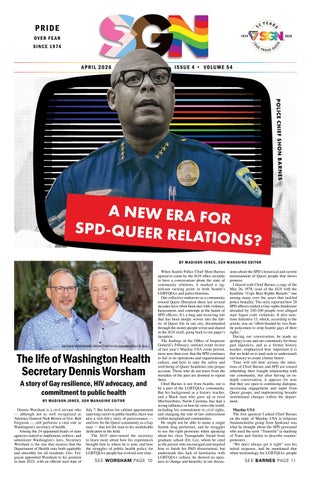
SGN April 1, 2026 - Section 2

Page 1


The life of Washington Health Secretary Dennis Worsham

A story of Gay resilience, HIV advocacy, and commitment to public health

Dennis Worsham is a civil servant who — although not as well recognized as Attorney General Nick Brown or Gov. Bob Ferguson — still performs a vital role as Washington’s secretary of health.

Among the 24 appointed heads of state agencies tasked to implement, enforce, and administer Washington’s laws, Secretary Worsham is the one that ensures that the Department of Health runs both equitably and smoothly for all residents. Gov. Ferguson appointed Worsham to his position in June 2025, with an official start date of

July 7. But before his cabinet appointment (and long career in public health), there was also a rich life’s story of perseverance — and love for the Queer community as a Gay man — that led the man to his unshakable dedication to the field.

The SGN interviewed the secretary to learn more about how his experiences brought him to where he is now, and how the struggles of public health policy for LGBTQIA+ people has evolved over time.

SEE WORSHAM PAGE 10

When Seattle Police Chief Shon Barnes agreed to come by the SGN office recently to have a conversation about the state of community relations, it marked a significant turning point in both Seattle’s LGBTQIA+ and police histories.

Our collective endeavors as a community toward Queer liberation these last several decades have often been met with violence, harassment, and contempt at the hands of SPD officers. It’s a long and recurring tale that has been deeply woven into the fabric of Queer life in our city, documented through the stories people wrote and shared in the SGN itself, going back to our paper’s inception.

The findings of the Office of Inspector General’s February sentinel event review of last year’s Mayday USA event proved, more now than ever, that the SPD continues to fail in its operations and organizational culture, and fails to take the safety and well-being of Queer Seattleites into proper account. Those who do not learn from the mistakes of the past are doomed to repeat them.

Chief Barnes is not from Seattle, nor is he a part of the LGBTQIA+ community. But his background as a history teacher, and a Black man who grew up in rural Murfreesboro, North Carolina, has had a strong influence on how he views the world, including his commitment to civil rights, and changing the role of law enforcement within marginalized communities.

He might not be able to name a single Seattle drag performer, and he struggles to use the right pronouns when speaking about his close Transgender friend from graduate school (Dr. Lee, whom he cited as the person who encouraged and inspired him to finish his PhD dissertation), but underneath this lack of familiarity with LGBTQIA+ culture, he showed an openness to change and humility in our discus-

sions about the SPD’s historical and current mistreatment of Queer people that shows promise.

I shared with Chief Barnes a copy of the May 26, 1978, issue of the SGN with the headline “Cops Bust Rights Benefit,” one among many over the years that tackled police brutality. The story reported how 20 SPD officers raided a Gay-rights fundraiser attended by 250-300 people over alleged state liquor code violations. It also mentions Initiative 13, which, according to the article, was an “effort headed by two Seattle policemen to strip Seattle gays of their rights.”

During our conversation, he made an apology to me and our community for those past injustices, and as a former history teacher, emphasized how important it is that we hold on to (and seek to understand) our history to create a better future.

Time will tell how serious the intentions of Chief Barnes and SPD are toward rebuilding their fraught relationship with our community, but after having an indepth conversation, it appears for now that they are open to continuing dialogue, increasing engagement and input from Queer groups, and implementing broader institutional changes within the department.

Mayday USA

The first question I asked Chief Barnes on the topic of Mayday USA (a religious fundamentalist group from Spokane) was what he thought about the SPD personnel who used the term “Transtifa” (a mashing of Trans and Antifa) to describe counterprotesters.

“We don’t always get it right” was his initial response, and he mentioned that when terminology for LGBTQIA+ people

SEE BARNES PAGE 11

DENNIS WORSHAM (RIGHT) WITH HUSBAND BRUCE BALL

SGN Crossword Puzzle - March 2026

SGN Crossword Puzzle - March 2026

Madison Jones editor@sgn.org (509) 827-7601

Calvin Jay Emerson info@sgn.org (503) 915-5268

SGN Crossword Puzzle - March

2026

SGN Crossword Puzzle - March 2026

SGN Crossword Puzzle - March 2026

SGN Crossword Puzzle - March 2026

Joey Amato • Nova Berger • Frank Gaimari Arul Gnanasivam

Network that connects your dishwasher to the web, for some reason (abbr.)

Untamable

Pesky problem for a princess 11 Completely supports

Grecian urn, e.g.

7 Good sign on a first date 8 "____ to myself because I like dealing with a better class of people." - Jackie Mason

9 Untamable 10 Pesky problem for a princess 11 Completely supports

How contracts are signed 14 Massages some wood? 21 Great ___ Forward

23 Copy that!

Grecian urn, e.g. 13 How contracts are

24 Ancient Nile kingdom 25 Analysts' org. 26 Mexican shawl

28 "___ Splash"

"___ Splash"

32 Member of The A-Team 33 COVID dining innovation

Member of The A-Team

34 Stone Age period

COVID dining

35 Rapper that's often in court?

Stone Age period

Rapper that's often in court?

36 Washington, for one

38 It gives you a little room?

Washington, for one

42 ___-do-well

It gives you a little room?

43 Texter's agreement

36 Washington,

___-do-well

48 Word with 3 or Y for 53D

Texter's agreement 48 Word with 3 or Y for 53D

49 Make penance

Make penance

Earl, e.g.

50 Earl, e.g. 51 "Wow, that's ___ of you!"

"Wow, that's ___ of you!"

Actress Jessica

Automaker supportive of fascism

Sometimes-teasing

OP-ED

What matters most: An essay on the eve of chemotherapy

The following is a personal reflection written by a contributor writer to the Seattle Gay News . It offers a candid glimpse into his journey with illness, shared in the hope of fostering connection, understanding, and resilience.

The house is quiet tonight. There’s just one lamp on, trying its best to hold back the darkness, but honestly, it feels like the darkness is winning. Outside, life rolls on — cars pass by, someone walks their dog, and I can even hear a television down the hallway. But here in my condo, the silence feels heavy, like the home is holding its breath right along with me.

Two days ago, they put in my PICC line. It’s still sore, taped to my left upper arm, a constant reminder that this is real — that chemo isn’t just a word I’ll face in the future but something that starts now.

Tomorrow is chemo. My first treatment. Just writing those words makes my stomach twist.

I should probably say this: writing is my therapy. Putting these words down helps me sort through the mess in my head. It’s how I make sense of all these big feelings. Sometimes, writing is the only way I can face what’s really going on. It lets me breathe.

I won’t lie — I’m scared. Really scared. Fear feels cold and heavy, settling in my bones and refusing to leave. It’s been hang-

ing around for weeks, always in the background, but tonight it’s front and center. Every time I close my eyes, fear serves up new images of what might come next. The unknown stretches out in front of me, and here I am at the edge, shaking.

Sometimes, my body hardly feels like mine anymore. This thing, hairy cell leukemia, has taken over so much of it. It’s actually an extremely rare kind of leukemia — so rare, it blows my mind that I have it. What a strange name for something that’s flipped my entire world upside down.

I’m so tired all the time, like I’m hauling invisible weights. I get out of breath just climbing stairs. My spleen is swollen, a constant, uncomfortable reminder that things aren’t right inside me. Nausea comes in waves, and sometimes it just lingers, making me wish I could feel normal for five minutes. Being sick is my new normal — a running list of what I can’t do or enjoy right now.

At first, when I got the diagnosis, it felt like this disease barged into my life and stole everything I was looking forward to: my plans, my energy, any sense of certainty about the future. It’s been a long stretch of canceled things, of trying to talk but not having the words, of silence when I need answers I can’t find.

But strangely, in all the space left by what’s been taken away, something else has started to grow. Maybe it’s clarity.

When you stare your own mortality in the face, all the little things suddenly don’t matter. I’m aware — sometimes painfully, sometimes beautifully — of how precious each day is. Just being able to breathe without thinking about it or feeling okay for a couple of hours feels huge. This leukemia has taken a lot, but it’s also forced me to really think about what matters.

And you know what? It’s people. It’s the look my husband gives me when our hands touch, the soft sound of our dogs shifting and snoring in the next room. It’s sharing a quiet moment with an old friend and feeling understood. I see love everywhere now, even when it’s mixed in with fear and worry. Before, a conversation was just talk — now, every “I love you,” every hug, every shared story is a lifeline. We talk about things that matter, because suddenly we know we can’t take any of this for granted.

My cancer group therapy has also become a lifeline for me. Knowing there are people out there who really get what I’m feeling has made all the difference. I’d honestly be lost without them and their support. Their understanding lifts me when I feel alone, helping me believe that brighter moments are possible, even in the middle of all this.

So here I am tonight, scared about whatever’s waiting for me in that treatment chair tomorrow. But I’m feeling something else

too —

gratitude. I’m grateful for the doctors and nurses, for the science that’s brought me this far. But most of all, I’m thankful for my people, my family, my friends — everyone who keeps me anchored through the storm. They’re the reason I’ll roll up my sleeve, take a deep breath, and start this fight. I don’t know what comes next. There will be bad days, days when I’m so tired and sick that it feels impossible. But I won’t have to face it alone. If nothing else, this journey has shown me what strength really is, and how powerful love can be.

Tonight, on the night before chemo, I’m terrified. But I know exactly what I’m fighting for. And somehow, that makes me believe I can get through anything.

Frank Gaimari is an author and film reviewer in Seattle, where he lives with his husband and their two golden retrievers. You can learn more about his work at www.FrankGaimari.com

The Society of Professional Journalists is conducting its annual regional conference at the University of Washington-Tacoma campus April 11. The conference brings together professional and student journalists and journalism educators for a program of professional development and networking. We will also recognize the best journalism produced by college journalists in Washington, Oregon, Montana, Idaho and Alaska.

Scan below for more information or to register:

FRANK GAIMARI
Our conference is proudly sponsored by Seattle Gay News.

SAM disregards the Gay history of its new exhibit,

“Beyond Mysticism: The Modern Northwest”

The Seattle Art Museum has a new major exhibition on the third floor, “Beyond Mysticism: The Modern Northwest,” curated by Theresa Papanikolas. It’s large, it’s beautiful — and the museum apparently does not want you to think of it as Gay.

The title is a play on the 1953 LIFE magazine article, “Mystic Painters of the Northwest,” that defined the Northwest School and crowned four men its “mystics,” given this name for their connections to nature, as well as their frankly orientalist and appropriative use of Indigenous and Asian aesthetics.

“The Northwest Mystics” consisted of Guy Anderson, Morris Graves, Mark Tobey, and Kenneth Callahan, who all worked in the art sphere in Seattle at the same time. The exhibition also highlights works by Malcolm Roberts and Leo Kenney (both Gay), along with many amazing works by Asian American artists, including George Tsutakawa and Paul Horiuchi, who were both heavily influential in the scene.

I have seen every painting and photo and read every word of every plaque at the exhibition, and while I have enjoyed my time gazing into the white lines of Tobey and the large canvases of Horiuchi and learned some interesting tidbits about them, I did not once read the words “gay,” “queer,” “homosexual,” or any other mention of the queerness of any of the showcased artists. What I was searching for is that of the original four, three were Gay (the other was Kenneth Callahan).

Of the Northwest art exhibited, at least 30% was made by Queer men, most obviously Graves, Anderson, Kenney, Roberts, and Tobey, who were openly Queer in the 1940s through the ’70s. In fact, two of the original four, Anderson and Graves, dated for a time early in their careers and painted nudes of each other (and gave one to a UW architect they shared a night with). Graves and Roberts also dated each other throughout the WPA era.

If you were to say that you felt that the sexual orientation of the artists or information about their personal lives is not relevant to the work (a frankly ignorant take if ever there was one), I would point to the placards for works by James H. Fitzgerald and Margaret Tomkins, which point out that they were married. Apparently their sexuality and relationship was fit to print for some reason.

If you said identity and minority group affiliation wasn’t relevant to the work (again, ignorant), I would point out how often SAM references the ethnicities of artists and the impact their cultures may have played in the development of their techniques, processes, and works. It’s only when acknowledging the Gay men’s minority position that this exhibition keeps its mouth shut.

Common knowledge

Acknowledging the Queer context and influence in the Northwest School is not even groundbreaking, as it was covered in “The Lavender Palette: Gay Culture and the Art of Washington State,” a 2019

exhibition at the Cascadia Art Museum in Edmonds. That show actually put forward the theory that the reason why Anderson, Graves, and Tobey were so influenced by Asian and Indigenous culture was in fact their belief that they were more accepting of homosexuality and less condemning and prudish than 1930s Seattle.

What has the Seattle Art Museum robbed from its patrons by refusing to contend with the Queer content it wants to exhibit? How do you engage as a patron with Kenney’s Voyage for Two (1953), a psychedelic nearkiss between two heads, when you don’t know this aspect? What about Tobey’s Dancing Miners (1922-1927), a five-foottall image of two bearded men dancing while looking into each other’s eyes? Without context, maybe it’s the celebration of a big score. With some extra knowledge, maybe it’s the earliest romanticization of the Queer west I have ever seen.

Both paintings come with plaques describing only names, dates, and acquisitions — as if the curator didn’t even have the time to bother with more.

Some of you may ask if it’s possible that SAM didn’t know about the sexuality of the

artists it was exhibiting. Well, the book The Lavender Palette, which contextualizes the Northwest modernist movement as one led and centered around Queer artists’ work, was published by the UW Press in 2019 and was written by the curator of that Cascadia Art Museum exhibit, David F. Martin. That book is still listed as for sale (although it is sold out currently) on the SAM website, and it is also in the Dorothy Stimson Bullitt Library in SAM’s downtown building.

It would be frankly nearly impossible for the curation staff to be unaware of the Queer history of the Northwest Mystics and Northwest School and that the movement was led by Gay men from the start.

I am not even the first person to bring this issue of Queer erasure in such an exhibition to light. In fact, I follow in the footsteps of Jen Graves, a former Stranger art critic, who asked why the 2014 Northwest Modernist exhibition also refused to discuss the topic of sexuality, in her article “Why You Should See the Big Northwest Modernism Show at SAM, Despite Its Vast Gaps and Tumorous Excesses.” There is no way this was unknown to the curators. Why?

Friends and family have asked me, “Why?” Why did the Seattle Art Museum put an exhibition together in 2026 that has no mention of Gay men, Queer sexuality, or the Seattle Gay community? Is it that contextualizing the work of the Northwest School as Queer art goes against the wants and needs of the funders? Do the private owners of certain works not want any mention of their Queer context in order to uphold the value of their holdings? Does SAM think so little of its members and patrons that it doesn’t trust us to value Queer art, or that visiting families from Idaho will throw a fit because they have to read the word “Gay” on a placard? Does SAM believe that recognizing the Queer nature of Tobey, Graves, Roberts, Anderson, and Kenney denigrates them? Is it that it devalues SAM’s own collection it has spent many years promoting?

It must be remembered that the Northwest School is one of the Seattle Art Museum’s larger contributions to the art world as a whole, gaining prominence at the same time as the museum itself. While New York had Pollock, we had Tobey; while Europe had the surrealists Dalí and Ernst, we had Kenney and Graves.

It should be noted that to reach worldwide acclaim, Tobey had to stop painting Dancing Miners and Pike Place Market butts in assless chaps and embrace abstract expressionism. In a similar way, Anderson, maybe the original mystic, whose art was the most explicitly or obviously Gay (see Icarus [1949], which is a nine-foot-tall winged nude male) is the mystic least represented in the collection (and was also sidelined in the 2014 exhibition).

So what should SAM do to rectify this? Well, it could start by erecting new placards discussing the Queer history of the Northwest School and make a commitment against Queer erasure in art. All these men (except Kenney) were openly Gay in their lifetimes, and it seems ludicrous to closet them in death.

If the question is whether or not you should see the exhibition, I don’t know what to tell you. It’s a wonderful group of pieces, even if the curation is subpar. I want to say it’s worth going if only to see how they ripped out our history, if only to gaze upon half a story, to cry at an altar to what’s missing, a closet forced on men who have all passed on. I find some of the art so moving, so deeply engaging — and yet I know it can only be half understood, half touched by most patrons, because of what’s missing.

More importantly than seeing or not seeing this collection is reading Martin’s book, The Lavender Palette, which is a real revelation — and demanding change from the Seattle Art Museum. “Beyond Mystics” is just another lost opportunity to engage Seattle’s large Queer community and make these important works resonate.

SPECIAL TO THE SGN
MALCOLM ROBERTS, DRIFT NO 2
KENNETH CALLAHAN FELLER
LEO KENNEY, VOYAGE FOR TWO

SEATTLE NEWS

Hundreds of soaked supporters gather for the Seattle Handmaids’ International Women’s Day march

International Women’s Day is celebrated on March 8 in commemoration of women’s roles in the fight for gender equality and reproductive rights, among other issues. In Seattle, various organizations held rallies and marches that Sunday in protest of the Trump administration.

The most organized of these actions was the one the Defund Musk Women’s Group held in Cal Anderson Park. Also known as the Seattle Handmaids, the group is recognized for its Handmaid Coalition–inspired approach to bringing awareness to societal issues affecting women, involving donning a red cloak and white bonnet and holding signs that state facts and statistics related to gender-based violence and sexist practices by institutions, such as “A rape occurs in the U.S. every 9 sec.” Another highlighted wealth disparity among women: “Women own only 20% of the land.”

The goal of this event was to bring awareness to these issues and heighten the voices of those most affected by poli-

cies and political corruption, including LGBTQIA+ people, women of color, Indigenous women, and women with disabilities.

The Seattle Handmaids first demonstrated in July 2025 at the Tesla dealership in University Village. At the time, the group had 16 handmaids; the number has since increased to 130 volunteers. Their attire references characters from Margaret Atwood’s dystopian novel The Handmaid’s Tale, which tells of a post–United States totalitarian society in which women are stripped of human rights.

Other groups also partnered to organize this event, including the wider Washington State Handmaid Coalition, the Freedom Road Socialist Organization, and Evergreen Resistance.

Nature proved a formidable force on this 40-degree morning, as torrential rains were hurled from the sky, heavy enough to block one’s view from a 20-foot radius. The wet cold was intense enough to chill bones and leave clothes feeling saturated.

Despite these less than ideal conditions, hundreds gathered in an outpouring of support for women’s rights and opposition to President Trump’s harmful policies.

Speakers

Before the march, speakers from various groups addressed the crowd. Organizers Amanda and Zoey began by presenting the Declaration of the Handmaids Coalition, which demands that Congress support the Equal Rights Amendment, which would prohibit discrimination based on sex and ensure legal protections for gender equality.

The FRSO’s speaker Meredith discussed the socialist origins of International Women’s Day, a holiday first declared in 1922 by Vladimir Lenin to honor women’s roles in the 1917 February Revolution. She reflected on how women in the workforce suffer under capitalism, especially migrant women targeted by ICE.

A representative of Seattle Against War spoke on the recent bombing of Iran by the

US and Israel, mentioning that on the first day, the US destroyed a girls’ elementary school, killing 165 children and teachers.

Danni Askini of the Gender Justice League spoke on recent attacks against Trans women, particularly in Kansas, which has a bounty provision against Trans people using facilities not aligning with their assigned sex at birth, as well as a recent law that invalidates driver’s licenses for Transgender people.

In a world that continues to get smaller and smaller for Trans people, Zoey and Amanda said they hope to provide acceptance and sisterhood to them. “I am disgusted and I’m horrified — just being Trans alone is a struggle to identify who you are and be brave enough to come out in that way that we should honor and celebrate,” Zoey stated.

Seattle City Councilmember Alexis Mercedes Rinck and Seattle City Attorney Erika Evans also made speaking appearances and joined in the crowd for the march.

EXCLUSIVE: CEO of Seattle-based AI company accused of nixing Andy Cohen appearance

Jason Maynard, the newly appointed CEO of the tech company Qualtrics, is accused of telling his team to remove Bravo TV host Andy Cohen from a speaking role at its convention, specifically because he is Gay.

The accusation comes from a whistleblower who claims to work at Qualtrics but requested to remain anonymous due to fears over losing their job. They wrote about the company’s annual convention “X4,” which this year is taking place at the Seattle Convention Center. Qualtrics has a small yet notable presence in Seattle’s tech community, leasing 13 stories of offices downtown and employing 500-800 local tech workers.

X4, like many tech conventions, also flies in an assortment of high-profile guests to hype up the crowd. As of January, the celebrity speakers included actress Mindy Kaling, in addition to Cohen. Their names were announced before Maynard, previously a vice president at the tech giant Oracle, was named CEO in early February.

A week later in February, Andy Cohen’s name and likeness were removed from the list of speakers. The whistleblower claims that the timing of this change in the lineup, close to Maynard’s arrival, is not a coincidence.

“Rumors at the office are that this happened because of anti-diversity (LGBTQ+) perspectives, specifically around the orien-

tation and politics of Andy,” they wrote initially. In a follow-up, they later claimed to have confirmed their suspicions, then more directly accused Maynard of saying Cohen “needed to be cancelled because he’s gay.”

After the CEO’s alleged comment, Qualtrics’ website and social media was “scrubbed,” in the whistleblower’s words, of any information revolving around Cohen’s scheduled appearance. However, an Instagram post by the company, in which the social media team highlighted Cohen as a speaker alongside Kaling, was left online. The whistleblower cited the post as evidence, and the SGN was able to confirm its legitimacy as a real, undoctored image.

The whistleblower also claimed Maynard has “donated to politics promoting anti-diversity,” which the SGN confirmed. While working his prior job at Oracle, documents show that Maynard donated a total of around $39,000 to Donald Trump, Sen. Marsha Blackburn, the Republican National Committee, and their respective PACs before the 2024 election. Sen. Blackburn is a hardline Republican from Tennessee, where Maynard previously lived.

The whistleblower also shared a document they claimed to have found in the company drive. They believe there’s more secrecy afoot at the company, though they’re afraid to dig further. However, the document doesn’t actually bolster the

whistleblower’s case that the company targeted Cohen’s sexuality. Instead, it allegedly presents a second motive: Andy Cohen is too scandalous to have as a keynote speaker.

It would be unfair to say Cohen doesn’t court controversy. He recently gave an inebriated rant, live on the air, against former NYC mayor Eric Adams. In addition, Housewives franchise star Leah McSweeney is suing Cohen and his producers at Bravo for allegedly preying on her alcohol addiction while on set. The details of said lawsuit will soon be heard publicly in court, and, while the phrasing is vague, Qualtrics seems to be aware of this.

“Andy Cohen has appeared in news coverage tied to broader scrutiny of realitytelevision culture and workplace dynamics at media networks,” reads the document, “including allegations raised by former cast members… While these claims have not resulted in criminal charges, civil findings, or substantiated investigative conclusions against Cohen personally, they have contributed to renewed online discussion and perception risk.”

Not all of the whistleblower’s accusations could be confirmed. These include claims that Amy Barone, who helped manage 2025’s X4 and allegedly handles the convention’s celebrity speakers, is “doing some sort of cover-up” regarding Maynard’s comments on Cohen, and that author

Priya Parker was removed from her speaking spot because Maynard “does not want to share a stage with a Seattle liberal hippie.” He allegedly said that she would make him look bad, and that he finds Parker’s speaking voice to be annoying. He said he would visibly express his annoyance with her voice if they were seen together.

On X4’s first day, the convention’s website was updated to include just one confirmed session with Parker, titled “Experience in the Moment,” contradicting the whistleblower’s claim about Parker’s removal. The session was made publicly visible the day after the SGN reached out to Qualtrics for comment.

“We’re disappointed these allegations were published despite repeated clarifications and documentation that contradict them,” wrote a Qualtrics spokesperson in response to the accusations. “We’ve been clear about the facts, and the record does not substantiate the allegations. Qualtrics is committed to welcoming all viewpoints and fostering an environment where people are respected and supported.”

X4 took place March 17–19 at the Seattle Convention Center’s Summit Building. Other celebrity guests, including comedian Colin Jost, Gov. Bob Ferguson, and Pitbull, were set to appear during the three-day event.

(L-R) ANDY COHEN AND JASON MAYNARD

From organizing to office:

LGBTQ leaders on running, serving, and staying grounded at the Victory Institute Summit in Seattle

Reprinted with permission from OutNW

At the Victory Institute’s Leadership Summit [on Feb. 28], a panel of LGBTQ elected officials and candidates offered a candid look at what it takes to run for office — and to serve.

The summit opened with a Campaign 101 session, “Roadmap to Campaigning,” led by Itay Balely, director of training and leadership development at the LGBTQ+ Victory Institute. Balely outlined the fundamentals of launching and sustaining a viable campaign, grounding attendees in strategy before the deeper discussions began.

The LGBTQ+ Victory Institute works to increase the number of LGBTQ+ people in public office by providing leadership development, trainings, and a professional network for LGBTQ+ leaders pursuing careers in the public sector. Its signature candidate and campaign trainings have helped thousands of LGBTQ+ candidates develop the skills to run for office. Alumni include US Reps. Robert Garcia and Sarah McBride, Colorado Gov. Jared Polis, Virginia state Sen. Danica Roem, Montana state Rep. Zooey Zephyr, and former Houston Mayor Annise Parker.

The Institute’s David Bohnett Leaders Fellowship provides outstanding LGBTQ+ elected and appointed officials with executive leadership training at the Harvard Kennedy School of Government. In addition, the organization maintains Out for America (outforamerica.org), a comprehensive resource identifying currently serving, openly LGBTQ+ elected officials across the United States at every level of government. The platform allows users to filter by region, level of office, sexual orientation, gender identity, race/ethnicity, and party affiliation — offering a clear picture of LGBTQ+ representation nationwide.

According to the Victory Institute, more than 46,000 additional LGBTQ+ people would need to be elected to public office to achieve full representation at all levels of government.

Looking ahead to 2026, the Victory Institute will host LGBTQ+ Candidate & Campaign Trainings in Philadelphia (April 23–26), with an optional extended training for Trans and gender-expansive participants; and Denver (July 9–12), with an optional extended training for LGBTQ+ women. (For more information, visit victoryinstitute.org/cc or email training@victoryinstitute.org

The conversation Following the opening training session, the panel discussion brought the area’s newly elected officials to the stage.

The conversation began with Seattle City Councilmember Alexis Mercedes Rinck reflecting on the early, uncertain days of

her campaign. Before filing paperwork or hiring staff, she called her community. She reached out to elders, friends, and trusted supporters to tell them she was considering doing something “kind of crazy.”

Their hesitation wasn’t about her qualifications. It was about her safety, her wellbeing, and the personal toll of public life. Those concerns forced her to weigh not just whether she could win but whether she was prepared for the scrutiny and sacrifice. In the end, she committed to staying grounded — to doing the mental work necessary to campaign without losing herself.

Pierce County Executive Ryan Mello traced his preparation back to years of community organizing. From environmental advocacy to defending marriage equality in Washington state, his path was built on movement work. Training through the Victory Institute sharpened his skills, but the foundation was relational organizing — building networks, earning trust, and mobilizing people at scale. On the campaign trail, he said, the priorities narrow quickly: talk to voters and raise money. Everything else is secondary. Clear, measurable goals — and a team aligned around them — create stability in the chaos.

Seattle City Council President Joy Hollingsworth spoke about the logistical realities of running while managing the rest of life. During her campaign, she was balancing school, relationships, and IVF treat-

ments. Discipline became essential. She scheduled her time tightly and constantly looked for ways to be more efficient. […] Efficiency wasn’t just about productivity; it was about survival. There was satisfaction in ending a day knowing she had made the greatest impact possible with the hours she had.

All three panelists emphasized the importance of support systems. Help doesn’t always look glamorous. It can mean someone hosting a small fundraiser in their living room, building a website, or bringing over dinner during a grueling week. Campaigning is sustained by community in both visible and invisible ways.

The discussion turned to representation and what happens when the cameras are off. Mello described closed-door negotiations during his time on the Tacoma City Council, where values are tested in real time. In one round of labor negotiations, he insisted that gender-affirming and Transgender-inclusive healthcare be treated as a non-negotiable benefit for city employees. Those decisions rarely make headlines, he noted, but they shape people’s lives. Who holds office matters most in the rooms the public never sees.

Rinck connected that point to broader challenges facing Transgender communities. Even in cities with strong legal protections, she said, affordability can undermine inclusion. Seattle is experiencing an influx

of Trans people fleeing hostile legislation in other states, only to confront an extreme housing crisis. Legal rights on paper are not enough if people cannot afford to live safely.

Fundraising — a topic that often intimidates new candidates — was addressed head-on. Rinck described having to reframe her discomfort with money. Campaign funds are tools for communication: mailers, events, outreach. Mello echoed that reframing, reminding himself that donors were investing in the work he was prepared to do. Whether in rural areas or urban centers, the fundamentals remain the same: build relationships, expand your circle, and make the ask.

The emotional weight of public service also surfaced. Elected officials often absorb constituents’ trauma and crises. Rinck described feeling like “the people’s therapist” at times. Her strategy is to be fully present in those moments, then intentionally release that energy later — by changing clothes, resting, and finding ways to reset. Without boundaries, she warned, the work can become overwhelming.

When asked how to take the plunge into running, Hollingsworth offered a dose of realism: you will never feel completely ready. Confidence grows through preparation — watching other leaders, studying how they conduct meetings, and understanding the mechanics of governance — but discomfort never disappears entirely. Mello reinforced the importance of a clear, data-driven plan to anchor candidates amid the controlled chaos of a campaign.

Rinck closed with characteristic honesty. After years working in homelessness and human services, she grew frustrated watching elected officials avoid difficult decisions. At some point, she stopped asking why they wouldn’t act and started asking why she shouldn’t. That spark — part anger, part determination — propelled her from advocacy into candidacy.

Leading with community “2026 has been a stark reminder that the results of elections aren’t abstract,” Balely added. “The people we elect to make decisions shape our daily lives. The LGBTQ+ Public Leadership Summit we held in Seattle not only celebrated strides toward better LGBTQ+ representation but paved the way for more LGBTQ+ leaders to get into the arena by leaving them with hard skills and a plan to take action. Having a seat at the table shifts the conversations in ways we cannot measure. Leading with community, like our summit in Seattle did, gets us one step closer to a fair and equitable world.” At the Leadership Summit, the message was clear: running for office is demanding, deeply personal work. It requires community, discipline, resilience, and values that hold firm — even when no one is watching.

VICTORY INSTITUTE LEADERSHIP SUMMIT
COURTESY MK SCOTT
COURTESY MK SCOTT
All hail the rainbow gospel! Drag Church celebrates its one-year anniversary with “REBIRTH”

When Kitty Smith, an artist disgruntled with Trump’s reelection, began to draw dragified versions of Jesus in 2024 to protest the increasing negativity toward LGBTQIA+ people across the country, never did she expect her idea to “yassify Jesus” would transform into a full-blown, flamboyant church service.

Working with Kara Sutra (the drag mother of the Haus of Sutra), she had decided a year ago to create a nonreligious, all-ages space for LGBTQIA+ people to build community together, called Drag Church. Now as they move toward their first anniversary, the duo plan to up the ante of extravagance and community engagement with the upcoming service, aptly named “REBIRTH.”

According to Smith, Drag Church was formed as a way to offer Queer people an alternative, nonreligious space for community building. She explained how, while showing her yassified portraits before Drag Church, that “it became clear [that people’s reactions were] a response to a very real and present need for connection and joy. People shared stories of exclusion and harm, and in that space, something began to shift.” She added that “Drag Church started to take shape as a radically inclusive and joyful gathering, where people could reclaim spirituality and reconnect with a sense of belonging on their own terms, because everyone deserves to feel holy in their own bodies.”

Kara Sutra told the SGN that although the Haus of Sutra has evolved over time from doing exclusively drag to adding, among others, burlesque performers, comedians, and fire dancers, there was still a need to grow the ability for it to connect with younger Queer people under 21 years old.

“I would get 18-year-olds asking if they could come to the shows,” she said.

She also stressed how important the Drag Church has become in engaging younger people in the art form: “I think that diversifying access is super important.”

In its time, the Drag Church has worked with and helped support local nonprofits.

At its last show, plants were sold to fundraise for the cost of new furniture for Lambert House. (The proceeds of “REBIRTH” will also benefit Lambert House.)

Challenging norms

Drag Church was also intended by its

founders to demystify drag in front of a Christian audience, and to challenge people’s perceptions of the divine.

“Drag is a protest wrapped in a sequined glove,” Smith said. Kara Sutra agreed.

Kara Sutra told the story of how she showed her conservative mother the

recorded video performance of the Christmas show, called “The Yassification of Ebenezer Scrooge,” and watched in her facial reactions how she had to reconcile what she was seeing with what she had been told drag was from watching Fox News. The hope is that by exposing her mother to the art, she is forced to reconsider why she believes in anti-Queer sentiments.

Smith also shared that the church has been asked by attendees to do a preschool program, so that children may have a nonreligious environment (as most preschool programs in the US are still run privately through churches). The idea of taking Drag Church on the road has also been floated, inspired by the work of others, like Flamy Grant, who does Southern drag church tours.

The threat of violence against LGBTQIA+ people, particularly in drag spaces, has been a concern for the duo. After the bomb threat and gun shots against Renton’s Brewster bar and its owner’s house, because of a children’s drag story hour event held there, the Drag Church instituted a clear bag policy.

Ultimately, the pair’s hope is that one day their concept will be as ubiquitous as Turning Point USA, which has recently pushed heavily to be on every high school campus. The two shared their feelings that every community in the US should have access to an all-ages, Queer-affirming space. Smith explained how the new event “marks our one-year anniversary and centers on a timely theme: what it means to rebuild when old systems no longer serve us. At a time when many in our community are searching for something that feels both safe and expansive, Drag Church offers a space rooted in radical joy as a deliberate, collective practice of resilience, visibility, and reimagining what becomes possible together.”

Tickets for Drag Church: REBIRTH on April 4 can be found at https://ticketbud. com/events/7672416e-00b5-11f1-bf6a42010a717003

JESSE SIEDEN

Upbringing

Dennis Worsham was born in Othello, Washington, in 1964 to a Mormon household that was not accepting of Queer people. He shared what is was like as a youth to have to hid his Queer feelings from others.

“My story is not unlike so many [other] people in those rural communities or environments,” he related. “All the things you have to do to make sure you’re fitting in were always top of mind… My earliest remembrance was probably just before turning eight years old. I was raised Mormon, and in the Mormon church you’re baptized at eight. I remember sitting in front of an elder in the church and wondering, ‘Do I share that I like boys or not?’

And something, you know, in our social environment told me it wasn’t a safe thing to share.”

Another core memory Worsham shared was of hiding his queerness at 12 years old, when his family’s religious community organized against the Equal Rights Amendment. He recalled his mother at the time coming home one evening, after being at a march in opposition to the measure, pointing out to him that “there were homosexuals there.”

When he asked his mother to explain what a “homosexual” was, her description gave him language to understand his dominant feelings for the first time. His mother stated, “It’s when somebody loves somebody of the same sex.” He suspects now that his mother may have known intuitively that he was closeted at the time, although his mother reportedly doesn’t think so. He reflected on the importance of that moment: “I thought it was a gentle way of saying that. It wasn’t in a derogatory way or anything, and it was the first time I had a definition for what I felt.”

In his high school years, he described spending most of his time trying to fit in, and doing everything he could to change himself to be straight, despite it taking a toll on his mental health.

“It just really wreaked havoc on me to be different and not feel, you know, a part of the mainstream,” he reflected.

College and coming out

But once Worsham started attending college, things began to change as he started to discover both himself and his passions. According to him, it took time to unlearn the conservative beliefs that were engrained from a young age. When he served as student government president of Columbia Basin Community College, the issue of HIV/AIDS started to become known on campus. Although his colleagues put forward a measure to add condom machines in campus restrooms, he remembered vetoing the measure because of how he was brought up. Later on, after he graduated and came out, he remembered calling back to apologize for what he did: “It was such a mistake,” he said. “I hope you’ve put condoms in the bathroom.” To which they responded: “As soon as you left, we put them in.”

But it was at Eastern Washington University where his passion for public health and community advocacy really began to shine. He continued to serve in student government as president, and ran on a platform of bringing student health to the campus.

“It was the only four-year university in the state of Washington that didn’t have student health, and [I] really saw the inequities of not having access,” he said of the situation. Before he graduated, the EWU student government was able to get a student health program approved, and as a strong proponent, he was even offered a job to get it started.

But it was also during that time Worsham began his coming-out process. He recalled that his initial plan was to graduate and move to Seattle, where he wanted to fully come out as Gay; however, he ultimately decided the opportunity to stay and work at EWU was too good to pass up.

When he came out at the end of his studies at EWU in 1991, he started attending

panels to talk with others about his journey as a young Gay man. He explained how challenging it was at the time “to dispel these myths about the Gay lifestyle, who Gay people are, and Gay men in particular.”

But alongside that, he also admitted how “it was [also] healing, because as we tell our story, there’s a healing component, and also some empowerment, because I started being able to say my story out loud. And, it’s probably what gave me that journey of wanting to step more into Queer health and Gay men’s health.”

HIV advocacy

As Worsham became more involved with Gay and HIV advocacy around Washington state, he slowly made the transition in his career from student health to public health, and HIV in particular. He mentioned how badly he wanted to work for an organization called the Northwest AIDS Foundation at the time, but how also unfortunately it didn’t have any openings.

Worsham talked about an elder he admired named Malcolm, who was heavily active in HIV work: “He was this phenomenal health educator… unapologetic about being a Gay man. And he was [also] part of the ACT UP movement and all of those things during that time.”

This elder tipped off Worsham about a new opening in Snohomish that got him his start in the field. According to Worsham, “ACT UP was upset that the government in Snohomish County hadn’t done anything to really address Gay men’s health, and so I was the first openly Gay person to be hired into doing that work up in Snohomish County.”

Worsham shared how working in public health during the HIV epidemic skewed his worldview of what was possible for his life

as a Gay man: “In my late 20s, I was feeling like… will I live to be 40? Will I live to be 35? And, is this my path? The sense of normalcy of young Gay men dying in their 20s and 30s became a community norm.”

He added that in his new job, “I only saw people [at first] who were dying, and who were suffering [with HIV]. And you can’t help but think about your own mortality, and the impacts a lack of federal government actions had.”

The homophobia Worsham encountered during those times also stands out distinctly in his memory. He shared how he had started a group called the Speakers’ Bureau to help bring HIV-positive people to schools around the region, to educate young people on the disease and combat the associated stigma. However, the speakers weren’t always so well received by the community. “I remember being up in Arlington,” he said. “And I have this guy who’s courageous, living with AIDS, on stage telling his story, and some kid stood up and said, ‘I hope you die’ and the crowd was clapping.”

Worsham pointed out that during those times, just as activists were bringing awareness to AIDS as a disease, there was also a strong social justice movement doing incredible things. And the line between his own journey and that of the Queer community became to feel deeply overlapping.

“I was so in the mix of it that I couldn’t really see where I began and where my work began, or where they stopped or intertwined,” Worsham said, “because the fabric was just so woven for me on both sides. It was my story, it was the story of others. And yet, it was a community of people who were like me that were suffering. And it was just a very surreal time.”

Worsham also gave his overall impression on the legacy of those times: “In the

state of Washington, had it not been for the HIV epidemic [and] the mobilization of communities, [there would not be] so many of the wonderful things that we have now. It cost a lot of lives, and a lot of suffering, but it is on the shoulders of those people that I’m so grateful.”

Queer health today

The SGN asked Secretary Worsham about the state of LGBTQIA+ community health in Washington today, and how it has changed over his career. The secretary emphasized the benefits of local government entities like the Department of Health, which now collect information on health outcomes of Queer residents, and how that helps policymakers tackle issues the community faces more precisely. He also lauded the progress made in hospitals and clinics offering LGBTQIA+-specific health services, including gender-affirming care, and touched on the advancements that have been made in HIV health and medication in recent years.

“ We have medications that really now have moved [those living with HIV] to a chronic condition, and we have moved into PrEP medications that really are blockers for HIV transmission,” Secretary Worsham said appreciatively. “We have come a long way… I mean, I never thought I would see medications like we have now in people living [with] a chronic condition, which is really pretty amazing.”

However, he pointed out that there were also some new health challenges that have unintentionally come with the advent of new medications. The secretary mentioned that in the ’90s, after the HIV epidemic began to subside, there was a backlash movement to make Gay sex feel “less dirty,” which led people to have more unprotected sex, and now that PrEP can quell people’s fears of HIV transmission, a similar trend has emerged that has increased the rates of unprotected sex — and transmission of other STIs — among the local Queer community.

“It has really opened up other disease paths,” he explained, “and of course gonorrhea and syphilis in men who have sex with men is pretty high, higher than it was when I was doing the education work. So, I do think we have some work around that in our community in particular as a concern.”

Overall, the secretary acknowledged that it will take ongoing work to find a balance between not making Gay sex feel like a “dirty thing” while also raising concerns about disease in the community, so as to make sure people protect their own health and that of others.

Mental health and Trump Secretary Worsham raided additional health issues that continue to disproportionately impact LGBTQIA+ people, including tobacco and recreational drug use. But out of everything, he believes that

DENNIS WORSHAM AGE 13 WITH LITTLE BROTHER DAVID WORSHAM AGE 2
DENNIS WORSHAM IN COLLEGE CAROLING GROUP 1980s

mental health is “the hardest journey we have ahead of us right now in our community… Suicide rates continue to be high, and I think under this [Trump] administration, they’ve gotten worse.”

The secretary stressed the importance that stress itself has on negatively impacting people’s lives, even citing a source that found that those with chronically high stress levels had worse health outcomes than those who smoked a pack of cigarettes a day. He noted that the World Health Organization defines public health as not just the absence of disease but also people’s overall well-being and preventive factors, including stress reduction.

He touched on the recent challenges of federal funding cuts to Medicare and Medicaid under Trump, as well as the attacks on

BARNES

CONTINUED FROM COVER

changes over time, it makes it hard for SPD officers to know which terms are and are not appropriate to use in what context. I saw this explanation as emblematic of a broader lack of understanding on the SPD’s part to recognize the term’s significance and use the moment as a learning opportunity.

I explained to him how the term, first used by the Mayday event’s security liaison before the SPD adopted its usage, was clearly meant as a pejorative to demean Queer, and especially Trans, people. I added that the purpose of Mayday USA’s “Save the Children” event in Cal Anderson Park that day was itself intended to depict Queer people — and again Trans people especially — as indoctrinating and preying on children.

It was also important for me in that moment to share with him my own feelings that, as a Trans woman, it was immensely hurtful to see the SPD adopt terms like “Transtifa” uncritically, as well as to see Police Outreach Engagement Team (POET) members only communicate with

gender-affirming care and erasing of Transgender people in government language and data collection. “They’re scrubbing our language out of our data points that the federal government collects,” he emphatically stated, “trying to erase a group of people and change the history… taking down plaques at Stonewall… I mean you can’t, as a Queer person, watch this and not have some kind of a reaction to it that is toxic in our bodies.”

The secretary of health was asked how he protects the health information of LGBTQIA+ residents, particularly in instances of federal data collection requests.

“Our governor is highly committed to data protection, and we have a really strong legal path here in this area,” he replied,

Mayday USA and not local Queer representatives.

“I am from Eastern Washington, so I know what these people are like. I grew up with them in school and at church,” I told him.

In a follow-up, I asked him how he would address those who might have lost some of their trust in the SPD after the OIG report. The chief said the SPD made a conscious decision to participate in the sentinel event review in good faith to take accountability, and to help come to a resolution about what went wrong and how to improve the department for the future.

He also acknowledged the broader importance of the event being at Cal Anderson Park, which is both in the center of Seattle’s historically Queer neighborhood and named after the city’s first openly Gay state elected official. Chief Barnes questioned how Mayday USA and Seattle’s Park & Recreation department were not also under scrutiny for their actions regarding the event.

Finally, he recognized that, outside of implementing the report’s recommendations, his department has a lot of work ahead to rebuild the trust that had been lost

adding, “We have very strong laws in the state of Washington that protect us in not sharing that data, and if the federal government tries to play a hard card, our AG’s office is quick to step in and interrupt that through a legal process.”

Love wins

The conversation ended on a warmer note as the secretary was asked to share a little bit about his husband Bruce Ball and their over three decades of partnership.

“He’s, as they say, my better half,” he said.

According to the secretary, his husband came out later in life. While serving in the military, he was arrested for being Gay and was detained for a week. While being investigated, “he never confessed.

from the SPD’s response to the event.

“It’s like rebuilding a sandcastle: we have to start with one grain of sand at a time,” as he described it.

Learning to be uncomfortable

As our conversation came to a close, I asked Chief Barnes how it felt to attend the SPD LGBTQ+ Advisory Council meeting in February.

“It made me sad, because I saw the fear in people,” he said. The chief touched on the attendees’ anxieties toward the authoritarian actions of the Trump administration regarding election interference, its antiLGBTQ+ policies, and ICE.

“In the past, it was the federal government people looked to for safety,” he pointed out, citing the Little Rock Nine (the first Black teenagers integrated into a whites-only high school in Little Rock, Arkansas in 1957, escorted by federal troops).

He also openly stated that “it’s not good” that no other Seattle police chief had ever attended the meetings, which have been held for over a decade.

Chief Barnes ended our conversation by positing that any form of constructive part-

They had no proof, and pulled [his] security clearance at that time. [The] only two things that [his clearance] could be pulled for was either giving information to Russia or being Gay. And so people knew what his clearance had been pulled for.”

Once marriage equality arrived and the two became legal spouses, he pointed out how stark the contrast was for his husband in that moment.

“You can imagine, from his time of being incarcerated for a week and questioned to a time that I now carry a military spouse card — because he ended up retiring from the military doing reserves — [we have come] a long way over [that] period of time. And he’s a kind, just really wonderful man. This September will be our 31st year together.”

nership requires each party to accept that being uncomfortable is an inevitable and necessary step in the process of humans learning how to do better by one another. The harm done must be fully recognized and apologized for, good-faith amends must be made, and a concerted dialogue between both parties will need to be kept up if there is any hope for the future of SPD–Queer relations. Chief Barnes mentioned that as law enforcement, “we are the most visible form of local government.” And just like any other local governmental body, we the citizens of Seattle have the power to influence and ultimately change how we want the system to work for us, including our own police department. The road ahead to enact those change will not be easy, but as someone who claimed to have strong beliefs in the principles of democracy (a character trait that is sadly absent in many of our elected officials these days), Chief Barnes has shown a willingness to begin the process on the SPD’s end to take accountability, and open the floor up to the people. It will be our choice as a community to decide how we want to show up in the future.

ARTS & ENTERTAINMENT

Local bands bring the noise at Chop Suey's second Trans Music Showcase

Seattle, known for its music scene, has produced many world-renowned rock stars and bands, including Jimi Hendrix, Nirvana, and Alice in Chains. Recently, one Trans musician, May Graves, took it upon herself to organize a monthly live showcase of Transgender musicians and bands in the Puget Sound area.

The Trans Music Showcase, hosted at Chop Suey on the third Saturday of each month, features musical acts with at least one Trans person. In addition, 20% of the proceeds from ticket sales are donated to the Gender Justice League.

Graves started the event, inspired by a previous show by her band Doll Scheme at Chop Suey in September 2025. That precursor was an emo rock-themed showcase of four Trans-fronted bands: Mike’s

Emo Band, Overripe, Worms in the Dirt, and Doll Scheme. Graves described it as a really great time, with an amazing turnout of Queer music fans.

Afterward, Graves decided to reach out to Chop Suey about making it monthly, each with different themes. The first official show in this series of performances was on February 21, for which the genre was punk. The lineup consisted of the bands Tripe, Auntie Death, and Pregnant Dad.

For March’s showcase, there wasn’t a specific genre or theme; instead there was a diverse presentation of rock genres and electronic music. The roster consisted of Modern Bird, a newer rock band performing one of their first shows; XEK, a solo artist who does industrial and dark wave

Seattle Women’s Chorus opens a new chapter with Legacy

Reprinted with permission from OutNW

The Seattle Women’s Chorus introduced its new resident conductor, Beth Ann Bonnecroy, [on Feb. 28 and Mar. 1], and she’s a wonderful addition. Engaging, expressive, and clearly connected to the singers, Bonnecroy led the group through Legacy, a program that felt more focused and substantial than many of [the chorus’s] recent concerts.

SWC has always put together strong set lists, but Legacy stood out for its depth and cohesion. The theme centered on the idea that legacy isn’t about fame or wealth but the impact we have on others — through our values, our relationships, and our courage. The program explored how everyday actions shape the way we are remembered and how influence can ripple through families, communities, and generations.

The concert blended choral works with spoken text and video elements. One of the most powerful moments came with Alysia

Lee’s “Say Her Name,” featuring exceptional solo work by Jordan Pontelandolfo. The piece honored women — particularly Black women and Nonbinary individuals — whose lives were taken by violence and hatred. The spoken reflections woven into the performance underscored the importance of remembering and speaking their names. It was direct, moving, and difficult in the way meaningful art sometimes needs to be.

Other highlights included “Does the World Say? ” by Kyle Pederson, with beautiful solos bv Catey Rose and Ariel Young. Their performances brought warmth and sincerity to themes of identity and belonging. A recurring message throughout the program — “You are not alone. Be who you are. Love who you love.” — felt especially relevant and heartfelt.

The concert also incorporated reflections by leaders and activists such as Jane Goodall and Gloria Steinem, connecting the idea of personal legacy to broader movements for

music; Shamebanger, a punk rock band from Seattle; and Grave’s Japanese rock–inspired band, Hetakuso. Modern Bird, despite being new to the scene, were able to engage the crowd and exceed expectations. XEK’s synthwave performance was fascinating; her presence made for a fun addition, and the transition from headbanging rock to dance floor beats really made the night.

Shamebanger, described as a punk band with a sharp political edge, delivered on just that. Most of their lyrics covered political issues and systemic injustices, which resonated with the crowd, whose emotionally charged energy makes these shows so cathartic. Last but not least was Hetakuso, which takes inspiration from J-rock bands that perform the closing-title themes for

anime. The vibes were not lost in this final act, which felt both exciting and serene, the perfect ending for a night of music and fun.

Next month’s show is set to be a showcase of Trans indie musicians. Graves revealed to the SGN an interest in expanding on the Trans Music Showcase in April by including art vendors and working with more organizations outside the Gender Justice League, including the Queer Sick Pay Fund, a newer charity that provides sick pay to Queer performers and grants to Trans people for gender-affirming procedures.

Overall, it’s a very fun way to expand your horizons by supporting local bands and connecting with the Seattle Queer community.

justice and equality. Toby Young’s setting of Emily Dickinson’s “My Letter to the World” provided a quieter, reflective moment, while Joan Szymko’s “Myr, Zaraz” (Peace, Now) offered a stirring call for peace as the foundation for any meaningful progress.

While much of the program carried serious themes, SWC didn’t abandon its sense of joy. The energy lifted with Bob Dylan’s “The Times They Are A-Changin’” and “Seize the Day” by Alan Menken and Jack Feldman. The finale — a sing-along combining “Put a Little Love in Your Heart” and “Love Train” — brought the audience

fully into the experience, ending the afternoon on an upbeat, communal note. This was likely the most serious concert the Seattle Women’s Chorus has presented in years, and it paid off. Under Bonnecroy’s direction, the ensemble felt focused and confident, willing to take on weightier material while still delivering the warmth and connection their audiences expect. Overall, Legacy was a thoughtful and satisfying Sunday afternoon concert — one that balanced reflection, activism, and joy, and marked an exciting step forward for the chorus.

MODERN BIRD
ALL PHOTOS BY ARIN WALLER
COURTESY MK SCOTT
HETAKUSO

Kris Andersson’s journey: Tupperware, theater, and fabulousness!

Kris Andersson is a name that might not immediately ring a bell, but his alter ego, Dixie Longate, has been making waves in theaters worldwide for over two decades. Born on November 29, 1969, in Ohio, Andersson has built a career that is as unique as it is inspiring. With a background in acting and a knack for storytelling, he has transformed a simple idea into a global phenomenon, proving that creativity and resilience can take you anywhere.

Before Dixie came to life, Andersson was a film and TV actor in Los Angeles, with roles in major productions like Titanic and Scream 2. But his career took an unexpected turn in 2001 when a roommate hosted a Tupperware party. What started as a humorous observation about the world of food storage quickly evolved into a theatrical masterpiece. Andersson created Dixie Longate, a brash, hilarious, and empowering character who uses humor and charm to sell Tupperware while delivering messages of self-worth and strength.

Dixie is more than just a character; she’s a force of nature. Drawing inspiration from Brownie Wise, the trailblazing woman who revolutionized Tupperware sales in the 1950s, her story resonates with audiences from all walks of life. Through her performances, Andersson weaves humor with heartfelt moments, encouraging people to embrace their individuality and find strength in their own stories.

Since its debut at the 2004 New York International Fringe Festival, Dixie’s Tupperware Party has become a beloved staple in theaters across the globe. The show has grossed millions, sold hundreds of thousands of tickets, and earned Andersson a loyal fan base. But beyond the numbers, it’s the personal connections that make the show special. Dixie’s ability to connect with her audience, both on and off the stage, has created a community of fans who see themselves in her story.

Offstage, Andersson is a thoughtful and introspective artist who values authenticity. As an openly Gay performer, he has used his platform to challenge stereotypes and celebrate individuality. His journey from a small-town upbringing to international success is a testament to his creativity, determination, and ability to turn life’s unexpected moments into opportunities.

Frank Gaimari: What inspired you to create Dixie Longate, and how has she evolved over the years?

Kris Andersson: I started selling Tupperware 25 years ago, just trying to make a little extra cash between entertainment jobs. Back then, it was all about filling the

gaps and staying afloat. Then, one day, a friend dared me to try selling in drag. It was one of those moments where you think, “Why not?” So I decided to give it a shot. I thought I’d have a few parties, make some money, and then move on. I had no idea that Dixie would take on a life of her own and completely change my life.

From the start, Dixie was this good Southern gal: charming, relatable, and full of personality. Over the years, she’s grown and evolved. She’s a little more polished now, and let’s be honest, a little feistier too. But at her core, she’s always been about empowerment. I wanted her to be someone who lifts people up, makes them laugh, and leaves them feeling better about themselves. I never wanted her to be meanspirited or cynical. Dixie is all about joy, positivity, and just the right amount of sass. It’s been an incredible journey watching her grow and connect with so many people. I’m constantly amazed at how much she’s become a part of my life. What started as a dare turned into something I never could’ve imagined, and I’m so grateful for it.

FG: How did your early acting experiences in films shape your approach to theater?

KA: I’ve always done theater, so stepping into Dixie wasn’t all that different from approaching any other character I’ve played. But what’s been truly special about Dixie is the time I’ve had with her. Over the years, I’ve been able to build her out in ways I never could with other roles. Every little nuance, every piece of her backstory — It’s all been carefully crafted, and she’s become the most fully realized character I’ve ever had the chance to play.

What really sets her apart, though, is the audience participation in my shows. Every performance is a little different, because I’m constantly interacting with new people, creating moments on the spot, and coming up with stories in real time. It’s this everchanging dynamic that keeps Dixie fresh and exciting, not just for the audience but for me too. She’s grown so much over the years, and I think that’s because she’s not just shaped by me — she’s shaped by every person I’ve had the privilege of performing for. It’s been an incredible journey.

FG: What challenges have you faced as an openly Gay artist in the entertainment industry?

KA: Honestly, I don’t think being Gay has caused many hurdles for me in the industry. Most of the time, it doesn’t even come up. The bigger challenges come from

being seen as someone who only does one thing. Many people in the entertainment world tend to associate me with Dixie, and they stop there. This has definitely limited other opportunities for roles and projects where I would be a good fit.

I have loved playing one role for so many years, but I know that at some point, I’ll have to retire Dixie completely and shift gears. Playing Dixie has brought me countless opportunities — I’ve been lucky enough to perform all over the world and write four different shows for her. For two and a half decades, I’ve truly lived in her world. But now, the challenge is getting people to see past the red wig and recognize what else I can do.

FG: What’s the most memorable reaction you’ve received from an audience member during a show?

KA: After 17 years on the road, I feel like I’ve seen it all. One of the most memorable moments was early in my career, when a pregnant woman’s water broke suddenly. Another time, a woman laughed so hard that she peed on the couch she was sitting on! I’ve also had several people faint or pass out during shows.

And I can’t forget the three different cities where tornadoes came through while I was performing. That’s a whole other level of chaos! Every show brings something new, and that’s what makes it so exciting. The audience reactions — whether they’re funny, unexpected, or just plain crazy — are what keep me on my toes and make every performance an adventure.

FG: If RuPaul called and asked you to appear on Drag Race, would you say yes?

KA: Honestly, no. I don’t think I’d be a good fit for that show. Those performers are so insanely creative and clever — they’re constantly coming up with these incredible looks and concepts. Dixie, on the other hand, is pretty much one look, and I don’t think I’d do well trying to come up with different hair colors, costumes, and ideas for an entire season to keep people entertained. Plus, I’m a terrible lip-sync performer, so that alone would probably send me packing quickly! It’s such an amazing platform, but I know my strengths, and Drag Race isn’t where I’d shine.

FG: What advice would you give to aspiring playwrights and performers looking to break into the industry?

KA: Honestly, I’d say the best thing you can do is take initiative — do as much as

you can on your own or find a group of like-minded, creative people to collaborate with and develop projects together. This is a tough industry to gain traction in, and waiting around for someone to give you an opportunity can feel like an endless uphill battle. But when you create your own work, you’re not just waiting for a door to open — you’re building the door yourself.

Auditioning can be incredibly frustrating, because so much of it is out of your control. You can give the best performance of your life, but there are so many variables — your look, your vibe, the timing — that you just can’t influence. When you’re creating your own work, though, you’re in the driver’s seat. You get to shape the vision, push things forward, and make things happen on your terms. And there’s nothing more rewarding than seeing something you’ve poured your heart into come to life. It’s hard work, but it’s worth it.

FG: If you could collaborate with any artist, past or present, who would it be and why?

KA: With so many incredible options, it’s hard to choose just one. Right now, I’d love to work with Kip Williams, the Australian theater director who created the one-person production of The Picture of Dorian Gray on Broadway. I’d love to be part of something like that.

Michael Arden is another director whose work on Broadway is highly inspiring. He has such a unique vision, and everything he touches feels fresh and innovative. And if I ever had the chance to work on a film project with Emerald Fennell, I think I’d feel like I’d died and gone to heaven. Her storytelling is so sharp, bold, and unapologetic — it’s the kind of work that really excites me.

Of course, there are countless actors I’d love to collaborate with too. Once Dixie officially retires, I believe I’ll have the opportunity to explore many new possibilities and dive into projects that challenge me in fresh ways.

Kris Andersson’s story is one of reinvention, resilience, and the power of laughter. Whether he’s on stage in Dixie’s heels or behind the scenes crafting new projects, Andersson continues to prove that life is what you make of it. And for him, it’s a fabulous, empowering, and hilariously unforgettable journey.

Kris Andersson’s website is www.dixielongate.com.

DIXIE LONGATE
COURTESY OF KRIS ANDERSSON
DIXIE LONGATE COURTESY OF KRIS ANDERSSON

With

Every night in Las Vegas for over 17 years, an act called “Two Men” was performed live onstage. Two shirtless dancers, one of pale skin and one of ebony, fought against their urges in an acrobatic dance. They softly gravitated toward the other’s intimacy, only to violently push themselves away. The fighting continued until neither man had the strength to resist anymore. They finally kissed. When they exited stage left, they left while holding hands.

While the sight of men embracing each other had occurred onstage for decades, it was never commercially successful. Past works were either off-off-Broadway performances or they were forced to redefine themselves as gentleman’s clubs and strip acts, rather than actual theater. “Two Men,” however, was introduced to the masses through Cirque du Soleil: the world’s largest and most successful circus troupe in history.

While Barnum & Bailey was still shackling elephants, Cirque du Soleil chose to take a more human approach. Its shows were all about the performers, highlighting the art of creating spectacle through the human body, an effort that had been refined and perfected by European performing

schools for centuries. With enough time, success, and persistence, Cirque du Soleil outlived the animal acts. It now brings in $1 billion in revenue every year, across a dozen international shows.

“Two Men” was a product of the early 2000s, as part of the new, adults-only Zumanity show. LGBTQIA+ representation in its shows has been sparse since (with the exception of a clown proposal in the revamped Alegria), but that’s mostly gone without critique. Cirque du Soleil, after all, following in the footsteps of other troupes, works as a form of abstract, interpretative art.

Stories are shown through body language rather than dialogue. Every moment is meant to be seen differently, yet strongly felt, by each guest under the big top. Pair this with recurring themes of discovery, self-acceptance, and rebirth, and critics have repeatedly seen a profound queerness in the performances.

“While the show [Volta] has no particular focus on sex, there was no doubt to anyone in the crowd,” wrote journalist Joseph Fenity for the Los Angeles Blade. “Gay or straight, male or female, the big top was bursting at the seams with the most purely

(and more appropriate) natural sense of sexuality they had likely ever seen on a live stage.”

Does Cirque du Soleil’s newest spectacle, the kaleidoscopic ECHO in Redmond’s Marymoor Park, share that same sense?

To start, ECHO doesn’t share the crazy makeup and maximalism of your local drag show. Costumes exist only in monochrome. The set is mostly barren, excluding the monolithic, 30-foot cube, which draws a large shadow over the audience. It’s a nofrills space for the performers, who emerge as various animals from the cube’s secret world to highlight their talents in their most raw, unfiltered forms.

Fabrice Lemire, a longtime artistic director for Cirque du Soleil, works directly with the performers to ensure that everyone feels comfortable enough to give their all onstage. If someone’s feeling ill or anxious, or is just having an off day, Lemire will prioritize their safety. Given the dangerous nature of some of ECHO’s stunts, he might even cut that performer’s act for the night.

“When you’re taking risk by defying gravity, there’s a fine line regarding how much I can push,” said Lemire. “In my work, you have to feel the room. You have

to listen to your staff… We adapt the show every single day, based on the news of the day.”

When asked about Zumanity and LGBTQIA+ representation, Lumiere acknowledges that Cirque du Soleil has gone away from the direct messaging of acts like “Two Men,” but the intimacy remains. He noted two dueling aerialists, called “The Fireflies,” who share a chemistry that could be read as a Sapphic relationship.

“We should have the talent to allow for interpretation,” said Lemire. “You may see these characters as genderless, this entire community of humans in colorful outfits. Males and females are in pants and jackets, they’re uniform. That’s not to cut sexuality or gender, but it allows you to grasp whatever you’d want.”

If you’d like to see ECHO yourself, the troupe’s North American tour continues into 2026, with stops in Dallas and Montreal, after the Seattle run ends on March 22

More information can be found at https://www.cirquedusoleil.com/echo

ECHO, Cirque Du Soleil brings high-flying, Queer-coded performances to Marymoor Park
COURTESY CIRQUE

Prepare yourself, girlies: Iconic pop star

Chrissy Chlapecka is coming to Seattle

One of the most beloved Muppet songs, “Just One Person,” waxes poetic about how being yourself can inspire glorious things in other people. “If just one person believes in you,” it begins, “Before you know it / Someone else would think / ‘If he can do it, I can do it.’” From there, the verses explore how “two whole people who believe in you” eventually become three. “And if three whole people,” the song ponders, “why not four?”

This moving ditty feels incredibly applicable to the LGBTQIA+ community, where we inspire each other to try new things, to explore new looks, to shatter the rigid status quos society puts upon us. Someone undoubtedly inspiring Queer people all over with her idiosyncrasies is singer Chrissy Chlapecka.

Born in St. Charles, Illinois, in 2000, Chlapecka (she/they) exploded as a TikTok comedian in 2019. Her amusing antics there focused on things like carving out a new definition of “bimbo” for the modern world, making bigots mad, and offering creative words of encouragement to viewers. This was just the start of Chlapecka’s exploits, though, as she shifted into music in 2023 with memorably titled tunes like “Head Bitch” and “I’m So Hot.” Three years later, Chlapecka’s work has only grown more ambitious and toe-tapping.

Thanks to these sonic exploits, Chlapecka is now engaging in a multicity tour (including a Seattle gig on March 30). Her performances will be rooted in a world that inspired her love for performing in the first place: theater.

“Growing up, I was a theater kid, so I wasn’t super into pop music,” Chlapecka explained. Instead, what entranced her was the stage — and especially the prowess of her brother. “[Kevin] is my icon, he’s the reason I do everything… I wanted to be just like him! So, it was a lot of musicals that I was surrounded with when I was younger,” she wistfully recalled.

Once high school hit, though, Chlapecka discovered a whole new world of music, especially Ariana Grande and Lady Gaga. One thought raced through her mind hearing their songs: “I would love to be like them one day.”

“A quick-witted girl”

Cut to 2026: Chlapecka is now brimming with life, a pop icon with pink hair, glorious

lipstick, fierce eyebrows, and a buoyant personality. Perhaps that wasn’t the career trajectory expected by some who encountered her via humorous TikTok videos in 2020, but for Chlapecka, this has been a long time coming. “I’ve been in musical theatre, I played piano, I played saxophone, I did choir,” she recounted. “I was just so musical! I love what I did on TikTok, I love that girl… but it got to the point where I wanna be who I really am! And who that girl is, is a musician.”

Thus, the era of “Head Bitch” began, which kicked off a streak of lyrically cheeky, witty, and toe-tapping tunes. In the tradition of “Weird Al” Yankovic, The Lonely Island, and Rachel Bloom, Chlapecka’s earliest tracks combine laughs with genuinely good melodies and lyrics. These are songs you can bop your head to while giggling incessantly. It’s a mode Chlapecka revels in, as clearly seen by how she lights up when describing her latest, “Andromeda,” as “my silly, goofball song.”

While many media depictions of Queer people and marginalized genders are defined by either tragedy or exceedingly subdued yearning, Chlapecka subversively and wittily emphasizes overt sexuality and pronounced silliness. For her, this comedic element was a natural extension of all those TikTok videos that established her reputation to begin with. Chlapecka elucidated: “I’ve always been a quick-witted girl — it was the theater training!”

While Chlapecka is happy to have discography that “always has a wink in there,” she’s also excited about how tonally varied her musical exploits can be. “ ‘Girl on the Moon,’” Chlapecka explained, “that’s one of my favorite songs, because it’s so vulnerable, it’s so me… It just describes how we all feel. ‘I wanna get away!’ ‘I wanna go to the moon!’ ‘I wanna get away from all this!’” Contrasting such a melancholy, aching tune with the sunny, sex act–themed puns of “10 Boyfriends” vividly illustrates the immense range Chlapecka is already carving out for herself.

Binding these disparate artistic forays, though, is one consistent trait: maximalism. “I feel everything in the maximalist way, everything I do is maximalist,” Chlapecka proudly proclaimed. As an example, she mentioned the recent track “Aria.” “We originally had two key changes on that,” she

recounted, “and I was like, ‘Why don’t we have a third? What’s stopping us?’”

Going for broke like that certainly fits in with an artistic influence rooted in the stage world. When you’re performing a live musical, you have to go big so that everyone in every seat of the house can hear you. That grandness in scope permeates Chlapecka’s discography.

There’s also, though, a deeply personal element informing this maximalism. This trait resonates profoundly with Chlapecka as a way of reflecting “my Lesbian identity, which is such a grand, beautiful thing.”

Embracing oneself is a glorious experience that truly feels enormous. It’s also one that can sometime be out of reach for people living in a late-capitalist society defaulting to homophobia and transphobia. Chlapecka’s intention of “translating that into my music” results in the perfect antidote to that reality.

Touring

By touring, Chlapecka hopes to “take the girls to the moon,” she said. “I want to take everyone away from everything for a second and just join me in this fun universe that I have created throughout the past couple months.” Expect to also hear previously unheard tracks and witness an exciting spectacle in what Chlapecka describes as “a fun little dream world.”

These events won’t just be about bringing patrons to realms that Chlapecka has freshly concocted, though. They will also allow the singer to venture to cities like Dallas and Seattle for the first time. “I am so beyond excited [for Seattle],” Chlapecka proclaimed before noting that her show was already nearly sold out, despite not having been here before. “Oh my god, I didn’t realize I had such a fan base there!” Chlapecka excitedly observed. “I’m so excited to see who comes, to see new fans I’ve never seen before… I love coming to the Queer areas and seeing the Queer people — that’s what I’m about.”

Evolution

Since the days of her online comedy back in 2020 or 2021, Chlapecka’s gone through a drastic evolution in just a few years’ time. The wit, craftsmanship, and unabashedly Gay spirit of those short-form bursts of comedy still endure, of course. However, those talents are now manifesting in songs like

“Bitter with You,” exploring new terrain and tones compared to Chlapecka’s earliest creative endeavors.

Given how much her life has evolved recently, Chlapecka wishes she could impart to her younger self just four words: “be gentle with yourself.” “I’m so hard on myself,” she explained. “I’m such a perfectionist, sometimes I don’t live in the moments that I’m experience… Me six years ago, before everything happened… I think I would just [say], ‘You’re doing what you love, and that’s what matters, and you have to be nice to yourself in that process.’” That younger self, she added, “needs a hug and a gal like me to take care of her, and I’m happy to be there for myself in that way.”

Chlapecka’s music has fulfilled a similarly reassuring and humanizing purpose for countless listeners, including those Seattle fans who’ve nearly sold out her upcoming concert. In her delightful, rocking, and excitingly Gay lyrics, Chlapecka urges people to embrace their biggest emotions, dreams, and crushes. The world doesn’t have to be conformity and bleak colors. It can be anything we want it to be, including one where we live up to the Muppets and Chrissy Chlapecka in believing in each other. After all, there’s a lot of (Gay) power in that.

Chrissy Chlapecka will perform at the Nectar Lounge on 412 N. 36th St., Seattle, on March 30. Doors open at 7 p.m., and the show begins at 7:30 p.m. For more information, go to https://www.tixr.com/groups/ hiddenhall/events/chrissy-chlapecka-wspecial-guests-174058

CHRISSY CHLPECKA RILEY VECCHIONE

From Sandusky to stardom: The rise of Tim Murray

Tim Murray’s journey is as enchanting as his comedy. It begins in Sandusky, Ohio, a lakeside town better known for its amusement parks than for Queer culture or a vibrant comedy scene. Growing up as a closeted Gay kid in a conservative environment, Murray often felt like an outsider. Yet it was within the walls of his small-town home, surrounded by family and a persistent sense of not quite belonging, that the seeds of his comedic genius were planted. His early years were a delicate balance of challenges and creative exploration, filled with dinner-table antics and the refuge he found in the arts at Sandusky High School.

There, the choir, drama club, and arts programs became his sanctuary — a space where he could express himself long before he was ready to come out. Leadership came naturally to Murray; he was elected class president, channeling his humor and charisma into every assembly and school event.

Today, he is celebrated for his one-of-akind comedy-musical show, Tim Murray Is Witches. Drawing inspiration from his lifelong love of the musical Wicked and a childhood fascination with witches, the show is a whirlwind celebration of selfacceptance and individuality. A mashup of stand-up, original songs, drag, and fearless crowd work, Tim Murray Is Witches has captivated audiences on both national and international stages.

Murray’s latest project, Wish You Were Queer, takes his comedy to new heights. The OUTtv original series follows Murray and his comedy partner, Michael Henry, as they embark on a cross-country journey, performing stand-up in cities across middle America. Under the mentorship of drag superstar Trixie Mattel, the duo is pushed to connect with audiences far beyond the liberal bubble of Los Angeles. Each episode blends comedy, culture, and heartfelt connection, as Murray and Henry navigate the joys and challenges of reaching new communities.

But Wish You Were Queer is more than just a comedy road trip — it’s a celebration of Queer culture in America’s heartland. Through quirky local encounters and moving conversations with LGBTQIA+ people, the series reveals the resilience and remarkable diversity of Queer life in unexpected places.

Recently, I had the opportunity to con-

nect with Murray for an in-depth conversation. What I found was that, beyond his undeniable talent and sharp comedic edge, he is a genuinely kind and thoughtful person — someone who uses his platform to inspire, uplift, and bring people together. Here’s an excerpt from our conversation, in which we explored the moments, mentors, and motivations that have shaped his incredible journey:

Frank Gaimari: How did your experiences growing up in Sandusky shape your comedic voice?

Tim Murray: I ate a lot of ranch dressing, and that made me feel very funny. The culture of Ohio is rooted in kindness and fun, which really set the tone for my upbringing. It was a wonderful place to grow up — aside from the homophobia of the ‘90s, which, unfortunately, was common everywhere back then.

The people I grew up with were incred-

ibly witty and personable, almost as if it were baked into the culture. Being surrounded by that level of sharpness and charm naturally sharpened my own comedic skills. It was like living in a master class in humor, where every interaction was an opportunity to refine your timing and delivery.

FG: What inspired you to create Tim Murray Is Witches?

TM: I had been doing traditional standup for a few years when I saw my friend Matt Rogers’ musical comedy show, Have You Heard of Christmas? And it completely clicked for me. That night, something shifted. I started thinking about performers like Cole Escola, Catherine Cohen, and all these incredible musical comedians I admire, and I realized I had that same energy in me — I just hadn’t tapped into it yet. Watching Matt’s show, which I absolutely loved, made me ask myself, “What’s

my version of this?” And then it hit me: Halloween!

From that moment on, it was like a floodgate had opened. Comedy songs about witches started pouring out of me, and I knew I had found something uniquely mine. That realization was the spark that brought Tim Murray Is Witches to life.

FG: What’s the most memorable moment you’ve had while performing Tim Murray Is Witches?

TM: When I was filming the special in Seattle, I went to breakfast that morning feeling incredibly nervous about how the audience would respond. Having lived in NYC and LA, I initially wanted to film the special in one of those cities where I knew I could count on friends to come out and support [me]. But my amazing director, Brent Driscoll, convinced me to film it in Seattle, promising he could make it look incredible on his home turf.

That morning, as I worried the crowd might not be as excited as I hoped, the waiter brought me a free dessert and said, “I loved your improv song last time you were in town.” It was such a surreal and reassuring moment. I gave him free tickets to the special (which he didn’t know I was filming), and that night, the improv song ended up being about him! It was such a full-circle moment, and one of the most memorable experiences I’ve had performing Tim Murray Is Witches

FG: In Wish You Were Queer, what was the most surprising thing you learned about performing in middle America?

TM: The biggest lesson I learned is that you truly can’t predict anything — it’s your job as the comedian to adapt and make it work, no matter the circumstances. Michael Henry and I encountered every type of audience you can imagine. Some were thrilled to have us, others seemed more interested in their drinks, and some were stone-cold sober and somber. And then there was everything in between. It was a major learning curve, but also incredibly fun and rewarding.

What stood out to me most was how performing in middle America differs from the coasts. Audiences there are often more excited to see live shows because they

COURTESY TIM MURRAY

don’t get them as frequently, which brings a unique energy to the room. At the same time, you must tweak a few references to make sure the material resonates. It’s a balancing act, but one that taught me so much about connecting with people.

FG: How has Trixie Mattel’s mentorship influenced your career and your approach to comedy?

TM: Trixie rocks so hard. Her support has been nothing short of transformative for me during this chapter of my life and career. This year, I’ve been fortunate to have people in higher positions extend a helping hand, and Trixie has been the most significant person doing that. Her mentorship has truly been a game-changer. What’s so inspiring about Trixie is her genuine love for supporting fellow Queer artists. She has an incredible ability to champion people, she believes in — those

who work hard and make her laugh — and I feel so lucky to be part of that camp. Her support has not only opened doors for me but also reinforced the importance of lifting others up in this industry. It’s a lesson I’ll carry with me as I continue to grow.

FG: What role does Los Angeles play in your creative process and personal life?

TM: I am deeply obsessed with LA. It gave me so much material and was such a pleasant and beautiful place to live. However, I’ve recently moved back to NYC for my husband’s job and some theater-related comedy opportunities that have come my way. I will always have a deep love for LA, but right now, I’m enjoying being back in New York, surrounded by so many live performance opportunities.

FG: How do you balance live perfor-

mances, teaching improv, and creating viral content for TikTok?

TM: I don’t! LOL. I’m constantly burnt out. If you’ve ever wondered why my hair looks disheveled or why there are bags under my eyes, it’s because I’ve spread myself way too thin! Luckily, I genuinely love everything I do, but I’ve been feeling the fatigue lately. I’m working on finding a balance so that none of these things suffer. For example, if I’m focused on writing, I still prioritize scheduling live shows and creating viral videos. It’s a beast to manage, but I’m doing my best to keep it all afloat.

FG: What’s next for you — another tour, a new show, or something entirely different?

TM: I’m currently writing two new comedy musicals. My Traitorz Musical Parody, which I co-wrote with Ben Fankhauser,

recently had its first concert version, and it went well! We’re hoping it will lead to an off-Broadway run or even a tour. The other project I’m working on is something I’m super excited about, but I can’t announce it just yet.

Touring will always be a big part of what I do, and I absolutely love being on the road! My next adventure is an hour of comedy at the Upright Citizens Brigade Theatre in NYC on April 9, and I couldn’t be more excited. Plus, I’m doing Witches again in Austin on April 15 and 16!

Tim Murray’s story is one of transformation, from a small-town boy with big dreams to a comedian redefining what it means to be Queer in America. With Wish You Were Queer streaming on OUTtv and Tim Murray Is Witches continuing to tour, he’s at the top of his game. Yet, he remains grounded, using his platform to inspire and uplift others in the LGBTQIA+ community.

Front man Ramesh Srivastava of Voxtrot talks band reunion, new album tour, and the Gay indie scene

After nearly 15 years, indie darlings Voxtrot are back together. The Austin-based band, led by front man Ramesh Srivastava, released their third full-length album on February 27, titled Dreamers in Exile The release precedes the band’s world tour, including their Seattle stop on March 30 at Neumos.

“It feels great. It feels kind of unbelievable to me,” Srivastava said. “The amount of time and work it took to get to this point just felt like such an intense climb.”

It indeed has been a long and arduous journey for the band. After an explosive debut in 2005, fueled by emerging blog music culture, the band released a selftitled album in 2007 and signed with a major music label. Three years later, they embarked on a “Goodbye, Cruel World” farewell tour.

“The couple of years that preceded the

ending were a very soul-destroying experience,” Srivastava said. “To really make it and think that’s the rest of your life and then see it crumble, that’s so devastating.”

Fresh out of the label machine, Srivastava went on a much more personal journey afterward, working on his first solo album. He described that time as “being stranded out in the wilderness,” focusing on finding himself and pushing through to put out the project. By the second album, he remarked, “I fell in love with it again.”

Despite tossing the idea of a reunion around since 2015, it wasn’t until 2020 that Srivastava seriously considered such a future. He noted the effect of COVID and its isolation in his decision. “I was suddenly able to see that it’s a wonderful thing that so many people were and are emotionally connected to these Voxtrot songs,” he said. The latest album features songs written

before and after the band’s reunion tour. While it features their familiar sound, the writing and story have matured greatly since the last project. “The persistent themes are about renewal, regeneration and the passage of time,” Srivastava said.

While the early works were rooted in the ’60s, this album is firmly alive in the ’70s, Srivastava remarked. He described the 1970s as the perfect apex, the height of fidelity, adding, “We used a lot of really nice vintage gear, vintage synthesizers, and tried to get a beautiful, raw sound.”

The Queer icons of the ’70s are a big inspiration for Srivastava, and for this album. “My biggest Gay icons are George Michael, who I think is just a true blue talent,” he said. Srivastava also described Larry Levan and Yves Saint Laurent as other inspirations for the aesthetic of the album.

After a long break, Srivastava was excited and nervous to get back on the road and in front of audiences. “I have to see how it is again when we actually do it again, headlining every night,” he said. “But I think I want it to be the main fixture of my life.”

As we wrapped up, Srivastava remarked on the current Gay indie scene. “I want to be one of the Queer artists,” he joked. “I have to blast it from the rooftops: ‘Please include me in the canon.’” And with this tour, he just might find himself up there with them.

Voxtrox performs in Seattle on March 30 at Neumos. More information is at https:// www.neumos.com/events/detail/voxtrot-tickets-1240596 . Their third album, Dreamers in Exile, is out now.

VOXTROT ANNIE GUNN

FILM

A

new era

I’ve been thinking quite a bit lately about 1990s Queer filmmaking. Artists were getting into the dirt, producing some of the most daring, innovative, and searing art of the late 20th century. Dubbed “New Queer Cinema” in 1992 by writer B. Ruby Rich in the September issue of Sight & Sound magazine, these films didn’t just rambunctiously brush up against the status quo; they gleefully busted right through it. Filmmakers such as Jennie Livingston, Todd Haynes, Lisa Cholodenko, Gregg Araki, Derek Jarman, Cheryl Dunye, Rose Troche, and Stephan Elliott took breathtaking chances with risky narratives, frequently using their own money and never taking “no” for a final answer when complications arose.

This plethora of talented creators planted the seeds that have blossomed into this century’s cinematic wonderments that branch across genres, stylistic choices, and wildly divergent budgets. We’ve seen major (mostly straight) actors step into the shoes of illfated Gay cowboy lovers, Transgender sex workers combat AIDS, and doe-eyed Lesbian socialites collide with social and class norms, determined to rip them apart — and many of these stars flirted with Oscar glory in the process (deservedly or not). We’ve had sexually rambunctious high school students start a fight club, Yorkshire farmers find solace in one another’s arms, a drug dealer discover redemption through admitting his love for a childhood friend, and a codependent Lesbian space alien making first contact by giving their heart to a perplexed human who didn’t know she was seeking an otherworldly adventure until it landed on her doorstep. The list is endless.

With current social and political events being what they are, it feels right to celebrate this era of Queer filmmakers and cinema with the same fanfare we now give to the New Queer Cinema of the 1990s. These storytellers — some of them brand-new to the medium, others respected masters who have been working behind the camera for over 40 years — have continued to explore a variety of fascinating narratives with inquisitive and introspective abandon. Their creativity is impossible to question, as is their utilization of stylistic techniques that bring old and new media into exciting synchronicity.

As is the style of the day, this discussion results in what could easily be construed as a “best-of” list. But I don’t want to call it that. This isn’t some polled, peer-reviewed ranking of Queer films released between 2000 and 2024. Instead, these are 25 of my personal favorites, nothing more and unquestionably nothing less, based on how I felt at the time of writing. Additionally, it’s a ranking that could be reshuffled and should not be taken as definitive.

Also, I have made the conscious decision to include just one film per director. Had I not done so, it is likely that Céline Sciamma, Todd Haynes, Jane Schoenbrun, Andrew Haigh, and the immortal Pedro Almodóvar would have taken up over half of the list by themselves, and I wanted to spotlight as many filmmakers as possible. I

for Queer cinema

My favorite 25 LGBTQIA+ films of the first 25 years of the 21st century

also excluded 2025 releases, so while stunners like Come See Me in the Good Light, Peter Hujar’s Day, Pillion, She’s the He, and Twinless were all worthy of consideration, frankly, I haven’t had enough time to fully weigh their historical merits. (But they’re all great. You should watch them.)

Another personal choice? I tried not to include stories that primarily focused on straight characters, no matter how strong their Queer components (and overall greatness). This explains the absence of such heavyweights like Y tu mamá también, Wonder Boys The Perks of Being a Wallflower Beginners Your Sister’s Sister, both versions of The Girl with the Dragon Tattoo, and, yes, as problematic as it may be, Dallas Buyers Club. I am a massive fan of all of these (many are among my favorites of this still young century), and I wouldn’t hold a grudge against anyone who chose to include them on their personal list of top Queer titles.

The other omission I think might confuse some involves David Lynch’s sublime 2001 masterwork Mulholland Drive. Make no mistake: there is a large crowd of critics and scholars who feel this is not only one of the best films of the 21st century but one of the greatest pieces of cinema ever made — and I wholeheartedly agree. But, much like, say, 1991’s Silence of the Lambs or 1970’s adaptation of The Boys in the Band, the way Lynch handles the Queer content is (to put it mildly) wildly discomforting. His picture is an unparalleled masterpiece, but also one that makes me feel slightly icky, and not in ways that produce fascinating discussions or complex debate. Instead, they only make me perplexed (and more than a little sad).

I also imagine some will be shocked to see my exclusion of several notable and largely beloved Queer favorites, like Tangerine, Call Me by Your Name, Big Eden, Saving Face, Mysterious Skin, and Kissing Jessica Stein. It broke my heart to leave them off, too, but there’s only so much room, especially when you limit yourself to 25. Other sensational titles I considered included Lingua Franca, D.E.B.S., And Then We Danced, Yossi & Jagger, Potato Dreams of America, Bodies Bodies Bodies, Afire, Nimona, By Hook or by Crook, Marwencol, Howl, Another Gay Movie, Wild Tigers I Have Known, Disobedience, and Fancy Dance. I urge people to seek all of them out.

Finally, some of my picks will undoubtedly be considered divisive, potentially even problematic (specifically entries 25 and 10). I’m okay with that. The reasons I went with the films I did has everything to do with how much each affected me on a visceral level. Cinema has always been about making an emotional connection. Stories should touch us personally. We laugh. We scream. We cry. We mourn. We cheer. When things click on all levels, we also see ourselves up on the screen. There’s precious little better than that. It’s magic, and all of these selections make me feel that way in one fashion or another.

The following are my personal picks as the top 25 films of the first 25 years of the 21st century:

25. Assassination Nation (2018) (Sam Levinson) (available to stream for free on Kanopy; also available on DVD, Blu-ray, and multiple streaming platforms)

24. Gun Hill Road (2011) (Rashaad Ernesto Green) (available to stream for free on Tubi and Hoopla; also available for purchase on multiple streaming platforms)

23. Viva (2015) (Paddy Breathnach) (available to stream for free on Tubi, Hoopla, and Kanopy; also available for purchase on multiple streaming platforms)

22. Stranger by the Lake (2013) (Alain Guiraudie) (available to stream for free on Kanopy; also available for purchase on DVD, Blu-ray, and on multiple streaming platforms)

21. A Fantastic Woman (2017) (Sebastián Lelio) (available for purchase on DVD, Blu-ray, and on multiple streaming platforms)

20. Sweetheart Deal (2022) (Elisa Levine, Gabriel Miller) (available for purchase on multiple streaming platforms)

19. God’s Own Country (2017) (Francis Lee) (available to stream for free on Kanopy and the Roku Channel; also available for purchase on DVD, Blu-ray, and on multiple streaming platforms)

18. Codependent Lesbian Space Alien Seeks Same (2011) (Madeleine Olnek) (available to stream for free on Fandango At Home; also available for purchase on DVD and on multiple streaming platforms)

17. Pain and Glory (2019) (Pedro Almodóvar) (available for purchase on DVD, Blu-ray, and on multiple streaming platforms)

16. The Miseducation of Cameron Post (2018) (Desiree Akhavan) (available to stream for free on multiple platforms including Tubi, Hoopla, and Kanopy; also available for purchase on DVD, Blu-ray, and on multiple streaming platforms)

15. Facing Mirrors (2011) (Negar Azarbayjani) (available to watch on YouTube but not in the best quality; it is not currently available on physical media or on any official streaming platform)

14. Bottoms (2023) (Emma Seligman)(available for purchase on Blu-ray and on multiple streaming platforms)

13. Before Night Falls (2000) (Julian Schnabel) (available for purchase on DVD, Blu-ray, and on multiple streaming platforms)

12. How to Survive a Plague (2012) (David France) (available to stream for free on Kanopy, Plex, PlutoTV, and the Roku Channel; also available for purchase on DVD, Blu-ray, and on multiple streaming platforms)

11. Pariah (2011) (Dee Rees) (available for purchase on DVD, Blu-ray, and on multiple streaming platforms)

10. Jennifer’s Body (2009) (Karyn Kusama) (available to stream for free on Tubi; also available for purchase on DVD, Blu-ray, and on multiple streaming platforms)

9. Brokeback Mountain (2005) (Ang Lee) (available for purchase on DVD, Blu-ray, 4K Ultra HD, and on multiple streaming platforms)

8. The People’s Joker (2022) v(Vera Drew) (available to stream for free on Tubi; also available for purchase on DVD, Blu-ray, and on multiple streaming platforms)

7. The Edge of Heaven (2007) (Fatih Akın) (available to stream for free on Hoopla, Kanopy, and Tubi; also available for purchase on DVD and on multiple streaming platforms)

6. All of Us Strangers (2023) (Andrew Haigh) (available for purchase on DVD, Blu-ray, 4K Ultra HD, and on multiple streaming platforms)

5. Carol (2015) (Todd Haynes) (available to stream for free on Plex; also available for purchase on DVD, Blu-ray, and on multiple streaming platforms)

4. Moonlight (2016) (Barry Jenkins) (available for purchase on multiple streaming platforms)

3. Hedwig and the Angry Inch (2001) (John Cameron Mitchell) (available for purchase on DVD, Blu-ray, and on multiple streaming platforms)

2. Portrait of a Lady on Fire (2019) (Céline Sciamma) (available to stream for free on Kanopy; also available for purchase on DVD, Blu-ray, and on multiple streaming platforms)

1. I Saw the TV Glow (2024) (Jane Schoenbrun) (available to stream for free on multiple platforms including Tubi, Hoopla, and Kanopy; also available for purchase on DVD, Blu-ray, and on multiple streaming platforms)

BOOKS

Nico Lang’s long road through America’s Queer faith spaces

Reprinted with permission from OutNW and edited for length

Seventeen months into a nationwide book tour, Nico Lang has grown used to living out of a suitcase. The Los Angeles–based journalist and author has spent more than a year crisscrossing the country, talking about their book American Teenager, a deeply reported portrait of Transgender youth and their families navigating a turbulent political moment.

This week, the tour brings Lang to the Puget Sound region. But instead of the usual bookstore circuit, Lang has chosen a different set of venues: Queer-affirming churches. The choice is intentional.

“Faith communities have always been part of these stories,” Lang said. “A lot of the kids in the book come from religious families. And some of the most powerful support they found was in places people wouldn’t expect.”

Ruby’s moment

Ruby Carnes […] radiated calm — porcelain skin carefully shielded from the sun, a black turtleneck and burgundy nails perfectly coordinated with the church’s pink cushions. Her outfits are always deliberate. Fashion is one of the few parts of life she feels she can fully control.

She remembered exactly what she wore the day she came out [as Trans].

“A blue sundress,” Ruby told Lang, “with green striped heels and gold wire earrings shaped like flowers.”

Two years earlier, St. Mary’s [Episcopal Church in Houston] hosted Ruby’s renaming liturgy, an Episcopal ceremony marking the release of a Transgender person’s birth name and the claiming of their true identity.

The church was filled with masked faces — family, friends, and parishioners gathered as sunlight streamed through the skylight. The service followed the familiar rhythms of Episcopal worship: hymns, scripture readings, and the steady cadence

of liturgy repeated countless times over generations.

But that day the ritual centered on Ruby.

The congregation read from Corinthians: “Now the Lord is the Spirit, and where the Spirit of the Lord is, there is freedom.”

For Ruby, the passage meant embracing herself fully — and inviting the people around her to do the same.

Telling fuller stories

Moments like Ruby’s are why Lang wrote American Teenager in the first place.

For more than a decade, Lang has reported on LGBTQ+ issues for outlets, including The New York Times, Rolling Stone, and Esquire. They also created the newsletter Queer News Daily. Over years of reporting, Lang built relationships with dozens of families raising Transgender children.

“I had interviewed families for years and years,” Lang told audiences during the tour.

“By the time I started writing the book, I had relationships and trust that very few journalists have.”

That trust mattered. Many families had previously been asked invasive questions by reporters — questions about their children’s bodies or medical care that felt dehumanizing.

Lang approached the work differently.

“My job was to create a space where people felt safe enough to open up,” they said. “Where they could tell their story in their own terms.”

The result is a book focused less on political battles and more on everyday humanity.

Some of the most memorable scenes aren’t legislative fights but quiet conversations — like a Florida evening Lang spent with a teenage Trans girl named Jack, dis-

cussing Kierkegaard on a balcony in the heat.

“There was something so quintessentially teenage about it,” Lang recalled. “Talking about philosophy and the meaning of life.”

Beyond the headlines

Lang said that much of the public conversation about Transgender youth focuses narrowly on legislation, court cases, or controversy. What gets lost are the ordinary parts of adolescence.

“I sometimes complain that I never get to call a Trans person and say, ‘Hey, did you see that movie?’” Lang said. “We want the same conversations everyone else has.”

That sense of shared humanity is the book’s core message.

For Lang, the meaning of life is ultimately simple.

“It’s connection,” they said. “It’s lying on your partner’s chest at night and feeling that closeness. That’s the meaning of life.”

Writing through difficult times

Lang finished the book before the 2024 election — an outcome that left them deeply discouraged.

“For months I didn’t know how to keep writing,” Lang admitted during a tour stop. “I didn’t know what we were fighting for anymore.”

A friend reminded them of something important: throughout the history of LGBTQ+ rights, activists often lost again and again before finally winning.

“You can lose and lose and lose until you win,” Lang said.

Today, as they continue the tour into its 17th month, Lang hopes readers leave the book both moved and motivated.

“I want people to feel overwhelmed by the humanity of these kids,” they said. “But also hopeful.”

Because, Lang added, the real ending of the story isn’t in the book.

“The ending,” they tell audiences, “is what we do next.”

NICO LANG AND RUBY CARNES AT SEATTLE FIRST BAPTIST CHURCH ON MARCH 7
NICO LANG

Hurricane Season Hustle:

Murder, mystery, and New Orleans

Greg Herren’s latest Scotty Bradley mystery, Hurricane Season Hustle, is a stormy, suspenseful ride that pulls you into the heart of New Orleans during one of its most chaotic and dangerous times. Herren, a master of blending humor, intrigue, and the unique flavor of his hometown, delivers a story that’s as much about family secrets as it is about survival.

The title itself is a perfect metaphor for the chaos that unfolds. On the surface, it’s about a literal hurricane — a Category 2 storm that traps Scotty and his family in their Garden District estate. But beneath that, it’s about the emotional and psychological storms brewing within the house.

The “hustle” hints at the frantic pace of the tale, as Scotty scrambles to uncover a killer hiding among them before it’s too late.

The plot kicks off with Scotty and his lovers taking shelter in the carriage house of his grandparents’ estate, thinking they’ll ride out the tempest safely. But when a tree crashes into the house, revealing a dead body outside, the real danger becomes clear. Forced to move into the main house, Scotty realizes that the storm outside is nothing compared to the one looming inside. With no way to escape, he must untangle a web of family secrets,

way Herren uses the hurricane as more than just a backdrop. It amplifies the tension, creating a claustrophobic atmosphere in which every interaction feels loaded with suspicion. The confined setting of the estate, combined with the relentless squall outside, makes for a nail-biting read. And as always, Herren’s knack for weaving in humor and heart keeps the story from feeling too heavy, even as the stakes rise.

For longtime fans of the series, this book offers a deeper look into Scotty’s family history, particularly the Diderot side. Herren doesn’t shy away from exploring the darker aspects of this lineage, including its ties to slavery and environmental exploitation. These moments of reflection add depth to the narrative, making it more than just a whodunit.

Herren’s love for New Orleans shines through on every page. A Lambda Literary Award winner, he has a gift for capturing the city’s vibrant culture and its resilience in the face of adversity. His Scotty Bradley series is a love letter to New Orleans, filled with the kind of details only a true local could provide.

Hurricane Season Hustle is more than just a mystery — it’s about family, survival, and the secrets we keep. Whether you’re a longtime fan or diving into the

COMMUNITY CALENDAR

EMBODIED ALTARS DANCE CLASS

Date: Monday, March 30-27

Time: 6:30-8:30 p.m.

Venue: Daybreak Star Indian Cultural Center, 5011 Bernie Whitebear Way, Seattle, WA

EMBODIED ALTARS is an all-levels dance class hosted by Daybreak Star Radio. Designed by Indigenous Chicana artist and El Sueño director, Alicia Mullikin. Dancers will utilize Indigenous principles within movement, meditation, and song as a way to practice gratitude, honor the land, and recognize their ancestors. The class is for those who are interested in reflection, intention setting, and a discovery of their own stories. No dance experience necessary.

Class Time: Mondays, 6:30-8PM

No class 9/15/25

No class 10/13/25

Venue: Daybreak Star Indian Cultural Center

5011 Bernie Whitebear Way, Seattle, WA 98199

Sliding Scale: $10-$20* per class.

Drag Bingo with Queen Rita LaRue

Date: Wednesday, April 1

Time: 7-9 p.m.

Venue: WeRise Wine Bar, 1913 2nd AVE, Seattle, WA

Admissions: $12.51

Get ready for laughs and daubs with Queen Rita LaRue at the fiercest Drag Bingo night in town!

Pillion

Date: Wednesday, April 1

Time: 7 p.m.

Venue: Northwest Film Forum, 1515 12th Ave, Seattle, WA

Admissions: $15 General Admission $10 Student/Child/Senior $7 NWFF Member

The Queer Agenda: a live comedy/dating show

Date: Wednesday, April 1

Time: 8-10:30 p.m.

Venue: Chop Suey, 1325 E Madison St, Seattle, WA

Admissions: $18.00 - $22.00

Seattle’s hottest queer dating show is live at Chop Suey! Part comedy show, part gay game night, part sapphic social experiment: The Queer Agenda is a wildly entertaining night of live dating games, audience participation, and unhinged queer chaos hosted by Jaleesa Johnson & Raven McIntosh. Whether you’re single, taken, poly, or just here for the spectacle, you’re invited! Come for the laughs, stay for the love (or the drama).

LBGTQ+ Kickball

Date: Thursday, April 2

Time: 6:30-8:30 p.m.

Venue: Cal Anderson Park, 1635 11th Avenue, Seattle, WA

Admissions: $7.94

Join us for some fun and friendly competition at the LGBTQ+ Kickball game— everyone’s welcome to play!

Karaoke

Date: Friday, April 3-17

Time: 10 p.m.

Venue: Julia’s on Broadway, 300 Broadway E, Seattle, WA

Bad Girls Brunch

Date: Saturday, April 4-26

Time: 1-2:30 p.m.

Venue: Julia’s on Broadway, 300 Broadway E, Seattle, WA Doors: 12pm | Show: 1pm

OIL PAINTING w/ BOTTOMLESS MIMOSAS (5 PART SERIES)(AGE 21+)

Date: Saturday, April 4-11

Time: 1-4 p.m.

Venue: Asylum Collective 108 South Jackson Street B, Seattle, WA

Admissions: $161.90

Five-Part Class in the Seattle Underground | 3/14 | 3/21 | 3/28 | 4/4 | 4/11 | 1PM-4PM | All Materials Included | Bottomless Mimosas

Mimosas Cabaret ft. Death Becomes They/Them

Date: Sunday, April 5-26

Time: 1-4 p.m.

Venue: The Mountain Room: Bar at the R, 3100 Airport Way South, Seattle, WA Mimosas Cabaret serves up a fierce drag and burlesque brunch, at The Mountain Room, featuring “Death Becomes They/ Them”, a parody mini-musical packed with camp, glamour, and laughs. Sip cocktails while the stunning cast of Mimosas Cabaret deliver high energy performances inspired by the cult classic! Equal parts fabulous and unhinged, this brunch is your excuse to drink early, tip generously, and live forever! Siempre Viva!

Building a More Welcoming Washington: Seattle’s FIFA World Cup Inclusion

Training

Date: Monday, April 6

Time: 3-4:30 p.m.

Venue: GSBA- Washington State’s LGBTQ+ Chamber of Commerce, 400 E Pine St Ste 322, Seattle, WA

Inclusion Training Initiative: Building a

More Welcoming Washington As Washington prepares to welcome the world for FIFA World Cup 2026, local businesses will be on the front lines of hospitality-serving visitors, supporting staff, and representing the values of our region every day. GSBA is partnering with SeattleFWC26 to offer Inclusion Training workshops designed to help small businesses and organizations feel prepared, confident, and welcoming. These sessions provide practical, real-world guidance on allyship, gender inclusion, and LGBTQ+ cultural competency, with a focus on everyday customer and workplace interactions.

Drama Queens! Flamy Grant + Heather Mae

Date: Friday, April 10

Time: 7:30 p.m.

Venue: The Royal Room, 5000 Rainier Ave South, Seattle, WA Doors at 6:30. Show at 7:30 Beautifully blending her Appalachian roots with drag artistry and musical excellence, Flamy Grant has stormed stages from Los Angeles to London, from New York to the Netherlands. This powerhouse vocalist, intrepid songwriter, and shame-slaying drag queen serves up a therapeutic, theatrical experience that is fearless, flamboyant, and full of heart. Heather Mae is an acclaimed social justice singer-songwriter, fearlessly baring her soul in her music and creating an intimate space of shared vulnerability for her listeners. Her unbridled honesty, both on and off stage, has cultivated a devoted fanbase and garnered recognition including accolades like the winner of the Rocky Mountain Folks Fest Songwriter Showcase and Northeast Regional Folk Alliance Artist-Activist of the Year award.

Supporting Queer & Trans People in Washington State with Identification Updates

Date: Friday, April 10

Time: 3:30-5 p.m.

A free virtual workshop for social work students interested in supporting queer and trans people in Washington State with identification updates. https://events.seattleu. edu/event/supporting-queer-trans-peoplein-washington-state-with-identificationupdates-8056

Yacht Party Live Drag and Industrial Goth DJ Music

Date: Friday, April 10

Time: 10 p.m.

Venue: Belltown Yacht Club, 2320 1st Avenue (Alleyway Entrance)

Admissions: $17.85

Get ready to sail into a wild night of drag vibes and dark industrial beats spinning live on the decks.

Figure.It.Out - Queer Lifedrawing

Date: Tuesday, April 14

Time: 6-10 p.m.

Venue: Vermillion, 1508 11th Ave, Seattle, WA

Monthly Queer Figure Drawing, every second Tuesday. $15 suggested donation paid to the model. All skill levels welcome.

Seattle LGBTQ Commission

Date: Thursday, April 16

Time: 6:30-8:30 p.m.

Venue: Seattle, WA

Grag Queen + Bright Light Bright Light

Date: Friday, April 17

Time: 6:30 p.m.

Venue: Neumos, 925 E Pike St, Seattle, WA

Grag Queen is a singer, songwriter, presenter, and one of the most influential drag queens in the world. Winner of the american reality show “Queen of the Universe” and presenter of “Drag Race Brazil”, she has established herself as a complete artist, combining charisma, vocal power, and representation in each new phase of her career.

Seattle Torrent Pride Night with GSBA

Date: Saturday, April 25

Time: 7-9 p.m.

Venue: Climate Pledge Arena, 334 1st Ave N, Seattle, WA

Admissions: $45.26

Seattle Torrent Pride Night with GSBA! Join us for an exciting night of Pride, community, and hockey at the Seattle Torrent Pride Night! Celebrate with GSBA members and supporters while supporting the GSBA Scholarship & Education Fund. Each ticket purchased through our link fuels the future of LGBTQ+ leaders. Wear your colors, bring your spirit, and cheer on the Torrent! #PrideNight

Turn static files into dynamic content formats.

Create a flipbook