A-4
THE NEW MEXICAN Friday, October 25, 2013
FDA seeks new restrictions on painkillers
By Matthew Perrone The Associated Press
WASHINGTON — The Food and Drug Administration is recommending new restrictions on prescription medicines containing hydrocodone, the highly addictive painkiller that is the most widely prescribed drug in the U.S. In a major policy shift, the agency said in an online notice Thursday that hydrocodone-containing drugs should be subject to the same restrictions as other narcotic drugs like oxycodone and morphine. The move comes more than a decade after the Drug Enforcement Administration first asked the FDA to reclassify hydrocodone so that it would be subject to the same restrictions as other addictive painkilling drugs. The FDA did not issue a formal announcement about its decision, which has long been sought by many patient advocates, doctors and state and federal lawmakers. For decades, hydrocodone has been easier to prescribe, in part because it is only sold in combination pills and formulas with other non-addictive ingredients like aspirin and acetaminophen. That ease of access has made it many health care professionals’ top choice for treating chronic pain, everything from back pain to arthritis to toothaches. In 2011, U.S. doctors wrote more than 131 million prescriptions for hydrocodone, making it the most prescribed drug in the country, according to government figures. The ingredient is found in blockbusters drugs like Vicodin as well as dozens of other generic formulations. It also consistently ranks as the first or second mostabused medicine in the U.S. each year, according to the DEA, alongside oxycodone. Both belong to a family of drugs known as opioids, which also includes heroin, codeine and methadone. Earlier this year the Centers for Disease Control and Prevention reported that prescription painkiller overdose deaths among women increased about fivefold between 1999 and 2010. Among men, such deaths rose about 3.5-fold. The rise in both death rates is closely tied to a boom in the overall use of prescribed painkillers. The FDA has long supported the more lax prescribing classification for hydrocodone, which is also backed by professional societies like the American Medical Association. But the agency’s top drug regulator, Dr. Janet Woodcock, said in a statement Thursday: “The FDA has become increasingly concerned about the abuse and misuse of opioid products, which have sadly reached epidemic proportions in certain parts of the United States.”
Audit: No strict timeline provided Continued from Page A-1 handling of Medicaid fraud allegations — to the letter. Human Services, he said, “does not have to determine whether or not fraud exists — that’s for law enforcement to look at — it simply has to receive credible reports of potential fraud and provide that to law enforcement. In this case, the feds and state law enforcement agencies have accepted the information and are investigating.” Meanwhile, Attorney General King had refused to release the Public Consultant Group audit until late last week, when his office released a heavily redacted 58-page segment to reporters. State Sen. Bill O’Neill, D-Albuquerque, asked about one un-redacted paragraph in the document that said “[Public Consultant Group’s] Case File Audit did not uncover what it would consider to be credible allegations of fraud, nor any significant concerns related to consumer safety. However, PCG’s review revealed a provider system in need of technical assistance.” King didn’t directly answer, but told O’Neill that “the audit is a good starting place.” He said his office’s investigation is much more thorough. King said his investigators have gathered all the documents they need from the providers, which itself was a major task. “If we made hard copies of all those documents, it would fill up this room,” he said referring to the spacious hearing room in the Capitol. But, he said, “A box of documents is not a box of evidence.” He said his investigators have found some billing irregularities, but he stressed that all irregularities don’t rise to the level of fraud. Asked when will he make any determinations about any of the providers, King said, “Hopefully by the end of the year.” But he quickly added that he couldn’t guarantee this would be done by Dec. 31. King told lawmakers he hopes to make a determination about whether some of those providers will face civil or criminal charges — or possibly be sent back to the Human Services Department and face only restitution. Contact Steve Terrell at sterrell@sfnewmexican.com. Read his political blog at roundhouseroundup.com.
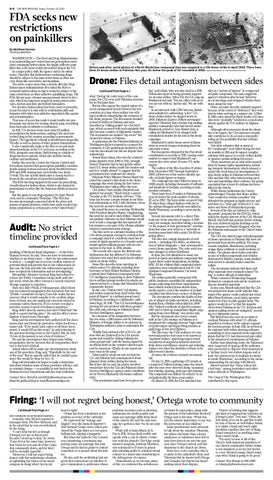
Before-and-after aerial photos of a North Waziristan compound that was targeted in a CIA drone strike in April 2010. There have been 23 drone strikes in Pakistan this year, far below the peak of 117 recorded in 2010. IMAGE OBTAINED BY THE WASHINGTON POST
Drone: Files detail antagonism between sides Continued from Page A-1 abad. During the early years of the campaign, the CIA even used Pakistani airstrips for its Predator fleet. But the files expose the explicit nature of a secret arrangement struck between the two countries at a time when neither was willing to publicly acknowledge the existence of the drone program. The documents detailed at least 65 strikes in Pakistan and were described as “talking points” for CIA briefings, which occurred with such regularity that they became a matter of diplomatic routine. The documents are marked “top secret” but cleared for release to Pakistan. A spokesman for the Pakistani Embassy in Washington did not respond to a request for comment. A CIA spokesman declined to discuss the documents but did not dispute their authenticity. Yousuf Raza Gilani, who was the country’s prime minister from 2008 to 2012, strongly denied Thursday that he had quietly authorized U.S. drone strikes inside his country and said it is “totally absurd” to suggest that his government had condoned the attacks. Pakistani Prime Minister Nawaz Sharif reiterated his country’s objections to the drone campaign this week during his first visit to Washington since taking office this year. CIA strikes “have deeply disturbed and agitated our people,” Sharif said in a speech Tuesday at the U.S. Institute of Peace. “This issue has become a major irritant in our bilateral relationship as well. I will, therefore, stress the need for an end to drone attacks.” He raised the issue in a meeting Wednesday with President Barack Obama, “emphasizing the need for an end to such strikes.” Sharif did not publicly elaborate on how Pakistan would seek to halt a campaign that has tapered off but remains a core part of the Obama administration’s counterterrorism strategy. The files serve as a detailed timeline of the CIA drone program, tracing its evolution from a campaign aimed at a relatively short list of senior al-Qaida operatives to a broader aerial assault against militant groups with no connection to the Sept. 11, 2001, attacks. The records also expose the distrust and dysfunction that has afflicted U.S.-Pakistani relations even amid their undeclared collaboration on drone strikes. Some files describe tense meetings in which senior U.S. officials, including thenSecretary of State Hillary Rodham Clinton, confront their Pakistani counterparts with U.S. intelligence purporting to show Pakistan’s ties to militant groups involved in attacks on American forces, a charge that Islamabad has consistently denied. In one case, Clinton cited “cell phones and written material from dead bodies that point all fingers” at a militant group based in Pakistan, according to a diplomatic cable dated Sept. 20, 2011. “The U.S. had intelligence proving ISI was involved with these groups,” the cable said, referring to Pakistan’s InterServices Intelligence agency. In a measure of the antagonism between the two sides, a 2010 memo sent by Pakistan’s Ministry of Foreign Affairs to its embassy in Washington outlined a plan to undermine the CIA. “Kindly find enclosed a list of 36 U.S. citizens who are [believed] to be CIA special agents and would be visiting Pakistan for some special task,” said the memo, signed by an official listed as the country’s director general for Americas. “Kindly do not repeat not issue visas to the same.” Gilani said he could not rule out that the U.S. and Pakistan had communicated about planned drone strikes during his tenure. But if they did, he said, the parties involved would have been the CIA and Pakistan’s InterServices Intelligence agency, under conditions set by Pervez Musharraf, the former military ruler. “The permission must have been given ear-
lier,” said Gilani, who was also cited in a 2010 WikiLeaks report as being privately supportive of some strikes. “After 9/11, the U.S. rang up Musharraf and said, ‘You are either with us or you are not with us,’ and he said, ‘We are with you.’ ” In an interview with CNN last year, Musharraf admitted to authorizing “a few” U.S. drone strikes before he stepped down in 2008. Pakistan’s Express Tribune newspaper reported Thursday that a former top-ranking military commander who had served under Musharraf, retired Lt. Gen. Shahid Aziz, is calling for Musharraf to be charged with extrajudicial murder for his role in the drone campaign. Musharraf is under house arrest in Islamabad on several charges stemming from his autocratic tenure. But documents obtained by the Post detail coordination as recently as 2011, causing some analysts to suspect that Musharraf’s successors also were aware of some U.S. strike targets. The earliest of the files describes 15 strikes from December 2007 through September 2008. All but two of the entries identify specific al-Qaida figures as targets. The campaign has since killed as many as 3,000 people, including thousands of militants and hundreds of civilians, according to independent estimates. There have been 23 strikes in Pakistan this year, far below the peak number of attacks, 117, set in 2010. The latest strike occurred Sept. 29, when three alleged fighters with ties to the militant Haqqani network were killed in North Waziristan, according to news media reports. Several documents refer to a direct Pakistani role in the selection of targets. A 2010 entry, for example, describes hitting a location “at the request of your government.” Another from that same year refers to a “network of locations associated with a joint CIA-ISI targeting effort.” The files also contain fragments of code words — including SYL-MAG, an abbreviation of Sylvan Magnolia — that correspond to covert drone operations. The code word was later changed to Arbor-Hawthorn. In time, the CIA identified so many suspected al-Qaida and militant compounds that it gave them coded designations, including MSC 215 for a Miran Shah compound where explosives were manufactured and SC 5 for Spailpan Compound Number 5 in South Waziristan. The strikes generally correspond with public databases assembled by independent groups, indicating that those organizations have reliably tracked drone attacks from media reports, even if the number of civilian casualties has often been a source of dispute. The documents confirm the deaths of dozens of alleged al-Qaida operatives, including Rashid Rauf, a British citizen killed in 2008 who “helped coordinate al-Qaeda’s summer 2007 plot to blow up transatlantic flights originating from Great Britain,” one memo said. But the documents also reveal a major shift in the CIA’s strategy in Pakistan as it broadened the campaign beyond “high-value” al-Qaida targets and began firing missiles at gatherings of low-level fighters. The files trace the CIA’s embrace of a controversial practice that came to be known as “signature strikes,” approving targets based on patterns of suspicious behavior detected from drone surveillance cameras and ordering strikes even when the identities of those to be killed weren’t known. At times, the evidence seemed circumstantial. On Jan. 14, 2010, a gathering of 17 people at a suspected Taliban training camp was struck after the men were observed doing “assassination training, sparring, push-ups and running.” The compound was linked “by vehicle” to an al-Qaida facility hit three years earlier. On March 23, 2010, the CIA launched mis-
siles at a “person of interest” at a suspected al-Qaida compound. The man caught the agency’s attention after he had “held two in-car meetings, and swapped vehicles three times along the way.” Other accounts describe militants targeted because of the extent of “deference” they were shown when arriving at a suspect site. A May 11, 2010, entry noted the likely deaths of 12 men who were “probably” involved in cross-border attacks against the U.S. military in Afghanistan. Although often uncertain about the identities of its targets, the CIA expresses remarkable confidence in its accuracy, repeatedly ruling out the possibility that any civilians were killed. One table estimates that as many as 152 “combatants” were killed during the first six months of 2011 and 26 injured. Lengthy columns with spaces to record civilian deaths or injuries contain nothing but zeroes. Those assertions are at odds with research done by human rights organizations, including Amnesty International, which released a report this week based on investigations of nine drone strikes in Pakistan between May 2012 and July 2013. After interviewing survivors and assembling other evidence, the group concluded that at least 30 civilians had been killed in the attacks. White House spokesman Jay Carney acknowledged Tuesday that drone strikes “have resulted in civilian casualties” but defended the program as highly precise and said there is a “wide gap” between U.S. estimates and those of independent groups. Several of the files are labeled as “talking points” prepared for the DDCIA, which stands for deputy director of the CIA. Michael Morell, who held that position before retiring this year, delivered regular briefings on the drone program to Husain Haqqani, who was the Pakistani ambassador to the United States at the time. The CIA also shared maps and photographs of drone operations in Pakistan that have not previously been shown publicly. The maps contain simplistic illustrations, including orange flame emblems to mark locations of strikes. The photos show before-and-after scenes of walled compounds and vehicles destroyed by Hellfire missiles, some marked with arrows to identify bodies amid the rubble. The documents indicate that these and other materials were routinely relayed “by bag” to senior officials in Islamabad. When contacted Wednesday, Haqqani declined to comment and said he would not discuss classified materials. In one case, Morell indicated that the CIA was prepared to share credit with the Pakistanis if the agency could confirm that it had killed Ilyas Kashmire, an al-Qaida operative suspected of ties to plots against India. The agency would do so “so that the negative views about Pakistan in the U.S. decision and opinion making circles are mitigated,” according to a diplomatic memo. But Morell was also sent on occasion to confront Pakistan with what U.S. officials regarded as evidence of the nation’s support for terrorist groups. In June 2011, he arrived at the embassy with videos showing militants scrambling to clear materials from explosives plants that the U.S. had discovered and called to the attention of counterparts in Pakistan. Rather than launching raids, the Pakistanis were suspected of tipping off the militants, who proceeded to disperse their materials in a “pickup truck, two station wagons and at least two motorcycles to multiple locations in South Waziristan,” according to the memo summarizing the meeting with Morell. Morell warned that “these videos left a bad taste” among lawmakers and other senior officials in Washington. Tim Craig of The Washington Post contributed to this report.
Firing: ‘I will not regret being honest,’ Ortega wrote to community Continued from Page A-1 not comment on personnel matters. Gonzales, who did not respond to messages from The New Mexican, said in his email that he was overwhelmed by the firing. “I can’t help but feel as though [Ortega] sees me as threat now because I stood up to him,” he wrote. “I also feel at the same time, however, that I have let you and all of the Cathedral community down, and for that I will be eternally regretful … “However, I will not regret being honest with this unfortunate situation or upholding the values of my moral compass in doing what I feel in my
heart is right.” Ortega has been a moderate in his position as rector of the cathedral. He expressed his “outrage and disgust” over the Santa Fe Reporter’s 2013 Summer Guide cover, which portrayed the Virgin Mary in a two-piece bathing suit, sipping a margarita. But when the Santa Fe City Council was considering a resolution supporting same-sex marriage this year, Ortega said he had no plans to contact councilors or to preach about the matter. He also said the archbishop had not given him instructions on whether to give Communion to politicians whose
positions on issues such as abortion, euthanasia, the death penalty and same-sex marriage differ from those of the church. He said the only message he’s gotten is that “we do not play judge.” While still at Santa María de la Paz in 2011, Ortega dealt swiftly and openly with a case in which a volunteer with the church’s The Edge youth ministry program, Anthony Martinez, was sentenced to 15 years in prison after pleading guilty to criminal sexual contact of a minor and contributing to the delinquency of a minor. “Immediately as we became aware of this, we contacted the archdiocese
[of Santa Fe] and police, along with the parents of the individual involved,” Ortega said at the time. “What was [of] the utmost importance to me was the protection of our children.” Some parishioners were reluctant to talk about the situation Thursday, but others said more than a dozen employees or volunteers have left or have been forced out over the past year since Ortega’s arrival, and that donations to the church are down. Peter Ives, a city councilor who is a cantor in the cathedral’s choir, said Thursday that he knows both Ortega and Gonzales but that he has heard nothing about their dispute.
“I know of nothing that suggests any kind of inappropriate behavior on [Ortega’s] part,” Ives said. “Often, the way many of us say hi, and this would be true of Xavier as well Father Adam, is to shake a hand and touch right shoulders together, that sort of thing. I don’t interpret it as anything more than a hearty hello. … “I’m sorry to hear of all of this. They’re both important members of our church community. Father Adam is our shepherd as rector, but Xavier is a very talented young church musician who I think is going to do great.” Contact Tom Sharpe at 986-3080 or tsharpe@sfnewmexican.com.