Monday, February 24, 2014 THE NEW MEXICAN
LIFE&SCIENCE
Health Science Environment
The Associated Press
UNM program helps providers assist those with chronic pain throughout New Mexico By Deborah Busemeyer For The New Mexican
T
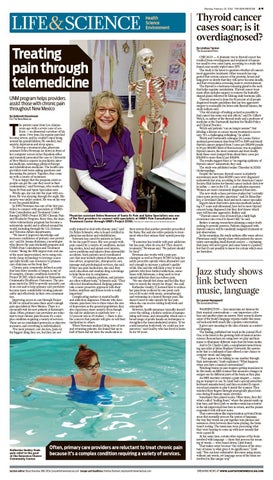
Katherine Guidry finds pain relief in the pool at the Genoveva Chavez Community Center.
Physician assistant Debra Newman of Santa Fe Pain and Spine Specialists was one of the first providers to connect with specialists at UNM’s Pain Consultation and Treatment Center through UNM’s Project ECHO. PHOTOS BY JANE PHILLIPS/THE NEW MEXICAN
really trained to deal with chronic pain,” said Dr. Belyn Schwartz, who is board certified in physician medicine and rehabilitation. Schwartz has cared for patients in Santa Fe for the past 19 years. She sees people with pain caused by a variety of conditions, including strokes, head and spinal-cord injuries, nerve problems and injuries from automobile accidents. Such patients need coordinated care that may include physical therapy, nutrition advice, acupuncture, chiropractor care, massage and psychological services, she said. If they use pain medication, she said, they need education and random drug screenings to help them stay in compliance. “It’s such a complex problem, and patients are often without tools,” Schwartz said. “They often feel disenfranchised. Helping patients take a more proactive approach with their bodies, nutrition and fitness levels is really important.” Complicating matters is mental health and addiction diagnoses. Patients who have chronic pain have two to three times the rate of depression as the general population; they also experience more anxiety. Even though the risk for addiction is relatively low — a 3.3 percent rate in 24 studies — there is also the concern that patients will give or sell their medication to others. When Newman analyzed drug tests of new and returning patients, she found that up to half of them did not have the medication in
Thyroid cancer cases soar; is it overdiagnosed? By Lindsey Tanner
Treating pain through telemedicine he patient came from Los Alamos years ago with a severe case of scoliosis — an abnormal curvature of his spine. Over time, his regular pain had become severe, and he couldn’t enjoy being around his grandchildren. He smoked, had anxiety, depression and sleep apnea. To develop a treatment plan, physician assistant Debra Newman sat down in front of her computer screen in her Española office and remotely presented the case to University of New Mexico experts in psychiatry, internal medicine, neurology, physical therapy and rehabilitation medicine. The health care providers took turns asking questions and discussing the patient. Together, they came up with a course of treatment. “I’m so happy that the program exists so people can get the care they need in their communities,” said Newman, who works at Santa Fe Pain and Spine Specialists now. Weeks ago, she ran into the man with scoliosis. He was sleeping through the night. His anxiety was under control. He was on his way to see his grandchildren. In 2009, Newman was one of the first providers to connect with specialists at UNM’s Pain Consultation and Treatment Center through UNM’s Project ECHO Chronic Pain and Headache Program. Since then, the innovative telemedicine program has become a nationwide model and is offered around the world, including through the U.S. Defense and Veterans Affairs departments. “We know it improves knowledge and increases confidence of primary care providers,” said Dr. Joanna Katzman, a neurologist who directs the pain telehealth program and UNM’s Pain Consultation and Treatment Center. “Being the fifth largest state and one of the most impoverished, we’re using relatively cheap technology to leverage scarce specialty health care resources to primary care clinicians on the front line.” Chronic pain, commonly defined as pain that lasts three months or longer, is one of 10 complex, chronic conditions treated by Project ECHO, which stands for Extension for Community Healthcare Outcomes. The program started in 2003 to provide specialty care at no cost and to help primary care providers become more comfortable treating patients safely and effectively in their own communities. Improving access to care through Project ECHO is critical because there aren’t enough pain specialists in New Mexico. There is a six-month wait for new patients at Katzman’s clinic. Often, primary care providers are reluctant to treat chronic pain because it’s a complex condition requiring a variety of services. There are no established protocols or objective measures, and everything is individualized. “For most primary care doctors, [pain is] the biggest thing they see, but they are not
A-9
their system that another provider prescribed for them. She said she refers patients to treatment when they misuse their opioid prescription. “If someone has trouble with past addiction but has pain, what do you do? They deserve treatment,” Newman said. “No patient should be fired.” Newman also works with a pain psychologist as well as Project ECHO to help her safely prescribe opioids when alternative care isn’t enough to increase a patient’s quality of life. She said she still finds a way to treat patients who have battled addictions, sometimes with Suboxone, a drug used to treat opioid addiction that can reduce pain. “No one should feel alone and feel like they have to search the streets for drugs,” she said. Katherine Guidry, 57, learned how to reduce her pain from scoliosis by one point each (on a 1-10 scale) with music, aromatherapy and swimming in a heated therapy pool. She doesn’t need to take opioids for her pain when she can receive rolfing bodywork and osteopathy. However, health insurance typically doesn’t cover the rolfing, a holistic system of manipulating soft tissue, and osteopathy, which uses a broad range of gentle hands-on techniques to strengthen the musculoskeletal system. “If we could monetize bodywork, we could use less narcotics,” said Guidry, who has lived in Santa Fe for 40 years.
Often, primary care providers are reluctant to treat chronic pain because it’s a complex condition requiring a variety of services.
Section editor: Bruce Krasnow, 986-3034, brucek@sfnewmexican.com Design and headlines: Kristina Dunham, kdunham@sfnewmexican.com
CHICAGO — A dramatic rise in thyroid cancer has resulted from overdiagnosis and treatment of tumors too small to ever cause harm, according to a study that found cases nearly tripled since 1975. The study is the latest to question whether all cancers need aggressive treatment. Other research has suggested that certain cancers of the prostate, breast and lung grow so slowly that they will never become deadly, and that overzealous screening leads to overtreatment. The thyroid is a hormone-releasing gland in the neck that helps regulate metabolism. Thyroid cancer treatment often includes surgery to remove the butterflyshaped gland, followed by lifelong daily hormone pills. Thyroid removal is done for 85 percent of all people diagnosed despite guidelines that say less aggressive surgery is reasonable for lower-risk thyroid tumors, the study authors said. “Our old strategy of looking as hard as possible to find cancer has some real side effects,” said Dr. Gilbert Welch, co-author of the thyroid study and a professor of medicine at the Dartmouth Institute for Health Policy and Clinical Practice. Welch said patients “can no longer assume” that labeling a disease as cancer means treatment is necessary. “It’s a challenging rethinking,” he added. Welch and Dartmouth colleague Dr. Louise Davies analyzed government data from 1975 to 2009 and found thyroid cancers jumped from 5 cases per 100,000 people to 14 per 100,000. Most of that increase was in papillary thyroid cancers, the most common and least deadly kind; those cases jumped from about three cases per 100,000 to more than 12 per 100,000. The results suggest there is “an ongoing epidemic of thyroid cancer” nationwide, they said. The study was published online Thursday in JAMA Otolaryngology. Despite the increase, thyroid cancer is relatively uncommon; more than 60,000 cases were diagnosed nationwide last year, according to the American Cancer Society. Risk factors for thyroid cancer include diets low in iodine — rare in the U.S. — and radiation exposure. Women are more commonly diagnosed than men. The new study echoes previous studies but “certainly raises some provocative questions,” said Dr. Brian Burkey, a Cleveland Clinic head and neck cancer specialist. Experts know that better detection methods including CT scans and ultrasound, have led to more thyroid cancers being diagnosed, but they don’t know which ones will become aggressive, Burkey said. “Thyroid cancer even if treated has a fairly high recurrence rate even if it doesn’t kill,” he said. Burkey is among researchers planning a major study seeking to provide answers. Patients diagnosed with thyroid cancers will be randomly assigned treatment or just observation. In the meantime, the study authors offer some advice: Physicians could “openly share with patients the uncertainty surrounding small thyroid cancers — explaining that many will never grow and cause harm to a patient,” but that it’s not possible to know for certain which ones are harmless.
Jazz study shows link between music, language By Lauran Neergaard The Associated Press
WASHINGTON — Jazz musicians are famous for their musical conversations — one improvises a few bars and another plays an answer. Now research shows some of the brain’s language regions enable that musical back-and-forth much like a spoken conversation. It gives new meaning to the idea of music as a universal language. The finding, published last week in the journal PLoS One, is the latest in the growing field of musical neuroscience: Researchers are using how we play and hear music to illuminate different ways that the brain works. And to Dr. Charles Limb, a saxophonist-turned-hearing specialist at Johns Hopkins University, the spontaneity that is a hallmark of jazz offered a rare chance to compare music and language. “They appear to be talking to one another through their instruments,” Limb explained. “What happens when you have a musical conversation?” Watching brains on jazz requires getting musicians to lie flat inside an MRI scanner that measures changes in oxygen use by different parts of the brain as they play. An MRI machine contains a giant magnet — meaning no trumpet or sax. So Limb had a special metal-free keyboard manufactured, and then recruited 11 experienced jazz pianists to play it inside the scanner. They watched their fingers through strategically placed mirrors during 10-minute music stretches. Sometimes they played scales. Other times, they did what’s called “trading fours,” where the pianist made up four bars, and then Limb or another musician-scientist in the lab improvised four bars in return, and the pianist responded with still new notes. That conversation-like improvisation activated brain areas that normally process the syntax of language, the way that words are put together into phrases and sentences. Even between their turns playing, the brain wasn’t resting. The musicians were processing what they were hearing to come up with new sounds that were a good fit. At the same time, certain other regions of the brain involved with language — those that process the meaning of words — were tuned down, Limb found. That makes sense because “the richness of the structure of music is what gives it its significance,” Limb said. “You can have substantive discourse using music, without any words, yet language areas of the brain are involved in this unique way.”
BREAKING NEWS AT WWW.SANTAFENEWMEXICAN.COM