OPINIONS
Sunday, December 15, 2013 THE NEW MEXICAN
B-3
MY VIEW: BENEDICTE VALENTINER
Nelson Mandela: The last statesman exits T
he world has lost its last statesman; Nelson Mandela touched all he met and taught us, despite the appalling treatment doled out to him by his own nation, how grace, generosity of spirit and wisdom prevail. Tall and handsome with snow white hair, and a dazzling smile, he was interested in everything and inclusive of everyone during his two visits at Blair House. The atmosphere around him when he first came in 1994 was electric! In September 1998, the 79-year-old Mr. Mandela, who did not wish to be known as President Mandela, came again before stepping down at the age of 80 as South Africa’s president, 35 years after facing death for “treason” against white minority rule. His treason: to state his ideals of democracy and equal opportunity. Some of his dreams had come true in his lifetime, and under his own leadership and example, legal equality had happened. Everyone had rights under the law in South Africa. This time, Mr. Mandela came to be awarded a Congressional Medal of Honor
MY VIEW: ARVO THOMSON
Save the flying farolitos! I
fail to see why my flying farolitos are being described as some unmanageable danger. When I first applied for a permit for Christmas Eve (in the 1990s, I think it was), a previous fire marshal basically scoffed and almost laughed when he saw the contraption of less than an ounce of paper, 30-some tiny birthday candles and two thin pieces of Styrofoam. He watched it fly up into the sky and self-destruct at a height of more than 700 feet; the burn was over in 15 seconds and no burning matter made it down past 500 feet of altitude. “There is next to no combustible matter here,” he said, “as long as there is snow on the ground, and low wind conditions, we’ll let you do it.” Henceforth, I could do this legally, launching anywhere between 24 to 31 flying farolitos each Christmas Eve, so long as there were favorable conditions. Many years, and many hundreds of launches later, I look back and wonder why this is now considered a dangerous activity. Flying farolitos have never hurt anybody or even caused damage to property. The only times there was ever a smidgen of fire on the ground is when a launch failed, in which case we stomped out what little flame that there was. I never needed the fire extinguisher which — by stipulation of the old fire marshal — I was required to have on location. I never had to contact the fire truck, which is conveniently parked in the same parking lot. When launched successfully, they go up, and they do not come down again. So it is sad to think it’s over, but pleas to city officials for a little help, like maybe finding insurance for this event, were ignored. Phone calls to a city councilor were not returned. It’s been the city indifferent for the flying farolitos. Now, I cannot claim that there could never be a set of circumstances in which some minor property damage might occur. There is always risk. Leaving one’s house in the morning could lead to one’s death, driving a car might lead to an accident. Fires caused by Christmas trees reliably kill scores of people each year. Maybe we should outlaw Christmas trees? That would make sense, from a firefighter’s point of view. If you are one of the people who have enjoyed my flying farolitos in the past — let the City Council know. Compared to the fireworks accompanying Fourth of July or New Year’s Eve, this is a very safe event. It also compares quite favorably to Zozobra in the categories of shootings, stabbings, drunken disorderly behavior and property crimes — just check the statistics. Yet all the above mentioned activities are deemed manageable risks by the city — just not a handful of flying farolitos. Bottom line is, if the city wants this to continue, I will do it. If not, it will be another beautiful, original budding tradition slain by a lack of vision. Arvo Thomson launches flying farolitos every Christmas Eve, weather and city officials permitting.
and to receive an honorary degree at Harvard University. The ceremony was dedicated solely to him, only the third person in the university’s history to be so honored; the other two were George Washington and Winston Churchill. This second Mandela visit was shortly after President Bill Clinton went public with his intern liaison. It was amid Congress’ glee at receiving and releasing on the Internet Kenneth Starr’s salacious report. Mr. Clinton, in his book, My Life, talked about his earlier visit in South Africa when he accompanied Mr. Mandela to see his prison cell on Robben Island. Mr. Clinton had asked him if he really hated those who imprisoned him, and Mr. Mandela had replied: “Of course I did, for many years. They took the best years of my life. They abused me physically and mentally. I didn’t get to see my children grow up. I hated them. Then one day … I realized that they had already taken everything from me except my mind and my heart. Those they could
not take without my permission. I decided not to give them away. Then he looked at me, smiled, and said, ‘and neither should you.’ ” The warmth and affection shown President Clinton by Mr. Mandela seemed genuine and true. After the visit they bid each other farewell just outside Blair House, standing on the curb facing each other, their arms entwined, Mandela talking and Clinton listening, as I believe he often had to the elder statesman who had taken such a liking to him. It was an extraordinary picture. My own and most personal moment with this remarkable man came just before he departed his first visit. At the front door, he took my hands in his, held them tightly, looked into my eyes and exclaimed: “Such a beautiful house. You are the House!” Benedicte Valentiner is the author of Bedtime and Other Stories from The President’s Guest House. She lives in Santa Fe.
THE DRAWING BOARD THE WEEK IN CARTOONS
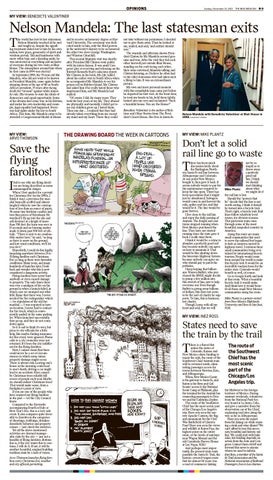
Nelson Mandela with Benedicte Valentiner at Blair House in 1998. COURTESY PHOTO
MY VIEW: MIKE PLANTZ
Don’t let a solid rail line go to waste
T
here has been much discussion lately about the Burlington Northern Santa Fe rail line between Albuquerque and Colorado. At one point New Mexico bought it, then gave it back. It seems nobody wants to pay for the maintenance required to keep the line open. There has been speculation that it might just be abandoned. Salvagers would come in and harvest the rails, spikes and ties, and that would be it. The line would be gone forever. I live close to the rail line and enjoy the daily passing of Amtrak. The freight and coal trains stopped running when New Mexico purchased the line. They have not started running since the state gave it back. I really miss them. I think it would be a crime to abandon a perfectly good rail line because nobody can agree on how to maintain it. That would be like shutting down the Interstate Highway System because nobody can agree on who should pay to patch the potholes. I keep hoping that billionaire Warren Buffett, who purchased the BNSF, might decide to pump a few million into this stretch of line, just to help everyone out. Even though Buffett is giving away billions of dollars, this does not seem to be the sort of charity he supports. To him, this is business, not charity. Though I pray, with all my heart and soul, that we will
not be so stupid as to throw away a perfectly good rail line, I think we should start thinking about what Mike Plantz we might do if the rail line is lost. Should the “powers that be” decide that the line is not worth saving, I think it should be turned into a bicycle trail. That’s right, a bicycle trail. Rail lines follow relatively level routes, for obvious reasons. This particular route runs through some of the most beautiful, unspoiled country in America. Along this route are many small communities that used to serve the railroad but began to fade as America moved to highway travel. I envision these small communities being revitalized by international bicycle tourism. People would come from around the world to make this bicycle trek. It would be an incredible tourism boon for the entire state. Colorado would benefit as well, of course. Go to Google Earth and look at that route. What a beautiful bicycle trail it would make. And think how it would benefit all those small New Mexico communities along the route. Mike Plantz is a printer retired from New Mexico Highlands University and lives in San José, N.M.
MY VIEW: INEZ ROSS
States need to save the train by the trail
T
here is a threat that unless the states of Colorado, Kansas and New Mexico share funding to repair the rails, the route of the Southwest Chief Amtrak train will be rerouted south, eliminating passenger access for towns between Newton, Kan., and Albuquerque. Whoa, New Mexico! Lamy is the gateway to Santa Fe, and Raton is the Boys and Girl Scouts’ access to the National Scout Camp at Philmont, plus the terminal for the Amtrak bus connecting passengers to Denver and the California Zephyr. The route of the Southwest Chief has the most scenic part of the Chicago/Los Angeles trip. Have you seen the narrow Apache Canyon, the flag and monument for the Civil War Battlefield of Glorieta Pass? Have you seen the views and wildlife at Raton Pass, the highest point on the entire route, or the herds of antelope near Wagon Mound and the old Castañeda Harvey House at Las Vegas, N.M.? And perhaps most importantly, the present train route parallels the Santa Fe Trail, the historic covered wagon route that for almost 60 years was a road of commerce linking
The route of the Southwest Chief has the most scenic part of the Chicago/Los Angeles trip. the Midwest to the foreign territory of Mexico. During summer weekends, volunteers from the National Park Service board at La Junta, Colo., and give a narrative from the observation car of the Chief, explaining trail sites along the way as far as Albuquerque. Have you seen the sunset from the dining car while enjoying a steak and wine dinner? We can’t afford to lose this necessary, beautiful and historic rail line. We could start with bake sales, but funding depends on action from the state and Congress. Contact them ASAP and forward this news to anyone whom we need to inform. Inez Ross, a member of the Santa Fe Trail Association and the National Association of Railroad Passengers, lives in Los Alamos.