A-4
THE NEW MEXICAN Sunday, August 4, 2013
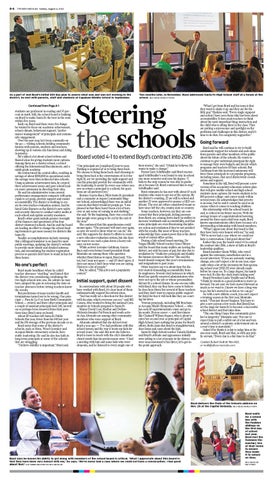
As a part of Joel Boyd’s initial 100-day plan to assess what was and was not working in the district, he met with parents, staff and students at Capshaw Middle School in September.
Continued from Page A-1 students are proficient in reading and 35 percent in math. Still, the school board is banking on Boyd to make Santa Fe the best in the state within five years. Early on, Boyd said there were five things he wanted to focus on: academic achievement, school climate, behavioral support, “performance management” of principals and community engagement. Over the past year, he’s been constantly on the go — visiting schools; holding community forums with parents, students and teachers; showing up at various city functions; and riding in parades. He’s talked a lot about school reform and floated ideas for giving students more options. Among them are a charter school, a school offering the International Baccalaureate, and a ninth-grade academy. He restructured the central office, resulting in savings of about $500,000 in operational costs; the savings were then redirected into schools. Using academic achievement data, he created three achievement zones and gave school leaders more autonomy in directing their sites. He and his administrative team created performance-management compacts with principals to set goals, provide support and ensure accountability. The district is working to create its own teacher-evaluation system. And he hired Gabe Romero as the district’s new safety and security director to conduct safety audits at each school and update security measures. Boyd’s other goals include greater oversight of the finances and operations of the four district-chartered schools. And he and the board are leading an effort to change the school funding formula to get more money for districts like Santa Fe. Smaller accomplishments include ensuring that a bilingual translator is on hand for most public meetings, updating the district’s website to provide more timely and detailed information, and streamlining the student registration process so parents don’t have to stand in line for three hours.
No one’s perfect Boyd made headlines when he called teacher absences “startling” and hinted that the district was considering combining the two high schools into one. He admits he may have jumped the gun in releasing the data on teacher absences before letting teachers know the results. But predictions of mass teacher layoffs and terminations turned out to be wrong. One principal — Pam de La O at Amy Biehl Community School — retired, and three other principals and a couple of assistant principals have left, moved on or perhaps been removed from their positions since Boyd came on board. About 115 teachers left Santa Fe Public Schools this year, fewer than the 140 last year and the 150 average of the previous decade or so. Boyd notes that some of the district’s schools, such as Nava, Wood Gormley and Acequia Madre elementary schools, have stable leadership. He said he also has faith in long-term principals at some of the schools that are struggling. “I believe stability is important,” Boyd said.
Two months later, in November, Boyd addressed Santa Fe High School staff at a forum at the school. NEW MEXICAN FILE PHOTOS
Steering the schools Board voted 4-1 to extend Boyd’s contract into 2016
“Our principals are [employed] year-to-year. Nothing is required of us to bring them back. We choose to bring them back. And choosing to bring them back is the conversation of: Is it the right fit, are we providing the right support and can this principal provide the community with the leadership it needs? In every case where you saw us return a principal to a school, the questions are all answered yes.” Bernice Garcia-Baca, NEA-Santa Fe president and a counselor at Aspen Community Magnet School, acknowledged there was an initial concern that Boyd would let people go. “I am pleased in that there hasn’t been a lot of turnover or any sense of coming in and slashing,” she said. “At the beginning, there was a real fear that people were going to be cut by the end of the year.” She cautioned that this apprehension could mount again. “The pressure will start over again, as now we need to show what we can do,” she said. She supports the district’s efforts to create a new educator-evaluation system, but she does not want to see such a plan stress a heavy reliance on test scores. While activist Lorraine Goldman, GarciaBaca and even former board president Frank Montaño are among those who question whether Boyd listens to input, Boyd said, “I listen, but I may not agree — and if I don’t agree, it does not mean I don’t hear what you are saying. I listen to a lot of people.” But, he added, “This job is not a popularity contest.”
Initial support, quiet dissent In conversations with about 20 people who have worked with Boyd, it’s clear most of them enthusiastically support his reform ideas. “Joel has really set a direction for this district with his plan, which everyone can see,” said Bill Carson, who worked to bring the national Communities in Schools program to Santa Fe. Mayor David Coss, Realtor and Dollars4Schools founder Pat French and youth activist Ana Alvarado are among other community members who voice support of Boyd. Alvarado admitted that she did not trust Boyd a year ago — “I’ve had problems with this school system and the way it treats my kids for several years,” she said. But now she believes Boyd is more in touch with the city’s disenfranchised youth than his predecessors were. “I had a meeting with him and some kids who were dropouts, and he listened to every single one of
their stories,” she said. “I think he believes. He wants to make a change.” Parent Gary Schiffmaller said Boyd encouraged Schiffmaller’s son Daniel to stay in school one more semester and earn his degree. “I believe the only reason he was able to graduate is because Dr. Boyd convinced him to stay,” Schiffmaller said. Boyd estimates he has met with about 67 such students who want to opt out of the system. By the district’s counting, 22 are still in school and another 23 were approved to pursue a GED certificate. The rest are either considered truant or have since left the city, county, state or country. Some teachers, however, say they are concerned that their principals, feeling pressure from Boyd, are coming down hard on staffers to increase workloads and accountability, and that some principals are even threatening disciplinary action and retaliation if they’re not satisfied with the results. But most of those teachers acknowledge they cannot prove this is the direct result of central office action. During a July school board meeting, De Vargas Middle School teacher Grace Meyer told the board that many staffers are leaving the district, not only because of pay, but also due to retaliation by “vindictive principals and frankly the human resources director.” She said the board should compare this year’s terminations and resignations to past years. Other teachers say it is about time the district started demanding accountability from its employees. Several cited instances in which Boyd has quietly removed administrators who were not up to the job or whose personalities did not fit a school climate. In one-on-one talks with Boyd, they say they have come to believe he does hear them; but several of these teachers said they don’t want to express public support for Boyd for fear it will look like they are courting his favor. Veteran principals, including Bill Beacham at Acequia Madre Elementary School — who has seen 10 superintendents come and go in his nearly 28-year career — and first-timers like Channell Wilson-Segura, who is about to enter her second year as principal of Capital High School, have nothing but praise for Boyd’s efforts. Both claim that Boyd is straightforward, does listen and cares about the kids. Santa Fe High School teacher Tamela Harkins said Boyd’s attitude and appearance initially were jolting to a lot of people in the district, who were unaccustomed to his direct, let’s-get-tothe-point approach.
“What I get from Boyd and his team is that they want to shake it up and they are for the little guy,” Harkins said. “Every single signpost and action I have seen them take has been about accountability. It does push teachers to think about the most important thing: instruction and the child who is sitting there in the class. They are putting a microscope and spotlight on the problems and challenges in this district, and it’s time to do that. I’m completely supportive.”
Going forward Boyd said he will continue to try to build community support for schools and seek ideas from parents and other members of the public about the future of the schools. He wants to continue to give individual principals the right to manage their own budgets and decide which programs and teachers fit their schools. But Goldman fears this increased autonomy will force those principals to cut popular programs, including music, that need districtwide coordination and support. Sometime in the fall, Boyd will present a new version of his secondary-education reform plan that will give middle school and high school students more options. He wants students to be 100 percent college- and career-ready within several years. He acknowledges that poverty is an issue, but he said it cannot be used as an excuse when it comes to teaching children. His relationship with the school board, he said, is critical to his future success. With the average tenure of a superintendent hovering around the three-and-a-half year mark, Boyd knows superintendents often leave because of a deteriorating relationship with board members. “What I appreciate about this board is that they have been very honest with me,” he said. “We’ve never had a case where we could not have a conversation. I feel good about that.” Earlier this year, the board voted 4-1 to extend his contract into 2016, a show of faith in Boyd’s leadership qualities. Board member Glenn Wikle, who voted against the extension, nonetheless said in a recent interview, “If you are seriously wanting change, you can’t expect a lot in one year, especially when a lot of the decisions for that upcoming school year [2012-13] were already made before he came on. To a large degree, his hands were tied. It’s like the clock starts ticking now.” Board President Linda Trujillo said of Boyd, “I think he stands in a good position to move us forward. I’m not sure we have moved forward as much as we want to. I know we have a long way to go, but he’s moved us as fast as we can go.” As with a new athletic coach, you can’t expect a winning season in the first year, Montaño noted. “That just doesn’t happen. You have to give a new person a few years. But [Boyd] has set the stage for Santa Fe to become a successful school district and that takes time. “The one thing I hope this community gives Joel is longevity,” Montaño said. “For one to expect him to pull a rabbit out of a hat and turn around a district’s academic achievement rate in a year’s time is unrealistic.” Asked if he thinks it is fair to judge him at the one-year mark, Boyd said that, as with any public servant, “Every day is a fair time to do that.” Contact Robert Nott at 986-3021. or rnott@sfnewmexican.com.
Boyd delivers the State of the Schools address on Nov. 26 at the Capitol Rotunda. NEW MEXICAN FILE PHOTO
Boyd says he knows his ability to get along with members of the school board is critical. ‘What I appreciate about this board is that they have been very honest with me,’ he says. ‘We’ve never had a case where we could not have a conversation. I feel good about that.’ KATHARINE EGLI/FOR THE NEW MEXICAN
Boyd waits for a school bus with the Faubion siblings on the first day of school last year. Boyd met the Sweeney Elementary trio at their home to ensure they made it to school on time. NEW MEXICAN FILE PHOTO