Report Card
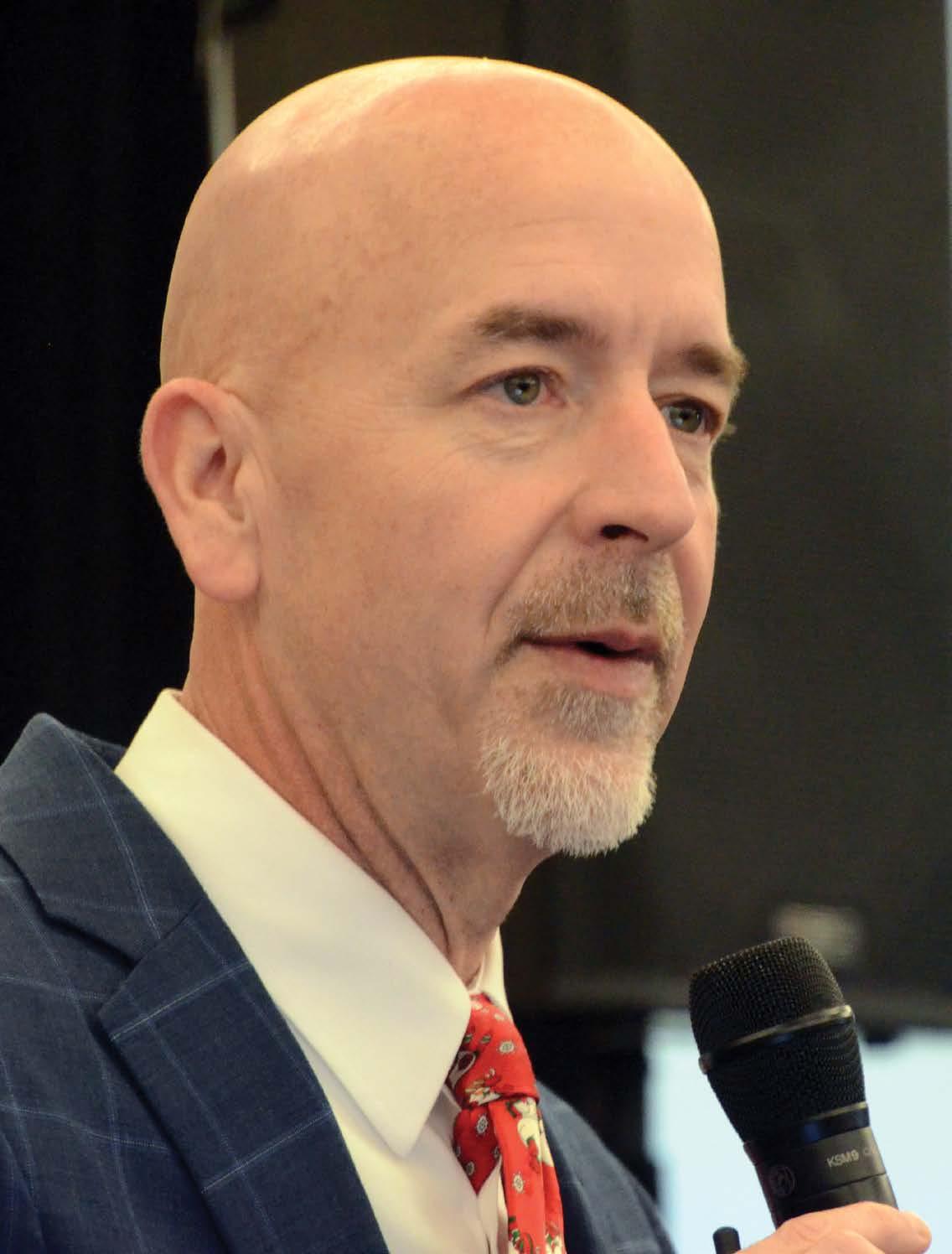
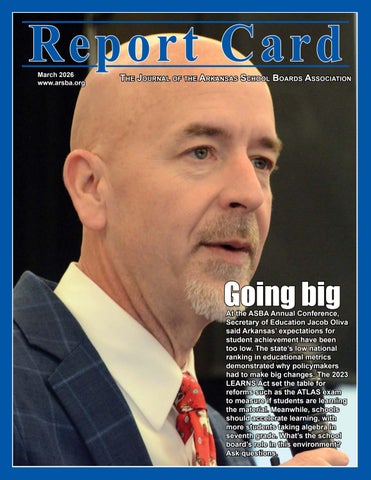
At the ASBA Annual Conference, Secretary of Education Jacob Oliva said Arkansas’ expectations for student achievement have been too low. The state’s low national ranking in educational metrics demonstrated why policymakers had to make big changes. The 2023 LEARNS Act set the table for reforms such as the ATLAS exam to measure if students are learning the material. Meanwhile, schools should accelerate learning, with more students taking algebra in seventh grade. What’s the school board’s role in this environment? Ask questions.

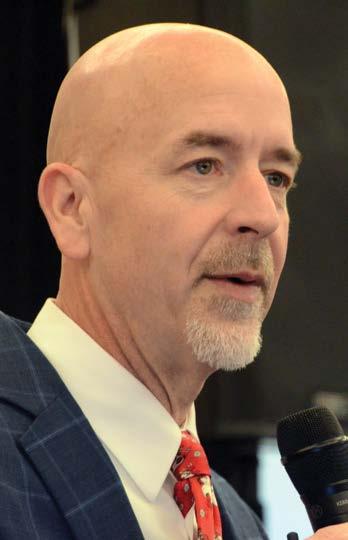
Secretary of Education Jacob Oliva said the state needed major reforms, as demonstrated by its low ranking in many national measurements. That’s why the state passed the LEARNS Act in 2023. Among its provisions was the ATLAS assessment tool, which helps districts respond to individual students’ needs throughout the school year.
What’s the formula for success? “E+R=O,” with the goal to be not just responsible but also “response-able.” That was the message of keynote speaker Kent Julian at the 72nd ASBA Annual Conference December 10-12.
Arkansas schools must set high expectations and must embrace systemic change, Secretary of Education Jacob Oliva said at the ASBA Annual Conference Dec. 12. Because if they don’t? “Bad systems beat good people every time,” he said.
Supporting teachers and using data can help school districts succeed, agreed leaders of Poyen and Van Buren, the two school districts awarded this year’s ASBA School Board of Excellence in Leadership awards.
When a tornado struck Rogers on May 26, 2024, the Rogers School District took charge of the community’s disaster response efforts because it had the resources and infrastructure to do so. As a result, it not only served the community, but it also built goodwill for itself.
Independent coordinator also says districts must justify need for “warm, safe and dry” in third installment of ASBA’s Boardcast podcast.









by Doris Parham
Aging is often discussed quietly, sometimes cautiously, and too often with a tone of decline rather than distinction. Yet aging is not merely a matter of years added – it is a process of experience accumulated, perspective refined, and responsibility deepened. For those of us entrusted with leadership in public education, aging is not something to avoid or fear, but something to honor, steward, and understand.
I chose the subject of aging not because I see myself in that category, but as I looked around at our last state school board conference, it was evident that age was a distinction in our school boards.
While looking over the crowd, a question came to mind: Why are we still serving? Not because of the pay or because we have children still in public schools. I quickly answered my own questions. It was because we care, we see a need, and, yes, because no one younger wanted responsibility in some cases.
In our schools and communities, aging shows up in many ways. It is present in veteran educators who have shaped generations of students. It is reflected in board members whose institutional knowledge provides continuity during seasons of change. It is seen in parents and grandparents who care deeply about the future of children even after their own children have graduated. Aging, in this sense, is not a single stage of life. It is a shared journey across generations.
Public education is uniquely positioned at the intersection of past, present, and future. Each decision we make as school board members is influenced by what we have learned over time and by our responsibility to those who will inherit the outcomes of today’s choices. Aging gives us context. It helps us recognize patterns, weigh consequences, and approach challenges with
patience rather than panic. It reminds us that sustainable progress is rarely rushed and that meaningful change often requires both vision and restraint.
At the same time, aging invites us to reflect on adaptability. Experience is invaluable, but it must be paired with openness – to new ideas, emerging technologies, evolving student needs, and shifting community expectations. Aging well, whether individually or institutionally, means honoring what has worked while remaining willing to learn, unlearn, and grow. It is a balance between tradition and transformation, stability and innovation.
Arkansas school boards serve communities with rich histories and strong values. Aging within these communities brings both opportunity and responsibility. We are called to respect the legacy of those who built our schools while ensuring that today’s systems remain responsive, inclusive, and forward looking. This includes acknowledging the diverse needs of an aging workforce, supporting mentorship between generations of educators, and fostering environments where experience and new perspectives are equally valued.
Perhaps most importantly, aging reminds us of stewardship. Leadership is never permanent; it is borrowed for a season. The measure of effective governance is not only what we accomplish during our tenure, but what we prepare for those who will lead after us. When we approach aging with humility and purpose, we model for students, staff, and communities what lifelong learning and responsible leadership truly look like.
As we continue our work together, let us reframe aging not as a limitation, but as an asset – one that strengthens decision-making, deepens empathy, and reinforces our collective commitment to the future of Arkansas education.
P.O. Box 165460 / Little Rock, AR 72216
Telephone: 501-372-1415 / 800-482-1212
Fax: 501-375-2454
E-mail: arsba@arsba.org / www.arsba.org
Board of Directors
President: Doris Parham, Bearden
President-elect: Nikki King, Pangburn
Vice President: Travis Warren, Farmington
Secretary-Treasurer: Joe Sheppard, Jonesboro
Past President: Jeff Lisenbey, Sheridan
Region 1: Suzanne Spivey, Rogers
Region 2: Jason Jones, Yellville-Summit
Region 3: Vacant
Region 4: Beth Ullrich, Paris
Region 5: John Gibson, South Conway County
Region 6: Keith Baker, Riverview
Region 7: Shane Bell, Cross County
Region 8: Graham Peterson, Mt. Vernon-Enola
Region 9: Donna Dunlap, Barton-Lexa
Region 10: Lonell “Dino” Lenox, Hot Springs
Region 11: Carl “Buddy” Puckett, Poyen
Region 12: Vacant
Region 13: Renee Skinner, El Dorado
Region 14: Debra Barnes, Crossett
Staff
Executive Director: Shannon Moore
Deputy Executive Director/Board Development Director: Tammie Reitenger
Finance Director: Diana Woodward
Policy Director/Staff Attorney: Lucas Harder
Database Administrator/Commercial Affiliates Manager: Kathy Ivy
Board Liaison Manager: Angela Ellis
Communications and Technology Director: Jessica Prothro
General Counsel: Jay Bequette
Risk Management Program & Workers’ Comp:
Misty Thompson
Linda Collins
Lisa Wigginton
Kara Worley
Julianne Dobson
Tamra Polk
Chelsea Ivy
TO
Please
brawnersteve@mac.com
The Arkansas School Boards Association will host the 2026 Southern Region Leadership Conference July 19–21 at the Hot Springs Convention Center.
The conference will welcome school board members and other attendees from Arkansas, Louisiana, and Mississippi for three days of learning, collaboration, and regional connection.
The three states, all of which are members of the Consortium of State School Boards Associations, or COSSBA, alternate in hosting the annual conference. Next year’s conference will be in Mississippi.
The Southern Region Leadership Conference offers valuable professional development while fostering collaboration among school leaders across state lines.
This year’s theme, “Meeting the Moment: Strategic Leadership for Today’s Schools,” will focus on equipping board members and district leaders to navigate the evolving challenges facing public education.
General sessions and targeted breakout sessions will address timely topics designed to strengthen governance, strategic planning, community engagement, and effective district leadership.
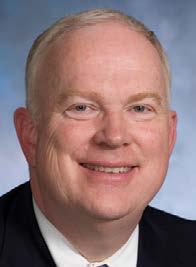
The conference’s keynote speaker will be Rex Nelson, senior editor at the Arkansas DemocratGazette and a respected voice on leadership, public policy, and Southern culture. As senior editor, Nelson writes three columns a week and also writes
essays for the cover of the newspaper’s Sunday Perspective section. He is the author of three books, including the first full-length biography of Hillary Rodham Clinton, and is the author of the blog Southern Fried and hosts the Southern Fried podcast. He has been inducted into the Arkansas Sportscasters and Sportswriters Hall of Fame.
After starting his career in journalism, Nelson served for almost a decade as the policy and communications director for Gov. Mike Huckabee and then served for four years in the administration of President George W. Bush as one of the president’s two appointees to the Delta Regional Authority. In 2016, Gov. Asa Hutchinson and the Arkansas Rural Development Commission named Nelson as the Rural Advocate of the Year for the state of Arkansas.
Additional details and registration information will be available soon at arsba.org
ASBA News and Notes continues on next page

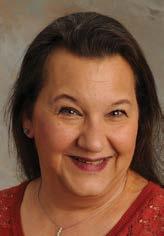
After more than 31 years, Krista Glover is no longer coming into ASBA’s office to help manage the association’s Risk Management Program and workers’ compensation program.
Instead, after retiring Feb. 27, she’s focusing on long walks with her husband and spending time with her five grandchildren.
Glover’s ASBA career began in September 1994 after she had worked about 10 years for the Arkansas Department of Education, doing similar work there with property and vehicle insurance coverage until ASBA took over many of those responsibilities.
Her days at ASBA were spent mostly helping school district administrators with their insurance coverage. Early on, she would go to those schools, draw up diagrams, and get an accurate picture of each school facility. In the beginning, the work was done on typewritten paper, and each time a building was added or a vehicle removed, the entire list had to be retyped by hand.
While most of her duties involved working with administrators, she missed only two Annual Conferences in those 31 years. She was working for her fourth ASBA executive director when she retired.
“It’s been an amazing, an amazing place, and I’ve loved every minute of it,” she said.
Glover said her old co-workers gave her an “awesome sendoff” with a lunch attended by former longtime ASBA employee Paulette Walker.
Her husband, Greg, retired the same day she did after almost 45 years at AFCO Steel. Now the Benton couple’s plans will revolve around spending time with their two children and five grandchildren, all of whom will be close after her daughter, son-in-law and their

May 5
ASBA/AAEA Joint Leadership Conference Wyndham Riverfront LIttle Rock
July 19-21
2026 Tri-State Southern Region Leadership Conference Hot Springs Convention Center
September 2
ASBA Fall Leadership Institute Hot Springs Convention Center
three children move to Arkansas from Fort Worth this summer. They are taking their children and grandchildren on an Alaskan cruise this summer. She and her husband have also booked a Viking River Cruise from Paris to Switzerland.
The retired Glovers also will spend time walking, hiking and birdwatching.
“We’re going to try to find some trails in Arkansas that we just hadn’t had time to drive to and hike on the weekends,” she said. “So we’ll have more time to do that, which will combine our love for hiking and birding at the same time.”
ASBA has expanded professional learning opportunities for districts and board members. Based on feedback gathered during regional meetings and through member surveys, ASBA has launched three monthly learning models designed to provide timely information in convenient formats: Lunch & Learn, ASBA BoardCast, and AR Board Ed. Lunch & Learns are held monthly from 11:30 a.m. until 12:30 p.m. to support districts and central office staff. Sessions are free, and school board members are also welcome to attend.
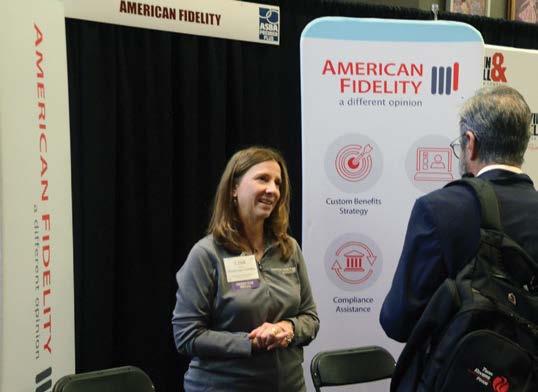
In addition, ASBA has launched a new podcast, ASBA BoardCast, featuring 15–20 minute episodes created to answer questions from members. Sponsored by American Fidelity, Boardcast is available at ASBA’s website, www. arsba.org, as well as on major podcasting platforms such as YouTube, Apple Podcasts, and Amazon Music. Episode 2 featured Jason Jones of the YellvilleSummit School Board and an ASBA Region 2 director, and Adam Bailey of the Bearden School Board. The two answered the question, “What is a board member?” Read about episode 3 on page 39.
ASBA also offers monthly evening webinars from 5:30 p.m. until 6:30 p.m. for district personnel and board members. Webinar registration is $55. Sessions feature a mix of ASBA staff and guest presenters. See following brief.
ASBA will continue sharing details on upcoming topics and how to participate through ASBA communications.
ASBA’s full-day School Law Seminar is now available online for board members and administrators to earn up to six hours of professional development credit.
The seminar is one of ASBA’s AR Board Ed programs available on the association’s website at www.arsba.org.
AR Board Ed is the association’s online, on-demand learning platform. It provides flexible learning opportunities with courses available anytime, anywhere at the user’s own pace. Board members can explore a wide range of topics relevant to their role. AR Board Ed’s user-friendly interface is easy to navigate.
Users of the service can complete the entire School Law Seminar or choose one of its five individual courses. The full cost is $200.
Courses include the following: • Campaign Finance Reports - The What, When, and How. Presented by Jill Rogers-Barham. One-and-a-half hours, $75.
• What Are You Dueing? Student and Employee Due Process. Presented by Leila Seigrist and Shasta Wagner. One hour, $55.
• Public Comment / Best Practices for Community Interaction. A panel discussion. One hour, $55.
• TESS, LEADS, & Recommendations for Rehire. Presented by Dr. Tyler Broyles and Jeremy Lasiter. One-and-ahalf hours, $75.
• Can They Say That? Student & Employee Free Speech. Presented by Cody Kees and Jay Bequette. One hour, $55.
Also available on the site is a onehour course on Post-Election Guidance presented by ASBA’s Lucas Harder and Tammie Reitenger. Cost is $55.
The one-hour February webinar outlined key requirements school board members must complete after the March 3 election. Topics included taking the oath of office, completing required contribution and expenditure reports, and understanding critical post-election
deadlines. The session is designed to help board members confidently navigate their responsibilities and ensure all required steps are completed accurately and on time.
To help board members become familiar with the platform, ASBA recommends watching a brief video tutorial on the website or enrolling in its free Getting Started course. These resources will guide members through the platform’s features and ensure a smooth learning experience.
Board members who would like to audit one or more of ASBA’s available recorded trainings for no cost and no credit can do so at arsba.org.
The phone number for National Safety Shelters on the commercial affiliates page in the December 2025 Report Card was incorrect. It should have been 886.372.1530.



Students must learn that their responses to life’s events shape their outcomes
What’s the formula for success? “E+R=O,” with the goal to be not just responsible but also “response-able.”
That was the message of keynote speaker Kent Julian at the 72nd ASBA Annual Conference December 10-12 at the Little Rock Marriott and Statehouse Convention Center. The theme was “Mission Possible: Local Leadership, Lasting Success.”
Julian’s address Dec. 11 was followed the next day by a talk by Secretary of Education Jacob Oliva about the importance of having high expectations and about the reasons for the major changes state policymakers have been making. (cover story, page 20). The conference started with early bird sessions that included one led by Van Buren and Poyen, the two school districts that received the ASBA School Board of Excellence in Leadership Awards (story, page 24). It also featured numerous breakout sessions, including one describing the leadership role played by the Rogers School District following a tornado that struck the community May 26, 2024 (story, page 28).


Julian said in his keynote speech that the formula for success is “E+R=O,” the letters standing for “Events plus Response = Outcome.”
He said many people wrongly leave out the “R,” believing that events alone, apart from their responses, determine outcomes. That omission creates learned helplessness and a victim mentality in a world where many things happen that are outside a person’s control.
In contrast, leaving the “R” in the formula helps a person be not just “responsible” but also “response-able” – not just doing what is expected, but able to turn a negative event into a positive outcome.
Julian said he struggled in school because of a learning challenge. By the third grade, he was still unable to read. His teacher asked his parents how he had made it that far. But his life started changing when he was in the seventh grade and a school administrator taught him the E+R=O concept.
DELEGATE ASSEMBLY. School board members cast their ballots during the annual Delegate Assembly at the ASBA Annual Conference Dec. 10.
“I finally figured out that it is a picture of reality, and he started teaching me how I could not just be responsible, but I could be response-able,” he said. “I could control my response. And I walked out of his office that day with a picture of reality: how the real world works or at least how it will work best for me. You have that opportunity. Local leadership, lasting success. You have that opportunity with your students.”
Even after learning the concept, he still struggled. He wanted to attend college after high school, but his SAT scores were so bad that no college would accept him. Determined to overcome his challenges, he attended a “developmental studies” school that would help him qualify for higher education. The chances of a student with his challenges earning a degree were very low. Instead, he ended up graduating college with honors and earning his master’s degree.
Julian said he worked with students for about 20 years doing nonprofit work related to religious education and afterschool programs. He said he taught them about being “response-able” through a concept he called the “four fence posts.” The idea is that a person can control everything within the posts even though they can’t control what happens outside. The first is one’s attitude – taking a
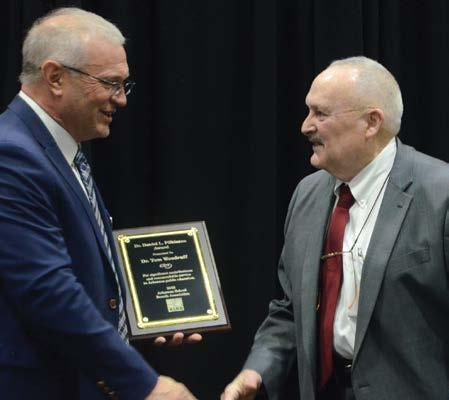
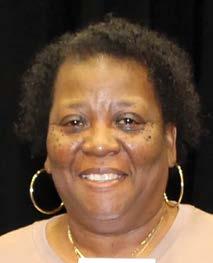
AWARD WINNERS. Left photo, right, Dr. Tom Woodruff, a teacher in the Rogers School District for 49 years, received the Dr. Daniel L. Pilkinton Award for outstanding service to public education. The award is meant to be a surprise announcement, and this year was no exception. ASBA Past President Jeff Lisenbey of Sheridan, left, presented the award. Right photo, Dorothy Williams, a longtime member of the North Little Rock School Board, received the inaugural Spirit of Excellence Award. The award highlights a board member who embodies the heart and pride of their school district. Through their positivity, encouragement, and tireless enthusiasm, this person lifts others, strengthens school culture, and spreads school spirit everywhere they go.



Beebe Superintendent Zebulon Prothro; and Beebe School Board President Clay Goff.
The presentation detailed Beebe’s response to an Arkansas law passed in 2025 that requires school boards to let district residents, employees, and parents and guardians of students speak for up to three minutes. The comments must occur before any action items on the agenda and must cover a subject that falls within the board’s powers and duties. Kees said the law would indicate it’s best to do public comment at the beginning of the meeting – even before



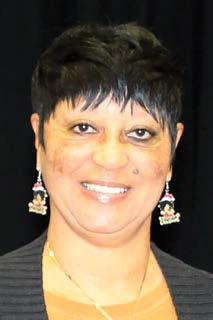
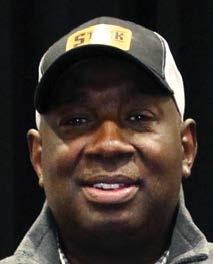
30 YEAR AND PRESIDENT’S AWARDS. Gary Cole from Pocahontas, left, received the 30-Year Service Award. Receiving the President’s Award for 500 hours of professional development were, from left, Elaine Sullivan from South Conway County, Sheridan’s Jeff Lisenbey, and Jacqueline Baker from Osceola. Not pictured is Tim Hudson from Fayetteville.

approving the minutes, which involves taking a vote.
Public commenters cannot talk about a personnel or student matter that is on the agenda, but Kees noted such items are rarely listed, so the law would suggest such matters could be discussed otherwise. School districts should consult their attorneys about the matter. However, Kees said it’s likely that school boards can halt discussion of staff or students. It’s fairly obvious that any discussion of a student is off-limits because of the federal Family Educational Rights and Privacy Act. The
personnel matter is a little grayer, but the case can be made that employees are protected because they are not present to defend themselves. The law doesn’t protect board members because they are public officials.
Goff said he at first had concerns about applying the law. The Beebe School District previously had not allowed for public comment. Often when patrons want to speak, it’s because they are upset. The first meeting that occurred after the law took effect covered a controversial issue that drew a large crowd with overflow seating.


Anticipating that emotions might run high, the district had two school resource officers present.
Beebe has a detailed set of policies meant to ensure it obeys the law and that the public comment process goes smoothly. It displays a sign-in sheet 30 minutes before the meeting begins that is meant to determine if the person is eligible to speak and if their subject is allowed. Beside it is documentation explaining the policy. The deputy superintendent determines eligibility and then walks it over to Prothro’s table, and he and Goff take a second look at it. Kees said the law should be applied without exceptions for consistency’s sake. The board president reads a statement informing patrons they have three minutes to speak, which is timed and strictly enforced. Beebe’s safety director cuts them off if they venture into disallowed comments. They are given one warning that they will be asked to sit or leave if they continue. Even positive comments



about a staff member aren’t allowed. A consistent policy would hold up better in court.
Prothro said it’s important that administrative staff and board members be on the same page as far as what they will and will not allow. The district has also determined where board members will park during meetings and how they will enter and exit the room.
Board members and administrators do not engage with the public as a practice. Kees said doing so prolongs the discussion and intrudes on the public’s

PINNACLE AWARD. Board members with 200 training hours receive the Pinnacle Award. Pictured above from left are Debra Barnes, Crossett; Gary Lucas, Drew Central; Angela PersonWest, North Little Rock; Jason Schmeski, Mountain Home; and Glenda Smedley, Ashdown. Bottom row, Natalie Wankum, North Little Rock; and Johnny Williams, Lakeside - Lake Village. Not pictured is John Weiss from Gosnell.
time. Prothro said administrators should not try to counteract a speaker, even if a short reply would answer their questions. It will just create a dialogue at the wrong time and place. Instead, board members are listening and taking notes.
“When you start engaging, what happens?” Goff said. “Voices get louder. Cheers come from the audience. Boos come from the audience. And I’m telling you, it gets real sticky really quickly.”
Goff said the public comments have provided useful information. In one
Continues on next page

case, a parent described a stage lighting issue in an auditorium, and now the district is making progress addressing it.
“As you know, most people, they just want to be heard, right?” he said. “They want to be heard, and anytime they’re
not being heard, they think, well, the school, the superintendent, the school board, is pushing things under the rug or whatever it may be. It gives them the opportunity to come out and to actually share their heartbeat, some concerns that


they have. So that’s always a plus right there.”
Legislators: Build relationships
The conference also featured a panel discussion involving four current


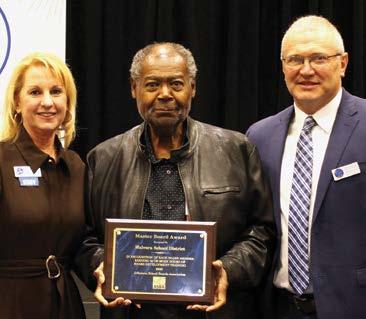
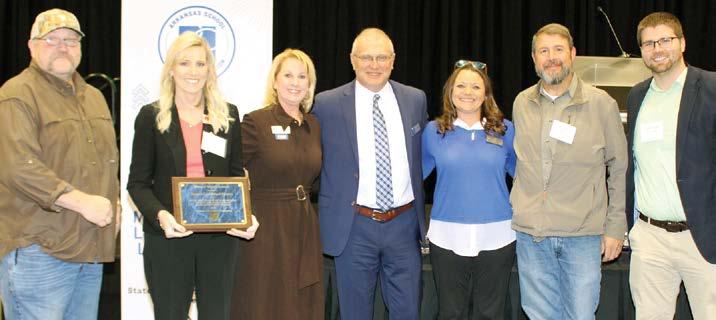
MASTER BOARD RECIPIENTS. School boards where all board members attain at least 50 hours of professional development are designated as Master Boards. Left photo, Malvern’s Jesse Clark, center, accepts the award from ASBA Executive Director Shannon Moore and ASBA Past President Jeff Lisenbey. Not pictured are Malvern School Board members Melanie Rock, Danny Riggan, Travis Worthington, Steve Williams, Connie Bane and Deborah Smith. Right photo, the Magnet Cove School District also received the award. From left are Jeff McJunkins, Karen Scott, Moore, Lisenbey, Samantha Nuckolls, David Sulton, and Superintendent Cameron Alexander. Not pictured is Mike Hughes. Other Master Board designees were Booneville, Harrisburg and Lake Hamilton.
legislators who have served on school boards: Sen. Breanne Davis, R-Russellville, who previously served on the Russellville School Board; Rep. Les Warren, R-Hot Springs, who served on the Lakeside School Board; Rep. Hope Duke, R-Gravette, a former member of
the Gravette School Board; and Rep. Paul Childress, R-Benton, who is finishing a term on the Benton School Board and is the only legislator actively serving in both roles.
The four legislators emphasized the importance of relationships and
communication. Warren said attendees should have meaningful conversations with their legislators to communicate the effects of legislation. Duke said hearing another person’s perspective can shape her own. Even if she doesn’t agree with
Continues on next page

it, there might be a middle ground. She encouraged attendees to invite legislators to events so they can learn. Davis stressed developing relationships with legislators before the Legislature meets.
“I always say in session, if you’re trying to form a relationship in session, when we are running around with our hair on fire, that’s not the time,” she said. “There’s no trust established. We don’t know you. There’s too much going

on. But if you take the time that we’re in the interim to reach out and try to build that relationship, then that’s always the most beneficial.”
The legislators said they need to hear from public schools. Duke said that



during a session, if she sends an email or text, the recipient should assume she needs the answer very quickly. Warren said that this past session, more than 2,600 bills were introduced. Five committees meet at the same time, each considering multiple bills that can be 30-40 pages long. He has three go-to local people in education in whom he relies for guidance. If a bill is advancing, he needs to hear from someone in Garland County, or he’s going to assume it’s OK.
Davis said people with different viewpoints share the same goals.
“We all want kids to be learning,” she said. “We want kids to be reading. We maybe have different ideas on how to get there. But that’s where we don’t have to be enemies. We can talk and have hard conversations and hash it out because ultimately we all want to be in the same place. We maybe just have a different road map on how to get there, and that’s OK.”
The conference also featured the annual surprise announcement of the Dr. Daniel L. Pilkinton Award, named in honor of ASBA’s first executive director and given for outstanding service to public education. This year’s winner was Dr. Tom Woodruff, a teacher in the Rogers School District for 49 years.
“His trademark is quiet, unwavering service, arriving early, staying late, showing up at every event that he can, simply

ensure
because supporting students is who he is,” ASBA Past President Jeff Lisenbey said in introducing Woodruff.
Surprised as the winners always are, Woodruff said his superintendent, Dr. Jeff Perry, had told him he was participating in a panel discussion before 20-30 people. He said he was

once asked why he has spent almost 50 years in education. He explained that there are three reasons. Educators must enjoy the people they work with, they must love what they do, and they must care about students.
In another presentation, North Little Rock School Board member Dorothy Williams received the new 2025 Spirit of Excellence Award, which goes to a board member who embodies their district’s heart and soul.



The Annual Conference also featured addresses by the top three finishers in ASBA’s Student Speaker Contest. Students were asked to describe the most important things schools can do beyond academics to prepare students for life.



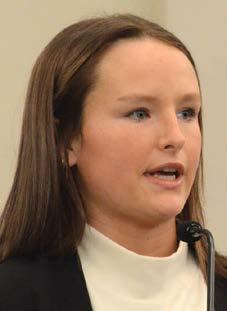

The winner, David Salinas, a senior at Bryant High School, received a $1,000 check. His speech focused on the value of open discussion in school.
“Schools should teach students what it means to discuss, disagree, consider,” he said. “It sounds simple, the ability to engage with other viewpoints and genuinely consider. But it’s something our world is lacking. We need more individuals who are open and willing. Individuals who see the value in others’ opinions. In schools, this can be taught in a number of ways. Courses can be dedicated to this type of learning – courses in which students are given comfortability to be able to speak up and share their voice. By empowering students to do this, they are getting in practice of sharing their voice, which is a precursor to understanding others.”
The second and third place finishers also addressed the conference and received cash awards. The second place

finisher, Tripp Lanehart, a senior at Monticello High School, received a $750 award. The third place finisher, Clinton High School junior Shelby Standridge, received a $500 award.
Jack Coleman, a Mountain Home High School senior, received the $250 honorable mention award.
STUDENT SPEAKERS. Bryant High School senior David Salinas, right, won the ASBA Student Speaker contest and addressed the Annual Conference during the awards luncheon. He received $1,000 for winning the contest. Students were asked to submit a recorded speech and a written version describing the most important things schools can do beyond academics to prepare students for life. The second place finisher was Tripp Lanehart, a senior at Monticello High School, middle. He received $750. Clinton High School junior Shelby Standridge, left, finished third and received a $500 award. Lanehart and Standridge spoke during the Friday morning session.
For her speech, Standridge had sent a survey to students and faculty asking, “What is the heart of our school?” Responses showed the answer was relationships.
In his address, Lanehart said the classroom can be a great equalizer where every student, regardless of their circumstances, has “a fair shot in shaping their future on an even playing field. That idea alone is worth protecting.”
He added, “When a school gives a student the confidence to take on the world and think bigger than their circumstances, it changes everything for them. Teaching math and history matters. Of course it does, But teaching resilience, kindness, and courage matters so much more. Those lessons [can] carry students through the times when life doesn’t hand them all the right answers.”
“School isn’t just a place of learning,” she said in her speech. “It’s a second home. For many of us, it’s where we’ve grown, made mistakes, rose again and discovered who we are. You see it in the quiet moments, a teacher pulling a student aside who didn’t seem like themselves. A coach reminding you that who you are off the field matters more than what you do on it. That’s a lesson you don’t find in textbooks. That’s something you carry for life. In the survey, a teacher also said, we’re all going to face the same ending, so how are we going to live with the time we have? That’s the heart that this school has. People who teach you not just how to pass a test, but how to live with a purpose.”

State’s secretary of education said at the ASBA Annual Conference that every student can learn, and many seventh-graders can learn Algebra I
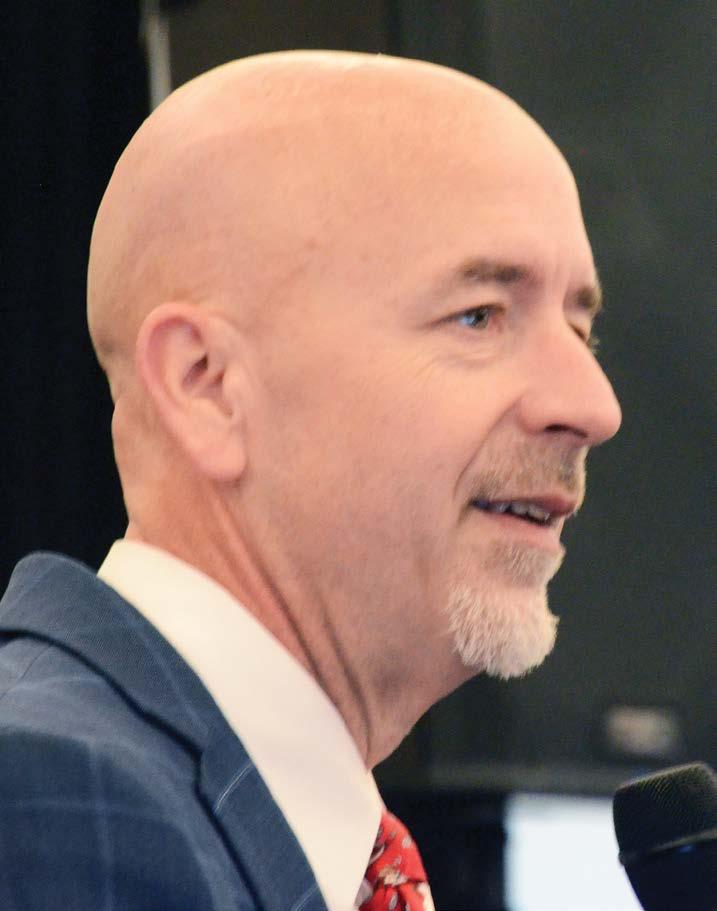
Arkansas schools must set high expectations and must embrace systemic change, Secretary of Education Jacob Oliva said at the ASBA Annual Conference Dec. 12.
Because if they don’t? “Bad systems beat good people every time,” he said.
Oliva described Arkansas’ low national ranking in academic achievement and said the state must do better. In fact, he said the state “drew a red line” with the LEARNS Act passed in 2023. One of the reforms arising from the legislation was the Arkansas Teaching, Learning, and Assessment System (ATLAS), which will provide up-to-date data for schools to make instructional pivots to help students succeed. School board members’ role is to ask questions and provide support, he said.
Oliva came to Arkansas in 2023 from Florida, where he had served as interim commissioner and as senior chancellor of the Florida Department of Education. Before moving into state level administration, he had been a superintendent, principal and special education teacher.
When he first arrived in Arkansas, he asked professional educators where they believed the state ranked in education nationally. They invariably said it was near the bottom.
It wasn’t just the adults who were aware of the state’s low ranking. The week before the Annual Conference, he posed the same question at a nearby high school to 150 students involved in a teacher preparation program. They agreed with the adults.
“Now, these are kids that love school,” he said. “They love it so much that they’re going to become teachers, but they’re telling us, the adults – we’re the ones that are responsible for supporting or running these schools – that
we’re failing them. So why are we doing so much so fast? Because I think our students deserve better.”
Oliva said Arkansas’ ranking is indeed unacceptably low. For example, the state’s high school diploma attainment rate is 87.2% according to the U.S. Census Bureau, which places the state 10th from the bottom.
Arkansas’ performance on the National Assessment of Educational Progress was no better. The assessment measures student achievement across the nation based on sample sizes – about
1,800 Arkansas students in 90 schools in the most recent one.
Oliva said fourth grade Arkansas students scoring in the 90th percentile in reading on the NAEP were 2-3 points’ standard deviation below the national average, while bottom quartile Arkansas students scored significantly lower than their national counterparts. He attributed that to low expectations, noting that, as a national average, 80% of students in the typical classroom are earning A’s and B’s, but only 20% are actually on grade level.
Arkansas similarly trailed the national average in fourth grade math scores. The difference was particularly high for 90th percentile Arkansas students and for the lowest performing students, with both groups scoring seven points behind the national averages.
Arkansas students did better in eighth grade reading. While national scores fell two points nationally, Arkansas stayed the same, moving to 38th. The state’s 90th percentile students were five points below their national counterparts, while the bottom quartile showed gains and was above the national average. Oliva attributed that change to an intensive reading course the state developed in 2023. Teachers were trained in the science of reading, and students had access to high-quality instructional materials.
But in eighth grade math, scores in Arkansas and across the country fell. Most troubling, Arkansas’ 90th percentile students were 11 points below the national average.
“That’s not a small gap,” he said. “That means our system is setting students up to not be successful. We designed this system. When I tell you this is the most alarming statistic in this slide deck, I hope you take this to heart. Our best and brightest math kids are 11 points below the nation’s.”
Fourth grade scores in Arkansas and across the nation began to decline between 2013 and 2015. The reason why is not clear, but Oliva noted that the time period coincides with the introduction of social media on students’ smart phones. Meanwhile, in Arkansas, the state moved away from Common Core around 2014-16 and made a political decision, not an educational one, to embrace the ACT Aspire assessment, he said. That test measures college readiness rather than assessing if a student is on grade level or needs intervention.
“It’s part of that confusion,” he said. “Remember, I said bad systems beat good people every time. It was step one
into making some confusion of what should be happening in our schools in our classrooms.”
‘Every kid can learn’
Oliva said that when he asked why students in Arkansas weren’t succeeding, some would point to the students’ poverty and circumstances.
He does not accept those explanations.
“What I heard is adults making excuses and setting up low expectations,” he said. “And we have adults in this room right now that are still doing that, and I’m going to challenge that because I firmly believe that every kid can learn. And I firmly believe that if we set high expectations, not only will our kids meet it, they’ll exceed it. So we’re starting a new day. We drew a red line in ’23, and said we’re going to take this snapshot of time and start putting some rapid strategies in place for an improvement.”
Continues on next page

screened for readiness in the youngest grades. Right, Annie Norman with the Forrest City School District said excelling areas of the state should assist struggling ones.
That red line was the LEARNS Act, in which Arkansas followed other Southern states in passing comprehensive education reforms. Mississippi in 2013 passed legislation that required teachers to be certified in the science of reading, and it invested in principal and teacher development. Louisiana in 2019 passed education reform legislation. Both states’ rankings improved.
‘We have to eliminate failure’ Oliva said Arkansas student performance since 2003 demonstrates the need for the state to act with the same urgency that it does with school safety. That’s because students who can’t read by the third grade are not safe in life. Bad teachers should not be retained, and teachers who don’t have a license should either earn one or perhaps do something else.
“I go back to, we have to eliminate failure,” he said. “We have schools that have been graded an ‘F’ for 13, 15 years. That’s a generation of kids. Why are these schools still open? At what point do we say, ‘You failed. We will close you. We have to have a better option’?”
Oliva said Arkansas must accelerate its math course timeline. When he arrived in Arkansas, only 17% of eighth-graders were taking algebra, even though the ACT Aspire exam indicated that 56% of students were ready. Unfortunately, that course often isn’t offered in those grades because there is an expectation in Arkansas that algebra is a ninth grade course followed by geometry and then Algebra 2. That schedule doesn’t allow students to reach calculus and other higher level math courses. In most states, the best students are taking algebra in seventh grade and geometry in the eighth grade. In Arkansas, less than 100 eighth graders took geometry last year. Oliva said ATLAS scores in 2025 showed that 81% of the seventh graders who took algebra scored at Levels 3 or 4 on the ATLAS exam. The percentage of eighth-graders scoring at Levels 3 and 4 was 67%. By ninth grade, the number had dropped to 20%. Eighth and ninth grade students also excelled at geometry.
“If kids are ready, let them go,” Oliva said. “We’re holding them back. We’re holding them back. We’ve got to build these systems to accelerate them.”
Furthermore, Oliva called for higher expectations regarding the senior year of high school. When he arrived in the state, 47% of seniors did not have a full schedule. He asked if an easy senior year with only two courses is a “rite of passage” in Arkansas. One National Merit semifinalist was taking only two courses. When he asked her why, she said she had taken all the Advanced Placement courses her district offered, and unweighted college courses would lower her grade point average and cause her to lose her scholarship. The Arkansas ACCESS Act passed in 2025 changed that provision so that now those classes would count as much as an AP course.
Oliva said that since 2023, Arkansas has written clearer new standards in English language arts and math. The state also created the ATLAS. It measures whether students are learning the standards the state wants them to learn from high school down to kindergarten, hopefully eventually extending to pre-K. With that knowledge, schools can make instructional pivots when
needed, rather than waiting until the end of the year to perform “an autopsy to find out what killed our schools.”
Thanks to ATLAS, board members now have access to more data faster, and state law requires them to discuss it. Oliva hopes they are doing that.
“I’ve actually had superintendents tell me that they have brought their principals to board meetings to talk about the progress monitoring data [they] want to share with the board, and the board chair says, ‘Never mind. We don’t have time for that,’” Oliva said. “That has happened. I hope we’re not doing that. You need to support your superintendents. You should listen to your principals. They’re working hard, and they’re proud of what they’re doing. Let them shout it from the rooftops. Hold them accountable. They want to be held accountable. It’s OK. Ask them the tough questions. They’re ready.”
Oliva said school board members can ask how their district and individual
schools compare to others, what the school district needs to be doing differently, and what additional resources need to be provided. Data can show which teachers are demonstrating more than a standard deviation of growth. Those teachers should be celebrated and assigned to the roles where they would have the greatest impact.
“We want to stay in our lane,” he said. “You cannot micromanage your superintendent. All you’re going to do is stifle innovation and handcuff their ability to do their jobs, right? But what data can I ask questions? If some of the data comes out, your curriculum team or assessment team or superintendent should be able to say, this is what we’re seeing by buildings, by grade levels. Did we hit the mark? Because you have a strategic plan, I hope. I hope you have a strategic plan that has some kind of metrics and data. It may be to improve literacy in fifth grade by 2%. Did we hit the mark or not? And if we hit the mark, great,
let’s keep doing it. If we didn’t hit the mark, did the district do what they were supposed to do? Or do we need a different strategy? I don’t want to use the data to be punitive. It should be to engage in a conversation.”
Oliva began his address by saying schools’ top priority is keeping students safe. This was not a theoretical discussion. In Florida, he had served four years on the Marjory Stoneman Douglas High School Public Safety Commission. It was created in response to the school shooting at that school in 2018 that took the lives of 17 people.
He encouraged attendees to follow safety procedures and protocols.
“Sometimes it seems tedious, maybe annoying, but it is so important because every parent that drops their kid off at school in the morning has every right to expect to be able to pick up that kid and take them home,” he said. “So at the heart of everything we do, safety is our number one priority.”


‘Excellent’ boards from Van Buren, Poyen offer thoughts on leadership at an Annual Conference early bird session
Supporting teachers and using data can help schools succeed, agreed the leaders of the two school districts awarded this year’s ASBA School Board of Excellence in Leadership awards.
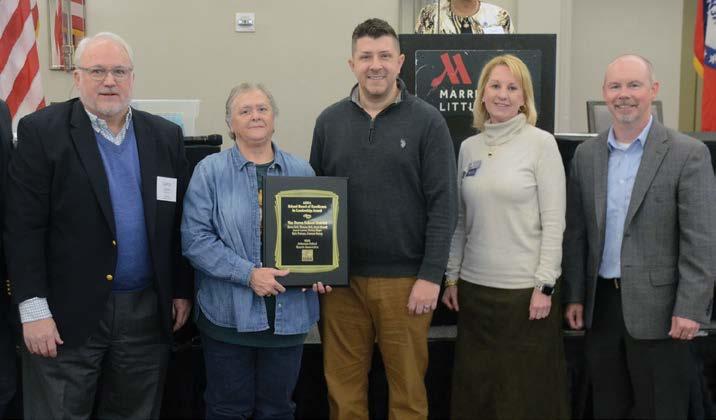
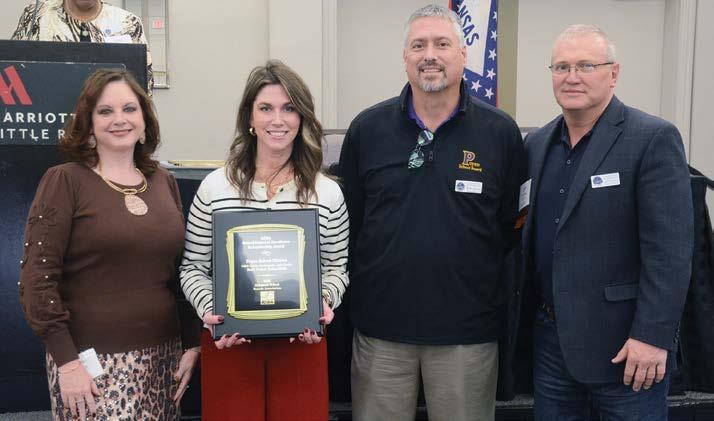
The Van Buren School District, which received the award for districts above 1,500 students, and the Poyen School District, which received the award for districts under 1,500 students, presented an early bird panel discussion at the ASBA Annual Conference Dec. 10. The topic was “Leveling up: Lessons in Leadership.”
The two districts differ in size and location. Van Buren, which sits on the state’s western border with Oklahoma south of Fort Smith, is one of the state’s largest with 5,585 students, Superintendent Dr. Harold Jeffcoat said. Poyen, a rural central Arkansas district near Malvern, educates about 537 students – about one-tenth as many. It receives the lowest per-mill amount of any district in the state, Superintendent Susan Kissire said.
But they also share many of the same priorities, and both scored well on the Arkansas Department of Education’s first-ever district report card. Poyen was one of the 9% of Arkansas school districts that received an “A.” Van Buren received a “B.”
Van Buren’s Jeffcoat said much of the district’s current success started when he and board members mapped out their hopes and dreams when he first became superintendent in 2015.
“It’s extremely critical that the board continue to revisit those goals,” he said. “Whatever the vision was that was set forth, continue to revisit those goals, see how close you’re moving towards reaching those goals. We have to be intentional about the work that we’re doing.”
Jeffcoat said schools must believe that all of their students can succeed. They must find areas where they can
improve, and they must be intentional about addressing problems. Van Buren’s path toward excellence was not a straight line.
“One thing that we all need to do is we have to stop believing the story we tell ourselves,” he said. “You have to stop believing that it’s because the kids come from poverty. It’s because the kids’ parents don’t care about school. We’ve got to let go of all of these reasons why the kids are not achieving and start focusing on what they can do and find those opportunities to sit down with teachers, looking at data with students to help them grow and improve.”
Raising teacher salaries has been a major part of that effort. School board member Carman Young said that before Jeffcoat was hired, the district was losing 40 teachers a year to neighboring school districts because its salary was the lowest in the area. When Jeffcoat arrived in 2015, the district was 63rd statewide in terms of average classroom teacher pay.
Now it’s in the top 10%, but it didn’t happen immediately. The district set a plan in place his first year and then restructured its debt and did a small millage increase the next year. Jeffcoat along
with school board members campaigned aggressively, and it passed with about 70% support.
Young said Jeffcoat and school board members “went everywhere” in their efforts to pass the millage increase. It wasn’t easy. She was running for reelection against a millage opponent, but she and the rest of the board members on the ballot won their races. Jeffcoat said that since that election 10 years ago, there’s not been a single contested school board election in Van Buren.
In addition to the pay increases, Van Buren has sought other ways of improving the quality of life of teachers and staff, including health and wellness events, a bowling competition, and whiffle ball games.
“We do things like that because we want our teachers and staff to love working in the Van Buren School District,” he said. “We want them to have pride in where they work, and to be able to share with others, with that level of excitement and pride that we want to have, that they work in Van Buren.”
As a result of the school district’s positive culture, the high school only had to hire one teacher for its 82-teacher faculty this year, said Van Buren High School Principal Chris Bryant. As he started his first year as a principal, “one parking spot changed on our campus.”
“Five years ago as a first-year assistant principal, when there was an opening and being on the interview
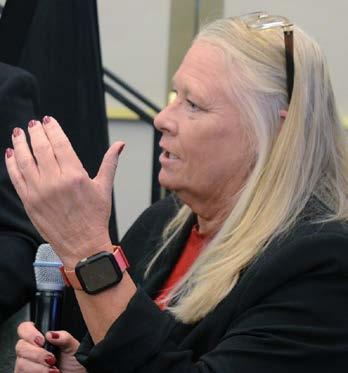
CARMAN YOUNG, Van Buren School Board member, said the district was losing teachers before it passed a millage increase and raised salaries. She said board members and superintendent Dr. Harold Jeffcoat “went everywhere” campaigning for the increase, which passed with about broad support.
committee, we were hoping to get that one really good applicant that was the right fit for us,” he said. “And because of the work of our board and the vision of our district administration, making our place a place that people want to be, now we’re choosing.”
Poyen’s four-day week
Poyen School District Superintendent
Susan Kissire agreed that taking care of the district’s people is a key feature of Poyen’s success. One way Poyen does that is by being a four-day-a-week school district. While it won’t be the

solution for every district, it’s been successful for Poyen. The arrangement is better for families, Kissire said. Students can work or schedule doctor visits on Mondays, so school attendance has improved. She said the decision was made because it would improve recruitment and retention.
“Now that LEARNS has kind of leveled that playing field for salaries, then you want to definitely do everything you can to be competitive,” she said, referring to the 2023 law that set a minimum public school teacher salary of $50,000. “If I’m a teacher, and I’m going to come in and make the same amount of money in your school district and work four days – four longer days, but still four days, same amount of instructional minutes and so forth, then you bet. I want to do that.”
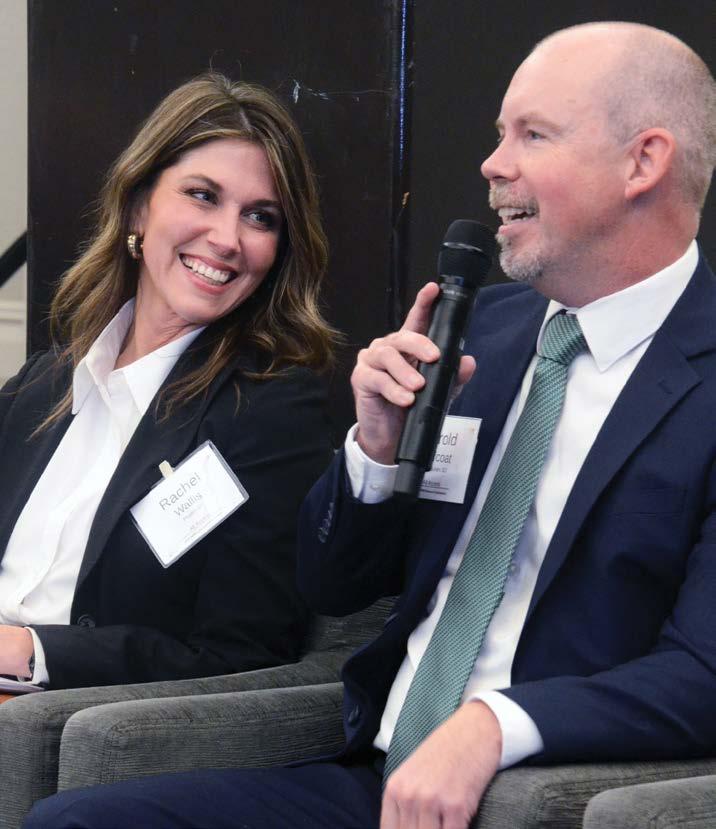
Poyen School Board member Rachel Wallis said board meetings start with what she called “appreciative inquiry,” which she said is a model for process improvement that studies effective practices. Last year, Poyen board meetings began starting with “tribal cheers” – it’s the Poyen Indians – where Kissire describes some of the district’s successes.
“It really humanizes the work that we’re doing and the data that we’re constantly looking at and reviewing and trying to figure out how to make better,” Wallis said. “And it allows us to kind of pause, recognize that we’re doing well,
Continues on next page
One thing is certain: change is a constant in Arkansas public education. At Stephens, we stay focused on what’s ahead, helping school boards and administrators navigate new paths with confidence.
Our commitment to providing tailored advice with regard to financing educational opportunities across Arkansas will never change. In fact, Stephens proudly ranked as the No. 1 municipal advisor for Arkansas school districts in 2025, based on number and size of bond transactions (source: LSEG).
Let us put our experience to work for you.
and it could be a very small win or it could be a really big win like becoming an A school, both campuses.
“But then I like to ask questions about, well, how did we get there? What caused this? This is amazing. What were the things that we did to make this happen? And then can we use those things to apply to one of these other challenging areas? So at the board level, it’s really our responsibility to create that culture that is supportive of those that are really the boots on the ground work(ing) with those students.”
Everything ‘backed by data’ Administrators and board members from both school districts emphasized the importance of using data to improve student achievement.
Dr. Travis Poole, Van Buren Butterfield Trail Middle School principal, said that when he first arrived, the school wasn’t really tracking students from beginning to end. The state’s Arkansas Teaching, Learning, and Assessment System (ATLAS) helps educators track students from day one of school.
School board member Young said she is a scientist. She likes to use data to compare Van Buren with nearby school districts. When the data shows Van Buren is succeeding, then they celebrate.
“But then when it’s not, we’re looking at that, trying to break it down and figure out, how can we make this one tiny area better?” she said. “And then these guys take over and school board doesn’t have to do anything. They do all the work. … Everything we do is backed by data.”
Likewise, Poyen’s Wallis, a health care executive, said she studies both outcome data and process data. It’s not just about goals and grades but whether the district is doing the right things.
“What we do is we look at the data,” she said. “We decide on where we are. We figure out where we need to be, how we’re going to get there, and then how are we going to know if we’re successful, and how are we going to know if we’ve gotten off track before it’s too late to course correct and get back on track?”
Wallis said Kissire is well prepared at board meetings with success stories and
data. Board members are curious about how things are progressing and how the district’s strategies are working to affect growth scores and students’ progress. They don’t want to micromanage. They want to know how things are going and whether the team is being set up for success.
Kissire said she wants board members to ask questions.
“This is my 17th year as a superintendent, and I don’t want a board that’s filled with yes men,” she said. “Because I would not feel successful in my job and not know if I was doing what I
needed to be doing if I felt like, well, no matter what I say, they’re just going to go, ‘Yep, stamp it and move on.’ I want us to have discussion about things. I want them to be interested in the data and to ask questions and especially, if it comes to hiring or purchasing resources and so forth, they need to have that information.”
Kissire said school board members should be engaged and visible. She opens car doors every morning as students arrive at school. Teachers, students and parents need to see that board members are vested and involved.
“There’s so much that goes into it, but, again, the greatest piece of data you’re going to be able to obtain is being visible, being there and seeing what you observe,” she said. “What is the culture? What is the climate? Not just what I’m telling you it is. What do you actually observe whenever you’re on campus?”
Kissire said the leadership team must collaborate. Her team members at her small district meet informally almost daily and formally every few weeks where they look at the data together and consider what professional development they need that summer or what resources they need to purchase.
“I will not go to the school board and recommend we purchase something unless it is a data-based decision – something that I know, and not just because it’s the next coolest thing,” she said.
Jeffcoat said when he first became superintendent, he scheduled time with other superintendents to learn from their experiences. He said Van Buren’s school facilities are so good because years ago he met with Greenbrier Superintendent Scott Spainhour and implemented the same plan as Greenbrier’s. He reads news articles about other districts and calls his colleagues.
He encouraged school board members to do the same. He noted that because of a state law passed in 2025,
board member email addresses must be posted online.
“Listen, if I said right now, what’s the one thing that needs to be better in your school district, it wouldn’t take a second for you to think and come up with that one thing,” he said. “Well, I promise you, there’s a school in the state that’s doing that thing really well, and all it takes is reaching out.”
Poyen second grade teacher Jill Hurst said schools must have a culture of shared responsibility where everyone takes ownership of all the students. Teachers must have a sense that they are answering to each other.
Hurst said this was Poyen’s first year to have student-led parent-teacher conferences. Students led the discussion about what they were learning and achieving.
It was a success. Only one of her 28 students’ families didn’t attend.
“It gave the students a stronger sense of ownership this year because they knew, ‘I’m going to have to take my data binder and walk my mom or dad through it, and my behavior sheet, and I’m going to have to explain why this rubric says that I’m not taking care of business when I’m supposed to,’” she said. “So, it just gave our whole classroom a stronger feel there. The kids, they really loved it. They liked being able to show off how smart they were to their families, and they really took it and ran with it.”
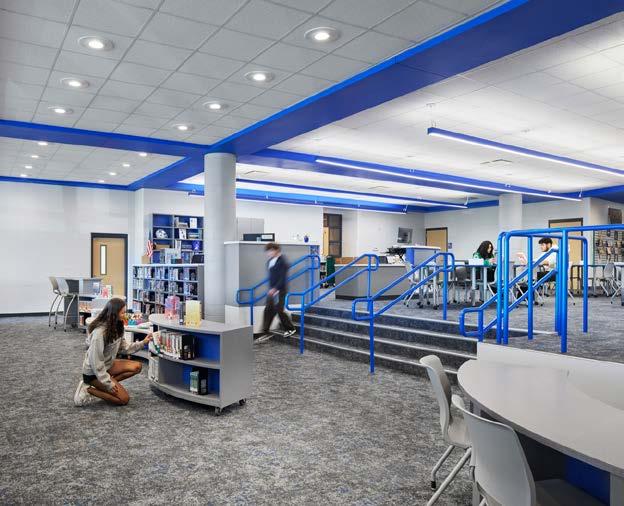
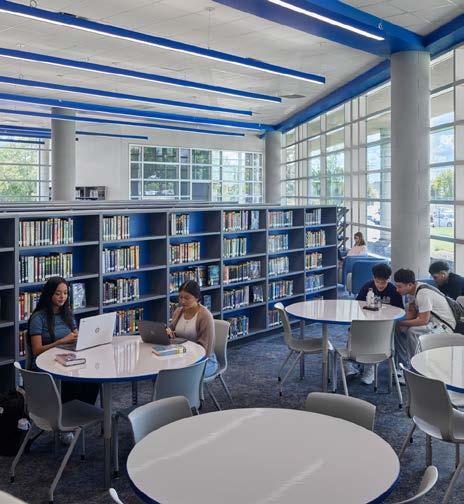
Asked what one change made the biggest difference in their district, Poyen panelists mentioned having protected time. Poyen Elementary School Principal Jamie Webb said this is his 12th year as a principal, and when he arrived, the school had a C letter grade. Teachers told him students were being pulled out of class too much. Then the school started protecting instructional time. Teacher Hurst said the school reserves an hour for literacy and an hour for math where no one can pull a student away for any reason.
Van Buren’s Jeffcoat said school districts should take inspiration from fast-growing moso bamboo. It spends years developing an extensive root system. Once the plant starts growing, it can grow a meter a day.
“If you have things you want to accomplish in your school system, and you have a vision and you have a plan, you also have to have patience,” he said. “It’s not going to happen overnight. And if you don’t see that sprout come out in the first year or the second year or the third year or the fourth year, as long as you’re still putting the work in, focused on the goal at hand, then I can assure you, at some point that sprout’s going to come out. And when it does, if the foundation is strong, if the root system is elaborate, then the success will happen quickly, and that success will continue. It will continue to grow.”

Superintendent said school district had the needed resources, infrastructure and culture of service
When a tornado struck Rogers on May 26, 2024, the Rogers School District took charge of the community’s response efforts because it had the resources and infrastructure to do so. As a result, it not only served the community, but it also built goodwill for itself.
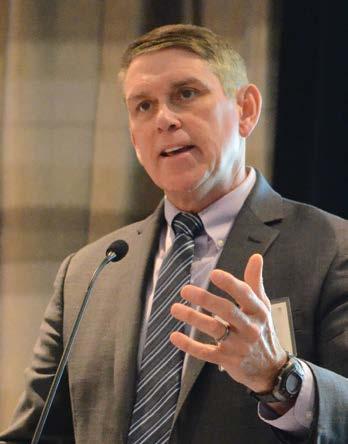
The district’s superintendent, Dr. Jeff Perry, shared those insights during a breakout session at the ASBA Annual Conference Dec. 11.
“[W]e didn’t really get into this to be the epicenter for all of the support, but we quickly became that,” Perry said.
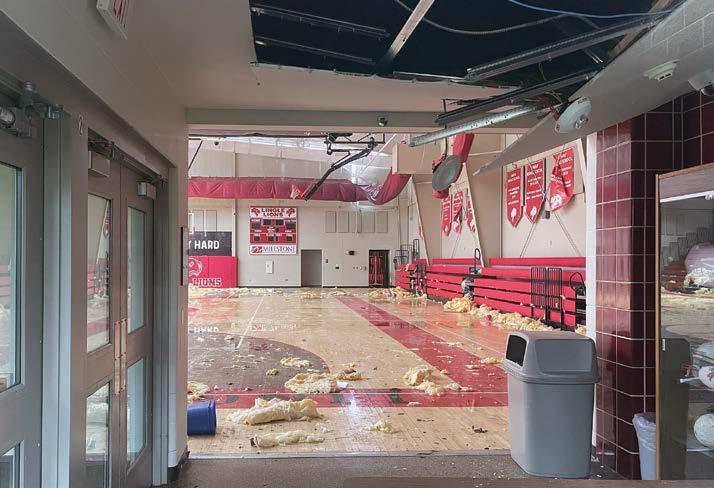
The tornado struck the town on a Sunday with two days remaining in the school year, so no one was killed or injured at the school. However, the district sustained nearly $30 million in damages. Fifteen buildings were damaged, including Greer Lingle Middle School, which required a year’s reconstruction while students were educated in mobile classrooms on another campus.
Perry said that, after assessing its own damage, the district soon learned that much of the city did not have electricity, including the facility the city intended to use as a shelter. But Rogers High School did, so the district opened the building and started providing shelter and services. That first day, more than 500 people came for breakfast. By the second day, the school was feeding 1,500 people for breakfast and 1,500 for supper. Teachers staffed free childcare centers from 6 a.m. until 6 p.m. so parents, including essential workers, could work. Because the district had some of the city’s best technology, it provided updated communications about where people could get assistance. The school became the place where people could work with employment agencies or file for unemployment. It housed counseling services for students, staff and community members who were struggling to deal with the trauma. The Federal Emergency Management Agency set up
shop at the school. Director of Community Relations JoAnna Lever created a digital portal where community members could share a specific need, such as cleaning their driveway or obtaining baby formula. Hundreds of requests came each day. The first day after the disaster, Perry estimated that nearly 1,000 students as well as staff members volunteered to help.
Perry said that during a disaster, people are looking for someone who is stable, calm, and can re-instill hope. A school district can fill that role. It has the resources, relationships and infrastructure. It knows where the needs are. And it has a culture of service.
recovery
lead the
The district’s efforts created goodwill in the community and directly benefited the district as well. A dozen job applicants later said they wanted to work for a district that puts people first. The district serves a community of 100,000 where only about 10,000 families send 15,000 students to school, Perry said. Most of the district’s patrons are paying property taxes to support a school system that doesn’t educate anybody in their family, so they need to see a return on investment.
“Because at some point in time, you’re going to have to pass the bond, you’re going to have to pass the millage, you’re going to have to do some things,” he said. “And if only 10% of the people are directly connected to your district, that’s not enough to pass some of the levies and some of the mills that you need.”
Perry said Rogers’ experience taught four lessons. One is that the school district is a natural hub because it’s the heart of the community. People trust the school district and have faith in its personnel. Second, the school board plays
a leadership role. In Rogers’ case, the board allowed the district to do things that could have opened it up to liability issues, and it authorized emergency resources. The third lesson pertained to the importance of communication. Perry said the district worked with the city to coordinate a unified message. The fourth lesson is that people are more important than processes.
“Don’t worry about anything else except we’ve got to take care of people because most of the time, the vast majority of time, people don’t care about what you know,” he said. “They just want to know that you care about them. And so we did put people first in everything that we did, and I think that ended up working out well for us.”
Perry said school districts can prepare for a disaster by auditing their facilities to ensure they are ready to serve the community. Districts should strengthen partnerships with police, churches, and business partners beforehand.

When the disaster does occur, they should document their activities. FEMA will reimburse a school district for the volunteer hours it performs. As a result, the district secured $1.2 million for itself and the city. About $600,000 to $700,000 could have gone to the school district, but Perry and the board decided to give it all to the city. That kind of favor could be remembered in the future when the district needs a permit or some other action from city government.
Finally, districts should plan for longterm recovery. The first two weeks, the district was focused on providing relief.
“But then beyond that, then you’ve got to switch to that recovery piece of getting people back on their feet,” he said. “I cannot overemphasize the importance of you providing a model for that. When this kind of thing happens, like I said, the first thing that leaves is hope.”
Perry advised attendees to read their insurance policies. At the time of the
conference, the district was still engaged in a dispute with its insurance carrier over $6 million it felt it was owed. The question was over whether the district’s policy would cover where the district was before the damage occurred, or allow it to meet the state’s more expensive current requirements.
Perry said the school worked in the community for 28 days. He would focus on school business for a couple of hours each morning and then cut downed trees the rest of the day.
“Last thing that I will say: There were a million reasons why we should not have placed a chainsaw in the hands of an 11th grader to clean out a driveway,” he said. “There were a million reasons why we should not have opened up our facility to over 3,000 people a day. There were a million reasons why we shouldn’t have done most of what we did. But there was one reason why we did it, and we’re in the business of helping people.”
Simbli
www.diligent.com/community C.R.
www.crcrawford.com
www.captg.com
www.chartwellsk12.com
Clark Contractors Cory Olson
Cromwell Architects Engineers, Inc.
colson@clarkcontractors.net clarkcontractors.net
Chris East 501.372.2900 ceast@cromwell.com www.cromwell.com
David H. Frieze Associates, Inc. Paul Frieze 501.922.9704 paul.frieze7@gmail.com
Dynamic Integrated Security
East Harding Construction
Educational Benefits, Inc.
Grand Canyon University
HES Facilities Management
Hight Jackson Associates, P.A.
Homeland Safety Systems, Inc.
ISG
J&J Flooring Group
Kinco Constructors
KLC Video Security
Lone Star Communications
McPherson & Jacobson, LLC
Modus Studio, PLLC
National Safety Shelters
Paragon Architecture
Precise
SFE - Southwest Foodservice Excellence
SOPA, Inc.
Southern Bleacher Company
SYNLawn
Zeev Fragachan 954.641.3444 Zeev@dynamicintegrated.net www.dynamicintegrated.net
Trish Jones 501.661.1646 info@eastharding.com www.eastharding.com
Jon Collins
501.500.1412 jon.collins@ebiteam.com www.ebiteam.com
Danielle Johnson 480.646.7038 danielle.johnson@gcu.com www.gcu.edu
Chas Harris 901.378.6994 charris@hes.com hes.com
Kaylee Hopper 479.464.4965 khopper@hjarch.com www.hjarch.com
Ann Day
318.221.8062 ann.day@hssems.com http://homelandsafetysystems.com
Maria Pedroso 605.274.6401 maria.pedroso@isginc.com www.isginc.com
Brad Bunch 479.305.4004 brad.bunch@jjflooring.com www.jjflooringgroup.com
Clay Gordon 501.225.7606 cgordon@kinco.net www.kincoconstructors.com
Stacee Walker 903.792.7262 staceewalker.klc@gmail.com klcvideosecurity.net
Liv Barwinski 312.539.6196 liv.barwinska@lonestarcom.com lonestarcom.com
Norman Ridder 402.991.7031 mail@macnjake.com www.macnjake.com
Josh Siebert 479.455.5577 josh@modusstudio.com www.modusstudio.com
Dennis Corrado 886.372.1530 dennis@nationalsafetyshelters.com nationalsafetyshelters.com
Brad Erwin 417.885.0002 erwin@paragonarchitecture.com www.paragonarchitecture.com
Amy Finster 870.698.1734 afinster@go-precise.com precisearkansas.com
Diane Johannes 850.449.0970 diane.johannes@sfellc.org sfellc.com
Teresa Snook 501.920.1699 tsnook@sopainc.com www.sopainc.com
Sarah Lundgren 940.549.0733 slundgren@southernbleacher.com www.southernbleacher.com
Paul Held 816.886.2747 paul.held@synlawn.com www.synlawn.com
The Interlocal Purchasing System (TIPS) Stacey McPherson 866.839.8477 stacey.mcpherson@tips-usa.com www.tips-usa.com
The Kirkland Group Chan Cleveland 601.383.0766 c.cleveland@kirklandgroup.org www.kirklandgroup.org
The PlayWell Group
www.playwellgroup.com
Arkansas’ Religious Rights at Public Schools Act of 2025 clarifies the rights of students and staff to freely express and practice their religious beliefs in public schools.
The law states that students may:
– Pray silently or aloud, individually or in groups, at any time when students are permitted to speak freely and engage in discussions of the student’s own choosing;
– Pray by assembling on district property in the same manner that students are allowed to speak and assemble on district property for other activities;
– Promote legal religious activities on district property in the same manner that other activities are promoted;
– Display, print, recite, or discuss religious figures, texts, and beliefs in school assignments in which students have discretion in choosing topics or people of interest;
– Give a Bible or other religious text to any other person at the district in the same manner that the student is allowed to give away other books or texts;
– Individually or in groups conduct religious observances such as speaking, singing, reading, or praying at times when students are free to voluntarily converse and interact with each other;
– Form and participate in religious groups, clubs, or associations in the

by Jay Bequette Bequette, Billingsley & Kees, PA
same manner that students do so with other groups, clubs, or associations;
– Invite and host members of the clergy or other religious leaders to the district in the same manner that other persons not enrolled in the district are allowed to be present;
– Express a religious viewpoint in the same manner as other viewpoints may be expressed in the district’s academic assignments, activities, speech or other expressions;
– Pray silently during any moment of silence during the school day or at the district’s school activities;
– Display and discuss the U.S. motto, “In God We Trust”;
– Read, discuss, and post documents of historical significance that are of a religious nature or contain religious quotes or references;
– Have a Bible or other religious text in the same manner that a student is allowed to have other books or texts;
– Read a Bible or other religious text in the same manner that a student is allowed to read other books or texts.
The law says that employees have the right to:
– Pray silently during any moment of silence during the school day or at school activities;
– Display and discuss the U.S. motto;
– Read, discuss, and post documents of historical significance that are of a religious nature or contain religious quotes or references;
– Have a Bible or other religious text in the same manner that an individual is allowed to have other books or texts;
– Read a Bible or other religious text in the same manner that the individual is allowed to read other books or texts.
School districts have an obligation to provide each student and employee with a copy of the law at the start of each school year, either by electronic means or by placement in the student handbook or employee policy manual. They can place Bibles and other religious texts in libraries, classrooms and other places where books or texts are available to students or employees. They also may offer a nonsectarian, nonreligious academic study of the Bible course.



By Steve Brawner Editor
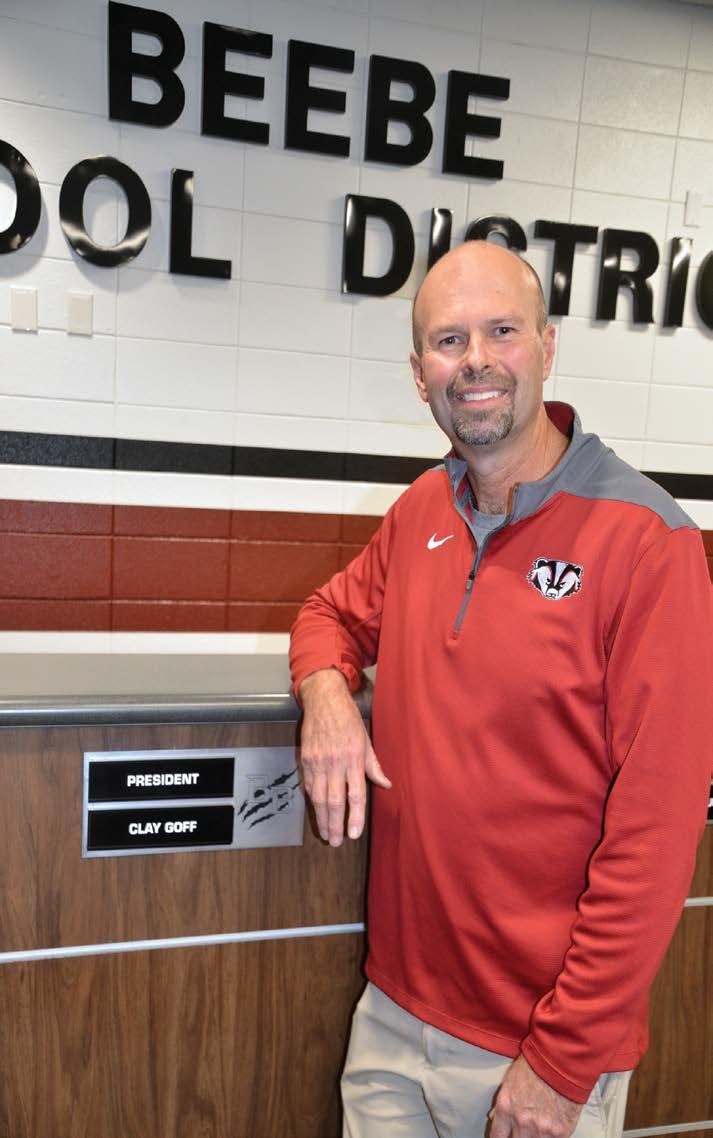
Clay Goff is a loyal “Beebe-an.”
The president of the Beebe School Board was born and raised in the central Arkansas community and never left, other than the three-and-a-half years he spent at Ouachita Baptist University. After graduating college, he went to work for the family business, Goff Realty, and then took a job with First Security Bank’s Beebe branch, where he eventually became president. Now he pastors Mount Hebron Baptist Church and raises 500 head of cattle on a 900acre ranch.
Goff first was elected to the Beebe School Board 14 years ago and was unopposed in his bid for a six-year term this year. He not only is school board president but also serves on the board of trustees for Arkansas State University – Beebe, which rests across the street from Beebe High School. The two institutions have a close relationship that allows Beebe students to earn concurrent credit. Goff’s son, in fact, will graduate Beebe with 21 college credits this year.
Report Card sat down with Goff in the district boardroom and talked about what he looks for when hiring a superintendent, what he has learned about the public comments portion of school board meetings, what it’s like for a pastor to be a school board member, and where he gets his passion.
You’re from here?
“Yes, I was born and raised in Beebe, been in Beebe all my life, graduated from Beebe in 1990. ‘Once a Badger, always a Badger,’ as they say.”
What was your education like here?
“Absolutely wonderful. I can still go back, my fondest memories from junior high to high school, just being involved in clubs and sports and friendships that started in grade school and still have today.”
You graduated from Ouachita Baptist University. What did you do then?
“I came back to Beebe in ’94 and immediately went to work in the real estate and rental office with my father and worked in that for about five years. I got
my real estate license on my 18th birthday. … Came back and worked in the family business there for several years, and we had a close relationship with First Security Bank, so the opportunity came open for me to go work for First Security. So, I did for 20 years. Enjoyed it. It’s a phenomenal organization and truly enjoyed it. But time came for me to pursue other interests, so I spent a whole lot more time on my cattle farm and in the real estate business. I also pastor a church, which I have thoroughly enjoyed that.”
You left out the part that you became the president of that bank.
“Yes. Correct.”
So how was that?
“It was great. Became the president there of First Security – Beebe, and I tell you what: It taught me so much about managing people and making decisions that are best for everybody, which brings me back to my school board, which is exactly what you’ve got to do. When we make decisions, we’ve got to do what we believe is the best for every student, and not just one individual student. So my career path that I have chosen has actually tremendously helped remind me that we’ve got to do what’s best for the whole.”
When did you run for school board first?
“Dr. Belinda Shook was our superintendent at that time, and we had a school board member, Tommy Vanaman, who was not going to seek reelection, so she called me. She said, ‘I want to take you to lunch. I want to have a conversation with you.’ And I’ve known Dr. Shook, oh, pretty much my entire life. She’s a Beebe-an also. We had a good visit, and she said, ‘I want you to run for school board.’ And anyway, I did.
“That was 14 years ago. I ran for school board and have been on school board ever since, and I just signed up for another six-year term. So I’m committed, I guess, is the word.”
You’re a minister. Tell me about that.
“Minister at Mount Hebron Baptist Church. It has absolutely been extremely rewarding. What I tell everybody, they ask me, how is it going? I tell them it’s going great. I’m enjoying it, and they’re tolerating it, so it’s a good trade.
“When you minister, you are dealing with a wide range of people from different ages to different backgrounds, different stages in life, to different hurts and burdens. But I’m telling you, it is extremely rewarding and truly a called position.”
What do you think a pastor’s role is in school board service?
“Everybody can talk about some problems in our school systems, and
we need to pull our children out and whatever, but that’s just not true at all. You’ve got to go into the school system and integrate good, solid values that I call them Christian values. But put those values out there to say, ‘Listen all of you, you can do it.’ With the proper encouragement from teachers and other staff and with encouragement, with a pat on the back with other members of the community supporting those kids, I’m telling you, they can achieve what they think is unachievable. And that first step is that high school diploma, and go from there.
“As a pastor, I want to be that positive influence. I want to be there to reinforce with those students through our programs and through just individual contact that you can do it. …
“I believe that Jesus taught through his actions that we see in His ministry on earth, and no more so than at that last supper when He got down and He washed the disciples’ feet. And I believe this right here: Authority wears an apron – meaning authority is you’re not at the top watching everybody else work, but you’re right there serving, promoting, encouraging. Authority wears an apron, whether that is as a pastor, whether that is as a school board president, or whatever it may be. I need to have my apron on, never asking somebody else to do something I’m not willing to do myself.”
Continues on next page


“ I love people. I just love people. I love engaging with people. I love shaking hands, patting on the backs. I love listening to their stories. I love their success stories. I love people. And I think that is what helps me to be passionate.”
Is there a challenge to balancing your faith with public school service where some things are limited in what you can say and do?
“There’s no question I am thankful for our governor. I’m thankful for her stance as being a Christian herself, and that, I believe, has trickled down into our education system. But yes, you know as well as I that there are some organizations out there that are not Christian based and actually are trying to push that out of the school.
“And so therefore, as a Christian, as a pastor, I have to walk a fine line at times, but it doesn’t mean I’m going to be weak and not express my faith. I’m going to be meek, not weak, meaning I’m going to be under control, if that makes sense.
“You know, meekness is not weakness. It’s power under control. Think of a dam. Think about that dam as power under control. Think about a vaccine when you get the flu shot. That is power under control. And I think as a Christian, as a minister. I want to have that power, but I want it to be in a controlled way that I’m not forcing my beliefs on somebody, but they know that I’m being led by my beliefs.”
What did you look for in a superintendent?
“In a superintendent, I look for integrity. Look for transparency. Transparency is huge in the school district. As you know, the school district, number one, is our largest employer in town. It houses over 3.000 students, so everybody has an opinion, it seems like. And Facebook, as you know, social media, people can get 10 feet tall and bulletproof pretty quickly there and express their opinion and stuff about oh, the school’s hiding this and hiding that. And that’s just not true. You want a leader at the top that is

being transparent in the decisions that we make. So transparency is huge.
“I believe in somebody that has walked up the ranks. They have been in the classroom, they have been out there on the forefront, so they understand what teachers are going through. They understand the day-to-day classroom activities, the challenges that are there. So I think that is extremely important.
“And I’m telling you, I want a superintendent that is personable. One that is not leading from a video that they put out, but is leading by walking the halls, opening up car doors, listening to those conversations from parents and from teachers alike, classrooms, cafeteria, janitorial staff, but is truly personable saying, ‘I hear you, I hear you.’ So, a personable approach is huge for a school district.”
Then how, ultimately, do you make a decision?
“You take notes; you listen. We had great candidates this last time, and just the one that you believe at the end of the day has got that one little niche that you believe is going to make them fit.
“One of the things that was so great with hiring our current superintendent, Mr. (Zebulon) Prothro, who we hired
last June, is he had been on our campus before. He’d been with us as an agri teacher, which as you know, in a rural district like ours, the agri department is a huge, active, extremely demanding department, and he was there and just did a phenomenal job. We moved him into a principal position, and he just did a phenomenal job. We knew that he had transparency, that he had quality, that he had integrity and that he was hands on. So we knew that about Zeb. So that was probably what pushed us over that Zeb is our man is because we had that personal experience with him. The other candidates, phenomenal. That was probably the niche that pushed him over the top.”
Well, you’re a hometown guy, so a candidate that had at least lived in the hometown, that would help.
“That’s right. I believe in Beebe. I believe in our district. It’s just phenomenal, and we are so blessed that we have ASU-Beebe in our city. I have said all my life that it’s a hidden gem in our community, and over the last three or four years, it’s not so hidden. People are starting to realize about ASU-Beebe, the importance of it, and the relationship that the public school here at Beebe has to go across the street, which makes it so convenient. It’s just across the street, literally. We have a great relationship with Dr. (Jennifer) Methvin. She’s the chancellor over there. We have so many of our kids taking concurrent classes back and forth. My son himself will graduate this May. He’s going to graduate with 21 college credits when he picks up his high school diploma. I mean, he has got a shot in the arm. He’s just so far ahead, and that is just so exciting.
“Not only do we have ASU-Beebe, but ASU-Searcy falls under the ASUBeebe’s umbrella. And that is more of what I call the vo-tech program, and they offer so many different options. We have a school bus that we take every day for those students that are juniors and seniors here at our high school that are choosing that type of vocation, those types of classes. We’re transporting them to ASU-Searcy to once again begin working on those certificates to prepare them for the next step of their life.”
You’re on the board of ASU-Beebe. How do you get the two together?
“Oh, it’s great because they’re in the same business, just different levels. That makes it so easy because from the ASU side of things, as they’re talking about areas that they’re wanting to extend in or grow in, I can immediately tell them from the public school side over here, ‘Hey, this is something right here that we are seeing that our students are desiring or where they’re expressing some interest.’ They can look to see if they can match up classes to meet just that. The relationship is just woven together. It’s like socks and shoes. It’s just great. It’s like a bat and ball.”
You all made a presentation about your public comment policies at the ASBA Annual Conference. What did you learn from the first board meeting where you had public comment?
“I think we learned, number one, is you as school board members, as a district, you take control of the room.
“I’ll say this about public comment. This is a take that we have: It’s called ‘public comment.’ It’s time for the public to comment, not for us as a board to respond. Because when you respond, sometimes tempers can flare, or that conversation goes longer than it should, or it turns into a conversation that really needs to be a private conversation, or a conversation with the superintendent, board, whatever it may be, and not an open forum. The first time we had public comment, first public comment, we had a situation on campus, and anyway, we had a room full, and the room got loud. So number one, we learned that it is a time to listen. It is truly public comment. I’m up there taking notes. Other board members are taking notes about whatever concerns, questions that they may have.
“Number two, of course the law protects our students that (commenters) cannot mention students’ names, but the law does not necessarily protect our teachers. And we learned that you don’t want to have a parent or a patron in our community talking negatively about a staff member when that staff member is not there to be able to defend themselves, so you’re only getting one side
of the story. And of course, that immediately hits social media, and that’s not fair to our staff.
“So, as a school district and as a school board member, we have a right to provide a great education for our students, but we also have the responsibility of protecting our staff. A staff that does not feel protected, morale is going to go down, and if other districts are hiring, they’re going to go out the door, and you’re going to lose some great staff. So you always want to protect your staff from top to bottom. …
“We also have one of our SRO officers, now, that they are the ones that will say, ‘Sir, you can’t say that.’ ‘Sir, ma’am, your time is up.’ And take that burden off of the board and let the SRO do his job. And I think that’s good because he’s a man of authority or person of authority. And that is what really his role is, is to protect the campus, including all staff or students.”
How’s it going since then?
“Great, great. I think we’ve just had one or two people comment, and it has been actually about positive things.”
You have a very animated, enthusiastic personality. Where do you think that comes from?
“You know, I guess I’ll answer that question by saying this. When Mount Hebron called me and they sat down, and they visited with me about becoming their pastor, they said, ‘What do you think your biggest thing to offer our church is?’ And I said, ‘The biggest thing that I have to offer your church is this: I love people.’
“And that’s just it. I love people. I just love people. I love engaging with people. I love shaking hands, patting on the backs. I love listening to their stories. I love their success stories. I love people. And I think that is what helps me to be passionate. And if we’re not careful in life, we lose our passion in our job, passion in our marriage, passion in serving in a public office, passion in being a teacher. That’s a bad place to be. Don’t lose your passion. Don’t lose your passion.
“And how do you do that? You keep reminding yourself of what your responsibilities are. You keep reminding yourself that, listen, I’m here to help and encourage others, whether it be from the school’s perspective, in the community, in my church, my family, whatever it may be. Passion can move mountains.”
Note: Executive Session is edited for length, style and clarity.


Nabholz is building Woodland Junior High for the Fayetteville School District using cross-laminated timber, or CLT, as its main construction material.
CLT is a relatively new construction method for school districts to consider when planning construction projects. The method fabricates plywood paneling in an off-site mill shop, where it is glued, pressed, and cut to size according to a project’s design specifications.
Using CLT instead of concrete or steel can speed up project schedules with its quick production time, allowing districts to fast-track construction during breaks and minimize learning disruptions. It is also more environmentally friendly, with a construction process that produces fewer carbon emissions than concrete or steel.
Nabholz has also constructed the University of Arkansas’ Adohi Hall and Anthony Timberlands Center.
For more information on CLT and Nabholz, go to www.nabholz.com

The new Woodland Junior High in Fayetteville, designed by modus studio, is taking shape as cross-laminated timber (CLT) panels are being erected. This construction phase features the new cafetorium, a gathering space supporting daily dining and school-wide events, with classrooms positioned above.
The exposed mass timber structure highlights the district’s commitment to sustainable design while creating a student-centered environment. The vision for a collaborative learning hub at Woodland is quickly becoming a reality. For more information about modus studio, go www.modusstudio.com or call 479.455.5577.
American Fidelity has a Roth option for 403(b) plans. The change comes after the SECURE Act 2.0 of 2022 defines employees earning more than $145,000 in FICA wages the prior year (adjusted for inflation) as “high earners.” If a high earner exceeds the annual deferral limit by making catch-up contributions, that excess must be made to a Roth account within the employer’s plan.
For more information about SECURE Act 2.0 or to add the Roth to your plan, contact Lisa Boone at 501.590.5499. To learn more about American Fidelity, go to americanfidelity.com.

WDD Architects was recently awarded the Education Transformation Award by the Fayetteville Chamber of Commerce for the design of Southwest Junior High School in Springdale. The school was designed around a question: Rather than just having a library, can a school be a library? By bringing the media center out from behind four walls, learning becomes the focus of the entire campus. Bright, open spaces elevate expectations for students and staff. Staff say the building has helped shift school culture, becoming a source of pride for students and the com-
munity. Administrators note a significant decrease in disciplinary incidents.
Learn more at https://wddarchitects. com/portfolio/southwest-junior-highschool-springdale-ar/.

East Harding’s work as construction manager for the Pine Bluff High School is under budget and on schedule to be completed for the 2026 academic year.
Voters in 2023 approved a millage to fund a $73.9 million campus. East Harding, construction manager since 2019, provided budgeting for the campaign. Following a collaborative design phase with Lewis Architects, the project bid within budget and engaged local and minority-owned businesses. Construction of the 173,500-square-foot campus began in June 2024 and included demolition of 250,000 square feet of outdated buildings, deep utility upgrades, and raising the site six feet to above floodplain. The project later included $3.4 million in football stadium upgrades.
For more information about East Harding, go to eastharding.com.

Hight Jackson helps restore Rogers’ Greer
Hight Jackson Associates, in collaboration with Milestone Construction, completed the restoration of Greer Lingle Middle School in Rogers following the May 2024 tornado. A ribbon cutting ceremony was held Jan. 14.
The school, which serves 740 students, reopened in time for this school year. The 133,234-square-foot restoration included a storm shelter for the entire student body and staff in the expanded fine arts building. Hight Jackson worked closely with insurance adjusters, FEMA, contractors, and the school district to address insurance claims and ensure a smooth and speedy process.
To learn more about Hight Jackson, go to www.hjarch.com.
TIPS Purchasing Cooperative can help school districts with any purchases they may need. Becoming a TIPS member today can help save time and money in their procurement process.
Contact Stacey McPherson at stacey.mcpherson@tips-usa.com or at 870.565.6178 for any TIPS inquiries. To learn more, go to www.tips-usa.com
The Little Rock School District’s award-winning Dr. Marian G. Lacey K-8 Academy, designed by Cromwell, serves 1,500 students, inspiring personal growth, values, and community pride.
Designed for both education and public use, it features a secure separation between classrooms and spaces like the gym, cafetorium, and media center. Flexible, multi-functional areas adapt to changing learning needs, while daylighting, fresh air, and energy-efficient systems create an engaging, healthy environment that supports student success and strengthens the community.
For more information about Cromwell Architects Engineers, contact Chris East at ceast@cromwell.com or go to cromwell.com.

ISG, an award-winning national school design firm, has acquired Unit Architecture, expanding its footprint into northwest Arkansas. The acquisition joins a respected local architectural firm and ISG’s pre-K-12 and higher education long-range facility planning, design, and engineering expertise, including referendum planning services.
“Local insight paired with our extensive school design experience will allow ISG to better serve Arkansas,” said ISG Education Planning Specialist Sue Peterson, pictured center above.
Learn more at ISGInc.com
C.R. Crawford served as construction manager for the 19,000-square-foot addition at Elkins Middle School. The project added a secure administration entrance, safe room/PE gym, art and music rooms, a self-contained classroom, a career education classroom, and a speech therapy classroom.
C.R. Crawford Site Superintendent David Sparks, pictured below, oversaw daily operations, scheduling, and coordination. Sparks has worked on every building at Elkins and brought institutional knowledge and a steady, experienced presence to the project. He has been with C.R. Crawford for more than 10 years and was recently recognized as the company’s Employee of the Year.

For questions about K-12 construction, contact Leigh Ann Showalter at lshowalter@crcrawford.com, or visit crcrawford.com

WER Architects celebrated the topping out ceremony of the Brookland Intermediate School Feb. 6 with school district leaders and future students.
The 90,000-square-foot, two-story school has been designed to enrich student learning. The design consists of classrooms, administration, media center, kitchen, dining, commons and support spaces. Additional special education classroom and resource areas, storage, and offices for itinerant personnel such as therapists are also included. The gym doubles as a storm shelter and has bleacher-style seating for 120 spectators during game day. The school will serve 750 third- and fourth-graders when it opens for the 2026-27 school year.
For more information about WER Architects, go to werarch.com
The Bergman School District has started a tire dismounting/mounting program with the help of Southern Tire Mart that will keep the district supplied with maintained tires and wheels.
The program eliminates the need to take buses off campus for tire replacements. This will allow fleet mechanics to concentrate on core maintenance and reduce the need for additional shop equipment.
For more information, go to stmtires. com or call 877.786.4681.
Sheridan School District sought a new custodial partner to improve quality and satisfaction.
After a thorough selection process, HES started providing services this school year, significantly transforming the facilities. Pictured is Sharon Dimler, day porter at Sheridan High School.
District leaders value HES’s responsive, high-quality service and smooth transition. The Arkansas Regional Management Team has made a noticeable impact. HES looks forward to helping keep Arkansas schools clean, safe, and healthy for students to thrive.
For more information, go to hes.com.

Baldwin & Shell’s construction of Little Rock’s Pinnacle View High School campus remains on track to meet all substantial completion milestones throughout 2026, with final completion anticipated in March 2027.
Installation will begin on bleachers and press boxes for the football, baseball, and softball complexes. Work remains active throughout the educational wings, including bathroom tile installation, luxury vinyl tile flooring, and terrazzo finishes. Site improvements are also advancing, with curb and gutter work underway, parking lot light pole bases poured and poles being set, and canopy installation in progress.
To learn more about Baldwin & Shell, go to www.baldwinshell.com

Architecture Plus is designing a 30,000-square-foot classroom addition and a 2,500-square-foot administration addition for Gosnell Elementary School. These additions will connect two existing buildings, with the administration addition creating a secure main entry.
Parallel to the administration addition will be a covered vehicle drop-off, while on the school’s opposite side will be a new covered bus drop-off. Separating these two will greatly improve efficiency and safety.
The classroom addition will feature 20 classrooms, a media center, an art classroom, and special education classrooms. Six classrooms will double as severe weather safe rooms.
Designed with energy-efficient HVAC, electrical, and glazing systems, the addition will allow the school to serve the community another 50 years.
To learn more about Architecture Plus, contact Craig Boone at craig@ archplusinc.net or go to archplusinc.net
Stephens can assist board members with obtaining their required professional development hours. Arkansas law generally requires that school board members obtain up to six hours of certified professional development.
ASBA has deemed Stephens’ financial advisors as certified trainers who can provide up to four hours of school finance training annually toward ASBA’s Boardsmanship Awards Program. Normally held in the evening or on a weekend, this free training workshop
addresses topics ranging from state and local funding revenue sources to debt financing of capital projects. Stephens believes this type of workshop can be particularly useful for boards considering how to finance future capital projects.
To learn more about how Stephens can assist your district, contact Michael McBryde of Stephens Public Finance at 501.377.2641, or go to stephenspublicfinance.com

National Safety Shelters is installing 183 mini safe-rooms at Searcy in January to protect students and staff from both active shooters and tornadoes.
Most units are located inside each classroom, giving all occupants immediate access to safety. This eliminates the hazards associated with relocating students to large destination areas on campus during a tornado warning, especially for students/staff with handicaps or other limitations. Additionally, should a violent threat occur, when seconds matter, students and staff have an immediate refuge only steps away.
Significantly, there is no disruption to normal school functions since the installation is performed solely on weekends. The entire project at the Searcy campus is expected to be completed by the end of April.
Several other districts have already installed these in-classroom shelters including Concord, Danville, Lawrence County, Ouachita River, Pangburn, Quitman, and White County Central. Other districts, including some with new construction projects, are planning to follow suit.
More information can be found at www.nationalsafetyshelters.com or by calling 772.672.3331.
Independent coordinator also says districts must justify need for
‘warm, safe and dry’
School districts must include all improvements in their master plan, said Aliza Jones, a facility planning coordinator, in “Facilities 101,” the third episode of ASBA’s Boardcast podcast.
Jones works with 30 school districts and previously helped launch the Division of Public School Academic Facilities & Transportation.
She shared her thoughts with ASBA Past President and Sheridan School Board President Jeff Lisenbey. The podcast is available on ASBA’s website, arsba.org, and on YouTube, Spotify, Apple Podcasts and Amazon Music platforms. The half-hour podcasts offer information and perspectives on school board leadership.
Completed or planned improvements must be included in the district’s sixyear master plan, which she described as the district’s “wish list.” New projects should be added to update it.
“The facilities master plan, I always tell every district, is we want to put everything in there that you want to do,” she said. “It doesn’t mean that you’re going to do everything in there.”
If a district undertakes a roofing project due to storm damage, it must


undertake the same facilities process as if it did a construction project. She said the school district should contact its architect to create a specification drawing and a plan to submit to the state. Districts must follow the state’s 700-page construction manual. A flat roof must be brought to a regulation pitch.
“You can’t just go back with what you have or what you want,” she said. “You’ve got to follow the standard. And the rule of thumb is, if the building code is higher than the standard, you follow the building code. If the facility manual standard is higher than the code, you follow the standard.”
Jones explained that state partnership funding is awarded based on adequacy, equitability and suitability. Adequacy means the facility can offer the spaces needed for the curricula, such as special education classrooms. Equitability ensures all students have equal educational rights regardless of poverty or demographics. Suitability ensures the district has enough square footage for the enrollment projected over 10 years.
Jones said the first funding priority is space for growth. Second is building replacement. Third is “warm, safe and dry” projects such as roofs, plumbing and HVAC.
Most districts received money this cycle. There weren’t as many applicants

as usual, and when districts can’t pass a needed millage request, the matching money goes back into the pot.
“We are seeing most everyone getting funded at some point,” she said. “It may not be on that May 1 announcement, but as projects get turned back, then funding gets moved up.”
Jones said a number of districts have been denied funding for warm, safe and dry projects the past two or three years because they didn’t provide sufficient justification. Schools should use OperationsHERO, a computerized maintenance program.
“You can’t say I have a bad roof and not have the work orders to justify it,” she said.
Jones said board members can help their superintendent with facilities planning by earning ASBA-certified training hours.
“If a district wants to go spend $3 million to put in a new field house,” she said, “but they’ve got two schools that have roofs that are collapsing and that are leaking and they need to get replaced, they’ll understand, ‘Hey, we need to rethink our prerogatives and where the money needs to truly go. Do we really need a new field house, or can we take half of that money, apply for partnership, and work towards getting our facilities up to standard?’”

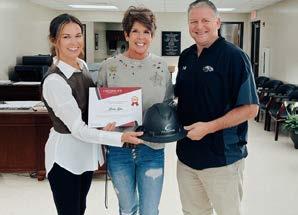




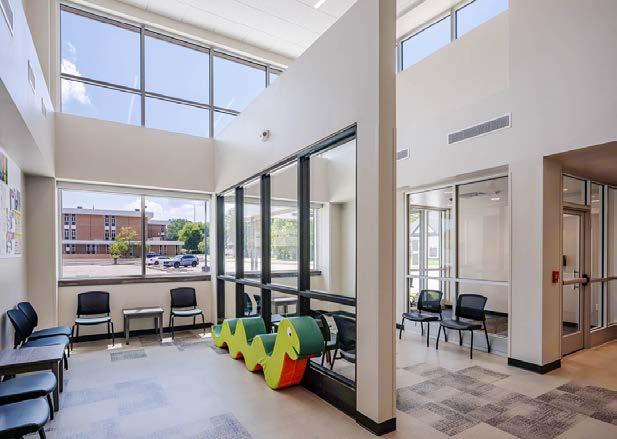
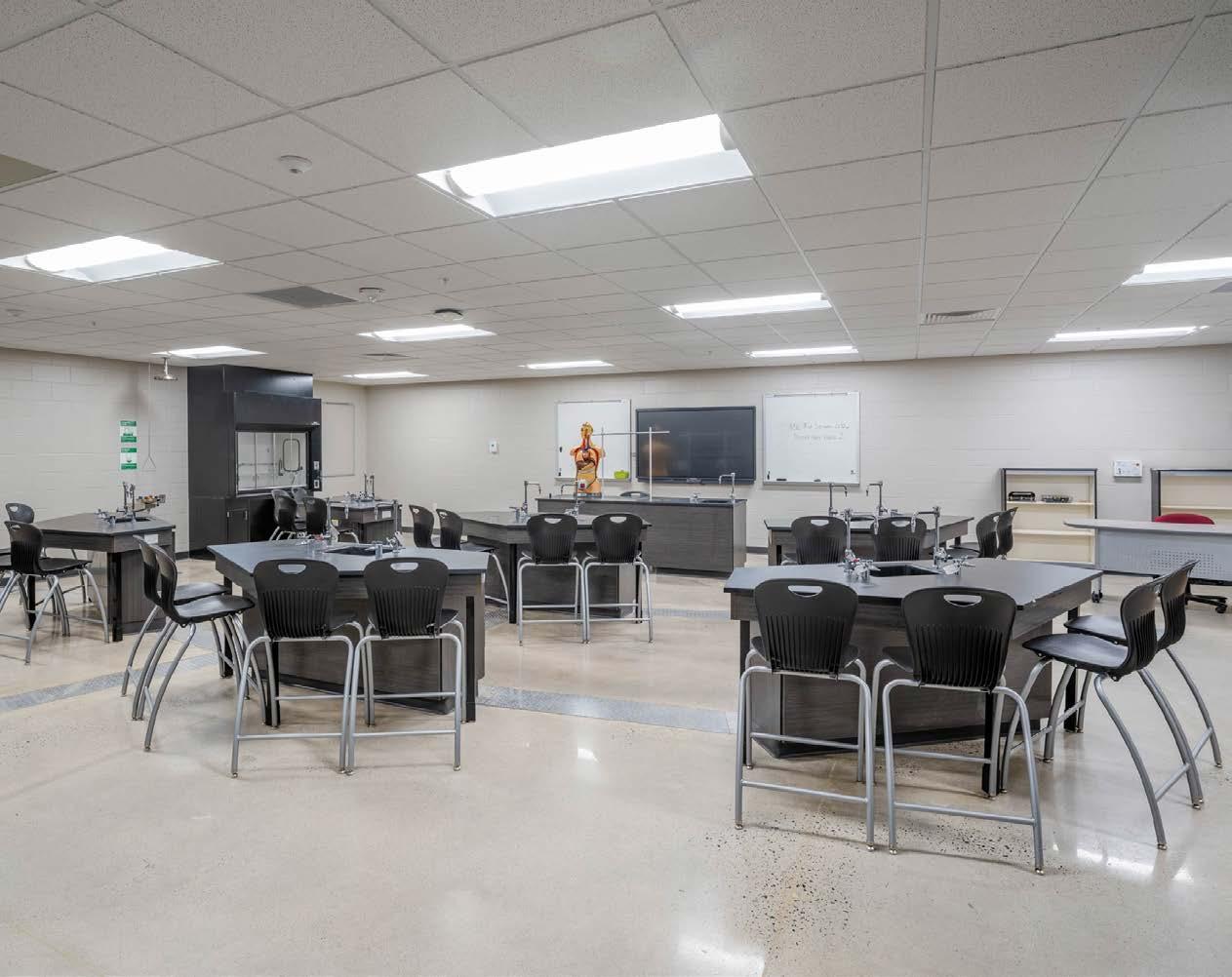
Founded as a small construction company over 75 years ago, Nabholz has grown into a strong team of professionals serving our clients, communities, and each other. With a wide range of K-12 projects under our belt, we have the experience to deliver your project successfully — regardless of size.