Report Card


Lakeside Primary School in Hot Springs has made a commitment to its pre-K program, which has grown to six classrooms of 20 students each. Each classroom is taught by a certified teacher making a LEARNS-level salary along with a paraprofessional. The school does not break even on the program, but school officials consider it a long-term investment. For four-year-old students like Grayson Watkins, shown here, it offers a head start on the school day’s lessons, routines and logistics. Educators learn about students’ needs and can start providing therapies and interventions early. Finally, it helps Lakeside attract students at a time when many districts are losing enrollment. Of the 138 students who enrolled in pre-K last year, 133 enrolled in kindergarten this year, and in the other five cases, the families moved out of town.



Grayson Watkins stacks blocks at the Lakeside Primary School’s preK program for four-year-olds. Students rotate among activity centers as part of the school day. Teachers and school leaders say it gives students a head start and helps the school see which students might need an intervention before they start kindergarten.
12 In first report card, 22 districts get A’s Twenty-two Arkansas school districts, or 9% of the state’s total, received an A in the first round of district report cards created by the Arkansas Department of Education.
The Legislature’s only current school board member says lawmakers want to hear board members’ perspectives at ASBA’s Region 10 meeting.
How did Dierks, a community of about 900 people, get almost 2 million votes in T-Mobile’s Friday Night 5G Lights nationwide contest and win a $1 million football field makeover? It started because a single booster club member believed it could. Booster’s dreams led to Dierks’ win
An education tech company founder tells an AAEA audience that AI used wrongly can make students do worse. The right way: Focus on outcomes.
Benton’s Williams named top teacher
Stephanie Williams grew up loving music, and now she loves teaching it to K-4 students at Benton’s Mountain View Elementary School. Starting next July 1, she’ll be able to share that love with the entire state as the 2026 Arkansas Teacher of the Year.
Cover / ‘Safe, calm and kind’
Four-year-old pre-K students at Lakeside Primary School learn basic behavioral skills at the same time they get a head start on the school’s curriculum. Educators say it helps the district attract students who stay for kindergarten. The program is such a high priority that each class of 20 is led by a certified teacher on the same salary schedule as the other teachers, with each assisted by a paraprofessional.
Dan Lovelady Vice President
First
Security Beardsley


From serving students as a teacher and superintendent to serving districts as a trusted advisor, Dan has invested decades into uplifting communities through education. Dan’s imprint can be seen in new elementary, junior high and high schools across the state.
We wish you happiness, adventure and well-deserved relaxation in your next chapter. Thank you!

by Jeff Lisenbey
Have you ever thought of yourself as serving on the board of directors for a large company? Most rural school districts are their community’s largest employer. We have multi-million-dollar budgets and a large workforce that uses various resources to achieve our goals. Often, we don’t think of ourselves as businesses, but we are responsible for producing a valuable product for our communities: Our students.
Our purpose is to produce graduates who are ready for the next step in their lives, whether that’s enrolling in higher education, entering the workforce, or enlisting in the military. We should strive to produce patriotic students who love their communities and country enough that it will drive them to succeed in any path they choose.
As board members, we must be leaders in our school and community. One of the first things we learned in kindergarten was how to line up and follow the leader to lunch or recess in an orderly and efficient manner. We must all keep in mind that as we “line up,” we must know where we are going.
All great leaders have a vision. Scripture in Proverbs teaches us that, “Without a vision, the people perish.” This still applies today. We must set forth a vision for our districts with measurable goals. This is the first step in producing graduates who will have a positive effect on our communities.
As we begin to enact our strategic plans, we must become great listeners. Many plans seem perfect on paper, but all of them require changes as we begin to implement them in our buildings. Board members and administrators must listen to teachers, staff and parents. We must be transparent with all stakeholders and continue to focus on student achievement. A school board and top-level administrators that are not transparent will NEVER succeed.
Failure is not an option. We are producing the greatest resource that our country has to offer. Our districts’ graduates will shape our nation’s future. I have three beautiful grandchildren, with another one on the way in April. I pray they will experience success and have a wonderful experience throughout their public school career.
I am excited about the direction of ASBA under the leadership of our new executive director, Shannon Moore, and deputy executive director, Tammie Reitenger. The association is providing board members with the tools to be successful using a service-oriented approach. ASBA is providing trainings in school finance, school law, governance for new board members, and various other topics. In addition, ASBA provides an affordable workers’ compensation program and model policy service for every district.
The best thing about Shannon and Tammie’s vision is that they want us to learn from each other. ASBA’s focus is to have trainings driven by board members. We want to hear from our peers and learn from each other’s successes and failures. I have thoroughly enjoyed this year’s regional meetings, where we heard from board members concerning hot button topics and learned how districts have navigated situations. I also appreciate ASBA’s efforts to arrange for legislators to be at our regional meetings. It was so valuable to hear from them, and for us to ask questions. The political process in many cases defines what we can or cannot do in our districts.
In closing, we have a job to do. We must continue to be professional and businesslike. The stakes are high because the product that walks out of our doors on graduation night will define the future of our communities, state, and nation. Failure is not an option.
Vol. 19, Number 4 December 2025
P.O. Box 165460 / Little Rock, AR 72216
Telephone: 501-372-1415 / 800-482-1212
Fax: 501-375-2454
E-mail: arsba@arsba.org / www.arsba.org
Board of Directors
President: Jeff Lisenbey, Sheridan
President-elect: Doris Parham, Bearden
Vice President: Nikki King, Pangburn
Secretary-Treasurer: Travis Warren, Farmington
Region 1: Suzanne Spivey, Rogers
Region 2: Jason Jones, Yellville-Summit
Region 3: Joe Sheppard, Jonesboro
Region 4: Beth Ulrich, Paris
Region 5: John Gibson, South Conway County
Region 6: Keith Baker, Riverview
Region 7: Shane Bell, Cross County
Region 8: Graham Peterson, Mt. Vernon-Enola
Region 9: Donna Dunlap, Barton-Lexa
Region 10: Lonell Lenox, Hot Springs
Region 11: Carl “Buddy” Puckett, Poyen
Region 12: Laura Clark, Blevins
Region 13: Renee Skinner, El Dorado
Region 14: Debra Barnes, Crossett
Staff
Executive Director: Shannon Moore
Deputy Executive Director/Board Development Director: Tammie Reitenger
Finance Director: Diana Woodward
Policy Director/Staff Attorney: Lucas Harder
Database Administrator/Commercial Affiliates Manager: Kathy Ivy
Board Liaison Manager: Angela Ellis Communications and Technology Director: Jessica Prothro
General Counsel: Jay Bequette
Risk Management Program & Workers’ Comp: Krista Glover
Misty Thompson
Linda Collins
Lisa Wigginton
Kara Worley
Julianne Dobson
Tamra Polk
Chelsea Ivy
TO CONTACT THE MAGAZINE
Please contact Steve Brawner, Editor
501.847.7743; brawnersteve@mac.com
Report Card is published quarterly by the Arkansas School Boards Association. Copyright 2025 by the Arkansas School Boards Association and Steve Brawner Communications. All rights reserved.
Children of Arkansas school board members can apply for the 2026 ASBA Educational Foundation Scholarship Awards until March 2.
Established in 1994, the one-time awards can go to sons, daughters, or legal wards of publicly elected Arkansas school board members who served during the 2025-26 school year.
Four $2,500 scholarships are awarded to incoming freshmen, one per Arkansas congressional district. The parent or guardian must have served on their local board during the school year in which the scholarship is awarded.
An overall statewide freshman winner selected from the applicants will receive the $5,000 Marshall Hughes Memorial Scholarship. Hughes was

MASON MEADOR of Green Forest, the son of Green Forest School Board member Alechia Meador, right, was last year’s scholarship winner from the 3rd Congressional District. Also pictured at the New Board Member Institute June 17 are, left, ASBA Executive Director Shannon Moore, and ASBA President Jeff Lisenbey.
a First Security Beardsley vice president who died of cancer in 2020 at age 41. He had conducted board trainings across northeast Arkansas. First Security
News and Notes continues on next page

Beardsley provided the award’s initial $50,000 in funding.
The awards are based on a student’s academic record, leadership and community service, extracurricular activities, special talents or unique endeavors, and future educational and career goals. Financial need may be considered.
Students must complete an application, present two letters of recommendation, provide an official transcript, write a 500-word essay, and provide a resume and photo.
Also, college juniors or higher who are pursuing a degree in education at an Arkansas institution are eligible for the $2,500 J.K. Williams Memorial Scholarship. The award is named in honor of former ASBA Executive Director J.K. Williams, who led the association for 14 years.
For more information, go to ASBA’s website at www.arsba.org, or contact Jessica Prothro at jprothro@arsba.org or 501.492.4820.




Feb. 3, 2026
ASBA School Law Seminar DoubleTree by Hilton Hotel Little Rock
Feb. 17, 2026
Early voting for school elections begins
March 2, 2026
ASBA Educational Foundaton 2026 Scholarships application deadline
March 3, 2026 School elections
April 7, 2026
New Board Member Institute DoubleTree by Hilton Hot Springs
May 5, 2026
ASBA/AAEA Joint Leadership Conference Wyndham Riverfront LIttle Rock
July 19-21
2026 Tri-State Southern Region Leadership Conference Hot Springs Convention Center
The 2026 Tri-State Southern Region Leadership Conference will be held July 19-21 at the Hot Springs Convention Center.
The annual event brings together school board members and school leaders from Arkansas, Mississippi, and Louisiana. The three states rotate serving as hosts of the conference. Arkansas last hosted the event in 2022.
More information will be available soon on ASBA’s website, www.arsba. org




ASBA directors in Regions 1, 3, 4, 6, 7, 9, and 14 were re-elected during this year’s Fall Regional Meetings, which were held in 14 locations Oct. 2-30. Those re-elected were:

• Region 1: Suzanne Spivey, Rogers
• Region 3: Joe Sheppard, Jonesboro
• Region 4: Beth Ullrich, Paris
• Region 6: Keith Baker, Riverview
• Region 7: Shane Bell, Cross County
• Region 9: Donna Dunlap, BartonLexa
• Region 14: Debra Barnes, Crossett
ASBA’s new podcast, “ASBA BoardCast: Questions Answered, Challenges Explored,” is available on the association’s website, www.arsba.org, and on all other major podcasting platforms.
The association started the podcast in response to suggestions made during last year’s Fall Regional Meetings.
The monthly podcast will serve as a resource for board members and school administrators by addressing questions coming from the field and by exploring broader challenges facing Arkansas schools.
Episodes will be 30 minutes or less and will include conversations with guests and subject matter experts.
The first episode, “All About ASBA,” features an introduction by the
association’s leaders, Director Shannon Moore and Deputy Director Tammie Reitenger, as well as comments by other ASBA staff members.
Created in 1955, the Arkansas School Boards Association promotes studentfocused leadership in public education. Services include conferences, the ASBA’s Model Policy Service, and state and national advocacy. ASBA also offers a workers’ compensation program for school districts, a vehicle insurance program, a legal liability program, claims management, and loss control.
“We exist to strengthen governance so you can focus on what really matters most, and that’s student achievement,” Moore said on the podcast.
Reitenger in turn described what ASBA is not. It’s not the State Board of Education. It’s not a regulatory authority over local school boards.
Other staff members introduced themselves and briefly discussed their roles.
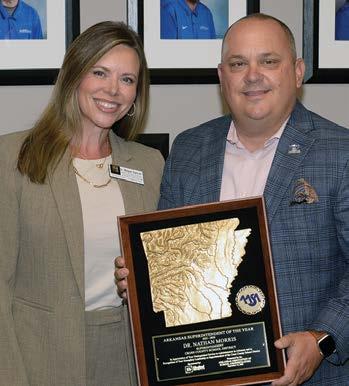
Cross County School District Superintendent Dr. Nathan Morris is the 2026 Arkansas Association of Educational Administrators Superintendent of the Year.
Dr. Megan Duncan, AAEA executive director, presented the award during the school board meeting Sept. 15.
Morris has served as superintendent since 2018. According to the district’s website, under his leadership, the district has achieved a 98% graduation rate, and enrollment has grown 20%. One in five Cross County students attends through school choice.
Cross County Elementary Technology Academy was recognized by T4 Education this year as one of 10 finalists ASBA News and Notes continues on next page

in its World’s Best Schools Prizes in the Overcoming Adversity category.
The district’s website says Morris has expanded advanced coursework at the high school and strengthened college and career readiness pathways. The district takes a “whole child” approach by expanding access to mental health services, increasing school safety, and strengthening family and community partnerships.
Laurie Smith, director of Lincoln High School’s Medical and Emergency Careers Academy, is the 2025 Arkansas Career and Technical Education Teacher of the Year.
Smith leads a program where 92 students this year are gaining experience and knowledge through criminal justice, medical
and firefighting pathways. She not only leads the program but also teaches the medical and firefighting pathways while an experienced law enforcement officer teaches criminal justice.
Regional CTE teachers will be chosen from among state winners in April followed by a national selection.
Smith is in her fourth year at Lincoln, her alma mater, after previously teaching health and emergency medical responder courses at Farmington for eight years. She brings real-world experience to the job, having worked as an assistant fire marshal for Washington County and as an emergency medical technician for Central EMS while also serving with the volunteer fire department.
She said she moved into career and technical education because she enjoys helping young people find their place, just as a boss helped her find her path when she was 19.
“I think that’s super important as we push kids out of high school to give them a soft spot to fall and help get them into where they want to be instead of just kicking them out hoping for the best,” she said. “So I think that that’s kind of where my passion lies is helping these kids go into the future, replacing our medical service people, replacing our fire department, our police officers, and helping replenish those different agencies, and helping grow better cops and grow better medical personnel. I think that’s fun having a part in that.”
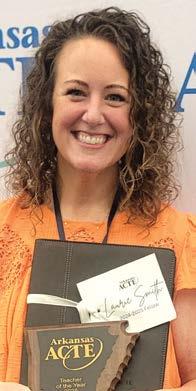
Graduates send pictures of themselves in the work world that are posted on the program’s “wall of fame.” She noted that two students left high school with jail standards certifications to work at the sheriff’s department earning $52,000 annually with no debt. One of those is attending school to be a veterinary technician but is using the job as a stepping stone.
“I think it’s really cool that we’re showing the kids that they can go directly into work and start making those big decisions,” she said.
“These kids that are working at the sheriff’s office, they’re already getting retirement at 18 years old. Like, how cool is that, that they’re not going to have to work until they’re 85 trying to draw their retirement?”

Gravette head track coach and physical education teacher Madie Edwards, 31, had the highest score among American educators and was second overall among educators in the women’s division at the 2025 CrossFit Service Cup competition.
She also placed fifth overall in the international Public Service Cup, where she competed against firefighters, medical professionals, law enforcement, and members of the military.
The CrossFit Games is an exerciserelated sport where competitors face unpredictable workout challenges. It is owned by the CrossFit physical fitness company.
Edwards came to Gravette this year after previously teaching P.E. and coaching cross country, girls basketball, and track and field at St. Vincent de Paul Catholic School in Rogers. She also was a P.E. assistant at Turnbow Elementary in Springdale.
“I tell my students they don’t have to be the fastest or the strongest,” she was quoted saying on the Gravette School District’s website. “If they give 100%, that’s all that really matters.”
Edwards grew up in a family of athletes and played soccer at Upper Iowa University. She started doing CrossFit while earning a master’s degree in exercise and coaching science at University College Dublin in Ireland.
“I’m always chasing progress,” Edwards said on the district’s website. “Every day is a chance to get a little bit better.”
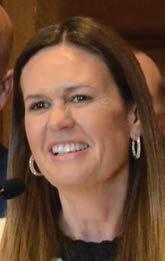
Governor Sarah Huckabee Sanders on Nov. 6 announced the creation of the Arkansas Plate Initiative, which will provide students with meals composed of Arkansas-grown products.
The program seeks to improve nutrition and strengthen the connection between agriculture and students.
“Arkansas students deserve access to healthy, nutritious foods at school, and the Arkansas Plate Initiative shows meaningful progress in our effort to improve child nutrition and support our farmers and producers across the
state,” Sanders said in a press release. “Not only will this program give students access to fresh, locally sourced products, but it will also teach them about Arkansas’ largest industry and what it takes to keep it.”
Sanders
The Arkansas Plate Initiative will pilot in five school districts beginning in January. On monthly “Arkansas Plate Days,” school cafeterias will serve meals highlighting Arkansas-grown products, including poultry, catfish, beef, rice, and seasonal fresh fruits and vegetables.
The program will collect feedback and purchasing data to evaluate the impact. The program is planned to expand to additional schools next year.
Schools participating in the program will receive educational materials, promotional signage, and “Meet the Farmer” profiles.
The Buffalo Island Central School District invites applications for superintendent.
Applicants must have a valid Arkansas superintendent license or eligibility to obtain one upon hire, and a master’s degree in educational leadership, administration, or a related field. Compensation will be negotiable based on experience and qualifications.
Applications must be completed through bicschools.schoolspring.com by Dec. 31. The position start date will be July 1, 2026.
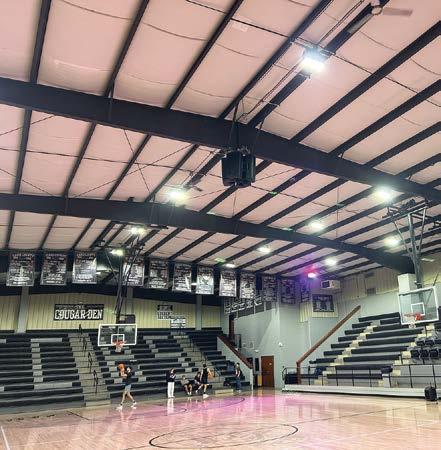

can take care of your school district’s lighting needs. From installation and upgrades to repairs and planned maintenance, LUMATECH can maximize efficiency and minimize costs.

ASBA’s Harder says transparency, accountability useful, but cautions against confusion
Twenty-two Arkansas school districts, or 9% of the state’s total, received an A in the first round of district report cards released Nov. 6 by the Arkansas Department of Education.
The new report card assigns A-F letter grades based on student outcomes, with a maximum score of 900 points. The system was created as a result of the ACCESS Act of 2025.
A review by Report Card magazine of ADE’s My School Info site showed the breakdown of districts and grades is as follows:
• A – 22 (8.6%)
• B – 95 (37.1%)
• C - 99 (38.7%)
• D - 27 (38.7%)
• F - 13 (5%)
• Exempt - 6
Districts receiving an “A” were Alpena, Benton, Bentonville, Centerpoint, Elkins, Fayetteville, Foreman, Founders Classical Academies of Arkansas, Greenbrier, Greenwood, Haas Hall Academy, Heber Springs, Hillcrest, Jackson County, Lakeside - Hot Springs, Ouachita River, Poyen, Prairie Grove, School for Advanced Studies - Northwest Arkansas, Valley Springs, Vilonia, and White County Central.
The state’s formula for assigning district letter grades is the same as the formula for high schools. Districts are measured according to the percentage of students scoring at Level 3 or 4 on state assessments in English language arts, math and science; growth of all students; growth of the lowest quarter; the percentage of students graduating in four years; and the percentage graduating on time with merit or distinction.
Hope Worsham, ADE’s assistant commissioner for public school accountability, said in a press release that the state’s report cards are designed to make it easier for people to understand their schools’ and district’s performances.

“They also allow school leaders, district administrators, researchers, and policymakers to dig deeper into the data and identify where improvement is needed so we can direct resources and support to the students that need it most,” she was quoted saying.
Districts were compared against state averages. Across Arkansas, the percentage of students scoring at Level 3 or 4 was 32% in English language arts, 33% in math, and 36% in science in the 202425 school year. Meanwhile, 50% met growth targets in English language arts and English language proficiency, while 51% did so in math and 48% did so in science. Among the lowest performing students, 53% met ELA growth targets, 53% did so in math, and 54% did so in science.
Ninety percent of students graduated on time in four years, while 55% graduated with merit or distinction, which the state says shows they have demonstrated readiness for enrollment, employment or enlistment. The data for the graduation categories came from the 2023-24 school year.
The Poyen School District, which serves a community in Grant County with a population of 263 within the city limits, was one of 22 scoring an A. It scored far above the state average in all of those categories except students graduating with merit or distinction, and in that category, it was above the state average. Forty-five percent of its students were at Levels 3 or 4 in English language arts, which was 13 percentage points above the state average of 32%. The differences were even more pronounced in math (60% versus 33%) and science (55% versus 36%).
While having higher numbers to begin with, Poyen also outpaced the state in student growth targets. Among its students, 66% met the targets in English language arts and English language
proficiency, a measurement for English language learners. The state average was 50%. Poyen also outpaced the state in math (71% versus 51%) and science (68% versus 48%). Its low-performing students also outpaced the state averages in all three subjects. And its on-time graduation rate of 98% was far above the state average of 90%.
The weighting of growth meant a district like Marvell-Elaine could earn a C despite ranking well below the state in its percentage of students meeting gradelevel standards, its graduation rate, and its percentage of graduates earning diplomas of merit and distinction.
During the 2024-25 school year, 12% of its students scored at Level 3 or 4 in English language arts, compared to a state average of 32%. Eleven percent of Marvell-Elaine’s students scored at Level 3 or 4 in math, compared to a state average of 33%. In science, the percentages were 12% in Marvell-Elaine and 36% overall.
Meanwhile, 76% of Marvell-Elaine’s students graduated on time, compared to a statewide average of 90%. Eight percent of Marvell-Elaine students graduated with merit or distinction. The statewide average was 55%.
But in the growth measurements, Marvell-Elaine scored far above the state averages. In fact, Marvell-Elaine Elementary School was in the top 5%, while Marvell-Elaine High School was in the 10%. Sixty-seven percent of students met growth targets in English language arts and English language proficiency, compared to a state average of 50%. In math, 71% of students met their targets, compared to a state average of 51%. In science, 64% of students met their targets, which was 16 points higher than the state average of 48%.
The lowest performing students also had growth rates above the state average. In English language arts and English language proficiency, 60% of students in Marvell-Elaine met their targets compared to 53% statewide. In science, it was 65% in Marvell-Elaine versus 54% statewide. The difference was most pronounced in math, where 81% of Marvell-Elaine students met
their growth targets. The statewide average was 53%.
ASBA Staff Attorney and Policy
Director Lucas Harder said the letter grades are useful. They help the district and its stakeholders know where the district is excelling and where it needs to make changes. They also inform the Department of Education about which districts need more support.
But the numbers don’t tell the whole story.
“Accountability and transparency are always important, but any time you introduce something new, there’s always the possibility for confusion,” he said.
Harder noted that the scores represent overall district performance and therefore can be skewed in certain circumstances. For example, a district can have an “A” high school but lower scoring elementary schools where educators are implementing new programs. Or, the district could have implemented effective programs at the elementary schools, but the results aren’t yet reflected at the
high school levels. Much depends on each district’s socioeconomic circumstances.
“Even if you have the best teachers and everything, all of the societal things that are occurring out of it are still going to impact your school,” he said.
Harder said there could be confusion to the average person about what a letter grade actually means. Some legislators have commented that the score to achieve an “A” is lower than they would like. Furthermore, the thresholds to achieve each letter grade are designed to rise as more districts achieve them. The result will be that some districts in future years could see their letter grades fall even if they are scoring at the same levels.
should keep in mind that every district is different. They especially should look at similarly situated districts to see what they are doing that’s working, but also should look at what mistakes similarly situated districts are making.
District and school report cards can be viewed on the Department of Education’s My School Info site at myschoolinfo.arkansas.gov.
The state also awarded $7 million to 151 schools through the Arkansas School Recognition Program. The program awards up to $100 per student to public schools and public charter schools in the top 5% in the areas of student performance and student academic growth. It awards $50 to schools ranking in the top 6% to 10%.
Searcy School District partnered with Entegrity to upgrade lighting across all campuses, including new LED systems for the football, baseball, and softball fields. By reusing existing infrastructure, Entegrity delivered brighter, safer fields — and, through district-wide upgrades, $92,000 in annual savings.
Harder said school board members can use the district report cards to ask questions of their superintendent, such as what changes the district is implementing and how new programs are doing. They can look at what high-scoring districts are doing. However, they 800.700.1414 | info@entegritypartners.com
The Bentonville School District had 29 of the 151 award-winning schools, or 19%. Thirteen finished in the top 5% in performance, and five finished in the top 6%-10%. Six scored in the top 5% in growth, while five scored in the top 6%-10%.



Legislature’s only current school board member says lawmakers want to hear perspectives at ASBA Region 10 meeting
Benton School Board member and state Rep. Paul Childress doesn’t hear much from his fellow board members about what they would like to happen at the State Capitol.
That’s unfortunate, because school board members have an opportunity to significantly influence legislators’ perspectives. He noted that he has nine school districts in his legislative district. They’re all voters, and they’re all influential in their community.
“Shannon (Moore, ASBA executive director) can get my attention, but they’re really going to get my attention. That’s a big pool, so I’m going to listen. I encourage y’all to reach out to your
representative,” he said. “We want to hear from you.”
Childress, who was elected to the Legislature in 2024, made his comments at ASBA’s annual Region 10 meeting in Arkadelphia Oct. 2. Each of the regional meetings held across the state were scheduled to include a talk by a local legislator as well as a panel discussion featuring school board members.
Childress noted that 2,800 bills were filed last year, and things can move quickly. He said he receives 400-500 emails and phone calls each day during the session. Board members should share their concerns with lawmakers because people who disagree with them will be sharing their point of view.
Childress noted that legislators have considered proposals to make school board members partisan officials. He didn’t know how much traction the idea
would get, but board members who are opposed should inform their legislators.
Legislators overwhelmingly in 2023 passed the LEARNS Act, which created educational freedom accounts that help families pay for private and homeschooling expenses. Still, he said legislators continue to support public schools and that a number are former school board members.
The only legislator who is also a current school board member, Childress said he will leave the Benton School Board at the end of his term after serving 16 years and will focus on his legislative duties.
“I’m never going to quit on public schools, and I don’t have any colleagues that would ever quit on public schools,” he said. “Most all of us are public school graduates, and I feel like … we’re going to take care of public schools.”
The fall regionals also featured panel discussions involving school board members. Region 10’s panel featured Gurdon School Board President Rodney Hurst; Hot Springs-Lakeside School Board President Erin McCarly; and Jesse Clark, vice president at Malvern.
The three discussed challenges facing schools and school boards, including declining enrollments caused by the LEARNS Act subsidies and by declining birth rates.
Hurst said his district currently has 550 students but must proactively consider what it might be like to have 500.
He said when he first joined the Gurdon School Board, the only way teachers left the district was if they did so voluntarily. In more recent years, the district has willingly let go of subpar staff, saving money in the process.
“Nobody likes change, but the good teachers are pretty supportive when you get rid of or non-renew what somebody would consider a bad teacher,” he said.
With students free to pursue other options, public school districts must “identify our customer” and recognize what students need and want, Hurst said. Located in timber country, Gurdon has purchased a logging equipment simulator to provide a hands-on approach and also supports agriculture and FFA.
Continues on next page



McCarly said the current environment makes it difficult for school boards to plan their budgets. Costs are increasing everywhere. Lakeside’s insurance premiums increased $120,000 this year with no warning, and the district also had an extra debt payment. Meanwhile, the amount of federal funding it expects to receive is uncertain, so the district is looking at contingencies. It saved $13,000 in energy costs just by being more efficient.
The district bucked the statewide trend and increased enrollment this year. McCarly credited its pre-K program for attracting families. (Story, page 30.)
“Once you get them in your building and show them our culture and show them what your school has to offer, how special it is, that your community is great and supportive, they want to be there,” she said. “I promise you, that is the opportunity to get them on board.”’
McCarly said another positive aspect of the pre-K program is that it prepares students for their future educations and for school settings that can be overwhelming to a young new student.
Even with the financial challenges, McCarly said the Lakeside district has committed to its employees that it will maintain its salary step system, and it’s avoiding layoffs. Educators must feel supported in their roles.
“They need to know that we are committed to them because they are the single best thing for our kids. … We can have the best facilities and technology, but without the educators, what are we even doing?” she said.
Nevertheless, McCarly said the district’s growth will stop, and when it does, it will have to make choices about staffing. Lakeside will try to cover the gaps through attrition, but teachers may have to be flexible. A kindergarten teacher may have to switch to a different role. With the end of the Teacher Fair Dismissal Act, the district may not renew an ineffective teacher.
Clark said budgeting is difficult because the district doesn’t know how many students it will have since they can leave at any time. Fortunately, once students are enrolled at Malvern, they generally stay. The challenge is getting them enrolled.

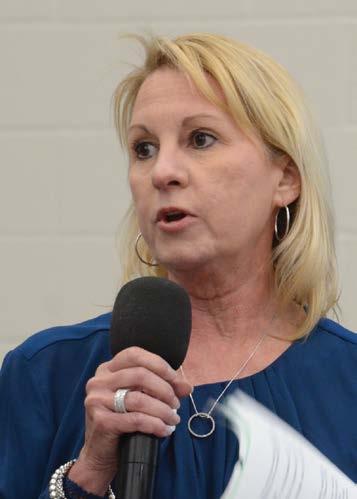
He said Malvern would avoid showing favoritism when it comes to staffing. At one point it appeared the district may have to lay off teachers. Someone asked him what he would do about his daughter, who is a teacher. He said he replied that she was looking for a job when she got this one.
“We’re there for the students, and we need to put the best teachers and administrators in front of those students that we can,” he said.
ASBA staff members sought input from attendees on how to improve the regional meetings as well as the association’s other offerings. In fact, the panel discussion was the result of last year’s suggestions, Moore said. Another suggestion from last year was a podcast. ASBA answered this call and recently published its first episode of “ASBA BoardCast: Questions Answered, Challenges Explored.”
The podcast is available on all major podcast platforms, on YouTube, and on the association’s website, www.arsba. org.
“The point is, we’re listening to you. We want your input,” she said.
The Region 10 meeting also included a presentation by Lucas Harder, ASBA’s staff attorney and policy director, about two new school board-related laws that were passed by legislators this year.
Act 503 requires that all school board elections will occur only in even-numbered years during the preferential primary elections in March. Annual school millage elections still will occur. School board member terms must be either four or six years, rather than the three-tofive-year terms that have been the case in the past. Boards will decide between the four- and six-year options; the law does not say how. Board members currently serving will see their terms adjusted to expire according to specific timelines laid out in the act. For example, board members who were elected in spring 2025 will be up for re-election in 2028 or 2030, depending on whether their board chooses the four-year or sixyear option. The law requires, as nearly as possible, filling an equal number of positions in each election. Because of the timelines prescribed in the act, there could be many board members up for reelection in March 2026. School boards then will have to stagger terms to provide continuity. Another change is that when a board moves to either all zones or fewer zones, all board members must be on the ballot in the next election, and then terms will be drawn to re-stagger the terms.
The law also states that vacancy appointees now will serve the remainder of the term, rather than until the next
school board election as has been the case. Harder noted that an appointee who serves more than 12 months must receive at least six hours of professional development.
Harder also discussed Act 902, which requires boards to provide at least three minutes of public comment for any member of the public who resides within the district, is a parent or legal guardian of a student in the district, or is employed by the district. Speakers must be given a chance to comment about an item that is within the board’s powers and duties, and they must be allowed to speak about an agenda item before the board votes on it. The board cannot require prior approval. Speakers may not provide public comment that prejudices the board concerning a student or personnel matter on the agenda for a disciplinary or employment action. If public comments stretch beyond 30 minutes, the board may move all non-agenda items to later in the meeting.
“It’s not quite open mic, but it could be close to it,” Harder said.
The law allows boards to provide a sign-up sheet, which ASBA strongly recommends they do. A sign-up sheet helps the board verify that a speaker meets the qualifications, ensures that he or she speaks prior to the topic appearing on the agenda, and verifies that the topic is not off-limits. If a board uses a sign-up sheet, it must be accessible until the start of the meeting.
Harder said boards should update their policies regarding agendas and public comments. He advised the board president, board vice president, and the superintendent to meet with the school district’s attorney to consider scenarios. Boards should practice how they will handle those scenarios. Public comment procedures should be posted.
Harder said the law does not distinguish between regular board meetings and other types of meetings. The rules are the same for all.









The community celebrated winning the nationwide T-Mobile contest that netted it $1 million for the Outlaws’ football field
By Steve Brawner Editor
How did Dierks, a community of about 900 people, get almost 2 million votes in T-Mobile’s Friday Night 5G Lights nationwide contest and win a $1 million football field makeover?
It started because a single booster club member believed it could.
Krystal Greene was watching a morning news show when she saw former NFL tight end Rob Gronkowski talking about the contest, then in its second year. Schools across the country would compete for the prize, which would be determined by a nationwide election where anyone with an email address could vote once a day.
“I saw it on Fox and Friends on July 17, and I took a picture of it on my phone, and I sent it to my sister, and I
said, ‘Hey, this is cool. We need to enter this,’” she said. “And [the district] got the application together, we got a video made for our stadium and our town, and we submitted it, and then we just started rallying the troops.”
The “troops” celebrated their victory Nov. 14 at the Dierks High School gymnasium. Gronkowski along with T-Mobile CEO Srini Gopalan presented the check to Head Coach and Athletic Director Paul Ernest and the rest of the school district.
“A really cool thing is this award isn’t just about football,” Ernest told the gymnasium crowd. “It’s about heart. It’s about hard work. And it’s about hometown pride. It’s about a community that comes together every Friday night under the Friday night lights, win or lose, to cheer, support and most importantly, lift each other up.”
The $1 million check will allow the district to renovate Ayers Field, home of the Outlaws. In addition, the high school is receiving a professional consultation
with a stadium expert, a weight room upgrade courtesy of Gronk Fitness, and 16 all-expense-paid tickets to the SEC Championship game that will allow the seniors to attend. Ernest said a 30-foot workout room expansion had already been scheduled for construction. This will allow the school to better outfit it.
Country music star Bailey Zimmerman sang the national anthem – his first time ever to do so on stage, he said – and gave a concert after the check presentation. Former NFL quarterback Jeff Christensen also spoke.
“This is a David and Goliath story,” comedian Jeff Foxworthy said in a short congratulatory video. “This shows what the little man can do. And I love it so much, and let me tell you, there was nobody in the contest that needed it and deserved it more than Dierks, Arkansas.”
The $1 million will help the school district renovate a grass field that slopes eight feet from one end to another, resulting in water pooling in one corner. The district also plans to replace the
BOOSTER. Krystal Greene, a member of the Dierks Athletic Booster Club, got the school involved after she saw the contest discussed on a morning news show. She expects her two sons to play on the same field where her husband played, and where she was a cheerleader. Below, Superintendent Grover Hill, who enrolled in first grade at Dierks in 1958, said Friday night football games are the highlights of the week in the community of 900.

aging visitors’ bleachers. If money is available, it will redo bathrooms and concessions. It all must be completed by next August, because T-Mobile will be back for a tailgate party celebrating the improvements.
Superintendent Grover Hill said the district hasn’t done any major work on the field in many years.
“[W]e’ve had a lot of things we want to do to upgrade, but it’s just not economically feasible with the school funding and things going on,” he said. “You don’t have extra money. We had extra dreams, but we didn’t have the finances to do it.”
Hill, who enrolled in first grade at Dierks in 1958 and has worked for his hometown district four times in his career, said the town generally is pronounced “Derricks” by locals and “Dirks” by others. Its rural economy is based on poultry, eggs and logging. Weyerhaeuser operates a state-of-the-art sawmill. Friday night Outlaws football games are the town’s big weekly events. The home stands are full, and the school takes a good crowd to away games.
More than 2,100 schools entered. To advance in the early rounds of the
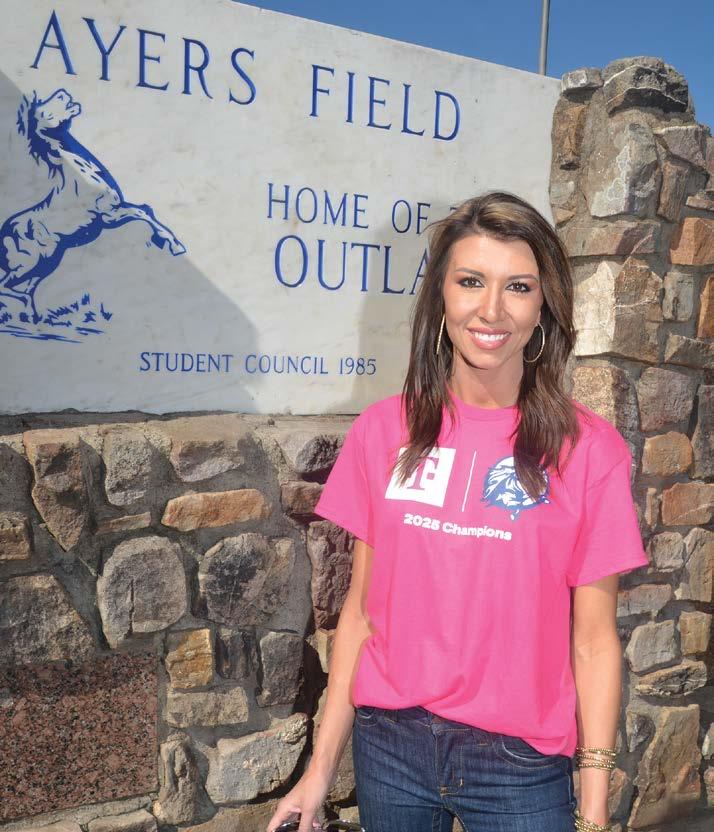




contest, Dierks submitted social media videos and photos featuring schools festooned with T-Mobile-related, magenta (pink) decorations, while students and staff wore magenta T-shirts. One video featured elementary students participating in a “mannequin challenge” where they stood as if frozen to depict a school scene. A tear-jerking five minute introductory video featured the coach, the quarterback, the cheer captain and a local business owner talking about the importance of the team to the community and the need for a new field.
Coach Ernest explained in the video that outgoing seniors are given a leather key ring etched with the school logo and the
field’s GPS coordinates “so that no matter where they go in life, no matter what they do, they can always find their way back home, and they’re always going to be welcome.”
Four hundred fifty schools advanced to the second round and won $5,000. The excitement rose when Dierks made the top 25 finalists and won $25,000.
The winner among those final 25 was chosen by a nationwide online election occurring Sept. 25 through Oct. 23. Anyone with an email address could vote once a day. More than 8 million votes were cast nationwide. Dierks received almost a quarter, 1,988,665 votes. Dierks supporters voted an average of
five times each, according to the company’s website.
Dierks received votes from across the nation and from foreign countries and had support from high-profile individuals. Hill enlisted the help of other schools in Arkansas. Foxworthy made a video encouraging people to vote for Dierks. So did country music star and Foreman native Tracy Lawrence, comedian Larry the Cable Guy, former college football coaches Houston Nutt and Barry Switzer, former Arkansas Razorback Darren McFadden, Gov. Sarah Huckabee Sanders, Attorney General Tim Griffin and Miss Arkansas Kennedy Holland.

Hill doesn’t know exactly why Dierks’ story caught on. He said it had something to do with “a small town from nowhere competing against the world.”
“It just kind of mushroomed, went wild,” he said. “After about the first week, we were like in the top four. And then, hey, it’s getting serious. If we’re going to play, let’s play hard. And about a week later, we got in the number one position and maintained that until the contest was over.”
The community was aware it had a big lead over secondplace Lebanon High School in Oregon once the voting stopped Oct 24. However, it had to wait for T-Mobile’s auditing process to make it official. Gronkowski announced the winner Oct. 30. Lebanon High ended up with nearly 1.5 million votes and received $100,000.
Ernest said the contest gave the close-knit team opportunities to spend time together making videos.
“In a small town, they’ve grown up together,” he said. “They’ve been on the football field since third grade together. It’s been a family for them for a long time, and I feel like my job, my responsibility, number one, is to protect that, protect what this program has been about, protect what this
Continues on next page


GENERATIONS. Butch Brown played tackle for the 1975 Dierks Outlaws that won the Class B state championship. Right, sixth-grader Tyler Tedford gets some quarterback training on the football field where he hopes to lead the senior high team in a few years.
community has been about, then make sure our product is good.”
Greene, the booster who started it all, is a lifelong Dierks resident and was a cheerleader in high school. Her husband, Marcus, played wide receiver on the 2005 state runner-up team, although they weren’t in high school at the same time. She said both her sons ages 6 and 3 will be Outlaws someday. In fact, the six-year-old was playing catch on the football field after the ceremony. He wasn’t alone. Sixth grade quarterback Tyler Tedford, the son of Booster Club president Cody Tedford, was being drilled by Christensen, a quarterback coach.
Greene called Dierks’ victory “an emotional journey.”
“It was honestly overwhelming in the best way,” she told reporters afterwards. “Everybody from our surrounding towns and our competition towns, everybody was supporting us. … We had all the support not just from the state but from the country. It was amazing.”
Mason Smith, a senior middle linebacker who has played football since the fourth grade, is a fourth generation Outlaw going back to his great-grandfather. He told reporters afterwards that the victory extended beyond the team.
“We’re going to be able to share this contest with the whole community, not just people on this team and in this program, but people in the stands who get to enjoy us play on the field, and even

get to sit in better stands and enjoy that,” he said. “So we’re just very thankful for that.”
Among those celebrating the $1 million award was Butch Brown, who played tackle on both sides of the ball for the 1975 Class B state championship team – the school’s only state champ. That team finished 12-1, losing only its first game before going undefeated the rest of the year.
That team, he said, was a “Bunch of big ol’ country boys. We had a tailback. Kid named Dallas Simmons. … He was about 6-3, 185-190 pounds and as strong as an ox. Scored 27 touchdowns and rushed for over 1,800 yards.”
Brown, who has lived in Dierks all his life, voted every day and said his son in North Carolina had his hospital coworkers voting for Dierks. His daughterin-law had her relatives and friends in Florida supporting the Outlaws. Brown called his former supervisor in Missouri asking him to enlist voters. A brother-inlaw in Louisiana encouraged people to vote for Dierks.
“It is tremendous,” he said. “You just can’t believe a little town this small, and we had nearly two million votes.”
Districts should stay informed, proceed with caution as cases wind through court system
In 2025, the Arkansas General Assembly enacted Act 573, requiring that the Ten Commandments be displayed in every public school classroom. The law mandates that the posters be framed, legible, and entirely paid for with private funds.
Shortly after passage, a group of parents and civil rights organizations filed suit in the U.S. District Court for the Western District of Arkansas. They challenged the law under the Establishment Clause in the U.S. Constitution’s First Amendment, which states that “Congress shall make no law respecting an establishment of religion …”
The case, pending before Judge Timothy Brooks, is being vigorously defended by Attorney General Tim Griffin, who argues that the statute serves a legitimate secular and educational purpose.
Judge Brooks has issued an order temporarily barring implementation in the districts named in the lawsuit. As additional districts – one in central and one in western Arkansas – have been added, he has promptly extended the injunction to those as well. The result has placed several superintendents in a difficult

by Cody Kees Bequette, Billingsley & Kees, PA
position: While community and faith leaders have urged them to “follow state law,” any district covered by the order risks contempt of court if it proceeds with posting.
For districts not under the federal injunction, Act 573 remains valid and enforceable, and the district is free to post any donated posters. However, because the statute includes no specific deadline or penalty for non-compliance, districts may prudently wait until the federal litigation concludes. Although a private citizen could theoretically file a state lawsuit for failure to post, a court would likely find it reasonable for a district to delay implementation while awaiting further judicial guidance.
The Arkansas case closely tracks a nearly identical Louisiana law that has
The result has placed several superintendents in a difficult position: While community and faith leaders have urged them to “follow state law,” any district covered by the order risks contempt of court if it proceeds with posting.
already been struck down by the U.S. Court of Appeals for the Fifth Circuit in Roake v. Brumley. The Fifth Circuit held that Louisiana’s Ten Commandments law lacked a secular purpose and violated long-standing Supreme Court precedent set by Stone v. Graham (1980). Louisiana has sought further review, and that case may soon reach the U.S. Supreme Court. Its outcome could ultimately decide the fate of Arkansas’ Act 573.
The Arkansas case is now on appeal before the Eighth Circuit Court of Appeals, with a decision expected in the near future. Until then, school boards and superintendents should stay informed, consult legal counsel, and proceed cautiously to ensure compliance with both state and federal law.
Editor’s note: Cody Kees is a private attorney with Bequette, Billingsley & Kees. His clients include school districts across Arkansas. He is also the mayor of Cammack Village.


Adam Ward is Senior Vice President, Head of Municipal Trading and Underwriting, at Stephens
For many Arkansas communities, access to the bond market is essential to sustaining growth. Whether financing a new school, upgrading sporting facilities, or modernizing tech infrastructure, districts rely on long-term borrowing to meet educational and community needs.
Accessing the bond market is an ongoing responsibility for school districts, as population shifts and changing demographics continually reshape their needs. In recent years, however, that responsibility has become particularly complex, amid one of the most challenging borrowing backdrops in memory.
We witnessed some of the lowest borrowing costs in history in the immediate aftermath of the Covid-19 pandemic, as school districts capitalized on a rare opportunity to finance long-term capital projects at an interest cost of about 2%. Since then, however, the interest rate landscape has shifted dramatically.
Although 30-year rates have eased from 5% last year to around 4.3% today, they are still considerably higher than what many districts grew accustomed to in prior years. This volatile market environment has undoubtedly added a layer of difficulty to managing long-term financing, but it is essential to maintain perspective.
Despite the sharp increase from pandemic-era levels, financing rates remain historically moderate. For districts with pressing infrastructure needs – whether for new facilities, classroom expansions, or other capital improvements – waiting indefinitely for the ‘perfect’ rate environment can be more costly than moving forward.
While some school districts may have sought to postpone borrowing amid spiking rates in 2023 and 2024, rates have not returned to those historic lows, even though there has been some softening, and many borrowers decided it was time to act. School districts recognized that ongoing inflationary pressures would likely continue to drive up construction costs and that the potential benefit of lower interest rates in the future would not offset these price increases.
Looking ahead, borrowing costs appear poised to ease further, with the Federal Reserve expected to continue gradually cutting interest rates as we move towards 2026. That said, forecasting monetary policy is never a precise science.
Should borrowing costs come down further over the coming years, Arkansas school districts can benefit from one of the unique features of the state’s bond market. Nationally, many municipal bonds have a 10-year ‘call’, meaning the issuer cannot refinance for at least a decade. In Arkansas, most school district debt is structured with a five-year call. This provides significantly greater flexibility, enabling districts to borrow and complete much-needed projects, which may include restructuring existing debt while also offering the opportunity to refinance sooner should future savings appear.
LITTLE ROCK, AR

DALLAS, TX
Each district’s situation is unique – some are managing steady enrollment and limited debt, while others are contending with rapid growth and expanding infrastructure needs. As a graduate of the Cabot School District, I have seen my hometown transform from a small center of 6,500 residents to a thriving community of nearly 30,000. Such growth creates both challenges and opportunities, underscoring the importance of experienced, locally attuned expertise.
Fortunately, our team at Stephens serves as municipal advisor to a significant number of Arkansas’s school districts, ranging from the smallest rural communities to some of the state’s largest systems. With deep roots across Arkansas, the Stephens public finance professionals combine local knowledge with national market reach, helping clients achieve competitive rates when issuing new debt or refinancing existing obligations.
The Stephens trading desk and advisory teams work closely together to ensure that each district’s bonds are marketed effectively and competitively nationwide. Every transaction, regardless of size, benefits from a disciplined process designed to achieve the best possible execution. That might mean a $1.4 million financing for a small rural district or a $70 million issuance for Little Rock. In every case, the goal is to help districts meet their capital needs cost-effectively.
Smaller transactions – those under $10 million – often meet the criteria as ‘bank-qualified’ issues, which continue to attract interest from local and regional banks. That renewed demand has provided valuable liquidity for smaller issuers, while national investors remain active participants in larger bond offerings. Together, this blend of local and national engagement supports a healthy market for Arkansas school bonds.
As the state continues to grow, so too will the demands on its schools and infrastructure. Interest rates will continually rise and fall, but the need for thoughtful, experienced guidance remains constant. With a long history in Arkansas and a deep connection to communities across the state, Stephens is on hand to help school districts navigate an ever-complex market with confidence.
Adam Ward Senior Vice President Head of Municipal Trading and Underwriting

Education tech company founder tells AAEA audience that AI used wrongly can make students do worse. The right way: Focus on outcomes.
By Melissa Brawner Contributing writer
Can artificial intelligence help your students make more progress? It can – if the district focuses like a NASCAR driver on the road, not on the wall.
That was one of the messages of Giancarlo Brotto, founder of PaveEdu, which helps governments and school systems transition to digital. Brotto spoke at the 2025 Arkansas Association of Educational Administrators Fall Conference Nov. 13.
Currently, Brotto noted, more than half of all students report using AI daily. At the same time, 70% of schools report that they’re just getting started using AI, and 71.3% feel they are behind in implementing it.
“Everyone always thinks they are behind,” Brotto noted.
That’s no wonder, considering the speed in which AI is advancing. Brotto described three levels of artificial intelligence. The first level is artificial narrow intelligence (ANI), such as Apple’s Siri and self-driving cars. Next, artificial general intelligence (AGI) is a theoretical form of AI that can learn and apply knowledge across a range of tasks.
“That’s where we’re at today,” Brotto said. “It’s really, really good. The world’s best chess player cannot beat an AI ChessBot.”
The last phase is artificial superintelligence (ASI), defined by IBM as a “hypothetical software-based artificial intelligence system with an intellectual scope beyond human intelligence.”
No one has reached that level yet. But they’re trying.
Already, more than three-fourths of businesses around the world use AI. Meanwhile, governments, businesses and philanthropists are investing billions of dollars into advancing AI to the ASI level.
“What’s now being created is the equivalent of the space race in the ‘60s

GIANCARLO BROTTO, founder of PaveEdu, said school districts should plan how they will use AI, how they will help teachers and students focus on positive outcomes and behaviors, and how they will measure progress.
and ’70s, where we have to beat Russia, we have to do this before China does,” he said. “It’s a massive race. If you talk to people who work in the AI field, they will tell you it’s progressing so much quicker than they anticipated.”
Whether the world wants it or not, Brotto said, it is headed toward AI.
“Every single company, there’s not a cell phone you buy today that doesn’t use AI,” he said. “There’s not a single computer that doesn’t have chips enabled for AI. Whether the world likes it or not, every single thing digital that you have purchased and will purchase, all the products that you’ll have for your district, will have AI imbedded into it.
AI will be used, just like electricity is used, in every fabric of society.”
Brotto has read more than 70 guidance documents on how to implement AI in a school district. All of the manuals provide the same directions.
Tech alone not the answer
Only, it hasn’t worked. Student achievement is not improving simply by implementing more technology. In fact, research has shown that students who were using technology more frequently than their peers performed lower academically than those who continued their original study habits they held prior to AI.
Giancarlo Brotto spent his early childhood in Italy, speaking only Italian. When the family moved to Canada, he didn’t know the language. By seventh grade, he was academically at a third grade level.
One of his teachers called a meeting with Brotto and his parents and told him if there weren’t any improvements, he was not going to finish high school.
That teacher changed the trajectory of Brotto’s life.
At home, Brotto’s mom handed her young teen a dictionary with an odd
According to the hechingerreport.org, University of Pennsylvania researchers found that Turkish high school students who had used ChatGPT while doing practice math problems did 17% worse on a test than those who didn’t have access to it. Meanwhile, a third group who had access to a version of ChatGPT that functioned more like a tutor did no better than the students with no access to it.
“This is telling us a story,” Brotto said. “We must note what research is showing us worldwide: Technology alone is not improving academic performance. It has the potential to decrease it.”
Brotto said that school districts that embrace AI should do so in three phases: ignite, or become aware of AI; implement, or begin to apply it; and evolve, or grow in their understanding and use of AI.
If implementing AI technology alone is not the answer, what is? Brotto said the missing key is focusing on behaviors – teaching students to focus.
Brotto said NASCAR drivers are more likely to hit a wall if they focus on it. Instead, they are trained to focus on where they want the car to go. When the focus moves that direction, so, often, will the car.
“Where our focus goes, our behaviors follow,” Brotto said. “We’re doing better things – not just doing the same things better.”
request: Find the missing word. Brotto spent hours going through the book, page by page, until he came to a page in the “I’s” where a rectangular square was missing. She had cut out the word “impossible.”
“Giancarlo, since we came to this country, life has not been easy for you or for the family,” she told him. “We’ve tried everything. Carrots and sticks. We’ve tried punishing you, rewarding you with money. Nothing’s worked. But nothing is what’s impossible. Let’s look at what’s possible, and let’s make it a reality.”
Brotto outlined the steps in building an effective AI strategy. Focus first on the outcome and then the purpose, and then formulate a plan on how to achieve it. Plan to help teachers, parents and the system become more AI literate. Set timelines for desired outcomes. Finally, to help students and others use AI effectively, leaders should use AI themselves.
“Just start playing with it,” Brotto advised. He recommended asking AI for help when planning a meeting or event, or asking for ways to improve an outcome or help keep people’s interest.
Brotto encouraged administrators that it doesn’t take a major expedition to implement AI into their school district and their students’ lives. It’s really a simple framework:
• Map out a plan on how to achieve it.
• Help teachers, students and parents focus on positive outcomes and behaviors.
• Be sure your district’s AI policy and your security and privacy policies align.
• Don’t invest a lot of money up front. Gemini and Microsoft’s Copilot are both free.
• Measure your students’ progress.
All over the world, Brotto said, people are “dumping” technology on students without tracking the data to see if their quality of life and academics are improving. Schools should monitor their progress to make sure they’re reaching their desired goals for them.
Brotto said many teachers will have legitimate concerns. How will they have time to use it? How will they know when the students’ work reflects their own thoughts? Will students still develop critical thinking skills?
His experience in working with districts is that the more teachers use AI, the more positive their responses become. Teachers often find AI gives them more time to spend with their students one on one and find creative and effective methods to teach them.
Referencing the importance of the NASCAR driver focusing on where he wants the car to go rather than the foreboding wall, Brotto encouraged administrators to not focus on what can go wrong, but instead focus on what the district wants teachers and students to accomplish. It should communicate those goals often until they become the focus of staff, students and their families.
“It’s not about getting this perfect,” Brotto said. “It’s about making small progress.”

The 2026 Arkansas Teacher of the Year teaches K-4 music, ties lessons into other subjects
Stephanie Williams grew up loving music, and now she loves teaching it to K-4 students at Benton’s Mountain View Elementary School. Starting next July 1, she’ll be able to share that love with the entire state as the 2026 Arkansas Teacher of the Year.
Williams learned she had received the award during a surprise announcement by Gov. Sarah Huckabee Sanders and Education Secretary Jacob Oliva in the school gymnasium Oct. 21.
As a result of winning the award, she’ll leave the classroom for a year to travel Arkansas promoting the profession while serving as a nonvoting member of the State Board of Education.
Asked what she would try to accomplish as Teacher of the Year, Williams said, “I haven’t totally processed in full
yet, but I know my heart is with the novice teachers or college kids going into education, and I am a huge advocate for mentoring those people. So I definitely feel like that’s a calling that I would like to explore more in.”
Williams received a $14,000 award sponsored by the Walton Family Foundation and is eligible to apply for the National Teacher of the Year program. She had already received $1,000 as a top 15 finalist and $1,000 as a state semifinalist.
Like past winners, Williams learned from the governor and the secretary of education that she’d received the award at a schoolwide assembly.
Principal Lori Bacon had called the assembly officially for a believable reason – to celebrate the school receiving an “A” on the state’s report card. Such an assembly wasn’t unusual in that the school celebrates small successes each Friday; this one just happened to
be on a Tuesday. Bacon had revealed the assembly’s real purpose only to her husband, whom she swore to secrecy, and then fibbed whenever someone at school asked if it might actually be a Teacher of the Year assembly.
Williams was recording the celebration with her phone and was none the wiser. She later said it wasn’t until she spotted her mom, and saw her mom’s facial expression, that she had an “inkling” about the assembly’s true purpose.
Those suspicions were confirmed when Sanders announced her as the Teacher of the Year. Accompanied by enthusiastic cheers by the students, Williams approached the stage and shared hugs with Oliva, Sanders, and the 2025 Teacher of the Year, Jeanie Wilcoxon, a fourth-grade math teacher in the Pulaski County Special School District.
“We looked at hundreds and hundreds of teachers across the state, and we decided that she deserved to be Arkansas’
Teacher of the Year,” Sanders told the assembly. “And that’s because she has some of the best students in the state, and because she has done the best job of helping us educate you guys.”
Now in her 17th year of teaching, Williams grew up in Benton loving music and knew as a sixth-grade clarinet player that she wanted a career related to music and education. She earned her music education degree at Arkansas Tech University and later earned a master’s degree in special education from Arkansas State University. She also has been certified as a master professional educator by the National Board for Professional Teaching Standards.
She said she spent her first 14 years in education as a band director in older grades, but her “heart strings were pulled to elementary.” She moved to her new school in 2023.
“The kids and the imagination and the creative play in things, I absolutely eat up with the kids,” she said. “It’s fun
to see them be able to have a moment to not have to overthink things and just to see them kind of walk in my room and kind of relax.”
Bacon, the school’s principal, said Williams’ connection with students is “unmatched.”
“She takes kids that have problems in every other class or in their homeroom class, and they don’t have problems with her,” she said. “She finds a way to reach them and bring them and motivate them, which is hard to do. She’s a leader among her peers. They look to her for guidance. She leads professional development for us often, and I just think she’s very well respected. The families, the parents, they love her. She’s just topnotch all the way around.”
Sanders said one reason Williams was chosen for the award is her ability to work with fellow teachers and incorporate other subjects into music class.
Asked to describe how she does that, Williams explained, “Music is
very much all subjects,” she explained. “Music is math. … There are fractions in music; there are addition, subtraction. It’s very easy. But not only that, there’s historical elements to it that are very easy to tie into things that are already being taught in the classrooms, and it’s just reinforcing. And literacy is so easy to bring into music, too, because you’re inferring things. You’re reading into things a little bit deeper, so it’s not just a one-size-fits-all. Music encompasses every aspect of learning.”
Williams said building relationships with students creates a secure and safe environment where learning can take place.
“I think as teachers, what makes a really great teacher is somebody who is finding ways to reach the kids that might be struggling or having a hard time, and they don’t give up on those kids,” she said. “They work through, and they just share their heart with the kids. I think that’s very important.”

“This course has given me the knowledge, confidence, and ability to help protect those around me.”
The training assists school staff in their ability to prevent, report and protect themselves and their students from an active shooter during the critical moments they are waiting for police to arrive. It also educates school staff about what to expect from officers once they are on site.



Four-year-old pre-K students at Lakeside Primary School learn basic behavioral skills at the same time they get a head start on the school’s curriculum. Educators say it helps the district attract students who stay for kindergarten. The program is such a high priority that each class of 20 is led by a certified teacher on the same salary schedule as the other teachers, with each assisted by a paraprofessional.
By Steve Brawner Editor
At Lakeside Primary School in Hot Springs, class is in session, but no one is sitting at a desk. Instead, the four-yearold Rams participating in the school’s pre-K program are busy at play while learning at the same time. At one table, Grayson Watkins stacks blocks to an impressively high level. Elsewhere,
Maximus Neely and Allegra Peterson paint. Teacher Christine Dyberg sits on a rug reading to Alonso Robledo. In a chair behind them is a throw pillow with the words “You are so loved.”
The day is “Fun. Happy. Busy,” Dyberg said. “Full of learning and socializing and lots of talking to each other, learning how to problem solve. They’re little sponges, so they’re absorbing
everything curriculum-wise, and when you get to start seeing it come out later, it’s exciting. It’s exciting for them. It’s exciting for the teachers.”
Dyberg started her career as a kindergarten teacher and then taught third grade for 11 years before moving to pre-K last year. She wanted more social interaction and play time.
“I loved every minute of third grade, but I was missing the little ones,” she said.
The program educates 120 fouryear-olds in six bright, colorful, engaging classrooms, each led by a certified teacher assisted by a paraprofessional. Enrollment numbers have grown. When Principal Bambi Norman began leading the school in 2020, there were 79
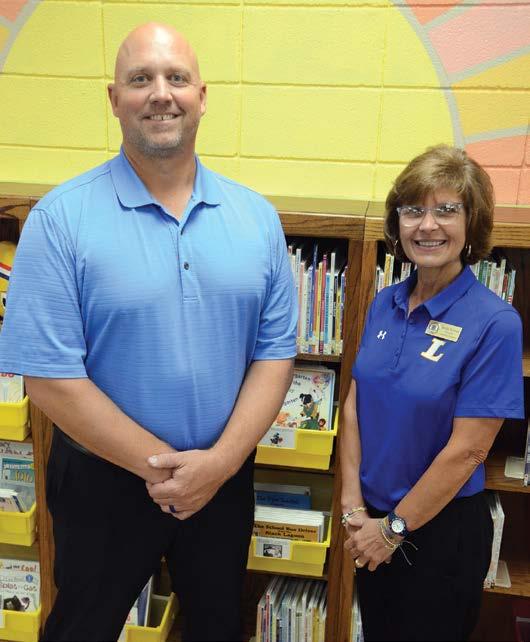
SCHOOL LEADERS. Superintendent Bruce Orr and Lakeside Primary Principal Bambi Norman say the pre-K program prepares students for kindergarten, allows the school to start interventions early, and attracts families to the district. Of the 138 students who enrolled in the pre-K program last year, 133 enrolled in kindergarten this year.
students in the program. Superintendent Bruce Orr, with the support of the school board, has made giving children access to pre-K a top priority. It’s good for students and their families, and it’s good for the district.
Lakeside educators say the program gives students a head start on their education. The district’s curriculum alignment starts in pre-K. In addition, those students start learning early about how school works, about daily routines, and about the school’s physical layout. For example, they learn where the cafeteria and library are, and what happens in those places. The school, meanwhile, gains insights into the child’s needs at age four rather than having to wait until their kindergarten year. Age-appropriate interventions and behavioral corrections can start early. The pre-K program offers speech therapy and developmental delayed therapy in partnership with the Dawson Education Service Cooperative. Such early preparation has gained increased importance with the 2023 LEARNS Act’s requirement that third grade students read proficiently or face being retained.
Continues on next page

Cadence Insurance is proud to join Gallagher, a global insurance brokerage that shares our core values and deep commitment to employees, clients and community. Together, we’re able to offer an expanded range of insurance, risk management and benefits solutions, including the Educator’s Legal Liability Program, endorsed by the Arkansas School Boards Association. This partnership allows us to bring even greater resources and support to Arkansas school districts, ensuring they have the protection they need to thrive. Learn more at ajg.com/cadence-insurance



“We feel that not only are we getting them a year early, but we’re getting them when they’re younger,” Orr said. “And maybe they haven’t picked up so many of those bad habits, and they understand what school’s like, and we can get them in and maximize the instructional time when they’re in those formative years better.” He later noted that a pre-K education provides an opportunity for enrichment for advanced students, as well.
Meanwhile, the school district benefits by attracting families who, after enjoying its pre-K offerings, enroll their children in kindergarten. After its enrollment fell during COVID, Lakeside’s numbers increased this year by about 40 students, not including the pre-K program. Thanks to the pre-K program, kindergarten enrollment is up this year for the first time in several years. This year’s class started at 230, compared to
about 210 previously. Last year’s preK enrollment was 138. Of those, 133 enrolled in kindergarten this year, and in the other five cases, the families moved away. The enrollment increase is occurring at a time when Arkansas schools are losing students because of falling birth rates and increased choice in Arkansas.
As everyone involved with public education knows, the LEARNS Act’s educational freedom accounts provide public funding for families to use for private and homeschooling expenses.
The LEARNS Act does not require schools to pay pre-K teachers at least $50,000 annually as it requires all other public school teachers to be paid. But Lakeside does pay its six certified pre-K teachers that amount and treats them as equal educators on the same salary schedule.
Each classroom has 20 students taught by a certified teacher and a paraprofessional. The latter are not certified and are not required to have college degrees. However, the program offers them a path to a certified position. Two former pre-K paraprofessionals have become certified teachers in the last year. One who worked five years as a pre-K paraprofessional stayed in the district and is teaching kindergarten this year. The other is working in another district. A couple of current paraprofessionals are working on their teaching degrees. This is the first year that all the pre-K classes have been located in the main primary school building. Previously, five smaller pre-K classrooms were housed separately from the rest of the primary students elsewhere. The program moved one classroom to the main part of the school two years ago, moved more last year, and moved the rest this year.
painting.
Orr credited the school board for supporting the district’s pre-K efforts.
“I give our school board a ton of credit,” he said. “I’ve been in the district 20 years in a variety of roles, and I have seen just steady leadership from the board, not chasing agendas, just understanding this is the main thing. We’ve got to make sure we keep the main thing the main thing. And I think steady leadership has really been one thing that has differentiated Lakeside over that 20-year period.”
The $500 monthly tuition per child – with a sliding scale based on income –covers all costs. There is no supply fee or registration fee, and the school does not charge extra for breakfast, lunch and a snack.
The district loses money on its program on the front end, but Orr said it’s worth it.
“[I]f you’re looking at those kids then going in and being part of your school and then possibly not having to put nearly as many resources into intervention along the ways, it’s an investment,” he said.
Childcare has been in the news in Arkansas after the Arkansas Department of Education announced Sept. 10 it was cutting reimbursements to providers





through the School Readiness Assistance program and instituting co-pays for families. The changes came after the federal government unexpectedly cut the state’s $137 million allocation for vouchers by $8 million. Private childcare providers feared they would not be able to stay in business. The Department of Education eventually settled on a plan that cut funding by less than originally announced.
Orr said if the cuts cause local pre-K providers to close their doors, schools will need to be prepared to take up the slack. He said he had told a local legislator that more funding is needed for early childhood education. A lot of money is spent on education programs for which there is no research showing its effectiveness, but early childhood education has been proven worthwhile.
At Lakeside, the day starts at 7:15 a.m. with early drop-offs and breakfast followed at 7:30. Like other young scholars, pre-K students are expected to come to school and stay throughout the
day, and not be dropped off and picked up at the parent’s convenience. The school has a tardy policy.
“We’re not a day care,” said pre-K teacher Erin Scott, who is in her 23rd year of teaching and third year of pre-K. “We’re not a babysitter. We’re teaching curriculum. We’re teaching routines that they’re going to carry over into kindergarten. Not only will it make it easier for the student, but also the teachers – that they’re used to, when you come to the carpet, this is what I expect. When you walk down the hall, this is how you do it.”
The academics and character-building activities start at 8 a.m. with “Brain Smart Start.” Students say the Pledge of Allegiance and tell each other good morning. The teacher leads them in a “wiggle dance” to burn a little energy, followed by a calming breathing exercise. Teachers assign each student’s job for the day: line leader, electrician to turn off the lights, supply manager to fetch a crayon or glue. The teacher
leads them in identifying absent students and then placing their photo in a big red heart on a “Wish you well board.” Then the teacher leads the students in singing or saying, “We wish you well. We wish you well. We wish you well throughout the day.” When the student comes back to school, the photo comes out of the heart and the class tells him or her they are glad they have returned.
One of Scott’s students is battling leukemia and has been unable to come to school. There’s been an outpouring of love from the classroom. She’s been taking the student pictures and items that other students have made for him. Scott made a photo album of all the students. She said it’s a way to teach compassion at four years of age. For the student and the parent, it’s a way to maintain the connection to the school.
“We hope that he’s able to come back, but if not, we want him to know he’s a Ram and, here at Lakeside, when he can, we’re ready for him to come back,” Principal Bambi Norman said.
The primary school has a behavior matrix with three expectations: “Safe, calm and kind.” Students are reminded of those expectations at the start of the day and taught what they look like in concrete terms, such as “safe, walking feet,” “hands to self” and “kind words.” Those expectations are applied to any circumstance, whether it’s in the classroom, hallway, playground or cafeteria. Each day, each student makes a commitment to live up to one of those expectations, and their photo goes into a pocket commitment chart. Throughout the day, the teacher can redirect their behavior by reminding them of their commitment and, if necessary, encouraging them to recommit.
“When you only have three expectations, you can work on that,” Norman said. “When you have more than that, it’s too much for the teacher, and it’s too much for the kids.”
The start-of-the-day activities are followed by recess and play in “centers” set up in each classroom where students can play with blocks, paint, play dress-up and engage in other activities. Students rotate from activity to activity, with teachers supervising and interacting. The rest of the morning is spent in enrichment activities in art, music, physical education and the library. Lunch is followed by recess, a literacy block, a math block, rest time and a snack. Students



student Elaine Couch. Dyberg said each day is “Fun. Happy. Busy. Full of learning and socializing and lots of talking to each other, learning how to problem solve.”
start going home at 2:45 p.m. By 3:30, the classrooms are usually empty.
When they first start the program, students are “Empty slates. Blank slates,” Dyberg said. “It’s a little wild, a little chaotic on day one, but they’re the sweetest. They come in loving their teacher who they know nothing about and excited to learn anything and everything. Everything is brand new to them, and they love it. It’s a kid walking into a candy store every day. I mean, they just are happy to be at school, and any little thing you tell them we’re doing, the joy that lights up their whole bodies, there’s nothing like it.”
The school day offers a balance between teaching life skills and giving students an academic head start for kindergarten. Some children have previously been in day care and now find themselves in an unfamiliar place. Some have not been anywhere outside of their parents’ care. Teachers do small group teaching where students are grouped according to their readiness. Some children may already have a head start on their letters, so the teacher can start them on the path toward reading and sounding out words. Others have never held a pencil or don’t know how to color. The goal is to finish the year knowing at least 10 upper-case and 10 lower-case letters along with their numbers 1-10. The keys are keeping them busy, keeping them moving, and keeping lessons short. The centers are the students’ favorite part. They spend about 15 minutes in each rotation.
“They’re learning how to interact with 19 other kids in a tiny space,” Dyberg said. “They’re learning how to solve problems when something doesn’t go their way. Or if they want something immediately and it’s not quite time, they’re learning how to be patient, so that’s a big learning curve, but they really learn quickly.”
Dyberg said it’s important that the students know the teachers love them. Once students trust them, feel safe, and

know the procedures, then they want to please their teachers and generally obey.
“You know that for some of these kids, 7:30 to 2:45 is their happy time. It’s their safe place,” she said.
Dyberg said she had a student last year who had never been to school
and was very active and energetic but wanted to do things on his own terms. Keeping his behavior contained was a struggle. He missed a lot of school. But around Christmas, things were starting to click. He was helpful and starting to learn some of the academics. Then

around March or April, he stopped coming to school. His mother brought him back one day to retrieve his belongings. He ran down the hall calling out Dyberg’s name and the name of her paraprofessional, Angie Carmona. He walked by the resting children and said hello to them. There were lots of hugs. The teachers were crying, and he was tearing up. The family is now living in the school district, and the student’s attendance is much improved.
“Those are the kids that just have your heartstrings,” she said.
Preparation for the families starts before the school year. Parents can tour the building during a spring registration night. Many want to see the classrooms where their children will be. At the beginning of the year, the school hosts an open house. There’s also a parents night at the beginning of each year where families can hear from each teacher about expectations. Like the students, pre-K gives parents a chance to learn how things work – the traffic, lunch, etc. – before kindergarten starts. Parents receive the state’s kindergarten readiness checklist that explains the skills the school is seeking to help the students learn. NOT A DAY CARE. Allegra Peterson paints at the Lakeside Primary School. Educators say the program goes far beyond a typical day care in that it prepares students for kindergarten.
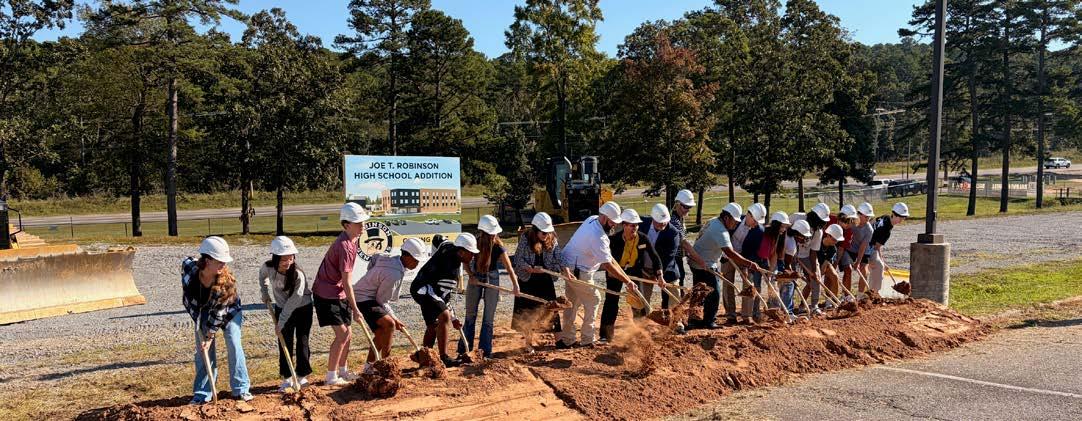
American Fidelity
Baldwin & Shell Construction Company
Consortium of State School Boards Associations
Gallagher
Lumatech
Simbli by eBoardsolutions
Safety Solutions, LLC
Lisa Boone
800.688.4421 lisa.boone@americanfidelity.com americanfidelity.com
Drew Williams 501.374.8677 drew.williams@baldwinshell.com www.baldwinshell.com
Dean Langdon 447.448.3076 dean.langdon@cossba.org www.cossba.org
Bill Birch 501.614.1170 Bill_Birch@ajg.com www.ajg.com
Chad Thornton 501.414.2244 cthornton@lumatechservice.com www.lumatechservice.com
Charlie Rigby 770.962.6844 crigby@eboardsolutions.com eboardsolutions.com
Brianna Davis 501.260.7003 bdavis@motorolaapss.com www.motorolaapss.com
Bailey Education Group Dr. Ivy Pfeffer 870.378.7098 ipfeffer@baileyarch.com www.baileyeducationgroup.com
BoardDocs (Diligent)
Capital Technology Group
Clark Contractors
Cameron Aud 301.814.0034 caud@diligent.com www.diligent.com/community
C.R. Crawford Construction, LLC Sarah Meadors 479.251.1161 smeadors@crcrawford.com www.crcrawford.com
Ben Higgs 501.375.1111 bhiggs@captg.com www.captg.com
Cory Olson 501.868.3133 colson@clarkcontractors.net clarkcontractors.net
Cromwell Architects Engineers, Inc. Chris East 501.372.2900 ceast@cromwell.com www.cromwell.com
David H. Frieze Associates, Inc. Paul Frieze 501.922.9704 paul.frieze7@gmail.com
Dynamic Integrated Security
East Harding Construction
Educational Benefits, Inc.
Grand Canyon University
HES Facilities Management
Homeland Safety Systems, Inc.
ISG
J&J Flooring Group
Kinco Constructors
KLC Video Security
Lone Star Communications
McPherson & Jacobson, LLC
Modus Studio, PLLC
National Safety Shelters
Paragon Architecture
Precise
SFE - Southwest Foodservice Excellence
SOPA, Inc.
Southern Bleacher Company
SYNLawn
Zeev Fragachan 954.669.5797 Zeev@dynamicintegrated.net www.dynamicintegrated.net
Trish Jones 501.661.1646 info@eastharding.com www.eastharding.com
Kylie Freyaldenhoven 844.559.3521 kylie.freyaldenhoven@ebiteam.com www.ebiteam.com
Danielle Johnson 480.646.7038 danielle.johnson@gcu.com www.gcu.edu
Chas Harris 901.378.6994 charris@hes.com hes.com
Hight Jackson Associates, P.A. Kaylee Hopper 479.464.4965 khopper@hjarch.com www.hjarch.com
Ann Day 318.221.8062 ann.day@hssems.com http://homelandsafetysystems.com
Maria Pedroso 605.274.6401 maria.pedroso@isginc.com www.isginc.com
Brad Bunch 479.305.4004 brad.bunch@jjflooring.com www.jjflooringgroup.com
Clay Gordon 501.225.7606 cgordon@kinco.net www.kincoconstructors.com
Stacee Walker 903.792.7252 staceewalker.klc@gmail.com klcvideosecurity.net
Liv Barwinski 312.539.6196 liv.barwinska@lonestarcom.com lonestarcom.com
Norman Ridder 402.991.7031 mail@macnjake.com www.macnjake.com
Josh Siebert 479.455.5577 josh@modusstudio.com www.modusstudio.com
Dennis Corrado 866.372.1530 dennis@nationalsafetyshelters.com nationalsafetyshelters.com
Brad Erwin 417.885.0002 erwin@paragonarchitecture.com www.paragonarchitecture.com
Amy Finster 870.698.1734 afinster@go-precise.com precisearkansas.com
Diane Johannes 850.449.0970 diane.johannes@sfellc.org sfellc.com
Teresa Snook 501.920.1699 tsnook@sopainc.com www.sopainc.com
Sarah Lundgren 940.549.0733 lundgren@southernbleacher.com www.southernbleacher.com
Paul Held 816.886.2747 paul.held@synlawn.com www.synlawn.com
The Interlocal Purchasing System (TIPS) Stacey McPherson 866.839.8477 stacey.mcpherson@tips-usa.com www.tips-usa.com
The Kirkland Group Chan Cleveland 601.383.0766 c.cleveland@kirklandgroup.org www.kirklandgroup.org
The PlayWell Group
Trane
Van Horn Construction, Inc.
WER Architects
Russell Fason 501.374.5300 rfason@werarch.com werarch.com Premier
Mitchell Wayman 479.567.3230 mitchell@playwellgroup.com www.playwellgroup.com
Jerry Shepard 501.605.6740 jerry.shepard@trane.com www.trane.com
Chad Weisler 479.968.2514 cweisler@vanhornconstruction.com vanhornconstruction.com


“We try to keep that connection so that they know what’s going on at school and they can follow up at home,” Norman said.
During the year, the teachers use the ParentSquare app to send class-wide or private messages to families as well as photos and videos – especially the first week of school. They also send home “REN” (Read Each Night) folders that parents are expected to sign every day. These include class newsletters, the student’s work, and personal communications about behavior and other issues. All the students are potty-trained, but the teacher might need to communicate that the student needs a new change of clothes for storage at the school. Parents can be “mystery readers” and participate in field trips. Likewise, students participate in homecoming and in the district’s Trunk or Treat Halloween event.
“We do a lot of events so that we can involve our families and get them to see they are an important part,” Norman said. “We’re trying to bridge this gap between, ‘You’re the family; we’re the school.’ We want to be on the same team together. It doesn’t do anything but benefit our student. So we offer a lot of opportunities for our parents to be involved.”








By Steve Brawner Editor
Shane Bell is a farmer. He takes a piece of land with a lot of potential, plants seeds, nurtures the plants, and reaps a bountiful harvest. In between, there’s a lot of hard work to be done, and a lot of decisions to be made. You have to fertilize. You might have to irrigate.
The Cross County School District was drying up when Bell ran for school board 20 years ago. The consolidated district was in fiscal distress, with a common high school and shrinking elementary schools in its spread-out communities.
Bell and others, however, saw its potential. The new school board members made the tough decisions to hire a new superintendent, ask patrons to support a millage increase, which they did, and consolidate the elementary schools.
Twenty years later, the district is thriving. Earlier this year, the Cross County Elementary Technology Academy was one of 10 finalists in the “Overcoming Adversity” category in T4 Education’s prestigious World’s Best School Prizes.
Report Card sat down with Bell to talk about that transformation, about his memories as a Cross County student and state championship football player, and about the challenges facing farmers today. Note: Much of the farming section came from a follow-up interview.
Where are you from?
“I grew up here my whole life. I grew up in a little community called … Bay Village. That’s where I grew up. I was right on the line, I could have either gone to Harrisburg, or I could have gone to Cross County. My parents chose
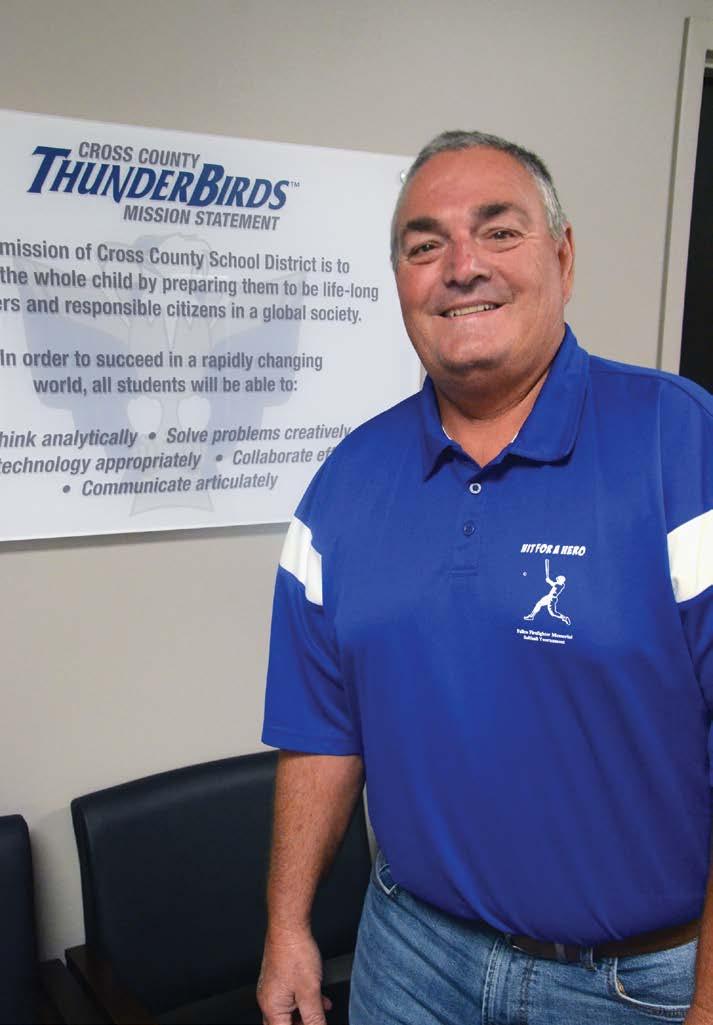
for me and my brother to go to Cross County. …
“I love the country life. You put me out in the country, out in the woods anywhere, I’m happy. Leave me alone, I can survive by myself. I enjoy that part of it. Now, don’t get me wrong. I don’t have [anything] against the big cities or any of that, but I’m just a country boy. That’s the way I was raised. Straight on the farm. ...
“When my grandma passed away, we ended up having to sell our farm because there were, like, six brothers and sisters. So, I moved from that farm, and I went to work for Matt and Danny Clements, Abner Clements. That’s who I work for now, and I’m the foreman on his farm.”
What kinds of crops do you all grow?
“Same thing. We raise the same thing: corn, rice and soybeans. My brother and I still have a little over 60 acres of our original farm that we kept for us.”
What do you learn on a farm?
“I learned it’s hard work, and you have to be dedicated. You’ve really got to be dedicated to do it, and you’ve got to enjoy being outside, and you’ve got to enjoy being able to adapt to the temperatures and the weather and everything. You’ve got to overcome all that.”
How are things going, and what challenges are you facing?
“Right now, things are really, really tough. Of course, this morning things may get a little better. I don’t know if you saw, but China did decide to start buying some more beans this morning, so that’ll be a plus. But the thing is, you’ve just got to try to pick your battles whenever you’re doing it. There’s stuff you can cut, things you can’t cut. You can’t cut fertilizer even though the price may still be high because you’ve got to have the yield to even have a chance to stay in business. … We used to try to update our equipment about every four to five years, and now we’re running eight-to-nine-year-old tractors because you can’t afford to trade them.”
Are y’all making it OK?
like I say, you just keep preparing and keep going. That’s all you can do right now.”
Farming’s always a boom and bust industry.
“We have no control over our market. We don’t know what our prices are going to be. They may be good. They may be low. They could change from day to day.”
What do you love about farming?
“I like the freedom, being by myself. I really enjoy that. The outdoors. I really like working outdoors. Get to do a lot of that. That’s what I really enjoy about it. My brothers and I, we started probably when we were nine, 10 years old going to the farm with our dad and my grandpa. So it’s just kind of got in the blood, and I’ve just been there ever since.”
When did you run for school board the first time?
“[It was] around 2005. Both my girls were still in school.”
Why did you run?
mainly the superintendent. But I knew there was some stuff that needed to be gone. …
“I knew [consolidating the elementary schools] was going to have to happen. I knew it wasn’t going to be good for the communities, but I knew it was going to have to happen for the school to survive. And I’m not against change. If you prove to me that there’s a way that it’s going to work, I’m all for it.”
At one point, Cross County went through fiscal distress.
“That was right before we consolidated.”
Were you on the board?
“I was not. Matter of fact, we had just been turned into the state the year I ran that fall. ... It was a whole new board when I started.”
Did the State Board …?
“No. No. The state never did take the school over.”
So did the old board just kind of say, “We need new blood in here?’’
“Pretty much, and that’s when we went to zones. We went to seven different zones in the school. The way it used to be elected was, they tried to elect two representatives from Hickory Ridge, two from Vanndale, and two from Cherry Valley. But the whole district voted on
“Yeah, we’re hanging in there, but it’s very thin. I mean, very thin margin. But, Continues
“I like giving back to the community. That’s one thing: I like being involved. And at the time, I could see that there were some things that needed to be done out here that I felt could have been done a little differently than they were. I know we don’t have a lot of control over people in the school system except for
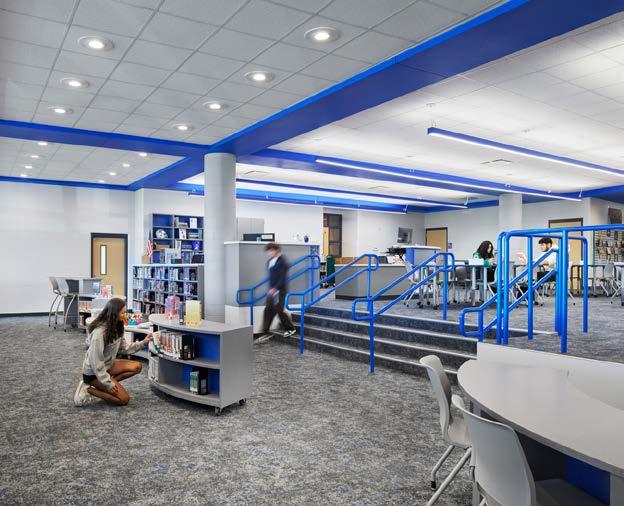


everybody that ran when they did it. Then when we went to the zone voting, the state came in, and you had to either be five or seven. You couldn’t be an even-numbered board.”
So you ran in part because of the fiscal situation?
“Yes. Yes. And that’s why I’m saying I knew that something was going to have to happen. When the new board came in, it was in the process of, we actually decided that we needed to look at possibly replacing the superintendent. And that’s where we started. We called a lawyer, first thing right off the bat.”
And that’s when you hired Matt McClure as superintendent.
“Mmm-hmm.”
When did you start consolidating?
“Consolidating started after that because we had to pass the millage to get enough funds to be able to do the elementary. So we had to go to the patrons and ask for a millage. … Once the millage got passed, then we proceeded with getting the elementary school built.”
It sounds like there previously had been an effort to keep every community happy and equally represented.
“Right.”
And you finally had to say, you’re either part of the Cross County School District. …
“Or you’re not. We either knew we were going to have to consolidate down to just one elementary school to stay open, or yeah, we were going to have to go to either Harrisburg, or we wouldn’t be here today doing what you and I are doing right now.”
How much pushback was there?
“There was a good bit of pushback. We had to set up several meetings. We’d go to Hickory Ridge. We’d sit down and talk and explain the reason behind it. We went to Vanndale. We went to Cherry Valley. It took some hard work to get it done. …
“[We] told them that was the only way the school was going to survive. There’s no way we could afford it. We

were down to, like, in Hickory Ridge, each classroom, the first grade may have five or six students in it. … It wasn’t feasible to keep it open to survive.”
That sounds pretty persuasive.
“It was. That’s what we had to do. We had to just explain to them that there’s no way this school district was going to survive like this right now.”
Was it hard to do that, considering that you were from here and had deep roots here?
“Not really, but it was hard persuading each community to try to give up their school. They didn’t want to give their school up.”
So you consolidated, built the school, hired Matt McClure. He was a change agent?
“He was.”
You became one of the early school districts to have one-to-one digital devices. What did you do?
“We were one of the first schools, I think, in the state that actually went, technology-wise, to computers. I’m talking about letting kids take their computers home. … And it was one of the best things we’ve ever done. It helped in the sense, kids trying to carry backpacks and stuff around schools, carrying those big books around like we did when you and I went to school. We did away with the lockers. We have no lockers. So it
“ I knew [consolidating the elementary schools] was going to have to happen. I knew it wasn’t going to be good for the communities, but I knew it was going to have to happen for the school to survive. And I’m not against change. If you prove to me that there’s a way that it’s going to work, I’m all for it. ”
made a big difference. When you and I went to school, you did a little bit of computer work, but computers were just really starting to come around.”
How did you go about the process of replacing Matt McClure with Nathan Morris?
“Matt actually made the recommendation. Actually, we went from Matt to Carolyn Wilson. She was superintendent for, like, five years. Then she was getting ready to retire, and …. Matt led us to Dr. Morris. He had him come in, and he sat down here with the board, and we did an interview, and everybody was pretty well pleased, and we hired him.”
And what was it about Dr. Morris that was obvious that he was going to be a good fit?
“He keeps you very, very informed. … And you could tell during the interview that he was …straightforward with you, that he’ll tell you just exactly how he feels and how he feels things should be going. … On Sundays, he sends out a thing for everything that’s going on that week, what he’s going to be doing that week so every board member knows what’s going on at the school.”
The district owns a house for the superintendent. Have you done that for a long time?
“We’ve provided a house ever since I’ve been on the board for the superintendent. Yes we have.”
Does it help?
“It does. It makes a big difference as far as trying to hire one, get one in. Yes it does.”
That’s just one major headache off the table. Is that part of it?
“It is, and we want the superintendent, whenever he comes to this school, we want him to live in our district.”
Do school board members have a role in bringing communities that are this far apart together?
“Mainly just your community that you’re in – the one I live in. The ones that live in Hickory Ridge, they bring theirs, and then the ones in Vanndale. We keep it spread out enough to where we’ve got enough in each community that they stay in touch pretty well.”
How important do you think sports are?
“I don’t want to ever say anything bad about academics because you’ve got to have the academics part of it, but I think, to me, sports plays a huge part in helping with the academics. If your sports programs are doing well, you see a lot of people at the ballgames, so that’s how people interact.”
If they’re at the ballgames, does that make them better academic parents?
“Technically, no. That work’s done at home.”
But does it help?
“I think it helps a little bit. Staying involved. What helps, too, is, I think, putting out the information, like the teachers putting out the information to the parents how their kids are doing.”
How important is that interaction between teachers and parents?
“I think it’s key to a district’s survival. I really do. I think a teacher ought to be able to interact. If a teacher sees a kid not performing very well, I think that teacher needs to say to the parents, ‘Hey, we need to possibly look at doing something to help.’ So I think they all need to interact very well.”
[Bell’s phone rings.]
That’s the ESPN theme song. “I meant to turn it on silent.”
You were talking a minute ago about the importance of sports, and
your ring tone is the ESPN theme song.
“When I played, I got to play for the ’84 championship team, state championship team.”
What did you play?
“I played right guard and outside linebacker.”
What are your memories of those years?
“We had a group of seniors, there were about 13 of us, but there were 10 of us that when the schools consolidated in the seventh grade and went from seventh grade to the 12th grade, we bonded really well together. We never had any real disagreements, arguments, or anything. I mean, if we found something, we could work it out. But we bonded as a group. I really enjoyed those years. Matter of fact, I still talk to several of them now.”
What do you think you learned from that?
“Main thing is trust – being able to trust an individual, your teammate. You’ve got to believe in your teammate. You have a responsibility, and you’ve got to believe your teammate’s going to take care of his responsibility at the
same time. So I truly believe in trust and responsibility, mainly out of all that.”
What do you think is the future of Cross County School District?
“I’d like to see us continue to grow student-wise. Plus, I think we can achieve higher things than we’re achieving now. When you’re doing something, you want to stay there, but you want to keep rising. You want to keep pushing the bar. … You want to keep moving. If we got to this level, let’s try to get to the next level. So that’s what I want them to keep doing. I want them to keep trying to push the goals to get higher. I mean, if we’ve got the goal set here, let’s go higher. Let’s just keep moving. That’s what I want.”
How does the school board help?
“The school board’s got to make sure we’ve got the right people in place, starting with the superintendent down. That’s our goal. I don’t come out here and step in teachers’ business. I’m usually the last person to know what’s going on out here. That’s not my job. My job is to make sure he’s doing his job. That’s my job. So that’s what I do.”
Note: Executive Session is edited for length, style and clarity.


Nabholz has partnered with districts to deliver storm-rated shelters that function as flexible learning and athletic spaces, such as Greenbrier High’s multipurpose safe room pictured above.
When schools plan new construction, safety remains at the forefront – especially during severe weather season. While state code now outlines which educational facilities must include storm-rated shelters, many districts go beyond compliance to create spaces that protect and serve students year-round.
Modern storm shelters are no longer single-use concrete boxes. Schools are designing multi-purpose facilities that double as gyms, cafeterias, or auditoriums while meeting ICC 500 standards for fire safety. This approach maximizes available funds, provides daily value to students, and ensures the space is ready in the event of a tornado.
From funding guidance to FEMArated construction, Nabholz helps districts navigate design, safety, and compliance every step of the way.
For more information, go to www. nabholz.com
First Security Beardsley, which advises a majority of Arkansas’ school districts, is moving west to a new office at First Security Park.
The lush, 33-acre campus is located at 4007 North Rodney Parham Road in Little Rock near the intersection of Cantrell and Rodney Parham Roads.

This larger location features walking trails, training rooms, computer classrooms and state-of-the-art conference rooms. The team looks forward to hosting superintendents and school board members at its new corporate campus.
First Security Beardsley is creating First Security Municipal Advisors, Inc. (FSMA) to serve Arkansas and national clients. It will focus on schools, cities, counties and nonprofit entities. The firm remains a corporate affiliate of Crews & Associates and a First Security Bancorp company.
To learn more, contact Scott Beardsley at 501.978.6385. More information can be found at www.fsbeardsley.com
WDD Architects celebrated the grand opening of Springdale’s Southwest Junior High alongside students, staff, and the community on Oct. 3. The school’s impact is clear: a stronger sense of pride, improved culture, and a more positive daily experience for students and staff.
The design centered around a bold idea: What if the school is the library? The media center was placed at the heart of the campus to make learning visible and central. The project was shaped by workshops, surveys, and community input, with a focus on preserving the site’s oak trees and creating a space the community could be proud of. Despite
the challenge of building on an active campus, the school opened on schedule thanks to a strong partnership with Baldwin & Shell’s construction team.
Learn more at wddarchitects.com

Strategos International’s Steve Anderson and Rodney Bardwell met with ResponsiveEd Arkansas leaders in Little Rock in October to discuss strategies for improving school safety readiness.
Their presentation highlighted the importance of comprehensive staff training and a clear, practiced response plan for violent threats. They also introduced a tentative schedule for Active Shooter Intruder Response training to be conducted across multiple ResponsiveEd campuses throughout Arkansas.
For more information about Strategos, go to strategosintl.com

The addition at Joe T. Robinson High School in Little Rock broke ground in October. WER Architects has worked closely with Pulaski County Special School District and Robinson High leadership to design this addition – bringing
50,600 square feet of new educational space to the campus.
The building will feature 20 new spaces for core subjects, special education classrooms, and new administration space. It will feature natural light, flexible furniture, and unique learning environments. The project also includes a state-of-the-art band facility that will serve as a fully equipped storm shelter.
For more information about WER Architects, go to werarch.com
McPherson & Jacobson is available to assist school districts in identifying outstanding leaders to be their superintendent and other educational leaders. Visit the company’s booth at the ASBA Annual Conference Dec. 10-12.
To learn more about McPherson & Jacobson, go to www.macnjake.com

Architecture Plus attended the ribbon cutting for Springdale’s 210,000-squarefoot Central Junior High School Sept. 25. Working with Baldwin & Shell, Architecture Plus completed this school in three phases while allowing it to remain operational for classes to continue. Construction was complete in March.
The school features a secure entry vestibule and a teaching stair leading to second floor classrooms. The dining area doubles as the lobby for volleyball and basketball games. Students will enjoy new music/band rooms, new P.E. facilities and a weight/workout room.
Each classroom offers individual heating/cooling and lighting control. Teacher workrooms are located at both floors of both classroom wings.
To learn more about Architecture Plus, contact Craig Boone at craig@ archplusinc.net or go to archplusinc.net.
TIPS can help schools save time, money on their procurements
TIPS Purchasing Cooperative can help school districts with any purchases they may need. By becoming a TIPS member, they can save time and money in their procurement process.
Contact Stacey McPherson at stacey.mcpherson@tips-usa.com or at 870.565.6178 for any TIPS inquiries. To learn more, go to www.tips-usa.com.

C.R. Crawford attended career fairs at Greenland High School and Elkins High School to help students explore career opportunities in construction.
Students experienced a virtual walkthrough of a C.R. Crawford project using a Matterport scan, allowing them to see firsthand the technology and processes shaping today’s construction industry. Students also gained insights into the wide range of career paths available, such as project management, engineering, skilled trades and technology.
“I was amazed by the thoughtful questions the students were asking,” said Abbie Rose with C.R. Crawford. “Their curiosity and excitement about the industry were really encouraging.”
For questions about K-12
construction, contact Leigh Ann Showalter at lshowalter@crcrawford.com. For more information about C.R. Crawford, go to www.crcrawford.com

Work continues on Little Rock’s Pinnacle View High School, which Baldwin & Shell is constructing.
Set for completion in 2027, the school will feature a three-story, sevenwing, 320,000-square-foot facility on a 27-acre campus. The project also includes renovations to the existing 100,000-square-foot building with striking monumental stairs at its center. Designed for 1,200 students, the school will include a 913-seat performing arts center, 24 classrooms, 44 specialty rooms, and extensive athletic spaces, including a competition arena, storm shelter gym, and new baseball/softball complex. The school also will have 979 parking spaces.
To learn more about Baldwin & Shell’s offerings, go to www.baldwinshell.com
School districts can simplify their purchasing with ARBuy Marketplace, Arkansas’ trusted source for statewide cooperative contracts. ARBuy helps districts buy what they need – faster, smarter, and at competitive prices –while ensuring full compliance with state procurement laws.
ARBuy lets districts skip the bidding process, access pre-approved contracts, and save time and money. With transparent pricing and built-in accountability, ARBuy can help districts stay on budget and focused on supporting students and staff.
To learn more, go to arbuy.info.

Modus Studio designed the new cafeteria for the Eureka Springs School District. This 10,000-plus-square-foot facility serves both elementary and middle school students. The cafeteria is designed to capture the natural light from the south and bring it in for a warming and comfortable experience. The natural softwoods throughout the facility fosters a natural calming feeling.
For more information about Modus Studio, go www.modusstudio.com or call 479.455.5577.

Lumatech this year has been installing new LED sport lighting at school districts. It installed new lights on football fields at Newport and Lonoke. It also this fall is installing new poles and
LED fixtures on the Bryant softball field and at the Cabot baseball field.
Last year, it installed lights for football fields at McCrory, Jessieville, and J.A. Fair and Scott Field for Little Rock. It also installed lights at the Izard County basketball gym.
For more information about Lumatech’s offerings, go to www.lumatechservice.com, or contact Chad Thornton at 501.414.2244 or at cthornton@lumatechservice.com
American Fidelity’s disability policy provides coverage for pregnancy claims in addition to the now standard 12-week maternity leave.
Since American Fidelity writes and manufactures its own policies specifically for education employees, it has the flexibility to make accommodations to continue to provide value and peace of mind to its customers.
While many companies are denying pregnancy claims in Arkansas, American Fidelity protects its customers regardless of legislative changes.
Learn more about American Fidelity at americanfidelity.com
Southern Tire Mart is teaming up with the Bergman School District to improve operational readiness and safety.
The Bergman School District has started a tire dismounting/mounting program with the help of Southern Tire Mart that will keep the district supplied with maintained tires and wheels.
The program eliminates the need for the Bergman School District to take buses off campus for tire replacements. This will allow fleet mechanics to concentrate on core maintenance and reduce the need for additional shop equipment.
For more information, go to stmtires. com or call 877.786.4681.

The Arkansas state fire marshal’s office is now willing to consider for approval pre-fabricated in-classroom style safety shelters like the ones offered by National Safety Shelters as an acceptable alternative to stand-alone FEMAstyle safe rooms for new construction and renovation projects.
These dual-purpose safe rooms protect against both active shooters and EF-5 tornadoes, providing immediate safety without having to leave the classroom.
This is a significant milestone in school safety since it equips teachers with a reliable safety plan and gives those with various handicaps easy access to a safe place. A campus project typically costs one-half to one-third the amount of a traditional FEMA safe room and can be installed after school hours in just a few months after contract commencement.
Several districts have already installed these in-classroom shelters including Quitman, Lawrence County, Concord, Danville, Pangburn, Ouachita River, and White County Central. Searcy School District recently ordered 183 safe rooms scheduled for installation in December.
More information can be found at www.nationalsafetyshelters.com or by calling 772.672.3331.
Cromwell recently completed the award-winning Dr. Marian G. Lacey K–8 Academy for the Little Rock

School District, transforming the former McClellan High School site into a new 238,000 square foot, three-story facility. The campus features 64 classrooms, project labs, fine arts and maker spaces, career education areas, and a cafetorium with media center. Site work added improved access, parking, and athletic facilities. The inclusive design includes community spaces and an ICC-500 FEMA-rated storm shelter.
For more information about Cromwell, go to cromwell.com.
Stephens can assist school board members with obtaining their required professional development hours.
Arkansas law generally requires that board members obtain up to six hours of certified professional development on topics related to school operations.
ASBA has deemed Stephens’ financial advisors as certified ASBA trainers who are able to provide up to four hours of school finance training annually toward ASBA’s Boardsmanship Awards Program. Normally held in the evening or on a weekend, this free training workshop will address topics ranging from state and local funding revenue sources to debt financing of capital projects. This type of workshop can be particularly useful if boards are considering how to finance future capital projects.
To learn more about how Stephens can assist your district, contact Michael McBryde of Stephens Public Finance at 501.377.2641. To learn more, go to stephenspublicfinance.com.

Searcy School District partnered with Entegrity to modernize lighting across
17 school facilities, including upgrades to the football, baseball, and softball fields. The new LED systems deliver better visibility, improved safety, and energy savings while reducing maintenance demands.
The project replaced or retrofitted more than 9,000 fixtures, resulting in 580,000 kWh and $92,000 in annual savings. At the football stadium, 262 new LED sports lights were installed with wireless controls, dimming, and color capabilities.
Entegrity’s sports lighting service helps schools upgrade outdated systems with LEDs designed for athletic fields of all sizes. By reusing existing infrastructure such as light poles and wiring, Entegrity significantly lowers project costs while delivering premium lighting, reduced light pollution, and long-term energy efficiency.
For more information, visit entegritypartners.com
The September 2025 print version of Report Card inadvertently omitted WER Architects as an Exhibiting Partner on the Commercial Affiliates page. It should have listed Russell Fason as the contact at 501.374.5300 and at rfason@ werarch.com The company’s website is werarch.com


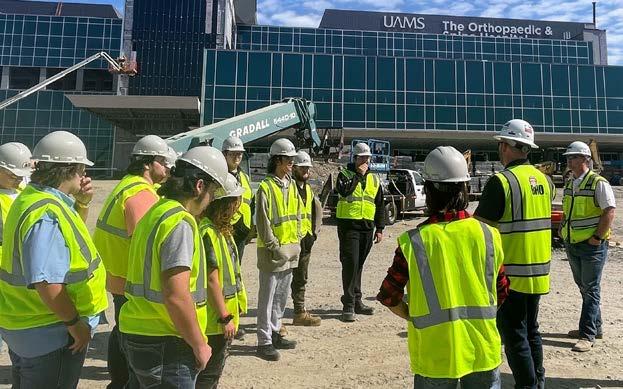

At Nabholz, we’re proud to help equip students with the tools they need to succeed — and that goes beyond building educational facilities. As careers in the trades continue to grow in popularity, we strive to open doors for high school students through the Nabholz Youth Apprenticeship Program. From carpentry to task management to effective communication, our apprentices gain valuable skills that prepare them to enter the workforce upon graduation.