FALL 2018/SPRING 2019 | ISSUE 30
SEU CAMP An official publication of College Assistance Migrant Program St. Edward's University - Austin, Texas
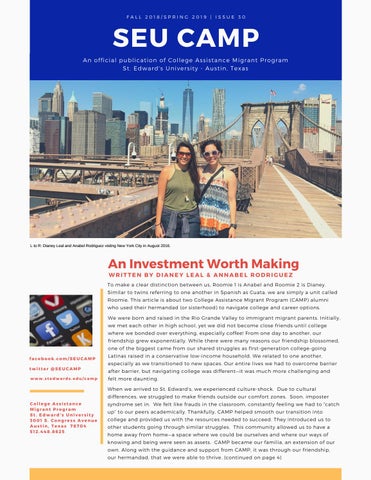
L to R: Dianey Leal and Anabel Rodriguez visitng New York City in August 2016.
An Investment Worth Making WRITTEN BY DIANEY LEAL & ANNABEL RODRIGUEZ
To make a clear distinction between us, Roomie 1 is Anabel and Roomie 2 is Dianey. Similar to twins referring to one another in Spanish as Cuata, we are simply a unit called Roomie. This article is about two College Assistance Migrant Program (CAMP) alumni who used their hermandad (or sisterhood) to navigate college and career options. We were born and raised in the Rio Grande Valley to immigrant migrant parents. Initially, we met each other in high school, yet we did not become close friends until college where we bonded over everything, especially coffee! From one day to another, our friendship grew exponentially. While there were many reasons our friendship blossomed, one of the biggest came from our shared struggles as first-generation college-going facebook.com/SEUCAMP twitter @SEUCAMP www.stedwards.edu/camp
Latinas raised in a conservative low-income household. We related to one another, especially as we transitioned to new spaces. Our entire lives we had to overcome barrier after barrier, but navigating college was different—it was much more challenging and felt more daunting. When we arrived to St. Edward’s, we experienced culture-shock. Due to cultural differences, we struggled to make friends outside our comfort zones. Soon, imposter
College Assistance Migrant Program St. Edward's University 3001 S. Congress Avenue Austin, Texas 78704 512.448.8625
syndrome set in. We felt like frauds in the classroom, constantly feeling we had to “catch up” to our peers academically. Thankfully, CAMP helped smooth our transition into college and provided us with the resources needed to succeed. They introduced us to other students going through similar struggles. This community allowed us to have a home away from home—a space where we could be ourselves and where our ways of knowing and being were seen as assets. CAMP became our familia, an extension of our own. Along with the guidance and support from CAMP, it was through our friendship, our hermandad, that we were able to thrive. (continued on page 4)
CAMPers in Action WRITTEN BY EDGAR LOPEZ
L to R: Justin Chavez, Michelle Guttierez, Denise Mares, David Enriquez, Adelita Rodriguez, Edgar Lopez, Apolonio Martinez (kneeling in front), Eduardo Ortiz, Christian Garza, Yacqueline Garcia, Maria Reyna, Marisol Rivas and Kathia Sosa pose outside of their volunteer site Santa Rita Courts.
In the 2018-19 academic year, the College Assistance Migrant Program (CAMP) embarked on a new initiative that introduced our first-year undergraduate CAMP scholars to a brand-new curriculum. The two-semester course was designed to enhance college student engagement and academic achievement by offering active and experiential learning opportunities through peer-advising and service-learning. It also aimed to provide our students with a better understanding of their educational trajectory and gain first-hand experiences working with local schools to advise and mentor younger students. During the fall semester, our scholars learned how to improve their writing, understand educational research, and navigate resources to adjust to St. Edward’s University as first-generation college students. They engaged in weekly critical thinking and dialogue within small groups. Students were also assigned a peer mentor to guide them throughout their first semester and provide any resources to successfully navigate through their courses, emotional well-being, and other areas of interests.
"PARTICIPATING IN THE FYSM COURSE OFFERED ME A NEW PERSPECTIVE. IT WAS CHALLENGING AT FIRST, BUT I AM GLAD I GOT THIS EXPERIENCE." In the spring semester, the CAMP staff partnered with Communities in Schools and local schools to establish a partnership in order to apply a service-learning method into the seminar course. The mentoring curriculum inhibited restorative justice and critical mentoring practices. The CAMP scholars were able to select from one of three sites available to serve on a weekly basis for the entire semester: Uphaus Early Childhood Center, Santa Rita Courts, or Fulmore Middle School. Each site offered a unique opportunity for the students to step out of their comfort zone. Thank you for our Communities in Schools and our partnering school sites as they allowed us to support their students! Overall, these two-semester courses were a success! PAGE 2
Front Row: Daniel Ortiz and Edgard Lopez. Second Row: Alexandria Sandoval, Kayla Rendon, Paola Herevia, Principal Claudia Santamaria, Tamara Cortes Nunez, Mario Aleman. Third Row: Miguel Vargas, Eduardo Carrillo, Cynthia Velasquez, Brianna Barrera and Arjelio Garza show their support for Anita Uphaus Early Childhood Center.
Finding Music on the Hilltop RUBY GONZALEZ-VALTIERRA - CAMP CLASS OF 2018 "I've always liked music and being a part of a group that cheers up an audience," says Ruby. In 6th grade, Ruby began playing the french horn in her school's band. By the time she was a high-school senior, she was playing in both the orchestra and marching bands. Naturally, when she arrived at St. Edward's as part of the College Assistance Migrant Program's (CAMP) 2018 class, she started searching for ways to keep music in her life. Enter the Fightin' Hilltopper Band, directed by Dr. James Van Zandt, Ruby was fortunate to learn about the pep band during St. Edward's fall involvement fair. She signed up and was excited to find out that student musicians were enrolled in a 1-hour credit course and provided with instruments and a small stipend to help them financially. As a member, Ruby plays at St. Edward's volleyball and basketball games. This past spring, the band joined the men's basketball team at the Heartland Conference in Tulsa, Oklahoma. Being able to provide spirit, support and music for the basketball players during this important conference was a rewarding experience. Ruby plans to continue playing next year and hopes in the near future that the band expands it's membership and becomes the Fightin' Hilltopper Marching Band.
Making a Difference ARIANNA VACIO - CAMP CLASS OF 2018 Volunteering is not just a bullet point on a resume for Arianna. Service has always been a part of the fabric of her life. In high school, she was a tutor, junior STEM camp counselor, and a catechism volunteer at her church, all while focusing on her academics and a member of the school's varsity soccer team. It was a given that Arianna would continue her commitment to service once she arrived on the Hilltop. During a summer visit to St. Edward's, Arianna's tour guide mentioned the opportunities available to students - one of them was the Alternative Spring Break (ASB) coordinated by Campus Ministry during spring break. This opportunity stuck with her, and once she returned to campus in August, Arianna applied and was selected for the ASB program. This is how she found herself a part of an experience she could not have imagined - volunteering during spring break at a local school on an Apache reservation located in Dulce, New Mexico. Arianna tutored students and assisted the teachers in the classroom. She walked away from this experience knowing that she made the right choice by participating in SBE. "I got an experience that I would not have gotten anywhere else," said Arianna.
A Journey of Service KATALINA RUBIO - CAMP CLASS OF 2018 Immediately upon arriving at St. Edward's, Katalina jumped right into the campus community - she was offered a position as a Tutor and Supplemental Instruction Leader for Calculus II along with working as a Tutor in the Math Lab - uncommon for a freshman. This level of commitment for Katalina is not new, since 8th grade she has been involved in her school's opportunities to give back. When she found out about Campus Ministry's Alternative Spring Break experience (ASB), she didn't hesitate to apply. Katalina was selected and assigned to a group that would be spending their week in Los Angeles, California. The goal was to provide students with the opportunity to work with local nonprofit organizations serving former gang members and at-risk youth in the LA community. At HomeBoy Industries students assisted in the kitchens, bakery, and with GED classes, while at St. Mary's they helped teachers in the classroom and provided afterschool tutoring. "The experience was a blessing and I can't wait to apply for the International Immersion Experience program to continue this journey," says Katalina. PAGE 3
CONTINUED FROM PAGE 1 Although we are now earning our PhDs, this career path was not our first choice. In fact, Anabel wanted to be a medical doctor, while Dianey wanted to practice law. While we did everything to pursue our future career goals such as earning good grades, doing research, and interning, our career paths ended up changing. We experienced disappointment at the beginning, but ultimately we had a breakthrough. Throughout the way, we had our CAMP familia, academic mentors, and each other. The difficult decisions we had to make while navigating college and career options led us to the following realizations: disappointment and breakthrough.
DISAPPOINTMENT
L to R: Anabel and Dianey after running their first half-marathon in March 2015.
Anabel
Dianey
I started my first semester as a pre-
My dream of being a lawyer was affirmed after
health biology student determined to
attending CAMP Career Day my freshman year
attend medical school, I quarantined
when I met a CAMP alumnus who was a law
myself in many St. Edward’s study
student. I remember being awed by her
nooks: Moody, JBWN, library, and my
honesty and work ethic. Determined to attend
room. For the first three-years, I
law school, I decided to major in English
focused so much on my GPA (grade
writing and rhetoric in addition to political
point average) that I lost touch of
science. However, much like Anabel, I got a low
other things that were important for
score on my LSAT. I cried myself to sleep for
medical school admittance. Despite
three days. I felt like a failure, but Anabel was
having a low MCAT (medical school
my rock through it all. She understood exactly
entrance exam) score,
what I was feeling and motivated me not to
I applied to medical schools across Texas; and I was denied an interview to all of them. I was at a complete mental and emotional loss. During this time, Dianey and I were living together. As devastated as I was about the continuous admission rejections, I knew I was not alone. I shared my disappointment with Dianey who at the time was studying for the LSAT (law school admission test). Through pláticas (conversations) and reflexión (reflection), we were able to to move beyond our internalized feelings of failure. We motivated each other to seek other possibilities and truly believed that if one door closed
give up. My senior year, I re-took the LSAT. This time, I scored even lower! Having watched Anabel navigate this process previously made me stronger. She constantly encouraged me to think about a Plan B and even C. “You have to be prepared and open to other options,” she would advise me. My friendship with Anabel sustained me through this disappointment and inspired my determination.
another would eventually open. As it eventually did for us…
BREAKTHROUGH Anabel
Dianey
That same semester after I had received
Mirna Garza, a fellow CAMP scholar,
multiple rejections from medical schools my academic advisor and research mentor, Dr. Baynham, mentioned how my interests aligned with many public health objectives. Under her supervision, I had conducted two summers of (microbiology) food safety research funded by the USDA—the first summer at St. Edward’s and the second summer at the Whitely Laboratory at the University of Texas. After much reflection and
told me about the McNair Scholars Program, a federally funded program that prepares participants for doctoral studies. Initially I was not interested, She encouraged me to apply and after much consideration and research on the program, I did and got accepted. The program became an opportunity that changed my life and career trajectory.
L to R: Dianey and Anabel after 24hours of data collection in Clovis, NM.
sorting different options and scenarios, I
That summer I conducted research on Mexican-American
applied to the University of Texas Health
students and their college trajectories under the direct
Science Center at Houston School of Public
supervision of Dr. Laura Hernandez-Ehrisman. Despite having low
Health in San Antonio, TX. Medical school
GRE (graduate record examination) scores, I applied to graduate
ended up not happening but six years later, I am doing exactly what I was meant to do— occupational health and safety for vulnerable agricultural workers. More than anything, this brawl with life taught me how to turn negative situations around. PAGE 4
school because I knew that standardized tests were not a reflection of my academic abilities or work ethic. While graduate school was not on my radar when I started St. Edward’s, I am glad that I remained opened to other options and took advantage of the services St. Edward’s and CAMP had to offer. Now, I am earning two doctoral majors, and am actively involved with CAMP at Michigan State University. I am exactly where I am meant to be.