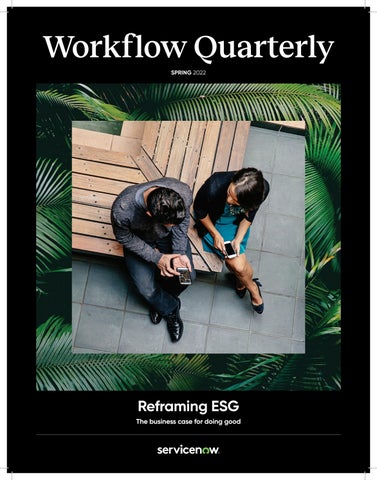
Workflow Quarterly SPRING 2022
Reframing ESG The business case for doing good
ii
WFQ Spring 2022
EDITOR IN CHIEF Richard McGill Murphy MANAGING EDITOR Paul von Zielbauer DEPUTY EDITOR Stuart Luman ART DIRECTION Steve Barretto
WORKFLOW QUARTERLY
Contributors GINA MASTANTUONO Gina is the chief financial officer of ServiceNow. She guest edited the ESG issue of Workflow Quarterly. Page 2
STUART LUMAN Stuart is the deputy editor of Workflow. For 20 years, he has edited and written for science and tech publications. Page 7
ELISHA HARRINGTON Elisha is a ServiceNow innovation evangelist focused on the future of work, digital transformation, and intelligent systems. PUBLISHER Sheila Dowd PRODUCTION MANAGER Sheryl Domingue COVER PHOTOGRAPHS BY Inti St Clair (Top) Susan Lee (Bottom)
Page 8
EVAN RAMZIPOOR Evan is a California-based writer whose work has appeared in McSweeney’s, Salon, and other publications. Page 12
JANET RAE-DUPREE Janet has covered innovation and tech since 1993 at publications such as BusinessWeek and the San Jose Mercury News. Page 16 Workflow Quarterly is published 4x/year. ©2022 ServiceNow. All rights reserved.
SPRING 2022
1
Contents 2 4
EDITOR’S LETTER Well-governed companies build trust by measuring their impact on the world By Gina Mastantuono
EVERY LEADER WAS ONCE A BEGINNER Survey says: ESG leaders grow faster and attract top talent
6 7
ACCOUNTING FOR EMISSIONS Businesses unwilling to report climate impacts could be left behind, says KPMG’s climate leader
MAPPING GLOBAL RISK An AI startup helps companies identify environmental and social risks in their extended supply chains By Stuart Luman
8
TECHNICALLY SPEAKING Match the ESG jargon terms to their definitions
12
16
22
THE FUTURE OF FINANCE IS GREEN We need a financial system that supports low-carbon, sustainable investments By Elisha Harrington
MIND THE (IT TALENT) GAP To bridge the tech talent gap, companies are recruiting and training workers from underserved communities By Evan Ramzipoor
FRAMEWORK FRENZY ESG reporting is a hot mess of overlapping frameworks and standards. Thankfully, help is on the way By Janet Rae-Dupree
HIRING THE NEURODIVERSE Businesses in need of tech talent have overlooked a fifth of humanity By Evan Ramzipoor
2
WORKFLOW QUARTERLY
Welcome to the ESG issue Well-governed companies build trust by measuring their impact on the world
LETTER FROM THE GUEST EDITOR GINA MASTANTUONO
Companies worldwide have come to view their environmental, social and governance (ESG) programs as a business imperative with real impact on stakeholder trust and long-term value creation. But as every CFO knows, you can’t manage what you don’t measure. ESG has skyrocketed up the list of business priorities over the past two years due to the pandemic, social unrest, stricter regulatory environments, and the increasingly obvious effects of climate change. Yet ESG measurement and reporting are relatively new disciplines. Leaders have had to figure them out quickly and hold themselves accountable for their progress. Here’s the good news: Strong ESG performance yields compelling business benefits. ESG connects to business strategy in a way that is good for the planet, good for people, and good for profits. As the chief financial officer of ServiceNow, my mission is to ensure ESG underpins every part of our strategy, culture, and decision-making framework.
Our ESG strategy centers on three strategic pillars, supported by our Now Platform and solutions. The first is sustaining our planet (environmental) by achieving our 2021 goals of 100% renewable electricity and carbon neutrality. It also involves setting, and receiving approval for, our near-term science-based targets, as well as accelerating our commitment to reach Net Zero by 2030, 20 years ahead of our prior target. The next pillar is creating equitable opportunity (social) by empowering employees through a strong company culture, an even-stronger focus on an inclusive employee experience, and new opportunities to make a difference in our communities. Our final pillar is acting with integrity (governance) by embedding robust governance and ethical business practices in every area of our company to increase transparency and accountability, while protecting the security and data privacy of our customers.
SPRING 2022
3
GINA MASTANTUONO CHIEF FINANCIAL OFFICER, SERVICENOW
Governance is at the core of ServiceNow’s approach to ESG. As a CFO, I firmly believe that good governance is how you earn trust. That’s because sound ESG management goes beyond defining how a business impacts and is impacted by the world. It mitigates risk, delivers competitive advantage, and builds stakeholder trust. It keeps us aligned, accountable, and provides transparency for all our stakeholders. To understand how organizations are defining and meeting their ESG goals, ServiceNow and ThoughtLab recently conducted a global survey of 1,000 global C-level executives working in five industry sectors across 12 countries. Company sizes ranged from $350 million to more than $5 billion in annual revenue. We sorted the survey respondents into three ESG maturity stages: beginners, intermediates, and leaders. We used 11 criteria to define these stages, from having an ESG strategy to incorporating ESG goals into their digital transformation efforts. This
approach helped us identify the best practices of ESG leaders, along with the performance returns achieved by moving to the next stage of maturity. The number one benefit for ESG leaders is, remarkably, increased revenue growth. Leaders say their boards and the C-suite are making ESG a top priority and that digital innovation is intrinsically linked to progress on ESG goals. They also report that ESG strategies and vision are key to attracting and retaining talent, customers, and shareholders. (Results from the ESG survey are highlighted throughout Quarterly.) The right ESG strategy can mitigate business risk and deliver competitive advantage. It can also build trust, the ultimate human currency. That’s why we packed the Spring issue of Workflow Quarterly with insights to help business leaders optimize their ESG efforts. This is a journey without a destination, but a strong ESG structure can help companies solve some of the world’s greatest challenges.
WORKFLOW QUARTERLY
4
Every leader was once a beginner Companies with advanced ESG programs grow faster and attract top talent Companies everywhere face rising pressure to account for their environmental and social impacts, according to a global survey by ServiceNow and ThoughtLab.* The research found that ESG leaders outperform financially and are more likely to attract and retain talented workers.
ESG delivers ability to attract and retain top talent
44
%
Beginners
86
Leaders
%
ESG enables us to deliver better financial results
49 Beginners
*ThoughtLab/ServiceNow 2022 ESG survey polled 1,000 executives across 13 counties in the financial services, healthcare, manufacturing, public sector, and telecom sectors
%
79 Leaders
%
SPRING 2022
5
100
68 63 % %
of leaders say digital innovation is key to achieving ESG goals
of leaders say ESG is a priority for their board and C-Suite
41
50
%
of leaders have set, or plan to set, sciencebased emission targets
38
%
of leaders have pledged to achieve net-zero emissions
0
PHOTOGRAPH BY ANDRII VERGELES
6
WORKFLOW QUARTERLY
Accounting for emissions Companies unwilling to report climate impacts could be left behind, says KPMG’s climate leader
ARUN GHOSH CLIMATE DATA AND TECHNOLOGY LEAD, KPMG
In March, the SEC released proposed regulations to enhance and standardize climate-related corporate disclosures. A key part of the new proposal is that disclosures would have to be independently verified. Enter Arun Ghosh, climate data and technology lead for Big Four accounting firm KPMG. Since 2018, Ghosh has helped numerous companies track their emissions using KPMG’s proprietary, patent-pending climate accounting framework. (This interview has been edited for clarity and length. The opinions expressed are those of the interviewee and do not necessarily represent the opinions of KPMG.) How have companies reacted to the SEC’s proposed regulations? A majority of the market won’t wait for this [to go into effect] because they have global supply chains and operations and they can’t just sit around. That’s why the UK and the EU markets [that already have regulations] are so critical, because if you solve for them, you can bring most of it stateside. The others are just starting out or waiting and watching to see what happens. Those others, what do they need to know to get started? If you look at Biden’s infrastructure bill, which has a massive level of ESG incentives, if you look at California, New York, Massachusetts, and other states that have enacted similar regulations, there is a lot of [ESG] momentum both legislatively and privately with investors. For those companies that haven’t started, maybe we don’t make this about a wake-up call, instead it’s more about awareness. The moment you bring awareness, the light bulbs
go on. Almost half of our conversations start with awareness. We’re brought in and the client says, ‘You know, we’re hearing about ESG, but we don’t know what to do.’ We explain why E, S, and G matter in their world. As the awareness builds, so does the interest in effecting change. Because climate is not an optional thing, social economic investment is not an optional thing for companies anymore. The Republicans may take back Congress this year and maybe the White House in 2024, what will that mean for ESG in the United States? There could be some scaling back. The challenge will be that companies are going to voluntarily want to disclose this information for stakeholders and stockholders. Maybe the government takes a minor role, because the wheels are already in motion.
PHOTOGRAPH BY KPMG
INTEGRATED REPORTING
TECHNICALLY SPEAKING
TRIPLE BOTTOM LINE NET ZERO
Match the ESG jargon to their definitions
SCOPE 1, 2, AND 3 EMISSIONS
We expect modern companies to improve the world, not just turn a profit. That’s why the business landscape is cluttered with terms related to environmental, social and governance strategy (ESG). Here’s a list to help readers navigate this linguistic maze.
SCIENCE-BASED TARGETS
SPRING 2022
7
Mapping global risk An AI startup helps companies identify environmental and social risks in their extended supply chains BY STUART LUMAN JENNIFER BISCEGLIE FOUNDER AND CEO, INTEROS
Jennifer Bisceglie, founder and CEO of supply chain risk-management company Interos, rattles off why business leaders are finally taking environmental, social, and governance (ESG) risk seriously. The global pandemic that has killed more than 6 million people. The increasingly dire warnings delivered from the UN’s Intergovernmental Panel on Climate Change. Wall Street’s hunger for ESGrelated investments, projected to hit $53 trillion by 2025. Pressure from Millennial and Gen Z, who increasingly demand companies take environmental and social issues seriously.
PHOTOGRAPH BY INTEROS
The focus on ESG is coming from buyers, sellers, financial institutions, and governments. The din got louder in March, when the SEC announced it
Unified financial and nonfinancial metrics that reflect the full commercial, social, and environmental context within which a company operates, creates value, and safeguards resources. A balance between the emission of greenhouse gases and their removal or mitigation. Scientifically derived carbon-emission targets based on the 2016 Paris Agreement to limit global warming to between 2° and 1.5° Celsius above pre-industrial levels. Measures “people, planet, and profit” to show the social and environmental impact of corporate operations in addition to profits. The range of carbon emissions starting with (1) direct emissions from operations; (2) indirect emissions related to operations (electricity generation, for example); and (3) the most broad encompassing all partner, vendor, and supplier emissions from procurement to production, sales, end-use, and waste.
would regulate ESG reporting. Bisceglie describes this step as “the most significant intention to overhaul corporate disclosure rules in decades.” Arlington, Virginia–based Interos helps corporate customers monitor cyber and geopolitical risk, financial viability, sanctioned countries, and operational resilience, in addition to ESG. “We have built the world’s largest business relationship graph,” says Bisceglie. Interos tracks 330 million companies and awards each an “i-Score,” which allows customers to vet across multiple levels of their supply chains. Current use cases could include identifying and blocking raw material procured from Russia, ensuring cotton isn’t harvested by slave labor, or requiring vendors to use renewable energy. By analyzing more than 19 billion relationships, the system can assess risk in global supply chains that include third, fourth, and even fifth parties. Customers access these analytics via a web browser or, as of April, a direct feed into the ServiceNow Platform. Interos is a 17-year-old privately held company valued at more than $1 billion. The company works with many Fortune 500 firms and government agencies, including NASA, to anticipate and navigate supply chain disruptions. ServiceNow is also an investor. Bisceglie’s advice for companies: Make sure your ESG plan aligns with your firm’s values. The plan must be repeatable and sustainable, and you must get partners on board. “No company can do this by themselves,” she says. “They are only as good as the businesses they surround themselves with.”
8
WORKFLOW QUARTERLY
SPRING 2022
The future of finance is green We need a financial system that supports low-carbon, sustainable investments
BY ELISHA HARRINGTON
PHOTOGRAPH BY TOM PENPARK
9
10
WORKFLOW QUARTERLY
Think, for instance, about car manufacturers who fail to shift quickly enough from gas-powered to electric vehicles or coal companies that lose out when nations set ever more ambitious renewable energy or carbon emission goals. These factors, combined with regulatory pressure, internal employee advocacy, and shifting consumer sentiment, are giving rise to what Mark Carney, UN Special Envoy on Climate Finance, calls a new and sustainable financial system that deploys capital toward low-carbon, resilient investments. The biggest mistake today’s leaders can make is to think of this system as an alternative to the one we currently have. Instead, our interconnected global economy requires it to be one and the same.
Climate risk is financial risk
B
lackRock is the world’s largest asset manager, so when it speaks, markets and organizations tend to listen. About two years ago, it said something significant that will impact world economies for decades to come. That’s when BlackRock CEO Larry Fink released his annual letter to CEOs and forecast a “fundamental reshaping of finance” around a new financial model: green finance, or the practice of financing sustainable, environmentally friendly investments. Notably, he cast green finance not as a public relations gambit or regulatory-induced pivot, but rather as a necessity for future business success. There are two key reasons why. First, it’s the only way to reduce exposure to assets and organizations that may soon become untenable due in part to the physical effects of climate change. A 2020 study found, for example, that Dutch financial institutions are collectively exposed to $550 billion in risk from companies highly dependent on ecosystem biodiversity. Second, it’s how financial institutions and the businesses they back can seize a competitive advantage by proactively addressing “transition risk,” which stems from assets and organizations that will inevitably lose market share when climate change impacts consumer preferences.
Since Fink’s January 2020 letter, the move toward sustainability has picked up pace. The U.S. Securities and Exchange Commission, for example, issued a request for comment regarding policies that mandate corporate disclosures around climate risk. Bank of America, JPMorgan Chase, and Citigroup, among others, have committed trillions to the advancement of sustainable finance— defined as sustainability-focused financing, research, and advisory services. According to Carney, this points at an emerging new reality. While “private finance is judging which companies are part of the [climate] solution, private finance, too, is increasingly being judged.” As a World Economic Forum article on BlackRock notes, “companies must act or face anger from investors over how unsustainable business practices might curb their future wealth.” However, despite the growing movement towards sustainable finance, financial services institutions (FSIs) will continue to fund and interact with “climate-negative” and “climate-exposed” companies and assets that could contribute to a future “green swan” event. A green swan is a potentially cataclysmic climate-related event with far-reaching impacts. Combined with a more traditional financial crisis, a green swan event could theoretically threaten the stability of the global banking and insurance sector. That means green finance’s ultimate success depends on effective risk mitigation of non-green, climate-exposed activities.
PHOTOGRAPH BY DANIST SOH
SPRING 2022
Old data, new needs France’s banking regulator recently piloted the world’s first-ever climate risk stress exercise with nine banks and 15 insurers. It found that while risk exposure appears moderate, data gaps and uncertainty over the speed of climate change make it hard to reach firm conclusions. This makes it difficult to build true resiliency, which ultimately depends on one’s ability to accurately gauge risk. As a result, FSIs must sharpen their climate risk lens.
11
Top ESG goals for leaders: 1. Reduced carbon emissions 2. Greater energy and water efficiency 3. More renewable energy SOURCE: THOUGHTLAB/SERVICENOW
Historically, these organizations have parsed decades of static information to develop rules and
The biggest mistake today’s leaders can make is to think of a future sustainable finance system as an alternative to the one we currently have.” guidelines that help them assess risk. As we enter a new paradigm, however, this data may not accurately predict future trends and risk exposures. Financial institutions need to start building forward-looking analyses using tools such as Climate Value at Risk—a quantitative model that measures climate-related risk in an investment portfolio—and by conducting stress tests like the French exercise.
These efforts require massive amounts of data that FSIs have been slow to gather. The Basel Committee on Banking Supervision notes this lag is “partly attributable to considerable additional non-standard data requirements associated with quantifying physical climate impacts.” FSIs need a better path forward, one that makes it easier to gather the data needed to build new frameworks while still meeting current regulatory expectations and requirements. Unfortunately, many financial institutions remain beholden to legacy platforms that weigh them down with unproductive tasks, such as manually compiling information from disparate sources and systems. This is where automation and artificial intelligence can help. Intelligent automation, for example, can handle repetitive tasks, such as unifying information from an organization’s many systems, and support value-add ones like collecting relevant climate data. In collaboration with regulatory bodies, FSIs need to build frameworks that embed climate risk in all business decisions. That’s possible with ServiceNow’s Governance, Risk, and Compliance solutions alongside our Financial Services Operations products, which together allow companies to incorporate controls into critical business processes, carry out stress and scenario testing, and embed climate-risk factors into decision-making workflows. It’s tough to consistently and accurately measure and act on climate risk when making financing and investment decisions, but it is necessary. Climate change is simply too important to the global economy and our future to ignore.
12
WORKFLOW QUARTERLY
SPRING 2022
Mind the (IT talent) gap Demand for skilled tech workers far outstrips supply. To bridge this gap, many companies have started to recruit and train workers from underserved communities BY EVAN RAMZIPOOR
PHOTOGRAPH BY WARREN WONG
13
14
W
WORKFLOW QUARTERLY
hile on deployment to the Japanese island of Okinawa, U.S. Navy petty officer 3rd class Joseph Laudon found out that his military career would be over in 20 days.
Laudon decided to go for it. He left his home in Maryland and traveled to Philadelphia, where he went through a 10 week program—eight hours a day—learning basic coding and Now Platform admin skills.
After his honorable discharge, Laudon says he struggled. He had been a navy aviation mechanic and tried to transition into civilian work, but floundered. He faced personal challenges as well; in 2017 Laudon lost his house and went through a divorce. “I had no plan,” he says.
When he finished the program, he got a job as a technical manager working with ServiceNow clients. Soon, Laudon had enough money to start his own consulting firm. “I went from being on food stamps to making $85,000 a year in my first job,” he says. “Now I make well over six figures working for myself. That’s unheard of where I come from.”
While in the Navy, a fellow sailor told him about a tech job he’d lined up post-deployment. This was on Laudon’s mind in 2019 when a ServiceNow recruiter reached out to him on LinkedIn to see if he was interested in breaking into tech. “I had no idea what ServiceNow was,” says Laudon, laughing. “I grew up dirt-road poor in Texas. I was a farm kid. But I knew I wouldn’t have to work out in the heat all day. I could potentially work from home and be around my kids.” Accepting the offer required a leap of faith. Laudon had remarried and he had a newborn son. Six months prior, the family had been unhoused. But
Bridging the gap The lack of tech skills among the workforce is becoming a major problem for business. According to McKinsey research, almost 9 out of 10 business leaders believe they have, or will soon have, a serious gap between the digital skills companies need and the existing skills of workers. The rise of enterprise automation has only exacerbated this problem. Many organizations are deploying AI-powered tools for routine tasks that were once performed by lower-skilled workers. The trend increases the demand for highly skilled workers to maintain these systems at the expense of lower-skilled positions, according to Kathleen Carson, a senior research analyst at the Seattle Jobs Initiative. The tech-skills gap has especially affected applicants from historically marginalized communities. In response, businesses and nonprofits have created new programs designed to equip candidates from these communities with the tech skills they need to succeed. ServiceNow is one of several tech companies working to attract overlooked workers—such as veterans, mothers returning to work, and refugees—to write code and work in IT. Its NextGen Professionals Program has so far trained more than 6,700 people. The program hosts hands-on digital training sessions, ServiceNow
FORMER NAVY PETTY OFFICER AND NEXTGEN PARTICIPANT JOSEPH LAUDON AND HIS FAMILY
PHOTOGRAPH BY SARA JAKUBIK
SPRING 2022
technical training sessions, and professional development workshops at colleges and universities. In 2021, ServiceNow was one of more than 30 companies that joined the Tent Coalition for Refugees to train Afghan immigrants in skills they would need to start new lives in the United States. The organization recently launched a similar effort to help fleeing Ukrainian refugees. This year, ServiceNow hired a director of racial equity to prioritize helping Black Americans, displaced communities, and indigenous Australian
15
Top challenges for leaders achieving ESG goals: 1. Lack of ESG skills and talent 2. Keeping up with regulations 3. Insufficient tech investment SOURCE: THOUGHTLAB/SERVICENOW
A renewed interest in training
I went from being on food stamps to making $85,000 a year in my first job.” populations to find jobs. NextGen senior director Kristen Knepper Bahbahani says goals for the program are no less than “achieving racial equity, achieving gender equity, and ending intergenerational poverty.” Unlike many company-sponsored IT training programs, NextGen ensures participants have a job at ServiceNow or a partner when they finish the program. This kind of employer investment in training is rare, says Carson. Usually, workers have to seek out and pay for IT skills training themselves.
ServiceNow is not alone in hosting an in-house IT training program for underserved talent. Gap launched This Way Ahead in 2007 to provide lowincome families with jobs training, and Kaiser Permanente is partnering with the Workforce Development Council to create opportunities in the healthcare industry. Nonprofits are also jumping in. California-based Bitwise, for example, trains thousands of students throughout the country to code. More than half of participants are women or people of color, and 40% live below the poverty line. Another organization, Per Scholas, has paired with more than 100 companies and foundations to train and secure jobs in tech for 16,000 students—mostly people of color—after completing a free training and professional development program. NextGen leader Bahbahani says IT employers have historically been reluctant to recruit from underserved communities. “This is a diversity, equity, and inclusion issue,” she insists. “If employers are not more introspective and aware of their biases, we’re not going to move the needle.” Last year, ServiceNow joined the U.S. Department of Defense’s SkillBridge program. SkillBridge provides hands-on job training to active-duty service members so they can secure a job in tech when they leave the military. Since the program expanded into SkillBridge, Laudon has been encouraging every vet he knows to participate. “Seeing the program now, the way it’s grown, is honestly a dream come true,” he says.
16
WORKFLOW QUARTERLY
SPRING 2022
Framework frenzy
ESG reporting is a hot mess of overlapping frameworks and standards. Thankfully, help is on the way
BY JANET RAE-DUPREE
PHOTOGRAPH BY VENTI VIEWS
17
18
C
WORKFLOW QUARTERLY
ompanies worldwide face rising pressure to help people, society, and the planet. To meet this challenge effectively, leaders must choose from a confusing array of frameworks and standards to measure their environmental, social, and governance (ESG) programs.
2021 Annual Corporate Directors Survey. And board directors across industries say ESG is the No. 1 topic that investors want to discuss during shareholder engagements. Yet only 25 percent of directors surveyed say their board understands the company’s ESG risks very well.
These frameworks are meant to standardize reporting and disclosure of ESG performance, so that investors, regulators, and other stakeholders can get a transparent, apples-to-apples view. The challenge is that no standard ESG reporting framework exists. Instead we find an alphabet soup of standards that vary widely in focus and recommended metrics (see sidebar).
Spoiled for choice
“We’re at an inflection point as discrete voluntary reporting standards move toward something that’s more harmonized and mandatory, but we’re not there yet,” says Adam Fishman, associate director at nonprofit sustainability consultancy BSR. “Every company will still need to report in line with their stakeholders’ information needs. But we’re starting to see the field converge around a streamlined and interoperable set of standards.” Meanwhile, the lack of common standards often leaves decision-makers in the dark. Nearly threequarters of CEOs feel standardized metrics would help their decision-making, according to PwC’s
Today, companies must choose from at least a dozen ESG reporting frameworks, each with its own methodology, metrics, and scoring system. Some frameworks address only environmental concerns. Others focus on the S and G legs of the stool. They range from the oldest and broadest framework—the 25-year-old Global Reporting Initiative (GRI)—to one of the newest and most focused—the Climate Disclosure Standards Board Framework, released in 2015.
Management teams and boards must take note— the ESG moment is accelerating in the United States.” Robert Half, a global talent solutions and business consulting firm based in Menlo Park, California, has been producing a corporate citizenship report since 2011 primarily aligned with the Sustainability Accounting Standards Board framework (SASB). This year the company plans to release an ESG report based on both GRI and SASB, said Stephanie Dolmat, the company’s senior director of ESG. “As the ESG universe moves toward greater transparency, stakeholders are looking for
PHOTOGRAPH BY ANDREY TRUBITSYN
C Av e E
14
th
SPRING 2022
Av e
D
Alphabet city
19
E
E
13
th
1
2t h A beginner’s guide to ESG E 11 th reporting frameworks E 10 E
E E E E E
2n
d
3r d
4t
h
5t
h
th
9t h No single standard or framework exists to help E 8t companies measure their ESG performance. The h entities below represent some of the biggest E 7names th in ESG reporting today. 6t h
CDP: Formerly known as the Carbon Disclosure Project, founded in 2000, CDP prepares thematic questionnaires used today by more than 9,600 companies and 800 cities, states, and regions to disclose their environmental impacts. CDSB: The Climate Disclosure Standards Board, founded in 2007 at the World Economic Forum, released the CDSB Framework in 2015. Unlike CDP, it seeks to integrate climate change–related disclosure into mainstream financial reports to encourage connections between sustainability and corporate strategy. Used by 374 companies across 32 countries and 10 sectors, it will merge this year with the IFRS Foundation described below. GRI: More a reporting standard than a framework, the Global Reporting Initiative was launched in 1997, becoming the first global standard for sustainability reporting. Around three-quarters of the world’s 250 largest companies use GRI. To date, more than 13,000 organizations in 90 countries have used GRI for their sustainability reporting and the standards have been translated into a dozen languages. IFRS: The International Financial Reporting Standards Foundation historically has been the body that produces financial reporting standards for much of the globe, but not the U.S., which instead uses GAAP, or Generally Accepted Accounting Principles. Today the foundation has an expanding role as it absorbs various frameworks and prepares to create a new set of ESG standards to be known as ISSB.
IIRC: The International Integrated Reporting Council first released its International Integrated Reporting Framework (IRF) in 2013. About 1,600 companies in 64 countries have used the framework for integrated reporting. In June 2021, the IIRC joined with SASB (described below) to form the Value Reporting Foundation (VRF), which in turn was acquired by the IFRS Foundation; VRF’s merger into IFRS is expected to be concluded in June. ISSB: Under the auspices of IFRS, the International Sustainability Standards Board has been tasked with developing international sustainability reporting standards to co-exist alongside the IFRS financial reporting standards used by much of the world. After VRF’s upcoming merger with IFRS, the SASB standards are expected to inform and feed into the new ISSB framework. SASB: The Sustainability Accounting Standards Board offers a set of 77 industry standards that companies can use to identify and report financially material sustainability information across all three pillars of ESG. Because SASB looks at sustainability impacts through a financial lens, while GRI focuses on broader organizational impacts, many companies report with both SASB and GRI. As noted above, SASB merged with IIRC last year to form VRF, which in turn is merging with the IFRS Foundation in June. SDGs: The United Nations’ Sustainable Development Goals make up a framework that provides a common language, ambition, and set of universal goals and targets. Intended more for governments and policymakers, it is not itself a corporate sustainability reporting standard. TCFD: The Task Force on Climate-Related Financial Disclosures was set up in 2015 by the G20’s Financial Stability Board (FSB) to develop voluntary guidelines for companies, banks, and investors to use when disclosing to stakeholders climate-related financial risks and opportunities. TCFD-based reporting became mandatory in 2020 for all asset owners and managers signed on to the UN Principles for Responsible Investment (PRI). It is expected that TCFD will inform some aspects of the upcoming ISSB standards.
WORKFLOW QUARTERLY
20
80
%
OF LEADERS SAY ESG GOALS WILL DRIVE INCREASED REVENUE IN TWO YEARS
SOURCE: THOUGHTLAB/SERVICENOW
accountability,” she says. “We look at it as a chance to discover where we can do better. It can be easy to get swept up in the regulations. But ESG has moved beyond just compliance into a strategic opportunity.” One reason for the multiplicity of frameworks is the wide variety of companies that now participate in reporting. Different industries have varying ESG impacts and risk exposures, so they need to report on a variety of metrics. Similarly, different stakeholders—investors, regulators, and customers—are interested in different types of information. Because of these varying needs, many companies choose multiple frameworks and standards as they develop their ESG reports. In 2020, five leading ESG standards bodies published a joint statement outlining their intent to work together toward more unified reporting. In December 2020 they released a prototype climate-related financial disclosure standard that may ultimately contribute to the development of a common standard to be issued by the International Sustainability Standards Board (ISSB). “I don’t think ISSB is going to make life any easier for reporters such as myself,” says Tonie Hansen, senior director of corporate social responsibility at chipmaker NVIDIA. But she acknowledged the importance of frameworks to help make ESG reporting more relevant to stakeholders. NVIDIA adopted the GRI standards 12 years ago, and now uses a total of five frameworks to prepare its annual ESG report.
Hansen adds that a dozen years of ESG reporting informed NVIDIA’s recent decision to create a digital twin of the planet by building Earth-2, which it claims will be the world’s most powerful AI supercomputer to predict climate change. “We’d like to have a more significant impact in the climate change space,” she says. “We’d like to do well financially and do good at the same time.”
Restless regulators While regulatory standards vary from country to country, numerous governments are in the process of developing ESG reporting mandates. The EU has
As long as you have the right questions in the back of your mind, that should guide you more than all the noise.” proposed mandatory reporting based on the European Commission’s draft Corporate Sustainability Reporting Directive, whose first set of standards would apply to large EU companies. Adoption of those standards, which are based in part on the GRI framework, is expected in October. New Zealand has already adopted mandatory climate risk disclosures. India, Singapore, and the United Kingdom are each at various stages of introducing compulsory disclosures. In March, the U.S. Securities and Exchange Commission started the 60-day review clock on a 490-page set of disclosure rules to compel public companies to reveal how they affect the climate— and how a changing climate will affect them.
SPRING 2022
21
People power While much of the conversation around ESG focuses on environmental impact reporting, many companies place as much or more weight on diversity, equity, and other social issues. “We’re a people-focused business helping people get hired, so we emphasize social responsibility,” said Hannah Erickson, senior ESG program manager at talent marketplace platform Upwork. “We’re very focused on social issues.” Upwork’s third annual Impact Report, released in March, incorporated several different ESG standards and frameworks, including the CDP (formerly the Carbon Disclosure Project), SASB, and the Task Force on Climate-Related Financial Disclosures (TCFD). While Erickson sees these frameworks as helpful tools, she encourages companies new to ESG reporting to look past the acronyms. “People get lost in the alphabet soup, but it’s not as complicated as it looks at first blush,” she says. “For companies crafting ESG reports, the frameworks are really getting at: Can you back up claims of being good corporate citizens? Can you disclose the numbers and follow up from year to year?” These claims can relate to how ESG issues affect a business and how companies impact the world. Fishman at BSR wants companies to look beyond financial materiality—potentially significant losses caused by climate change—to also report on their outward impacts, “not just because it’s the right thing to do but also because, from a strategic perspective, those outward impacts tend to become more financially material over time. There’s interconnectivity between those two dimensions.” PHOTOGRAPH BY MARTIN REISCH
Observers believe this new transparency will help hold companies accountable for their role in climate change. “The SEC’s action underscores the imperative for businesses to understand likely reporting requirements and connect them to their strategy and operations,” says Scott Flynn, vice chair of the U.S. audit practice at consulting giant KPMG. “Management teams and boards must take note: the ESG moment is accelerating in the United States.”
Balancing the reported numbers with a narrative about what the company is doing to effect change can turn an impersonal, data-heavy ESG report into one that stakeholders of all stripes can relate to, says Erickson. “As long as you have the right questions in the back of your mind—What’s the impact? What’s important? What can we address?—you have the most important pieces covered,” she says. “And that should guide you more than all of the acronyms and the noise.”
WORKFLOW QUARTERLY
22
Hiring the neurodiverse Businesses in need of tech talent have overlooked a fifth of humanity BY EVAN RAMZIPOOR
Global Talent Shortage Global Tech Talent Shortage by 2030
At the same time, organizations worldwide are struggling to address a massive shortage of IT talent. In 2016, EY created its Neuro-Diverse Center of Excellence to connect neurodiverse technologists with companies that need their skills, including ServiceNow.
-85 million -4.3 million unfilled positions
-$8.5 trillion -$449.7 billion unrealized unrealized annual annual revenue revenue
Lost revenue by 2030 due to tech talent deficit 25 24 18 12 $BILLION
6
0
-6
-12 -18
T
he statistics are shocking. One in five of the global population is considered neurodiverse, an umbrella term that describes people with autism, dyslexia, ADHD, and other cognitive differences. Of that number, 85% are either unemployed or underemployed. Yet many in this population have the skills needed for advanced work in IT and other technological fields.
0
Participants receive managerial support and training in soft workplace skills while working a full-time job as an EY technologist. The program recruits neurodiverse individuals with skills in AI and automation, cybersecurity and cloud infrastructure, blockchain, or data science. “As we looked at the workforce of the future, we realized that every industry, sector, business function, or job will be impacted by these four technologies,” says program director Hiren Shukla.
-25 -50
-47.8
-44.45
-30.7
-28.1
-27.7
-75 -100 -125 -150 -175
-24 -200
-162.25 USAR
USA
USSIAC JAPAN
HINA CHINA
JAPANI NDONESIA GERMANY BRAZIL
BRAZI L UK
EY is just one of a growing number of firms focusing its attention on hiring from this previously overlooked group. The Neurodiversity @ Work Employer Roundtable, established in 2017, includes a broad range of companies that have established programs to recruit and train neurodiverse talent.
SPRING 2022
23
Global Population Neurodiverse
20%
80%
Neurodiversity includes ADHD, autism, dyscalculia, dyslexia, dyspraxia, and other cognitive differences
20
%
Up to 20% of the population is considered neurodiverse
Neurotypical
Neurodiverse un- or underemployed Neurodiverse employed 15%
EY Neuro-Diverse Center EYExcellence Center of Excellence of
85%
2.6 million
hours freed up by tech created in-house
92% retention rate for EY technologists, versus 57% average for U.S. software developers PHOTOGRAPH BY SPENCER SIKES
SOURCES: BUREAU OF LABOR STATISTICS, EY NEURO-DIVERSE CENTER OF EXCELLENCE, KORN FERRY, UCONN CENTER FOR NEURODIVERSITY & EMPLOYMENT INNOVATION
Neurodiverse people are 8x more likely to be un- or underemployed than the neurotypical population
99 24
97
WORKFLOW QUARTERLY
%
of ESG leaders are communicating their ESG strategy to stakeholders
%
are incorporating ESG goals into products, services and business models
96
%
are actively developing an ESG vision, implementation plan, budget, and strategy
ESG beginners and leaders agreed overwhelmingly that digital innovation is key to achieving their ESG goals. SOURCE: THOUGHTLAB/SERVICENOW
SPRING 2022
The world works with ServiceNow. Let’s face it, it’s been a tough couple of years. The toughest. And yet, despite it all, amazing things are happening. Look around. Driverless cars. Vegan meat. Solar-powered skyscrapers. Vaccines in just over a year. Amazing. Things are actually working. The world is working.
Every day, we’re helping organizations just like yours find smarter, faster, better ways to work. To be more connected, more innovative, and more agile. There are infinite applications of our solutions to help solve even your toughest business challenges. Because when the work flows, the world works.
Organizations of every size, in every industry, everywhere in the world, are looking to ServiceNow for better ways to work. Digitally transforming everything about the work they do—so it simply works better. Unlocking progress once blocked by barriers. Streamlining ideas once stymied by siloed systems. So your employees can be more engaged, unified, and focused on the work they love. Your customers can enjoy the intuitive, connected experiences they’ve come to expect. And we can all create the future we imagine. Not next year. Not next quarter. Now.
That’s why over 80% of the Fortune 500 works with us. That’s why the world works with ServiceNow. ServiceNow.com/WorldWorks
© 2022 ServiceNow Inc. All rights reserved.
25
servicenow.com