Workforce Management Software For Small & Medium Businesses: What To Look For A Sentrient Resource | Updated April 2026
Why Australian SMBs Can No Longer Afford to Wing It Running a small or medium-sized business in Australia has never come with more compliance complexity than it does today. You're managing sales, looking after customers, handling payroll, and keeping your team engaged and productive. But as your team grows, coordinating shifts, tracking attendance, managing leave, and staying compliant with a fast-moving legislative environment can quickly become overwhelming. The compliance stakes have also changed fundamentally. From 1 January 2025, intentional wage underpayment became a criminal offence under the Fair Work Act - not just a civil penalty. And the Fair Work Ombudsman recovered $358 million for more than 249,000 underpaid workers in the 2024-25 financial year alone, with anonymous tip-offs surging 50% year on year. That's the environment Australian SMBs are operating in. Getting workforce management right is no longer optional. This guide covers what to look for in (WFM) workforce management software - and why the right system can be one of the most important compliance investments your business makes.
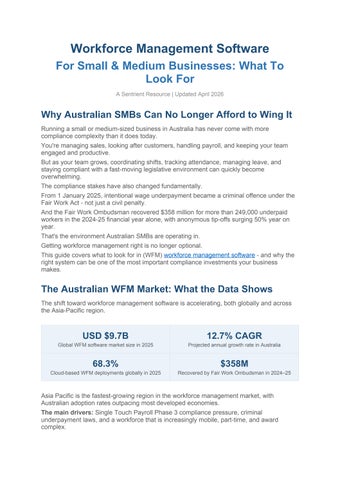
The Australian WFM Market: What the Data Shows The shift toward workforce management software is accelerating, both globally and across the Asia-Pacific region.
USD $9.7B
12.7% CAGR
Global WFM software market size in 2025
Projected annual growth rate in Australia
68.3%
$358M
Cloud-based WFM deployments globally in 2025
Recovered by Fair Work Ombudsman in 2024–25
Asia Pacific is the fastest-growing region in the workforce management market, with Australian adoption rates outpacing most developed economies. The main drivers: Single Touch Payroll Phase 3 compliance pressure, criminal underpayment laws, and a workforce that is increasingly mobile, part-time, and award complex.