Discovering Diverse Content Through Random Scribd Documents
Then an aeroplane flies overhead. Is it German or Belgian? Will it drop bombs? It passes on. And then I am approached by German soldiers, who point revolvers at me, and order me to retire, for in my eagerness I had stepped beyond the Dutch frontier post.
In a still later message he writes:
The Belgians have destroyed several bridges on the light railway from Tongeren to Bilsen.
Several important despatches appeared on Monday, August 10th, giving particulars of the movements of troops during Saturday and Sunday. There were no movements by the Germans for three days. Beyond the range of the forts' fire they rested, recovering strength. The threatened attack along the river Ourthe was suspended. These facts, in the view of the Belgian General Staff, denoted insufficient preparations and showed that the German concentration had not been fully carried out. The situation, in their opinion, gave every assurance that merited punishment would follow the invasion.
Liège was invested by the Germans on Sunday night, but this was expected, and was regarded as unimportant. The forts were known to be ready for further and prolonged resistance, while the foe's stock of projectiles was evidently short. The Belgian field forces, apart from the Liège garrison, were massing in the right directions. The portion of Belgian Luxemburg invaded by the Germans was being cleared of them by the advancing French troops, who marched forward with the greatest speed and energy and got good assistance from a division of Belgian cavalry.
Many trains conveyed more French troops to the front via Brussels. King Albert reviewed and congratulated the triumphant Third Division, which had been keeping the foe at bay at Liège.
Liège city possessed an old disused fortress, which the Belgians blew up to prevent the Germans from availing themselves of it.
It was reported, and afterwards confirmed, that many Bavarians were deserting or refusing service, the idea of fighting peaceful Belgium, whose Queen is a beloved Bavarian princess, being very unpopular.
A Belgian who passed through Rotterdam on Saturday evening said: "I left Liège on Saturday morning, and then the town was still defending itself valiantly. Not one of the forts was then in the hands of the Germans. An armistice of three hours was agreed upon to bury the dead, who lay all around."
The man, who was evidently highly wrought up after the terrible experience of the siege, declined to say more. The German prisoners captured had very few cartridges, from which it was assumed that the Germans had some difficulty in bringing up ammunition and supplies.
How deadly a task the Germans had undertaken in rebuilding the bridge over the Meuse was illustrated by the following telegram sent by the Rotterdamsche Courant's correspondent at Maastricht on Saturday afternoon:
The pontoon bridge built by the Germans was shot away, so that further troops cannot cross. The 90th and 25th German Regiments, which supported the bridge-builders, were mown down by the quick-firing guns. A wounded Belgian was asked how the Germans had fared. He replied in one word, "Annihilated." Those of the wounded who can be transported by rail are to be brought from the hospitals at Maastricht to Alkmaar.
The gallant defence offered by the Belgian garrison was not to pass without suitable recognition. On August 7th, the French President, M. Poincaré, despatched the following telegram from the Elysée to the King of the Belgians:
I am happy to announce to your Majesty that the Government of the Republic has just decorated with the Legion of Honour
the gallant town of Liège. It wishes thus to honour the courageous defenders of the place and the whole Belgian army, with which since this morning the French army has been shedding its blood on the battlefield.
In the view of a very high military authority, the severe check inflicted by the Belgian garrison of Liège on the German VII. Army Corps was of cardinal importance. The German General Staff made no secret of the fact that they looked forward to an easy task in marching through Belgium. An officer in the German War Office recently stated that they counted on the benevolent neutrality of Belgium at worst; and, more probably, the King of the Belgians would range himself on the German side.
Some time ago a military mission, at the Kaiser's invitation, attended manœuvres of special importance near Berlin. In conversation with the senior British officer present the Kaiser said: "I shall sweep through Belgium thus"—and waved his arm in the air. The authority alluded to expressed the opinion that the line of the Meuse could now be held, but that the crucial trial of strength would occur when the main bodies of the two field armies met in the open.
What was of no less interest, as showing the elaborate methods adopted by the Germans for years beforehand, was Dr. E.J. Dillon's account of the Germans in Belgium before and after the outbreak of war. Dr. Dillon telegraphed from Brussels on Sunday, August 9th:
It is a noteworthy fact that during the fierce fighting of the past few days a disproportionately large number of officers as compared with privates were disabled owing to their distinctive uniforms, and among the officers were a disproportionately large percentage of surgeons, whose uniform is still more conspicuous. The War Minister's attention is being drawn to the advisability of rendering the outward marks of rank differences less noticeable at a distance.
The Belgian Government has decided not to proceed to the expulsion of Germans en masse, although the country is infested by spies and agents, who make desperate efforts to reveal and frustrate the plans of the military authorities. In the German Consulate and the German school wireless telegraphy apparatus were discovered. At Antwerp, where the Germans had for years wielded paramount influence, many of them repaid the hospitality shown them with perfidious hostility.
Two sons of the principal German firm in Antwerp, which has been established for over twenty years there, have been arrested on a charge of treason. Even the School of Aviation had trusted a caretaker of German nationality, who has occupied this and similar posts for eighteen years, and was discovered on Friday working the wireless telegraph apparatus. He was arrested, tried, and condemned.
Nowhere in Belgium were the Germans more at home than in Antwerp; nowhere have they proved such relentless enemies to their hosts. When quitting the city on Friday some of them exclaimed, "We are going now, but we will return shortly escorted by troops." The bitterness against Germany in Antwerp is intense, but there and throughout Belgium the German prisoners and wounded are treated with the utmost consideration.
The Germans, who were hospitably received in Holland, fed, and sent home, were not, as the Belgian Press believed, soldiers, but fugitive civilians. Holland has scrupulously discharged her duties as a neutral State.
The Flemish population of Belgium is making heroic sacrifices for the struggle, which has only been begun. The smiling suburbs of Antwerp, with their gardens, lawns, thickets, and luxurious villas, are being disfigured beyond recognition in order to meet the requirements of the military strategists, and the owners look on with grim approval at the destruction of their cherished property.
The narrative of how the neutrality of Luxemburg was violated is interesting. On Sunday morning while I was painfully travelling through Bavaria towards the Rhine the population of Luxemburg awakened to find all the ways of communication in German hands. Everywhere detachments of German soldiers were stationed, but what most astonished the simple-minded citizens was this—that the detachments were commanded by the employés of commercial and industrial firms established in Luxemburg who two days previously had been at their offices as usual.
Now, attired in military uniform, they were at the head of bodies of German troops, leading them through the streets, directing them to places where perquisitions might be made or arrests effected, and giving them the benefit of their admirable knowledge of the town and people.
This they did with noteworthy results. Thus they denounced some 200 Alsatians who had not served in the German army, and who naturally reckoned on a safe asylum in neutral Luxemburg. These unfortunate men were roused from their sleep and spirited away, their appeal for humanitarian treatment being answered by violence or threats.
A German major who was first to cross the Adolf Bridge found his way barred by the Cabinet Minister M. Eyschen, who, having arrived in a motor, turned the car lengthwise across the bridge. Taking out a copy of the Berlin Treaty, he showed it to the German officer, who remarked, "I am acquainted with it, but have orders which I must execute." Immediately afterwards the Grand Duchess Marie Adelaide drove up in an automobile, which she also turned lengthwise across the bridge, saying that the neutrality of Luxemburg must be respected, and that she would telegraph to the Kaiser, whereupon the major curtly answered, "You had better go home quietly."
The commander of the Luxemburg army, Vandyck, came up just then and remonstrated with the German officer, who retorted, "If these are not your methods they are ours," and, putting a revolver to his head, cried, "Clear out!"
Soon afterwards the work of military destruction began, villas and farmhouses being demolished, and thickets cut down for strategic purposes. Terror reigns throughout Luxemburg since then. A farmer with provisions, being stopped and his wagons seized, grumbled. He was arrested, taken before a Court-martial, and has not been heard of since. From Luxemburg to Rodange the fields are devastated, houses razed to the ground, trenches dug, and whoever casts a glance at these is arrested as a spy. In a word, the population of the Grand Duchy is learning the meaning of the words "reign of terror."
Military experts here hold that some days must elapse before important aggressive operations are resumed by the German army. They explain the miscalculation of the invaders as follows:
Germany secretly moved forward about 900,000 men towards the Franco-Belgian and Russian frontiers during the week ending August 2nd, with the object of being able to surprise and overpower the resisting forces at the very outset of the war.
In order to accomplish this stroke, which would have had an immense effect upon the morale of the troops, the men were despatched without adequate provisions or ammunition, on the assumption that they would find the former in the conquered districts, and could await the latter from their own trains of supplies, which would follow shortly afterwards. The reception at Liège upset this reckoning, and explains why the prisoners complained of hunger.
These unexpected reverses, which have given time for the junction of the French and Belgian forces, will now necessitate the definitive concentration of the German army, which includes the second line of another million men, and this operation is at present in full swing. It involves the mobilisation of the Landsturm, or Territorial army, and according to trustworthy private advices received here, the officer commanding the Cologne military district has already called all the men of the Landsturm to arms.
In other words, a tremendous effort will shortly be put forth to burst through the Franco-Belgian barriers of the forts and men, and inundate France with German soldiers.
In view of this mighty tide of armed men and the relatively narrow area through which they must force a passage, it is nowise impossible that they may at the last moment choose a route northwards of Visé, and violate Dutch territory. This eventuality should be borne well in mind by those interested in preparing for it.
One of the curious methods of warfare employed by the Germans is the despatch of Uhlans in groups of six and eight, who ride for miles in advance of the army, enter undefended towns and villages, announce the arrival of the bulk of the troops, and return. It is amazing how far ahead of the army they advance.
On Friday evening they entered Arlon, and were received in silence, but when leaving they heard the report of a revolver in the principal café. Then, turning sharply, they discharged their firearms at the house, and one rushed with pointed lance against a woman sitting at a window. She was wounded mortally.
The municipal authorities, fearing further reprisals, drove out in a motor, with a white flag, found the commanding officer, and tendered their excuses, promising to punish the person guilty of firing.
The organisation of the German espionage was elaborate beyond belief. Large German commercial firms established for many years in Belgium prospered under conditions which rendered competition by Belgians hopeless. They entertained intimate relations with all classes of the population, subscribed handsomely to local charities, wielded great influence in municipal affairs, and were conversant with everything which the German Government was concerned to know.
The secret of their prosperity was a munificent State subvention from the Berlin Government. Each German subject who was in the secret service of the Government had his own work to execute. At Cambria, it is affirmed, a German firm was charged with the work of having the bridge blown up. A Belgian servant discovered and denounced the plot. The authorities shadowed a German merchant day and night, and when at last he drew near the bridge with the requisite explosives the sentinel rushed upon him with the bayonet.
The German military captain Erchard was arrested at Ostend on suspicion. On his person was found a sum of 4,000 francs and a written order, "Remain Ostend observant," also the key to a cipher with which he corresponded with the German staff. After his arrest a letter to him was intercepted from a Belgian offering him important information concerning the plans of national defence. The writer of the letter has also been apprehended. In the ancient synagogue of Antwerp, now used only as a magazine, 3,000 German rifles, carefully wrapped and packed in cases, have been discovered.
For a day or two the main interest shifted from Liège to Alsace, as on Sunday, August 9th, a French force advanced into Alsace and occupied Mülhausen. The men were greeted with unbounded enthusiasm by the inhabitants; but strategic considerations necessitated the evacuation of the town shortly afterwards. Another wing of the French army, however, advanced at the same time into Belgium, and there were several cavalry encounters, of minor importance, on the banks of the Meuse.
Mr. Granville Fortescue, who, as the special representative of The DailyTelegraph, had spent the first two days of the siege in the city of Liège, caught the last train from the besieged city and sent his telegram dated Liège, August 6th, from Brussels. He said:
Last night and early this morning the Germans attacked this city in force. About 11.30 p.m., on hearing heavy cannonading, I
crossed the river by the bridge Fragnée, and took position on the heights to the south of the city. It was full moon.
The German attack was directed against the forts at Fléron, Embourg, and Boncelles. The artillery practice was perfect. Shell after shell was exploded fairly on the ramparts of the forts. The return fire of the Belgians I could not judge for effectiveness, as the German gun positions were admirably concealed. The rough nature of the country and the darkness favoured the attackers. In my opinion no siege guns were in action. The Germans used a high explosive shell that burst with extraordinary vividness.
About three a.m. infantry fire broke out in the woods west of the River Ourthe, between Embourg and Boncelles. It was impossible to distinguish anything except the flashes of the rifles. About this time I heard infantry fire in the west. The country in the vicinity of the forts has not been cleared, and evidently only hastily fortified.
The Belgian infantry, 9th and 14th Line Regiments, held the country between the forts Fléron, Embourg, and Boncelles. The 9th Regiment bore the brunt of the attack, which was repulsed along the line.
With the first rays of daylight, about four a.m., I was able to make out the troops of the German line of battle.
They were fighting in close order. I could not believe I was watching the first line, as this seemed to me to be a return to old-fashioned tactics. But there could be no doubt as to their formation. The engagement attained its fiercest stage about five a.m. About this time the fort at Fléron was silenced. I was afterwards told that the German fire had smashed much of the machinery of the disappearing gun carriages.
Small parties of German cavalry could be seen in the intervals between the infantry battalions. But there was no attempt at a cavalry attack.
Towards eight o'clock there was a lull in the attack. The accidental nature of the country to the south favoured the concealment of the Germans. I would not attempt to estimate closely their force at this point. It might have been a division. They were occupying the intervals between the fortresses, and had as their objective the bridges south of the city.
The attack was checked all along the line. Battalion after battalion was thrown back by the Belgians, whose 9th Regiment of the Line fought like demons.
My own adventures were many and varied. The most stirring was when I was held up by a lancer, who kept his revolver pointed at the pit of my stomach while I explained that I was not a German. Four times I was arrested and brought before the authorities. When I got back into the town the crowd that swarmed on the streets would one minute surround me and threaten me as a German, and the next loudly acclaim me as the first of the arriving English.
That was the question in every mouth. "When would the English come?" The whereabouts of the French was another topic eagerly discussed by the mob.
Panic-stricken refugees came hurrying in during the morning, and continued throughout the day to flood the city. Wherever they could find listeners, which was easy, they would tell the story of their night's experiences. One woman with her two daughters had spent the whole night in the cellar of their home. A shell had exploded in the kitchen. Had any of her family been injured? someone asked.
"Yes, monsieur, the poor cat was dead." A stout gentleman, with a pointed grey beard was inconsolable because his "collection of little birds" had been left behind at the mercy of the Germans.
This influx of frightened outsiders had a very baleful effect on the people of Liège itself. Naturally the discussion of the number of killed and wounded on both sides was the principal topic.
Motors carrying wounded soon began to arrive. These stopped before the hotels or establishments which had been turned into improvised hospitals. "Fifteen beds ready," "Ten beds for wounded here," were signs posted on the doors of many houses.
The news was soon current in the city that the fighting had ceased for the moment. There was to be a conference with the Germans.
The Palace of Liège was now the centre of attraction. "The Germans demanded the immediate surrender of the forts and the city." "The Belgians had asked for twenty-four hours in which to consider this proposal." "The Germans refused, and threatened to bombard the city at once." These and a dozen other rumours ran through the crowds.
Suddenly a loud explosion set every heart thumping. "Had the bombardment commenced?" "No, the Belgian engineers had blown up the arches of the bridge."
But as the afternoon wore on it became known that the Belgian commanders had refused to give up the city. The bombardment was to begin at six p.m. That was the last word I got.
The last train out of the city was crowded with refugees fleeing with such little property as they could gather together. The scenes were pitiful in the extreme when the train pulled out. Never can one forget the expression of those left behind.
And the scenes in the train!
I carried a woman who must have been between eighty-five and ninety years old up the step of the vehicle and to a rude bench in a third-class carriage. A Sister of Mercy was her only attendant. Before we were half-way to Brussels a priest had given her extreme unction. Opposite me sits a man with four five-week old puppies and the mother in his lap. In the next car are herded a score of German prisoners. The helmets covered with cloth. The insignia gone.
In order to understand the attack which the Belgians so gallantly repulsed during the early hours of the morning it is necessary to have some idea of the country south of Liège.
The most remarkable feature of the terrain is the sharp rise of the hills south of the River Meuse. From the flat banks of the stream the land rises at an angle of fifteen degrees until it reaches 300 feet. These figures are my estimation. The country is wooded and rough.
From a military point of view the section to the south and west of where the River Ourthe joins the Meuse is extremely important. In the first place, the Meuse is crossed here by two bridges, one railway and the other a splendid masonry road bridge built to commemorate the Liège Exposition. This latter is called sometimes the Pont de Fragnée and sometimes the Exposition Bridge. The Pont du Val-Benoit is the name of the railway bridge. The Exposition Bridge has been mined ready for destruction. I could not get a chance to examine the railway bridge. The railways from Hervé and Verviers enter the city over this crossing. As it is certain that the main German force is coming over these lines of communication, the capture of the bridges must be their first object.
The angle between the Rivers Ourthe and Meuse is a flat plain. Besides the railway junction, the angle is occupied by the electric lighting plant, a smelting works, and a gun and small arms factory. These were all in full blast during the day. A coal mine was also being operated.
In addition to these plants, whose value to an invading army is beyond estimation, a force holding the hills to the south would have the city at its mercy. Again, there is another railway running to Namur. So if the Germans are to get anywhere near their second objective this line of communication must be taken.
Nothing could be superior to the resistance put up by the Belgian army to the attacks made between Embourg and
Boncelles. The 9th and 14th Regiments of the Line not only checked the advancing Germans, but actually threw them back. The Belgians were greatly helped by the fact that the enemy advanced in close order. Battalion after battalion of Germans were thrown into the fight in solid formation. It is small wonder that they were decimated. However, the estimated number of killed and wounded on their side is certainly exaggerated. Rumour puts it at 25,000. At the assault of Port Arthur where I saw the Japanese swarm up the forts at Ban Ju San, and where there were 400 pieces of artillery in action, the losses from August 16th to the 21st totalled 16,000 on the Japanese side. While the Belgians have inflicted the severest kind of repulse, yet I cannot believe that the enemy's casualties reach the figures given. Still, they have been heavy enough to make them ask for an armistice of twenty-four hours.
The Belgian troops engaged are the 3rd Division and 15th Mixed Brigade. The Germans are reported as the 7th, 9th, and 10th Corps under General von Emmich. The detachments of Germans captured which I have seen have all been cavalry. They are mostly boys of from eighteen to twenty-four years old. Their grey uniforms are stripped of all insignia, and they have covered their helmets with grey drill. In justice to the attacking force, I must say that their artillery practice was excellent. This fact only adds to the credit of the Belgian defence.
In all honour to the work done by the army, the spirit of the citizens of Liège also merits the highest praise. It takes courage to sit still under a bombardment. And this is what the civilians have had to do. Their courage was also tested to the utmost by the stories of murder and rapine told by the panic-stricken refugees coming in from the outlying towns. Fortunately, so far, the German shells have done little harm to the city proper. Yet it seems contrary to the spirit of our boasted civilisation that the rules of war permit an enemy to drop projectiles among women and children. Liège is a fortified town, and under this classification it is liable to artillery attack without notice.
In a subsequent despatch Mr. Fortescue emphasised the fact that the dogged resistance of the Belgians had been of the highest military importance for two reasons: in the first place, it had given France time to complete her mobilisation; and, in the second, it had given the British army time to mobilise and to begin its landing on the Continent.
At noon on August 11th, the Press Bureau issued a statement showing, interalia, the disposition of the German forces at Liège, so far as they were known. The statement said that about two German cavalry divisions were reported in the neighbourhood of Tongres; three German corps were still opposite Liège; other German troops were reported to be entrenching the line of the River Aisne.
The large German force was moving through Luxemburg, and the advanced troops were now on the Belgian frontier.
CHAPTER III
PRELIMINARY ATROCITIES—BRAVERY OF THE BELGIANS—BATTLE OF HAELEN-DIEST
At this stage of the fighting numerous circumstantial stories of German atrocities began to filter through, though for various reasons large portions of them were deleted by the Censors. They were generally summed up in an official statement by the Belgian Government which is quoted in a subsequent chapter. Dr. Dillon, telegraphing on August 11th, asserted that it was still impossible to throw any light upon the military operations, which might culminate on Thursday or Friday in a terrific collision between the forces of disruption and those of civilisation. Never before, not even during the Japanese campaign against Russia, had the movements of an army been shrouded in such impenetrable mystery. Considering the number, audacity, and ingenuity of the German agents still in Belgium, these precautions were indispensable. Anyhow, the War Office, the only source of intelligence, contented itself with a brief
assurance that the news was satisfactory, or that there was no news of importance to communicate. Concrete facts were learnt mostly from Paris or Holland.
Another fact which was beginning to dawn upon the public was that the heroic resistance of the Belgian army had been offered hitherto to covering troops only, and that the enemy's losses did not exceed 5,000, although three German army corps had been thoroughly beaten. It was believed in Brussels that the hostile main armies would be ready any time after Wednesday night, August 12th. On the 11th several detachments of German covering troops were sent forward to the Belgian advanced posts as feelers. The Belgians when possible concealed themselves in thickets or in fields, and captured a considerable number of the invaders.
One Belgian lancer, named Bogaerts, deserves especial mention. His habit was to sally forth alone, lance in poise, and dash forward against the Uhlans, one of whom he generally killed or wounded, whereupon the remainder gave themselves up. In this way he took fourteen prisoners, wounded several Uhlans, and killed three, without suffering the slightest injury.
Encounters became frequent in the district stretching from Liège to Tongres, Hannut, and Tirlemont, whither two divisions succeeded in penetrating on the 11th.
Already the airships of the different combatants were floating gracefully into the visual range of the Brussels population, but at such a height that one could only conjecture the nationality of each; and the authorities warned the public neither to fear nor attack the Uhlans.
Anxiety respecting Holland's neutrality was not yet wholly dispelled. Nobody doubted the firm resolve of the Dutch Government to maintain its right to hold aloof from the war, but certain misgivings were entertained as to the adequacy of the troops stationed in the district where the violation of territory by the Germans was most probable. Some months previously Dutch Limburg, possessing only a
few squadrons of cavalry, was practically defenceless. Since then a number of infantry battalions were stationed along the frontier from Maastricht to Venloo, together with several companies of the local Landwehr. If, as many military men believed, these troops were the only obstacle to a German advance in Holland, they constituted an inducement rather than a deterrent, it was thought.
German spies and secret agents were still numerous and audacious. Ten days before the declaration of war all trees near the sources of water in the forest of Soignes, outside Brussels, had notices posted up in German, with the words, "Potable water." The Mayor of Brussels had these placards removed, but they were afterwards found posted up anew. On August 12th when a representative of TheDailyTelegraphwas leaving the American Legation, he saw two municipal guards arresting a lady, whom they politely conducted to the police-station. His chauffeur cried, "That's no lady. He is a German spy." A couple of men hearing this rushed up and attempted to maltreat the prisoner, but the guards protected their charge effectually. At the station the prisoner, who looked quite collected, was found to be a male German agent possessed of apparatus for cutting telegraph wires and also of compromising documents. Belgian treatment of Germans, said the correspondent, whether civilians or prisoners, erred on side of humanitarianism if it erred at all.
On the night of August 12th the Press Bureau stated:
Of the twenty-six German army corps the bulk have now been definitely located, and it is evident that the mass of the German troops are concentrated between Liège and Luxemburg.
The number known to be on the Western side proves that in the Eastern theatre of war the frontier, as far as Germany is concerned, is comparatively lightly guarded, unless by reserve troops.
At this time, beyond some unimportant outpost fighting near Liège, the position in Belgium was quiet. "A sense of stagnation," as Dr.
Dillon expressed it, was creeping over the public. Of the troops massing behind the various cavalry covers, of the enemy's numbers, whereabouts, and plans, nobody but the General Staff knew anything. The vaguest of conjectures were the sole substitute for knowledge. Some held that the Germans, disheartened by their failure to traverse Belgium in three days and by the severe defeat of three army corps, were preparing for the defensive. This view, taken in official circles, was borne out by the circumstance that they were entrenching themselves on the River Ourthe, employing the peasants to make routes in the south of the province of Liège and in Luxemburg, bringing up fresh troops for the reinforcement of the line Maestricht-Liège, and withdrawing most of their covering cavalry regiments.
Passing from the region of conjecture to that of fact, it was soon learnt that the enemy's cavalry which advanced on Monday into Belgium to see how the land lay threw out feelers from Hannut and Saint Trond towards Tirlemont, Hougaerde, and Jodoigne. They
came with artillery and machine guns, occupied Landen, Neerwinden, Pellaines, and other places, burning houses and hayricks as they passed. A regiment of Belgian lancers met them at Dormael, where a sharp encounter gave a momentary advantage to the defenders, whom the German artillery, which was opened shortly afterwards, forced to retire.
The Germans then proceeded to shoot seven inmates of the houses on an unproved charge of firing. They also burned the houses of the village of Orsmael, and shot three brothers, peasants, on a like allegation.
Universal execration followed the German troops in Belgium, where all observers were unanimous in accusing them of cruelty towards civilians, unwarranted by the attitude of the population and forbidden by the rules of war. Wherever they tarried peaceful inhabitants were shot down on charges which were emphatically denied by their neighbours. At Dormael a Uhlan, seeing a priest go forward to administer the last sacraments to the agonising wounded, cut him down as if he too were a combatant.
Having compelled the Belgian lancers to retire from Dormael, the German cavalry advanced in the direction of Tirlemont to the number of about 2,000. Arriving at Bost, which is a mile from Tirlemont, they found their further advance barred by Belgian infantry, whereupon they fell back upon Saint Trond and Waremme.
The Belgian troops did not begin the pursuit of the enemy's cavalry until August 11th, when they drove it beyond Waremme.
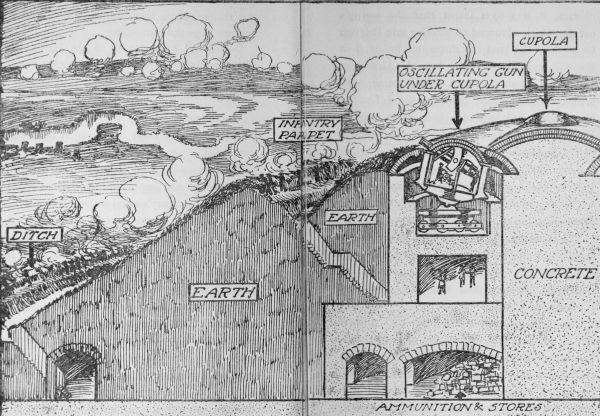
Liège became a new centre of an artillery action, both offensive and defensive. The Germans pounded away at the forts, their shells exploding on the cupolas and around these, while the forts responded with vigour unimpaired. Meanwhile the invaders began to construct a pontoon over the Meuse at Lixhe, for troops and trains of ammunition and provisions. It was believed that they were also preparing to cross the river above Liège, for they were forwarding heavy war material in the direction of Engis.
Meanwhile, the French cavalry showed themselves to the population of Brussels, who gave them a warm ovation.
The second general engagement in the struggle for the possession of the Liège forts took place on Wednesday, August 12th, and lasted until the early morning of the 13th. The Germans attempted a "reconnaissance in force," and attacked the Belgian army at two points.
Again, however, the Belgian soldier proved more than a match for the most highly trained troops of the Kaiser. The reconnaissance in force failed utterly. Two of their finest cavalry divisions and two regiments of Jaegers suffered heavy losses in killed, wounded, and prisoners.
The attack was made at two points, one to the north of Namur and the other near Diest, which is a railway junction. About ten in the morning cavalry patrols reported the advance of the enemy towards Haelen, a village about three miles south of Diest. At the head of the force rode the famous 17th Dragoons; behind them marched a regiment of Jaegers with a battery of artillery and machine-guns. Belgian carbineers awaited them at Zelck and succeeded in checking the advance until they could retire on Haelen, which was formerly a fortress.
With reckless courage the Dragoons galloped into what was an armed cul de sac. In front of them was a battery on the mound of the fort, and the road was trenched and barricaded. The Belgians opened fire from buildings which had been loopholed to meet an attack from that quarter. Under cover of artillery fire and aided by machine-guns the cavalry attempted to carry the position by assault. It was an enterprise that did more credit to the courage than to the judgment of the German soldier.
Mr. William Maxwell, who communicated these facts, added:
At manœuvres in Germany some years ago I remember the Kaiser asking Sir Ian Hamilton what he thought of the infantry formation. Sir Ian ventured to suggest that the formation was too dense. Whereupon the Emperor rebuked him with these words: "Half of those men would be killed, but we can afford to lose them." The cavalry seem to act on this principle. Without a pause they rode upon the barricade, which they attempted to leap. I counted seven dead horses close to the barricade, while others lay writhing a hundred yards off, bearing testimony to the bravery of two-score men who now lie side by side awaiting burial. So stout was the resistance of the 700 Belgians who held this position against a division of cavalry and a regiment of infantry that the enemy soon found it prudent to withdraw. Not allowed to retire unmolested, though pursuit beyond Zelck would have been folly, they left behind about forty dead, many wounded, and 300 prisoners.
It was remarkable, according to the accounts of eye-witnesses, how readily some of these brave men surrendered. One Belgian officer captured three officers. The first question they asked was, "What is England doing?" They were evidently ignorant that England had declared war. Their second question was, "What of our fleet?" The wounded were treated not only with skill and kindness, but even luxury.
The object of this raid was to feel the nature and strength of the opposing force, and, if possible, to capture points on the railway as well as to threaten the capital in order to strike terror—a phrase so often on the lips of their War Lord—into the heart of the people.
A more detailed version of the Haelen-Diest fight on the road to Louvain says that the encounter lasted all day. The Germans were supported by a battery of artillery. The Belgian field forces fought desperately, and Lieutenant Van Doren even enlisted the Diest fire brigade against the enemy, whose loss in killed, wounded, and prisoners was comparatively heavy.
Many of the prisoners were fainting, and the horses were dying from hunger. The German attacking party had probably been detached from the Liège right wing for an audacious raid on Louvain and Brussels.
Further details about the Haelen-Diest combat showed that the German losses must have approached 3,000.
The action, when the German mitrailleuses (machine-guns) were captured, took place north of Eghezée, on the road from Liège to Namur. Of course, the main German forces continued to be arrested before Liège, but they sent forth detachments in every direction to make believe that they had carried everything before them in their rear and to create popular panics. Each of these detachments was gradually beaten in its turn, and this slowly weakened the large forces intended for the great general battle, and estimated at about seven army corps, or about 250,000 men.
The following official statement was issued at Brussels on Thursday, August 13th:
The victory gained by the Belgian troops yesterday is now officially confirmed. The Belgian troops engaged were only one cavalry division and a brigade of all arms. The German losses were very heavy, and it is believed that about three-fifths of the enemy engaged was put out of action. The Belgian losses were relatively slight, only a few men being killed.
The Belgian cavalry division this morning took up the offensive against yesterday's defeated troops, in order, it is believed, to pick up the dead and wounded and to collect the abandoned war material. No German surprise is expected.
Another encounter took place this morning in the south with the German troops reported yesterday to be marching towards Eghezée. These were attacked by our troops and repulsed with very heavy losses. We captured a number of machine guns mounted on motor-cars.
There is no reason to fear any German cavalry movement on Brussels from the south, all roads to the capital being guarded by the army and by the Garde Civique.
The military situation at the time was summed up as follows by Mr. E. Ashmead-Bartlett, TheDailyTelegraph'smilitary expert:
Every single account of conversations with wounded German soldiers or prisoners serves to show that the rank and file of the German army have not the smallest idea for what they are fighting, and that all profess not to have the smallest desire to invade either France or Belgium. In the war of 1870, the situations were reversed. Every German knew that the future of his country as a world Power depended on victory, and all marched to the front with a determination to conquer or to die. The French, on the other hand, had no idea for what they were fighting, and their purely professional army left for the war amidst vague cries of "À Berlin!" buoyed up by no moral principle. These factors must bear a very far-reaching effect on the eventual outcome of the campaign.
In a recent journey through France, I noticed nothing so remarkable as the intense seriousness of the people. Frenchmen will tell you there has been nothing like it since the Revolutionary wars, prior to the Napoleonic epoch, when the levée en masse crushed the invader at Valmy and Jemappes. The French have entered into this struggle through no love of fighting, but because they know their existence as an independent nation is at stake. One other fact must also be noted before the chances of the opposing armies are examined. In 1870 the French regular army, which should have had a peace strength of 400,000 men, only numbered 270,000, whereas the Germans, at the very start of the campaign, stood at a total war strength of over 1,200,000 men.
This inequality no longer exists. On paper Germany has a considerable superiority of numbers, namely twenty-five army
corps against twenty-one, and her reserves are probably more numerous and better organised than those of the French. On the other hand, she is, according to the most reliable information, keeping four corps on the Russian frontier, and, therefore, the numbers available against France should certainly not show any superiority, and will probably show an inferiority when the Belgian and British armies are united along the line of the Meuse. For years German strategists have reckoned on having to fight both France and Russia at the same time, and they have professed themselves as being confident of undertaking such a gigantic task. Four corps especially trained under Von der Goltz to fight in more open formations were to hold the Russians, whilst the remaining twenty-one were to be flung with such rapidity against France as to obtain a decisive success before Russian intervention could make itself seriously felt.
It is one thing to have twenty-one army corps ready to invade France, and quite another to find a suitable front on which to deploy them for such an invasion. All the time-honoured old routes for the invasion of France are practically closed to modern armies by the chain of fortresses which the French have constructed, and, vice versa, the old roads to Germany are closed to a French invasion. Therefore, French, German, and Belgian strategists have long recognised that the only route by which a modern German army could invade France and march on Paris would be via Belgium, and that declarations of neutrality would count but little in the strategic scale. It was to resist such a menace that the Belgians constructed two fortified camps at Liège and Namur. The old routes of 1870 present too many formidable obstacles to be overcome. A direct advance into France from Alsace would have found itself faced by the fortified front Belfort-Epinal-Toul, and Verdun, four formidable fortified camps, supported by forts on the heights overlooking the Moselle and Meuse.
Welcome to our website – the perfect destination for book lovers and knowledge seekers. We believe that every book holds a new world, offering opportunities for learning, discovery, and personal growth. That’s why we are dedicated to bringing you a diverse collection of books, ranging from classic literature and specialized publications to self-development guides and children's books.
More than just a book-buying platform, we strive to be a bridge connecting you with timeless cultural and intellectual values. With an elegant, user-friendly interface and a smart search system, you can quickly find the books that best suit your interests. Additionally, our special promotions and home delivery services help you save time and fully enjoy the joy of reading.
Join us on a journey of knowledge exploration, passion nurturing, and personal growth every day!