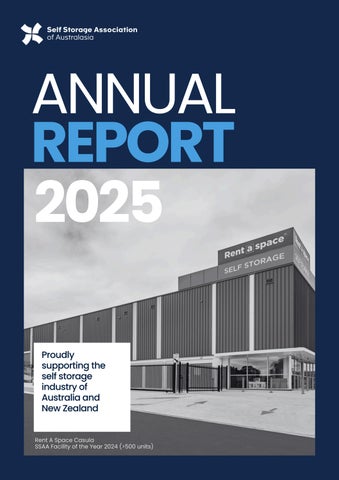
FINAL_ Annual Report FY25

Page 1


AboutUs

TheSSAArepresentsmorethan60%ofselfstorageproviders acrossAustralasia,servicingover900membersand their1,500selfstoragefacilities.

Foundedbyasmallyetpassionategroupoffacilityownersin 1990,theSSAAhasevolvedintotheprofessionalpeakbodyfor theselfstoragesector,providingeducation,advocacyand supportforitsmembers

SwiftStorageYeppoon SSAAFacilityoftheYear2024 (<150units)

TheYear inReview

Advocacy

FY25sawadvocacyandregulatory engagementatthetopoftheagenda. In2024,theSSAAwasapproachedbythe AustralianCompetitionandConsumer Commission(ACCC)aspartofareview intotheselfstoragesector.Wewelcomed theopportunitytoworkcollaborativelywith theregulator,addressingmattersatan industrylevelinthespiritofgood governanceandwithacommitmentto continuallyliftingstandards

TheinsightssharedbytheACCCprovided avaluableopportunitytoimproveclarity, communication,andcustomerexperience acrosskeyareasofselfstorageoperations. Amajoroutcomeofthisprocesswasthe releaseofthe2025SelfStorageAgreement Suite-anupdatedversionforAustraliaand anewstandardforNewZealand.

Engagement

Industryengagementbetweenmembers andsupplierswasatanalltimehighthis year GC24brokerecordsas420 selfstorageenthusiastsdescendedupon SurfersParadiseoverthreedynamicdays. Industryleadersgatheredtoexplorethe themesofinnovation,elevationand integrationthroughkeynotes,panelsand hands-oninsights.

ThebiennialSkiSummitinQueenstown sawAussiesandKiwiscometogetheron theslopesforafewdaysoffocused

presentationsandinspiringkeynotes,with plentyoftimefornetworkingoveradropof NewZealand'sfinest

Toroundouttheyear,wehostedfour sell-outnetworkingeventsandfacilitytours acrossAuckland,Adelaide,Brisbaneand Melbourne,bringinglocaloperatorsand supplierstogethertoshareideas

Intelligence

Industryintelligenceremainsacriticalpillar fortheSSAA.DevelopmentofStorIntel-an industry-ownedplatform-hasprogressed, withalaunchanticipatedinthefirsthalfof 2026.StorIntel,deliveredincollaboration withtheQueenslandUniversityof Technology(QUT)andtheBuilding40CRC, willequipmemberswithdeeperinsights intomarkettrends,operationalbenchmarks andemergingopportunities

QUThasalsocontributedtothe developmentoftheSSAAAI-ChatBot, designedtoenhancethememberportal experienceandimproveresponsetimes. TheChatBotwillalsodriveefficiencies throughautomationandreducethe Association’senquiry-basedworkload.

TheSSAA’spurpose-builtdatabase, StorerCheck,hasexpandeditsreporting capabilitiesandnowcapturesFacility Incidentreporting Thisenhancementallows incidentstoberecordedandsharedatthe facilitylevel-ratherthanonlybyindividual storer-helpingoperatorsstayaheadof emergingrisks

Resources

Memberresourcesremainthebackboneof ourofferingandthisyearwecontinuedour effortstosupportmembersinoperational efficiency.

InAprilwelaunchedamonthlywebinar series,SSAAUnlocked.Theprogram,which hasbeenwellreceived,isdesignedtoequip operatorswiththeknowledgeandtools theyneedtomanageriskandenhance operationalperformance

Ourmemberportalhasalsocontinuedto expandinresponsetobothregulatory changeandevolvingoperatorneeds In FY25,wereleasedacomprehensiveArrears ManagementGuide,newBatteryGuidelines andupdatedFacilityRulestofurther supportday-to-dayfacilitymanagement

TheSSAAteamisproudtohavedelivered animpactfulprogramofworkformembers overthefinancialyear Manyofthe investmentsmadeinFY25willcontinueto benefitmemberswellintothefuture. Importantlytheseachievementshaveall beendeliveredwhilecontinuingto strengthenthefinancialsustainabilityof yourAssociation.

Theseachievementswouldnotbepossible withoutthesupportofourindustry. Inparticular,weacknowledgethe investmentandcontributionofour dedicateddirectors,PrincipalPartnerJanus InternationalAustralia,allourMajorPartners andourdedicatedSSAAteamfortheir significantcontributionacrosstheyear.

Mostimportantly,wethankourmembersYourcontinuedsupportallowsustobuilda strongerfuturefortheselfstoragesector.

Yourssincerely,

Governance

TheSSAAcontinuestobenefitfromthe expertiseofindustryleaders,independent advisorsandoperationalspecialistswho serveonitsBoardandCommittees Their guidanceandoversightwerepivotal throughoutFY25,particularlyinprogressing the2023–2025SSAAStrategicDirectionand advancingdevelopmentofthenewSelf StorageAgreementSuites.

AttheAnnualGeneralMeeting,Thomas Whalanwasre-electedasLargeOperator Representativeandwillserveafurther three-yearterm

TheBoardandtheAudit,Finance&Risk CommitteeeachmetfourtimesinFY25 ensuringeffectivegovernanceand oversight.TheBoardheldanadditional workshopinNovemberatGC24.TheAudit, Finance&RiskCommitteecontinuesto meetandoverseetheAssociation’sstrong financialperformance.

Regulatoryengagementremainedakey focusfortheBoard In2024,theACCC approachedtheSSAAaspartofitsreview intotheselfstoragesector,highlightingthe importanceofmaintainingstrong advocacyandcomplianceframeworks. WiththeBoard’ssupport,theAssociation securedapositiveoutcomeformembers

InFY25theSSAAexecutedacontractforthe saleofitsBundooraofficeinMelbournefor $840,000(excludingGST),withsettlement anticipatedinFY26.

Followingamovetoremoteworkingin2021 theSSAAsub-lettheofficespace, generating$26,000annuallyinrental income TheBoarddeterminedtheoffice wassurplustoSSAA'sneedsandinlightof marketconditions,proceededtosale.The Boardwillundertakeaninvestment strategyrefreshaheadofsettlement,to ensurefundsaremanagedforlong-term benefit.

Financials

TotalRevenueforFY25increasedby1363% This relativeincreaseinrevenuecanbeattributedto theincreaseinConventionIncomegrowth.

Expensesincreasedby793%,demonstrating prudentialfinancialmanagement.

Netassetsgrewby708%reflectingtheNetProfit for2025.

Asanon-profitentity,theSSAAseekstoinvestthe majorityofavailablefundsintoprojectsand servicesforthebenefitofmembers.Aprofitof $144,580hasbeenretainedforfuture requirements

Membership

TheSSAAhad901membersat30June2025 (FY24:890)representing1511facilities(FY24: 1440)acrossAustralasia.Thisrepresentsan increaseinmembershipof1.24%onFY24, despiteongoingindustryconsolidation

DuringFY25,SSAAwelcomed120new membersandincreaseditssupplier membershipby125%

COUNTRYOFORIGIN

AUMembers (FY24:87%)

NZMembers (FY24:13%)

ENGAGEMENT

AcrossFY25,69membersresignedand 50lettheirmembershiplapse (uncontactable/nopayment).

MemberBenefits

FY25sawthedeliveryofnewresources,eventsandservicesdesignedtostrengthenmember success Somehighlightsincluded:

Respondedtomorethan1,260member enquiriesbyphoneandover360via theSSAAHelpDesk,providingtimely legalandoperationalsupport.

Facilitatedmorethan162kchecksand reportedover1,260newincidents throughStorerCheck,strengthening industrysecurityandtransparency

Advocatedonbehalfofmembersand industrythroughongoingengagement withtheACCC.

Releasedthe2025updatedAUand newNZSelfStorageAgreementSuites toensurecompliancewiththelatest industrystandards.

Connected222localowners,operators, andsuppliersacrossfourcitiesthrough networkingeventsandfacilitytours.

DeliveredourlargestConventionto date,welcoming420delegatesto GC24and74atourSkiSummitinNew Zealand.

WorkedincollaborationwithQUTand theBuilding40CRCtoprogress StorIntelindustryintelligenceplatform.

Monitoredsectorperformanceand deliveredcriticalmarketintelligence throughtheStateoftheIndustry2024

ExpandedStorerCheck’sreporting capabilitiestoincludefacility-level insights

Publishedthelatestindustrynewsand thoughtleadershipthroughsixeditions ofInsiderMagazine,11issuesof STOReFLASHandregularblogposts

Bolsteredindustryresourcesandtools withthereleaseofBatteryGuidelines, updatedfacilityrulesanda comprehensiveArrearsManagement Guide.

LaunchedSSAAUnlocked,awebinar seriesdesignedtoequipoperators withthetoolstheyneedtomanage risk,driveoperationalefficiencyand upholdbestpractice

DesignedaChatBottoimproveuser experienceinthememberportaland reduceenquiry-basedworkload.

OurStrategy

Weadvocatefortheindustryatlargeand onbehalfofourmembers.

Keypriorities:

Deliveringaccurateandtimelyindustry researchandinsights

Informindustrystakeholdersaboutthe profileandpotentialofselfstorage

Tracksectorperformanceandkey industrymetrics

Focusouradvocacyagendaonhigh impactissues

Wesupportourmembersbysharing knowledge,resourcesandinsights

Keypriorities:

Enhanceindustryunderstandingofself storageoperations

Offertimelyandaccuratelegaland operationalsupport

Embedgoodgovernancepractices acrosstheindustry

Helpourmembersadapttoindustry innovation

Created by the industry for the industry, the SSAA exists to help members’ businesses thrive by providing advocacy, education and support. As the peak body for the sector, the SSAA seeks to inspire excellence and engagement across the self storage industry.

Weworktoconnect,nurtureand developtheselfstorageindustry.

Keypriorities:

Creatingvalueforourmembers throughregularengagement

Connectourmembersand stakeholderstobuildandmaintain industryrelationships

Communicateeffectivelytoensure membersarewell-informed

Consultwithourmembersto providerelevantservices,resources andadvice

LookingForward

Intheyearaheadwewillseethelaunchof severalkeyprojectsalreadyinthepipeline, includingStorIntelandtheSSAAChatBot

Anumberofflagshipeventsareonthe horizonwithengagementamongmembers andsuppliersatanalltimehigh

Welookforwardtodeliveringourinaugural SelfStorageWeekatSYD25thissummer, followedbythebiennialSSAASummitinNew ZealandnextWinter-pluswe'replanningto takeSSAAmembersontourtointernational eventsacrosstheyear

OurrecentTrans-Tasmannetworkingseries andfacilitytourswereverywellreceived, andweplantotakethisprogramonthe roadagainnextyear.

Thetimelydeliveryofresearch,resources andtoolsdesignedtosupportoperatorswill continuetodriveourannualprogram.

The2025SSAAIndustrySnapshotwillexplore high-impactissuessuchascrimeand security,whilemaintainingastrongfocuson technologyandinnovationtosupport operationalexcellenceandgrowth

AdvocacywillremaincentraltotheSSAA’s mission,withcontinuedemphasison navigatingtheevolvingandincreasingly complexlandscapeofdevelopmentand compliance

Yourassociationiswellplacedandwell resourcedtocontinueitssupportand stewardshipofselfstorageacross Australasia

The SSAA acknowledges the ongoing support of industry, including principal partner Janus International Australia andmajorpartnersVISYBoxes&More, Southwell Lifts & Hoists, Storman, Storco, Stellar Storage Containers and PTI Security, Convention sponsors, advertisers and all those who contributed their expertise for the benefit of members throughout the year.

Self Storage Association of Australasia Limited

ABN 23 050 341 725

Financial report

For the year ended 30 June 2025

Self Storage Association of Australasia Limited

DIRECTORS’ REPORT FOR THE YEAR ENDED 30 JUNE 2025

Your directors present their report on the Company for the financial year ended 30 June 2025 Directors

Directors have been in office since the start of the financial year to the date of this report unless otherwise stated The details of the directors in office at any time during, or since the end of, the year are:

Michael Alafaci

Title Director and Chairman

Experience 19 years of experience in the self-storage industry

Edward Coten

Title Director

Experience 20 years of experience in the self-storage industry

Thomas Whalan

Title Director

Experience 13 years of experience in the self-storage industry

Aaron Alsweiler

Title Director

Experience 23 years of experience in the self-storage industry

Adrian Wylde

Title Director

Experience 14 years of experience in the self-storage industry

Anthony Regis

Title Director

Experience 23 years of experience in the self-storage industry

Brent Hayes

Title Director

Experience 17 years of experience in the self-storage industry

Sam Kennard

Title Director

Experience 34 years of experience in the self-storage industry

Elizabeth Rutland

Title Director

Experience 22 years of experience in the self-storage industry

Company Secretary

The following persons held the position of company secretary at the end of the financial year:

Makala Castelli

Principal Activities

The principal activities of the Self Storage Association of Australasia Limited during the financial year were providing education, advocacy and support to help members improve their businesses.

No significant change in the nature of these activities occurred during the year.

Self Storage Association of Australasia Limited

DIRECTORS’ REPORT FOR THE YEAR ENDED 30 JUNE

2025

Meetings of Directors

During the financial year, 4 meetings of directors (including committees of directors) were held. Attendances by each director during the year were as follows:

Review of Operations

During the year, the Company continued to engage in its principal activity, the results of which are disclosed in the attached financial statements.

The profit after income tax of the Company for the financial year ended 30 June 2025 amounted to $144,580 (2024: $22,937).

Objectives

The Company's objective is to:

• Promote excellence and high standards of service in the self storage industry and associated businesses, by its members and the industry generally;

• Support members through facilitating information exchange, advocacy to government and regulatory bodies, education, and member benefits and services; and

• Engage members through events and other activities, and foster a strong, supportive network of like-minded businesses.

Strategy

To achieve these objectives, the Company has adopted the following strategies:

Advocacy: undertake a range of research, insights and advocacy projects on behalf of members.

Support: develop and deliver a range of member benefits, services and education programs that support our members and promote operational excellence.

Engagement: deliver a communications and events program that engages and connects our members and the broader industry.

Performance Measures

The following measures are used within the Company to monitor performance:

• The CEO provided regular reports to Directors regarding the activities of the Company and how tasks undertaken by the Company's administrative team contributed to the effective delivery of core services to members. This process allowed Directors to ensure that activities undertaken by staff were supportive of the timely attainment of the Company's strategic and financial objectives

Self Storage Association of Australasia Limited

ABN 23 050 341 725

DIRECTORS’ REPORT FOR THE YEAR ENDED 30 JUNE 2025

Members’ Guarantee

Self Storage Association of Australasia Limited is a Company limited by guarantee. In the event of, and for the purpose of winding up of the Company, the amount capable of being called up from each member in the year prior to the winding up, is limited to $50, subject to the provisions of the company's constitution.

At 30 June 2025 the collective liability of members was $75,550 (2024: $71,900).

Significant Changes in the State of Affairs

No significant changes in the Company’s state of affairs occurred during the financial year.

Events Subsequent to the End of the Reporting Period

No matters or circumstances have arisen since the end of the financial year that significantly affected or may significantly affect the operations of the Company, the results of those operations or the state of affairs of the Company in future financial years.

Likely Developments and Expected Results of Operations

The Company will continue to pursue its strategic objectives to provide supporting services to the members in the self storage industry.

Environmental Regulation

The Company’s operations are not regulated by any significant environmental regulation under a law of the Commonwealth or of a state or territory.

Dividends

No dividends were paid or declared during the financial year.

Indemnification of Officers

No indemnities have been given or insurance premiums paid, during or since the end of the financial year, for any person who is or has been an officer or auditor of the Company.

Proceedings on Behalf of Company

No person has applied for leave of court to bring proceedings on behalf of the Company or intervene in any proceedings to which the Company is a party for the purpose of taking responsibility on behalf of the Company for all or any part of those proceedings.

The Company was not a party to any such proceedings during the year.

AUDITOR’S INDEPENDENCE DECLARATION

UNDER SECTION 307C OF THE CORPORATIONS ACT 2001 TO THE DIRECTORS OF SELF STORAGE ASSOCIATION OF AUSTRALASIA LIMITED

In accordance with section 307C of the Corporations Act 2001, I am pleased to provide the following declaration of independence to the directors of Self Storage Association of Australasia Limited.

As the lead audit director for the audit of the financial report of Self Storage Association of Australasia Limited for the year ended 30 June 2025, I declare that, to the best of my knowledge and belief, there have been no contraventions of:

i. the auditor independence requirements of the Corporations Act 2001 in relation to the audit; and ii. any applicable code of professional conduct in relation to the audit.

onefocus Audit & Assurance Pty Ltd

Scott Phillips ACN 163 796 147 Director

Signed in Melbourne this 8h day of October 2025

FOR THE YEAR ENDED 30 JUNE 2025

The accompanying notes form part of these financial statements.

OF FINANCIAL POSITION AS AT 30 JUNE 2025

The accompanying notes form part of these financial statements.

23 050 341 725

STATEMENT OF CHANGES IN EQUITY FOR THE YEAR ENDED 30 JUNE 2025

The accompanying notes form part of these financial statements.

STATEMENT OF CASH FLOWS FOR THE YEAR ENDED 30 JUNE 2025

CASH FLOWS FROM OPERATING ACTIVITIES

CASH FLOWS FROM INVESTING ACTIVITIES

The accompanying notes form part of these financial statements.

NOTES TO THE FINANCIAL STATEMENTS

FOR THE YEAR ENDED 30 JUNE 2025

The financial statements and notes represent those of Self Storage Association of Australasia Limited (the “Company”)

The financial statements were authorised for issue by the directors of the Company on the same date as the directors signed the Director’s Declaration.

Basis of Preparation

The financial statements are general purpose financial statements that have been prepared in accordance with Australian Accounting Standards – Simplified Disclosures of the Australian Accounting Standards Board and the Corporations Act 2001. The company is a for-profit entity for financial reporting purposes under Australian Accounting Standards.

Australian Accounting Standards set out accounting policies that the Australian Accounting Standards Board has concluded would result in financial statements containing relevant and reliable information about transactions, events and conditions. Material accounting policies adopted in the preparation of the financial statements are presented below and have been consistently applied unless stated otherwise.

The financial statements, except for the cash flow information, have been prepared on an accrual basis and are based on historical costs, modified, where applicable, by the measurement at fair value of selected non-current assets, financial assets and financial liabilities. The amounts presented in the financial statements are in Australian Dollars and have been rounded to the nearest dollar.

NOTE 1: MATERIAL ACCOUNTING POLICY INFORMATION

a Income Tax

The income tax expense (income) for the year comprises current income tax expense (income) and deferred tax expense (income).

Current income tax expense charged to profit or loss is the tax payable on taxable income for the current period. Current tax liabilities (assets) are measured at the amounts expected to be paid to (recovered from) the Australian Tax Office (ATO) using tax rates (and tax laws) that have been enacted or substantively enacted by the end of the reporting period.

Deferred income tax expense reflects movements in deferred tax asset and deferred tax liability balances during the year as well as unused tax losses.

Current and deferred income tax expense (income) is charged or credited outside profit or loss when the tax relates to items that are recognised outside profit or loss or arising from a business combination.

Except for business combinations, no deferred income tax is recognised from the initial recognition of an asset or liability where there is no effect on accounting or taxable profit or loss.

Deferred tax assets and liabilities are calculated at the tax rates that are expected to apply to the period when the asset is realised or the liability is settled, and their measurement also reflects the manner in which management expects to recover or settle the carrying amount of the related asset or liability. With respect to non-depreciable items of property, plant and equipment measured at fair value and items of investment property measured at fair value, the related deferred tax liability or deferred tax asset is measured on the basis that the carrying amount of the asset will be recovered entirely through sale. When an investment property that is depreciable is held by the Company in a business model whose objective is to consume substantially all of the economic benefits embodied in the property through use over time (rather than through sale), the related deferred tax liability or deferred tax asset is measured on the basis that the carrying amount of such property will be recovered entirely through use.

Deferred tax assets relating to temporary differences and unused tax losses are recognised only to the extent that it is probable that future taxable profit will be available against which the benefits of the deferred tax asset can be utilised, unless the deferred tax asset relating to temporary differences arises from the initial recognition of an asset or liability in a transaction that: – is not a business combination; and – at the time of the transaction, affects neither accounting profit nor taxable profit (tax loss).

23 050 341 725

NOTES TO THE FINANCIAL STATEMENTS FOR THE YEAR ENDED 30 JUNE 2025

NOTE 1: MATERIAL ACCOUNTING POLICY INFORMATION

a. Income Tax (Continued)

Where temporary differences exist in relation to investments in subsidiaries, branches, associates and joint ventures, deferred tax assets and liabilities are not recognised where the timing of the reversal of the temporary difference can be controlled and it is not probable that the reversal will occur in the foreseeable future.

Current tax assets and liabilities are offset where a legally enforceable right of set-off exists and it is intended that net settlement or simultaneous realisation and settlement of the respective asset and liability will occur. Deferred tax assets and liabilities are offset where: (i) a legally enforceable right of setoff exists; and (ii) the deferred tax assets and liabilities relate to income taxes levied by the same taxation authority on either the same taxable entity or different taxable entities, where it is intended that net settlement or simultaneous realisation and settlement of the respective asset and liability will occur in future periods in which significant amounts of deferred tax assets or liabilities are expected to be recovered or settled.

b. Fair Value of Assets and Liabilities

The Company measures some of its assets and liabilities at fair value on either a recurring or nonrecurring basis, depending on the requirements of the applicable Accounting Standard.

Fair value is the price the Company would receive to sell an asset or would have to pay to transfer a liability in an orderly (ie unforced) transaction between independent, knowledgeable and willing market participants at the measurement date.

As fair value is a market-based measure, the closest equivalent observable market pricing information is used to determine fair value. Adjustments to market values may be made having regard to the characteristics of the specific asset or liability. The fair values of assets and liabilities that are not traded in an active market are determined using one or more valuation techniques. These valuation techniques maximise, to the extent possible, the use of observable market data.

To the extent possible, market information is extracted from either the principal market for the asset or liability (ie the market with the greatest volume and level of activity for the asset or liability) or, in the absence of such a market, the most advantageous market available to the Company at the end of the reporting period (ie the market that maximises the receipts from the sale of the asset or minimises the payments made to transfer the liability, after taking into account transaction costs and transport costs).

For non-financial assets, the fair value measurement also takes into account a market participant’s ability to use the asset in its highest and best use or to sell it to another market participant that would use the asset in its highest and best use.

The fair value of liabilities and the Company’s own equity instruments (excluding those related to sharebased payment arrangements) may be valued, where there is no observable market price in relation to the transfer of such financial instruments, by reference to observable market information where such instruments are held as assets. Where this information is not available, other valuation techniques are adopted and, where significant, are detailed in the respective note to the financial statements.

c. Property, Plant and Equipment

Each class of property, plant and equipment is carried at cost or fair value less, where applicable, any accumulated depreciation and impairment.

Land and buildings

Freehold land and buildings are shown at their fair value (being the amount for which an asset could be exchanged between knowledgeable, willing parties in an arm’s length transaction), based on periodic, but at least triennial, valuations by external independent valuers, less accumulated depreciation for buildings

NOTES TO THE FINANCIAL STATEMENTS FOR THE YEAR ENDED 30 JUNE 2025

NOTE 1: MATERIAL ACCOUNTING POLICY INFORMATION

c. Property, Plant and Equipment (Continued)

Land and buildings (Continued)

Increases in the carrying amount arising on revaluation of land and buildings are credited to a revaluation surplus in other comprehensive income. Decreases that offset previous increases of the same asset are recognised against revaluation surplus directly in other comprehensive income; all other decreases are recognised in profit or loss.

Any accumulated depreciation at the date of revaluation is eliminated against the gross carrying amount of the asset and the net amount is restated to the revalued amount of the asset.

Plant and equipment

Plant and equipment are measured on a cost basis and are therefore carried at cost less accumulated depreciation and any accumulated impairment losses. In the event the carrying amount of plant and equipment is greater than the estimated recoverable amount, the carrying amount is written down immediately to the estimated recoverable amount and impairment losses are recognised either in profit or loss or as a revaluation decrease if the impairment losses relate to a revalued asset. A formal assessment of recoverable amount is made when impairment indicators are present (refer to Note 1(e) for details of impairment).

The cost of fixed assets constructed within the Company includes the cost of materials, direct labour, borrowing costs and an appropriate proportion of fixed and variable overheads.

Subsequent costs are included in the asset’s carrying amount or recognised as a separate asset, as appropriate, only when it is probable that future economic benefits associated with the item will flow to the Company and the cost of the item can be measured reliably. All other repairs and maintenance are recognised as expenses in profit or loss during the financial period in which they are incurred.

Depreciation

The depreciable amount of all fixed assets, including buildings and capitalised lease assets but excluding freehold land, is depreciated on a straight-line basis over the asset’s useful life to the Company commencing from the time the asset is held ready for use. Leasehold improvements are depreciated over the shorter of either the unexpired period of the lease or the estimated useful lives of the improvements. Depreciation is recognised in profit or loss.

The estimated useful lives used for each class of depreciable asset are shown below:

The assets’ residual values and useful lives are reviewed, and adjusted if appropriate, at the end of each reporting period.

An asset’s carrying amount is written down immediately to its recoverable amount if the asset’s carrying amount is greater than its estimated recoverable amount.

Gains and losses on disposals are determined by comparing proceeds with the carrying amount. These gains or losses are included in profit or loss in the period in which they arise. When revalued assets are sold, amounts included in the revaluation surplus relating to that asset are transferred to retained earnings.

NOTES TO THE FINANCIAL STATEMENTS FOR THE YEAR ENDED 30 JUNE 2025

NOTE 1: MATERIAL ACCOUNTING POLICY INFORMATION

d Financial Instruments

Initial recognition and measurement

Financial assets and financial liabilities are recognised when the Company becomes a party to the contractual provisions to the instrument. For financial assets, this is the date that the Company commits itself to either the purchase or sale of the asset (ie trade date accounting is adopted).

Financial instruments (except for trade receivables) are initially measured at fair value plus transaction costs, except where the instrument is classified “at fair value through profit or loss”, in which case transaction costs are expensed to profit or loss immediately. Where available, quoted prices in an active market are used to determine fair value. In other circumstances, valuation techniques are adopted.

Trade receivables are initially measured at the transaction price if the trade receivables do not contain a significant financing component or if the practical expedient was applied as specified in AASB 15: Revenue from Contracts with Customers

Classification and subsequent measurement

Financial liabilities

Financial liabilities are subsequently measured at:

– amortised cost; or – fair value through profit or loss.

A financial liability is measured at fair value through profit or loss if the financial liability is: – a contingent consideration of an acquirer in a business combination to which AASB 3: Business Combinations applies;

– held for trading; or – initially designated as at fair value through profit or loss.

All other financial liabilities are subsequently measured at amortised cost using the effective interest method.

The effective interest method is a method of calculating the amortised cost of a debt instrument and of allocating interest expense over in profit or loss over the relevant period.

The effective interest rate is the internal rate of return of the financial asset or liability. That is, it is the rate that exactly discounts the estimated future cash flows through the expected life of the instrument to the net carrying amount at initial recognition.

A financial liability is held for trading if it is: – incurred for the purpose of repurchasing or repaying in the near term; – part of a portfolio where there is an actual pattern of short-term profit-taking; or – a derivative financial instrument (except for a derivative that is in a financial guarantee contract or a derivative that is in effective hedging relationships).

The change in fair value of the financial liability attributable to changes in the issuer's credit risk is taken to other comprehensive income and is not subsequently reclassified to profit or loss. Instead, it is transferred to retained earnings upon derecognition of the financial liability.

If taking the change in credit risk in other comprehensive income enlarges or creates an accounting mismatch, then these gains or losses should be taken to profit or loss rather than other comprehensive income.

A financial liability cannot be reclassified.

NOTES TO THE FINANCIAL STATEMENTS FOR THE YEAR ENDED 30 JUNE 2025

NOTE 1: MATERIAL ACCOUNTING POLICY INFORMATION

d. Financial Instruments (Continued)

Classification and subsequent measurement (Continued)

Financial assets

Financial assets are subsequently measured at:

– amortised cost; – fair value through other comprehensive income; or – fair value through profit or loss

Measurement is on the basis of two primary criteria:

the contractual cash flow characteristics of the financial asset; and – the business model for managing the financial assets.

A financial asset that meets the following conditions is subsequently measured at amortised cost:

– the financial asset is managed solely to collect contractual cash flows; and

– the contractual terms within the financial asset give rise to cash flows that are solely payments of principal and interest on the principal amount outstanding on specified dates.

A financial asset that meets the following conditions is subsequently measured at fair value through other comprehensive income:

– the contractual terms within the financial asset give rise to cash flows that are solely payments of principal and interest on the principal amount outstanding on specified dates; and

– the business model for managing the financial asset comprises both contractual cash flows collection and the selling of the financial asset.

By default, all other financial assets that do not meet the measurement conditions of amortised cost and fair value through other comprehensive income are subsequently measured at fair value through profit or loss.

The Company initially designates a financial instrument as measured at fair value through profit or loss if:

– it eliminates or significantly reduces a measurement or recognition inconsistency (often referred to as an “accounting mismatch”) that would otherwise arise from measuring assets or liabilities or recognising the gains and losses on them on different bases;

– it is in accordance with the documented risk management or investment strategy and information about the groupings is documented appropriately, so the performance of the financial liability that is part of a group of financial liabilities or financial assets can be managed and evaluated consistently on a fair value basis; and

– it is a hybrid contract that contains an embedded derivative that significantly modifies the cash flows otherwise required by the contract.

The initial designation of financial instruments to measure at fair value through profit or loss is a one-time option on initial classification and is irrevocable until the financial asset is derecognised.

Derecognition

Derecognition refers to the removal of a previously recognised financial asset or financial liability from the statement of financial position.

Derecognition of financial liabilities

A liability is derecognised when it is extinguished (ie when the obligation in the contract is discharged, cancelled or expires). An exchange of an existing financial liability for a new one with substantially modified terms, or a substantial modification to the terms of a financial liability, is treated as an extinguishment of the existing liability and recognition of a new financial liability.

The difference between the carrying amount of the financial liability derecognised and the consideration paid and payable, including any non-cash assets transferred or liabilities assumed, is recognised in profit or loss.

NOTES TO THE FINANCIAL STATEMENTS FOR THE YEAR ENDED 30 JUNE 2025

NOTE 1: MATERIAL ACCOUNTING POLICY INFORMATION

d. Financial Instruments (Continued)

Derecognition (Continued)

Derecognition of financial assets

A financial asset is derecognised when the holder’s contractual rights to its cash flows expires, or the asset is transferred in such a way that all the risks and rewards of ownership are substantially transferred.

All the following criteria need to be satisfied for the derecognition of a financial asset:

– the right to receive cash flows from the asset has expired or been transferred;

– all risk and rewards of ownership of the asset have been substantially transferred; and

the Company no longer controls the asset (ie has no practical ability to make unilateral decision to sell the asset to a third party).

On derecognition of a financial asset measured at amortised cost, the difference between the asset’s carrying amount and the sum of the consideration received and receivable is recognised in profit or loss.

On derecognition of a debt instrument classified as fair value through other comprehensive income, the cumulative gain or loss previously accumulated in the investment revaluation reserve is reclassified to profit or loss.

On derecognition of an investment in equity which the Company elected to classify under fair value through other comprehensive income, the cumulative gain or loss previously accumulated in the investments revaluation reserve is not reclassified to profit or loss, but is transferred to retained earnings.

Impairment

The Company recognises a loss allowance for expected credit losses on: – financial assets that are measured at amortised cost or fair value through other comprehensive income;

– lease receivables;

contract assets (eg amount due from customers under construction contracts);

– loan commitments that are not measured at fair value through profit or loss; and

– financial guarantee contracts that are not measured at fair value through profit or loss.

Loss allowance is not recognised for:

– financial assets measured at fair value through profit or loss; or

– equity instruments measured at fair value through other comprehensive income.

Expected credit losses are the probability-weighted estimate of credit losses over the expected life of a financial instrument. A credit loss is the difference between all contractual cash flows that are due and all cash flows expected to be received, all discounted at the original effective interest rate of the financial instrument.

The Company uses the simplified approach to impairment, as applicable under AASB 9: Financial Instruments

Simplified approach

The simplified approach does not require tracking of changes in credit risk at every reporting period, but instead requires the recognition of lifetime expected credit loss at all times.

This approach is applicable to trade receivables

In measuring the expected credit loss, a provision matrix for trade receivables is used taking into consideration various data to get to an expected credit loss (ie diversity of its customer base, appropriate groupings of its historical loss experience, etc).

NOTES TO THE FINANCIAL STATEMENTS FOR THE YEAR ENDED 30 JUNE 2025

NOTE 1: MATERIAL ACCOUNTING POLICY INFORMATION

d. Financial Instruments (Continued)

Impairment (Continued)

Recognition of expected credit losses in financial statements

At each reporting date, the Company recognises the movement in the loss allowance as an impairment gain or loss in the statement of profit or loss and other comprehensive income.

The carrying amount of financial assets measured at amortised cost includes the loss allowance relating to that asset.

Assets measured at fair value through other comprehensive income are recognised at fair value with changes in fair value recognised in other comprehensive income. The amount in relation to change in credit risk is transferred from other comprehensive income to profit or loss at every reporting period.

For financial asset that are unrecognised (eg loan commitments yet to be drawn, financial guarantees), a provision for loss allowance is created in the statement of financial position to recognise the loss allowance.

e. Impairment of Assets

At the end of each reporting period, the Company assesses whether there is any indication that an asset may be impaired. The assessment will include considering external sources of information and internal sources of information. If such an indication exists, an impairment test is carried out on the asset by comparing the recoverable amount of the asset, being the higher of the asset’s fair value less costs of disposal and value in use, to the asset’s carrying amount. Any excess of the asset’s carrying amount over its recoverable amount is recognised immediately in profit or loss, unless the asset is carried at a revalued amount in accordance with another Standard (e g in accordance with the revaluation model in AASB 116: Property, Plant and Equipment). Any impairment loss of a revalued asset is treated as a revaluation decrease in accordance with that other Standard.

Where it is not possible to estimate the recoverable amount of an individual asset, the Company estimates the recoverable amount of the cash-generating unit to which the asset belongs.

Impairment testing is performed annually for goodwill and intangible assets with indefinite lives.

f Employee Benefits

Short-term employee benefits

Provision is made for the Company’s obligation for short-term employee benefits. Short-term employee benefits are benefits (other than termination benefits) that are expected to be settled wholly within 12 months after the end of the annual reporting period in which the employees render the related service, including wages, salaries and sick leave. Short-term employee benefits are measured at the (undiscounted) amounts expected to be paid when the obligation is settled.

The Company’s obligations for short-term employee benefits such as wages, salaries and sick leave are recognised as part of current trade and other payables in the statement of financial position.

Other long-term employee benefits

The Company classifies employees’ long service leave and annual leave entitlements as other long-term employee benefits, as they are not expected to be settled wholly within 12 months after the end of the annual reporting period in which the employees render the related service. Provision is made for the Company’s obligation for other long-term employee benefits, which is measured at the present value of the expected future payments to be made to employees. Expected future payments incorporate anticipated future wage and salary levels, durations of service and employee departures, and are discounted at rates determined by reference to market yields at the end of the reporting period on corporate bonds that have maturity dates that approximate the terms of the obligations. Any remeasurements for changes in assumptions of obligations for other long-term employee benefits are recognised in profit or loss in the periods in which the changes occur.

NOTES TO THE FINANCIAL STATEMENTS FOR THE YEAR ENDED 30 JUNE 2025

NOTE 1: MATERIAL ACCOUNTING POLICY INFORMATION

f. Employee Benefits (Continued)

Other long-term employee benefits (Continued)

The Company’s obligations for long-term employee benefits are presented as non-current provisions in its statement of financial position, except where the Company does not have an unconditional right to defer settlement for at least 12 months after the reporting date, in which case the obligations are presented as current provisions.

Retirement benefit obligations

Defined contribution superannuation benefits

All employees of the Company receive defined contribution superannuation entitlements, for which the Company pays the fixed superannuation guarantee contribution to the employee’s superannuation fund of choice. All contributions in respect of employees’ defined contribution entitlements are recognised as an expense when they become payable. The Company’s obligation with respect to employees’ defined contribution entitlements is limited to its obligation for any unpaid superannuation guarantee contributions at the end of the reporting period. All obligations for unpaid superannuation guarantee contributions are measured at the (undiscounted) amounts expected to be paid when the obligation is settled and are presented as part of current trade and other payables in the Company’s statement of financial position.

g Provisions

Provisions are recognised when the Company has a legal or constructive obligation, as a result of past events, for which it is probable that an outflow of economic benefits will result and that outflow can be reliably measured.

Provisions are measured using the best estimate of the amounts required to settle the obligation at the end of the reporting period.

h Cash and Cash Equivalents

Cash and cash equivalents include cash on hand, deposits held at-call with banks, other short-term highly liquid investments with original maturities of three months or less, and bank overdrafts.

i Revenue Recognition

All revenue is stated net of the amount of goods and services tax.

Revenue is recognised when the amount of the revenue can be measured reliably, it is probable that economic benefits associated with the transaction will flow to the Company and specific criteria relating to the type of revenue as noted below, has been satisfied.

Revenue is measured at the fair value of the consideration received or receivable and is presented net of returns, discounts and rebates.

(i) Membership Subscriptions

Revenue from the provision of membership subscriptions is recorded as deferred income and recognised on a pro-rata basis over the membership period regardless of the fact that no other enforceable performance obligation is required to be satisfied.

(ii) Rendering of services

Revenue in relation to rendering of services is recognised depending on whether the outcome of the services can be estimated reliably. If the outcome can be estimated reliably then the stage of completion of the services is used to determine the appropriate level of revenue to be recognised in the period.

If the outcome cannot be reliably estimated then revenue is recognised to the extent of expenses recognised that are recoverable.

NOTES TO THE FINANCIAL STATEMENTS FOR THE YEAR ENDED 30 JUNE 2025

NOTE 1: MATERIAL ACCOUNTING POLICY INFORMATION

j. Trade and Other Receivables

Trade and other receivables include amounts due from customers for goods sold and services performed in the ordinary course of business. Receivables expected to be collected within 12 months of the end of the reporting period are classified as current assets. All other receivables are classified as non-current assets.

Trade and other receivables are initially recognised at fair value and subsequently measured at amortised cost using the effective interest method, less any provision for impairment. Refer to Note 1(e) for further discussion on determination of impairment losses.

k. Trade and Other Payables

Trade and other payables represent the liabilities for goods and services received by the Company that remain unpaid at the end of the reporting period. The balance is recognised as a current liability with the amounts normally paid within 30 days of recognition of the liability. Trade and other payables are initially measured at fair value and subsequently measured at amortised cost using the effective interest method.

l Goods and Services Tax (GST)

Revenues, expenses and assets are recognised net of the amount of GST, except where the amount of GST incurred is not recoverable from the Australian Taxation Office (ATO).

Receivables and payables are stated inclusive of the amount of GST receivable or payable. The net amount of GST recoverable from, or payable to, the ATO is included with other receivables or payables in the statement of financial position.

Cash flows are presented on a gross basis. The GST components of cash flows arising from investing or financing activities which are recoverable from, or payable to, the ATO are presented as operating cash flows included in receipts from customers or payments to suppliers.

m Comparative Figures

When required by Accounting Standards, comparative figures have been adjusted to conform to changes in presentation for the current financial year.

n. Critical Accounting Estimates and Judgements

The directors evaluate estimates and judgements incorporated in the financial statements based on historical knowledge and best available current information. Estimates assume a reasonable expectation of future events and are based on current trends and economic data, obtained both externally and within the Company.

Key estimates

Useful lives of assets

The Company determines the estimated useful lives and related depreciation and amortisation charges for its property, plant and equipment. The useful lives could change significantly as a result of technical innovations or some other event. The depreciation and amortisation charge will increase where the useful lives are less than previously estimated lives, or technically obsolete or non-strategic assets that have been abandoned or sold will be written off or written down

Fair value of financial instruments

The Company has certain financial assets and liabilities which are measured at fair value. Where fair value has not able to be determined based on quoted price, a valuation model has been used. The inputs to these models are observable, where possible, however these techniques involve significant estimates and therefore fair value of the instruments could be affected by changes in these assumptions and inputs.

ABN 23 050 341 725

NOTES TO THE FINANCIAL STATEMENTS FOR THE YEAR ENDED 30 JUNE 2025

NOTE 1: MATERIAL ACCOUNTING POLICY INFORMATION

o New and Amended Accounting Standards Adopted by the Company

The Company has adopted the following revised or amending Australian Accounting Standards and Interpretations issued by the Australian Accounting Standards Board that are mandatory for the year ended 30 June 2025. Adoption of these standards has not had any material effect on the financial position or performance of the Company.

– AASB 2020-1 Amendments to Australian Accounting Standards – Classification of Liabilities as Current or Non-Current –

AASB 2022-6 Amendments to Australian Accounting Standards – Non-current Liabilities with Covenants

NOTES TO THE FINANCIAL STATEMENTS FOR THE YEAR ENDED 30 JUNE 2025

NOTE 2: REVENUE AND OTHER INCOME

The Company has recognised the following amounts relating to revenue in the statement of profit or loss:

a. Revenue Disaggregation The

is disaggregated along natures:

NOTE 3: PROFIT BEFORE INCOME TAX

a. Expenses

b.. Significant Revenue and Expenses

NOTE 4: TAX EXPENSE

a. The components of tax expense comprise:

b The prima facie tax on profit before income tax is reconciled to income tax as follows: Prima facie tax on profit before income tax at 30% (2024: 30%)

NOTES TO THE FINANCIAL STATEMENTS FOR THE YEAR ENDED 30 JUNE 2025

NOTE 5: KEY MANAGEMENT PERSONNEL COMPENSATION

Key management personnel compensation - -

The totals represent the remuneration paid by the Company to key management personnel (KMP) during the year.

NOTE 6: CASH AND CASH EQUIVALENTS

Reconciliation of cash

Cash and cash equivalents at the end of the financial year as shown in the statement of cash flows are reconciled to items in the statement of financial position as follows:

There are no restrictions with respect to access to the cash and cash equivalents.

NOTE 7: TRADE AND OTHER RECEIVABLES

NOTE 8: OTHER ASSETS

NOTE 9: FINANCIAL ASSETS

NOTE 10: PROPERTY, PLANT AND EQUIPMENT

23 050 341 725

NOTES TO THE FINANCIAL STATEMENTS FOR THE YEAR ENDED 30 JUNE 2025

Note 10: Property, Plant and Equipment (Continued)

a. Movements in Carrying Amounts

Movement in the carrying amounts for each class of property, plant and equipment:

b. Asset revaluations

The basis of the valuation of land and buildings is fair value, being the amounts for which the assets could be exchanged between willing parties in an arm's length transaction, based on current prices in an active market for similar properties in the same location and condition. The land and buildings were last revalued on 16 April 2024 based on independent assessments by a certified practising valuer. The year 2024 revaluation report indicated that the land and building at Unit 4, 2 Enterprise Drive, Bundoora VIC 3083, is valued at $840,000.

NOTE 11: INTANGIBLE ASSETS

NOTE 12: TRADE AND OTHER PAYABLES

NOTE 13:

NOTE 14:

NOTE 15: PROVISIONS

Self

ABN 23 050 341 725

NOTES TO THE FINANCIAL STATEMENTS FOR THE YEAR ENDED 30 JUNE 2025

NOTE 15: PROVISIONS (CONTINUED)

Provision for employee benefits

Provision for employee benefits represents amounts accrued for annual leave and long service leave.

The current portion for this provision includes the total amount accrued for annual leave entitlements and the amounts accrued for long service leave entitlements that have vested due to employees having completed the required period of service. Based on past experience, the Company does not expect the full amount of annual leave or long service leave balances classified as current liabilities to be settled wholly within the next 12 months. However, the amounts must be classified as current liabilities since the Company does not have an unconditional right to defer the settlement of these amounts in the event employees wish to use their leave entitlement.

The non-current portion for this provision includes amounts accrued for long service leave entitlements that have not yet vested in relation to those employees who have not yet completed the required period of service.

In calculating the present value of future cash flows in respect of long service leave, the probability of long service leave being taken is based upon historical data.

NOTE 16: ASSET REVALUATION RESERVE

The assets revaluation reserve records the cumulative amount of gains or losses recognised in remeasuring the land at fair value through other comprehensive income.

NOTE 17: MEMBERS’ GUARANTEE

Self Storage Association of Australasia Limited is incorporated under the Corporations Act 2001 and is a company limited by guarantee. If the Company is wound up, the constitution states that each member is required to contribute a maximum of $50 towards meeting any outstanding obligations of the Company. At 30 June 2025, the number of members was 1,511 (2024: 1,438)

NOTE 18: CONTINGENT LIABILITIES AND CONTINGENT ASSETS

There were no contingent liabilities and contingent assets as at 30 June 2025.

NOTE 19: EVENTS AFTER THE REPORTING PERIOD

There were no significant events since the end of the reporting period other than contract for sale of land and buildings for a consideration of $840,000 was signed in June 2025 and it will be settled in December 2025

NOTE 20: RELATED PARTY TRANSACTIONS

a. Key management personnel

Any person(s) having authority and responsibility for planning, directing and controlling the activities of the Company, directly or indirectly, including any director (whether executive or otherwise) of the Company, is considered key management personnel.

b. Other related parties

Other related parties include close family members of key management personnel and entities that are controlled or significantly influenced by those key management personnel, individually or collectively with their close family members.

c Transactions with related parties

There were no transactions with related parties.

ABN 23 050 341 725

NOTES TO THE FINANCIAL STATEMENTS FOR THE YEAR ENDED 30 JUNE 2025

NOTE 21: FINANCIAL RISK MANAGEMENT

The Company financial instruments consist mainly of deposits with banks, term deposits, accounts receivable and payable.

The carrying amounts for each category of financial instruments, measured in accordance with AASB 139: Financial Instruments as detailed in the accounting policies to these financial statements, are as follows:

NOTE 22: FAIR VALUE MEASUREMENTS

The Company has the following assets, as set out in the table below, that are measured at fair value on a recurring basis after initial recognition. The Company does not subsequently measure any liabilities at fair value.

Recurring fair value measurements

assets

assets at fair value through other comprehensive income:

For freehold land, the fair values have been determined by an independent valuer based on a market approach using recent observable market data for similar properties.

NOTE 23: AUDITOR’S REMUNERATION

Remuneration

NOTE 24: COMPANY DETAILS

The Company is domiciled and incorporated in Australia.

The registered office of the Company is:

Unit 4, 2 Enterprise Drive Bundoora VIC 3083

INDEPENDENT AUDITOR’S REPORT TO THE MEMBERS OF SELF STORAGE ASSOCIATION OF AUSTRALASIA LIMITED

Opinion

We have audited the financial report of Self Storage Association of Australasia Limited (the “Company”), which comprises the statement of financial position as at 30 June 2025, the statement of profit and loss and other comprehensive income, statement of changes in equity and statement of cash flows for the year then ended, notes to the financial statements, including a summary of significant accounting policies, and the directors’ declaration.

In our opinion, the accompanying financial report of Self Storage Association of Australasia Limited is in accordance with the Corporations Act 2001, including:

• giving a true and fair view of the Company’s financial position as at 30 June 2025 and of its financial performance for the year then ended; and

• complying with Australian Accounting Standards – AASB 1060: General Purpose Financial Statements – Simplified Disclosures for For-Profit and Not-for-Profit Tier 2 Entities and the Corporations Regulations 2001.

Basis for Opinion

We conducted our audit in accordance with Australian Auditing Standards. Our responsibilities under those standards are further described in the Auditor’s Responsibilities for the Audit of the Financial Report section of our report. We are independent of the Company in accordance with the auditor independence requirements of the Corporations Act 2001 and the ethical requirements of the Accounting Professional and Ethical Standards Board’s APES 110 Code of Ethics for Professional Accountants (including Independence Standards) (the Code) that are relevant to our audit of the financial report in Australia. We have also fulfilled our other ethical responsibilities in accordance with the Code.

We confirm that the independence declaration required by the Corporations Act 2001, which has been given to the directors of Self Storage Association of Australasia Limited, would be in the same terms if given to the directors as at the time of this auditor’s report.

We believe that the audit evidence we have obtained is sufficient and appropriate to provide a basis for our opinion.

Information Other than the Financial Report and Auditor’s Report Thereon

The directors are responsible for the other information. The other information comprises the information included in the Company’s annual report for the year ended 30 June 2025, but does not include the financial report and our auditor’s report thereon.

Our opinion on the financial report does not cover the other information and accordingly we do not express any form of assurance conclusion thereon.

In connection with our audit of the financial report, our responsibility is to read the other information and, in doing so, consider whether the other information is materially inconsistent with the financial report or our knowledge obtained in the audit or otherwise appears to be materially misstated. If, based on the work we have performed, we conclude that there is a material misstatement of this other information, we are required to report that fact. We have nothing to report in this regard.

Responsibilities of the Directors for the Financial Report

The directors of the Company are responsible for the preparation of the financial report that gives a true and fair view in accordance with Australian Accounting Standards – AASB 1060: General Purpose Financial Statements – Simplified Disclosures for For-Profit and Not-for-Profit Tier 2 Entities and the Corporations Act 2001 and for such internal control as the directors determine is necessary to enable the preparation of the financial report that gives a true and fair view and is free from material misstatement, whether due to fraud or error.

In preparing the financial report, the directors are responsible for assessing the ability of the Company to continue as a going concern, disclosing, as applicable, matters related to going concern and using the going concern basis of accounting unless the directors either intend to liquidate the Company or to cease operations, or have no realistic alternative but to do so.

INDEPENDENT AUDITOR’S REPORT TO THE MEMBERS OF SELF STORAGE ASSOCIATION OF AUSTRALASIA LIMITED (CONT’D)

Auditor’s Responsibility for the Audit of the Financial Report

Our objectives are to obtain reasonable assurance about whether the financial report as a whole is free from material misstatement, whether due to fraud or error, and to issue an auditor’s report that includes our opinion. Reasonable assurance is a high level of assurance, but is not a guarantee that an audit conducted in accordance with the Australian Auditing Standards will always detect a material misstatement when it exists. Misstatements can arise from fraud or error and are considered material if, individually or in the aggregate, they could reasonably be expected to influence the economic decisions of users taken on the basis of this financial report.

As part of an audit in accordance with the Australian Auditing Standards, we exercise professional judgement and maintain professional scepticism throughout the audit. We also:

• Identify and assess the risks of material misstatement of the financial report, whether due to fraud or error, design and perform audit procedures responsive to those risks, and obtain audit evidence that is sufficient and appropriate to provide a basis for our opinion. The risk of not detecting a material misstatement resulting from fraud is higher than for one resulting from error, as fraud may involve collusion, forgery, intentional omissions, misrepresentations, or the override of internal control.

• Obtain an understanding of internal control relevant to the audit in order to design audit procedures that are appropriate in the circumstances, but not for the purpose of expressing an opinion on the effectiveness of the Company’s internal control.

• Evaluate the appropriateness of accounting policies used and the reasonableness of accounting estimates and related disclosures made by the directors.

• Conclude on the appropriateness of the directors' use of the going concern basis of accounting and, based on the audit evidence obtained, whether a material uncertainty exists related to events or conditions that may cast significant doubt on the Company’s ability to continue as a going concern. If we conclude that a material uncertainty exists, we are required to draw attention in our auditor’s report to the related disclosures in the financial report or, if such disclosures are inadequate, to modify our opinion. Our conclusions are based on the audit evidence obtained up to the date of our auditor’s report. However, future events or conditions may cause the Company to cease to continue as a going concern.

• Evaluate the overall presentation, structure and content of the financial report, including the disclosures, and whether the financial report represents the underlying transactions and events in a manner that achieves fair presentation.

• Obtain sufficient appropriate audit evidence regarding the financial information and business activities within the Company to express an opinion on the financial report. We are responsible for the direction, supervision and performance of the audit. We remain solely responsible for our opinion.

We communicate with the directors regarding, among other matters, the planned scope and timing of the audit and significant audit findings, including any significant deficiencies in internal control that we identify during our audit.

onefocus Audit & Assurance Pty Ltd

Scott Phillips

ACN 163 796 147 Director

Signed in Melbourne this 21st day of October 2025

Turn static files into dynamic content formats.

Create a flipbook
Issuu converts static files into: digital portfolios, online yearbooks, online catalogs, digital photo albums and more. Sign up and create your flipbook.