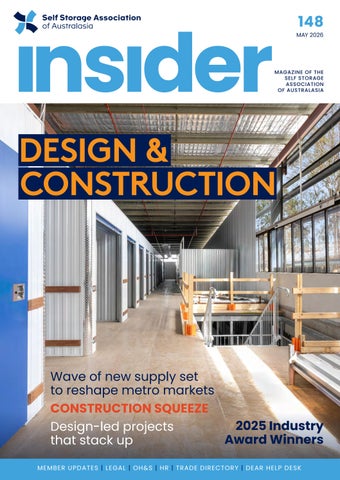

DESIGN & CONSTRUCTION

Seeking SSAA Members’ expressions of interest
Paper Bubble
Coming soon
Australian Made Product
Australian made paper converted into bubble. Locally produced, the product can be customised, with advertising print, roll length and paper colour.
Paper Alternative
This product is a paper alternative for bubble wrap and other plastic based packing products
Other Benefits
• No product sweating
• No cutting tools required
• Easier for the end client to recycle in commercial and domestic situations
• Dispensers not required
We would love to receive your feedback and your expressions of interest. Contact your State Sales Representative for further information.

SSAA BOARD OF DIRECTORS
Chairman – Michael Alafaci
Storage King Group, New South Wales
Aaron Alsweiler
Safe Store Self Storage, New Zealand
Brent Hayes
Store and More Self Storage, Victoria
Ivor Morgan
Jim’s Self Storage, Victoria
Sam Kennard
Kennards Self Storage, New South Wales
Anthony Regis
Regis Built, Victoria
Elizabeth Rutland
Monash Self Storage, Victoria
Thomas Whalan
Rent a Space, New South Wales
Adrian Wylde
All-Bay Mini Storage, Queensland
LIFETIME MEMBERS
Mark Bateman
David Blackwell
Frank Cooney
Elaine Coote
Liz Davies
Dallas Dogger
John Eastwood
Keith Edwards
Simone Hill
Neville Kennard
SSAA STAFF
Sam Kennard
Bob Marsh
Paul McFadzien
Jim Miller
Jon Perrins
Phil Robbie
Mark Snooks
Michael Tate
Richard Whalan
Makala Ffrench Castelli
CEO
Sandra Evans
Office Manager
Priscilla Lee
Member Relations
Anna Mortimer
Marketing Communications Manager
www.selfstorage.org.au
TOLL FREE – AUS:
1800 067 313
TOLL FREE – NZ: 0800 444 356
T: +61 3 9466 9699
Address:
Unit 4/2 Enterprise Drive, Bundoora Vic 3083
E: admin@selfstorage.com.au
Connect with us online!


Are you better off minimising tax now – or in the future? 40 OH&S: A safety first approach for self storage facilities
HR: Termination during probation: fact or HR myth?
LEGAL: Tips for reviewing and assessing construction contract
9 THE CONSTRUCTION SQUEEZE
Labour shortages, weaker productivity, material costs and market volatility could create the perfect storm for developers.
10 2025 INDUSTRY SNAPSHOT: Wave of new supply set to reshape metro markets
12 WOMEN IN DESIGN & CONSTRUCTION
Three women shaping modern self storage
16 ON STORAGE AND STUFF
Medium-density housing and storage
18 BETTER PROJECT DESIGN
Design-led projects that stack-up
20 CONVERSIONS
Capitalising on conversions 22 CONTAINER STORAGE DESIGN
The rise of container storage solutions
STUDY
Construction complexities when building up 26 EXCELLENCE IN CONVERSION FINALISTS / WINNER
EXCELLENCE IN COMMUNITY ENGAGEMENT
/ WINNER
(ABN
050
(Insider)
725).
of
of
or in part,
in the
Michael Alafaci Chairman SSAA
Land scarcity, regulatory burden and the rising cost of construction are front and centre for those looking to develop, expand or retrofit. This edition brings the industry to life through the bright and industrious individuals working within it, and the ideas shaping the next decade of self storage design and development.
I especially enjoyed reading the feature on women in design and construction and learning more about the career paths that led them into self storage. We are fortunate to have many exceptional women in self storage, and I think that is a real testament to the inclusive nature of our industry.
A consistent thread throughout this edition is the increasing scarcity of affordable land and what that means for maximising net lettable area, refining facility design and thinking more creatively about development opportunities. Whether you are planning a new build, conversion or extension, this issue is full of practical ideas and fresh

“Our Awards section also showcases the ingenuity behind smart conversion projects and the creative thinking helping unlock value in constrained or unconventional sites.
perspectives to help navigate constraints, sidestep roadblocks and make smarter decisions. Our Awards section also showcases the ingenuity behind smart conversion projects and the creative thinking helping unlock value in constrained or unconventional sites.
At a time when economic conditions remain uncertain, it is also reassuring to see a healthy supply pipeline and steady operating performance. As an industry, we have weathered many storms, and I am confident self storage will continue to adapt and perform through these changing market conditions. l


Makala Ffrench Castelli CEO SSAA
It’s been a busy start to 2026 and I’m excited to announce a new member-only program, StorMentor. Championed by Board member Lizzy Rutland, the program is designed to help members connect, share knowledge and learn from others across the self storage community. Be sure to read more about it on page 37 and get on board to support or learn from our wonderful network.
We’ve also released a number of key member resources, including the Hardship Guidelines, Cyber Security & Information Management Guidelines and Deceased Storer Guidelines. If you haven’t visited the member portal recently, now


“This one-day forum was created to directly support operators in the local market. It was a great turnout, with more than 80 members attending alongside our Self Storage Supplier Marketplace.
is a good time to familiarise yourself with the tools, training and resources available to support you, your team and your business.
In March, the SSAA headed to the Hilton in Auckland for our first NZ Exchange. This one-day forum was created to directly support operators in the local market. It was a great turnout, with more than 80 members attending alongside our Self Storage Supplier Marketplace.
From Linda Sharkey’s Industry Snapshot highlighting green shoots in the New Zealand market, to our legal deep dive with Darryl King and wide-ranging panel discussions, the day was packed with insights and perspectives for owners and operators. Add in plenty of networking, drinks, dinner and great conversations, and it was a fantastic day for the New Zealand self storage community.
A big thank you to our speakers, facilitators and panellists for sharing their insights and experience so generously with the industry. We look forward to doing it again next year!
With mid-year approaching, it’s time to turn our attention to the self storage event of the year – Convention. In a welcome twist, we’ll be back on the sunny Gold Coast for GC26. Who doesn’t love a beach destination? This year, Convention will be held at The Star Gold Coast from 10–12 November. Don’t miss your early bird registration offer! l


panel centre opening with Infra-red safety
Traction Drive MRL


Southwell Lifts & Hoists delivers engineering excellence with robust, dependable solutions, perfect for the Self Storage industry. The ideal traction lift, combining high capacity with cutting-edge technology for outstanding performance.
HIGH CAPACITY: Rated for 2500 kg (33 Passenger), maximising what your customers can move.
SPACE OPTIMISATION: Our design maximises the car size to suit EN81-20 standards, ensuring you get the most usable space.
FAST & EFFICIENT: Fast speed of 1m/ second and compliant to 180 starts per hour.
SUPERIOR BUILD: Built tough, built to last. Featuring a durable and stylish finish, specifically designed for premium self storage requirements, including stainless steel bump rails for wall protection.
ENERGY EFFICIENT: Premium quality gearless motor and state-of-the-art inverter provide exceptionally low energy consumption and sound levels.
ENGINEERING EXCELLENCE
Locally designed and engineered solutions. European partners with high-quality products and parts. Factory-trained technicians for dedicated service support.
Guaranteed operational, on-time, on budget, with no hassles.

The construction squeeze
Labour shortages, weaker productivity, material costs and market volatility could create the perfect storm for developers.
Rising construction costs, labour shortages and economic uncertainty are placing sustained pressure on development feasibility and capacity constraints across the property sector.
These pressures are making it harder for projects to stack-up financially, particularly developments with high upfront capital requirements. The question now is whether projects can still be delivered on time, on budget and at a yield that makes sense.
National construction activity reached $318 billion in 2025, with the strongest pipeline conditions in Western Australia, South Australia and Queensland. Rider Levett Bucknall’s (RLB) March 2026 Construction Market Update forecasts construction costs to rise between 4% and 6% nationally in 2026, with stronger increases expected in Adelaide (5.1%), Brisbane (5.0%), Darwin (5.2%), Perth (5.4%), and Gold Coast and Townsville (6.0%). Lower rates of escalation are forecast in Canberra (3.75%),
Melbourne and Sydney (4.0%).
The Australian Bureau of Statistics (ABS) latest Producer Price Indexes (December 2025) reported ongoing skilled labour shortages continue to push up labour costs. The ABS has pointed to competition from public sector work and strong demand for trades, site management and concrete as ongoing influences on prices.
Add labour shortages to that equation and it is easy to see why project budgets have blown out. Beyond the eye watering price of materials, the industry must now contend with the availability and cost of people needed to deliver these projects at every stage, from consultants and engineers through to subcontractors and skilled trades.
A longer-term concern is productivity. In a paper presented at the Reserve Bank of Australia’s 2025 ABS/RBA conference, the Productivity Commission argues that improving the productivity of the construction process would lower construction costs and make more approved projects viable, even without changes to workforce size, interest rates or material costs. That points to a deeper structural problem for the sector, one that is likely to shape project economics for years to come.
Major public infrastructure will continue to compete for workers, consultants, subcontractors and materials. In Queensland especially, the Olympic build-out is likely to intensify that competition in the second half of this decade, with Queensland’s 2032 Delivery Plan setting out a $7.1 billion venue capital works program.
Across the Tasman, RLB’s Forecast Report 114, prepared by the New Zealand Institute of Economic Research, points to early signs of recovery, with falling interest rates and a significant infrastructure pipeline. Residential construction is leading that uplift, while non-residential demand remains subdued. Cost inflation is expected to stay relatively contained in the near term, but RLB expects pressure to rebuild as demand strengthens and spare capacity is absorbed.
Global uncertainty remains another risk to watch, with further disruptions to supply chain and additional cost burdens expected, particularly where imported materials and supply chains are concerned.
Experts advise developers to tighten project scoping, use phased delivery, and leverage early supply chain contracts to mitigate budget risks. Modular and offsite construction, along with exploring regional opportunities, may also offer relief if planned carefully.
With the outlook still uncertain, industry stakeholders, developers and property investors will need to remain agile and adjust their strategies to meet a market facing opportunity and risk in this evolving construction landscape. l
“ Experts advise developers to tighten project scoping, use phased delivery and leverage early supply chain contracts to mitigate budget risks.
Supply Stages
Self storage development applications and construction time tracked to demonstrate the progression of new supply projects market.
2025 Industry Snapshot: Wave of new supply set to reshape metro markets
There are 198 projects currently tracked across Australia and with approximately 42% (84 projects) having received counc
Over the past year, the strongest growth in development activity in Melbourne (+103%) and Sydney (+24%), reflecting continued in metropolitan markets.
Record levels of self storage supply are forecast to continue into 2026 and beyond, with development activity accelerating across Australasia and a further wave of projects due over the next two to three years.
Self storage pipeline
The 2025 SSAA Industry Snapshot shows project completions rose 22% year-on-year from 54 to 66 projects, while the known pipeline across Australia and New Zealand has expanded to more than 350 projects, up about 26% over the same period.
The scale of this pipeline suggests supply will play a much bigger role in shaping market outcomes over the next few years. A mix of strong demand and limited transaction opportunities in recent years has pushed more capital towards development, with new supply now becoming a more visible force in local market dynamics.
almost 60% of development activity now being tracked, while Greater Brisbane, Sydney and Melbourne collectively account for 179 of the 198 proposed projects.
These east coast markets have increased their total net storage area by about 7.5% during 2025, well above the pre-pandemic norm of around 2-3% annual growth, confirming metro markets remain the epicentre of self storage expansion.
Melbourne has taken the lead from Brisbane, with 67 proposed which 8 of which (12%) are under construction. Sydney follows 52 proposed facilities, including 13 (25%) under construction. reports 36 proposed facilities in the pipeline, with 10 (28%) under construction, while Perth has 21 proposed sites, 6 (29%) of which currently being developed.
New Supply Stages - Major Cities
New Supply Stages Major Cities
DA Preparation DA Submitted
DA Approved Under Construction
Supply Pipeline
Pipeline
Supply Pipeline
Supply Pipeline
Melbourne now leads the pipeline with 67 proposed facilities, overtaking Brisbane, which was the frontrunner in 2023. Sydney follows with 52 proposed facilities, while Brisbane has eased to 36. Perth has 21 proposed sites, while Adelaide, Auckland and Canberra continue to contribute to the broader development picture.
points to sustained activity, with 40 facilities in the 2025 completion pipeline, 78 in 2026 and a further 111 scheduled for 2027 and beyond.
to continue its expansion els of new supply forecast.
The outlook for the next two to three years points to a more competitive environment, particularly in metropolitan catchments where projects are clustering and operators may need to work harder to defend occupancy, rate growth and customer acquisition.
The self storage supply pipeline is set to continue its expansion o 2026 and beyond, with record levels of new supply forecast.
supply pipeline is set to continue its expansion nd, with record levels of new supply forecast.
The self storage supply pipeline is set to continue its expansion o 2026 and beyond, with record levels of new supply forecast.
Projects move closer to delivery
cross the seven major markets, representing an e last year (164).
The self storage supply pipeline is set to continue its expansion into 2026 and beyond, with record levels of new supply forecast.
ed facilities in the pipeline across the seven major markets, representing an compared to the same time last year (164).
re are currently 198 proposed facilities in the pipeline across the seven major markets, representing an ease of approximately 21% compared to the same time last year (164).
ed facilities in the pipeline across the seven major markets, representing an compared to the same time last year (164).
All eyes on the east coast
There
market,
market, there are ~350 known proposed
d New Zealand self storage market, there are ~350 known proposed
While underlying demand drivers remain supportive, the volume of new space entering some metro catchments is likely to test pricing power and place short-term pressure on revenue growth in selected pockets.
26% compared to the same time last year.
That story is playing out most clearly on the eastern seaboard. Melbourne and Sydney together account for
d New Zealand self storage market, there are ~350 known proposed facilities increase of approximately 26% compared to the same time last year.
ross the entire Australian and New Zealand self storage market, there are ~350 known proposed facilities he pipeline, representing an increase of approximately 26% compared to the same time last year.
increase of approximately 26% compared to the same time last year.
Importantly, the current uplift isn’t a spike and the forward pipeline
9
Sydney 10 Melbourne 9
Sydney 10 . Melbourne 9
9
20 · Sydney 15
Melbourne 20 · Sydney 15
5 . Perth 4 berra 2
7 . Adelaide 5 . Perth 4
Brisbane 7 . Adelaide 5 . Perth 4
12 · Adelaide 9 · Perth 8
5 . Perth 4 berra 2 Melbourne 20 · Sydney 15
Brisbane 12 · Adelaide 9 · Perth 8
9 · Canberra 8 to continue its expansion els of new supply forecast.
Auckland 3 . Canberra 2
3 . Canberra 2 Melbourne 20 · Sydney 15 Brisbane 12 · Adelaide 9 · Perth 8
7 · Canberra 7
7 · Canberra 7
7 · Canberra 7
Auckland 7 · Canberra 7

25 · Sydney 22
15 · Adelaide 13 · Perth 12
9 · Canberra 8
The composition of the pipeline suggests more projects are progressing beyond the earliest planning stages. Of the 198 projects currently tracked across the major markets, about 42% have already received council approval. Across the major metro markets, 46% of projects are now considered likely to complete, classified as underway or committed, up from 37% a year ago. This points to growing confidence in the sector and a stronger near term delivery profile, even as feasibility conditions remain challenging. At a market level, Melbourne is setting the pace in approvals and forecast supply, while Sydney and Brisbane still have a greater proportion of projects already under construction. That mix suggests the next phase of delivery may be
Melbourne 25 · Sydney 22
15 · Adelaide 13 · Perth 12
Melbourne 25 · Sydney 22 Brisbane 15 · Adelaide 13 · Perth 12 Auckland 9 · Canberra 8
9 · Canberra 8
plications
Sydney follows
including 13 (25%)
construction. Brisbane in the pipeline, with 10 (28%) under 21 proposed sites, 6 (29%) of which are
nes are across the New Zealand, approval. activity occurred confidence facilities, of closely with Brisbane under which are
more staggered than the headline pipeline first implies, with some markets closer to completion and others still building momentum.
Completions pick up pace
Completions data tells a similar story. A total of 66 major self storage projects were completed in 2025, up 22% from 2024. In capital city markets, 40 facilities were expected to reach completion by year end 2025. Although this is below the 62 completions forecast at the same time last year, it still leaves 2025 on track to record materially higher
delivery than 2024. Melbourne has rebounded strongly after limited activity in 2024, while Sydney has also recorded a solid lift in completions.
Melbourne sets the stage for new supply growth and construction forecasts with a record number of development applications approved
That said, not every project in the pipeline will proceed. More than half of all tracked projects remain classified as forecast or uncertain, reflecting the reality of elevated construction costs, tight labour conditions, extended approval and delivery timeframes, and more disciplined funding conditions. Major owner groups continue to dominate active construction, but private
equity and private investors are taking a larger share of early-stage projects. This broadens the pool of capital pursuing development, while also increasing the range of outcomes across the pipeline. Overall 2026 is likely to see supply become more concentrated and influential in shaping local market performance. Demand drivers for self storage remain intact, but operators in some metro catchments may soon be contending with a level of new competition not seen in several years. l
Supply Stages


FROM BLUEPRINT TO CUSTOMER EXPERIENCE
Three women shaping modern self storage
Behind every self storage facility is a complex blend of design, construction, finance and technology. As the sector evolves, operators are rethinking the way facilities are built and how they function day-to-day for customers and staff. In this issue, Insider speaks with three women working at the centre of these decisions. From construction to customer experience, each offers a different perspective on what modern self storage looks like today.

As Storco’s Development Operations Manager, Lauren Boulton is largely focused on supporting clients after their initial build. She assists with repairs and maintenance, and helps facilities expand and add new lettable area. This can be anything from filling in void spaces with storage lockers, partnering with Stellar to add container storage, or supplying fit-out materials for new buildings and stages.
After starting out in residential property, an opportunity on the commercial side saw Lauren land in self storage, where the mix of practical problem-solving and industry collaboration quickly clicked. “It’s been a great decision,” Lauren said. “One of the best things about working in the self storage sector is being able to follow a
project all the way from enquiry to delivery. Also, it turns out the trade shows are a lot more fun!”
Where is self storage design headed?
One of the most visible design shifts in recent years has been the professionalisation of the industry. You can see it in the end product, but it’s also there in the structure and the thinking of developers. There’s a sophistication in facility designs that simply wasn’t there a decade ago. Facility layouts are more than just plain boxes with a roller door - they’re more diverse now, but that’s just a small part of it.
There’s an understanding of design efficiency that’s baked into developers’ thinking that comes from this gradual accumulation of industry knowledge.
WHAT DO OPERATORS OFTEN UNDERESTIMATE?
“
Planning and approvals: The time and effort required to navigate local councils is often underestimated. Having someone with boots on the ground who knows the local process can be invaluable.
Lauren Boulton Storco
So what you get is a lot of little decisions: manufacturing doors to suit the latch so there’s less on-site cutting, or better timing so trades aren’t stepping on each other’s toes. Or even little details, like adding a sink in the loading dock so customers can wash their hands after moving in.
On design trends
I really like how facilities are becoming more boutique and customer-friendly. The underlying structure is still just four metal walls but we’re seeing nicer interiors with more variety in the material choices, better use of lighting and music, and more attractive facades that blend better with the local environment. Anything that puts customers first has got to be worth considering. From a planning perspective, we’re seeing a pull between designing for the customer experience versus for peak operational efficiency.
What advice would you give to other women in self storage?
For women building careers in self storage, I’d say that selfconfidence is key. You’ll be working with people from a lot of different backgrounds, so having a strong sense of self will make it easier to build those relationships. The benefit of self storage is that there’s real opportunity for an individual to make changes that ripple through the entire industry.

Karen Jacobs Total Construction
As General Manager of Corporate Services at Total Construction, Karen Jacobs oversees the IT, Marketing and People & Culture departments. Her team supports employees across the business, from corporate functions through to project delivery, and she also contributes to the company’s overall strategy as a member of the Executive Management Team.
Karen’s involvement in the sector came from working on projects where operators were looking for specialist construction knowledge. “Self storage is a unique sector and vastly different to traditional commercial or industrial developments,” she said. “There are few construction companies that understand the operational requirements needed for self storage builds, such as layouts, loading areas, security and customer access.”
WHAT DO OPERATORS OFTEN
UNDERESTIMATE?
“ Early builder involvement: Engaging the construction team early can make a significant difference. The earlier builders are involved, the better the outcome tends to be.
What should operators be thinking about?
Over the past five to ten years, operators have started thinking much more holistically about how a facility performs. In addition to maximising space, there is now a much stronger focus on customer experience, operational efficiency, sustainability and building performance. Technology is also becoming a much bigger part of the conversation, with digital access, automation and smarter security systems increasingly considered as part of the design itself.
On construction trends
From a construction perspective, one of the biggest trends we’re seeing is the shift towards more

complex, multi-level facilities, particularly in urban areas where land is becoming harder to secure and operators are looking to maximise smaller sites.
We’re also seeing a much stronger focus on customer experience in the design of facilities. That includes things like better loading areas, drive-through access where possible, wider corridors, efficient lift placement, and making it easier for customers to move through the building with trolleys or goods.
Another important trend is sustainability and building efficiency. Many projects are now incorporating solar, energy-efficient lighting, and smarter building systems that reduce operating costs over the long term.
And finally, technology integration is playing a bigger role. Operators are planning for digital access systems, automated entry, and smarter security solutions, which means the building itself has to be designed to support those technologies from the start.
So overall, facilities today are becoming much more purpose-built, efficient, and customer-focused buildings, rather than just simple storage warehouses.
What advice would you give to other women in self storage?
One of the most rewarding parts of working in this sector is that it’s a really collaborative industry. There’s a genuine willingness to share knowledge and work together to deliver great facilities.
My advice to women building careers in this industry is don’t be afraid to take up space and share your perspective. Construction and property have traditionally been male-dominated fields, but that’s changing, and diverse perspectives make projects and businesses stronger.
I’d also say build strong relationships and stay curious. This industry offers a huge range of opportunities, from development and operations through to construction and technology. And the more you learn about how the whole ecosystem works, the more opportunities open up.

After 22 years in the industry, Kristi Adams’ role sits at the intersection of technology, operations and strategy within self storage. As Chief Revenue Officer at OpenTech Alliance, she works closely with operators globally to help them integrate automation, data and digital customer journeys into their facilities. Much of her career has been spent in customer acquisition, marketing and operations, including hands-on experience with CubeSmart that gave her a strong grounding in the realities of running facilities day-today. “That operational foundation has been incredibly valuable because it shaped how I think about technology today,” Kristi said. “Not just as innovation, but as a tool that must genuinely improve operations and the customer experience.”
Kristi’s cross-border experience working with operators across North America, Europe, and Australasia has given her a unique perspective on how the industry continues to evolve globally.
WHAT DO OPERATORS OFTEN UNDERESTIMATE?
“ Technology infrastructure: Many projects focus heavily on the physical build, but the technology ecosystem is what ultimately shapes long-term operational efficiency and future scalability.
On technology and data trends
Today, operators are thinking much more about the role data and technology play in creating a more seamless customer journey, and as a result are looking at ways to integrate new offerings into their revenue stream.
I’m seeing a much stronger focus on contactless customer journeys. Tenants increasingly expect to move from online booking to unit access without waiting for staff, and operators are designing workflows and infrastructure to support that level of convenience. At the same time, they’re investing more heavily in security technology, automation, and data-driven tools that help them manage sites more efficiently.
What’s really changed is how operators think about data, and how the design of their facility and operational systems facilitate their access to those insights. The operational Intelligence that we used to rely on; customer behaviour, traffic patterns, even security concerns, was manager reported. Now, access control systems and sensor networks are giving operators a real time view of what’s actually happening at their facilities. Unit motion detectors, gate and door sensors, foot traffic tracking, and other connected devices are generating insights that help operators respond faster, reduce risk, and run more disciplined operations.
The sensor ecosystem is also opening the door to new revenue opportunities. As more devices become available, whether it’s smart locks, unit level sensors, or tenant facing services, operators are finding ways to package premium features and convenience into recurring revenue streams. That shift only works if the facility is built on a strong digital foundation.
What advice would you give to other women in self storage?
One of the most rewarding aspects of working in the self storage sector is how collaborative and supportive the community is. I’ve had incredible mentors and they were all men! My advice to women entering the industry is to seek out that support and build your network. Self storage touches so many areas; operations, real estate, technology, marketing, and there are opportunities for growth all over. l
Kristi Adams OpenTech Alliance


Medium-density housing and storage

Anthony Vile discusses spatial minimums, consumerism and life in medium-density housing.
The push for yield maximisation and ‘efficiency’ of design in medium-density housing (MDH) is eroding functional elements historically associated with the family home. Where design minimums are not legislated, utility spaces like storage are targeted as non-critical, running the risk of being reduced in scale or even eliminated.
Storage space has become a casualty of austerity and, ironically, a symbol of a successful free market in action. Population growth coincident with the reduction of domestic storage in MDH is driving the rising demand for offsite storage facilities as necessary urban infrastructure.
The private sector has embraced self storage as a profitable asset class – cheap to build, low risk and offering stable, long-term revenue, thanks to persistent demand. Unitary Plan intensification in Auckland has driven the evolution of a new, highly rationalised building type: the multistorey storage facility.
“ Population growth coincident with the reduction of domestic storage in MDH is driving the rising demand for offsite storage facilities as necessary urban infrastructure.
This architecture is based purely on clear dollar-per cubic- metre returns – the poetics of space reduced to an algorithm – making it the ‘bean counter’s dream’.
Life in medium-density housing
The rise of the self storage industry clearly demonstrates the market’s response to a deficit of domestic provision in MDH. But what are residents’ actual experiences?
In 2023, Auckland Council’s Economic and Social Research and Evaluation team and Tāmaki Makaurau Design Ope (TMDO) completed the Life in Medium Density Housing in Tāmaki Makaurau study. This research investigated how Aucklanders are experiencing life in recently built MDH, providing analysis of 57 design attributes based on online surveys completed by 1243 households.
The findings painted an objective picture of six years of intensification. Feedback regarding the human need for storage was clear: “Storage is inadequate for many households. Over half of all the participants reported that they had insufficient storage for general household items (e.g. vacuum cleaner), linen, kitchen equipment and food, and occasional items (e.g. suitcases).” “For those households with a garage and at least one car, half used it for purposes other than parking their car, including storage, exercise, as a study and for other living activities.”
Notably, the draft Unitary Plan originally included minimum standards for storage provision, with the purpose to “ensure dwellings have sufficient space for
the storage of everyday household items and bulky items, such as bicycles”, but these were removed in the operative plan. The reason – whether developer lobbying or otherwise – is unclear but the effect is the creation of a clear deficit. Despite this, best practice guidance does remain for minimums.
Global ergonomics and housing research generally suggests that the average human adult generates 1–1.5m3 of long-term storage need (seasonal clothing, sports gear, archives, tools, etc.) in addition to daily cabinetry. This is roughly equivalent to the storage volume of our top-selling family wagon, the Toyota RAV4, which provides 1.6m3 of storage with the seats down.
The illusion of minimalism and the reality of consumption
The minimalist houses featured so often in glossy design publications exist largely through the practical application of expensive, hidden storage strategies. Though photographed without the clutter of daily life, these houses are built to be lived in, and even minimalists have a significant volume of objects –practical and symbolic – to be curated, filed and hidden with the help of German-engineered hinges and expensive cabinetry.
In a society obsessed with growth and consumption, the lack of accessible, affordable domestic storage only intensifies the problem. Alternatively, as useful social policy, rather than encouraging consumption, we could enforce the reading of The Gentle Art of Swedish Death Cleaning: How to free yourself and your family from a lifetime of clutter and stop buying so much stuff we don’t really need. “Simplify your life by surrounding yourself only with things that bring you joy.”
Even the recent IKEA Life at Home Report New Zealand 2024, based on 500 home visits across the country, confirmed that widespread dissatisfaction with storage indicates a key domestic need for Kiwis. The report noted: “Kiwis are seeking to maximise functionality and storage to accommodate a growing number of activities across different multifunctional rooms in the home.”
Though not a human right, the provision of a basic level of storage is assumed as a human need, when considering homes are “to be designed to meet day-today needs of residents”
Our appetite for stuff
The deficit of household storage highlights not just a design flaw but a broader cultural tendency: our massive appetite for stuff. Stuff is manufactured to address utilitarian and emotional needs, as well as to generate a dopamine hit at the checkout. Stuff comes from somewhere, needs to be stored somewhere and needs to be disposed of somewhere. “It’s said that almost 90% of everything we consume is shipped in a container.”
Auckland and Tauranga ports annually handle a staggering volume of imports. If you were to stack the combined number of TEUs (20-foot equivalent units) processed annually onto a one-hectare site, the stack would reach approximately 3,172m into the sky. That is a mountain of stuff – 85% of the height of Mount Cook –that annually needs to be distributed, sold, organised, stored and, ultimately, disposed of. While the deficit
“ Though not a human right, the provision of a basic level of storage is assumed as a human need, when considering homes are “to be designed to meet day-to-day needs of residents”.
of storage in our developer-delivered MDH stock is an evident problem, it runs in parallel with our need to reflect on and refine our appetite for buying stuff generally.
Essential safeguards for liveability
The future house is fluid, flexible and distributed. The trend of distributing elements of the house into the urban fabric is visible in many cities. The laundry is relocated to the laundromat, the backyard to the local park, the dining room to the local bistro, the lounge to the local cafe or bar, storage to the storage unit. The city is the new house.
However, in the wave of neo-liberalism pushing the free market as our saviour, the deletion of design minimums needs to be cautioned. Best-practice guidance on minimums to support healthy and culturally supportive living environments is required. The outcome of research is clear. Some things in design, despite the naysayers, are not subjective, and need to be approached with an engineer’s pragmatism. Humans require minimums for survival – oxygen, food, water, sunlight, weather tightness and, critically, storage.
The evolution of MDH in Auckland reveals both the strengths and shortcomings of our planning framework. Intensification has delivered more housing but, often, at the expense of liveability. Storage, though rarely glamorous, remains fundamental to domestic life. Without it, residents turn to offsite facilities, fuelling a profitable and growing industry with the burden of additional costs transferred to individuals.
MDH reveals a critical lesson for architects and planners. Design minimums aren’t bureaucratic constraints; they’re essential safeguards for liveability and an opportunity to deliver genuine long-term value to our communities.
Now, where the hell did I put those golf clubs? Thankfully, they’re only 3km away in my storage unit: just a quick dash in my RAV4. l
This extract was published with permission from Architecture New Zealand (Nov/Dec 2025)
Anthony is Director of Urban Futures Research Lab, an Auckland-based urban think tank and design agency. His practice spans residential architecture, master planning, and urban design strategy, with expertise in New Zealand's regulatory environment and the delivery of resilient, equitable urban outcomes. He has advised both public and private sectors, taught at the University of Auckland and Unitec, and regularly contributes to Architecture NZ and other media on contemporary urban issues in Aotearoa. www.urbanfutures.nz
DESIGN-LED PROJECTS THAT STACK-UP
Good self storage design doesn’t begin on site. It starts much earlier, when owners and operators are testing whether a project will work.

For Javier Rezzonico, Managing Director of STORCAD, that early thinking and integrated approach to self storage design and delivery helps clients get projects right from the outset.
Javier founded STORCAD after seeing a gap in the market for a specialist focused purely on self storage. A building designer and joiner by trade, he had experience working on the design and fit-out side of self storage, and could see an ongoing disconnect between the architect, the internal fit-out team and the realities of industry-specific compliance onsite.
Too often, issues only emerged once construction was underway. His answer was to build a more integrated model, one that could bring design, project coordination and delivery closer together from the outset.
Javier said STORCAD was built to shape projects from the earliest planning stages through to delivery and help clients make better decisions before they are too far down the path. “I wanted to create an affordable, seamless approach tailored to self storage”, he said. “An integrated offering that ensured a project ran more smoothly once on site.”

AFTER BEFORE
That role has become more important as the market changes and the sector grows in scale and sophistication. “Conversions, in particular, are becoming more attractive in a tighter market, and operators need more than a set of plans,” Javier said. “They need design thinking that helps assess yield, access, compliance, customer flow and the overall viability of a site before construction begins.”
In practice, Javier says the process starts with a clear scope from the client. What type of customer are they designing for? What does the site allow? What are the trade-offs between yield, access and customer amenity? Are they sticking to a traditional self storage design or integrating elements such as wine storage because it might work well in that location?
Those questions shape everything that follows, from early due diligence and planning through to design documentation and, in some cases, internal fit-out delivery.
The focus then shifts to key planning considerations: zoning, setbacks, height restrictions, and net lettable area. Early due diligence is a critical part of the process, helping clients understand whether a site is viable before they progress too far.

STORCAD’s use of advanced laser scanning technology, particularly on retrofit projects, allows for precise technical and practical recommendations. By capturing the full building and services in 3D before design begins, the team can identify structural and compliance issues early, reduce unnecessary demolition and refine layouts with greater confidence.


Javier points to projects such as Rent a Space Girraween, where STORCAD did a full laser scan and set of construction documentation. The process helped the client get to market faster, by avoiding a full development application in favour of a complying development pathway (CDC). The data from the scan also informed a more efficient structural design, identifying Inadequate ceiling heights, as well as existing floors and office space which could be retained and worked into the design, reducing demolition and constructions costs.
It also revealed that some stairs and handrails weren’t BCA compliant, allowing the team to make the necessary adjustments early and install compliant handrails before the project progressed too far. Overall, the approach helped streamline documentation, avoid issues onsite and support a faster path to market.
This approach is becoming more important as facility design evolves. Javier said operators are increasingly returning to traditional self storage models, but on a much larger scale. “Lately it’s been a case of bigger is better,” he said. “I’ve not seen anything under 3,000 sqm recently. Instead, we’re looking at 7,000 to 9,000 sqm builds and they’re going up.”
Javier said for a while, operators were testing the market with new niche offerings and adjusting their facility design to incorporate things like wine or gun storage. “In general, I would say a lot of those specialist storage offerings haven’t taken off the way operators had hoped, and we’re seeing a return to traditional self storage design, which is a proven model,” he said.
The rising cost of land is driving more multi-level development, but customer expectations are also reshaping design priorities. Historically, operators were
“ Early due diligence is a critical part of the process, helping clients understand whether a site is viable before they progress too far.
heavily focused on maximising NLA. Now, Javier is seeing a much stronger emphasis on customer satisfaction. Larger loading bays, better weather protection, brighter lighting and more comfortable arrival areas are becoming part of the conversation. “With many facilities offering extended hours, I’m seeing things like music and better lighting integrated into design so that customers feel safe at night,” he said.
Competition is part of that shift, but so is the changing customer mix. Facilities are increasingly catering to business users as well as household storers. Javier cited Wilson Storage’s business hub model as one example, with features such as hot desks, boardrooms and forklift access for deliveries.
When asked what operators often get wrong or overlook when planning a project, Javier pointed to security. “Owners and operators need to closely monitor their security,” he said. “Ask your security provider to include testing as part of the installation process and run continuous testing for the first few months.” For operators, it is a reminder that good design is not just about what fits on a site, but how the whole project comes together. l


Capitalising on conversions
For operators trying to enter constrained catchments, accelerate delivery and unlock value from underused buildings, conversions can offer a compelling alternative to the development
of new builds.
In a market where well-located vacant land is increasingly hard to secure, conversions are becoming a more practical path into self storage.
Anthony Regis, Managing Director of Regis Built, said the appeal is easy to understand. In established urban areas, greenfield sites are scarce and planning pathways can be slow, with development approvals often stretching out from six months to two years. “Most operators don’t have that sort of time,” Anthony said. “A well-selected conversion can offer a more direct route when speed to market, visibility and local presence matter.”
Anthony points to a recent Regis Built project for Storage King Mordialloc, where an old donut factory in a prime location is being converted into a large 850-unit self storage facility in under 12 months.
Conversions often require a straightforward approvals process and can get operators trading faster. In many cases, conversions simply require an operator to secure the site, commission compliant fire services, obtain a building and occupation certificate, and they can commence operations while the balance of the fit-out is

staged and rolled out at a later date. Other significant benefits can include savings on architecture and design, tapping, connections and infrastructure costs.
This speed to market only matters if the basics stack-up. “Undertaking appropriate due diligence before purchase is critical,” Anthony said. “Try to maximise your due diligence period by negotiating 60 to 90 days if you can, and use it fully.”
For first timers, Anthony recommends focusing on the following:
l Security: Can the building and perimeter be secured to meet self storage standards?
l Height: Is there enough height to accommodate fire compliance and additional floors?
l Structural: Can the structural floors take the intended loads? What is the condition of the roof and cladding? Can ventilation be regulated throughout the facility?
l Access and functionality: Is there easy road access and parking, suitable vehicle height, ample circulation, loading room and realistic turning areas?
l Approvals: What existing approvals are in place? If the building has previously got council and NCC compliance much of the complexity is reduced.
Existing fire safety statements, engineering design and structural reports can help form an early picture of the asset, but slab performance, framing and roofing should still be tested independently. Water issues also deserve close attention, with leaks, rising damp and poor drainage far cheaper to address early than remediate after opening.
Some issues are manageable, while others can blow-out costs.
Low water pressure can become a major obstacle to fire compliance, while inadequate electricity supply can restrict lifts and access systems.
A slab that requires significant strengthening under mezzanines or heavy corridors can quickly erode the commercial case for conversion.
And if the building height can’t facilitate a mezzanine, it may be a deal breaker. “It’s rare to see a conversion where an additional floor isn’t required,” Anthony said. “We have looked at many buildings across Australia, where the mezzanine height just doesn’t allow the required clearance for sprinklers and/or detection. When those issues cannot be resolved at a sensible cost, the right decision may be to walk away or reprice.”
Finally, choose your builder and consultancy team carefully. You will need a builder who specialises in self storage and is comfortable with conversions. Likewise, a town planner, certifier, fire engineer and structural designer with self storage experience will better understand the requirements and risks involved. l
Unapologetically tough. Smart latch, perfected.

1,000s Installed Worldwide. Zero Equals. Why compromise with inferior smart latches?
The ProEdge Smart Latch simplifies door security for both operators and tenants with its next-generation Bluetooth technology that provides keyless access, automated rental possibilities, and overlocking functionality. With many customers worldwide, this one latch is all that is needed to accommodate left or right latch mounting and is designed for both flat and corrugated doors. Tenants just need to swipe left on the app to unlock the latch.
DUAL-METHOD ACCESS
Tenant access controlled using next-gen bluetooth via the StorID app, or via keypad if they do not have their phone.
TAMPER RESISTANT BREAKAWAY TAB
A breakaway tab, with onboard accelerometer, mitigates forced entry efforts and notifies both tenant and owner in real-time.
DIGITAL KEY SHARING
Using the StorID app, tenants can easily provide other users with access to their unit for a specific period of time or indefinitely.
STORLOGIX CLOUD INTEGRATION
StorLogix Cloud connectivity through a robust mesh network provides operators with information on tenant access and overlocking capabilities.
3 YEAR BATTERY PERFORMANCE
A single lithium manganese dioxide battery performs up to 3 years.
2 YEAR WARRANTY
All PTI products including ProEdge come with a 2-year warranty from the installation date, giving you complete peace of mind.
StorLogix Cloud, ProEdge gateway, and ProEdge subscription required. Contact PTI Sales for further information.
Custom Projects. Custom Pricing. Speak to your local PTI installer for more details.
THE RISE OF CONTAINER STORAGE SOLUTIONS

There is no denying container storage is on the rise. Whether you’re looking to maximise NLA, validate demand before making an investment, holding land, or simply looking at a quick-tomarket model, container storage is an attractive solution.
Operators only need to look across the pond, where in the UK alone, more than 40% of self storage is now containers. At SYD25, around 100 delegates gathered at a dedicated container storage breakfast – a level of interest the industry had perhaps underestimated.
So what’s driving this trend and how has the appetite for alternative storage models changed in Australia and New Zealand?
Building a full-scale self storage facility requires significant investment in land, permits, buildings and infrastructure, with longer delivery timeframes, regulatory demands and feasibility pressures challenging the traditional model. These pressures have opened the door for alternative models.
Insider caught-up with Storco’s Louis Funnell to chat about the
recent strategic partnership between Storco and Stellar Storage Containers, and the changing face of facility design.
When asked how the container storage market had evolved in recent years, Louis said it had become more accessible, with more suppliers entering the market. “Container storage has essentially become more necessary due to increasing obstacles,” he said.
Storco has seen substantial growth in demand for container storage, with feasibility and NLA a big driver. Louis said rising institutional investment was also reshaping the sector and pushing operators to think differently about how they expand.
“Big players are looking to grow portfolios and increase NLA, and quickly,” he said. “You need to be able to get creative and offer a complimentary set of products to achieve this.”
For operators, container storage can support continuous growth by allowing sites to scale gradually, add units as demand builds, and reduce the risk of overbuilding.
Louis said operators were also facing increasing regulation and funding challenges, alongside rising land and construction costs. “The knock-on effect is huge delays in planning and approvals, and that's creating a real barrier to entry for the traditional storage model,” he said.
Louis said only three years ago, it took around 6-18 months to complete a two-level building. “Nowadays that’s virtually impossible. We’re looking at 18 months to two years for a true greenfield site.”
For developers looking to maximise returns while holding land, Louis said a smart option is to drop down some pods while waiting for DA. “In many instances it allows us to grow NLA quickly and efficiently while waiting for the traditional model to progress through approvals. It gives some flex,” he said.
Louis said that level of corporatisation has also made market entry challenging for Mum and Dad operators. “When you’ve got large players coming to a small town that can build a multi-million dollar facility, it can be hard to compete,” he said.

Container storage can give operators the opportunity to start generating revenue in as little as 4-6 months, once operational considerations are in place. “Stellar containers can pop open in 45 minutes and you can start trading that afternoon,” he said.
Louis said people often think of container storage as a bunch of containers behind a chain wire mesh fence on a pile of dirt, but the reality is modern container storage can transform vacant land into a modular facility complete with fencing, surveillance and keypad entry systems. “We’re now offering our customers technology that can help them automate and operate container storage at the same level as the big players,” he said.
It was on the golf course at the SSAA’s GC24 Convention, that


Why container storage?
Quick deployment
Portable units can be delivered and set up in days, compared to months for constructing a permanent building.
Cost-effective
They significantly reduce upfront investment, enabling operators to launch with lower capital risk.
Flexible locations
Operators can place containers on vacant lots, leased land, or underutilised industrial properties.
Modular growth
Businesses can start small and scale as demand increases, allowing for agile expansion.
Stellar’s Shay McQuade and Louis Fennell found themselves paired up as a team. Louis a golfing novice, recalls how Shay, who is a keen golfer, was not impressed! The two hit it off and while they didn’t win the tournament, almost two years later they shook on a strategic partnership that would bring Stellar Storage Containers to the Storco market.
This isn’t Storco’s first rodeo in the container storage game. In fact, Storco’s container solution Smartshed had already been on the market for a number of years when the team realised it needed a rethink.
Louis said the premium Colourbond containers were a great additional storage solution, but they were still facing many of the
challenges of traditional storage.
“The Smartsheds weren’t selling to scale – they weren’t transportable, the install was laborious and the overwhelming feedback from customers was that it was simply too expensive,” he said. “We knew we wanted to be in the container business, but we needed to go back to the drawing board and design a more customer focused solution.”
Louis said working with Stellar had already saved Storco customers time and money. “We are now able to offer a compelling mix of storage solutions to help our customers at every stage of their self storage journey, whether it’s planning, expanding, new builds, retrofits or stop gap measures,” he said.
Louis points to a recent project in Altona where his customer has a second block of land. Feasibility studies have been weighing up the cost benefit of extending the facility with containers or putting a bricks and mortar building in place.
“It’s a constant battle of whether it stacks-up,” he said.
While containers provide many advantages, businesses must still navigate local regulations. Zoning laws, site access, and council approvals all influence whether a container-based storage site can be implemented in a given location. That said, container solutions often face fewer barriers than permanent buildings, especially when used for short-term storage or classified as temporary structures.
Some local councils in Australia have already shown support for these developments, recognising their value in serving community needs with minimal impact.
“Benefits can extend as far as tax”, Louis said. “But that’s a question for your accountant!” l


Construction complexities when building up
As development footprints tighten in urban areas and self storage facilities go vertical, the construction industry is facing increasingly complex builds.
In a recent project, the team at Total Construction delivered stage one of a complex four-storey Kennards Self Storage facility in Meadowbrook, Queensland. The project highlights how soil and site conditions can have a significant impact on structures, access, approvals and construction sequencing.
The new facility features a 6,195m2 floor area incorporating over 452 various sized storage units, a ground-floor office, associated car parking and feature landscaping.
Delivered as the first of a fourstage development, the facility was planned with future expansion in mind, including the installation of infrastructure and services to support subsequent stages.
A closer look at some of the project’s challenges and innovations offers some insight into the construction considerations operators should keep in mind when building up
Construction challenges
The project presented several challenges driven by the complexity of the site conditions and surrounding environment, requiring extensive collaboration with all stakeholders including the local council, utility authorities and adjoining landowners. The project team developed a complex construction methodology to satisfy
all stakeholders as well as uphold quality and safety standards.
Subgrade and earthworks
The site presented extremely challenging soil conditions with high quantities of asbestos and acid sulphate present across the entire development footprint.
A complete bulk excavation and replacement of the site was required, managed through a substantial programme of geotechnical investigation and specialist advice. The scale and complexity of the earthworks demanded meticulous planning and sequencing to maintain the project programme, while also ensuring safety and compliance.
Council infrastructure and road widening
Tight council infrastructure channels, challenging site constraints, and road widening requirements adjacent to active traffic corridors demanded extreme construction methodology planning. Road construction and widening works were undertaken at night, with structured daily handover protocols enabling public access to resume for full heavy vehicle access each day.
Constructability was a critical consideration throughout to ensure the road widening works would not cause delays to the programme.
Project innovations
Purpose-engineered stabilisation material
In response to the site’s significant soil and operational complexity, the project team developed a purpose-engineered stabilisation material capable of being batched directly from concrete trucks on site. A specific blend was achieved to eliminate supply issues, enabling the team to meet nightwork requirements, which significantly reduced overall programme’s duration and minimised safety risks when opening the road back up to the general public, delivering cost savings for the client.
Horizontal
directional boring
The team employed horizontal directional boring for the 230LM sewer installation, allowing infrastructure to be installed with minimal disruption to neighbouring properties and residents. Given the proximity of critical infrastructure services, directional boring was considered the most practical solution.
Through innovation, meticulous attention to detail and strong collaboration, Total Construction and Kennards Self Storage (Stevens Stor Meadowbrook Pty Ltd) partnered to deliver a state-of-the-art facility designed to support the current and future self storage needs of the community. l
Excellence in Conversion
FINALIST
Wilson Storage, Launceston, TAS
Wilson Storage Launceston, owned by CHAPTER + CO, has been named a finalist for Excellence in Conversion for its transformation of one of Tasmania’s most significant industrial landmarks. What was once the Coats Patons textile mill – a heritage-listed, 16,000 sqm industrial complex dating back to the 1920s – has been reimagined as a modern, 6,861 sqm self storage facility that honours its past while delivering the standards expected of a contemporary site.
The original building was once among the largest textile mills in the Southern Hemisphere and played a major role in Launceston’s industrial and social history. After manufacturing ceased in 1997, the site deteriorated. CHAPTER + CO identified an opportunity to preserve an important piece of Tasmania’s heritage while creating a fully compliant, multi-purpose storage facility. The exterior and architectural character of the mill remain intact, while the interior has been rebuilt


to meet modern Building Code of Australia standards, incorporating premium security, fire protection systems, efficient lighting and upgraded infrastructure.
The redevelopment followed a structured, multi-year plan. The project commenced in 2021 with acquisition and due diligence. In 2022, major hazardous-material works were undertaken, including a 6,500 sqm asbestos roof replacement and remediation of underground oil tanks. Retrospective approvals were secured for earlier fit outs, enabling a cohesive


redevelopment. By 2023, ground floor upgrades were complete and Wilson Storage was appointed as operator. Leasing and occupancy programs commenced in 2024 alongside the Level 1 expansion, which reached practical completion ahead of schedule in 2025. The entire redevelopment was delivered on time and under budget.
The facility offers a diverse mix of features. Despite the sloping site, it provides 100% ground-level access, with 75% genuine drive-up units. The unit mix ranges from compact three-square-metre lockers to 1,800 sqm commercial spaces, catering to personal and business customers. It is the only facility in Launceston with a fully undercover loading zone. Enhanced by 30-plus HD cameras, sensors, alarms, upgraded lighting and nightly patrols, the site delivers high-level security across its 32,000 sqm footprint.
The project strengthens Launceston’s commercial landscape by improving accessibility, increasing available space and activating an important heritage precinct.
Wilson Storage Launceston stands as a strong example of adaptive reuse, demonstrating how heritage preservation and modern performance can coexist through thoughtful planning and execution. l
Sponsored by
FINALIST StorHub
North
Lakes, QLD
StorHub North Lakes has been recognised as a finalist for Excellence in Conversion for its transformation of a former Nick Scali furniture warehouse into a purpose-built, two-level self storage centre designed for modern customer expectations. The conversion delivered 550 units across 7,000 square metres of net lettable area, supported by a 120-metre undercover drive-through that provides weather-protected access for every customer – a standout feature that sets a new benchmark for North Brisbane.
The project reimagined an outdated single-level commercial space into a fully automated, highly secure and customer-focused facility. From the outset, the vision centred on creating an environment that was not only compliant but genuinely innovative. A key feature is the central drive-through, which runs through the heart of the building and allows vehicles of various sizes to load and unload fully undercover, ensuring safe and convenient access year-round.
In addition to storage, the site includes a modern business hub reflecting contemporary working needs. With hot desks, Yealink video conferencing technology, printing and scanning facilities, kitchen amenities, and receipt-anddispatch services, the hub provides added value for small businesses, remote workers and commercial tenants seeking flexible solutions.
Despite challenges – including national material shortages and the impacts of Cyclone Alfred –the project was completed under budget and within two weeks of the


preferred timeline. Strong project governance and collaboration were supported by digital systems such as Procore to manage documentation and workflow. Many PCG meetings were conducted via video conferencing, maintaining efficiency throughout disruptions. Technology and automation underpin the customer experience. Online bookings, digital contracts, automated billing and cloud-based management systems reduce administrative burden and enhance service delivery. Smart access technology enables 24/7 PIN-code entry, supported by automated gates, internal roller doors and highdefinition CCTV throughout the facility.
Designed for accessibility, the facility features wide corridors,

generous loading areas and a clean, well-ventilated interior. While there are no outdoor units, the drive-through ensures sheltered access for all customers. Highspeed Southwell hoists streamline movement between levels, providing a smooth and safe experience.
Safety remains central to the design, with continuous CCTV coverage, modern access controls, well-lit interiors and comprehensive fire systems supported by regular inspections and maintenance.
StorHub North Lakes stands as a forward-thinking conversion that blends smart design, strong project execution and customer-focused amenity – a worthy finalist for Excellence in Conversion. l
Excellence in Conversion
WINNER Roomia Springfield, QLD
The facility and its place within a rapidly growing community
Roomia Springfield is located minutes from Springfield Central station, Orion Shopping Centre and major road networks, serving a broad and growing customer base. The region is forecast to exceed 120,000 residents by 2036, reinforcing the need for accessible storage solutions that support both current and future demand.
A benchmark conversion delivering modern storage for a growing region
Roomia Self Storage Springfield has set a new standard in self storage conversions, by transforming a former snack-food manufacturing facility into a purpose-built, futureready storage asset that reflects both the needs of a fast-growing community and the ambitions of a modern operator. The project demonstrates how an existing structure can be reimagined to deliver scale, efficiency and customer experience without the cost or environmental burden of a ground-up build.
Positioned in Greater Springfield – Australia’s largest master-planned city – the facility sits within one of the country’s strongest growth corridors. With planning restrictions limiting new storage developments, conversion was not only viable but also sustainable, addressing regional demand while aligning with Springfield’s broader focus on innovation and long-term urban planning.
Converting a robust industrial building into a modern storage facility
The original building was a two-storey warehouse and

Sponsored by


manufacturing facility constructed in 2012, covering more than 5,000 sqm. Its precast concrete walls, steelframed roof and clear-span design provided a strong foundation for conversion, with existing warehouse, retail and office areas offering flexibility for adaptive reuse.
Roomia retained the building’s industrial strength while reshaping key areas for storage operations and improved customer experience. The most significant change involved demolishing the former loading dock and constructing a purpose-built, two-level loading bay spanning 800 sqm, complete with undercover protection, improved traffic flow and two hoists for efficient multi-level movement.
A partial demolition of 662 sqm of roof space created additional internal height for a new mezzanine level, adding approximately 480 sqm of net lettable area. This complex engineering solution also enabled a new 95-metre highwayfacing façade along the Centenary Highway, enhancing brand visibility and presence within the precinct.
The resulting facility offers approximately 690 units across
more than 6,200 square metres of lettable area, maintaining structural integrity while delivering a clean, functional and well-planned environment for customers.
Engineering complexity and a solutions-focused design approach
Converting the industrial building into a multi-level storage site required careful engineering, particularly around load-bearing elements. Upper-level slabs required strengthening and adjustments to ensure compliance, while new openings in precast walls demanded specialist engineering to maintain bracing, fire resistance and structural performance.


The partial roof removal and mezzanine addition were among the most complex elements. Close collaboration between Roomia, engineers and the builder ensured these works were completed safely and in full compliance.
Roomia’s in-house design, construction and operations teams also addressed access and flow, with the new loading bay supporting efficient circulation and improved wayfinding signage enabling customers to navigate independently.
Project timeline, delivery and execution
Roomia worked closely with construction partner Inbilt to deliver the conversion. While key milestones were achieved, the timeline was adjusted to accommodate refinements to structural elements, particularly slab re-engineering and layout optimisation.
The project was delivered with a three-month delay – reasonable given the complexity – while remaining within expected cost parameters and meeting operational and design targets. Strong collaboration ensured issues were resolved quickly without compromising quality.
Technology and automation to support a modern customer journey
Roomia Springfield integrates a suite of modern storage technologies to support convenience, security and operational efficiency. The Nokē Bluetooth smart access system enables app-based entry to the facility, individual units and lifts, supporting secure keyless access.
Southwell goods lifts provide reliable multi-level movement, while Roomia’s digital customer journey –powered by R6 and connected with SiteLink – enables real-time bookings,
payments and automated access. The relocated gate and improved wayfinding signage further enhance visibility, control and independent navigation.
Operational excellence, customer focus and community connection
Since opening, operations have focused on building occupancy while maintaining pricing integrity and delivering a high-quality customer experience. Introductory promotions supported early uptake, while ongoing service quality is reflected in a 4.9-star customer trust score – well above the industry average.
Community engagement remains central, with local organisations including Springfield Scouts, Mobility To You, Carbon Carpentry and All Family Nursing Care involved as customers or partners. Internally, strong staff engagement has supported consistently high operational standards.
A high-quality conversion with long-term value
Roomia Self Storage Springfield demonstrates the potential of thoughtful adaptive reuse within a rapidly developing region. Underpinned by integrated site sourcing, design, development and operational expertise, the project shows how strategic investment and customer focus can unlock long-term value while delivering a modern, high-performing facility. l
Excellence in Community Engagement
FINALIST Storco
Storco’s Biggest Morning Tea has grown into a meaningful community initiative led by Operations Coordinator Laura Rodd. What began as a simple idea in 2024 has evolved into a program reaching more than 2,000 people through Storco’s communications and raising over $5,500 for the Cancer Council. It reflects genuine team engagement, a strong internal culture, and a shared desire to support a cause that has touched many within the business and the wider community.
Held in May 2024 and 2025, the Biggest Morning Tea sits within the Cancer Council’s national fundraising framework, supporting education, professional training, and cancer research. Storco’s involvement began organically, driven by Laura. Her motivation was shaped by team experiences, particularly the loss of a colleague to cancer only weeks before the 2024 event, which united staff around a shared purpose.
The initiative quickly became a whole-team effort. Laura coordinated contributions across the business, from baking to fundraising activities, including a “friendly competition” that boosted participation. In its second year, the program expanded with an impressive spread


of homemade food and strong financial support from employees, their families, clients and suppliers. Storco also matched donations each year, doubling the impact and reinforcing its commitment to the cause.
Across both years, more than $5,500 was raised, helping deliver outcomes such as SunSmart education for over 1,900 children, 40 calls to cancer support professionals, or 25 days of PhD-level cancer research. While Storco promoted the initiative through email and social media, much of the success came from word of mouth, reflecting genuine personal engagement rather than a marketing-led campaign.


The Biggest Morning Tea has strengthened Storco’s collaborative culture, giving staff an opportunity to work together in an uplifting, community-focused setting. Team members who normally support workplace barbeques brought a more personal touch through baking, creating a generous spread that became a highlight in its own right. The program reinforces Storco’s values of care, teamwork and contribution, while supporting an issue that affects nearly every Australian family.
Beyond Storco, the initiative is highly transferable. The Cancer Council framework provides simple tools and resources, making it easy for other businesses to replicate in their own workplaces. Storco’s model shows how a grassroots idea, led by a motivated team member, can gain momentum and create meaningful impact without complex planning.
Storco’s Biggest Morning Tea stands out because it is authentic, team-driven and grounded in real community need, demonstrating how shared experiences can be transformed into constructive action. l


Excellence in Community Engagement

WINNER Storage King
Stepping up for community, connection and cerebral palsy
Storage King’s long-running involvement in STEPtember has become one of the strongest examples of consistent and meaningful community engagement in the self storage sector. What began during the uncertainty of the COVID–19 pandemic as a workplace wellbeing initiative, has grown into a network-wide program delivering measurable outcomes for both staff and the wider community. The 2024 campaign highlighted how far the initiative has come, with Storage King raising $53,111 for the Cerebral Palsy Alliance and placing sixth nationally out of more than 1,000 organisations. They also secured the top position in the Retail category, outperforming far larger brands despite their comparatively smaller workforce.
These results demonstrate the strength of Storage King’s internal culture. STEPtember has become a unifying force across the business, encouraging staff, families and customers to participate in daily movement, contribute to a meaningful cause and stay connected throughout the month-long event. The challenge is straightforward – reach 10,000 steps a day – but within the Storage King network it has become a shared pursuit that builds morale and community spirit each September.
A
program born in a challenging period
Storage King first joined STEPtember in 2021, when lockdowns and rapid shifts in routine were affecting staff across Australia and New Zealand. Leadership recognised the need for physical activity, structure and mental resilience, and viewed STEPtember as a way to support their people through an unpredictable period.


Staff quickly embraced the initiative, and over time it developed into something far greater than a wellbeing exercise. Since joining the program, Storage King has raised almost $200,000 for the Cerebral Palsy Alliance. Participation has broadened, fundraising totals have increased and enthusiasm has grown. The link between STEPtember and staff wellbeing remains central, but the organisation has also embraced the wider community benefit. In 2024, this was particularly significant given the tightening landscape around NDIS support, which created additional uncertainty for families living with cerebral palsy. Storage King’s continued involvement provided timely support when it was especially needed.
A clearly structured and motivating campaign
The success of the 2024 campaign was driven by a coordinated communication strategy led by Regional Operations Manager (QLD) Sharon Dorward and Marketing team member Lachlan Strada. Their approach built momentum from early August and kept teams informed, motivated and connected throughout the month.
The structure included:
l A live fundraising meter updated across the network
l Weekly challenges to encourage participation and friendly rivalry
l Promotion of STEPtember-hosted events around the country
l An internal leaderboard tracking steps and donations
l Spotlight features showing prizes and standout contributors

This mix of transparency, competition and recognition supported participation at all levels and gained the attention of the STEPtember organising team, who expressed interest in adopting similar communication methods for future campaigns.
Stores also added their own local flavour. Staff shared walking updates and photos, and some facilities created additional fundraising opportunities. A notable example was the sausage sizzle hosted at Storage King Eagle Farm by team member Gwen Barbour, which drew strong support from local commercial clients and strengthened community connection.
The network also continued its relationship with ambassador Alexander Gilbert, who lives with cerebral palsy and has represented Storage King at Cerebral Palsy Alliance awards. His involvement reinforced the purpose behind the campaign and kept participants connected to the real impact of their support.
A tangible community impact
The $53,111 raised in 2024 directly supported programs, equipment, research and community services delivered by the Cerebral Palsy Alliance. With more than 1,000 organisations participating nationally, Storage King’s topsix ranking underlines the strength of their contribution. Their first-place result in the Retail category is another significant achievement, particularly given the scale of the brands they outperformed.
While Storage King does not approach STEPtember as a publicity exercise, their efforts have been recognised by the Cerebral Palsy Alliance. Feedback highlighted not only the value of the funds raised but the reliability of Storage King’s long-term support, providing reassurance to families navigating changes to disability funding.
Delivering value within the business
Internally, STEPtember has become an important contributor to staff wellbeing and workplace culture. The 10,000-step goal encourages movement throughout the day, helping counter sedentary roles and reduce stress.
The initiative also brings staff together across locations and regions, creating a shared experience that fosters morale and connection. Colleagues track progress together, cheer one another on and engage in light competition through the leaderboard, with families often participating alongside employees.
A model that could be scaled across
the industry
While fundraising events are common across the sector, STEPtember offers a structure that could be adopted across the broader self storage industry. Its monthlong format, approachable daily goal and community purpose make it especially accessible. Storage King has suggested the potential for an SSAA-specific category in future campaigns, creating healthy competition while amplifying support for the Cerebral Palsy Alliance.
Staying focused on what matters
Storage King’s long-standing involvement reflects a clear and consistent approach to community engagement. The focus is not on publicity but on supporting staff, contributing to community wellbeing and participating in a program that delivers real impact. With strong internal champions and engaged staff, the organisation has demonstrated how meaningful outcomes can be achieved through steady, ongoing involvement. l Sponsored by

Access 1 Security
Protect what your customers trust you with
Every self storage facility holds more than belongings. It holds memories, businesses, livelihoods and trust.
Access 1 Security Systems helps storage operators protect what matters most – their customers, their facilities and their reputation.
Based in Western Australia, Access 1 Security works with commercial and industrial clients across Australia, delivering integrated security solutions designed specifically for modern self storage operations. From perimeter protection to smart access management, their systems help operators maintain control, reduce risk and provide peace of mind for tenants.

to the layout, risk profile and operational needs of each facility.
Their solutions include:
l CCTV surveillance and intelligent monitoring
l alarm systems and monitored response
l access control and smart entry systems
Access 1’s approach goes beyond simply installing equipment. Their team works with operators from consultation and design through to installation and ongoing support, ensuring every solution is tailored
l video intercom and communication systems
l data, audio and integrated security infrastructure
l fire detection systems
For storage operators, strong security means more than
Capstone Industries
Supporting efficient, safe operations in self storage

Capstone Industries is an Australian manufacturer of Goods Hoists, Dock Levellers, Scissor lifts and associated equipment for self storage and warehouse environments.
Founded in 2015 and headquartered in Campbellfield, Victoria, the company designs and manufactures solutions to meet the operational needs of modern facilities.
With a team of experienced engineers across Australia and decades of combined industry expertise, Capstone works closely with clients to develop customised systems that improve productivity, safety and workflow efficiency. Designed locally to suit Australian conditions, they work with architects and designers to tailor the equipment to each site’s layout, load requirements and operational demands.
For self storage operators, these solutions play a practical role in day-to-day operations. Loading docks, hoists and lift systems help streamline deliveries, tenant move-ins and contractor access, while safety barriers,
protection – it provides confidence in day-today operations and reassurance for customers who rely on safe, secure storage.
With experience in multitenant storage environments and extended-access facilities, Access 1 understands the importance of visibility, reliability and scalable technology that grows with your business. The company also works with storage-specific platforms including PTI, Nokē, StoreAxxS, OpenTec and Integriti / Inception systems.
Access 1 Security supports operators in creating safer facilities and stronger customer confidence through responsive service and dependable support.
Andrew Herrmann +61 (0) 417 907 061 andrew@access1security.com.au www.access1security.com.au

traffic controls and access infrastructure reduce risk in busy environments. The focus is on enabling smooth transitions between transport and storage while maintaining high safety standards for staff and customers.
Capstone’s involvement typically spans the full lifecycle of a project, from design and manufacture through to installation, maintenance and ongoing technical support. A national network of technicians provides responsive service and helps minimise downtime for operators.
By working alongside self storage designers and logistics operators, Capstone Industries contributes to more efficient facility design, improved operational flow and safer environments – supporting the continued evolution of high-performance storage infrastructure across Australia.
www.capstoneindustries.com.au

Dear Help Desk
Real questions from members – along with answers from the SSAA Help Desk Team.
QCan we relocate or terminate customers if our site is being redeveloped?
Yes, the redevelopment, sale or closure of a facility is generally a valid reason to terminate a storage agreement, provided it is done in line with the agreement and handled clearly and reasonably.
The most important step is to issue a formal written notice to the Storer. This notice should clearly set out:
l that the Storage Agreement is being terminated
l the date they must vacate by l what action is required (i.e. remove goods, clean unit)
l what will happen if goods are not removed by that date
While your Agreement will outline the minimum notice period, the SSAA strongly recommends giving as much time as possible. If redevelopment timelines allow, early communication is always better as it gives customers time to organise
transport, find alternative storage and reduces last-minute issues.
Where possible, look to offer practical solutions for your customers:
l Can you relocate them to another unit onsite (in the case of redevelopment/expansion)?
l Can you stage any works to minimise disruption?
l Can you contact a nearby facility and arrange a move-in offer or referral option for affected storers?
These steps aren’t required, but they go a long way in maintaining goodwill and reducing complaints. You should also be clear about what happens if a Storer does not vacate. Typically, if goods remain after the termination date, they may be dealt with under the terms of the Storage Agreement and relevant legislation (e.g. disposal or sale processes). This should be clearly stated upfront in your notice.
“ The most important step is to issue a formal written notice
to the Storer.
From an operational perspective, we recommend:
l keeping a record of all notices and communications
l sending reminders as the vacate date approaches (email/SMS/ calls)
l being consistent in how the process is applied across all customers
Handled properly, redevelopment terminations can be managed smoothly – the key is clear notice, reasonable timeframes, and practical support where possible.
Q Do we need to email our Privacy Policy to customers, or is a website link enough?
The SSAA Privacy Policy is designed to cover key areas such as the type of information collected, how it is used, and who it may be disclosed to – including items like CCTV, identity verification, StorerCheck and government requests. Ensuring customers receive this information upfront is an important part of meeting your privacy obligations.
If you are using the SSAA Standard Self Storage Agreement, the Privacy Policy forms part of the agreement suite and should be provided to the customer at sign-up.
While having the Privacy Policy available on your website is important and a useful reference point, relying on a hyperlink alone is not recommended. Customers should be given access to the document when entering into the Agreement.
The SSAA recommends making the Privacy Policy available in multiple places:

l Your website (e.g. footer link)
l Hyperlinked within the Storage Agreement (as part of the Agreement section)
l Hyperlinked within the Personal Information Collection Statement (Eg. At the top of the PDF agreement or within the relevant step of a digital sign-up process)
l Emailed to the customer along with the Storage Agreement, Facility Rules and any onboarding documents at sign-up
This approach ensures transparency and demonstrates that the policy has been clearly provided to the customer. l

The SSAA is thrilled to launch StorMentor. A light-touch mentoring and connection service designed to support members at every stage of their self storage journey.
StorMentor makes it easier to tap into the collective experience of the SSAA community, without formality or fuss. Get practical, real-world guidance and build trusted connections. Whether you’re new to the industry or navigating growth, StorMentor helps you connect with experienced operators and industry specialists who’ve been there before.
Choose how you connect
Virtual check-ins
Zoom or Teams calls.
In-person catch-ups
Coffee, site visits or event meet-ups.
A casual coffee near your site or office, a quick walk-through of a facility, or a catch-up around an SSAA event.
Good for: practical insights, site operations, relationship-building
Short, focused online chats - monthly, quarterly or as needed.
Good for: problem-solving, strategy chats, sounding boards
How it works
1. Register your interest as a mentor, mentee, or both
2. Tell us what you’re looking for – experience, topics, preferences
3. SSAA makes the match
4. You connect – one chat or many, your choice.
Who can participate?
StorMentor is open to SSAA members including:
l Independent and multi-site owners and operators
l Facility managers
l New entrants to self storage
l Industry suppliers.
Quick
calls & texts
Phone, email or text.
Sometimes a quick call or message is all that’s needed.
Good for: fast guidance and quick, simple questions
Your connection, your pace
Some connections may be a single conversation. Others will continue over time. StorMentor is flexible, informal and designed to fit around busy schedules. It’s a supportive way to connect members and share experiences across the self storage community. It’s not consulting, coaching or professional advice (check the supplier guide for these types of services).
Become a mentor
Facility visits
Learn by seeing it in action.
An informal tour or walk-through to see how others approach layout, security, systems or customer experience.
Good for: new entrants, managers and growth insights
Mentors play a vital role in strengthening the industry by sharing experience, perspective, and practical insight. You choose how often you participate, who you connect with and the type of support you offer.
Looking for guidance?
If you’re new to self storage, growing your business, or navigating a specific challenge, StorMentor can help you find the right person to talk to.
To become a mentor or apply for support email membership@selfstorage.com.au
Turnkey Self-Storage Design & Construction. Delivered with Certainty.
From concept to completion, Akura offers a total, end-to-end design and construction solution specifically for self-storage facilities.
At Akura, we combine deep self-storage experience with full in-house capability to give you control, consistency and speed.
Why choose us for your self-storage build?
We manage everything: site investigation, planning and approvals, architecture and engineering, manufacturing of structural steel and precast panels, construction and completion.
Our in-house manufacturing removes delay and variation: steel and precast produced internally means fewer interfaces, fewer delays, and better quality.
Turnkey delivery means one partner accountable: with a single project manager from day one, you avoid the cost and risk of multiple suppliers.
Quality and longevity built in: every facility is architect-designed, engineered and constructed to stand up to the demands of high-use storage.
Speed without compromise: our integrated approach brings cost-efficiency and faster returns for your project.
What you’ll get:
Turnkey self-storage facility delivered on time, on budget
A single point of contact, from initial concept to final hand-over
High-quality structural steel and precast concrete manufactured and installed by Akura
A building designed for efficient operation, low maintenance and long-term performance
Ready to get started?
Let’s talk about your next self-storage project.
Scan the QR code or go to akura.com.au to start your enquiry and connect with our team.

Roomia Self Storage, St Marys

Are you better off minimising tax now – or in the future?
When acquiring a self storage facility, most operators focus on location, occupancy and revenue potential. But one of the most important decisions happens before settlement – how the asset is owned.
That structure will influence not only how much tax is paid each year, but also how much is ultimately retained when the facility is sold.
In Australia, self storage sites are typically held in individual names, partnerships, discretionary trusts, companies or self-managed superannuation funds (SMSFs). The most common structures for storage operators are discretionary trusts and companies, with discretionary trusts often used as a starting point.
There are two key tax considerations: the ongoing tax during ownership, and the capital gains tax (CGT) applied on sale.
Ongoing tax – cash flow matters
During ownership, tax directly impacts cash flow. A facility held in an individual name or through a discretionary trust where an individual receives the profits may be taxed at marginal rates of up to 47% (including Medicare levy).
By comparison, a company structure generally caps tax at 30% (or 25% in some cases). That difference can be substantial.
For example, a facility generating $500,000 in taxable income could see a difference of up to $85,000 per year between individual and company
“ There are two key tax considerations: the ongoing tax during ownership, and the capital gains tax (CGT) applied on sale.
tax rates. That additional cash can be reinvested into the site – whether through upgrades, debt reduction or expansion into additional facilities.
This is why many operators prioritise stronger after-tax cash flow during the ownership phase.
Sale of the asset –the CGT trade-off
The position shifts when the facility is sold. If the asset is held by an individual, partnership or discretionary trust, the 50% CGT discount generally applies (for assets held longer than 12 months). This means only half the capital gain is taxed. For instance, if a facility is purchased for $5 million and later sold for $10 million, the $5 million gain may be reduced to $2.5 million for tax purposes. At the top marginal rate, this results in an effective tax rate of around 23.5%.
In contrast, a company does not receive the CGT discount. The full gain is typically taxed at 30%, resulting in a higher tax outcome on sale.

Ewen Fletcher is the Director of Progress Accounting and a self storage facility owner. He and his team support self storage businesses with compliance, tax and reporting, cash flow management, business structure and business financial health checks. This work helps owners better understand performance, manage risk and plan for growth, transition or succession with confidence.
Balancing today and tomorrow
This creates a strategic decision: minimise tax each year to improve cash flow or aim to reduce tax at the point of sale.
In the self storage sector, where many operators grow from one site to multiple facilities, having more cash available during ownership can support expansion, improve operations and reduce financial pressure.
There is also ongoing discussion around potential changes to the CGT discount in Australia. If the discount were reduced in the future, the advantage of non-company structures on sale may decrease.
There is no single “right” structure. The best approach depends on individual circumstances, including growth plans, financing, risk profile and long-term objectives.
Professional advice is essential before making any decision, as the structure chosen at the time of acquisition can have lasting implications. l
Disclaimer: This article provides general information only and does not take into account your personal circumstances. Taxation outcomes vary depending on individual situations, structures and legislative changes. You should seek advice from a qualified accountant or financial adviser before making any investment or structuring decisions.
Design and construction: A safety first approach for self storage facilities

As safety in the self storage sector continues to mature across Australia and New Zealand, design and construction decisions are increasingly recognised as central to safe and successful operations. With facilities growing larger, more vertical, and more technologically advanced, safety must be considered from the earliest planning stages and carried through to delivery and ongoing use.
Structural integrity is the foundation of a safe self storage facility. Local regulatory frameworks, including the National Construction Code in Australia and the New Zealand Building Code, set clear expectations around building performance and live load requirements. Storage units can be subjected to significant weight, particularly in multi-level environments, making appropriate floor load ratings, slab thickness, and column design essential. This is especially relevant in adaptive reuse projects, where existing structures must be carefully assessed to ensure they are fit for purpose.
Fire safety remains a primary risk within self storage, given the varied and often unknown nature of stored goods. Effective facility design incorporates robust fire compartmentation, compliant fire detection systems, and appropriately
“ With facilities growing larger, more vertical, and more technologically advanced, safety must be considered from the earliest planning stages and carried through to delivery and ongoing use.
rated fire walls, ceilings, and doors. Sprinkler coverage, smoke detection, and clearly marked egress paths are not only regulatory requirements but also fundamental to the safety of personnel, customers and asset protection. Attention to construction detailing – including sealing penetrations and ensuring fullheight unit walls – plays a critical role in preventing the spread of smoke and fire.
Personal safety is another key consideration influenced by design and construction. Modern facilities rely heavily on controlled access systems, perimeter security, CCTV and lighting to support 24-hour access. These systems must be planned early to ensure seamless integration and avoid compromises during construction. From a layout perspective, clear sightlines, consistent lighting, and the removal of blind corners contribute to a safer environment for customers and staff.
Day-to-day operational safety is also shaped by design choices. Wide corridors, appropriate ramp gradients, non-slip floor finishes, and adequate ventilation all reduce the risk of slips, trips and manual handling injuries. Lift sizing and load capacity must reflect realistic customer use, while clear signage and intuitive wayfinding help minimise congestion and confusion.

Rachel Campbell OHS Consultant.
Construction quality and contractor capability also play a significant role in achieving safe outcomes. High-quality materials, correct installation, and disciplined site management reduce the likelihood of defects, premature wear, or latent safety issues. Early collaboration between designers, builders, fire engineers and operators helps ensure that safety intent is maintained through value engineering, sequencing and commissioning, ultimately supporting smooth approvals and long-term operational reliability. Ongoing maintenance, inspections and compliance reviews then reinforce these outcomes over the life of the facility.
In the Australian and New Zealand context, safety is not a single feature or compliance milestone. It is the outcome of informed design, disciplined construction, and a clear understanding of how facilities operate in practice. By embedding safety considerations throughout the design and construction process, self storage operators can confidently deliver facilities that protect people, property and long-term business performance. l
The OH&S Help Desk has been established by SSAA to support members with safety questions and concerns. Call 1800 067 313 (AU) or 0800 444 356 (NZ) or email membership@selfstorage.com.au to access the OH&S Help Desk.

Termination during probation: fact or HR myth?
In this article, we explore the HR myth that probation is a period where you can end employment at any time, for any reason, without following any process. This is not the case – probation does not give employers unlimited power to dismiss someone without risk.
The myth: probation means total freedom to terminate
Many employers assume: “They’re still in probation, so we can let them go without any issues.”
Probation is not a legal shield. It is a contractual period used to assess whether someone is suitable for the role. It coexists with, but does not override, statutory employment protections.
The reality: probation does not remove obligations
While most probation periods fall within the minimum employment period required for unfair dismissal claims, probation does not eliminate all legal risks. Employees still have protections under the Fair Work Act 2009 (Cth):
l Unfair dismissal claims: available once the employee has completed the minimum employment period, known as the ‘qualifying period’. This is 6 months for businesses with 15 or more employees, or 12 months for businesses with fewer than 15 employees
l General protections / adverse action claims: employees can take action if they are dismissed for prohibited reasons, such
as discrimination, exercising workplace rights (for example, making a complaint or taking leave), or asserting entitlements. These protections apply from the first day of employment, including during probation
For example, in a real case, an employee was dismissed during their probation period shortly after raising concerns about their workplace. The employer could not demonstrate that the dismissal was unrelated to the employee’s complaints. As a result, the dismissal was found to be unlawful and constituted adverse action under the Fair Work Act’s general protections provisions. Being on probation did not shield the employer – they were still held legally accountable.
The reality: process still matters
During probation, if there are concerns with an employee, you should:
l communicate concerns clearly l give the employee an opportunity to respond
l document performance or behavioural issues
l make decisions based on genuine, lawful reasons

Careta Marmarinos HR Consultant, HR
Central.
Additionally, contractual notice periods in the employment contract must still be honoured, even during probation.
The reality: extending probation doesn’t extend your legal protection
Another misconception is that a longer probation period equals greater employer protection. In reality, it is not the probation clause that determines what protections apply, but how long the person has been employed.
Setting probation at 9 or 12 months does not override these rules. Once an employee reaches the minimum employment period, they can lodge an unfair dismissal claim if their employment is terminated, regardless of what the contract says about probation. You cannot contract out of statutory protections.
The bottom line
Probation is a valuable tool for assessing fit, but it is not a legal loophole. Even during probation, employers must act fairly, follow a reasonable process, honour contractual obligations, and ensure any termination is based on lawful grounds.
For a useful probation checklist, please contact the HR Central help desk. l
If you would like any further information call the SSAA
Tips for reviewing and assessing construction contract documentation
By Ellorie Mercer, Viv Williams and Zhara Bedewi-Hayes.
Building or expanding a self storage facility is a significant investment. Before shovels hit the ground, a range of contracts must be negotiated and signed to govern your project. Whether expanding an existing facility or commencing your self storage journey, understanding these contracts can be the difference between a smooth build and a costly dispute.
Scope of work
The scope of work defines exactly what the contractor is responsible for delivering. It should be detailed and specific, clearly outlining materials, finishes and any required site preparation. Construction contracts commonly reference Australian Standards for materials and workmanship – ensure these are correctly included and clearly identified within the documentation.
Project timeline
Your contract should include clear start and completion dates, along with a framework for managing delays. Review what entitles the contractor to an extension of time versus delays that may trigger liquidated damages. Understanding how risk is allocated will help avoid disputes and manage expectations.
Payment schedules
A well-defined payment structure is essential to prevent disputes. The contract should clearly outline how and when progress payments are claimed, assessed and paid, with agreed timeframes followed. Be cautious of schedules requiring
large upfront payments before substantial work is completed, as this increases financial risk.
Variations
Changes to scope are common in construction projects. Your contract should require all variations to be documented in writing, signed by both parties, and include any adjustments to cost and timing. Verbal agreements are risky and often lead to disputes.
Warranties, defects and damages
Ensure there are clear warranty periods for both workmanship and materials, and that the process for raising defects is well defined.
For self storage construction, your level of protection will largely depend on what is negotiated within the contract. Confirm how defects are reported and the timeframe in which the contractor must rectify them at their own cost after practical completion.
Also understand the circumstances in which damages may be payable by either party, as these typically arise from contractual breaches or failure to meet agreed obligations.
Supporting documentation
Before works commence, request copies of the contractor’s professional indemnity, public liability and contract works insurance. You may also require performance security, such as bank guarantees or performance bonds. Confirm that all required development approvals and building


permits have been obtained prior to construction. Copies of licences, insurances, securities and approvals should be retained.
A well-drafted construction contract protects all parties involved. Even with these considerations, documentation for a self storage development can be complex. Before signing, engage a solicitor experienced in construction law and consider appointing a project manager to provide technical oversight. Investing in professional advice early can save significant time, cost and stress, helping ensure the project runs as intended.
Ellorie Mercer.
Vivienne Williams.
Zahara Bedewi-Hayes.
ACCESS CONTROL, FIRE & SECURITY
PTI SECURITY SYSTEMS
T: Sales: 1300 798 860
Support: 1300 159 473
E: sales@ptistoragesecurity.com.au www.ptistoragesecurity.com.au
NOKĒ™ SMART ENTRY
T: +61 7 3865 1600
E: sales@janusintl.au www.janusintl.au/noke
Access 1 Security Systems
Andrew Herrmann
T: +61 417 907 061
E: andrew@access1security.com.au www.access1security.com.au
AD-TECH Security
Adrian Rostirolla
T: 1300 306 090
E: adrian@ad-tech.com.au www.adtsecurity.com.au
ADT Security Australia Pty Ltd
Chris Petrie
T: 131 238
E: Christopher.Petrie@adtsecurity.com.au
AlarmQuip Security Systems
Evan Richardson
T: 1300 552 520
E: admin@alarmquip.com.au www.alarmquip.com.au
Cobra Security Electric Fencing
Matthew Golland
T: +61 413 901 007
E: sales@cobrasecurityelectric fencing.com.au www.cobrasecurityelectricfencing. com.au
Digital Surviellance Solutions
Access Control, Fire & Security
Brett Archer
T: +61 3 8360 3055
E: brett@digitalss.com.au www.digitalss.com.au
Gallagher Group Limited
T: +64 7 838 9800
E: sales.nz@security.gallagher.com www.security.gallagher.com
Inside Out Security
Brendon Neal
T: +61 7 4243 6235
E: service@insideoutsecurity.com.au www.insideoutsecurity.com.au
OpenTech Alliance
T: +61 2 7229 0270
E: ANZSales@opentechalliance.com www.opentechalliance.com
QueAccess Pty Ltd
Mike Bristol
T: 1300 783 222
E: office@queaccess.com.au www.queaccess.com.au
Security Vision Networks
T: 1300 500 606
E: sales@secvision.com.au www.secvision.com.au/self storage
Self Storage Security Ltd
T: +64 22 493 7700
E: mark@selfstoragesecurity.nz www.selfstoragesecurity.nz
Sentinel Storage Security
Jason Keane
T: 1300 852 117/+61 3 9988 2035
E: sales@storagesecurity.com.au www.storagesecurity.com.au
Trilect Automation Ltd
T: +64 9 271 2493
E: sales@trilect.co.nz www.trilect.co.nz
ANCILLARY SERVICES
CLEANING
360 Products Australia
T: +61 437 265 993
E: admin@360products.com.au www.360products.com.au
PEDY Property Services Pty Ltd
Yasemin Ozbey
T: +61 3 9650 0348
E: y.ozbey@pedypropertyservices.com.au www.pedypropertyservices.com.au
Sweepers Australia Pty Ltd
Michelle Maxwell & Vaughan Rose
T: +61 3 9562 7533
E: info@sweepersaustralia.com.au www.sweepersaustralia.com.au
LOCKS
Astute Access
Nick Mooyman
T: +64 2191 0799
E: sales@astutesmartlocks.com www.astutesmartlocks.com
Lock Distributors Australia
Martin Coote
T: 1800 28 77 24
E: sales@lockdistributors.com.au www.lockdistributors.com.au
LOGISTICS
IAS Logistics P/L
Kingsley Mundey
T: +61 2 8988 7507
E: kmundey@iaslogistics.com.au www.iaslogistics.com.au
PACKAGING
VISY SPECIALTIES
Sonja Becke
T: 13 84 79
E: vbm_vic@visy.com.au www.boxesandmore.com.au
Branches across AUS and NZ
PRINTING
Homestead Press
T: +61 2 6299 4500
E: printing@homesteadpress.com.au www.homesteadpress.com.au
SIGNAGE
Informe Global Pty Ltd
T: Marcus Baker
E: +61 3 8001 7175 marcus.b@in-forme.co www.in-forme.co
STORAGE AUCTION
iBidOnStorage
Brennan McLoughlin
T: +61 2 4302 0605
E: info@ibidon.com.au www.ibidonstorage.com.au
TELECOMMUNICATION
IGD Computer Solutions Pty Ltd
T/A 3SIP Services
Orhan Guzel
T: 1300 843 256
E: sales@igd.com.au www.igdsolutions.au
URL Networks
Ashley Breeden
T: 1300 331 178
E: support@url.net.au www.url.net.au
DESIGN & CONSTRUCTION
JANUS INTERNATIONAL
AUSTRALIA
Stephen Boxall
T: 1300 991 321
E: sales@janusintl.au www.janusintl.au
STORCO STORAGE SYSTEMS
Jonathan Layton
T: +61 2 6391 2800
E: sales@storco.com.au www.storco.com.au
Akura
Luke Irwin
T: +61 2 6338 1900
E: admin@akura.com.au www.akura.com.au
Beyond Bayside Project Management
T: +61 435 906 852
E: lance@beyondbaysidepm.com.au www.beyondbaysidepm.com
Bruac Design
Michael Bruton
T: +61 416 352 057
E: admin@bruacdesign.com.au www.bruacdesign.com.au
Gliderol Garage Doors
Tom Ainscough
T: +61 8 8360 0000
E: sales@gliderol.com.au www.gliderol.com.au
Indecon Pty Ltd
T: +61 8 6209 5432/+64 7 809 4003
E: info@indecon.com.au www.indecon.com.au
Patterson Building Group Pty Ltd
Gary Heald
T: +61 2 9662 6522
E: garyh@pattersonbuild.com.au www.pattersonbuild.com.au
PROFECT1
Joel Ribbons
T: +61 420 262 289
E: joel@profect1.com.au www.profect1.com.au
www.selfstorage.org.au
Regis Built
Anthony Regis
T: 1300 388 224
E: info@regisbuilt.com.au www.regisbuilt.com.au
Steel-Line Garage Doors
Jim Tomlin
T: +61 7 3717 6624
E: jtomlin@steel-line.com.au www.steel-line.com.au
STORCAD Pty Limited
Javier Rezzonico
T: +61 447 566 988
E: info@storcad.com.au www.storcad.com.au
Storform Pty Ltd
Oscar Keddy
T: +61 407 271 212
E: oscar@storform.com.au www.storform.com.au
Structor Projects Pty Limited
Shayne White
T: +61 2 6331 5428
E: shayne@structorprojects.com.au www.structorprojects.com.au
Taurean Door Systems
Vikram Indugula
T: +61 408 556 795
E: vikram.indugula@stramit.com.au www.taureands.com.au
Total Construction Pty Ltd
Steve Taylor
T: +61 2 9746 9555
E: stevet@totalconstruction.com.au www.totalconstruction.com.au
DIGITAL SERVICES
Big Budda Boom Pty Ltd
Andy Pudmenzky
T: 1300 660 937 / +61 412 630 064
E: info@bigbuddaboom.com.au www.bigbuddaboom.com.au
Jigsaw Ensemble Pty Limited
Chinthaka Mampitiya
T: +61 413 440 086
E: chinthaka@jgsw.com.au www.jgsw.com.au
R6 Digital
Michael Dogger
T: +61 7 3485 0771
E: sales@r6digital.com.au www.r6automate.com
StorNow Digital
Gavin Koorey
T: +61 2 9432 2880
E: gavin@stornowdigital.com www.stornowdigital.com
StorTrack
Stefan Kulas
T: +1 650 539 2480
E: stefan@stortrack.com www.stortrack.com
VerifiMe Digital Services
Zoe McKeough
T: +61 2 7208 7799
E: hello@verifime.com.au www.verifime.com/solution/ self-storage
INSURANCE SERVICES
AON Risk Services
Darren Clauscen
E: darren.clauscen@aon.com
T: +61 2 9253 8350
www.aon.io/4iiNlnY
AON Risk Services New Zealand
Jeffery Nathan
E: jeffery.nathan@aon.com
T: 0800 266 276 www.aon.co.nz
Aviso Marine & Logistics
T: +61 2 9007 2491
E: info@avisoml.com.au www.avisoml.com.au/storeprotect
Howden Group
Simon Keenan
T: 0800 500 510 / +64 9 358 7233
E: simon.keenan@howdengroup.com www.howdengroup.com
Midland Insurance Brokers Australia
Gilda Mihran
T: 1300 306 571
E: storage@midlandinsurance.com.au www.midlandinsurance.com.au
Self Storage Insurance Australia (SSIA)
Jackson Wall
T: 1300 477 662
E: storesafe@ssia.au www.ssia.au/facility-approval
Storage Secure
Joel Morrell
T: +61 475 744 111
E: Joel.morrell@avisospecialty.com.au www.avisospecialty.com.au
LIFTS & HOISTS
SOUTHWELL LIFTS & HOISTS
Hamish McGregor
T: +61 2 4655 7007
E: sales@southwell.com.au www.southwell.com.au
Capstone Industries Pty Ltd
Marty Rodgers
T: 1300 247 786
E: marty.rodgers@capstone industries.com.au www.capstoneindustries.com.au
GoingUp Elevators
Derek Dixon
T: 1800 855 127
E: sales@goingup.com.au www.goingup.com.au
Loadmac Pty Ltd
Chris Walker
T: +61 431 281 108
E: chris.w@loadmac.com www.loadmac.com
Safetech Lifts & Hoists
Tony Krlevski
T: +61 3 5127 4566
E: sales@safetech.com.au www.safetech.com.au
MANAGEMENT SERVICES
All Secure Group
T: +64 800 111 777
E: info@allsecure.storage www.allsecure.co.nz
Kennards Self Storage Management Services
Fiona Harding
T: +61 2 9764 9815
E: fiona@kss.com.au
www.kss.com.au
Lock and Lead Self Storage Management
T: +61 3 8402 9984
E: management@lockandlead.com.au
Storage King Management Services
Michael Alafaci
T: +61 2 9460 6660
E: michaela@storageking.com.au www.storageking.com.au
StorEdge Solutions
Andrew French
T: +61 497 178 283
E: solutions@storedge.com.au www.storedge.com.au
StoreLocal
Mark Greig
T: +61 499 110 599
E: partners@storelocal.com.au www.storelocal.com.au
StorKeeper
Apryl Hawker
T: +61 439 367 032
E: info@storkeeper.com.au www.storkeeper.com.au
PROFESSIONAL SERVICES
Action OHS Consulting Pty Ltd
Tim Callinan
T: 1300 101 647
E: Tim.Callinan@actionohs.com.au www.actionohs.com.au
Bishop Collins Pty Ltd
Phillip Keenan
T: +61 2 4353 2333
E: mail@bishopcollins.com.au www.bishopcollins.com.au
Commonwealth Bank of Australia
Franky Cheng
T: +61 436 664 753
E: franky.cheng@cba.com.au www.commbank.com.au
Forpoint Solutions Australia Pty Ltd
T: 1300 795 564
E: info@forpoint.com.au www.forpoint.com.au
HR Central
Cath Nicholson
T: 1300 717 721
E: cath.nicholson@hrcentral.com.au www.hrcentral.com.au
Hunt & Hunt Lawyers
Tony Raunic
T: +61 3 8602 9200
E: traunic@huntvic.com.au www.hunthunt.com.au
Progress Accounting Pty Ltd
Ewen Fletcher
T: +61 3 4344 4322
E: efletcher@progressaccounting.au www.progressaccounting.au
Red Deer Capital
Vincent Marotta
T: +61 400 974 144
E: vincent@reddeercapital.com.au www.reddeercapital.com.au/selfstorage-finance
Storage Finance Co.
Mick Kuzmanoski
T: +61 402 653 733
E: mick@sfco.au www.storagefinance.com.au
Suncorp Bank
Steve Hammond
T: +61 459 836 982
E: steven.hammond@suncorpbank.com.au www.suncorpbank.com.au
The Brokerage
Troy Williamson
T: +61 476 767 626
E: troy@thebrokerage.au www.thebrokerage.au
REAL ESTATE & VALUERS
CBRE
Dylan Adams
T: +61 401 274 866
E: dylan.adams@cbre.com www.cbre.com.au/services/propertytypes/alternatives/self-storage
CBRE Limited
Sam Scott
T: +64 9 355 3333
E: sam.scott@cbre.com www.cbre.co.nz/services/industries/ self-storage
Collins & Associates
Malcolm Collins
T: +61 412 476 554
E: malcolm@malcolmcollins.com www.malcolmcollins.com
Cushman and Wakefield
Dominic Morley
T: +61 458 728 660
E: dominic.morley@cushwake.com www.cushmanwakefield.com/ en/australia/services/valuationadvisory-services/self-storage
Four Leaves Property
Linda Sharkey
T: +61 3 9070 2979
E: info@fourleaves.property www.fourleaves.property

Highway Frontage Specialist
Estate Agents
Matt Walsh
T: +61 411 880 054
E: matt@highwayfrontage.com.au www.selfstoragerealestate.com.au m3property
Jeremy Hoffman
T: +61 7 3620 7900
E: Jeremy.hoffman@m3property.com.au www.m3property.com.au
Norling Consulting Pty Ltd
Jon Norling
T: +61 7 3236 0811
E: jon@norling.com.au www.norling.com.au
Self Storage Advisory Australia
Stefan Kulas
T: + 61 478 900 416
E: stefan@selfstorageadvisory.com.au www.selfstorageadvisory.com.au
SOFTWARE SOLUTIONS
STORMAN SOFTWARE PTY LTD
T: Sales: +61 744 400 006 Support: 1300 669 020
STORMAN NEW ZEALAND
T: +64 9 280 3393
E: sales@storman.com www.storman.com
Alyta Pty Ltd
Adrian Cassimaty
T: +61 3 8740 1146
E: info@alyta.com www.alyta.com
R6 Automate
Curt Dogger
T: +61 7 3889 9822
E: sales@r6automate.com www.r6automate.com
R6 Group Pty Ltd
Dallas Dogger
T: +61 7 3889 9822
E: enquiry@r6automate.com www.r6automate.com
Sitelink
Michael Dogger
T: +61 7 4243 4340
E: support@sitelinksoftware.com.au www.sitelink.com.au
Stora Limited
T: +1 332 213 1714
E: hello@stora.co www.stora.co
Storeganise
Miles Davison
T: +61 7 3608 5351
E: hello@storeganise.com www.storeganise.com
Storesync
Nick Scanlen
T: 1300 786 914
E: sales@storesync.com.au www.storesync.com.au
Tenant Inc sales@tenantinc.com www.tenantinc.com/
STORAGE CONTAINERS
STELLAR STORAGE CONTAINERS
Shay McQuade
T: +61 438 256 541
E: shay.m@stellarstoragecontainers.com www.stellarstoragecontainers.com
AIM Quickbuild
Jason Dillon
T: +61 3 9720 4455
E: jdillon@aimhire.com.au www.aimsitesolutions.com.au
Boxwell
T: +1 303 317 5850
E: sales@boxwell.co www.boxwell.co
Portable Storage Box Company
Al White
T: +1 800 264 161
E: alan@portablestoragebox.com www.portablestoragebox.com
Qingdao Greevel Industry Co. Ltd
T: +86 0532 80758668
E: contact@greevel.com www.greevel.com
United Rentals Australia Pty Ltd T/A
Royal Wolf Trading
Craig Baker
T: 1300 135 808
E: APACReleases@ur.com www.royalwolf.com.au

AUS ADDITIONAL LOCATION
Forster Storage
5 Commerce Court
FORSTER NSW 2428
T: +61 2 6555 6555
KeepSafe Storage Bayswater
9B Radius Loop
BAYSWATER WA 6053
E: bayswater@keepsafestorage.com.au
T: +61 8 9200 2270
Kennards Self Storage Brunswick
338-340 Albert Street & 65-79 Fallon Street
BRUNSWICK VIC 3056
E: customerservice@kss.com.au
T: 1800 658 855
Roomia Self Storage Oran Park
35 Southwell Road
ORAN PARK NSW 2570
E: oranpark@roomia.com.au
T: +61 2 9023 9947
Scotty's Self Storage
4 Kendall Street
GLOUCESTER NSW 2422
E: gloucester@eldersrealestate.com.au
T: +61 2 6558 1507
Silo Storage Nowra
15 Tom Thumb Avenue
SOUTH NOWRA NSW 2541
E: sales@silostorage.com.au
T: +61 2 8529 0444
Silo Storage Oran Park
104 Southwell Road
ORAN PARK NSW 2570
E: sales@silostorage.com.au
T: +61 2 7258 1181
Storage Spot Minchinbury
22 Sterling Road
MINCHINBURY NSW 2770
T: +61 2 8359 2841
Swift Storage Hope Island
78 Halcyon Way
HOPE ISLAND QLD 4212
E: hello@swiftstorage.com.au
T: +61 7 2497 5072
Swift Storage Operations Pty Ltd
59 Endeavour Way
PLAINLAND QLD 4341
E: hello@swiftstorage.com.au
T: +61 7 2497 5072
AUS FACILITY OVER 50
Ballarat Storage Units
8 Icon Drive
DELACOMBE VIC 3356
E: buxtonballarat@email.propertyme.com
T: +61 3 5331 4544
Superior Storage Bunbury 5 Barnard Street
DAVENPORT WA 6230
E: paul@palicepropertygroup.com.au
T: +61 418 920 375
WestSide Easy Store
Building 6/2404 Logan Road
EIGHT MILE PLAINS QLD 4113
E: alastair@opd.com.au
T: +61 7 3340 5100
AUS FACILITY UNDER 50
Cube 10
U2 31 Lindsay Road
LONSDALE SA 5160
E: schaffer@live.com.au
T: +61 414 441 714
AUS SERVICE-INDUSTRY
Credit Agricole Corporate and Investment Bank, Sydney Branch
Level 15 Aurora Place 88 Phillip Street
SYDNEY NSW 2000
E: aus-syd-realestate@ca-cib.com
T: +61 3 8312 4307
AUS SERVICE-SUPPLIER
360 Products Australia
114 Sulphide Street
BROKEN HILL NSW 2880
E: admin@360products.com.au
T: +61 437 265 993
Beyond Bayside Project Management
41 Central Avenue
MOSMAN NSW 2088
E: lance@beyondbaysidepm.com.au
T: +61 435 906 852
Capstone Industries Pty Ltd
57A Merri Concourse
CAMPBELLFIELD VIC 3061
E: marty.rodgers@capstoneindustries. com.au
T: 1300 247 786
PROFECT1
13/60 Lillee Crescent
TULLAMARINE VIC 3043
E: joel@profect1.com.au
T: +61 3 7067 7919
NZ ADDITIONAL LOCATION
Kennards Self Storage Hastings - 2 814-820 Omahu Road
HASTINGS NAPIER 4110
E: hastings2@kennards.co.nz
T: +64 6 878 7374
NZ FACILITY OVER 50
Boxman Nelson 22 Quarantine Road
NELSON NELSON REGION 7011
E: accounts@boxmannelson.co.nz
T: +64 27 439 1786
CBD Mini-Storage 55-59 Nelson Street
AUCKLAND 1010
E: cbdministorage@gmail.com
T: +64 9 366 6686
NZ FACILITY UNDER 50
Prime Storage NZ 1469 Morrinsville Tahuna Road
MORRINSVILLE WAIKATO 3373
E: primestoragenz@gmail.com
T: +64 27 430 9033


