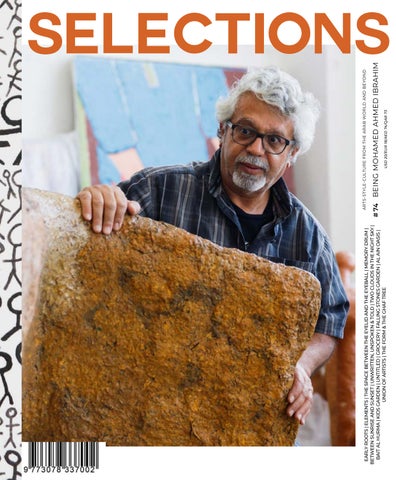
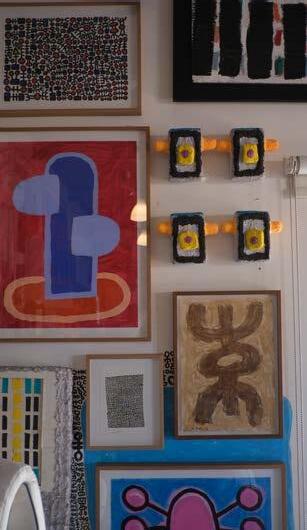
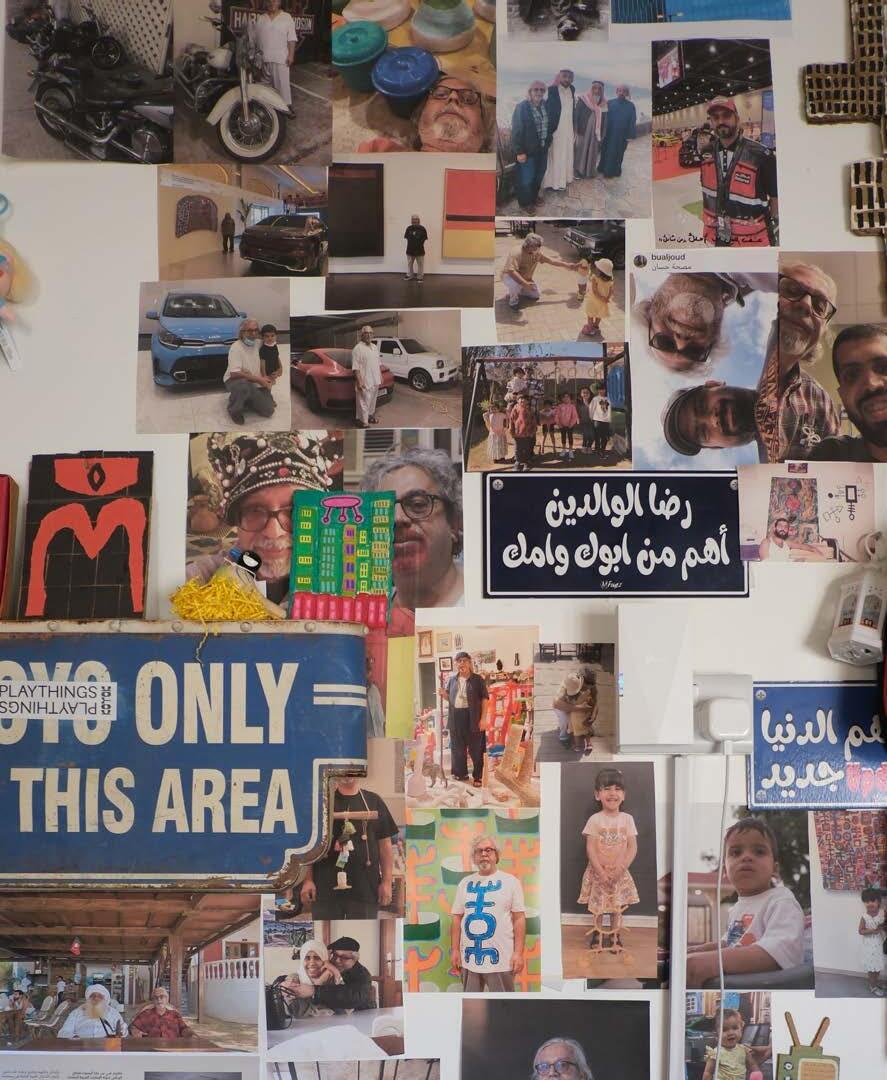
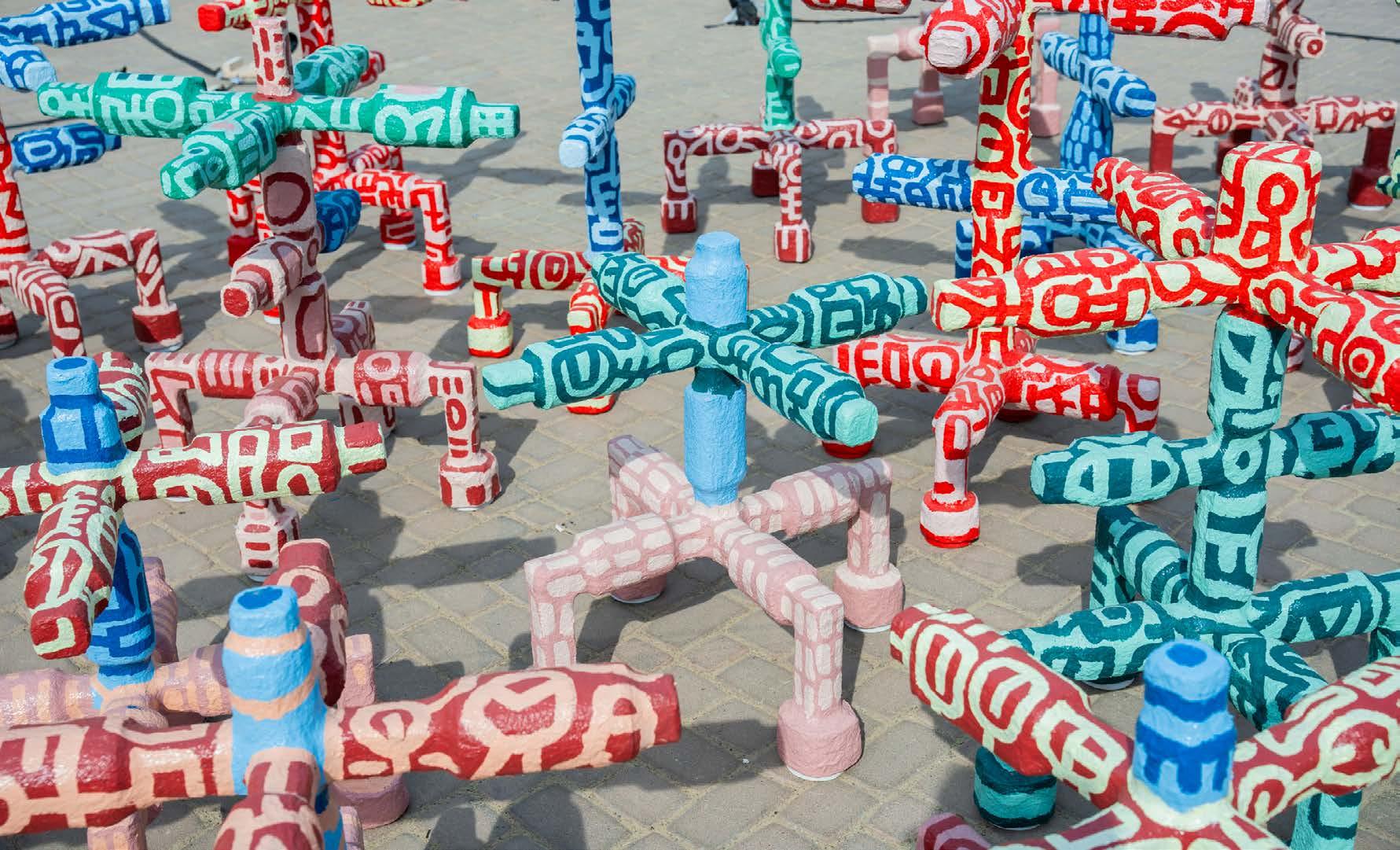
Tere is a particular kind of joy that lives inside the work of Mohamad Ahmad Ibrahim. It is bright, playful, unapologetically naïve, and deeply intelligent. His colours feel as though they were chosen by a child who never agreed to grow quiet. His shapes repeat, insist, and dance. Behind this apparent simplicity lies a lifetime of looking, surviving, and believing in art when almost nothing around him encouraged it.
Ibrahim is no ordinary artist. And he did not emerge from an ordinary environment.
When he began his journey, there was no established art infrastructure in the UAE, nor in the wider region. No clear paths or validation. What existed instead was conviction. Alongside what would later be known as the “Five,” a group of contemporary artists he worked closely with, he helped form a community when community itself still had to be imagined. Together, they navigated the emotional terrain familiar to every artist: doubt, isolation, persistence, and hope, without precedents to guide them.
Today, that same environment not only accepts Ibrahim; it celebrates him.
In recent years, Mohamad Ahmad Ibrahim has continued to shape the narrative of contemporary Emirati art on an international scale.
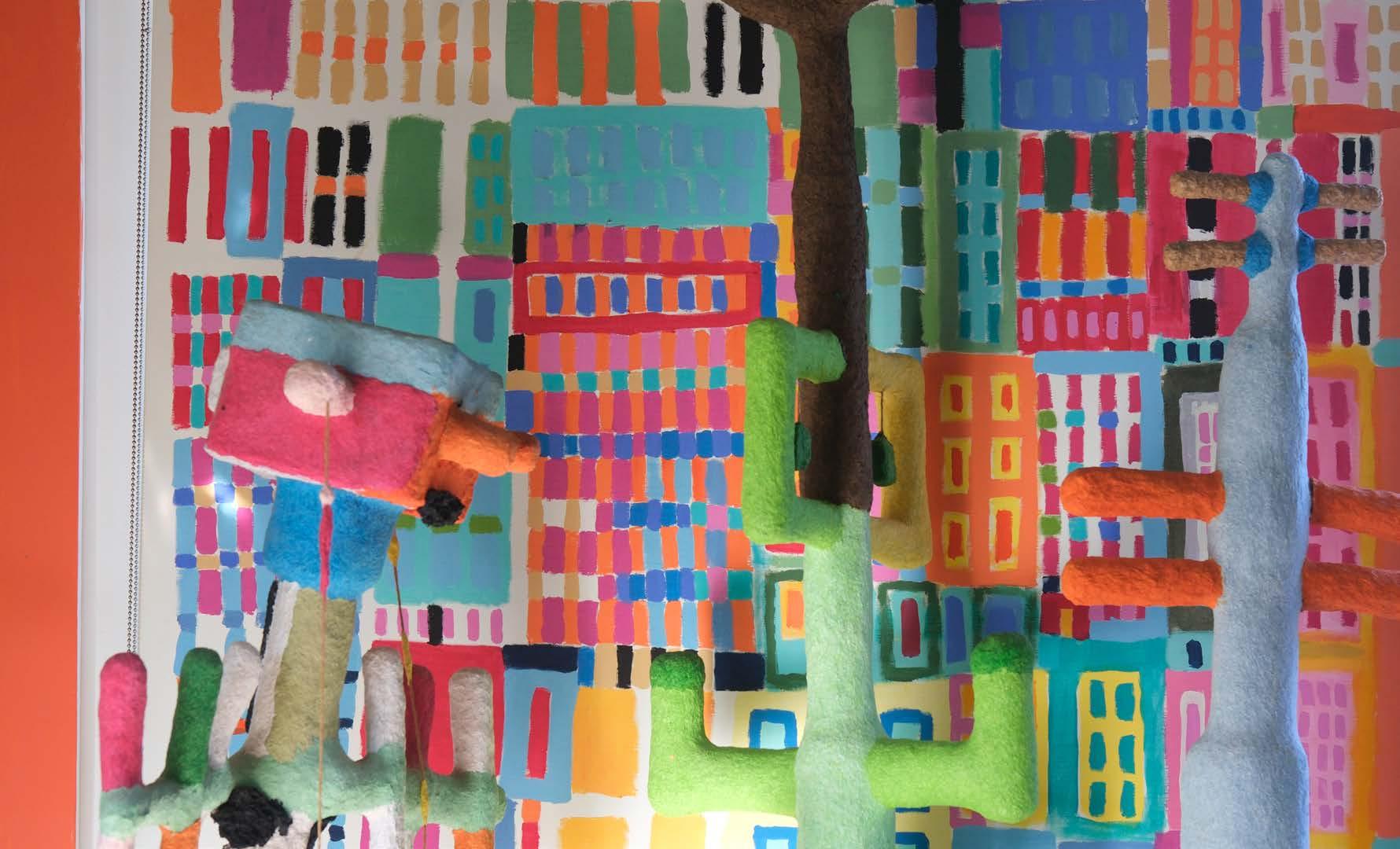
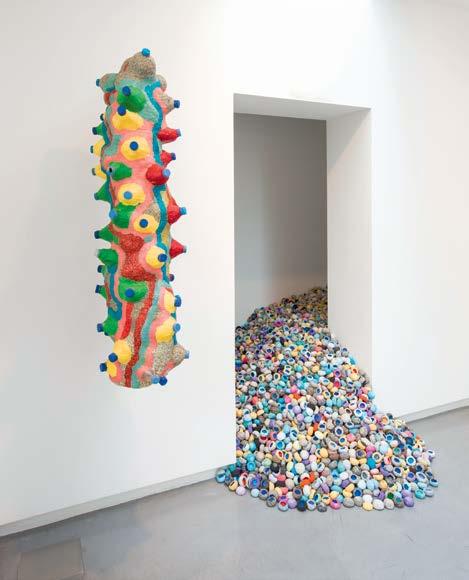
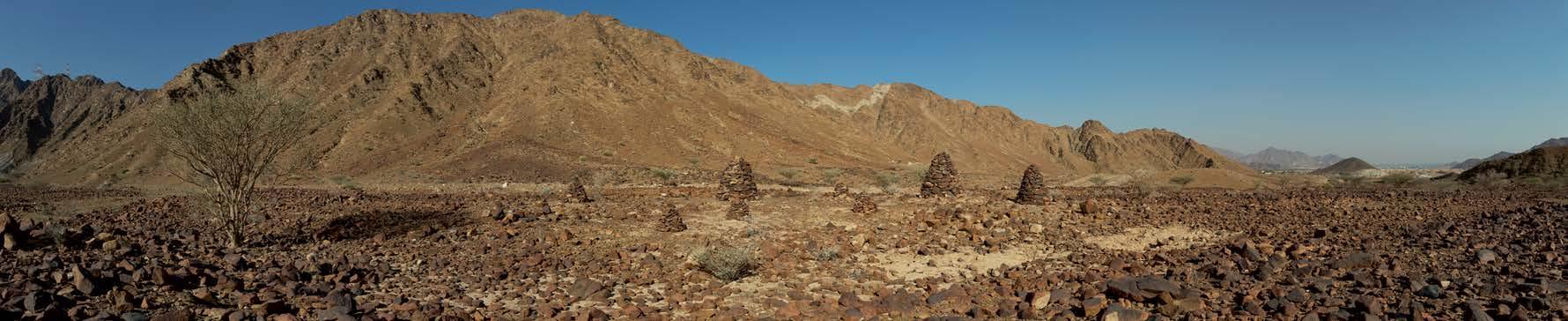
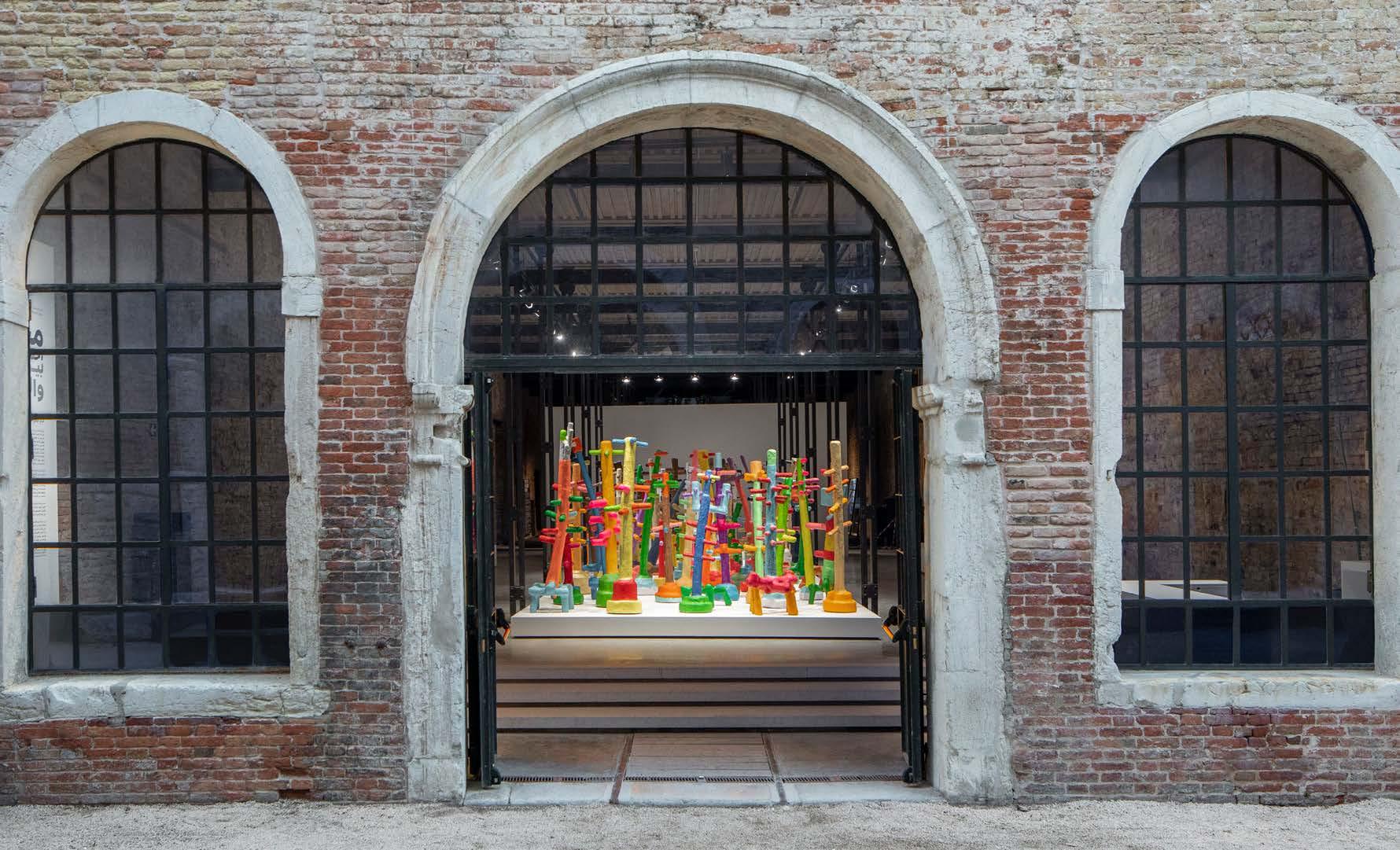
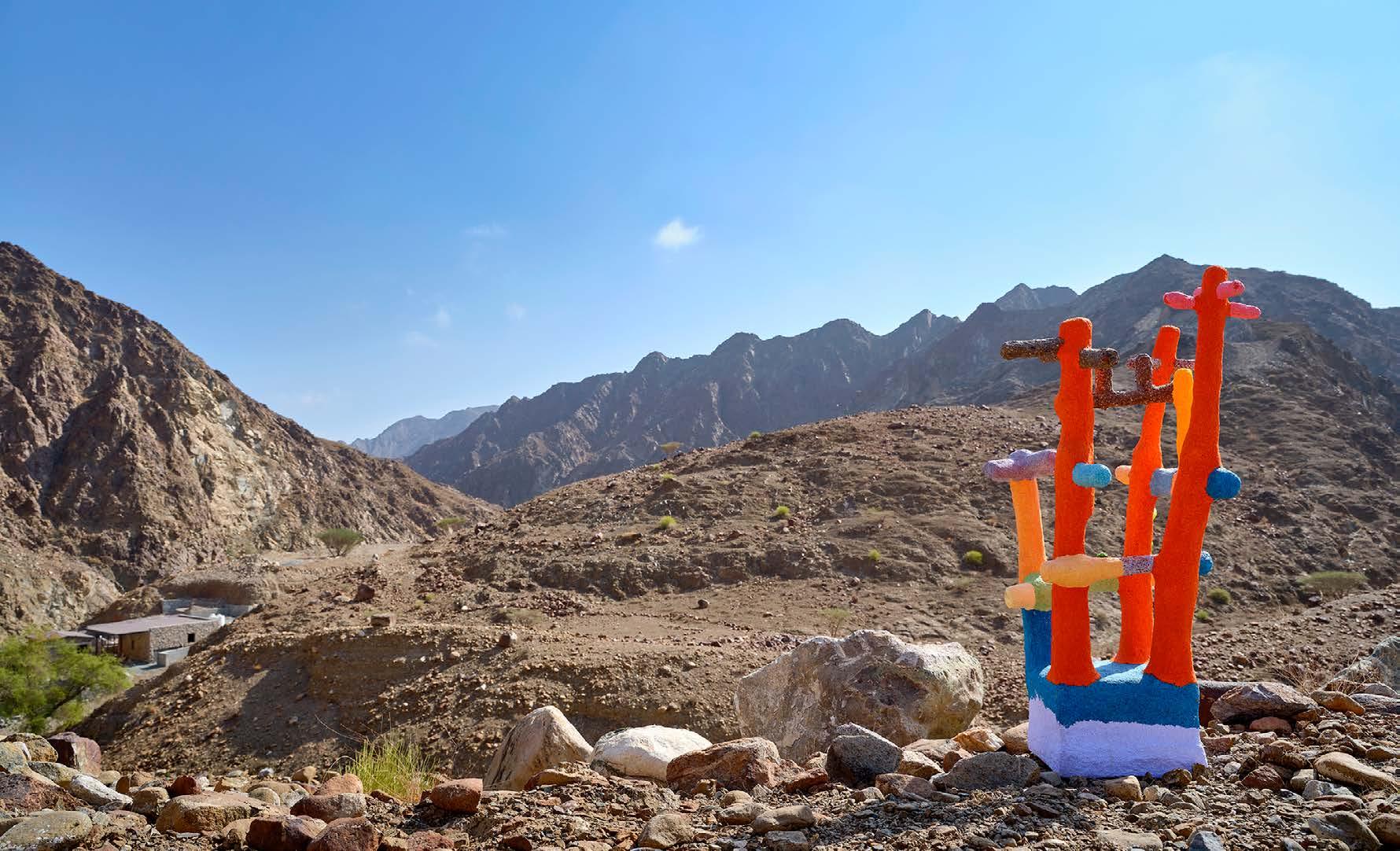
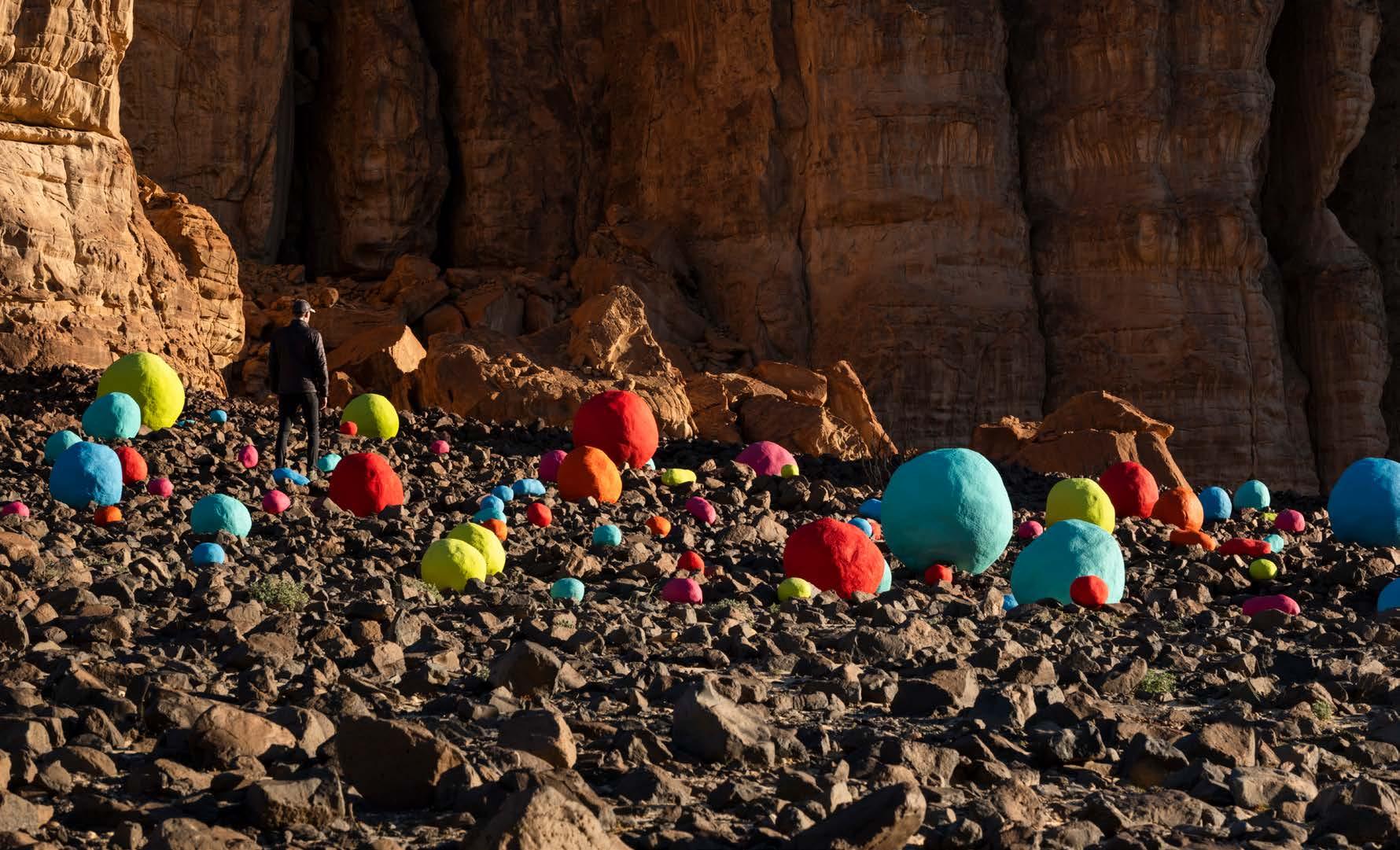
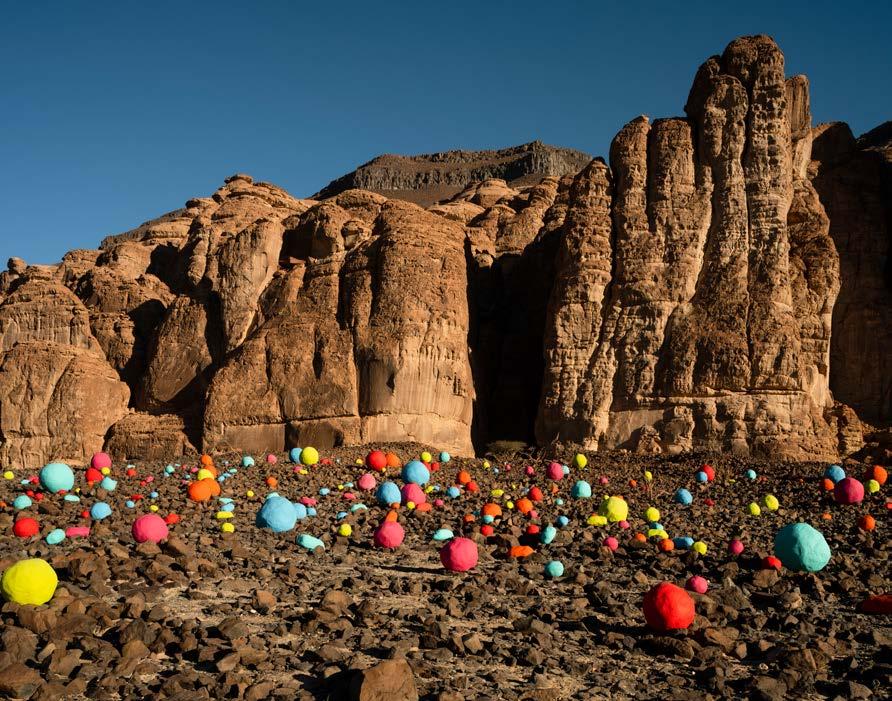
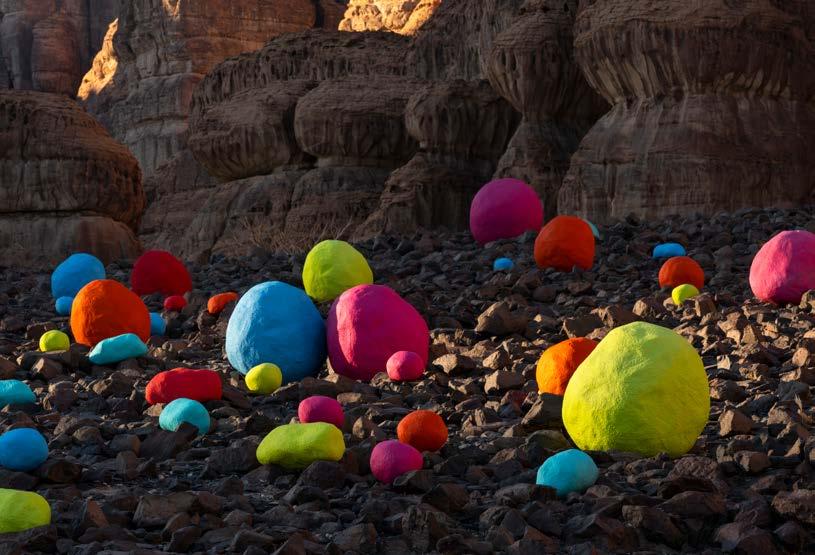
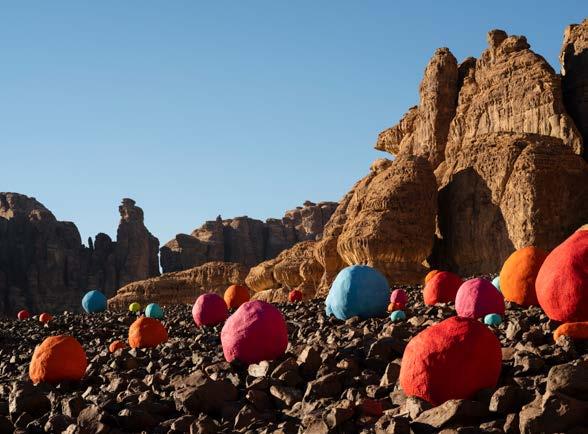
In 2020, he created Falling Stones Garden, a site-specifc installation of 320 brightly coloured, stone-like forms for Desert X AlUla, inviting viewers to reconsider the desert landscape with renewed attentiveness. In 2022, he represented the UAE at the 59th Venice Biennale with Between Sunrise and Sunset, a sculptural installation where light, form, and memory converged.
In 2024, several of his works entered the collection of the Solomon R. Guggenheim Museum in New York, marking signifcant institutional recognition of his contribution to contemporary art.
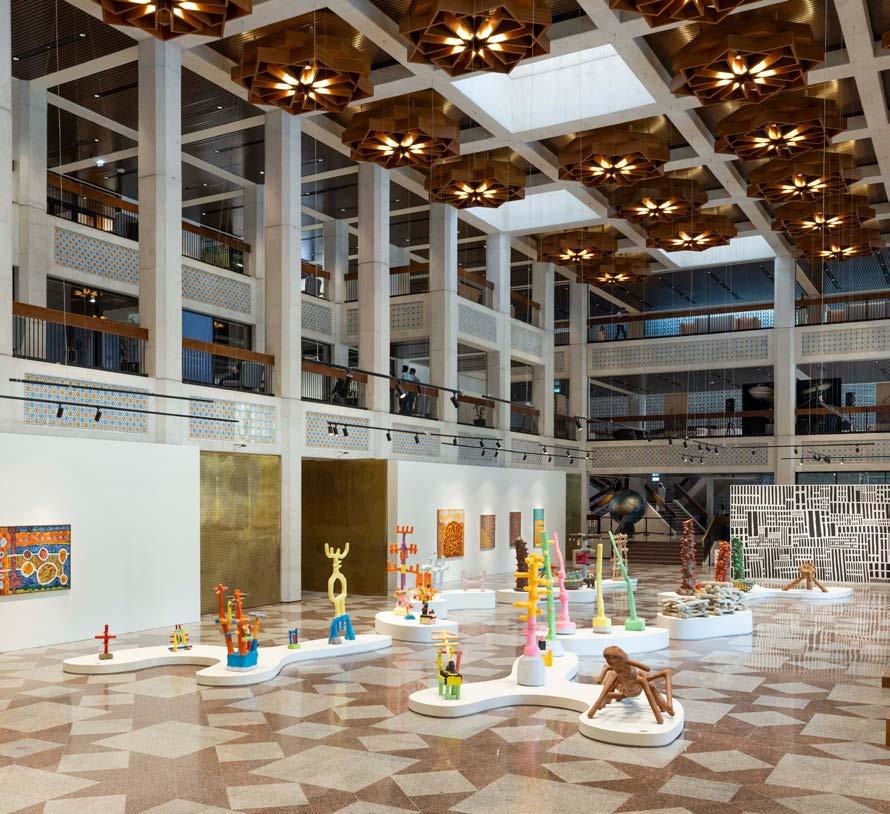
Most recently, his solo exhibition Two Clouds in the Night Sky (2025–2026) at the Cultural Foundation in Abu Dhabi offered a poetic and immersive
refection on colour, repetition, and nature, reaffrming his enduring infuence on the UAE art scene.
Tis monograph is both a celebration of an artist’s career and a portrait of endurance, curiosity, and joy. To enter Ibrahim’s world is to remember that art does not need to be loud to be radical, nor complex to be profound. Sometimes, happiness itself is the bravest gesture.
We are deeply honoured to have worked so closely with Mohamad Ahmad Ibrahim for this issue. It would not have been possible without the generosity of Kaph Books in providing archival material, nor without Mohamad himself, his family, and of course, the cat.
Above all, we thank the artist who reminds us that repetition can be freedom, colour can be memory, and joy can be a lifelong discipline.
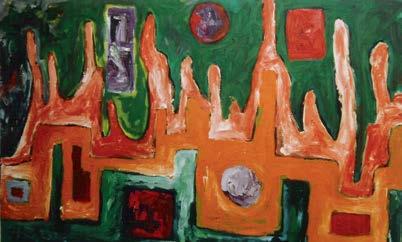
His early work was almost like discarded trash: raw and experimental. He painted extensively in oil, and each work looked entirely different from the next. Much of that early production no longer exists; it was destroyed or burned by him, making this period diffcult to trace.
From the mid-2000s onward, his practice became more structured, developing in series that span several styles and media at once. He often begins with a large batch of materials and lets them guide his process. For example, when he was producing a number of black-and-white works, I asked him where they ft within his broader practice, and he said, “I got a lot of black-and-white paper, so I just worked my way through it.” His choice of materials often determines the direction of his work.
Around ten or more years ago, he created some remarkable black-and-white pieces, though he hasn’t returned to them recently. Certain
IBRAHIM
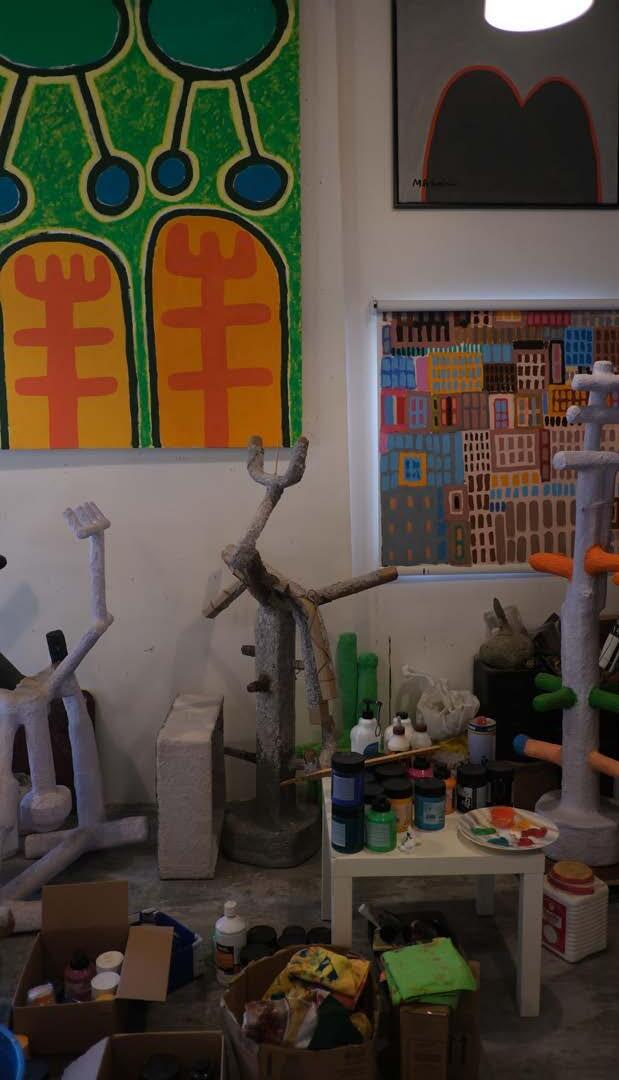
elements, however, keep reappearing. He often makes papier-mâché fgures that might resemble animals, trees, or people, producing them in series and revisiting them over time. Some motifs continually resurface, symbols he calls forms, revealing a self-referential approach to his practice.
If you visit his studio, you’ll notice that many of his papier-mâché fgures hold small bundles of pages covered in delicate marks. Tis gesture recurs throughout his work and traces back decades to when he frst began making art. While working in a police station early in his life, he would fll his notebooks with small marks to pass the time: a quiet act that became a foundational element of his visual language.
WILLIAM LAWRIE ON MOHAMED AHMED
52
Founder
Rima Nasser
Editor-in-Chief
Anastasia Nysten
Designer
Maria Maalouf
Project Manager
Yasmina Hammoud
All images marked with an asterisk (*) originate from the publication commissioned by the National Pavilion UAE for its participation in La Biennale di Venezia – Biennale Arte 2022.
Unless otherwise stated, all images are courtesy of the artist. We would like to extend our sincere thanks to KAPH Books, Lawrie Shabibi Gallery, Mohamed Ahmed Ibrahim, the National Pavilion UAE and Sueraya Shaheen for their kind support.
Copy editor
Bryn Haworth
Editorial and Advertising Inquiries
Anastasia Nysten
anastasia@selectionsarts.com selectionsarts.com
facebook.com/selectionsarts
instagram.com/selections_arts
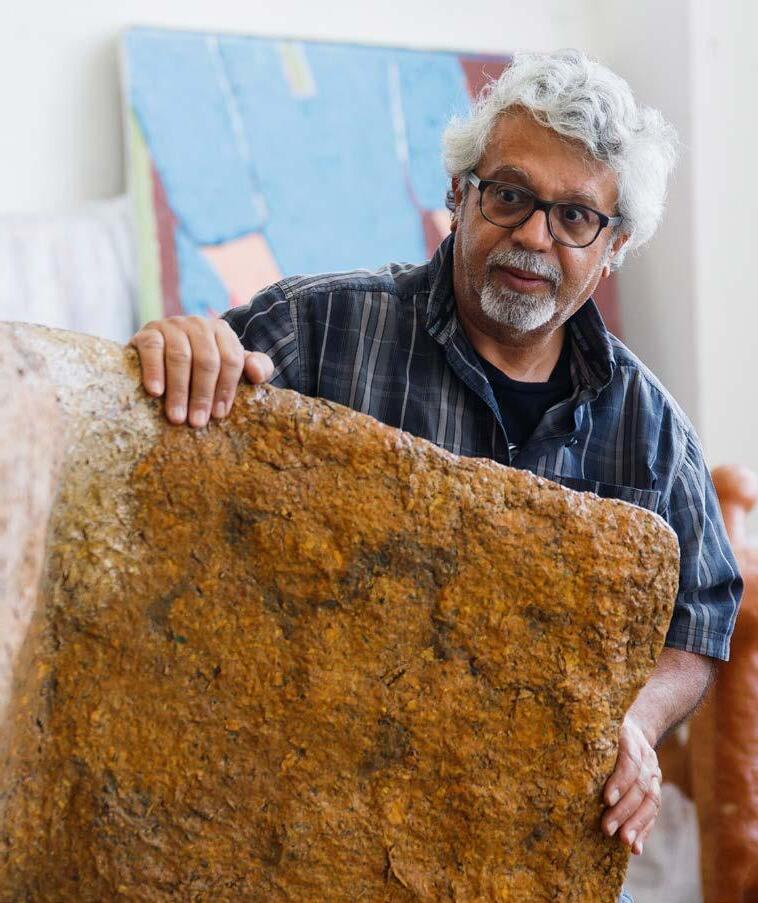
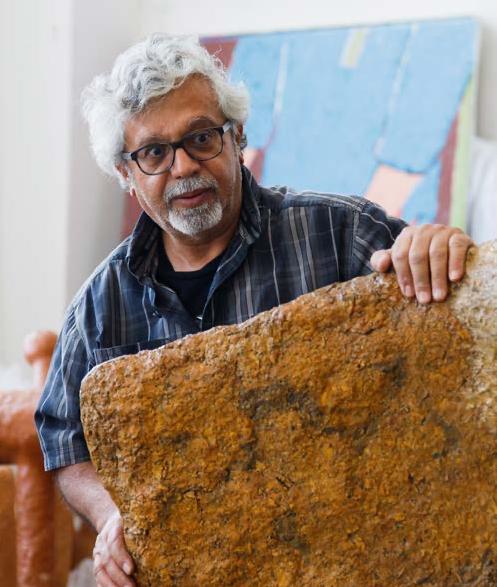
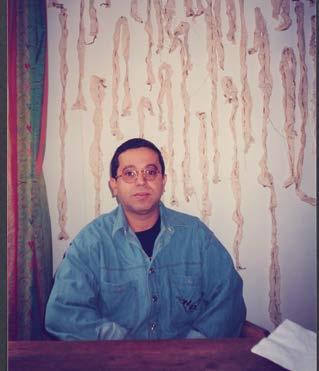
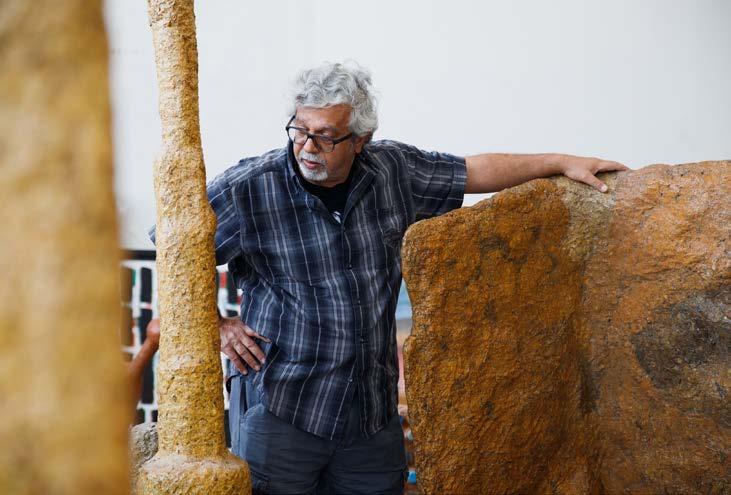
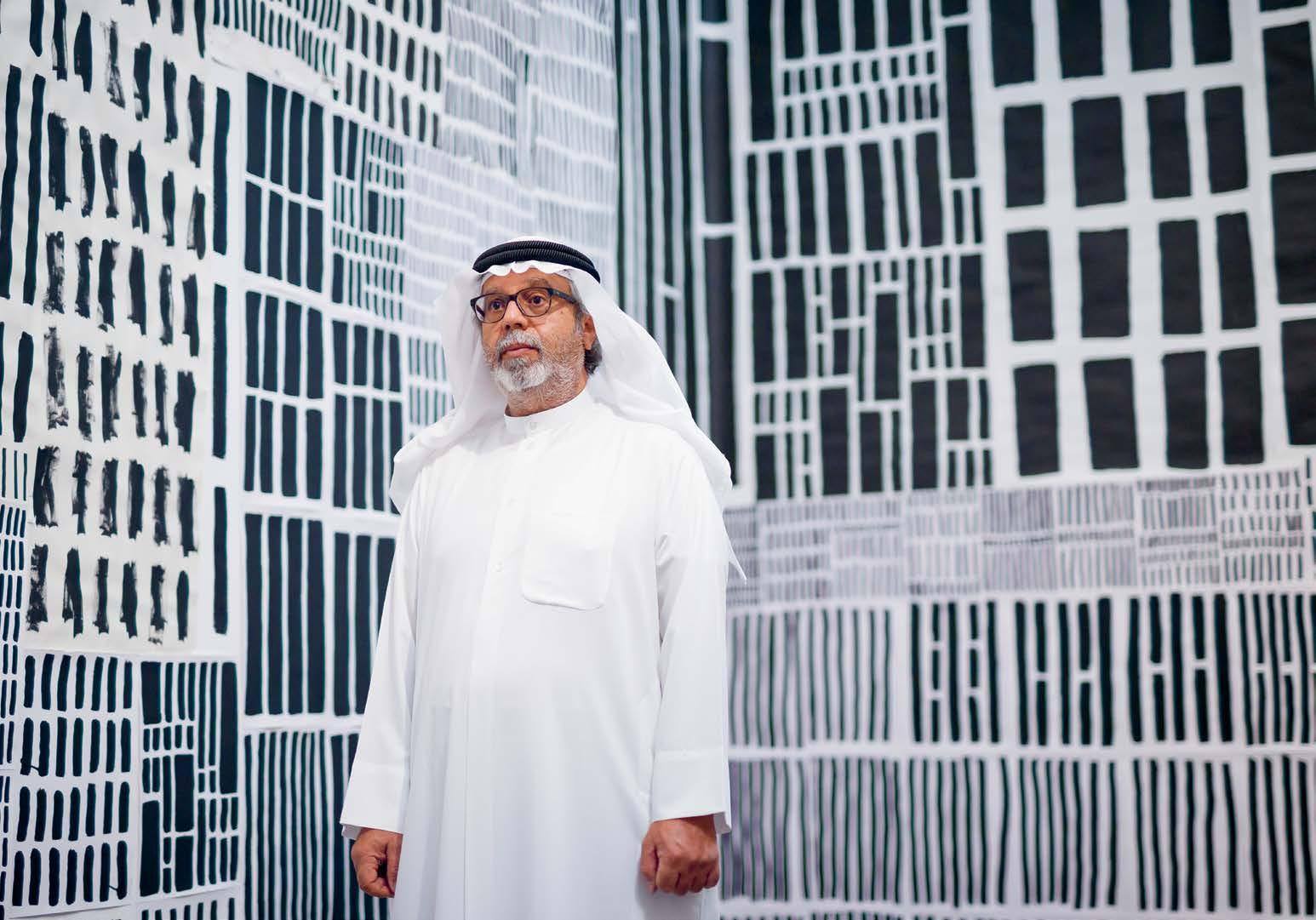
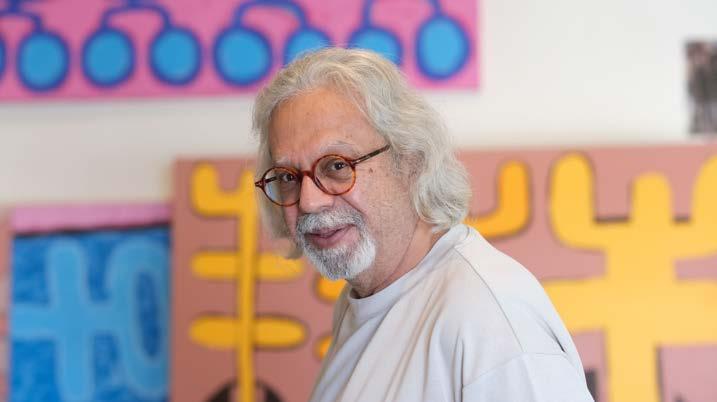
Mohamed Ahmed Ibrahim at his studio. Courtesy of Lawrie Shabibi.
Young Serwan Baran on his mother’s lap and other members of his family
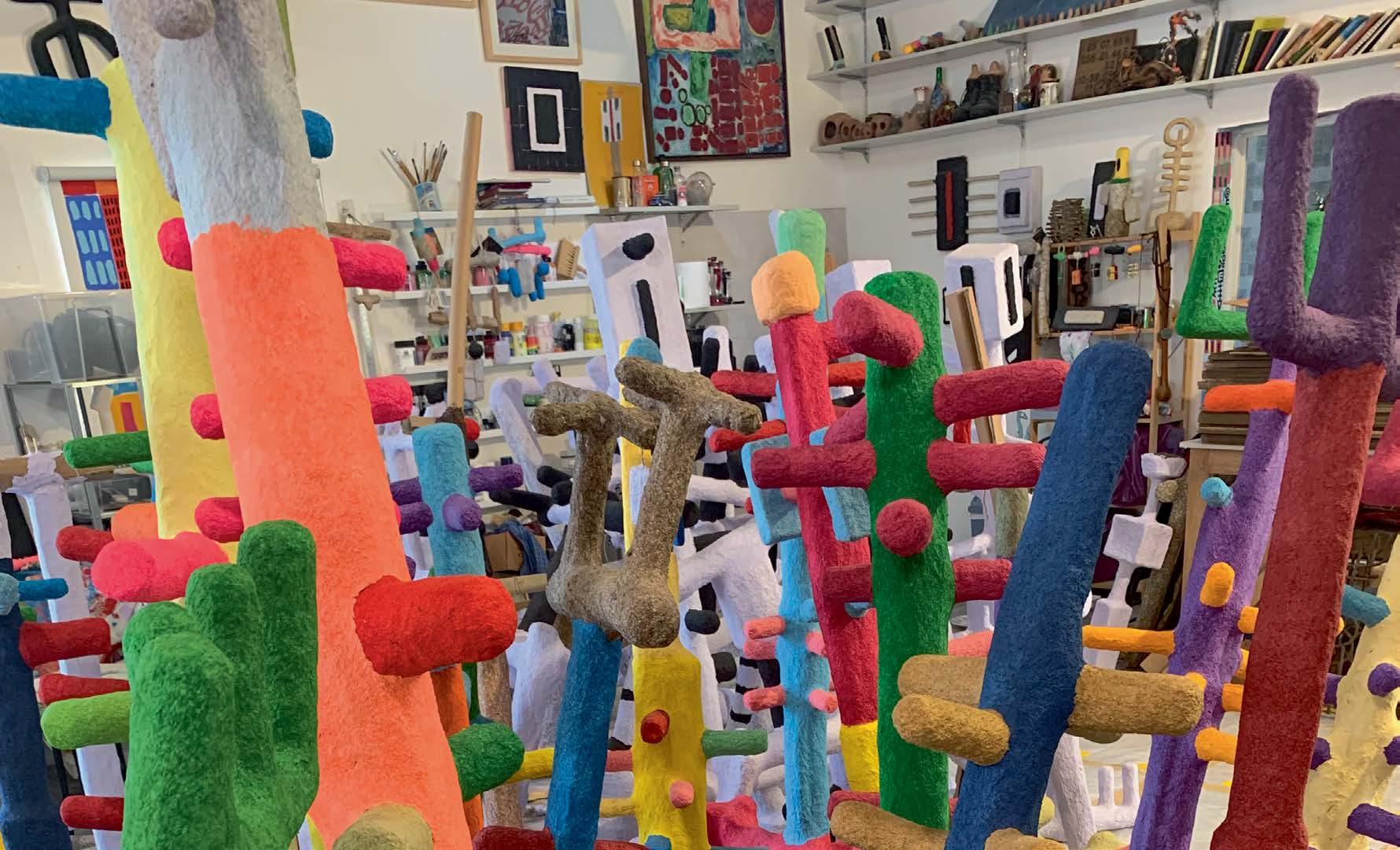
Work in progress view of Between Sunrise and Sunset, 2022, in the artist’s studio. Courtesy of the artist.*
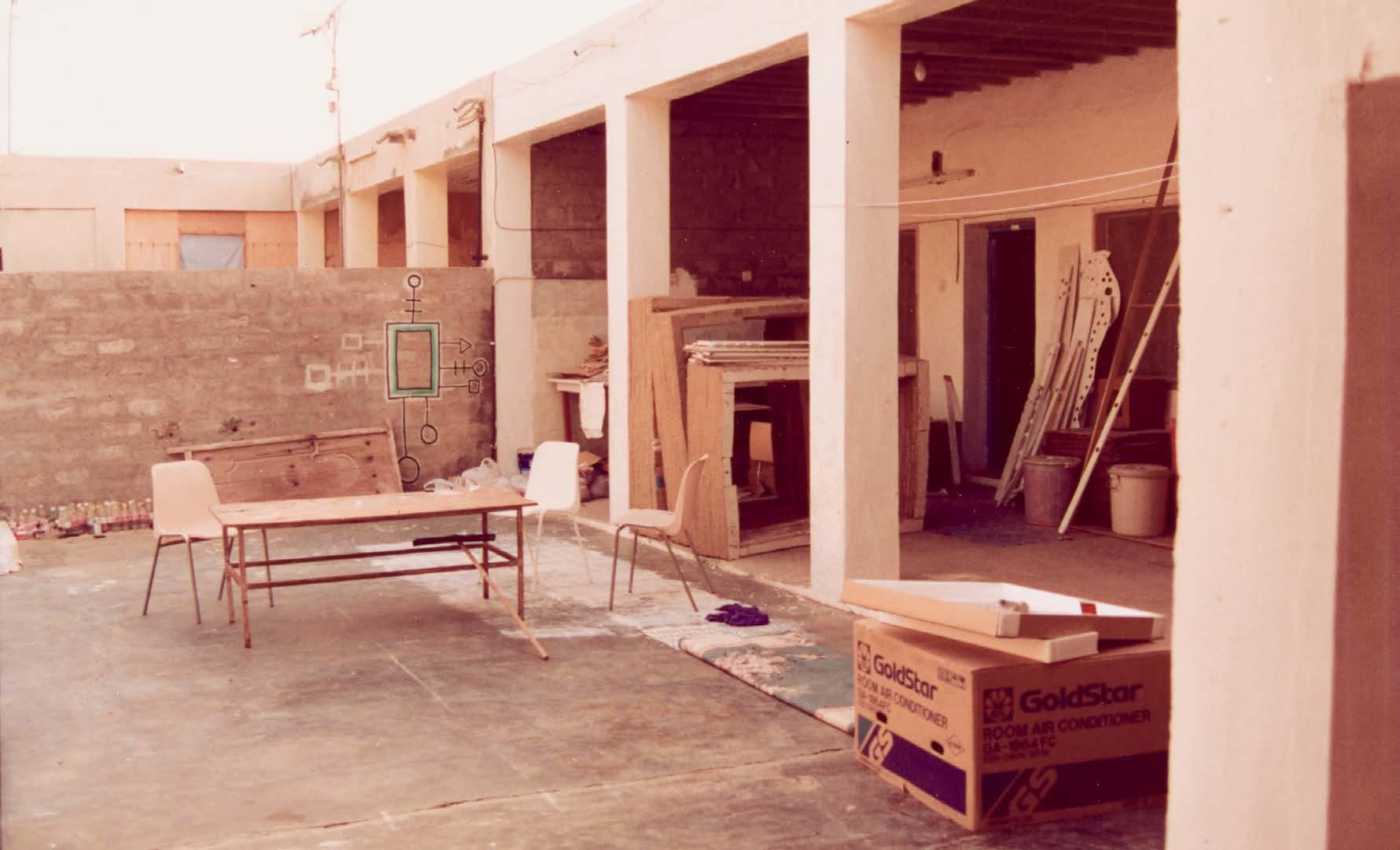
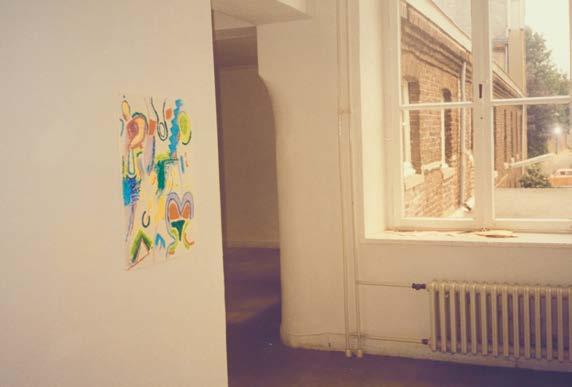
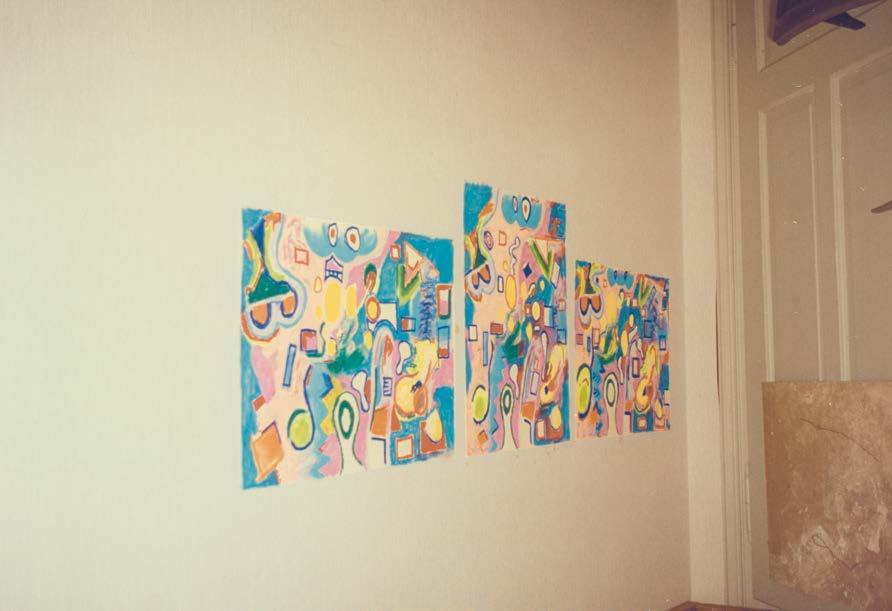
The Khor Fakkan branch of the Emirates Fine Arts Society. Two-bedroom and one mailis shaabi house-turned studio.
Pictured here is the garage work space, c. 1994.*
01
EARLY ROOTS
Born in Khor Fakkan in 1962, Mohamed Ahmed Ibrahim is one of the pioneers of contemporary art in the UAE. He is a founding member of the country’s experimental art movement and a fgure whose practice has remained deeply connected to the rhythms of nature and the landscape of his birthplace. In this intimate conversation, he recalls his formative years in a small coastal village, his early
fascination with drawing, and the profound infuence of his father’s curiosity about the wider world. From discovering Picasso’s Guernica as a teenager to meeting Hassan Sharif and joining a generation that redefned art in the Emirates, Ibrahim refects on the beginnings of a lifelong journey shaped by friendship, intuition, and an enduring dialogue between nature and the self.
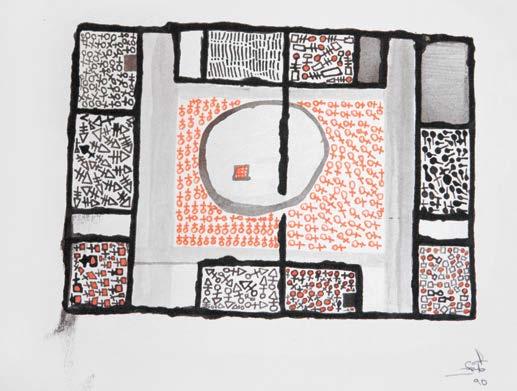
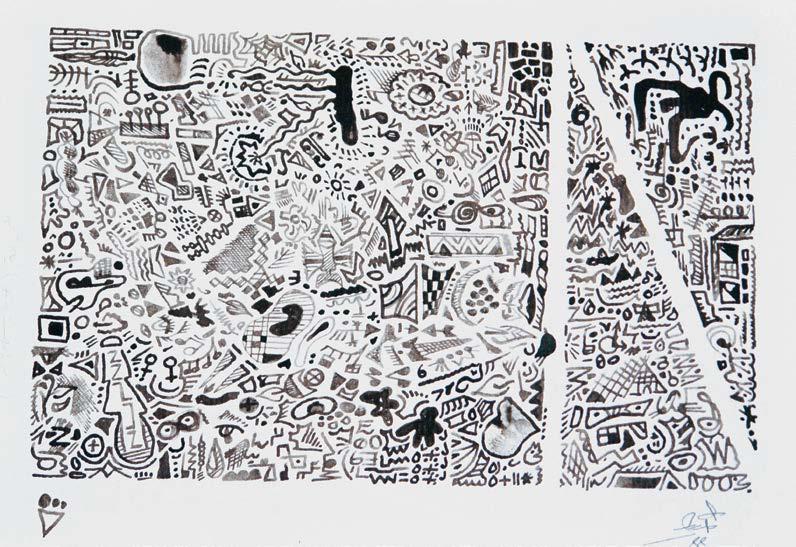
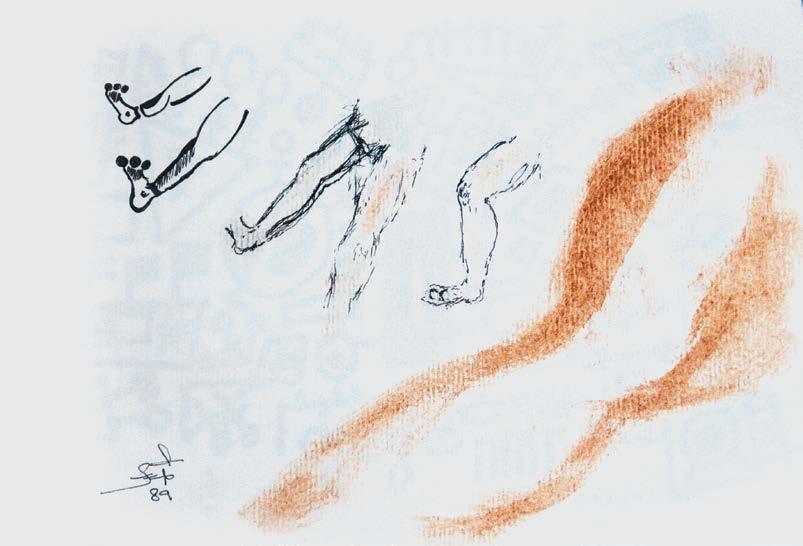
(This Page) Note Book No 02, 1990, India ink on paper, 18 x 25 cm. Courtesy of the archive of The Flying House.*
Can you tell us about your family and childhood, and how your interest in art began?
I was born in 1962 in Khor Fakkan, which was a small village at the time. It’s on the east coast of the UAE, near Sharjah. I was always getting into mischief at school, but I was very close to my art, Arabic, and geography teachers. We used to make our own educational materials by hand, and I loved that process. I used to use colours and draw portraits. I didn’t even think of them as portraits. I just liked drawing people.
How old were you?
I was ten or eleven years old at the time and I got a lot of encouragement from my teachers. Tey told me I had a special talent.
Did your family encourage you?
Yes, I got a lot of encouragement from my family too, especially from my father. He was an adventurous man. He started his working life as a pearl diver in the 1920s. Ten he became a sailor and travelled to India,
Africa, even Greece. He was illiterate, but he spoke English and French fuently. He also spoke Swahili, and some Greek. He inspired me a lot – not just because of what he did, but because he was so curious and open to the world.
than just drawing?
It’s hard to pin down exactly. It was probably when I came across a newspaper story in Arabic about Picasso’s Guernica It was then I realised that art was not just about making beautiful images. It could have a message behind it. Guernica was the frst work I’d
seen that broke the rules of painting. Te shapes were divorced from reality. Te head of a human being, or of a bull, was not like any I had seen before. I learnt that there was complete freedom in drawing, that you didn’t have to convey reality as it was; you could express your own way of seeing it.
How old were you?
About 15 or 16 years old. It was before I graduated from high school. Trough these discoveries, I got more and more attracted to art, and I tried to study it after graduation, but eventually ended up studying psychology.
Psychology seems very different to art. What attracted you to it?
Actually, psychology followed a parallel course to artistic discourse in many ways. Tey both deal with perception, thought, and emotion. It opened a lot of doors for me. It also raised a lot of questions.
At the same time, my brother-in-law was studying in Britain, and he started sending me books about art. In those days, there were very few books about art in Arabic. Tere were academic studies, but they lacked depth or complexity. Te books he sent me were in English and German, so I started translating them myself, word by word. It was very slow, but I enjoyed doing it. I could read English pretty well in the end, but sometimes the terms were a bit diffcult and I would have to consult the dictionary. I could spend months reading a single book!
I read about movements and art history. I learned about everything, from the classical beginnings to the icons in the churches. I was at the stage of formation, just grabbing as much knowledge as I could and working out my own position on all this. Eventually, I became convinced that art was really something different. It was a refection of you as a person: your thinking, your vision, your religion, how you look at the world. It could even refect the way you eat! Every aspect of life.
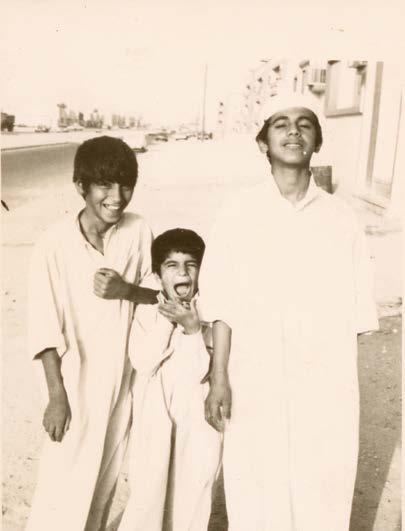
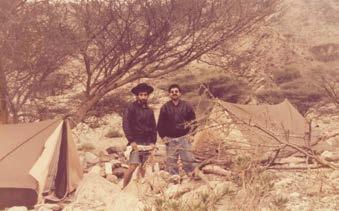
(Above) Mohamed Ahmed Ibrahim (right) with his younger brother Ali Ahmed Ibrahim (middle) and neighbour Ibrahim Ali Issa (left). Al Khaitan neighbourhood, Kuwait, 1974.*
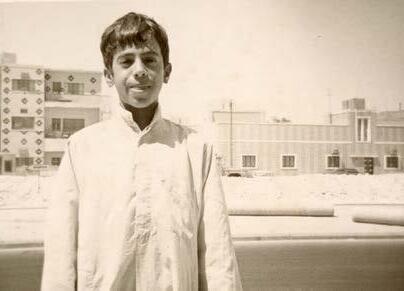
(Left) Mohamed Ahmed Ibrahim in front of the building where his teacher lived. Mohamed lived adjacent to these buildings, in the neighbourhood near AlRandi house where a musical group would play, n.d.(right).*
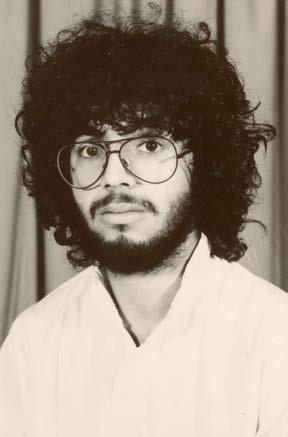
(Left) Mohamed Ahmed Ibrahim, Yearly Self Portrait, c. 1979, Khor Fakkan, UAE.*
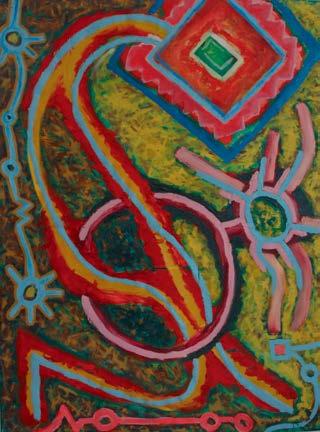
(Below) Abstract 1, 1986, oil on canvas, 120 x 90 cm.*
the most?
Initially, I wasn’t infuenced by anyone in particular. Ten, in 1987, I got hold of a book by the artist Paul Klee, called Te Tinking Eye As soon as I began reading it, I knew I’d met a like-minded person. He speaks about movement, and about the dot, and I saw connections with Arab philosophy and Suf thought. So, it wasn’t his artistic style that infuenced me. It was his way of thinking about art.
How did you start producing your own work? Was it easy to get the canvases, the paint and other tools in the Emirates at the time?
Tey were available, but very poor quality. I mean, the tools were basic, not professional, and the materials were not the best. In 1985, I joined a workshop run by Dr Yaser Dweik in Sharjah, and there I learned how to use various techniques. From A to Z, to be honest. I learnt how to use watercolours, oils, acrylics, and how to stretch and prepare canvases. We used tent fabric for canvas. It wasn’t ideal, but such limitations taught me to improvise. I liked the process of making a painting according to my own vision. It was around 1987 that I started producing in earnest.
And did you have a community of artists or friends around you?
Well, they weren’t artists at frst. Tey were friends I used to hang out with. Some were interested in writing and reading. Others were interested in music. One close friend was studying philosophy. We used to meet in our psychology classes. Te frst time he came to my place, he saw the paintings.
What was his name?
Ali Al-Andal. He was one of the young revolutionaries in poetry and he introduced me to Hassan Sharif. I showed Hassan my work and afterwards he invited me out to a bar for a couple of beers. Well, we didn’t leave that bar till the early hours. When I met Hassan, a sort of explosion happened inside me. It was as if I’d been walking alone through a desert and suddenly there was someone by my side. Tat’s how it felt. And it became a mutual feeling between the two of us. He was in the same situation as me. Te only difference was that he studied art.
We started having conversations and debates, and we continued to support each other. When you practise something, it starts to accumulate at the sensory,
cognitive and knowledge levels. And it’s continued from that day. One’s experience develops. I liken it to a snowball. Te further it rolls, the bigger it gets. So, in short, these were the beginnings.
And does your wife draw or do art?
No, my wife was a teacher. She didn’t have any connection with art, music, or culture in general. But she was a big support for me, in terms of supporting the family. At that time, I was away from home for months on end, but she always supported me.
And your children?
My children were interested in art when they were young, but as they grew older their interest faded. Tey didn’t share my passion. When it comes to art, the most important thing is to be passionate about it.
S
Right after I met Hassan Sharif, they had the annual exhibition at the Emirates Fine Arts Society. Hassan chose about fve of my works to present, but the board of directors wouldn’t accept them. Hassan was undaunted and took one of my works to them. He said this work had to be presented. He imposed it on them. From then on, I became involved with the association and this was the frst exhibition in which I exhibited one work.
Te second exhibition included fve of my works, but the administration placed them at the end of the show. Ten, before the exhibition opened, they put a red barrier up so that people wouldn’t be able to get near my works. Tis action made me sad, but also resilient. When someone tells you no, you want to prove them wrong. I spoke to Hassan Sharif about it and he supported me. He said this showed the power of my artworks. Tat really encouraged me.
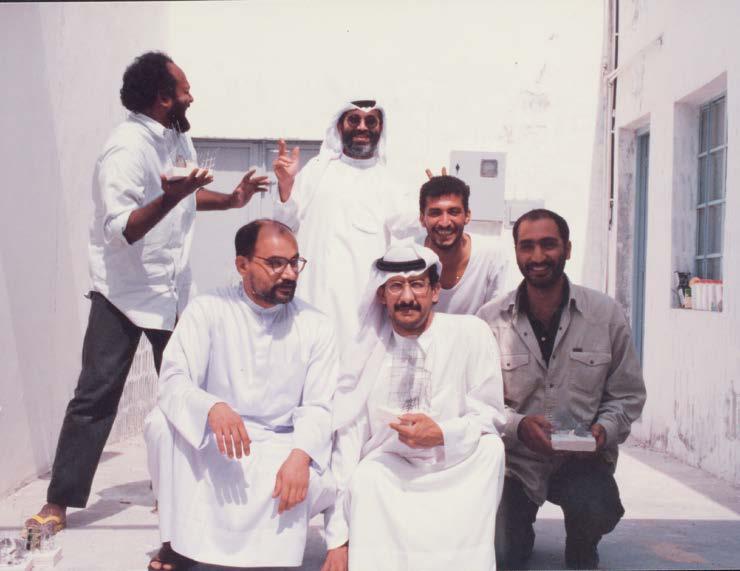
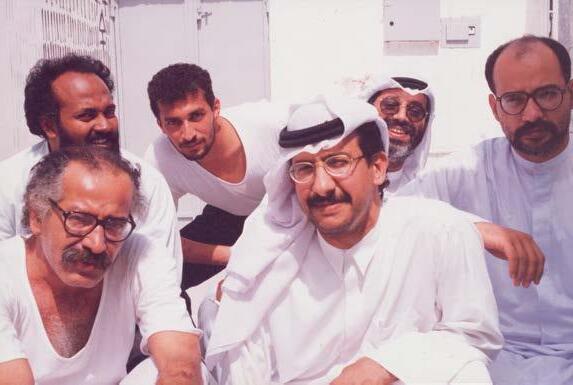
Left to right: Vivek Vilasini (standing), Hussain Sharif (front), Mohamed Ahmed Ibrahim (back), Abdullah Abdelwahab (front), Mohammed Kazem (back), Mohamed Al Mazrouei (front).
In the courtyard of Hassan Sharif’s home in Dubai’s Satwa neighborhood, c. 1996.
Photo: Hassan Sharif.*
Left to right: Hassan Sharif (front) Vivek Vilasini (back), Mohammed Kazem (back), Abdullah Abdelwahab (front), Mohamed Ahmed Ibrahim (back), Hussain Sharif (back).
In the courtyard of Hassan Sharif’s home.*
Form 2, 1989, Oil on canvas, 90 x 120 cm Courtesy of the archive of The Flying House.*
Documentation of Mohamed Ahmed Ibrahim’s performance at the Sittard Art Centre, the Netherlands, 1994.*
When did you meet Abdullah Al Saadi?
I met him later, when the exhibitions were happening. His thinking was close to that of Hassan and myself at that time. Tere was also Hassan Sharif’s brother, Hussain. So, there were four of us in all. And then there was Mohammed Kazem. At that time, he was very young, but his experience was strong regardless of his age. His work was very different. He entered the feld of experimental art with us. We had a common discourse, a common vision, and we produced similar kinds of work. Each proposal was different from the other, but we were similar in the way we presented them, so we became good friends.
Were you inspired by each other?
Te inspiration came from our discussions. Each of us had a distinct personality, with a different method of production, but we were similar in our presentation.
Can you tell us about your exhibition at the Cultural Foundation?
Tat was my frst solo exhibition. I still do solo exhibitions, because I consider them a kind of transition, getting rid of the old and moving on to the new. Tey’re a type of renewal. When people ask me ‘What’s next?’ after an exhibition, I tend to avoid the question. It’s as if the next thing has already happened.
Who approached you to present in Dhaka Art Biennale?
It was because I was a member of the Emirates Fine Art Society. Because, you know, in those days there was no single instigator; everything was done through offcial invitations.
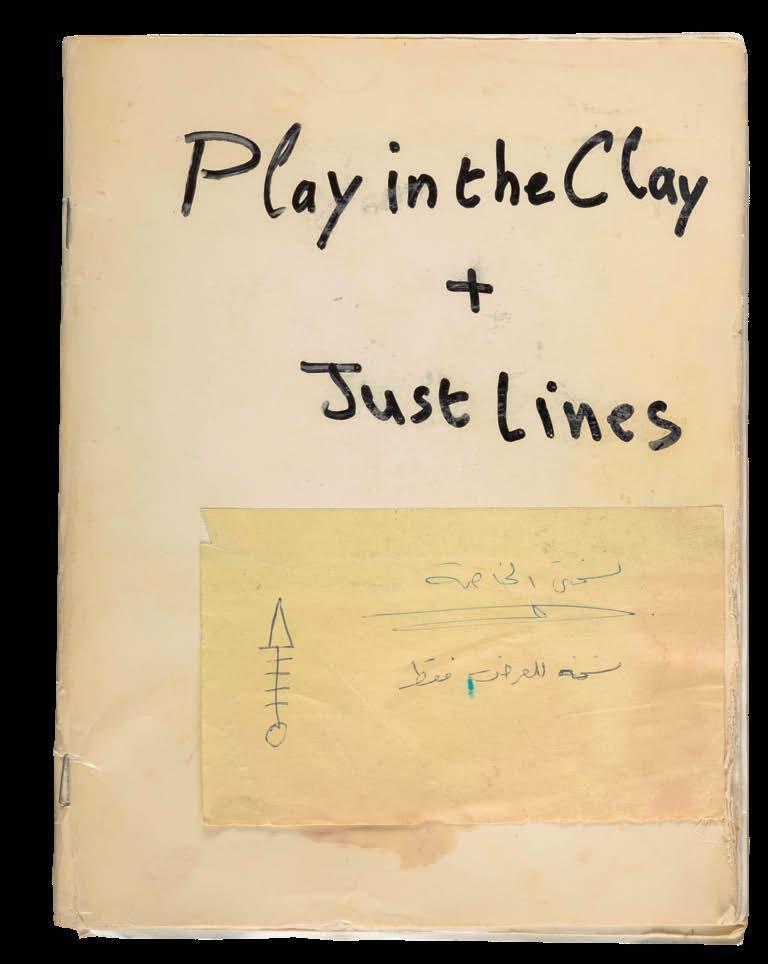
Play in the Clay + Just Lines, 1997, Handmade brochure, 21.5 x 16.5 cm.*
Sittard Art Center, the Netherlands, c. 1995.*
And what did you present in Dhaka?
I did an installation comprising eleven or twelve pieces. Te installation was like a painting from one side, which was coloured, while the other side was black and white.
You met Jos Clevers, the Dutch artist. Can you tell us about that?
It’s a story of how two souls meet. I used to work in the Sharjah Culture Department. I was a supervisor in the General Library. Tey knew I was an artist. Tey called me and said, ‘We have an artist who has a workshop for children in Sharjah and we want you to meet him and take him to Khor Fakkan so he can start a second workshop there.’
It was a very pleasant idea for me to get out and interact with someone in a different language. It turned out he was a bohemian with long hair. As soon as he got in the car, within the frst few minutes, we could see into each other’s souls. We had the same ideas and ways of viewing art as the rest of the group and we all became frm friends. And that same year, he became the director of the Kunstcentrum Sittard. He said, ‘I invite you to come to visit me in the summer, and you can work there, I’ll give you a studio.’ So, I went to the Netherlands in 1994. Tere was a studio and a place to live, and I started working there.
As a residency, you mean?
It wasn’t a residency as such, because I lived in his home, and the term residency didn’t exist yet. Tere was no mentor or room where you could go and buy your tools.
In 1995, he said ‘I’m going to do an exhibition for you at the Kunstcentrum Sittard.’ So we did a show, the four of us, me, Hassan Sharif, Hussain Sharif, and Mohammed Kazem. Te show was important for Jos, because while he was living in Abu Dhabi and Sharjah he’d met the director of a German museum. Tis person said to Jos, ‘In the Emirates there is no art, there are no artists!’ We are talking about the Nineties. So Jos arranged an exhibition as a challenge to this person, and invited him to open it, saying ‘Look, you said there was no art in the UAE. What about this?’ Eventually, in 2002, this person mounted an exhibition for us in Germany, in Aachen.
Tis is how our relationship with Jos grew. And then we became friends. He used to come to us once a year. I used to go three or four times a year to the Netherlands. He was among the founders of the Flying House. Te name was borrowed from the title of one of his paintings.
(Upper Left) Abdullah Al Saadi (left) and Mohamed Ahmed Ibrahim (right) in Khor Fakkan, n.d..*
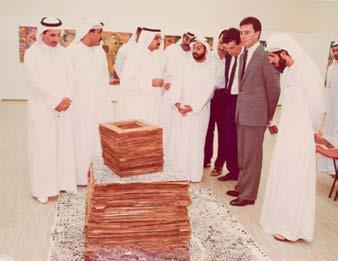
(Lower Left) Mohamed Ahmed Ibrahim’s frst solo exhibition, 1991. Opening reception at the Qasr Al Thaqafa.*
(Right) Mohamed Ahmed Ibrahim in Sittard, sitting in front of Hassan Sharif’s wall installation,
Lines, 1995, Acrylic on paper and cardboard boxes. Site-specifc installation at the Sittard Art Centre, the Netherlands.*
You participated in the Sharjah Biennale. Can you tell us about that?
I participated in the frst, second, third and fourth Sharjah Biennales. I think the last Biennale was when Sheikha Hoor Al Qasimi was the creator. Tat was in 2003, I think. And I participated in the Biennale and won two prizes for sculpture, even though I’m not a sculptor.
I was surprised and asked them ‘How can I win the frst prize in sculpture, even though I’ve never thought of myself as a sculptor?’ Te very concept of sculpture is slightly alien to us Arabs. I’m sorry to say, for a while there were a lot of things that we didn’t have. Many concepts and things were completely absent. For example, installations. Tat’s why, when they tried to fnd a name for it, they called it artistic work done in a vacuum. Yet, as you can see, painting is also working in a vacuum. Everything works in a vacuum.
You had Moscow, Dhaka, and so on. How did it feel to be exhibiting in places you weren’t familiar with. I’ve always believed artistic work has a message that can be shared all over the world. I mean, I could be working in Khor Fakkan, and another person might be living in Alaska or South America and producing similar works that speak the same language. Tis makes us stronger as human beings, as a culture. Tere are many similarities between us. In art, the language is universal.
artworks. Why did you do that?
It was in 1999, when I left my job in Khor Fakkan Art Centre. I had an entire warehouse for my stuff there. Imagine, I’d loaded it all in two trucks and I didn’t know where to take it. I used to live in my mother’s house. Tere were two rooms, one for me and one
Courtesy
Courtesy of the archive of The
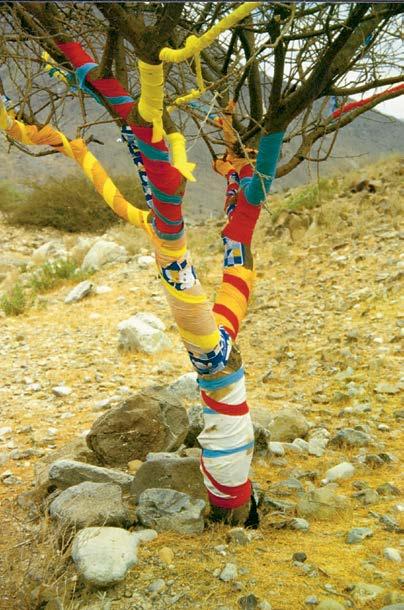
(Above) Draped Trees (Ashjar Muqammasha), 1996 Textiles, dimensions variable.
Courtesy of the archive of The Flying House.*
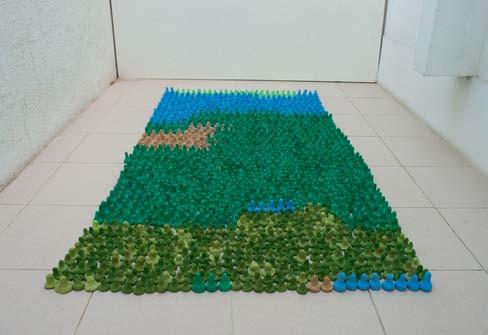
(Right) Carpet, 1997, paper and glue, 300 x 150 cm.
Courtesy of the archive of The Flying House.*
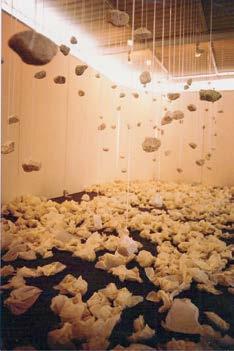
(Above) Hanging Stones, 1994. Installation at the EFAS Annual Exhibition.
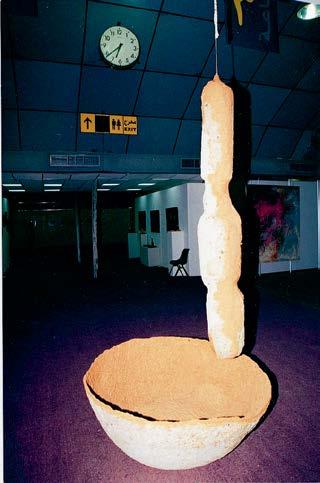
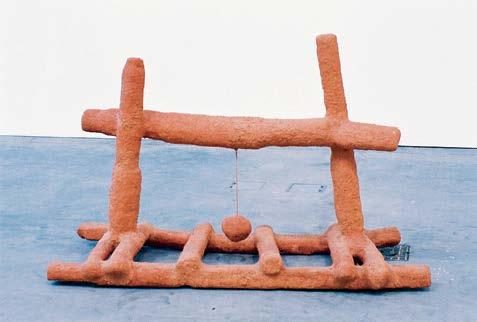
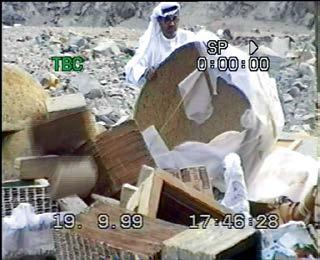
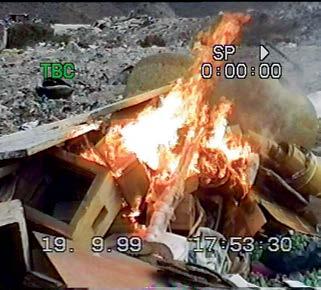
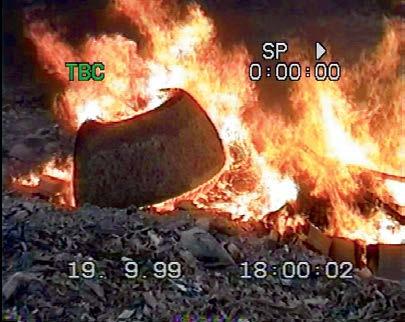
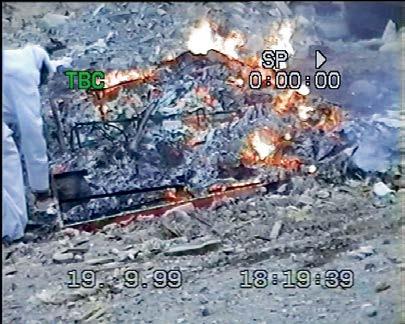
for my kids. Tere was no place for the art. So I drove away in a car with these two trucks behind. I didn’t know where to go, so we drove for about 30 minutes. In the end, the truck drivers got bored. Tey stopped me and said, ‘Where are you going to take us?’ I said, ‘I am paying you for your time, so don’t worry about it.’ I decided to take them to the mountain, which has fascinated me ever since I was a child. I went to the mountain and tried to lose them there. To be honest, I didn’t have a fre in mind, but I realised I didn’t want to leave the works with them, so I told them to burn the lot. Afterwards, I didn’t feel a thing. I went back home and, after an hour or two, I produced two drawings. It was a kind of cleansing, a new beginning.
What kind of works did you burn?
Paintings, objects, works that had won in the Biennale, everything. started from zero. I started again with those two new drawings.
But there were works that survived the fre. I used to give them to my family, to my friends, and after a
while, years maybe seven years ago, my son noticed this, and he started to gather the art. In some cases, they were happy to give them to him for free; in other cases, he had to buy them. In this way, we got about seven of the old paintings back.
A S
Yes, because I was jobless, so I spent about six months at home, hanging around. I couldn’t go out. I mean, I was very depressed, and I took up gardening. I found that trees were the only things I could talk to. My wife saw this and thought I was crazy to talk to trees. I was at home, and she came in and said, ‘Here’s your ticket; go and see your friend, Jos Clevers.’
I remember the reservation was for the next day. So, with almost no preparation, I got on the plane and went to the Netherlands to see Jos Clevers. I stayed there for about a year, till the end of 2000. Within a month, I was able to sell pieces of paper worth 100 euros, 200 euros.
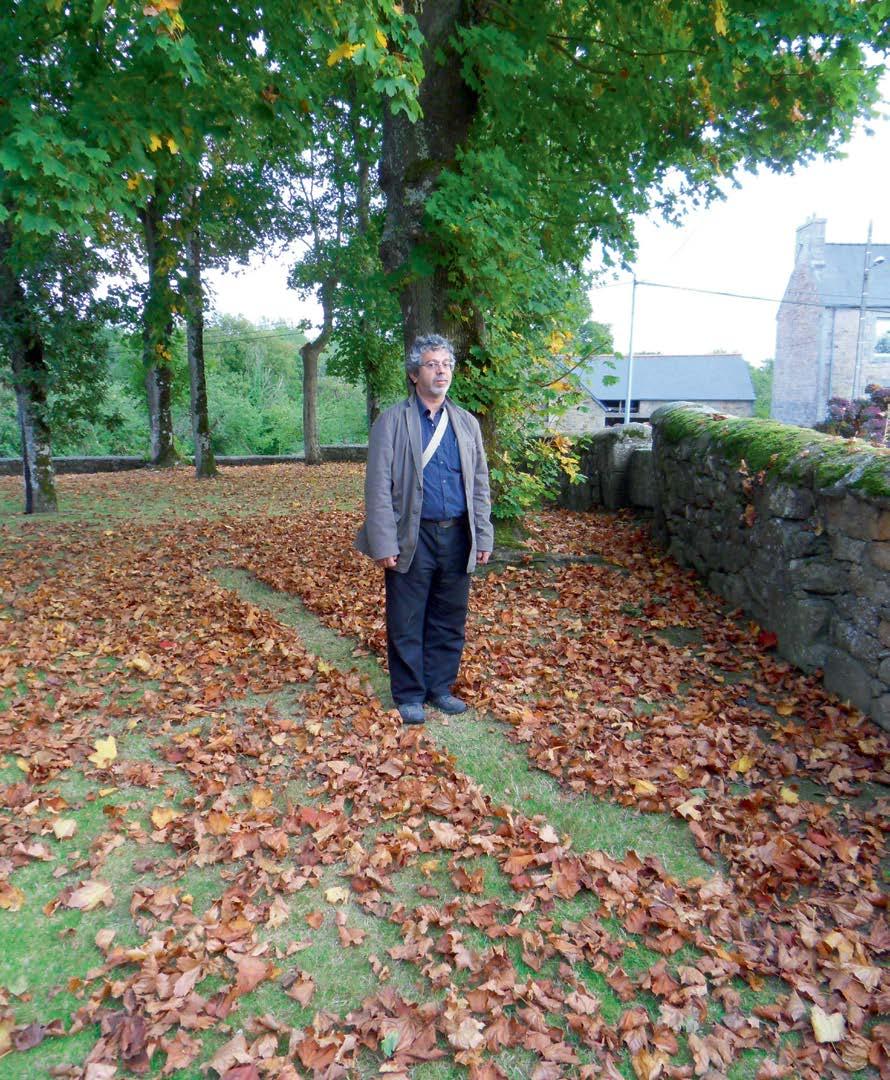
I also worked as a tractor driver on a dairy farm. And then I worked part-time as a cleaner. We would turn on the leaf blower and clear away the leaves in the autumn. I really enjoyed that. It turned into a kind of performance art for me.
After about a year, I realised I had to go back home. I worked as a bank clerk for a while, and I began to enter this psychological state, working in a crazy way. It was a kind of self-punishment. I didn’t like the work,
Left) Leaf, Clay, & Glue, 2001, Leaf, clay, glue, dimensions variable. Courtesy of the archive of The Flying House.*
(Opposite Right) Khor Fakkan (detail), 2002, Leaf, glue, clay, dimensions variable. Courtesy of the archive of The Flying House.*
(This Page) Burning Works (video still), 1999, video, silent.*
AFTERWARDS
D DN T FEEL A TH N WENT BAC HOME AND AFTER AN HOUR OR TWO RODUCED TWO DRAW N S T
WAS A ND OF CLEANS N A NEW BE NN N
(Opposite
to be honest. I knew I was being masochistic. But this work led to me becoming Area Manager. By the end of my career in the bank, I was the director for three branches. I kept at it for seven years, but whenever I didn’t have customers, I used to draw. I had secret place I kept my pencils in. Ten I woke up one morning and decided ‘I can’t be a banker anymore.’ I told my wife ‘I’m going to resign!’ and I left the bank for good.
Can you tell us about how you work today?
Well, when I started, my interest was always in the point and the shape. My work is still like that today, and it’s all a search for what’s behind the shape, a kind of quest for the most basic form. I try to fnd the simplest area I can. When I look at a car, for example, I look at the wheels as two circles, and the doors in the middle, I can symbolise them as a rectangle, and so I reach the most basic form of this shape.
I also like to experiment with natural materials. For example, I started to experiment with leaves, trees, soil and mud to create a material that was close to me, or let’s say a material that was in harmony with me. Tis search has turned into a long exercise over the past few years. Te same shapes began to appeal to me. I started to draw the mountain or a natural scene. Tat is, the natural scene as I see it. It came from accumulation, and from an abundance of work. So, my work has become, let’s say, a job. It’s become automatic. For example, from time to time, from waking up to going to bed, I have to be present in the painting, whether I have a work plan or not.
Tis presence is what creates a kind of repetition, or creates a kind of stability, for the work itself. I started from the mountain, turning the template into symbols, and looking for the next shape. Tereafter, it turns into themes, and into titles.
I started drawing the sea, for example, in a different way. I would develop a sea theme, or a mountain theme. For me, these topics are still very fresh. It’s just seven years since I started exploring these topics.
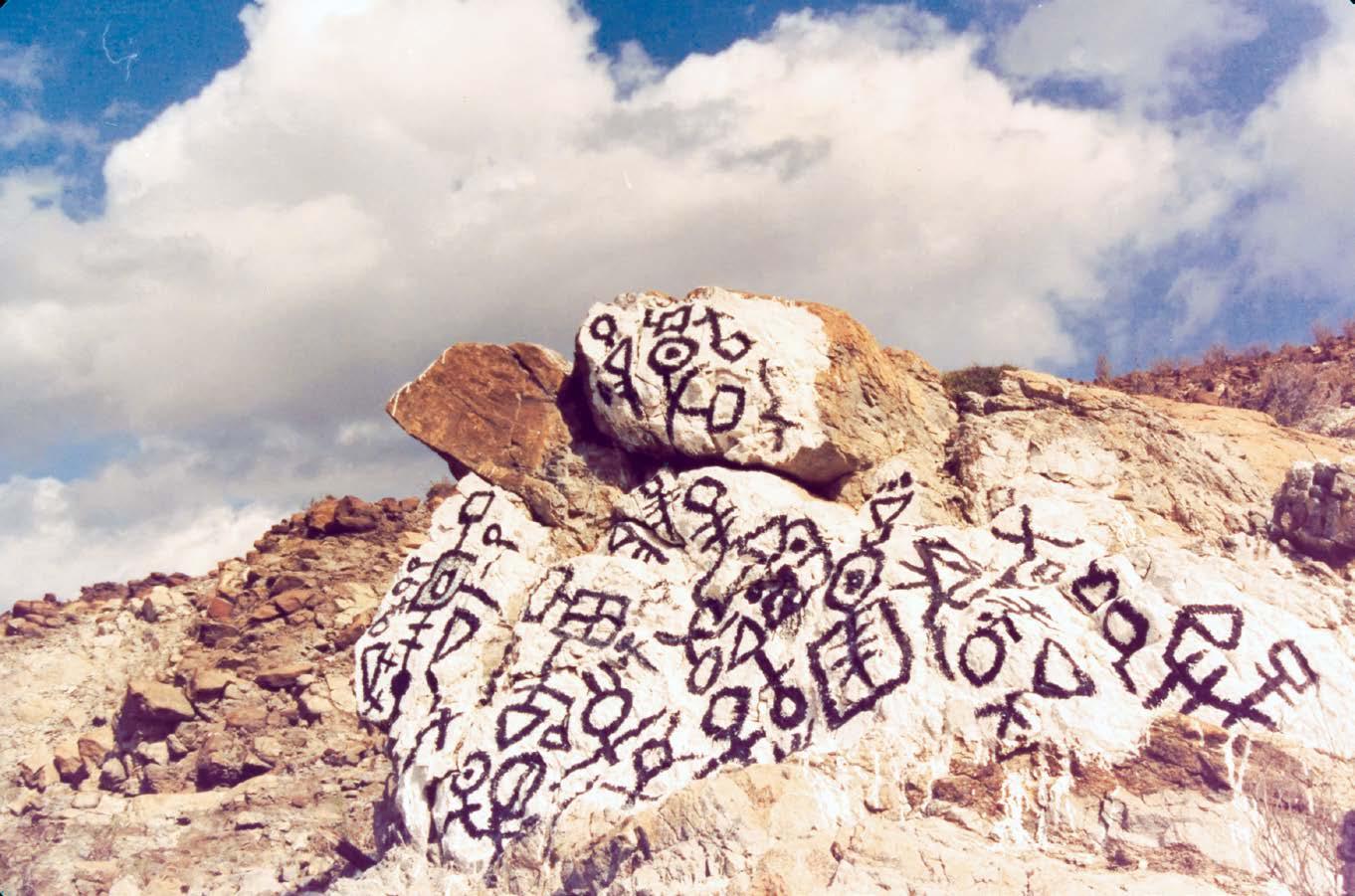
Painted Stone, 1991, paint on rocks in Khor Fakkan.*
Note Book No 01, 1985-89, India ink on paper, 18 x 25 cm.*
Courtesy of the archive of The Flying House.*
02
FINDING FORM
Mohamed Ahmed Ibrahim refects on the enduring bond between his art and his birthplace. Khor Fakkan is a landscape of sea, mountains, and memory that continues to shape his creative language. He describes how his early encounters with nature evolved into a tactile, intuitive practice rooted in everyday materials such as clay, paper, soil, and copper. Tese elements, drawn from the land itself, embody his ongoing dialogue with place, time, and transformation. Trough recollections of his formative experiments
with stones and earth, his discovery of land art, and his deepening understanding of colour and repetition, Ibrahim reveals an artistic journey where intuition meets material intelligence, and where psychological insight and artistic process merge into a single, seamless way of being.
(This Page) Installation view of Mohamed Ahmed Ibrahim: Elements 2018 at Sharjah Art Foundation.*
(Opposite) Mohamed Ahmed Ibrahim at his studio. Courtesy of Lawrie Shabibi.
You’ve travelled a lot. What makes you keep coming back to Khor Fakkan?
I’ve lived elsewhere in the UAE. I lived in Al Ain for about nine years, but I used to come back to Khor Fakkan regularly with my family. My wife is from here. I love this city. Even now, when I travel, I always feel homesick, at least for the frst two or three weeks, until the feeling disappears.
Besides, I still haven’t found another place to live, though I think I could move now, because I’m ready to live in other places. I don’t want to be stuck in one place, because you can always carry a place with you.
I like the tranquillity here, though in the last fve or six years there have been a lot of tourism projects, so the city has started to get more crowded.
What attracts the tourists?
It has the sea, and there are places to rest in the mountains, and hiking trails. Tere’s a variety of restaurants opening. Tere’s a lot of things for adults and even for children.
But Dubai is two and a half hours away.
It’s about an hour and a half from Dubai, so people have started to visit Khor Fakkan for lunch, then go back to Dubai again.
And the weather is better because it’s a high-altitude area?
Exactly. In the summer, for example, we get cloudy days. Te clouds are beautiful. But, in general, the weather is harsh, very humid and very hot. No different, in other words, from the rest of the UAE.
What is the nature like? Are there rocks, different trees? Are there other things that inspire you?
Yes, it has a different, more temperate climate. It has mountains. And there are valleys, with small streams that are there almost year-round.
everyday materials? Are you making a statement? Or is there a personal connection that exists between you and these materials?
My relationship with the nature of Khor Fakkan is something I’ve had since my childhood. I remember the frst time I really noticed it. I’d been sleeping on the stern of a ship with my father, on our way back from Kuwait. We arrived home at night and there was a rule that you had to wait until the morning for customs to open.
As we were disembarking at the crack of dawn, I saw clouds around the summit of the mountain. Tey were beneath the summit of the mountain, so you could see its outline above. It was as if the two elements were mixed together. Te summit looked like something strange in the sky.
How old were you?
I was about 11 or 12 years old at that time, and later I grew more and more attached to the mountain. In my schooldays, I got into the habit of cycling there by myself every Friday morning. I still do that journey today. It’s become a sort of pilgrimage when the weather gets cooler, in January or February. My presence on the mountain, between the stones, sparked this passion for nature, and in particular for this area.
Te stones are exposed to the sun and no one has touched them. I once turned one of these stones over, and I noticed that the part that was touching the ground had a lighter colour than the part exposed to the sun. Ten I set about turning more stones over. I arranged them into a circle of different colours. And when I stood some way off, I could see the difference I’d made.
At what stage of your life was this? When you were young, or later?
“When you take solitary walks among the rocks on bare mountains, collecting the dry branches that have fallen from small trees, following traces of desert animals, sensing the humming of insects … it is at that moment that you faintly hear the murmur of the city as a fading echo in your mind. You begin to fear that you have stepped on a rock or a blade of grass that has blocked the door of an insect’s home and disturbed a creature with your intrusion on his path. At this moment you are overcome with the feeling of being at one with nature, so you begin to shed your layers, piece by piece, and commence with creating an artwork.”
Mohamed Ahmed Ibrahim
Te nature is a little different from the rest of the Emirates. It can be likened to the Hatta, which is an exclave of Dubai, and the Emirate of Ras Al Khaimah. Tese three areas are similar in their geographic environment.
Let’s talk a little bit about the artistic processes and the basic concepts of your works. Your art is very tactile. You use materials that many people consider mundane, like papier-mâché, or cardboard, or threads, or soil. What pushes you to use these
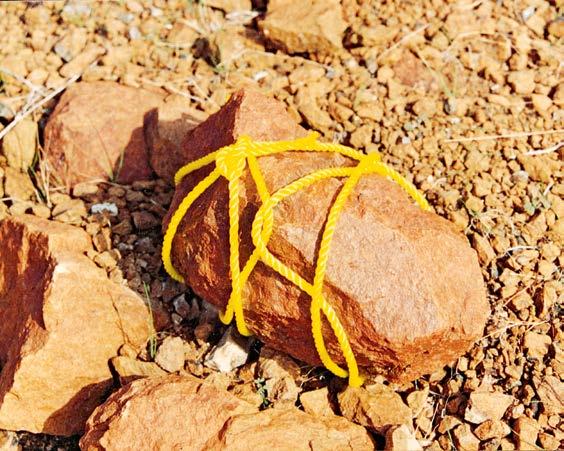
Tis was later, during my art studies in the Eighties. I enjoyed this process, so I said to myself that every time I went, I would arrange the stones in rows. Sometimes I built the stones on top of each other, like a building. I even tied stones to the mountainside. And I kept repeating this process for about a year. Back in 1987, I invited Hassan Sharif to Khor Fakkan and showed him what I’d done.
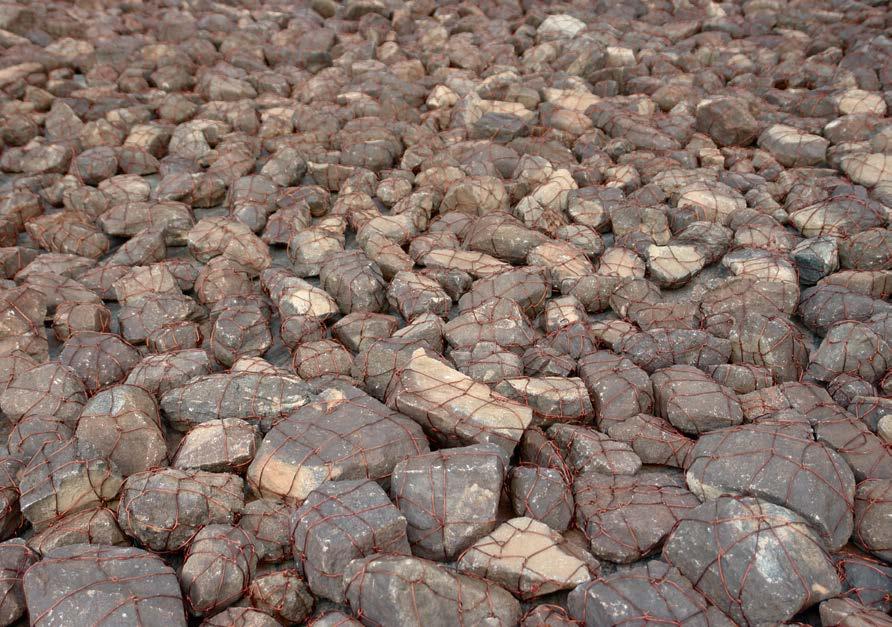
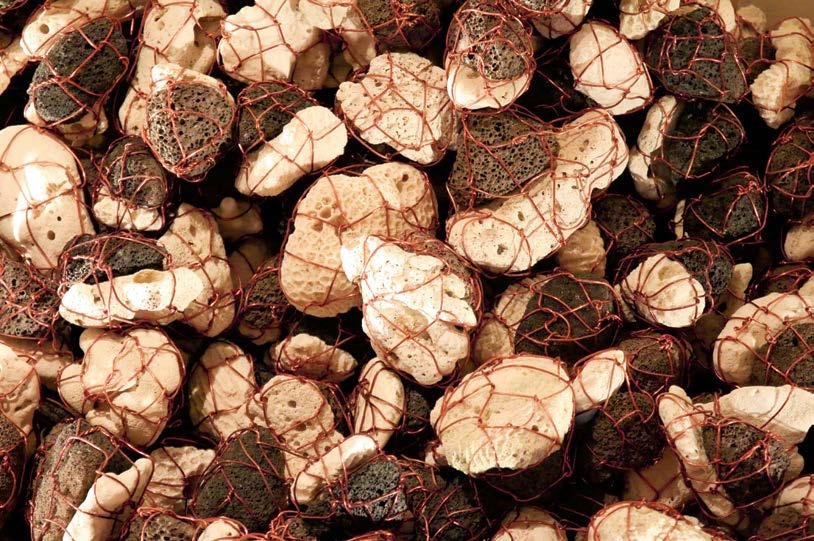
Fresh and Salt (detail), 2015, copper wire, stones from Caspian Sea, coral from Khor Fakkan, dimensions variable.*
He said, ‘Mohamed, what you’re doing is land art.’ Honestly, I didn’t know much about land art at the time. Hassan urged me to do more, and that’s when my relationship with the mountain became deeper. I read about land art created by American artists. Ten I discovered there were Dutch land artists, too.
You mention tying the stones. Why did you use copper for that?
It’s the process of pulling the mountain into shape. I was convinced that I was the frst person to touch this stone. No one had touched it before me. It’s a beautiful material, I like it, so I started to give an artistic shape to the stones.
But you’re twisting them, choking them almost. No, on the contrary. Here’s what happened. One day, I didn’t have any materials apart from some wire. So I started with the thread that I had, then I moved on to colouring. First, I realised that it gave an added value to the stones if I went against the context of art or the context of my experience. Ten I started to look at the branches of the trees that fell to the ground – I mean, the leaves of the trees. I try not to bother nature. I don’t cut trees or plants. But I collected this dry, dead material.
You gave it life again.
Yes, in a different way, in a plastic bag. And then, I used the clay, because it’s abundant in the mountains. In the past, we used to build our houses from this material, so when I was young I used to play with it when they were building the houses. Tey used to mix it with mud.
Information like this, which a person has since childhood, is stored in the brain, in the drum of memory. It only comes back to the surface again when there are things that interest you, like mud. Mud
affected me, or brought back this information, which was about our society, building houses, and so on. I feel close to these materials. Tey’re the materials of my society. None of them are imported. I started to experiment with them, to create artworks.
And it wasn’t only the case with clay. In the painting sometimes, this stored information can come back from childhood.
And the paper?
It’s the same thing. Paper is a natural material. It’s harsh, it can hurt more than a knife, but it’s also wounded in itself. It was one of the natural materials I used, because paper is made from trees. A paper machine gives you freedom, it gives you a large space in production, in shaping. It’s one of my favourite materials.
You used to work with natural colours. How did you start colouring? What kind of colours do you use?
Do you make your own colours?
In the case of papier-mâché, I started to use tea for colouring. I also used coffee, herbs and the leaves of a tree. In the past, people used these leaves to dye their fabrics.
, 2015,
landscape, dimensions variable. Later presented as fve C-print photographs and flm as an Abu Dhabi Festival 2016 commission.*
(Above) The Qubba Project
Al Hajar mountain rocks,
(Below) Stones Wrapped in Copper (detail), 2007. Stones, copper, dimensions variable Courtesy of the archive of The Flying House.*
What is the tree?
We call it the almond tree. We have it in every house in the Emirates. So, I started using these colours. I also used tobacco to colour the papier-mâché. Tis started giving me organic colours. And eventually I was able to control the shade. I mean, taking coffee as an example, I can get several shades from it. Once you learn the secret of the material, you develop a close relationship with it.
With canvases, did you use acrylic or pigments or oil?
I used oil in the very early stages. It’s true that I used a lot of colours, but I didn’t use the same shade as in the tube. I used shades that were specifc to me.
I mixed different colours, black with red, black with blue, and so on. An artist creates for others, but at the same time, he creates for himself frst, for his own enjoyment. Tese colours brought me a kind of joy.
Colours are important for children too. I like to appeal to the child and any person who is immersed in art. My work is directed towards children as well as grownups.
You use a lot of blue. Does it relate to the sea? Maybe. Where I come from, we have two prominent colours: blue, which relates to the sea and sky, and brown for the desert.
Did colour start affecting you after your move to the Netherlands, or did the fascination start before that?
It predated my visits there. Still, Europe was very important, because it was the frst time I saw works by the big international artists in the fesh. I gained more experience of colour and materials.
Tis was in the Nineties when European art included conceptual art, like installations, especially among the younger artists. We were also young at the time, and we worked in the same building.
You worked with artists and you learned from each
I wasn’t infuenced by anyone. I don’t know if anyone was infuenced by me. I worked in a studio in Maastricht with a group of young people who were students at the university. We lived together for about four months. We had long conversations about the use of different artistic techniques.
Your work is characterised a lot by repetition, with a sense of rhythm. What does repetition mean to you?
Te issue of repetition came on my return. I was working in the main Library in Khor Fakkan and I used to take the same road every day. Tough there was repetition, yet it wasn’t the same. Te cars were different, maybe a tree had fallen down or a rock had fallen, so the journey changed. As see it, there is no repetition.
It’s a process of production rather than repetition.
you create a different visual story; a visual singularity. Has your study in psychology had an impact on your relationship with repetition?
Psychology gave me the tools to understand character, and this is refected in my artistic work. Nowadays, in clinical psychology, there is a psychological treatment of art. For me, they are two sides of the same coin.
When you complete this repetition, do you wish to send any special message to the audience?
It’s a private message, but I direct it to viewers to read it for themselves, in their own way. I don’t impose anything on them. You like to hear what the viewer is reading, of course, it’s a kind of feedback, but I’m not sure if you can really deliver your message precisely. Tis reveals the difference between the artist’s consciousness and that of people who have nothing to do with art. For example, someone said to me, ‘I can draw lines. It’s very simple, I can draw lines like you.’ I said, ‘Of course, you can draw lines. But it took me thirty years to draw this line.’ It’s no easy matter.
Why did it take you thirty years? Explain this to me. My experience took me thirty years. It took me that long to learn what the line is.
Do you leave the viewer to read your painting in their own way, or do you correct them?
It depends on the person. If the person has a good eye, it would be a waste my time discussing it with them.
Fresh and Salt (detail), 2015, copper wire, stones from Caspian Sea, coral from Khor Fakkan, dimensions variable.*
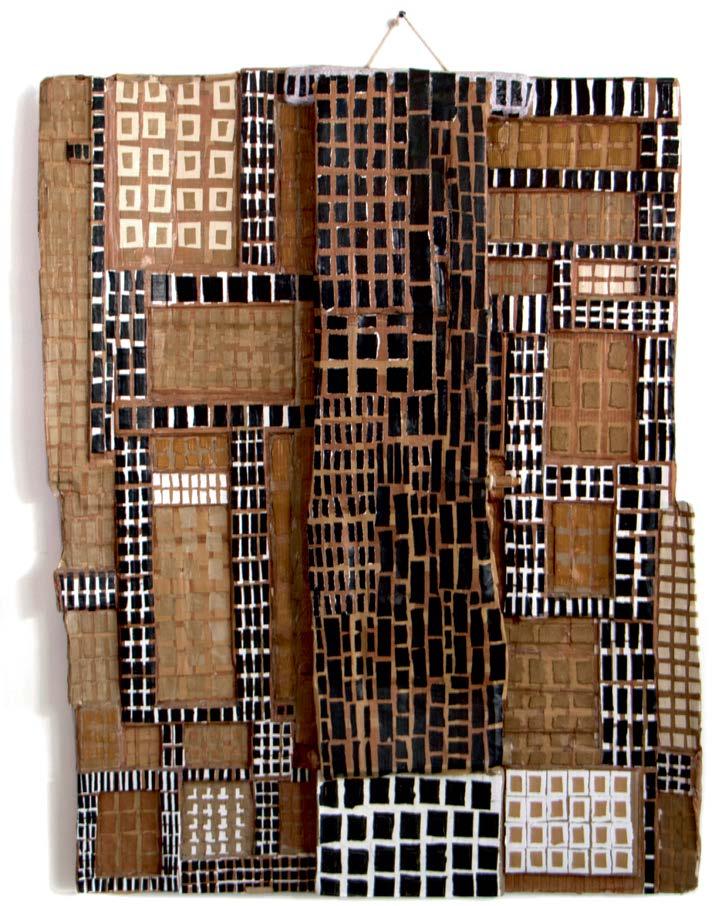
(This Page) Untitled, 2015, cardboard assemblage, 148 x 116 x 10 cm. Courtesy of Lawrie Shabibi.*
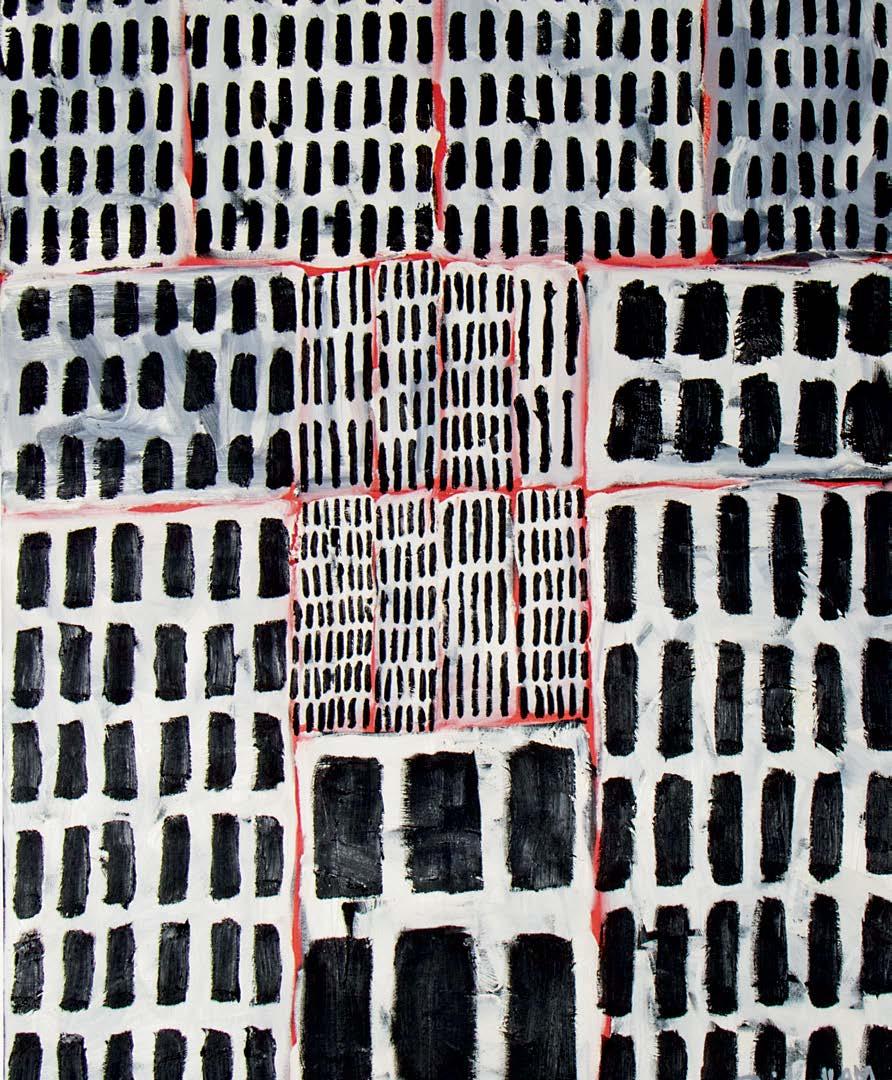
(Opposite) Different Lines, 2017, Oil on canvas, 122 x 91 cm. Courtesy of Lawrie Shabibi.*
Y S were the visual singularities that you discovered at that time?
Tat frst exhibition was of oil paintings on canvas. A lot of people were against my work. Tey would hide it rather than show it.
Why the rejection?
It was the artists themselves, they weren’t used to what I was painting. Tey were used to trees and realistic scenes, and suddenly they saw shapes that they couldn’t read. It was too unfamiliar. From the beginning of the Eighties through to the beginning of the Nineties was a stage in the type of work I used to do. In two exhibitions, a lot of my work had symbols in it. After that, I started to focus on the production of objects.
Why?
I don’t know. Maybe felt that the painting didn’t give me enough scope to express myself. So, I switched to objects. Ten, you know, you start to feel nostalgic. You miss painting. I don’t know why. At that stage, I had these two practices. I made paintings and, at the same time, I made objects. I also went through a phase of experimenting with colour, particularly putting opposite colours together in a painting. Most artist swouldn’t dream of putting these colours together, but I had the boldness to try!
I 20 2 of your works in Sharjah and to see the whole thing for yourself. Were there aspects of your past practice that you did not expect?
Like I said, solo shows are a great way to move on to the next stage. I even told Sheikha Hoor Al Qasimi: ‘You’ve put me in this exhibition when I’m at a crossroads.’ It was clear to me then. When an artist sees their work outside the studio, they see it in a completely different way.
Tis exhibition was like my frst retrospective really, and it helped change my mode of production, of the objects in particular. I started to put more colour on the objects. I also started using coloured paper.
Y 20 Te Space Between the Eyelid and the Eyeball, has a poetic title. Does it indicate a kind of inner vision? And can you explain to me what this inner space is for you?
As humans, we always believe that when you close your eyes, the process of vision stops. Tat’s not actually the case. Te process of vision is like the heart or lungs. It’s continuous. When you close your eyes, what you see depends on the warmth of your surroundings or the strength of the force that you apply to the eye. For example, if I close my eyes and turn my face towards the sun, it’s different to when I do the same with a candle. When you focus on this idea, it leads to a kind of meditation, a kind of contemplation that is completely different from yoga practice, for example. And during this exhibition, I wanted to shed light on this area.
I want to come back to the small works you do. Does your study of psychology affect you in terms of shapes?
Not in any particular way, but in general, as an experience. In the course of an artistic work, it doesn’t affect me. Psychology became the comprehensive framework for my experience in general, for my personality even. I don’t make a distinction, honestly, between my artistic life and my production, or between my real life and my social life. I occupy the same personality. I don’t have a split personality. I’m like that. I produce artistic work and practise my personal life. Just as myself. Tere’s no duality. It’s one personality. And I see many artists, Arabs and others, who have this duality. You see them wearing a suit and a tie, for instance, and he’s a gentleman, but when he attends an exhibition, he wears the same clothes as other artists. It’s a kind of performance.
Going and Coming, 2009, documentation of the performance in Brittany, France.*
Elements, (2018, Sharjah Art Foundation)
Curated by Hoor Al Qasimi, the exhibition featured work spanning over three decades of the artist’s practice, which includes paintings, drawings, sculpture and installations as well as documentation of the artist’s extensive explorations into land art. His practice has been inspired by a lifelong relationship with the environment of Khorfakkan, situated between the Gulf of Oman and the Hajar Mountains. Encompassing the various forms in which he works, this survey also traces the aesthetic and conceptual concerns that run throughout his practice, such as his use of permutations and his art projects and the tools he produces, which evoke thoughts of the primordial.
Installation view of Mohamed Ahmed Ibrahim: Elements 2018 at Sharjah Art Foundation.*
Mohamed Ahmed Ibrahim, various works. Mixed Media Installation, dimensions variable. Installation view Elements at the Sharjah Art Foundation, 2018. Image courtesy of Sharjah Art Foundation.
Installation view of Mohamed Ahmed Ibrahim: Elements 2018 at the Sharjah Art Foundation.*
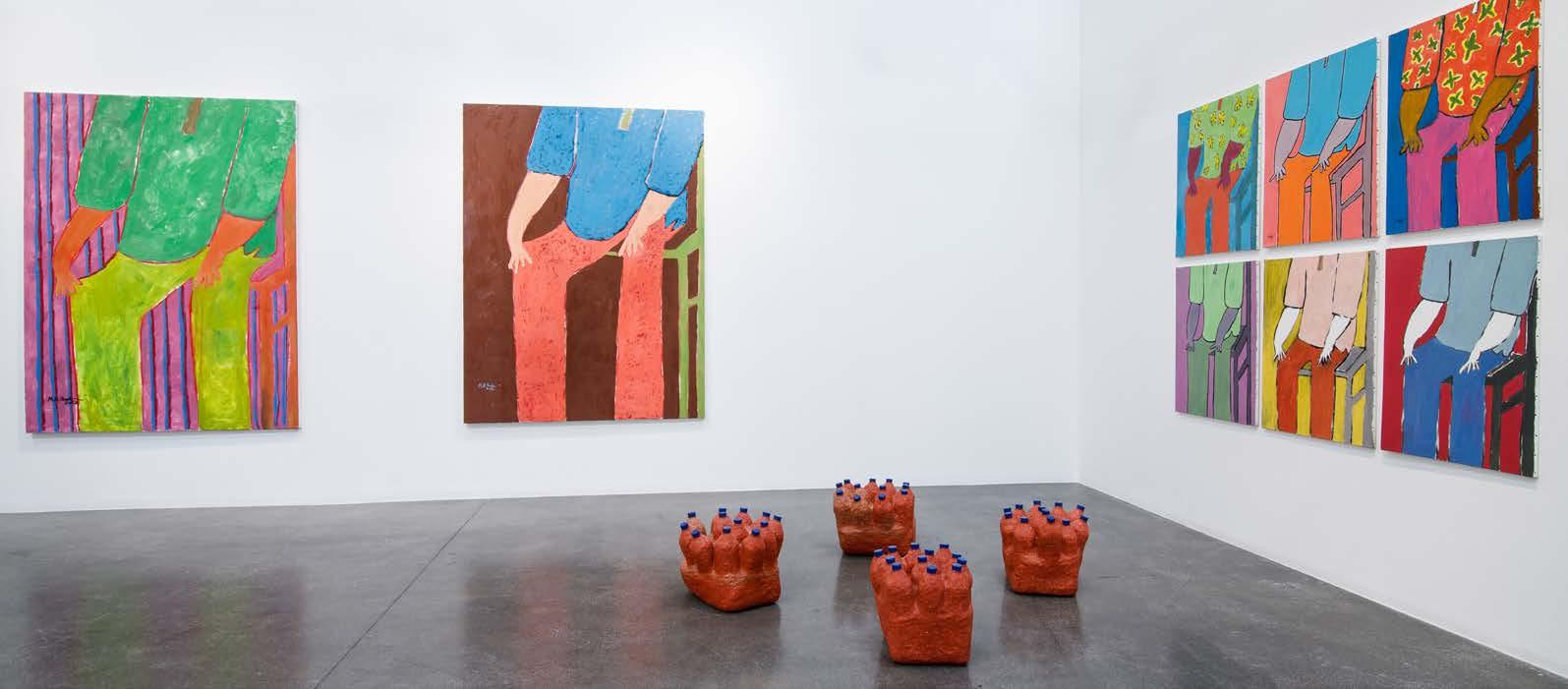
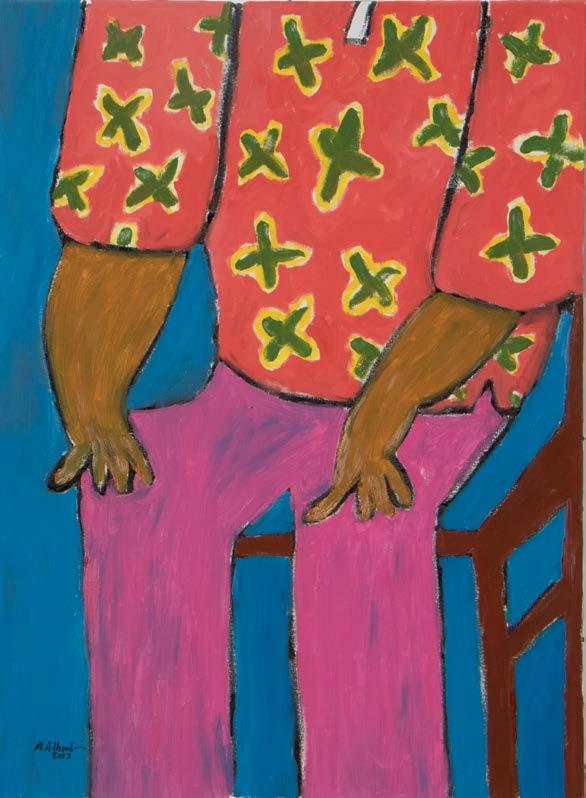
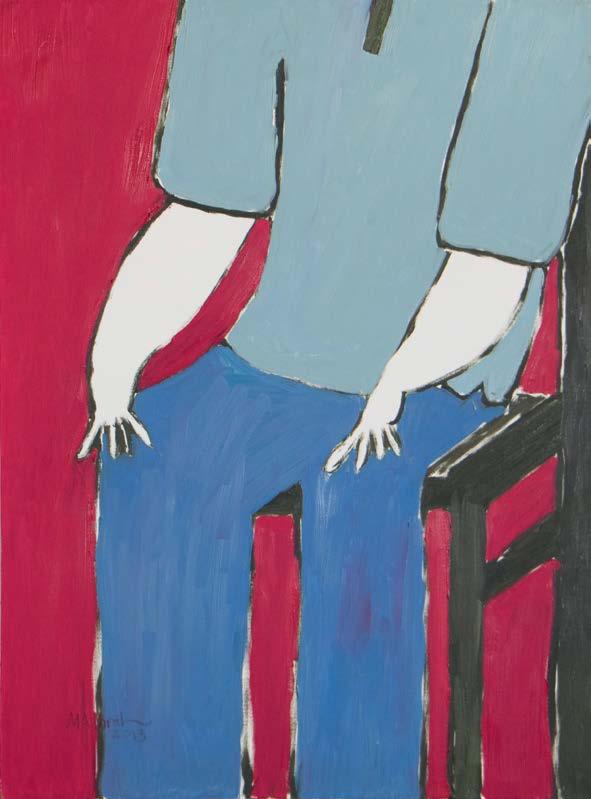
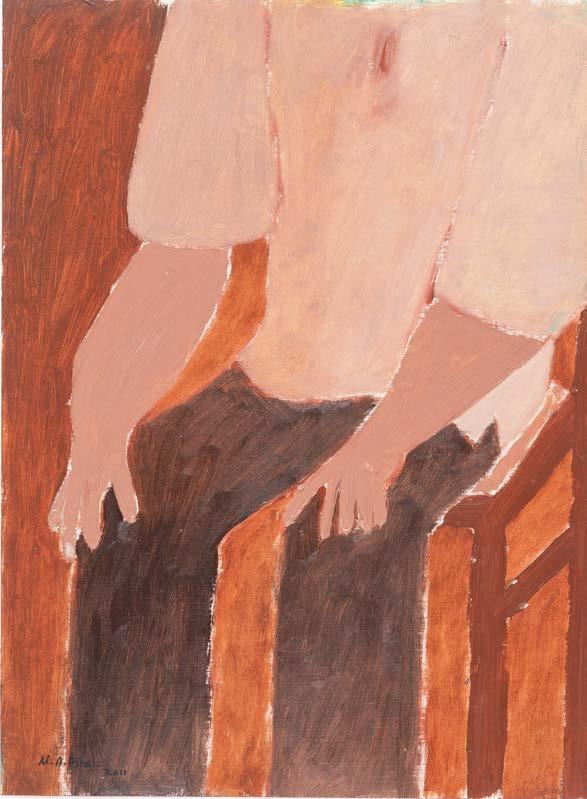
Groups of Sitting Man portraits, an intriguing series in different sizes and colours in which the head of the sitter is always cropped, moving the focus instead to the bodily posture and H
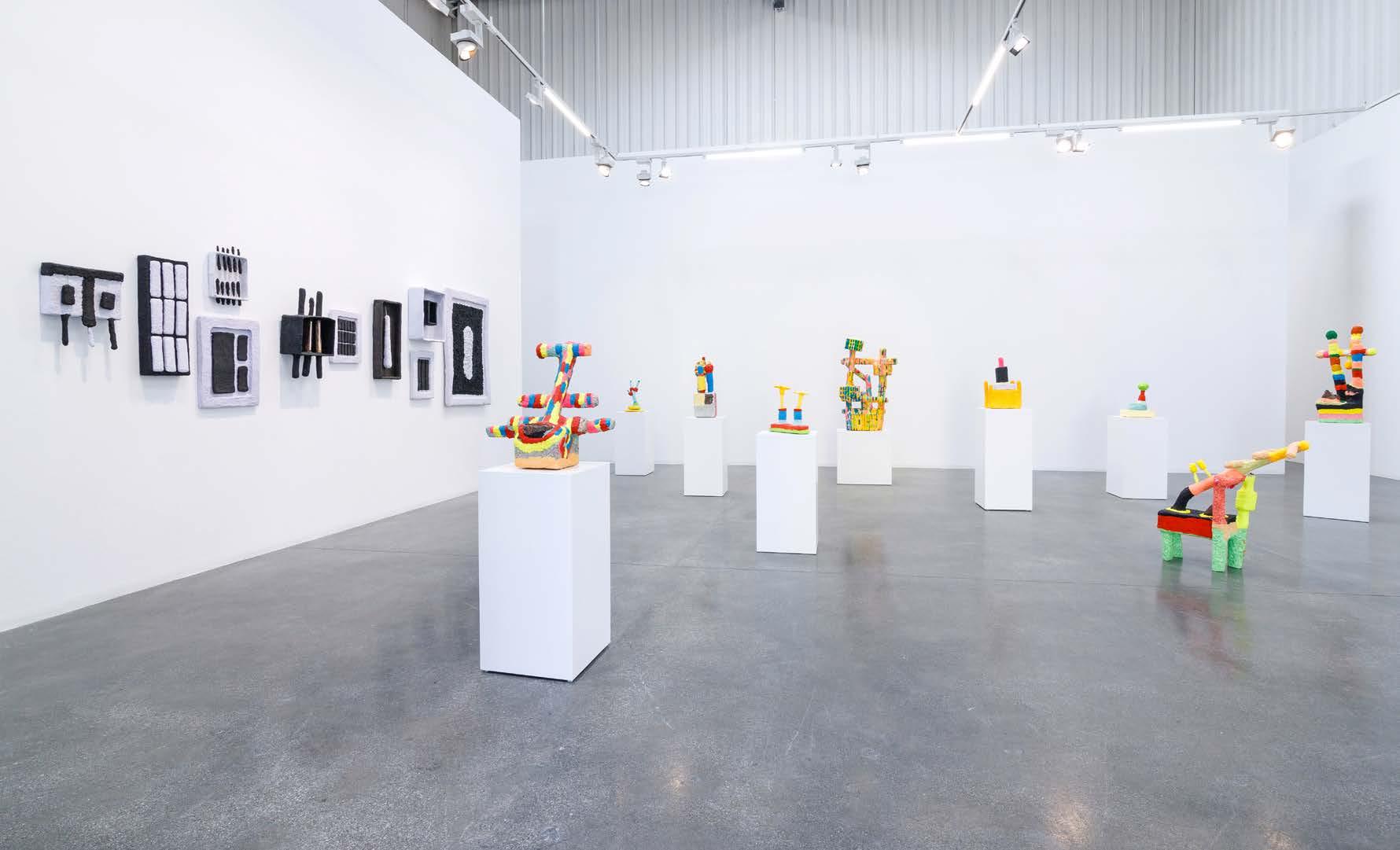
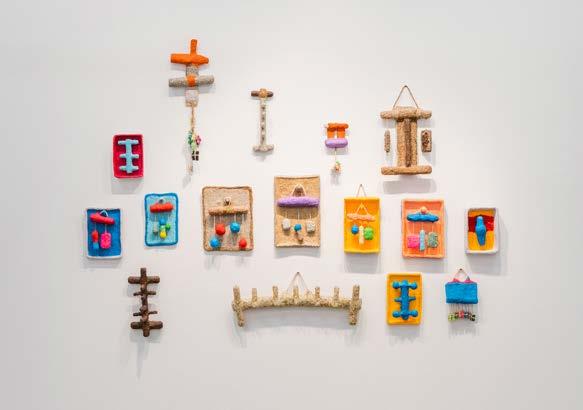
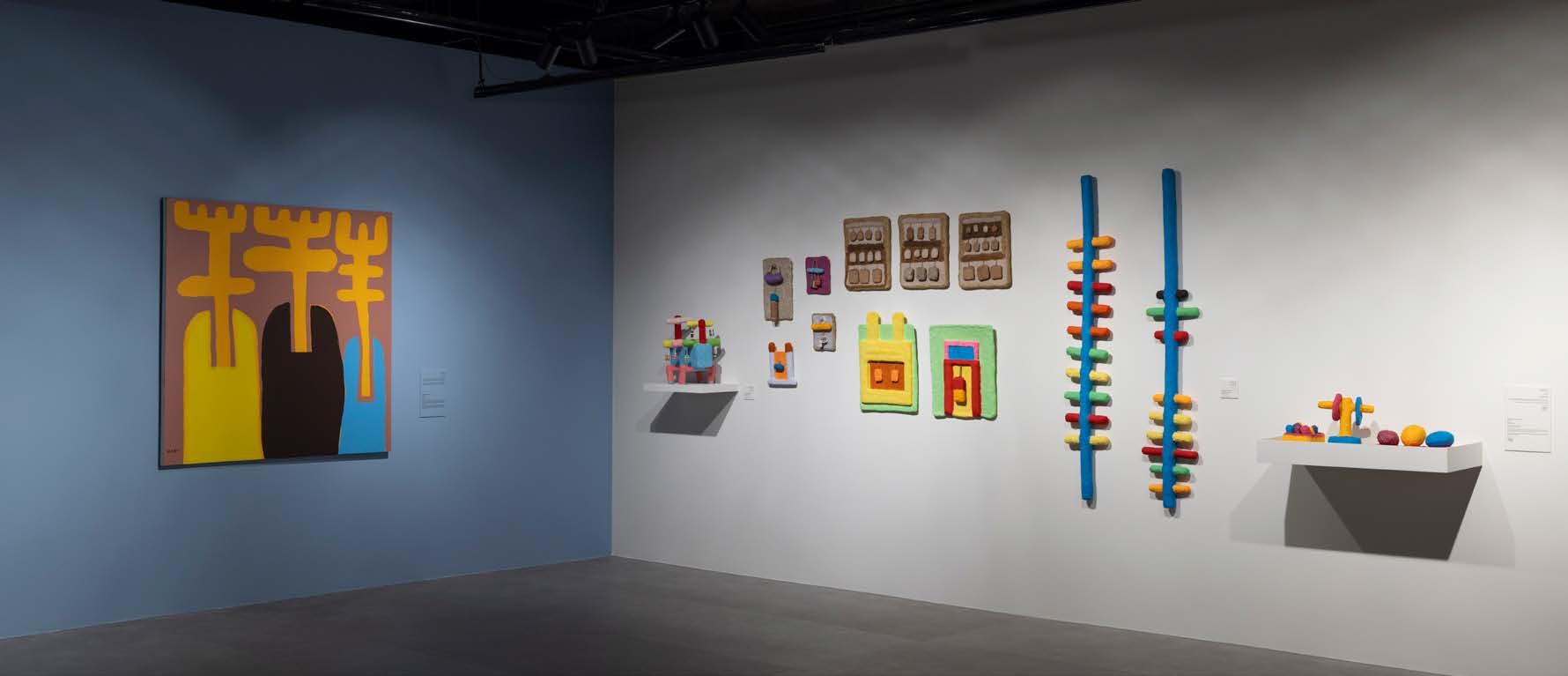
S brightly coloured papier-mâché sculptures are made of natural paper pigments combined by the artist, their vivid repeated lines of colour consistent with the obsessive mark-making H choice of vibrant and at times garish colour combinations seek to capture the ‘explosion in his eyes’ H Mountains had obstructed its view.
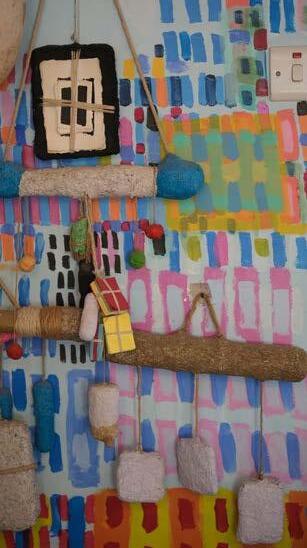
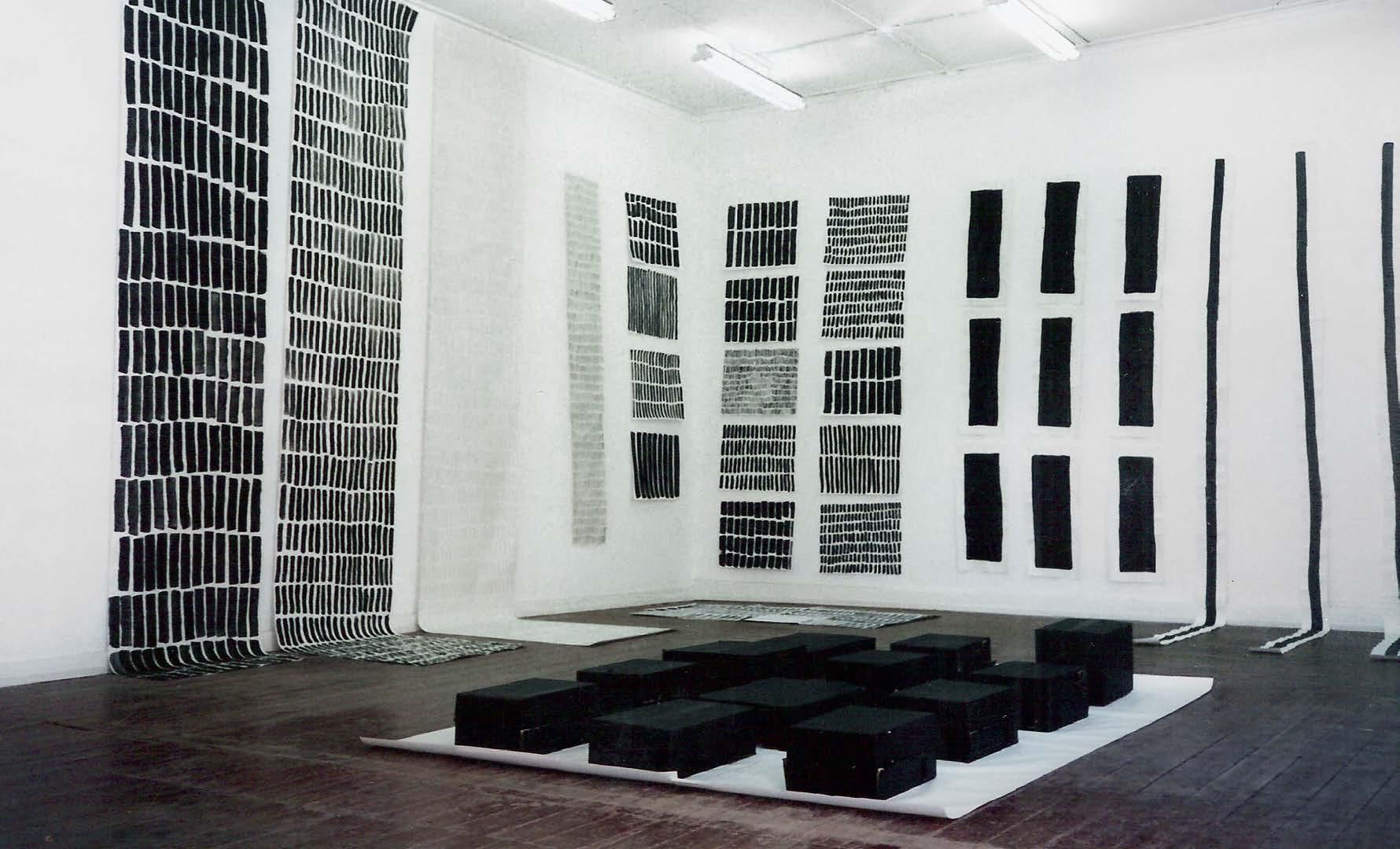
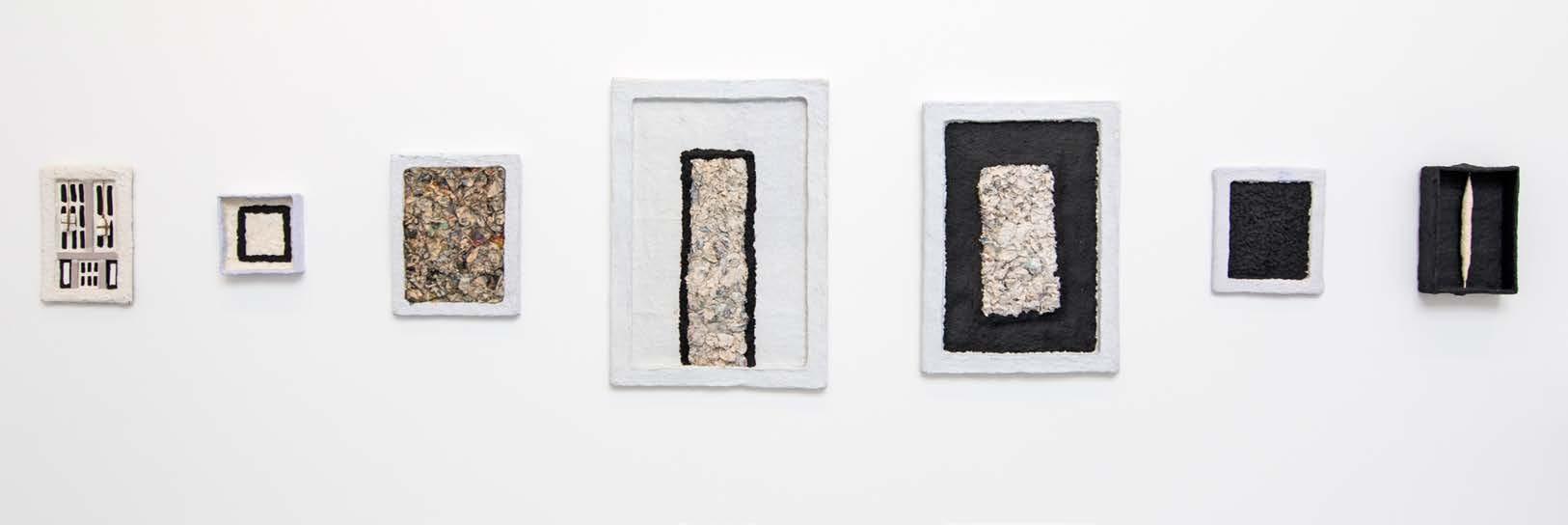
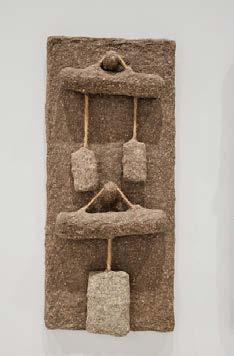
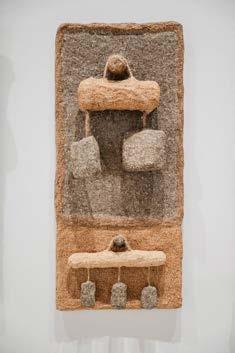
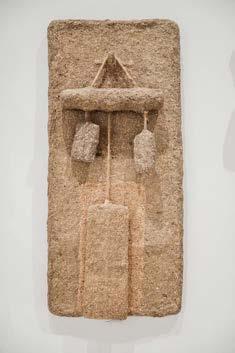
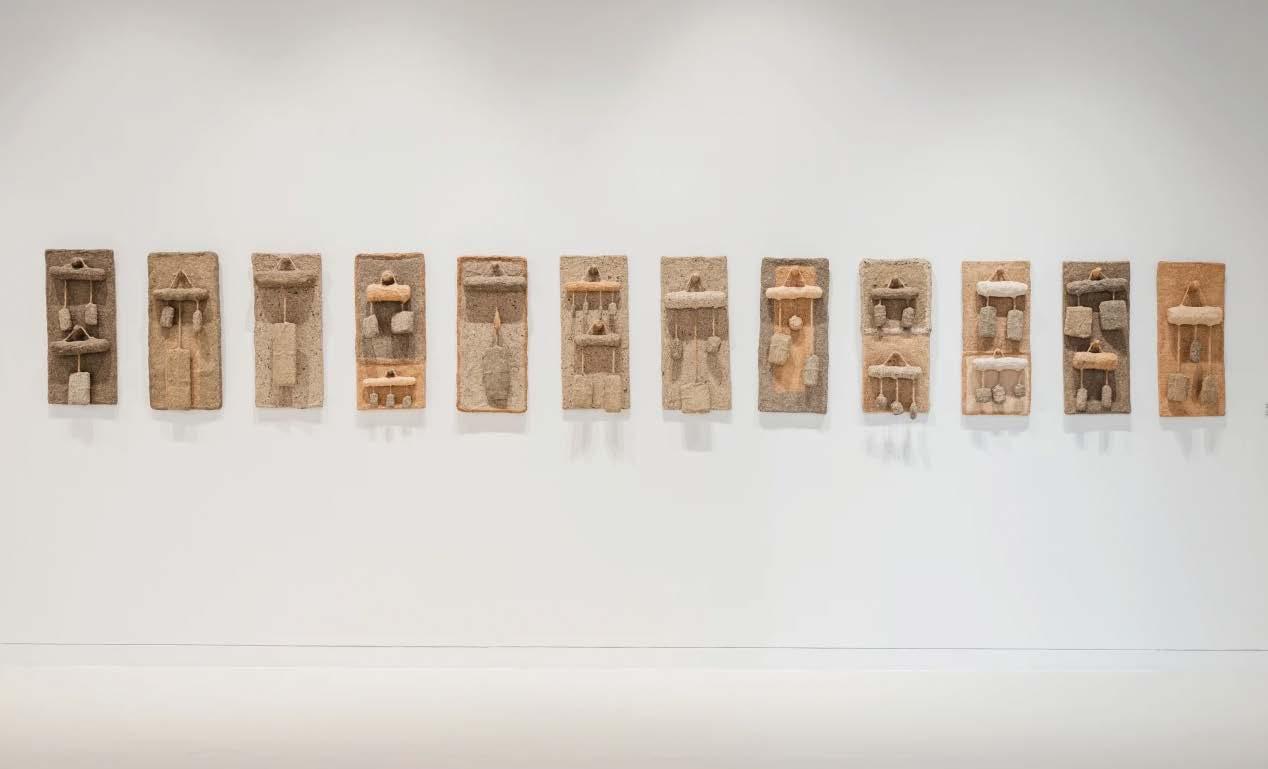
Black and white papier-mâché architectonic works, part painting, part sculpture, part collage line. Drawing from Ibrahim’s two-dimensional Lines series (drawings of black or white lines that are reminiscent of ancient cave markings) these peculiar pieces have a primordial quality to them – a grouping of hand-molded oblong shapes wedged with blocks, slivers or bodies of paper hanging from strings. At times minimal, at times complex, the works play with notions of multiplicity and division.
Sharif, Ibrahim’s mentor and pioneer of conceptual art in the UAE.
Mohamed Ahmed Ibrahim’s modest structures explore his deep fascination with memory, imagery and ways of seeing and experiencing the environment. Consequently ‘the space between the eyelid and the eyeball’ is the place where forms and shapes reside even with closed eyes. Ibrahim’s art comes from both his personal experiences and the kind of innate memory found in our DNA, which he describes as a ‘primitive urge.’
Mohamed Ahmed Ibrahim, The Space Between the Eyelid and the Eyeball 2019, Lawrie Shabibi. Photography by Jandri Angelo Aguilor. Courtesy of the artist and Lawrie Shabibi.
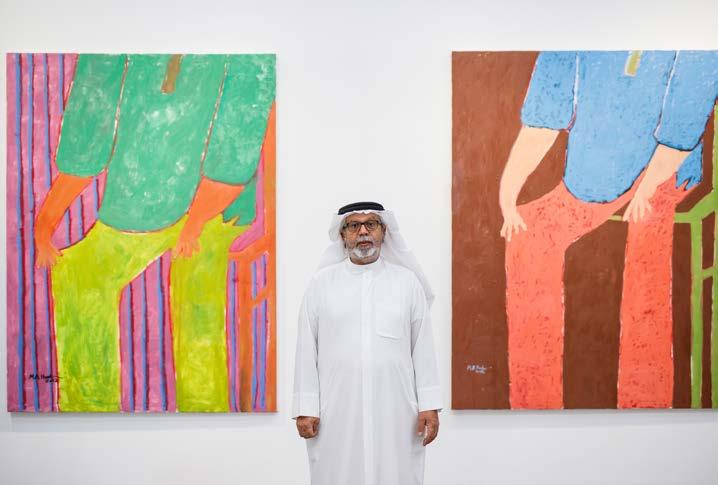
Mohamed Ahmed Ibrahim in his exhibition The Space Between The Eyelid and the Eyeball 2019 at Lawrie Shabibi Gallery, Dubai
Courtesy of Lawrie Shabibi.*
(Top) Fatherland Serwan Baran, The Pavilion of Iraq, 58th Venice Biennale, 2019.
Mohamed Ahmed Ibrahim, The Space Between the Eyelid and the Eyeball 2019, Lawrie Shabibi. Photography by Jandri Angelo Aguilor.
Courtesy of the artist and Lawrie Shabibi.
03 ECHOES OF THE MIND
For Mohamed Ahmed Ibrahim, memory is not merely recollection but a living organism: a drumbeat echoing through generations, storing traces of experience, knowledge, and imagination. He describes this phenomenon as a ‘memory drum,’ an inner mechanism that gathers and transmits the essence of life, much like genetic inheritance. Tis idea unfolds in his artistic practice, where form and abstraction become vessels of shared memory and collective identity.
His presentation at the Venice Biennale, Between Sunrise and Sunset, encapsulated these ideas through organic sculptural forms that bridge the human and the natural. In dialogue with curator Maya Allison, Ibrahim shaped a vision that speaks of belonging, transformation, and the freedom of interpretation: a space where each viewer completes the work through their own perception.
(This Page) Installation images of Mohamed Ahmed Ibrahim, Memory Drum, 2020, Lawrie Shabibi, Dubai. Courtesy the artist and Lawrie Shabibi.
(Opposite) Mohamed Ahmed Ibrahim portrait; Courtesy of Lawrie Shabibi.
Can you explain your piece called Memory Drum to me?
Yes. Every person has it. Just as the drum on an old piano stores the memory of a tune, so there is something in us that accumulates our experience. Only, with humans, this accumulates from the day we’re born. As you get older, you start to get some of the earlier stuff back. I can retrieve my childhood memories from that place in the brain. A person is full of this knowledge, this treasure, and it becomes a legacy. It turns into genes and is inherited. In the generation that follows it might reappear. It’s like eye colour. One of my children has very dark eyes. He carries the genes of the previous generation. In the same way, the cognitive and visual store of one generation turns into a form of heritage.
Can you give me an example of any of your works that demonstrate this idea?
All of my work demonstrates it. Of course, in some cases the inspiration is more specifc. Sometimes a particular sentence or a poem affects me.
Your exhibition at the Venice Biennale, Between Sunrise and Sunset, was a huge achievement. It resembles human forms and nature at the same time. Was this intended, or did you just see it that way?
Tat exhibition was a heavy burden. I felt I had to speak on behalf of my community, not just myself. Venice is so important in the art world. Te geography of the UAE is two bays, one facing the Gulf of Oman and the Indian Ocean, the other the Arab Gulf. We live between these two bays in many different natural environments, with different customs and dialects. We’re very diverse. I wanted to convey the nature of this demography.
And what about the similarities between humans and animals? Does this mean anything or not?
It does mean something, because I intentionally created a shape – let’s say, a fgurative shape – and I’m not the frst one to do that. Compare the way Piet Mondrian saw a tree and started representing it, or how he represented an apple.
It’s not a mystery, like I said before. It’s just that, in the most abstract form, I’m trying to minimise the shape. When you reach the smallest form, it creates
a different position for the viewer. It gives that viewer freedom. If they see a tree, that’s fne. If they see a man or a woman, it’s equally true. Tere is no wrong answer. So, there’s a lot of room for the viewer to see it in a different way. It carries all the meanings that the viewer can come up with.
What was the importance of the role of artistic value, of Maya Allison, in shaping the ultimate vision for the exhibition?
Maya Allison is someone I respect a lot. I often work with her. I respect her opinion. Te problem is that the art space – especially in the modern era, because of the existence of technology – has become vast, and the artist’s freedom has become greater. Tis creates so many concepts. To be honest, I don’t agree with the classifcation of artistic works into schools, for example, because I see this as coming from the critics, to facilitate their study of artistic works.
WHEN YOU REACH THE SMALLEST FORM, IT CREATES A DIFFERENT POSITION FOR THE VIEWER. IT GIVES THAT VIEWER FREEDOM.
Robot, 2020, Sliced cardboard, wood, fabric, papier-mâché, 72 x 42 x 51 cm
Courtesy of Lawrie Shabibi.*
In psychology, Memory Drum is a theory that unconscious neural patterns acquired from past experience are stored in the central nervous system within a memory storage organ, analogous to the drum used to store music in the oldfashioned roll pianos. It also refers to the “drum memory” of early computers, a magnetic storage device. Ibrahim
cognition for the artist is more important than that learnt later on throughout the course of life. Most people lose touch with it through learned behaviours, but Ibrahim is constantly aware of it, especially so during this time of enforced isolation, which has forced him to go back deeper still into his “drum memory”.
Flowers and Boulevards, I M
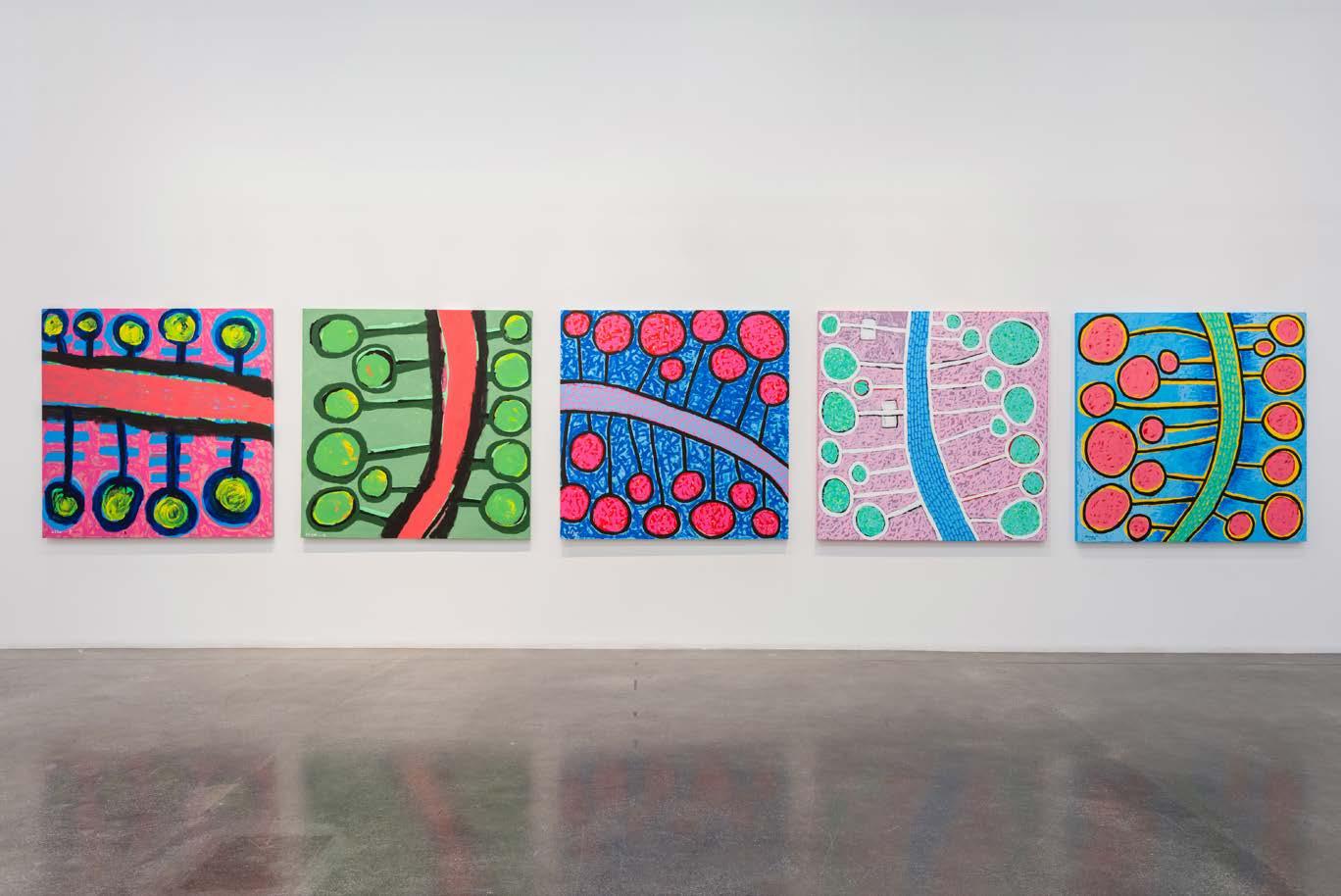
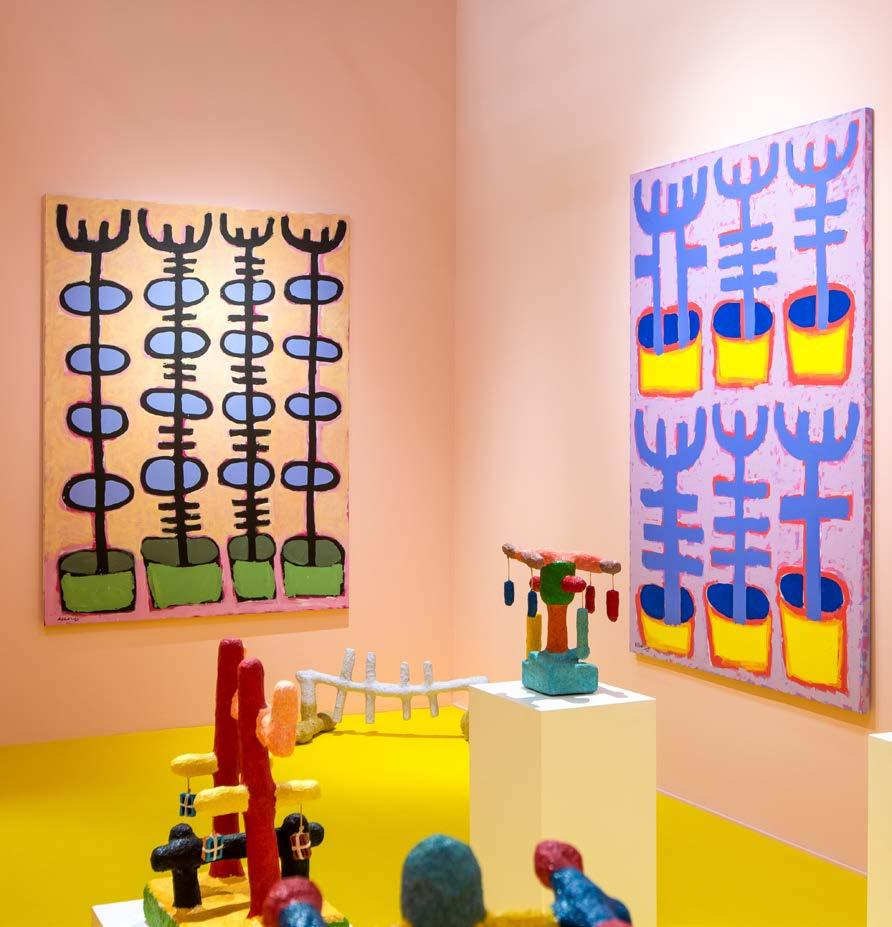
Flowers paintings are growing from schematic pots, whilst the Boulevards paintings recall aerial maps of cities or landscapes, with large trees lining roads or rivers. Conversely, they may also be read as zoomed-in slides of organic matter viewed under a microscope.
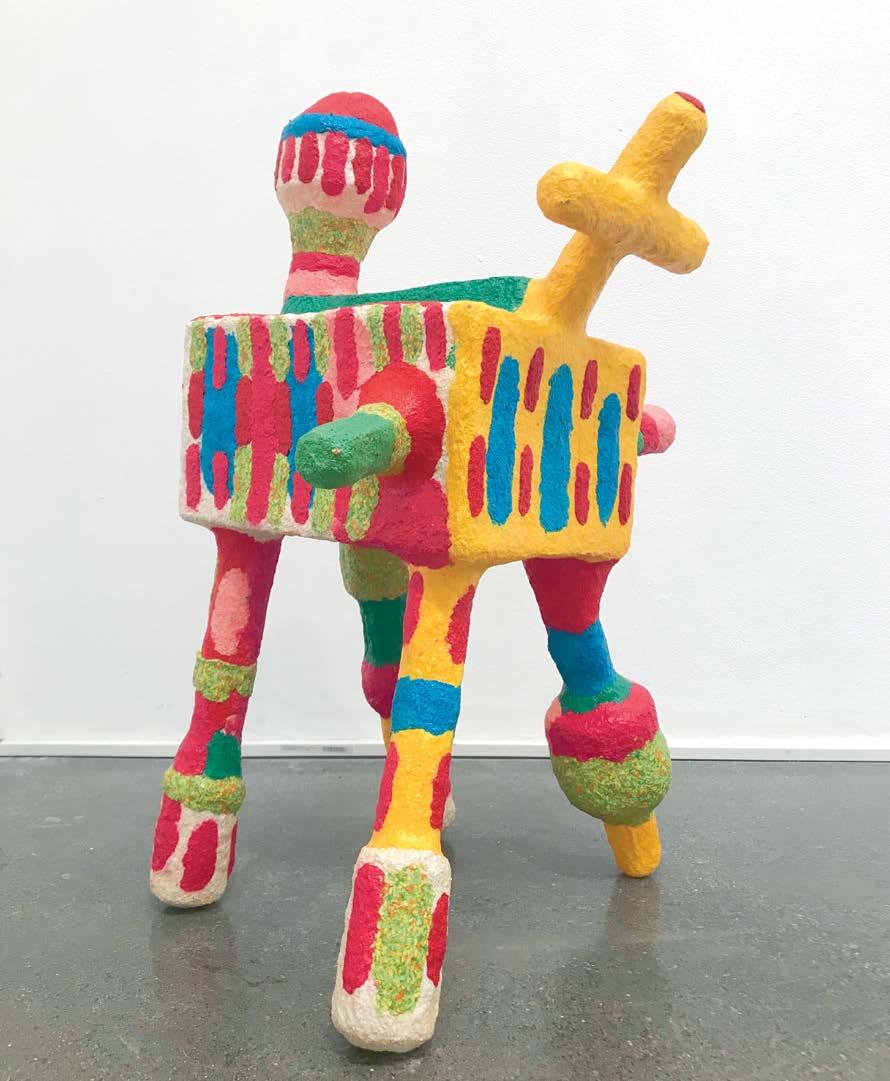
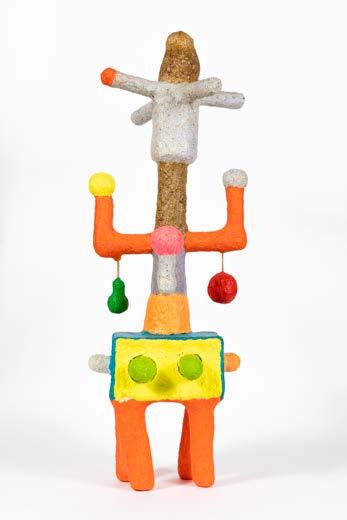
Play is central to Ibrahim’s practice. With much of his three-dimensional work in papier-maché, he may play for weeks with his materials, mixing in leaves, grass, tea, coffee or tobacco into his paper mix to produce nuanced natural and S Dancer Contessa, that hang over babies’ cribs.
Iautomatic almost subconscious object-making of the sculptures, analogous to organic growth; the disregard of scale, and the vibrancy of colour and texture that suffuse both.
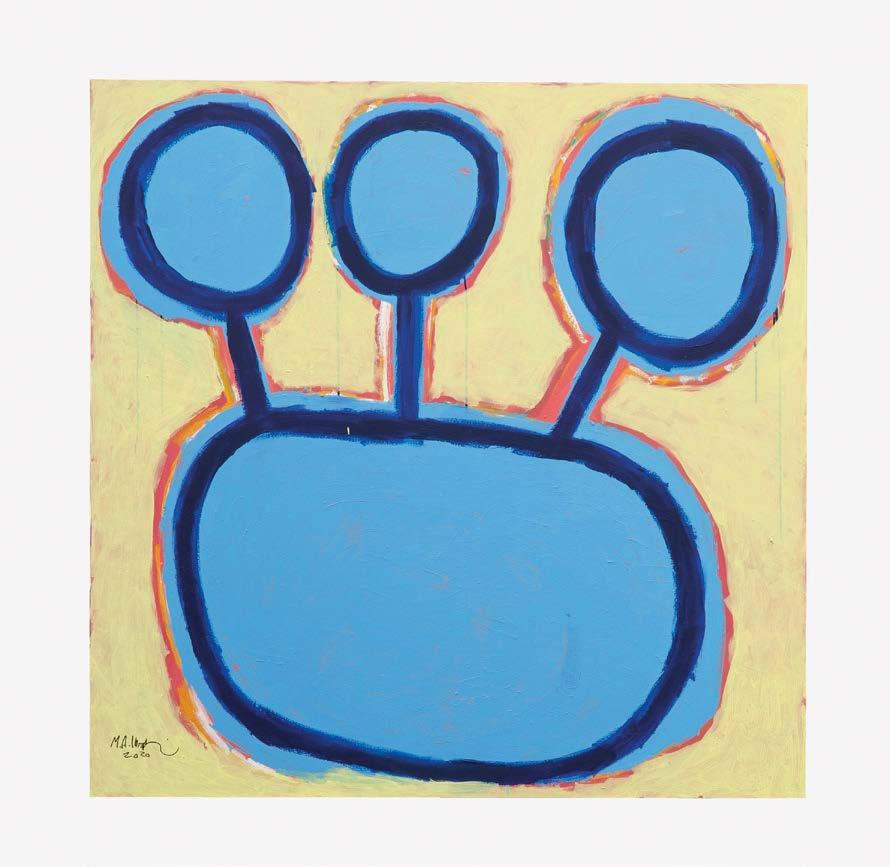
3 Blue Flowers, 2020, acrylic on canvas, 155 x 155 cm.*
Installation images of Mohamed Ahmed Ibrahim, Memory Drum, 2020, Lawrie Shabibi, Dubai. Courtesy the artist and Lawrie Shabibi.
Embryonic Coat explores the conception or manifestation of the known, experienced, or imagined as contained within rudimentary forms, referencing the protective sheath around a seed or the membrane around an embryo. As always, what inspires him were his surroundings, and so naturally, his new series of paintings and cardboard
much as the abstract notations in his Symbols paintings and murals, or the vertical marks in his Lines works. Although often regimented, as with all of Ibrahim’s works these plants are somehow also treated individually and with tenderness. Entitled My Garden’s Details
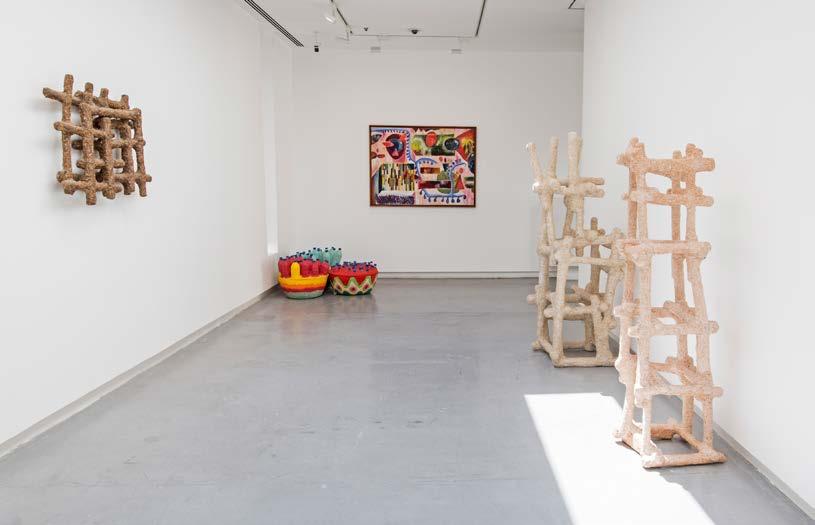
Showing alongside these are recent papier-maché sculptures of the same period, including six large-scale works entitled S B I H works materialise spontaneously through weeks of experimentation with various materials, either coloured or black and white paper, though often mixing in leaves, grass, tea, coffee, or tobacco into the paper to produce nuanced natural and neutral tones. Some are anthropomorphic and dynamic - others emerge as organic plant-like forms, and some toy-like. Whereas a few clearly relate to those in the Venice installation, in contrast to it, here we are presented with an eclectic
Embryonic Coat, Installation view, Courtesy of Lawrie Shabibi, Photo by Ismail Noor of Seeing Things.
Between Sunrise and Sunset, 2022 (Venice Biennale, UAE Pavilion)
by
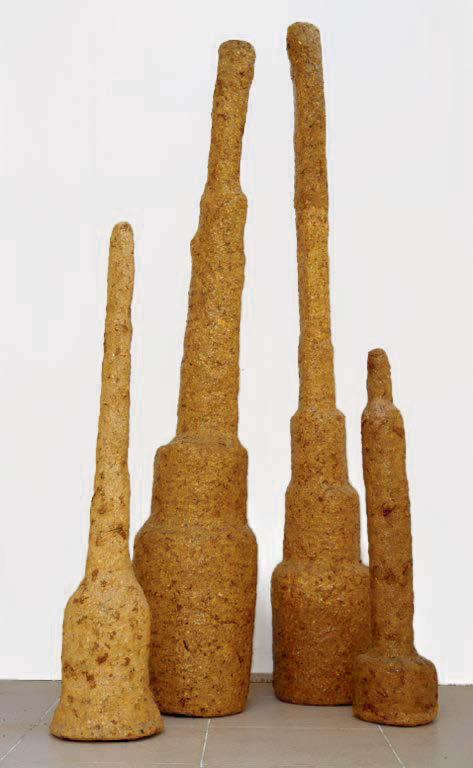
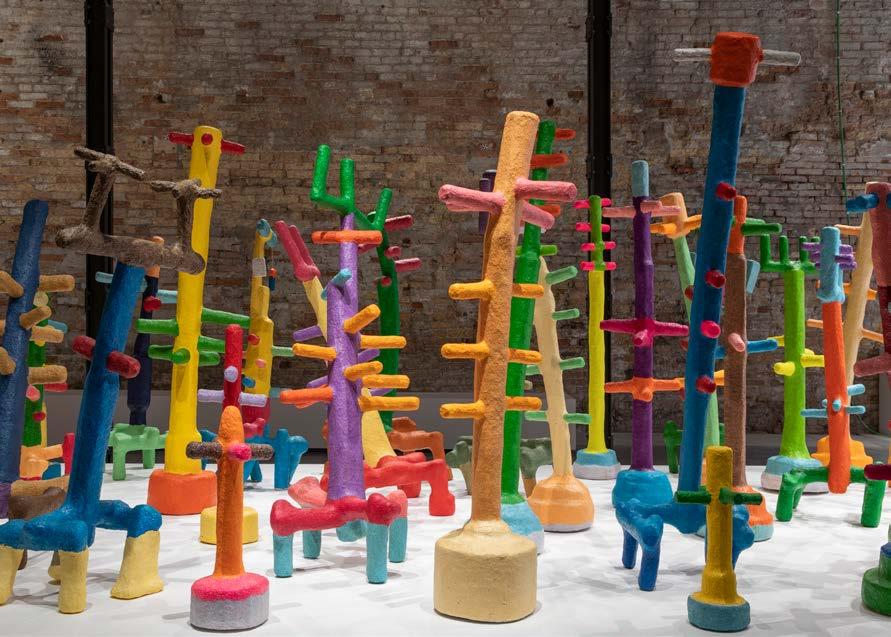
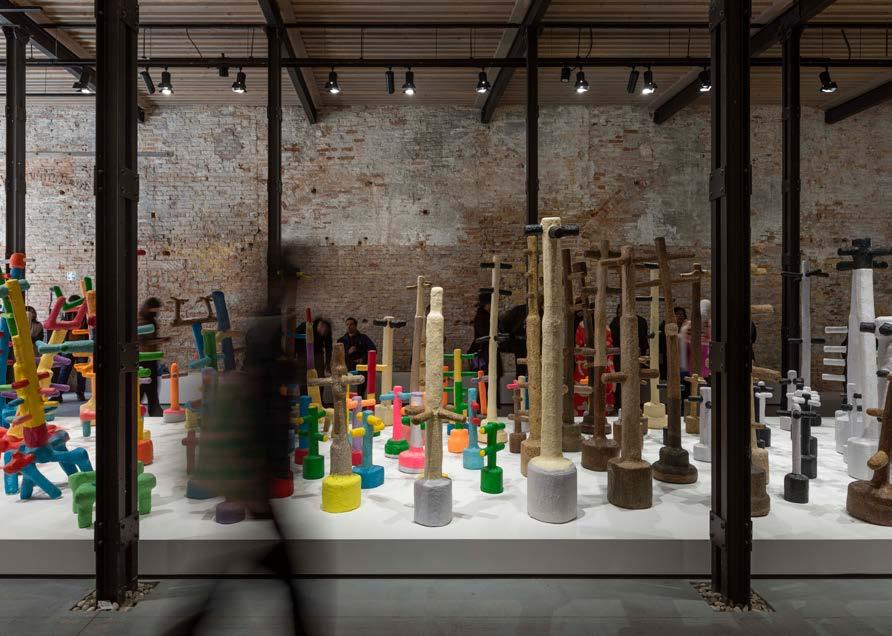
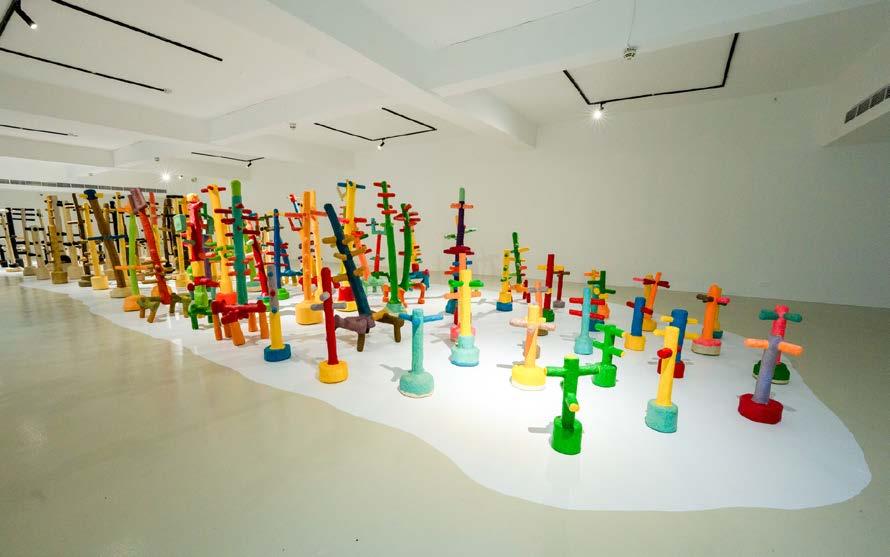
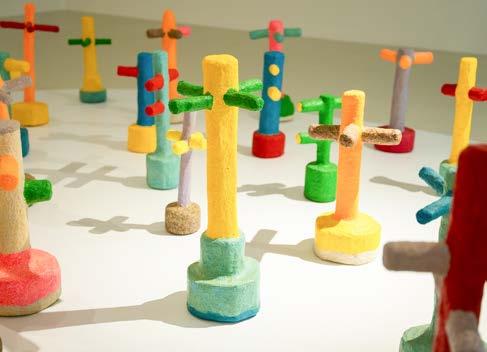
for Biennale Arte 2022, Between Sunrise and Sunset is a single work by Mohamed Ahmed Ibrahim in which dozens of human-sized, biomorphic sculptures cluster in undulating colour and movement— physical dialogue with the materials. By hand he builds up papier-mâché over loose skeleton structures that shift and O colours of the forms derive from his raw materials. I 0 H
of a tightly knit group of experimental, conceptual artists who have led the vanguard of visual art in the UAE since the 0 G studied elsewhere until it began appearing in canonising surveys of the region. Members have included the late Hassan Sharif, Abdullah Al Saadi, Mohammed Kazem, and Hussain Sharif, among others.
Curated
Maya Allison
Installation view, Mohamed Ahmed Ibrahim, Between Sunrise and Sunset, 2022. Courtesy of UAE National Pavilion at the Venice Biennale. Photography by Ismail Noor of Seeing Things.*
Installation view, Mohamed Ahmed Ibrahim, Between Sunrise and Sunset, 2022. Courtesy of UAE National Pavilion at the Venice Biennale. Photography by Ismail Noor, Seeing Things.
Image Courtesy of National Pavilion UAE La Biennale di Venezia. Photo by John Varghese.*
Dubai Culture and Arts Authority (Dubai Culture) introduced expressions of contemporary art from both local and international artists in the Unwritten, Unspoken & Told 5 2 communication, and progressing from language around the self to familial, communal, and spiritual contexts, all in an exploration of other forms of communication and language.
Door Knocker, created by artist Mohamed Ahmed Ibrahim, encourages viewers to think about the passage of time and the shift to modern communication in the digital age.
(This Page) Installation
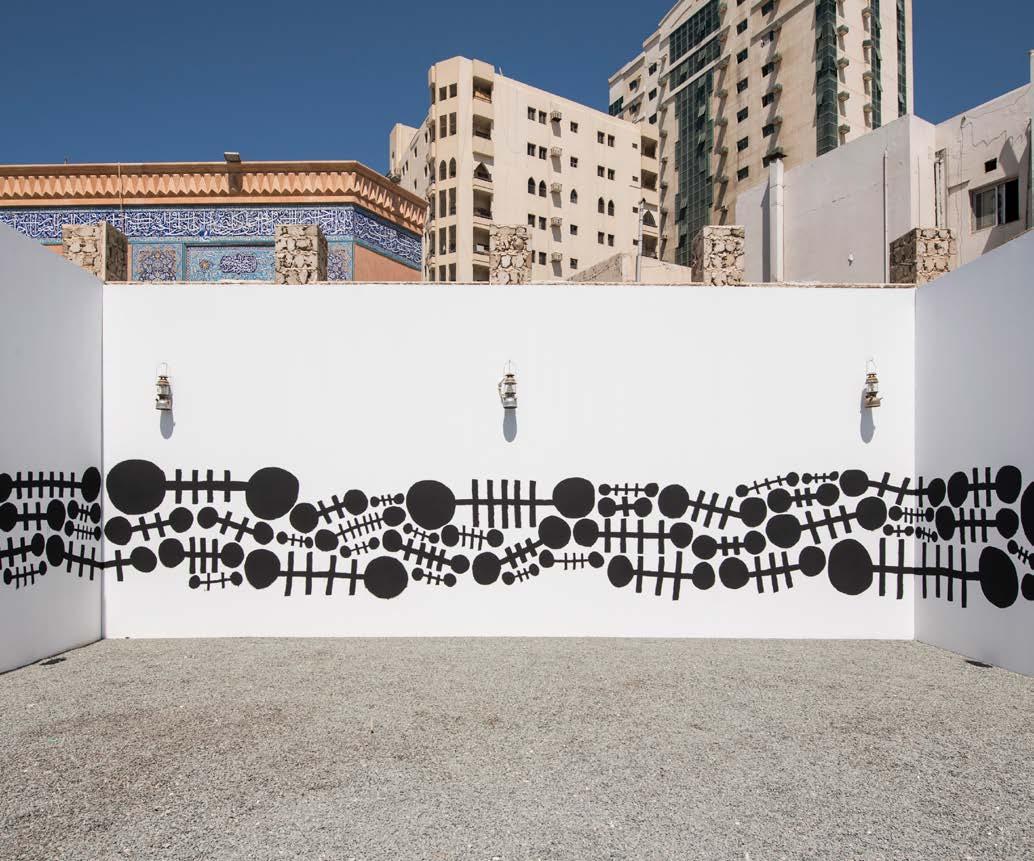
shot of Mohamed Ahmed Ibrahim, Between Sunrise and Sunset at Maraya Arts Center. Originally curated by Maya Allison for the National Pavilion UAE at the 59th Venice Biennale, this installation fnds a new home in Sharjah, brought to life by Cima Azzam in collaboration with Lawrie Shabibi.
(Opposite) Mohamed Ahmed Ibrahim, Door Knocker, 2023, The Foundry Downtown, Dubai Calligraphy Biennale, 2023. Courtesy of the artist and Lawrie Shabibi.
Mohamed Ahmed Ibrahim, Door Knocker, 2023, The Foundry Downtown, Dubai Calligraphy Biennale, 2023. Courtesy of the artist and Lawrie Shabibi.
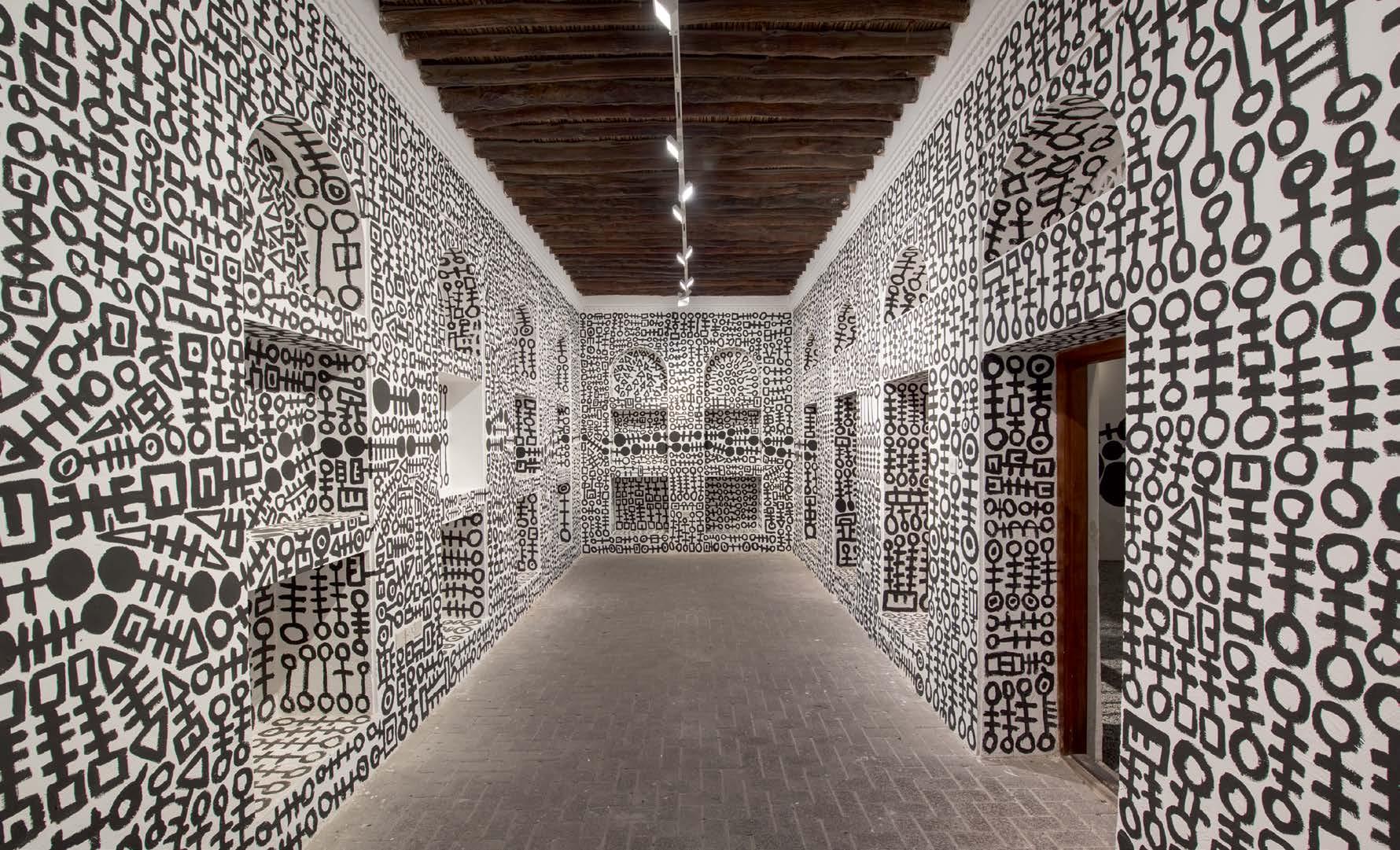
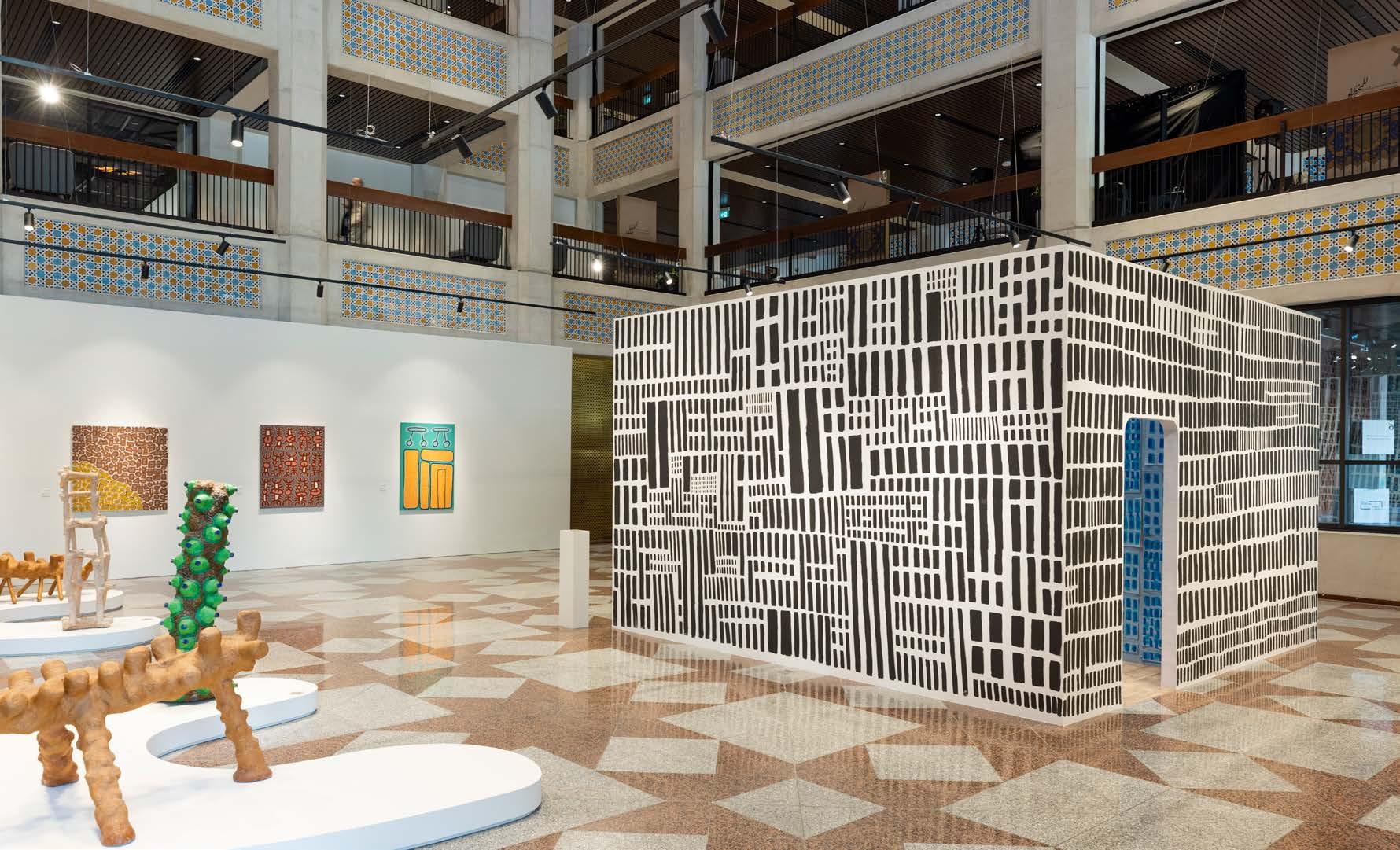
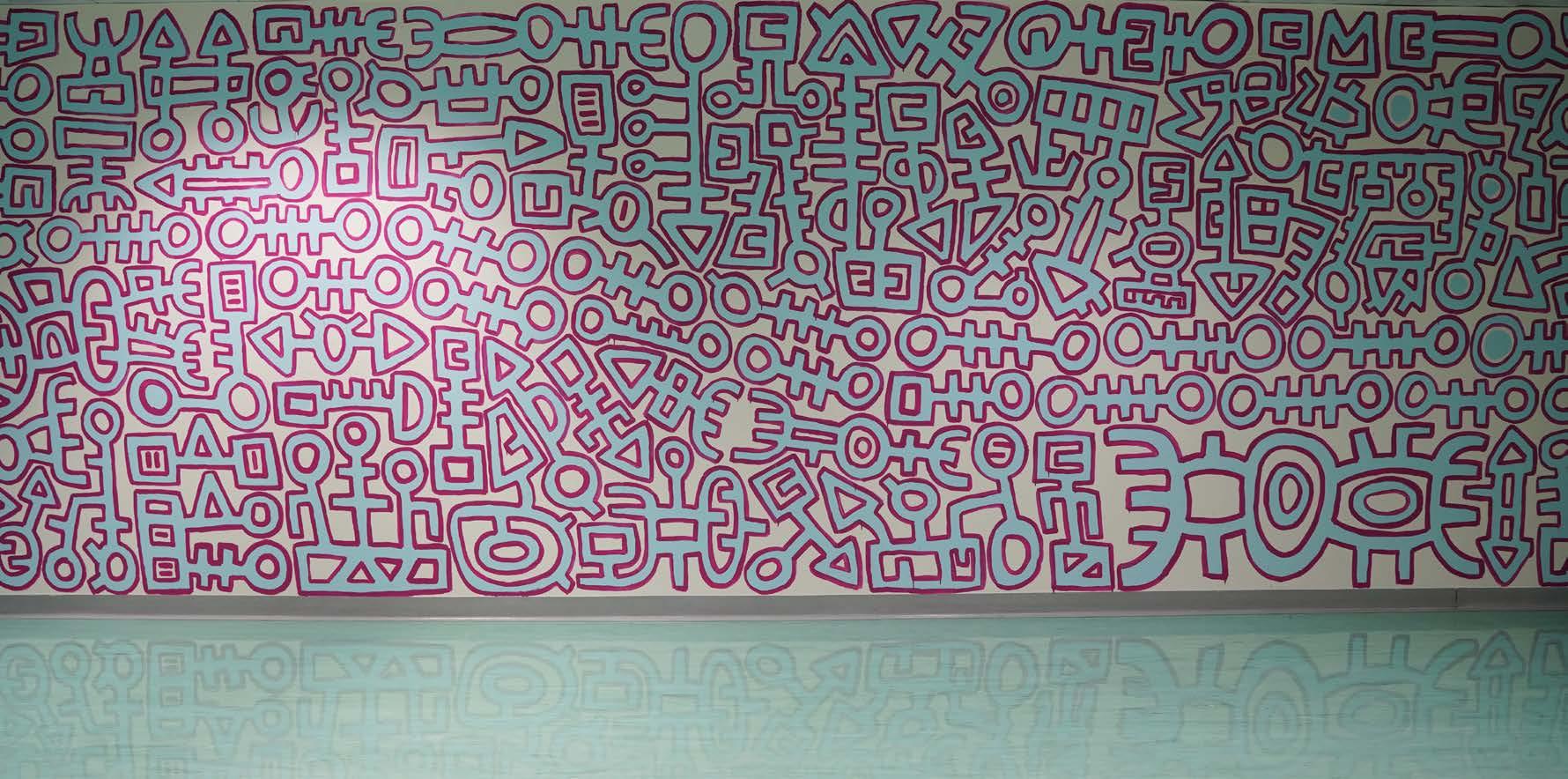
Time | Place | Void is an existential and architectural intervention composed of four interconnected rooms. Inscribed with Mohamed Ahmed Ibrahim’s distinctive line drawings, this work serves as a space of poetry and meditation that invites visitors into his recent ruminations on time, place, and void, which lie at the heart of his practice and his inner worlds.
Time (Al Zaman)
For Ibrahim, ‘Time is material for producing the artwork...it is not merely an external condition that disrupts or suspends H trace behind. ‘Te artwork is completed in its disappearance. It takes two paths: either the work ends with its completion, or it vanishes through its accomplishment.’
T ‘In my works, time is not a straight line with beginning and end, but a cycle... there are no ends to time, but transformations.’
Place (Al Makan)
Ibrahim’s artistic sensibility is inseparable from Khor Fakkan’s landscape, ‘where the mountain stands as my father and the sea as a window.’ For him, nature is not a backdrop but an active collaborator—rock converses, water shifts, the land
‘I am captivated by forms that push vision toward abstraction...Te form acts as trace, and as a ritual to repeat them without end. Te form does not follow the conventions of traditional drawing; it arises instead from a bodily encounter with material. Out of this sustained meditation, form becomes a pathway to the interior, a means of discovering what lies within.’
Void (Al Faragh)
Rather than a point of annihilation, Ibrahim embraces the void as ‘a companion of contemplation... a feeling of completeness.’ H seeks explanation.
‘Te visual rhythm is the serious organising player—the repetition of forms. It is not ornamental, but an internal structure that imposes rhythm. Entering the work is like entering a dense forest: one does not know where they will end up, but they feel the total rhythm that surrounds them.’
In his expression, the void holds the silence that precedes form or music—a silence charged with potential. Drawing on S ‘what lies beyond the point?’ It is not an act of seeing but of ‘conveying a sensation of tension, of possibility, of serenity, and cosmic wonder.’
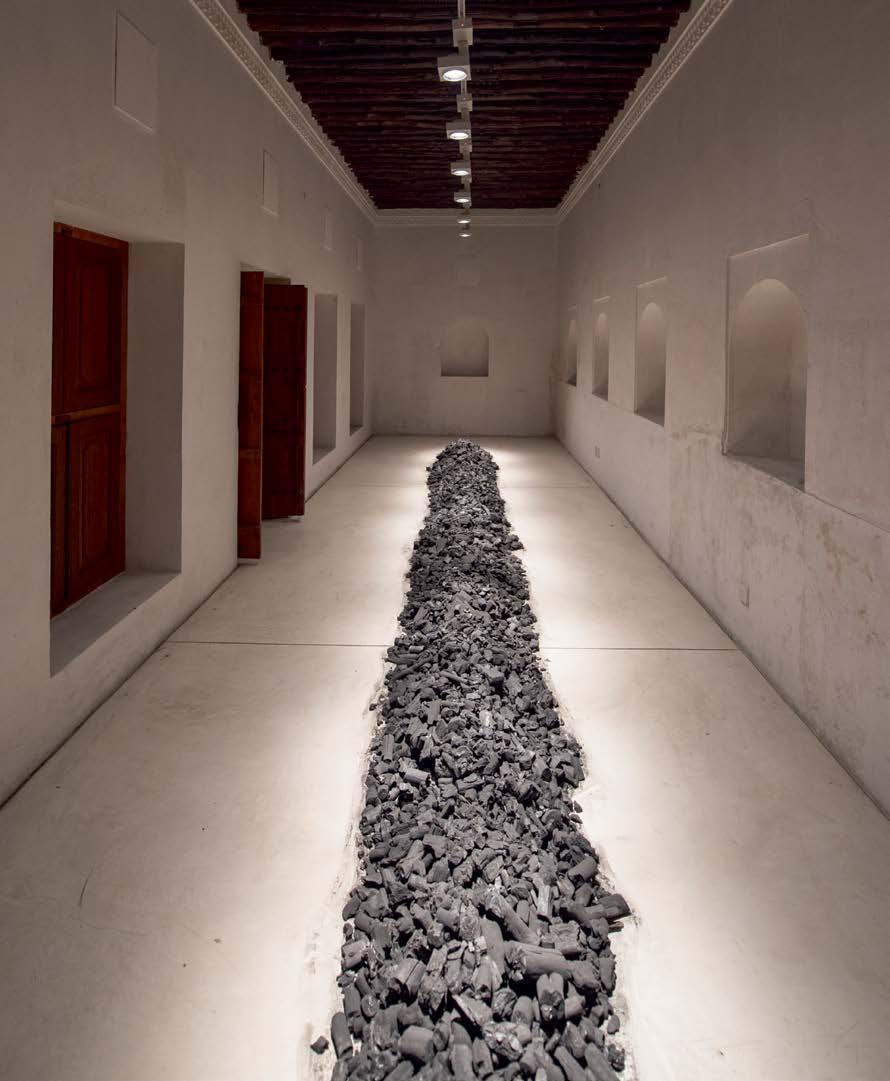
Installation View. Mohamed Ahmed Ibrahim, Two Clouds in the Night Sky Courtesy of the Cultural Foundation, Abu Dhabi.
Installation View. Mohamed Ahmed Ibrahim, Two Clouds in the Night Sky Courtesy of the Cultural Foundation, Abu Dhabi.
Installation View. Mohamed Ahmed Ibrahim, Two Clouds in the Night Sky Courtesy of the Cultural Foundation, Abu Dhabi.
04
BETWEEN LAND AND EO LE
Mohamed Ahmed Ibrahim’s public art and outdoor sculptures extend his lifelong dialogue with nature into communal and open landscapes. From Fallen Stone Garden in AlUla to projects in playgrounds, hospitals, and urban settings, his works transform the experience of place through material, movement, and human interaction. Each installation responds intuitively to its environment to the geology, textures, and rhythms of daily life. Te installations invite viewers to inhabit the work rather than merely
observe it. Whether walked through, touched, or played around, his sculptures dissolve the boundary between art and living space. In these open-air gestures, Ibrahim redefnes public art as a participatory and sensory experience, one that celebrates connection, memory, and the quiet vitality of the landscape itself.
(This Page) Mohamed Ahmed Ibrahim, Bearer, 2020, Cardboard twine, papiermâché, 117.5 x 42 x 42.5 cm. Solomon R. Guggenheim Museum, NY, USA.
In AlUla, the work of the stones, the fallen stone garden, the effect of a natural rock collapse is reimagined. How did you envisage the dialogue between your social forms and the great geological history of the site?
Well, this is one of the works that I really love, and one of the works that really infuenced my practice. All the artists visited that site, so that everyone could see it and choose a spot. I was having a smoke to one side, and I saw my friends, the artists, all looking down, or looking at the trees. No one was looking up. So I did. And I saw a rocky layer, dark in colour, black even, but completely different from the surroundings. And it has a sound when you walk over it.
Yes, exactly. And you felt it, right?
So, I wanted to add some colours to the place. I wanted the viewer to enjoy the work by entering into it, to experience the stones not just with their eyes, but with all their senses, and to dance. And that really happened. Following posts on Instagram or social media, it turned into a place for fashion photography. Tey brought in fashion models, did shoots there, and moved around the works. I wanted viewers to visit the work like they were going on a picnic. Not dress up in a suit and tie, but wear shorts and a T-shirt and bring food. And at the same time as having a picnic, they would see the artistic work.
How old are you now?
I’m a big child.
Your childhood was beautiful. Tank God, yes. But my mother was quite strict with me. Because I was a bit of a troublemaker, I wouldn’t listen. I wouldn’t pray.
How many siblings were there?
I had three sisters and a younger brother.
How many children do you have?
I have six children, three boys and three girls. And each of them is two years apart. First the boys were born, and then the girls were born.
You worked on a project in a children’s playground and in a hospital. How does your creative approach change when you design a work for children, or patients, or regular shoppers, instead of displaying it in an exhibition setting?
Well, we’re talking about public art now. You sometimes get questions from people who have nothing to do with art, like workers, doctors, and so forth. Tey ask questions that are very important to me. Tey give me a kind of unexpected but valuable feedback. Tey are simple people, but they ask beautiful questions.
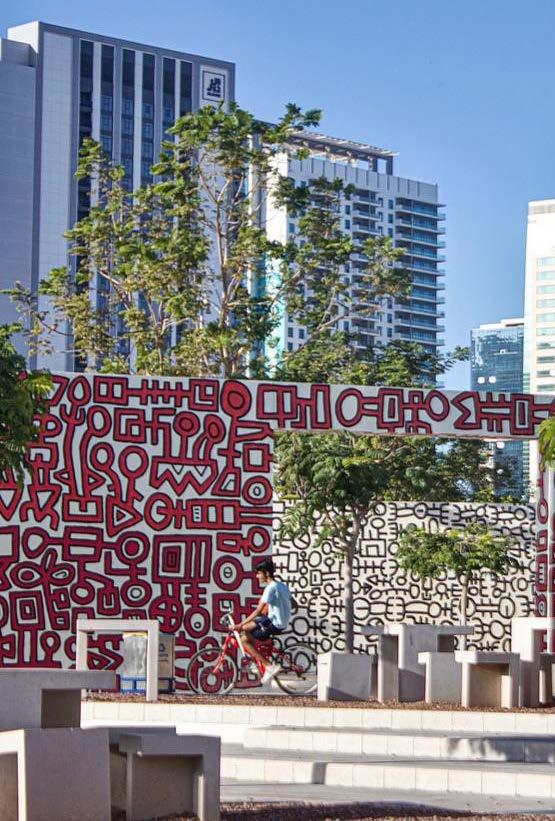
In my frst experience of public art, they gave me big walls to work with. Tere was a lot of space for expression. It gave me the option of using various tools. For example, that was the frst time I used a 12-inch or 10-inch brush. You can use canvas, but it has its limits. And then the surface of a wall is not always even, there are always bulges and cracks, which gives you movement.
I did the last project in Russia in Yekaterinburg and worked with students at the university. Te questions in Russia were the same as I got in Abu Dhabi, because the audience is universal. Tere are people who stop and look, and there are people who remain silent, they just look and then leave. But even with these, the artist is able to control, I don’t say the mind of the viewer, but he is able to control the viewer’s vision and spark some questions, whether they ask the questions or take them away with them and leave quietly. In the end, the question remains. It’s a kind of work the viewer does.
If I asked you to choose one moment – one project or one memory – that has been the most important in your artistic career, what would it be? It was something that lasted two years, actually:
Bait Al Hurma 2018. Commissioned by Sharjah Art Foundation. Image courtesy of Sharjah Art Foundation.
Bait Al Hurma (2018, Sharjah Art Foundation)
Mohamed Ahmed Ibrahim, Kids Garden, 2019, Sheikh Khalifa Medical City, Abu Dhabi, UAE, commissioned by Abu Dhabi Health Services Company, Courtesy Lawrie Shabibi and the artist
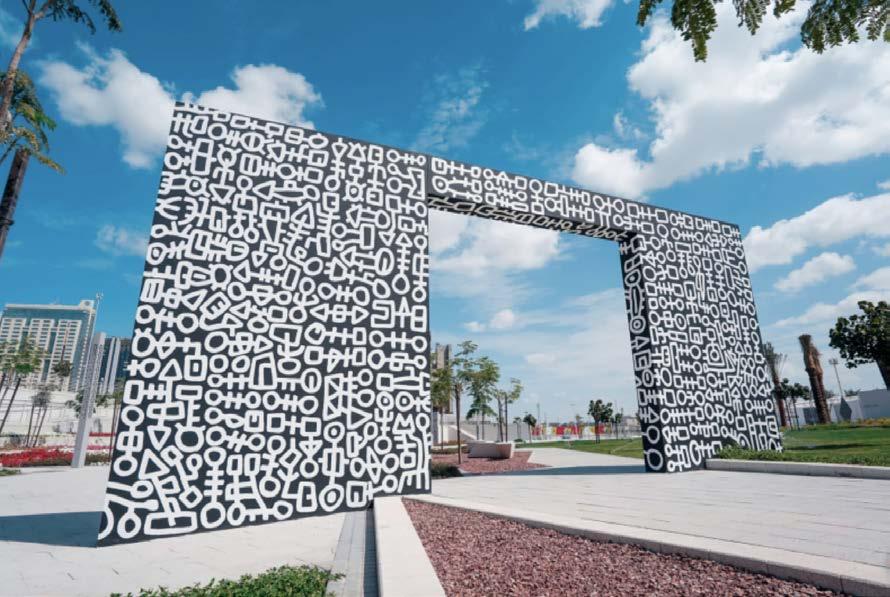
Mohamed Ahmed Ibrahim, Untitled 2019, Reem Central Park, Al Reem Island, Abu Dhabi, UAE, commissioned by Aldar Properties PJSC in partnership with Abu Dhabi Art
the exhibition at the Sharjah Foundation in 2018. Tat was one of the most important moments in my life, both as a personal experience and an artistic one.
Te second moment was when the Emir of Ajman called me to ask about a painting. Tese two things really had an impact on me.
If we look at your artistic journey as a whole, starting N most important message that you would like to pass on to the next generation? Keep thinking.
You read a lot.
I used to read a lot. It’s been a while since I read anything. I used to read everything. I read a lot from the Khor Fakkan library because I worked there for six years. I read everything. Even when I went to the supermarket, I read what they had. I love to read. I’m not a specialist, but the books I like most are related to art, philosophical books, or books on psychology. And, of course, novels.
After you read a book, do you take inspiration from it for your art?
No, it doesn’t affect my artistic work. But whenever I read a novel, I’d reach a point where I became the hero, I became a character, or else I’d see this character in the street. Te events of the novel would happen to me in my daily life.
Tere is a very important novel by Ernesto Sabato, a writer from Argentina. It’s called ‘On Heroes and Tombs’. I read it so many times that the pages are almost transparent now. Tis novel really had an impact on me. Not really the story itself, but more the way the writer writes, the terms he uses. I read it in Arabic.
I exhibition.
For Play in the Clay yes. I made a lot of copies, all by hand. I distributed them to my relatives. I only have one copy left.
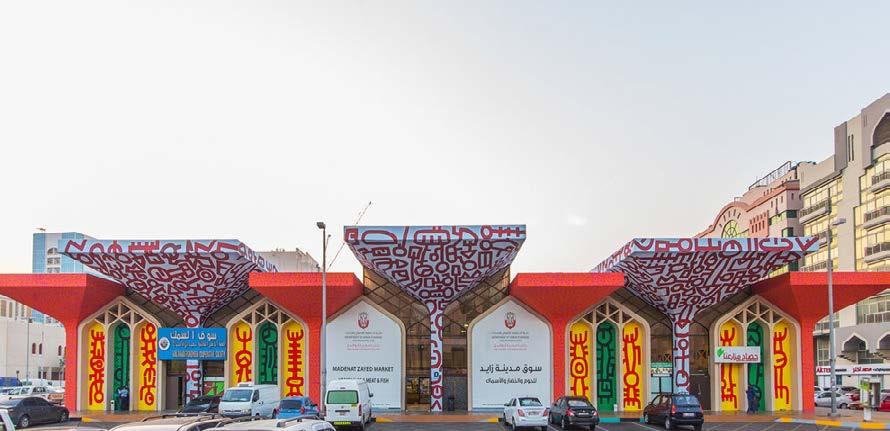
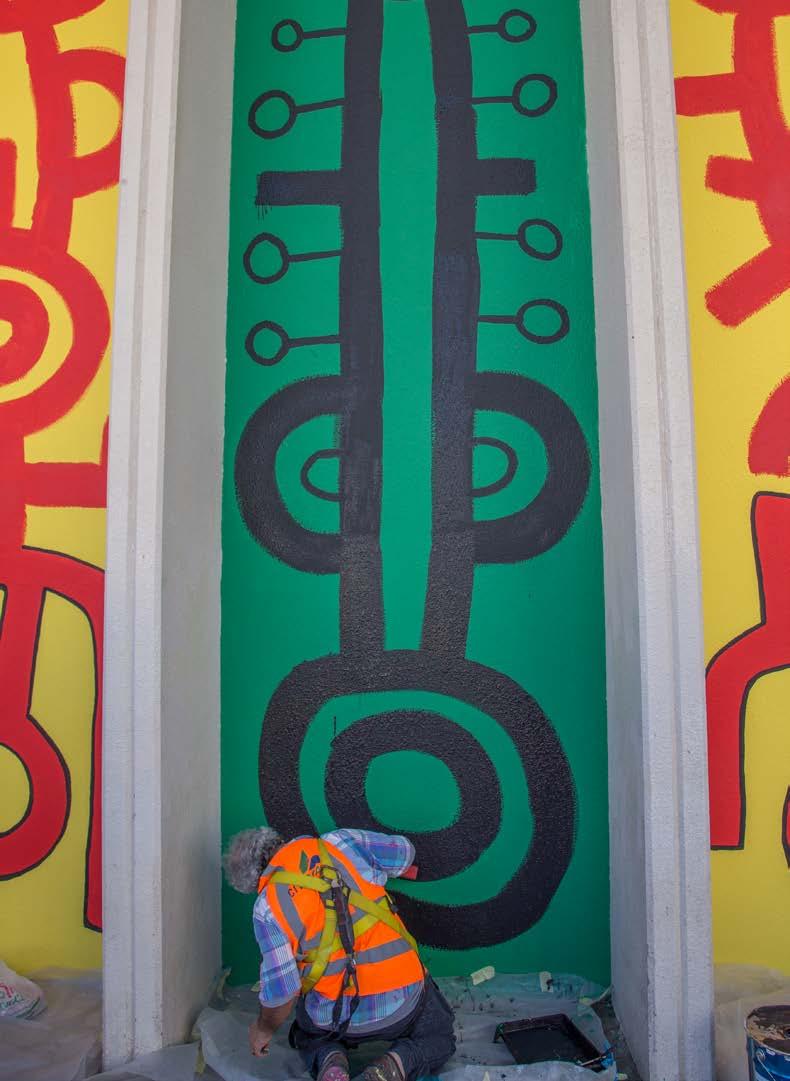
(This Page Above) Mohamed Ahmed Ibrahim, Grocery 2019, Madinat Zayed Market, Abu Dhabi, UAE, commissioned by Ghadan 21, Government of Abu Dhabi as part of the For Abu Dhabi initiative.
(This Page Right and Opposite) Mohamed Ahmed Ibrahim, Grocery 2019, Installation view at Madinat Zayed Market, Abu Dhabi, Commissioned by Ghadan 21, Government of Abu Dhabi as part of the For Abu Dhabi initiative, Courtesy the Artist and Lawrie Shabibi, Photo credit Mario.
Mohamed Ahmed Ibrahim, Falling Stones Garden, 2020, Installation view at Desert X AlUla, Photo by Lance Gerber, Courtesy the artist and Lawrie Shabibi, RCU and Desert X.
Falling Stones Garden (2020, Desert X, AlUla)
And why did you decide to do this?
Because I had trouble getting them printed. Te printers promised me it would be done “Inshallah”, but it ended up taking ages, so I took matters into my own hands and did them myself, just so I had something to show in case I met a young artist or had a visitor.
Can you describe a day in your life? How do you start your day?
Very easy: wake up, I go to the studio. I have my lunch, then back to the studio until sundown. Tat’s how I spend my days. Unless I have to go to the supermarket, to buy groceries. Tat’s it. If there’s nothing else, I don’t go out. Sometimes I don’t go out for weeks.
Is there someone in your family who helps you with your art?
No, but my children, both the boys and the girls: they
have a good way of reading artistic works. A beautiful way. We used to travel a lot, going to museums and galleries. Tat’s why they can distinguish between good work and bad work. But none of them got into art as a practice. It’s like the old saying, you can lead a horse to water, but you can’t make it drink.
Mohamed Ahmed Ibrahim, Falling Stones Garden, 2020, Installation view at Desert X AlUla, Photo by Lance Gerber, Courtesy the artist and Lawrie Shabibi, RCU and Desert X.
Mohamed Ahmed Ibrahim, Al Ain Oasis, Installation view, Al Ain Oasis Farm, Abu Dhabi, UAE, 2023. Courtesy of the artist, Abu Dhabi Art and Lawrie Shabibi.
Union of Artists (2024,
Union of the Artists installation, commissioned by Dubai Culture in collaboration with Art Dubai. Photo by Cedric Ribeiro, Getty Images for Art Dubai, 2024.
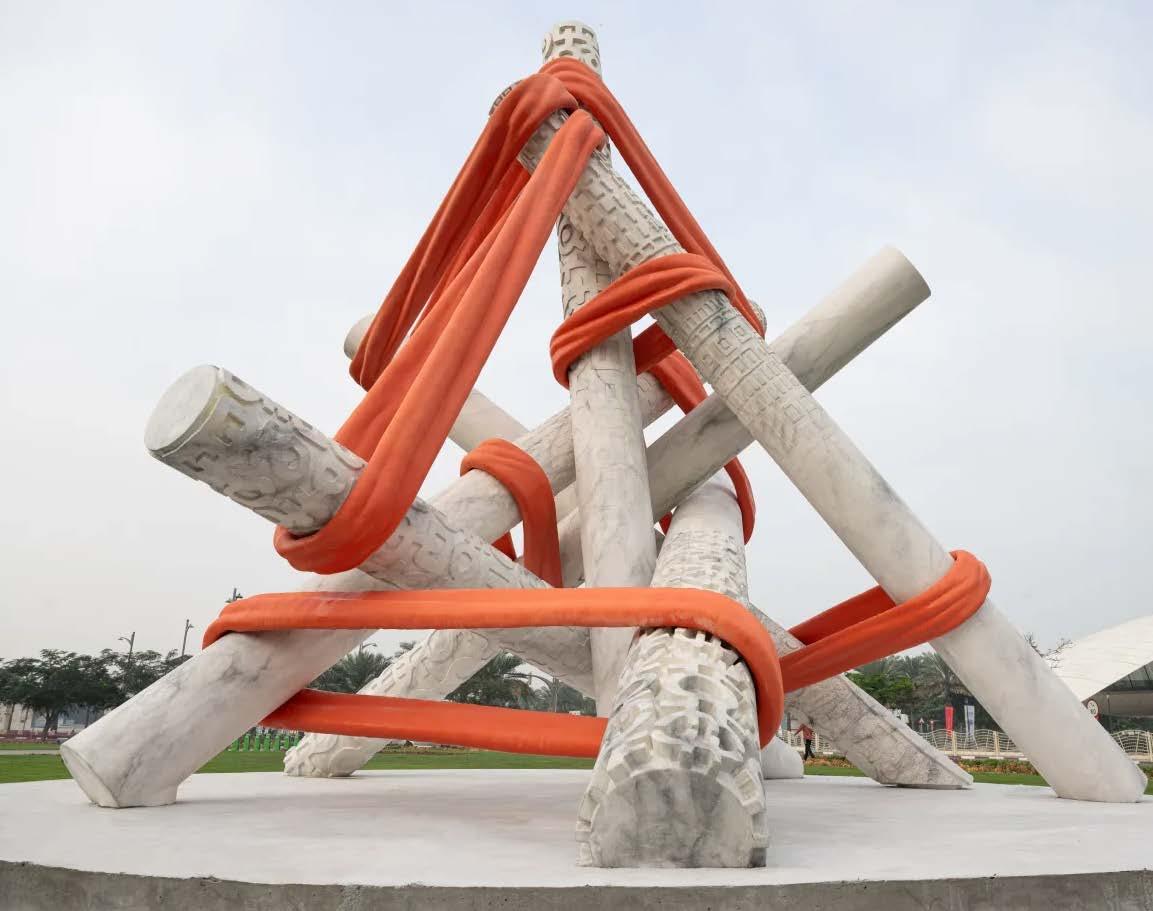
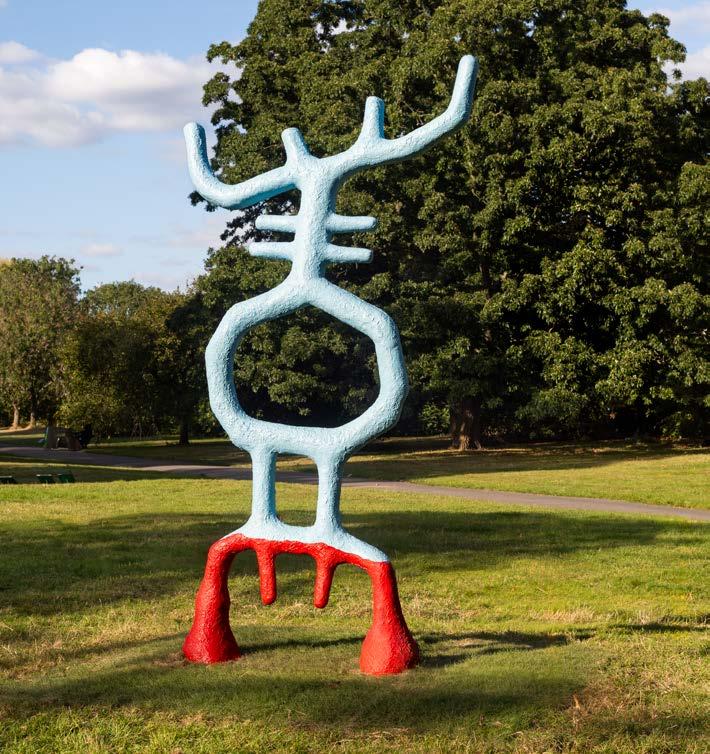
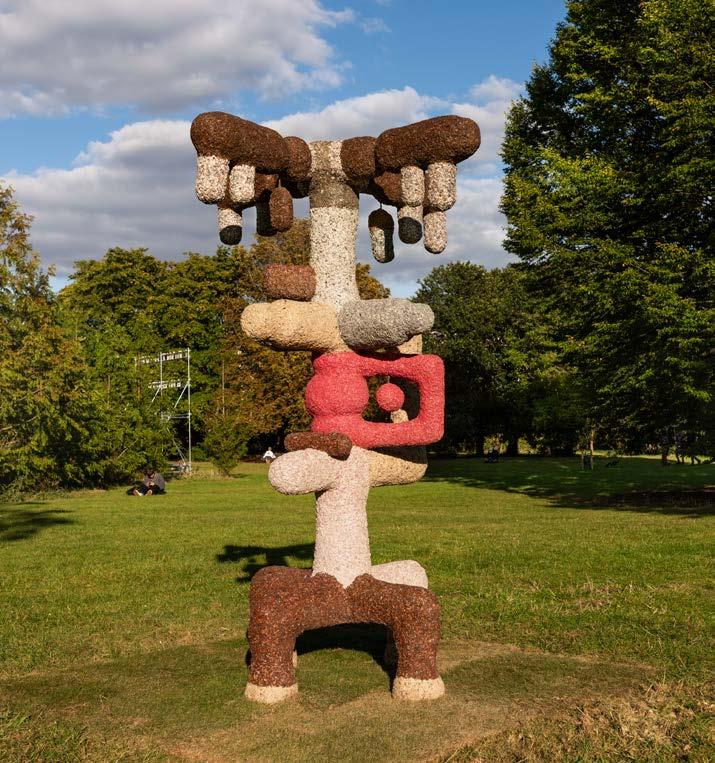
Mohamed Ahmed Ibrahim, The Form 2024, Fiberglass and resin on polystyrene over steel armature.
Mohamed Ahmed Ibrahim, The Ghaf Tree, 2024, Fiberglass and resin on polystyrene over steel armature.
Play in the Clay + Just Lines (1997), Handmade brochure, 21.5 x 16.5 cm.*