
Luxury Beyond Noise

Page 1


LUXURY BEYOND NOISE

THE ARCHITECTURE OF DESIRE

Luxury and the Human Brain

A Reflection on Spectacle Luxury, Experiential Luxury, and the Emergence of Living Luxury Luxury decisions rarely begin with logic. They begin with emotion.

Modern neuroscience shows that feelings often guide judgment before conscious reasoning begins

Some brands attempt to trigger this response through spectacle and identity projection.

The most enduring brands create something deeper: presence, meaning, and belonging.

This paper explores that shift — from symbolic luxury, to experiential luxury, and ultimately to living luxury grounded in place.

THE ARCHITECTURE OF DESIRE

From Symbolic Luxury to Lived Luxury

Implications for the ABFE Estate Transformation

. The Misunderstood Nature of Luxury

Luxury has long been analysed through rational frameworks: price, craftsmanship, rarity, brand equity.

Yet the true mechanism of luxury decision-making is emotional.

As behavioural research consistently shows, the commitment happens first — emotionally — and the rational explanation follows afterwards.

This phenomenon is what we describe as the Architecture of Desire.

Clients do not purchase luxury primarily for what an object is.

They purchase it for who they become through the experience of it.

2

. The Luxury Paradox

Today the luxury industry faces an important paradox.

• The global population of ultra-high-net-worth individuals is growing.

• Yet more than half of luxury consumers believe many luxury brands are overpriced.

This suggests a fundamental shift. The challenge is not purchasing power.

The challenge is emotional legitimacy.

Brands that fail to generate emotional resonance inevitably drift toward comparison and price sensitivity.

3

. The End of Information Advantage

Historically, luxury brands benefited from control of narrative and expertise.

Clients depended on boutiques, showrooms, and brand storytelling to interpret value.

That informational asymmetry has now disappeared.

Digital transparency — and increasingly artificial intelligence — has flattened access to knowledge.

The result:

Luxury brands can no longer rely on information superiority. They must rely on emotional architecture.

. Spectacle Luxury vs Experiential Luxury

The industry is now dividing into two models.

Spectacle Luxury

Luxury expressed through:

• visibility

• spectacle

• cultural noise

• trend cycles

• accessibility

Experiential Luxury

Luxury expressed through:

• restraint

• authenticity

• belonging

• place

• emotional resonance

The contrast between these two approaches can be clearly illustrated through the examples of Gucci and Aman.

. The Gucci Lesson: Symbolic Luxury

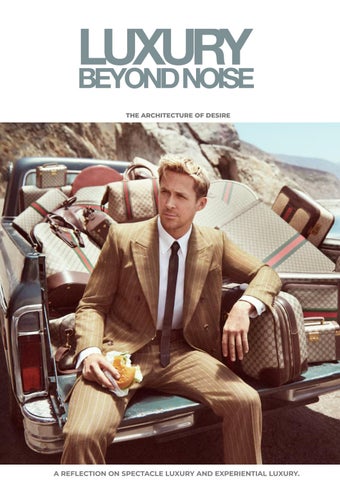
The Gucci Valigeria campaign illustrates how luxury fashion brands construct identity

narratives around objects.

In the image analysed in your paper, the product itself — the luggage — is almost secondary.

The emotional trigger is the lifestyle narrative:

• mobility

• masculine elegance

• cultural coolness

• spontaneous travel

The viewer is invited to imagine becoming a modern nomadic aesthete.

The campaign illustrates an essential mechanism of symbolic luxury.

The product becomes a prop in an identity narrative.

Yet the transformation remains symbolic.

It exists primarily in imagination.

The lifestyle is suggested — not experienced.

This contrast becomes particularly visible when comparing symbolic fashion luxury with experiential hospitality.

. The Aman Principle: Experiential Luxury Aman represents the opposite philosophy.

Rather than constructing identity through imagery, Aman constructs presence through place.

Its communication rarely centres on characters or lifestyle narratives.

Instead it focuses on:

• architecture

• landscape

• silence

• atmosphere

The guest is not asked to imagine becoming someone. They are invited to inhabit a different state of being.

They are invited to inhabit a state of being.

This is the key difference between spectacle luxury and experiential luxury.

7

. From Symbolic Luxury to Lived Luxury

The contrast between these models is fundamental.

Fashion Luxury Estate Luxury

Symbolic travel Actual place

Identity projection Cultural belonging

Brand narrative Land narrative

Cinematic fantasy Lived experience

Luxury fashion often sells the image of belonging.

Estate hospitality can create real belonging.

8

. From Estate Hospitality to Belonging

Luxury hospitality, at its highest level, eventually evolves beyond service.

It creates belonging.

Some pioneering brands have begun to explore this transition. Within the urban environment of Aman New York, a private club was introduced to create a curated circle of individuals aligned with the brand’s philosophy of privacy, cultural refinement, and discretion. A small circle of individuals — invited through shared values…

Membership is intentionally limited. Its purpose is not scale, but alignment.

Members do not simply visit the brand. They become part of its ecosystem.

Yet within the emerging AgriLuxury estate model, the concept of belonging may take on a deeper meaning.

Where urban luxury clubs connect individuals to architecture and environment, living estates connect them to land, culture, and seasonal continuity.

Across the global portfolio of estates — from Patagonia to Napa Valley, from Tuscany to the Barossa — hospitality already operates within the context of agriculture, stewardship, and cultural landscape.

Among these properties, Bodega Garzón offers a particularly compelling opportunity to explore the next stage of this evolution.

Here, belonging could emerge not as a traditional membership, but as a form of affiliation with the estate itself.

A small circle of individuals — invited through shared vision and long-term commitment — may one day become affiliated with the philosophy and future of the estate. Such affiliation would not be defined by access alone.

It would represent participation in the life of the estate:

• privileged presence during harvest and cultural gatherings

• allocation of rare wines and vintages

• participation in environmental and philanthropic initiatives connected to the land

• access to the broader ecosystem of estates within the portfolio

Unlike traditional clubs, the value of this circle would not lie in exclusivity alone.

It would lie in custodianship.

A shared relationship with place.

Through such initiatives, the estate evolves beyond hospitality.

It becomes something rarer.

A landscape where land, culture, wine, and community converge.

9

. The ABFE Philosophy: Quite Luxury

The transformation of the ABFE estate portfolio follows precisely this philosophy.

Rather than competing within the noise of spectacle luxury, the estates operate within the discipline of Quite Luxury.

Luxury defined by:

• restraint rather than visibility

• land stewardship rather than spectacle

• cultural continuity rather than trend cycles

• experiential belonging rather than symbolic identity

Across the portfolio — from Patagonia to Napa Valley, from Tuscany to Barossa — the estates function as living ecosystems.

Agriculture, hospitality, culture, and landscape operate within one coherent philosophy.

1

0. AgriLuxury: The Land as Luxury

The AgriLuxury framework formalizes this emerging category.

AgriLuxury hospitality integrates:

• active agricultural landscapes

• refined hospitality

• cultural continuity

• regenerative stewardship

Guests do not merely observe luxury.

They participate in it.

Through:

• harvest

• cuisine

• land stewardship

• seasonal rhythm

The result is lived luxury rather than symbolic luxury.

11. The Human Advantage

Artificial intelligence will increasingly absorb:

• information

• comparison

• booking

• service logistics

What it cannot replicate is human emotional precision.

Moments where a guest senses that they have entered not merely a property, but a philosophy.

That feeling of belonging is the most powerful luxury signal of the future.

2. The Future of Luxury

The brands that will define the next era of luxury will not be those that are loudest.

They will be those that create meaningful emotional environments.

Places where identity is not performed.

But discovered.

In this sense, the ABFE estate network represents not simply a collection of vineyards and hospitality properties.

It represents a living model of the future of luxury.

3. The Psychology of Quiet Luxury

Why Aman Works — and Why ABFE Naturally Aligns

The success of brands such as Aman is not accidental. It reflects a deeper psychological mechanism in luxury perception.

While many luxury brands pursue attention, Aman deliberately cultivates silence.

Its communication rarely focuses on people, celebrities, or status signals.

Instead, the visual language emphasizes:

• landscape

• architecture

• stillness

• natural materials

• absence of spectacle

This aesthetic restraint creates a powerful psychological effect.

Where spectacle brands stimulate excitement, quiet luxury stimulates presence.

Guests experience a subtle shift in emotional state: from stimulation to calm, from comparison to immersion.

The brand is no longer merely observed.

It is inhabited.

This explains why Aman has been able to maintain extraordinary desirability despite relatively limited scale and minimal marketing noise.

The brand does not sell lifestyle imagery.

It sells a state of being.

The emerging ABFE philosophy follows precisely this direction.

Across the estate portfolio, the emotional signal is not manufactured through design alone.

It emerges from the combination of:

• agricultural landscape

• cultural continuity

• architectural restraint

• human hospitality

In this sense, ABFE aligns naturally with the psychological foundations of quiet luxury.

4. Why Wine Estates Represent the Ultimate Luxury Platform

While fashion brands rely on symbolic identity narratives, and hotels rely on architectural staging, wine estates possess a unique advantage.

They are living cultural landscapes.

Unlike most luxury assets, they combine four powerful dimensions simultaneously:

Land

The vineyard landscape anchors the experience in a real geography and seasonal rhythm.

Culture

Wine production carries centuries of accumulated knowledge, ritual, and craftsmanship.

Gastronomy

Cuisine becomes a direct extension of the land through agricultural production.

Hospitality

Guests are not merely visiting a hotel — they are entering a functioning ecosystem. This convergence of land, culture, gastronomy, and hospitality creates something rare in the modern luxury economy:

authentic continuity.

The estate is not an artificial stage. It is a living organism.

For this reason, vineyard estates represent one of the most powerful luxury platforms available today.

They transform luxury from symbolic identity into lived participation.

15. AgriLuxury: The Evolution of Estate Hospitality

The concept of AgriLuxury emerges naturally from this convergence.

AgriLuxury defines a hospitality model where refined guest experiences exist within actively productive agricultural landscapes.

Unlike traditional agritourism — which typically emphasizes rustic authenticity — AgriLuxury integrates:

• sophisticated hospitality

• architectural refinement

• regenerative land stewardship

• cultural continuity

• meaningful guest participation

Guests do not merely observe luxury. They participate in it.

They encounter:

• harvest cycles

• seasonal cuisine

• vineyard work

In this way, the estate becomes both destination and narrative.

Luxury is no longer an object or service.

It becomes a relationship with place.

From Spectacle to Stewardship

The shift from spectacle luxury to experiential luxury reflects a broader cultural transition.

For much of the twentieth century, luxury was defined by visibility.

Brands signaled prestige through logos, celebrity association, and visual recognition.

Today that signal has begun to weaken.

The most sophisticated luxury clients increasingly seek something different:

• authenticity

• meaning

• cultural depth

• environmental responsibility

In this context, the role of the luxury brand evolves. From performer of status to custodian of place.

The ABFE estate ecosystem embodies precisely this transformation.

Through eco-certified wine production, regenerative agriculture, cultural heritage, and refined hospitality, the estates operate not as luxury stages but as living environments of stewardship.

7. The Architecture of Belonging

The ultimate goal of luxury is not attention.

It is belonging.

Belonging occurs when a guest senses that they have entered a place with coherence, memory, and meaning.

A place where the landscape, architecture, people, and culture speak the same language.

When that coherence exists, the guest no longer compares alternatives.

They return.

They advocate.

They identify.

This is the deepest level of luxury value creation.

Not product desirability.

But emotional attachment to place.

18. Conclusion

The Quiet Architecture of the Future

Luxury is entering a new phase.

The informational advantage of brands has disappeared.

Artificial intelligence will continue to automate many transactional layers of hospitality and retail.

What will remain valuable is the human capacity to create emotionally resonant environments.

Places that feel meaningful.

Places that feel authentic.

Places that cannot be replicated.

In this context, the most powerful luxury environments of the future may not be boutiques or flagship stores.

They may be living estates.

Landscapes where agriculture, culture, gastronomy, and hospitality converge.

This is the direction in which the ABFE transformation is moving.

Not toward louder luxury.

But toward something far more enduring.

Luxury beyond noise.

Within the ABFE estate portfolio, this philosophy is increasingly expressed through the emerging AgriLuxury model.

A Quiet Statement

Luxury is entering a new era. AgriLuxury — where land, culture and hospitality converge to create belonging.

For decades the industry has competed through visibility — through spectacle, expansion, and cultural noise.

But meaning cannot be amplified through volume. It must be cultivated through coherence.

The most enduring luxury environments of the future will not be those that attract the most attention, but those that create the deepest sense of belonging.

Places where land, culture, architecture, and hospitality speak the same language.

Places where luxury is not performed — but lived.

Across the estates of the ABFE ecosystem — from the vineyards of Patagonia to Napa Valley, from Tuscany to the Barossa Valley — a different philosophy is quietly taking shape.

Offering moments where a guest senses that they have entered not merely a property, but a philosophy.

Not louder luxury.

Not faster luxury.

But luxury grounded in land, continuity, and custodianship.

In a world increasingly defined by noise, the rarest luxury may ultimately be the presence of meaning.

Luxury beyond noise.

AgriLuxury

— where land, culture and hospitality converge to create belonging.

Turn static files into dynamic content formats.
Create a flipbook
Luxury Beyond Noise by Selected Hotels Promotion L.C. | CHC CoutureHospitalityConcept | HoteliersGuild - Issuu