

3 Reasons Securities Fraud Litigation Exposure Fell In Q1
By Nessim Mezrahi and Stephen Sigrist (April 9, 2021, 4:38 PM EDT)
In anticipation of a U.S. Supreme Court decision in Goldman Sachs Group Inc. v. Arkansas Teacher Retirement System, tempered filing frequency and lower severity of fraud-on-the-market claims against directors, officers and their respective U.S.listed corporations led to a material decrease in Rule 10b-5 private securities fraud litigation exposure during the first quarter of 2021.
Based on our monitoring of securities class actions, we posit that three factors have contributed to U.S. issuers' and non-U.S. issuers' lowest exposure since 2018 to securities class actions that allege violations of the federal securities laws under Sections 10(b) and 20(a) of the Securities Exchange Act, and SEC Rule 10b-5 promulgated thereunder.
First, sustained scrutiny of the securities class action mechanism by the federal judiciary and a new conservative regime in the Supreme Court have kept filing frequency in check.
Second, expectations of stricter evidentiary requirements of price impact during class certification proceedings may have deterred greater filing frequency due to the potential for precedent-setting case law that rebuts the presumption of reliance established in the Supreme Court's 1988 Basic Inc. v. Levinson opinion.


Third, record-setting U.S. equity markets have reduced institutional investors' trading losses, thereby limiting the opportunities for plaintiffs lawyers to file high severity fraud-on-themarket claims.
Our data and analyses indicate that global exposure of U.S. issuers and non-U.S. issuers to Rule 10b-5 claims amounted to $177.1 billion in the fourth quarter of 2020 and decreased by $139.2 billion to $37.8 billion in the first quarter of 2021.[1]
Rule 10b-5 exposure for U.S. issuers decreased by $64.2 billion, or 66%, to $33.6 billion in the first quarter of 2021.[2]
Nessim Mezrahi
Stephen Sigrist
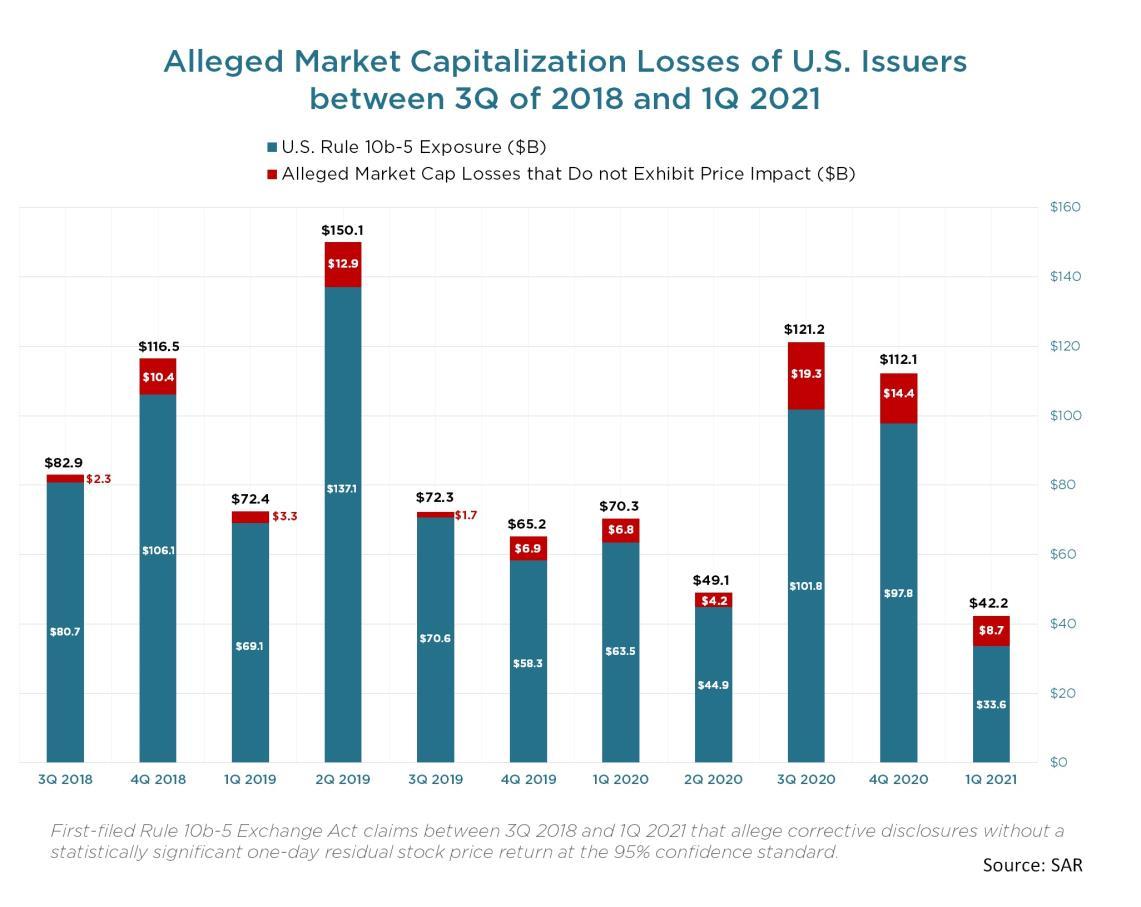
The lowest Rule 10b-5 exposure and the greatest aggregate market capitalization of U.S.-listed corporations since the third quarter of 2018 led to a first quarter of 2021 Rule 10b-5 exposure rate of 0.08%, which is 71% lower than the average of the preceding 10 consecutive quarters.[3]
On the American depositary receipts front, Rule 10b-5 exposure for non-U.S. issuers also decreased materially by $75.1 billion, or 95%, to $4.3 billion.[4]
These economic estimates of securities class action exposure are based on investors' claim-specific market capitalization losses that stem from alleged violations of Rule 10b-5 of the Securities Exchange Act.
Our estimates of class action exposure to Rule 10b-5 private securities fraud litigation exclude alleged stock drops that do not surpass statistical thresholds of price impact, at the 95% confidence standard, in line with the 2015 U.S. District Court for the Northern District of Texas ruling that followed the Halliburton II 2014 Supreme Court ruling.[5]
Fraud on the market securities litigation typically focuses on a price change at the time of a corrective disclosure. … To show that a corrective disclosure had a negative impact on a company's share price, courts generally require a party's expert to testify based on an event study that meets the 95% confidence standard, which means ''one can reject with 95% confidence the null hypothesis that the corrective disclosure had no impact on price.''[6]
1. The Federal Judiciary's Sustained Scrutiny of Securities Class Actions and an Increasingly Conservative Supreme Court
The addition of Justice Amy Coney Barrett to the Supreme Court fortifies a new era of conservatism that has the securities plaintiffs bar on notice, especially after the string of high-profile securities class action dismissals penned in the U.S. Court of Appeals for the Second Circuit
According to a study by the University of Virginia that was reported in the National Law Review, "[d]uring her time as a Judge on the U.S. Circuit Court of Appeals for the Seventh Circuit, Justice Barrett voted conservatively over 80 percent of the time compared to other judges on the Seventh Circuit Court of Appeals."[7]
With fresh, conservative eagle eyes now inspecting critical class certification procedures from the highest court in the land, the securities plaintiffs bar appears to be exercising measured restraint.
For example, on Feb. 25, lead plaintiffs counsel filed a notice for voluntary dismissal without prejudice in City of Riviera Beach General Employees Retirement System v. Royal Caribbean Cruises Ltd.[8] This case was originally filed in the U.S. District Court for the Southern District of Florida and amounted to $6.8 billion in Rule 10b-5 exposure during the fourth quarter of 2020.
In the U.S. District Court for the Southern District of New York, plaintiffs also filed notices of voluntary dismissal against a special purpose acquisition company, or SPAC, in Verger v. MultiPlan Corp. and Srock v. MultiPlan Corp.[9]
Both complaints were filed in response to a short-seller report published by Muddy Waters Research LLC and claimed that "[t]he price of Churchill III stock has remained depressed despite MultiPlan's efforts to deny the allegations of the Muddy Waters Report, indicating that the market finds the allegations credible and compelling."[10]
Nevertheless, on April 6, the plaintiffs opted to continue pursuing securities claims against MultiPlan in the U.S. District Court for the Eastern District of New York in Paradis v. Churchill Capital Corp. III.[11] The directors and officers of the SPAC are also facing claims for alleged breaches of fiduciary duties in the Delaware Chancery Court.[12]
Increased judicial scrutiny of unsubstantiated alleged violations of Rule 10b-5 particularly scienter has delivered debilitating blows to the securities plaintiffs bar this past quarter.
Focused review of plaintiffs scienter allegations by federal judges has helped U.S.-listed corporations ward off a litigation wave of purported irregularities related to Regulation S-K, specifically pertaining to alleged violations of Item 303, or management's discussion and analysis of financial condition and results of operations.[13]
On Nov. 19, 2020, the U.S. Securities and Exchange Commission modernized Item 303, with an effective date of Feb. 10, and mandatory compliance required by Aug. 9.[14]
According to the summary order by the Second Circuit in In re: General Electric Securities Litigation, investors "failed adequately to plead scienter in connection with any of the alleged misrepresentations under Rule 10b-5 or the allegedly wrongful omission under item 303."[15]
U.S. District Judge Ronnie Abrams of the Southern District of New York followed suit and dismissed the event-driven Rule 10b-5 Exchange Act claims related to alleged violations of Item 303 of Regulation S-K
that stemmed from the NotPetya cyberattack In re: FedEx Corp. Securities Litigation.[16]
According to the court's dismissal order:
Plaintiff has not alleged sufficient facts to raise a strong inference of scienter. Plaintiff's failure to adequately plead scienter provides an alternate basis for dismissal of its claims under Section 10(b).[17]
U.S. District Judge Kimba M. Wood of the Southern District of New York also granted dismissal with prejudice of #MeToo Rule 10b-5 claims in Danker v. Papa John's International Inc., related to the company's alleged duty to disclose information about sexual misconduct in accordance with Item 303 of Regulation S-K.[18]
Chief U.S. District Judge Stefan R. Underhill of the U.S. District Court for the District of Connecticut also dismissed Rule 10b-5 Exchange Act claims that alleged disclosure violations related to Item 303 of Regulation S-K in Labul v. XPO Logistics Inc.[19]
According to the court's ruling on the motion to dismiss:
"The failure to make a required disclosure under Item 303, however, is not by itself sufficient to state a claim for securities fraud under Section 10(b)." That is because "Rule 10b–5 makes only 'material' omissions actionable."[20]
In the ruling on the motion to dismiss, Judge Underhill explained key requirements of alleging scienter successfully against individual defendants and the corporation:
Scienter can therefore be pled by alleging that defendants "knew facts or had access to non-public information contradicting their public statements."[21] When a defendant is a corporation, "the pleaded facts must create a strong inference" of scienter as to "someone whose intent could be imputed to the corporation."[22]
U.S. District Judge Ann M. Donnelly of the Eastern District of New York, also dismissed Foreign Corrupt Practices Act-related Rule 10b-5 Exchange Act claims in Salim v. Mobile TeleSystems PJSC, for failure to sufficiently plead scienter.[23]
These district court rulings in the Second Circuit send a clear message to securities class action attorneys on both sides of the aisle that scienter is now top of mind for federal judges.
2. Stricter Evidentiary Requirements of Price Impact During Class Certification
The second factor that may have deterred filing frequency this past quarter is enforced scrutiny of evidentiary requirements of price impact because of the potential for defendants to rebut Basic's presumption of reliance with event study analysis at the class certification stage.
According to the Seventh Circuit's 2020 decision in In re: Allstate Securities Litigation, "to decide class certification using the Basic presumption, a court must consider the same evidence if the defense offers it to show the absence of transaction causation, also known as price impact."[24]
The Seventh Circuit ruling in Allstate reinforces the district court's duty "to split some very fine hairs" and stated that district court judges "must examine the evidence for its cohesiveness while studiously ignoring its bearing on merits questions, even in cases much simpler than this one."[25]
Senior U.S. District Judge Mark Wolf of U.S. District Court for the District of Massachusetts stated in his 2020 opinion in Arkansas Teacher Retirement System v. State Street Corporation:
If judges are appropriately skeptical and do the work necessary to discharge their duties as fiduciaries for a class, its members will be protected and the integrity of the administration of justice will be promoted. This effort may sometimes be arduous. It will always be important.[26]
According to the latest reply brief for Supreme Court petitioners in Goldman Sachs v. Arkansas Teacher Retirement System, "[r]espondents do not dispute that, of the more than 2,000 securities class actions filed since Halliburton II, defendants have rebutted the presumption by showing no price impact in only five cases and almost never in inflation maintenance cases."[27]
According to the brief filed by the U.S. Department of Justice and the SEC for the United States as amicus curiae supporting neither party in Goldman Sachs:
When event studies reveal no statistically significant movement in a company's stock price at either the time that an alleged misstatement was made or the time when it was corrected, it is relatively straightforward to conclude that the alleged misstatement had no price impact.[28]
According to our data, which is derived from claim-specific, single-firm event study analyses, 32% of alleged stock drops claimed against U.S. and non-U.S. issuers during the first quarter of 2021 exhibit an absence of price impact.[29]
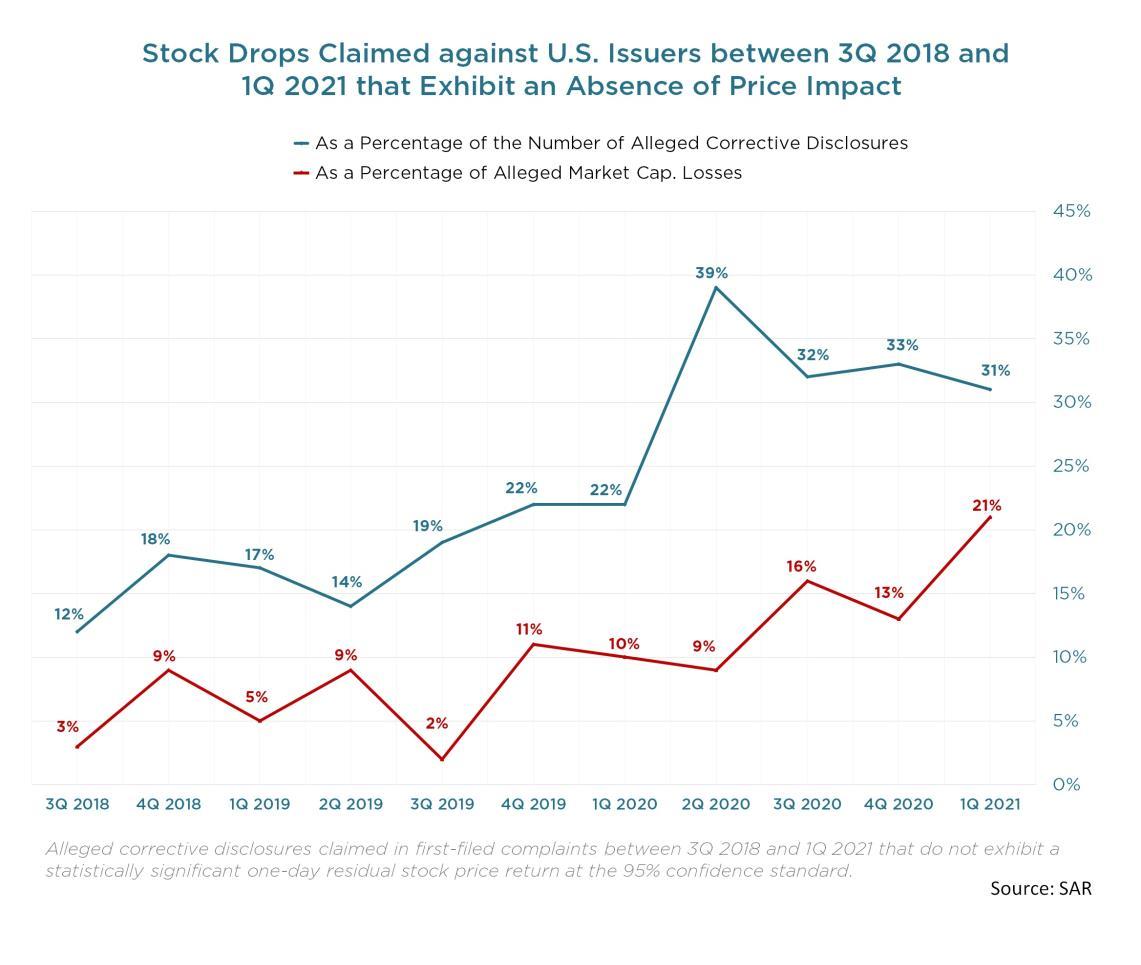
Four Rule 10b-5 claims filed against U.S. issuers in the first quarter of 2021 exhibit a complete absence of back-end price impact; this means that not a single alleged stock drop exhibited a statistically significant one-day return at the 95% confidence standard after controlling for the effects of the general equity markets and industry-specific factors.[30]
Since June 2018, investors have filed 44 Rule 10b-5 claims that do not allege single stock drop that surpasses statistical thresholds of price impact against U.S. issuers.[31] Six of the 44 claims have not survived the motion to dismiss, leaving 38 open Rule 10b-5 claims that do not warrant class certification.[32]
Based on clarified class certification case law in Allstate, and a 2020 median settlement rate of $8.1 million, approximately $307.8 million in potential settlement monies excluding legal defense costs are unwarranted because the corresponding claims exhibit a verifiable absence of transaction causation, or no price impact, and may not translate into classwide damages.[33]
Econometric transparency of transaction causation during class certification proceedings offers defendants the real possibility of weeding out non-meritorious fraud-on-the-market claims that allege deficient stock drop declines that may not contribute any alleged artificial price inflation to potential aggregate damages because they do not warrant inclusion in a certified class.
Insurers can attain a significant reduction of defense and cost containment expenses, and loss costs related to the adjudication of Rule 10b-5 private securities fraud claims, by introducing price impact evidence that can prove that stock price was not impacted by the alleged materially misleading statements.
3. Record-Setting U.S. Equity Markets
A third factor that has dampened Rule 10b-5 exposure materially this past quarter is a record-setting U.S. stock market that is making it increasingly difficult for plaintiffs lawyers to identify and snag the biggest losers to secure lead counsel positions.
On April 1, the S&P 500 closed above 4,000 for the first time ever, and on April 5, the S&P 500 and Dow Jones Industrials posted record highs.[34] Frothy returns are lining institutional investors' portfolios and limiting the trading losses that securities class action lawyers depend on to seek monetary recompense from alleged violations of Rule 10b-5.
Predictions of an uptick in Rule 10b-5 Exchange Act claims, specifically those related to COVID-19, have in fact not come to fruition coming into the spring of 2021.
According to our tally, 24 Rule 10b-5 Exchange Act claims related to COVID-19 have been filed since March 11, 2020, when the novel coronavirus was officially characterized as a pandemic by the World Health Organization.[35][36] A total of 181 Rule 10b-5 Exchange Act claims have been filed against U.S. and non-U.S. issuers since then, amounting to 13.3% of the claims being related to the COVID-19 pandemic.[37]
Securities class action plaintiffs firms have shifted their focus to the jaw-dropping market capitalizations amassed by SPACs which have attained around $98.9 billion in proceeds in 2021.[38] According to a recent Law360 article, "[a]nother 436 SPACs that have raised $138.2 billion since 2019 are still hunting for an acquisition."[39]
Federal regulators have deployed their resources to audit the unprecedent growth associated with the SPAC-crazed equity markets, including an SEC inquiry into SPAC underwriting and risks.[40]
According to Kevin LaCroix of the D&O Diary blog:
Companies that go public through traditional IPOs also sometimes stumble. But there generally is a process for companies that complete traditional IPOs to try to ready themselves for life as a public company. Some commentators have noted that companies going public through merger with a SPAC may not have the benefit of these processes. Which raises the question whether at least some companies that go public through merger with a SPAC are ready for what comes next.[41]
Record-setting equity markets have welcomed SPACs and limited the population of high-severity trading losses that trigger stock-drop litigation. These market conditions led to the lowest litigation exposure of U.S. and non-U.S. issuers to Rule 10b-5 claims since the third quarter of 2018, when we began tracking this data.
Securities class action exposure will likely increase with potential corrections in the equity markets, but filing frequency should remain controlled under the supervision of a new conservative regime at the Supreme Court.
Court-driven scrutiny of scienter allegations at the motion to dismiss stage will also deter aggressive securities class action plaintiff attorneys from filing unmeritorious claims.
Lastly, focused inspection of price impact evidence at the class certification stage of the securities class action life cycle will present defendants with the opportunity to rebut Basic's presumption of reliance.
Nessim Mezrahi is co-founder and CEO and Stephen Sigrist is vice president of data science at SAR LLC.
The opinions expressed are those of the author(s) and do not necessarily reflect the views of the organization, its clients or Portfolio Media Inc., or any of its or their respective affiliates. This article is for general information purposes and is not intended to be and should not be taken as legal advice.
[1] SAR Securities Class Action (SCA) Rule 10b-5 Exposure Report – 1Q 2021: https://eb3b0561-876a4f09-b7dd-6830b21a7579.usrfiles.com/ugd/eb3b05_775dd0055eb9471b8d7721b9c78da66a.pdf
[2] Id.
[3] Id.
[4] Id.
[5] In re Erica P. John Fund Fund, Inc. v. Halliburton Co., F.R.D. 251 (N.D. Tex. 2015).
[6] Id. Internal citations to Merrit B. Fox, Halliburton II: It All Depends on What Defendants Need to Show to Establish No Price Impact, 70 Bus. Law 437, 457 n. 47 (2014-15) omitted.
[7] "Justice Amy Coney Barrett's Potential Impact on the Supreme Court – President Biden's Reaction,"
Rachel Popa, The National Law Review / The National Law Forum LLC, January 24, 2021, Volume XI, Number 78. https://www.natlawreview.com/article/justice-amy-coney-barrett-s-potential-impactsupreme-court-president-biden-s
[8] Notice of Voluntary Dismissal Without Prejudice, In re City of Riviera Beach General Employees Retirement System v. Royal Caribbean Cruises LTD et al. Case No. 1:20-cv-24111.
[9] Notice of Voluntary Dismissal, In re Verger v. MultiPlan Corporation, et al., Case No. 1:21-cv-01965; and Notice of Voluntary Dismissal, In re Srock v. MultiPlan Corporation, et al., Case No. 1:21-cv-01640.
[10] Securities Class Action Complaint, In re Verger v. MultiPlan Corporation, et al., Case No. 1:21-cv01965; and Securities Class Action Complaint, In re Srock v. MultiPlan Corporation, et al., Case No. 1:21cv-01640.
[11] Securities Class Action Complaint, In re Paradis v. Churchill Capital Corp. III et al., Case No. 1:21-cv01853.
[12] Class Action Complaint, In re Kwame Amo v. MultiPlan Corp. f/k/a Churchill Capital Corp. III, et al. Case No. 2021-0258.
[13] Title 17, Chapter II, Part 229, Subpart 229.300 – Financial Information, (Item 303) Management's discussion and analysis of financial condition and results of operations. https://www.ecfr.gov/cgibin/text-idx?amp;node=17:3.0.1.1.11&rgn=div5#se17.3.229_1303
[14] "SEC Adopts Amendments to Modernize and Enhance Management's Discussion and Analysis and other Financial Disclosures," Securities and Exchange Commission, November 19, 2020. https://www.sec.gov/news/press-release/2020-290
[15] Summary Order, In re General Electric Securities Litigation, Case No. 20-1741.
[16] Opinion & Order, In re Fed Ex Corp. Securities Litigation, Master File No. 1:19-cv-05990.
[17] Id.
[18] Opinion & Order, In re Danker v. Papa John's International, Inc. et al., Case No. 18-cv-7927.
[19] Ruling on Motion to Dismiss, In re Labul v. XPO Logistics, Inc. et al., Case No 3:18-cv-02062.
[20] Id. Internal citations to Stratte-McClure v. Morgan Stanley (2d Cir. 2015) omitted.
[21] Id. Internal citations to Teamsters Local 445 Freight Div. Pension Fund v. Dynex Capital Inc., (2d Cir. 2008) omitted.
[22] Id. Internal citations to Teamsters Local 445 Freight Div. Pension Fund v. Dynex Capital Inc., (2d Cir. 2008) omitted.
[23] Memorandum Decision and Order, In re Salim v. Mobile TeleSystems PJSC et al., Case No. 1:19-cv01589.
[24] In re Allstate Securities Litigation, Case No. 1:16-cv-10510. Internal citations to Halliburton Co. v. Erica P. John Fund, Inc., 573 U.S. 258 (2014) (Halliburton II) omitted.
[25] Id.
[26] Opinion and Order, Arkansas Teacher Retirement System v. State Street Corporation et al., Case No. 1:11-cv-12049-MLW.
[27] Reply Brief for the Petitioners, Goldman Sachs Group, Inc. et al. v. Arkansas Teacher Retirement System, et al., Case No. 20-222.
[28] Brief for the United States as Amicus Curiae Supporting Neither Party, Goldman Sachs Group, Inc. et al. v. Arkansas Teacher Retirement System, et al., Case No. 20-222.
[29] SAR SCA Platform Database as of March 31, 2021.
[30] Id.
[31] Id.
[32] Id.
[33] Id.
[34] "U.S. Stocks Climb to Record on Signs of an Economic Rebound," Wall Street Journal, April 5, 2021. https://www.wsj.com/articles/global-stock-markets-dow-update-04-05-202111617611646?mod=hp_lead_pos2
[35] SAR SCA Platform Database as of March 31, 2021. This tally excludes the securities class action filed against United States Oil Fund, LP.
[36] "WHO Director-General's opening remarks at the media briefing on COVID-19 – 11 March 2020," World Health Organization, March 11, 2020.
[37] SAR SCA Platform Database as of March 31, 2021.
[38] SPAC Insider – SPAC Statistics https://spacinsider.com/stats/.
[39] "What Companies Must Know Before Merging With a SPAC," Tom Zanki, Law360, April 2, 2021. https://www.law360.com/articles/1370474?sidebar=true.
[40] "EXCLUSIVE-U.S. regulator opens inquiry into Wall Street's blank check IPO frenzy -sources," Reuters, March 24, 2021. https://www.reuters.com/article/usa-sec-spacs-idUSL1N2LM3CH.
[41] "Another Post-SPAC Merger Electric Vehicle Company Securities Suit," Kevin LaCroix, The D&O Diary, April 4, 2021. https://www.dandodiary.com/2021/04/articles/securities-litigation/another-postspac-merger-electric-vehicle-company-securities-suit/