
Senate Proposes Furloughs-Harmful to Working Families and Public Services
Gov. Bev Perdue and Senate budget writers have both proposed budgets for the upcoming biennium. Although a two-year, $6 billion deficit is looming overhead and both budgets are balanced, one is significantly more poised to tackle the needs of North Carolina during this difficult financial time.
The difference between the two proposals is the use of furloughs in the Senate budget. Gov. Perdue paused longevity pay for two years in order to avoid furloughs and mass pay cuts; layoffs were kept to a number that could be achieved through attrition.
The Senate, however, took the easy way out by balancing their budget on the backs of working families. The Senate’s budget calls for an unlimited number of furloughs at the discretion of agency heads, as well as laying off 712 state employees. Senate budget writers have expressed a desire for even more cuts; Sen. Linda Garrou (D-Forsyth), one of the Senate’s chief budget writers, told The News & Observer she would cut more if she had “a magic wand.”
Additionally, a bill has been filed to allow up to 20 furlough days per year, and legislators have expressed support for 12 furlough days per year.
“I am extremely disappointed at the Senate’s obvious neglect toward the employees of this state,” said SEANC Executive Director Dana Cope. “The demand on public services – unemployment offices, community colleges – has increased drastically. For the Senate to answer that demand with a reduced workforce is ludicrous.”
State employee furloughs could result in a 7.7 percent or higher pay cut – much higher than the 1.5
By Mary adelaide Bell
percent to 4.5 percent in longevity pay state employees receive.
While SEANC recognizes that longevity pay is a great benefit for career state employees, the association has run the numbers (see box below) and knows a longevity freeze, instead of furloughs, is the
Furloughs vs. Longevity Pay Breakdown
most equitable solution for employees. The governor’s plan also offsets the loss of longevity play with bonus leave. Bonus leave can either be used in later years or saved until retirement and paid out in the final paycheck along with unused vacation pay. Thus, it increases the average final pay on which the retirement benefit is calculated.
Although state employees with less than 10 years of service are not losing longevity pay, they are not gaining bonus leave.
Longevity pay is an important benefit to state employees, most of whom make less than the market rate. The association looks forward to working with the Perdue administration to ensure it is reinstated fairly and accurately in two years.
As of press time, the House had not presented its budget proposal. None of these measures will be enacted until approved by the Senate, the House and the governor.
Remember, the most important person your legislators hear from is you. Come to Raleigh on May 5 for SEANC Lobby Day. Share your story with your legislators, and remind them to put public services first. See page 7 for more information.
mbell@seanc.org
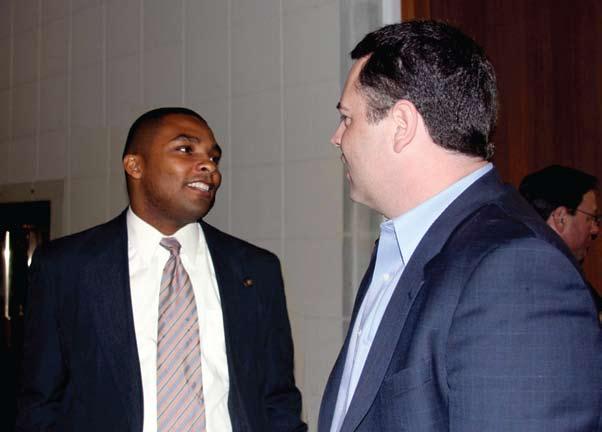
Freshman Sen. Don Davis (D-Greene), left, and SEANC Executive Director Dana Cope meet outside of the Senate chamber on March 25 to discuss legislation affecting state employees.
2 PUBLIC POLICY

Legislators Spend Their Time and Your Money on Unnecessary Bills
Everyone knows this is a tough economy. One in 10 North Carolinia workers is without a job. Demand on state services is up, but hiring freezes mean employees are doing more work with fewer resources.
Legislators are barking about the $2 billion to $3 billion budget deficit, or an estimated $6 billion over the next two years. Sen. Tony Rand (D-Cumberland) told a group of Capital Press Corps reporters, “We gotta cut $2 billion, ya know. It’s not gonna be fun… We’re just getting ready for the war now.”
Then why, during a budget crisis, are legislators filing bills to spend taxpayers’ money? The legislators filing these spending bills (see box at right) are the same legislators pushing for 20 days of unpaid furloughs for state employees, which would result in a 7.7 percent pay reduction.
These bills total $574.6 million of spending. The projects so urgent in this budget crisis include $200,000 for folk festivals, $300,000 for kids’ mock voting projects, $2 million for a support program for teachers for their first three years (what other agency has support programs for its new employees?) and more than $90 million for pay raises in hand-picked state agencies (when SEANC was told no one was going to see pay raises this year).
By erica Baldwin
When questioned by SEANC lobbyists, your elected official’s answer? “The bill isn’t going to pass anyway.”
Legislators are using staff time for bill drafting, resources for paper copies and session time for “pork” projects when they could be debating the state’s real budget problems. All of this work for something that isn’t going to pass?
Whether they expect the bills to pass or not, they are spending taxpayer money to either:
a) File and funnel the bills through the legislative process or
b) Fund $600 million worth of projects during one of the worst budget crises in decades.
Either way, it’s a lose-lose situation for state employees – and taxpayers for that matter. Hold our legislative leaders accountable and tell them to get down to business. It’s time to stop playing politics and to put people first. Ask legislators to keep the state’s working families working so they can serve the millions of citizens in need.
ebaldwin@seanc.org
as of March 31, the number of spending bills supported by the very legislators pushing furloughs under House Bill 708 includes: rep. Margaret dickson (d-cumberland) 24 rep. rick Glazier (d-cumberland) 101 rep. Bruce Goforth (d-Buncombe) 23 rep. Verla insko (d-Orange) 78 rep. Marvin lucas (d-cumberland) 110 rep. ray rapp (d-Madison) 55
2142) is published in the months of March, May, August and November for $3 per year, per member, by the State Employees Association of North Carolina, Inc., P.O. Drawer 27727, Raleigh, NC 27611-7727. Periodicals postage paid at Raleigh, N.C. and additional offices. POSTMASTER: Send address changes to: THE REPORTER, P.O. Drawer 27727, Raleigh, NC 27611-7727.
o4 Quotes to Note
“That is outrageous; literally billions of dollars of taxpayers’ money and employees’ money go to fund this plan, and to have the third-party administrator be unaudited for its business expenses is crazy.” SEANC Executive Director Dana Cope on the State Health Plan’s failure to order an expense audit on Blue Cross and Blue Shield of North Carolina in The News & Observer’s March 27 article “State to monitor insurer’s expenses.”
“It’s repugnant; it doesn’t save $91 million. It cost shifts.” SEANC Legislative Affairs Director Ardis Watkins on proposed changes to the State Health Plan under Senate Bill 287 in the March 25 issue of The Insider.
“While state purchasing agents are required to bid office furniture, it’s ridiculous that the $100 million annual health plan contract is not openly bid for the best services and price available.” SEANC Executive Director Dana Cope in The News & Observer article, “Employees’ group seeks audit of health plan,” on March 5.
“It’s important that we educate the taxpayers about what is going on with the retirees’ and employees’ families health plan that is provided by the state of North Carolina.” SEANC Executive Director Dana Cope on SEANC’s decision to air radio ads on the State Health Plan and Blue Cross and Blue Shield of North Carolina on News 14 Carolina’s March 30 story “New radio ad targets state health plan.”
“The problem with this plan is that it begs more questions than we have answers right now.” SEANC Legislative Affairs Director Ardis Watkins on April 2 in The Associated Press article “NC State Health Plan gets back on track in House.”
“Our employees can have no confidence in the process if the administration costs of the plan are swept under the rug.” SEANC Executive Director Dana Cope told NBC 17 in the April 2 story “State employees criticize proposed health care plan.”
“This is immoral and gross. The Blue Cross CEO makes $4 million a year, yet they are unwilling to do their fair share during this economic crisis.” SEANC Executive Director Dana Cope on News 14’s April 2 story, “Legislators discuss future of State Health Plan.”
“It was shameful. They turned their back on wanting to take any responsibility by passing that.” SEANC Legislative Affairs Director Ardis Watkins on the House Appropriations Committee’s 44 to 40 vote to pass Senate Bill 287 on The News & Observer’s Under the Dome blog “Health plan narrowly passes key vote” on April 8.
“State employees want to make sure that their monthly paychecks are kept intact and furloughs won’t do that.” SEANC Assistant Director of Communications Erica Baldwin on News 14’s “Senate budget proposal cuts spending by $2B” on April 6.
“The cost-shifting in this bill hits those who cannot afford it the hardest.” SEANC Executive Director Dana Cope in an April 13 report that showed women and African-Americans would be disproportionately harmed by SB287.
“My oldest son and youngest son do not have medical coverage because I cannot afford it as a state employee. That saddens me.” SEANC District 40 member April Graham at the Obama White House regional forum on health care reform in Greensboro on March 31.
PUBLIC POLICY
SEANC Criticizes Senate Bill 287 and Continues Push for Long-Term Health Plan Solutions
SEANC is asking legislators to explore long-term solutions for the State Health Plan, instead of one-year fixes that pass costs on to plan members and taxpayers. North Carolina ranked 49th in the nation for its contribution toward family health insurance coverage and 40th among state governments in individual coverage in 2006, the last year for which data is available. The proposed changes in Senate Bill 287, which would increase the average employees’ out-of-pocket costs by $600 a year, would most likely make North Carolina last in the nation.
“Employees can’t take the brunt of the health plan cost increases, while details of the plan’s administration remain vague,” said SEANC Executive Director Dana Cope.
SEANC’s Proposal
On April 2, SEANC Legislative Affairs Director Ardis Watkins presented a comprehensive solution to House Insurance Committee members, recommending the following:
• The General Assembly should immediately appropriate $250 million from the Rainy Day Fund to allow the State Health Plan to pay current expenses.
• The General Assembly should freeze State Health Plan member benefits at current levels until a thorough, proper and professional audit, done by a firm that is given full access to State Heath Plan contracts, can be done to assess where the plan may be paying for expenses not actually incurred by plan members.
By erica Baldwin
staff works around the
are
at the
• The General Assembly should fund the 20092010 fiscal year of the plan with the General Fund money that was already going to be spent in SB287 (approximately $491 million) to allow one year for completion of the audit and reporting of its findings to the General Assembly.
• The General Assembly, after examining the audit findings, will decide at that point how much cost shifting (if any) would actually be required to determine funding for 2010-2011. After a proper audit, members of the plan can have more confidence in the actions of the General Assembly and all parties can move forward.
SEANC Fights University System’s Illegal Layoff Plan
By Mary adelaide Bell
On March 26, SEANC Executive Director Dana Cope sent a letter to University of North Carolina System President Erskine Bowles regarding the termination of university employees that violates State Personnel Commission rules.
Cope learned of an e-mail sent to Information and Technology Service employees at the University of North Carolina at Chapel Hill informing them of anticipatory layoffs in light of the state’s expected budget deficit in the next fiscal year.
“I’d like to think there’s been a well thought out plan based on who and what is needed and what’s not,” said District 25 member Mike Hawkins, an ITS employee at UNC. “I think we could find a way to keep more people employed with less layoffs.”
According to State Personnel Commission rule 25 NCAC .01C .1004, a reduction in force (RIF) is only authorized “whenever it is necessary due to shortage of funds or work, abolishment of a position, or other material change in duties or organization.”
As of press time, only the governor and Senate had presented budget proposals for the upcoming fiscal year. Gov. Bev Perdue’s budget included no RIFs in any level of state government. As such, SEANC contends it is premature for the university system to begin laying off employees when the 2009-2010 fiscal year budget has not been approved.
Cope told The Daily Tar Heel SEANC would consider legal action in the matter.
mbell@seanc.org
SB287’s Progression
House Insurance Committee members hastily approved SB287 without SEANC’s recommendations, sending the bill to the House Appropriations Committee for consideration.
as
The House Appropriations Committee narrowly passed the bill with a 44 to 40 vote on April 8, after more cost shifting to employees was added by the House Insurance Committee, raising dependent premiums by 10 percent per year in 2009 and 2010 (from a 7.8 percent increase). This would raise dependent coverage to nearly $592 a month, while also increasing co-pays and deductibles. On April 14, SEANC members and staff watched as House members chose politics over the state’s working families. The House passed SB287, despite thousands of phone calls and e-mails from SEANC members. As of press time, the bill was headed to a House and Senate conference committee for final debate and approval.
The background for SEANC’s request includes a 2003 audit of the State Health Plan in which the State Auditor’s Office found the plan was only recovering overcharges of 0.3 percent on claims of more than $4.15 billion for the period. Nationally, about 5 percent of hospital bills are overcharges. If the State Health Plan recovered the national average, it would have yielded more than $200 million for the plan in one year. Blue Cross and Blue Shield of North Carolina, the plan’s administrator, claims overcharges simply don’t exist and are negligible. However, on March 27 The News & Observer revealed that the State Health Plan has never audited BCBSNC’s expenses to ensure they are accurate and appropriate.
“[Health Plan Administrator] Jack Walker can tell us fairy tales, but what employees and the legislators need are honest facts,” said SEANC District 25 member Ernie Patterson.
Health Plan Oversight
To provide more accountability and comply with a state auditor’s report last year, SEANC is also seeking to move oversight of the health plan to the executive branch from the legislative branch of state government. The health plan is an essential part of employees’ benefits, and changes should not be rushed through by legislators who switch committee appointments and are simply unfamiliar with the complex plan.
The association will continue its efforts for a transparent BCBSNC contract to reveal if overpayments are grossly underestimated and to ensure employees will not bear unnecessary cost shifting.
ebaldwin@seanc.org
SEANC
clock
General Assembly
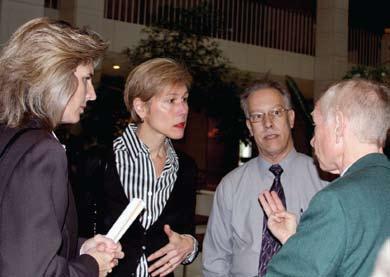
they educate legislators on the harmful effects of SB287. Pictured, left to right,
SEANC Legislative Affairs Director Ardis Watkins, Rep. Deborah Ross (D-Wake), EMPAC Chairman Mark Dearmon and North Carolinians for Affordable Health Care Director Chuck Stone.

by Tony SmiTh
Call to Action –A Season of Musts President’s Message

As you read through numerous newspaper articles, news alerts and even the front page of this issue of The Reporter, you’ll realize that we, the state employees of North Carolina, will be asked to share the burden of a terrible economy. We will be asked to give up something to meet a $6 billion state budget deficit over the next two years. But that does not mean that we must give up everything – in fact, it means that we must fight harder; we must speak louder.
In my March column, I challenged each of you to tell your story to at least one co-worker who was not a SEANC member. For those of you who met my challenge, I thank you. Now I have an additional challenge for you – CALL YOUR LEGISLATORS. This is one of our “musts.” We must make phone calls to legislators; we must make our concerns heard by our elected officials who represent us back home.
Several critical bills are on the table this session, and the governor’s budget has been submitted to the legislature for debate. Senate Bill 427 and House Bill 750 call for the repeal of G.S. 95-98, the statute that prohibits public employee collective bargaining, and both bills are in committee right
now. Make the call, tell your representatives to vote “yes.” This will ensure that employees and our representatives have a place at the table when the state is determining our benefits. We, the employees, can help state government become more effective and efficient. A united voice is a massive voice, and together we can make ourselves heard.
In March the governor submitted her budget proposal to the legislature. In her budget she called for no furloughs or layoffs, but the legislature doesn’t agree. We must let them know the devastating impact furloughs and layoffs would have, not only on us and our families, but also the services we are dedicated to providing to the people of this great state.
“We
must fight harder; we must speak louder.”
Along with calling your legislators, I challenge you all to attend our next lobby day on May 5. If you have never attended a lobby day before, then I strongly encourage you to join hundreds of other SEANC members and me as we unite to fill the halls of the legislature. Together let us show the legislative body what a large, strong, united group we are; together let’s raise our voices for the workers of this great state. Together we can – and must –do this!
tsmith@seanc.org



Smith

by Dana Cope
SEANC Urges Legislators to Examine Blue Cross Contracts Executive Director
“This year SEANC asked the General Assembly to take a close look at all options to make health care coverage affordable for the state’s working families…[the] State Auditor… admonished the General Assembly and State Health Plan administrators to save money for the State Health Plan by adequately researching plan options, properly monitoring contracts and improving internal controls…Recovery of just an additional 1 percent on overpayments to hospitals would have yielded $41.5 million for the State Health Plan.”
Sound familiar? These are SEANC’s arguments documented in a June 5, 2003, Legislative Update. This year is no different as SEANC continues to insist legislators thoroughly examine the State Health Plan’s contract with its administrator Blue Cross and Blue Shield of North Carolina to find any potential cost savings.
BCBSNC claims they have released the once-closed, no-bid contract and that they only profit less than a penny on the dollar. It’s not clear, however, if expenses and overhead are included in their “profit margin,” according to recent media reports, or if BCBSNC’s expenditures are accurate. BCBSNC says it’s the state’s fault that the health plan is in trouble. “Poor planning,” they say. The State Health Plan blames members, saying they are too old and expensive to insure. (At the same time, they are putting dependent costs, which draw in younger, healthier family members, further out of reach.)
But the State Health Plan has never audited BCBSNC to make sure claims and expenses are on track — information that only became available thanks to a News & Observer investigative report. BCBSNC takes in $120 million a year for administering the SHP, yet they’ve never been checked up on!?!
That is outrageous! SEANC has heard story after story from members who say BCBSNC has overpaid, double paid or covered procedures they never received. But when members call about the over-
payments, they are asked, “Is any of it coming out of your pocket? If not, don’t worry about it.”
State Health Plan Administrator Jack Walker says they will hire a firm for an audit — but not in time to save health plan members from inheriting more cost increases as legislators attempt to speed the passage of Senate Bill 287.
All session, SEANC has been making noise about SB287. Members have shown up at numerous legislative committee meetings and sessions urging lawmakers to stop passing costs on to them, all the while BCBSNC, a nonprofit, profited a total of $180 million and its CEO Bob Greczyn made $4 million last year.
More than 45 percent of state employees make less than $33,000 a year, yet the legislature is looking to shift costs to you, somewhere in the ballpark of $600 a year in additional expenses!
But after public pressure, it seems BCBSNC and some legislative leaders are getting nervous. BCBSNC lobbyists showed up in droves after our radio ads aired asking members to call their House leaders about the BCBSNC contract, while legislators’ phones rang off the hook. SEANC lobbied to keep Greczyn off the University of North Carolina Board of Governors, which is determined by the legislature. His nomination was withdrawn after SEANC expressed concerns that his board position would be a conflict of interest since his company’s no-bid contract covers thousands of university employees. This is the first time in 12 years BCBSNC won’t have a seat on the UNC board. And in April, BCBSNC purchased $108,000 in radio ads to criticize SEANC, as we attempt to open up their contracts to see if massive overpayments exist.
The struggle to keep health care affordable continues as we attempt to overcome strong legislative ties with BCBSNC, who is a major political donor. Keep asking your elected officials to put the needs of the state’s working and retired families above a multi-million dollar “nonprofit.”
dcope@seanc.org
What State Leaders Have to Say About the State Health Plan
“I don’t have a clue.” – Sen. Tony Rand (D-Cumberland) during a March 10 Senate committee meeting on what cost increases state employees and retirees would see under Senate Bill 287
“ The Blue Cross people tell me they make less than a million dollars on our plan in profit. So that’s – I can’t tell you other than what they tell me, but that’s certainly not where we can go to find the money that we need.”
House Majority Leader Hugh Holliman (D-Davidson) to NC Public Radio on March 31, on taking Blue Cross’ word about their costs and overhead
During an April 2 House Insurance Committee meeting on important health plan changes:
“Everyone wants to go home. I know I do, I have a four-hour drive.”
– Rep. Bruce Goforth (D-Buncombe)
“Let’s get out of here by 3:45.” – Rep. William Wainwright (D-Craven)
“Or before.”
– Rep. Bill Faison (D-Caswell)
“All we’ve done the last five years is put out fires. We need some one looking over this.”
– Rep. Jerry Dockham (R-Davidson) on moving oversight from the legislative to executive branch (the amendment failed)
“I’m going to hold my nose and vote for a plan I can’t stand because we have to fix this.”
– Rep. Pryor Gibson (D-Anson)
During an April 8 House Appropriations Committee meeting:
“This is an immediate fix we need for this year.”
– Rep. Hugh Holliman (D-Davidson)
“I don’t know how much worse this will make it.”
– Mark Trogden of the General Assembly Fiscal Research Division when asked how the proposed changes to the SHP will continue to drive younger, healthier dependents from the plan
“We have reached a point where the adverse selection almost can’t get worse. I don’t think it will have that much of an impact.”
– SHP Administrator Jack Walker on how the 10 percent rate hike on dependent care will affect state employees’ decision to cover their spouses and children under the SHP
Want to know the latest news affecting your pay and benefits?
1) Go to www.seanc.org. Under “Legislative Affairs,” find bill tracking and weekly Legislative Updates.
2) Call Lynn Cote in the SEANC Member Action Department at 800-222-2758 for a SEANC staff member to update your co-workers during a break or staff meeting at your agency.

Cope
6
COLU mns
Counselor’s Comments
by Tom harriS SeanC Chief of STaff/General CounSel

Examining Legal Issues Relating to the State’s Budget

This column reviews several legal issues that have arisen during the course of the 2009 legislative session and the dealings with the budgetary shortfall.
Illegal “Anticipatory” RIFs: The University of North Carolina system may have prematurely initiated a round of reductions in force (RIF) in anticipation of a possible lower level of funding in the upcoming fiscal year. One of SEANC’s members reported an e-mail addressed to a segment of employees at UNC-CH containing the following statement: “In order for us to be positioned to make the kind of cuts that seem likely next FY, we need to reduce staff size now, so that we can realize a full year’s worth of salary savings for the positions eliminated beginning July 1st.”
Implementation of a RIF this fiscal year in anticipation of a shortage of funds in the next fiscal year is premature and violates the State Personnel Commission rule 25 NCAC .01C .1004 authorizing a RIF only “whenever it is necessary due to shortage of funds or work, abolishment of a position, or other material change in duties or organization.” There is no shortage of funds yet, as the next budget has yet to be passed and signed into law. The General Assembly may, in fact, find a way to fund UNC for the next fiscal year in such a way that no RIFs are required. SEANC opposes all “anticipatory” RIFs that are based on expectations in what the FY 2009-10 budget may provide. Instead, all reductions in force should occur only in strict compliance with the State Personnel Commission rules.
Furloughs and the FLSA: For reasons elaborated on the front page of this issue of The Reporter, SEANC favors Gov. Bev Perdue’s budgetary proposal to freeze longevity pay over the proposals pending in the General Assembly to furlough state employees up to 20 days. However, it is not accurate to oppose furloughs on the grounds that they will actually end up costing the state more money with respect to state employees exempt from overtime pay under the
Fair Labor Standards Act (FLSA).
Certain exemptions from the FLSA overtime requirements are based, in part, on the exempt employee being paid on a “salary basis,” that is, a guaranteed salary of at least $455 per week. In general, a private industry employer must pay such an exempt employee (bona fide executive, administrative and professional employees) the full week’s salary if the employee works during any part of the workweek. If the employer shorts the employee’s pay for working a “short” week, the exemption may be lost and the employer will have to start paying overtime pay for hours worked over 40 in any workweek thereafter.
If the short workweek rule applied to the state’s FLSA exempt employees, then either furloughs wouldn’t save the state any money with respect to those employees since it would still have to pay them their full salary in weeks containing furloughs or start paying overtime pay to those employees. However, the rule that applies to governmental employers is different from the private sector rule. The U.S. Department of Labor rules make a special exception for governmental employers: “Deductions from the pay of an employee for absences due to a budget-required furlough shall not disqualify the employee from being paid on a salary basis except in the workweek in which the furlough occurs and for which the employee’s pay is accordingly reduced.”
tharris@seanc.org

Join us at seaNC Lobby day on May 5!
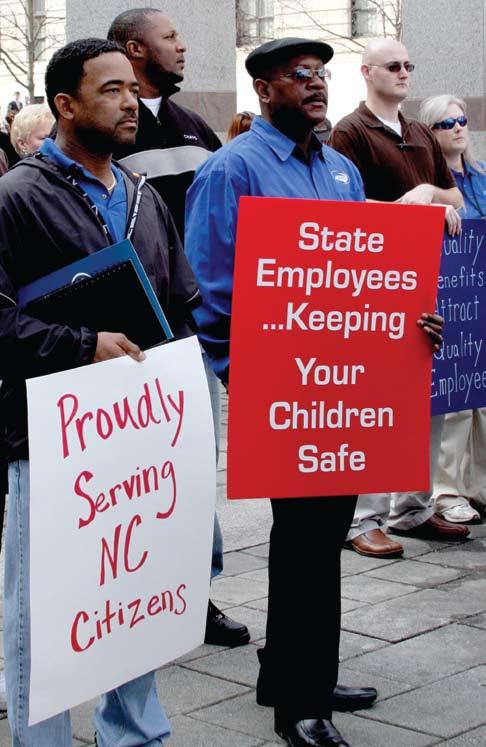
SEANC Continues Support of Employer-Employee Partnerships
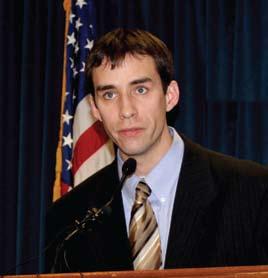
SEANC District 25 member Jonathan Stephenson speaks in support of collective bargaining during a March 24 press conference at the Legislative Building in Raleigh. He joined other pro-employee groups, telling the press, “On a daily basis I see public employees going above and beyond the call of duty. What they want is a voice to make the workplace more efficient and effective for the citizens of North Carolina.”
Monday, May 4
Member Action Team Training
12:00 p.m.-5:00 p.m.
SEANC Central Office, Raleigh, NC
Register at www.seanc.org.
It is not required that you be MAT trained to attend lobby day.
Tuesday, May 5
Pre-Rally Briefings
8:30 a.m. and 9:15 a.m.
Archives and History/State Library Building Auditorium 109 E. Jones St., Raleigh, NC 27601
Rally
10:00 a.m.
Bicentennial Mall
Across from the Legislative Building on Jones St., Raleigh, NC
Meetings with Legislators
9:00 a.m.-10:00 a.m.
10:30 a.m.-3:00 p.m.
Boxed lunches will be provided for Lobby Day participants at noon in the Archives Building parking lot. Districts or individuals are responsible for expenses related to travel and meals (except for the boxed lunch).
How to prepare for Lobby Day
1. Register for SEANC Lobby Day ASAP by visiting www.seanc.org
2. Schedule appointments with your legislators. Visit the “Legislative Affairs” section at www.seanc.org to find your legislators’ contact information.
3. Contact your district to make arrangements for group transportation to lobby day and training.
4. Arrive May 5 and don’t forget to wear your SEANC blue!
NC Division of Public Health Improves Dental Health Statewide
Every day in North Carolina, the work of state employees impacts the life of every person in the state. One area of government often overlooked by North Carolinians is public health, since people often assume that public health serves a limited number of people in each community. But the truth is, public health is for everyone. We are touched by public health services every day when we drink clean water, are immunized, eat at restaurants or use a walking trail. Public health programs and policies improve the health and well-being of every community.
Dental health is one area of public health. State employees who work for the Oral Health Section (OHS) in the North Carolina Division of Public Health help to improve the oral health conditions of all North Carolinians by promoting and providing preventive services and educational messages.
Tooth decay is the most common, chronic infectious disease of childhood, more common than asthma. It starts as a white spot on the tooth that may turn into a cavity (tooth decay), leading to pain, suffering and tooth loss.
Fluoridation is safe, effective and the least expensive way to prevent tooth decay. In 2009, 88 percent of North Carolinians who drink water from community water systems are receiving the benefits of fluoride. For many years, the Oral Health Section
By doranna anderson, district 47 chairwoMan
has provided grant funding to help communities add fluoride to their water systems to help reduce dental decay, and has provided expert advice and scientific information to community leaders.
Using scientific data, North Carolina Oral Health Section staff are able to determine the most effective means for spending state funds to provide services to children who are at the highest risk for tooth decay.
The Oral Health Section’s kindergarten and fifth grade dental assessment is an ongoing effort to track children’s dental health. The 2007-2008 assessment showed that 26 percent of fifth graders had cavities or fillings in their permanent teeth, with 4 percent of them having cavities that needed treatment. Among children entering kindergarten, 39 percent already had cavities or fillings in their baby teeth, and 18 percent of them had cavities that needed treatment. Low-income children often had the greatest needs.
The Oral Health Section staff uses this data in providing primary preventive services in public schools, particularly dental sealant projects and fluoride mouthrinse programs. Participating schools are selected based on the dental need and community interest.
Over the years, the work of these state employees has helped reduce dental decay among North Carolina’s school-age children. Last year, the OHS provided about 12,000 seal-
ants for children at high risk for tooth decay through school-based projects in selected elementary schools across the state. Currently, about 77,000 high-risk children are participating in the fluoride mouthrinse program in selected elementary schools. By using evidence-based program planning, these state workers are able to save state taxpayers money by preventing higher costs in Medicaid claims for treatment of ongoing dental care.
This is just one example of how SEANC members are working to improve the lives of North Carolinians
through their jobs. Many other state employees go to work each day to protect us from criminals, provide clean water and air, provide state parks or museums to enjoy, build and maintain roads, create opportunities for new jobs and businesses, help those who have become unemployed, make sure working conditions are safe for all employees, work to prepare for and respond to disasters and much more. Our state would not be as great if it were not for the commitment and hard work of state employees.
danderson83@nc.rr.com

Take advantage of a great new benefit for SEANC members – the SEANC Group Legal Plan, provided by Hyatt Legal Plans, a MetLife company.
Whether you’re buying a new home, drawing up a will or just need some legal advice, the SEANC Legal Plan can give you easy access to a nationwide network of over 10,000 carefully selected, experienced participating attorneys. Plus you receive a wide range of covered legal services at an affordable monthly cost that is deducted right from your paycheck. It’s like having your own lawyer on call. With the group legal plan, a participating attorney is just a phone call away. Some of the services provided under the plan include:
➤ Wills and estate planning
➤ Deed preparation
➤ Traffic ticket defense (DUI not included)
➤ Debt collection defense and identity theft defense
➤ Purchase, sale or refinancing of your primary residence
➤ Civil litigation defense
➤ Review of personal legal documents
➤ Telephone and office consultations for an unlimited number of matters
Your exclusive enrollment opportunity is May 15 to July 17 – don’t miss it! Look for more information about the new SEANC Legal Plan and an enrollment form at your district’s annual meeting. See page 11 for a list of annual meetings. You can also contact Hyatt Legal Plans for information about the plan at 1-800-821-6400. Don’t miss your chance to enroll in this important and worthwhile benefit – it can pay for itself the first time you use it.
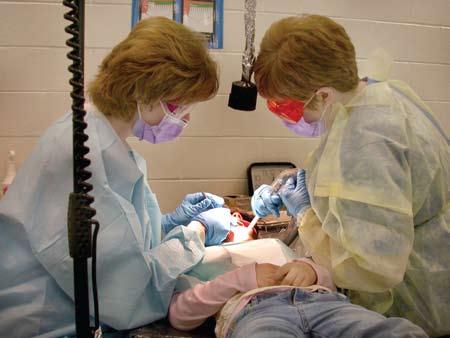
Dental hygienists Wendy Seymore, left, and Beverly Bizzell, right, of District 20 place dental sealants on a student at Bonlee Elementary School in Chatham County. Seymore and Bizzell are from the NC Oral Health Section of DHHS.

District 16 Hosts Membership Blitz
In February, District 16 recruited 11 new members during a membership blitz at Winston-Salem State University. At the luncheon, attendees were updated on SEANC’s legislative agenda and proposed changes to the State Health Plan.
Pictured are District 16 member Melva Daniels, front left, new member Valerie Howard who won $100 as a door prize, front right, and Chairman Steve Thompson, standing.

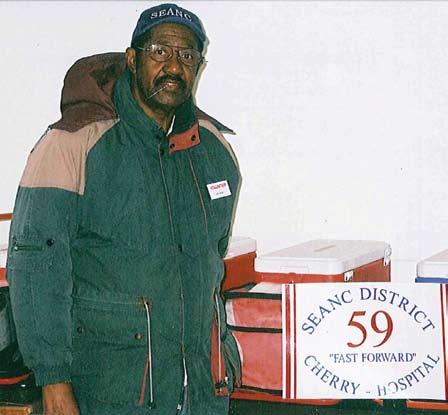
District 59 Provides Meals to Needy Citizens
Feb. 4, District 59 member Orie Henry Jr. prepares to deliver Meals on Wheels to seniors in need on behalf of his SEANC district.
2009 SEANC Scholarship Raffle


Lois W. Forrester Memorial Golf Tournament
Sponsored by District 3 to benefit the Scholarship and Community Services Activities Fund
• Thursday, May 14
• 8:00 a.m. (shotgun start)
• Boone Golf Club, Boone, NC
• Captain’s Choice
$70 per person or $280 per team (includes cart, lunch and two mulligans)
Prizes for longest drive (male and female) and closest to pin
For registration information, please contact District 3 Fundraising Chairwoman Amy Winebarger at winebargerab@appstate.edu or 828-262-6289 or District 3 Chairwoman Janice Smith at smithja@appstate.edu.


SEANC District Annual Meetings
1
2
3
4
5
6
7
19
Yes Tammi Blake - tammiwblake@hotmail.com
Patsy Tilley - pm.tilley@earthlink.net
22 June 22 7:00 p.m. Ribeyes Steakhouse, 320 E. Cornelius Harnett Blvd. Lillington Yes Flint Benson - FlintBenson@aol.com
23 May 28 6:00 p.m. St. Pauls Community Building, 111 N. 3rd St. St. Pauls Yes Harold Faulk - hsfaulk@netzero.net
24 Cath Fields - cathyf2@ec.rr.com
25 Tommy Griffin - tgriffin@fac.unc.edu
26 Stacy Dowdy - dsl13@doc.state.nc.us
27 June 11 5:30 p.m. TBD TBD Gracie LaSane - gracie_lesane@msn.com
36
37 June 18 5:30 p.m. Equipment Conference Room, 4809 Beryl Rd. Raleigh
38
39 June 9 5:30 p.m. McKimmon Center, 1101 Gorman St. Raleigh
40 June 9 6:00 p.m. Parole Commission Conference Room, 2020 Yonkers Rd. Raleigh
41
Bruce Dixon - bruce.dixon@ncmail.net
George Kapentanakis - gkapetanakis@seanc37.org
Kim Glover - kbglover48@embarqmail.com
Mary O’Neill - meoneill@gw.fis.ncsu.edu
Julie Parrish - jbryersmom@nc.rr.com
Wendell Powell - d41wpowell@live.com
42 June 25 SEANC Central Office, 1621 Midtown Place Raleigh Tara Minter - tara.minter@doa.nc.gov
43
44
Debra Dunston - ddunston1@gmail.com
Bruce Garner - bgarner@sosnc.com
45 May 23 6:00 p.m. Carolina Barbecue Lodge, 730 US Hwy. 70 W. Garner Yes Charles Johnson - Charlie.brwn1@yahoo.com
46 June 18 5:30 p.m. SEANC Central Office, Conf. Rm. A, 1621 Midtown Place Raleigh
47 June 16 5:30 p.m. SEANC Central Office, Conf. Rm. C, 1621 Midtown Place Raleigh
56
Randy Bruton - 919-754-2147
Doranna Anderson - danderson83@nc.rr.com
Percy Underdue - punderdue1@aol.com
57 Daisy Stancill - sdw05@doc.state.nc.us
58
Eddie Brogden - jamesbe03@aol.com
59 June 8 6:00 p.m. Cherry Hospital, Conference Center, 201 Stevens Mill Rd. Goldsboro Yes John Miller - John.Miller@ncmail.net
60 June 18 6:00 p.m. Madison’s Prime Rib, 413 E. New Hope Rd. Goldsboro Yes
61
Carolyn Davis - carolynlm@earthlink.net
Mark Turlington - mturlington@embarqmail.com
62 Robert Barnhill - rbarnhill@ec.rr.com
63 May 19 6:30 p.m. Heritage House, 1303 S. King St. Windson J. E. Skinner - jes375@embarqmail.com
64 June 9 6:30 p.m. Parkers BBQ Restaurant, 3109 S. Memorial Dr. Greenville Yes Valorie Sullivan - seancdist64@aol.com
65 Del Kingsland - kingslandd@ecu.edu
66 May 21 6:00 p.m. TBD Kinston
Mike Kollock - kollock@yahoo.com
67 June 16 6:30 p.m. West New Bern Fire Department, 900 Chelsea Rd. New Bern Yes Bill Boyle - bwl05@doc.state.nc.us
68 May 28 7:00 p.m. Plymouth Church of Christ, 905 Washington St. Plymouth
James Vaughan - vaughanjw@earthlink.net
69 June 25 6:00 p.m. K.E. White Graduate Center, Rm. 107 1704 Weeksville Rd. Elizabeth City Tonya Jennings - seanc69chair@gmail.com
70
Arvis Sutton - arvis.sutton@ncmail.net
71 Stuart Glover - comanchecreekllc@yahoo.com
your
go to www.seanc.org under “Quick links.” Please contact your
to change, or check the calendar of events at www.seanc.org
and
as
are


FEATURED MEMBER DISCOUNT VENDOR







Maggie Valley, NC Doswell, VA
Myrtle Beach, SC
Myrtle Beach, SC
Concord Mills, NC; Myrtle Beach SC Greensboro, NC