Ukraine Shipwreck Rescue
Lepanto and End of Galley Warfare
Titanic's Second-Class
Camden Coming Back

Ukraine Shipwreck Rescue
Lepanto and End of Galley Warfare
Titanic's Second-Class
Camden Coming Back
fine paintings of maritime history
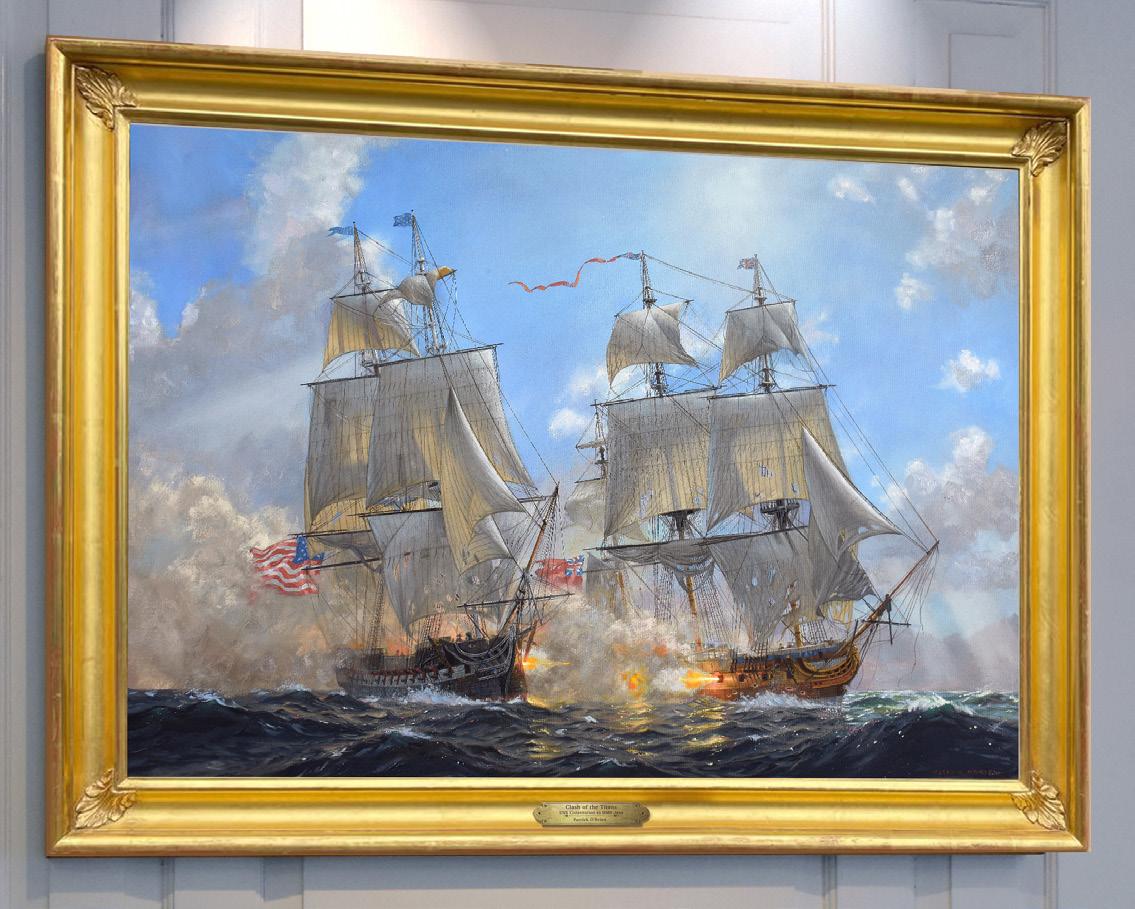
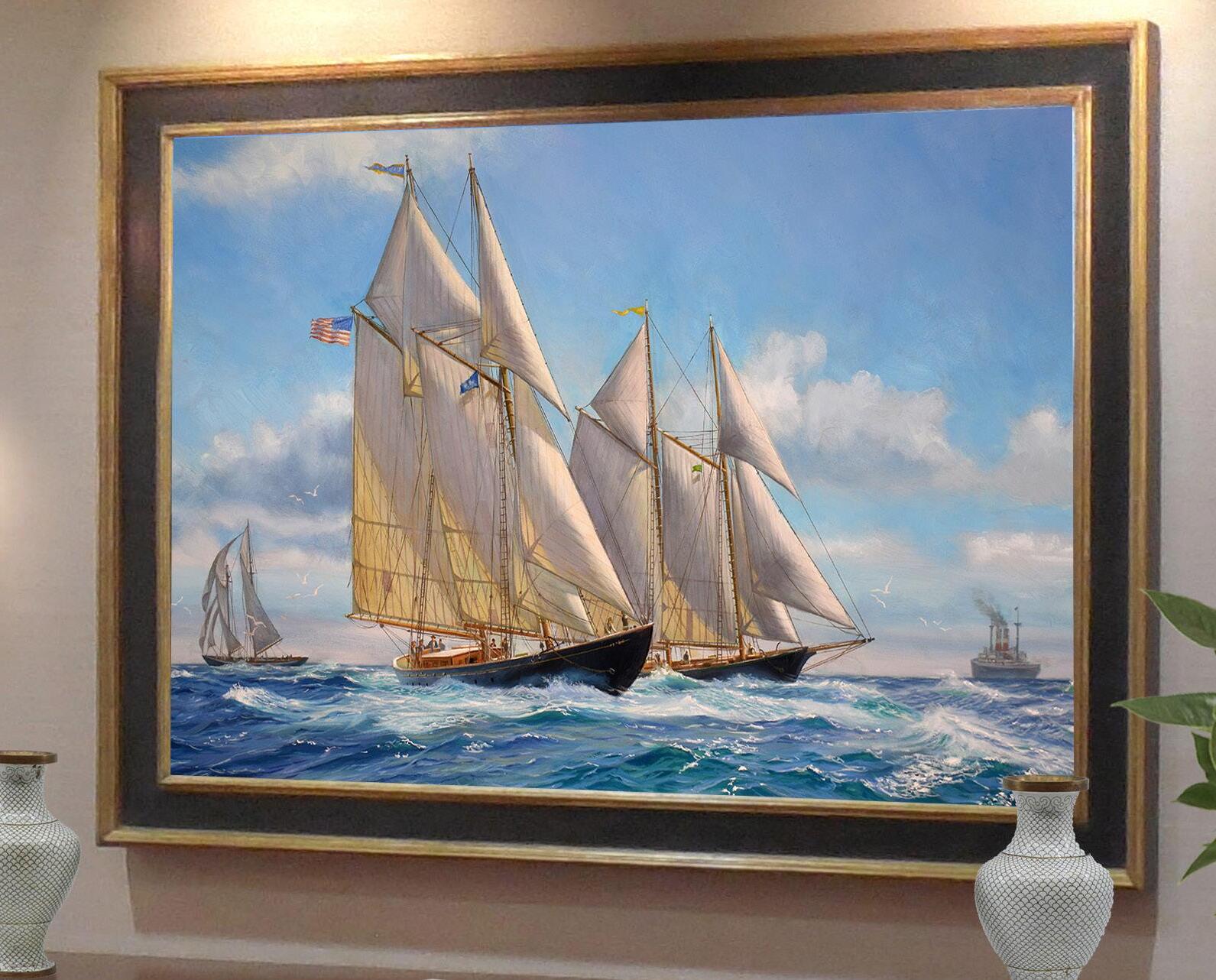
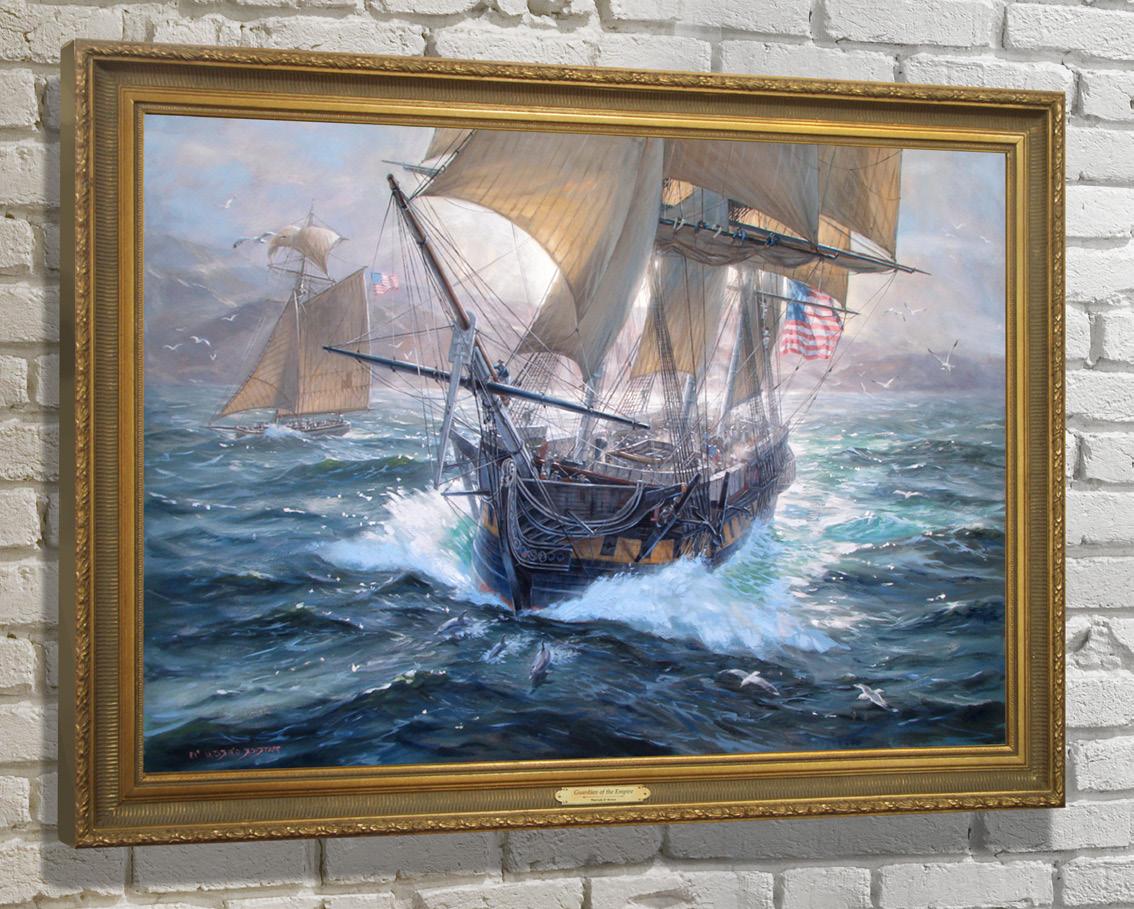
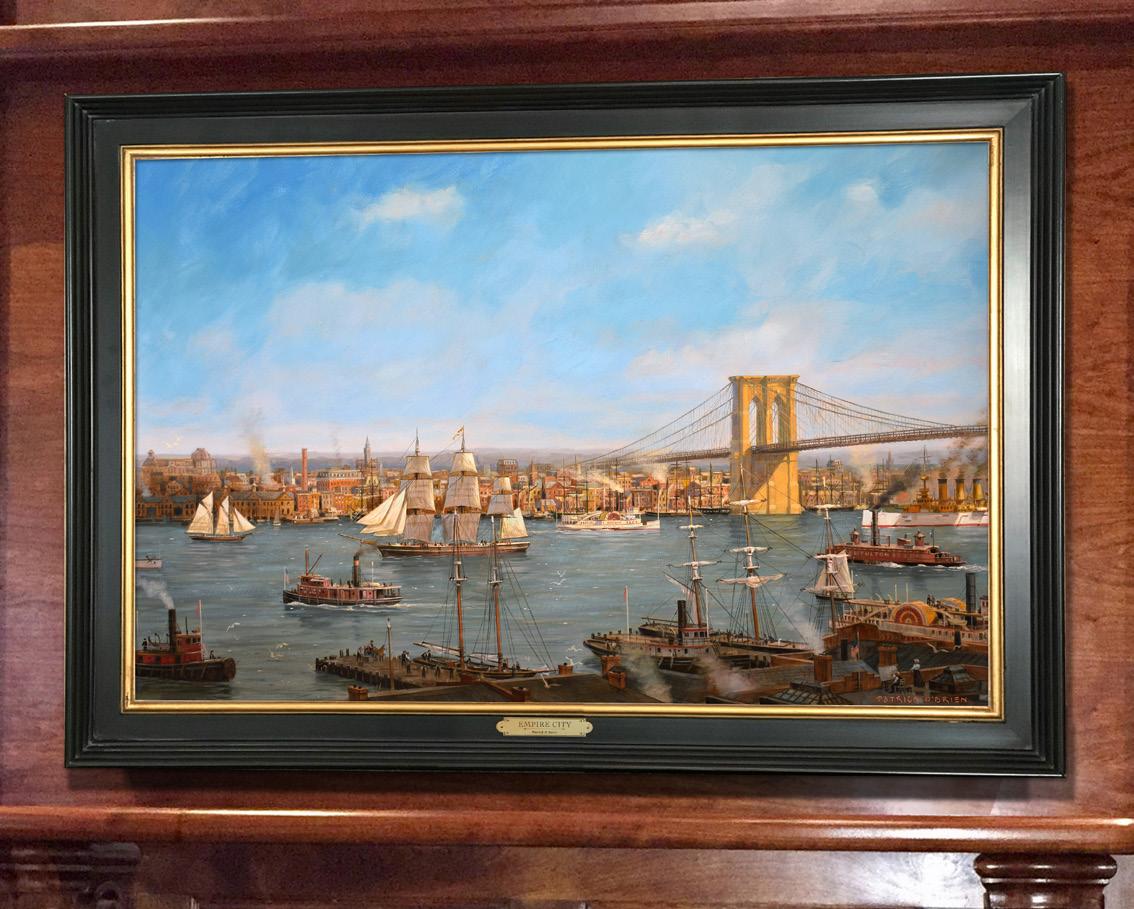
Commission a custom painting
Share your ideas with Patrick, and he’ll provide sketches for your approval before starting the fnal work.
Patrick is the President of The American Society of Marine Artists. Learn more about him, and how to commission a painting, at:

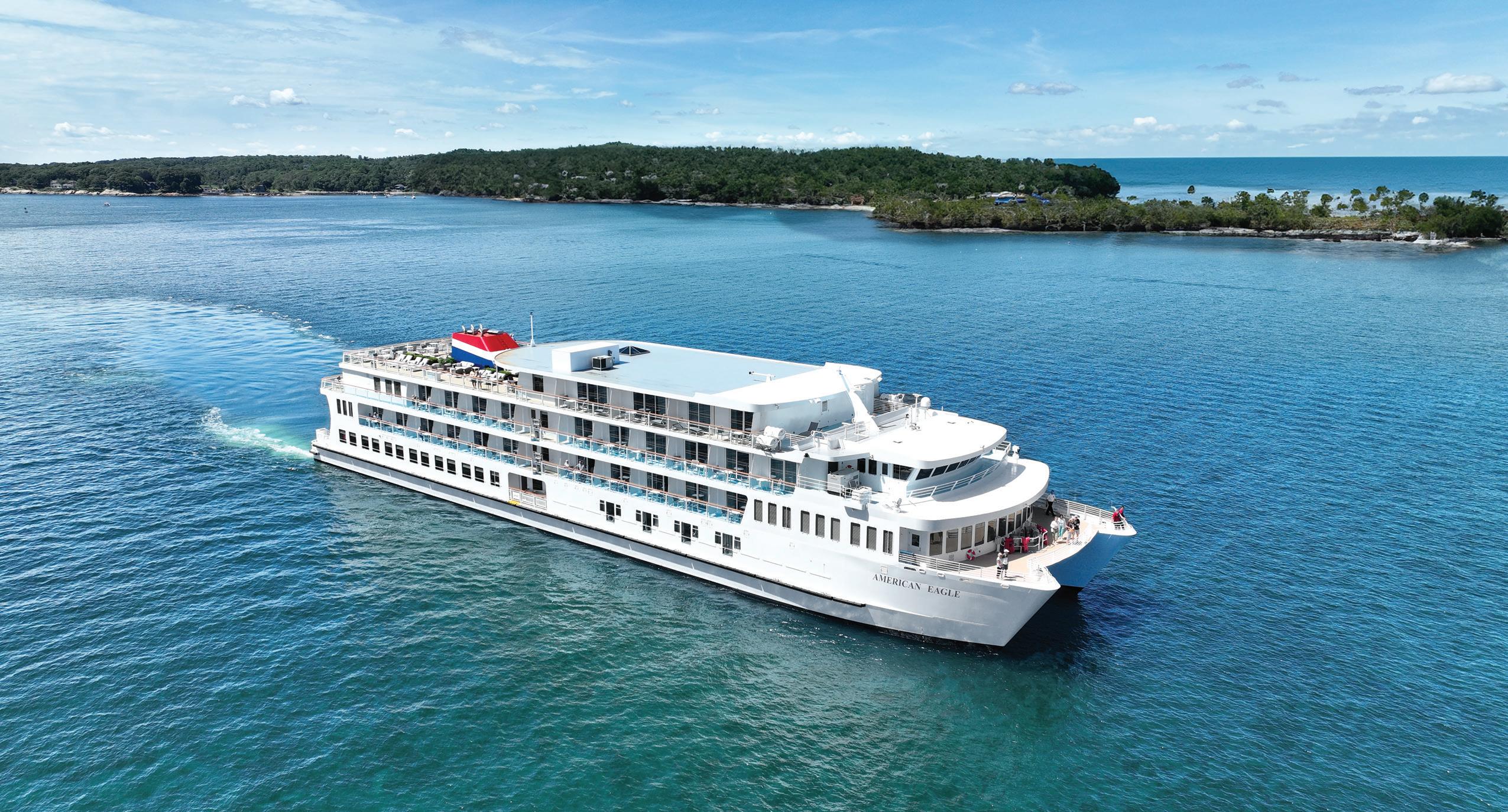


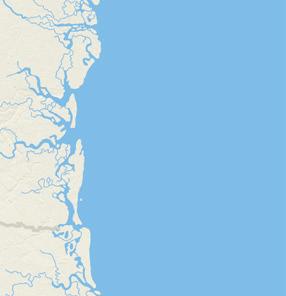

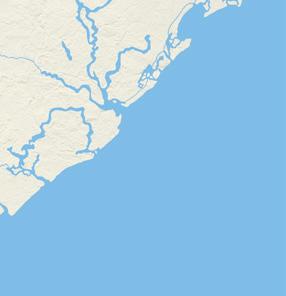



Southeast Sea Islands Cruise
9-day/8-night exploration
6 ports of call with guided excursion options at each
All onboard meals and our signature evening cocktail hour
Full enrichment package with guest speakers and nightly entertainment
All tips and gratuities


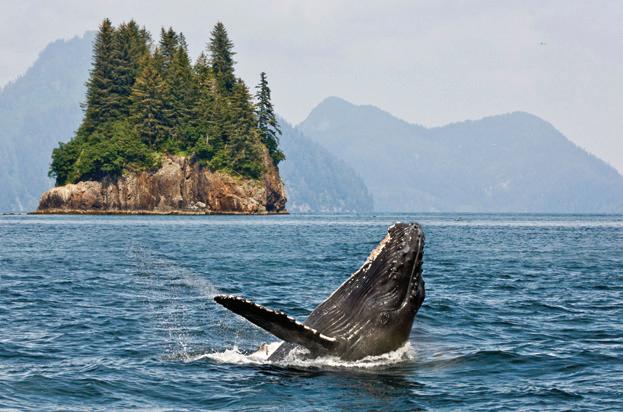
On this enchanting voyage from Charleston to Amelia Island, experience the charm and hospitality of the South. In the comfort of our modern fleet, travel to some of the most beautiful historic cities in America. The fascinating sites you visit, the warm people you meet, and the delectable cuisine you taste, come together for an unforgettable journey.

Haveyou ever truly felt a calling—to a service, a profession, or an opportunity? at call came loud and clear for me this past summer when I took part in a shipwreck archaeological expedition in Ukraine—yes, in Ukraine. It struck me on both a personal and professional level. Most importantly, it reminded me of what the National Maritime Historical Society is called to do in this time of change for all of us working in history, heritage, and preservation. As our nation approaches its 250th year, what is NMHS called to be?
We are sentinels, reminding the nation of the maritime stories and remarkable people who built this country over the past 250 years.
We are allies, standing shoulder to shoulder with museums, historic ships, and sailing programs across the nation that connect people to their maritime heritage, in particular young people who may not be aware of our nation’s—and their own—seafaring connections.
And increasingly, we are protectors, called upon to safeguard history itself. at calling has guided us throughout this past year. In September, NMHS brought together more than 300
people for the 12th Maritime Heritage Conference, carrying forward the legacy of the National Maritime Alliance. More than 130 presenters shared groundbreaking work, from innovative ship preservation techniques to new historical research and trailblazing approaches to interpretation. e Society’s 60-plus year e orts to bring diverse perspectives on historical events—written by an equally diverse range of authors in these pages—is another e ective way we continue to serve our community. Each issue of Sea History helps preserve not only the narrative of our maritime roots but also the ongoing story of our dependence on the maritime world today. e sailors, merchant mariners, and shipbuilders of the past, along with their families and communities, crafted the legacy we inherit. To overlook any part of that legacy is to lose opportunities for growth and understanding that re ection a ords.
Perhaps most concretely, NMHS partnered with the International Congress of Maritime Museums on an extraordinary expedition to Ukraine, where a team of maritime archaeologists met to document and excavate shipwrecks along the banks of the Dnipro River near the front lines of war (see pages 12–21). ese historic vessels were
The National Maritime Historical Society unites, connects, and advocates for us all. Please consider donating to support our work. If you love the sea, if you love history, make your gi today.
Seahistory.org/give Call 914-737-7878 ext. 0
Or please make checks payable to:
National Maritime Historical Society 1000 Division Street, Suite #4, Peekskill NY 10566
in imminent danger of being lost forever. anks to international collaboration, they are now preserved and recorded for future generations.
Which brings me back to what it means to answer a call. Saving pieces of history—literally—is deeply important, and I am grateful NMHS was able to have a role in this e ort. But the lasting impact for me was personal, far outweighing any help we provided with trowels and tape measures. I am forever changed by the strength, determination, and hope I witnessed in my Ukrainian colleagues, who are struggling but determined to save the physical remains of their maritime heritage in the middle of a devastating war.
I hope our presence there, standing beside friends facing daily the consequences of war and threats to their culture, made clear that people around the world are standing with them. I hope that by sharing their story here, we a $ rm that message once more: history matters, heritage endures, and together we must continue to answer the call.
Cathy Green, President, NMHS
Sea History e-mail: seahistory@gmail.com
NMHS e-mail: nmhs@seahistory.org
Website: www.seahistory.org
Phone: 914 737-7878
Sea History is sent to all members of the National Maritime Historical Society. MEMBERSHIP IS WELCOME: Afterguard $10,000; Benefactor $5,000; Plankowner $2,500; Sponsor $1,000; Donor $500; Patron $250; Friend $100; Regular $45. Members outside the US, please add $20 for postage. Individual copies cost $5.99.
PETER ARON PUBLISHER’S CIRCLE: Guy E. C. Maitland, Ronald L. Oswald, William H. White
OFFICERS & TRUSTEES: Chairman , CAPT James A. Noone, USN (Ret.); Vice Chairman , Richardo R. Lopes; President: Catherine M. Green; Vice Presidents: Deirdre E. O’Regan, Wendy Paggiotta; Secretary, Capt. Je rey McAllister; Trustees: Charles B. Anderson; CAPT Patrick Burns, USN (Ret.); Samuel F. Byers; CAPT Sally McElwreath Callo, USN (Ret.); William S. Dudley; Karen Helmerson; VADM Al Konetzni, USN (Ret.); K. Denise Rucker Krepp; Guy E. C. Maitland; Elizabeth McCarthy; Peter McCracken; Salvatore Mercogliano; Brandon Phillips; Kamau Sadiki; Richard Scarano; David Winkler
CHAIRMEN EMERITI: Walter R. Brown, Alan G. Choate, Guy E. C. Maitland, Ronald L. Oswald; Howard Slotnick (1930–2020)
FOUNDER: Karl Kortum (1917–1996)
PRESIDENTS EMERITI: Burchenal Green, Peter Stanford (1927–2016)
OVERSEERS: Chairman, RADM David C. Brown, USMS (Ret.); RADM Joseph Callo, USN (Ret.); Christopher Culver; Richard du Moulin; David Fowler; Gary Jobson; Sir Robin Knox-Johnston; John Lehman; Capt. James J. McNamara; Philip J. Shapiro; H. C. Bowen Smith; Philip J. Webster; Roberta Weisbrod
NMHS ADVISORS: John Ewald, Nathaniel Howe, Steven Hyman, J. Russell Jinishian, Gunnar Lundeberg, Conrad Milster, William Muller, Nancy Richardson, Jamie White
SEA HISTORY EDITORIAL ADVISORY BOARD: Norman Brouwer, Robert Browning, William Dudley, Lisa Egeli, Daniel Finamore, Kevin Foster, John O. Jensen, Frederick Leiner, Joseph Meany, Salvatore Mercogliano, Carla Rahn Phillips, Walter Rybka, Quentin Snediker, William H. White
NMHS STAFF: President, Catherine M. Green; Deputy Director, Susan Sirota; Vice President of Operations, Wendy Paggiotta; Senior Sta Writer, Shelley Reid; Business Manager, Andrea Ryan; Manager of Educational Programs, Heather Purvis; Membership Coordinator, Marianne Pagliaro
SEA HISTORY: Editor, Deirdre E. O’Regan; Advertising Director, Wendy Paggiotta
Sea History is printed by e Lane Press, South Burlington, Vermont, USA.
Our Contributors Make It Happen I read the note “From the Editor” in the Autumn 2025 issue of Sea History, thanking the contributors who write articles and donate photographs, illustrations, and artwork for use in the magazine. I’m sure that I speak for many readers who also appreciate these contributions. e articles are interesting and well-written. e photographs are clear and sharp. e illustrations and artwork are amazing and depict a moving and dynamic environment in fascinating and unique ways. Together, they take the reader on a journey like no other. ey take us back in time. ey take us on deck and in the rig, and they take us to sea in good conditions and bad. is is what makes this magazine so unique and why many of us read it from cover to cover. ank you to all the contributors. Please know that we, the readers, value your work and how much it means to this community.
C aptai( Da)id Cha,-.( Clearwater, Florida
Following a Historic Voyage on the Erie Canal
I would like to thank the organizers of the 12th Maritime Heritage Conference that took place in Bu alo, New York, in September. Members of the National Maritime Historical Society and the Historic Naval Ships Association did an outstanding job keeping things running smoothly. From my experience, the four-day conference was a complete success. e World Canals Conference also took place that week. Both conferences were scheduled to coincide with the 200th anniversary of the opening of the Erie Canal, which in 2017 was designated a National Historic Landmark. To mark this special occasion, the Bu alo Maritime Center built a full-size replica of the Seneca Chief, the rst canal boat to travel from Lake Erie through the 363-mile-long canal to
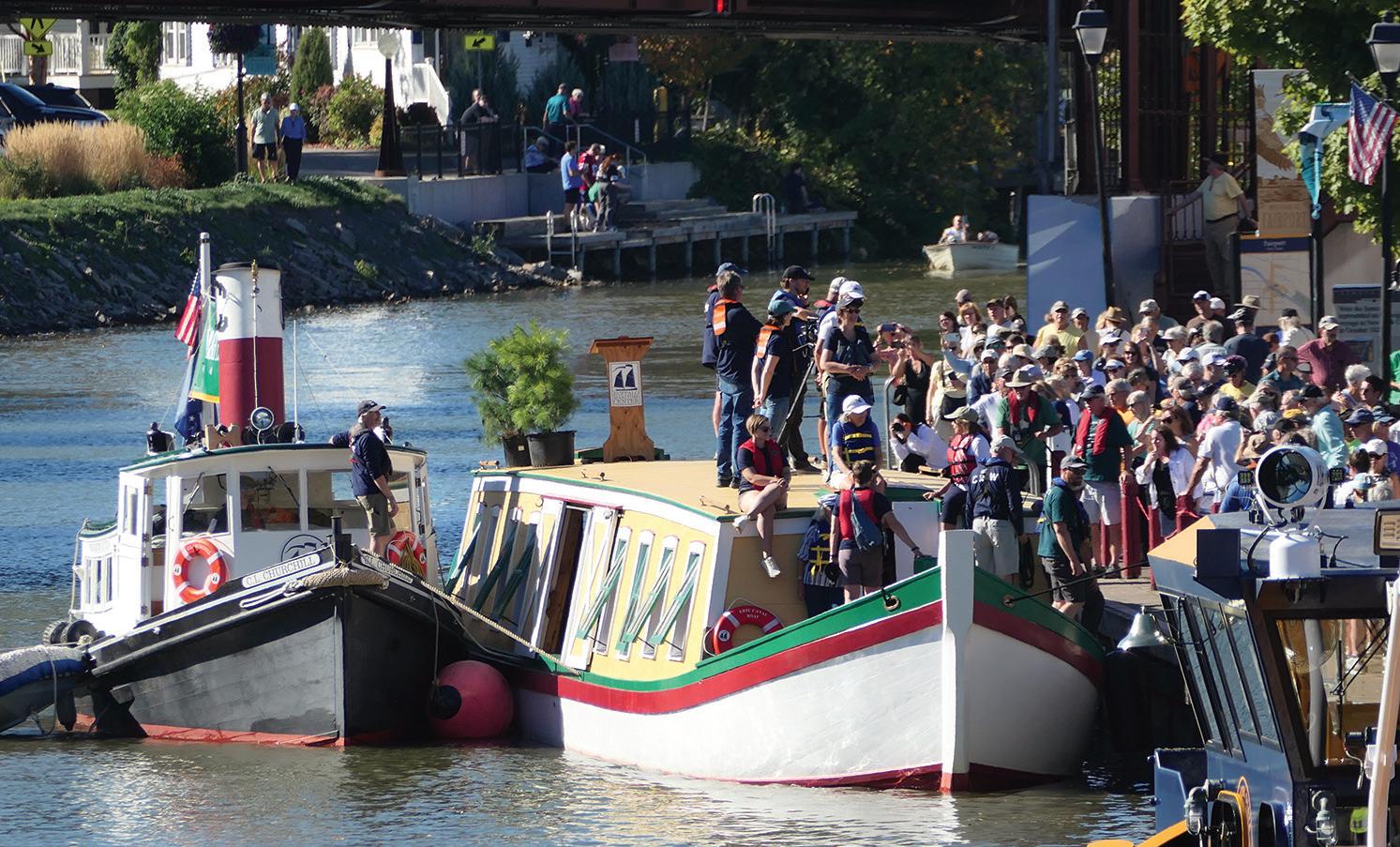
New York City. Along the route, the boat had to maneuver through more than 80 locks, as Lake Erie is more than 560 feet higher in elevation than the Hudson River. Today, the canal follows a slightly altered route; it was upgraded and rerouted in places in the early 20th century.
e Seneca Chief replica departed Bu alo on 24 September 2025 and arrived at Pier 26 in New York City on 26 October, completing the nearly 500-plus-mile route in 33 days. Since the Seneca Chief has no propulsion of her own, the entire trip was made possible by the Bu alo Maritime Center’s wooden tugboat, CL Churchill, to move the canal boat through the waterway and maneuver through the extensive system of locks between Bu alo and the Hudson River. When the conference in Bu alo was over, I caught up with the Seneca Chief in Fairport, New York, on my way home and then followed her progress through the Buffalo Maritime Center’s website.
One of the more remarkable lock systems along the canal is the Waterford Flight, where a series of ve locks allows vessels to access the Mohawk River from the east and the Hudson River from the west. I decided to catch up with the Seneca Chief there, and having never seen a lock in action before, I felt
like a kid on Christmas morning as the Seneca Chief entered the westernmost lock of the Waterford Flight. I followed the boat as she worked her way through
THETRADITION OFHANDCARVED EAGLES CONTINUES TODAY
(508) 939-1447

OWNER’S STATEMENT: Statement filed 9/22/25 required by the Act of Aug. 12, 1970, Sec. 3685, Title 39, US Code: Sea History is published quarterly at 1000 N. Division Street Suite 4, Peekskill NY 10566; minimum subscription price is $27.50. Publisher and editor-in-chief: None; Editor is Deirdre E. O’Regan; owner is National Maritime Historical Society, a non-profit corpo-ration; all are located at 1000 N. Division Street, Suite 4, Peekskill NY 10566. During the 12 months preceding October 2025 the average number of (A) copies printed each issue was 10,955; (B) paid and/or requested circulation was: (1) outside county mail subscriptions 5,193; (2) in-county subscriptions 0; (3) sales through dealers, carriers, counter sales, other non-USPS paid distribution 4,436; (4) other classes mailed through USPS 241; (C) total paid and/or re-quested circulation was 9,870; (D) free or nominal rate distribution was: (1) outside county 400; (2) in-county 0; (3) mailed at other classes through the USPS 200; (4) outside the mail 130; (E) total free distribution was 730; (F) total distribution 10,600; (G) copies not distributed 355; (I) total [of F and G] 10,955; (I) Percentage paid and/or requested circulation 93%. The actual numbers for the single issue preceding October 2025 are: (A) total number printed 10,547; (B) paid and/or requested circulation was: (1) outside-county mail subscriptions 4,726; (2) in-county subscriptions 0; (3) sales through dealers, carriers, counter sales, other non-USPS paid distribution 4,451; (4) other classes mailed through USPS 186; (C) total paid and/or requested circulation was 9,363; (D) free or nominal rate distribution was: (1) outside county 130; (2) in-county 0; (3) mailed at other classes through the USPS 200; (4) outside the mail 520; (E) total free distribution was 850; (F) total distribution 10,213; (G) copies not distributed 334; (I) total [of F and G] 10,547; (I) Percentage paid and/or requested circulation 92%. I certify that the above statements are correct and complete. (signed) Catherine Green, President, National Maritime Historical Society.
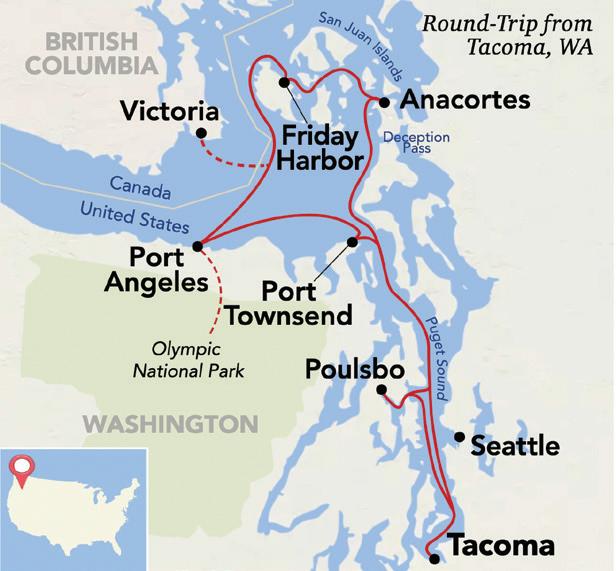
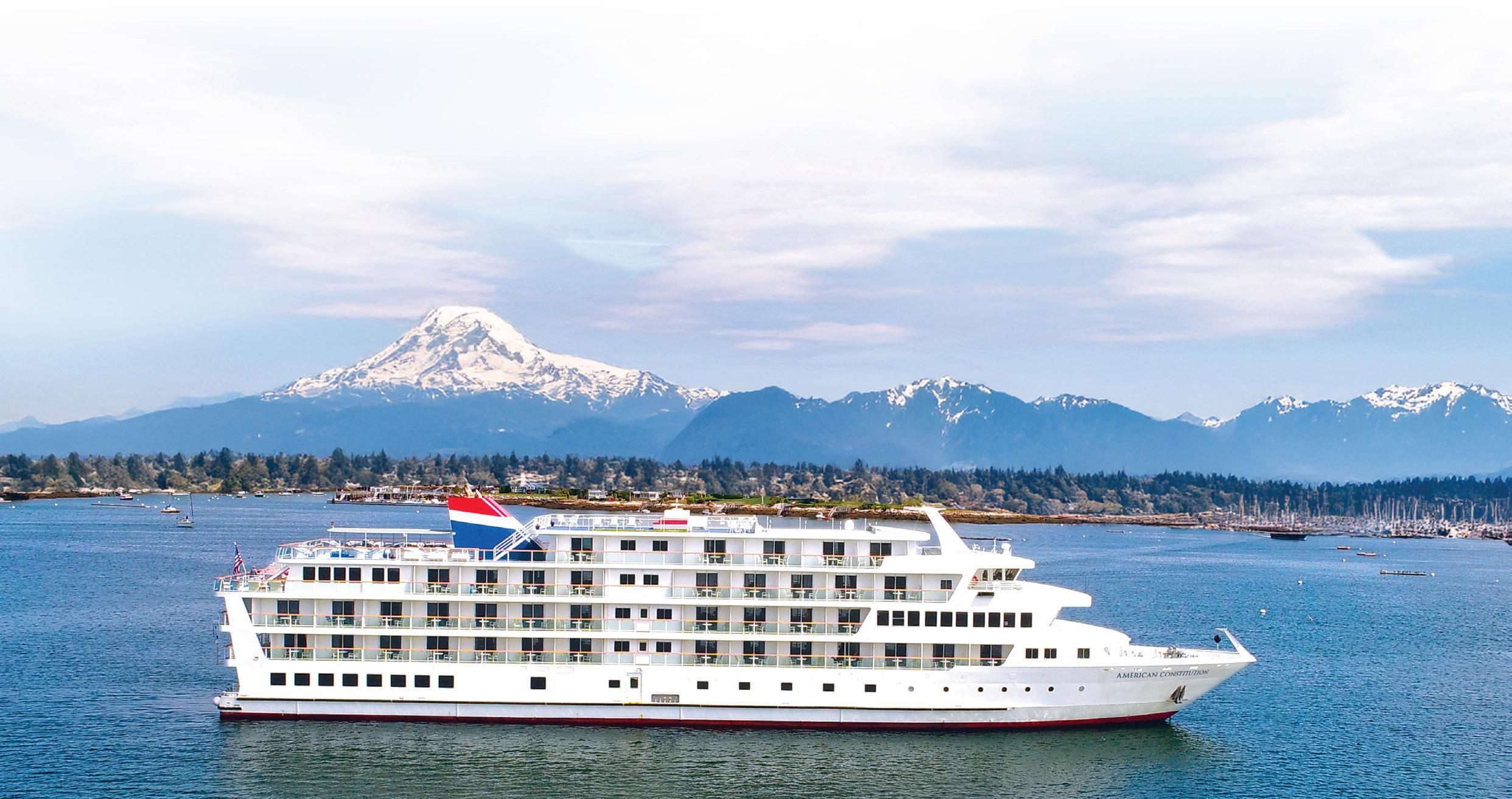
Join NMHS leadership and members on an unforge able cruise aboard the luxurious American Constitution, round-trip from Tacoma. www.seahistory.org/cruise2025
Embark on a voyage through time as we set sail on a tailor-made journey through the heart of Puget Sound. This exclusive itinerary—crafted especially for maritime heritage aficionados—offers NMHS members unparalleled access to historic ships, vibrant waterfront museums, and immersive cultural experiences.
Each day, gather for captivating lectures by renowned maritime historian Robert Steelquist and special guests, bringing the region’s rich nautical legacy to life. Go behind the scenes with unique tours of museums, artisan workshops, and off-the-trail adventures.
Included Pre-Cruise Night Hotel (27 March) at the Hotel Murano, Tacoma
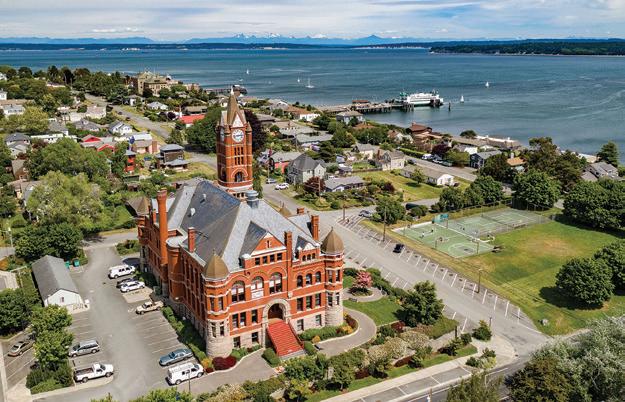
From the storied shores of Tacoma to the Nordic charm of Poulsbo, this voyage is more than a cruise—it’s a celebration of our shared maritime past, curated with care and passion for those who cherish the sea and its stories. Be among the first to experience this unique offering, designed to inspire, educate, and connect.
To secure your place on this remarkable journey, contact Izzy Pearson, Group Manager, at izzy.pearson@americancruiselines.com or call 888-458-6027.
When making your reservations please use the code NMHS A portion of the proceeds will benefit the Society.

the remaining four locks, then I waited for them to arrive on the Waterford waterfront. A few days later, I picked up Seneca Chief’ s trail in Dutchess County and followed her down to Ossining, where the crew docked the boat at one of the marinas and invited the public to tour the boat. I stayed with it as she continued her route, and when she was scheduled to arrive in New York City, I drove down to Pier 26 and took a lot of photographs, as I had been doing throughout the canal boat chase. It was an absolute thrill to follow this beautiful replica, built by the hands of more than 200 volunteers over four years, under the guidance of several shipwrights. After a short stay in the city, Seneca Chief headed back up the Hudson to Waterford, where she will stay until the spring of 2026 before heading back to Bu alo.
Da)id R.cc.
Yorktown Heights, New York
Farewell Falls of Clyde
e Autumn issue of Sea History was of particular interest to me, featuring the stories about the demise of the historic ships Falls of Clyde and Tusitala For nearly eight years, I toiled happily as a rigger aboard Falls of Clyde in Hawaii. I have never hurt so much and been so tired at the end of the day, smelling like a forest re from slopping Stockholm tar on every piece of rigging, and looking forward to doing it again the next day. Working with ve other riggers alongside master rigger Jack Dickerho , we made shrouds and stays, backstays, and many more hundreds of lesser pieces of rigging. Hanging in a bosun’s chair at the end of a gantline, we set them in place or wrestled with heavy, massive steel yards, all while getting fried in the hot tropical sun with sweat pouring into our eyes—and loving it. By the time that the Winter issue of Sea History goes to print, she will have been scuttled in deep water o Oahu. I wonder if the two resident
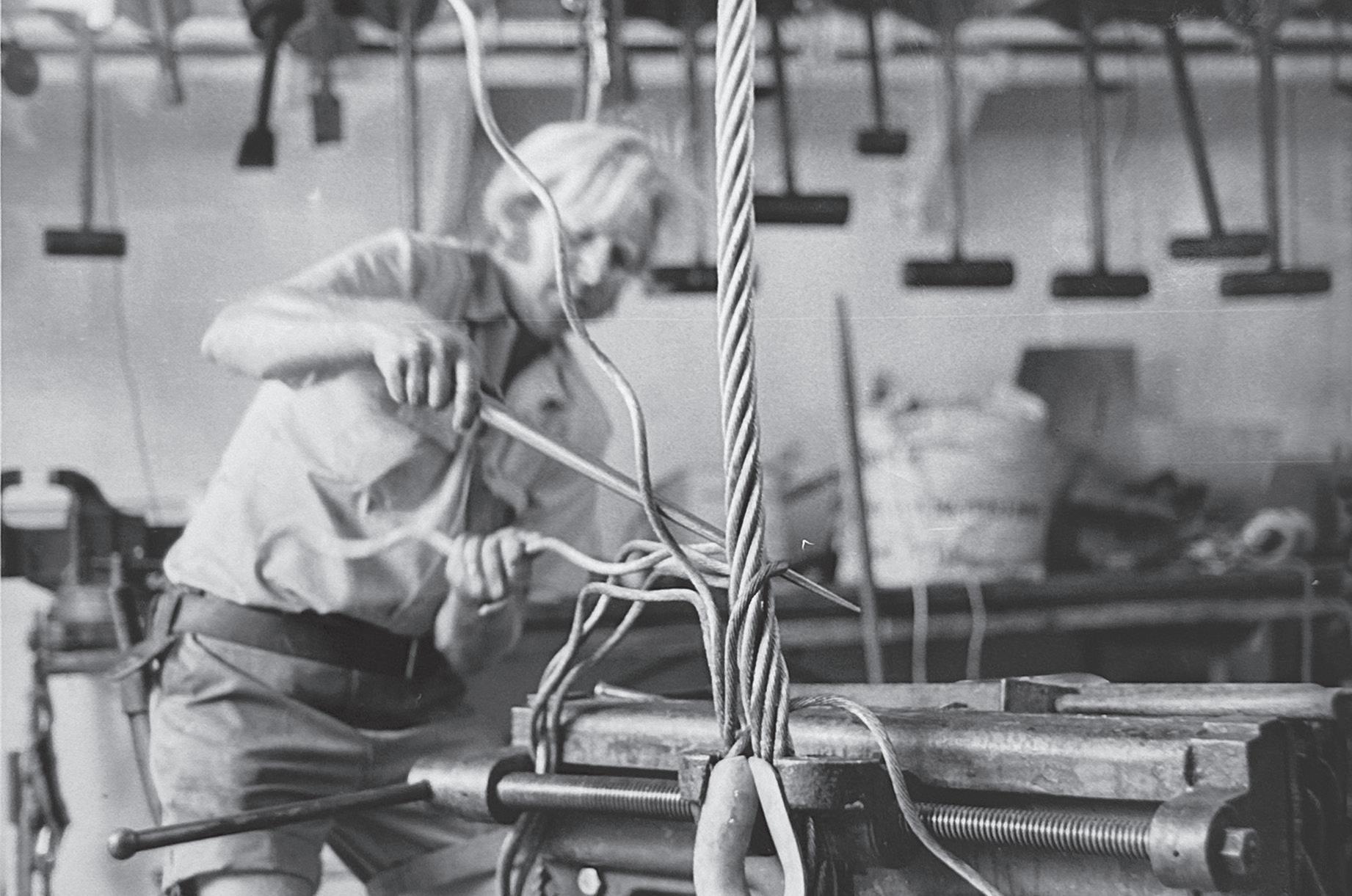
Indrek Lepson making the first tuck of a massive wire splice for Falls of Clyde “Between the shrouds and backstays, there were 80 such splices, plus a zillion more on small stu like footropes and stirrups—12 per yard. I can a est that one does not learn to splice wire cable merely by watching a master rigger.”
ghosts, a man and a woman (for real!) who kept me company when I lived in a passenger cabin on the ship, moved elsewhere or if they went down with the ship, embraced in a spectral romance.
e loss of this important piece of not just American maritime history, but, as an oceangoing ship that sailed across the globe, world history, should be classi ed as one of the greatest mancaused American maritime disasters. After all, it was preventable. Unknown millions of dollars were expended over the years, all for naught. She came back to Honolulu in 1963 as an unrigged, grimy hulk with just the lower masts standing. And she went out 62 years later the same way, a battered hulk with just the lower masts standing—but a lot cleaner.
From the video I saw online, she went down stern rst, her bowsprit pointing skyward as if waving a last goodbye, a lasting legacy to the Bishop Museum and, perhaps, a classic case of snatching defeat from the jaws of victory. She was once so close to complete restoration, until they decided to
abandon her and leave her to rot. I don’t know what took place in the boardroom to come to that decision. While I served aboard her, I was under the impression that she generated enough income for her upkeep. Maybe not, but clearly grants were awarded and squandered elsewhere.
Nobody loved her more or was sadder to see her go than I. Farewell, Falls of Clyde, I knew you well.
I(d012 L 1p-.( Louisburg, North Carolina
From the Editor: e 146-year-old Falls of Clyde, once the pride of the Hawaii Maritime Center and a xture on the Honolulu waterfront, was towed out to sea and scuttled in deep water on 15 October. e ship was the only surviving four-masted, iron-hulled, full-rigged ship in the world. You can read more about it on page 64 in this issue’s Ship Notes, Seaport, and Museum News. e video of her sinking—if you can stomach it—can be viewed online at the Hawaii News Now website (www. hawaiinewsnow.com; search for “Falls of Clyde.”)

Traditional Knotwork Downtown Mystic CT
25 Cottrell St. 2 Holmes St. MysticKnotwork.com


Anne T. Converse Photography
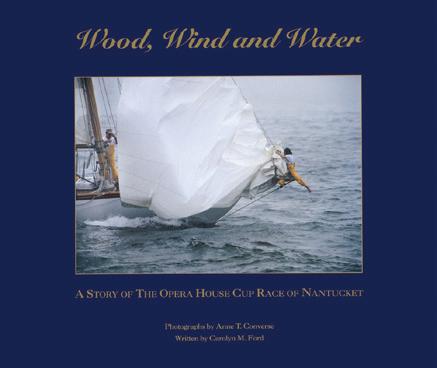
Neith, 1996, Cover photograph Wood, Wind and Water
A Story of the Opera House Cup Race of Nantucket
Photographs by Anne T. Converse Text by Carolyn M. Ford
Live vicariously through the pictures and tales of classic wooden yacht owners who lovingly restore and race these gems of the sea.
“An outstanding presentation deserves ongoing recommendation for both art and nautical collections.”
10”x12” Hardbound book; 132 pages, 85 full page color photographs; Price $45.00
For more information contact: Anne T. Converse Phone: 508-728-6210 anne@annetconverse.com www.annetconverse.com
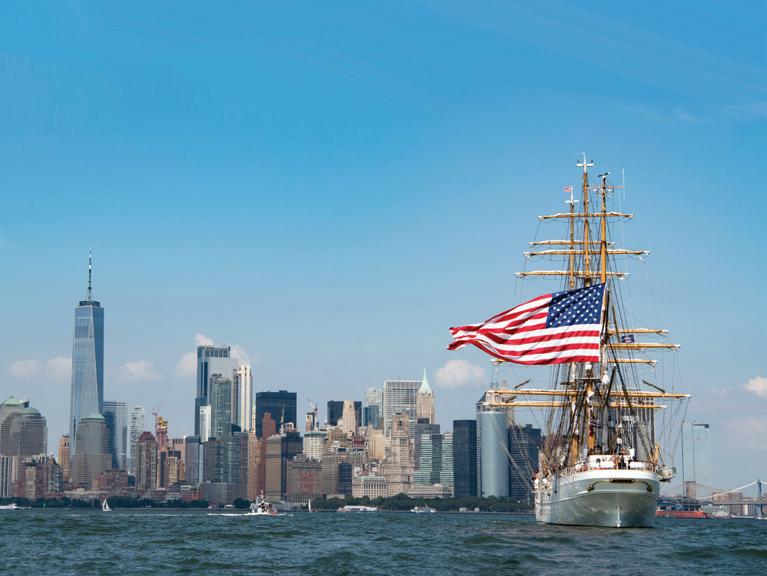
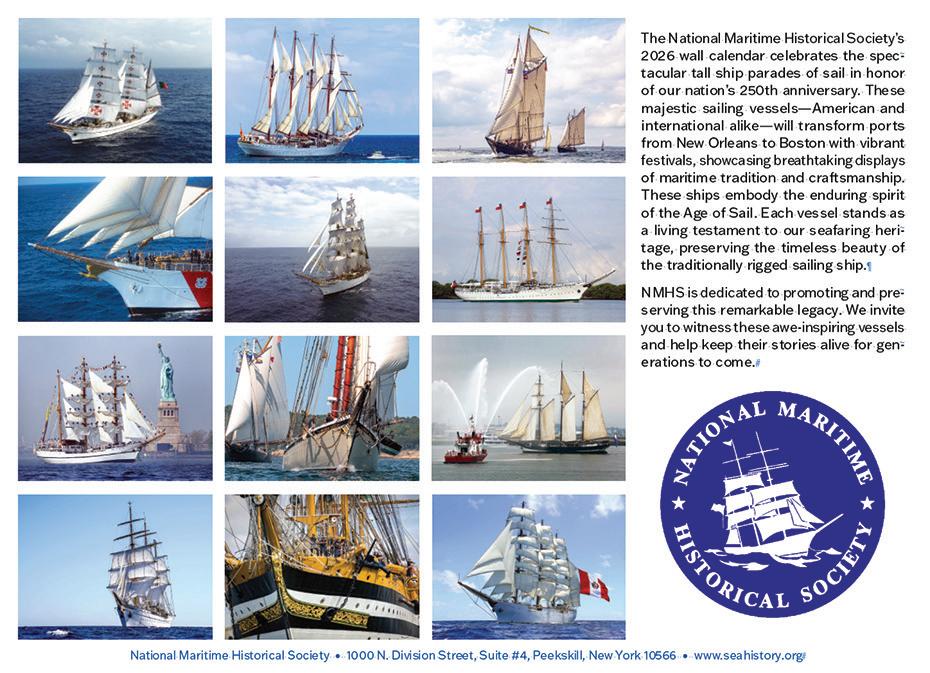
The National Maritime Historical Society’s new wall calendar celebrates the American and international fleet of tall ships that will visit seaports from New Orleans to Boston for spectacular parades of sail and tours in 2026. Enjoy these stunning images of participating ships and make sure to plan to visit them next summer!
12-month calendar is wall hanging, saddle-stitched, and printed on quality heavyweight paper. 18”H x 12”W (open)
$14, plus $6 s/h (media mail) within the USA. NYS residents add sales tax. Please call for multiple or international shipping charges.
TO ORDER, call 914 737-7878 ext. 0, or online at www.seahistory.org/calendar2026.
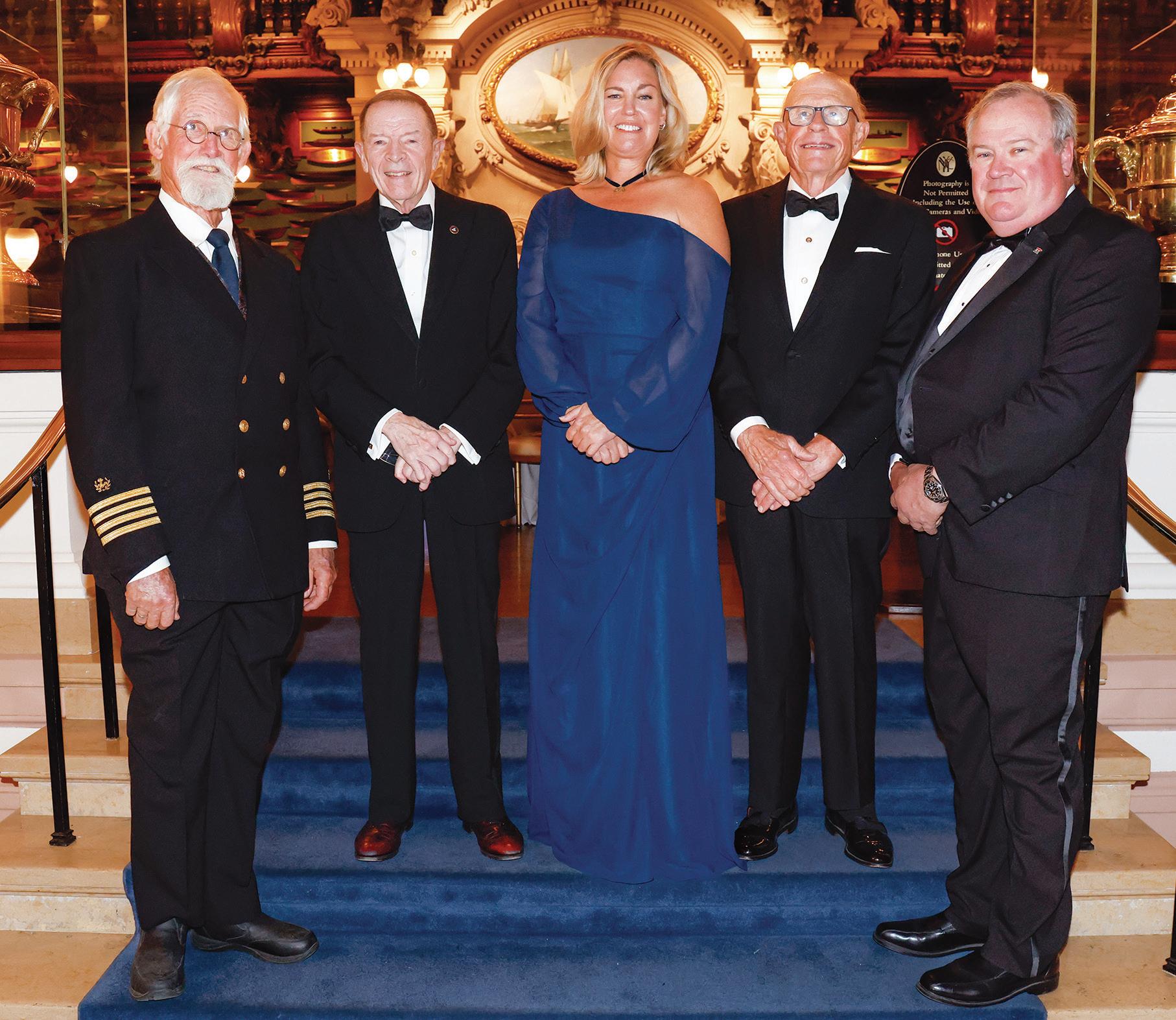
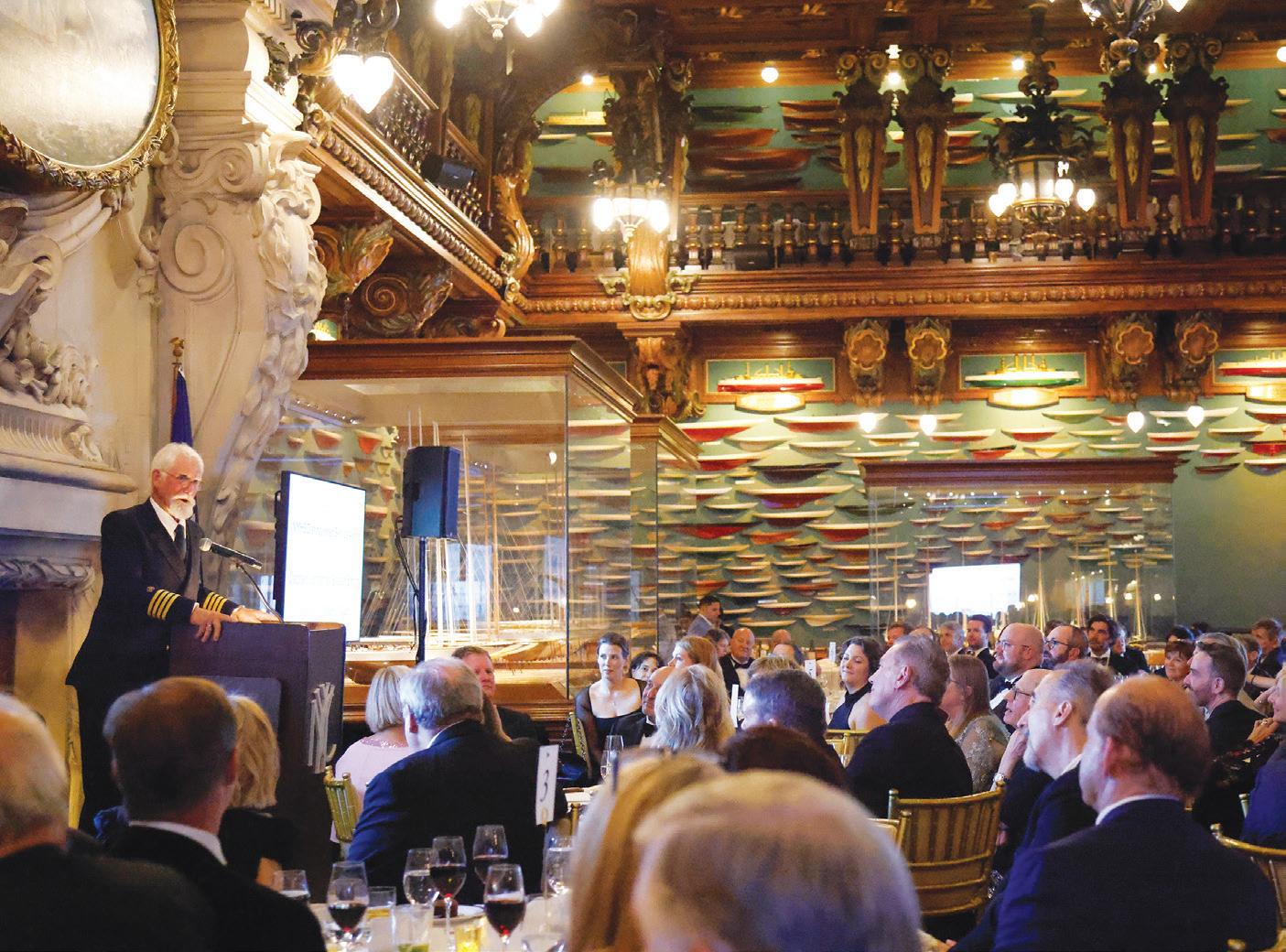
e National Maritime Historical Society’s 2025 Annual Awards Dinner was an inspiring evening that brought together leaders and friends from across the maritime community to celebrate excellence, honor achievement, and support the Society’s educational mission. Held on 23 October at the New York Yacht Club, the gala gathered 200 guests for an evening that was as meaningful as it was memorable.
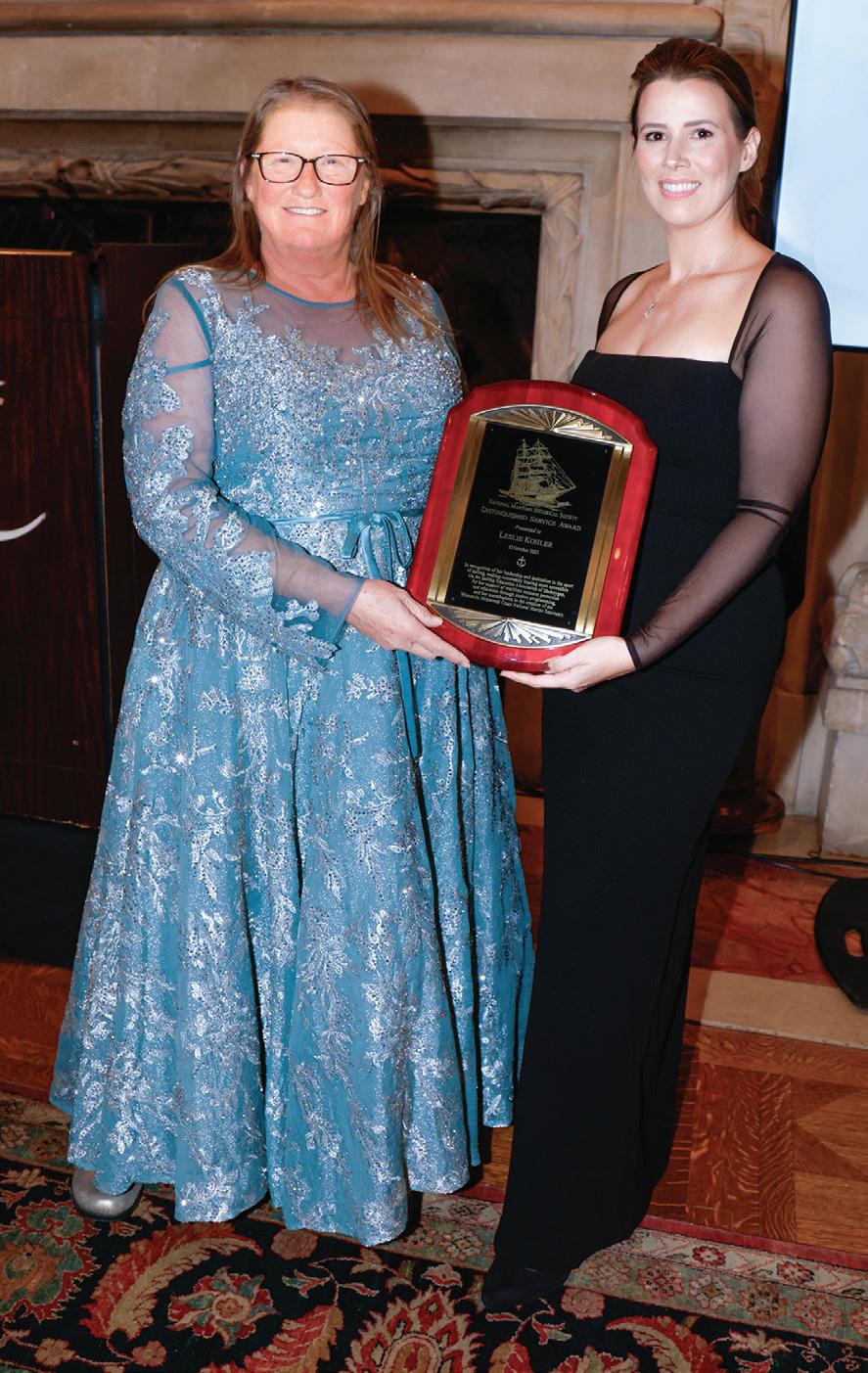
is year, NMHS proudly honored American President Lines, Leslie Kohler, and Captain Jonathan Bacon Smith for their extraordinary contributions to preserving and promoting our maritime heritage with Distinguished Service Awards. Each recipient’s story re ected a deep commitment to the values that de ne the maritime world— leadership, innovation, and service.
American President Lines was recognized for its enduring legacy as a pioneer in American shipping and as a steadfast supporter of maritime education and workforce development. Leslie Kohler, a long-time advocate for sailing education, was honored for her visionary leadership in providing barrier-free
“...An’ I don’t care if it’s North or South, the Trades or the China Sea, Shortened down or everything set — close-hauled or runnin’ free—
You paint me a ship as is like a ship . ...an’ that’ll do for me!’’
Known for his expansive inventory of seafaring poetry, from which he readily draws to share with his students and crew at sea, Captain JB Smith recited “Pictures” by Cicely Fox Smith as part of his acceptance remarks. His ability to charm and command an audience, whether on the deck of a schooner or at the New York Yacht Club, became clear to all.
access to sailing programs. Captain Smith received his well-deserved award for his exemplary career at sea in traditional sailing vessels and his dedication to education and mentoring the next generation of sailing ship mariners.
e evening’s program featured engaging presentations, heartfelt tributes, and beautifully produced video segments that brought each honoree’s story to life. e US Coast Guard Cadet Chorale, led by Dr. Daniel McDavitt, added a stirring musical dimension to the night’s celebration, reminding us all of the time-honored traditions that unite the maritime community. Emcee Richard du Moulin guided the event with warmth and a ability, while presenters shared re ections that were both personal and inspiring. e atmosphere was one of camaraderie and shared purpose—guests gathered not only to celebrate outstanding achievements but also to rea rm their commitment to preserving maritime history for future generations.
A highlight of the evening was the Education Paddle Raise, which invited guests to support the Society’s Sea History for Kids feature in Sea History magazine. anks to the generous contributions of attendees and advanced pledges from members of the NMHS board of trustees and supporters, the Society can continue to bring the stories from our maritime history to young readers across the nation.
As guests departed, many expressed their appreciation for an evening that both celebrated the past and looked forward to the future of maritime heritage. e success of the 2025 Awards Dinner was made possible by the dedication of the dinner committee, dinner chair Tom Whidden, award presenters, and sta members, whose e orts ensured a seamless and memorable occasion.
With gratitude to all who participated and supported this year’s event, the Society looks ahead to its next Annual Awards Dinner on 22 October 2026 and continuing a tradition that honors the best in maritime achievement while advancing the mission of the National Maritime Historical Society.
— Cathy Green, NMHS President
Monthly, all year: First Thursdays Seminar Series—Online presentations highlighting the art, history, science, and adventure of the sea.
27 March–4 April: Puget Sound & San Juan Islands Cruise— Sail with NMHS through the scenic Pacific Northwest.
27–29 May: NMHS Annual Meeting (joint meeting with NASOH) New Haven, CT. Presentations, tours, and networking.
June: Art of the Sea Online Exhibition—Juried maritime art show featuring works for sale.
Summer: Sail 250—Tall ship celebrations marking America’s 250th anniversary and its maritime heritage.
22 October: Annual Awards Dinner—Celebrate maritime excellence and leadership at our signature gala at the New York Yacht Club.
by Fred Hocker
The MiG-29 screamed over the river, barely a hundred meters above our heads and using the Naumova Rock outcrop to mask its radar signature. It banked left, the sun glinting on its canopy and showing o the bright blue and yellow tailplanes, and was gone, the roar of the twin Klimov engines echoing from the rocks. Bombed up and booking it, the ghter jet was heading east to deliver presents to the orcs.1
It was a powerful reminder of the violent history of this war-torn country, a battleground for millennia between empires crashing against each other. We were there to excavate the remains of just one of those con icts, from the
18th century, but we had to rst dig through the site of a 1943 battle while the current war played out in the sky above us.
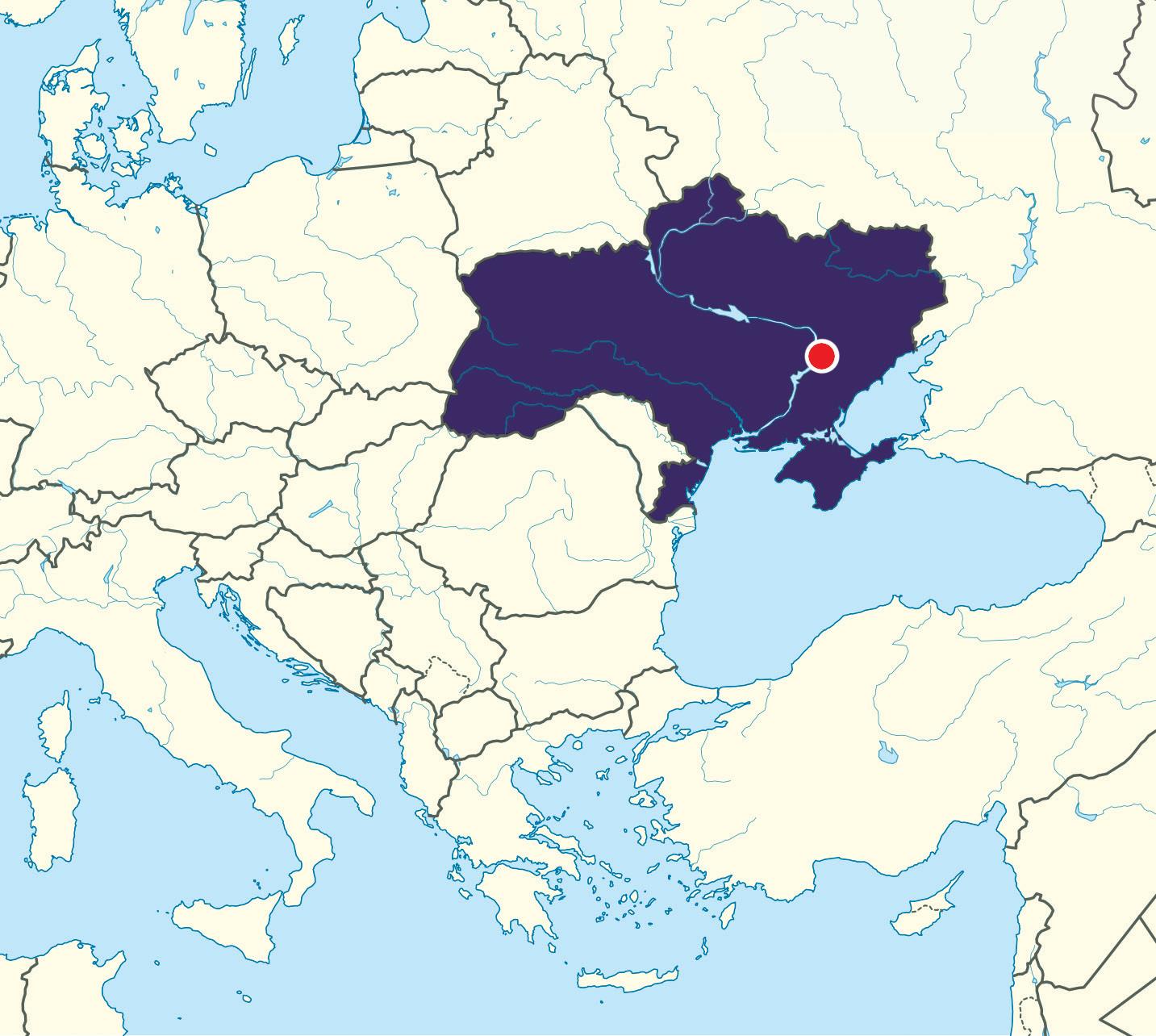
In 1735 the Russian and Ottoman empires collided in one of their many wars over control of the Crimean Peninsula. For four years, Russian, Turkish, and eventually Austrian armies fought along the lower Dnipro River and into Crimea. Russian forces typically would invade Crimea in the spring and then retreat in the fall. Army commanders chose to use the island of Khortytsia, in the great bend of the Dnipro, as a winter camp. It lay just below the rapids at Zaporizhzhia, the e ective head of navigation in the lower river and within
1 Fans of J. R. R. Tolkien will recognize the word orc, which refers to humanoid creatures that served as the Dark Lord’s foot soldiers. In Ukraine, it has been adopted as a derogatory term to refer to Russian soldiers.
the area controlled by the Zaporizhzhian Cossacks, who were allied with Russia. e army had built a eet of transports, originally numbering about 400 vessels, to move men, horses, guns, and supplies down the river and back. ese vessels were built on a tributary of the upper Dnipro, north of Kyiv, and oated down to the lower river over the rapids, losing some boats in the process. By the winter of 1738–1739, the Dnipro otilla numbered about 300 boats, organized into three squadrons. When the army was in winter quarters, the boats were drawn up on shore or moored in the river along the west side of the island and the right bank of the river.
In 1738 the encampment was struck by the plague, forcing the troops to withdraw upstream. e boats were abandoned at their moorings, after being stripped of useful equipment, and in some cases after being partly dismantled to prevent their use by the Turks. Over the years, the river washed some of them away and buried others in sand. Mennonite settlers who came to the island after 1785 reported seeing the skeletons of boats along the shoreline.
e new Soviet Union, as part of its e ort to modernize the economy and develop the infrastructure within Ukraine, built a series of dams, locks, and hydroelectric plants along the Dnipro River between 1920 and 1960. is allowed navigation all the way to Kyiv and provided electricity and water reservoirs for new industrial cities, such as Dnipropetrovsk and Zaporizhzhia. Dams at Kakhovka and Zaporizhzhia created a lake more than 300 km long,
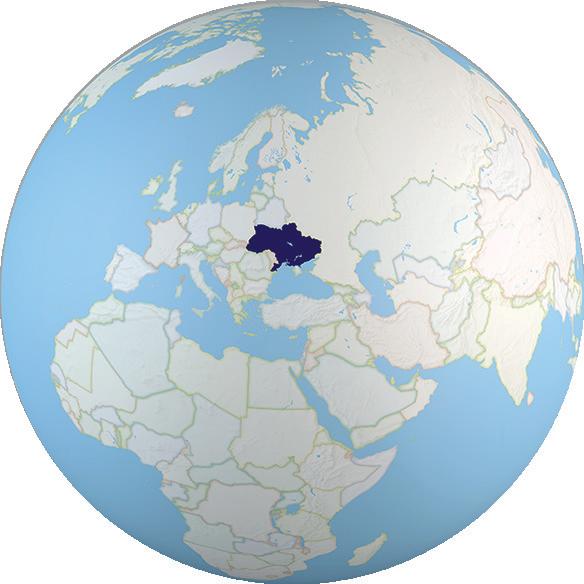
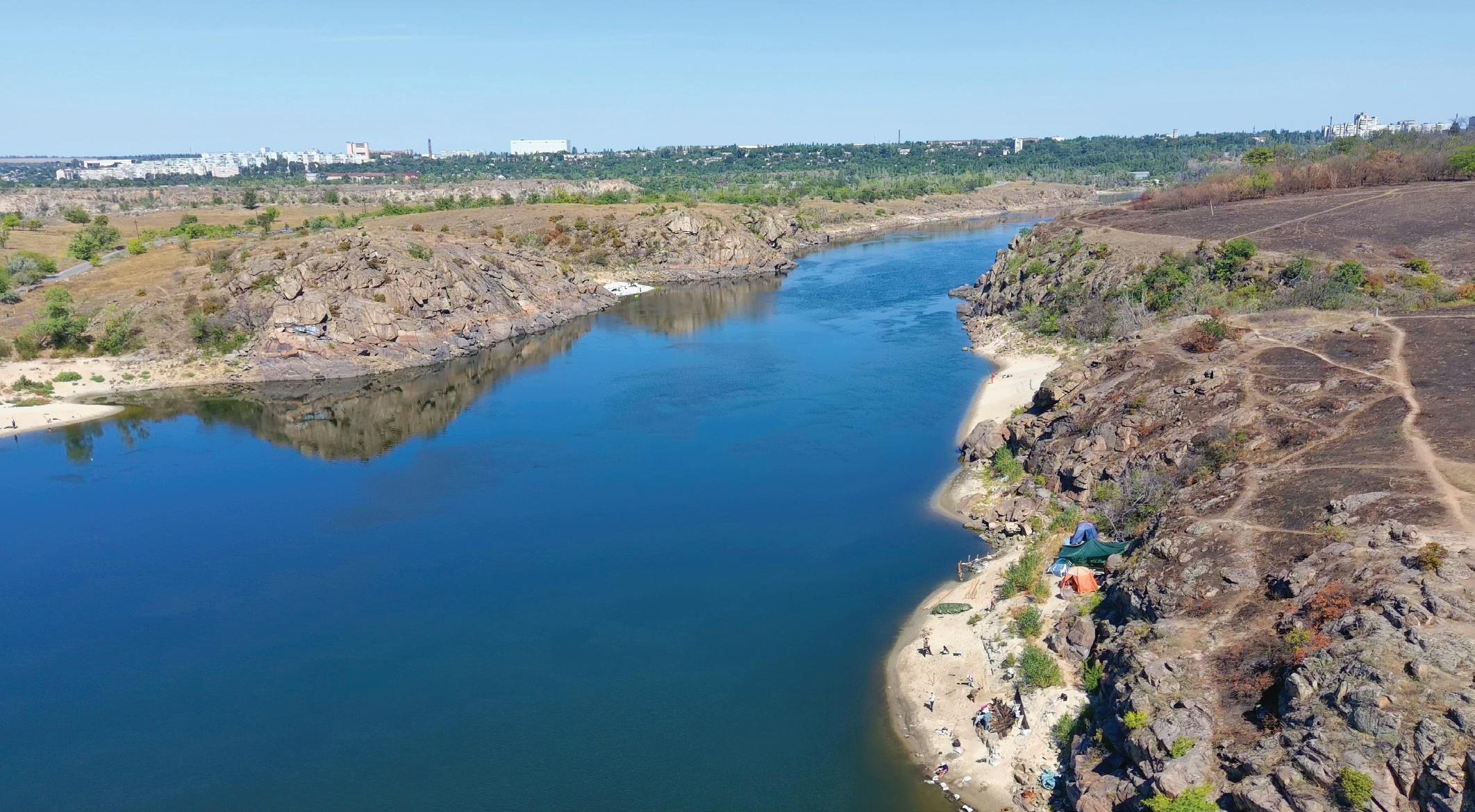
The shipwreck site near Zaporizhzhia lies just north of Russian-held territory.
ooding over 2,000 square kilometers of what is called the Great Meadow, the low-lying land downstream of Zaporizhzhia. e rising water covered medieval settlements, ancient Scythian grave elds, and what was left of the 1738 eet.
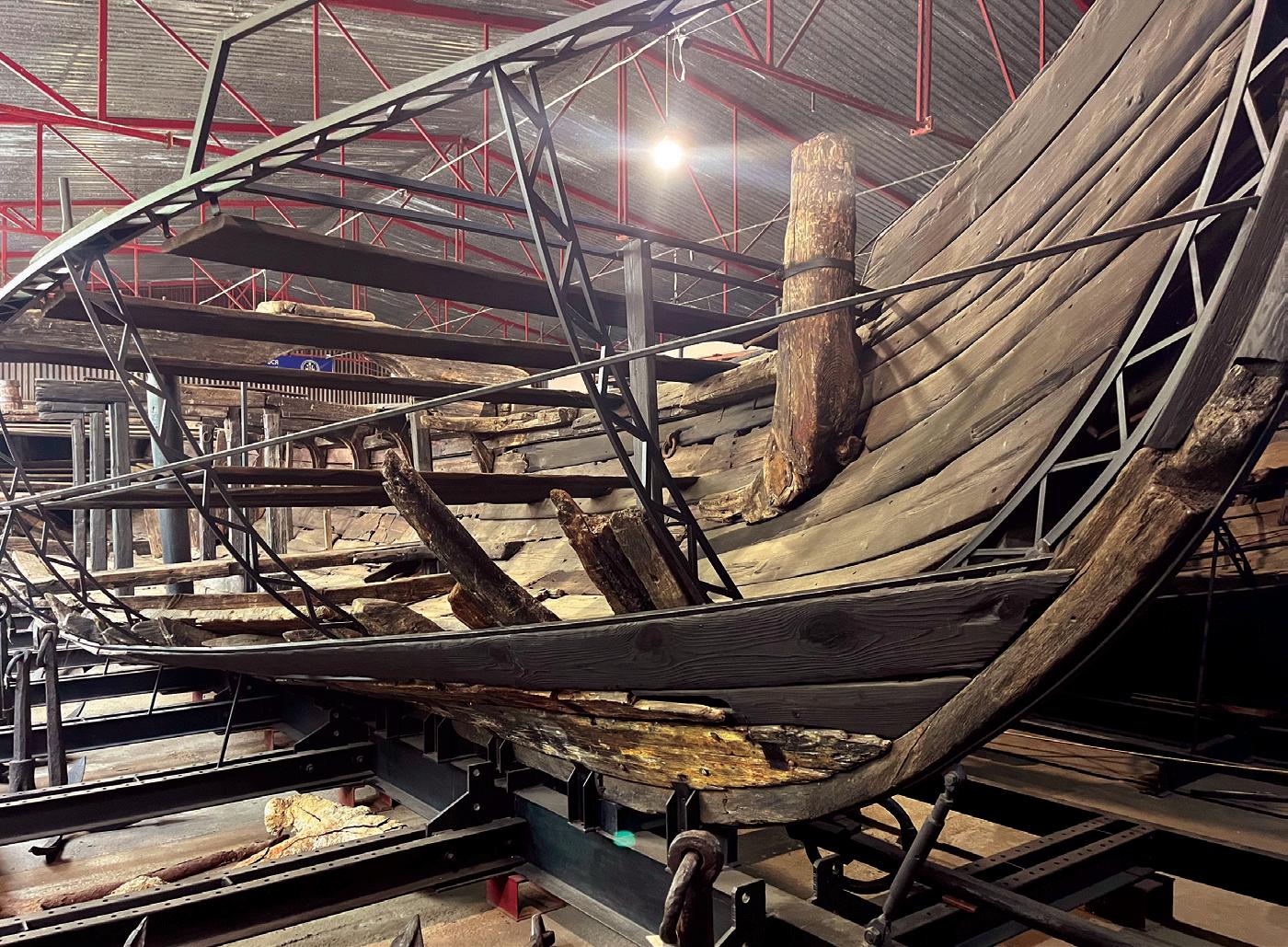
In the 1970s, divers led by Ivan Shapovalov began exploring the wrecks in the lake and discovered several remains from the 1738 eet. By the 1980s, the island had become a national park, the Khortytsia National Reserve (KNR), which combined a nature reserve with a museum of local archaeology and Cossack culture. When spring oods in 1998 eroded away parts of the riverbed around the island, more wrecks were exposed, and the underwater archaeological team based at the KNR began to investigate them. Over the course of the next twenty years, they recovered one largely complete horse transport, most of a heavy sailing vessel, and fragments of three large, open troop transports. ese have been conserved by polyethylene glycol (PEG) impregnation and are on display at the southern end of the island in a repurposed storage hangar.
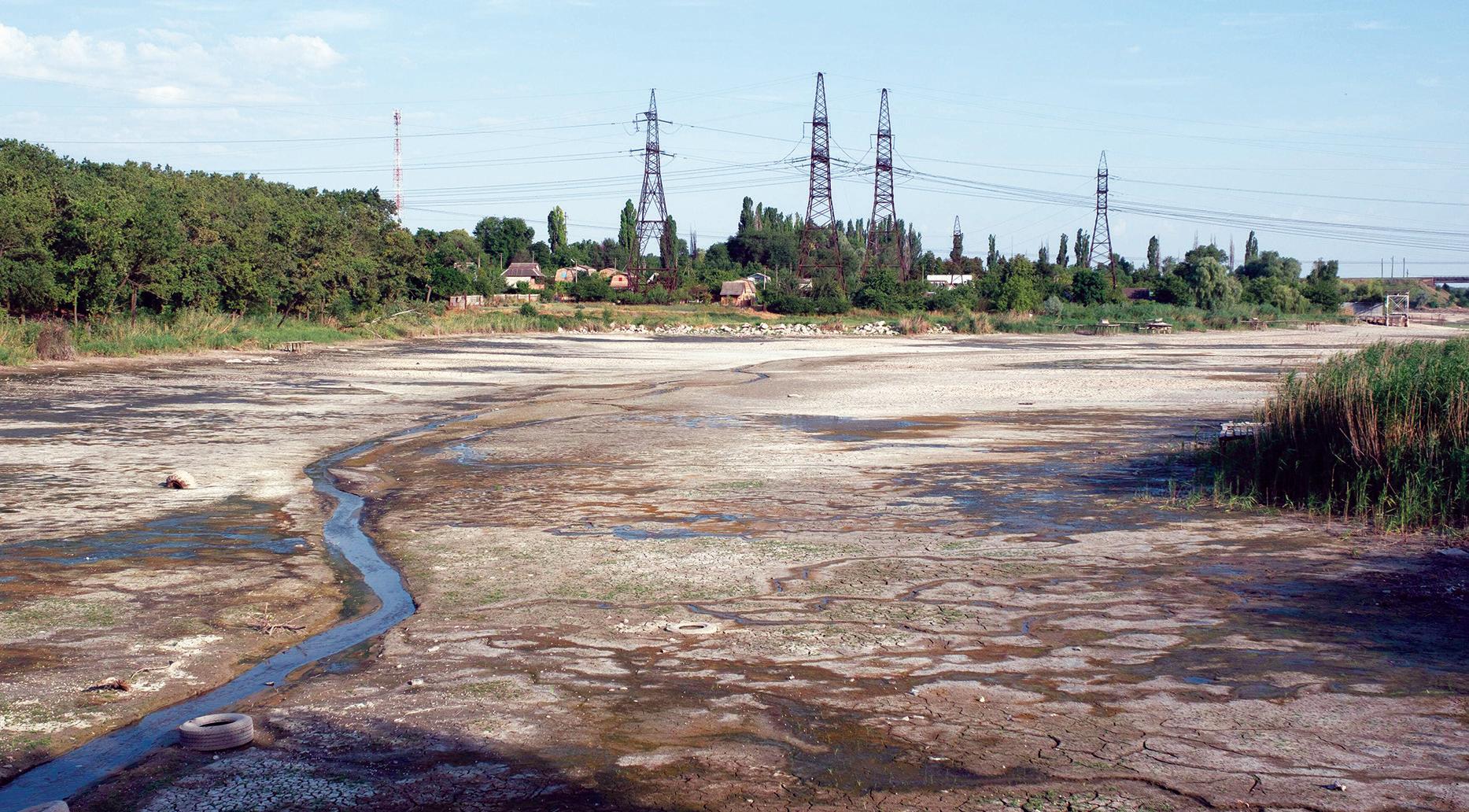
Russian forces destroyed the Kakhovka dam in June 2023 to head o a Ukrainian anking attack, which
(above right) In June 2023, Russian forces destroyed the Kakhovka Dam downstream from Zaporizhzhia, causing water levels to drop 6–12 meters and se ing o widespread humanitarian, cultural, and ecological impacts.
(right) Several vessels from the 1738 fleet had been previously excavated and conserved. Unable to be moved to safety when the invasion began, they remain in their display hanger on Khortytsia Island. In the past 12 months, the building has been hit by Russian drone strikes, but so far the vessels inside have not been damaged.
drained the lake between Kakhovka and Zaporizhzhia. is lowered the water level by 6 to 12 meters and exposed the original shoreline. e ow of the river, once more in its smaller original channel, accelerated, causing erosion of its new (old) banks.
e archaeological and conservation sta of the KNR are responsible for documenting and preserving the cultural heritage of the island and the northern part of Zaporizhzhia Oblast, most of which is currently occupied by Russian forces. ey have been busy since the full-scale invasion began in 2022 trying to evacuate, stabilize, or
protect the artifacts and monuments in their care. When the lake was drained, they also became responsible for surveying the newly exposed shoreline and stabilizing archaeological sites—all taking place in an active war zone.
ey noted the appearance of several boats along the northwestern shore of the island, in the same area where the KNR had recovered the other 1738 vessels. Two of the exposed wrecks appeared to be substantially preserved troop transports, which had previously only been seen in badly broken up examples. Both were in the same stretch of beach, at the ends of a shallow
BY
embayment between the ends of a crescent-shaped cli , Naumova Rock.
e one at the north end (Object 1) was entirely submerged except during periods of low water during the summer months. Most of the vessel remains were buried under the sand, except for a couple of meters at the bow. e other (Object 2) was at the southern end of the beach, lying parallel to the waterline and just clear of the water in the summer. It was the detached bow of a nearly identical vessel, broken into two pieces and lying on its port side. Just to the north was what looked like the end of a hull plank, lying loose in the sand.
e KNR sta stabilized the remains as much as possible with geotextile and sandbags, but when the water rose the following spring it was clear that Object 2 would eventually be undermined and washed downstream. It needed to be excavated and moved to a safer location, but the Reserve was short on sta , with many of its male employees ghting on the front lines and nancial resources limited.
In autumn 2024, the head of the archaeology department, Dmitry (Dima)
Kobaliia, contacted me about a possible collaboration. He had just been discharged from the military after more than two years of deployment with a mortar battery in Donbas and was eager to get back to the project. My employer, the Swedish National Maritime and Transport Museums, had worked with the KNR in 2023 on a project documenting and stabilizing the previously conserved wrecks, now in the hangar. We invited some of their curatorial and conservation sta to Stockholm in March of that year to share their experiences and discuss how we could help them. Two of us had spent a week in the hangar in May, so we already had a good working relationship.
Dima and I discussed a possible rescue excavation while we were both attending the biannual meeting of the International Congress of Maritime Museums (ICMM) in Rotterdam and Amsterdam in September 2024 and presented a proposal to the meeting: ICMM would create an international cooperative project to assist the KNR in saving the wrecks during the following summer. e executive council of ICMM approved the project, several

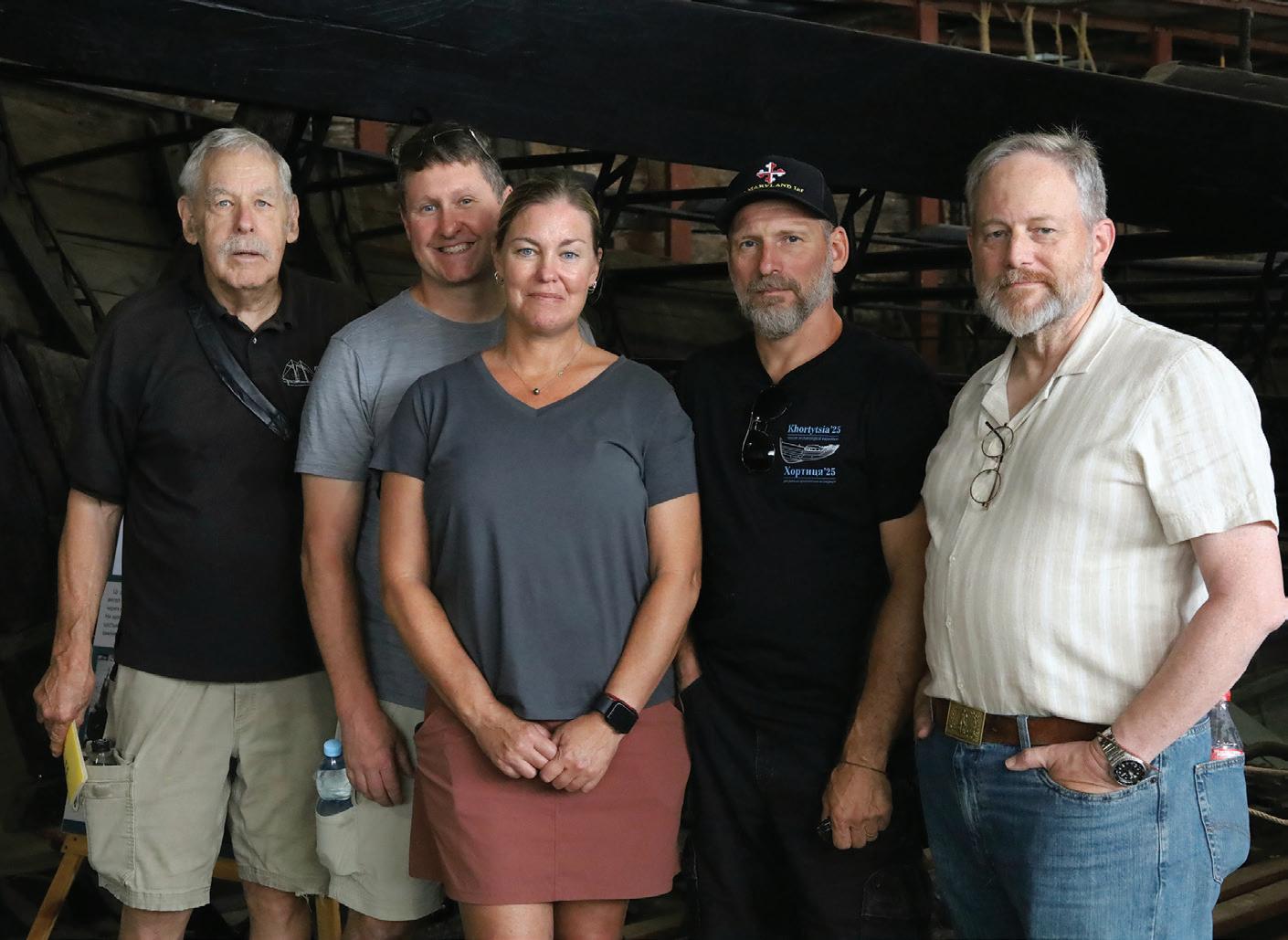
member museums stepped forward to o er support, and individuals began to o er their services as eld sta e rst person to volunteer was Cathy Green, the president of the National Maritime Historical Society.
Over the winter we made all the normal preparations for a eld project: raising money, recruiting sta , developing plans and equipment lists. We also had to consider the security situation. e site lies only 30 kilometers from the front line, within artillery range, and the city of Zaporizhzhia is regularly attacked with missiles, drones, and glide bombs. We had to decide how much risk we could accept—both as individuals and as a team—and began monitoring the situation in Zaporizhzhia. In spring 2025, things were relatively calm—at least calmer than they had been in 2023—and I was able to make a brief trip to Khortytsia in April to see the site for myself and make concrete plans with the Reserve sta
We decided that Object 1 was not seriously threatened and could be protected by building a partial co erdam around the exposed bow to divert water ow and trap sediment. I had constructed a nearly identical structure to protect a wreck in similar circumstances in the Savannah River in 1992, and that co erdam is still doing its job. e conservation sta , under the leadership of Valery Nefyodov, would handle this task, while Dima and I would manage the excavation of Object 2 with a larger team of KNR sta , plus Ukrainian and international volunteers. Once it had been excavated and documented, Valery’s team would be able to move its
Russian drone and missile a acks are a daily reality for most of the country. This 28 August snapshot from a widely circulated air-alert app illustrates the hundreds of airborne threats within a 24-hour period.
components upstream a few hundred meters to a conservation facility.
I recruited two more colleagues to the international team, who eventually came to be known as the Zaporizhzhia Zouaves, a reference to the colorfully dressed exotic troops used in the Crimean and American Civil Wars. Larry Babits, a retired director of the maritime archaeology program at East Carolina University and a leading con ict archaeologist, has excavated everything from Revolutionary War battle elds to World War II prison camps. He was also part of the Savannah River project I directed in 1992. Jon Faucher has been working in maritime archaeology for three decades, although he is currently employed as a paramedic and rapid-response logistician for FEMA; he has helped hurricane, wild re, and
earthquake victims in remote places and survived a helicopter crash high in the Andes. e risk of working in Ukraine probably seemed dull by comparison. e team from KNR was made up of the core sta of the park’s heritage
departments, including three of the colleagues who had visited Sweden in 2023 (head of collections Alina “Alya” Budnikova, archaeologist Tetyana “Tanya” Shelemetyeva, and conservator Polina “Polya” Petrashnya) and Dima’s father,
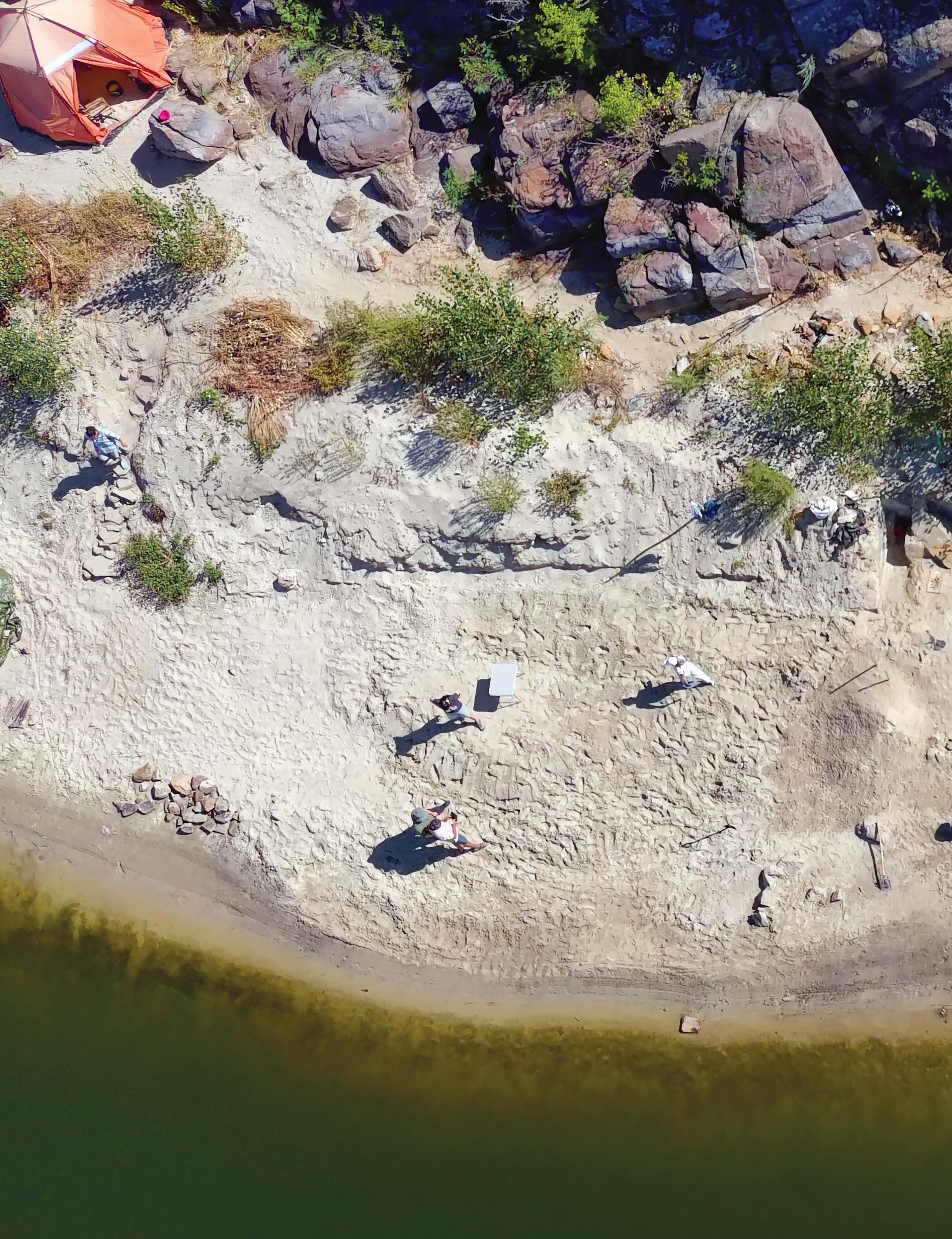
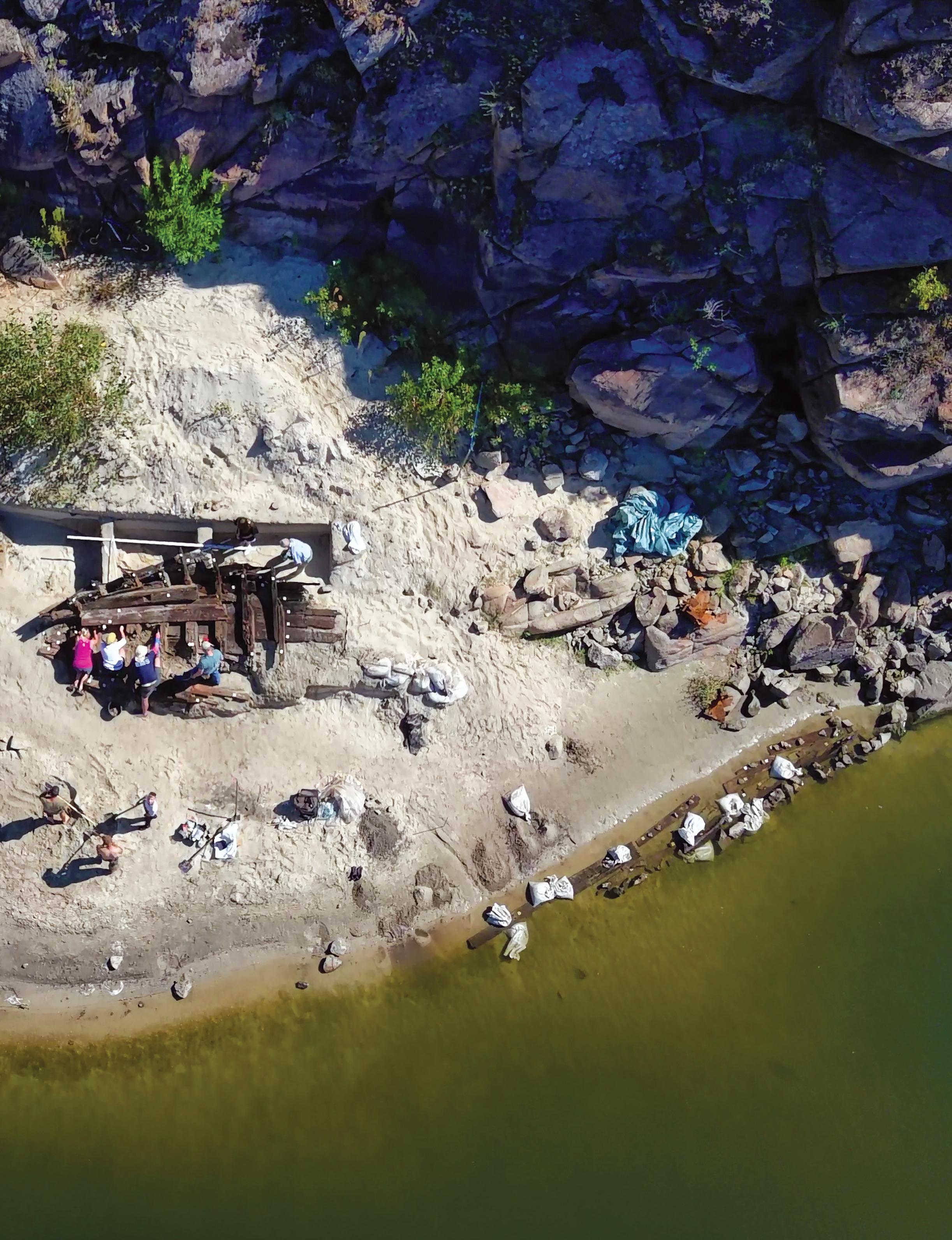
The site on the western side of Khortytsia Island. Object 1 is just outside the frame at the far le . The camp is in view in the upper le corner. (le of center) Archaeologists finish restoring portions of the beach that hide a treasure trove of ship timbers. (center right) Object 2: The team excavating between frames in preparation to move the vessel. (lower right corner) As timbers were removed, they were placed in a holding pen in the river to keep them hydrated before transport to the conservation lab. Note: special government permission was obtained to fly a drone to document the site. Drones in Ukraine are not usually friendly or tolerated.
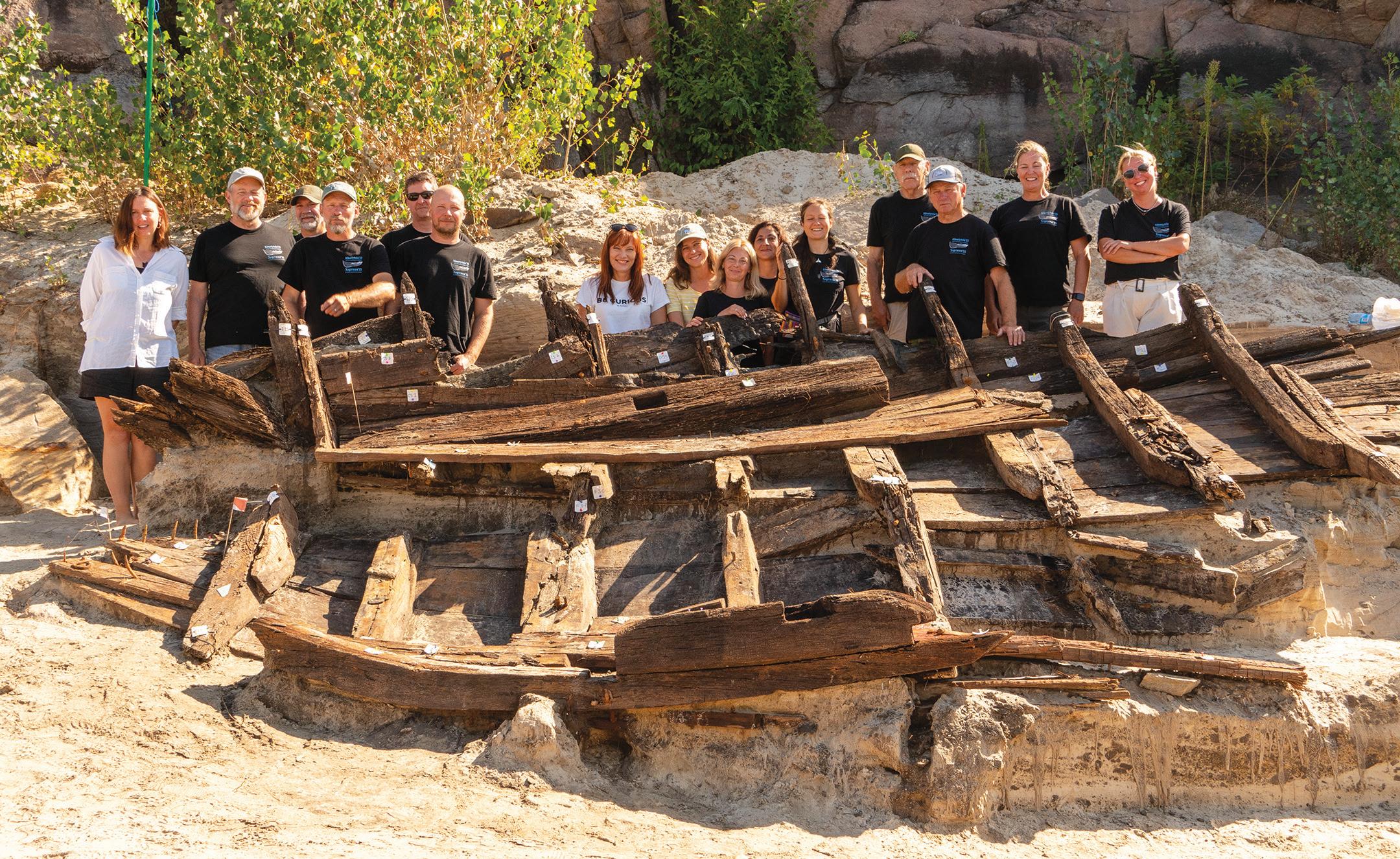
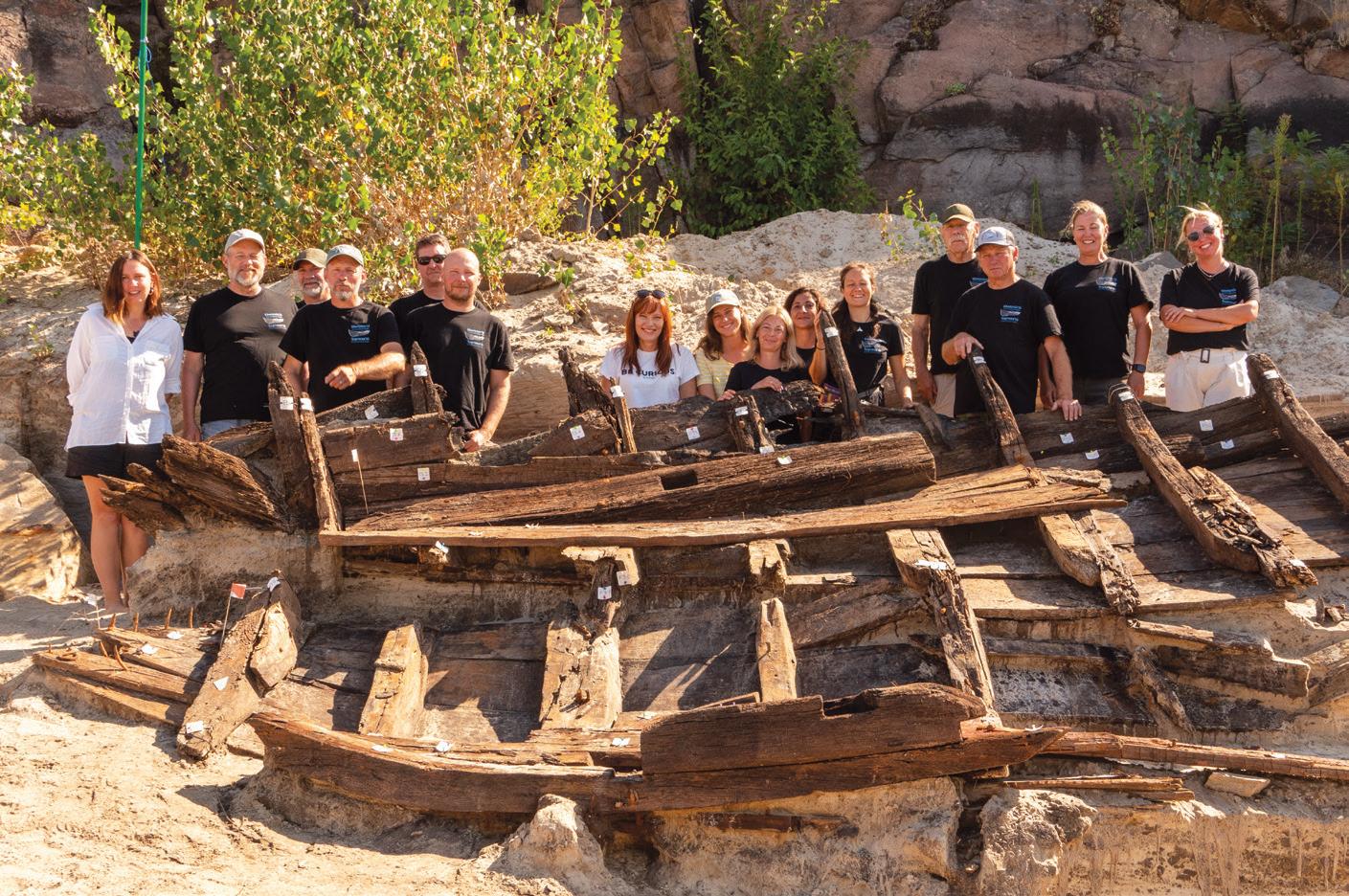
Ruslan Kobaliia, known as “Bagratich” or sometimes just “Pa.” Anatoly “Tolek” Volkov was responsible for photogrammetry, while the museum’s photographer visited regularly to document the project. Dima had also recruited some of his colleagues from other museums as volunteers, and Tetyana’s husband, Andrej, served as our main cook. For most of the project, we had a core sta of about a dozen, plus guests who would come to dig for a few days, including the now-retired Ivan Shapovalov and the former director of KNR, Maxym Ostapenko. e excavation is the subject of a documentary being produced by NOVA/Blink Films, so we had a resident cameraman/host/producer, Ben Holgate, on site for most of the time. ese days, you cannot just hop on a plane to Ukraine. We ew into Krakow and took a car across the border to Lviv, where we were met by Dima’s wife, Kseniya. She is a translator by profession, but also a crack photographer and an undisputed wizard of logistics.
She managed to sort out all our land travel, on the long-haul overnight trains between Lviv and Zaporizhzhia, and accommodation in hotels. Once we were in Krakow, we put ourselves in her hands, and she made miracles happen. e eld campaign ran for four weeks, beginning 10 August with the construction of a eld camp and infrastructure. Because the local weather that time of year is hot and very dry—a steppe climate—one challenge throughout the project was keeping exposed timbers from drying out and cracking. To keep the site (and the diggers) in the shade, we erected a canopy over the wreck. A few people would have to overnight at the site to guard equipment, so a camp was set up on a sand ledge above the beach against the base of the cli , with tents, a eld kitchen, and a tarp erected over a long dining table and benches. Bagratich, our resident eld engineer, also built a staircase of rocks down the face of the ledge to make access to the camp easier.
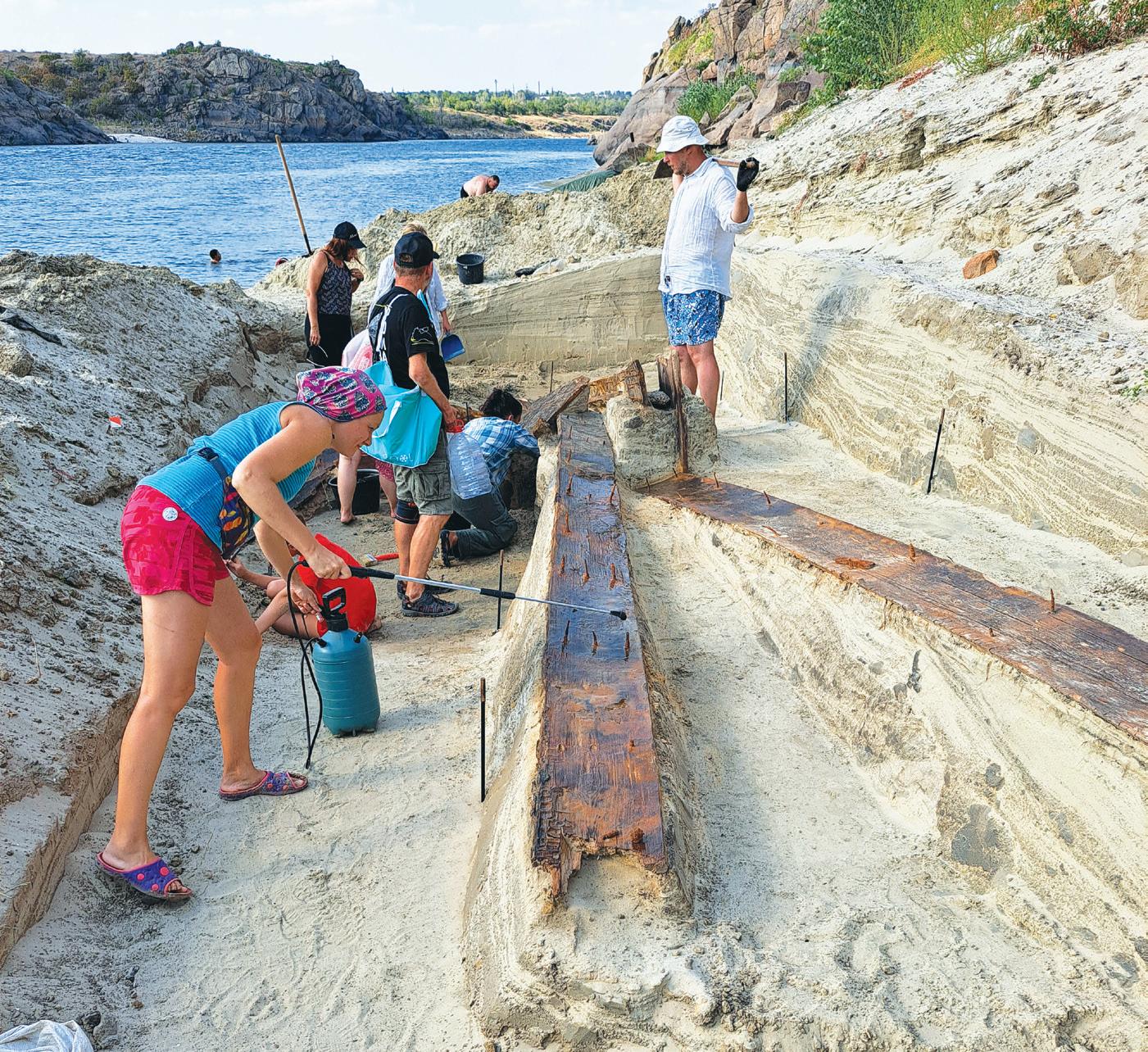
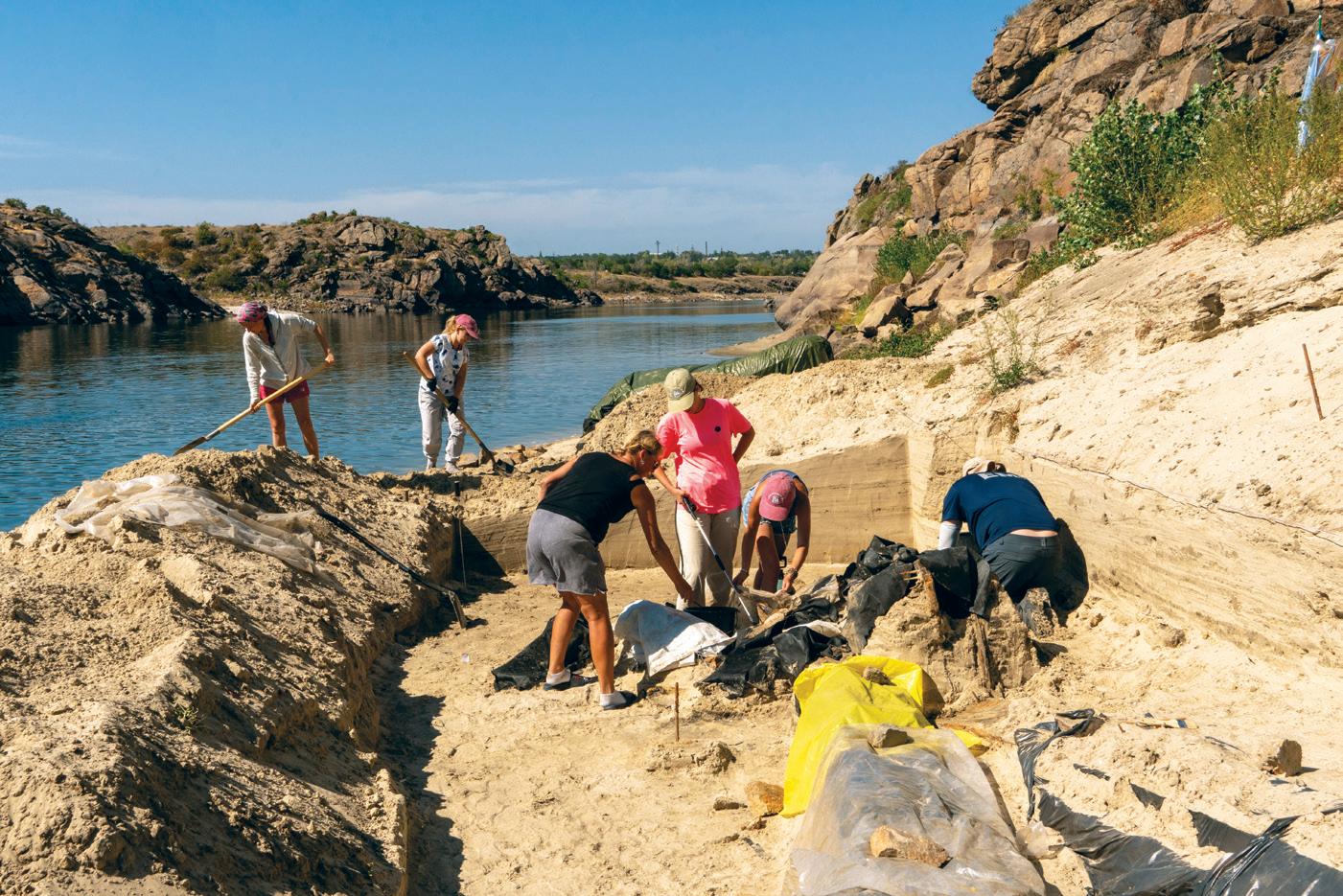
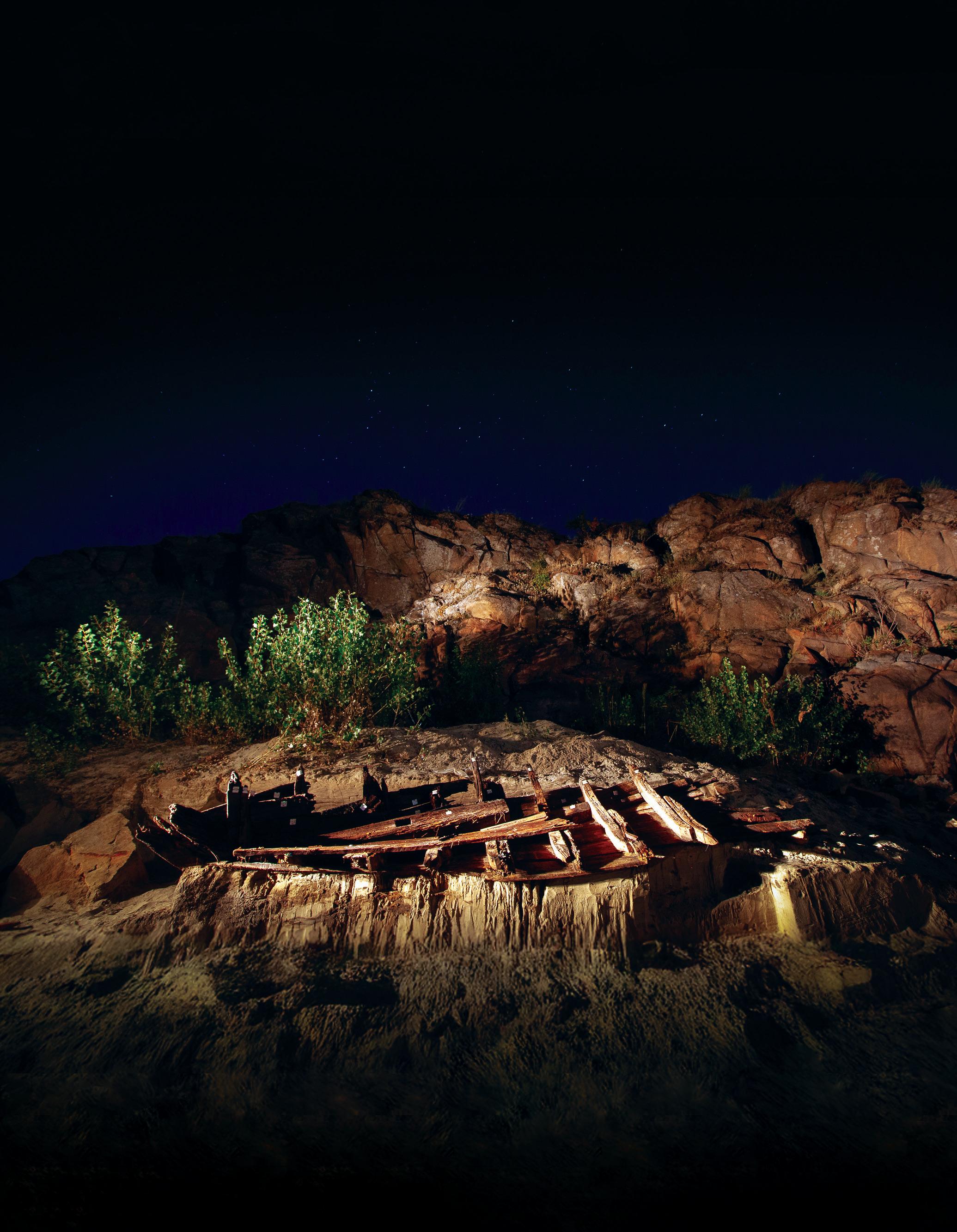
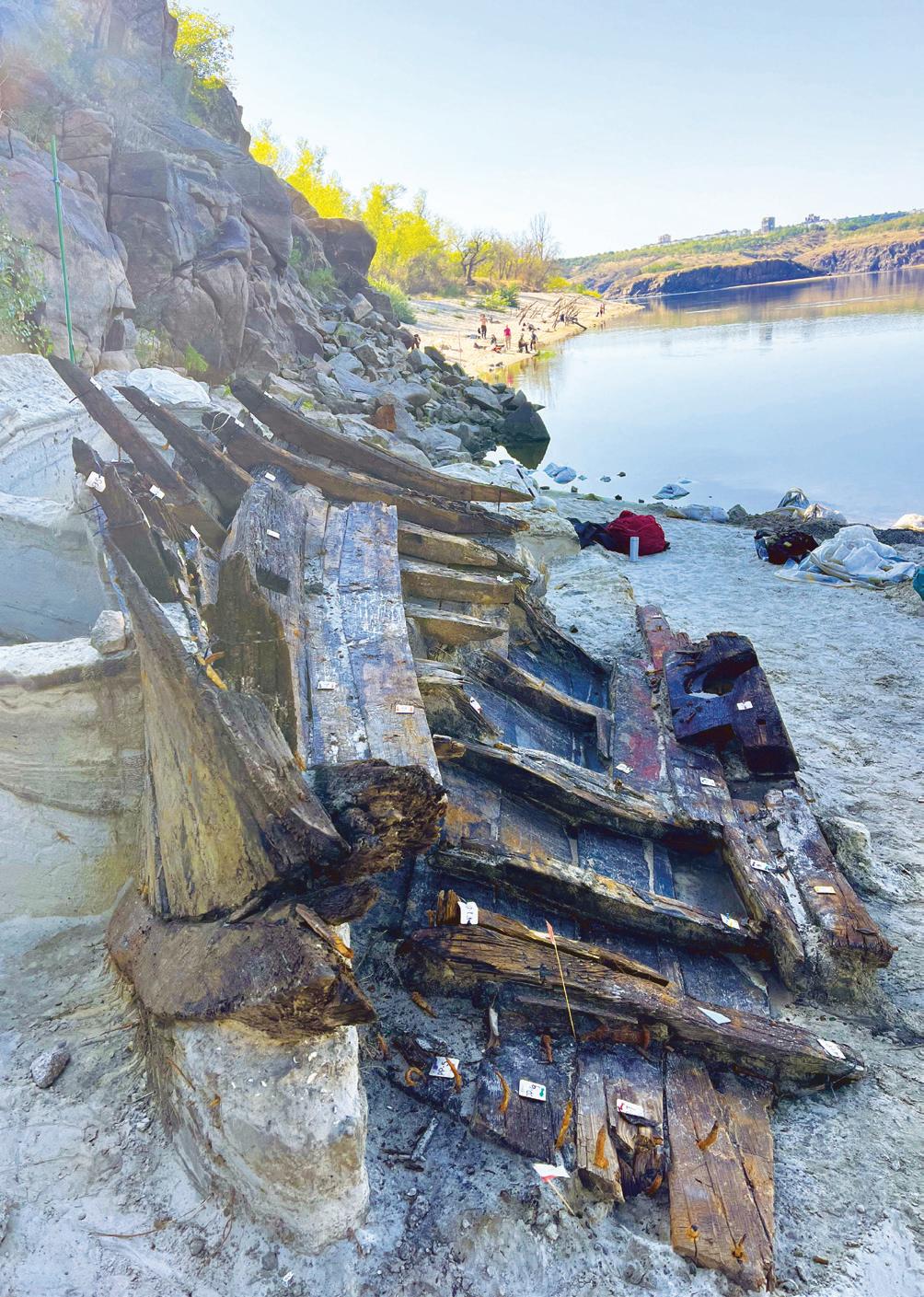
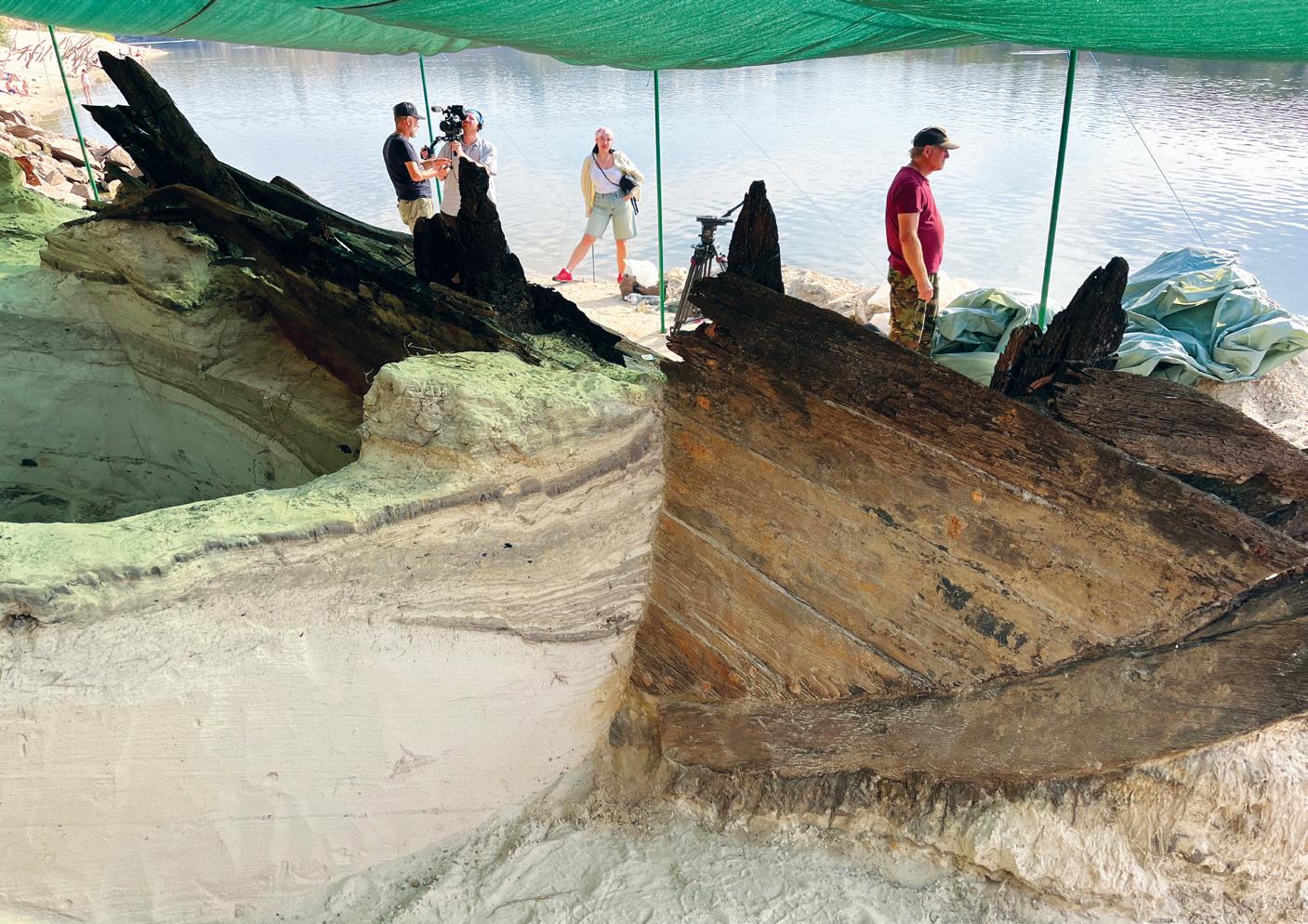
e archaeological site is a sandy beach between spurs of the Naumova Rock, which with a matching outcrop on the opposite (west) bank constricts the river to only a few hundred meters wide. Access is by boat, by clambering over the fallen boulders at either end of the beach, or by climbing down the cli face. We usually arrived over the boulders at the southern (downstream) end of the beach. I took the cli route in April; I do not recommend it. e wreck lay in the sand, hard against the boulder pile at the southern spur parallel to the water, with its bow towards the north (facing the current) and the keel about ve meters above the water’s edge and up the slope. e boat had leaned over onto its port bilge, and the upper half of the port side had pulled away from the stem and broken along the turn of the bilge to lie at on the lower slope. e upper part of the starboard side had been partly dismantled and deliberately burnt at some point in the past, and the after two thirds of the wreck was missing. e boat lay with its bow deeply buried in the sand but rising towards the stern, so the after part of the hull had probably been resting on the boulders. Some of the wreckage found in earlier years in the water just downstream may be the missing parts of the rest of this boat. e rst stage of the excavation required uncovering the wreck, removing the textile and sandbags used to protect it since 2023. is revealed that the uppermost parts of the wreck had dried out to some degree, but the structure was still intact, in two main pieces. It was immediately clear that most of the bow survived up to the railing on the
Boat timbers lay beneath the sand between Objects 1 and 2. This section of the site was documented and reburied, requiring more than 20 tons of sand to be removed and then put back.
port side, with a prominent mounting block for a windlass and a large bitt for a swivel gun bolted into the heavy railing structure. e upper part of the stem was missing, but most of the rest of the backbone was present, including a heavy keelson or maststep timber.
We divided our crew into two teams. e larger group began the process of removing the remaining sand from the wreck, while the smaller group investigated the loose plank to the north. Digging soon became a competition between Larry and Bagratich. Both retired and veterans from opposite sides of the Cold War, they are double tough and neither was going to be outworked by an “old man.” e sand ew faster and faster until it became obvious there would be no winner, but they had become friends in the process.
As we shovelled more than 25 tons of sand into mounds along the water’s edge, we discovered that there was much more to this site than had rst appeared. A ground-penetrating radar survey commissioned after my visit in April suggested that there might be another wreck about midway between Objects 1 and 2, and there were wrecks known from the beach to the south, as well as vessel remains in the water below the beach. We had planned to test a few of the buried features revealed by the radar, but what lay north of the wreck was a surprise. e plank turned out to be over 6 meters long and led to a
(above right) Object 2: The starboard bow emerges from the beach. As each shovelful of sand was removed, more of the vessel’s construction details were revealed, as well as the stratigraphy of the riverbed embankment.
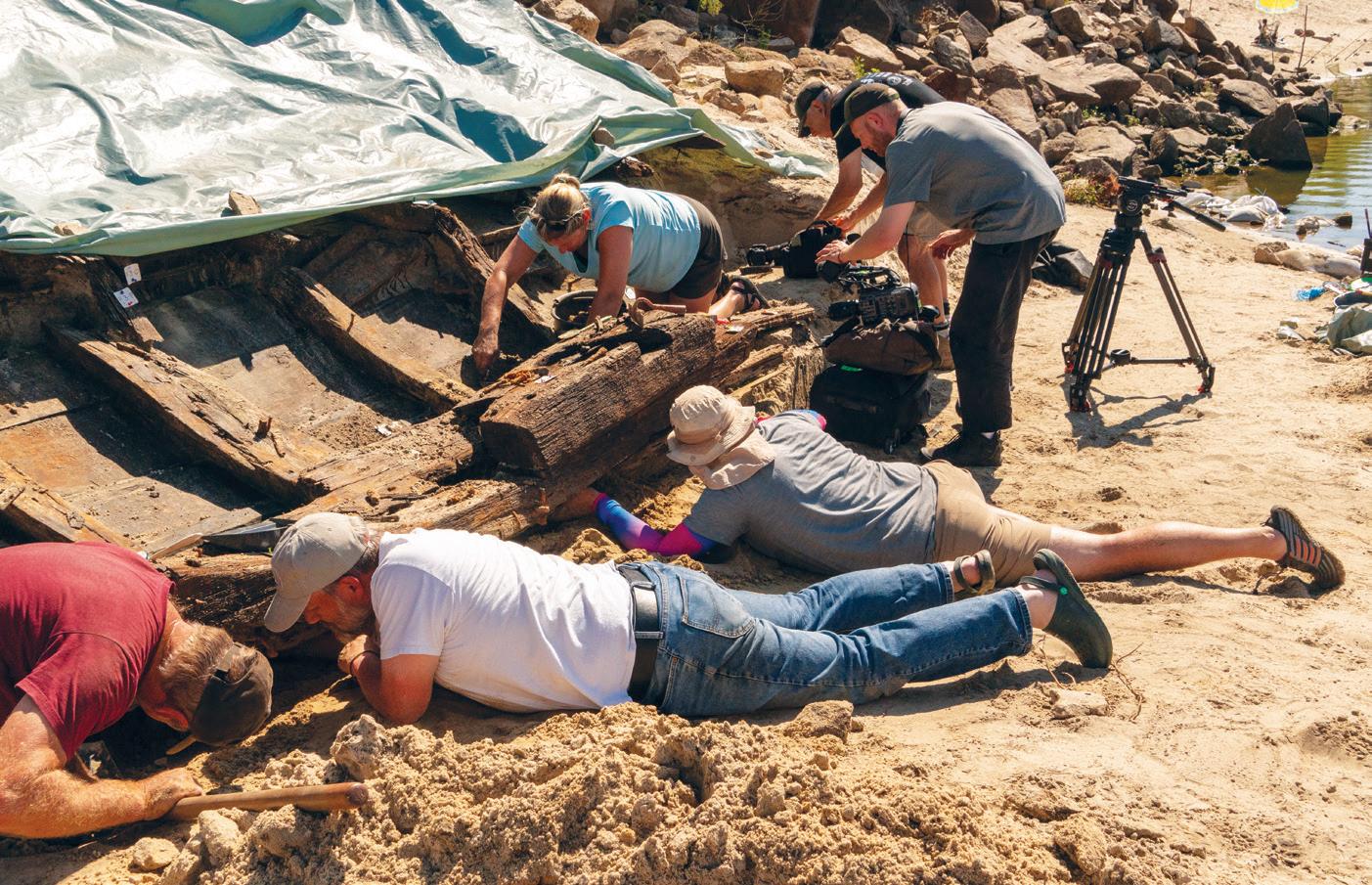
(right) The final stages of excavation included undercu ing the wreck to insert supports so it could be moved into the river and floated to the conservation facility a short distance upstream.
large heap of boat timbers, mostly loose planking and frames, but also a swivel gun mount, carelessly piled like a giant game of pickup sticks. e excavation eventually expanded to an area about 20 meters long and 6 meters wide before the pile ended. e timbers tended to lie deeper towards the north, so the excavation reached a maximum depth of more than 1.5 meters, and even then it was clear that we had not reached the bottom of the pile.
It was while we were excavating this pile that we came upon evidence
of a battle fought between Axis and Soviet troops in 1943. In World War II, Hungarian troops attached to the German army occupied the island, and as the Soviet Army began to push Hitler’s army back out of Ukraine, re was exchanged on the beach. We found red Soviet bullets and un red rounds of Hungarian ammunition. Jon Faucher even excavated a fully loaded magazine for a Solothurn 7.92mm machine gun, as well as fragments of grenades. is was not one of the risks we had anticipated in our project planning, but our
colleagues from the Reserve reported that they had boxes full of this sort of thing from previous excavations all over the island; they had not thought it unusual enough to mention, just part of the background noise of local archaeology in a region that has been heavily contested for centuries.
e loose timbers lay deep enough in the sand that they were still wet and not threatened by the river, so we elected to record them and rebury them, but they suggest that there is much more to be discovered along this little stretch of beach. ere are probably wrecks from one end to the other.
Object 2 revealed new features with each passing day of shoveling. Although it had been mostly stripped of useful equipment, there was still some material just thrown out onto the beach or left in the bottom of the boat. Rigging tackle, including a deadeye and a block, as well as military equipment, were the most common nds. ese included musket parts (two intlocks, gun ints, a brass ramrod pipe) and
even a complete musket with bayonet (model 1715, one of the main weapons of the Russian army) under the keel. ere was a fair amount of rope, much of it small cable running along beside the keel, a sheet-iron bucket, a few uniform buttons, and even a curved sailmaker’s needle. Some ammunition in the form of 3-pounder and 1-pounder shot lay in front of the bow, and one 24-pound shot was found at the north end of the beach, near Object 1.
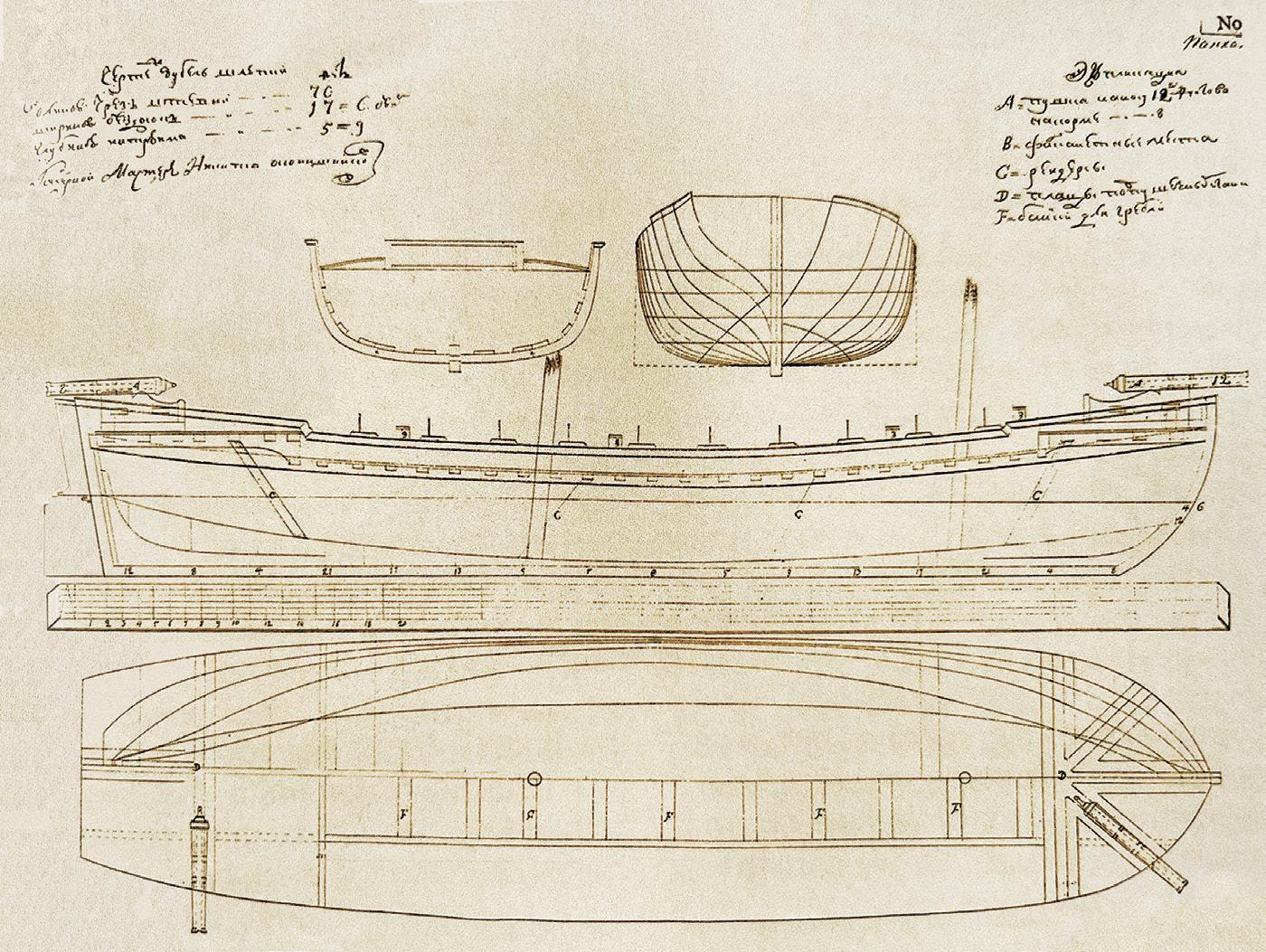
e boat itself proved to be one of the large troop transports known as double chaloupes. ese were open boats, 16 or 18 meters long with a simple schooner rig and 16 to 20 oars. ey could transport about half a company of soldiers and were armed for defense with three small swivels on each side (at the bow, stern, and amidships). Chaloupes were relatively lightly built and not very durable; many broke apart in the rapids while being delivered to the theater of war. e hull shape is surprisingly graceful, with a hollow entrance and easy bilges, and the standard of
construction is good, with tightly tting joints and fair plank runs. ere are some unusual features, such as an odd arrangement of oor timbers and futtocks, as well as the mix of wood species and how they were used. e backbone timbers are all oak, but the framing and planking are a mixture of oak and pine. e rst, second, fth, and sixth strakes of nine total are oak— the rest are pine. e frames in the bow have pine oor timbers, which are little more than thick planks, with oak futtocks, while the frames in the middle of the ship are oak oor timbers and pine futtocks of equal size. ere is some indication of haste in their construction, with standardized dimensions and parts and the use of nails for fastening nearly everything together. e visible part of Object 1 at the north end of the beach is another vessel of the same type, with its bow still intact. ese troop transports were the most common type of vessel in the eet, and several fragments had been found previously, although none this complete or well preserved.
Once it was fully exposed, we could see that it would not be possible to lift the wreck as a single piece. e lower hull, up to about the fth strake and the turn of the bilge, was still relatively solid, except for a long plank extending more than two meters farther aft than the last frame. e upper part of the port side had separated from the lower hull and, except for the railing structure, was not held together by much more than the rusty nails between the planks and frames. e ceiling on the inside of the frames was also quite fragile, so we decided to dismantle much of the upper section. Once this began, we could see that the nails were no longer holding; the ceiling could be lifted easily o the frames and some of the futtocks could be removed. Loosened timbers were stored temporarily in a holding
pen built in the river. e two coherent sections of the hull were slid over skids into the water, where they could be buoyed for the short tow upstream to the conservation facility.
e visiting archaeologists—our team—began making our way back home on 29 August, leaving on the last train out of Zaporizhzhia that evening. e calm that had descended on the city since the previous winter had broken, as Russian forces began stepping up their nighttime attacks on civilian targets all across Ukraine; while we were in the city, they destroyed the bus station, a hospital, a supermarket, and several apartment buildings. In fact, three of the most extensive air raids of the entire war to that point occurred in August, and we were not spared on the ride home. Drones and missiles rained down on Ukraine during the night, and on two occasions hit train stations fewer than ten minutes after we passed through them.
One may ask if a 290-year-old boat of unremarkable construction is worth risking your life for, and those of us who travelled to Zaporizhzhia in August 2025 have been asked variations of that question many times. Each person must make their own choice for their own reasons. In my case, I am helping my Ukrainian colleagues, letting them know that they are not forgotten. We shared their world for a few weeks, but they have been living with the constant threat of destruction for more than three years. By organizing this project, we could help give them a chance to do the jobs they love in a way they have not been able to since 2022, and to allow them to think of how the world might look after the war.2
It is also a chance for me to contribute my specialized skills to something
that is not just a luxury. ose of us who work in history and archaeology like to talk about the importance of learning and preserving history as an essential component of the knowledge base needed for planning a better future, but in reality, what we mostly do is provide interesting stories to entertain. We do not feed the hungry or heal the sick, but in this case, we can reach closer to that higher purpose. An important goal of the Russian assault is to extinguish and erase any
memory or thought that Ukraine ever existed as a separate culture or state, and to that end, Russian forces have been plundering and destroying cultural heritage sites across the country.
e cultural heritage of Ukraine is a vital component of its identity, and its future independence requires the physical remains of its past. I am too old and lack the right training to carry a gun in the defense of my friends, but I can use a shovel to make sure that their identity survives.
Fred Hocker is the director of research at the Vasa Museum and the Swedish National Maritime and Transport Museums. He holds a PhD in anthropology from Texas A & M and was a former professor of maritime archaeology there. He has participated and directed numerous maritime archaeological excavations in the United States, Northern Europe, and the Mediterranean. He serves as a trustee with the Kalmar Nyckel Foundation and on the board of governors for the Chesapeake Bay Maritime Museum.
Learn more about this expedition by viewing the NMHS First Thursday Seminar Series from 4 December 2025, online at www.seahistory.org/latest-news/seminars.
2 The regional government hopes to establish an international center for river archaeology and cultural heritage when the war is over. Right now, the remains at the Khortytsia site that have been identified are all relatively protected, but the KNR would like to continue the excavation, with international participation, when it is practical to do so.
by CAPT Daniel A. Laliberte, USCG (Ret.)
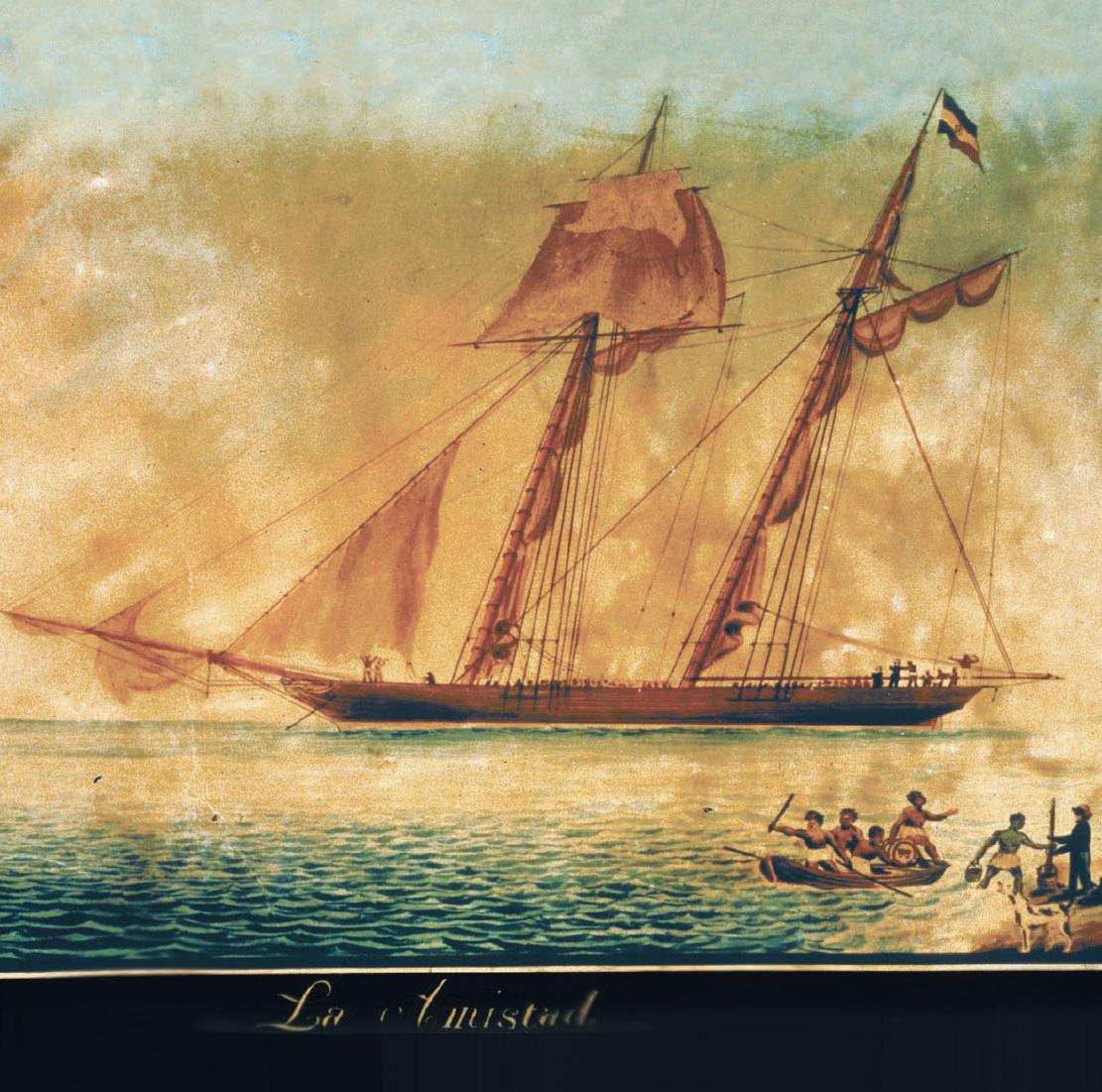
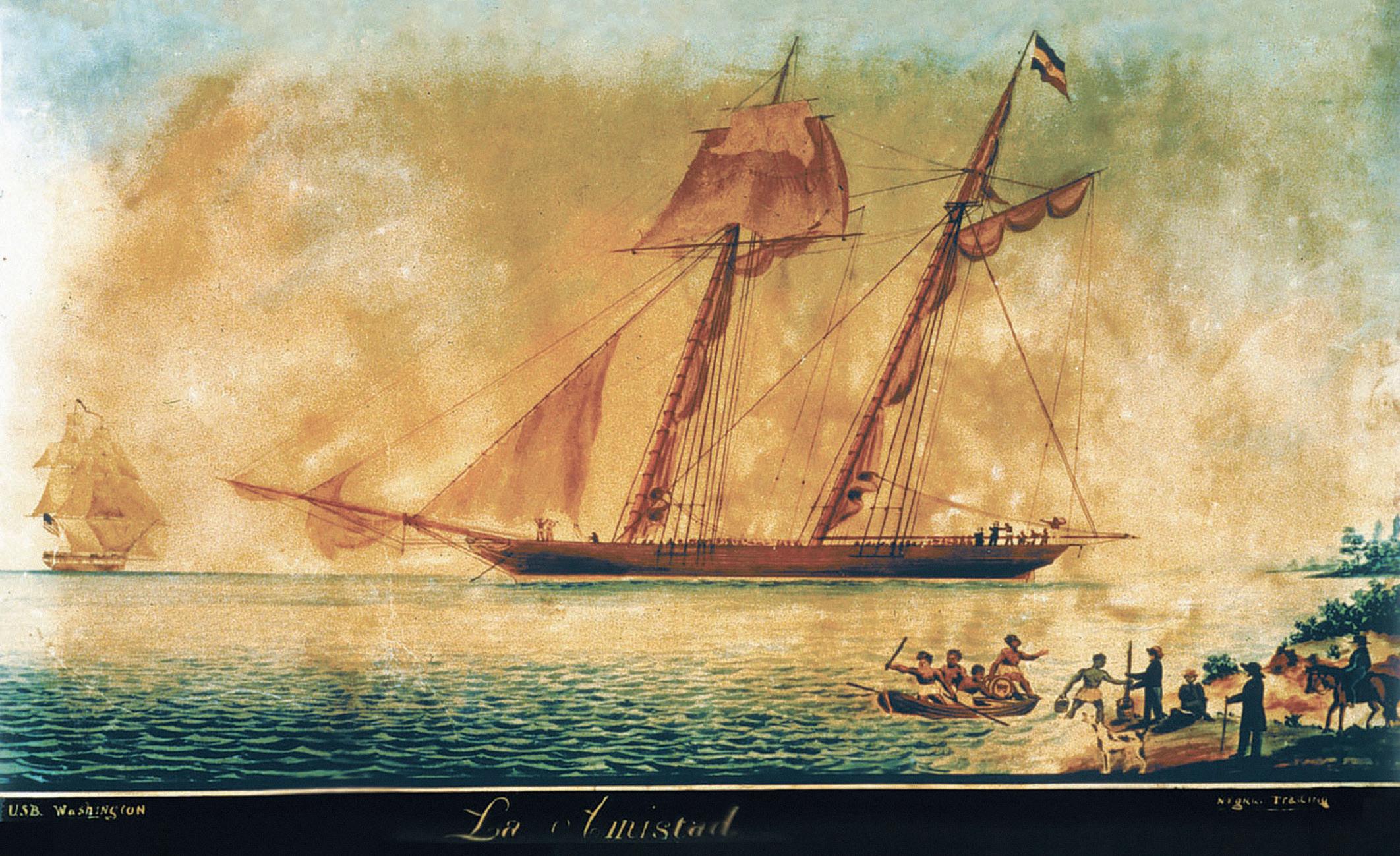
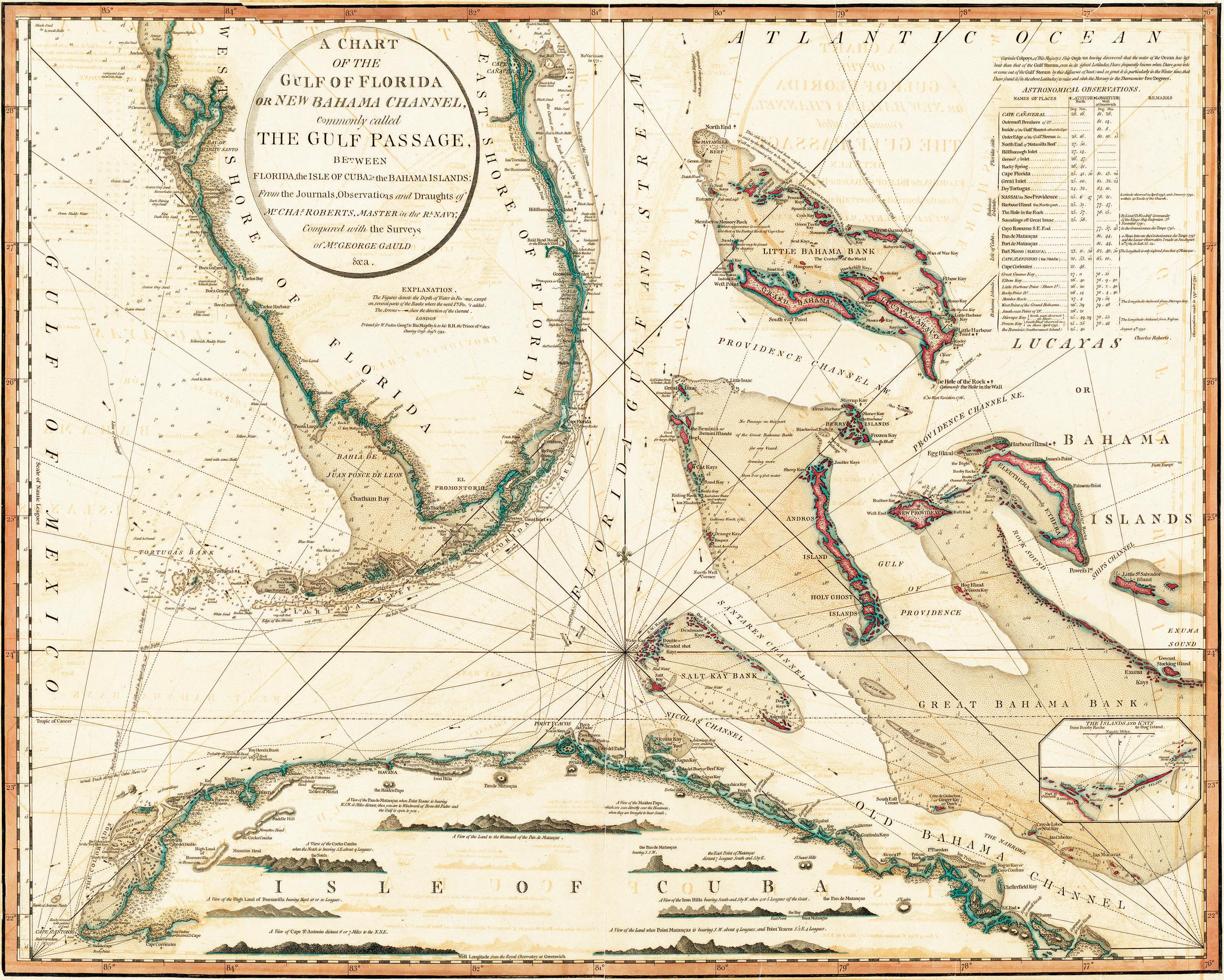
On the morning of 28 June 1839, the Spanish merchant schooner Amistad cleared the port of Havana, bound for Guanaja, under the command of Captain Raymon Ferrer. e 300-mile route eastward along the coast was a regular route but posed signi cant challenges for vessels in that era. e initial relatively open passage through the Straits of Florida would soon begin to narrow at the San Nicholas Channel and could be quite restricted through the subsequent Old Bahama Channel. Adverse winds and a variable current out of the east could lengthen the four-day voyage to two weeks, or worse, drive a vessel onto the Grand Bahama Bank or the reefs all around the Cuban coastline. Amistad ’s tiny crew of two seamen, a cook, and a cabin boy placed their trust in Ferrer’s seamanship and the schooner’s manageable 5½-foot draft, which enabled them to pass safely over some of the hazards lurking beneath the waves along the way.
Reefs and submerged hazards would certainly have concerned Ferrer, but he was likely more worried about the
risk that the 55 passengers posed to the safety of the ship and the $40,000 worth of foodstu $ s, clothing, dry goods, agricultural supplies, tools, and gold coins sitting in his hold. ey had crowded aboard after nightfall the previous evening; all but two of the 55, however, were there against their will.
Transporting slaves was not something Ferrer did regularly. His vessel was con gured to move goods—not people—in the coastal trade. Amistad lacked the “slave deck” characteristic of a true “slaver.” Without a slave deck, which typically sported only 3–4 feet of clearance and was built to restrain prisoners securely within, the risk of a successful uprising dramatically increased. is risk was compounded by the small size of Ferrer’s crew.
Nevertheless, Captain Ferrer was not averse to transporting “docile” slaves in short hops between Cuban ports. Two wealthy Dons—Jose Ruiz and Pedro Montes—had booked passage for themselves and 53 slaves intended to work their sugar cane plantations near Puerto Principe. In
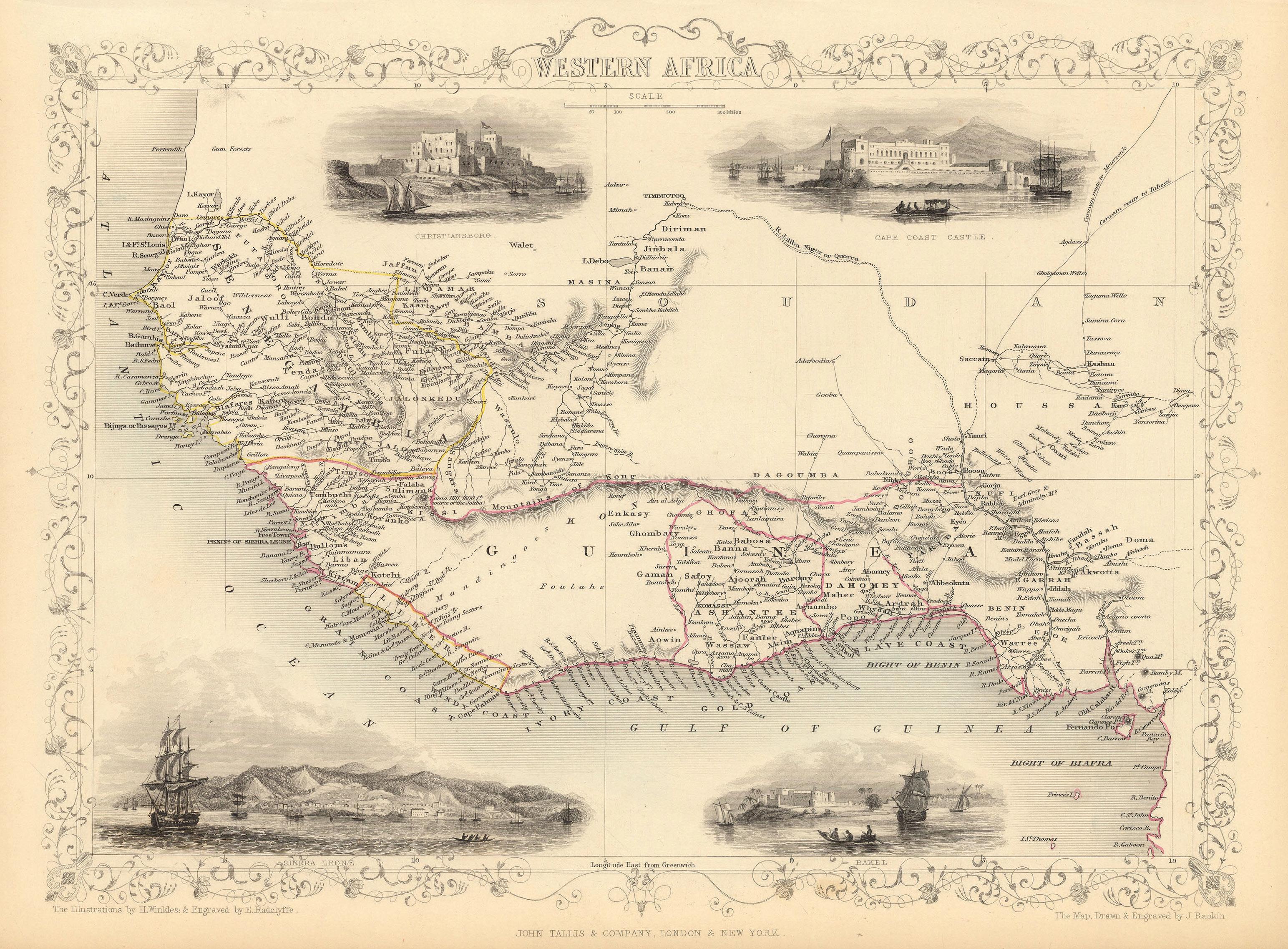
1851 map of West Africa. The Africans aboard the schooner Amistad came from what is now Sierra Leone and were held and sold at Lomboko, a major slave “factory” at the mouth of the Gallinas River. By 1839, when the Amistad captives passed through Lomboko, the transAtlantic slave trade had been abolished by the United States, Great Britain, Portugal, and Spain, yet the Gallinas coast remained a major hub for illicit tra icking. An estimated 1,500–2,000 Africans a year were still brought to Lomboko and shipped into slavery. A decade later, in 1849, the British West Africa Squadron a acked and destroyed the slave factory, freeing the people held there and ending its operations.
this case, he probably assumed, or at least hoped, that the slaves purchased by Ruiz and Montes had accepted their fate and posed minimal risk of rebellion. He would further mitigate the risk by securing in the hold the few troublemakers he had suspicions about. e rest would be allowed topside during the day, as long as they behaved.
e Africans onboard were originally from Mende-land, a region that lay in what is now southeastern Sierra Leone. Some had been prisoners captured in the constant wars that wracked the area, some had been sentenced to slavery after committing crimes, others had been sold to settle debts, and some were simply travelers, caught in the wrong place at the wrong time.
At some point after having been seized, they were taken by their African captors to be sold or bartered to the Spaniard Pedro Blanco at the infamous “slave factory” at
Lomboko. Lomboko’s fortress, barracoons (rough slave quarters), open pens, market areas, and administrative buildings sat astride a tight group of islands just o$ the Gallinas Coast. It was here that the 53 Mende who would later be resold to Ruiz and Montes were initially sorted, bought, and processed.
In mid-April 1839 they were forced, along with hundreds of others, aboard the Portuguese brig Teçora. A purposebuilt slave ship, Teçora could carry up to 500 persons shackled in its slave deck for the Middle Passage across the Atlantic to Cuba. During the crossing, about a third of the prisoners died from disease or dehydration. ose who survived the voyage were landed at a small village outside of Havana in early June, where they were met by Ruiz and Montes, who accompanied the Africans as they were smuggled into Havana. e landing and subsequent
movement of ship’s human cargo was done in secret, necessary because every aspect of this undertaking had been in direct violation of both Spanish and international law.
Nineteen years earlier, Spain had joined an already decades-old agreement between Great Britain and the United States to ban participation by their ships and citizens in the international slave trade; Portugal had also signed, although only three years earlier. e agreement banned new enslavement, but allowed the domestic sale of those who were already slaves and the continued enslavement of their descendants.
e Martinez and Co. slave house in Cuba used by Ruiz and Montes was part of an illegal infrastructure designed to skirt that agreement. e company was infamous for forging the documents to establish “Bozales” (the Spanish term for Africans who had been only recently brought from Africa) as “Ladinos” (those who had been enslaved prior to Spain’s ban). Using those documents, Ruiz and Montes were able to obtain the appropriate licenses and customs clearance permits required to ship their newly purchased “slaves” to Guanaja, the seaport nearest the location of their respective sugar cane plantations.
e rst three days out of Havana had gone smoothly, with Amistad making it approximately two-thirds of the way to her destination. e fourth day, however, brought constantly shifting winds and frequent downpours. By nightfall, progress had been slow, and although the rain had let up, a heavy cover of clouds obscured most of the light the moon would otherwise have provided.
By midnight, with the crew exhausted and the weather having calmed down, Captain Ferrer caught some sleep
on a mattress on deck back aft, while a single crewmember manned the helm. e rest of the crew was sent below to get some sleep. e passengers on board were asleep in various locations about the ship…except for the few captives restrained in the cargo hold. ese men were locked up with a padlocked chain passed through a loop on their iron slave collars, which was then bolted to the hull. ese “troublemakers” did not think of themselves as slaves, but rather as free people who had been kidnapped and transported against their will, thousands of miles from home. Rather than sleeping, they were plotting their escape.
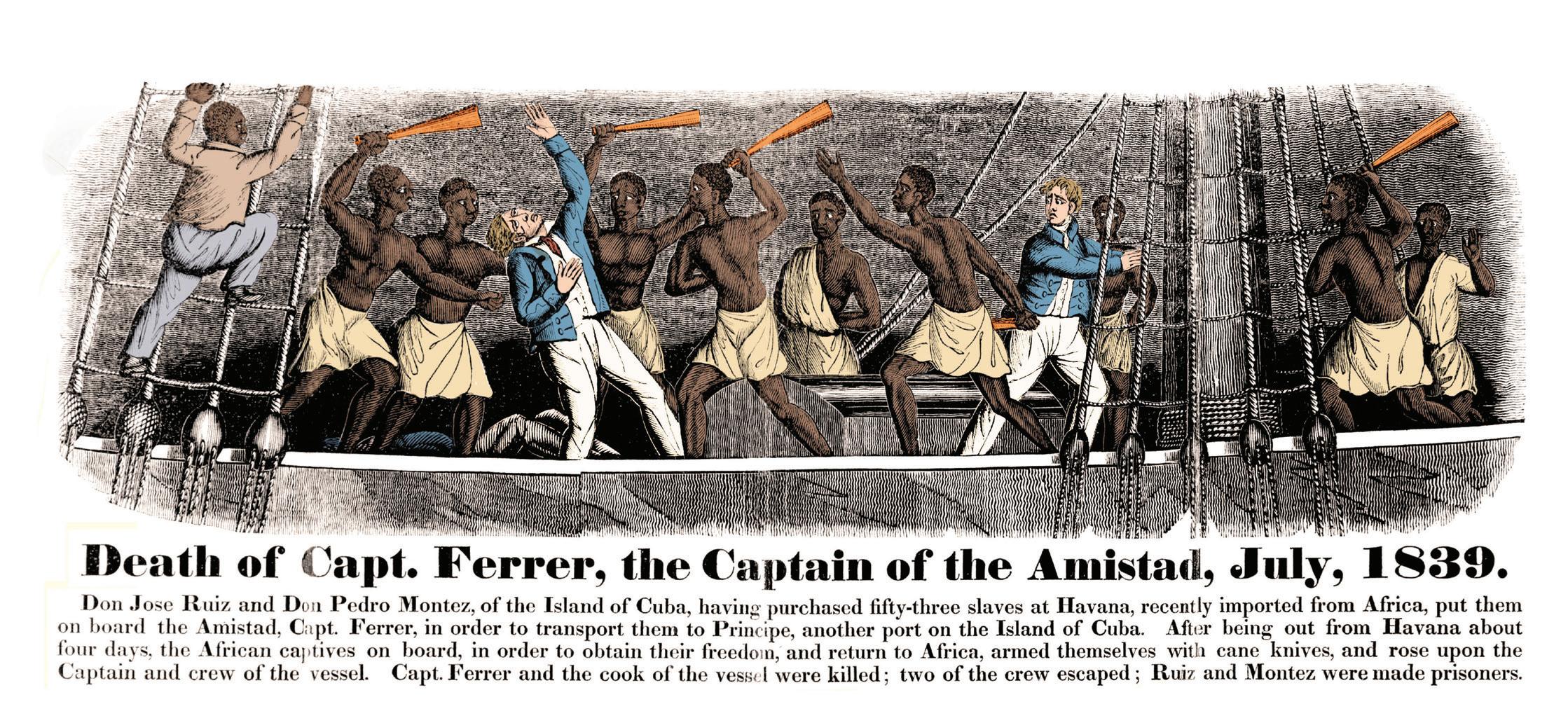
One of them found a nail among the building supplies stored nearby. He passed the nail to Sengbe Pieh, who used it to break the padlock securing the chain that bound them together. After pulling the chain through the links on each their collars, a more thorough search through the cargo turned up cane-cutting knifes—similar to modern machetes—and blunt instruments that could be used as clubs. us armed, the group ascended to the main deck and stalked aft. Others quickly joined the revolt; some set o$ in search of the ship’s cook, Selestino. Although he was, himself, a slave, Selestino had become a trusted long-time companion to Ferrer and had used his position to mercilessly taunt the prisoners over the last three days. When the captives found him asleep, they fell upon him with clubs and knives. He never woke up.
Back aft, Ferrer awakened to chaos and confusion about the deck. Many of his erstwhile prisoners had scattered seemingly randomly about the ship, ransacking living quarters, breaking open containers, and strewing their contents about the deck. He shouted for his cabin boy, Antonio, to
toss bread among them, hoping to distract their attention; however, the rioters were undeterred.
Eventually, Sengbe and three others engaged Ferrer on the fantail. e captain fought desperately with either a sword or a long knife, by some accounts killing two of the freedom seekers before being brought down himself. Miraculously, the two deckhands, Manuel Pagilla and another known only as Jacinto, somehow managed to avoid notice as they launched a boat and escaped into the darkness. Although the Mende now controlled the schooner, the problem of getting back to Africa remained. None of them knew how to sail or navigate.
is lack of knowledge saved the lives of Ruiz and Montes. e 52-year-old Montes had been a ship’s master before becoming a plantation owner. He made this known
through the interpretive services of Antonio, the cabin boy, who spoke a smattering of the Mende language. e Mende reluctantly agreed to the proposal to spare the Spaniards in return for their services.
Montes and Ruiz convinced them that a larger store of water and provisions would be needed for the lengthy trip east. Nassau, on New Providence Island, which lay more than 200 miles to the north, was chosen as the most likely port to allow them entrance, since it was under British rather than Spanish control. Amistad, however, would rst need to cross the treacherous Grand Bahama Bank.
Amistad altered course for her new destination, but it was a struggle to get down the Old Bahama Channel towards the Ragged Islands, where a passage north could be found. Due to constantly “boxing” winds—an archaic term
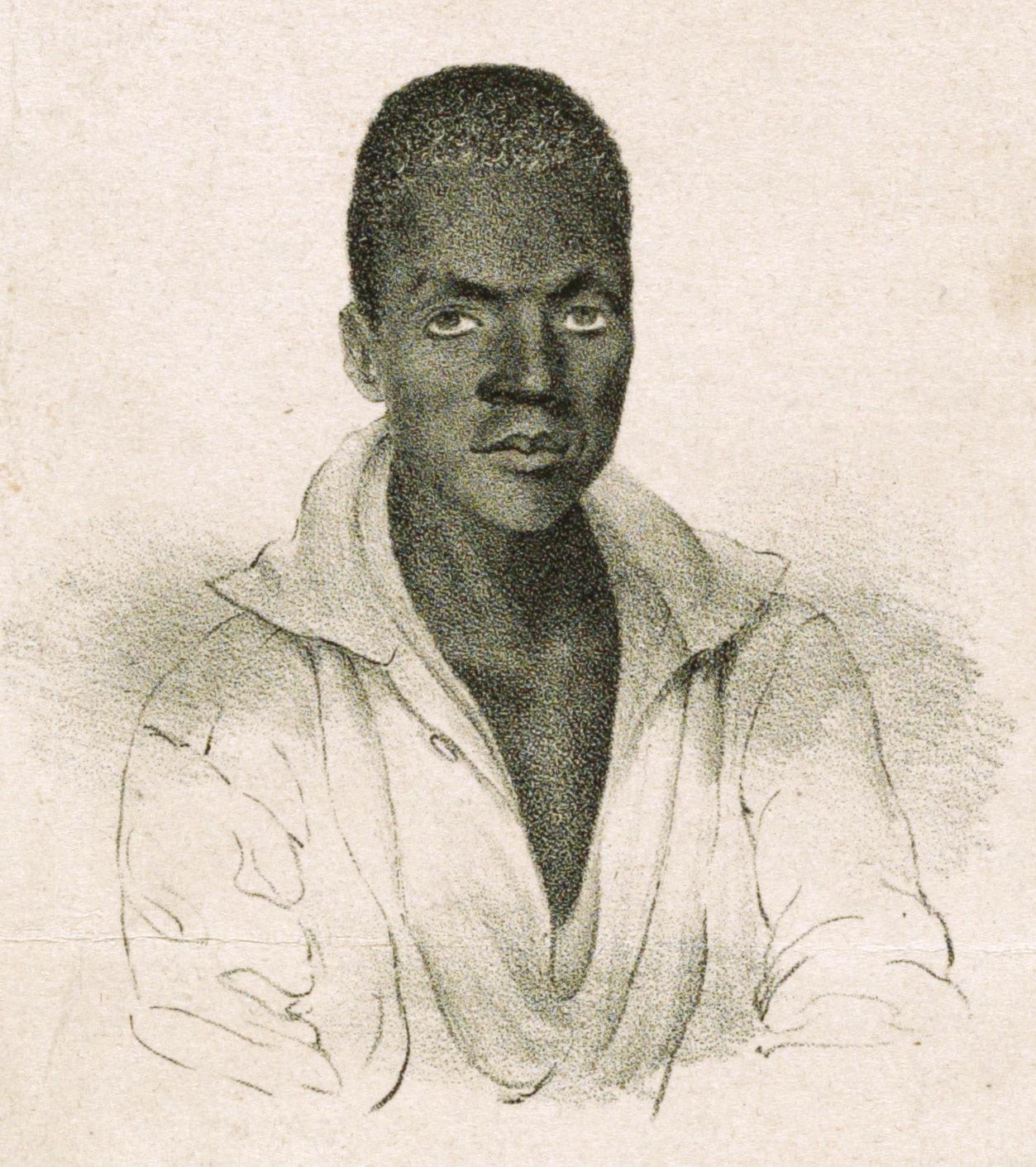
Sengbe Pieh (also referred to as Joseph Cinqué) was a rice farmer in West Africa with a wife and three young children when he was abducted. In 1841 Sengbe Pieh and the surviving Amistad captives finally made it back to Mende-land. Not much is known of his life a er his return home, but it was reported that he never found his family, that they likely had perished in ongoing local conflicts.
describing winds that seemed to shift among all points of the compass—the schooner took several days to reach its rst stop, Saint Andrew’s Island. is was probably the island more commonly known today as Little Ragged Island—although locals still recall its older moniker.
Sitting at the southern tip of the Ragged Island chain, not far from the eastern terminus of the Old Bahama Channel, Saint Andrews provided a sheltered anchorage and fresh water. It was also not far from the southern end of what is now called the Blossom, or Old Mailboat Channel, running roughly NNW from the Ragged Island Chain to the Tongue of the Ocean, which then provides easy access to New Providence. Modern sailors cruising the Bahamian archipelago can make the entire 170 or so miles from the Ragged Island Chain to New Providence in a matter of days; Amistad took several weeks, anchoring thirty times along the way.
Although several vessels were encountered during this passage, the Mende always con ned Ruiz and Mendes
below deck during any interaction—wisely suspecting that they would attempt to betray them. e next stop along their route was at Green Key, not far from the exit of Blossom Channel into the Tongue of the Ocean. ere, the schooner once again took on drinking water before getting underway for what was believed would be the nal jumpingo$ point for the long oceanic voyage.
Upon arriving at New Providence Island, Amistad was denied permission to enter the port. e schooner gave every appearance of being a pirate, and authorities ocially wanted nothing to do with it. Many private merchants shared no such reservations, however, and were more than happy to barter or sell supplies at a nearby anchorage.
When Amistad nally exited the Bahamas via the Northeast Providence Channel, the schooner initially headed east. Although unskilled in seamanship, the Mende had learned enough to keep the vessel moving during the day, but they still relied on Montes and Ruiz to navigate through the night. Montes exploited the opportunity to steer northward and westward rather than towards Africa, hoping to reach New England or encounter a vessel that might free them.
On 18 August, Amistad met a schooner out of Kingston, from which the new masters of the Amistad bought some water and supplies. Although Ruiz and Montes had again been con ned below during the exchange, reports of a suspicious “long, low, Baltimore-built schooner” of about 120 tons, “with a black hull, green bottom and two gilt stars on its stern,” began to circulate among the maritime community.
Two days later, having sailed, unknowingly, to within 25 miles of New York, they were hailed by the New York pilot boat No. 3. Montes and Ruiz were con ned below while Amistad declined assistance and sailed on. A short while later, Pilot Boat No. 4 approached and hailed. is time, the Mende refused more forcefully, brandishing weapons to warn o$ the pilot.
By now, Ruiz and Montes believed that their subterfuge had been realized and feared they might be killed at any time. With the Amistad needing to reprovision before striking out across the Atlantic for Africa, the Mende tried to approach the shore near Montauk, at the eastern end of Long Island. On 24 August, Amistad came to anchor in 3½ fathoms of water, about a half mile o$ Culloden Point. A shore party was dispatched via the ship’s boat and promptly encountered Henry Green, a ship’s captain who lived nearby, who was happy to facilitate the purchase of supplies.
Fate can be ckle, and shortly thereafter a US Coast Survey vessel, the brig Washington, happened upon the scene. e Washington had been transferred for the summer
from the US Revenue Marine to assist with charting the coast. As part of its new duties, the brig “was sounding this day between Gardner’s and Montauk Points” and sighted the suspicious schooner “lying inshore o$ Culloden Point [with] a number of people on the beach with carts & horses and a boat passing to and fro.”
Everything about the scene gave the appearance of a pirate surreptitiously “unloading” ill-gotten gains to enthusiastic residents. Washington’ s captain, USN Lieutenant Richard Gedney, dispatched an armed boarding party that seized the Amistad, rounded up those who had gone ashore, and freed Montes and Ruiz—who immediately spun a tale of mutiny and murder. With the Mende unable to communicate their side of the story, Gedney decided to escort the Amistad —under control of his crew—and all the persons aboard across Block Island Sound to Fort Trumbull at New London, Connecticut, where he sought judicial guidance.
Justice A. T. Judson, Federal District Court judge, travelled from New Haven to hold an inquiry aboard the Washington on 29 August, after which he declined to grant the request of Montes and Ruiz to summarily return to them the vessel, its cargo, and those they claimed to be their rightfully owned slaves, but he also declined to decide that the Mende were “kidnapped Africans,” who had freed themselves from an illegal attempt to enslave them. Instead, the case venue was moved to the seat of the court in New Haven. ere, a more complete hearing was held, in which the Mende’s cause was aided by the translation services of James Covey, a seaman aboard the British brig Buzzard Covey had been born in Mende-Land, where he had been known as “Kaw We Li.” As a youth, he had been kidnapped and sold to slavers but had the good fortune to be rescued by a vessel from the British anti-slavery patrol. After receiving an education in a British-run school in Sierra Leone, Covey joined the Royal Navy. Serendipity placed the ship to which he was assigned in New Haven at the time of the trial.
Although Judson soon decided for the Mende, the Justice Department, at the direction of President Martin Van Buren, appealed his ruling. Van Buren did not want to roil relations with Spain, nor did he want to alienate voters from the southern slave states. After two long years of litigation, the Supreme Court nally a rmed Judson’s initial ruling and freed the long-su $ering litigants. With private donations supplementing government funding, a
vessel was chartered to repatriate them to Sierra Leone. is case settled the issue that all Africans arriving in the US after 1809 were presumed to be free; however, the pro ts involved would continue to drive the illegal trade until the Civil War and rati cation of the 13th Amendment on 6 December 1865 freed those still enslaved.
Daniel Laliberte served for more than thirty years in the US Coast Guard, during which time he participated in or provided intelligence support to the interdiction and repatriation of hundreds of undocumented Haitian migrants and the seizure of numerous drug smuggling vessels. He writes on topics involving the history of the US Revenue Marine and the US Coast Guard. A frequent contributor to Sea History, his work has also appeared in American History, Naval History, and the Nautical Research Journal.
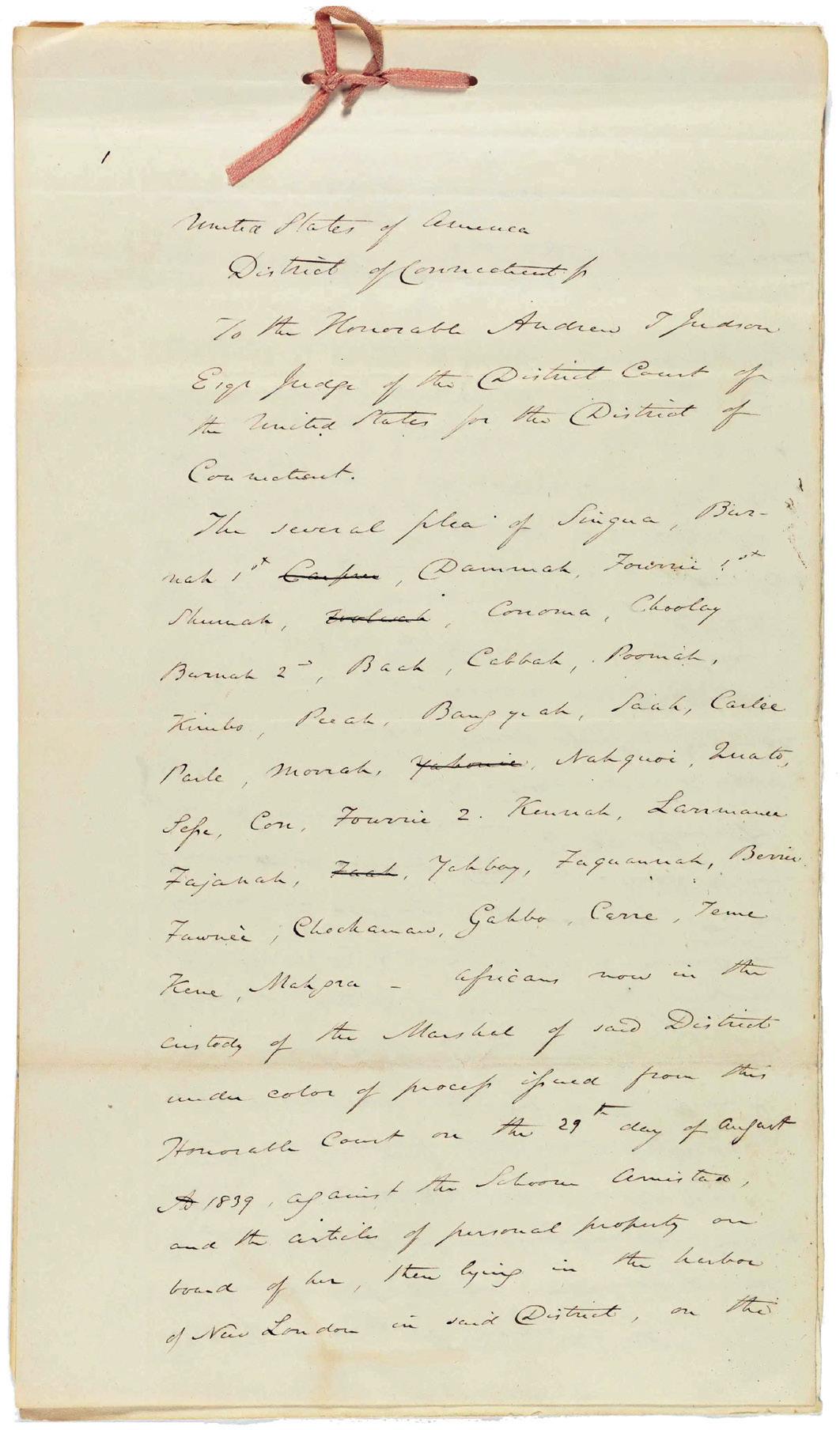
In this court document, Sengbe Pieh stated that he and the others were “natives of Africa and were born free, ... and ought to be free, and not slaves...”
by John S. Sledge
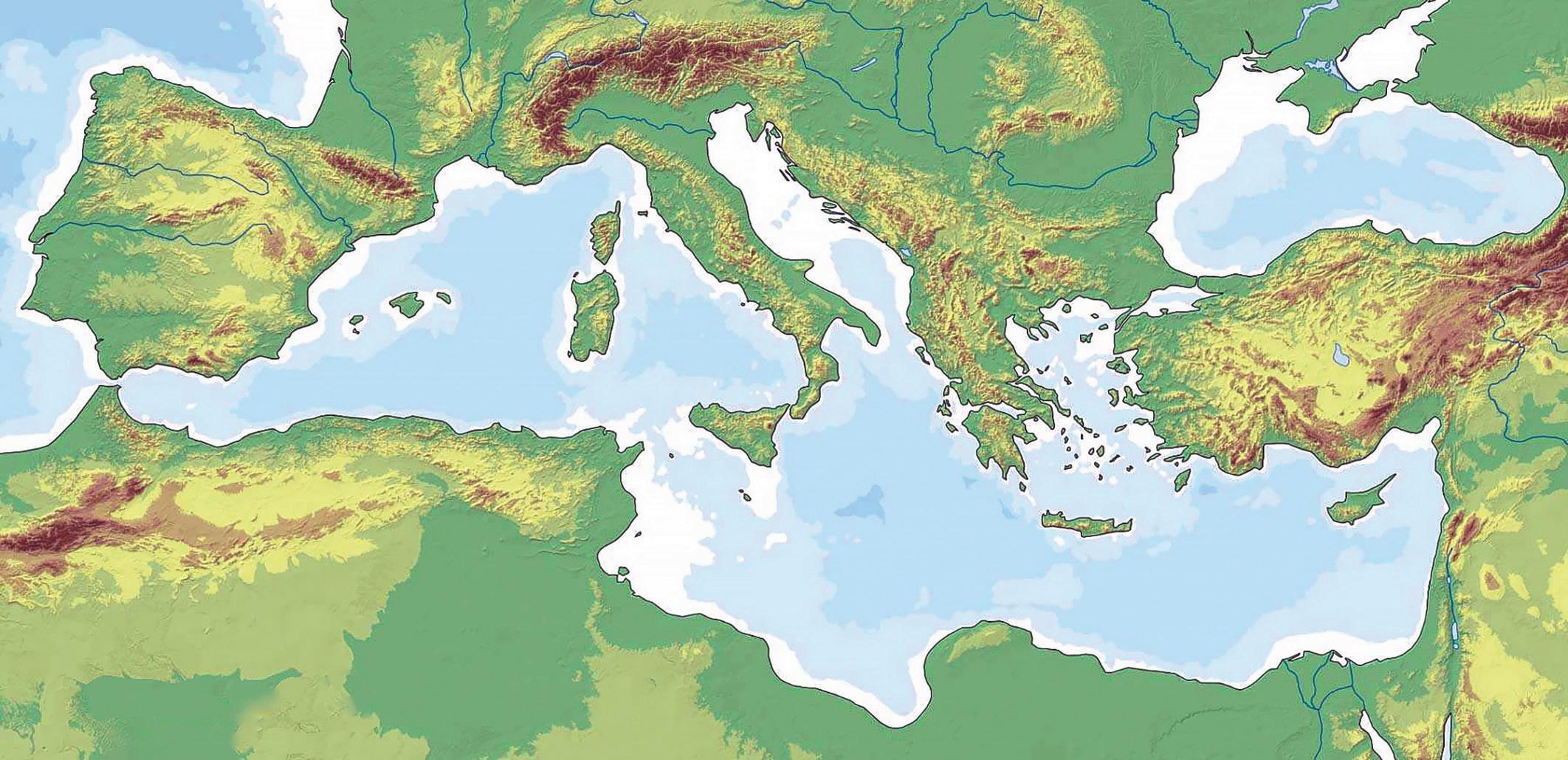
By the spring of 1571, the Ottoman Empire had been jostling aggressively against the eastern borders of Christian Europe. With alarming speed, it had gobbled vast chunks of territory stretching from Anatolia through the Balkans into Hungary to the very gates of Vienna, and in the opposite direction through the Middle East and along the North African littoral all the way to Algiers.
!e fearsome agent of this stunning advance had been Sultan Suleiman the Magni cent, who died unexpectedly in 1566 while campaigning in Hungary. His son Selim II, derisively called “the sot,” preferred the pleasures of his harem to the rigors of the march. Nonetheless, he continued his father’s expansionist policies with the help of an experienced vizier and veteran military leaders. It was no secret that he coveted
Rome itself, “the Red Apple” as he called it, causing visions of a minaret rising over St. Peter’s Square to haunt Christian dreams. In the winter of 1570, Selim declared war on the Venetian Republic, whose holdings stretched far into the eastern Mediterranean Sea, and that summer landed his forces on the island of Cyprus.
!e Venetians, who preferred neutrality and trade, begged Pope Pius V for help. !ey were fortunate in their ponti . Ascetic to the point of conducting his o ces barefoot and in a coarse hair-shirt, Pius yearned to declare a new crusade. Venice’s plea meshed perfectly with this ambition. Energized, he hammered together a grand Christian alliance called the Holy League. !e signatories included the Papal States, Philip II’s Spain, the Republics of Venice and Genoa, the Knights of
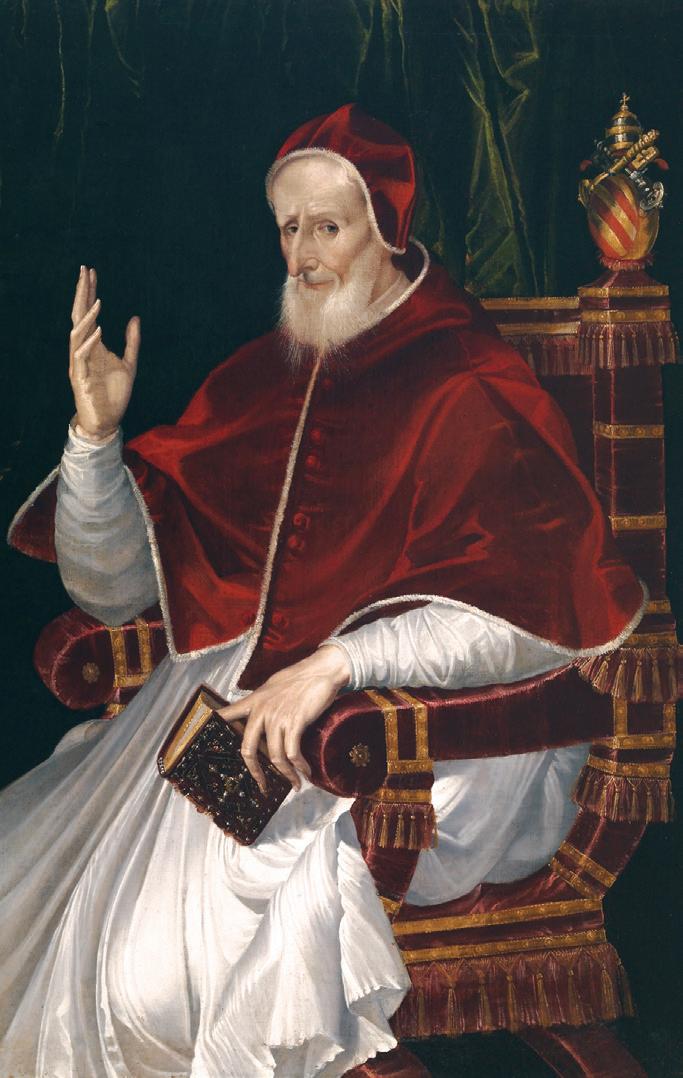
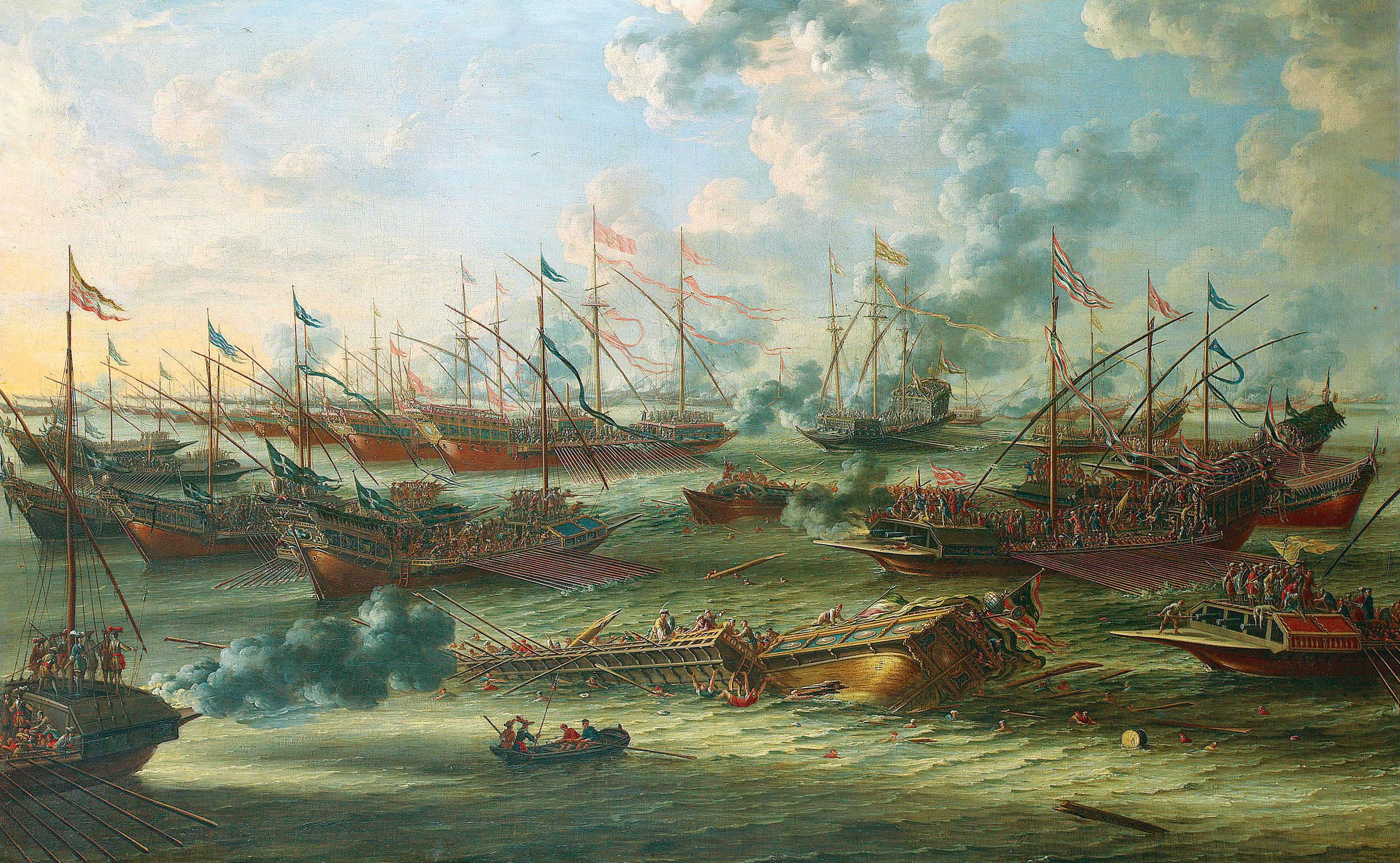
Malta, and the duchies of Savoy, Parma, and Tuscany. Spain bore half the expense of raising a eet, Venice a third, and the Pope one-sixth. France declined to join due to antipathy towards Spain and an existing treaty with the Turks. Despite their confederation, the parties had di ering aims. Pope Pius coveted Jerusalem; Philip favored an attack on Tunis, whence erce corsairs continually harried Spanish shipping and coastal settlements; and the Venetian doge wanted Cyprus returned, and then peace. Neither the signatories nor knowledgeable observers placed much stock in the shaky alliance. Philip grumbled, “I do not believe it will do or achieve any good at all,” and the French ambassador to the Holy See quipped, “It will look very ne on paper, but ... we shall never see any results from it.”1 As for the Ottomans, they believed the Christians too quarrelsome to hold an alliance together for long.
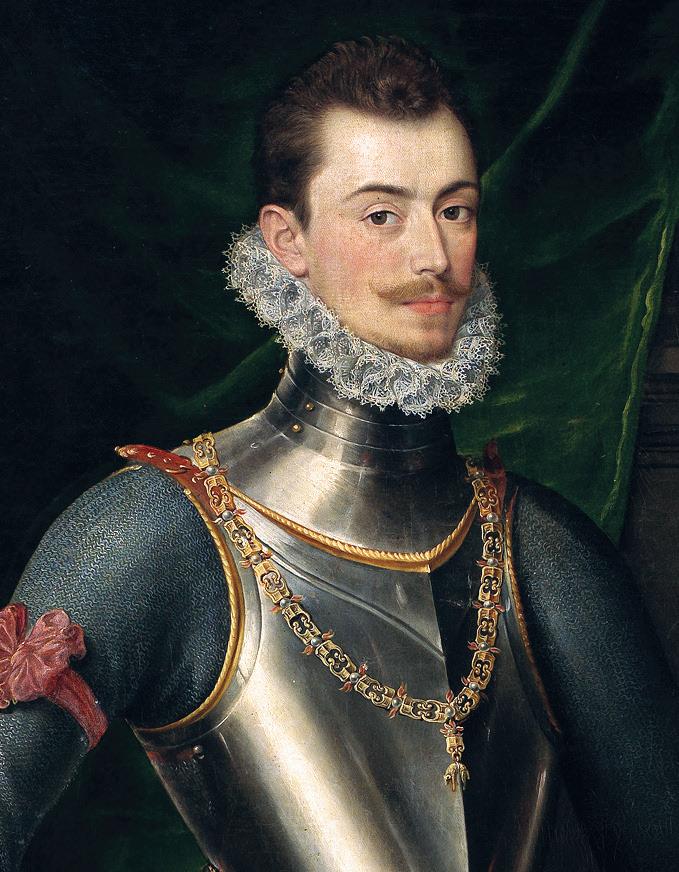
Happily for the Holy League, Pius sagely selected Don John of Austria for its leader. Just 24 years old, he had already demonstrated signi cant diplomatic and military talents in southern Spain. He certainly looked the part of a hero. One contemporary described him as “handsome, alert, and courageous.” Born out of wedlock to Emperor Charles V and Barbara Blomberg, a burgher’s daughter and former singer, his father and his half-brother Philip did not hesitate to acknowledge him, though the latter instructed his courtiers to address the young noble as “Excellency” rather than “Highness.” !e pope minced no words when he addressed his favored captain: “Charles V gave you life. I will give you honor and greatness. Go and seek them out!”
!e League’s eet slowly assembled that summer at Messina, Sicily. Marcantonio Colonna, an Italian duke with Spanish service under his belt, led the
papal contingent; the hotheaded Sebastian Venier, 75, captained the Venetian complement, comprising half the eet’s ships, with the more eventempered Agostino Barbarigo as his second; Gian Andrea Doria, greatnephew of the famous Andrea Doria, led the Spanish vessels; and Álvaro de Bazán, a Spanish captain, the reserve. Due to ceremonial obligations along the way, Don John did not join them until 29 August. Locals thronged the shore when his agship Real nally hove into view. She made a marvelous show with her red-and-white striped sails, elaborately carved stern topped by three huge lanterns, and 24-foot-high blue banner depicting Christ on the cross. Surveying the united host, Colonna exclaimed, “ ! ank God we are all here, and that it will be seen what each of us is worth.”
If Pope Pius could have beheld the Christian eet, his heart doubtless
would have soared. Nearly 200 lowslung, oared galleys rode at anchor, along with six massive Venetian galleasses and dozens of smaller vessels.
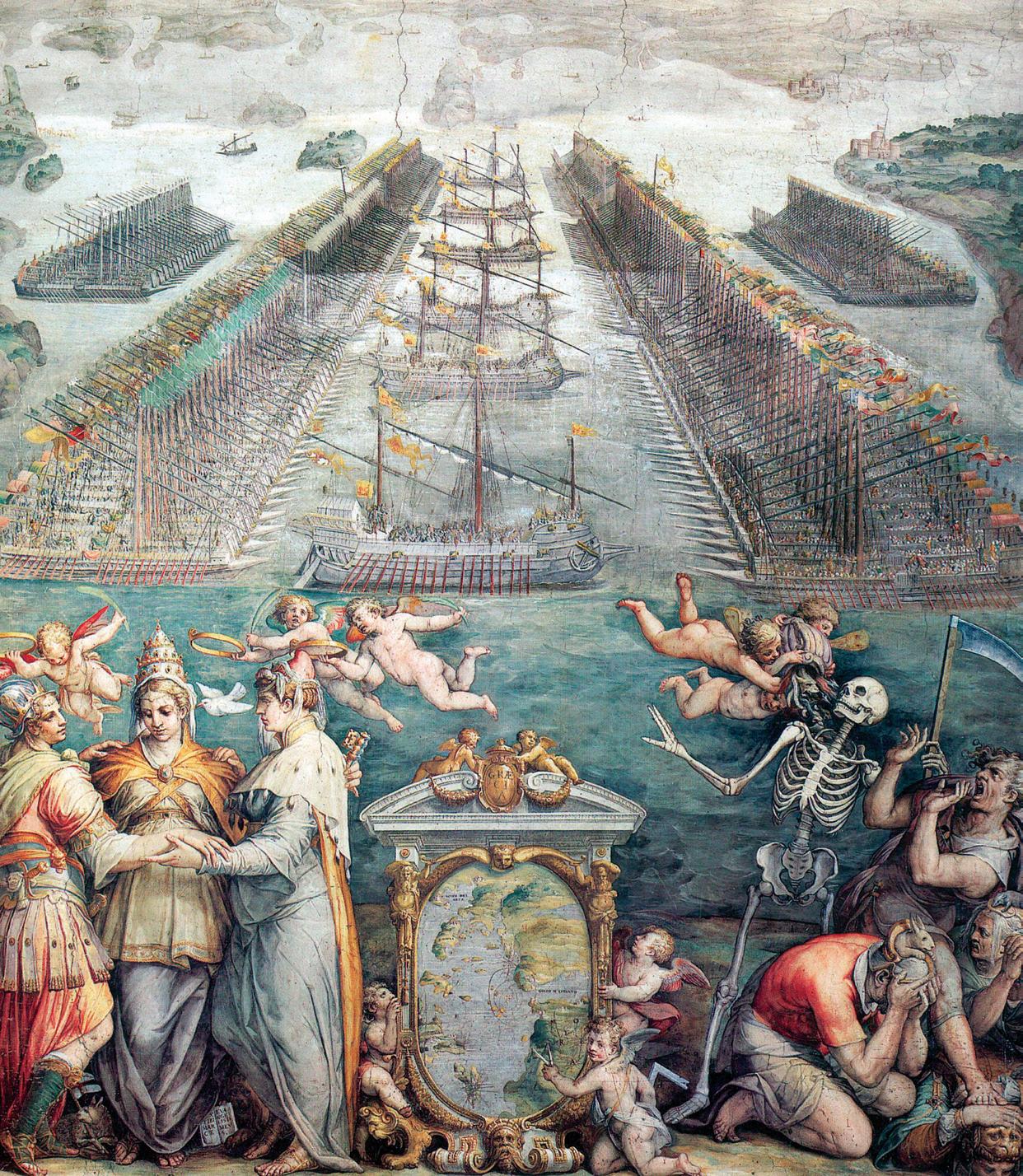
!e typical 16th-century Mediterranean galley appeared little changed since antiquity. Powered by a combination of wind (three masts with lateen sails) and muscle (four men at each of the 24 oars per side) they displaced 200 tons and could do 12 knots with the
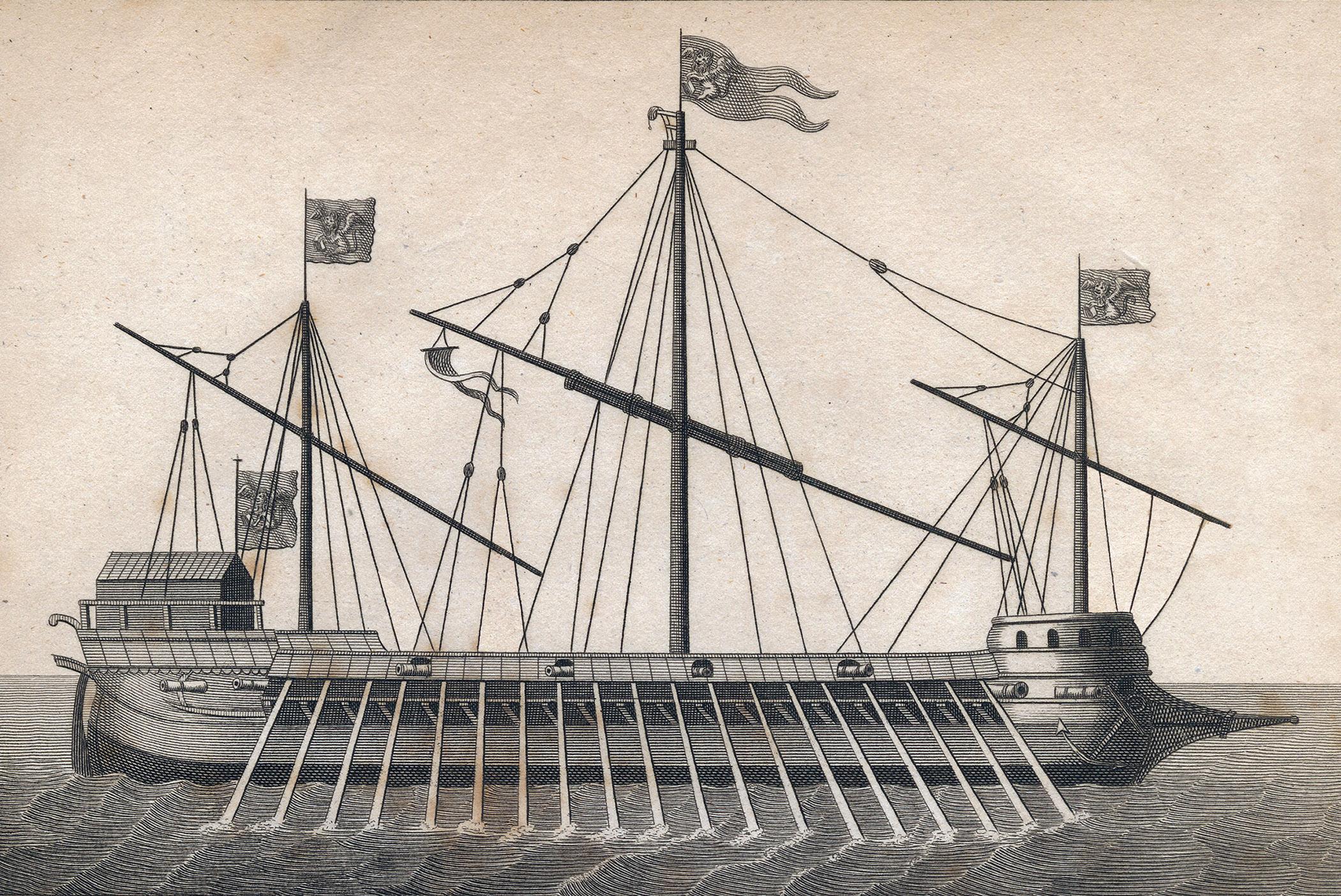
wind and four by the oar alone. Each ship featured a prominent ram and a ghting platform at the bow, where boarding parties could amass, a battery consisting of a powerful centerline bow gun capable of throwing a 60-pound shot, and a pair of smaller anking pieces. Swivel guns ranged along the sides. Nevertheless, it was the massive Venetian galleasses that provided the eet’s most devastating repower. Due to their bulk, smaller vessels had to tow them into ghting position. !ey carried 40 guns each—30- to 50-pounders, arranged within a forti ed roundhouse that allowed them to cover all directions.
Manning these ships were 1,500 Papal troops; 5,000 Venetians; 5,000 Germans; 8,000 Spaniards; 5,000 Italians; 4,000 gentlemen adventurers; and 40,000 sailors and rowers. Many of the latter were enslaved Muslims, but the Venetians took pride that their rowers were well-paid freemen. Given all these mouths to feed, the captains had to frequently dispatch shore parties to replenish food and water. Pius urged Don John to also mind the men’s spiritual nourishment and ensure that they “lived in virtuous Christian fashion in the galleys, not playing [gambling] or
swearing.” One of Don John’s lieutenants, more familiar with rough men, mumbled, “We will do what we can.”
!e Christian eet departed Messina on 16 September and arrived o Corfu 11 days later, but the soldiers appeared more likely to destroy each other than the Turks. When Don John sent Spanish troops to bolster the undermanned Venetian ships, brawls erupted and resulted in several deaths. Venier ew into a fury and hanged several Spaniards in retaliation. Whether the alliance could hold together long enough to even meet the foe looked doubtful.
Meanwhile, the Turks had not been idle. On 4 August, they captured the city of Famagusta on eastern Cyprus after a punishing siege. Enraged by their high casualties, they slaughtered the garrison and ayed its commander alive. To the west, their eet spent the summer raiding Greece and the Adriatic coast. On 8 August, after weeks of activity, the eet sheltered at Lepanto (modern Nafpaktos) where the Gulf of Patras narrows into the Gulf of Corinth, between the Peloponnese peninsula and the Greek mainland.
Securely anchored there, 49-yearold Müezzinzade Ali Pasha, Selim’s hand-picked Grand Admiral, pondered his next moves. Spies kept him apprised of the enemy’s activities. He knew he faced a severe test. He would have preferred to spend more time re tting, resting, and recruiting, but his orders were clear. “If the [Christian] eet appears,” the Sultan told him, “...confront the enemy and use all your courage and intelligence to overcome it.” Ali Pasha was certainly equal to the task. Of humble origins, he became a polished diplomat and skilled soldier,
Sketch of a typical Venetian galleass used at the Ba le of Lepanto. Note the round house on the bow, which held its heaviest guns.
fought at the Siege of Malta, and served as governor of Egypt. Everyone liked him; one admirer wrote that he was “brave and generous, of natural nobility, a lover of knowledge and the arts; he spoke well, he was a religious man and clean living.” Surprisingly humane for that brutal age, he considered the needs and feelings of everyone, no matter their station in life—including, to an extent, the galley slaves under his command.
Despite its hard usage, the Turkish eet still constituted a formidable force. !e Grand Admiral counted 208 galleys, 56 galliots (each with 16 pairs of oars, one mast, one gun) and a bevy of smaller vessels. His agship, Sultana, ew a bright-green swallowtail banner adorned with the name of Allah 28,900 times. His ships were lighter and faster than the enemy’s but woefully under gunned. Similarly, his troops, including 10,000 well-trained Janissaries, 5,000 Greeks, and contingents of Berbers, Syrians, and Egyptians, were lightly armed with scimitars and bows and wore insubstantial armor and turbans. Fifty thousand sailors and rowers kept the ships going, but many of the latter were enslaved Christians, apt to revolt at the earliest opportunity.
Like Don John, Ali Pasha relied on brave subordinates. Mehmet Sulik Pasha, an aggressive ghter nicknamed Sirocco after the powerful Mediterranean wind, was a former bey of Alexandria and a Malta veteran. Uluch Ali Pasha was an Italian captured by Barbary corsairs as a youth who had served as a galley slave until he converted to Islam and became a feared corsair himself. !e Grand Admiral knew he could expect complete candor from these men. When scouts reported the League’s eet at Corfu, he held a council of war. Uluch Ali cautioned: “ !e shortage of men is a reality. From this point of view, it’s best to remain in Lepanto harbor and ght only if the unbelievers
come to us.” Keenly aware of his eet’s weaknesses, Ali Pasha considered the matter, but mindful of the Sultan’s mandate, he decided to sail.
As Don John worked his way south along the Greek coast, he received two important pieces of news—the enemy was at Lepanto, and Famagusta had fallen. When details of the latter garrison’s slaughter and its commander’s ghastly torture raced through the eet, all rivalries vanished, replaced by a thirst for revenge. !e 7th of October was the fateful day. !e two eets sighted one
another that morning just o Scropha Point, within the narrow mouth of the Gulf of Patras. Nudged by a light breeze, the Ottoman ships glided west in a broad crescent formation that gradually straightened. Ali Pasha held the center with 87 galleys. On his right, close to the shore, Sirocco commanded 60 galleys, while Uluch Ali led 61 galleys and 32 galliots on the left.
!e Muslim eet presented an arresting spectacle. Bright banners and ags uttered from the masts, sunlight darted o polished weapons, and the
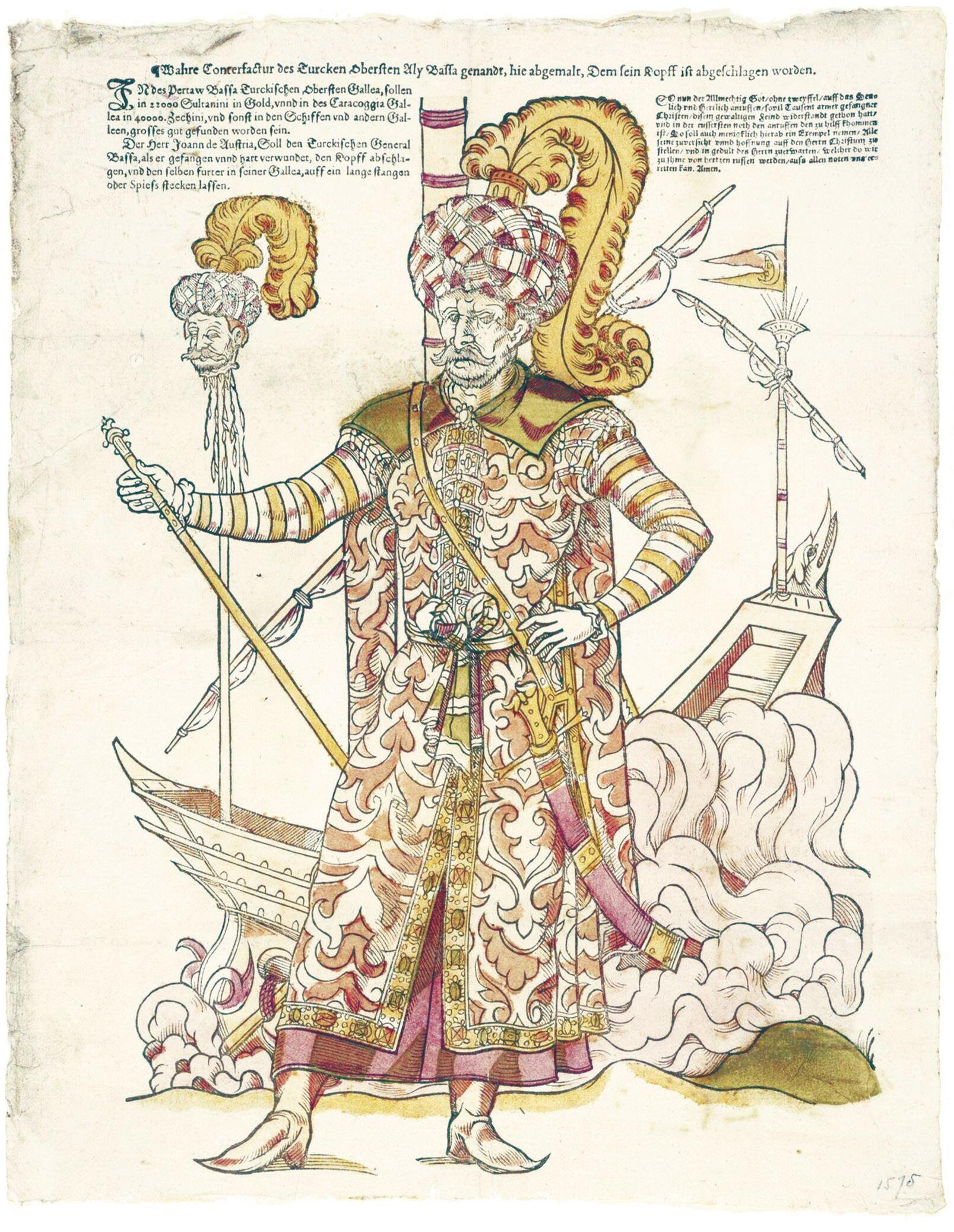
Müezzinzade Ali Pasha, the Turkish Grand Admiral depicted in all his finery before the ba le—and a erwards, his head on a pole. Though reluctant to give ba le, he confided to his trusted captains that he had no choice: “I continually receive threatening orders from Istanbul, I fear for my position and my life.”
sound of horns, cymbals, and drums rolled across the glittering water. !e Grand Admiral took up a recurve bow and addressed the enslaved rowers gazing up at him expectantly: “Friends, I expect you today to do your duty to me, in return for what I have done for you. If I win the battle, I promise you your liberty; if the day is yours, Allah has given it to you.”
On the Christian side, Don John ordered the rams sawn o his ships’ bows. Gunnery would decide this battle, and without the rams the Christians could better depress their gun barrels to strike enemy hulls. Anticipating a vicious hand-to-hand ght, he had boarding nets strung up in the rigging and sand poured on the decks to help the men keep their footing once the blood started owing. He advanced his eet in a straight line divided into three divisions, or battles, each preceded by a pair of galleasses. He led the center with 63 galleys. Venier and Colonna positioned their ships close to the Real, since the heaviest ghting would likely take place there; Doria captained the right wing with 53 ships, and Barbarigo the left with 53. Bazán’s 38 reserve galleys followed. As the ships closed, Don John reviewed his eet in a small boat. Resplendent in full armor and brandishing an ivory cruci x, he shouted: “My children, we are here to conquer or die. In death or victory, you will win immortality.” On every vessel, every man knelt for mass, the priests admonishing, “No paradise for poltroons.”
!e Battle of Lepanto consisted of three distinct clashes within a fourmile-wide front. !e action began to the north, where Sirocco attempted to out ank Barbarigo. He hugged the shore, but Barbarigo intercepted. Other galleys joined the fray, and the sky lled with arrows, shot, and hissing re pots. Frustrated by his visor, Barbarigo lifted it to better direct his men. A subordinate cautioned him, but Barbarigo
snapped, “Better to be hit than not heard.” At that moment, an arrow stuck his eye, mortally wounding him.
Sirocco fared little better. A Venetian galley rammed his vessel astern, carrying away her rudder, and another smashed into her amidships. As she took on water, Venetian arquebusiers swept her decks, and Sirocco fell, badly wounded. Surrounded by boarders, he asked to die, and a Venetian o cer named Giovanni Contarini obliged, unceremoniously beheading him with a heavy sword.
To add to the mayhem, Christian galley slaves broke free aboard one of the Turkish vessels and rampaged among their former captors, slinging their chains and attacking the crew. Sensing defeat, several of Sirocco’s captains made for the shore and grounded their vessels, their crews scampering inland. Hundreds of others were drowned, slaughtered in the water, or made prisoner. Diego de Medrano, a Spaniard who commanded one of the Neapolitan galleys, soberly recalled, “It was an appalling massacre.”
In the center, Don John could barely contain his excitement and danced a galliard on the Real foredeck. !e rst guns there sounded around 11 am, just as the wind shifted in the Christians’ favor. !e opposing admirals espied one another’s agships and exchanged challenge shots. As their vessels closed the gap, the Venetian galleasses opened re. According to one eyewitness, “So great was the roaring of the cannon at the start, that it’s not possible to imagine or describe.” !e balls smashed into the light Turkish galleys with frightful e ect, splintering and sinking three instantly, severely damaging many others, carrying away the Sultana’s big stern lantern, and mowing down scores of men. Stunned by the punishing barrage, Ali Pasha cried, “Allah allow us to get out of here in one piece.”
With frightening violence, the Sultana smashed into Don John’s agship at the prow, penetrating to the fourth rowing bench. Venier and Colonna subsequently rammed into the Sultana. ! irty other ships, both Christian and Turkish vessels, crowded around the agships in a confused and desperate scrum. Boarders surged onto enemy decks, only to be driven back and then surge again. Aboard the Real, one of the most determined ghters was Maria de la Bailadora, who had followed her lover to sea. Dressed as a man, she led a boarding party, red an arquebus, and according to one witness, “cost many Turks their lives.” Venier, not known for his modesty, bragged: “My galley, with cannon, arquebuses and arrows, didn’t let any Turk make it from the poop to the prow of the pasha’s ship.” Arrows ew so thickly that the Christian galleys looked more like hedgehogs than warships. Arquebuses ashed continuously. !e very sea and sky seemed a ame, and the waters turned red with blood. One participant recalled, “death came endlessly from the two-handed swords, scimitars, iron maces, daggers, axes, swords, arrows, arquebuses, and re weapons.”
With his heavier ships and greater repower, Don John held the advantage, and Christian boarders nally captured the Sultana. Ali Pasha tried to bargain for his life, but a soldier beheaded him and carried the grisly trophy to Don John. To the soldier’s dismay, his commander rebuked him, “What am I to do with it?” Don John considered Ali Pasha a brave and worthy opponent. Numerous sources state that he would have preferred to have taken the Turkish admiral alive for the prestige and propaganda value. Rather than throw the head into the sea as ordered, the soldier hoisted it on a pole. Cries of “Victory! Victory!” rose from the Christian vessels. Surveying the carnage on the Real, one participant noted “an
in nite number of dead.” On the Sultana, dozens of Turkish heads rolled about the deck with the swell, still wrapped in their turbans.
!e Ottomans enjoyed better fortune on their southern ank, where Uluch Ali managed to out ank Doria. He outnumbered his opponent and knew how to maneuver and exploit numerical superiority. As bitter ghting enveloped Doria’s ships, the sea was strewn with broken hulls, casks, masts, spars, torn canvas, rope, and thrashing men. Serving on board the Christian galley Marquesa was 24-year-old Miguel
de Cervantes. Despite a fever, he struggled into his armor and fought, receiving two shots in the chest and a wound that disabled his left hand. More than thirty years later, Cervantes wrote his 1605 masterpiece Don Quixote and included details from his direct experience: “When ships are locked and grappled together, the soldier has no more space left him than two feet of plank on the beak-head.” !e Turks killed or wounded all but six men on board a nearby Maltese galley and took it in tow, but Bazán’s timely arrival with the reserve convinced Uluch Ali
to ee rather than continue ghting. Leading fourteen ships, he outdistanced his pursuers, leaving a bloodied and exhausted Doria in his wake.
!e Battle of Lepanto was over after just four hours of combat. In that short period of time, the Turks counted 30,000 killed or wounded and 3,000 captured. Don John liberated 12,000 Christian galley slaves, sank or destroyed nearly a hundred galleys, and sailed into a nearby cove with 117 captured vessels. !e Holy League’s losses included 10 galleys sunk, 8,000 dead, and 15,000 wounded. According to
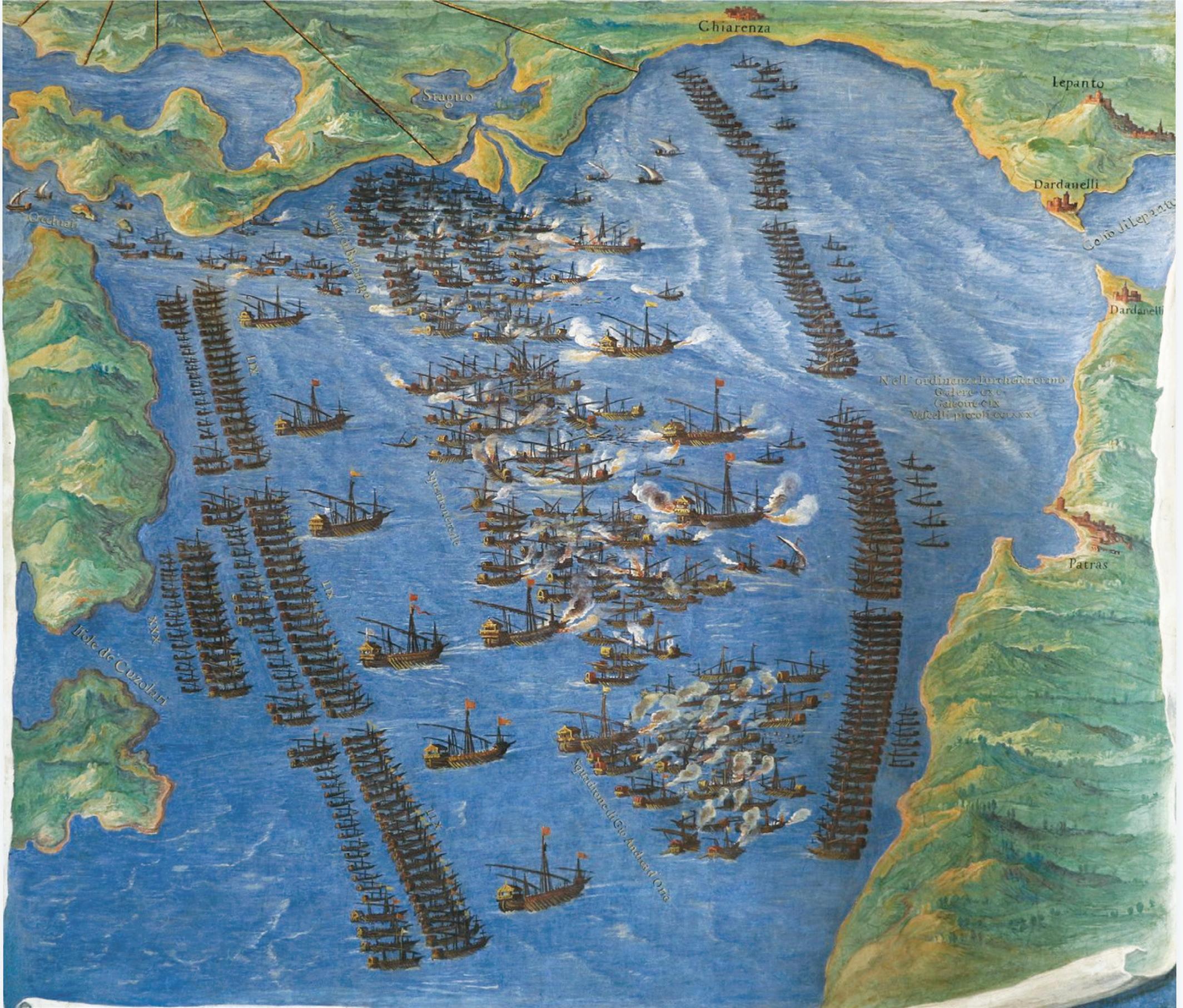
one source, Pope Pius had a premonition at the fateful moment Ali Pasha died. “God be with you; this is no time for business, but for giving thanks to God,” he told his startled treasurer, “for at this moment our eet is victorious.” It was a stunning triumph, and all of Christendom, even Protestant England, rejoiced at the news. Cervantes called Lepanto the “greatest event witnessed by ages past, present, and to come.”
Lepanto’s most important consequences were to destroy the myth of
Turkish maritime invincibility and to check Ottoman expansion in the western Mediterranean. But to Pius’s disappointment, the Holy League did not follow up its victory and dissolved shortly thereafter. Christians and Turks each shifted their attention away from the Mediterranean, the Turks towards Persia and the Christians towards the Atlantic. Venice signed a separate treaty with the Sultan and resumed its commerce but did not regain Cyprus. !ere would never be such a battle
between row galleys again. !e future belonged to sailing ships and broadsides.
John S. Sledge is maritime historianin-residence at the National Maritime Museum of the Gulf and a member of the National Book Critics Circle. He is the author of eight books, including The Gulf of Mexico: A Maritime History and Mobile and Havana: Sisters Across the Gulf.
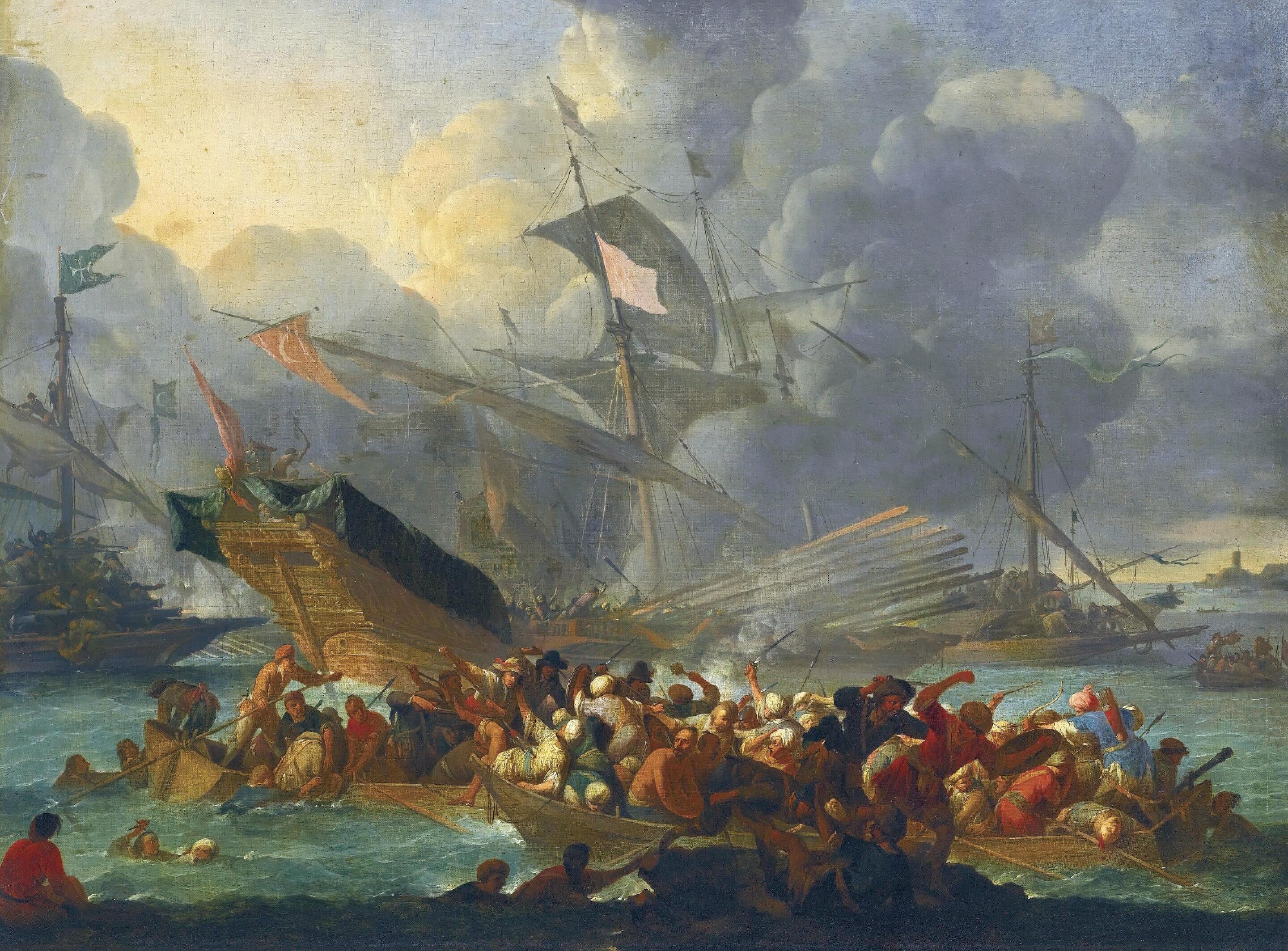
Ba le of Lepanto, 1571, by Johannes Lingelbach (1622–1674). The artist created more than a dozen paintings on the ba le. In this scene, he depicted a crowded rowing vessel and men in the water, scrambling to get ashore.
1 There are many contemporary sources about the Ba le of Lepanto. These include accounts by chroniclers, clerks, accountants, religious figures, o icers, and even common soldiers from both the Christian and Turkish sides. Additionally, cartographers and artists, both Christian and Muslim, produced beautiful maps and stunning paintings a er the ba le. In modern times, gi ed historians and writers like William H. Presco , Fernand Braudel, G. K. Chesterton, and Halil (nalcık (whom some modern Turks refer to as “the shaykh of historians”) have further explored this pivotal ba le, its lessons, and consequences.
by Michael Lang
The city of Camden, New Jersey, sits across the Delaware River from the better-known Philadelphia, Pennsylvania. e area has a deep and rich history of shipbuilding and was colloquially referred to as the “American Clyde,” referencing the mighty center of that industry on the River Clyde in Scotland. On the New
Jersey side of the Delaware River, this once-rural area was transformed into a shipbuilding powerhouse. e prosperity would not last, however, and after a period of de-industrialization, Camden fell into decline. Its waters and waterfront properties had become environmental liabilities and its population dwindled. ose who remained
su ered—and continue to su er—from poverty and lack of opportunity. Hope is not lost, however, and in recent years Camden’s traditions of riverine activity, both commercial and recreational, are being restored through a renewed focus on environmental stewardship and on-the-water educational programming, spurring urban revitalization.
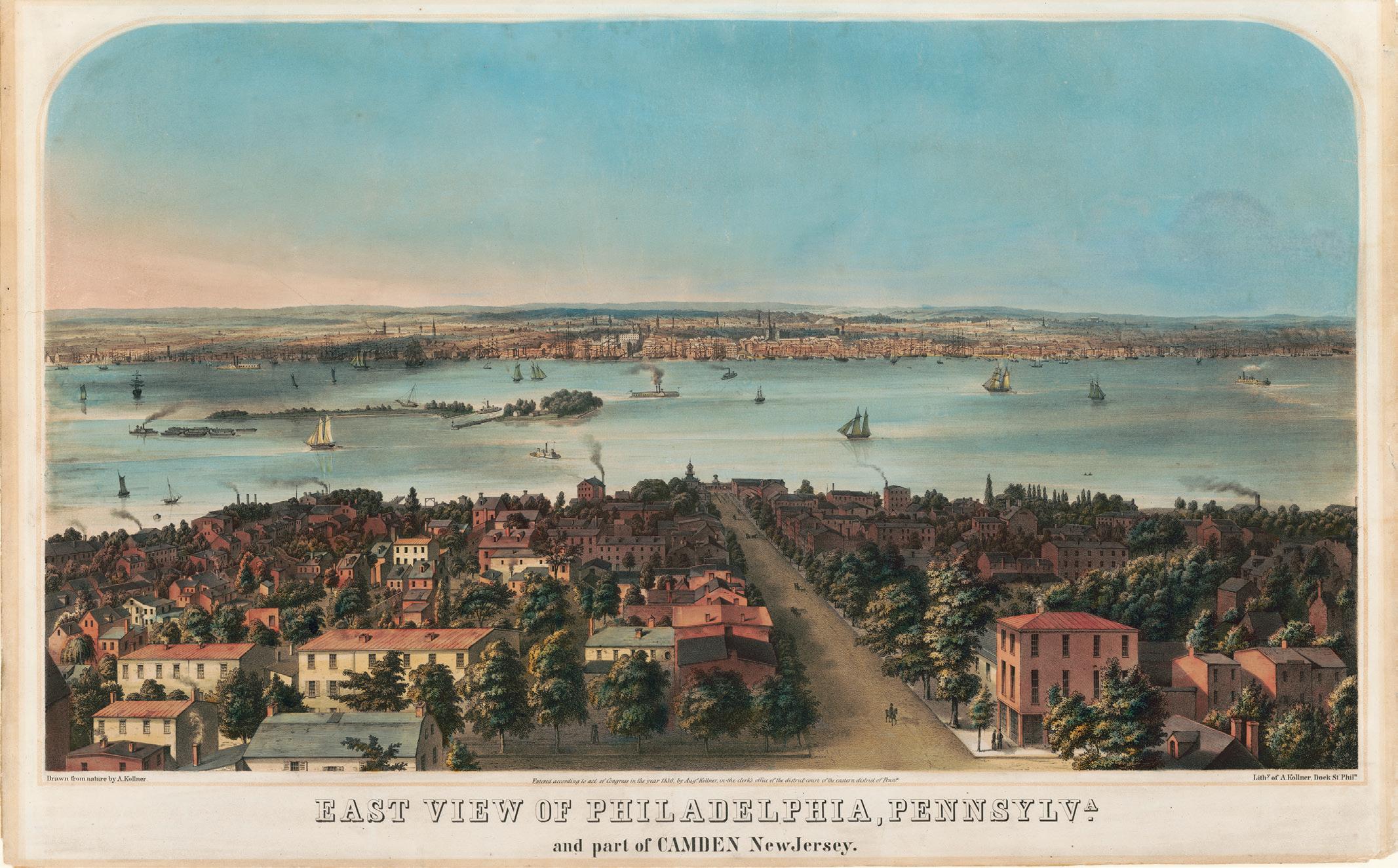
View of Philadelphia, Pennsylvania and Part of Camden, New Jersey
by Augustus
This contemporary bird’s-eye view looks across Camden to Philadelphia on the opposite bank of the Delaware
Cooper’s Ferry was the rst name of the settlement across the river from Philadelphia. In that era, West Jersey, as the area was then called, was characterized by small hamlets colonized by European settlers who shared the land with the native Lenape people. While most people would not associate the Camden area with the slave trade, since the agricultural economy of southern New Jersey relied on slave labor, the practice was very much a presence in the growing city.
Ferry service to the burgeoning city of Philadelphia started in 1688 and occasioned the early development of a network of terminals and other maritime support industries and infrastructure at the river’s edge. e city of Camden, transected by the Cooper
River and the Newton Creek, was founded in 1828 and laid out with a gridiron street pattern starting at Front Street on the Delaware River.
In the rst half of the 19th century, rail lines came to dominate the waterfront and would play a major role in the region’s early development. e Camden and Amboy Railroad (1830) was one of the rst railroads in the country and provided service to New York City. By 1854, fast trains were running day-trippers to the New Jersey shore, which was actively building hotels and creating other services for tourists. Camden developed around its two large ferry terminals, its rail yards, railroad roundhouses, shops, and other rail-related facilities. As a result, the waterfront became increasingly
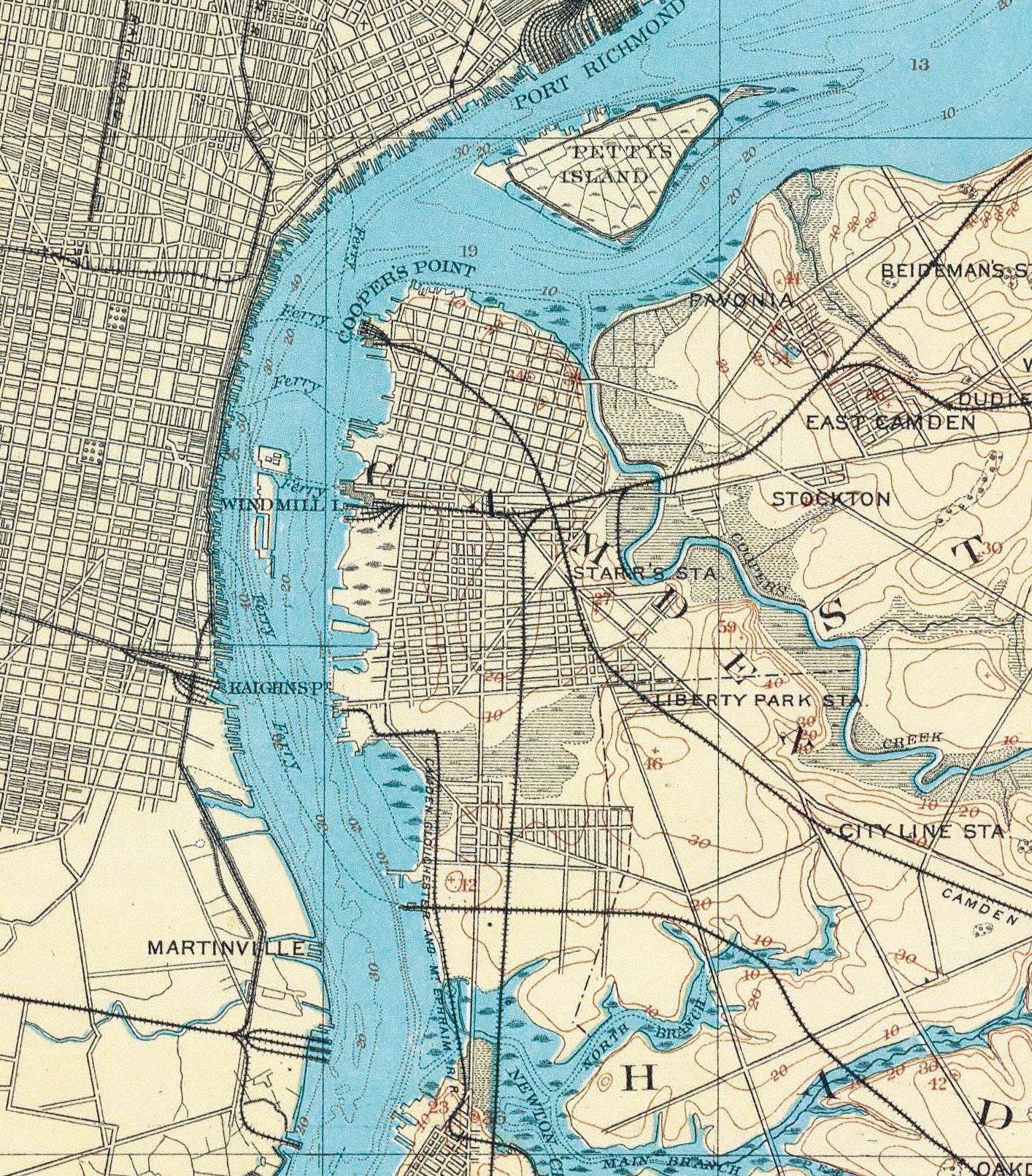
characterized by the development of bulkheads, wharves, and warehouses to service the growing trans-shipment of fuel, goods, and people across the river.
e pace of industrial growth in Camden in the 19th century was indeed impressive, earning it the sobriquet “Biggest Little City.” Camden’s waterfront district was dominated by a number of major rms that soon developed international reputations. The big three—New York Shipbuilding Corporation (1899); Campbell Soup Company (1869); and Victor Talking Machine Company (1901), which became the Radio Corporation of America (RCA) in 1929—were clustered on or near the waterfront, where they used their own piers for the shipment of raw materials. Immigrants from many countries were attracted to the opportunities in the city, which soon boasted several large hotels, banks, hospitals, department stores, and other retail businesses and public services required of a fast-growing community.
e early history of Camden’s waterfront saw competition between the rising commercial land uses and public access for recreational boating, hunting, and shing. Several yacht clubs and private boatyards were established along the waterfront, but competition from increased commercial shipping and industrial development (and its attendant air and water pollution) pushed these activities out. Public access to Camden’s rivers was fated to sharply decline as the river and waterfront spaces industrialized.
1887 map of Camden and Philadelphia. Rail lines are marked in black ink. The Camden and Atlantic Railroad ends at the Cooper’s Point ferry terminus; the other major rail line bisecting the city, coming from the northeast, is the Pennsylvania Railroad Amboy Division.
The Rise of Shipbuilding
Shipbuilding is one of America’s oldest industries, and the Delaware River has hosted a large number of yards constructing ships for the Navy since the Revolution. In the 19th century, that industry grew at an impressive pace on the Camden side of the river. e John H. Dialogue and Son (1862–1914) company grew from working on steam engine boilers to become a major producer of iron vessels, particularly tugboats, for which it gained great renown.
e Dialogue Company’s reputation for excellent workmanship earned it the contract to restore USS Constitution in 1876, when the frigate was being converted from an active warship to a sail-training vessel.
ere were many other shipyards in Camden, both large and small. Notable was the John H. Mathis Company (1900–1961) in North Camden, which built a wide variety of commercial vessels, including ferries, freighters, and barges. John Trumpy, a Norwegian immigrant, joined Mathis in 1910. Soon, he established a companion rm,
Mathis Yacht Building, where he focused on large luxury motor yachts. ese impressive yacht houseboats, as they were called, were sought after by the captains of American industry; USS Sequoia, a Mathis-built vessel, served as the presidential yacht from 1933 to 1977. Trumpy yachts were highly respected, and many are still a oat today, a testimony to solid designs and craftsmanship.
All of these maritime developments would have been impressive on their own, but the major industrial powerhouse in the city was clearly New York Shipbuilding Corporation.1 New York Ship, as it came to be known, was established in 1899. Under the direction of Henry G. Morse, the yard grew to become the largest private shipyard in the world by 1918, a status it held through World War II. Morse wanted his yard to be the most modern in all respects, able to handle the largest of ships.
By 1910 the yard was producing ships up to 27,940 tons displacement, and soon even these were surpassed in size. Morse pioneered a system of fabrication—the mold loft template system—using templates made directly from layouts on the loft oor. He also instituted a system whereby the entire yard was serviced by overhead cranes. Starting with building small oil tankers, the size and complexity of its output grew rapidly to include a full array of warships, as well as peacetime ocean liners, ferries, tugboats, and pleasure boats. In the course of its 68-year lifetime, New York Ship built more than 670 vessels of all types and sizes, constructed on the massive-covered ways at the yard.
New York Shipbuilding was also the birthplace of the nation’s rst shipbuilders’ union in 1934. e largest employer in the city, it employed some 30,000 at its peak. With this diverse industrial workforce, the city’s population grew to 124,555 by 1950, though storm clouds were rolling in on the horizon.
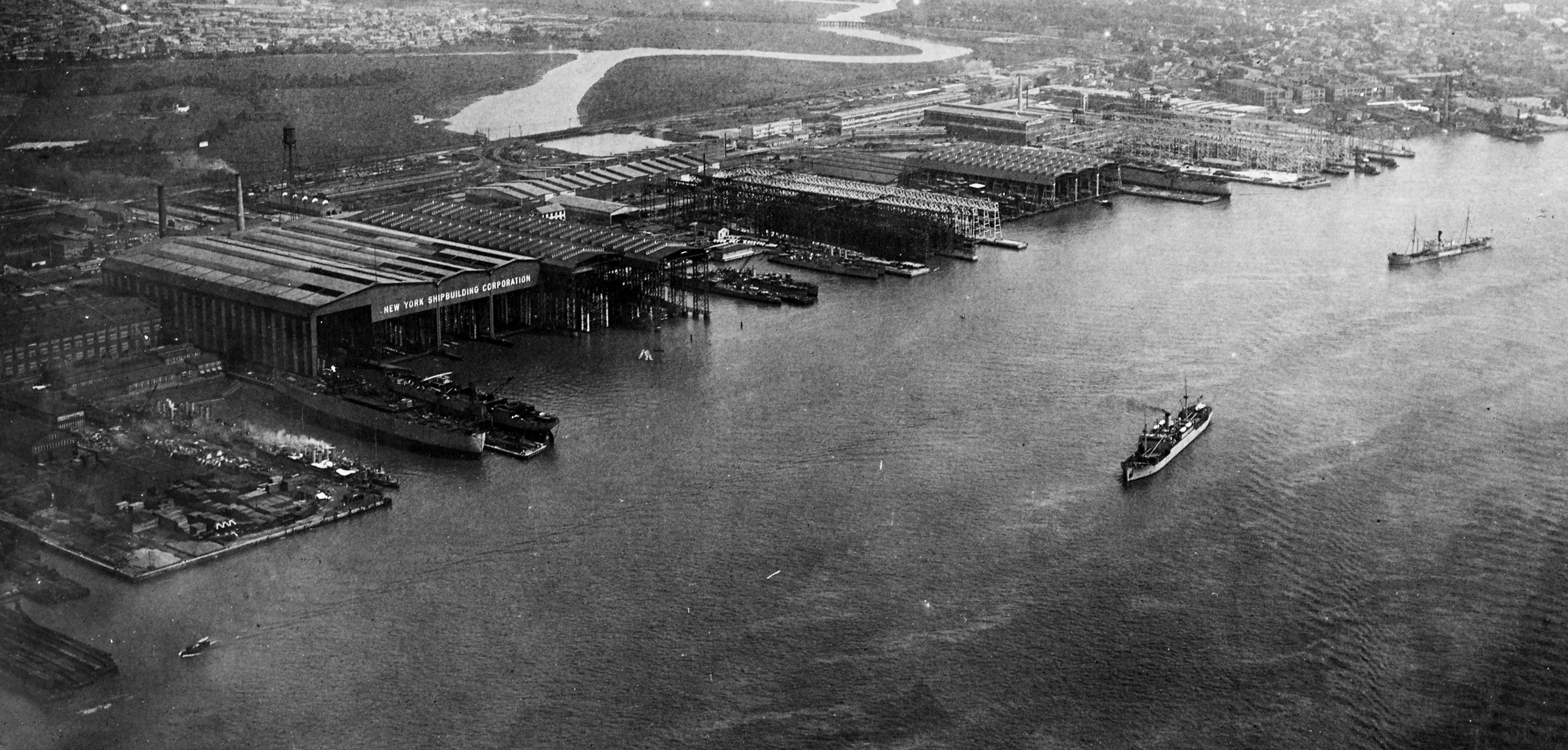
Not unique to Camden, the city suffered greatly in the post-war era of deindustrialization. Many say Camden’s decline began with the building of the Delaware River Bridge (now the Benjamin Franklin Bridge, renamed when the Walt Whitman Bridge was built) in 1926, which e ectively cut the city in two with its wide approach roads and toll booths. Soon suburban growth and the rise of car ownership led to the severe loss of ferry and railroad employment. New York Ship closed in 1967, and many of the other major industries within the city limits downsized or closed for good, hollowing out the city’s tax base. e 1960s and ’70s saw recurring periods of such harrowing urban violence and vandalism that Camden became known as the crime capital of the country. Its population fell to 102,551 by 1970; today it is just 71,749.
One of the few neighborhoods to buck this downward trend was Fairview, a.k.a. Yorkship Village. is comprehensively planned community was built in 1918 for shipyard workers at New
York Ship. Its predominantly owneroccupied homes were a major contributor to the city’s dwindling tax base. Many attribute the tenacity of its residents to the quality of the original Garden City-inspired design by architect Electus Litch eld. Funded by the federal government to house shipbuilders during World War I, houses of various sizes were made of brick, with slate roofs using a colonial architectural style set on tree-lined curving streets with sidewalks. It was more than just housing; Fairview has a bucolic village feel, with ample open spaces and public facilities. All the streets are named after ships built at the yard. It has been recognized by the American Planning Association as a planning landmark and is on the state and federal registers of historic places.
“Eds and Meds” and a Repurposed Waterfront
Since that time, Camden has slowly begun to ght back against the forces of decline. e direct involvement of the state and county governments has
been critically important. Investment began to ow based on several wellestablished urban revitalization strategies. First, Camden used the so-called “Eds and Meds” approach, meaning increased funding for healthcare and higher education facilities and programs. ese investments were concentrated in the central business district. Cooper Hospital and Rutgers, the State University of New Jersey, were the chief bene ciaries, but the focus on downtown entities garnered strong pushback from neighborhood community action groups. Clearly, more was needed and the rivers and the waterfront were to provide the answer.
After years of commercial maritime development, Camden’s waterfront had been completely industrialized, leaving no public recreational access to the river. Even after many of the city’s waterfront factories and businesses closed, most of these former commercial sites were found to be dangerously contaminated, so-called “brown eld” sites.
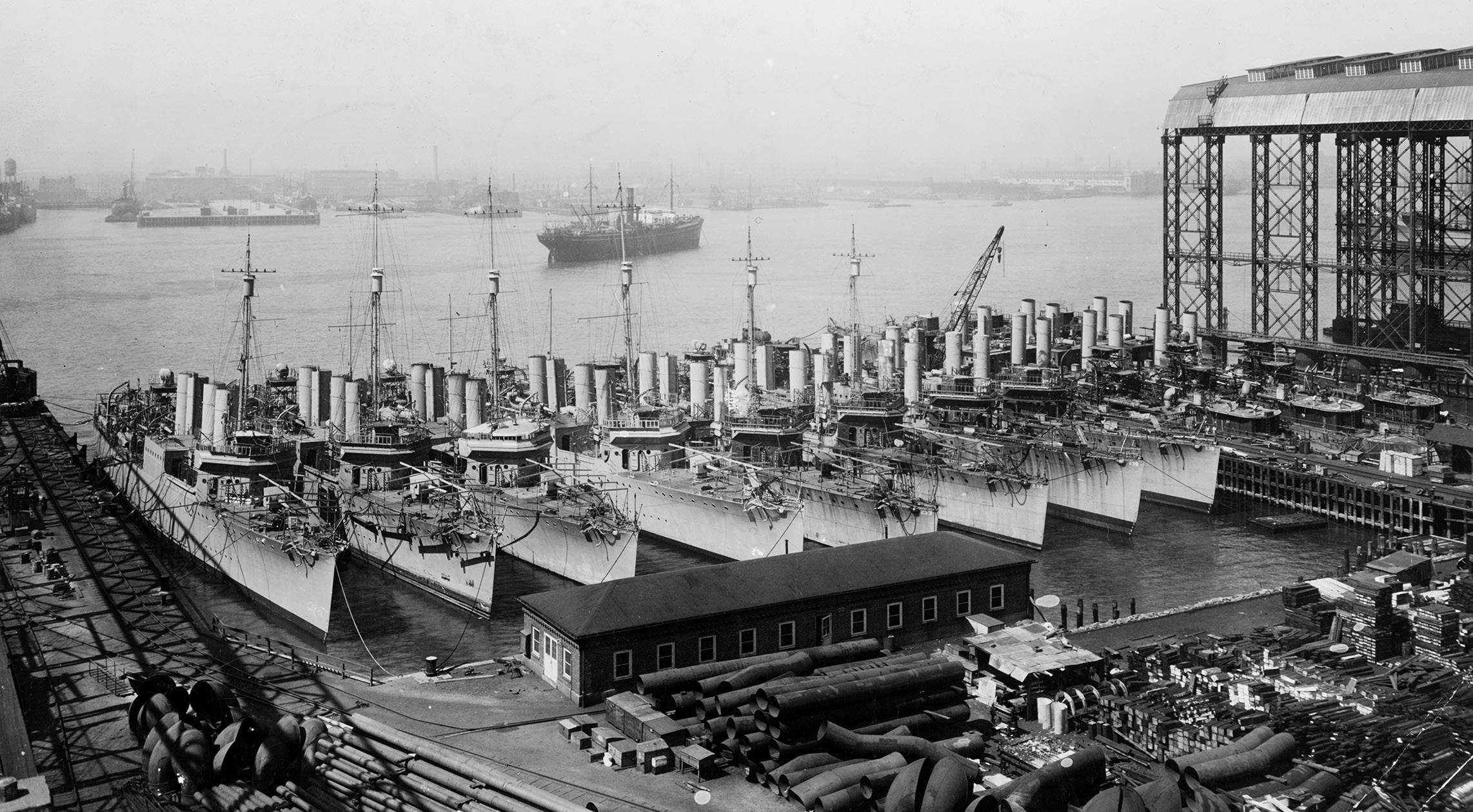
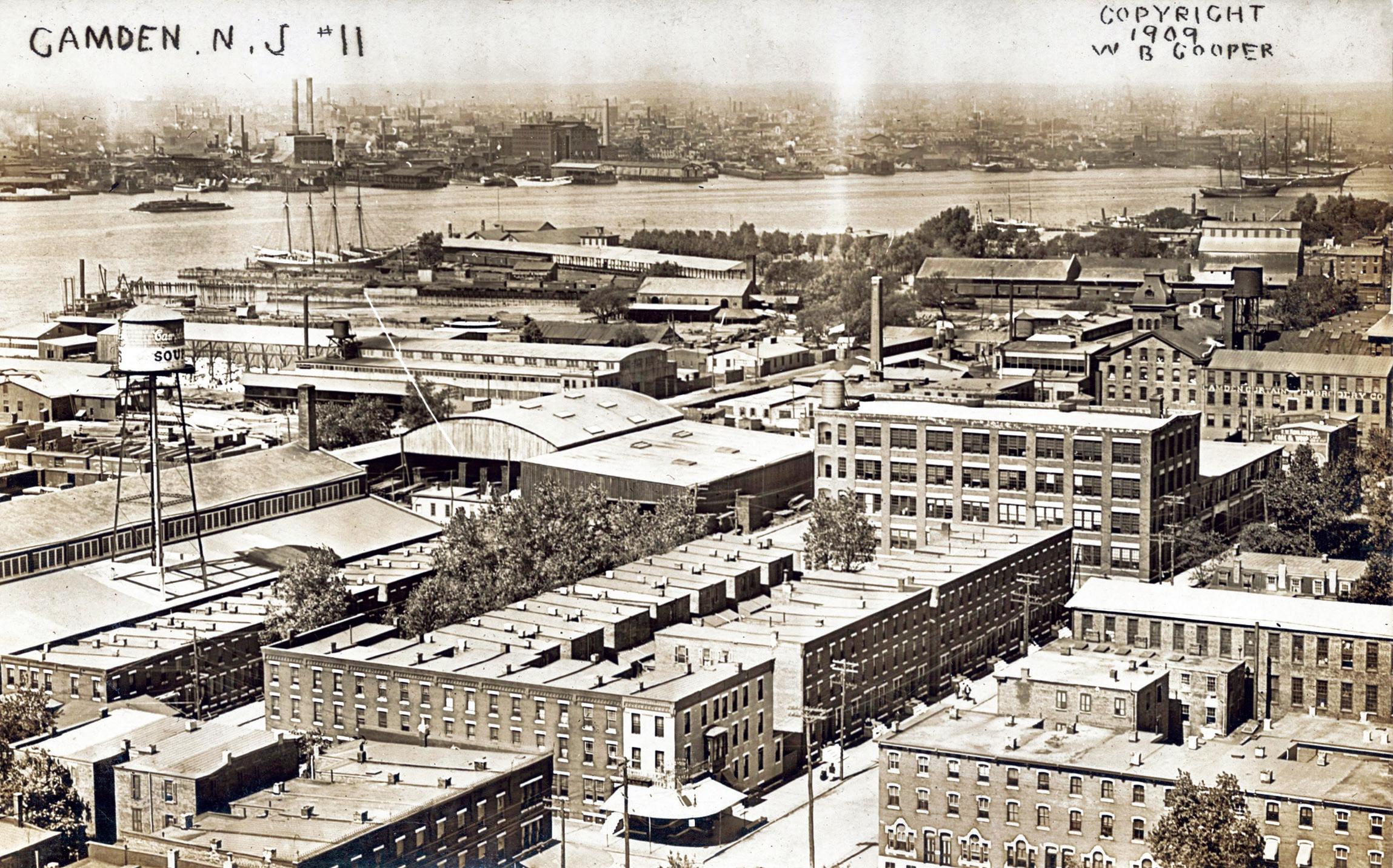
This photo from 1909 looks NNW toward Cooper’s Point with a Campbell Soup warehouse and various factories in the foreground. On the river are several large sailing ships. Camden was thriving in this era, with numerous large manufacturing companies choosing to headquarter their businesses in the city, providing a large employment base.
e demise of Radio Corporation of America (RCA) left large vacant warehouses, factory buildings, and wharves adjacent to the waterfront. Campbell Soup Company decided to keep its headquarters in Camden but stopped producing soup in the city, resulting in more vacant waterfront property.
e railroad infrastructure along the waterfront also radically downsized during this time. Acres of abandoned, contaminated, and derelict properties were, in theory, available, but they required massive funding to clean up and repurpose.
Given its prime location and spectacular skyline view of downtown Philadelphia, city planners and developers recognized its potential and, beginning in the early 1980s, e orts coalesced around redeveloping the city’s
waterfront as a tourist destination. Much of this waterfront development was spearheaded by the Cooper’s Ferry Development Association (1984), a public-private planning and redevelopment agency. Its rst project was the construction of a small marina and promenade along the riverfront (1987), followed by the development of a number of tourist-oriented projects, including the New Jersey State Aquarium (1992) and a major arena, which successfully began booking nationally known entertainers.
is investment spawned further waterfront development in the form of adapting an old RCA building into loft-style rental apartments with water views. Seasonal passenger ferry service to Philadelphia was added in 1992; a few years later, ground was broken for
an old-style minor league ballpark on vacant waterfront property adjacent to the Ben Franklin Bridge.
e capstone of this revitalization e ort was the successful campaign to permanently station the battleship New Jersey in Camden as a museum ship in 2000. Further recent developments include Subaru of America headquarters, the Philadelphia 76ers training complex, a major o ce complex, and other business facilities and market-rate housing.
Commercial maritime activity in Camden, to some extent, continues to thrive. New York Ship’s old docks and buildings have been taken over by the South Jersey Port Corporation, which runs the Port of Camden, a break-bulk port that remains a busy hub of transshipment worldwide. Several private
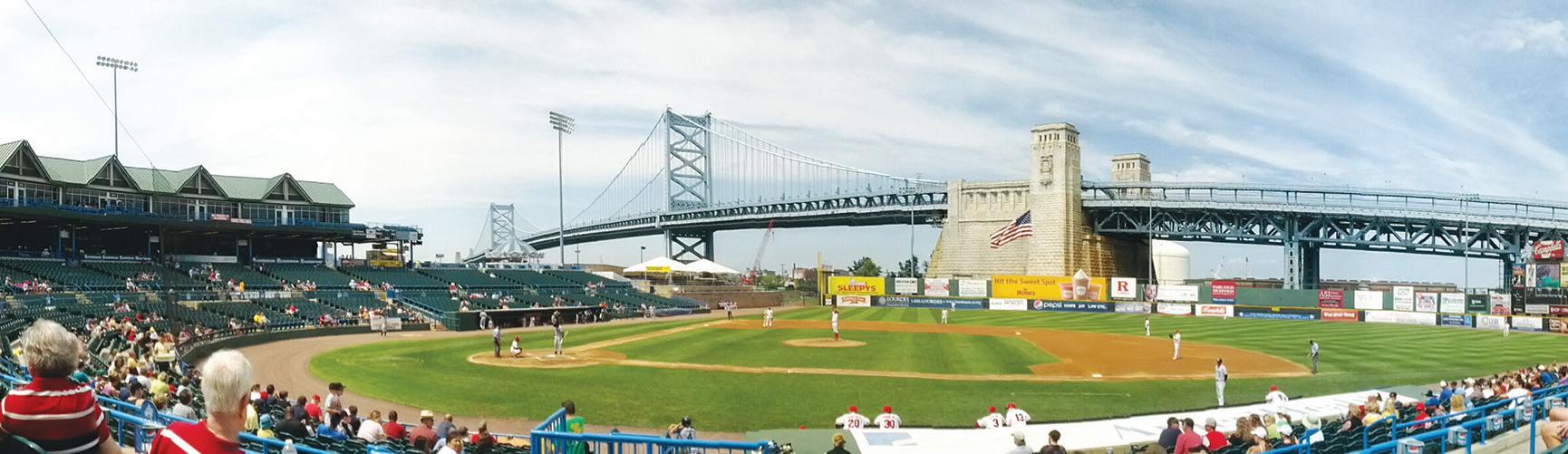
companies also share this facility. It continues to coexist, albeit uneasily, with adjacent recreational uses, ever hungry for more access to waterfront property. Other parts of New York Ship parcels have been redeveloped by the Holtec Company, a major facility serving the nuclear energy industry.
Having largely shed its former negative reputation, Camden is now considered as being on a rebound. It is no accident that much of this revitalization has been centered along its waterfront and the impressive array of public-private ventures that have injected a new spirit of optimism and pride. One often overlooked factor aiding Camden’s revitalization has been the successful e ort to clean up the pollution owing into the Delaware and Cooper Rivers. One problem that remains is that much of the revitalization has not bene ted local residents nor resulted in marked improvement in many of the city’s neighborhoods. Camden remains a struggling city, with approximately a third of its residents living below the poverty level.
Much of Camden’s redevelopment catered to the a uent, who could a ord to pay entrance fees. After the decline in the 1960s, Camden became a city
dominated by poor minorities. Grassroots e orts to include these families, and especially children, in Camden’s revitalization have been e ective. With the ongoing cleanup of the Delaware and Cooper Rivers, these waterfront spaces and the rivers themselves have been recognized as potential sites for educational and recreational programs.
Recognizing there was no convenient and safe place to access the river to sh, a local priest, Father Michael Doyle, persuaded the county to develop a shing pier in South Camden in 2002. He followed this successful e ort with a push for the development of a small waterfront lot, called Phoenix Park, on a ve-acre remediated brown eld site hemmed in by industrial facilities. Here, in these two small hidden places, neighborhood residents can cast a line to sh in the river, launch a small boat, or simply take in the view of the Philadelphia skyline.
Doyle’s e orts led to several other waterfront parks being developed along the Camden waterfront, including Petty’s Island, where a former oil terminal has been transformed into a protected environmental area. On the adjacent shore, Camden’s former city dump has been remediated and has been made into a beautiful new park. As Atlantic sturgeon and shad runs return to the Delaware River, so have
bald eagles, ospreys, and great blue herons, which are now regularly spotted on and around Camden’s rivers.
ese new riverfront parks sparked the development of experiential learning programs. Urban Trekkers, developed by Jim Cummings, a teacher at the Urban Promise School, focuses on providing inner-city youth with boating excursions along the Cooper River and out to the seashore. With the success of those rst programs, Cummings soon hit on the idea of having the kids build their own boats. is, he anticipated, would add energizing, practical, hands-on experiences that bring science, technology, engineering, and math (STEM) into the program.
Urban BoatWorks, a boatbuilding shop run by volunteers, quickly took shape at the Camden Shipyard and Maritime Museum in the Waterfront South neighborhood (described in the Autumn 2013 issue of Sea History). at year, students in the program began building wooden kayaks, sailboats, and rowboats under adult supervision, which they would then launch on the Cooper and Delaware Rivers. is development was celebrated by many; Camden’s “Good Gray Poet,” Walt Whitman, would have celebrated it as well. Whitman loved Camden and the
Delaware River, and his published works included moving passages about riding the old Camden ferries and watching the stars at night. e trend towards prioritizing cleaner waters and public access has led to more players developing programs that use the waterfront and rivers for educational purposes. Upstream Alliance, another Camden-based environmental organization, is building a new solar-powered boat, Fire y, a 49-foot catamaran that will be able to take large groups of students out on the rivers to conduct environmental studies and simply enjoy the river environment and all its glory.
Today, Camden remains a somewhat gritty, post-industrial city, where poverty is a major problem, but port operations and boatbuilding continue, growing alongside environmental initiatives and educational programming. e grassroots citizen action that has led to the reclaiming of public access to the rivers is inspiring to see. is access has enabled local youth to enjoy exploring and learning in Camden’s natural environment and connect to maritime careers. It is hoped that this river-based strategy of urban revitalization will lead to better times for New Jersey’s “Biggest Little City” and its residents.
Michael H. Lang is professor emeritus at Rutgers University-Camden and past director of the Camden Shipyard and Maritime Museum. A former resident of Yorkship Village in Camden, he views his 30-plus years in the city with nostalgia. He wishes to recognize the important contributions to this article from Jim Cummings, president of the Board of Trustees of the Camden Shipyard and Maritime Museum, and Ronnie Vesnaver, Director of Regional Programs and Partnerships at the Upstream Alliance, Annapolis, Maryland.
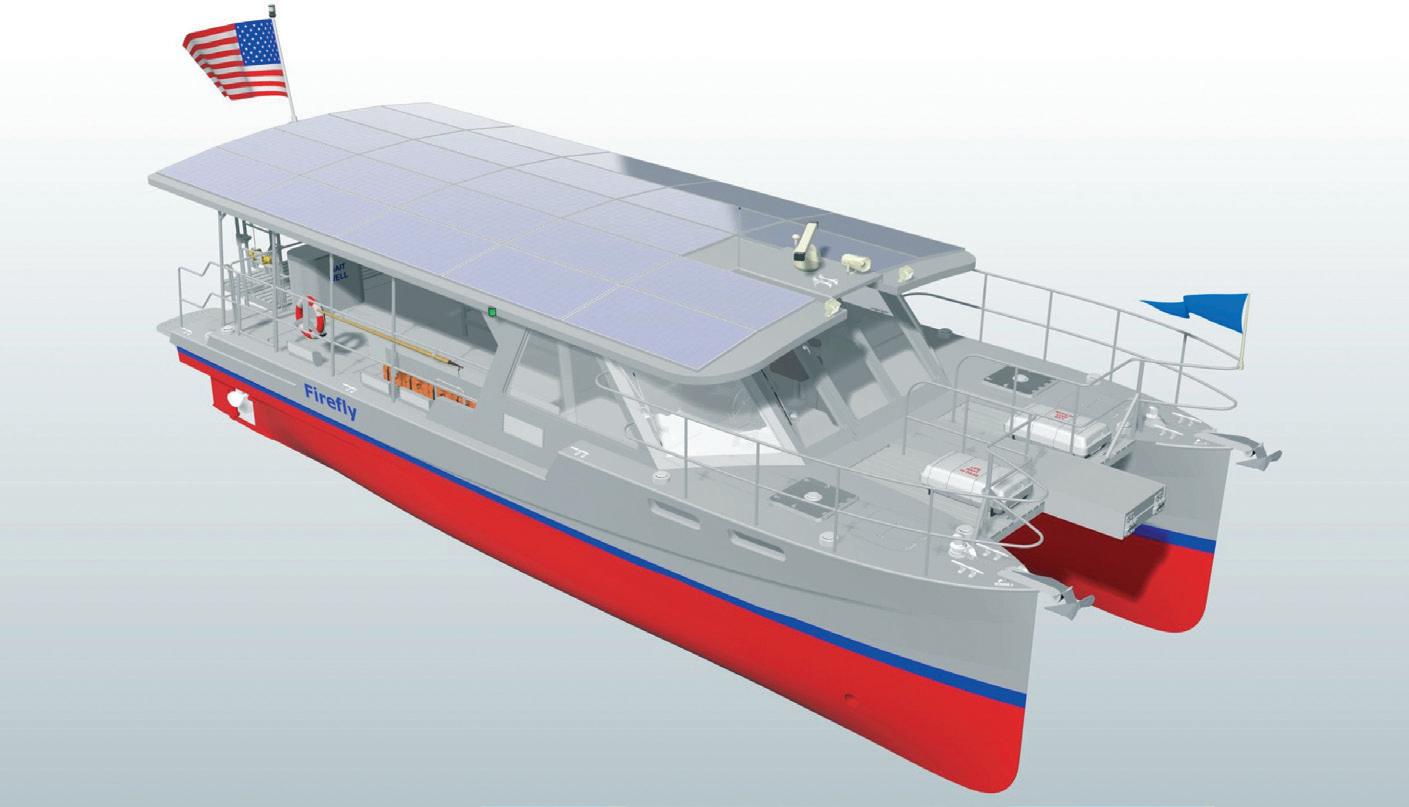
Maritime-based youth programs are bringing the city’s youth to the waterfront to explore its local waterways. (above) Upstream Alliance runs programs to connect local citizens to nature by providing on-the-water experiences to explore local waters and conduct field work in environmental conservation. It is currently awaiting the completion of a carbon-neutral aluminum catamaran, Firefly, which it will use as a floating classroom and science lab. (www.upstreamalliance.org)
(right and below)
Urban Promise programs (Urban Trekkers and Urban Boatworks) get young people out on the water in boats they build themselves through a collaboration with the Camden Shipyard and Maritime Museum. (www.urbanpromiseusa.org)
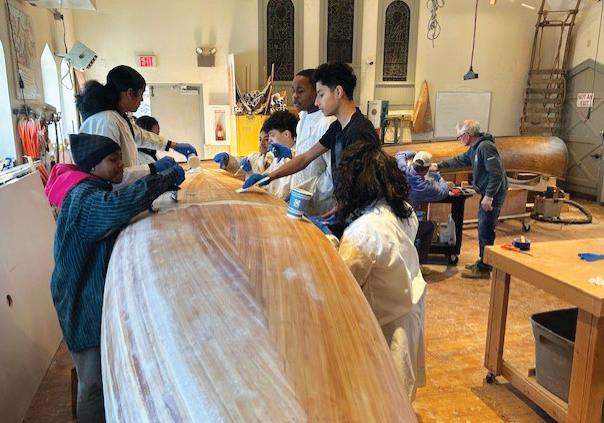
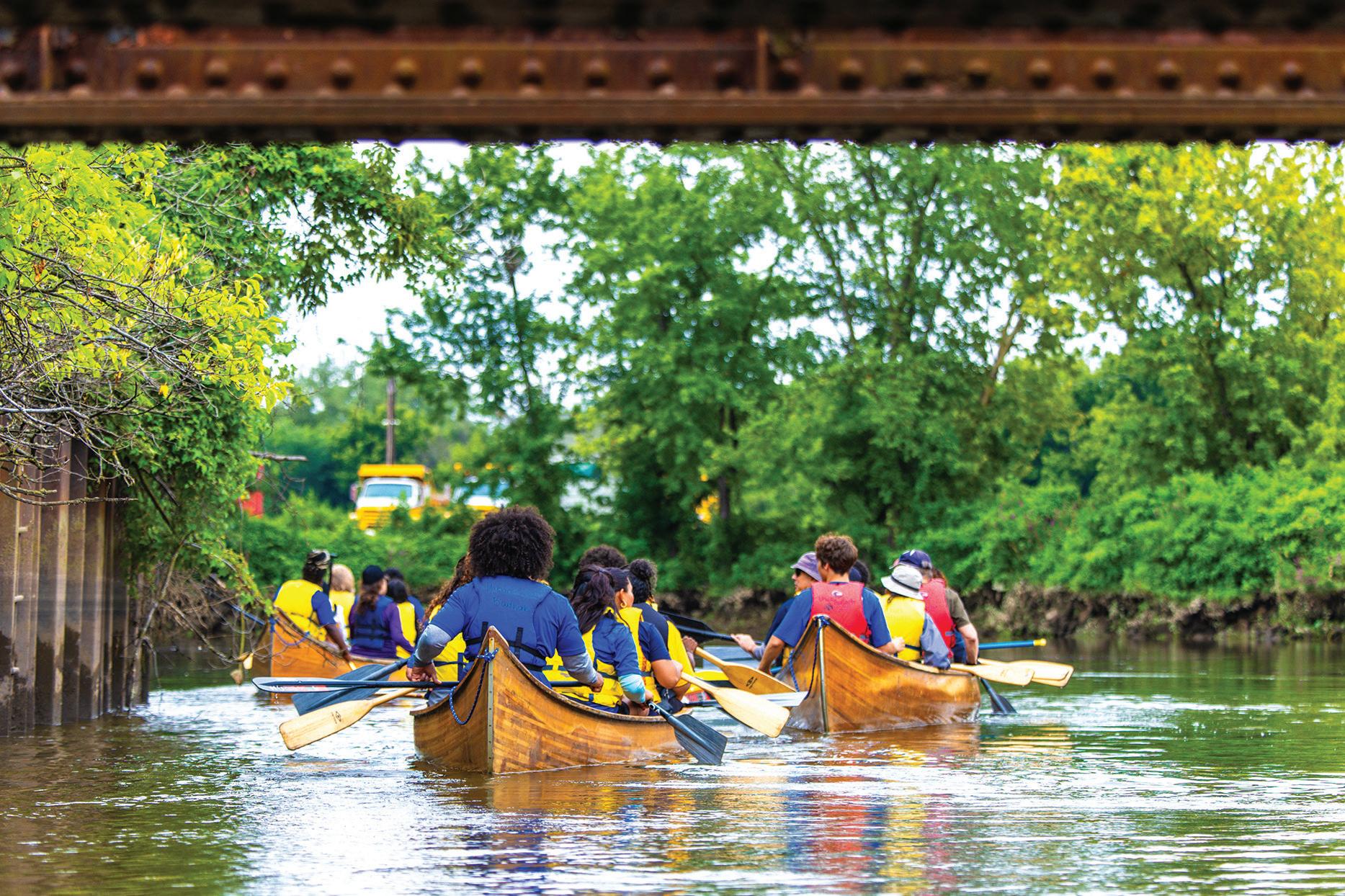
by Paul F. Johnston
George Henry “Harry” Hunt (1878–1912) and Elizabeth Maude Holder (1879–1967) had a plan. Harry was an English estate gardener working for his father, a noted horticulturist in Surrey, England, who specialized in cultivating prize-winning chrysanthemums and orchids. e oldest of ve, Harry was also a well-known horticulturist who worked with his father at Ashtead Park for wealthy landowner Pantia Ralli, but he wanted more. So did his ancée, Elizabeth, the second of nine children and a cook with an eighth-grade education. Both in their late twenties, the couple decided to emigrate to the United States, get married, and settle there. Wealthy estate owners in the
American Northeast cherished British and European symbols of wealth and power, and they especially needed gardeners and groundskeepers to develop and maintain their extensive gardens and grounds designed on the English paradigm.
eir plan worked like clockwork: Harry left Southampton aboard the twin-screw liner SS New York on 17 March 1906, arriving at New York on 25 March. His younger brother Albert followed, leaving England on 27 April and arriving in New York aboard SS Philadelphia on 10 May 1906. Elizabeth departed two months later, leaving Southampton with $245 aboard RMS Campania on 7 July, arriving at New York on 14 July.
Perhaps propriety dictated the couple’s di#erent ships and arrival dates, or Harry may have needed time to arrange for employment, lodging, and the wedding. Exactly a week after his betrothed’s arrival, the couple was married at St. Andrews Church in Yonkers, New York. Albert soon wed as well, marrying Elizabeth Rose Kingman on 16 September 1906 in the Bronx. Nine months after their nuptials, Harry and Elizabeth had a daughter, Marjorie.
Over the next few years, Harry worked di #erent jobs in di#erent towns in New York, New Jersey, and Pennsylvania. His rst job may have been working for chief gardener John Featherstone at the magni cent Greystone estate in Yonkers, north of Manhattan.
Greystone was owned by Samuel Untermeyer, a prominent New York attorney, businessman, and orchid collector and cultivator. e 150-acre property featured a 99-room mansion on a blu # overlooking the Hudson River; it originally had thirteen greenhouses and formal gardens. In 1905 Featherstone won rst prize at the Tarrytown Horticultural Society Flower Show, but all was not well. e next year, the head gardener sued Untermeyer for wages owed him. e public newspaper notice of this lawsuit must have embarrassed Untermeyer, whom famous jurist and politician Williams Jennings Bryan called “America’s greatest lawyer.”
Harry’s tenure at Greystone was short. e Morris County Chronicle (New Jersey) for 5 February 1907 published the terse notice that “Henry Hunt, of Yonkers, succeeds Richard Vince as gardener for R. D. Foote. Mr. Vince is taking a vacation.” Robert Dumont Foote was a Morristown bank president, gentleman farmer, and noteworthy civic leader; his $250,000 44-room mansion Spring Brook House was completed in 1906 as the hub of a large estate of more than 180 acres. e 1907 Morristown directory lists the more modest Hunt home at 4 Macculloch Ave., from which Harry polished his credentials. e Florists’ Exchange for 23 March 1907 recorded that Geo. H. Hunt “had three vases of ne carnations in as many kinds” at a local $ower show. Following that,
(top right) SS New York was operating as a transAtlantic ocean liner for the American Line. It was first built and put into service in 1888 as SS City of New York for the British-based Inman Line.
(right) Harry and Elizabeth Hunt were married in Yonkers, New York, on 21 July 1906, one week a er her arrival in the United States.
at the October 1907 meeting of the Morris County Gardeners’ and Florists’ Society, Henry H. Hunt was scheduled to read a studious essay on orchids (Horticulture, 28 September 1907).
A year later, Harry was working for D. Rait Richardson of Morris Plains, who had bought Stone Acres,
the former residence of businessman and philanthropist Louis A. ebaud. e ebauds summered in Gloucester, Massachusetts, and in maritime circles, his wife became better known than he, as the namesake of the famous Gloucester shing schooner Gertrude L. ebaud. e Essex-
built boat fondly nicknamed “Gertie Thebaud” outsailed the Canadian schooner Bluenose to take the International Fisherman’s Trophy in 1930. e 1910 Census had the Hunts living in Philadelphia, “America’s Garden Capital,” with more than 30 public gardens in the region. roughout the geographical and vocational changes, the family kept close ties with relatives in England, with transAtlantic crossings in both directions a near yearly routine. In early 1910, Elizabeth and daughter Marjorie sailed to England aboard SS Adriatic to visit relatives, returning to the United States on 5 March.
Harry’s range in his profession was expanding; the Pittsburgh Post-Gazette for 24 October 1910 described the annual chrysanthemum show at the Pittsburgh home of H. J. Heinz, singling out a variety named “Mrs. George Hunt.” Two weeks later, the Philadelphia Inquirer for 9 November 1910 listed rst prize winners at the annual Horticultural Hall $ower show, including a croton named “Mrs. George Hunt.” Harry’s abilities and reputation were also $ourishing, and in 1911 he became the orchid grower for Edna Wilson of Philadelphia shortly after she red and sued her chief gardener, Alphonse Pericat, over a business deal gone wrong. Her husband, George B. Wilson, was one of the wealthiest property owners and realtors in greater Philadelphia (perhaps coincidentally,
(above le ) Elizabeth Holder followed her fiancé across the Atlantic aboard RMS Campania. In 1901, Campania and her sister ship, RMS Lucania, were the first Cunard liners fi$ed with the Marconi wireless telegraph and became the first to exchange an ice bulletin at sea.
(le ) The magnificent Greystone estate in Yonkers, New York.
a same-named character appears in F. Scott Fitzgerald’s 1925 great American novel, e Great Gatsby ).
At her magni cent home at 43rd and Walnut in Philadelphia, Edna Wilson had seven greenhouses housing the largest and most diverse orchid collection in the nation. An avid collector, she employed multiple orchid hunters in South America to root out the rarest and most exotic examples and bring them back to Philadelphia.
e Florist’s Exchange for 16 December 1911 describes a Wilson greenhouse tour by Harry that featured a Phalaenopsis Harriettiae variety of orchid worth over $2,000. In this new position, Harry had reached the absolute peak of his profession, and he was writing learned correspondence in local $oral journals.
Elizabeth’s younger sister Rosina crossed the Atlantic the next year to visit with the American branch of the family. Sailing in the opposite direction, brother Albert visited the old country in February 1911 with his wife and son, returning to the US aboard SS Adriatic on 10 March. Elizabeth Hunt gave birth to their second child in January 1912, a son, Wilfred.
(above right) Harry Hunt le Greystone to accept a position as gardener for R. D. Foote’s Spring Brook House, the largest residence ever built in Morristown, New Jersey. A 1926 real estate listing for the property included a description of the grounds: “Comprise 20 acres of sweeping lawns. Large floral and vegetable gardens. A decorative feature being Sunken Gardens with ornamental carved stone foundations. Magnificent trees.” In 1986, Spring Brook House was added to the National Register of Historic Places.
(right) Elizabeth and Marjorie Hunt during a 1910 trip to England to visit family.
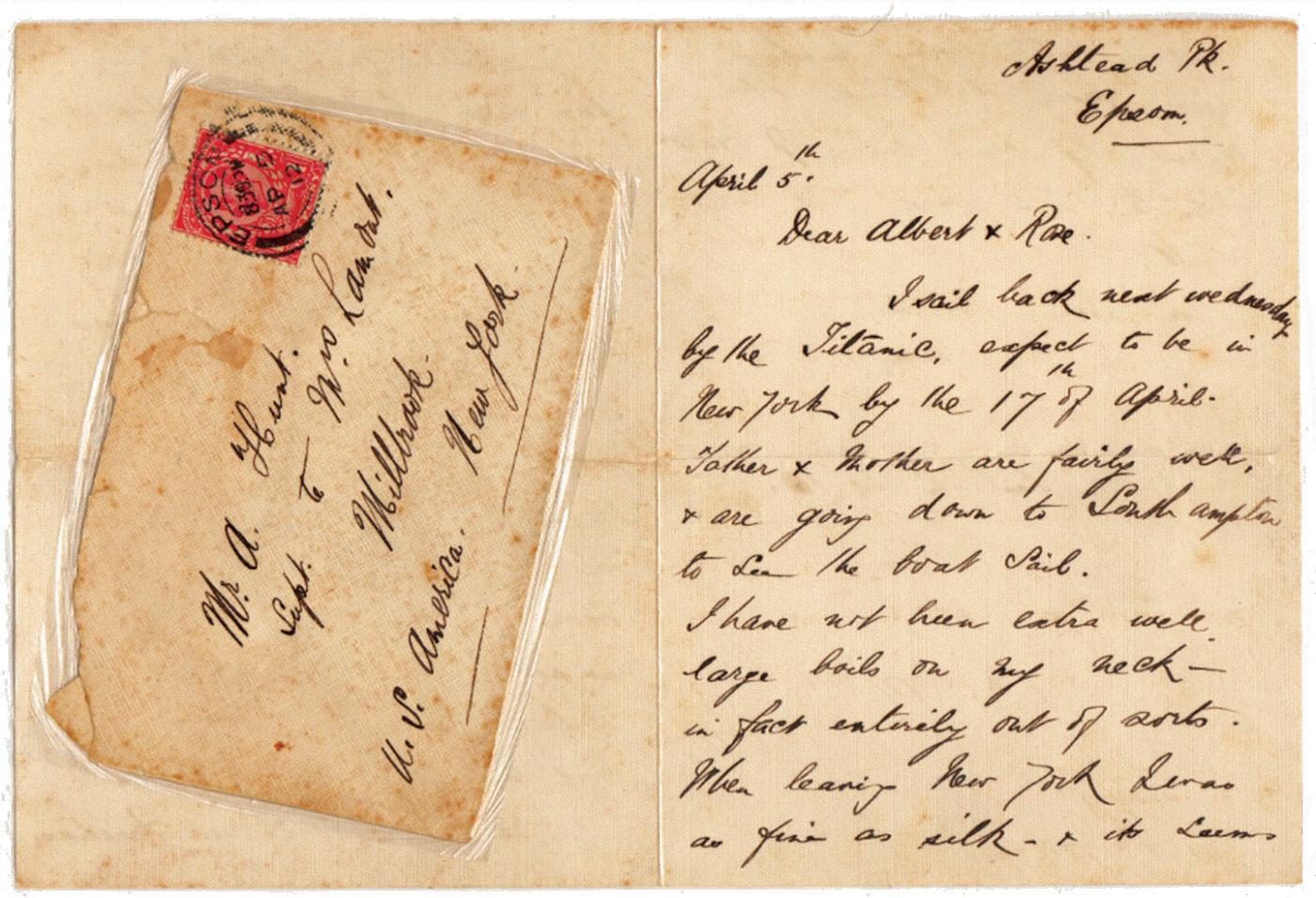
5 April 1912 le$er from Harry Hunt to his brother Albert and his wife, Rose, in New York, mailed from Surrey, England, a few days before boarding RMS Titanic for his return trip home to his wife and young children.
(below) One of the last photographs of Titanic, taken as the ship was departing Southampton, England, on 10 April 1912.
For his next voyage back to England in early March 1912, Harry booked a second-class round trip on the White Star liner RMS Oceanic, arriving at Southampton on the 17th. He traveled alone. Wilfred was two months old at the time, and four tickets might have been prohibitively costly. Springtime weather on the Atlantic Ocean can be rough; there may have been other reasons, of course, that in $uenced his family’s decision to remain in Philadelphia. Soon after Harry’s eastbound trip, Oceanic lost a blade on its starboard propeller, so White Star rebooked him on Titanic for the voyage back to New York, with ticket #1585 at a cost of 12 pounds, 5s 6p (around $60 then).
Harry visited relatives and friends in Surrey, and on 5 April, just a few days before leaving England, he wrote the rst of two letters eventually donated to the Smithsonian by the estate
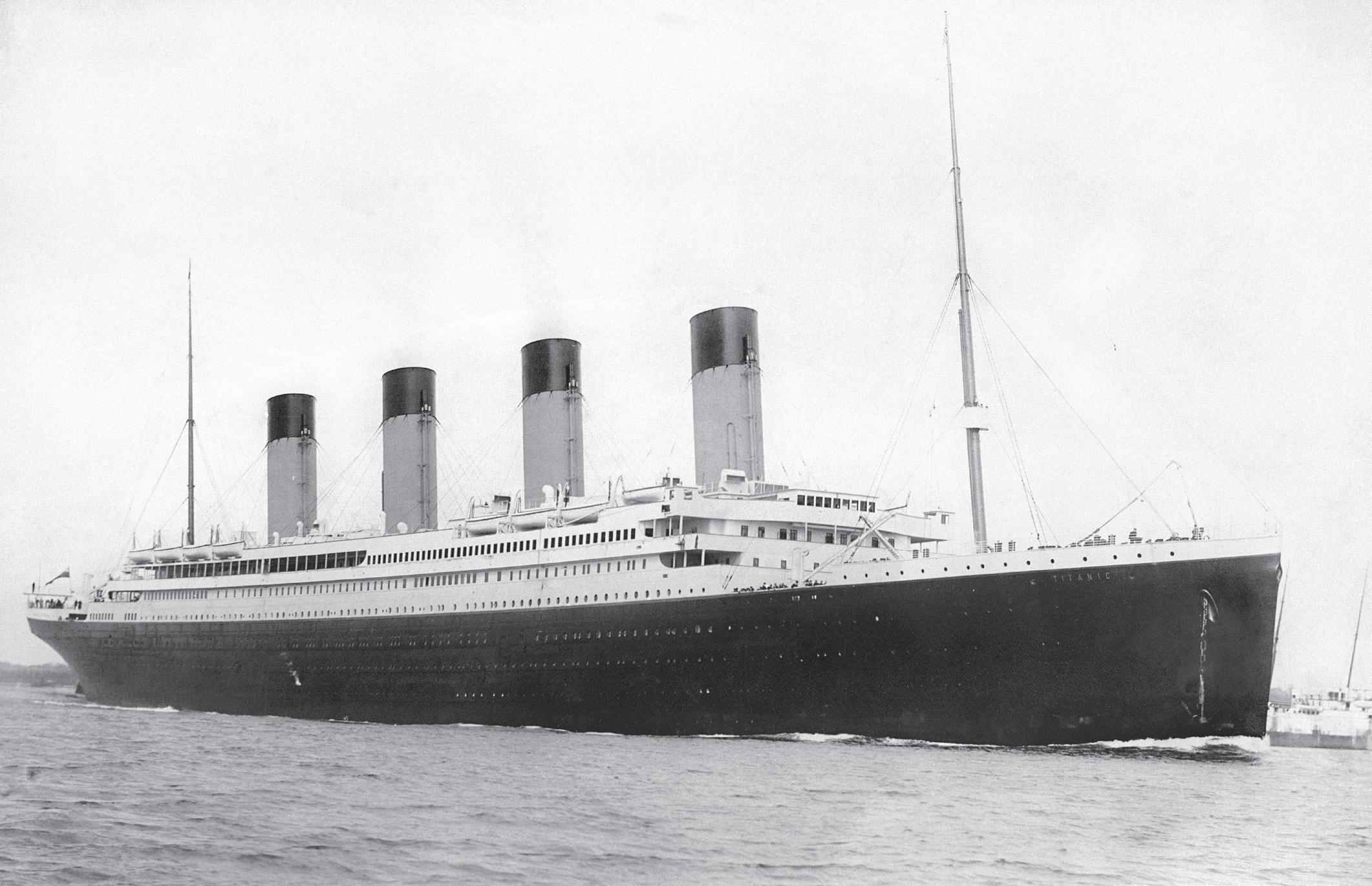
of Harry’s granddaughter, Carolyn Hunt. e letter was written to Harry’s brother Albert and sister-in-law Rose back in New York: Ashtead Pk [parental home] Epsom
April 5th
Dear Albert and Rose, I sail back next wednesday by the Titanic, expect to be in New York by the 17th of April. Father and Mother are fairly well, & are going down to Southampton to see the boat sail. I have not been extra well large boils on my neck—in fact entirely out of sorts. When leaving New York, I
was as ne as silk & it seems a pity that one can’t stay long enough to get climatized. Have bought a few orchids for Julius Roehrs. I don’t suppose I shall see you in New York as you are busy this time of year.
I must say the weather has been very good the last fortnight. It rained a lot the rst week I was home. Have seen all the Holloways. Was up to see GH Holloway yesterday.
Next Monday the 8th I shall go down to Ruth at Fareham. It will be better than rushing away from Ashtead the morning of the sailing of boat. Hope this will nd you all well.
Your loving brother Harry
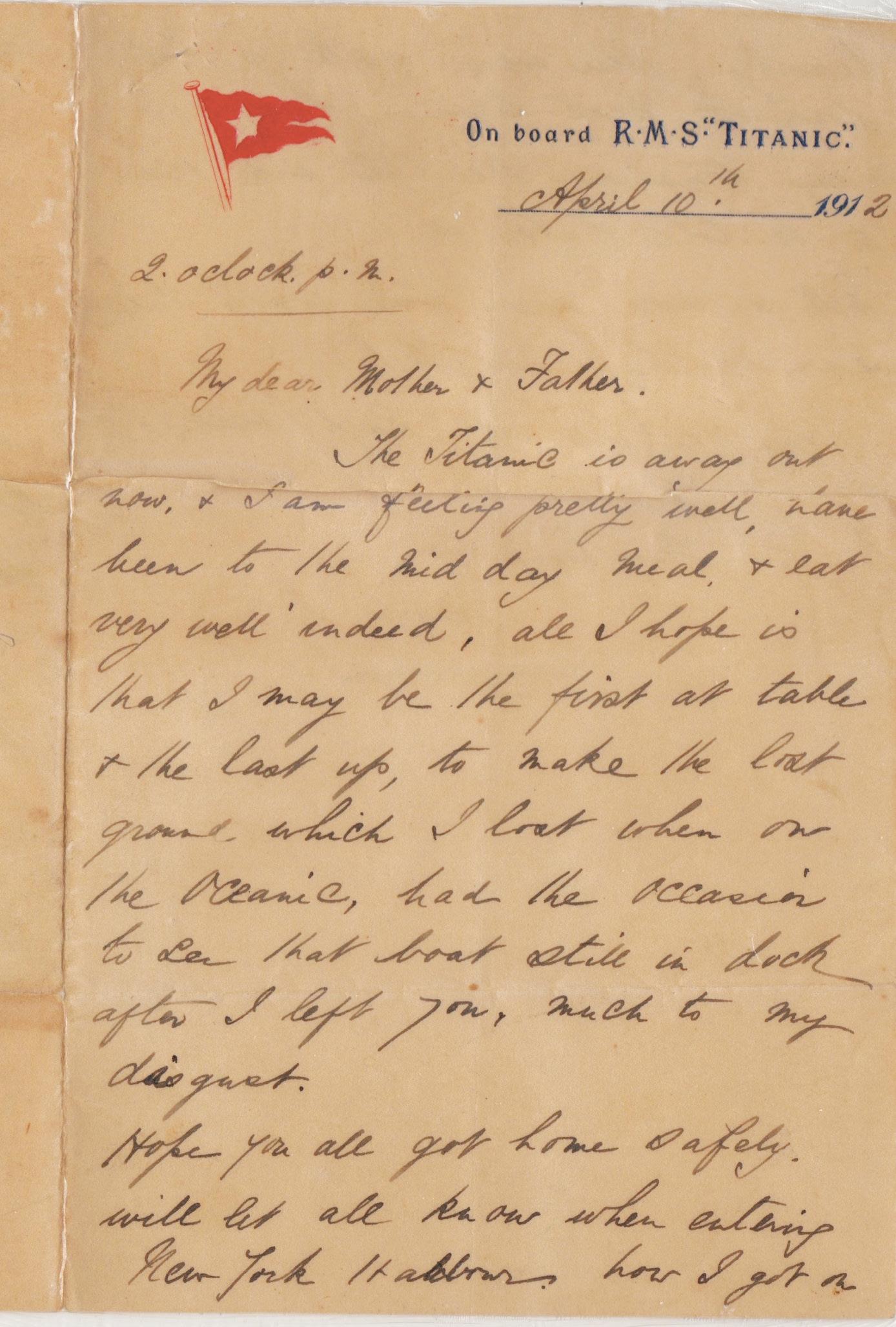
Ruth was Harry’s youngest sibling; the Holloways were Hunt cousins. e letter mentioned Harry’s purchase of a few orchids for Julius Roehrs. Roehrs was a German who had migrated to the United States in 1864 to grow orchids for a wealthy industrialist in Jersey City. He opened his own business in 1869, supplying fresh $owers to New York $orists and major Manhattan o ce buildings, including Rockefeller Center. Based today on an 86-acre complex in Farmingdale, New Jersey, the Julius Roehrs Company continues to o#er interior design and plantscaping services, along with $owers from its tropical nursery.
Harry traveled to Southampton and boarded Titanic on 10 April, seen o# by his parents, a brother, and his sister Ruth. at same day, shortly after boarding, he sat down and wrote two letters to family members. e two letters were posted at Queenstown (now Cobh), Ireland, Titanic ’s last stop before heading out across the Atlantic:
On board R.M.S. “Titanic.” April 10th 1912 2.oclock. p.m.
My dear Mother & Father, e Titanic is away out now, & I am feeling pretty well, have been to the mid day meal and eat very well indeed. all I hope is that I may be the rst at table & the last up to make the lost ground, which I lost when on the Oceanic. had the occasion to see that boat still in dock after I left you, much to my disgust.
Hope you all got home safely. Will let all know when entering New York Harbour how I got on during the voyage. is letter will reach you through Queenstown, the mails close at 5. p.m. Maybe the boat will reach that port this evening. e thing I am satis ed that I saw you all and found every body looking so well.
Have not seen my Bedroom Mate yet. I expect to spend most of my time on deck. I want to see as much as I can of the land—there will be plenty of water later on.
Will let you know how I nd them all at Philadelphia and how the Orchids got through.
is boat seems to me a good vibrator. She is shaking heavily. ere were quite a lot down at meal time, but how many tomorrow the tale will have to be told later on.
Well no more now, will write directly I am reaching New York. Hope you will all keep well.
From Your loving Son, Harry.
It is a common trope that a secondclass passage aboard Titanic was as good as rst-class on other ocean liners. Around a quarter of Titanic ’s accommodations were for second-class passengers, but information about the
shipboard second class is scarce. Much more research has gone into Titanic ’s rst and third classes, from the enduring fascination with celebrity at one end, and greater interest in immigration at the other.
In some places, rst- and secondclass accommodations aboard Titanic were indistinguishable from one another, and the two classes had adjacent cabins on the same decks. e secondclass library, smoking and dining rooms
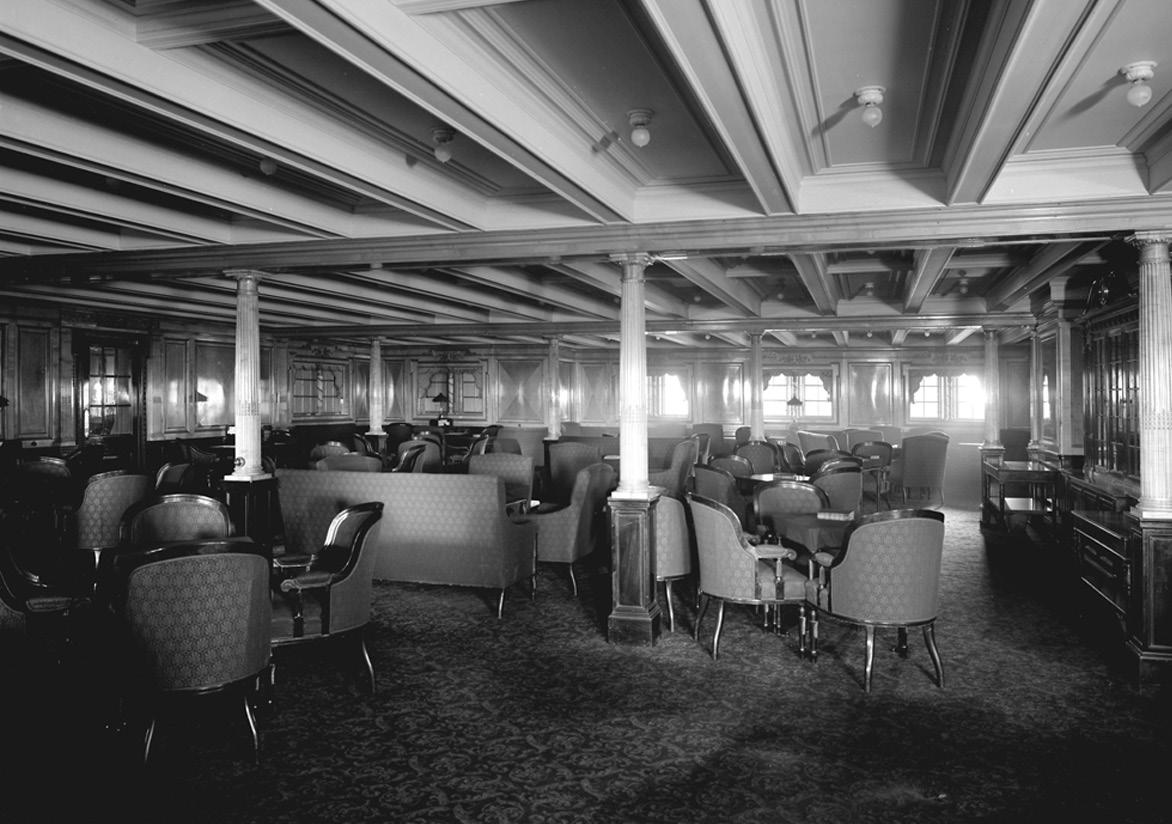
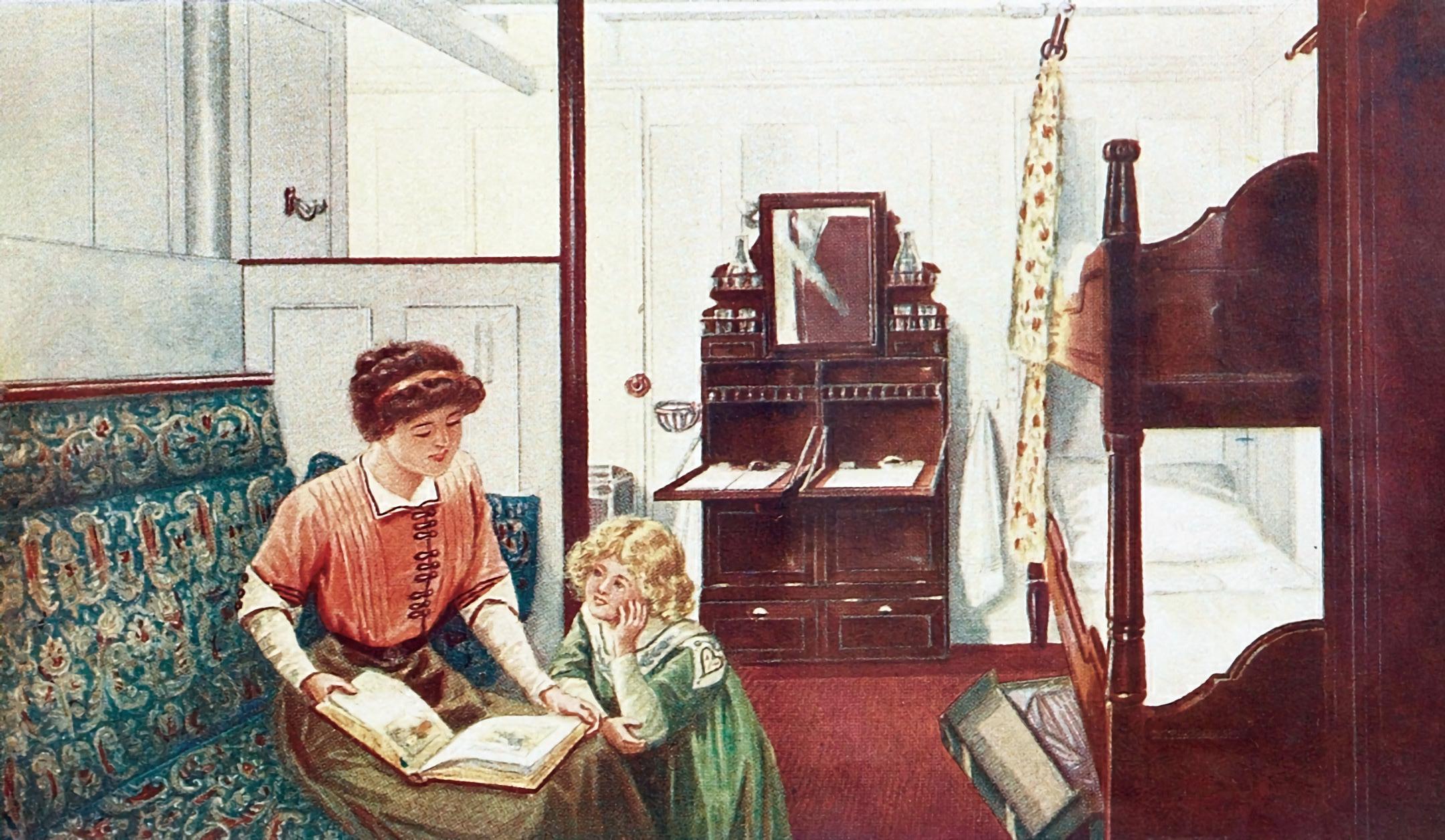
on the bridge, and shelter decks were lavishly lined with dark oak paneling, leather upholstered chairs, and other elegant features.
Olympic-class dining rooms featured formal banquet seating with white tablecloths and painted paneling. Matching the same décor as the dining room, second-class cabins had painted oak paneling, linoleum $ooring, bunk beds, and heavy mahogany furniture. Unlike in rst class, men’s and women’s bathrooms in second class were shared. On one deck, the second-class cabins could be converted to rst class if needed; likewise, the second-class cabins on lower decks could be made into third class, when required. Titanic had 284 second-class passengers booked for its maiden voyage, but some surely failed to board for various reasons.
Loss and The Family
Harry did not survive the Titanic sinking and his body was never recovered. Contemporary sources indicate that the American Red Cross and the Charity Organization Society of the City of New York combined to help Elizabeth rent a boarding house near a Philadelphia university, and she began supporting herself and her two children by renting rooms to college students.
In 1913 the Red Cross published the booklet Emergency Relief by the American Red Cross After the Wreck of the SS Titanic, in which it reported that it distributed $91,532.34 to 58 Titanic widows. Identi ed as No. 199, Elizabeth received $2,500 of that amount, of which $1,000 was designated for the boarding house and the remainder placed in trust for the children’s education. Harry was said to earn $80/month. e report further detailed that she received “$1,000 life insurance and $2,651.84 from other American relief funds,” for a total of $6,151.84. An in $ ation calculator grows that amount to $195,227.71 in 2024. With
two young children, many young widows might have returned to their home country to start afresh there, but Elizabeth decided to stay in Philadelphia and forge a new life without a husband. e money she received for Harry’s death aboard Titanic was likely a factor in her decision.
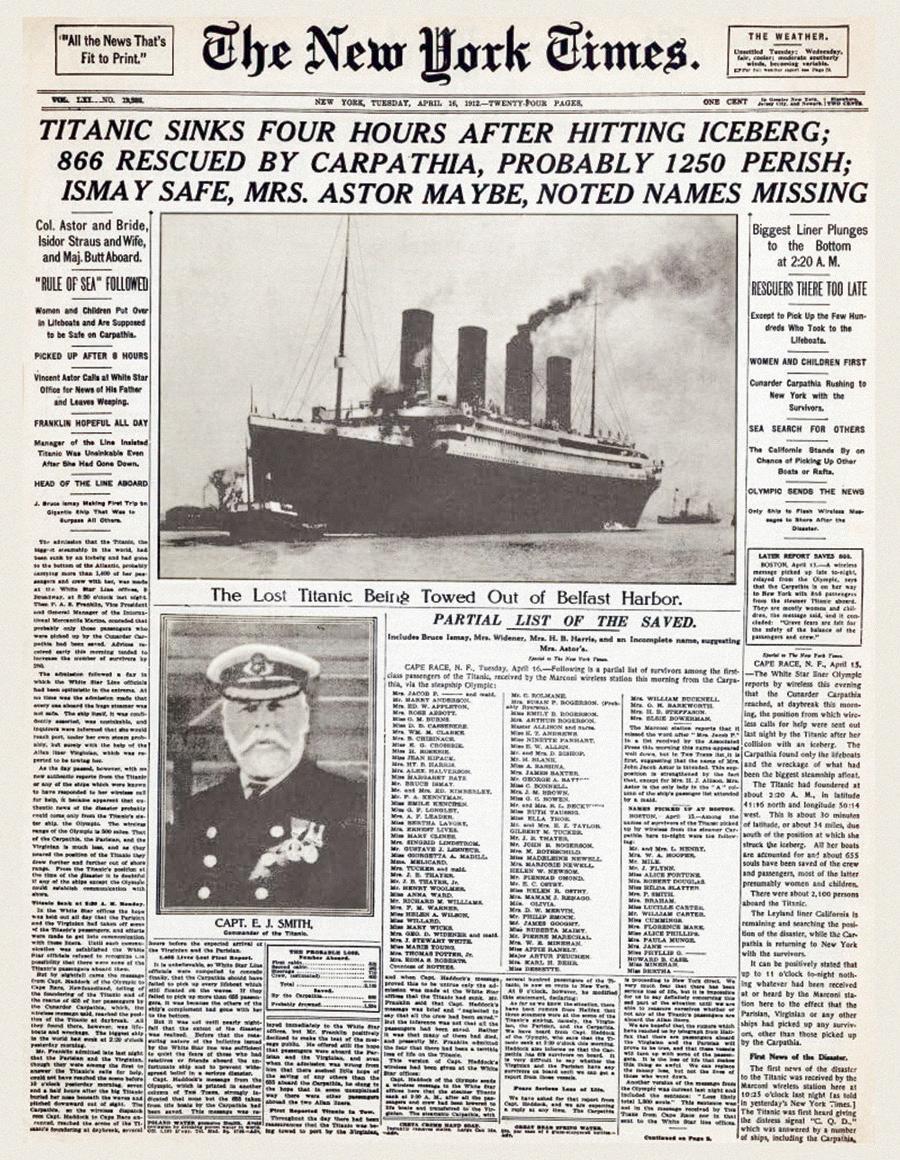
Seven months after Harry’s death, Elizabeth’s younger sister Alice and her husband Frederick, a carpenter, arrived at New York on 16 November 1912 aboard SS Baltic, almost certainly to help their sister’s transition from wife and mother to widow and small business owner. A year after the tragedy, another of Elizabeth’s younger sisters, Lillian, emigrated to the United States aboard SS Carmaria , arriving on 24 March 1913. e 1920 Census placed Elizabeth and Lillian in a rented boarding house at 300 North 40 th St., Philadelphia; both Drexel University and the University of Pennsylvania were just a few blocks away and would have supplied plenty of tenants. Elizabeth and Harry’s children, Marjorie and Wilfred, also lived there, along with ve boarders, two of whom were shipyard workers. Lillian married in 1923 and died in Philadelphia at the age of 41. By 1930, Elizabeth had purchased a 1,894-square-foot house
at 44 St. Bernard Street in Philadelphia for $6,800 and lived there with Marjorie and Wilfred. At rst, there were no boarders or tenants, but by 1940, there were lodgers.
e transAtlantic crossings continued. In August 1936, Elizabeth visited her relatives in England; two years later, in April 1938, she hosted her sister Rosina at her home in Philadelphia. By 1950, Elizabeth was living at 5041 Walton Ave., Philadelphia, with her son, Wilfred, and his wife and daughter. Wilfred was a shopkeeper dealing in radios; the 1950 federal census listed Elizabeth as a saleswoman there. In early 1955, nearly 43 years after he perished at sea, Elizabeth received a letter from the Cunard Line con rming that Harry was lost on Titanic. is must have been needed for naturalization, for just two months later, Elizabeth became an American citizen at the age of 67.
Why she waited that long is unknown. e following year, she and Marjorie and Marjorie’s husband visited the homeland via a round trip aboard the Cunard liner Queen Mary It’s interesting to note that family members continued to travel aboard ocean liners even after transAtlantic $ ights began and were becoming more regular (and a #ordable). In 1967, Elizabeth died in Drexel Hill, a Philadelphia suburb.
Marjorie, a secretary, had married a poultry commission merchant in 1932. ey had two daughters and lived in various Philadelphia suburbs; Marjorie was 90 years old when she died in 1997 in Pottstown, Pennsylvania. A Philadelphia shopkeeper, her younger brother Wilfred married in 1935; he and his wife, Florence, had a daughter, Carolyn Hunt, whose estate donated her family’s Titanic archive to the National Museum of American History. Wilfred died in 1996 at the age of 84 in Berwyn, Pennsylvania.
Unlike what we know about most other Titanic passengers—and it’s quite a lot—there were no upper-class nanciers, celebrities, or society members in the Hunt family. ey migrated to the United States in the early 20th century, integrated into American society, and became a typical American middle-class family within a generation. Elizabeth kept their family’s Titanic history private, as she did not want it to de ne them; it was her granddaughter, Carolyn, who preserved the family’s documents. e archive contains a few documents not described here: Harry and Elizabeth’s birth certi cates, Elizabeth’s death certi cate, and a few photographs with some unidenti ed family members.
Elizabeth’s decision to remain in the United States in the aftermath of Titanic’ s sinking as an independent woman raising two small children could not have been the easiest path to follow. She never remarried. Charitable organizations helped her through the most di cult transitional period after her husband’s death. Although separated by an ocean, family members on both sides of the Atlantic kept in touch and visited each other regularly, with some even migrating to the United States to help support her and her children. Not a second-class story by any marker.
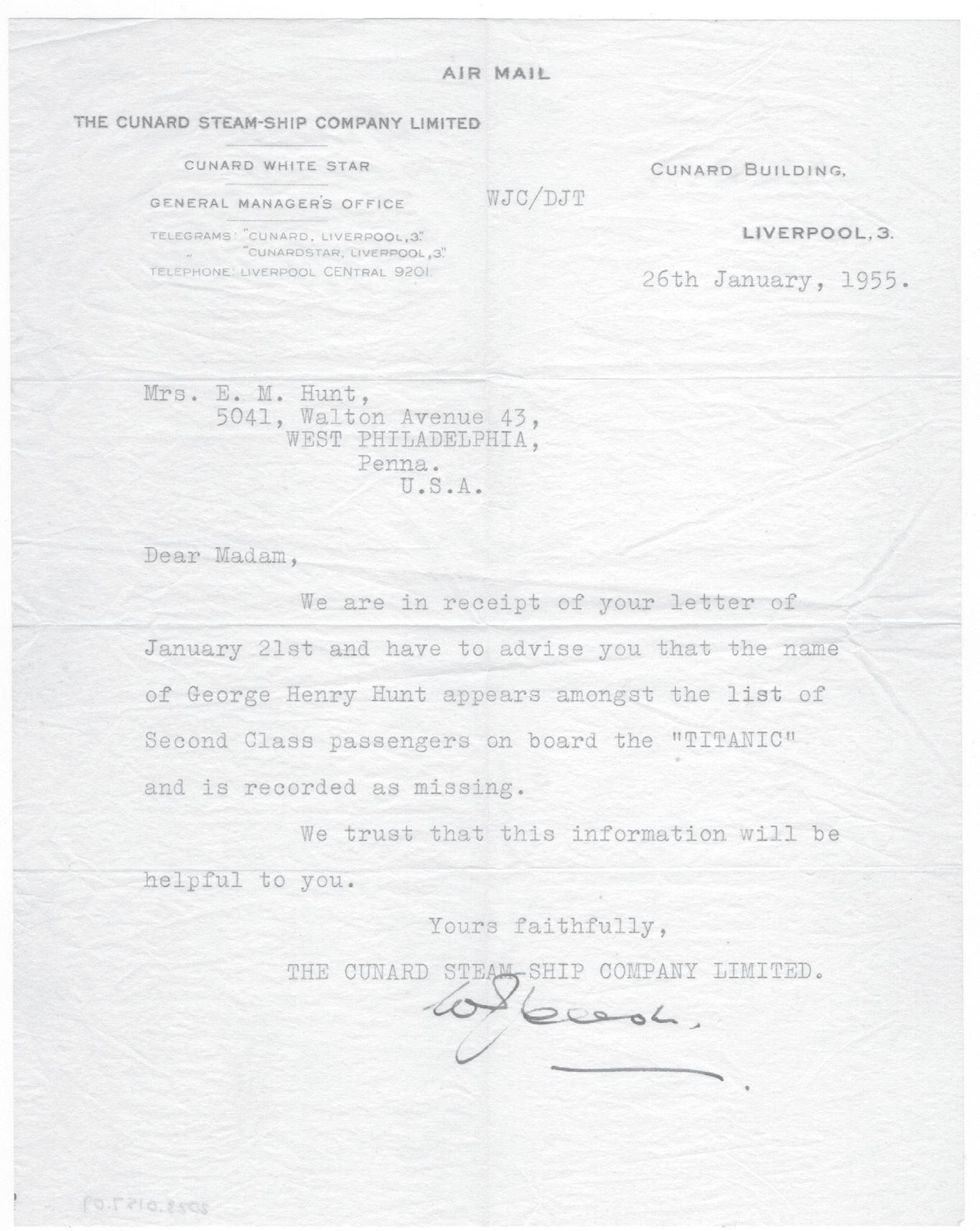
Paul F. Johnston is Curator Emeritus of Maritime History at the Smithsonian’s National Museum of American History in Washington, DC. He is profoundly grateful to genealogist and former volunteer Michael D. Smith, who came out of retirement to help with the Hunt family genealogy. Emily K. Troutman also generously provided critical background research and editing.
(top right) 1955 Cunard le$er confirming Harry’s loss on Titanic.
(right) Elizabeth Hunt’s naturalization certificate, dated 5 April 1955.
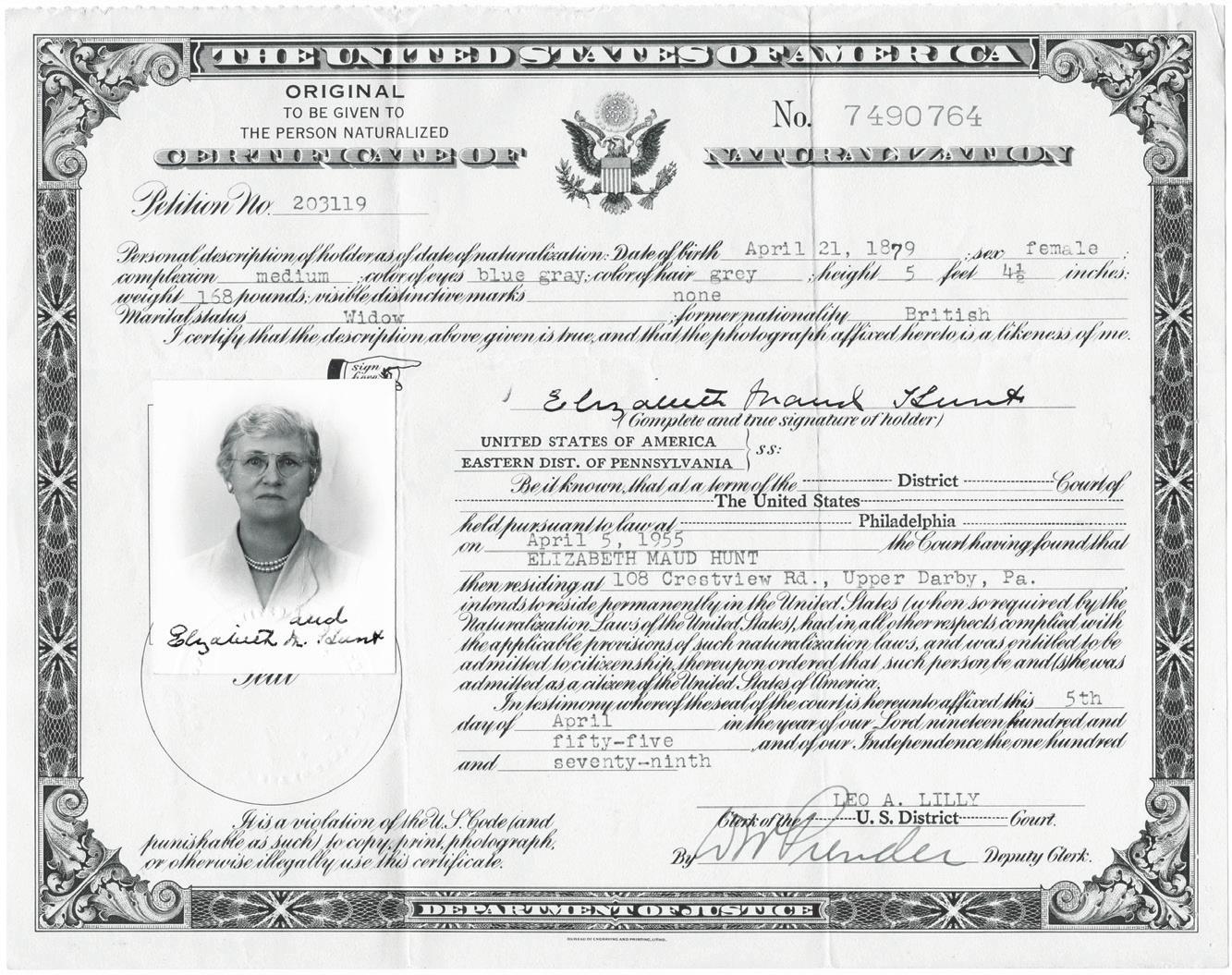
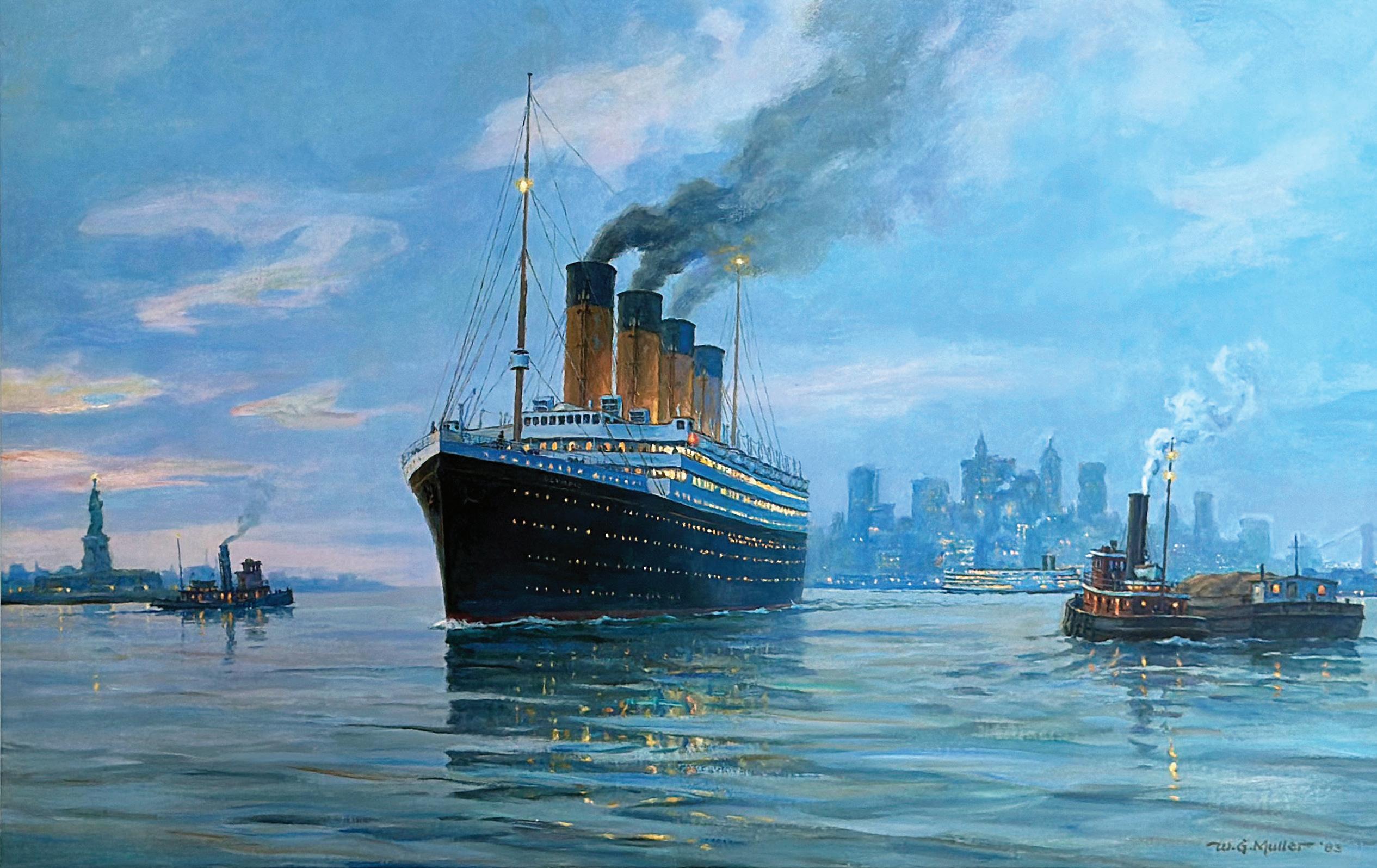
Operated by the White Star Line between 1911 and 1934, RMS Olympic was the largest ocean liner in the world at the time of her launch and was only surpassed by her sister ship, Titanic, for a short while. She served as a troop ship during World War One but regained her reputation as a fast luxury liner after the war until she was retired from transAtlantic service and sold for scrap in 1935.
Marine artist Bill Muller grew up on the Hudson River. As a young man, he served as quartermaster aboard SS Alexander Hamilton in the 1950s and went on to become a master painter, specializing in the steamboat era in the Hudson River and beyond. A founding director and Fellow of the American Society of Marine Artists, Muller serves as an advisor to the National Maritime Historical Society.
Image size 16” x 25” • Sheet size 23” x 30.5” • Signed & numbered limited edition of 950 $150, plus $30 s/h (within the US, NYS add applicable sales tax)
To order this and other prints by William G. Muller visit www.seahistory.org.
by Samantha Notick
The Curator’s Corner series in Sea History o ers maritime museums the opportunity to feature historical photos or artifacts from their collections that, while available to researchers upon request, rarely go on public display. Each issue, we ask a museum curator to pick a particularly interesting, revealing, or representative photo or artifact from their collections and tell us about it. In this installment, we are invited into the collections of the Cape Cod Maritime Museum. Enjoy!
Next to lighthouses and ship captains, at the Cape Cod Maritime Museum, we are asked most often about the many shipwrecks o Cape Cod, in particular those that went down in Nantucket and Vineyard Sounds. Known for shifting sandbars and shoals, fog, adverse weather, and strong currents, these waters are notoriously dangerous, and much more so before the 20th century and the advent of advanced navigational technology, weather forecasting, and more accurate charts. I’ve heard it said that, at one point in the 19th century, an average of two vessels per month met their end along our coast. Of the more than 3,000 recorded shipwrecks in local waters, there have been some particularly newsworthy shipwrecks. Still, one stands out among the maritime disasters—the loss of SS City of Columbus.
e City of Columbus was an iron-hulled passenger steamer owned by the Boston & Savannah Steamship Company, which operated her on a regular run between Boston, Massachusetts, and Savannah, Georgia. At 275 feet long, she could carry up to 200 passengers. e vessel had two masts rigged for auxiliary sails, but most of her power came from a compound steam engine—a double-expansion engine with two steam cylinders.
At 3:35 am on a cold and blustery January morning in 1884, the City of Columbus struck Devil’s Bridge Reef, o the western end of Martha’s Vineyard. e captain ordered the engines reversed and the ship backed o somewhat, but the hull immediately began taking on water and settled on the bottom in just ten minutes. Onboard was a crew of 46 and around 80 passengers—only 29 survived.
e vessel wrecked in sight of Gay Head, on the western tip of the Vineyard, but in that era, communication between the island and the mainland was next to impossible in the middle of winter. Once word got out that the ship had foundered, many families and loved ones had to make their way to the island, or to nearby Woods Hole on Cape Cod, or New Bedford, for any scrap of news. Newspapers were quick to print descriptions of the incident, the
survivors’ condition, and rescue attempts. ey also published descriptions of the bodies that washed ashore—not so much for sensationalism, but rather hoping loved ones might be able to identify them.
e loss of the City of Columbus was, at that time, the deadliest maritime disaster in New England. e dramatic story of the wrecking event has been told and retold and is part of the local lore, but what gets forgotten is the ship’s history and operations before her tragic end. Many artifacts from the ship washed ashore or were salvaged from the wreck site and are, today, in the collections of local museums and historical societies.
e Cape Cod Maritime Museum holds a number of artifacts from the City of Columbus, including this page from the ship’s menu from December 1882, just shy of two years before she was lost. It serves as an excellent snapshot of life aboard a passenger steamer in the late 19th century, featuring such delectables as blueberry pie, mock turtle soup, beef tongue, and turnips. In addition to outlining the menu options for the evening, it also gives us the ship’s name and that of her captain, S. E. Wright, who was in command when the steamer made its nal voyage. He was one of the few survivors, but he was reportedly one of the last to leave the ship.
In our City of Columbus collection at the Cape Cod Maritime Museum, alongside the menu is a small photograph of Mrs. Charles Daniels, who perished in the wreck along with her young son. Despite the traditional lifesaving priority of “women and children rst,” aboard the City of Columbus, this did not hold true—not a single woman or child survived.
e wreck of SS City of Columbus is just one of thousands lost in these waters, an area that still claims lives and vessels as recently as June 2025. An artifact like this 1882 menu may seem unassuming to the casual viewer, but in context, it holds a powerful connection to one of the largest single losses of life at sea in New England.
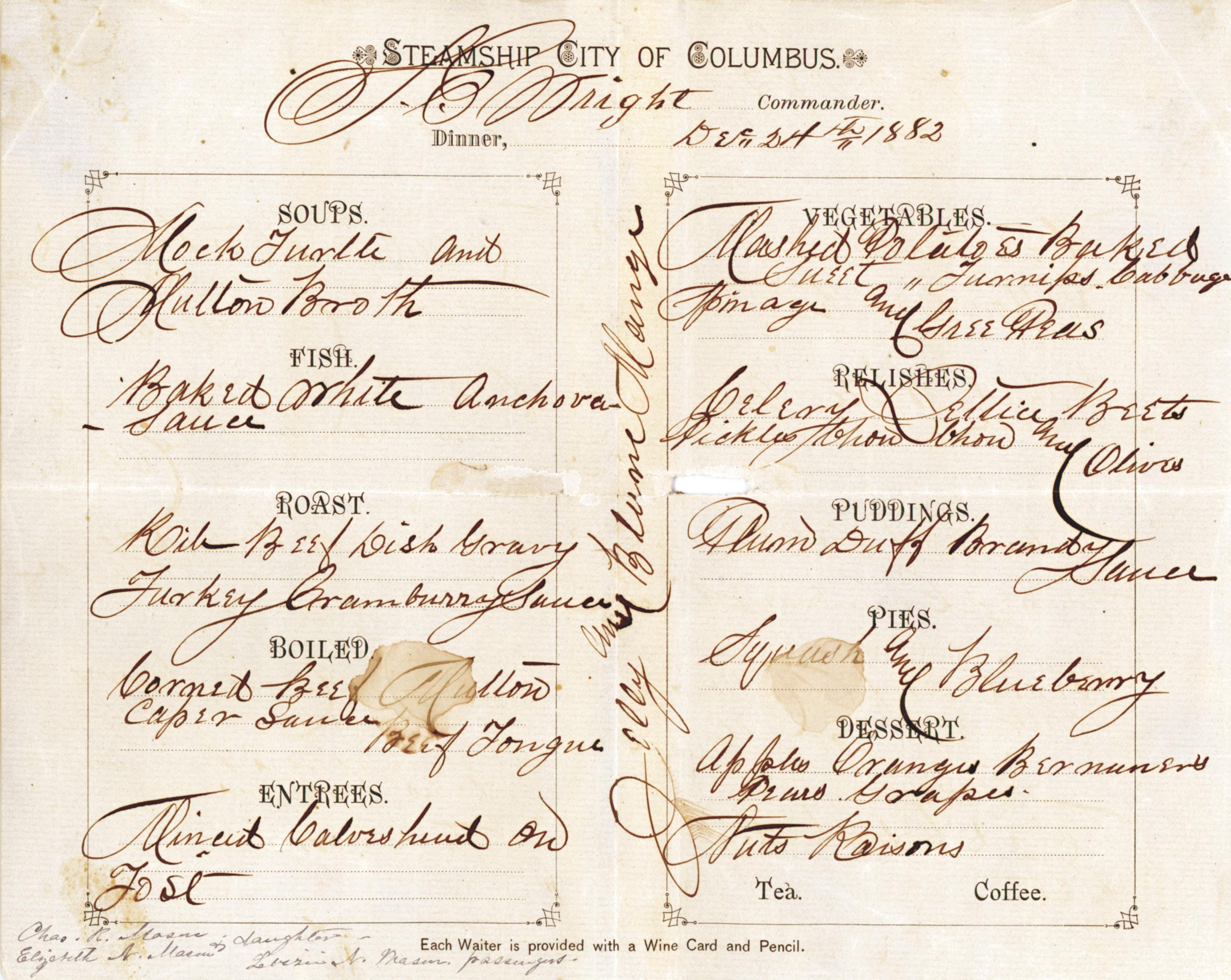
The 1884 wreck of SS City of Columbus was, at that time, the deadliest maritime disaster in New England, but this artifact reminds us of happier times aboard the passenger ship, when fine dining at sea had become commonplace and passengers could expect a safe and pleasant passage to their destination.
Samantha Notick is the Collections and Exhibits Manager of the Cape Cod Maritime Museum.
The Cape Cod Maritime Museum aims to preserve and celebrate the rich maritime traditions and history of Cape Cod and the Islands. Its mission is to engage audiences of all ages in the understanding and enjoyment of maritime culture through exhibitions, collections, public events, and hands-on educational programs.
135 South Street, Hyannis, Massachuse s • www.capecodmaritimemuseum.org
What did you do last summer? Work a summer job? Go to camp? Have an internship? Hang out with your friends? When Dayle Tognoni Ward was 17, she signed up for a two-week volunteer gig on a square-rigged ship in Erie, Pennsylvania. Once she was onboard, she had such a good time that she talked her way into staying for the rest of the summer. She was tempted to stay and bail on her senior year of high school, but the professional crew talked her out of it. e ship would still be there in a year, after all. Sure enough, after graduation, she went back to the ship, this time as a member of the paid crew, and she stayed on for the next three seasons. e ship was the brig Niagara, and it was a great place to learn not only how to sail this kind of vessel, but how to maintain the rig and sails. is ship carries more than 11,000 square feet of sail on two masts, and the entire rig is put together without the use of modern hardware and tools. It is very labor-intensive.
Sailing ship crewmembers tend to migrate from ship to ship, and pretty soon most people in that community either will have sailed with each other or will know someone on another ship you might want to sail with. From Niagara, Dayle got subsequent jobs aboard other schooners and traditionally rigged ships, sailing on waters along every coast in the US and across the Atlantic to Europe and back.
On a voyage home from Europe aboard the Pride of Baltimore II, Dayle was on watch up at the bow and she started really looking at the sails as they did their work over her head. e sails on traditionally rigged vessels are a combination of old and new materials and are constructed using old and new techniques. It got her thinking she might
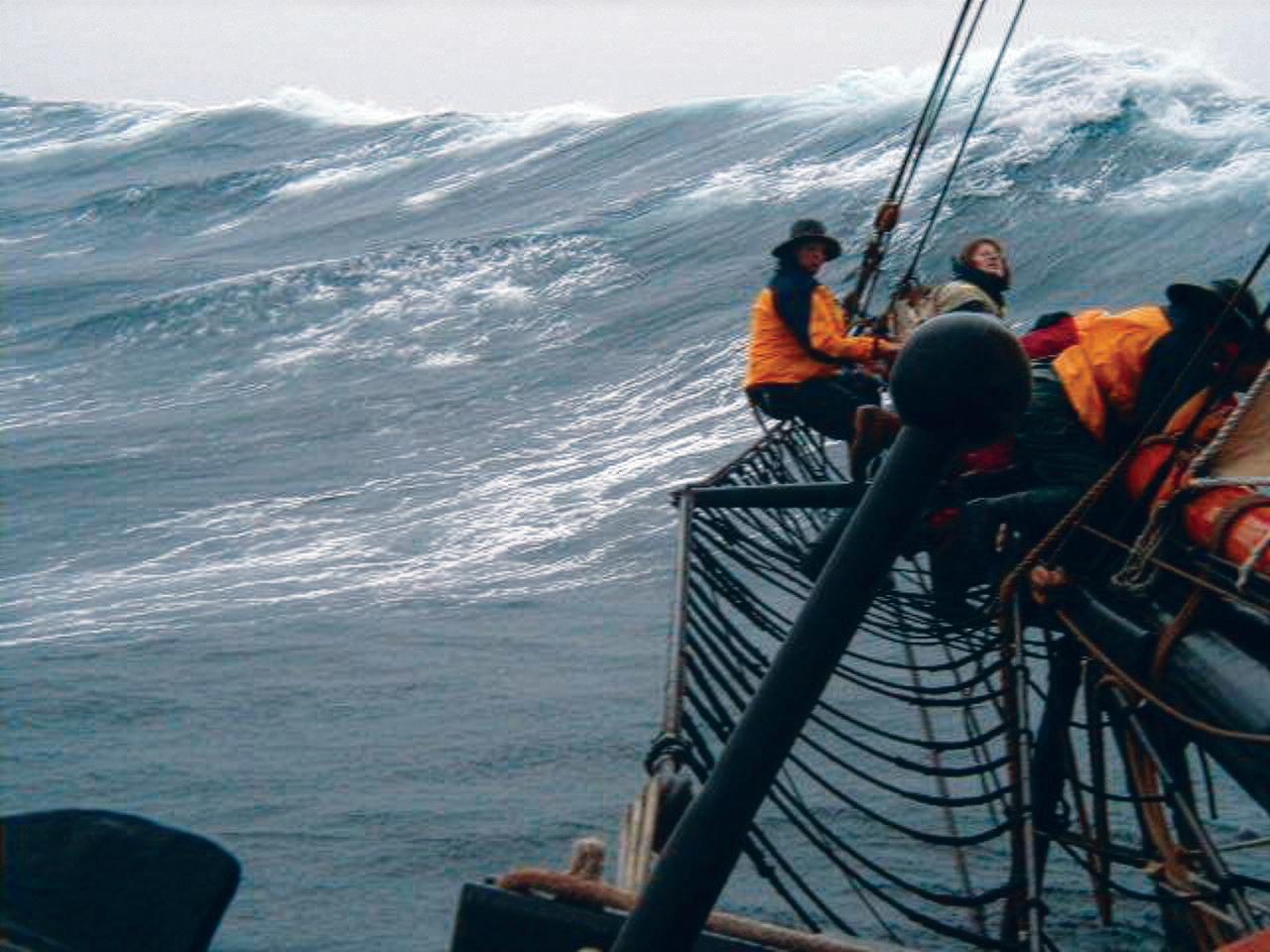
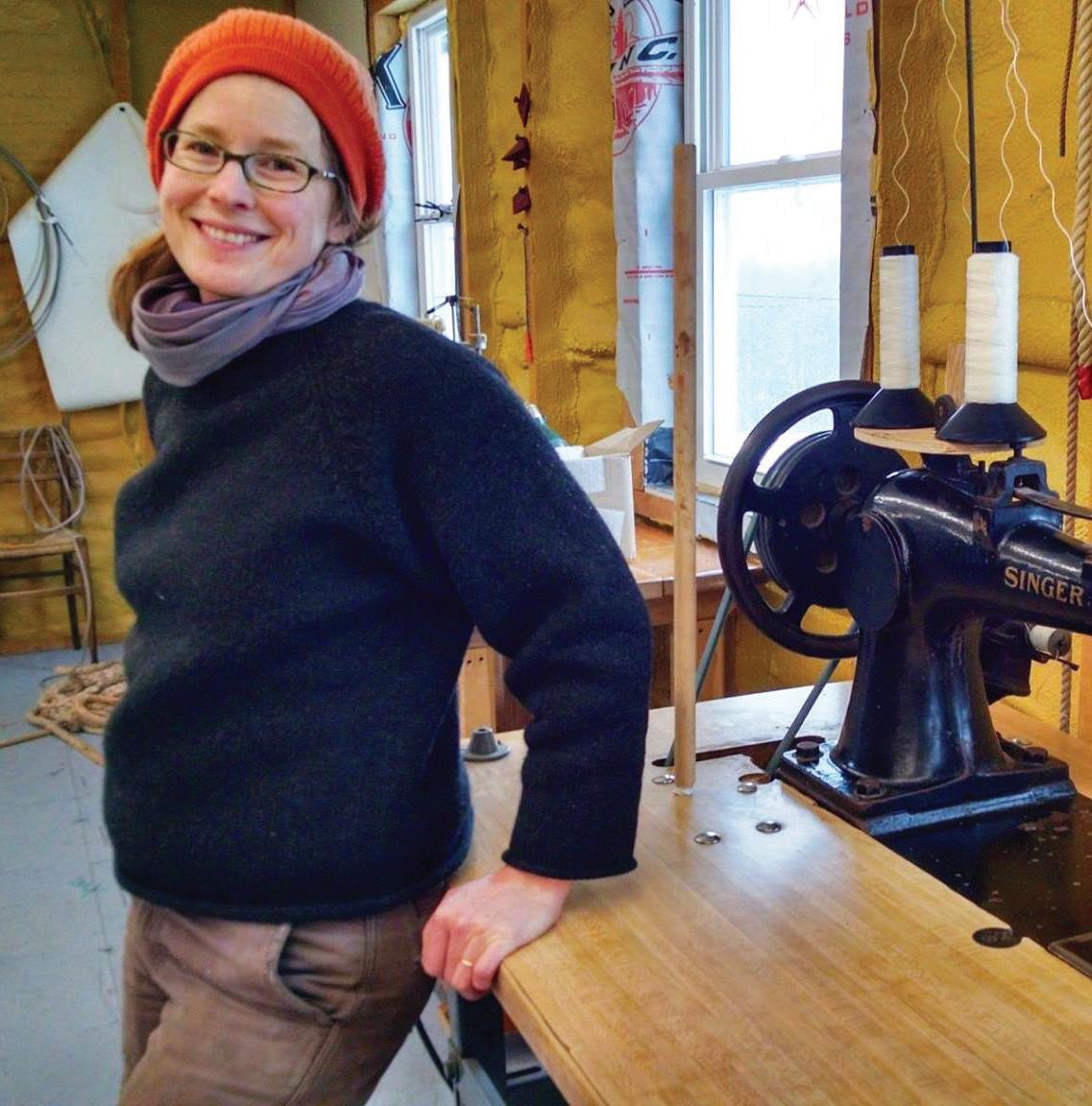
like to learn how to make them. She had always preferred working with her hands and making things over other kinds of work.
So when her contract with Pride II was up, she went back to Erie and asked the local sailmaker, Dave Beirig, for a job. He had her sew a couple of scraps, and she stayed there for rest of the day. at turned into a two-year job. When Dayle told him she was planning to move to Maine, he called sailmaker Nat Wilson out of East Boothbay, Maine, and handed her the phone. Nat hired her and, over the next couple of years, taught her the historic techniques that have been used for hundreds of years to make sails for all kinds of watercraft, from massive square riggers to small sailing dinghies.
Nat’s sail loft was not like modern sailmaking facilities, where laminates and high-tech materials are molded, shaped, and nished. In his loft, sailmakers still laid out bolts of
(above) Dayle Tognoni Ward in her sail lo in Maine. (le ) Before she became a full-time sailmaker, Dayle sailed for several years as a professional crewmember aboard traditional sailing ships. In this photo, Dayle (in the blue and white jacket, looking up at the rig) is on the end of Pride of Baltimore II’s jibboom, working with her shipmates to secure the sails during some heavy weather in the North Sea.
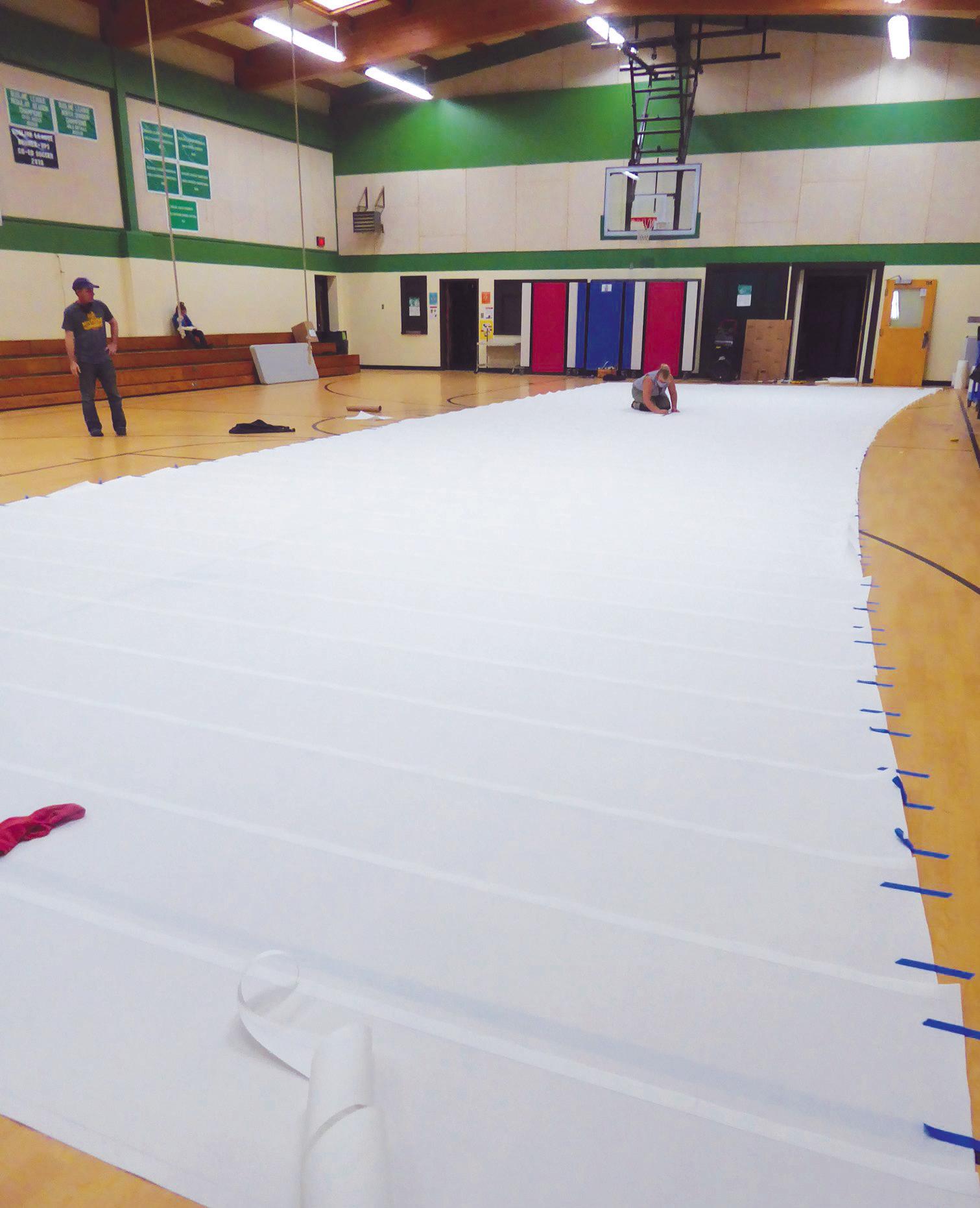
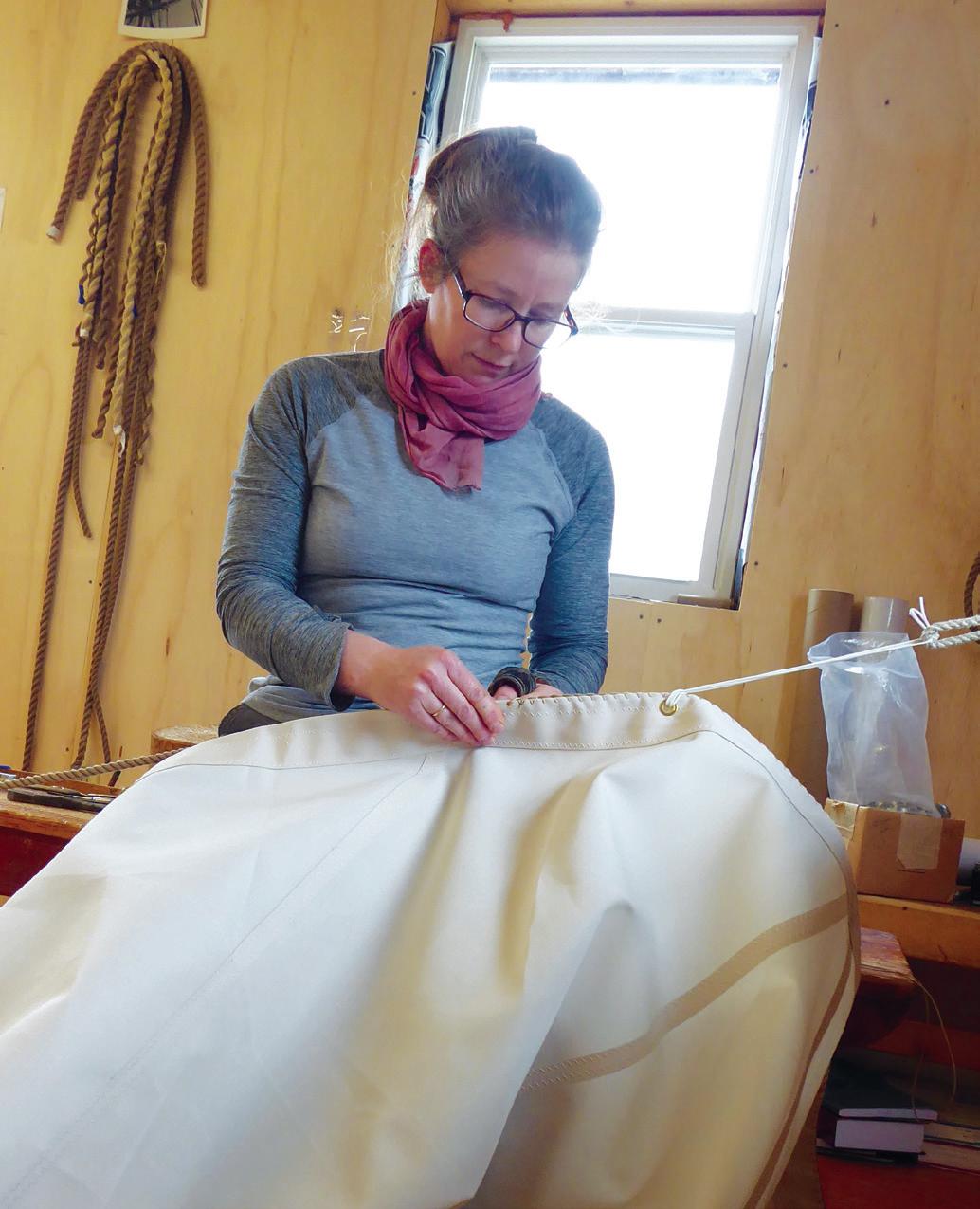
When an order comes in for a really big sail, the local elementary school allows Dayle and her crew to lay out the panels on its gym floor. The sail being cut here is a main upper tops’l for the three-masted barque Eagle, the sail training ship for the US Coast Guard Academy. Since this sail was delivered to Eagle, it has powered the 295-foot ship across the Atlantic two times, sailing to Scandinavia, Bermuda, Canada, South America, and the West Coast of the United States. (above right) Once the seams, tablings, and reinforcement patches have been completed with an industrial sewing machine, Dayle finishes the sail at her bench, stitching grommets, cringles, reefpoints, and boltropes by hand.
sailcloth on the wooden oor and marked them up by hand. e sails are usually machine-seamed and hand- nished. According to Dayle, Nat and Dave passed on the skills to make these kinds of sails, but they also taught her invaluable lessons about how to manage money and how to nd a balance between running a business and a life.
Dayle eventually got married to one of her shipmates from Niagara ey had a couple of kids and in 2008 opened their own business in Appleton, Maine. At rst, it was just her husband doing rigging work while Dayle took care of their little children. After a few years, they built their own shop next to their house with a loan from a neighbor. Downstairs is the rigging shop and upstairs is the sailmaker’s loft, where Dayle is the boss and, over time and lots of sailmaking contracts, has emerged as one of the country’s most skilled traditional sailmakers.
Traditional Rigging Company is certainly a niche business, but sailmaking is still a viable career for a handful of people in the 21st century. Museum ships, sail training and educational vessels, and classic boats of all sizes still need these kinds of sails, and when they do, Dayle is one of the
rst sailmakers they call. It might not be a lucrative career, but the work is steady and the lifestyle it provides her with is very ful lling. She walks just 200 feet across her yard to get to work and gets to create beautiful and functional products with her own hands.
Of course, as a small business owner, she also has to perform tasks that aren’t very exciting. On a typical day, she tries to take care of email correspondence with customers and suppliers, accounting work, and marketing her business in the mornings, reserving the bulk of the day for working in the loft. “I have never had a desk job. Working with my hands is what drives me.”
Most of her workday is spent in the loft, but she does travel to measure a ship or boat if the owner doesn’t supply updated measurement s and sail plans. Occasionally, she gets to go sailing under the sails she made, and that is, perhaps, the most satisfying of all.
You can learn more about Dayle Ward and her sailmaking business at www.traditionalrigging.com.

Welcome to the Ocean Classics Top 10 Countdown! We are sharing our top ten favorite stories set at sea or along the coast—books wri en for younger audiences. Next up in our countdown is #8, The Sea-Wolf by Jack London.
Blinded by the fog at the mouth of San Francisco Bay, a steamboat runs down a passenger ferry. Cast into the freez ing water is the literary critic Humphrey Van Weyden, who is pulled out to sea by the current, then miraculously fished out of the water by a schooner crew. Van Weyden o ers to pay them an enormous fee to deliver him back to shore, but this is no ordinary boat—nor does it have an ordinary captain. Outward bound on a voyage to hunt fur seals in the far North Pacific, Captain Wolf Larsen ignores the man’s proclamations of wealth and education and orders the crew to throw him in the galley to clean dishes and peel potatoes.
Larsen is in command of a violent ship. When not ba!ling stormy seas, his crewmembers ba!le him and each other. To survive, Humphrey has to learn—quickly—how to sail and how to fight. As they sail toward the sealing grounds, Humphrey discovers that Larsen is not only physically powerful but also intellectually gi ed. The two spend hours discussing great works of literature and philosophy, all of which Larsen interprets with his might-is-right view of the world. That is, until a female poet arrives on board a er a shipwreck. And everything changes.
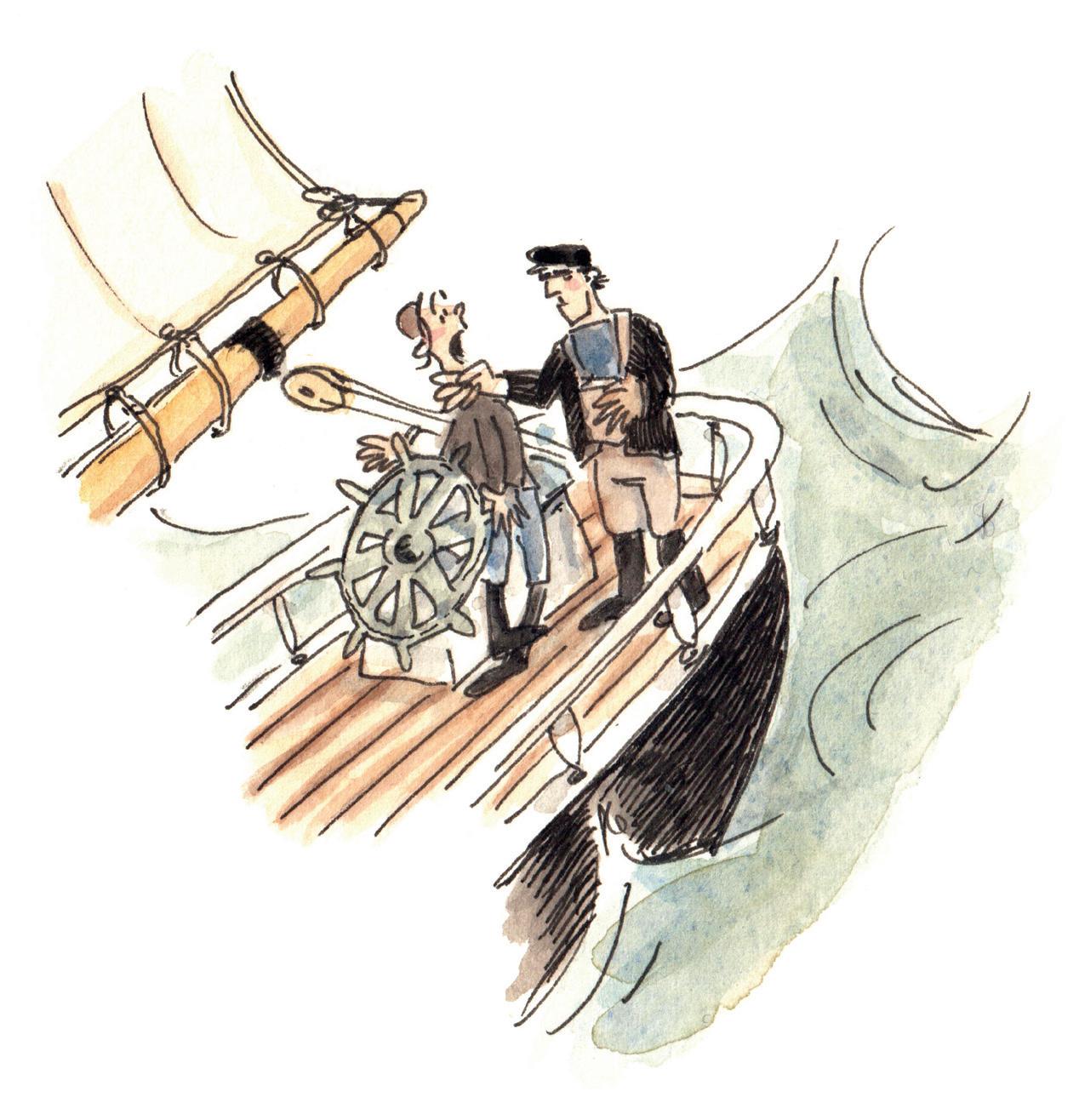

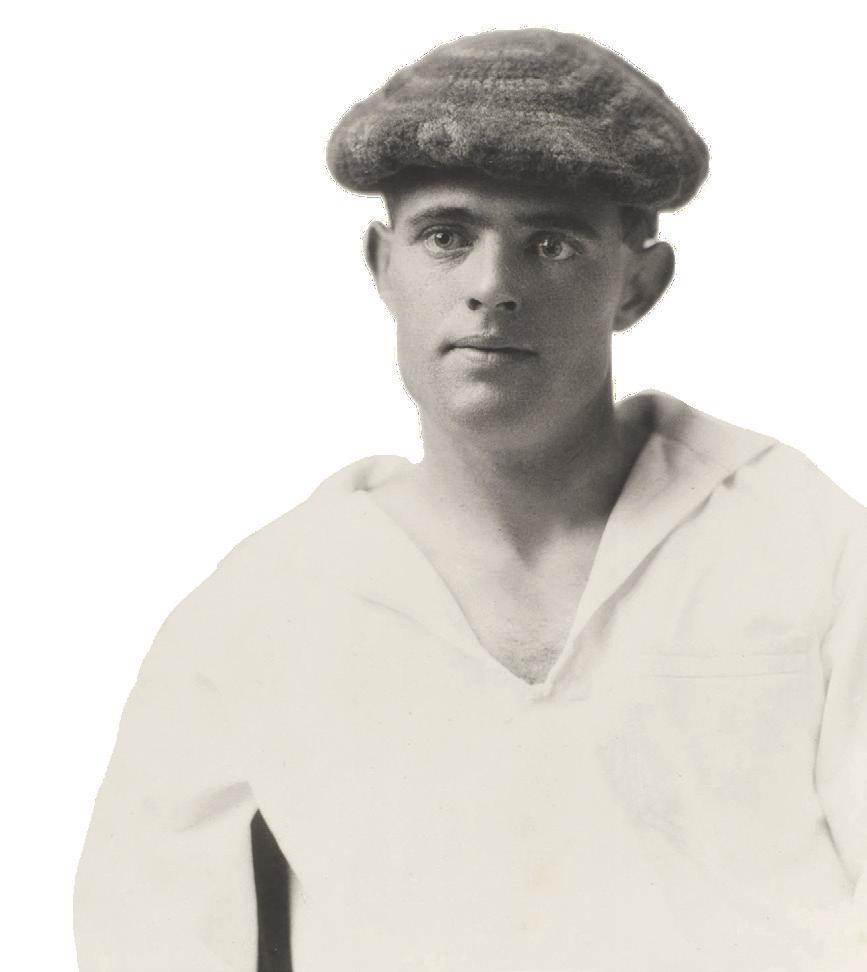
London at age 17 during his sea voyage, 1893.
Jack London published The Sea-Wolf in 1904. The novel has remained popular ever since, although London is perhaps be!er known for other novels set on land, such as The Call of the Wild and White-Fang. Many of his stories reveal the racism of his time, and The Sea-Wolf o ers much to discuss about the roles of men and women.
London lived a life almost as adventurous as his fictional characters. To escape poverty and a rough childhood, at 17 he joined the crew of a sealing schooner, which, like the crew in his book, sailed on a voyage to the coast of Japan. In The Sea-Wolf, Jack London wrote parts of himself into both Humphrey Van Weyden and Wolf Larsen.
Stay tuned for #7 in the next issue. You can see past selections at www. seahistory.org. Don’t forget to tell us about your favorites. Email your suggests to seahistorykids@gmail. com. You might be able to sway the judges!



In Jack London’s novel The Sea-Wolf, published in 1904, his fictional characters sail out of San Francisco Bay under the command of the fierce Captain Wolf Larsen and set a course across the North Pacific toward Japan. Underway, they come upon “the great seal herd” that they had been seeking. The narrator explains:
Coming from no man knew where in the illimitable Pacific, [the herd] was travelling north on its annual migration to the rookeries of Bering Sea. And north we travelled with it, ravaging and destroying, flinging the naked carcasses to the shark and salting down the skins so that they might later adorn the fair shoulders of the women of the cities. It was wanton slaughter...No man ate of the seal meat or the oil.
In this passage, and throughout the book, the author leaves an accurate record of a fascinating period in our relationship with marine mammals, a time when public opinion about hunting
them was beginning to shi . Native people had hunted fur seals sustainably for thousands of years. They hunted with harpoons and used every part of the animal (meat and oil for food and fuel, skins and fur for clothing, and bones for tools and cra s), only killing what they needed to supply their local communities.
In the mid-1700s, hunters from Russia, Great Britain, and the United States began sailing to the region to hunt fur seals in vast numbers, shooting the animals while they were swimming in the Bering Sea and clubbing them (to avoid pu!ing gunshot holes in the skins) when the seals came ashore on remote islands. As Jack London explained in
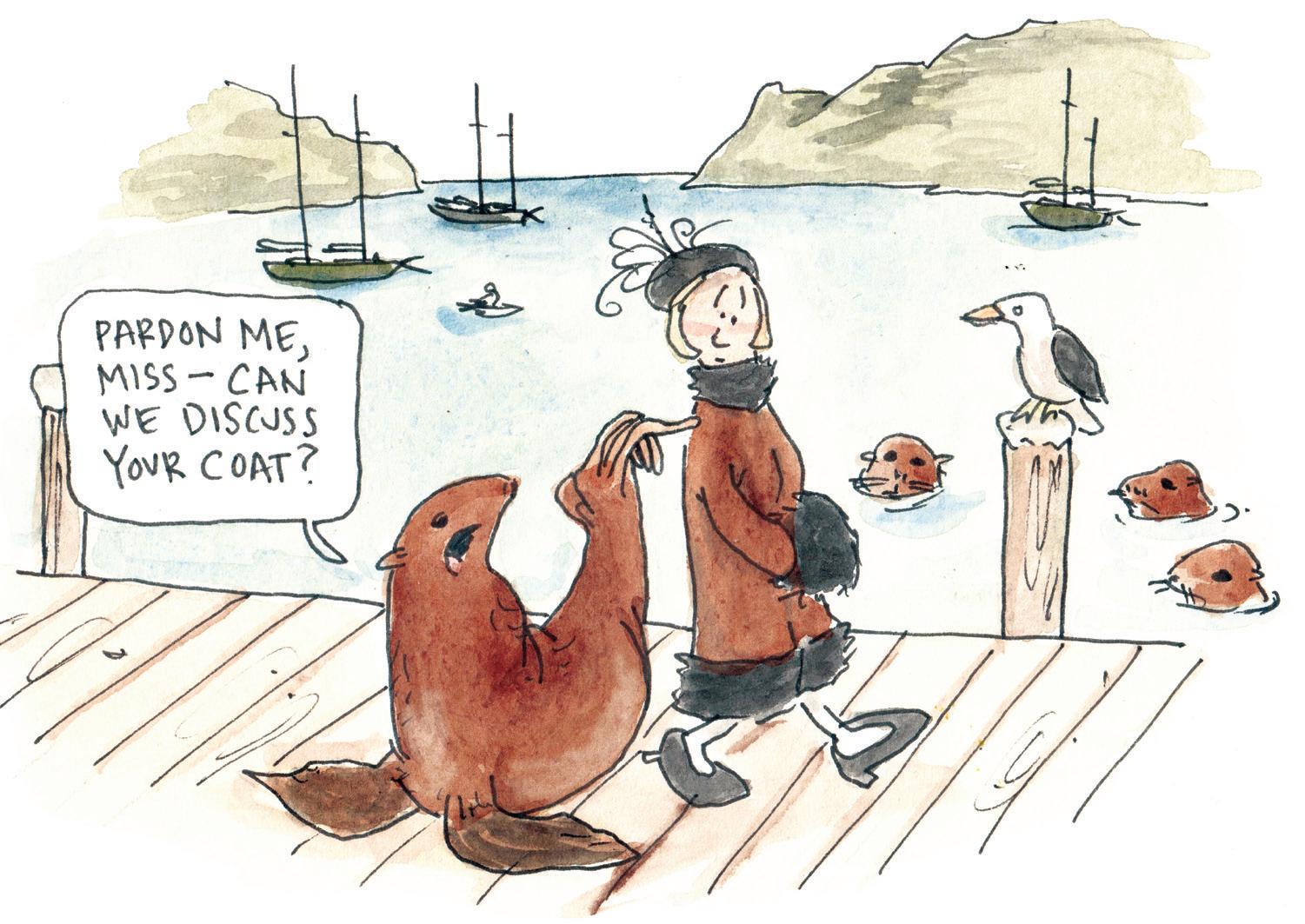
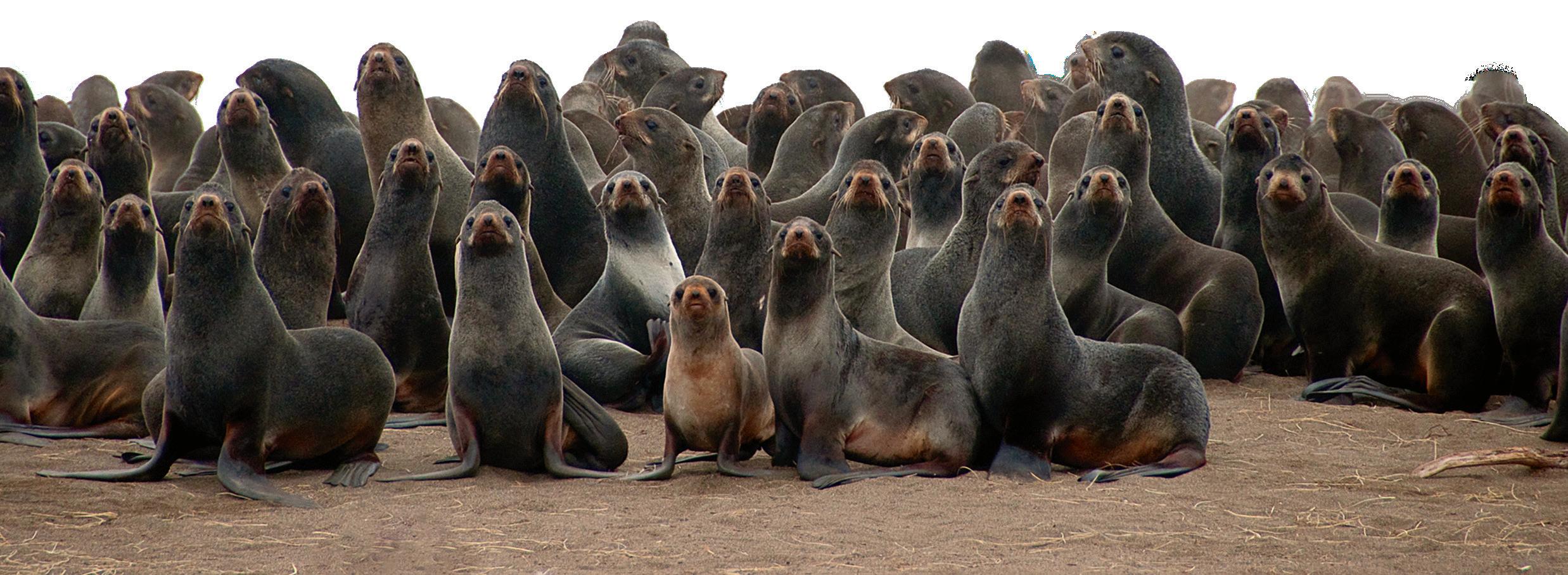
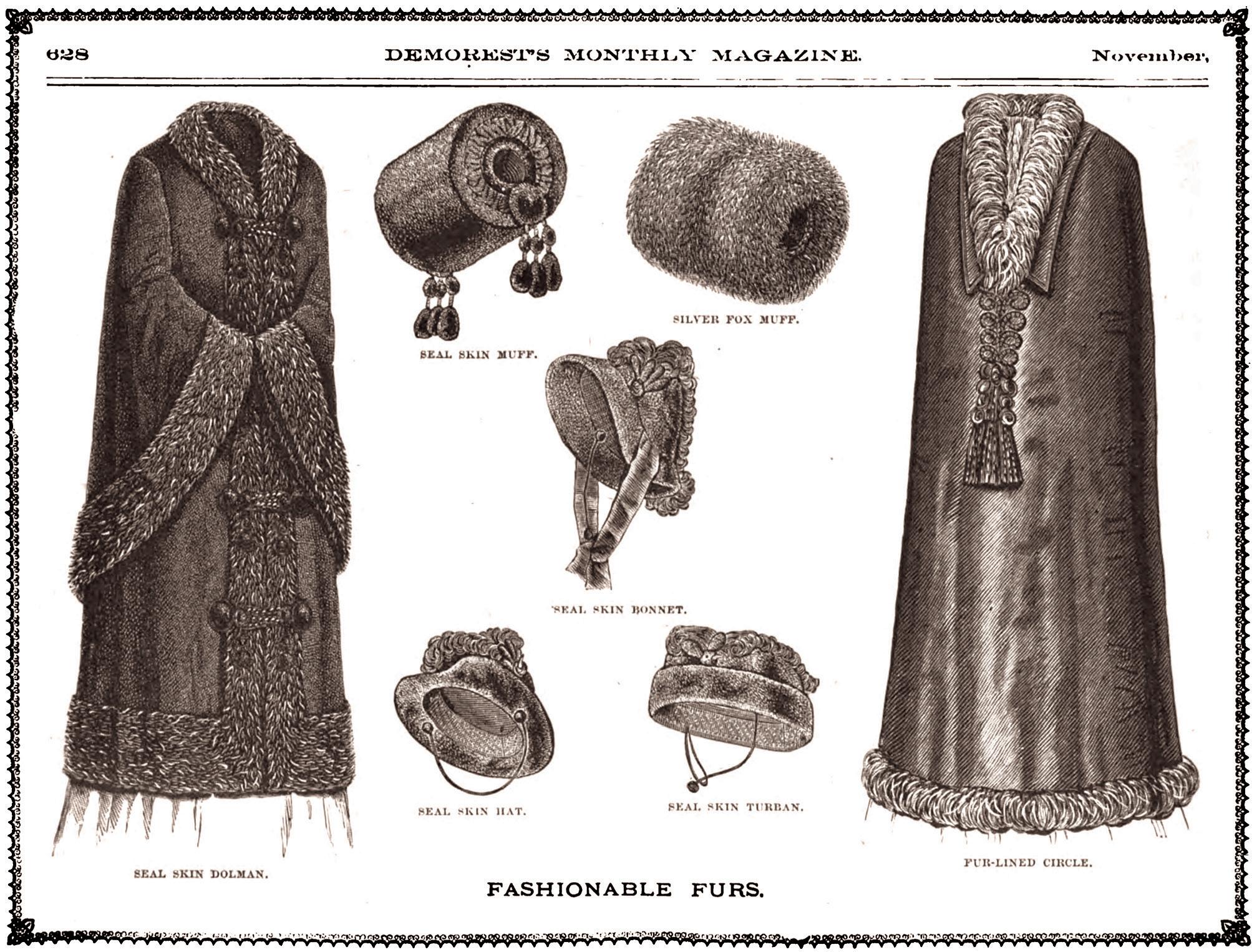
This ad for seal skin “fashionable furs” in the November 1879 issue of Demorest’s Monthly Magazine shows some of the variety of clothing and accessories that were popular at the time, which made seal hunting a profitable enterprise in the 19th century and into the 20th century.
his novel, these fur seals were not killed for food, or even for the oil in their blubber (which in that era was used for lamp oil and lubrication for small machinery but primarily came from whales, walruses, and sea lions). From the 1700s to the early 20 th century, sealers killed these animals by the tens of thousands
for their pelts alone, which were a valuable commodity in the fashion industry to make hats, gloves, and coats.
Fur seals are more closely related to sea lions than their “true seal” cousins. Fur seals have small visible ear flaps, use all four flippers to walk on land, and have a shaggier outer layer
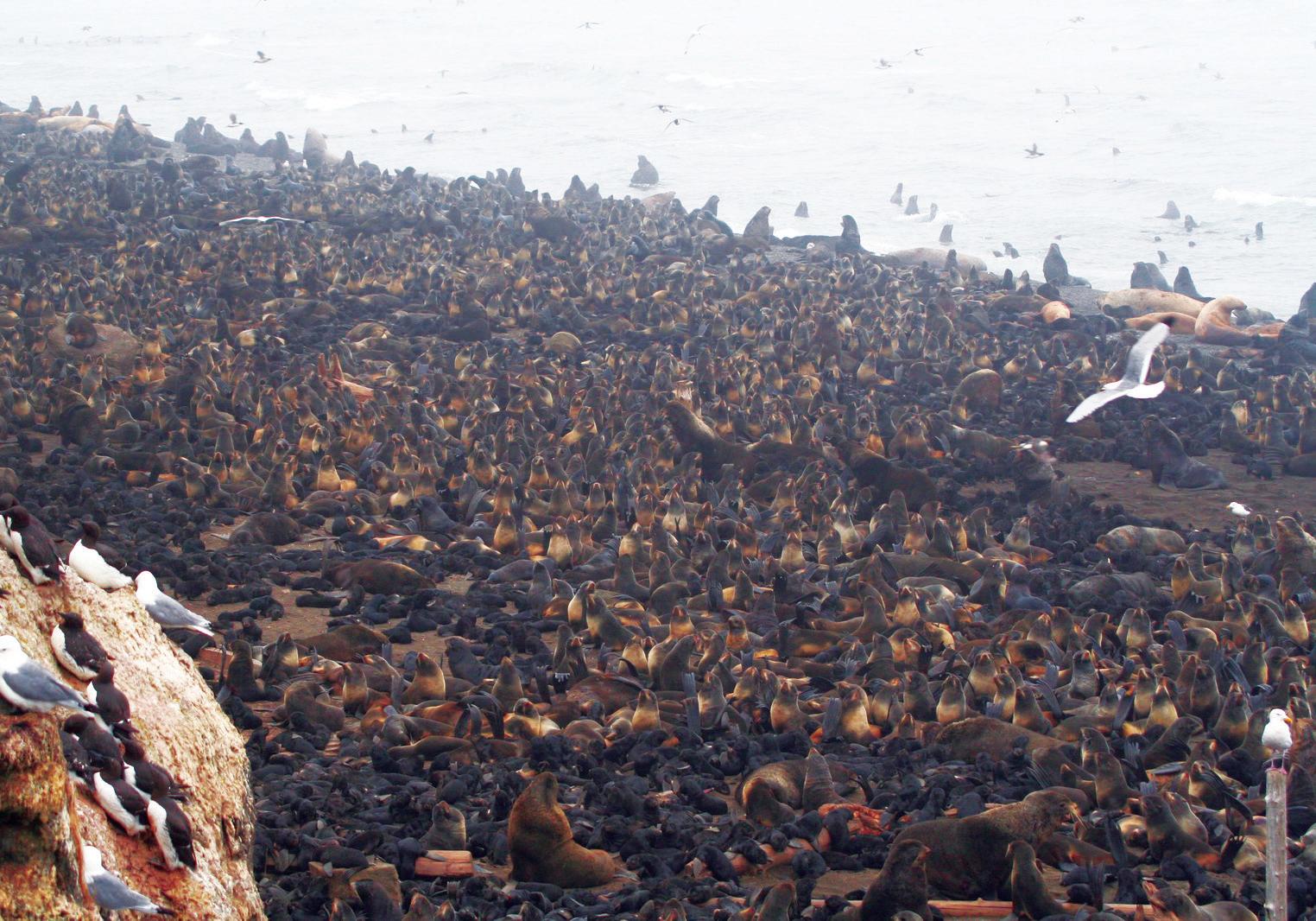
of hair. Unique to fur seals, they also have a second inner layer of fur with shorter, denser hair that traps air to insulate and repel water.
Hunters in the North Pacific were a er the northern fur seal, the only fur seal species that lives in this region. The other eight species around the world, most of which are in the Southern Hemisphere, had by that time been hunted to commercial extinction, including those all the way on the islands o Antarctica. A er spending several months or even years out at sea, northern fur seals migrate in the summer season to breeding grounds located on just a few islands in the Bering Sea and as far south as Baja California.
During breeding and pupping seasons, northern fur seals gather in large herds on remote beaches to stay away from sharks, orcas, and humans. The males arrive early on the islands, fasting as they ba!le each other for the chance to mate. Mothers give birth and then mate again soon a erward. The moms stick around to raise their pups before going back to sea, only returning the next year to give birth again. This predictable, seasonal reunion of fur seals allowed hunters to take advantage of the animals when they were the most vulnerable. In the 1800s and 1900s, hunters typically targeted the young males, whose pelts were considered the best quality. The idea was that this approach would cause less harm to the overall population.
One of the main reasons the United States purchased Alaska from Russia in 1867 was to gain access to the Pribilof Islands, home to the largest northern fur seal colonies. By the 1870s,
Northern fur seals gather in the tens of thousands on remote beaches during breeding and pupping season. In some locations, there might be hundreds of thousands all together in one place. This rookery is crowding the shoreline of Tyuleny Island in the Sea of Okhotsk, o the coast of Russia.
however, animal rights activists in Great Britain were calling for an end to sealing and threatened a boyco! of seal-fur clothing. At the same time, hunters and merchants were reporting that fur seal populations had been crashing. Scientists were brought in to help (one of them, David Starr Jordan, was even referenced in The Sea-Wolf ). One report estimated that between 1867 and 1906, the northern fur seal population had plummeted from about four million to only 180,000. The general thinking was that killing the animals at sea was causing the most damage because these were o en females on shorter trips to feed so they could return to nurse their newborn pups. Since fur seals swam across national borders, this led to international conflicts between Russia, Japan, the United States, Canada, and Great Britain. Jack London references this in The Sea-Wolf when Captain Larsen is accused of illegally capturing fur seals in Russian waters.
In 1911, representatives from these countries met to dra one of the first international marine conservation treaties. They all agreed to stop hunting fur
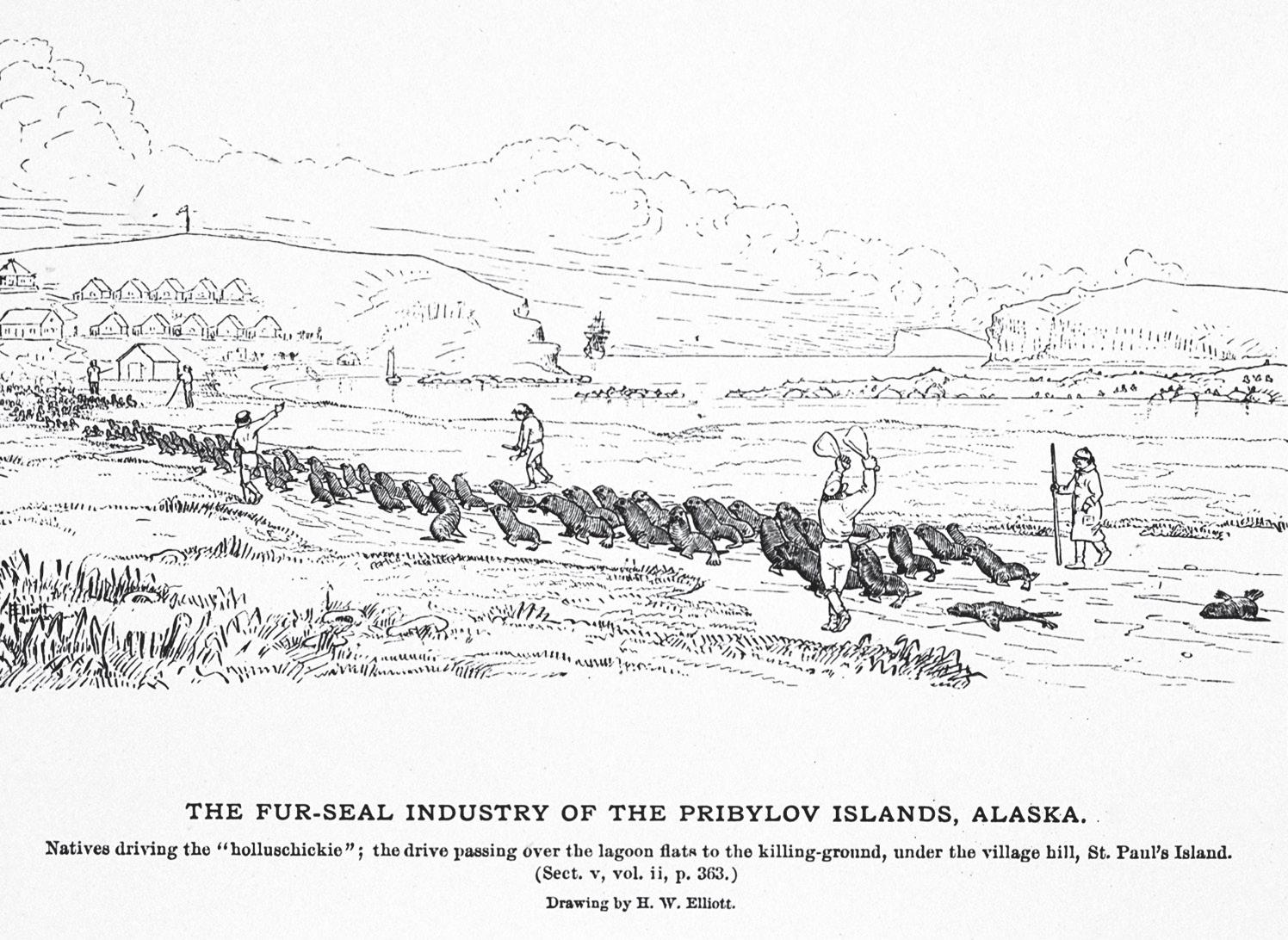
seals at sea and to set strict limits on how many, and of what age and sex, could be hunted on shore. Around the same time, the demand for seal-skin clothing began to wane. Yet commercial hunting continued into the 1970s. On some islands, the fur seal populations
rebounded and even thrived, while at other rookeries their numbers have never quite recovered. Northern fur seals are still considered vulnerable and their total populations are declining recently, perhaps due to competition from commercial fishing.

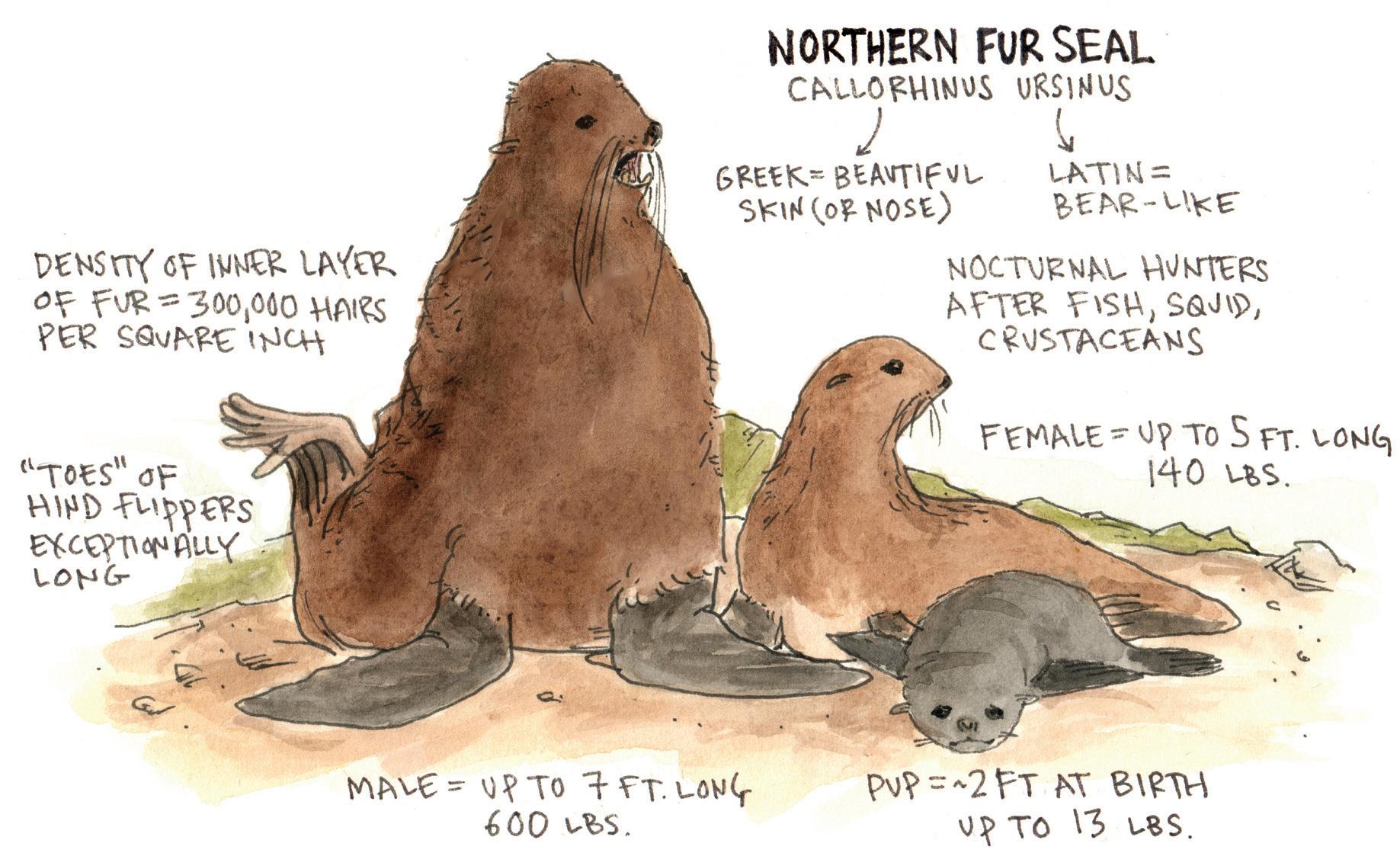
For previous Animals in Sea History, visit www.seahistory.org or check out the book Ocean Bestiary: Meeting Marine Life from Abalone to Orca to Zooplankton, a revised collection of 19 years of this column!
Capt. Michael Rutstein
Coming o a successful Tall Ships Challenge on the Great Lakes this past summer, Tall Ships America Executive Director Stu Gilfillen and Director of Events Erin Short sat down with us to discuss how these events are evolving post-pandemic, and what role their organization hopes to play in the sail training community and the wider public arena.
Marlinspike: First, congratulations on what sounds like a prosperous campaign in the Midwest. Any takeaways from this summer’s events?
Erin Short: It was lovely, just a really nice summer with great vibes. We’re already looking ahead to 2028, the next time the ships will meet again in the Great Lakes. We already have ports and ships that are interested. So that’s a good sign.
M: Folks in the Midwest really do seem to relish these events. With the bigger East Coast cities, sometimes it’s hard to get on their radar. Do these events simply move the needle a lot more in small and mid-sized ports than they do in places like Boston or New York or Philadelphia?
ES: It’s a combination. I think people in the Midwest are aware that these ships have come a long way to get into the Lakes, but yes, the ports we work with there are typically smaller communities. It is easier to make a big splash, no pun intended! I also feel that because we’ve been doing this series in the Great Lakes for so long, there is an expectation—that it’s going to be a good event and that we will come back every three years. On the Atlantic Coast, it can get a little wobbly in terms of scheduling.
M: Next summer is unusual in that it is the nation’s 250th birthday and there are huge events—Sail 250—planned for New Orleans, Norfolk, Baltimore,
New York, and Boston. What is Tall Ships America’s role going to be?
Stu Gilfillen: We are an o!cial educational partner for Sail Boston. Tall Ships America will provide connections and educational programming—primarily targeted at youth—for the ships, not only the ones that are in our network, but all participating tall ships. We have had some great conversations with New York about playing a similar role there. Looking beyond that, we’ve discussed working with some of the smaller ports to engage with ships that they might not normally see. When you get this many ships, it creates opportunities! We want to connect the ships visiting these larger cities with people from across the country and highlight the events for people who
may not be attending in person. It could be anything from tracking individual ships, telling their stories, or working with di erent school districts.
M: Erin, how are tall ship events trending now? What have you seen changing in the post-COVID world in terms of organizing these kinds of events?
ES: at’s de nitely a question we’ve been addressing internally. ese types of events have de nitely evolved. We’re such a niche market. We’ve been working on making adjustments to keep it fresh and relevant in a rapidly changing world. In 2022, for example, we were in the Great Lakes after a gap in our schedule and had really good turnout because people so wanted to be outside. ey wanted that normalcy. In 2025





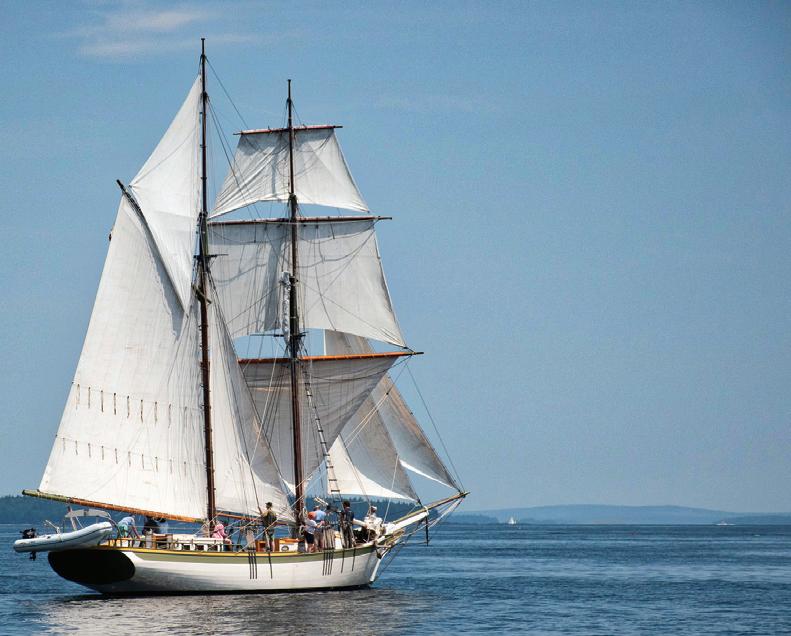
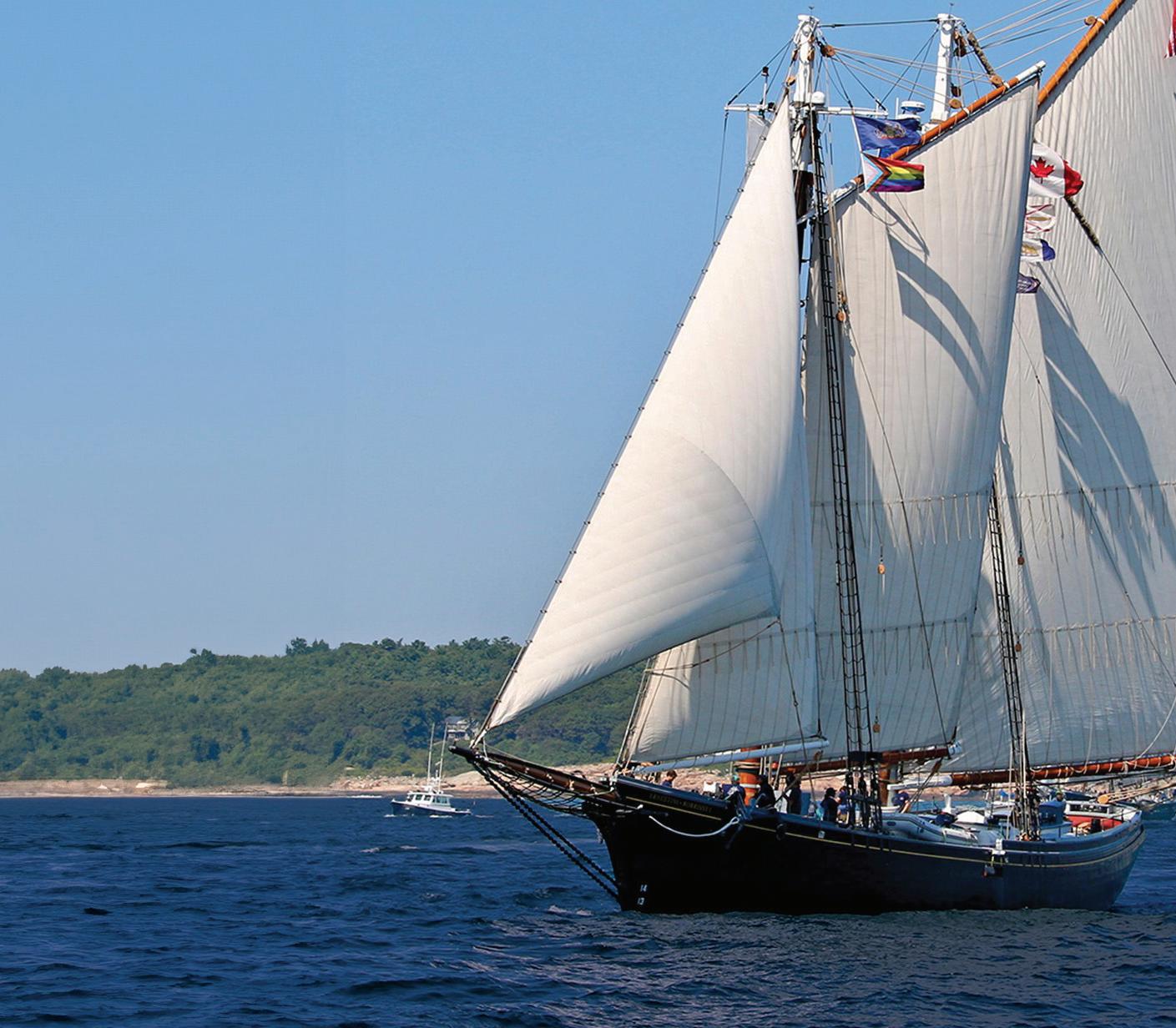

it felt a little di erent, but we are already looking ahead to 2028 and I’m excited. We are looking to introduce new activities and push the boundaries of what a tall-ships event looks like. I’ve started referring to them as maritime events. I think “tall ship event” is too limiting.
M : You say that 2025 was di erent than 2022. How so?
ES: Sponsorship was di erent, for starters. It’s a bit more challenging now. I don’t think communities have recovered from the pandemic—from a nancialsponsorship standpoint. We still had support and we had the visitor numbers we are used to, but we had to approach more sponsors and widen that net. at isn’t something that we’ve ever really struggled with before. Before COVID, it was steady and predictable. Since then, less so. We need to come up with
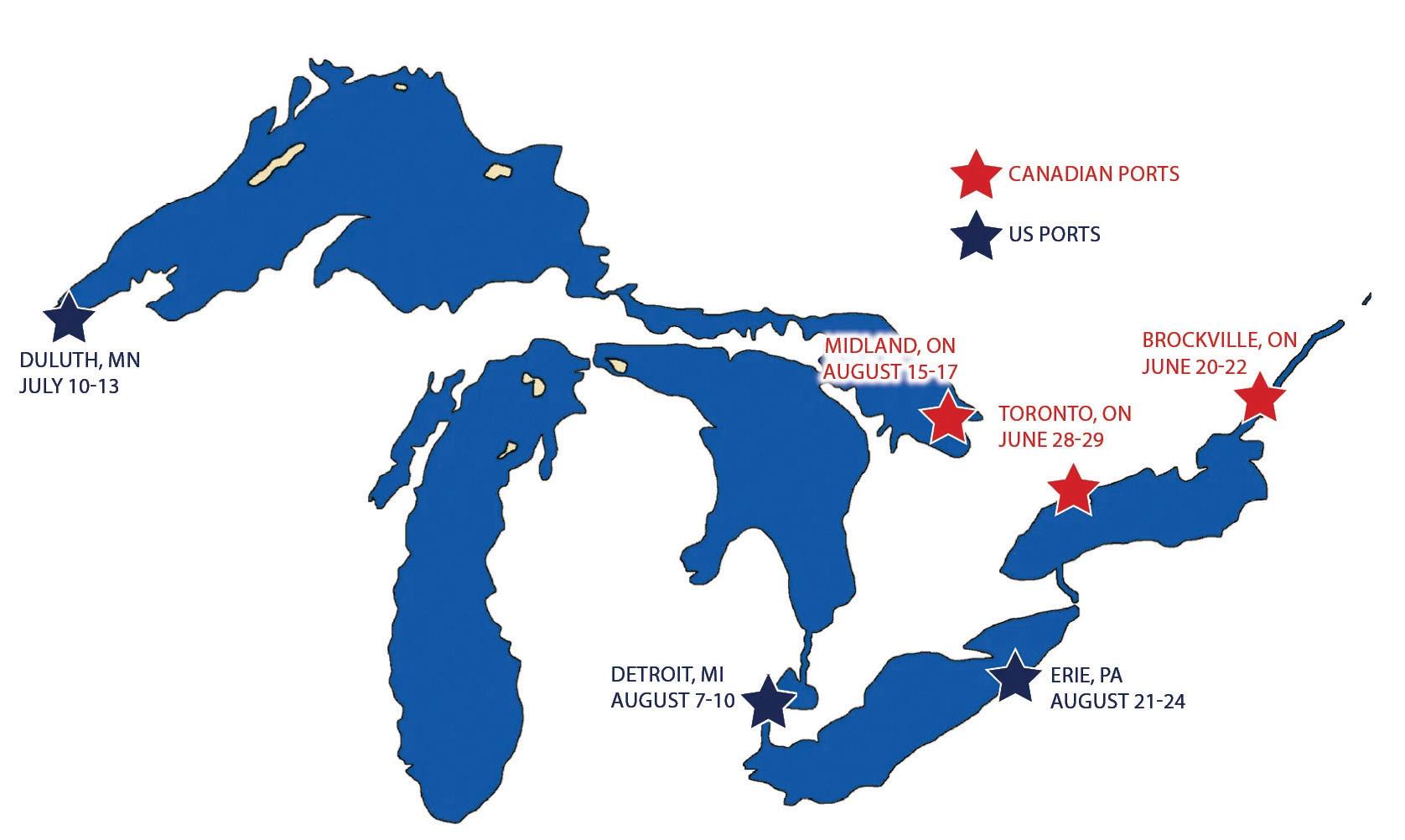
Tall Ships Challenge 2025 — Great Lakes
This summer, approximately 125,000 visitors came out to see and tour 20 participating ships in six o icial host ports and three outports.
di erent approaches to how we organize, fund, and market these events.
M: Do you think that every three years is too often for these smaller markets?
ES: In the Great Lakes, every three years is not enough! Many of the ports
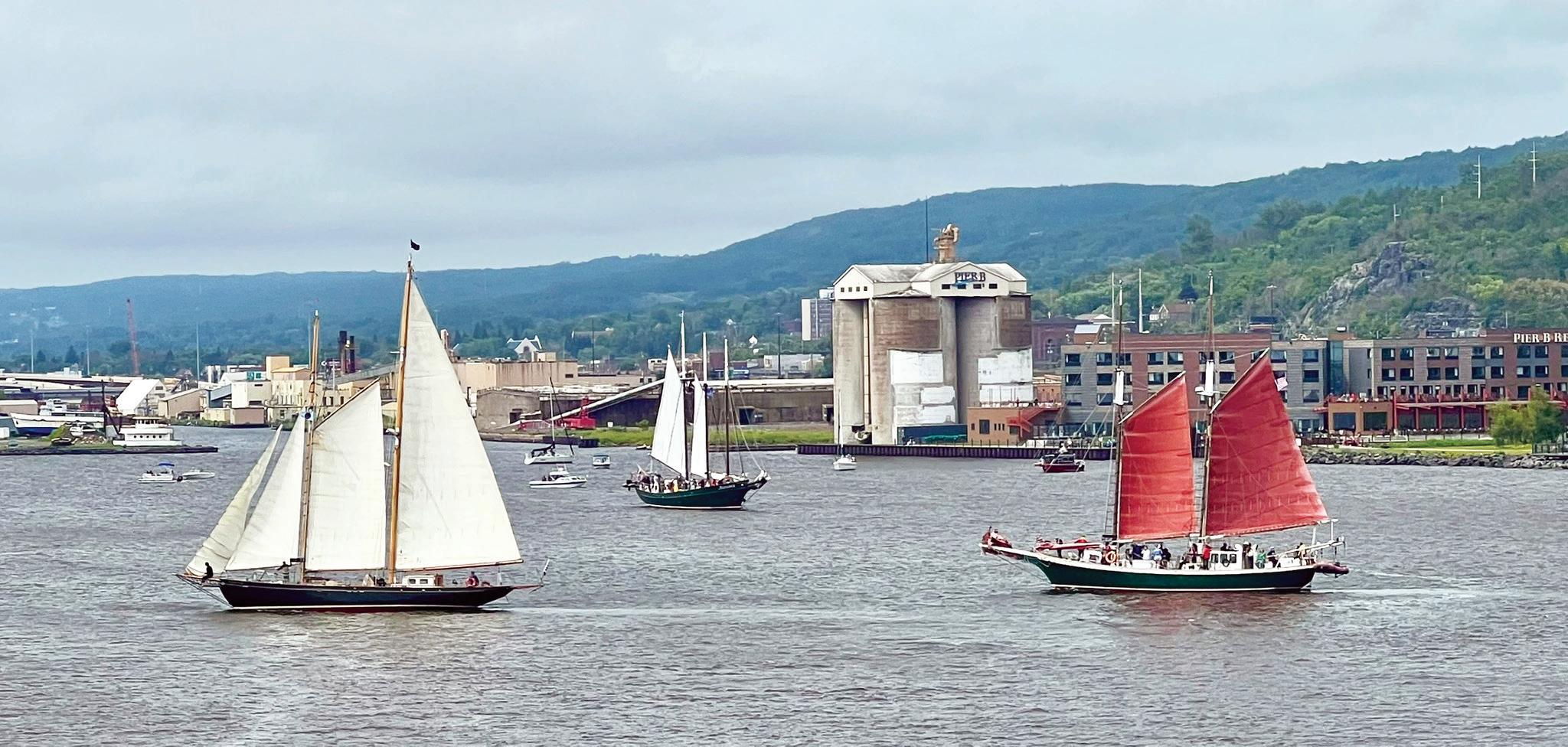

tell us they wish we had them more often because it would help them sell sponsorships. You build on that momentum every year. But again—every community is di erent.
M: Going forward, what is Tall Ships America’s role going to be? Will you still be organizing these events 5, 10, 15 years down the road? Is this still a central part of your mission?
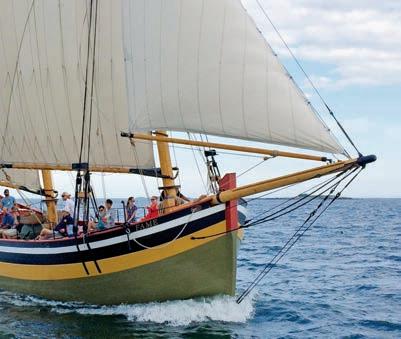
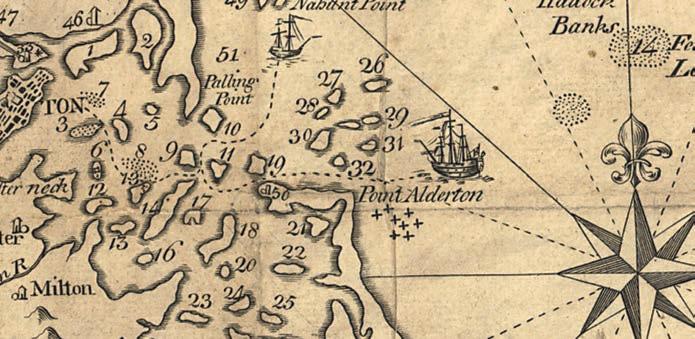
SG: We will continue to organize events and programs that connect the public to tall ships, but I think the way those events manifest themselves is going to change. Other organizations, like the Ocean Race and SailGP, are working diligently to connect di erent communities to racing and sailing of different types. ere are places in this country, like the Great Lakes, where people can tell you the history of every vessel along the docks. ere are other places where people would just say “that’s a really cool boat.” We want to appeal to and support both kinds of people, and we always want to support the ships themselves and continue to connect people to them in a variety of ways. So, yes, we’re going to see these events continue, but I think you’re going to see them evolve as well in the next couple of years.
(www.tallshipsamerica.org)
e Association Hermione-La Fayette (AHL), custodians of the replica ship Hermione, was placed in receivership by the La Rochelle District Court on 18 September. !e original Hermione carried the Marquis de Lafayette to the United States with news of France’s decision to back the American colonists in the Revolutionary War. AHL is seeking new sources of nancial support to
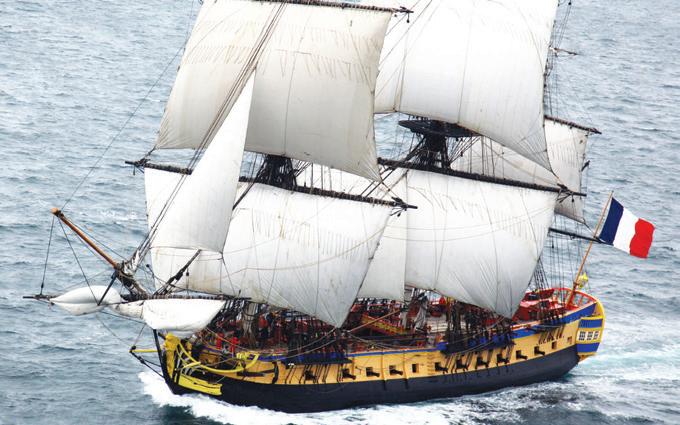
restore the vessel and resume her programming as a sail-training ship and symbol of the Franco-American relationship. !e AHL states that the court’s action “gives us time and every opportunity to complete our recovery plan, which requires the involvement of new partners/sponsors to nance the second phase of the work. We call on citizens, businesses, patrons, local authorities, and the state to join the crew and complete the restoration of the frigate.” During routine maintenance in 2021, serious fungal rot was discovered in Hermione ’s timbers, necessitating immediate drydocking to investigate the extent of the damage and carry out repairs. Hermione was hauled out in Bayonne, France. !e organization raised €5 million (roughly $5.9 million) and was able to complete about half of the repairs, but it is estimated that another €5 million is needed to nish the shipyard work. !e AHL was founded in the late 1990s, and Hermione ’s construction followed the restoration of historic dry dock facilities in the town of Rochefort. !e replica’s design is based on the plans of Concorde, a sister ship that was seized by the Royal Navy in 1783. In 2015, Hermione
crossed the Atlantic and toured the US East Coast and Nova Scotia. (www. fregate-hermione.com) … e Stockton Maritime Museum in California welcomed the public aboard the Aggressive -class minesweeper USS Lucid (MSO-458) for a semi-annual open house on 11 October, eager to showcase progress in the vessel’s restoration. Museum leadership estimates that the vessel is about 85% restored. !e wooden minesweeper is berthed behind the campus of the San Joaquin Building Futures Academy (BFA), a charter school that teaches construction skills to students working on their GED or high school diploma. Dedicated volunteers and BFA students work on the ship. In early November, the museum sent a team to Taiwan to harvest gear from the former USS Implicit, the last MSO minesweeper in the world to be decommissioned and slated for scrapping, an undertaking for which the
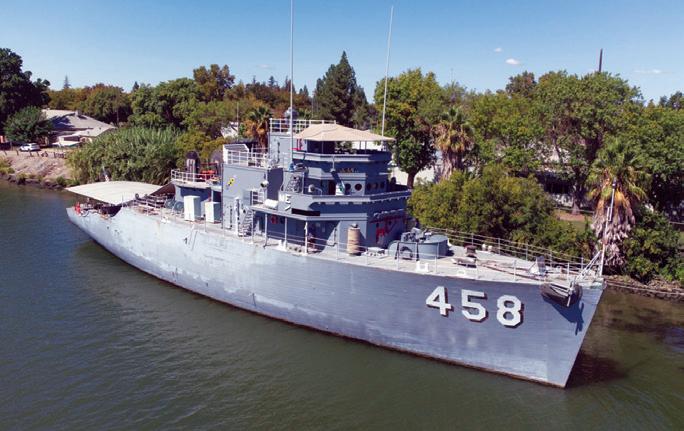
organization was still fundraising as of press time to cover the estimated $80,000 cost of the mission. !e 172foot Lucid was built in 1953 in New Orleans by Higgins Industries. Her connection to Stockton is via three sister ships—USS Dynamic, USS Engage, and USS Embattle —which were built for the US Navy in Stockton’s Colberg Boat Works. USS Lucid patrolled the coast of South Vietnam during the Vietnam War. She was decommissioned in 1976 and wound up in private hands; past owners stripped the vessel and cut a hole in the hull for use as a door. !e museum hopes to eventually move Lucid to a site near the Weber Point

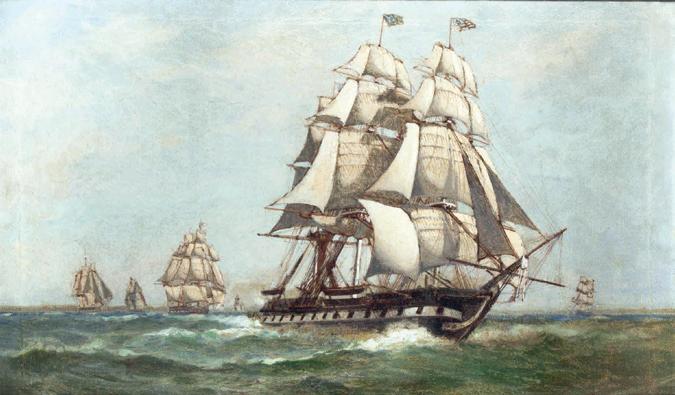
Our organizaton keeps history alive through the restoraton of historic artfacts, establishment of memorials, and collecton of our shared history through academic papers, published works, and stories
We are a community of members spanning multple generatons and military engagements. Do you or your ancestors have a story to tell? Come join us — and help preserve America’s maritme history.
USMC • USN • USCG • USMM • USPHS • NOAA Learn more at navalorder.org

NEW Manufactured in the 40s in original wood box
WWII-era USN solid brass 10" BearingCircle
$150 each – includes shipping in the USA davehindsusmc @yahoo.com (614)-205-0357
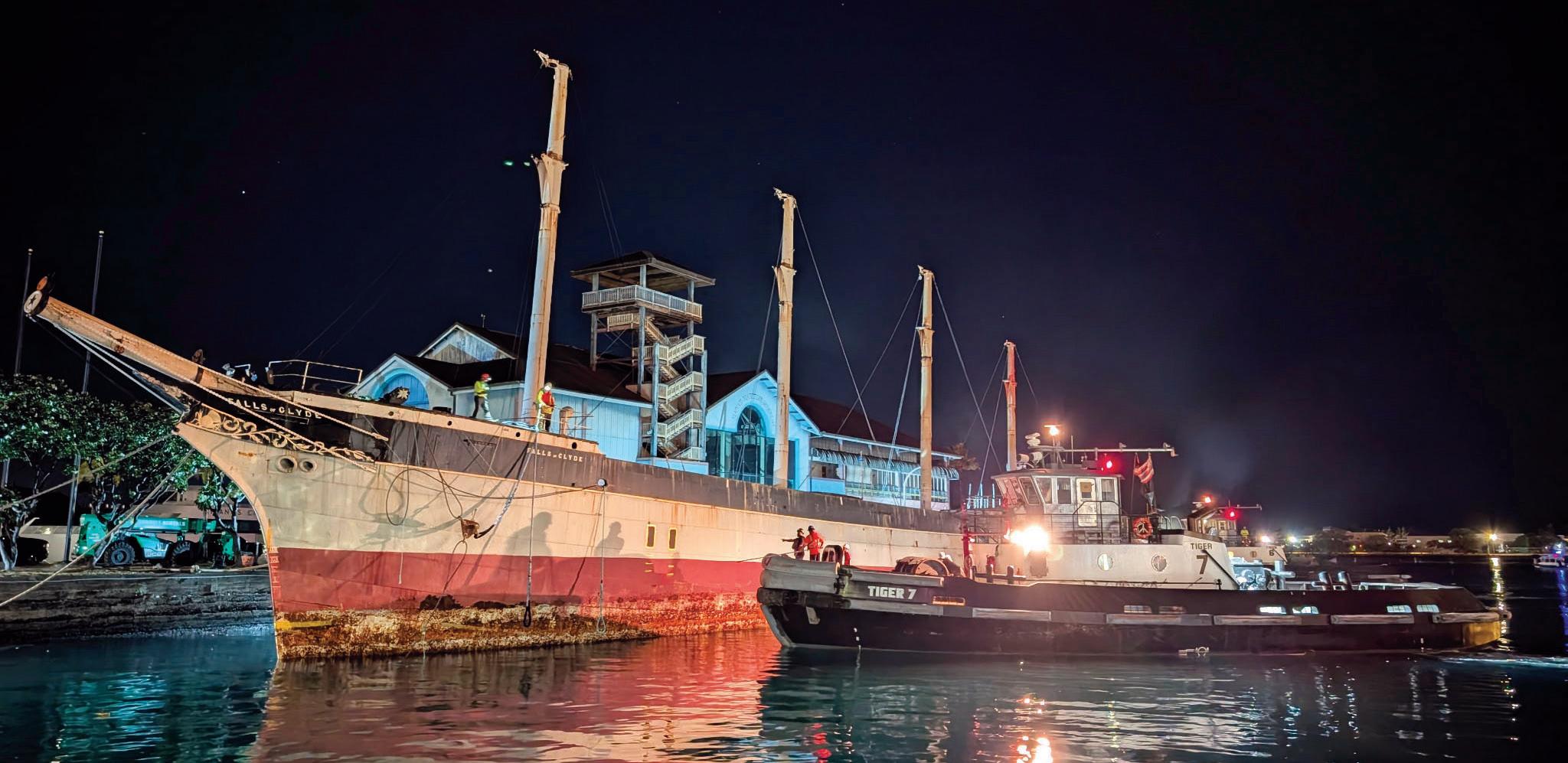
Falls of Clyde leaving her berth for the last time, 15 October 2025.
Beaufort Naval Armorers
Beaufort Naval Armorers
Beaufort Naval Armorers
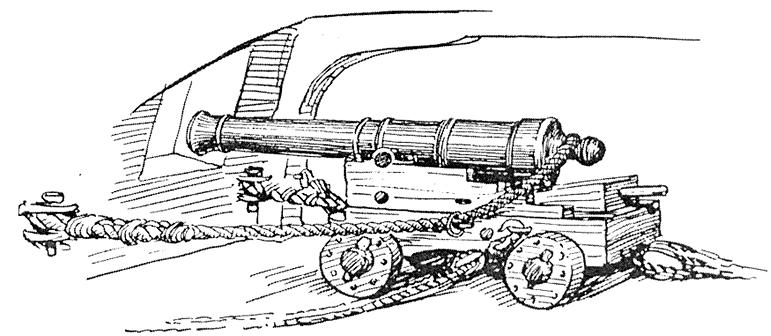
CANNONS
CANNONS
Finely Crafted Marine Grade Working Replicas
Events Center and construct a reproduction of the Colberg Boat Works, which stood on that location until it was destroyed by re in 2022. (Stockton Maritime Museum, 3100 Monte Diablo Avenue, Stockton, CA; www.stocktonhistoricalmaritimemuseum.org) …
Finely Crafted Marine Grade Working Replicas
Finely Crafted Marine Grade Working Replicas
Morehead City, NC USA 252-726-5470 www.bircherinc.com
Morehead City, NC USA 252-726-5470 www.bircherinc.com
Morehead City, NC USA 252-726-5470 www.bircherinc.com
2.25x4.5_HNSA_FleetCOL#1085.pdf 6/5/12 10:47:40 AM
Sit in the wardroom of a mighty battleship, touch a powerful torpedo on a submarine, or walk the deck of an aircraft carrier and stand where naval aviators have flown off into history. It’s all waiting for you when you visit one of the 175 ships of the Historic Naval Ships Association fleet.


www.HNSA.org
For information on all our ships and museums, see the HNSA website or visit us on Facebook.
On 15 October, the last surviving iron-hulled, four-masted full-rigged ship Falls of Clyde was towed to a location about 25 miles south of Oahu and scuttled in 12,500 feet of water. !e Friends of the Falls of Clyde, former stewards of the ship, held a small send-o$ ceremony the day before. Before daybreak, the Hawaii Department of Transportation (HDOT) and contractor Shipwright LLC took the historic ship under tow. While several components of the ship had been previously removed (the gurehead is reportedly on display in a local tiki bar), the HDOT has stated that it is working with the Friends group to establish a permanent memorial display for the ship, featuring artifacts such as her nameboard, wheel, and bell. Other items removed from Falls of Clyde will be displayed at the San Francisco Maritime National Historic Park, and some of her rigging tools will be used to maintain that museum’s flagship square rigger Balclutha !e Falls of Clyde was built in 1878 and sailed as a tramp cargo ship for Wright, Breakenridge & Co. carrying cargo such as lumber, whiskey, cotton, explosives,
jute, cement, and wheat to ports around the world. After 70 voyages, she was sold to Capt. William Matson. !rough a legislative loophole, Matson was able to obtain US registry via a stint as a Hawaiian-registered vessel just prior to the islands’ o%cial annexation by the US. Her service in the sugar trade was short-lived; recognizing that oil would soon overtake coal as an industrial fuel, Matson invested in oil transportation and had several of his ships, including the Falls of Clyde, converted to oil tankers. Her nal role as a working vessel was that of a &oating fuel depot for the o$ shore shing &eet in Ketchikan, Alaska. In 1968 she was acquired by the Bishop Museum in Honolulu, which embarked on a project to restore the ship to her original con guration. In 2008 the Bishop Museum announced that it could not a $ord the Falls of Clyde ’s annual upkeep and alerted the maritime community that it would have no choice but to scuttle the ship if it couldn’t nd a new home for her. !e Friends of the Falls of Clyde organization formed to accept stewardship of the ship to try to secure a new situation for her as a museum ship, but after many years was unsuccessful in securing her a permanent berth or funds for restoration. In 2018 a group of Scottish supporters formed Save Falls of Clyde–International, hoping to return her to the region where she had been built. !ese organizations were unable
to obtain the approval of the Hawaii Department of Transportation Harbors Division for their proposal to remove the Falls and transport her back to Scotland. Meanwhile, the ship continued to deteriorate in place, to the point that she was delisted from the National Register of Historic Places. Farewell Falls of Clyde … Two World War II-era mooring platforms were removed from USS Arizona in September and October. After the Pearl Harbor attack, two concrete mooring platforms were installed to aid in salvaging the ship’s ammunition and armament for use in the war e $ort. Since that time, they have remained in place, attached to the ship. A routine inspection in October 2023 revealed that one of the platforms had partially collapsed, and the Navy concluded that the removal of the platforms would prevent
possible harm to USS Arizona, its memorial, and the environment. “ !e removal of the platforms will be conducted in a manner that respects the ship’s historic importance to the nation, its sacred status as a war grave, marine life, and the local community,” said Bill Manley, Navy Region Hawaii environmental director, in a statement prior to the start of the operation. Located at Pearl Harbor in Honolulu, the USS Arizona Memorial marks the resting place of more than 900 sailors and Marines killed aboard the ship during the attack on Pearl Harbor on 7 December 1941, as well as survivors of the attack who were later interred. !e memorial, built in 1962, is accessible only by boat. (www.nps.gov/perl) ...
Explore the decks of the last Destroyer Escort afloat in America.
518-431-1943 ussslater.org

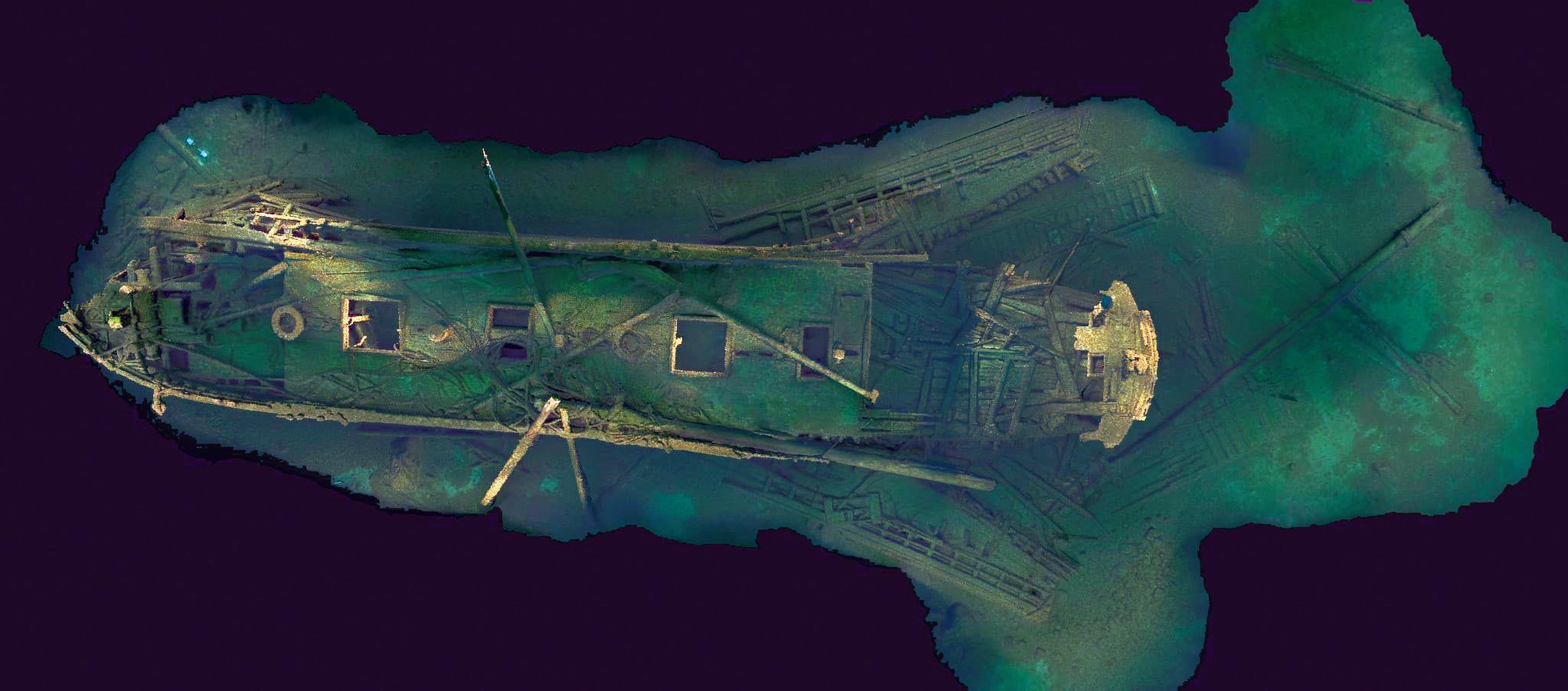

We carry:
100s of ship model fttings , modeling tools , wood stock in basswood, mahogany, and cherry.
Plans of sailing ships, power vessels, and pond models.
All our model kits contain: a pre-carved basswood hull, fttings, rigging, wood, plans, instruction guidebook, display base, and pedestals.
See our catalog online at: www.ajfsher.com
A. J. Fisher
1 Strawberry Lane, Norfolk, MA 02056 978-462-4555
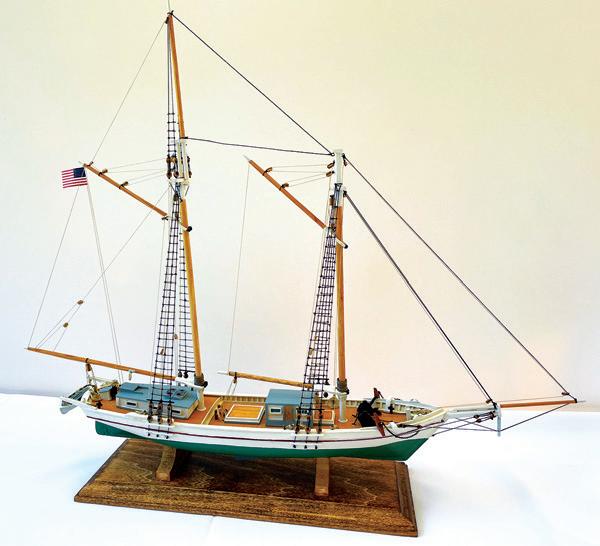
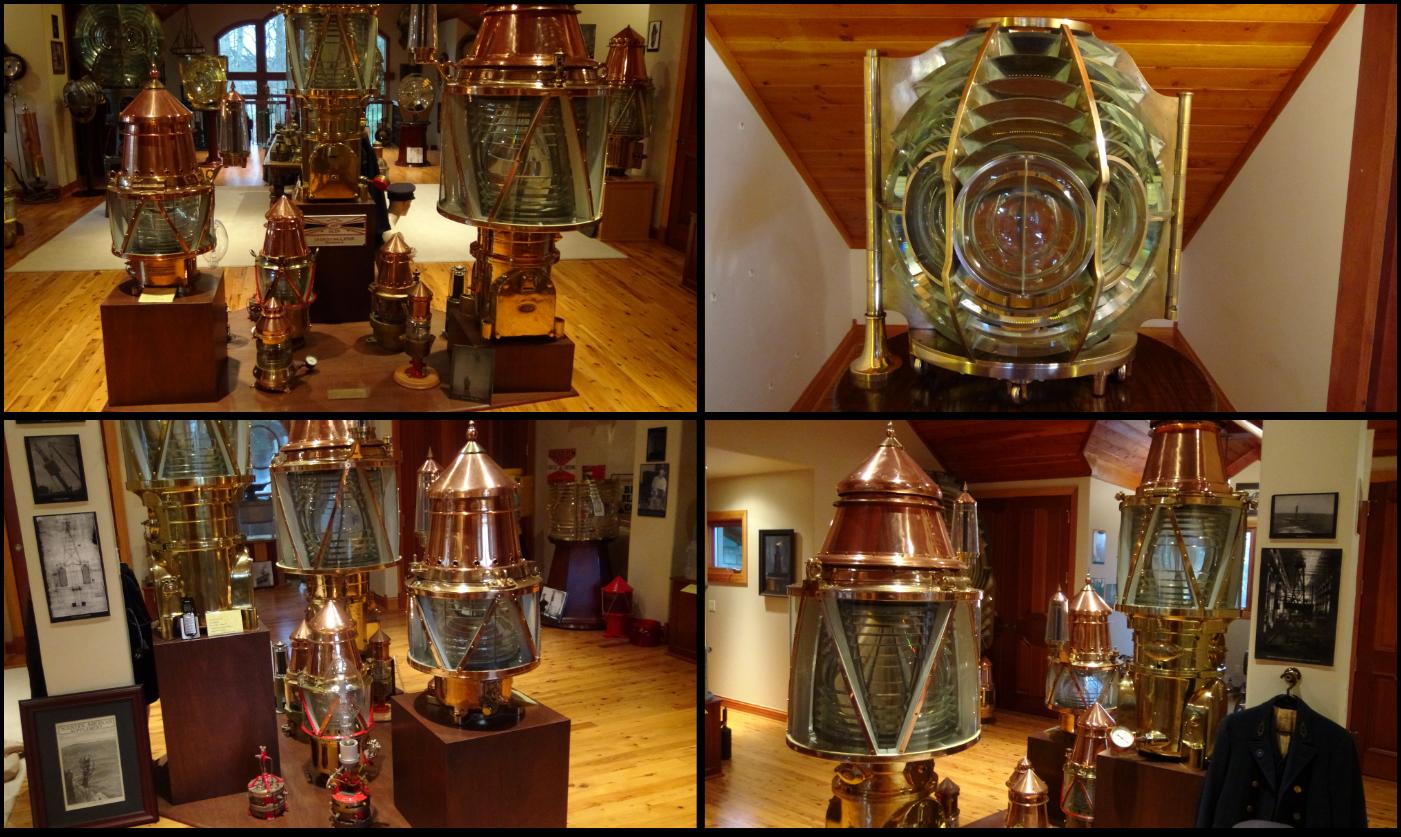
In June, Wisconsin Underwater Archeology Association (WUAA) principal investigator Brendan Baillod and a group of 20 citizen-scientists discovered the shipwrecked remains of the schooner F. J. King, which went down in a storm in September 1886. WUAA had chartered a boat to take the group out to survey for shipwrecks while learning about sidescan sonar and remotely operated vehicle (ROV) technology. Two hours into the excursion, the instruments picked up a target; ROVs were deployed and WUAA citizen scientists swam down
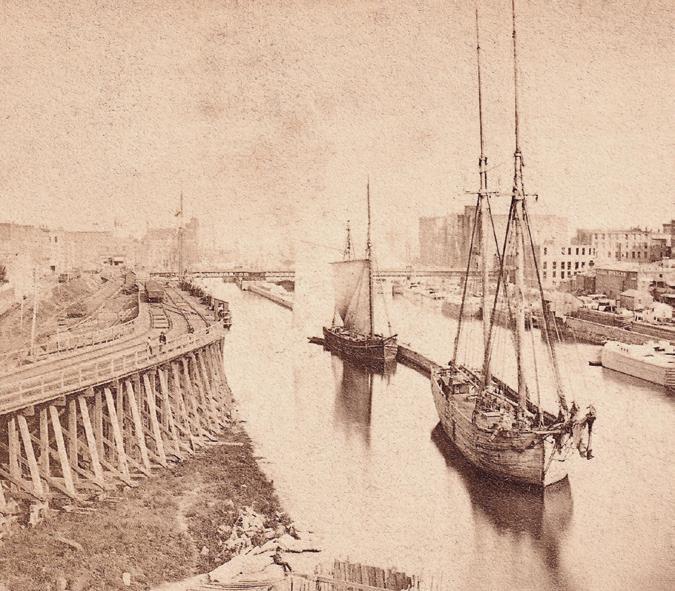
to investigate. ! is particular wreck had been an elusive target for shipwreck hunters for years, in part because of a discrepancy between the King’ s captain’s estimate of where the schooner sank and that of a lighthouse keeper who reported seeing the vessel as she went down. !e Wisconsin Historical Society’s Maritime Archeology program later sent sta $ to the site to document it and to create a 3D photogrammetry model. !e wreck site will eventually be nominated to the State and National Registers of Historic Places; once the shipwreck has been listed on the National Register, its location will be made public. !e 144-foot three-masted wooden schooner F. J. King was built in 1867 in Toledo, Ohio, by master shipwright George Rogers. She served
in the grain and iron ore trades. She got underway from Escanaba, Michigan, in September 1886 with a load of iron ore. She was heavily damaged in a gale o$ the Door Peninsula, forcing Captain William Gri % n and the crew to abandon ship in the vessel’s yawl boat. (www.wuaa.org) … e USS Silversides Submarine Museum (USSM) of Muskegon, Michigan, has deaccessioned USCGC McLane from its permanent collection and has sold the vessel for scrap. In a press release, the museum stated, “After nearly a century of service in both salt and fresh water, the McLane ’s condition had deteriorated to the point of being inaccessible for public touring and beyond the scope of feasible preservation.” !e ship’s artifacts and interpretive materials were removed prior to her departure and will remain as part of the USSM collection. !e Alert-class patrol boat McLane was launched in 1927 in Camden, New Jersey; she was named for US Secretary of State Louis McLane (1786–1857). She was transferred to the US Navy during WWII and served as a patrol boat and convoy escort;
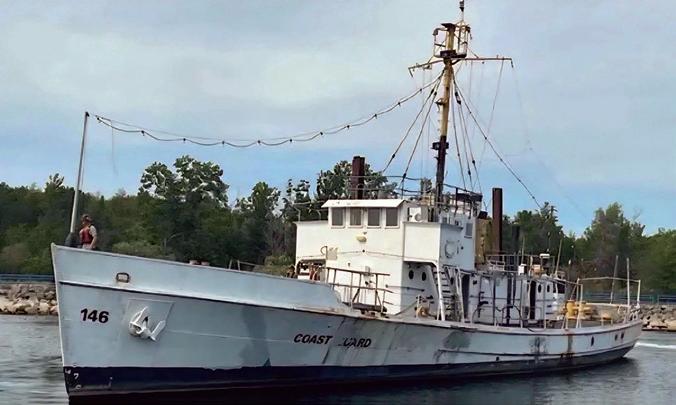
McLane sank a Japanese submarine in 1942 and rescued a downed aircraft crew in 1943. In 1993 she was acquired by USSM for use as a museum ship to serve its mission of honoring military service and educating future generations through hands-on experiences. !e 1941 Gato -class submarine USS Silversides (SS-236) was built at Mare Island Naval Yard, California. She received twelve battle stars for service in WWII and was awarded a Presidential Unit

Shop for Nautical Gifts, Marine Art Prints, Maritime Books, more at the NMHS Ship’s Store.
www.seahistory.org/store 1/8 page AD

For Sale — Six original Station Bills from SS United States
Signed by Captains L. J. Alexanderson & J. Anderson. Station Bills for every department and crewmember: Fire & Emergency Signal Bells, Man Overboard, Abandon Ship, etc. Each document framed in red, matted in white with blue trim, protected by museum conservation glass.
Framed size: 30.5 X 29 inches • $12,000 for the collection. Call (917) 287-8339
TUGBOATS AND SHIPYARDS: THE RUSSELLS OF NEW YORK HARBOR, 1844–1962, winner of the Steamship Historical Society’s 2020 C. Bradford Mitchell Award. Hilary Russell recounts the full lives and remarkable accomplishments of the three generations of watermen and the often beautiful, sometimes original, evolving forms of the craft that objecti ed the family’s work. $31—order through AbeBooks, PayPal, or mail a check to: Berkshire Boat Building School, PO Box 578, She%eld, MA 01257.
HARBOR OF THE MIND: A SAILOR’S MEMOIR by RADM Joseph F. Callo, USN (Ret.) is a self-portrait created in poems, vignettes, and quiet musings. In this work of poetic memoir Admiral Callo recalls his voyage through relationships, ports of call, and days adrift. His life has been a journey across many seas and shores, observing the world and the people around him. $21.95, plus shipping. To order visit www.seahistory.org/ shop or call 914-737-7878 ext 0.
CHESAPEAKE BAY ODYSSEY by Captain Michael J. Dodd explores 23 cities and towns. Dodd suggests historical sights to see and describes entrances to ports with tantalizing facts. Who knew there was a German U-boat at the bottom of the Potomac River? Did you know Francis Scott Key wrote the Star-Spangled Banner while he was a temporary captive on a British ship? Available through Amazon, Barnes & Noble, and others.
OUT- OF- PRINT NAUTICAL BOOKS SEA FEVER BOOKS !ousands of titles. E-mail: seafeverbooks@aol.com; Ph. 203 464-8808 (EST); www.seafeverbookstore.com.
NATIONAL PARKS PLAYING CARDS. Many of America’s National Parks are represented on these cards with interesting facts and images. www.ArcturusLLC.net
SUICIDE RUN TO ARCHANGEL by Captain Michael J. Dodd. A World War II novel based on the true story of how Deck Cadet Jack Dodd, with no combat experience, is caught up in a shocking new reality, as bullets &y, shells crack, and torpedoes streak through the sea as his Liberty Ship is attacked by German U-boats and bombers. Available through Amazon, Hellgate Press, Barnes & Noble, and others.
122 YEARS ON THE OLD BAY LINE by Jack Shaum is the winner of the Maryland Center for History and Culture’s 2023 M. V. Brewington Prize for maritime writing about Chesapeake Bay. It is the history of the Baltimore Steam Packet Company, better known as the Old Bay Line, perhaps the most famous steamboat line on Chesapeake Bay. !e book features many outstanding photographs by noted photojournalist Hans Marx, most of which have not been published before. Softback, 160 pages, $25.99. Available from Amazon, Barnes and Noble, and others.
PRESIDENTS PLAYING CARDS. All 47 US presidents are represented on these playing cards with interesting facts and quotes. www.presidentsplayingcards.com.
LOST HERO OF CAPE COD by Vincent Miles. !e story of an elite mariner, Captain Asa Eldridge, and the nineteenth-century battle for commercial supremacy on the Atlantic. Reviews, availability, at www.vjmiles.com/losthero and Amazon.com.
CIVIL WAR NAVY The Magazine, the only Civil War magazine dedicated to the naval history of the con & ict, published quarterly, 72-page issues. Subscribe at civilwarnavy.com or mail check for $37.95 to CSA Media, 29 Edenham Court, Brunswick, GA 31523. International subscriptions digital only.
MULTINATIONAL COLLECTION 1030+ SHIPS POSTCARDS. US Lines: SS America & United States; American Export Lines: SS Constitution & Independence; President Lines; Grace Lines; French; Italian; German, etc. Many historical ships: Titanic; Olympic; Cap Arcona (9 di $ cards), a Nazi German ship converted to prison ship in WWII, sunk by the Brits with 6,000 lost; Andrea Doria (2+ cards); Lusitania (Cunard Lines), torpedoed 1915 (actual photo); Wilhelm Gustlo (steamship named after a Gestapo chief, who was assassinated at time of ship’s naming). Being sold as collection: only $7k (neg.). Ph. 917 287-8339 or email: Chrysedawn@gmail.com.
CUSTOM SHIP MODELS, HALF HULLS Free Catalog. Spencer White, 4223 Chestnut Dr., Center Valley, PA 18034.
PIRATE PLAYING CARDS by Signature ASMA Artist, Don Maitz, National Geographic contributor and originator of the Captain Morgan Spiced Rum character. Full-color playing cards have di $erent watercolor images on each face. Prints present sea-rover adventurers. Order from: www.paravia.com/DonMaitz.
84-YEAR-OLD SHIPS’ BAKER SELLS PERSONAL COLLECTION OF 400 SHIP MENUS FROM THE 1900s AND ON: France, Germany, Italy, Britain, Holland, the US, etc. Century of Continental Cuisine & Fine Dining on the High Seas! $6,000 Ph: 917 287-8339 or email chrysedawn@gmail.com.
FINE ART PRINTS OF SEA ROVERS & BUCCANEERS by award-winning ASMA Signature artist Don Maitz. Visit: www.paravia.com/DonMaitz.
NAUTICAL GIFTS, BOOKS, MARINE ART PRINTS, & MORE AT THE NMHS SHIPS STORE at www.seahistory.org.
Advertise in Sea History! Contact Wendy Paggiotta at advertising@seahistory.org.
Citation. She has been berthed in Muskegon since 1973. (www.silversidesmuseum.org) … e Navy SEAL Museum San Diego (NSMSD) opened on 4 October 2025 to o er access and insights into the world of the US Navy SEALS. “Navy SEALs have played transformational roles in our nation’s history through clandestine operations. And due to that fact, many Americans have no idea what it takes to become a SEAL, how we came to be, what our missions entailed, and where we’re going in the future,” said Brian “Beef” Drechsler, the museum’s executive director. !e new museum is a sister institution to the National Navy UDT-SEAL Museum in Fort Pierce, Florida, where predecessors to today’s Navy SEALs trained for WWII. !e Fort Pierce museum tells the story of the evolution of the SEALS, beginning with Scouts and Raiders, Naval Combat Demolition Units, and Underwater Demolition Teams. !e San Diego museum is located just across the bay from Naval Special Warfare in Coronado, where all Navy SEALs are trained today. (Navy SEAL Museum San Diego, 1001 Kettner Blvd., San Diego; www.navysealmuseumsd.org) … On 31 July, the US Coast Guard released its report on the investigation into the dismasting of the Maine schooner Grace Bailey, which resulted in one death and the injuring of ve passengers on 9 October 2023. Factors in the accident were identi ed: severe internal rot of the mast due to fungal growth, the absence of a properly treated sapwood shell to protect the heartwood interior of the mast, a lack of e$ective preservative treatment to the mast material, and inadequacies in inspection methods on the part of both the owners/operators and the Coast Guard. !e report did not call for punitive action or criminal prosecution but included recommendations for the US Coast Guard to try to prevent mast
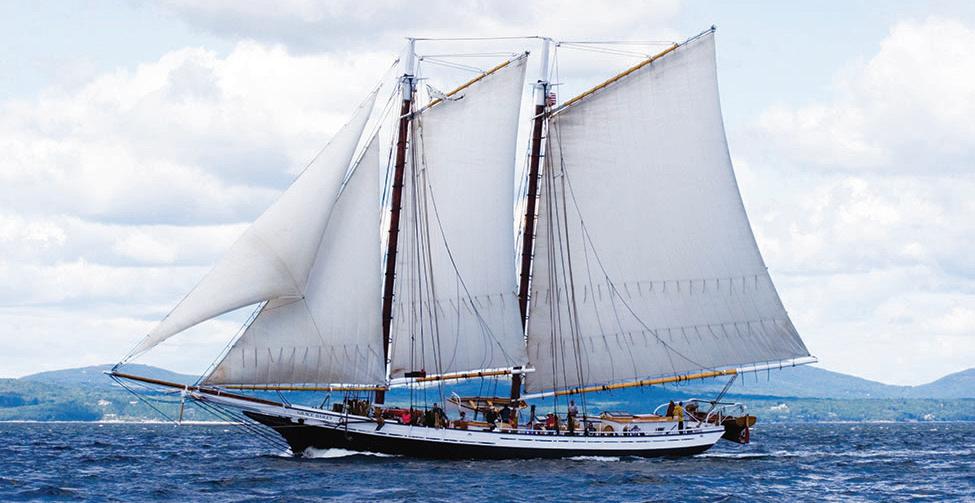
failures in the future, including working with the traditional sailing ship industry to develop better inspection and testing practices to monitor mast conditions. !e Grace Bailey was built in 1882 in Patchogue, New York, by Oliver Perry Smith; she was named for the owner’s daughter. !e schooner was rebuilt in 1906 and renamed Mattie, after Bailey’s granddaughter. Since 1919, she has served along the Maine coast,
joining the windjammer Maine passenger &eet in 1939. She underwent a signi cant restoration in 1989–90, after which her name was changed back to Grace Bailey. In 2022 she was purchased by Capt. Sam Sikkema, Suzannah Smith, and Marc Evan Jackson as a member of the Maine Windjammer Association. Grace Bailey has returned to passenger service since the incident. (www.sailgracebailey.com)
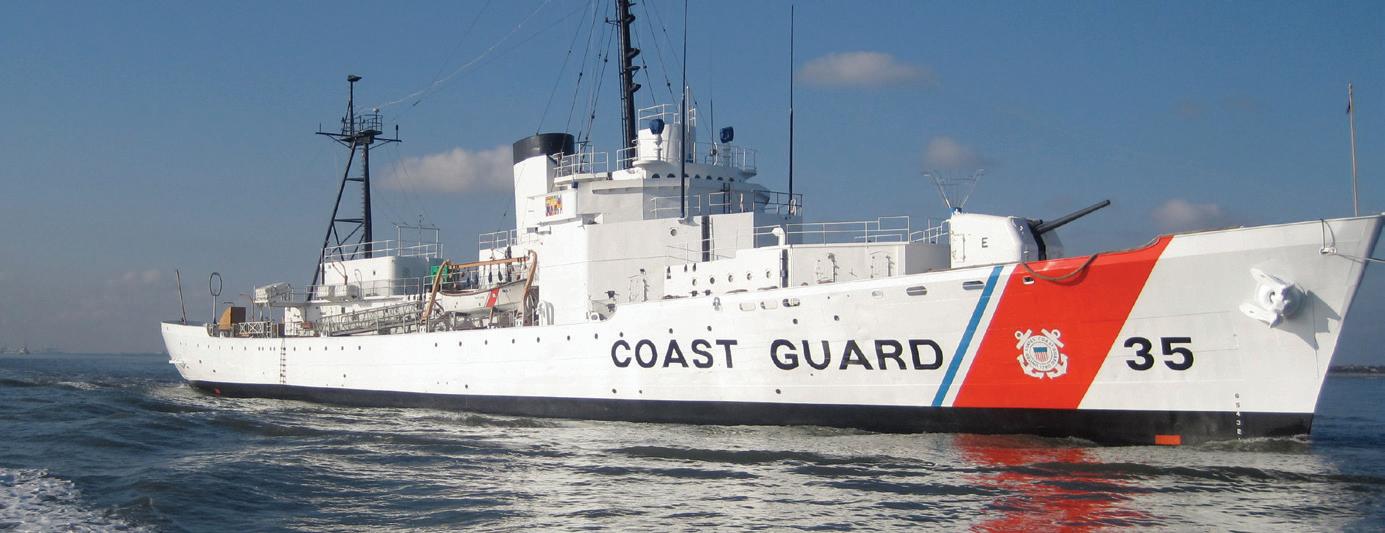






Freedom Ship: e Uncharted History of Escaping Slavery by Sea (Viking, an imprint of Penguin Random House, 2025, New York, 416pp, ISBN 978-0-52555-834-7; $33hc)
Marcus Rediker’s Freedom Ship: !e Uncharted History of Escaping Slavery by Sea is a masterful historiographical achievement. e author has created a wonderfully engaging book, rich in detail, that takes a familiar historical subject—the Underground Railroad— and recasts it with great precision using a bigger, far more detailed mold. In so doing, Rediker dramatically expands on known stories of heroism and intrigue inherent in Antebellum escapes from enslavement. Focusing squarely on the agency, skill, and ingenuity of enslaved persons who labored on or near Eastern Seaboard and Gulf Coast working waterfronts, he compels the reader to reexamine the Underground Railroad story and comprehend it within a broader maritime context.
Freedom Ship’s core analysis encompasses the intersection of two distinct but usually disparate academic elds— scholarship of the maritime world and that of slavery in North America. Rediker brings his enormous experience with both subjects to the task of explaining this heretofore little considered and understudied subject: escapes from enslavement accomplished speci cally by seaborne means. Rediker demonstrates conclusively that ships and maritime labor lie at the center of a comprehensive reconsideration and retelling of the long-established but terrestrially focused Underground Railroad story. Based on extraordinary, geographically broad research with maritime archival primary resources and secondary materials, this work describes the methods and tools used throughout the maritime UGRR with exceptional clarity.
Rediker succeeds not just in adding new details to previously acknowledged
stories of seaborne marronage, but his industrious research into under-exploited maritime records has yielded dozens of newly discovered incidents of escape from enslavement by sea. is fresh evidence conclusively establishes the case for the central importance of maritime fugitivism in the Antebellum America.
is edition opens with a comprehensive introduction by the author, in
which Rediker sets his stage, providing context for the central importance of maritime activity to the early American economy, and explaining why coastwise commerce provided opportunities for freedom to enslaved people. He also surveys the literature of the Underground Railroad, discussing why the maritime dimension of this story has not been more prominently studied until recently.
e core of the book contains eight main chapters, each focusing either on salient individuals whose experiences exemplify aspects of seaborne fugitivism (persons held in bondage and abolitionists), or on port cities (Philadelphia, New York, New Bedford, and Boston) that emerged as key entrepôts for freedom seekers en route to new lives where slavery had been abolished.
One of the great strengths of this volume is its richness in the explication of numerous individual lives—brief, meticulously documented biographies and ne-grained descriptions of incidents of seaborne marronage. Taken together, these accounts create an extraordinarily vibrant mosaic. e Freedom Ship narrative returns frequently
to the central importance of “head work”—the complex protracted strategic thinking and planning carried out by persons held in bondage that was essential to achieving a successful escape from enslavement. rough such careful explication, Rediker has succeeded in providing his readers with an intricate, practical understanding of the diverse and complex ways that maritime escape from enslavement historically played out.
A ne selection of carefully selected illustrations (23 black-and-white images distributed throughout the book, as well as an insert with 15 color plates) complement the text and provide essential context. In the volume’s introductory pages, a striking map to remind modern readers of the key maritime centers along the eastern seaboard, together with a map of the New York City waterfront, make clear that the geography and economy of the Antebellum era in the United States dictated that maritime routes of the Eastern Seaboard would serve as a primary highway for persons seeking to ee enslavement and that Black maritime workers themselves would be the main engineers of such escapes.
Rediker’s engaging writing style and highly innovative analysis have resulted in a subtle, layered treatment providing a comprehensive exploration of the history of escape from enslavement by sea, as well as a much-needed window into enslaved maritime workers’ lives in the 18th- and 19th-century United States. Whether for a specialist or general student of slavery, maritime studies, or American history, Marcus Rediker has produced a rst-rate read, with comprehensive scholarly apparatus that illuminates this central but oftneglected dimension of the maritime experience within the Underground Railroad.
T)m$th, D. W&-.er, P hD New Bedford, Massachusetts
Rope: How a Bundle of Twisted Fibers Became the Backbone of Civilization by Tim Queeney (St. Martin’s Press, New York, 2025, 336pp, ISBN 978-1-25034-645-2; $27hc)
Sea History readers will likely be drawn to this book for its aptly descriptive title. Cleverly written, Queeney’s book relates a story in chronological order, covering rope’s origins dating from the Neanderthals, who arguably could have invented it, to the not-toodistant future of space exploration and the implications of how mankind has used, and continues to use, and beneted from rope in all its forms over millennia.
e twisted bers of grasses laid up by hand thousands of years ago to snare a bird, secure a load, or hold something together was most likely one of the rst tools, and arguably it still lls that role and others even to this day. Cordage is timeless and irreplaceable on the grandest of scales.
e author adeptly lays out that, if it were not for this simple device, mankind could not have advanced, and the way such a ubiquitous yet powerful tool can be easily overlooked, considering how few people know how to use it
beyond tying their shoes. Since the advent of Velcro, that number might be fewer still. Rope is well researched and easy to follow; Tim Queeney takes us on an exploration from prehistory to the Nile of the pharaohs, the ancient Greeks, the Chinese treasure ships, the Andes, and nally to the great Age of Sail. His discussion of materials includes the fascinating story of Roebling and wire rope, and the near miracle of truly making life better through chemistry by inventing new things to make rope from in a laboratory, and explores the future of this amazingly versatile and oft overlooked thing. is is not a book about knots, though the subject is brie y touched upon. ere have been hundreds of such books written by various authors over time, and if you’re looking for any insight on that topic, you will not nd it here. is book, as its title implies, is a single-thread (see what I did there) through time explaining the origins, usage, and likely future of rope in all its forms. I found it a very pleasant summer read, delving into the esoteric details of something I’ve earned a living using, perhaps, without giving it its full due and consideration.
T$m W&r( Appleton, Maine
e Great River: e Making & Unmaking of the Mississippi by Boyce Upholt (W. W. Norton & Company, New York, 2024, 352pp, ISBN 978-0393-86787-9; $29.99hc)
Can there be a more fundamentally American subject than the Mississippi River? It traverses the nation north to south for over 2,300 miles from Lake Itasca, Minnesota, to the Gulf of Mexico, draining all or part of 32 US states and two Canadian provinces. Among its cities are Minneapolis, Saint Paul, St. Louis, Memphis, Baton Rouge, and New Orleans; among its dozens of tributaries are the Arkansas,
Missouri, Ohio, and Red Rivers. Variously called the Mighty Mississippi, the Father of Waters, the Big Muddy, and the Brown God, it boasts a long and colorful history, in addition to serving a vital ongoing economic role. Endlessly manipulated and engineered with levees, locks, wing dikes, concrete riprap, and meandering cuto0 s, it annually carries hundreds of millions of tons of valuable freight ranging from agricultural products to steel, paper, chemicals, petroleum, and automobiles. Yet in the words of Boyce Upholt in his readable new book, it remains a “chaotic domain of water.”
! e Great River is Upholt’s rst book, a bold endeavor considering that he follows the likes of Mark Twain, Francis Parkman, William Percy, John Barry, and Rinker Buck. If he does not always reach their heights, one can at least respect his ambition. A Connecticut native, Upholt rst encountered the river as a Teach for America Corps member in the Mississippi Delta during the early 2000s. He subsequently paddled its length from St. Louis to New Orleans, camping on sandbars, swimming its muddy currents, sweating its infernal heat, swatting its clouds of mosquitoes, and exploring Indian mounds and semi-deserted towns along the way. Certainly, there is no gainsaying Upholt’s personal familiarity with this watercourse.
Upholt’s overarching theme is the American relationship with the Mississippi, especially the long and fraught e0ort to control its oods and harness its power to productive ends. By his own admission, more “nature critic” than conventional scholar, Upholt broadly sketches the region’s usual historical highlights—the awe-inspiring Indian mound city Cahokia, Hernando de Soto’s “discovery” of the river, RenéRobert Cavalier Sieur de La Salle’s failed colonization attempt, Andrew Jackson’s triumph over the British at
the Battle of New Orleans, and the devastating ood of 1927.
Upholt is at his best when he shares rsthand observations and forays. At Jonesville, Louisiana—an ancient mound site, ood-prone, and economically struggling—he wanders an “unshakably spooky” landscape. “ e roads are potholed; some of the downtown lots have been reduced to rotting piles of insulation and plywood, though it was unclear to me whether the precipitating disaster was a ood or a tornado or simply neglect.” Upriver in Illinois, he nds a nice state park, “but the region beyond o0ers a compendium of sad Americana: warehouses and trucking depots, steel re neries and coal loading terminals, everything abutting the channelized remnants of ancient creeks.”
Hoping to see the sun rise and conjure the ancient spiritual vibe left behind by the area’s indigenous inhabitants, he is interrupted by a trio of locals coming o0 a bender: “But in this setting, with this company, I did not feel much of anything.” In Hinds County, Mississippi, he visits the ruins of the Mississippi Basin Model, an ambitious Corps of Engineers project that reproduced nearly the entire river valley in concrete on a 200-acre site. It took more than 20 years to build but eventually closed during the 1970s, having been made obsolete by computers. Now a state park, Upholt found it sadly neglected. “Styrofoam cups and empty PBR cans and black trash bags litter the grass. Boastful, self-granted nicknames are spray-painted across the concrete, along with the occasional oversized phallus.” Farther downstream, he tours the infamous Cancer Alley, “America’s Mordor, down to the aming towers,” and in St. James Parrish, contemplates a pile of “mildly radioactive waste” 200 feet tall.
Considering all the engineering, industrial-scale farming, pollution, and
urban development, Upholt rightly labels the river “a geological artifact of the Anthropocene Epoch.” Gone forever are the Edenic wilds and abundant game that greeted the region’s rst inhabitants—trackless wilderness and the Lord God Bird (the ivory-billed woodpecker, alas extinct). “Since our in uence is everywhere now,” Upholt observes, “‘nature’ no longer really exists.” Sadder words were never written.
J$h1 S. S-e(2e Fairhope, Alabama
Nelson’s Path nders: A Forgotten Story in the Triumph of British Sea Power by Michael Barritt (Yale University Press, New Haven, 2024, 267pp, ISBN 978-0-300-27376-2; $35hc)
Whether in war or in peace, the hydrographic service of the Royal Navy has been an institutional force that expands the military, diplomatic, and commercial in uences of a great maritime empire. Captain Michael Barritt,
the distinguished former Hydrographer of the Navy and a worldwide authority on the subject, has provided us with an outstanding treatise, buoyed with examples, on the trenchant in uence or role played by surveyors of the sea, chartmakers, and compilers of o3cial sailing instructions.
e in uence of seapower upon history was largely determined by naval vessels’ ability to navigate safely and e0ectively in the waters where outcomes would be achieved. Amphibious operations, mine laying, close-in barrage and intelligence gathering, and espionage missions depended upon reliable scienti c data of inshore waters.
Barritt’s lively account and skillful analysis tackles the vast expanse that the Royal Navy’s hydrographers were responsible for, from surveying the West African coast in ghting the slave trade to sounding inshore waters of the Red Sea so that bombards could be brought into range to win the acceptance of
recalcitrant piratical sheiks, and from surveying the coastline of the Iberian Peninsula so that Wellesley’s army could be safely withdrawn, to plumbing the shallow Baltic approaches ahead of British warships. e survey of the River Scheldt and approaches to Antwerp (“the pistol pointed at England”) is a classic discourse, but so, too, are evaluations of South Atlantic ports, the Canadian shores of the Great Lakes, and, not least, the survey of home waters, always tricky work because of tides and shoals, to say nothing of fog and shifting weather.
If British territory across the Atlantic—Bermuda and British-held Caribbean islands—fell into enemy hands, it would surely test British strength and confound its commerce. Bermuda’s strategic value was made clear during the American Revolution, the war against France (begun in 1793), and in the War of 1812. Fearing that the US or France might seize the island, in
1806 the Admiralty, on the advice of Rear-Admiral George Murray, began the process of making it a well-forti ed location. Murray, the commander in chief on station, was delighted at the prospects, for ships could be sent swiftly and secretly from Bermuda to any part of his station, stretching from Newfoundland in the north to Trinidad in the south.
Britain’s vision to survey and produce accurate charts for military and commercial use fell to omas Hurd, the second Hydrographer of the Navy and the principal gure in this book. Hurd was articulate, far-sighted, and managerially competent; moreover, he was able to get the attention of his naval superiors, who grasped the reality that if Great Britain were to become a great maritime power, “anchors of empire,” such as Bermuda, would have to be made secure and developed on a military scale. In 1808 Hurd was appointed Hydrographer to the Board of Admiralty with the express purpose of bringing order and e3ciency to the system.
In a famous memorandum, Hurd pointed out the many places of the world where marine surveys needed to be undertaken, charts made, and sailing directions produced. e breadth and scope of his appreciation of these matters is manifold as well as extraordinary. e fruits of hydrographical surveying—charts and sailing directions—are among the greatest legacies of the British Empire. e Royal Navy and British mariners were the chief beneciaries of these e0orts, of course, but the charts and navigational guidance they produced would bene t all who sailed the seas, for, while other nations held their charts and data close to their chests, the British data was made available to all.
Hydrographic surveying was hazardous work. George Vancouver issued double rations to his crew doing that
lonely work on the Alaska shore in cold conditions and rain-soaked boats. e crews faced all sorts of privation, illness, and even death. Ships surveying uncharted waters sometimes found themselves aground. Even the most diligent and accomplished of surveyors could nd himself in a dire situation. Anthony De Mayne, for example, who had charted a safe passage through wild and dangerous seas on the approaches to Nassau, Bahamas, and did yeoman’s work in the Turks and Caicos, as well as parts of Jamaica, was in command of the survey brig Kangaroo in December 1828 when the ship was lost o0 the coast of Cuba. An unforgiving Admiralty subsequently court martialed him, but the work of the surveying service continued expanding its coverage to the coasts of Belize, Siam, and to the recesses of the Rio de la Plata—indeed, anywhere else hazards could be found, identi ed, and charted.
It has been a tradition that the best historians of hydrography are hydrographers themselves. With a sharp eye for detail, a thorough personal knowledge of the service, and an appreciation of historical details and events, particularly from the era of the French and Napoleonic wars, Captain Barritt treats his readers to revelation after revelation as to how hydrographic surveys in uenced the outcome of history. His concluding chapter includes personal details of how bureaucratic in uences often de ected policy. Departmental a 0 airs were often examined (or dismissed) by persons who had little to no knowledge of the particulars of the hydrographical service. Nelson’s Pathnders is a very ne book, blessed with maps and charts, richly illustrated, and a delight to read—and full of all sorts of lessons.
B&rr, G$42h Victoria, British Columbia
Here is a database containing almost 165,000+ vessels, with many fields of information. This list is compiled from numerous annuals, Custom House records, books and newspapers. Contains American and foreign, commercial, pleasure, sail, power, warships, unrigged and undocumented vessels. Constantly updating and adding more information.
Ships’ Figureheads: Famous Carving Families by Andrew Peters (Whittles Publishing, Ltd., Caithness, Scotland, UK, 2025, 231pp, ISBN 978-1-84995583-6; $24.95
In Ships’ Figureheads, Andrew Peters—woodcarver of ship gureheads and founder of Maritima Woodcarving (est. 1990)—draws on his professional expertise to produce a richly illustrated and well-researched study of ship carving in the United Kingdom. Notably, the book contains more than one hundred images, including a trove of gurehead designs shipcarvers used in their bid processes.
Framing the histories of the Hellyer and Dickerson families (1715–1922) and noting the family of master carver Henry Provis Trevenen, whose own work included gureheads for HMS Sapphire (1874) and HMS Iris (1877), Peters provides an expansive account of these British shipcarvers’ lives, training, and business practices. He discusses billed costs, time involved, and workshop organization, while interspersing vivid descriptions of gureheads: a shipowner’s mother-in-law, a woman holding a squirrel, a Native American hunting a raccoon, a snake charmer grasping a cobra, and Hercules dressed in lion skin. Peters also documents ornamental carving on sternboards, ta 0 rails, and quarterboards, some adorned with owers, animals, and mythological gures.
e author addresses both the artistic ambitions and commercial realities of the shipcarvers who worked for Royal Naval yards and private clients, while unveiling contemporary responses to their work. ese include Her Majesty’s reported critique of the overly large nose on the Victoria gure, and the press’s emphatic condemnation of the bulldog gurehead for Growler
e author discusses timber varieties used for gureheads, referencing pine, American r, and elm, and comments on climatic in uences on wood
in regions of ship operation. He also observes that timber shortages sometimes necessitated the relocation of carvers within the United Kingdom.
Ships’ Figureheads: Famous Carving Families is a valuable contribution to the literature on maritime sculpture and will interest scholars, conservators, and enthusiasts of ship gureheads alike. Future editions could bene t from the inclusion of a subject index to facilitate reference. For the carvings Peters has examined directly, the addition of dimensional data and detailed surface descriptions would help readers approximate his expert visual assessments. Greater discussion of stylistic features that Peters considers attributable to individual carvers or workshops would also be of bene t. For example, when he writes of the 1855 Chesapeake gurehead that “the folds to the drapery were particularly well-formed,” readers might wish to know whether he identi es in this the slightly twisting diagonal drapery across the chest and the bold, deep cuts creating surfaces that capture light and enliven the gure.
In an engaging section on the author’s 2018 restoration of the gurehead from Satellite, a vessel that was broken up in 1879, he observes that “all large
gureheads were constructed from laminates xed together largely by wooden dowels,” and he refers to the central core to which outer laminates were attached. It would be of interest to know the dimensions of “large” gureheads and whether the laminations mentioned represent complex joinery or the typical addition to a solid wood core of smaller solid wood pieces that provide additional width for arms or drapery, and help align wood grain in the preferred orientation for smooth carving.
Overall, the detailed and well-researched information presented by Andrew Peters in Ships’ Figureheads represents a substantial contribution to the eld of maritime art history. It deepens our understanding of British carving families whose skillful and artistic craftsmanship so vividly contributed to the maritime heritage of the United Kingdom.
C &r$- O-5e1 Annapolis, Maryland
Phantom Fleet: e Hunt for Nazi Submarine U-505 and World War II’s Most Daring Heist by Alexander Rose (Little, Brown, New York, 2025, 342pp, ISBN 978-0-316-56447-2; $30hc)
On 4 June 1944, General Eisenhower was pondering over the weather and the decision to launch the largest amphibious invasion ever. Americans at home were listening to the Harry James orchestra’s I’ll Get By on radios kept on so that listeners would not miss what everyone expected was coming— news of the invasion of the European continent by Allied forces.
Nazi authorities had determined the chances of the invasion coming within the next few days in the face of inclement weather were low enough that key ag o3cers were given leave for visits home in Germany. Further south on that same ocean, Americans manning the ships of a hunter-killer
squadron centered on the auxiliary aircraft carrier Guadalcanal and the Germans in the Nazi U-boat 505 were ghting their own version of the war, an encounter set out by Samuel Eliot Morison in !e Atlantic Battle Won, May 1943–May 1945: History of United States Naval Operations in World War II
Morison’s terse prose reports the success of Captain Daniel Gallery and his crew in not only overcoming U-505 but successfully boarding her and taking her captive, the rst such armed boarding of an enemy vessel of war by the US Navy since the War of 1812. American servicemen and women are renowned souvenir collectors, and Gallery and his men collected what must be the grandest souvenir of them all, an intact Nazi U-boat. (U-505 was preserved and has been on public display in Chicago at the Gri 3 n Museum of Science & Industry since 1954.) “A

IN PAPER, ISBN: 9781611865417 $29.95
Admiral Gallery recounted the hunt and capture of U-505 in several books, including Twenty Million Tons Under the Sea: !e Daring Capture of the U-505 In the years since, the incident has been relayed and updated in monograms and periodicals; this year saw the addition of two more books on the subject: Codename Nemo: !e Hunt for a Nazi U-boat and the Elusive Enigma Machine, and Phantom Fleet: !e
Hunt for Nazi Submarine U-505 and World War II’s Most Daring Heist.
Codename Nemo (reviewed in the autumn issue of Sea History) expanded on Gallery’s work with details about life aboard the U-boat and the Guadalcanal. In contrast, the discovery, attack, and capture of U-505 simply serve as the backdrop in Phantom Fleet; instead, author Alexander Rose focuses his attention on the intelligence surrounding the action by delving into three topsecret programs—Nemo, Ultra, and

Enigma. Nemo was the codename the US Navy assigned U-505 in the months after the submarine was seized. Because the trove of secret information and equipment recovered from the U-boat was of such immense value to the Allied war e 0ort, it was essential that the Germans not learn of the loss of the boat. Rose explains the e0orts to keep it secret, a feat successfully carried out against overwhelming odds.
After all, thousands of US Navy personnel witnessed its boarding and capture. Moreover, the U-boat crew was rescued by their American enemies with only a single casualty, and the laws of war required that the prisoners be given access to the outside world. Winston Churchill’s evaluation of Russia is applicable to the Allied intelligence challenge surrounding the capture of U-505: “a riddle, wrapped in a mystery, inside an enigma,” with the enigma, in this example, being the Nazi coding
About Wrecked: About Sail, Steam, and Diesel:
“This is the most thorough and complete work covering the sinking of the Edmund Fitzgerald. If you want to know everything about this tragedy, then you need to read this book.” Toby Marcovich, attorney for the families of Michael Armagost, Ransom Cundy, and Freddie Beecher, crew members lost with the Edmund Fitzgerald

msupress.org
The Untold Story of the Boston Merchant Who Launched Donald McKay to Fame by
Vincent J. Miles
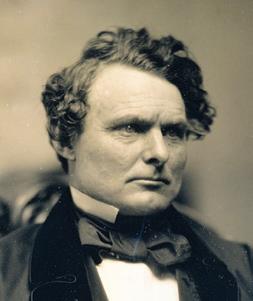
Donald McKay
“An impressive feat of historical research that illuminates the life of an unjustly neglected historical fgure.” Kirkus
Reviews and more information at vjmiles.com. Available at Amazon.com, etc.
The story of three young sailors coming of age during the Second World War — sailors who crewed the engine room of an ocean-going tug. War changes people for those fortunate enough to survive it. Many who served in the U.S. Merchant Marine during the war did not.
Available at Amazon
system constructed around a typewriter-looking machine that encrypted and decrypted radio messages through a series of rotors and electrical contacts.
Ultra was the codename assigned to the intelligence operation devoted to decrypting Nazi messages, the “anti-Enigma,” and its history is told in Phantom Fleet through the experiences of two leading o3cers who ran the intelligence operations to break the Enigma code, the Royal Navy’s Rodger Winn and the US Navy’s Commander Kenneth Knowles. Early leaders in the development of Ultra, the British shared their ndings with their American allies only sparingly for fear that subsequent actions based on Ultra information would alert the Nazis that their Enigma codes had been cracked.
The British approach to antisubmarine warfare was passive—protect the convoys and drive the U-boats away.
e Americans preferred to seek out and destroy the U-boats with hunterkiller units built around small carriers. To be successful, the hunter-killer commanders needed to know the enemy’s location, and Ultra was the key to guring that out. Knowles and his team, with the support of the top US Navy o3cials, gambled that the rewards from their exploitation of Ultra discoveries would outweigh the risk of losing the intelligence advantage.
Out in the Atlantic, Ultra gave Gallery the edge over his opponent. Intelligence data led his hunter-killer group to the location where they might nd U-505. With its successful capture, he was able to return to the intelligence community a trove of equipment, code books, and documents, just two days before D-Day, improving the Allies’ capacity to combat the U-boat menace when the invasion eet was most vulnerable.
Phantom Fleet will be most appealing to readers interested in
military intelligence, especially naval intelligence. Readers whose interest is primarily U-505 would be advised to start with a reading of Gallery’s Twenty!ousand Tons, followed by Lachman’s Codename Nemo, and then follow up with Rose’s Phantom Fleet. D&6)( O. Wh)tte1, P hD Sullivan’s Island, South Carolina
Siege: e Canadian Campaign in the American Revolution 1775–1776 by Donald Grady Shomette (Heritage Books, Berwyn Heights, Maryland, 2025, 2 vols., 738pp, ISBN 978-078845-078-5; $77hc)
Donald Shomette’s latest book, Siege, presents readers with a unique opportunity to immerse themselves in the long-forgotten details of the American attempt to capture Quebec province in the early days of the American Revolution. is campaign followed the battles of Lexington and Concord and was endorsed by the Continental Congress and Commander-in-Chief George Washington. e American strategy was to approach Canada by two routes, one aimed at seizing Montreal and the other directed at Quebec,
where the two American armies united with Canadian allies led by Moses Hazen and others to launch an attack on the citadel, the headquarters of the British command in North America. e Canadian Campaign, covered in Volume I, ultimately met defeat on 31 December 1775, during an attack on the citadel with the death of General Richard Montgomery and the wounding of Benedict Arnold. Volume II narrates Arnold’s four-month winter siege of Quebec, followed by his withdrawal from Canada as a British eet arrived to reinforce Governor General Guy Carleton with British and Hessian troops. is retrograde march stands as a prologue to Arnold’s hard-fought battle of Valcour Island in November 1776. e Americans’ ghting retreat to Fort Ticonderoga put an end to the British incursion into Lake Champlain and led to the defeat of General Burgoyne at the battle of Saratoga in 1777. Beautifully written and deeply researched through French, British, and American documents, Shomette’s book is a pleasure to read. He gives his readers a detailed explanation of the di 3culties facing both leaders, as well as their principal British opponent, General Carleton. For example, General Montgomery led his army up the western route from Lakes George and Champlain to the Richelieu River leading to Montreal. His fellow general, Benedict Arnold, led the eastern army by sail from Newburyport, Massachusetts, and then by foot along the Kennebec River, and into Quebec province by way of the Chaudière River to the St. Lawrence. Arnold’s trek through the northern wilderness was made difcult by untrammeled and poorly marked trails, fallen trees, marshy swamps, early snowstorms, and shortages of food, causing many of the volunteers to fall ill from exposure to freezing temperatures. We get reacquainted with some other American
military leaders through Shomette’s thumbnail character portrayals, such as Generals Philip Schuyler and Daniel Morgan, Nathanael Greene, Henry Dearborn, Ethan Allen, and Moses Hazen, who had leading roles that played out during the campaign.
e Continental Congress lacked the resources to adequately support the armies with funds, food, medicine, and clothing during the campaign. Hence, the troops su 0ered greatly on the march and especially after they reached their destination in November 1775. e American forces commenced the siege of Quebec during one of its worst winters in years, with snow piling six feet deep on the Plains of Abraham.
e author shows his competence in using French-language sources, portraying the American e 0 orts to persuade the French and English commoners of Quebec to join the Americans by helping to overthrow Governor General Carleton, his small army of regulars, the militia, and the French-speaking upper and middle classes who supported him. General Washington advised his two generals to ensure their Protestant troops would be circumspect in their dealings with the largely Catholic inhabitants. e American soldiers, he insisted, must avoid creating incidents that might in ame the Canadians’ Indian (Caughnawaga) allies. is First Nations tribe was a branch of the New York Iroquois who were converted to Catholicism by Jesuit missionaries.
Of critical comments, I have few, but I must mention the need for a conclusion that provides an overview of the campaign’s signi cance in the Revolutionary era, the reasons for its failure, and perhaps a consideration of its consequences even if it had succeeded. Could Quebec have become the fourteenth American state, given the Crown’s resources? Secondly, the index contains excessive blocks of page
numbers without subheadings. is makes it di 3cult for readers to seek the right page(s) in reference work.
Shomette’s Siege is a rst-rate study of an important event that is seldom, if ever, taught now in secondary school and university history classes. For example, a glance at a commonly used American history college textbook, Give Me Liberty! (2023) by Eric Foner, Kathleen DuVal, and Lisa McGirr, reveals but two sentences allotted to the Canadian Campaign. e most riveting passages in the book are those
describing the British naval pursuit of Arnold’s otilla across Lake Champlain, the Battle of Valcour Island, Arnold’s fog-bound escape after the battle, and his arrival at Fort Ticonderoga. For these reasons, this reviewer recommends that readers take the time to read this fascinating history of one of the earliest campaigns of the American Revolution. (Note: is book is only available directly from the publisher at www.heritagebooks.com.)
W)--)&m S. D4(-e,, P hD Easton, Maryland
Decorative Nautical Charts are the perfect solution for displaying your favorite chart area in your home or office. Just peel the backing off and apply no frame needed. These charts are not intended for navigation and are for decorative purposes only.
• PEEL & STICK technology
• No frame necessary
• Printed on self-adhesive matte fabric
• Easy to peel off and reapply – does not leave residue behind
• Can be attached to almost all smooth surfaces including walls and windows
• Popular harbors, islands and bays
• 24 x 34 inches
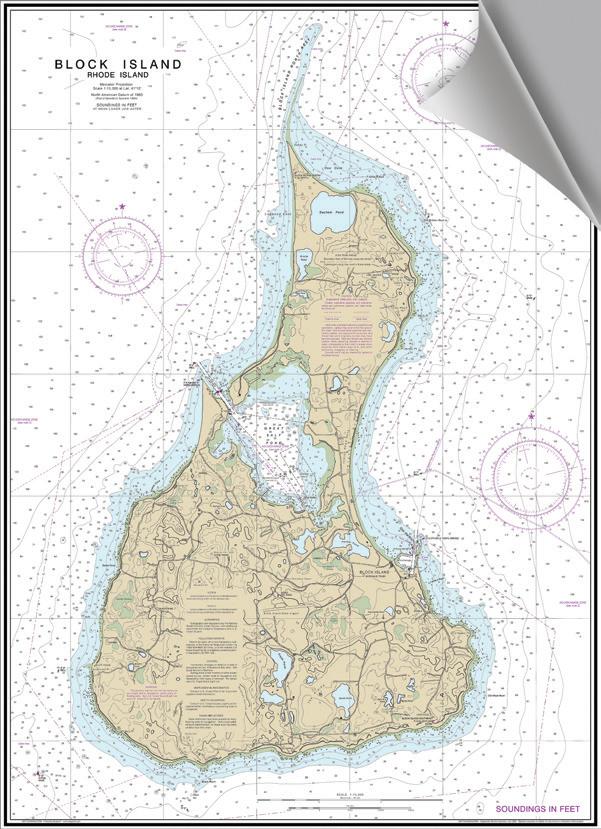
Visit www.maptech.com to see the extensive collection online.
The National Maritime Historical Society is grateful to the following individuals and institutions who have so generously supported our work. We are also grateful to our many anonymous donors.
PETER A. ARON PUBLISHER’S CIRCLE: Guy E. C. Maitland • Ronald L. Oswald • William H. White
NMHS LEGACY SOCIETY IN MEMORY OF: Peter A. Aron • James J. Coleman Jr. • Jean K. & CAPT Richard E. Eckert, USN (Ret.) • Ignatius Galgan • D. Harry W. Garschagen • William J. Green • Robert F. Henkel • Charles R. Kilbourne • Arthur M. Kimberly • H.F. Lenfest • Pam Rorke Levy • Arthur Peabody • Walter J. Pettit Sr. • CAPT Joseph Ramsey, USMM • Charles A. Robertson • Capt. Bert Rogers • Dr. Timothy J. Runyan • Howard Slotnick • Peter Stanford • John Stobart
AFTERGUARDS: American Cruise Lines • American Maritime O cers • Matt Brooks • Caddell Dry Dock and Repair Co., Inc. • CAPT Sally McElwreath Callo, USN (Ret.) & RADM Joseph F. Callo, USN (Ret.) • Richardo R. Lopes • McAllister Towing • CAPT James A. Noone, USN (Ret.) • North Sails • James Pollin • Rydell Mortenson Charitable Foundation • Sailing Education Association of Sheboygan • Richard Scarano & Scarano Boat Building, Inc. • e Schoonmaker Foundation • Dix & Barbara Wayman Fund • Windway Capital Corp.
BENEFACTORS: American President Lines, LLC • Richard Breeden • James & Michele DeSalvo • Richard T. du Moulin • James & Patricia A. Hilton • Benjamin Katzenstein • VADM Al Konetzni, USN (Ret.) • Peter McCracken • William Gordon Muller • John W. & Anne Rich • Seafarers International Union of North America • Margherita Sorio • Alix T. orne • Turner Foundation Inc. • Twenty Maples Fund • Rik van Hemmen • Betsy & omas A. Whidden • Dr. David & Mary Winkler
PLANKOWNERS: A.G.A. Correa & Son • American Bureau of Shipping • Byers Foundation • omas A. Diedrich • Dr. William S. & Donna Dudley • Benjamin & Francesca Green • omas Harrelson • Leslie Kohler • H. Kirke Lathrop III • Cyrus C. Lauriat • Dr. Joseph F. Meany Jr. • Naval Institute Press • North American Society of Oceanic History • Erik & Kathy Olstein • Philip Ross Industries Inc. • Ford Reiche • Sidney Stern Memorial Trust • Philip J. & Irmy Webster • Jeremy Weirich
SPONSORS: Paul M. & Marjorie Aldrich
• Allen Insurance & Financial • Kenneth Andersen • Charles B. Anderson • Fran Babashak • James Barker
• CAPT Donald Bates, USN (Ret.)
Charles C. Chadbourn III, USN (Ret.)
• Lawrence Behr
• Lauretta Bruno
• Robert P. Burke
• George W. Carmany III
• CAPT
• James W. Cheevers • Chesapeake Bay Maritime Museum • Frank Crohn • VADM Robert F. Dunn, USN (Ret.)
• Jacqueline Eldridge
• John F. Finerty
• Ronald & Elizabeth Fisk
• Charles Fleischmann
• Anne Fletcher
• Christopher Freeman
• John Gladsky
• Pamela Goldstein
• Burchenal Green
• CAPT Vernon C. Honsinger, USN (Ret.) • Joseph Hoopes • Ruth R. Hoyt-Anne H. Jolley Foundation, Inc.
• Steven A. Hyman
• CDR Gerald Innella, USN (Ret.)
• e Interlake Steamship Company
• Dana Jackson
• Sarah Je ords
• Dale Jenkins
• Gary Jobson
• Neil E. Jones • Elizabeth Kahane
• Brian Keelty
• Nelson & Linda La ey • Arthur & Ruth D. Lautz Charitable Foundation • Paul Jay Lewis
• Jean Henri Lhuillier
• Robert Lindmark
• Com. Chip Loomis III • David J. & Carolyn D. McBride
• Walter C. Meibaum III • CAPT Joseph Mocarski • Mystic Seaport Museum • National Liberty Ship Memorial • National Marine Sanctuary Foundation • National Museum of the Great Lakes • Wynn & Patricia Odom • Dr. Alan O’Grady • Old Stones Foundation • Diana Pearson • James S. Perry
• Brian R. Phillips • Carl A. Pirolli • Mr. & Mrs. Andrew A. Radel
• Charles Raskob Robinson • Richard Rudick • CMDR James K. Ruland • Mr. & Mrs. Lee H. Sandwen • George Schluderberg • Douglas H. Sharp • Marjorie B. Shorrock • C. Hamilton Sloan Foundation • Gail Skarich • Richard W. Snowdon • Edmund Totten Sommer III • Philip E. Stolp • Daniel R. Sukis • Craig ompson • Steven J. Traut • Kim Wickens • Jean Wort • CAPT Channing M. Zucker, USN (Ret.)
DONORS: Benjamin Ackerly • CAPT John E. Allen, USN (Ret.) • CDR Everett JR Alvarez, USN (Ret.) • Carter S. Bacon Jr. • Mark W. Barker • Eric Barreveld • Larry & Lucinda Barrick • Jason & Heidi Bemis • W. Frank Bohlen • Dan B. Bookham • Capt. Jonathan Boulware & South Street Seaport Museum • Michael Bower • RADM David C. Brown, USMS (Ret.) • Henry S. Burgess • Mary Burrichter & Bob Kierlin • John B. Caddell II • James C. Caviola • Dr. Christopher Cifarelli • Mark Class • Columbia River Bar Pilots LLC • John C. Couch • CAPT R.L. Crossland, USN (Ret.) • Samuel & Pamela Crum • VADM Dirk Debbink, USN (Ret.) • James P. Delgado, PhD • Richard H. Dumas • Gary E. Eddey • Charles C. Fichtner • Rip & Noreen Fisher Charitable Fund • Lars Forsberg • Michael Franzen • Michele Gale-Sinex • Susan Gibbs • Laura Grondin • Samuel Heed • Peter Hollenbeck
• Christopher P. Jannini • Robert C. Kennedy, Jr. • CDR Robert E. Kenyon III, USNR (Ret.) • Laurence & Omie Kerr • omas Kopczynski • Donald R. Kritsch • Christopher Lehman • Hon. John Lehman • Alan I. Levenson • Robert Lindmark • John L. Lockwood • Alan R. McKie • Otto & Elizabeth Marx • James Moore • CAPT Robert G. Moore, USCG (Ret.) • omas A. Moran • Michael C. Morris • CAPT Vance H. Morrison, USN (Ret.) • Rev. Bart Muller • John & Elizabeth Murphy • John E. Nelson • Rev. Mark Nestlehutt • Christopher O’Brien • COL Bruce E. Patterson USA • Eleanor J. Perkins • Jennifer N. Pritzker • Mr. & Mrs. William P. Rice • Francis Rienho • Patrick W. Roche • Robert F. Sappio • Larry C. Schramm • Ronald L. Skaggs • Dr. Chuck Steele • Patricia Steele • William T. Stevens • John & Barbara Stotsenburg • Diane & Van Swearingin • RADM Cindy ebaud, USN (Ret.) • CAPT John M. Torjusen • Paul Tully • Frederick A. Van Mourik • Robert L. Van Nice • Kurt D. Voss • William R. Walsh • LT COL Lee P. Washburn • Chase Welles • Nathaniel S. Wilson • William L. Womack • David Zehler
For more information on how to support our work, please visit us at www.seahistory.org. e National Maritime Historical Society is a 501(c)(3) nonpro t organization founded in 1963 whose mission is to preserve maritime history, promote the maritime heritage community, and invite all to share in the adventures of seafaring.

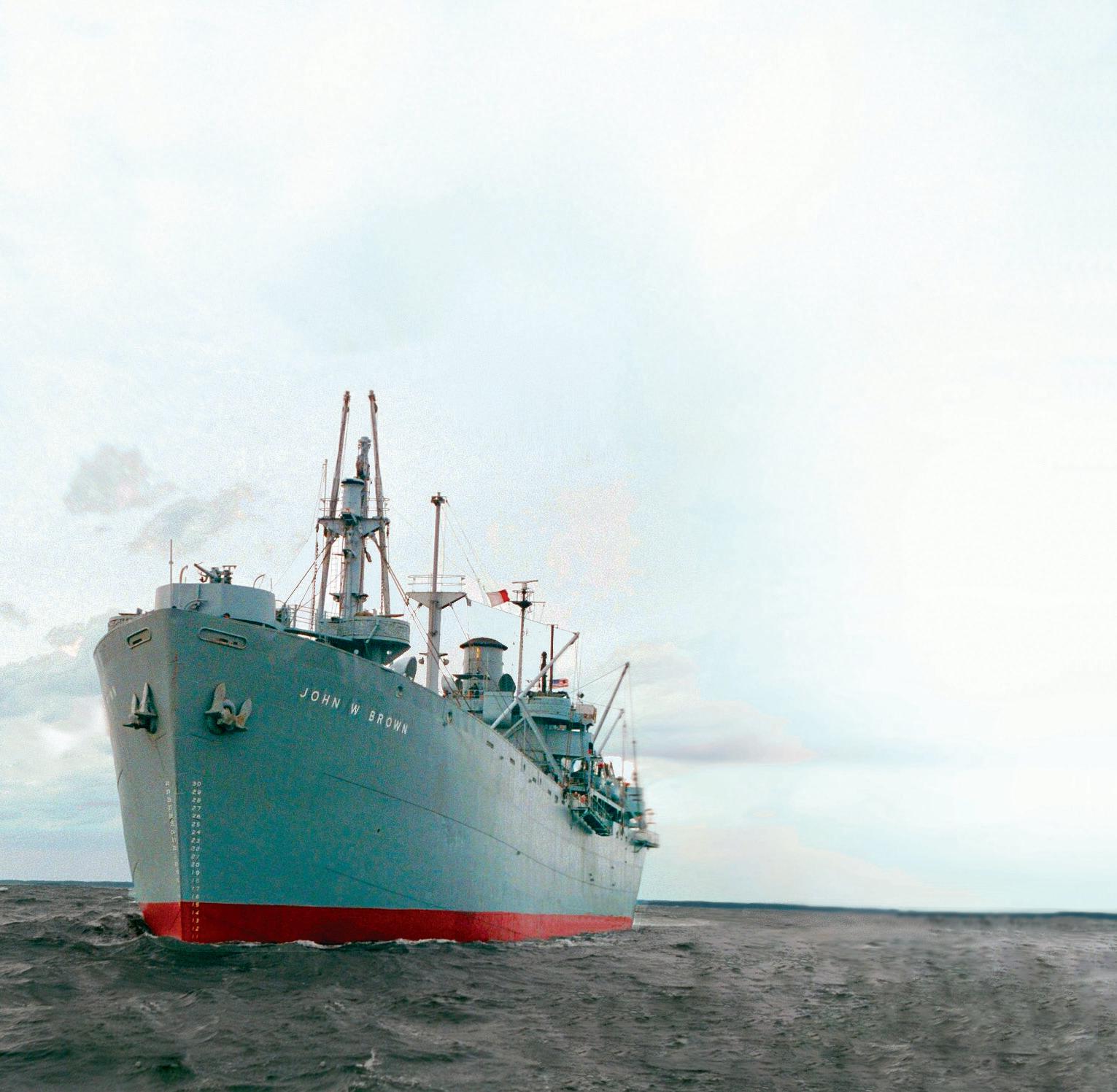
On a cruise you can tour museum spaces, bridge, crew quarters, & much more. Visit the engine room to view the 140-ton tripleexpansion steam engine as it powers the ship though the water.
Reservations: 410-558-0164, or www.ssjohnwbrown.org
Last day to order tickets is 14 days before the cruise; conditions and penalties apply to cancellations.
Many – but definitely not all – academic libraries will allow visitors to enter and use their databases. When librarians sign contracts to provide access to these expensive databases, most try to ensure access for “walk-in” users – for anyone who comes in to the library, especially in public academic libraries. If you have an academic library near you, ask if you can use most of its resources as a walk-in user. For more research ideas visit: https://shipindex.org/research_help
Over 150,000 citations are completely free to search
Use Coupon Code “NMHS” for a special discount to access the full database.
With ShipIndex.org you can find vessel images, ship histories, passenger and crew lists, vessel data, and much more. Search over 1200 sources including books, magazines, databases, and websites, all at once.