SECTION E
SUNDAY • NOVEMBER 15, 2020
FA C E S
O F
T H E
A R T S
S H U T D O W N
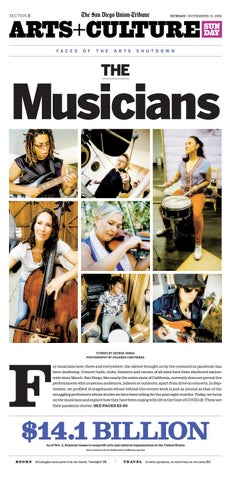
THE
Musicians
F
STORIES BY GEORGE VARGA PHOTOGRAPHY BY EDUARDO CONTRERAS
or musicians here, there and everywhere, the silence brought on by the coronavirus pandemic has been deafening. Concert halls, clubs, theaters and venues of all sizes have been shuttered nationwide since March. San Diego, like nearly the entire state of California, currently does not permit live performances with in-person audiences, indoors or outdoors, apart from drive-in concerts. In September, we profiled 10 stagehands whose behind-the-scenes work is just as pivotal as that of the struggling performers whose stories we have been telling for the past eight months. Today, we focus on the musicians and explore how they have been coping with life in the time of COVID-19. These are their pandemic stories. SEE PAGES E2-E6
$14.1 BILLION As of Nov. 2, financial losses to nonprofit arts and cultural organizations in the United States Source: Americans for the Arts (findings based on 19,800 survey responses)
BOOKS
McConaughey waxes poetic in his new memoir, “Greenlights” E9
T R AV E L
As winter approaches, ski resorts focus on virus safety E13
E2
SUNDAY • NOVEMBER 15, 2020
THE SAN DIEGO UNION-TRIBUNE
FAC ES O F T HE A RTS SHUTDOWN
TH E MUS I CI AN S
478 MILLION N AT H A N H U B B A R D
Number of admissions lost due to event cancellations Source: Americans for the Arts (findings based on 19,800 survey responses)
P E R C U S S I O N I S T
‘As far as I know, everything is off the table’ BY GEORGE VARGA
N
athan Hubbard was a doublewinner in July at the 2020 San Diego Music Awards, where he won the Best Jazz Album award for “This Stream” by the Nathan Hubbard Trio and shared Best Hip Hop or Rap Album honors for “The Bully Pulpit” as a member of the group Parker Meridien. ■ His acceptance speeches, like the entire awards ceremony, were delivered remotely online because of the coronavirus pandemic. It was an all too telling illustration of the virtual reality conundrum now faced by myriad musicians whose performance schedules evaporated in mid-March and have yet to return. “Things are at a standstill,” said Hubbard, a genre-leaping percussionist, band leader and composer. He lives in San Carlos with his wife and three children, two of whom started high school this year entirely online. Apart from a Sycuan Casino date and a few fleeting music jobs at restaurants, his calendar has been empty. “I’ve always been the guy who works at night and is here for the kids in the day, picking them up from school and driving them to karate class and ballet rehearsals,” Hubbard said. “Now, it’s shifted. Instead of running out at night, I’m doing gigs from home on the Internet. This would not be possible for me if my wife didn’t have a very good full-time import/export position.” In a typical week before COVID-19, Hubbard performed an average of five to seven nights per week. He worked steadily in various musical theater productions, with club dates, recording sessions and periodic cocktailjazz receptions in between. “I did one preview performance of ‘La Cage aux Folles’ at Cygnet Theatre in March before it got shut down,” Hubbard said. “That was supposed to have run for eight weeks, seven shows a week. I was supposed to then do ‘An American in Paris’ at Moonlight Amphitheatre, followed there by ‘Ragtime.’ All that went away, as did all my club work.
EDUARDO CONTRERAS U-T PHOTOS
What I was going to be doing the past six months of all went up in smoke.” So did a Santa Fe Christian High School musical theater production Hubbard was booked to play. Originally scheduled for October, it has been pushed back to May. The likelihood of doing any live performances does not look promising, even if health protocols are strictly implemented. Pragmatic by nature, Hubbard accepts this as a situation well beyond his control. “As far as I know, everything is off the table until we get to the next state clearance level,” the La Jolla native said. “Even then, it will be a challenge. A smaller theater that has to give up two of every three seats for social distancing? It’s hard enough for them to make money at full capacity. So I can’t imagine how that will work until there’s full clearance from the state to operate without any social-distancing protocols.” With all three of his children
taking their school classes online from home, Hubbard has assumed new responsibilities. These include “making sure the Wi-Fi is always working” and helping his kids stay focused and grounded. “My youngest son is in first grade and now has to do all these things he’s never done before. He doesn’t know how to type, so it’s been a technological challenge,” Hubbard said. “Are my kids getting the education and information they need? Do they understand what is going on? Clearly, social interaction is null and void, so how do we keep them from going stir-crazy?” That is a challenge their dad, a San Diego State University classical percussion-performance graduate, now faces as well. With his regular live dates canceled at least into next year, Hubbard is creating and honing his music — from hip-hop beats to wildly ambitious extended instrumental compositions — almost completely at home.
L A U R A C H AV E Z
Until eight months ago, he would rehearse, record, perform and exchange ideas face to face with his collaborators. Now, he does so almost exclusively via the Internet. That’s a major disadvantage in many ways, although Hubbard notes that he is able to record long-distance with musi-
“On a purely musical level, it’s challenged me to focus on things that maybe I skipped over.” Nathan Hubbard
cians whom he could not afford the expense of flying and housing in San Diego. “Rather than going to band rehearsal or a studio session, it’s now a matter of recording sound files and transferring it to somebody, doing videos and using all kinds of technologies that weren’t so important before,” he said. “It makes you wonder if this is the new paradigm, or if things will eventually shift back to how they were before. “On a purely musical level, it’s challenged me to focus on things that maybe I skipped over. Because I was busy enough performing, I didn’t have enough time to focus on technical things, both musical and electronic, like video editing or finding better ways to record my drums. “So that’s been a nice silver lining to be able to step back, and think, ‘OK, I don’t have anything to do for the foreseeable future, so what do I want to work on?’ ” george.varga@sduniontribune.com
G U I TA R I S T
‘This is the first time I have ever busked in my life’ BY GEORGE VARGA
T
he coronavirus pandemic has led to many firsts for the many musicians who have had no venues to perform in since the lockdown for live events began in mid-March. For blues-rocking guitarist Laura Chavez, the pandemic has led her from those shuttered venues to the streets — at least when it comes to performing. “I’ve been busking in Little Italy every weekend with Chickenbone Slim and his bassist and drummer, and this is the first time I have ever busked in my life,” said Chavez, who usually does at least 250 concerts a year on the road. “Busking was never something I thought I would do,” she continued. “People in Little Italy have been respectful. They keep their distance, wear masks and enjoy the music safely. And we’ve actually come out fairly well, money-wise (from tips), about the same as we would if we played a weekend club or restaurant gig here in town. We all kind of look at it the same way. Busking is fun. It gives us a chance to play. And we’re doing more than if we were sitting at home not doing it.” Sitting at home is some-
thing Chavez was happily unaccustomed to before the pandemic struck. As the guitarist in two bands — one led by North Carolina singer Nikki Hill, the other by Philadelphia saxophonist/singer Vanessa Collier — she is constantly traveling. Chavez is also the fleet six-string ace in the house band for the annual Blues Caravan tours, which are produced by Germany’s Ruf Records and crisscross the European continent. This year’s edition, which was curtailed after its February leg because of the pandemic, also featured San Diego singer Whitney Shay. She and Chavez did a separate one-week tour of Russia in January. “I’m usually out of town 300 days a year,” the devoted guitarist said, speaking from her Hillcrest apartment. “Everything was set up for me to be here two to three days at a time, then go back on tour, which is what I’ve done since I moved to San Diego from the Bay Area two years ago. “So, it’s weird to have been here since March, and I’ve started to rearrange things to make it a more permanent living space. It was a big adjustment, especially at the beginning of the pandemic. I didn’t touch a guitar for so long
“Financially, it’s rather bleak, but everybody is dealing with one thing or another.” Laura Chavez
that my callouses pretty much wore off. I don’t have a car, and I’ve never had a driver’s license, so I’m walking everywhere.” Chavez grew up in the San Jose/Mountain View area, took up guitar in grade school, and has been a professional musician since 18. She became a favorite with audiences here, and beyond, after joining the band of San Diego vocal favorite Candye Kane in 2008. Chavez subsequently became Kane’s musical
director and was featured on three of her albums, as well as in the charismatic singer’s autobiographical musical “The Toughest Girl Alive,” which debuted in 2013 at Moxie Theatre. Kane died of cancer in 2016. Chavez, one of her closest friends, was devastated. Six months later, in early 2017, she accepted an invitation to join the band of blues, rock and soul singer Hill. All of the guitarist’s tour dates with Hill since March have been canceled, as have all her shows with saxophonist/singer Collier. “Lots of dates from this year are rescheduled, hopefully, for next year,” Chavez said. “A lot of the big festivals we were booked for are planning to recycle their 2020 lineups in 2021. But it’s so hard to plan, because I feel a lot of them will start canceling again since there’s no real for-sure time that this pandemic will end.” Chavez played a midAugust drive-in concert at the Del Mar Fairgrounds with Shay, whose most recent album features the guitarist. Apart from a private party, some informal front-porch concerts and busking on weekends in Little Italy, Chavez has had few non-online performance options. She commutes by train to give socially dis-
tanced guitar lessons to three students in Oceanside. With her career on hold, Chavez has been able to pay her bills while trying not to dip into her savings too much. Without a second government stimulus bill, she is understandably concerned about the long-term impact of the pandemic. “Financially, it’s rather bleak, but everybody is dealing with one thing or another,” she said. “The music industry has been hit so hard, and it will take so long to recover, that I’m thinking way more about the future than I ever have. I’ve been a professional musician since I was 18, and I don’t think I’ve ever made a dollar doing anything else. So, I don’t know what I would do. I think about it. I wonder. But I’ve made it through half my life doing music, so it’s hard to imagine what it would be. “This has definitely been a blow to my livelihood and psychological outlook. I was used to being constantly busy performing music. It’s an emotional outlet, and it’s more than just an occupation or career. With all that’s going on in the world right now, it’s really hard to have that ripped away so suddenly.” george.varga@sduniontribune.com
THE SAN DIEGO UNION-TRIBUNE
FAC ES O F T HE A RTS SHUTDOWN
96%
Percentage of nonprofit arts and cultural organizations that have canceled events
95%
Percentage of artists and creative workers who have reported loss of income
C L A U D I A G O M E Z
E3
SUNDAY • NOVEMBER 15, 2020
TA P - D A N C I N G
TH E MUS I CI A N S
63%
Percentage of artists and creative workers who have become fully unemployed
Source: Americans for the Arts (findings based on 19,800 survey responses)
P E R C U S S I O N I S T
‘Now is a time when people need their spirits lifted’ BY GEORGE VARGA
C
laudia Gomez is an expert at putting her best foot forward, as befits a skilled tap-dancing percussionist and yoga and dance instructor. But her usually impeccable timing was thrown off in a big way by the coronavirus pandemic, which has impacted her as a performer and as the owner and operator of Tap Into Yoga & Reiki, the North Park studio she opened in July. “It’s not an easy situation,” said Gomez, who had to close her new studio after holding just one event there this summer. She was only able to reopen it this fall. “I was hoping we could continue and not get shut down,” Gomez said. “But all of a sudden, everyone had to shut down again. I went from being able to teach a small percentage of people in the studio with limited capacity, to nobody, which was a bummer.” “I was hoping we could continue and not get shut down,” Gomez said. “But all of a sudden, everyone had to shut down again. I went from being able to teach a small percentage of people in the studio with limited capacity, to nobody, which was a bummer.” She decided to move her classes to Balboa Park, a few blocks away, even though doing so eliminated any potential earnings. “I was like: ‘OK, let’s keep this going,’ ” Gomez said. “I took it as a positive thing and a way to safely create free classes, outside, to promote the studio once we were able to open again. I figured the shutdown would not be forever. And now is a time when people need their spirits lifted. They need to dance, make music, create art, do yoga and really get into the mindfulness aspects with everything going on.” Health considerations are a key concern for Gomez, both for her students and personally, since her chronic asthma puts her at higher risk should she contract COVID-19. “I’m a one-person operation, and — since my studio reopened — I can have no more than six to eight students at a time, instead of the 30 I could normally have per class,” she said. “People have to pass a checkpoint and answer questions before they come in, and wear masks throughout the entirety of their visit. They can’t come in if they have sniffles or allergies. They have to be very healthy. Right now, I’m teaching three classes a week inside and three outside.” Gomez’s finances have suffered because of the pandemic. It not only forced the North Park resident to shut down her studio for several months but also led to the cancellation of all her performances with Besos Jazz Trio and Trio Gadjo. To further compound matters, as a dance instructor at San Diego’s Keiller Leadership Academy — where she has taught for nearly a decade — Gomez is not paid during the school’s summer vacations. That made the opening (and quick subsequent closing) of her studio all the more financially perilous. “In the summer, I was not able to pay my rent, so I had to rely on help from others,” she said. “Plus, all the studios where I had taught as an independent contractor for the past 20 years were also closed. I had very, very little to work with and was barely scraping by. And my unemployment checks never arrived, so I’m still kind of behind. I’m catching up a bit. But now I have to pay my taxes, and I can’t push that off. “It’s definitely been a struggle to make ends meet. But I feel it won’t last forever. I’m positive things will get better, somehow.” Things began to improve for Gomez when she resumed her fall-to-spring job at Keiller Leadership Academy, where she teaches tap and jazz dance to about 200 students a week. Because of the pandemic, all of her classes are now conducted online. This has required her to
EDUARDO CONTRERAS U-T
learn and utilize such teaching apps as Flipgrid and WeVideo, rather than teach as usual on campus. “I feel very fortunate to be at Keiller teaching dance. That’s my love,” she said. “Because tap is an instrument, my students are percussionists, and I teach them basic music theory. When they are learning a step, we count in measures and bars. I want them to be able to communicate with other musicians so they can have a call-and-
“It’s definitely been a struggle to make ends meet. But I feel it won’t last forever.” Claudia Gomez
response when they perform together. Because eventually, as part of the class — when we’re back in person — they will perform with the school’s jazz band and improvise together.” This summer, with no concerts or club gigs on the horizon, Gomez began leading weekly jam sessions in Balboa Park. There, each Saturday, she and various jazz musician pals play informally — 6 feet apart, with masks on — for the sheer joy of it. Gomez brings a wooden board to
tap dance on and uses her feet and body movements to provide percussive propulsion. “It’s not a gig,” she stressed. “We’re just playing outside because we need to. It’s not a show. It’s very casual, and we’re doing it for free. We need a place to play, hang out and have fun, because it had been too long since anything was happening. It’s a perfect way to get together, outside, and make music.” george.varga@sduniontribune.com
E4
THE SAN DIEGO UNION-TRIBUNE
SUNDAY • NOVEMBER 15, 2020
FAC ES O F T HE A RTS SHUTDOWN
TH E MUS I CI A N S
$15.1 BILLION H E A LY H E N D E R S O N
Amount lost in audience spending at local businesses nationwide Source: Americans for the Arts (findings based on 19,800 survey responses)
V I O L I N I S T
‘To not be able to perform ... is unthinkable’ BY GEORGE VARGA
T
he numbers used to add up nicely for Healy Henderson. They don’t anymore. ■ Not counting her teaching duties as an adjunct music professor at Southwestern College, the Bonsallbased Healy has worked constantly for nearly 20 years as a first-call freelance violinist throughout San Diego and beyond, including at Disney Hall in Los Angeles. Orchestral and musical theater performances are her forte. “Pre-pandemic, I’d do 10 to 12 weeks a year playing in productions at the Old Globe and 10 to 12 weeks at La Jolla Playhouse,” said Henderson, whose husband is a horse trainer. “I also played with the San Diego Symphony, San Diego Opera and Broadway San Diego’s touring productions at the Civic Theatre. I worked an average of between 34 and 45 weeks a year with those organizations. “On March 11, we were in previews for ‘Fly’ at La Jolla Playhouse. We got an email the next day to not come back to work because the production was canceled. I have not worked since then in San Diego. I went from what would have been a really good year of $60,000 in freelance work to nothing.” Like many other musicians, Henderson initially hoped things would resume this summer or in the fall at the latest. She has resigned herself to waiting until well into next year and cites New York as a barometer for live performances nationwide. “Broadway has canceled all of its productions through the end of June, and so has the New York Philharmonic and the Metropolitan Opera,” Henderson said. “I think the rest of the country will have to follow suit, mainly because the actors and production crews have to start four to five months ahead of when the musicians come in. So, my hope is we might get to do one of these 2020 San Diego productions that has been canceled or postponed in the fall of 2021.” An Orange County native who grew up in Dana Point, Henderson earned her bachelor’s degree in music at DePaul University in Chicago. She studied at the Moscow Conservatory in Russia before earning her master’s at the Peabody Institute in Baltimore.
EDUARDO CONTRERAS U-T PHOTOS
In 2000, she signed a one-year contract with the San Diego Symphony and moved here in 2002. While no longer a full-time member, Henderson is a frequent substitute violinist in the orchestra. Or, rather, she was. Her only two gigs this summer were with an all-masked string quartet at a pair of outdoor weddings in Orange County, which less stringently enforces California’s prohibition of live performances during the pandemic.
R I C H A R D
“This is not what musicians would choose. We’re not getting ‘time off.’ We’ve had our performing careers stripped from us.” Healy Henderson
S E L L E R S
“I have had friends, who are not in the music business, say to me, ‘You must be so grateful to have all this time off,’ ” she said. “I lost it with one friend and told them: ‘This is not a vacation. This is who we are. To not be able to perform for six months, or a year, is unthinkable.’ “Even my family, who has known me for the last 43 years, doesn’t understand that this is not what musicians would choose. We’re not getting ‘time off.’ We’ve had our performing careers stripped from us. We’re usually playing eight shows a week.” Henderson has been a faculty member for the past nine years at Southwestern College, where she teaches music history and violin and viola performance classes. Because of the pandemic, she is now teaching only her music history class — and only virtually. In order to do that, she had to upgrade her home computer system. “We’ll be staying online until at least through spring semester,” Henderson said. “I lost half my classes because the enrollment now doesn’t warrant the number I had been teaching. I am making about an eighth of what I used to, although I have been able to keep teaching my private students, which I feel very fortunate about. I’m taking new distance education faculty training, which I have to do in order to teach online at Southwestern. And I’m looking at other positions for online teaching, outreach, adult education and some various extension courses. “Now that everything has gone online, it makes it much more accessible for me to look at working at places out of state, from Bonsall. I’ve never done that before. I’m also looking at earning my doctorate in music online from Columbia or Boston College, which both offer programs for working musicians.” With more time on her hands, Henderson has been learning improvisation, bluegrass fiddling and improvisation. She is also devoting more time to playing her viola. “I just hope audiences don’t get too familiar and comfortable with hearing us online and not live,” she said. “It would be such a shame if that happened. Because hearing the music live, instantly, at concerts and theater productions is the essence of what we do. It’s why we’ve studied for all these years. I hope society doesn’t shift so much that we can’t come back as strong and creative as we were, pre-pandemic.” george.varga@sduniontribune.com
D R U M M E R
‘Let’s just get through this week and this month’ BY GEORGE VARGA
H
ow in demand was Richard Sellers before the coronavirus pandemic? The numbers tell the story for this ace jazz, rock, reggae, blues and calypso drummer, whose many credits include La Jolla Playhouse and San Diego Ballet productions. “I received at least 13 different 1099 tax forms in 2019 for my work in at least 13 different bands,” Sellers said. “I went from all those different gigs last year to playing once a week at The Promise Church in Escondido, which I am a member of. That is the only thing I have now that is steady and the only thing that has given me any income, other than the money from my California unemployment benefits. And, Lord knows, that’s not much. So, I’ve had to change all my plans. Everything has changed.” Sellers and his wife, Snejana, are no strangers to challenges — or to the deep faith that has helped them persevere in the face of soul-sapping adversity. In 2016, their then 8month-old daughter, Nikki, was diagnosed with a rare form of leukemia. She required extensive treatment at Rady Children’s Hospi-
tal, including specially prepared and transported breast milk that had to be packed in dry ice and cost $4,000 a month. The breast milk was one of a number of items not covered by Medi-Cal, which Sellers gratefully credits for covering the bulk of his now healthy daughter’s medical expenses. A 2016 benefit concert by an array of San Diego’s top jazz musicians helped defray some of the uncovered costs. So did contributions to a GoFundMe account for Nikki. Now, with all of Sellers’ once-steady music work having vanished because of the pandemic, the stylistically eclectic drummer finds himself again calling on his faith. He lives in an apartment in San Marcos with his family, which also includes older daughter, Everly, 6. “I owe almost $7,000 in back rent, and that amount is steadily growing because there are no gigs. My income has been reduced by at least 75 percent,” said Sellers, who performed at jazz sax great Charles McPherson’s Oct. 17 Mainly Mozart drivein concert at the Del Mar Fairgrounds. “I used to play sometimes two or three gigs a day, starting with 8 a.m. school performances, but everything is gone. I’ve
“My income has been reduced by at least 75 percent.” Richard Sellers
performed at Pala Casino once since March. I used to have six drum students. Now I have two. We’ve cut down on all our expenses, our groceries, everything is cut down. I’m just hoping we can get back to work as quickly as possible. Being a Christian, my background of knowing the Lord provides for me, so I’m just trusting in him.”
Sellers was born in Valencia. He was playing with such Los Angeles jazz luminaries as saxophonist Gary Foster when he accepted an invitation to join Phazz, a San Diego band led by future Black Eyed Peas music director Priese “Printz” Board. That was nearly 25 years ago. It didn’t take long for Sellers to become a valued member of the music community in San Diego, where his collaborators have included pianist Mike Wofford, flutist Holly Hofmann and saxophonist/keyboardist Kamau Kenyatta. Eager to keep his drum chops up during the pandemic, Sellers has been performing weekly Facebook Live concerts with keyboardist Mikan Zlatkovich and other notable San Diego jazz musicians. “Occasionally, we asked if people wanted to donate online,” the drummer said. “But, basically, it’s a free concert we do every Sunday just so we can play with other musicians. I am trying to look for other opportunities for work, even cleaning someone’s garage. I’m trying to do anything I can.” Eager to create new opportunities, Sellers recently completed a recording project called “Revela-
tory Drums.” Designed to be used for audio system demonstrations and evaluations, it features him performing on nearly three dozen drums, cymbals and percussion instruments. “I did it to try to generate some income to help with our finances, and I did all the (audio) engineering and mastering myself,” Sellers said. “I’m living day to day and hoping there will be some kind of way to safely perform live, just so we can get back to work and out of this loop of owing money for rent every month. Some people are acting like it will be another half year, or longer, before things start to return to normal. I don’t want to hear that. I’m like, ‘Let’s just get through this week and this month.’ “I miss playing with all the other musicians and bands I used to play with — and not just because of (lost) income. But I’m still thankful I’m able to play at all. There are musicians here who can’t even play once a week, even if it’s only for free on Facebook. “We’ve just got to make it through until we get back to doing what we do, which is playing music and making other people happy.” george.varga@sduniontribune.com
THE SAN DIEGO UNION-TRIBUNE
FAC ES O F T HE A RTS SHUTDOWN
35%
TH E MUS I CIA N S
41%
Percentage of arts and cultural organizations that have laid off or furloughed staff members
E5
SUNDAY • NOVEMBER 15, 2020
Percentage of nonprofit arts organizations currently open
59%
Percentage of nonprofit arts organizations that remain closed
Source: Americans for the Arts (findings based on 19,800 survey responses)
EDUARDO CONTRERAS U-T
S U S A N
W U L F F
B A S S I S T
‘I’m an optimist by nature’ BY GEORGE VARGA
S
usan Wulff ’s life was profoundly impacted when the San Diego Symphony had to cancel its 2020 spring, summer and fall concert seasons because of the coronavirus pandemic. Her annual salary as the orchestra’s associate principal bassist was cut by nearly 48 percent, while the symphony’s other members took pay cuts of varying sizes. ■ “I’m grateful to have any salary at all, and to have any health benefits, especially since I have my 13-year-old son to take care of,” said Wulff, who joined the symphony in 2004. “We used to go out to restaurants a few times a week. Now, we only cook at home. If we don’t really need something, we don’t get it.” She has kept her spirits up by keeping busy exploring new creative vistas, in particular video editing. She is doing so on her own and with her son, Cameron, an eighth-grader who is now distance learning from their North Park home. “I’m an optimist by nature,” said Wulff, a divorced single mother. “It’s very easy to slip into the dark side and look at all the things that are wrong,” she continued. “But I don’t find that to be very produc-
tive. My son and I both volunteer hundreds of hours for the symphony because we’re very passionate about our organization. Now, people have seen the work we’ve done and are hiring us to do some editing projects. Cameron is using part of the money he’s been earning from these video projects to create and build a new computer.” A Sacramento native, Wulff was in grade school when she began playing bass in The Wulff Pack, a
Top 40 and rock oldies band that also featured her brother and two sisters. She joined the San Diego Symphony 16 years ago, after earning a double bachelor’s degree in bass and vocal performance at California State University Sacramento and a Master of Music and Advanced Studies degree at USC. The pandemic-fueled shutdown of concerts has provided her with time to learn new repertoire for the bass. But watching the symphony and most orchestras around the world come to a near-standstill has been gut-wrenching. “My heart was aching because I understood that live performances would not happen for quite some time,” she said. “It really brought into focus that the arts need a lot of help right now. You can’t have an arts organization thrive without the organization doing what it does. And we do concerts. “So if we can’t put on concerts, how do we survive?” In contrast with some of her symphony colleagues, she does not earn a side income teaching music. Like San Diego Symphony
Music Director Rafael Payare and CEO Martha Gilmer, Wulff is hopeful The Shell — the orchestra’s yet-to-open $45 million outdoor concert venue — will give it a major advantage in adapting to safe, socially distanced performances. The venue can accommodate audiences of up to 10,000. “I know the symphony has been looking into ways to do smaller-scale performances and be socially distanced. One of our saving graces will be The Shell, because — being in San Diego — you can perform outside there nearly every month,” Wulff said. “The Shell has the capacity to hold enough people that, even if you socially distance the audience, it can still be a decent size. I played a solo at The Shell two weeks before the pandemic hit for a promotional video, and the acoustics were stunning. The main thing will be operating costs, and we won’t know what they are until we can move forward and utilize the venue. But I do know The Shell was built at the perfect time.” In the interim, Wulff is doing her best to help keep
the orchestra visible. “I’m on the symphony’s social media team, which has been curating projects and putting them together to keep us valid and in the public eye,” she said. “We did a video this spring of Lucy A. Warner’s children’s book ‘Zap! Boom! Pow! Superheroes of Music,’ which is on YouTube. It has 12 chapters, each dedicated to a different composer. We got musicians from the symphony to record the pieces. Nuvi Mehta, our
“My heart was aching because I understood that live performances would not happen for quite some time.” Susan Wulff
special projects director, narrated it, and I edited it.” Assisted by her son, Wulff subsequently produced and edited an equally ambitious video featuring performances by bassists from 16 U.S. orchestras, including her. Titled #BeAnArtsHero #DAWNact, it was created to fuel support for the grassroots Defend Arts Workers Now. The proposed $43.85 billion government relief fund would provide financial assistance to operators, employees and artists of live venues, recording venues, cultural spaces and related businesses. “My idea with the video was: ‘What if we reached out with each of us playing our basses in our closed concert halls?’ ” Wulff explained. “The video has been shared over 20,000 times on different sites, so I’m happy the message is getting out. I want to help remind people of the joy music brings to their lives and also give them a platform to help arts organizations of all sizes.” george.varga@sduniontribune.com
E6
THE SAN DIEGO UNION-TRIBUNE
SUNDAY • NOVEMBER 15, 2020
FAC ES O F T HE A RTS SHUTDOWN
TH E MUS I CI A N S
$50.6 BILLION
Amount artists and creatives expect to lose in creativitybased income in 2020 Source: Americans for the Arts (findings based on 19,800 survey responses)
EDUARDO CONTRERAS U-T
C E C I L
M C B E E
J R .
B A S S I S T
‘I’m practicing at home, all day, every day’
B
BY GEORGE VARGA
efore the coronavirus pandemic, Cecil McBee Jr. played as many as eight to 10 music gigs a week. Now, the veteran bassist is lucky to score one or two a month, but he’s not letting his lack of paid performances lead to idle time. ■ “I always like to come out of a crisis better off than when I went in, if I can, musically speaking,” said McBee, a versatile mainstay of the San Diego music scene for several decades. “One of the benefits of being a full-time musician — even now — is you can really get a lot of work done, if you want to. I have time to be constructive, so I’m practicing at home, all day, every day.” A native of Tulsa, Okla., who grew up in Los Angeles, McBee was seemingly born to his instrument. The son of a storied jazz bassist, he has the same tireless devotion to his instrument as his father. The younger McBee is also well-versed performing jazz and counts the late drum legend Chico Hamil-
ton among his former employers. Over the years here, he has stood out playing rock, funk, pop and other contemporary styles, including a two-year stint as the bassist in the band of now-deceased R&B vocal favorite Ella Ruth Piggee. “Even before COVID-19, the life of a musician has always been unpredictable,” McBee noted. “There are times when everyone is working, like before 2007. And then the bottom fell out, because we had a recession, and nobody could work. Even the
booking agents went out of business.” To hear him tell it, weathering the 2007-08 economic crisis was in some ways even more daunting than dealing with the current pandemic, albeit for a shorter period. “All of our work disappeared then and almost everything shut down,” McBee recalled. “Unlike now, we — self-employed musicians — didn’t get any unemployment benefits to help us get through back then. But we survived. The lesson I learned was a spiritual one — that no matter how dark and scary things get, everything will work out.” Yet, even with some current government financial aid, life is not easy for the North Park-based musician. He currently receives weekly unemployment checks for $260, but those payments will stop in December. Unless Congress approves a second stimulus package, which brought him an extra $600 a week through July, McBee could
find himself in dire straits. “At one point, I had a four-month extension on my car payments,” he said. “Now, it’s time to pay up, and I owe them for four months. As we speak, I’m about to pay my water bill, and it’s a lot, because I haven’t paid it since April. If you do a gig that pays more than $260, you won’t get unemployment for that week.” But getting any live gigs now, for any amount of pay, is a formidable challenge. In years prior to the pandemic, McBee played at weddings every weekend during the summers, earning $200 to $600 for each. The most recent wedding he played was before the mid-March lockdown. His other engagements — including club dates, casino shows and lucrative private events and parties for hotels and conventions — evaporated at the same time. One of his only two October gigs was at Valley View Casino, for which he was paid. The other was in
the parking lot at Tio Leo’s in Bay Park, for which he and the other two musicians — drummer Barry Farrar and keyboardist Adam Wolff — received dinners, but no financial compensation. “We get a meal out of it and we get to play,” said McBee, who has also performed at some audiencefree backyard jam sessions. “Musicians are hungry to do $100 gigs, which won’t cover much other than, maybe, your cellphone bill and a little gas for your car.”
“Even before COVID-19, the life of a musician has always been unpredictable.” Cecil McBee Jr.
One of his musician friends is now “making good money” by driving for Lyft. Such work is not an option for McBee, as he is quick to stress. “No, because I’m completely focused on music,” he said. “I believe I’ll end up playing again, the same as I always have, and I’m not planning to do anything else. I’m an artist and I want to improve my skills. I don’t want to be driving people around all day because I need money. I would do that, if I had to. But I would not be a happy camper, and I would feel like I’m wasting my time. ... “I’m single. For musicians who have spouses who are working, it’s a little easier, financially, but it might be a little more stressful on the relationship. You never know what will happen to you as a musician, and you don’t have any security. It can be kind of stressful sometimes, but it’s what I do. And I wouldn’t trade it for anything.” george.varga@sduniontribune.com