SECTION E
SUNDAY • SEPTEMBER 6, 2020
FA C E S
O F
T H E
A R T S
S H U T D O W N
THE
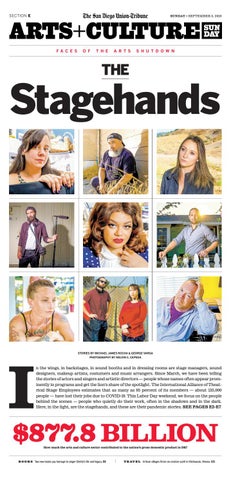
Stagehands
I
STORIES BY MICHAEL JAMES ROCHA & GEORGE VARGA PHOTOGRAPHY BY NELVIN C. CEPEDA
n the wings, in backstages, in sound booths and in dressing rooms are stage managers, sound designers, makeup artists, costumers and music arrangers. Since March, we have been telling the stories of actors and singers and artistic directors — people whose names often appear prominently in programs and get the lion’s share of the spotlight. The International Alliance of Theatrical Stage Employees estimates that as many as 95 percent of its members — about 135,000 people — have lost their jobs due to COVID-19. This Labor Day weekend, we focus on the people behind the scenes — people who quietly do their work, often in the shadows and in the dark. Here, in the light, are the stagehands, and these are their pandemic stories. SEE PAGES E2-E7
$877.8 BILLION How much the arts and culture sector contributed to the nation’s gross domestic product in 2017
B O O K S Two new books pay homage to singer Odetta’s life and legacy. E8
T R AV E L Artisan villages thrive on creative spirit in Michoacán, Mexico. E11
E2
THE SAN DIEGO UNION-TRIBUNE
SUNDAY • SEPTEMBER 6, 2020
FAC ES O F T H E A RTS SHUTDOWN
THE STAG EH A N DS
$12.5 BILLION
As of Aug. 24, financial losses to nonprofit arts and cultural organizations in the United States Source: Americans for the Arts (findings based on 17,900 survey responses)
J I M T O M P K I N S M A C L A I N E M U S I C D I R E C T O R , T E A C H E R
‘I just felt like there was absolutely no purpose to my life’ BY MICHAEL JAMES ROCHA
J
ing with my son — we make a lot of muffins!” Speaking of her son, he was in pre-kindergarten when the pandemic hit, and “I briefly tried home learning by practicing writing and tracing and counting with him,” she said. “I was very aware that it was home schooling, but not even close to what it needed to be. That was tough. He didn’t like me trying to teach him.” Things are slightly better now, she said. “We try to find something to do every day. We do things in the backyard. We take little walks. We read books. We did Broadway Babysitters storytime with some actors.” All this, she admitted, to while away the time in anticipation of everything opening back up again. But every now and then, she falls back down emotionally. “I miss the work and the people and the community,” she said. “I’m upset that it’s all gone. We’re not producing things that other people can enjoy. I miss calling shows. I miss being in the moment with the artists and the audience. I miss that incredible feeling of running a show and watching people enjoy it and watching everything come together every day.” She longs for that one day — in the near future, she hopes — when she can do all of that again. “I’m looking forward to the joy of being able to come together and create something and work on something together,” she said. “It’s really important for people to be in the same room together to create something, and there’s nothing that can replace that. The magic of everyone getting together for that first rehearsal or on opening night. I miss that, and I can’t wait to be a part of it again.”
im Tompkins-MacLaine considers himself lucky. He still has a fulltime job as a music teacher at Eastlake High School in Chula Vista and a part-time job as music director for United Church of Christ in La Mesa. But when the arts world shut down in midMarch, a big part of his life disappeared, and that’s been hard to deal with. Besides his school and church gigs, Tompkins-MacLaine had several musicaltheater-related jobs he did after school and on Saturday and Sunday afternoons with area arts groups — J Company, San Diego Junior Theatre and Young Actors’ Theatre, to name a few. At 62, he’s used to living an active life — “I’m always busy!” he exclaimed. But with COVID-19, “I just felt like there was absolutely no purpose to my life. It frightened me a little bit. I’ve never been an unhappy person. It messed with my routine. I live by routine. I know where I’m going to be on Thursday night every week. I’m going to be at church choir. I know on Wednesday night, I’ll be at Baja Betty’s with friends. Almost every night, I have a place to be, especially when doing a show. “All of a sudden that was all taken away.” “It kind of brought along a little depression,” he said from his Kensington home. “The perfect word is malaise. All of a sudden, I’m home all day teaching from the computer and then not going anywhere at night for rehearsal, I didn’t know what to do with myself.” Quickly, out of necessity, he found things to do. He cleaned the house. He worked on woodworking projects he’d been putting off. He worked on jigsaw puzzles — “a lot of jigsaw puzzles!” He watched movies. He cataloged his entire music library at church. And he worked on a new arrangement for a four-piano quartet. A diabetic, Tompkins-MacLaine found a silver lining in the pandemic: “I’m overweight. I have taken this time to plan my meals better, to measure my glucose on a regular basis. I’ve lost some weight. I’ve learned how to eat more responsibly. I haven’t been to a fast-food place in four months, and I haven’t missed it.” And “luckily,” he said, “when all this happened, I was still taking my paycheck from church and school. I used my musical theater money to pay down my student loans — a lot of student loans.” The new school year started in early August, and his biggest worry was “how the heck am I going to teach choir over the computer?” Now in his second year at Eastlake, he has about 140 students in show choir, concert choir and guitar classes. “In the 42 years I’ve been teaching,” he said, “this has been one of the most challenging things I’ve gone through. I’m gonna lose some students, especially in the choir, because none of us have ever done this before. Some people are scared by change. I’m not. I’m anxious but excited at the same time. But like any other teacher, I miss that real-life interaction with students in the classroom. I definitely miss that.” Never one to dwell on the negatives, Tompkins-MacLaine turned philosophical when asked what he’s hoping for in the near future. “I would say for everything to go back to normal, but let’s face it, we don’t have a normal anymore. But I want everything to come back and be better,” he said. “I feel like this whole time we’ve been secluded, a giant rain has washed all over us. Look at us as a society. We are dealing with some things that we’ve been brushing aside for years. Now we have time to sit and talk and change things. I think some of that change is very good. Some of it is upheaval, but I think we’re gonna come out on the right side of this. I just think it will take longer than we want it to take.”
michael.rocha@sduniontribune.com
michael.rocha@sduniontribune.com
NELVIN C. CEPEDA U-T PHOTOS
L A U R A
Z I N G L E
S TA G E
M A N A G E R
‘It just makes me cry’ BY MICHAEL JAMES ROCHA
W
hen the pandemic began in midMarch, Laura Zingle thought she’d better keep a running list of which jobs were still happening and which jobs were canceled. As a freelance stage manager for various arts organizations around town, she had enough jobs to keep her busy through the spring. ■ “I had all these things lined up,” recalled Zingle, a 39year-old mother of two who, for most of her adult working life, has been able to make a living through a patchwork of stagehand gigs. “I had a spreadsheet of all the jobs — the dates for them, the number of hours and the fee. It helps me keep track of things for 1099s and W-2s.” In early spring, Zingle had a few dates scheduled with the La Jolla Music Society, followed by a short job with the San Diego Gay Men’s Chorus, which was putting on its annual spring concert, “Return to Broadway.” Then, she said, “I started to get email after email: ‘This one’s canceled. This one’s on hold.’ And I would just highlight things in red as they got canceled. I thought, ‘Oh, it’ll be like this for just a couple of weeks.’ But then I suddenly had a big chunk of the list highlighted in red.” Soon, Zingle realized the world she knew — the arts world — was about to be turned upside down. “I began to ask myself, ‘Just how long could this last?’ All of the organizations I relied on were suddenly shut down. I had a lot of questions: How long is this going to last? Are we even going to have jobs to go back to when this is over?” Nearly four months later, in late July, Zingle wasn’t any closer to getting answers to any of her questions. And it was beginning to take its toll. “I have a lot of emotions,” said Zingle, who lives in the College Area with her husband and two children, a 41⁄2-year-old son and 9-monthold daughter. “There’s the
despair of not being able to work, not seeing the people I work with and not being able to do what we love. It’s overwhelming. Many people and many organizations are struggling. I know many are trying to replace live performances with streaming, and they’re trying very hard. It just reminds me how much I miss it so much. It just makes me cry.” Zingle’s husband is a nurse and manages a couple of departments at a local hospital. She knows “how incredibly lucky I am to have a spouse who has a job,” she said. The financial impact, Zingle said, “was less dramatic for me” because of that, but she did apply for and was approved for unemployment. Since moving to San Diego from Philadelphia a decade ago, Zingle has made a living as a stage manager, working oneday stints to some as long as six months. She’s worked for arts organizations all over town, from La Jolla Playhouse and the Old Globe to San Diego Opera and Cygnet Theatre. In her role as a stage manager, she does a little of everything, from working with the director and actors to helping map out detailed instructions during rehearsals. “Basically, making sure
everything runs smoothly. I started out performing as a kid. I was a dancer. Toward the end of high school, one of my teachers thought I might be a good stage manager. He kinda taught me the job. I continued stage managing and acting in college,” said Zingle, who received her Master of Fine Arts degree from the University of California San Diego. These days, she misses all that and more. But all’s not lost. She’s enjoying spending time with her children and working on improving her skills. Doing all those things — non-theater-related things — helps her mentally. “I try to find things to do outside of theater with my family,” Zingle said. “Initially, I was finding different ways to stay connected with the theater community — taking online classes and webinars. But I can only do so much of that. So I’ve been learning Spanish on Duolingo, trying to learn American Sign Language, finding new recipes, and cook-
“There’s the despair of not being able to work, not seeing the people I work with and not being able to do what we love. It’s overwhelming.”
THE SAN DIEGO UNION-TRIBUNE
FAC ES O F T H E A RTS SHUTDOWN
96%
THE STAG EH A N DS
61%
Number of arts and culture organizations that have canceled events since March
E3
SUNDAY • SEPTEMBER 6, 2020
Number of arts and culture organizations that have canceled through September 2020 Source: Americans for the Arts (findings based on 17,900 survey responses)
NELVIN C. CEPEDA U-T
C H A N E L
M A H O N E Y
C O S T U M E
D E S I G N E R
‘I wondered what I was going to do to survive’ National City, admits she had a “delayed reaction” to the harsh reality of being o put it simply, Chanel Mahoney has unemployed in the middle of one concern with everything shut down a pandemic. “Originally, in the performing arts: “How am I go- when everything shut down and we were told to shut ing to keep the lights on?” ■ Mahoney down ‘House of Joy,’ all I and the cast and crew of Cygnet Thea- wanted was to keep busy, so I told myself: ‘I’ll just sew. tre’s “House of Joy” had just wrapped up opening It’ll make me feel better.’ ” night in March when the coronavirus pandemic shutSo she sewed. A lot. tered everything, from theatrical productions to classi- Masks — for friends and for her father and his co-workcal music concerts. ■ Luckily, Cygnet, unlike many ers, who went back to work arts organizations, kept the entire cast and crew of much sooner than many. “House of Joy” on the payroll until the end of the run. “But everyone was doing the same thing,” she said, addAfter that, “we were all laid off.” ing that long lines at Joann Theater workers “alforced to close. Of all the Fabric and a shortage of ready don’t make a lot to shows I’ve had the opportuelastic for masks “just ended begin with. I was living nity to work on, I have never up stressing me out. The one essentially paycheck to seen a more beautiful projthing that was supposed to paycheck. I wondered what ect than ‘House of Joy,’ ” the make me happy was stressI was going to do to survive,” Madhuri Shekar play about ing me out.” said Mahoney, who was an elite squad of female So she found other ways wardrobe supervisor for guards who protect the to deal with stress. “House of Joy.” “I have stuemperor’s imperial harem in “I used to go to 24 Hour dent loans. I have rent.” 17th-century India. Fitness to train for 5Ks,” “Working in theater is my She doesn’t have health said Mahoney, who also is a passion,” said the 32-yearinsurance, so she’s applied certified cosmetologist and old Mahoney, who’s attendfor Medi-Cal. And her applimakeup artist. “Last year, I ing San Diego Mesa College cation for unemployment got signed up for 5Ks this year, pursuing a fashion design approved, but she still feared but all of them were candegree that she hopes to one the short-term ramifications celed. So now I’m hula hoopday parlay into a career in of the shutdown: “I was living ing. I also started learning costume design. “It was on 25 percent of what I was more about photography. I devastating to see a profesoriginally making. How was read a lot and play video sional production have its that going to work?” games with my boyfriend. opening night and then be Mahoney, who lives in I’m baking like a psycho. I’ve BY MICHAEL JAMES ROCHA
T
baked everything on my Pinterest board.” All that has helped, she said, but then on some days, worry creeps back in. As a costume designer, Mahoney has a couple of San Diego productions under her belt: “Marie and Rosetta” at Cygnet and last year’s Opera NEO summer productions. But, she said, “honestly, I’m worried if I will get to work in my field again. Everything is going to be so different. I know Broadway won’t be back until 2021. It’s already challenging enough to be a costume designer in San Diego. When everything reopens — whenever that is — everyone is going to be vying for the same jobs. You know when they say, ‘If you do what you love, you’ll never work a day in your life?’ That was my life. I loved waking up every day and designing and making beautiful things. After all this, with debt and bills piling up, is that going to be enough?” As quickly as she rattles off a list of concerns, though, Mahoney admits “I don’t have time to be depressed about all this,” she said, adding that with the $600-a-
week federal unemployment benefit gone, things will be more difficult. “But I need solutions, and being depressed just takes time away from finding answers.” So, like many others, she’s focusing on the future — and on things she can control. “I have learned different ways to cope,” she said. “I guess a lot of times, especially in theater, there are many things that are just out of your control. Many things right now are out of my control. So I just have to find different ways to let go. I can’t control everything. It
“I was living on 25 percent of what I was originally making. How was that going to work?”
sounds a little self-centered, but through all this, I have learned to take care of me first. I have also realized the importance and value of certain friendships and relationships. People who have reached out and said that we are all in this together. People who call and check in just to say they care.” Through it all, she said, she can’t help but miss theater. “I miss working with my crew,” she said. “I miss the camaraderie and the family unit and just being there — together. And being backstage. We were really handson for ‘House of Joy.’ There weren’t wigs, so I had to style the women’s hair. I miss having those moments and talking to them — and helping them tell a story. ... “I don’t want to lose sight of my dreams and my goals,” she added. “I don’t want to give up my passion for creativity and settle. ... Settle because of this pandemic? No.” Someday soon, Mahoney said, there will once again be time “to create something beautiful.” michael.rocha@sduniontribune.com
E4
THE SAN DIEGO UNION-TRIBUNE
SUNDAY • SEPTEMBER 6, 2020
FAC ES O F T H E A RTS SHUTDOWN
94%
THE STAGEH A NDS
63%
Number of artists and creative workers who report loss of income
Number of artists and creative workers who have become fully unemployed Source: Americans for the Arts (findings based on 24,200 survey responses)
NELVIN C. CEPEDA U-T PHOTOS
B R A N D O N
B O O M I Z A D
A U D I O
A S S I S TA N T
‘We need to make the best of it’ BY MICHAEL JAMES ROCHA
B
randon Boomizad knows things haven’t been easy for many in the arts world. Careers were upended and wages were lost — all cloaked in uncertainty. But he’s grateful. ■ “In some weird way,” he said, “and I feel bad for feeling this, I kind of feel a lot better about myself as a result of all this. With a lot of time in my hands, I got to know myself a lot better. I got to know my girlfriend a lot better, and that we’re a really good match. I spend more time with my roommates.” Don’t get him wrong, though. He still has a lot of concerns: With the $600 weekly unemployment benefit from the federal government gone, things will be tighter on unemployment. Because he’s 26 now, he no longer has health insurance through his parents. And, he wonders, will he ever be able to return to his job as part of the house crew at the California Center for the Arts, Escondido, where he also served an apprenticeship for two years before becoming an audio assistant a year and a half ago? “When it first happened, I
wasn’t really concerned much about it, so I didn’t acknowledge that it could be this long,” the Oceanside resident said, recalling when the center shut down in midMarch. “We were two minutes from clocking in when our boss walked in and said the show was canceled. I just thought it was just going to be this one show because everyone was really scared. In my head I was OK, but as the weeks progressed, some stress started to kick in.” Luckily, he said, the additional $600 unemployment benefit, which ended in late July, helped him save some money.
“I feel blessed that they gave it to us for as long as they did,” he said. “I’m sorry it’s gone, but it was nice to have it when we did.” He’s grateful, too, for the staff at the California Center for the Arts, Escondido, especially technical director Robert Collier: “They have been the best during all this — patient and communicating with us.” The California Center for the Arts occasionally called in its staff for maintenance chores — a day here and there — in anticipation of things coming back. But that all ended when San Diego shut down again in mid-July as coronavirus numbers surged. For the most part, Boomizad has been unemployed, and he’s chosen to use the downtime to do a pandemic pivot. “I’m hopeful that our jobs will be there when this is all over,” said Boomizad, a member of Local 122 of the International Alliance of Theatrical Stage Employees. “But let’s face it, it may not, or if it does, it may not be the same. Our culture is going to change about how it deals with events and large gatherings. So that made me think
I maybe need to rethink my career choice. “When this all started, I got into cooking a lot more,” he said. “I started exercising more when I got bored or played video games. Then the stress kicked in. I knew I need to find something if my job doesn’t return. So I just started researching and learning things on my own, and I found a lot of
“I’m hopeful that our jobs will be there when this is all over. But let’s face it, it may not, or if it does, it may not be the same.”
communities that can help me figure it all out.” He would still like to remain in a line of work that involves sound or sound design — perhaps for video games and movies. He worked in audio-visual for hotels for eight years, so sound work has always been an interest. Even though things have not been easy — a relative passed away recently, and his grandfather had a stroke and tested positive for the coronavirus — he chooses to remain hopeful. “I would like to see performances come back,” he said. “We just have to think of new and creative ways to bring them back in a way that’s safe for everybody and fits the guidelines. But I am in the camp that there is a possibility that the way it was may not be how it comes back, and we will have to adapt to it. I hope that we as a society won’t have too much of an attachment to how things were and be open to what it could be. “I feel like if this is how life is, we need to make the best of it.” michael.rocha@sduniontribune.com
S A M A N T H A M C L A U G H L I N T E C H N I C A L D I R E C T O R
‘I miss it. I miss it all’ BY MICHAEL JAMES ROCHA
I
t didn’t take long for Samantha McLaughlin to figure out why she was being called to the city of Vista’s human resources office. As the technical director at Moonlight Amphitheatre, a venue run by the city, McLaughlin oversaw a staff of nearly 70. Audio engineers, hairstylists, carpenters, costumers, makeup artists — people behind the scenes who are never in the spotlight but keep productions running like a welloiled machine. When the pandemic hit, many immediately felt the impact. “Because I employed so many people, they were affected long before I was,” she said. “I was one of the few remaining stagehands left. I kept going in, even though we didn’t have any shows. I was helping with ticketing. There are thousands of refunds and donations that have to be processed, so I was helping with that.” But months after many of her colleagues were let go, McLaughlin received the call. Officially laid off July 1,
McLaughlin said: “For months, there had already been a parade of people before me, so I just kind of knew.” As a result, McLaughlin has joined the thousands of stagehands across the country who have been furloughed or laid off as arts venues have shut down. Now, the reality of the news has hit her, followed by many questions and concerns. She and her husband, Dallas, live in Temecula with their 6-year-old daughter. With her husband still employed in July — he’s an actor and performer whose full-time job is managing YouTube talent — her biggest concern had been how they’ll manage paying $1,859 a month to keep health insurance coverage. She also found out she was pregnant. Happy news, she said, but bad timing. As a journeyman with Local 122 of the International Alliance of Theatrical Stage Employees, she can work at other venues around San Diego County, places like Balboa Theatre and the San Diego Civic Theatre. But all those venues are dark, too. She’s applied for unemployment and got approved.
“This sounds like a cliché,” she said, “but I was finally seeing what many of my friends and colleagues had gone through. Initially, when the shutdown happened in March, you thought it would be a month or so. Then a couple of months. But when I got laid off in July — four months later — I thought, ‘Oh crap, this is going to be for a long time.’ ” In August, things changed drastically when her husband got laid off. Health insurance isn’t as big a worry anymore — “Now with my husband laid off, we can apply for Covered California and all have the same coverage, which makes that aspect a little easier.” McLaughlin added: “I think now our biggest worry is figuring out what to do next. We can’t just hang on for this to all end with a baby on the way and both of us on unemployment. So I think a big career shift is in our futures.” She admits that for many people, especially those in the arts like her, making it work isn’t easy. That’s why McLaughlin — who worked at the California Center for the Arts, Escondido, for 12 years before joining Moonlight about a year ago —
made it a point to help friends who have been laid off. When she and her husband sold their home in San Diego County and moved to Temecula in late April, she hired a few stagehands to help them pack and clear out the house for the move. “The mama bear in me kicked in,” she said. “I’ve kind of always been that way. I want to help anyone get through whatever they’re going through.” She knows that for countless stagehands, especially in theater, times
“We can’t just hang on for this to all end with a baby on the way and both of us on unemployment.”
are tough — tough enough to make her question about her future. “The biggest question on my mind right now is what else I should be doing for a career,” she said. “What else can I do that’s going to be back before theater? The performing arts was the first to go, and it will be the last to come back. Should I be doing something else?” What’s keeping her spirits up these days? Hope. “In March,” she said, “I knew there was no way anything was happening through the summer. There was no way. It wasn’t realistic. But I’m hopeful that when things settle down, Moonlight will open again. Because of its outdoor venue, it’s set up the best to reopen sooner than others.” This would have been the busiest time of the year for Moonlight, which mounts musicals in its outdoor amphitheater. And it’s not lost on McLaughlin just how easy it was to take all of that for granted. “I miss it,” she said. “I miss it all. I miss the last tech rehearsal before the show comes up. When it’s almost there and we’re making final tweaks to get it perfect. I miss the audience enjoying it. Yes, there are Zoom shows, but it’s not the same. Theater is meant to be experienced live, and I’m hopeful someday soon, we will get to experience that again.” michael.rocha@sduniontribune.com
THE SAN DIEGO UNION-TRIBUNE
FAC ES O F TH E ARTS SHUTDOWN
10%
Number of arts and cultural organizations that are “not confident” they will survive the pandemic (a potential loss of 12,000 organizations)
E5
SUNDAY • SEPTEMBER 6, 2020
THE STAG EH A N DS
29%
Number of arts and cultural organizations that have laid off or furloughed staff (38 percent expect to make permanent staff reductions) Source: Americans for the Arts (findings based on 17,900 survey responses)
NELVIN C. CEPEDA U-T
U B A L D O
S A LVA D O R
S TA G E
M A N A G E R
‘It can wear on you, and you get depressed’ BY GEORGE VARGA
U
baldo Salvador is upbeat and gregarious by nature. But as the coronavirus pandemic that brought the local and global live-events industry to a halt in March stretches on, staying optimistic has become more challenging for this dedicated concert and festival stage crew veteran. ■ “I just feel like it’s a really crappy time,” said Salvador, a 47-year-old Chula Vista native, who recently lost an uncle to the virus. “I wish it was better,” he said. “I wish it was like normal. Dealing with so many things at once — COVID-19, the work situation, the heat — makes it really hard. But I’m staying positive as much as I can.” Salvador’s main job as the stage manager at Observatory North Park has been, much like the venue itself, dormant for nearly six months now. His biggest gig this year outside of San Diego fell through not once, but twice. “I was supposed to work
the Coachella festival in Indio this spring,” he said. “Then they moved it to October, which also won’t happen. Right now, I don’t see anything happening until next summer with the kind of work I do. It makes it hard to keep your spirits up, but you do what you have to do.” As the stage manager at the Observatory, Salvador was employed as a seasonal worker by concertindustry giant Live Nation, which bought the 1,100capacity venue in the heart
of North Park in 2019. The company, which announced mass layoffs and furloughs this spring, subsequently saw its secondquarter earnings for 2020 plunge dramatically. Live Nation reported a loss of $431.9 million, compared with the $3.16 billion it earned in 2019’s second quarter. Working at the Live Nation-owned Observatory alone, even in the pivotal role as the venue’s stage manager, did not pay all of Salvador’s bills. He regularly augmented his income by working corporate events and concerts in venues small (Casbah) and large (Petco Park). All his freelance gigs disappeared in the wake of the pandemic. For Salvador — whose stage manager position saw him happily work 10- to 14-hour days — the sudden transition to joblessness was as unexpected as it was initially disorienting. “It’s pretty weird from being on the go, all the time,
to all of a sudden being at home, all the time. It can wear on you, and you get depressed,” said Salvador, who with his former wife shares custody of their daughter, Ryder, 18, and son, Cash, 16. “I was the first one at work each day and the last to leave, and I loved it,” he continued. “I’m used to seeing at least 1,000 people a day at each show. And now, it’s my girlfriend and my daughter and son. I love having more time with them, but it was like: ‘Boom!’ Now I know what it’s like when the artists who are on tour say they’re all alone in their hotel room.” With far more free time on his hands than he ever imagined or wanted, Salvador is doing his best to look to the future. “I don’t sit around and mope about a situation,” he stressed. “I do something about it. If there’s no liveevent work by the fall, I’ll look for something else. I have no idea what that might be. I’m open.”
In the meantime, Salvador networks weekly with concert-industry colleagues and drives by his parents’ home to say hello. He also rehearses once a week in Tijuana with his punk-rock quartet, Bumbklatt, named after a 1998 song by the heavy-metal band Soulfly. “I’m constantly spraying disinfectant everywhere,” Salvador said. “Not just on my hands, but my whole body, the microphones, guitars, and everywhere. I go crazy with that.” Salvador is not a member of the International Alliance of Theatrical Stage Employees, Moving Picture
“I wish it was better. I wish it was like normal.”
Technicians, Artists and Allied Crafts of the United States. He was aided greatly by the $600-a-week pandemic unemployment assistance he received from the federal government, but that funding ended in late July. “It’s a big difference, and I’m worried about making rent again,” Salvador said. “I live very simply and try not to accumulate big bills, like I did when I was in my 20s. “So we’ll wait until rent gets paid, buy some food, and then see how much money we have left for the month. My son just started 10th grade and my daughter just started at Southwestern College. Luckily, I don’t have to buy my kids new school clothes this year because their classes are all online. “The situation now is like fish when the water runs out. It hasn’t happened, not yet. But if we don’t do something soon, we’ll be dry.” george.varga@sduniontribune.com
E6
THE SAN DIEGO UNION-TRIBUNE
SUNDAY • SEPTEMBER 6, 2020
FAC ES O F T H E A RTS SHUTDOWN
THE STAGEH A N DS
$4 BILLION K E V I N
&
C H A N D R A
A N T H E N I L L
Total economic impact of organizational and audience-spending losses in lost government revenue Source: Americans for the Arts (findings based on 17,900 survey responses)
S O U N D D E S I G N E R , S TA G E M A N A G E R
‘It’s hard to plan for the future when you just don’t know’ BY MICHAEL JAMES ROCHA
O
n March 12, Chandra Anthenill and her La Jolla Playhouse crew were en route to Barnett Elementary in Ramona for one of the theater’s Performance Outreach Program (POP) Tour performances when it happened. ■ “We were right in front of Barona Casino,” said Anthenill, a freelance stage manager. “The street was flooded, and we were on the side of the road. I called someone back at the Playhouse to tell that I didn’t think we were going to make it in time. They said, ‘Come back, we have to talk to you.’ ” She and her crew drove back to La Jolla, and there, amid cupcakes — it was her birthday — the news came: Gov. Gavin Newsom had just issued an order that said gatherings of 250 or more were no longer allowed, essentially shutting down the Playhouse’s POP Tour and countless other productions across the state. “A lot of people in the room were very sad,” said Anthenill, who received one week’s pay after the tour’s abrupt closure. “I was pretty numb to the news. The show was ending in three weeks anyway, so I didn’t see it as a big deal. It didn’t really dawn on me how big of a deal it was until later that day when I got an email from Cygnet that they would be postponing my contract, too.” Meanwhile, her husband, Kevin, got word, too, that the San Diego School of Creative and Performing Arts, where he was on contract, would be closing for three weeks. The school’s production of “In the Heights,” for which Kevin was doing some sound and video work, was postponed. “But I saw the writing on the wall,” Kevin, 33, said. “I had my doubts about the timing. From the beginning, we were both in the camp that expected the closures to be longer than that.” In the weeks that followed, Chandra and Kevin quickly realized that the COVID-19-induced shutdown was indeed a big deal — and it would definitely be longer than three weeks. Nearly six months later, the biggest concern they had early on is still the biggest concern today:
NELVIN C. CEPEDA U-T PHOTOS
“The uncertainty,” Kevin said. “The back and forth of it’s open, it’s not open, it won’t be open for a while. That uncertainty — it’s hard to plan for the future when you just don’t know.” Because of Kevin’s status as a sole proprietor, he did not qualify for unemployment. Chandra, thanks to her Actors’ Equity membership, qualified for unemployment and the $600-a-week federal unemployment benefit. What’s the biggest worry now? Bills? Health insurance? “I was lucky enough to not have health insurance be my immediate worry,” said Chandra, who added that she had enough weeks through Actors’ Equity to keep her health insurance through the end of the year. “But it’s becoming more of a worry now we know many theaters won’t be opening until 2021. In addition to that, there’s just this general worry of how are we going to pay the bills.”
H E AT H E R
“For me,” Kevin said, “the biggest worry is, how long is this going to go?” In the meantime, like many, they’ve altered their lifestyle. “We’ve stopped eating out,” Chandra said. “I’m trying to avoid going to the grocery store several times a week. And we used to have our friends come over a lot. Obviously, that’s not happening anymore.” In March, the couple adopted a dog, a Havanese mix they named Jerry. Chandra has taken to the kitchen and has been doing most of the cooking and housework in their Chula Vista home, allowing Kevin to do “whatever work he’s able to get.” “I hate it,” she said with a chuckle, quickly adding: “But I’ve mastered making my own sourdough starter. So I usually make one to two loaves a week. That has been lovely.” They already had a garden,
S V E L A N
Kevin said, “but it’s definitely expanded” since the pandemic began. They’ve mostly sheltered in place, but recently ventured out for a bike ride on the Bayshore Bikeway along San Diego Bay. When they’re not keeping themselves busy in quarantine, there are those moments when they remember what they’ve lost. “I miss the process of creating
“For me the biggest worry is, how long is this going to go?” Kevin Anthenill
P R O D U C T I O N
theater,” said Chandra, who’s worked for many theaters all over town, including the Old Globe, San Diego Repertory Theatre and San Diego Musical Theatre. “Being the stage manager, I got to watch so many shows and so many actors in the middle of that creative process. ... I don’t really get to see that anymore, and I miss that. “My hope is that we get through this and are able to go back into theaters and do the traditional live plays,” she said. “But I also hope that once we get back to that, we don’t forget about online presence. Going digitally during this pandemic has really helped theaters reach audiences they would otherwise not be able to reach.” As for Kevin, “I definitely miss the audience,” he said. “When this is all over, I hope and pray for the survival of theater — as much of it as possible.” michael.rocha@sduniontribune.com
A S S I S TA N T
‘There doesn’t seem to be a light at the end of the tunnel’ BY GEORGE VARGA
H
eather Svelan was 33 when she landed her dream job six years ago, working behind the scenes at rock concerts. Now, with her work at a standstill because of the coronavirus pandemic, that dream has been indefinitely deferred. “I finally found something I love to do,” said Svelan, who has been unemployed since the live-music industry shut down in mid-March. As a production assistant at Observatory North Park and — since 2019 — the Magnolia Performing Arts Center in El Cajon, she prepared and maintained backstage dressing rooms for performers, transported them to and from their hotels, helped with their shopping and did advance work with their managers prior to each concert. A San Diego native, Svelan lives in Golden Hill with her boyfriend, Dayne. His work as a traveling production crew member for touring bands also came to a sudden halt in March. With concerts and festivals not expected to resume until sometime next year at the earliest, Svelan is dismayed about the prospects for her industry. “There doesn’t seem to be a light at the end of the tun-
nel,” she lamented. “It’s unknown when, or if, anything will change or improve. I know people are trying to do drive-in shows and livestreamed concerts, which is great. But in my line of work, we’re still screwed out of our jobs because we don’t have any role with those kind of events. “I’m not happy. I’m not happy about any of this. You almost get delirious.” Svelan had previously spent 10 years in the corporate world, working in purchasing and logistics. After becoming a production assistant at the Live Nationowned Observatory North Park, where she was a seasonal employee, she landed regular freelance gigs at other venues booked or operated by Live Nation, including Viejas Arena at San Diego State University and Pechanga Arena San Diego. “We worked all over the place, and we had to do that. Since there was not a show every day at the same venue, we had to bounce around,” Svelan said. “It just sucks now because we can’t bounce around anymore. ... We’re seasonal employees, so we work for Live Nation, but we don’t reap the benefits of full-time employees, and they don’t have to give us health insurance.”
“I’m not happy. I’m not happy about any of this.”
Health coverage is a bigger concern than ever for Svelan, who turned 40 on Aug. 26. In the last week of August, her son, Kane, a 21year-old student at Cal State San Marcos, was tested for COVID-19 after showing symptoms. He was subsequently diagnosed with
strep throat. “Because he’s at my house, and I’m at my boyfriend’s house, I’m now quarantined from my son,” Svelan said in late August. “Until we hear the results of the test, he has to quarantine. It’s scary.” Happily, by Sept. 1, the scare had passed. “Luckily, the results were negative, and the strep is slowly going away,” Svelan said. “Thank God for Medi-Cal! They covered the visit, steroid shot and antibiotics.” Svelan’s son is living in the Mira Mesa home owned by her mother. Svelan, who lived with her son there until last year, is covering the $1,500 monthly mortgage payments, at least for now. “My mom is the landlord,” she said. “And she has told me, multiple times, that if I need to skip (paying) a month now and then, it’s OK, because the house she and her husband live in is paid off. My son also gets help from his dad.” Mindful of expenses, Svelan has reduced her budget as much as possible. Since she and her son have little need to drive anywhere, she reduced their monthly joint car insurance payments from $213 to $102. Not all spending reductions have been voluntary. After work ended in
March, Svelan qualified for the $600 weekly unemployment benefit. In August, that was reduced to $350 per week. And $236 worth of monthly food stamps got slashed to $6. “I talked to two friends and their food stamp amounts have gone down to $17 and $12, respectively,” Svelan said. “It’s going to be tough. I saved as much as I could from the $600 payments. I don’t know what we’ll do when what I saved runs out.” Svelan is grateful for the extra time with her son, until his recent quarantine. And she values having more time with her boyfriend, who was sometimes away on concert tours for weeks, or even months, at a time. But not working has been soul-sapping for Svelan, who loves music and thrived on her 10- to 15-hour workdays. And while she enthusiastically took up making crossstitch family and pet portraits earlier this summer to earn some money, by late August enthusiasm waned. “I feel like my spirit is dying, so I’m not into it,” she said. “I want my real job. I love my real job. We’ve got to do something, but crossstitching is not going to pay my bills.” george.varga@sduniontribune.com
THE SAN DIEGO UNION-TRIBUNE
FAC ES O F T H E A RTS SHUTDOWN
701,000
E7
SUNDAY • SEPTEMBER 6, 2020
Number of jobs no longer being supported in the arts and cultural sector
THE STAG EH A N DS
69% vs. 60%
Black, Indigenous and artists of color have higher rates Source: Americans of unemployment than White artists due to the pandemic for the Arts
NELVIN C. CEPEDA U-T
S E A N
FA N N I N G
S C E N I C D E S I G N E R
‘Past five months have been a total emotional roller coaster’ BY MICHAEL JAMES ROCHA
S
ix months after everything shut down in the arts world, Sean Fanning still cannot believe what the coronavirus has done to the industry he loves so much. ■ “Everything just stopped dead in its tracks,” said Fanning, a freelance scenic designer whose work has been seen in countless theatrical and live entertainment productions in San Diego County. “It’s absolutely bizarre to go from this pressurized system of collaboration and creation — which for me, had been a nonstop job for over a decade — to a complete halt.” ■ The harsh reality of the shutdown hit him hard and fast.
“In addition to the obvious financial strain of losing all the jobs, March brought a roller coaster of depression, anxiety and grief about our field, and a feeling that I had spent much of my life training for a job that seemed to no longer be essential,” said Fanning, who answered questions via email because he is hard of hearing. Since March, Fanning, 37, has been among the legions of arts workers whose lives were upended by the pandemic, leaving lifelong careers in tatters and lives hanging in the balance. As a freelancer, Fanning is mostly under contract on a show-by-show basis and not considered a full-time employee. He was, however, able to get unemployment — plus the $600 federal benefit — because one of the jobs he was under contract for classified him as an employee, as required by the “gig worker bill,” popularly known as AB5. “Of course, personal
finances were the biggest initial worry,” he said, adding that the anxiety is compounded by the “many lingering questions about the future of the theater industry and the fate of the companies around which I’ve formed my entire career.” In mid-March, Fanning and his fellow crew members were one day away from opening “La Cage Aux Folles” at Cygnet Theatre, where he had been on contract as scenic and project designer for the production. At the same time, also at Cygnet, he was in the last phase of creating the scenic design for August Wilson’s “Two Trains Running.” Not too far away, at San Diego REP, he was in the early stages of design work for what would have been the theater’s summer musical, “On Your Feet.” All that — and more — evaporated. Just like that. “The past five months have been a total emotional roller coaster,” he said via email in August. “The com-
bination of my field being utterly eviscerated by this pandemic, the worries about the future, events in the news and media, and the feeling of isolation and communication barriers have all created this perfect storm. The only way I’ve found forward is to take things one day at a time, one challenge at a time, and try and hang onto hope in places I never thought to look. Painting provides me with joy. Being out in nature, and getting away from screens, helps me see a larger picture than myself or my problems. Reconnecting with family, all of those things are deeply important.” It helps, too, that he’s had support from friends and family, especially his wife, a research coordinator at the Hubbs-SeaWorld Research Institute whose job has been deemed “essential.” “Together, and with the help of our respective families, we have somehow been holding it all together,” said Fanning, a Mira Mesa resident who moved to San Diego from San Francisco in 2005 to pursue a master’s degree in scenic design for theater, TV and film at San Diego State University. A big part of “holding it all together” has been keeping busy. “I feel like I’ve been several different people during this pandemic,” he said. “In the beginning of the shutdown, I focused on restoring and archiving my scale models from the ‘project graveyard’ and did a bit of remodeling and repair I had been putting off in the studio. “While some businesses
were still hanging on in March and April, I did some part-time freelance drafting for architectural lighting and residential projects. Once those jobs began to dry up, I shifted my focus towards a passion that I haven’t had time to pursue in almost 20 years: fine art and painting. I’ve since created five canvas pieces — two of which were commissioned works. Similarly, I’m a guitarist as a hobby and have used some of my time to get more practice in. Now I’m working to prepare for an adjunct teaching job at Mesa College and keep the house together for the essential worker when she comes home. Finding a routine and focus has been absolutely imperative to get through this bizarre time.” For someone who’s used to working all the time, this down time has left him with many things racing through his mind. “The first concern is the future, and the hardest part has been planning for that future,” Fanning said. “I’m so used to having design jobs lined up six to 10 months in advance, and normally, I can look at a calendar and know pretty much what I’m going to be doing a half year at a time. When I first started freelancing full-time, after leaving my job as Resident Design Assistant at the Old Globe some five and a half years ago, I wanted to find a way to live solely on the income from my art. I would juggle anywhere from two to five shows in my head at a time, all with staggered deadlines, in perpetuity. A dozen or so shows per year.
It sounds a little nuts, but I had gotten it down to a healthy routine. Living and working in the moment, but always looking ahead, and pushing forward. This pandemic has cut all of that short.” If he had to look for a silver lining, Fanning said, he’s learned a lot about himself and has found a new way to look at life. “I found an inner well of resilience I didn’t know I had until it was put to the test,” he said. “I grew to appreciate my wife, my family and my friends at a much deeper level. I discovered that for all the things I love about theater, I’m not entirely happy with the economic inequality that comes with it. When I was stuck home for months, I realized in the flurry of projects how much gas I was using, how much I was spending on design material, and how little I had really saved from theater jobs. Somehow, I would like to find a way to change this.” For now, though, he
“Together, and with the help of our respective families, we have somehow been holding it all together.”
longs for the day he can return to theater and all the things he misses about it. “I really miss the collaboration with directors and other designers,” he said. “I miss bringing a rendering or a scale model of an idea into a discussion and feeling this power of being able to affect how a production will take hold of an audience. ... I miss the smell of lumber, of opening a can of slightly old paint, the sound of sizzling bacon when someone welds a set piece together. I miss being in an actual theater, dressing a set, watching it light up, hearing an orchestra or an original score play for the first time. I miss getting beers with the creative team after a hard weekend of second guessing ourselves and realizing we had it right the first time. I guess it’s not any one thing I miss, it’s the whole experience.” All that talk makes him hopeful of the day it all returns to normal, whatever that is. “I absolutely hope that theater comes back. I dream that when it does, we also see the manifestation of many important conversations that have been happening about equity in our field — both economic but also about race and representation. I hope that I can continue to diversify my skill set, and continue expanding into other fields so that I can plan for the future. I hope I can continue to grow as an artist and human being.” michael.roacha@ sduniontribune.com