FALL 21
SAYING HELLO...
ENGINEERING NEWS
The School of Engineering is delighted to introduce four new faculty members joining our community of scholars this year. They bring a passion for teaching and provide a depth of experience in their research that will captivate our students and enhance our program.
School of Engineering
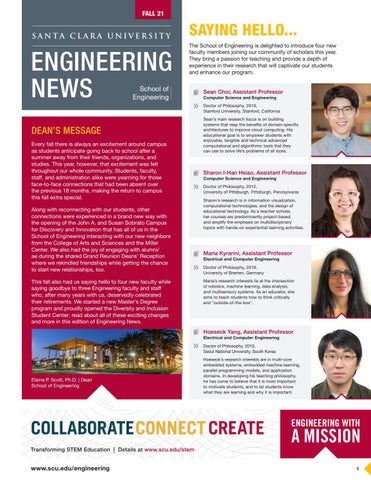
Sean Choi, Assistant Professor Computer Science and Engineering Doctor of Philosophy, 2019, Stanford University, Stanford, California
DEAN’S MESSAGE Every fall there is always an excitement around campus as students anticipate going back to school after a summer away from their friends, organizations, and studies. This year, however, that excitement was felt throughout our whole community. Students, faculty, staff, and administration alike were yearning for those face-to-face connections that had been absent over the previous 18 months, making the return to campus this fall extra special. Along with reconnecting with our students, other connections were experienced in a brand new way with the opening of the John A. and Susan Sobrato Campus for Discovery and Innovation that has all of us in the School of Engineering interacting with our new neighbors from the College of Arts and Sciences and the Miller Center. We also had the joy of engaging with alumni/ ae during the shared Grand Reunion Deans’ Reception where we rekindled friendships while getting the chance to start new relationships, too. This fall also had us saying hello to four new faculty while saying goodbye to three Engineering faculty and staff who, after many years with us, deservedly celebrated their retirements. We started a new Master’s Degree program and proudly opened the Diversity and Inclusion Student Center; read about all of these exciting changes and more in this edition of Engineering News.
Sean’s main research focus is on building systems that reap the benefits of domain specific architectures to improve cloud computing. His educational goal is to empower students with enjoyable, tangible and technical advanced computational and algorithmic tools that they can use to solve life’s problems of all sizes.
Sharon I-Han Hsiao, Assistant Professor Computer Science and Engineering Doctor of Philosophy, 2012, University of Pittsburgh, Pittsburgh, Pennsylvania Sharon’s research is in information visualization, computational technologies, and the design of educational technology. As a teacher scholar, her courses are predominantly project-based and amplify the emphasis on multidisciplinary topics with hands-on experiential learning activities.
Maria Kyrarini, Assistant Professor Electrical and Computer Engineering Doctor of Philosophy, 2019, University of Bremen, Germany Maria’s research interests lie at the intersection of robotics, machine learning, data analysis, and multisensory systems. As an educator, she aims to teach students how to think critically and "outside-of-the-box".
Hoeseok Yang, Assistant Professor Electrical and Computer Engineering Doctor of Philosophy, 2010, Seoul National University, South Korea
Elaine P. Scott, Ph.D. | Dean School of Engineering
Hoeseok’s research interests are in multi-core embedded systems, embedded machine learning, parallel programming models, and application domains. In developing his teaching philosophy, he has come to believe that it is most important to motivate students, and to let students know what they are learning and why it is important.
ENGINEERING WITH Transforming STEM Education | Details at www.scu.edu/stem
www.scu.edu/engineering
A MISSION 1
SAYING GOODBYE This fall the School of Engineering must bid farewell to three long-term faculty and staff as they begin the next chapter of their lives in retirement. Read more about their many contributions. We will miss them all greatly!
TIM HIGHT
Tim Hight started at Santa Clara in 1984 and has contributed many years of service to his department, school, and University. His expertise is in finite element methods and applications to biomechanics, where he developed collaborations with the VA hospital in Palo Alto. Tim’s work has always focused on how engineering can and does help people. Tim was the faculty advisor for SCU's Solar Decathlon teams in 2007, 2009, and 2011. Two of his teams took third place overall in the U.S. Department of Energy competition. He was also faculty advisor of the 1st Place Champion Revolve House team in the 2016 Tiny House Competition. Honoring his achievements and dedication, he was recognized as a top teaching scholar in 2011 for his "profound influence in incorporating concepts of sustainability into the Department of Mechanical Engineering.” Tim has been a large part of our program and has helped to create the culture we see today. We most heartily thank him for all of his contributions, congratulate him on his retirement, and wish him and his family well!
37 YEARS
Dan Lewis joined the Electrical Engineering and Computer Science Department in 1975 and served his department, the school, and SCU for 46 years. He has the longest service record among all faculty members in the Computer Science and Engineering department. During his tenure, Dan served as the founding chair in 1992, when it split off from the EECS department and served as chair for nearly 15 years playing a key role in shaping the department. He was also the key founding member of our Web Design and Engineering program. Since 2004, Dr. Lewis has focused on K-12 education and outreach in engineering and computing, supporting his efforts by raising more than $2.5M in grants, mostly from the National Science Foundation. He has provided professional development workshops for more than 250 teachers and hosted summer camps for over 2,000 K-12 students. We owe Dan many thanks for his vision and pioneering work, for his dedication in educating our students, and for his support to our faculty. We thank Dan for his immense contributions to our School, and wish him and his family the best in enjoying his life after retirement!
DAN LEWIS 46 YEARS
HEIDI WILLIAMS 24 YEARS
2
www.scu.edu/engineering
Heidi Williams began her SCU career in 1997 as receptionist for the School of Engineering, and in 2006, she completed her BA, summa cum laude, in English. Immediately putting her education to work as director of communications, she has been the heart and soul of our communications with the outside world while working under eight deans. Godfrey Mungal expressed that she is the living, breathing record of the School of Engineering. She was tasked with knowing and documenting who we are, what we have done, where we have been, what we aspire to, and where we are headed. She has told our story time and time again with a critical eye, open ears, a big heart, numerous interviews, and countless words. Heidi was tasked with creating The Buzz to share our weekly updates, eNews, and the Five-Ten Report to inform the campus of our activities. She wrote for the Development Office to help us raise funds and authored our 100th anniversary book in 2012. Where there is communication, there is Heidi! We all have been blessed to work with her throughout these many years. Thank you, Heidi, for all you have done for the School. Your words are everlasting, and you will be missed!
NEW M.S. IN ROBOTICS AND AUTOMATION Recognized as a world leader in the field robotics education, Santa Clara University is now offering an interdisciplinary master’s degree program in Robotics and Automation, drawing on the capabilities and partnerships of the Robotic Systems Laboratory (RSL). Christopher Kitts, RSL Director and Professor of Mechanical Engineering, reports, "One of the most exciting aspects of this new degree is its alignment and partnership with local companies and agencies in the robotics and automation technology sector. This will allow us to establish a strong recruiting pipeline, a set of industry-aligned elective tracks, and real-world R&D opportunities." The degree will provide students with knowledge about the design, control, and automation of robotic systems and smart machines, and includes: • Core courses covering the hands-on design of mechatronic devices, the dynamics and control of robotic manipulators/vehicles/systems, and advanced perception systems using technologies such as vision processing and machine learning. • Industry-aligned concentration options with courses in areas such as advanced manufacturing, bio-devices, autonomous vehicles, aerospace systems, agricultural technology, and more. • An in-depth R&D opportunity consisting of work on an industry design problem or conducting research leading to a publication. • A co-curricular badging system and electronic portfolio allowing students to showcase their experience relating to design capabilities, computing languages/environments, maker skills, etc. • Courses from the School’s graduate core in areas such as technology ethics, the societal impact of engineering, and high-tech business/entrepreneurship that complement the technical degree with a broader societal perspective.
Photo by Jim Gensheimer
Kitts notes that the program will leverage the expertise and international reputation of the School of Engineering’s Robotic Systems Laboratory, which develops advanced robotic systems and automation technology for vehicles and instruments that operate on or in land, sea, air, and space. Examples of this work include the development of deep-sea instruments and robots for the National Science Foundation, the design of agricultural field robots for several California growers, the development of AI-based robotic control algorithms for the Megachips Corporation, and the control of on-orbit spacecraft for NASA. Since its inception, the RSL has developed systems for a wide range of government sponsors, industry partners, academic collaborators and non-profit partners, resulting in well more than $10 million of external funding. Learn more about graduate programs on our website.
Graduate Enrollment
Undergraduate Enrollment
1026
7%
Increase from Last Year
608
15%
Increase from Last Year
SCHOOL OF ENGINEERING
3
OPENING THE DOORS TO COLLABORATION After years of hard work, long meetings, and communal efforts, the doors for the John A. and Susan Sobrato Campus for Discovery and Innovation finally were opened for the Fall Quarter. The Dedication Ceremony was a wonderful celebration of all of the work that has gone into turning an idea into a reality - it even included a surprise visit by Gov. Gavin Newsom ’89. The SCDI integrated STEM Campus -- which includes the new Sobrato Discovery building along with the updated Heafy and Bergin Buildings -- provides a variety of new spaces that redefine educational environments. These reimagined spaces will serve to create exciting and inspiring opportunities for students to grow, learn, and collaborate for years to come. The Bronco Community vision for this venture began in 2013, and by 2018, the revisions to the Heafey and Bergin buildings came to fruition; and not long after, ground broke for the Sobrato Discovery building. The Sobrato Campus for Discovery and Innovation is far more than a STEM campus: the new areas welcome undergraduates of all majors, beyond engineering, to enjoy its spaces. Almost all undergraduates will have a class in the new building, wherein even non-stem majors are able to fulfill their natural science requirements and/or elective courses. The collaborative rooms - with doors wide open - provide the perfect space for everything from informal student-led think tank sessions, faculty run projects, or just the space that stimulates learning, growth, and interpersonal connection. Even when the SCDI was nothing more than an idea, its aim always extended far beyond STEM. Integrating a wide variety of opportunities and disciplines will present new perspectives to old problems and fuel dynamic innovation to take head on the problems yet to come. The campus includes a variety of novel spaces such as the Latimer Energy Lab, the 3,000 square foot Innovation Zone, the Frugal Innovation Hub, and state of the art Robotics Systems Lab located in the Sobrato Discovery building; as well as the virtual reality Imaginarium, and the WAVE computer lab located in the Heafy-Bergin Building. The open spaces, state of the art technology, and commitment to diversity will allow Santa Clara to perpetuate one of its goal to “build on its academic programs and linkages within Silicon Valley to become one of
the top educational institutions advancing an entrepreneurial mindset, scientific discovery, and technological innovation in greater service to humanity” and to realize the School of Engineering’s vision to educate the whole person to solve society’s most complex problems. Collaborating the knowledge and vision within arts and sciences alongside the knowledge and technical skills of STEM fields, as well as state-of-the-art technology, will propel the SCDI along its mission: connection, collaboration, and creation of a better world. The integrated STEM space will also serve a purpose beyond education; Elaine Scott, Dean of the School of Engineering, says it “will provide a focal point for bringing people together in the Silicon Valley to address critical issues facing our world. This will be the catalyst for building partnerships with local companies, providing internships and projects for students, and research programs for both students and faculty.” This investment - an investment in the one of largest STEM facilities in the country for undergraduate students - is an investment in the future of education and the future of the world. Santa Clara is providing the place, attracting the people, and the product will follow. The message is clear: a more just, humane, and sustainable world of tomorrow is being built right here, today. Watch the “Celebrating the Future of STEM at Santa Clara University” video on SCU’s YouTube channel.
@SCUENGINEERING #ICYMI: Highlights from the SCDI Dedication Ceremony on Oct. 15, 2021 One of our favorite posts from the celebration was from Kairan Quazi ’22 @thepythonkairan “Kairan Quazi ’22 posts, “Oh sorry I couldn’t hang out yesterday because I was too busy meeting my Governor and fellow SCU Bronco, he was so nice, and a little shocked by my age!” Swipe ️ to see more highlights!!!
➡
#SCUengineering #SantaClaraSTEM #scuSTEM @SantaClaraCAS @SantaClaraUniversity
4
www.scu.edu/engineering
1,446
classroom, teaching lab, and research lab seats
$300M facility stocked with the latest equipment and resources
50
student clubs housed in SCDI
DISC: A MISSION TO RECONNECT SCU After about five years in the making and with the dedicated support of multiple student organizations, the Diversity and Inclusion Student Center (DISC) has come to life in the new Sobrato Campus for Discovery and Innovation. This was made possible by partnership between the School of Engineering, College of Arts & Sciences, and the University’s Provost Office. While Santa Clara University may be separated into different schools and departments, the DISC aims to unify the students, staff, organizations, and resources on campus in order to create stronger connections and a university-wide community. As a new point of convergence, the DISC offers a dynamic expanse for students. With the goal of connection at the forefront, all aspects of the DISC aim to bring us together in new and innovative ways. It can be daunting for students to identify the on-campus resources that they need, which is why the DISC builds a bridge between students and all of the resources that are available to them. Information and guidance about on-campus resources are all easily accessible at the center. Students can enjoy a simpler process of finding and using these resources.
The DISC creates a collaboration of the diverse perspectives that we value, giving students a space to work together to create, educate, and inspire. Students from different schools and organizations within SCU that share common interests or are working on similar projects can connect in order to streamline research and learning. Collaboration of students from different backgrounds and cultures also allows for the inclusion of additional perspectives, launching a deeper analysis of the work at hand. Ricardo Padilla, Jr., who serves as the Programs Director for Diversity, Equity and Inclusion in STEM, has worked to support students in creating the space and implementing feedback from students and organizations on campus. Ricardo continues to show his dedicated support, stating, “I'm here for the students. There is no university without the students. So I must do my best to work, to advocate, to amplify their voices, their concerns, to listen and hear them, and lead by example of what it means to walk the walk in building a more just, diverse, equitable, and inclusive campus community, so with that said, please reach out to me as all ideas and feedback are welcome." Learn more about Ricardo’s role and find his contact information on our website.
@SCUENGINEERING @shpe_scu very own @louisa_mantilla was in the mix at the STEM Student Mixer which took place at the SCDI Sordello Family Courtyard during SCDI Dedication Week.
🎧🎵🎶
#SantaClaraSTEM #scuSTEM #SCUengineering
270K
Sq. Ft. of Space
The Sobrato Campus for Discovery and Innovation, made possible by a $100 million gift from John A. ’60 and Susan Sobrato, represents Santa Clara’s commitment to be a world-class leader in STEM education.
SCHOOL OF ENGINEERING
5
ARACI RECEIVES PRESTIGIOUS NSF CAREER AWARD Emre Araci, Associate Professor of Bioengineering, has received a prestigious National Science Foundation CAREER award of $518,406 in support of his work on next-generation wearable movement sensors that can help improve the lives of patients with musculoskeletal disorders and stroke survivors, advance sports medicine, and more. Musculoskeletal disorders (e.g., arthritis, herniated disc, etc.), on the rise due to an aging population, are the leading cause of disability in the world, Araci reports. Up until now, the main course of action in response to these conditions has been to improve the availability and efficacy of physical rehabilitation. But just how successful are those rehab efforts? Dr. Araci aims to quantify how well the exercises are being performed based on data rather than observation or patient reports . His work will focus on developing an imperceptible skin patch that wirelessly transmits the number of repetitions of the physical rehabilitation exercises with the correct form and intensity to a master mode such as a smart-watch or smart-phone. The devices will be validated on volunteers in consultation with the Stanford Rehabilitation Center. The device will incorporate a capillaric circuit designed to function as a micropump driven by human movement. “Combining fluid physics with wearables and human biomechanics allows us to investigate skin deformation characteristics, their relation to human movement, and their potential to control fluid flow. Studying human movement as a source of functionality in a microfluidic wearable device is a novel approach,” Araci said.
“ My dream is to help millions of patients suffering from shoulder, neck, and back pain...” Araci and his team of undergraduate and graduate student researchers will use digital image correlation (DIC) and the skin strain field (SSF) for characterizing a large range of movements. The capillaric sensor networks with electrical and image-based readouts will be designed for real-time wireless data transfer and fluidic data storage, respectively, using techniques to reduce energy consumption and computational power required for complex movement analysis.
6
www.scu.edu/engineering
The project will also investigate the development of new manufacturing techniques for large-area skin-conformal microfluidic devices and stable electrode-ionic liquid interfaces to further advance the field of wearable technologies. In addition, by utilizing the bioinspired device design and simple fabrication methods available in Dr. Araci’s lab, educational kits for teaching human physiology and device physics to high school and college students will be developed and teachers will be trained through a collaboration with the Santa Clara County Biotechnology Education Partnership program. “My dream is to help millions of patients suffering from shoulder, neck, and back pain,” Araci said. “A skin-like patch with a network of fluidic channels to characterize human movement could help improve the outcome of the physical rehabilitation. This is a crazy approach that was not tried by anyone before. I am grateful for this award because it will give us a chance to create something unique to improve human health.” The Faculty Early Career Development (CAREER) Program offers the National Science Foundation's most prestigious awards in support of early-career faculty who have the potential to serve as academic role models in research and education and to lead advances in the mission of their department or organization. Watch Dr. Emre Araci’s “Biowearables” Lightning Talk on our YouTube channel.
A COMMUNITY OF CONNECTION AND GUIDANCE Bronco engineering undergraduates now have even more opportunities to seek advice, guidance, and insight throughout their entire college experience thanks to the School of Engineering’s Mentor Collective Program that began last year. Knowing mentoring relationships are difficult to establish, the School of Engineering is partnering with the Mentor Collective organization to develop a successful mentorship program. The Mentor Collective organization has worked with universities nationwide on programs that prove fulfilling for both mentors and mentees alike. Our goal for this program is to facilitate meaningful relationships for students with mentors who are invested in their success, who have the experience in their situations at Santa Clara, and who obtain the knowledge to help guide the students through personal, academic, and professional endeavors. We seek to obtain this goal by offering two Mentor Collective programs: the First-Year Experience (FYE) and the Career Program. To get things going, we started the Career Program for second-year and transfer students last fall. Within the first month, we faced an unusual problem: the amount of alumni wanting to offer mentorship exceeded the amount of secondyear and transfer student sign ups. This problem was nothing
‘20-’21 Career Program Overview 2020-21 Students Matched Mentors Matched Conversations Logged Average Conversation per pair
232
48.6% of offered
105
6.3% of offered
Benchmark* 17.2% of offered 3.2% of offered
1160
-
5.0
3.0
Average SMS exchanged per pair
12.3
9.0
% using SMS relay
41%
35.8%
Insight Flags
38
0.16 per mentorship
Student Participation: 33% female/non-binary 35% URM 14% First-gen
0.1 per mentorship
*Average participation and engagement rates across Mentor Collective's 2020–21 AY career-focused programs (N=11,863 mentorships across 41 programs) *Average participation and engagement rates across Mentor Collective’s 2020-21 AY career-focused programs (N=11,863 mentorships across 41 programs)
but an opportunity - the program quickly expanded to include third-year students, and by the start of this second year of the program, was open to all engineering undergraduates. The program allows participating students to tap into our extensive engineering alumni network, matching student mentees with alumni mentors based on academic and professional interests. We opened the FYE program along with the Career Program this fall. Where the Career Program focuses on matching alumni/ ae to sophomores, juniors, and seniors, the FYE program facilitates first-year students with connections to their upper division undergraduate peer mentors. This is a role that our second-year students will typically assume going forward; however, due to Covid protocols, most of our current secondyear students also had little or no on-campus experience; most are still familiarizing themselves with the SCU environment just as the first-year students are. As a result the program reached out to our class of 2021 engineers and in Bronco fashion, many of our recent graduating class stepped up to fill the FYE mentor
roles. Nonetheless, the temporary pivot for this year’s FYE program is enabling valuable connections that help ease our first-year engineering students' transition into college life. For both our programs, mentors are matched with mentees based on personal profiles and algorithms that identify similarities in academic experience, as well as factoring in student interests and alumni professional experiences for the Career Program. Uniquely, the final determination for every match is made only after an expert from the Mentor Collective organization evaluates and advocates for the match. Having expert evaluation and avocation makes an impact. In its first year, participants in our Career Program demonstrated higher levels of engagement within their mentoring relationships when compared to a cohort of similar mentoring programs at other universities throughout the country. Aside from getting to know each other, the topics of conversation range from coursework insights, resume building and interviewing tips, research opportunities, work-life balance, and even connecting specific coursework to relevant professional roles. However, these connections are personal as much as they are professional. Insights revealed mentors and mentees discussed dealing with mental health struggles, as well as dealing with the difficulties of finding a job, and the effects of Covid-19. As our Mentor Collective program embarks on year two, it is proving to be very advantageous for students. An upper division student in the Career Program notes, “My mentor has been really supportive of my internship journey and helped a lot with getting my resume set up and also with getting prepared for interviews. I'm grateful for his advice as well as his words of encouragement.” This program does not exclusively benefit students, though; alumni often reflect on their experiences, are thankful for the support they received, and want to pay it forward. The Mentor Collective provides them this opportunity, as one mentor from last year explains: "I am volunteering as a mentor because I had many, many people support me and guide me throughout my time at SCU. So, I'd love to help and give back in any way I can.” Our engineering community at Santa Clara continues to grow as Bronco alumni/ae pass along wisdom and knowledge, help ease the college terrain, and enhance the overall experience for current Santa Clara engineering students. Partnering with the Mentor Collective to deploy this program provides Bronco engineers with the space to both seek guidance and to give guidance, to build and strengthen community, and to grow into a connected network of engineers - with competence, conscience, and compassion who will, together, build a more just, humane, and sustainable world. www.mentorcollective.org
SCHOOL OF ENGINEERING
7
Santa Clara University 500 El Camino Real Santa Clara, CA 95053 The Jesuit University in Silicon Valley
GIVE TO SCU ENGINEERING scu.edu/engineering/give
SCUEngineering
@SCUEngineering
@SCUEngineering
PH.D. DEGREES CONFERRED IN 2020 & 2021
Photo by Jim Gensheimer 2021 Ph.D. Graduates with their Advisors
ELECTRICAL AND COMPUTER ENGINEERING
ELECTRICAL ENGINEERING
Rami Akeela '21
Thesis: An Input Power-Aware Maximum Efficiency Tracking Technique for Energy Harvesting in IoT Applications
Thesis: Configurable HW/SW Co-design Partitioning Methodology Prior Degree: M.S. Computer Engineering, Lehigh University Advisor: Dr. Shoba Krishnan
Kamak Ebadi '21 Thesis: A Drift-Resilient and Degeneracy-Aware Loop Closure Detection Method for Localization and Mapping in PerceptuallyDegraded Environments Prior Degree: M.S. Computer Engineering, Florida International University
Sanad Kawar '21
Prior Degree: M.S. Electrical Engineering, Princess Sumaya University for Technology (Amman, Jordan) Advisor: Dr. Shoba Krishnan
Ali Khoshniat '21 Thesis: Metamaterial Absorbers for Mitigating Unintended Radiated Emissions Prior Degree: M.S. Electrical Engineering, Utah State University Advisor: Dr. Ramesh Abhari
Pavel Dimtchev Arnaudov '20
MECHANICAL ENGINEERING
Thesis: Artificially Intelligent Search Algorithms for Video Fast Motion Estimation
Chenli Wang '21
Prior Degree: M.S. Electrical Engineering, Technical UniversitySofia, Bulgaria, 1995 Advisor: Dr. Tokumbo Ogunfumi
Thesis: Cost effective and nonintrusive occupancy detection in residential building through machine learning algorithm Prior Degree: M.S. Electrical Engineering, Santa Clara University Advisor: Dr. Hohyun Lee
COMPUTER ENGINEERING Chelsey (Chia Chi) Li '21 Thesis: Taming the Challenges of Accurate and Ultra-High-Rate Data Collection in Wireless Sensing Systems Prior Degree: M.S. Computer Engineering, Syracuse University Advisor: Dr. Behnam Dezfouli
Robert Thomas McDonald '20 Thesis: Mission-Oriented Multirobot Adaptive Navigation of Scalar Fields Prior Degree: M.S. Mechanical Engineering, Santa Clara University, 2017 Advisor: Dr. Chris Kitts
COMPUTER SCIENCE AND ENGINEERING Suthee Chaidaroon '20 Thesis: Deep Generative Models for Semantic Text Hashing Prior Degree: M.S. Computer Science and Engineering, Santa Clara University, 2014 Advisor: Dr. Yi Fang
Chenjun Ling '20 Thesis: MNews: A Study of Multilingual News Search Interfaces Prior Degree: M.S. Geographic Information System, University North Carolina, Charlotte, 2015 Advisor: Dr. Silvia Figueira
Advisor: Dr. Sally Wood
Engineering News is published twice a year by the School of Engineering, Santa Clara University, Santa Clara, California. Writers in this issue: Stefano Paolina, Madeline Tragoutsis, and Heidi Williams. Editor: Nicole Morales, nmorales@scu.edu
FL-15244 11/2021 400