Health Care Access & the Mediverse
Transforming Hospital Architecture Scott Abernethy 04/21/22
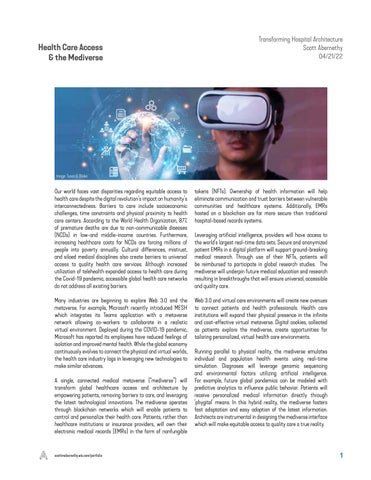
Image: Tyson & Blake
Our world faces vast disparities regarding equitable access to health care despite the digital revolution’s impact on humanity’s interconnectedness. Barriers to care include socioeconomic challenges, time constraints and physical proximity to health care centers. According to the World Health Organization, 87% of premature deaths are due to non-communicable diseases (NCDs) in low-and middle-income countries. Furthermore, increasing healthcare costs for NCDs are forcing millions of people into poverty annually. Cultural differences, mistrust, and siloed medical disciplines also create barriers to universal access to quality health care services. Although increased utilization of telehealth expanded access to health care during the Covid-19 pandemic, accessible global health care networks do not address all existing barriers.
tokens (NFTs). Ownership of health information will help eliminate communication and trust barriers between vulnerable communities and healthcare systems. Additionally, EMRs hosted on a blockchain are far more secure than traditional hospital-based records systems.
Many industries are beginning to explore Web 3.0 and the metaverse. For example, Microsoft recently introduced MESH which integrates its Teams application with a metaverse network allowing co-workers to collaborate in a realistic virtual environment. Deployed during the COVID-19 pandemic, Microsoft has reported its employees have reduced feelings of isolation and improved mental health. While the global economy continuously evolves to connect the physical and virtual worlds, the health care industry lags in leveraging new technologies to make similar advances.
Web 3.0 and virtual care environments will create new avenues to connect patients and health professionals. Health care institutions will expand their physical presence in the infinite and cost-effective virtual metaverse. Digital cookies, collected as patients explore the mediverse, create opportunities for tailoring personalized, virtual health care environments.
A single, connected medical metaverse (“mediverse”) will transform global healthcare access and architecture by empowering patients, removing barriers to care, and leveraging the latest technological innovations. The mediverse operates through blockchain networks which will enable patients to control and personalize their health care. Patients, rather than healthcare institutions or insurance providers, will own their electronic medical records (EMRs) in the form of nonfungible
scottmabernethy.wix.com/portfolio
Leveraging artificial intelligence, providers will have access to the world’s largest real-time data sets. Secure and anonymized patient EMRs in a digital platform will support ground-breaking medical research. Through use of their NFTs, patients will be reimbursed to participate in global research studies. The mediverse will underpin future medical education and research resulting in breakthroughs that will ensure universal, accessible and quality care.
Running parallel to physical reality, the mediverse emulates individual and population health events using real-time simulation. Diagnoses will leverage genomic sequencing and environmental factors utilizing artificial intelligence. For example, future global pandemics can be modeled with predictive analytics to influence public behavior. Patients will receive personalized medical information directly through ‘phygital’ means. In this hybrid reality, the mediverse fosters fast adaptation and easy adoption of the latest information. Architects are instrumental in designing the mediverse interface which will make equitable access to quality care a true reality.
1