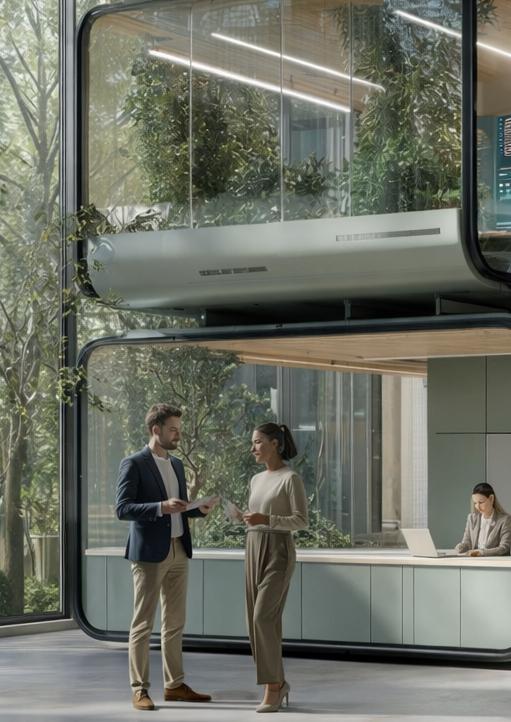
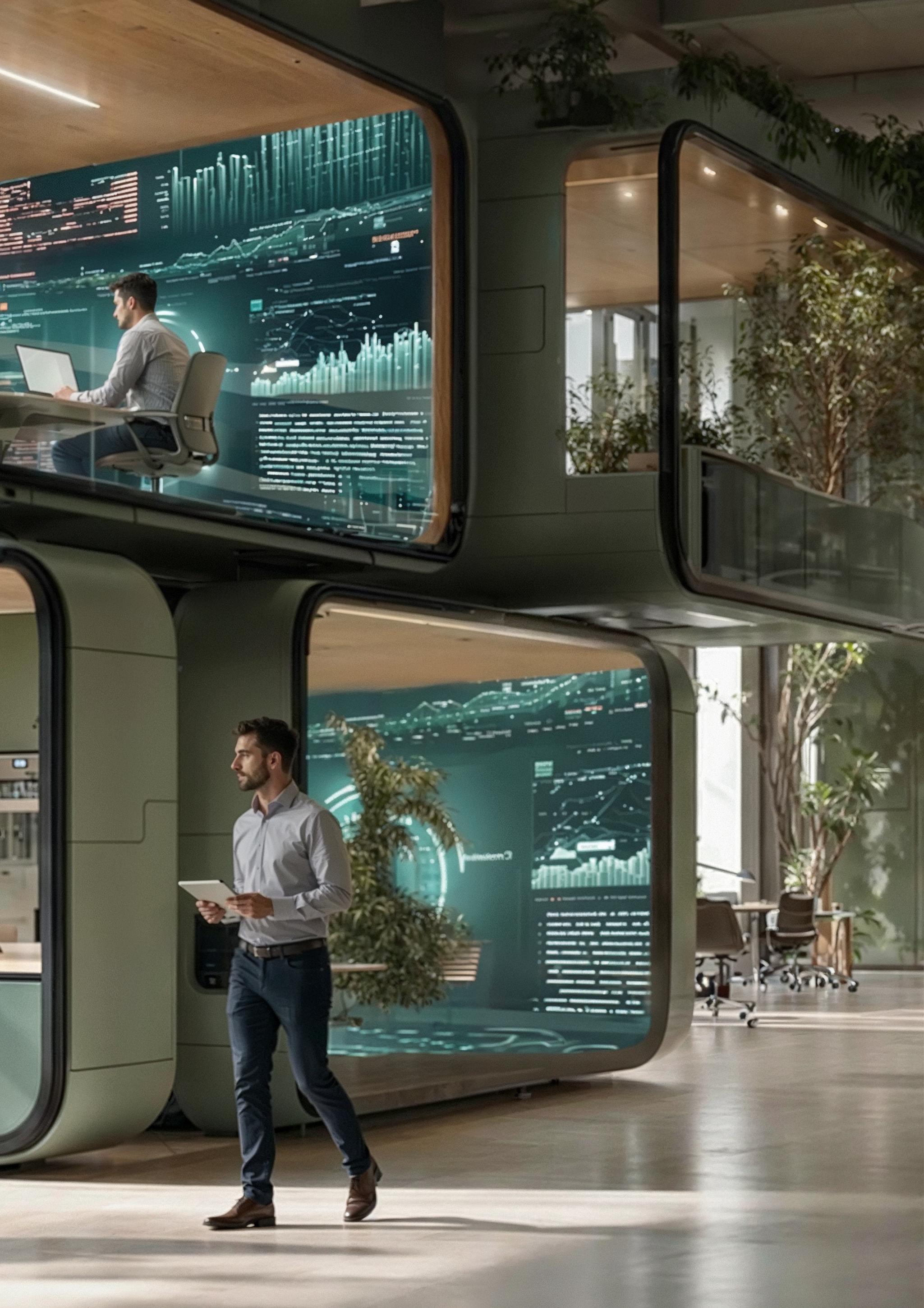
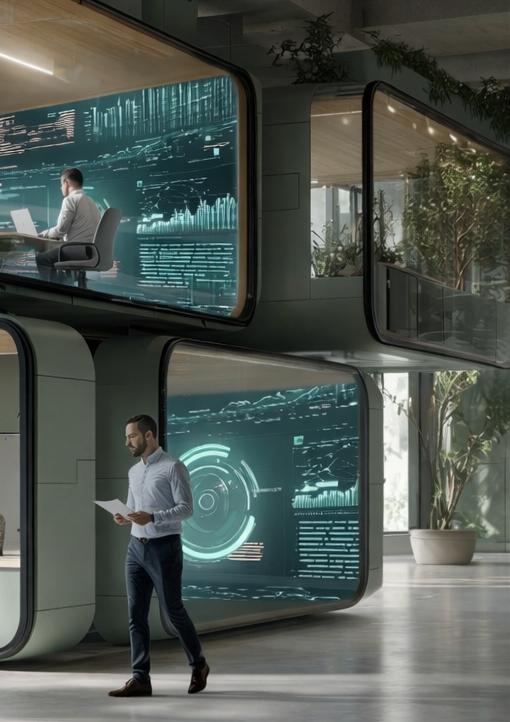
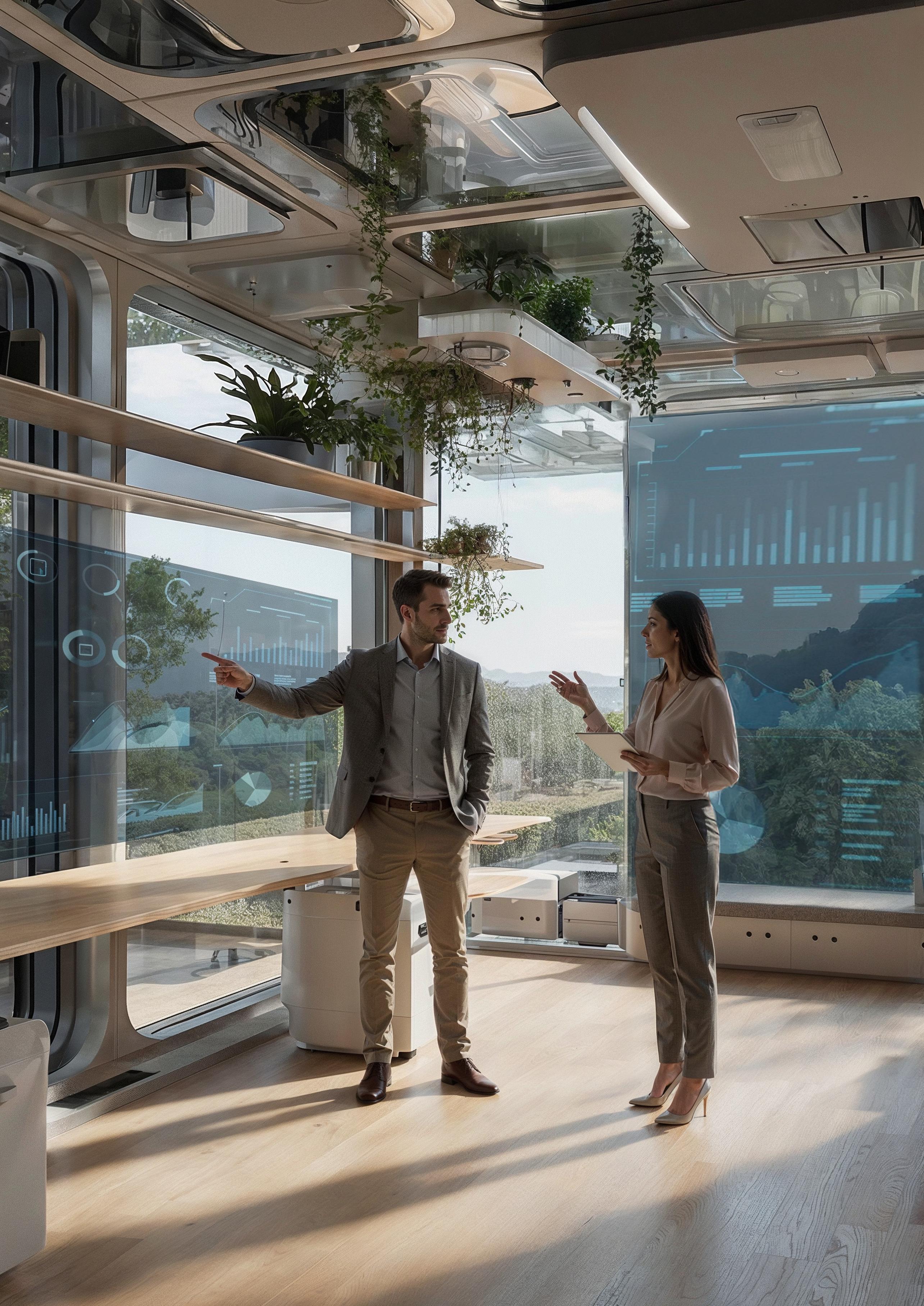
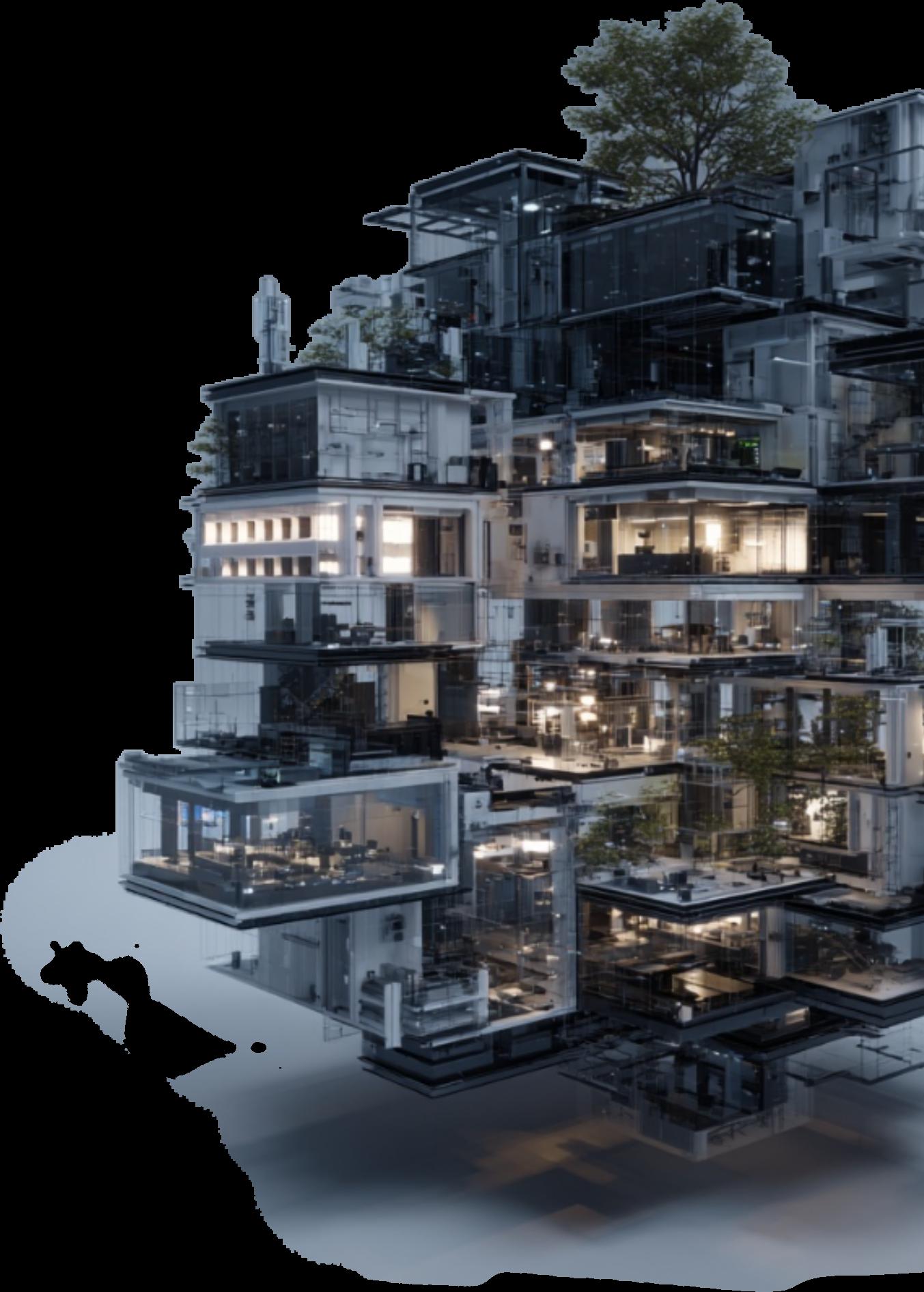
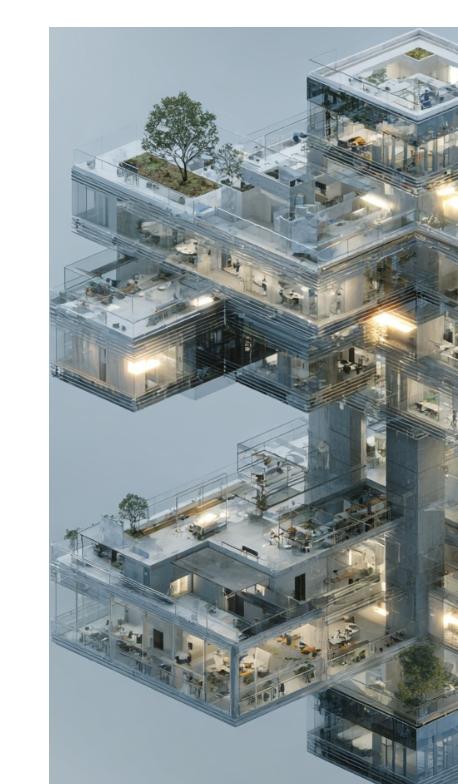
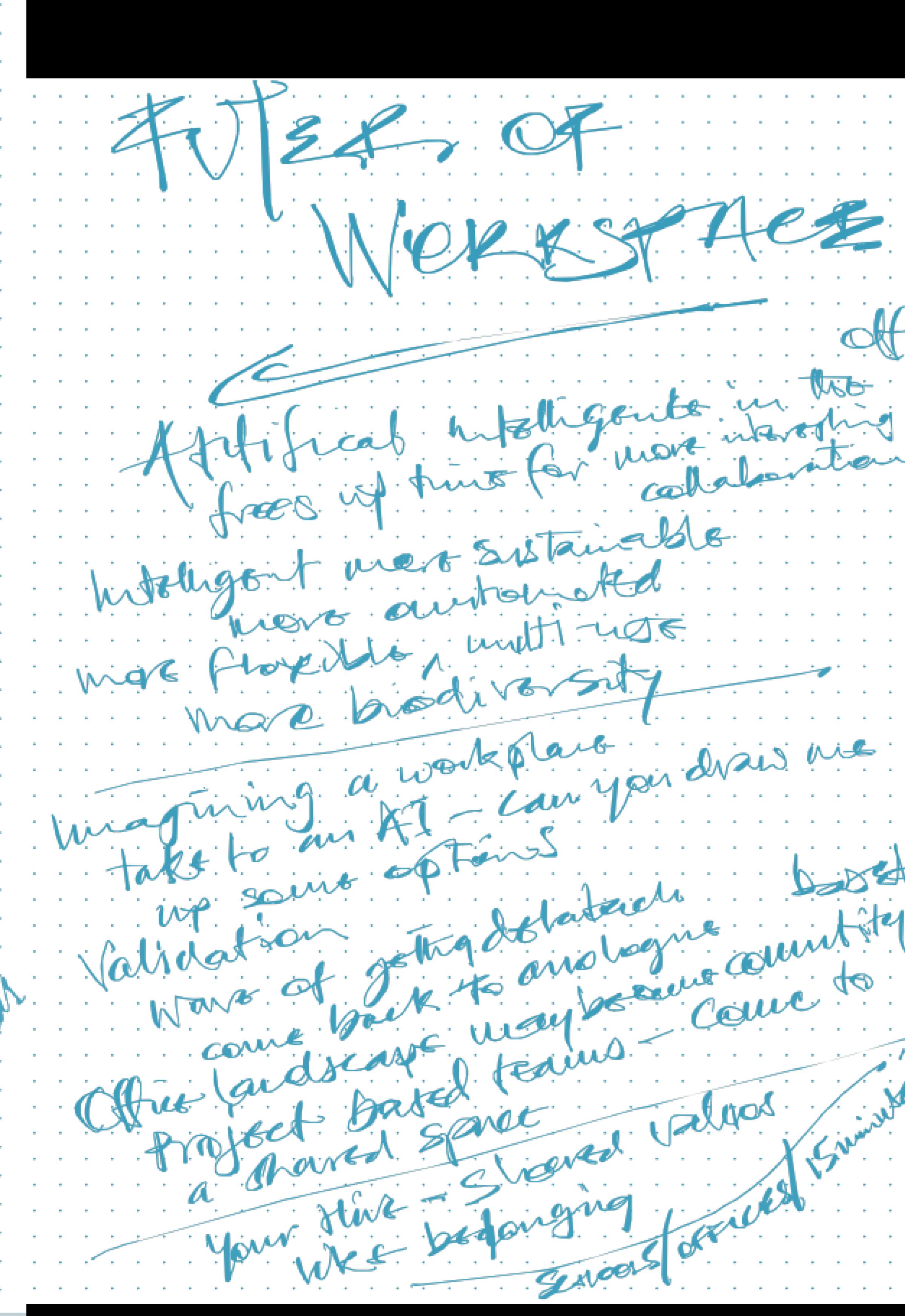
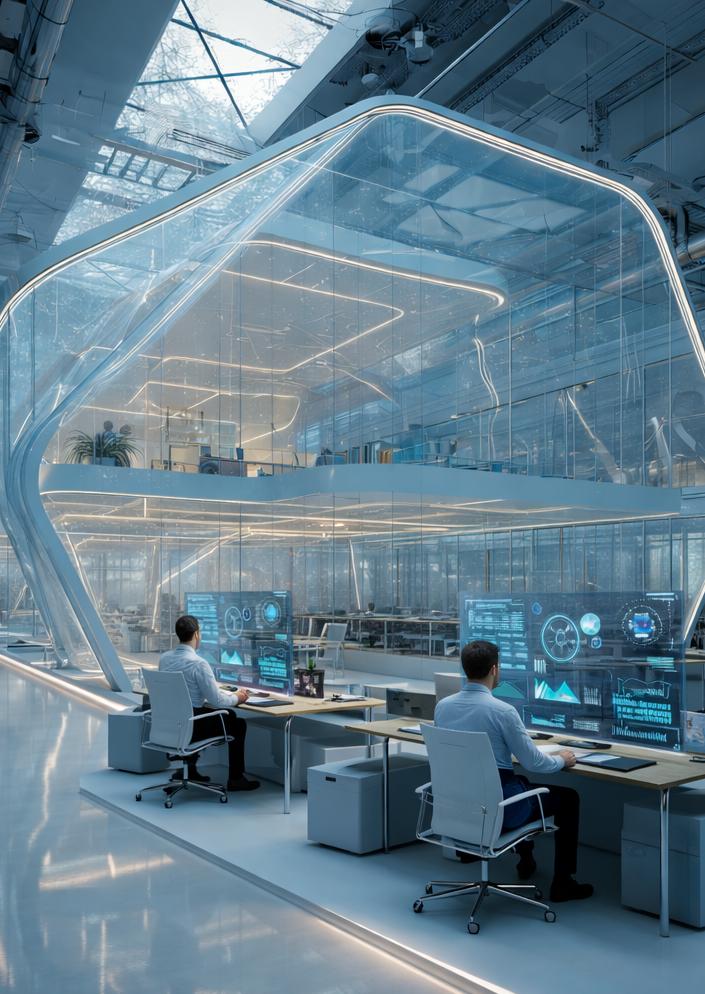
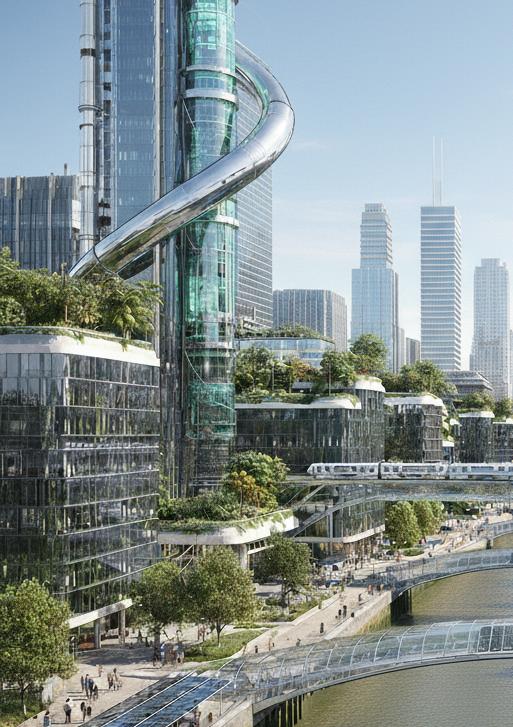
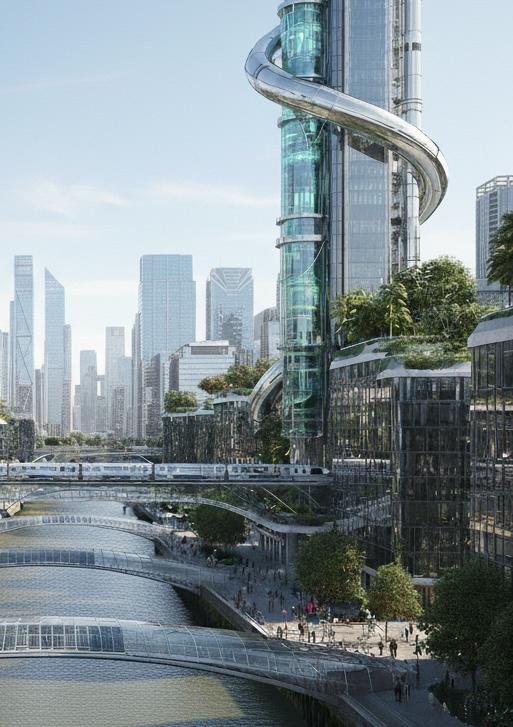
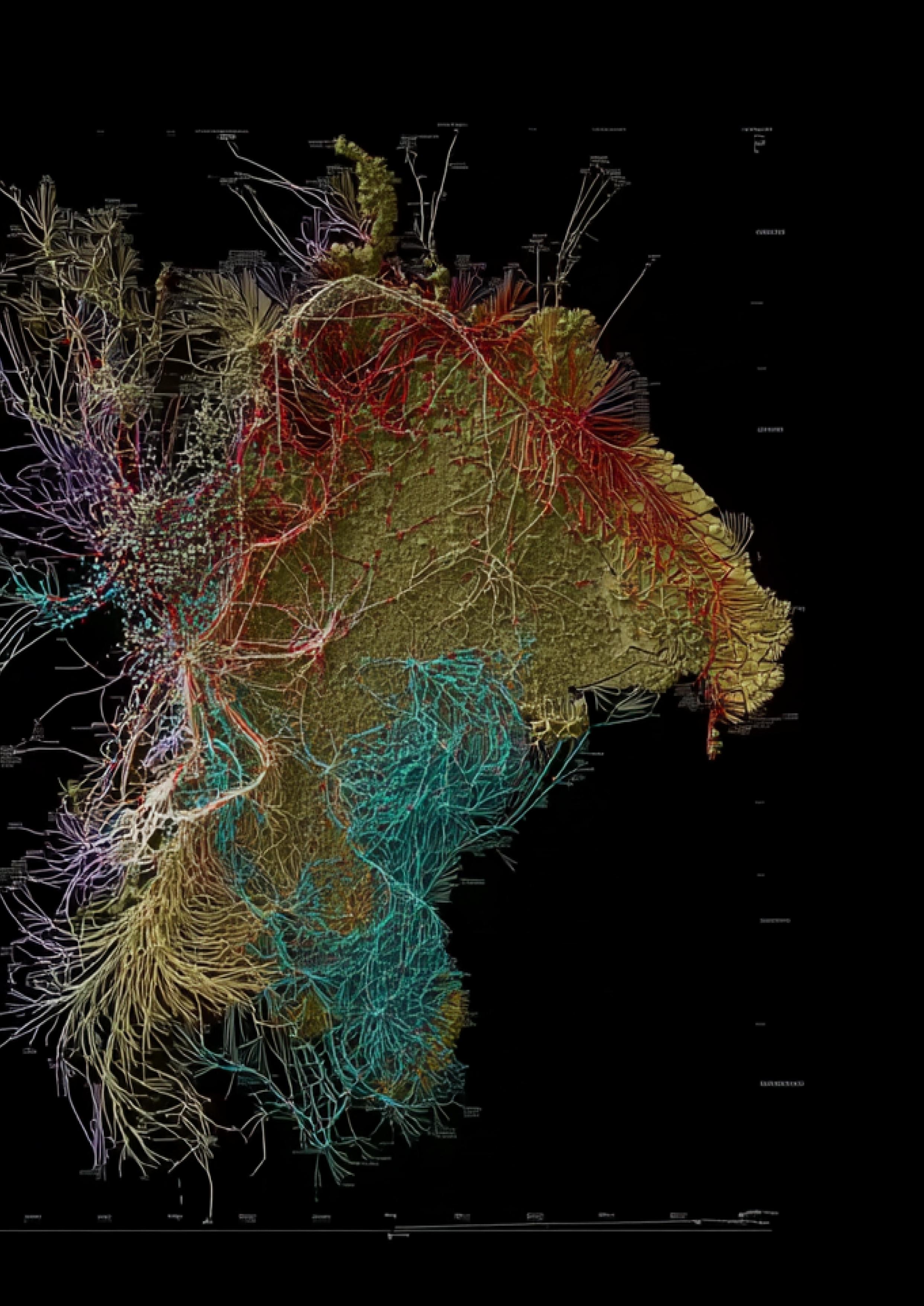
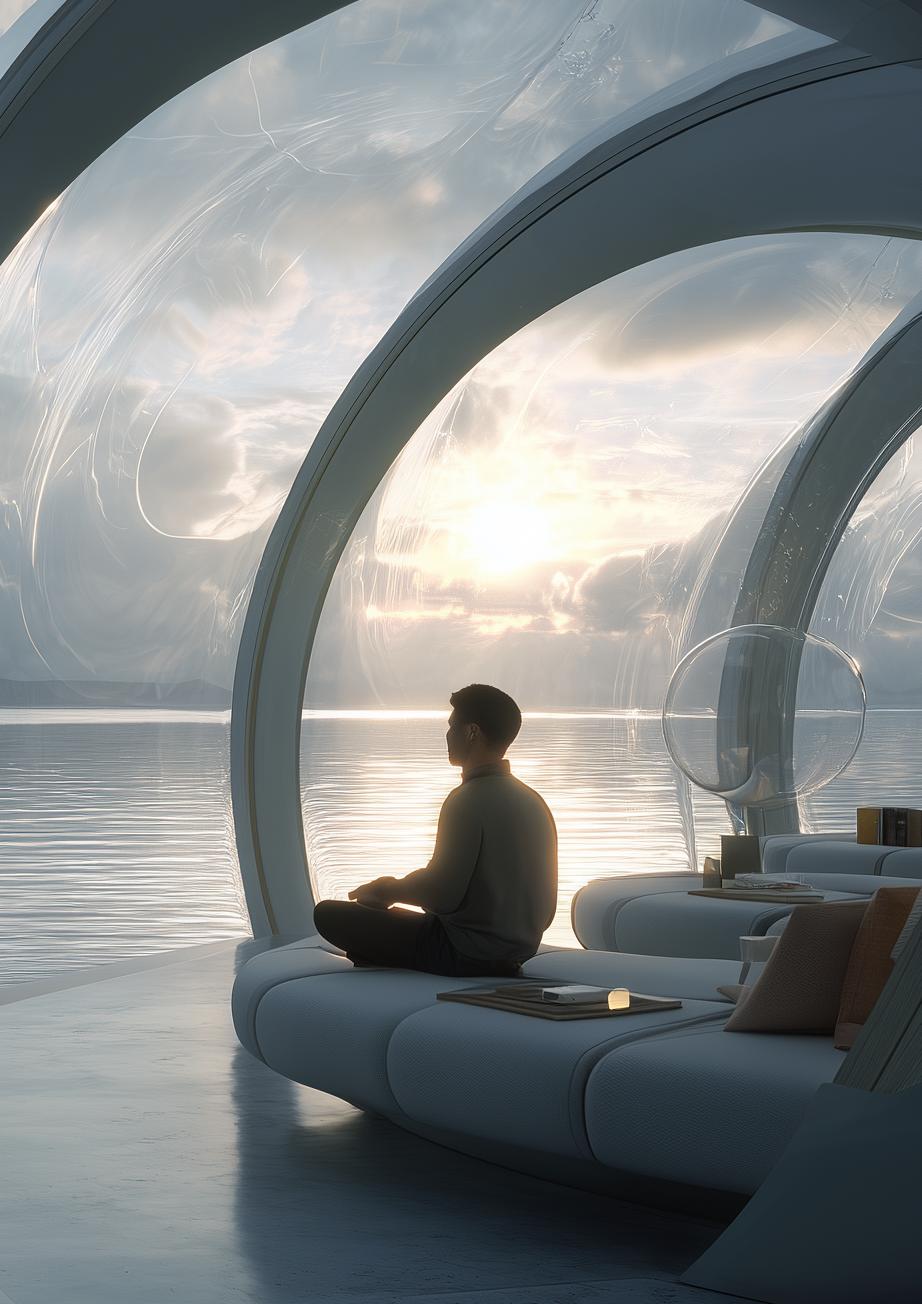
The colour theme of this issue is a muted midnight blue - a shade that conveys sophistication, stability, and depth. It draws inspiration from the night sky, a powerful symbol of exploration, innovation, and limitless possibilities. Linked to the vastness of the cosmos, this colour reflects ambition and curiosity, reminding us that progress begins with bold ideas
CONTENTS
PRELUDE: THE VALUE OF VISION
INTRODUCTION: BEYOND THE HORIZON, IMAGINING THE NEXT CENTURY
RESIDENTIAL & MIXED USE: SENTIENT CITIES RAIL: NETWORKS OF CONNECTION
EDUCATION: LIFELONG LEARNING
WORKPLACE: FROM OFFICE TO ECOSYSTEM
ADVANCED TECHNOLOGIES: BEYOND THE GADGET
AVIATION: HORIZONS RECONSIDERED
CONCLUSION: NOSTALGIA AND IMAGINED FUTURES
The value of vision
Looking a hundred years ahead is not about accuracy. It is about agency. It is about refusing to be confined by present-day constraints by daring to envision alternatives and using those visions to influence choices today.
Hear from Head of Design Research Unit, Alistair Brierley, as he introduces this special edition of iA: Intelligent Architecture, exploring bold new possibilities for the future of the built environment.
The 20th edition of Intelligent Architecture does not claim to see the future with certainty. Instead, it claims the power of imagination whilst exploring and narrating the capacity to imagine futures that are socially equitable, environmentally sustainable, culturally rich, and technologically wise.
Whether in education, residential, advanced technology, rail, aviation, or workplace, the ultimate task is the same, to design not only for efficiency or novelty, but for a collective humanity, by aiming to build futures that will nurture learning connections and meaning. We know that architecture is not simply about shelter or infrastructure but about offering frameworks and places for the kind of society we want to inhabit.
In 2026, readers of Intelligent Architecture may look back at these pages with curiosity, perhaps amusement. But if our vision today inspires curiosity, dialogue, and action (even if our specifics prove wrong) it will have succeeded. For the true value of vision lies not in its accuracy, but in its capacity to expand what we dare to imagine. With special thanks to all our sectors and contributors, whose insight and collaboration helped bring this issue to life �
“Imagine reuse and re-wilding of vacant properties to enhance amenity and biodiversity.”
GENERATE PROMPT:
PROMPT:
“Transform ‘inbetween’ spaces in the city into spaces to learn, work and live.”
GENERATE
Beyond the horizon Imagining the next century
Anniversaries prompt reflection as much as projection. The 20th edition of Intelligent Architecture offers both bringing together a moment to take stock of the full back catalogue of inquiry into the built environment, and a chance to look forward, not just ten or twenty years, but a full century into the future.
A hundred years from now is both an impossibly vast horizon to encompass as well as an urgent design lens through which to see. It compels us to expand our field of vision beyond technological novelty and incremental change to consider deeper cultural, social, demographic, and scientific shifts. What kind of world will education, residential, advanced technology, rail, aviation, and workplaces inhabit in 2125? How will architecture shape and be shaped by them, and crucially how much of this future can, or should we attempt to predict?
In exploring these questions, one truth becomes clear. The most valuable tool architects and planners possess is not simply the algorithm, the material breakthrough, or the regulatory code but our imagination. Imagination allows us to suspend the limitations of the present without discarding its lessons. It allows us to sketch possibilities, to build hypotheses, to ask relevant questions and, in doing so, to create frameworks that inspire dialogue, experiment, and ultimately action. The power of this exercise lies less in the accuracy of its forecasts and more in the richness of the perspectives it generates.
This edition of Intelligent Architecture is therefore less a prophecy than an invitation to explore, to question, and to imagine. It does not seek to offer definitive blueprints for the next century, but to probe the possibilities across six sectors working together at Scott Brownrigg. The chosen sectors comprise education, advanced technology, rail, aviation, workplace, and residential, and the line of questioning asks not just what they may become, but how they may converge. It is in the overlaps and the mutual inclusivity that some of the most compelling opportunities for design and society may emerge.
THE ROLE OF IMAGINATION IN FUTURE THINKING
Designers are often asked to see beyond the brief. Clients, policymakers, and the public look to architects, not only to solve today’s challenges, but also to anticipate tomorrow’s needs. Yet there is a danger in reducing foresight to prediction. The world of 1925 could not have foreseen the digital revolution, our shared climate emergency, or the everpresent global interconnectivity of today. Likewise, 2025 cannot hope to chart with precision the circumstances of 2125. But that should not discourage us. If anything, it highlights the unique value of inspired imaginative projection.
The visionary paradigm, when coupled with rigorous process enables us to consider plural futures rather than single certainties. It opens space for optimism in an era often dominated by crisis narratives. It asks us to design not only for efficiency or resilience, but for joy, equity, curiosity, and meaning. In doing so it helps position architecture as both a cultural act and a technical craft, and a discipline that bridges science with history and technology with humanity. When imagining the next hundred years, accuracy is less critical than relevance. The aim is not to produce a flawless forecast, but to generate ideas that matter to people today, stimulating decisions that will ripple into tomorrow. The measure of value then is not whether our 2025 predictions for 2125 prove correct, but whether they provoke the kind of curiosity and exploration that can drive better design in the present.
PROCESS, NOT JUST PRODUCT
In imagining these multiple futures, we must also reflect on how they are designed. Architecture is not only about physical outcomes (including buildings, infrastructures, and spaces), but also about processes and the methods of inquiry, collaboration, and speculation that shape them. The next century will demand new processes of design research with interdisciplinary teams spanning science, art, economics, and anthropology. Participatory methods may come to the fore engaging communities as co-creators and
iterative approaches that treat experimentation not as indulgent but as learning. Such processes should embody imagination in order the challenge convention. They will recognise that the “process of design” matters as much as the design itself. The role of the architect then to orchestrate, to hold space for multiple perspectives, and to synthesise and provoke.
MUTUAL INCLUSIVITY: THE POWER OF OVERLAP
While each sector carries its own dynamics, the most compelling futures may lie in their intersections. Education informs the workplace by shaping the workforce; workplaces influence aviation and rail through patterns of mobility; technology underpins all with materials, data, and
systems. These overlaps are not incidental, rather they are the lifeblood of future architecture.
Consider a rail hub that doubles as a lifelong learning campus, where commuters engage in micro-courses during journeys. Or an airport that functions as a research district, with laboratories integrated into terminals. Or workplaces that adopt the modularity of rail stations, the adaptability of classrooms and the connectivity of airports. Each scenario demonstrates how sectors can not only coexist but actively enrich one another.
This mutual inclusivity suggests that the most visionary design solutions for 2125 will not be sector-specific, but cross-sectoral. It will require imagination that transcends isolated silos weaving together multiple threads and fully engaging with human experience �
RESIDENTIAL & MIXED USE
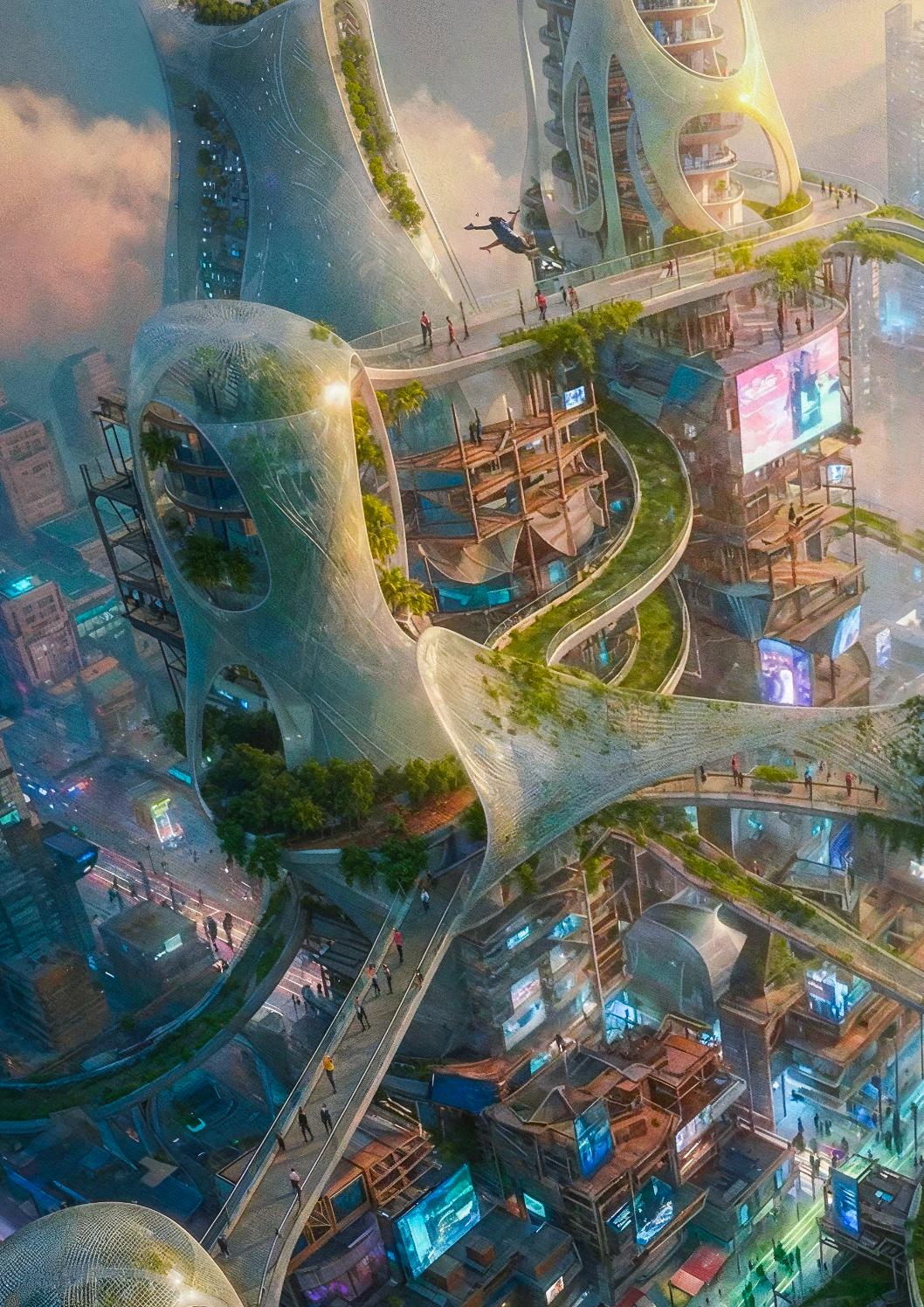
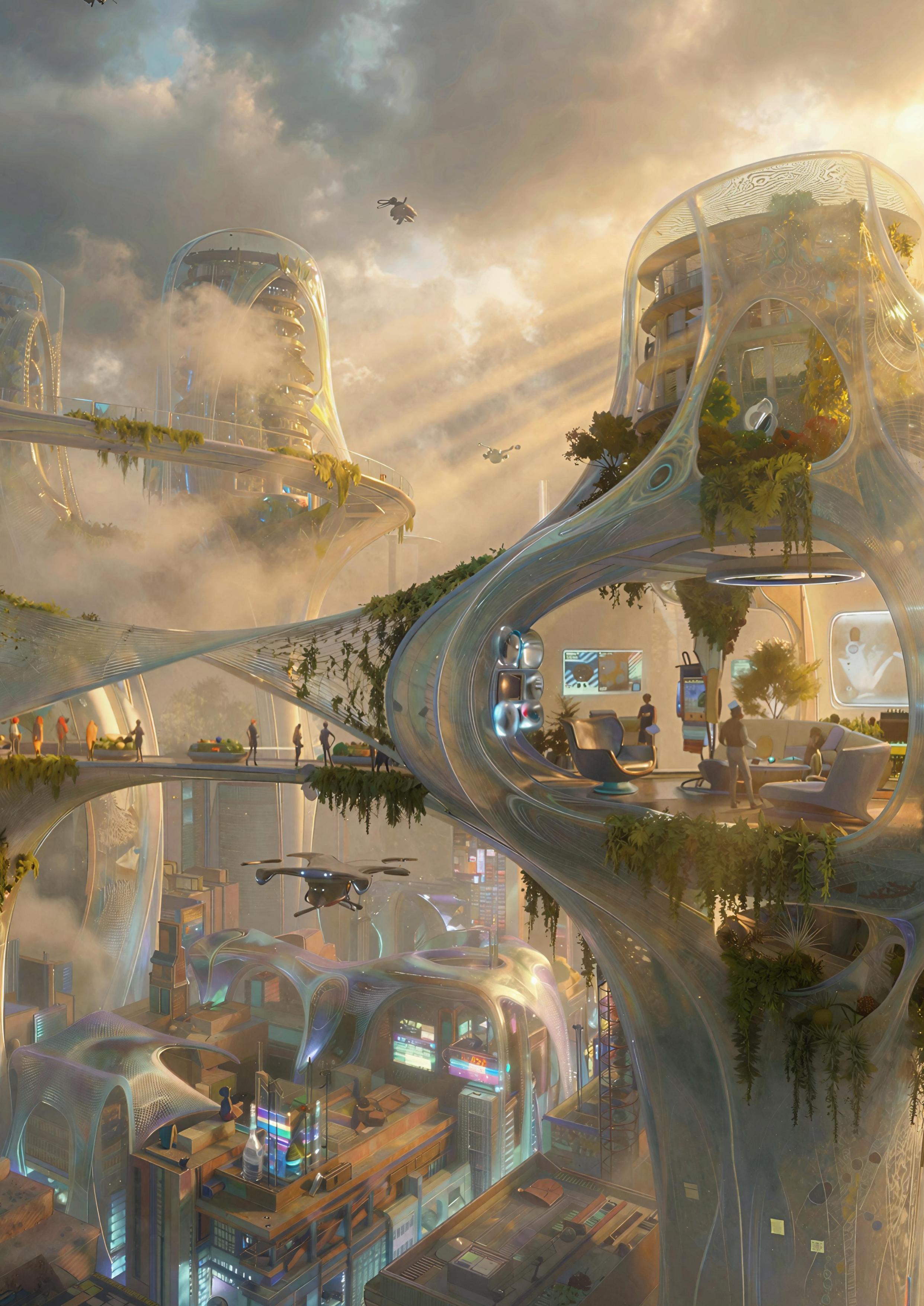
“Streets elevated in the sky are designed to support better connections with our neighbours.”
PROMPT: GENERATE
Sentient cities
In an era characterised by rapid urbanisation, digital migration, climate urgency and mental health crises, the future will be about creating adaptable, resilient and safe places to live, while learning to co-exist harmoniously with the natural world.
Successful masterplans prioritise people, offering access to nature, opportunities for connection, and quiet spaces to retreat. They are regenerative and cooperative and help foster a culture of stewardship that spans generations, encouraging communities to take pride and responsibility for their evolving spaces. Masterplans of the future must achieve this, and so much more. The changing condition of the natural environment around us presents both a challenge and an opportunity. It means we must not only design for the current climate and landscape, but for a potentially entirely different context in the future. For example, as sea levels reduce, it’s important we anticipate how coastal edges will function and how habitable spaces evolve as the shoreline recedes.
REGENERATIVE DESIGN
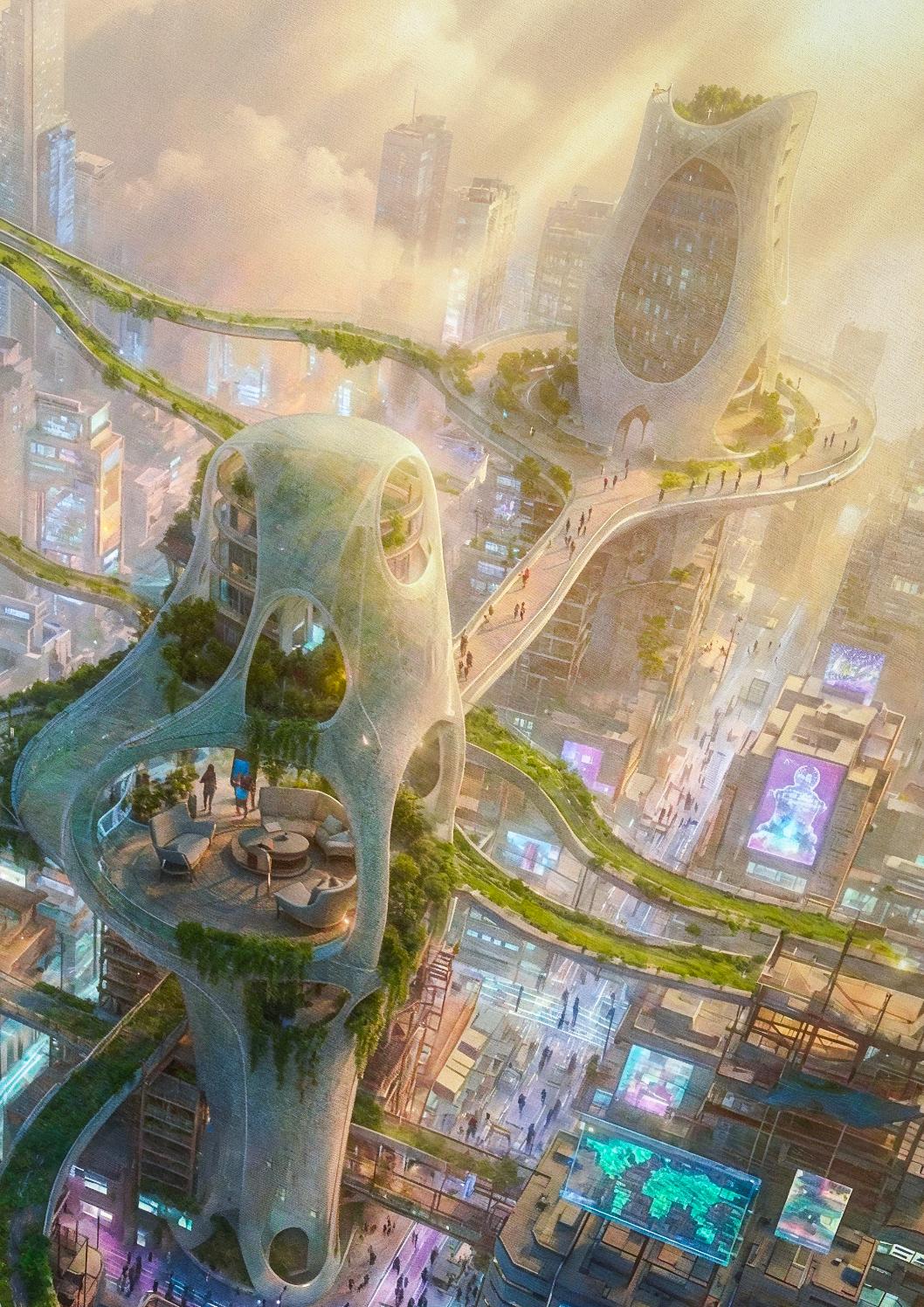
To take this a step further, rather than simply responding to the natural environment, places and spaces of the future could be designed to mimic it. Studies show that looking at fractals, which are self-repeating patterns found in nature, can reduce stress and cortisol levels. By embracing biomimicry and applying principles found in nature into design, from the macro-scale zoning of our cities to the micro-detail of facades, we can embed natural rhythms to support mental wellbeing into every corner of the places we call home. Fractal-inspired inspired structures can create shelters that protect us from strong solar rays and filter air pollution, whilst offering natural daylight to pass through.
These structures and patterns naturally suit, and can therefore help to increase and enhance, biodiversity within the urban landscape.
When it comes to building these structures, imagine a future where they are constructed purely from materials already in circulation, omitting the need to dig, quarry, or harvest from the environment. The act of construction would begin not with design, but with an audit: assessing first what materials exist, what can be dismantled, catalogued, and redeployed. In this context, the concept of material passports will be essential records that track the performance, and potential reuse of every building element, ensuring that nothing is lost to landfill.
If this approach were scaled, architecture could shift from a linear model of consumption to a regenerative practicewhere homes are not static objects but evolving systems of materials with continuous lives. Such an extreme circular economy would radically redefine architectural practice, forcing us to question what is truly necessary in a home, and in doing so, drive innovation in form, adaptability, and efficiency.
As a minimum, homes need to be safe, thermally comfortable, well-ventilated and naturally lit. However, now, they more than just a place for sleep and shelter – homes offer a space to work, socialise and retreat. An incredible demand from what is effectively a static form, inhabited by an ever-changing programmatic range of activity. In the future, more emphasis will be placed on shared spaces. Could homes be better designed to support longevity and long-term occupancy, to support a model of custodianship rather than ownership? Will our streets be elevated in the sky to mitigate against rising sea levels, and designed to support better connections with our neighbours?
PROMPT:
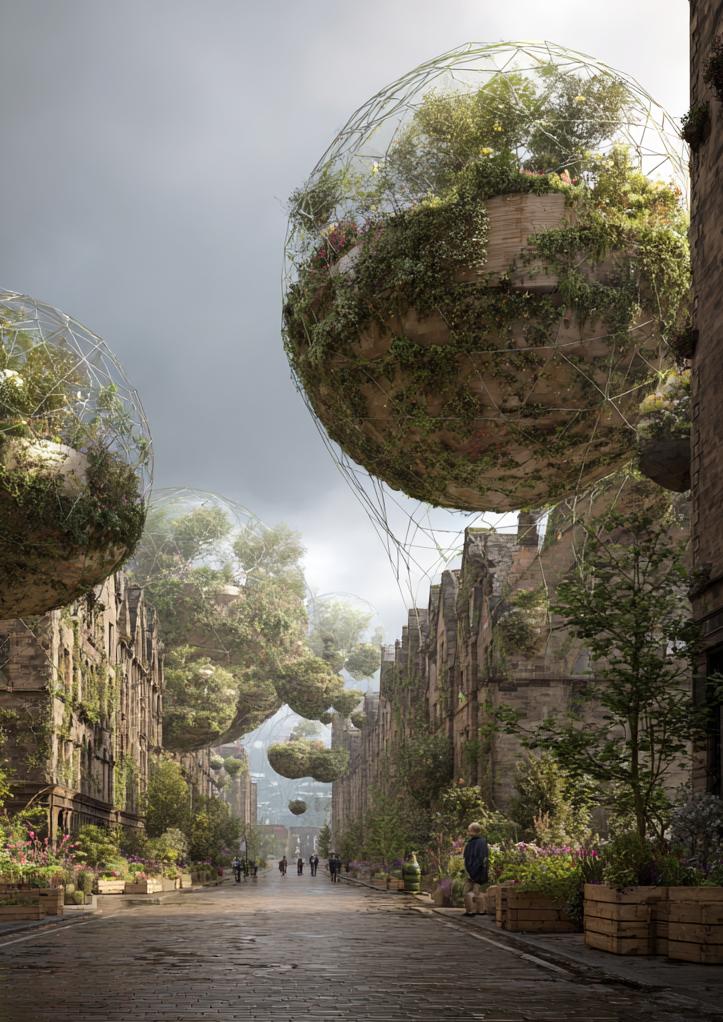
“Fractal-inspired biomimicry shelters provide shade, filter air, and let in natural light.”
GENERATE
PROMPT:
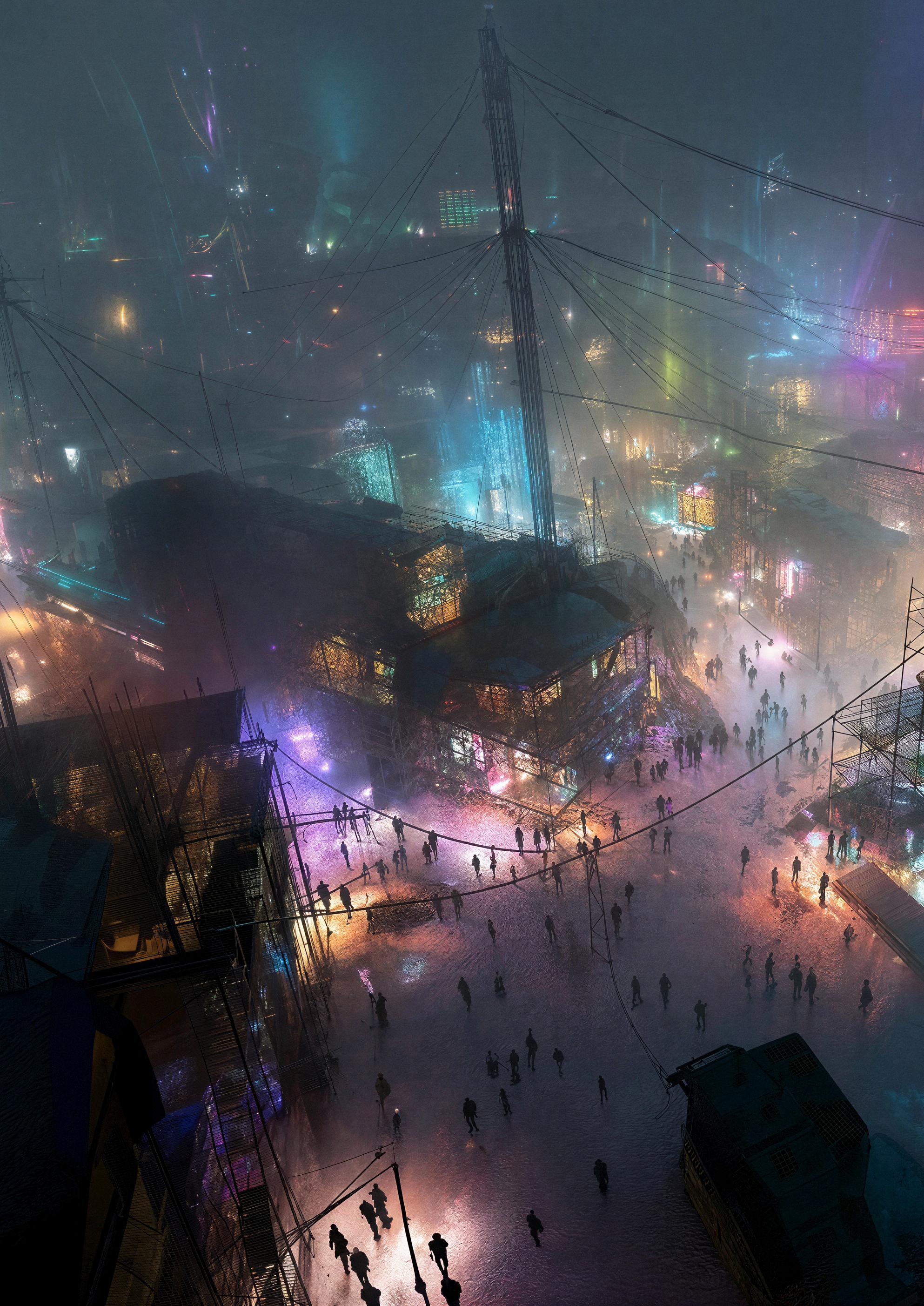
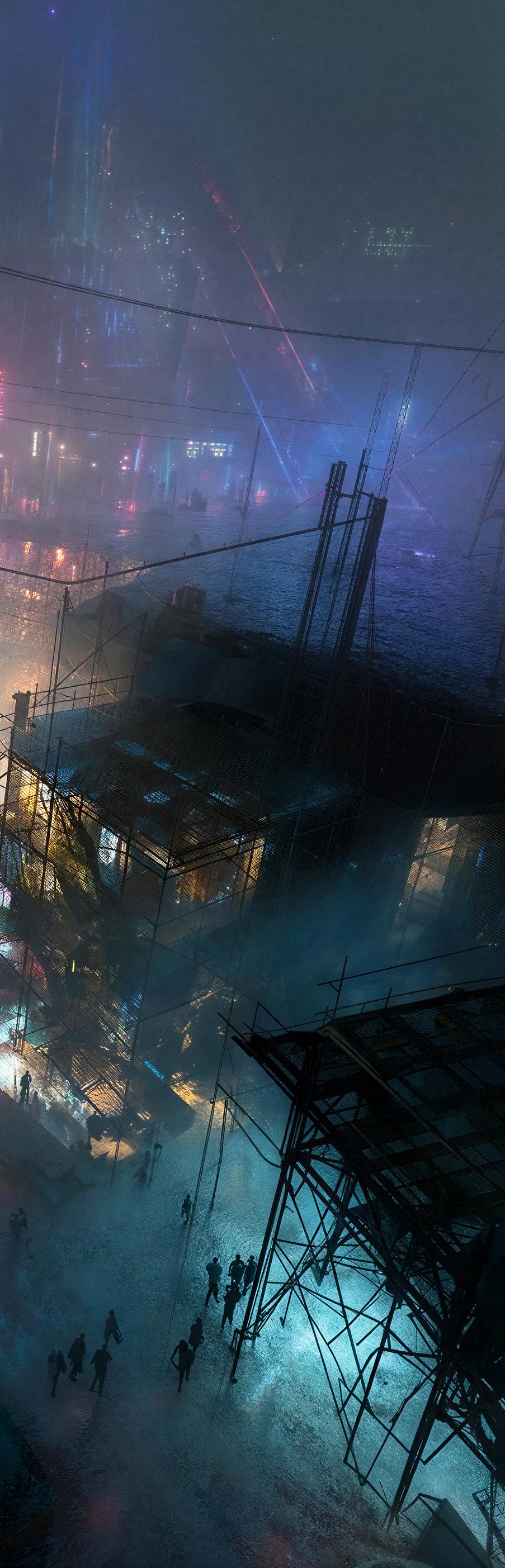
“A digital landscape of modular scaffolds, fabric membranes, suspended walkways, and stagelike structures for augmented reality.”
GENERATE
THE DIGITAL CITY
An alternative vision for the future is that our cities become completely digitised. As augmented reality technologies advance, and digital assets acquire cultural and economic significance, the role of physical architecture is undergoing a profound shift. Increasingly, spatial experience is defined not by fixed structures, but by virtual environments layered over them. A speculative scenario imagines an extreme version of that trajectory: a future city where architecture has become a lightweight framework for digital life, its physical form secondary to the immersive overlays that define how people perceive and interact with space.
In this vision, the urban fabric transforms into a network of semi-permanent scaffolds, fabric membranes, and modular stage-like structures rising from the streets below. These structures act as platforms for augmented reality, supporting holographic facades and virtual extensions that flicker, glitch, and evolve in real time. People move through the city as though within a vast interactive game via climbing platforms and suspended walkways, navigating layers of projected information and digital landscapes.
Social connection within this environment is no longer rooted in shared physical spaces, but in algorithmically generated affinities. Individuals find one another through mutually productive 3D algorithms. Systems continuously learn from users’ preferences, values, and interactions to create overlapping digital worlds. These echo chambers reinforce belonging through curated visual and spatial experiences, ensuring that each group inhabits a version of the city tailored to its collective identity.
In this context, architecture becomes less a stable material presence and more a dynamic interface between people, data, and environment. The city functions as a stage for augmented performance and social co-presence, where the value once embedded in permanence and form, now resides in the fluid, networked exchanges of digital experience. A future in which the built environment is not merely constructed but continuously computed; a landscape of impermanence shaped as much by algorithms as by human intention �
The digital city concept forms part of a broader body of research undertaken by architect Adam Najia.
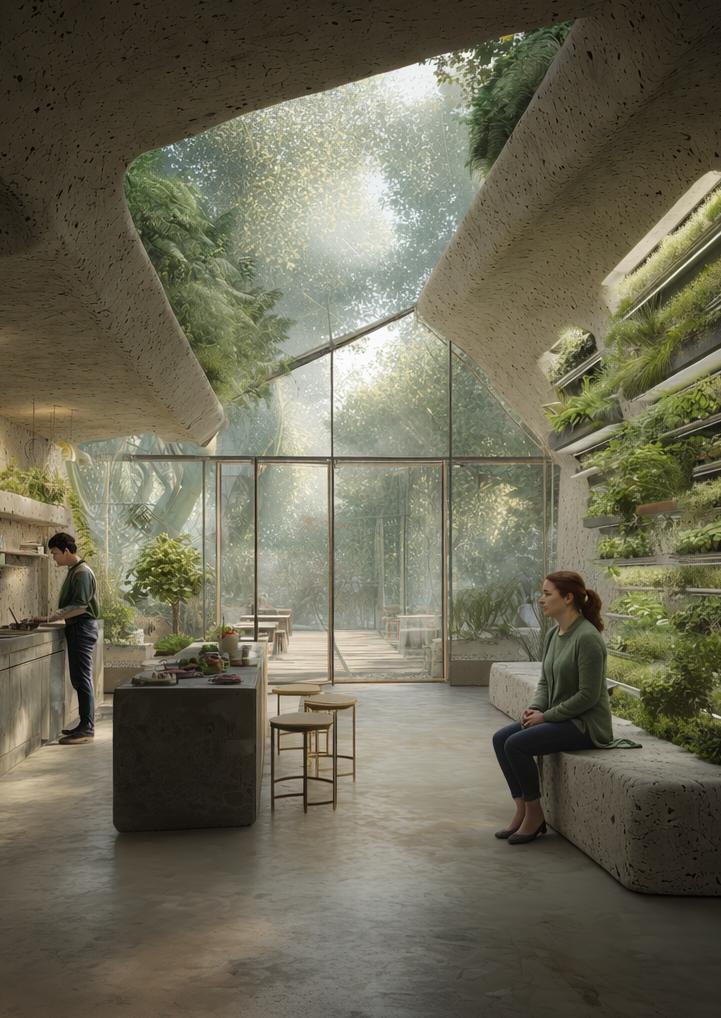
“An immersive eco-home that embraces nature with organic mycelium walls, algae bioreactors, and a lush indoor vertical herb garden.”
GENERATE PROMPT:
Inheritance
SATURDAY 6 JANUARY 2125
The last time Remy moved house, she was thirteen. That was twenty years ago, back when her grandmother still oversaw the family home’s material passport from a worn tablet, tracking every nut, beam, and wire like they were ancestors in a family tree. Now, standing at the threshold of the same house, Remy waited for the lock to blink green. It was strange really, returning not to a new mortgage or lease, but to something far older: legacy.
The front door slid open silently. Solar-heated air greeted her with familiar warmth. She stepped inside, brushed her hand across the polished mycelium panelled wall, and the lights adjusted to her presence. Her grandmother had passed away three months ago, and in accordance with the Registry Act of 2062, Remy now held custodianship of the home. Ownership was an ancient concept, phased out with landfill. You inherited stewardship, managed materials, and added only what could be removed without cost to the earth. The Registry ensured every bolt was accounted for and every component and panel tagged and traceable.
In the kitchen, her grandmother’s old fusion kettle still hummed faintly on the induction slab. Remy smiled. Even now, the home generated more energy than it needed. Its rooftop algae farms and salt-battery banks made sure of that. The excess fed the district grid, subsidising neighbours’ heating. It was the way things worked now. Hyper-local sharing, total digital integration.
She walked to the back window. The garden had changed. A small modular greenhouse had been bolted onto the southern wall and a note in the Registry documentation flagged its origin as a deconstructed nursery from Liverpool. Above it, two new window units were made from lightweight, carbon-neutral composites, probably harvested from a demolished office tower. Remy wasn’t aware that her grandmother had conducted renovations in her last year.
Flicking open the Registry tab on her wrist implant, Remy scrolled through the recent updates. The house had evolved. Her grandmother had been preparing for her return. A chime echoed and Remy turned. “Remy Winters” came the voice, gentle but firm. A translucent figure shimmered into form. This was an AI caretaker shaped like a younger version of her grandmother. “I thought they decommissioned the companion programs after 2075” Remy said, her throat catching a little. The AI smiled stating that “She had made special arrangements.” Of course she had. Her grandmother believed in redundancy, both in architecture and in life. Remy walked into the expanded back room, now styled as a co-living suite with adaptive walls, convertible furniture, and voice-controlled environments, perfect for multigenerational living.
“She hoped you'd start a family here” the AI said, reading the pause in her footsteps. Remy hesitated. She hadn't decided yet. Most of her friends lived in the Cloud Corridors, floating housing stacks above the old city cores. These nonplaces were compact, automated, and utterly impersonal. But here, this house remembered her. It was designed to flex and change with her like a living organism. “Do you want to review possible future expansions?” the AI asked. Remy nodded. The ceiling projected options showing modular floor inserts, solar skin overlays, vertical hydro towers and even a removable nursery pod. All these potential modifications were sourced from surplus stock with no extraction required. The Registry would approve any combination that didn’t violate planetary net-materials limits. “Let’s wait and see,” she said softly.
She moved through the house, absorbing its quiet intelligence. It had changed its ventilation pattern since she arrived, recalibrating to her body temperature and respiration. The walls subtly shifted, dampening the acoustics to soften her footsteps. Behind the scenes, nano filters scrubbed air and moisture. If something broke, the house printed its own biopolymer and biodegradable patches. Yet it was the intangible elements that struck her most. The walls held memory, not just of material, but of moments. Here, her fingerprints were layered beneath her mother’s, and her grandmother’s before that. In a world where everything was reused, shared, or rented, this house was not just a shelter. It was a story, a place of belonging, evolution, and balance.
Her grandmother’s voice, real this time, sounded quietly in the air. A final recording woven into the home’s fabric.“Remy. I hope this home will be enough. Not in size or status, but in love. If it’s not, then make it more. It’s your turn now.” Remy’s throat tightened. Yes. It was her turn now. She opened the Registry tab again and tapped “modification intent,” which immediately sketched a rooftop nursery proposal. Not because she had children yet, but because someday, someone else would need it. The Registry AI prompted: “Primary purpose?” She responded and typed, “To stay. To grow. To remember.” Outside, a drone from the district circled once, confirming the update. In a quiet hum, the blueprint was sent to local cooperatives. Materials would be sourced not from mines, but from memory, from deconstructed schools, retired trade halls, and even other houses that had seen their final family move on.
In the distance, the old shoreline shimmered. The ocean had risen another half centimetre this year. Masterplanners were already adapting, but here, Remy wasn’t planning cities. Just one home. One life. That was enough for the moment.
RAIL
PROMPT:
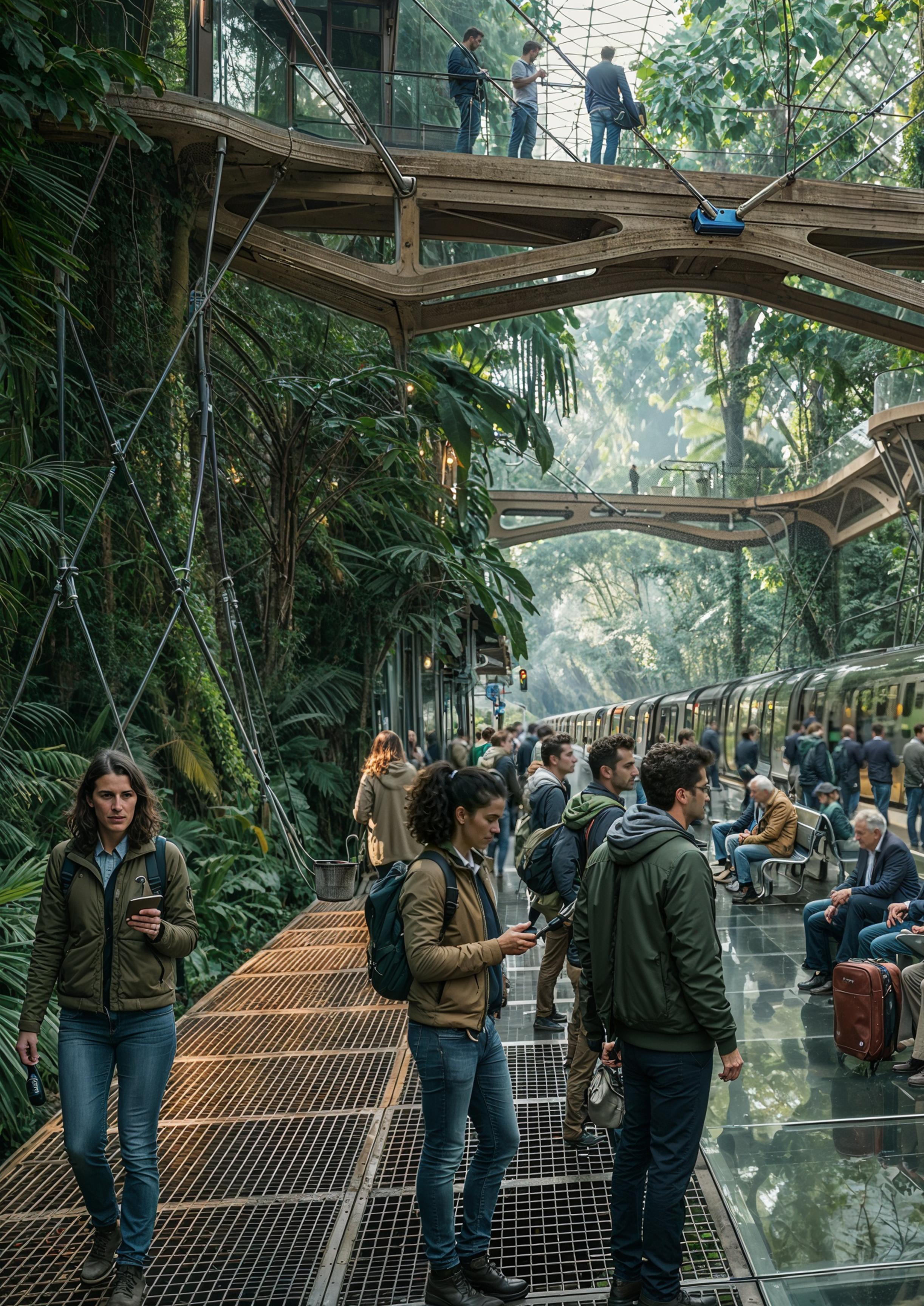
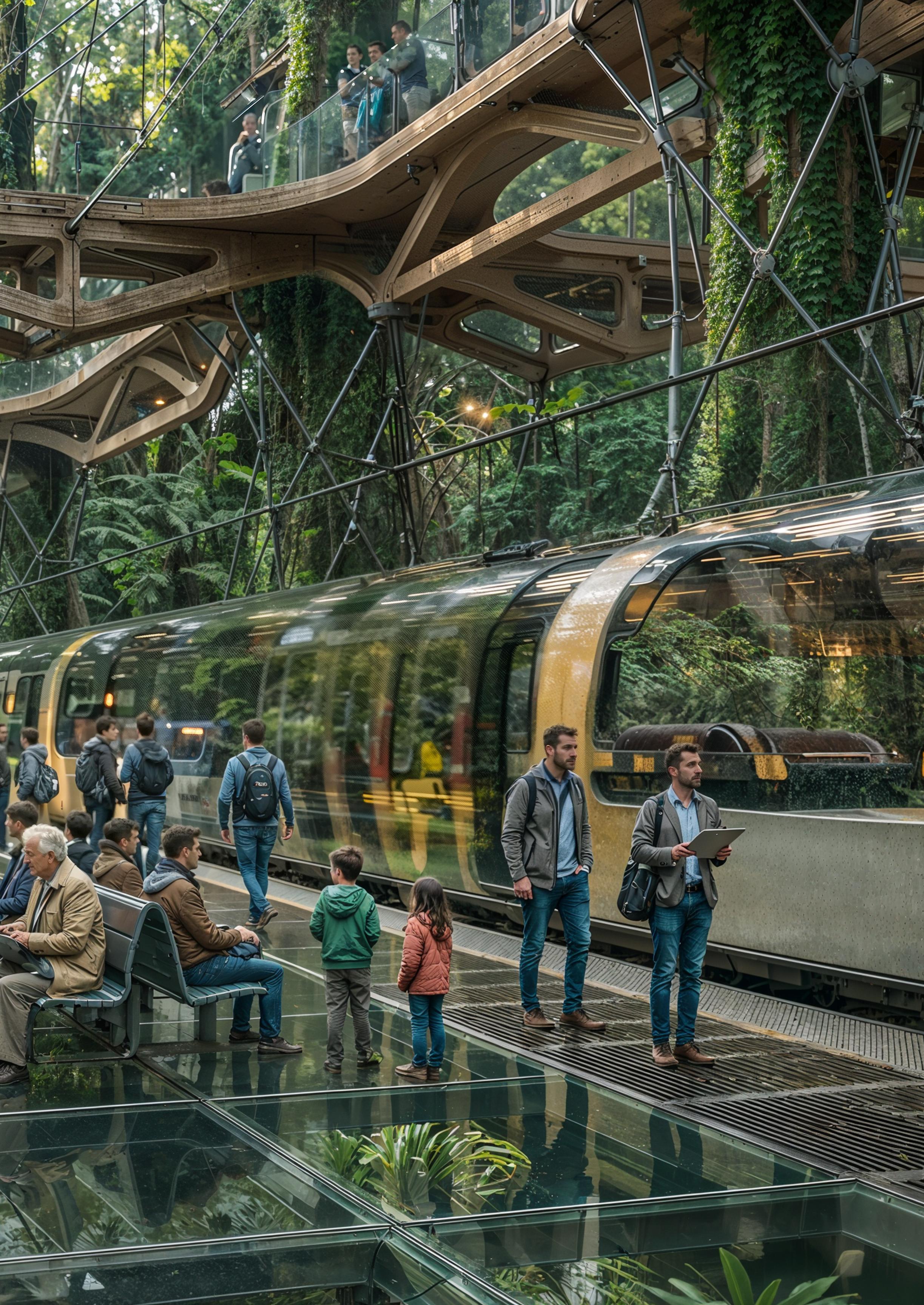
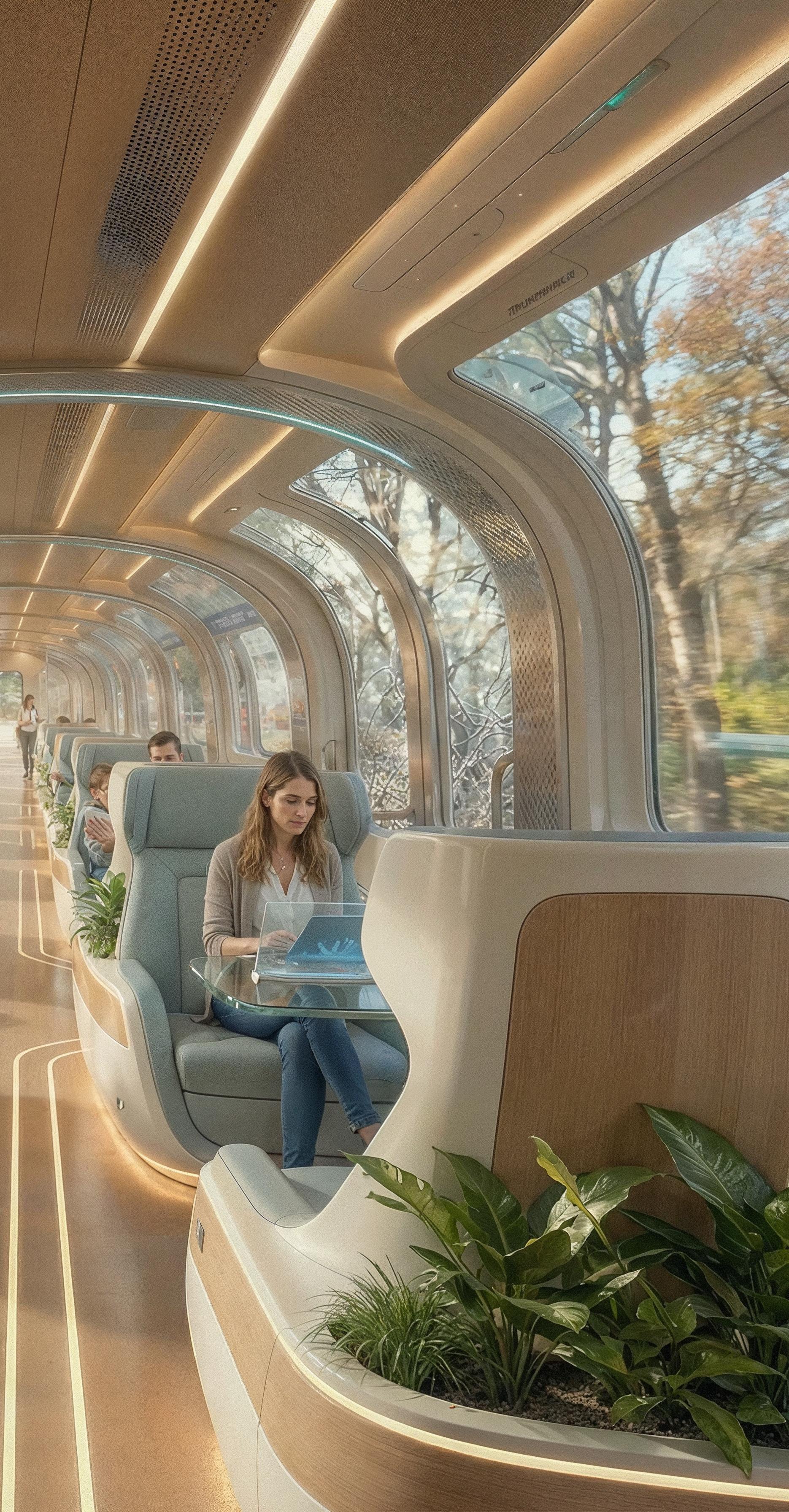
“Envisage a future rail system where glass pods glide through re-wilded landscapes and concourse walkways weave through forest canopies.”
GENERATE
Networks of connection
On the occasion of the 200th anniversary of the world’s first passenger rail journey, this offers a timely opportunity to reflect on the legacy and future of rail infrastructure. This article brings together two complementary discussions: one focused on speculative design and emotional engagement with rail travel, and the other on civic infrastructure and technological transformation. Together, they propose a future where rail is not only a mode of transport, but also a catalyst for community, culture, and wellbeing.
Our exploration of future rail travel emerged through a collective reflection on Sunningdale, a quintessential commuter station on the Berkshire/Surrey borders whose familiar yet architecturally unremarkable setting lends itself to a canvas for imaginative transformation. Using this everyday view as a springboard, we envisioned a series of speculative futures, each pushing the boundaries of infrastructure, experience, and emotional engagement. From subtle enhancements like electric pods and open station plazas, to radical reimaginings involving elevated
walkways, immersive glass transport tubes, and climatealtered landscapes, the sketches and narratives invited us to rethink not just how we move, but why we move. Sunningdale, in its ordinariness became a powerful symbol of possibility, a place where the everyday could evolve into the extraordinary.
Each sketch served not only as a visual projection of future infrastructure but as a narrative device to explore how travel might evolve emotionally, socially, and psychologically. The familiar view of Sunningdale station with its car-centric layout, modest architectural expression, and surrounding suburban fabric was reimagined across time horizons. In one version, the station becomes a seamless, contactless hub surrounded by greenery and electric pods; in another, it transforms into a vibrant elevated walkway through forested canopies. Further ahead, rail travel dissolves into immersive glass tubes or meditative pods, offering either sensory richness or complete detachment. These speculative scenes prompted reflections on the changing nature of movement from necessity to pleasure, from congestion to calm and invited us to consider how future travel could nurture wellbeing, curiosity, and connection.
In 200 years’ time…
1. SEAMLESS COMMUTER HUB
In the first sketch Sunningdale station is reimagined just a few decades ahead, retaining its rail infrastructure but transformed into a more open, elegant, and user-friendly environment. The cluttered station buildings are replaced with a minimalist canopy, allowing for contactless access and fluid movement. Electric pods and Uber-style vehicles circulate through redesigned drop-off zones, while green spaces and café hubs invite commuters to linger. This vision reflects a pragmatic evolution enhancing the commuter experience without radically altering the station’s core function. It also aligns with the idea of stations as civic spaces, where infrastructure supports not just movement but community life.
2. LOGISTICS NODE AND URBAN PODS
This image imagines a future where Sunningdale becomes a hub for vertical logistics and modular transport. Stacked autonomous pods deliver food, parcels, and people, while the station integrates with new urban developments. The rail line continues but is augmented by flexible, responsive systems that adapt to changing needs. The surrounding architecture evolves to reflect contemporary design, and the station becomes a node in a broader network of smart mobility. This vision blends technological advancement with urban regeneration, suggesting a future where infrastructure is dynamic and multi-purpose drawing directly from themes of Artificial Intelligence, automation, and Mobility as a Service (MaaS).
Bio-mineral technologies and 3D construction printing could revolutionise how above-ground structures are built, while Nanotech could revolutionise how below-ground infrastructure is built – removing the need to demolish existing buildings as nanites are injected into the ground and tracked as they burrow to create new structures below.
ABOVE Logistics node sketch by Rob Lintern
Seamless commuter hub sketch by Rob Lintern
In 400 years’ time…
3. ELEVATED RAIL AND FOREST CANOPY
In this transitional vision, the rail line remains but is elevated above the main road to eliminate congestion and level crossings. Inspired by Bracknell Forest and canopy walks, the station becomes part of a high-level green network, connecting developments through treetop paths and vertical transport hubs. The surrounding area is softened with vegetation and contemporary architecture, replacing the postmodern retail blocks. This sketch explores how infrastructure can coexist with ecology, offering both functional connectivity and immersive experiences.
4. NATURE-INTEGRATED LEISURE CORRIDOR
This image pushes the time machine lever much further forward, imagining a future where rail travel has been replaced entirely by leisure-focused infrastructure. The tracks become a green corridor, a nature reserve, or a pedestrian and cycling route. The station itself dissolves into a public square, surrounded by trees and community spaces. Local transport shifts to road-based trams and glass pods, while longer distance transportation streaks across the sky above via advancement in electrical propulsion technology. This vision reflects a world where movement is slower, more intentional, and deeply embedded in the natural landscape echoing the call for infrastructure that is sustainable, adaptable, and emotionally resonant.
ABOVE
Sketch of a nature-integrated leisure corridor by Rob Lintern
LEFT
Sketch of elevated rail within the forest canopy by Rob Lintern
In 600 years time…
5. CLIMATE-RESILIENT FUTURE RAIL STATION
In this final image a future rail station is carved into the ground to shield passengers from extreme heat, using natural insulation and passive cooling. Above ground, tensile fabrics inspired by North African and Middle Eastern architecture provide shade. The landscape features drought-resistant plants like date palms, and succulents, while mist solar-powered towers enhance comfort. Earthtoned materials and cultural design elements create a serene, climate-resilient space.
Beyond infrastructure and technology, the emotional experience of travel emerged as a vital theme in our discussion. The group reflected on how commuting can be both a source of stress and a moment of personal sanctuary especially in post-pandemic London, where reduced ridership has restored a sense of space and calm. The desire for personal space, the psychological toll of overcrowding, and the subtle rituals of travel such as headphones, podcasts, and quiet reflection were all seen as essential components of the journey. Travel is indicated not just as movement, but as a transitional state between identities, between work and home, solitude and society.
Expanding on this, the concept of personal travel experience was explored through a range of experiences, from functional necessity to immersive pleasure. For some, travel is a moment of solitude and decompression while for others, it’s a social or cultural encounter. The idea of customisable travel environments, meditation pods, observation lounges, or interactive cultural spaces emerged
to elevate the journey itself. This aligns with the broader vision of rail infrastructure as a civic and cultural space, where stations and carriages are designed to support diverse emotional needs and lifestyles.
As stations evolve, they must also reflect the emotional and cultural fabric of the communities they serve. Reimagining rail infrastructure as civic space where people gather, work and engage, adds depth to the travel experience and strengthens the station’s role as a place of belonging. This invites us to design future transport systems that are not only efficient, but also empathetic spaces that support mental wellbeing, offer comfort, and allow for moments of introspection or connection.
As we journeyed through sketches and shared reflections, it became clear that the future of rail travel is not simply a matter of engineering or infrastructure, it is a canvas for imagination, emotion, and societal transformation. Sunningdale, in its quiet ordinariness, became a lens through which we explored possibilities. We
considered stations as sanctuaries, journeys as experiences, and movement as a deeply human act. Whether through elevated walkways in forested canopies, immersive glass pods gliding through re-wilded landscapes, or fictional characters meditating in double-height observation lounges, our visions challenged the notion that travel must be rushed, crowded, or purely functional.
As technology reshapes mobility, the challenge is to ensure that innovation serves human needs - creating systems that are not only efficient, but also emotionally and socially enriching. Rail must remain a catalyst for civic life, blending heritage with adaptability and global insight. In doing so, we not only reimagine rail, but also reconnect with the timeless romance of movement, the psychological need for space, and the enduring power of design to shape how we live, feel, and connect �
ABOVE Sketch of a climate resilient future by Rob Lintern
PROMPT:
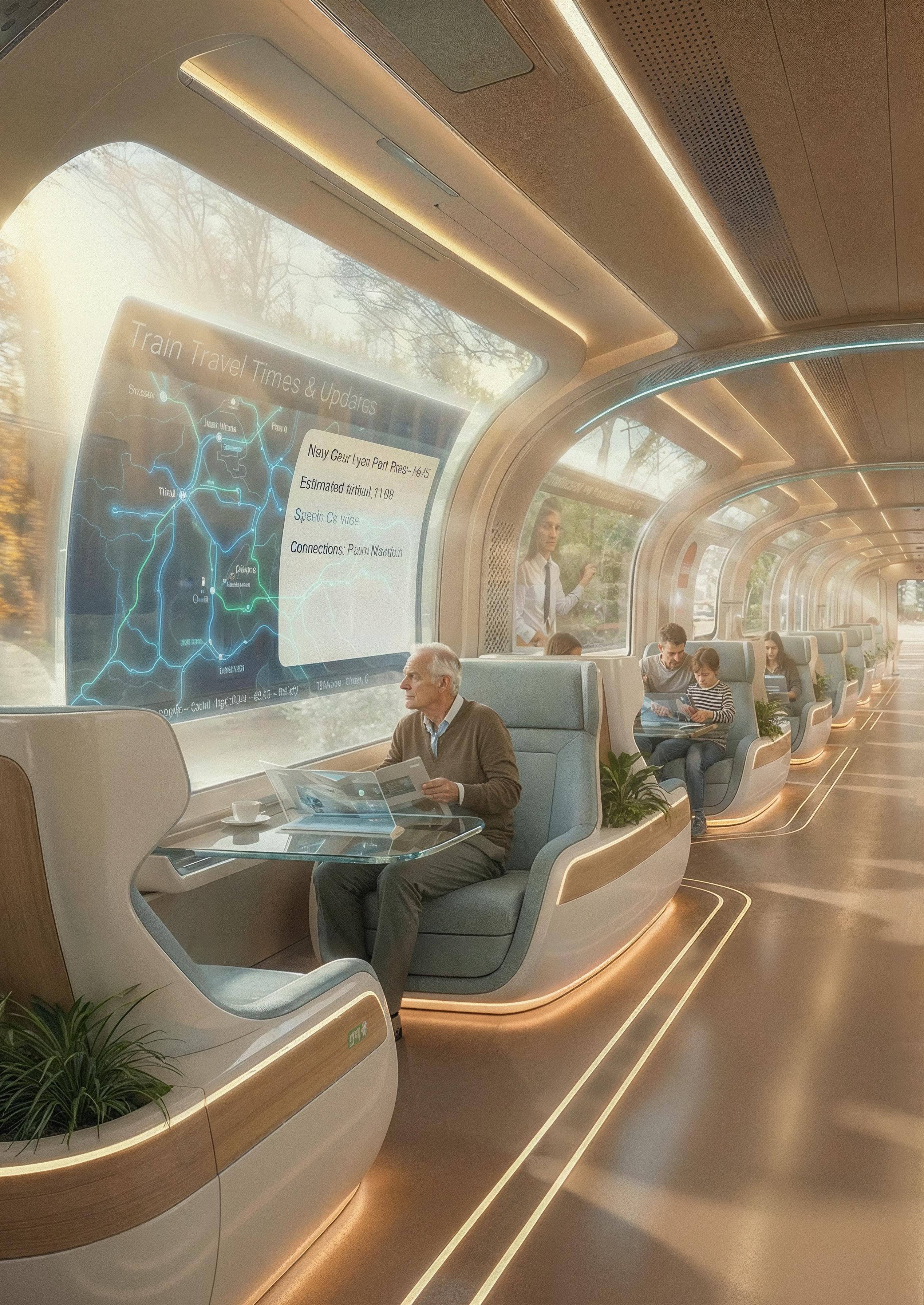
“Interactive holographic travel updates and lessons project onto the glass skin of the train carriage.”
GENERATE
GENERATE
The Brighton run
MONDAY 26 JUNE 2125
It was just after eight in the morning when Amara stepped onto the concourse of Victoria Station. A hundred years ago, it had been a place of chaos, suitcases wheeled across cracked terrazzo, boards clattering with delays, harried commuters running for platforms. Now it was calm, luminous, and almost ceremonial.
The station’s roof arched high above, a green parkland unfurling above the tracks. Here trees grew in carefully engineered soil trays, and in between filtered daylight fell into the space below. People came here not just to travel, but to stroll in the elevated gardens, take a yoga class, or eat breakfast under the canopy. Stations in 2125 had become civic spaces once again, as important to the life of the city as museums or theatres had once been.
Amara’s commute to Brighton had never been a chore. She checked in by touching her wristband against a floating glass pillar. A small glyph shimmered on her forearm, her boarding signal. No luggage check, no gates. The entire security process had already been handled invisibly by the systems that monitored flows across the city. She walked freely, unhurried. Most of the time trains and flexible timetables adapted to her, not the other way around. On the platform, her carriage slid into view without sound. The glass skin of the train caught the morning light, and through it she could already see passengers settling into zones of choice. There was a quiet pod for those who needed to work, a family space with childcare attendants and play areas, and a salon car with art exhibits and live music.
Travel had become a blended offer, something between a university, a hotel, and a performance space. She chose the “language lounge”, where every morning a dozen commuters gathered for their French class. They had been meeting here for years as part of a community enabled by the predictability and comfort of the Brighton run. AI tutors drifted between groups by projecting holographic conversation scenarios against the walls. Today, a Parisian Street market shimmered into existence around them. Amara ordered a coffee, and the café robot delivered it silently. She then joined her classmates in bargaining over imagined cheeses and charcuterie. What struck her most, (as it did every day), was the gift of time. In the 2020s, people had rushed, frustrated on slow crowded and frequently delayed services. In 2125, optimisation meant her 55-minute journey was perfectly orchestrated, not just fast but meaningful. She often arrived in Brighton feeling better, smarter, calmer, more connected. Travel wasn’t lost time anymore, rather a meaningful life lived in motion.
As the train accelerated, she glanced out of the window. Once speed had been limited by carbon costs and track quality, but now the high-speed lines running on superconducting tracks elevated above the old motorway corridors, carried people across the UK at flight-like
velocities without the environmental guilt of aviation. Flying domestically had all but vanished. In fact, the airports themselves had transformed.
Amara thought of her upcoming business trip. She would check in for her Lisbon flight at Victoria Station itself in what was called a “clean environment”. Digital security would already have cleared her, baggage would be whisked away by drones, and her boarding pass was part of her wristband. From Brighton or Manchester or Leeds, passengers could ride directly into the aircraft terminal, stepping from train to gate without friction. The whole of London, (and in fact the whole UK) had become one subliminal connected airport city.
The train glided through a landscape reshaped by infrastructure. Alongside stations new districts had emerged offering a mix of diverse cultural quarters, residential enclaves and green plazas layered above the tracks. Light rail lines stitched into smaller cities, not fixed, rather modular sequential tracks that could be lifted and relocated as populations shifted. Mobility was treated like a public utility, flexing to needs rather than locked into established routes.
At the halfway point Amara wandered into the observation lounge, a double-height car where artists displayed new work and musicians played at the far end. A pianist was improvising against the rhythm of the train. Around her passengers sipped breakfast wine or sat in meditation pods. A century ago, trains had been designed to pack in customers. Now they were designed to elevate the spirit and soul.
She thought about the irony. Uber, once just a ridehailing app, had evolved into one of the largest logistics and mobility platforms in the world. Its hubs now sat at major stations, handling both people and parcels, just as Royal Mail had done long ago. Deliveries, autonomous shuttles and shared rides, all were orchestrated from these nodes, blurring the line between personal transport and urban logistics.
When the announcement came “Brighton in five minutes” Amara barely noticed the deceleration as the train slowed. She stepped off refreshed, coffee in hand and new French phrases in her head. The station here was another civic place. A roof garden accommodated two micro amphitheatres tucked into its flanks, a university annex in the old concourse and an associated sequence of life science hubs. What had changed in 100 years was not only speed and automation. It was the rethinking of travel as something humanistic and personal, not just mechanical. Journeys were no longer inconvenient interruptions. They were rituals, civic acts with time reclaimed and a chance to recharge.
As she walked out into the sea air, she thought how strange it must have felt in 2025 to have suffered unreliable and uncomfortable commutes as wasted hours. For her, the journey itself had become the destination.
PROMPT:
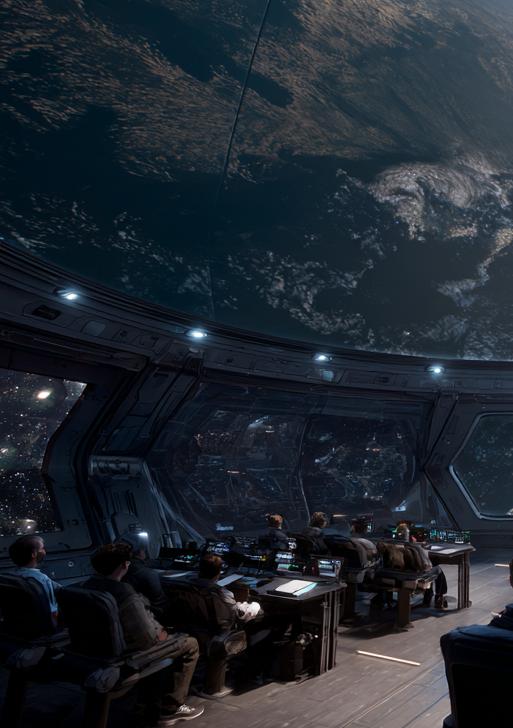
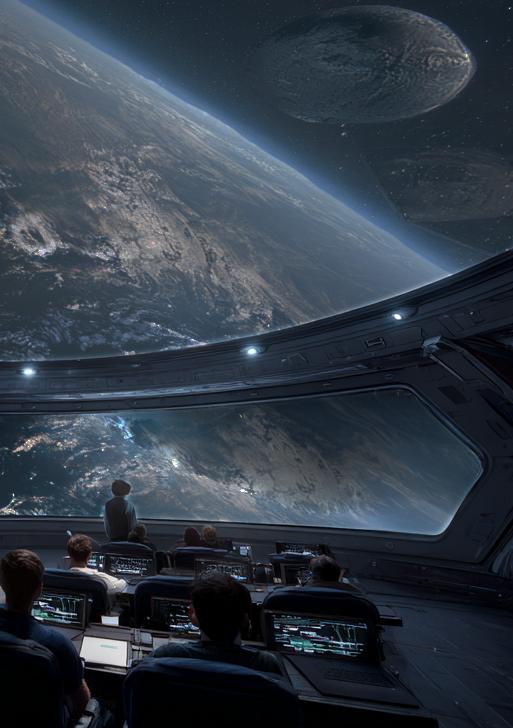
“Virtual environments could enable astronomy classes to be hosted on board a spacecraft.”
GENERATE
Lifelong learning HIGHER & WORKPLACE
Imagine a future where all young people, regardless of location or individual characteristics, have access to a dedicated safe and comfortable physical space - indoors and outdoors - that allows them to be with their peers, build friendships, access support and guidance, and experience a sense of community and fun.
While education is defined as ‘acquiring knowledge’, achieving competency and progression also includes the holistic attainment of skills, experience and behaviours. While education establishments focus on the delivery of education and skills at different stages in people’s lives, measured through the acquisition of qualifications, the design of the education environment provides an opportunity to both support that core mission, and significantly influence experience and behaviours. As a minimum, education environments should support positive societal relationships. They can and must remove barriers to learning and development, make people feel safe and valued, promote health and wellness, and at their best, they should inspire a lifelong love of learning, encourage play, empathy, curiosity and creativity.
Different types of learning is characterised as visual, auditory, read/write, and kinaesthetic, and most people have a unique combination of preferences. Learning is also often a social activity. Educational frameworks and research highlight that knowledge is constructed through interaction with others and that students often learn more effectively when they discuss, debate and solve problems together, through questioning and dialogue and by sharing experience. Meanwhile, technological advances have enabled new models for learning such as flipped classrooms, hybrid or blended learning and Massive Open Online Courses – leading to shifting spatial requirements. Interdisciplinary interaction and collaboration drive innovation, which can be supported through the provision of
maker labs and studios providing space for research, prototyping and experimentation. In the future, perhaps more spatially fluid, diverse, agile settings will be required to support social interaction and learning, hybrid or blended learning, independent learning and innovation. It may even be less about academic attainment, and more about supporting lifelong learning and community connectivity.
Rather than structure children by age group, creating inclusive intergenerational environments, such as nurseries in elderly care homes, have already proven successful in facilitating strong relationships between adults and children and supporting the mental and physical health of both. Education environments can be bases for a range of indoor and outdoor facilities that let children and young people experience a range of subjects and activities to see where their passion lies - available to the wider community so that different generations interact.
Schools worldwide are suffering from a shortage of teachers. Creating an environment where trained teachers want to work is vital - somewhere that allows them to teach effectively and cares for their needs and wellbeing. Limited access to teachers might mean that schools become like mobile libraries, or relocatable theatre sets, moving specialist teachers and their resources around to different environments. Older children may travel to centres of excellence in particular subjects - in person or online - rather than learn everything in one place. Perhaps the teacher's role in the future will focus on being a mentor and supporter, helping young people to better relate to each other, enabling access to a bespoke learning and development pathway and the best teachers around the world online. Climate change also needs to build resilience into education delivery - enabling learning and connection to carry on even if the physical environment or travel modes are unavailable.
EARLY LEARNING
Lifelong Learning
PROMPT:
“Create a virtual environment that enables Palaeontology students to walk amongst dinosaurs”
GENERATE
IMMERSIVE DIGITAL EDUCATION
The continued evolution of digital technology and immersive environments could be transformational for access to education. Real-time virtual models of the physical learning environment will offer educational organisations significant benefits by enhancing strategic insight and oversight – better enabling predictive maintenance, improving space utilisation, facilitating scenario simulation and change, enabling data-driven decision making, supporting the achievement of sustainability and net zero goals.
Metaverses could enable the creation of global classrooms with real time translation to help pupils meet, collaborate and learn from others around the world. Technology could help with personalised learning styles while managing access to resources and cost, or challenges of travel. Allowing students to virtually explore historic events and to visit and experience different cultures and climates all around the globe. It's even possible that technology will be paired with remote access robotic hosts so that students can physically interact with local environments. Virtual environments could even enable Palaeontology students to walk amongst dinosaurs, marine studies scholars to observe ocean life underwater, and astronomy classes to be hosted on board a spacecraft.
However, overreliance on Artificial Intelligence and similar technologies can reduce our ability to think deeply and independently. When answers and images are instantly provided, the mind has fewer chances to explore and make its own connections. Digital free zones, particularly for young children, could help to protect and encourage imagination - not just through screens, but through silent contemplation, listening to stories, and having the time and space to think and connect with other people and the world around them.
While digital technology and buildings become ever more integrated, connectivity to nature is critical if we are to support young people to address the changing climate and learn the skills they need for the future. Advances in neuroscience are already helping to validate and deepen our understanding of how and why natural environments benefit the human brain and body. Moving forward, the convergence of neuroscience, psychology, and environmental design will make biophilic design principles more universally accepted and actionable in the design of learning places.
This evolution will be happening in the context of limited resources. We need to make the most of what we have rather than keep building new. For example, vacant properties in towns and city centres offer well-connected places and spaces that can be imaginatively transformed, through public or private sector intervention, to create new educational settings and to stimulate urban regeneration. Nurseries, university micro-campuses, living labs or lifelong learning hubs perhaps?
PERSONALISED LEARNING EXPERIENCES
Learning already happens outside the confines of university campuses and mainstream school buildings. Education opportunities in non-traditional settings and natural environments are growing and are potentially better placed to address the diverse range of student needsincluding the growth of diagnosed additional education needs, neurodiversity or health issues. Sensory inclusion and technological interactions within a space may not need to be restricted to handheld or wall-mounted devices. Maybe our education buildings will adapt to the learner, rather than the learner having to adapt to them, enabling a collective experience, becoming different things to different people at different times, and providing sensory inclusion.
Imagine responsive or kinetic architecture that uses intelligent sensors and actuators to modify building form, appearance and functionality based on environmental conditions and occupant behaviour. Adapting to seasons, acoustics, lighting based on different learning styles or the lesson typology. Addressing individual physical and psychological aspects which can affect the appreciation of, or response to, a space. Might the walls themselves adjust to suit the needs of individual learners, their mental health, and their ability to learn or perform effectively? Walls that adjust light, colour, softness, hardness, comfort, tactility, planting, temperature, technology, experimentation and interactivity. Perhaps this is an area where artificial intelligence could help us to integrate more individualistic learning needs into our physical environments. Walls which ‘grow’ and flex - adapting to different educational uses and individual responses throughout the day.
While education needs may always be diverse, education never stops. We are all lifelong learners, and all spaces are learning spaces. The desire for flexibility and efficiency does not have to create anonymous, interchangeable spaces. Teachers want to inspire - to impart a love of learning as well as specific knowledge and skills. Learners want to flourish - to feel a sense of growth and progression as well as achieving qualifications. Future architecture for education will give agency to every individual learner - to experiment and explore, to connect and create, and to grow and succeed. Promoting positive human interaction and collaboration, a sense of community and helping empower individuals and societies to build a better future �
The village school
WEDNESDAY 6 MAY 2125
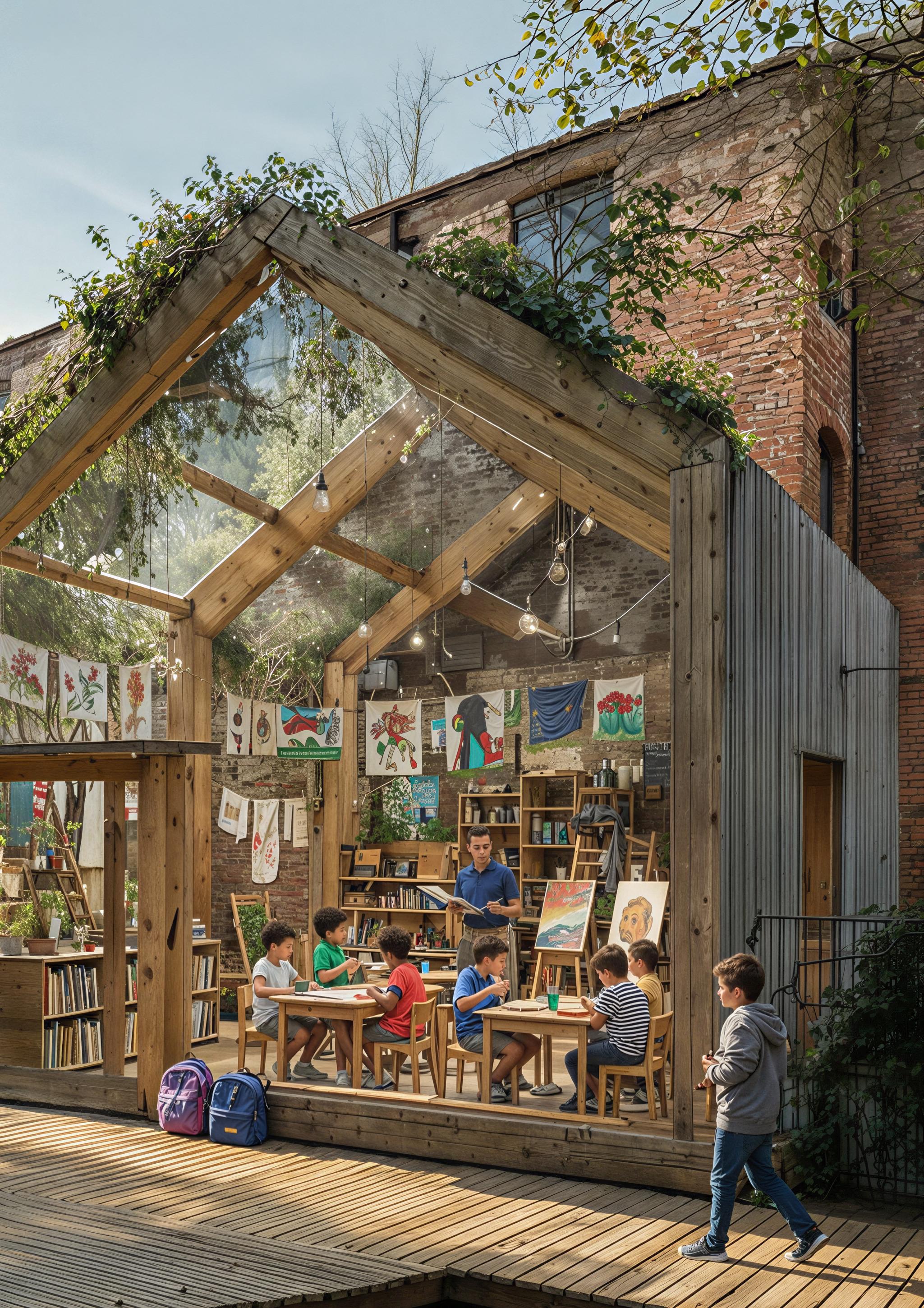
The morning sun spilled across the learning courtyard, warming the timber decks that ran between gardens, glass pavilions, and open playing fields. The air smelled faintly of lavender from the biodiverse planting woven into every surface. Children arrived, not in single streams of uniforms, but in clusters of friends, accompanied by parents, grandparents, and mentors. It was less like a school in the old sense, and more like a civic village. The architecture itself carried this ethos incorporating low-rise timber-framed structures with rammed-earth walls for insulation, rooftops that fold into gardens where food is grown, and rainwater captured in reflective pools that double as play features. Education was not hidden completely within the buildings, instead flowing between sheltered colonnades, orchards, amphitheatres, and digital domes.
Kali, a twelve-year-old complete with restless curiosity, tugged at her grandmother’s hand as they crossed the threshold arch. The entrance was not a gate or security barrier, but an open portico shaped from woven bamboo.
“Do you think we’ll go into the ocean today?” she asked. “Perhaps,” her grandmother replied with a smile. “But remember, your teacher may have something else in mind. you never quite know.” Inside groups were already forming. There were only some fixed classrooms. In between these teaching spaces were modular and kinetic with walls sliding aside, canopies opening to the sky, and acoustic baffles adjusting automatically depending on use. A space could be a language lab in the morning, a dance hall in the afternoon, and a designated space for the community at night. At the centre of it all stood the ‘educators’. Teacher was no longer a sufficient description. They were known as mentors, guides, and exemplars within their specialist fields.
Today, Kali’s group was led by Dr. Imani, a historian who worked in museums before returning to education.
“Good morning children,” Imani said, her voice carrying across the sunken amphitheatre lined with monolithic sandstone steps. She always began this way, reminding them that education was about belonging, responsibility, and society. “Today,” she continued, “we will walk with dinosaurs.” With a gesture, the amphitheatre canopy unfolded like a petal and holographic imagery filled the air. The timber beams overhead dissolved into an ancient Cretaceous Forest. Children gasped as towering ferns swayed, and the distant call of a hadrosaur echoed loudly above their heads. Some reached for their wristbands, activating real-time translation nodes so they could collaborate with the students joining virtually from Tokyo, Nairobi, and São Paulo.
After the simulation ended, they walked further into the school gardens. Wildflower meadows edged with sculptural wind towers created shaded microclimates. Beneath a centuries-old oak, benches carved from reclaimed stone offered space for discussion. Dr. Imani crouched low to meet their eyes. “A machine can tell you the facts,” she said,
“but only we can help each other understand meaning. What do you think dinosaurs would tell us about extinction?”
Hands shot up. Some students spoke boldly, others hesitantly. The spatial architecture supported them using curved seating that placed every child in view, gentle acoustics softened voices rather than amplifying them, and natural light filtered through woven canopy structures to encourage focus.
At midday, the younger children spilled into the play commons. This offered an open field punctuated with climbing structures grown from living willow, shallow streams to dam and divert, and sculpted earth mounds to climb up and tumble down. Open play was as valued as structured learning.Older mentors drifted among them including linguists, retired engineers, artists, and craftspeople. A grandfather taught a group how to whittle wood under a lightweight tensile canopy, while nearby, a teenager led a sound lab in a reverberation chamber designed to echo like a canyon.
“It takes a village to raise a child,” people often said and here, it was literal. The school was stitched into the community fabric. At dusk, parents and elders would return,
filling the same pavilions for workshops, cooking classes, and debates. The architecture adapted continuously, folding outwards into the city, never entirely closing itself off.
In the afternoon, Kali’s group entered the Ocean Hall, a flexible chamber with programmable walls. For Zoe, whose interest leaned towards marine science, the room connected directly to a floating research lab in the Pacific. She guided a robotic submersible in real time; its feed projected across the room’s curved ceiling like a planetarium. Meanwhile, Kali shifted into the Storytelling Studio, its acoustics tuned for performance. Cushions scattered on a tiered timber platform made the space feel intimate. A playwright from Lagos appeared as a life-sized hologram, encouraging the children to create dramas about climate migration.
The architecture enabled both extremes including limitless immersion within digital worlds, and a grounding presence in tactile, human-scaled rooms. But not all learning was digital. Silence mattered too. A quiet pavilion at the edge of the grounds, and open to the breeze was reserved for reflection. Teachers insisted students spend time there watching clouds, reading, or listening to birdsong. “Imagination grows in stillness,” Dr. Imani often said. As
PROMPT:
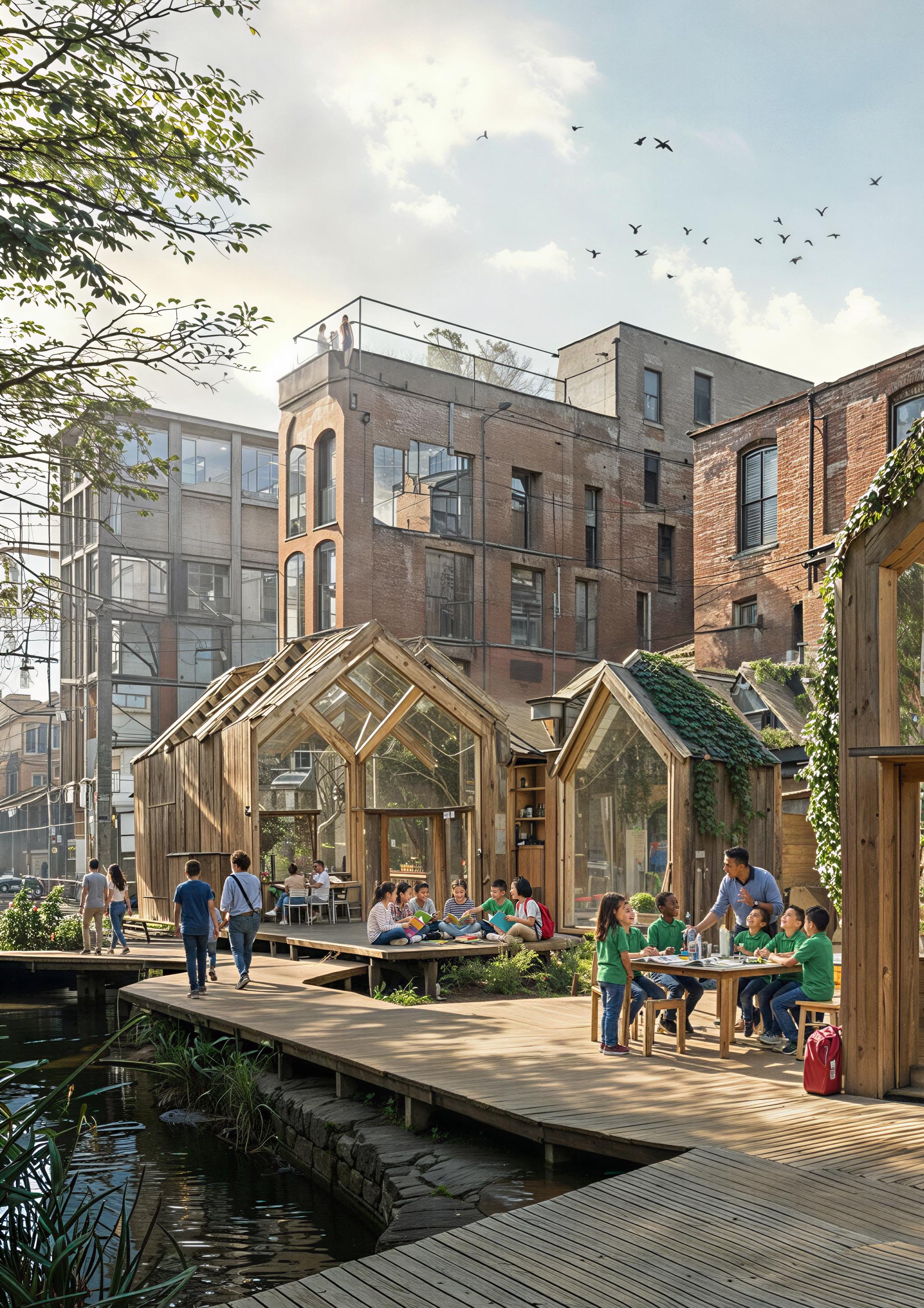
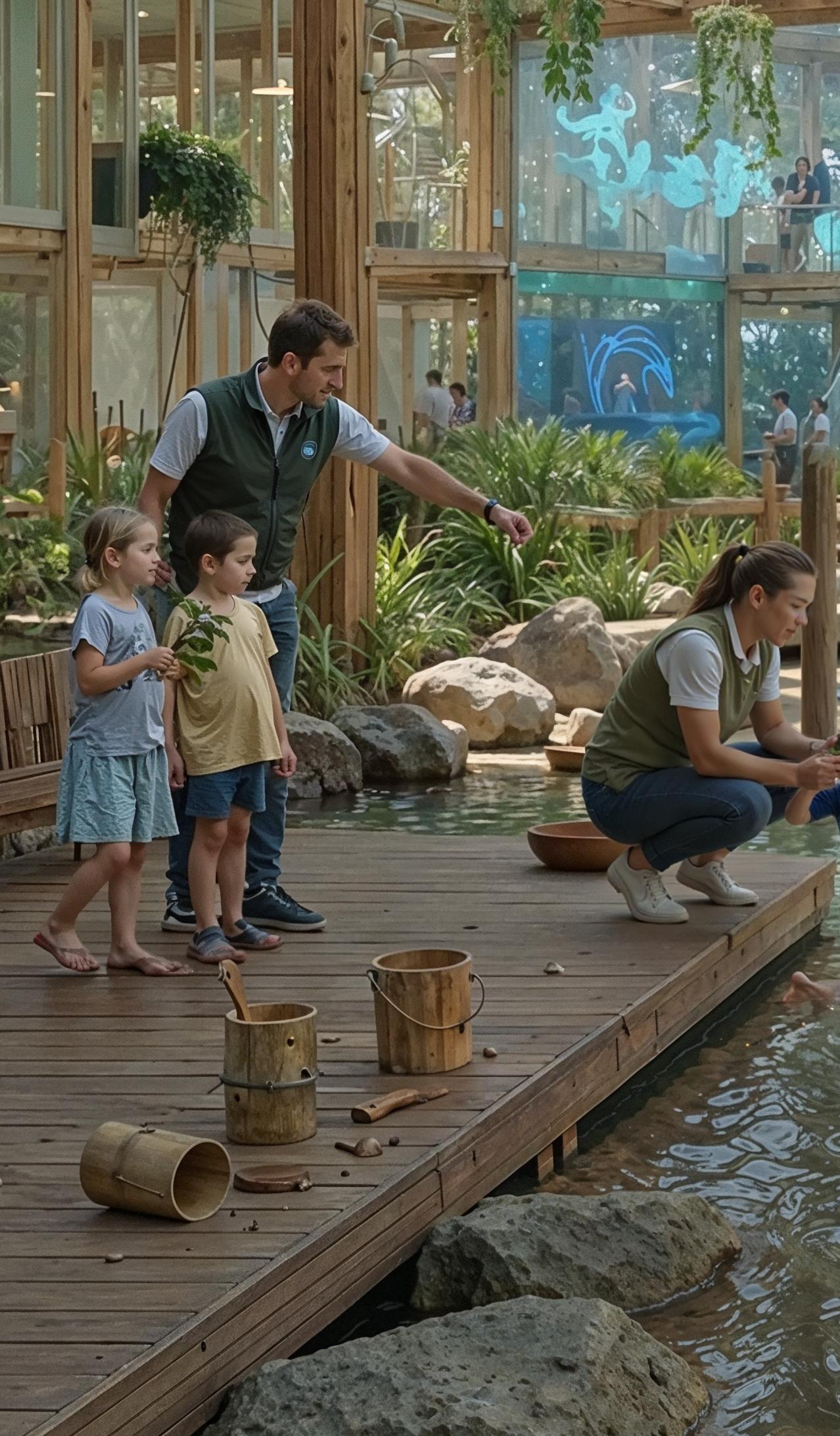
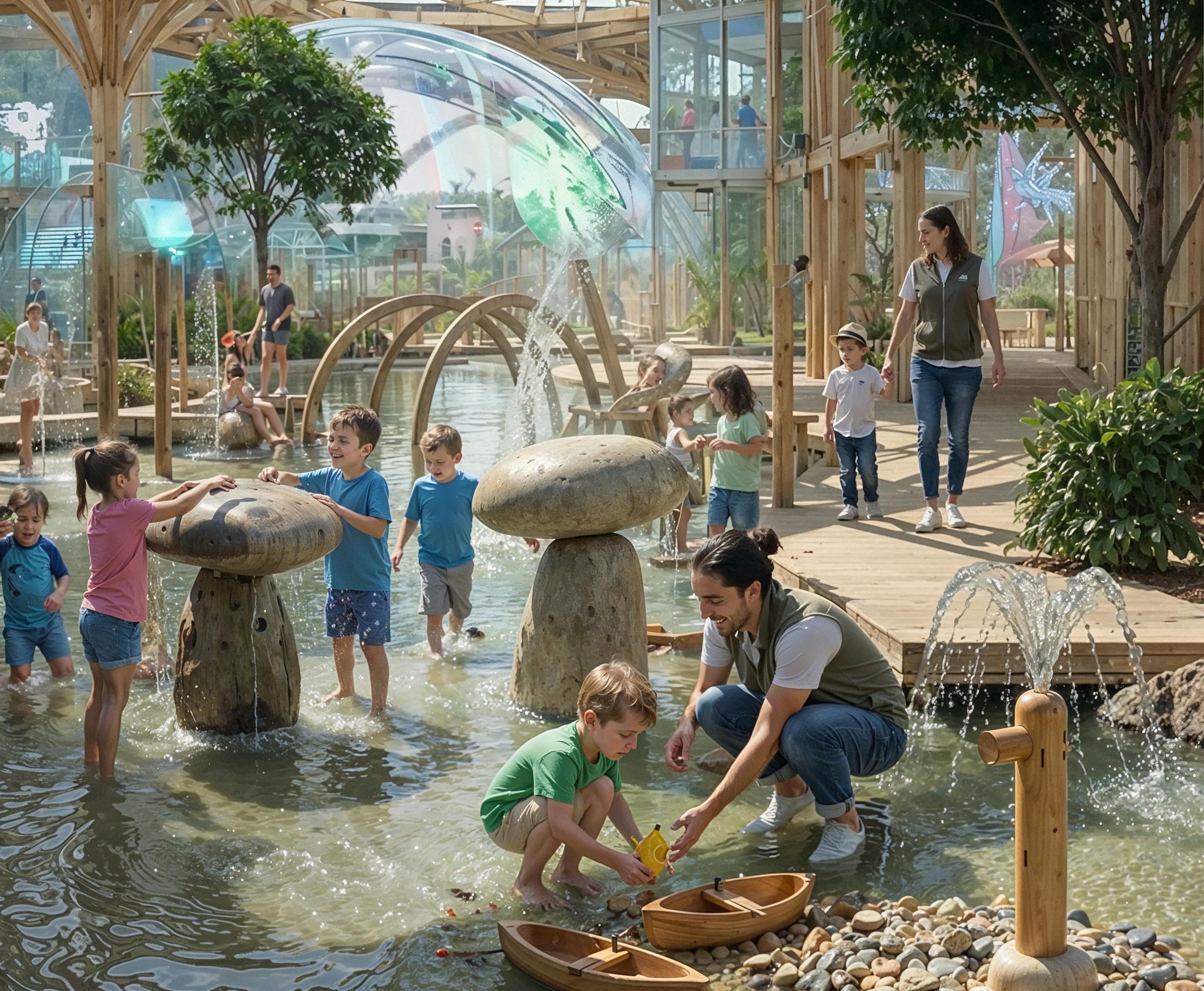
“Educational spaces could span between orchards, amphitheatres, and digital domes, with rooftop gardens and rainwater play pools.”
GENERATE
evening fell the buildings shifted again. The amphitheatre’s canopy retracted, transforming it into an outdoor stage, glowing with solar lanterns while families gathered. Adults took evening courses. Robotics was available in one pavilion, weaving in another, and next to that, cooking classes spilled out into courtyard kitchens.
That night Kali stayed behind to watch her grandmother teach weaving in the Craft Hall, a double-height laminate barn with circular skylights that adjusted to the setting sun.
Children and adults worked side by side, their hands tugging multicoloured threads across the looms. The space hummed with concentration.
Walking home later Kali looked back at the school glowing softly against the horizon. It wasn’t just a place to “learn.” It was a civic heart, a cultural hub, a living architecture that embodied the values it taught reflecting flexibility, inclusivity, resilience, joy. Her grandmother slipped an arm around her shoulders. “Remember,” she said, “knowledge is power. But what matters is how you use it together.” Kali nodded. The dinosaurs, the ocean, the woven threads, the village around her, all of these. Education was no longer a means to an end. It was a way of experiencing the world.
WORKSPACE
PROMPT:
“Adaptable workplace pods offer unique work environments from quiet focus zones to collaborative hubs and creative studios within repurposed buildings.”
GENERATE
Future workspace
Filmed in the 1920s and 1970s, both ‘Metropolis’ and Woody Allen’s film ‘Sleeper’ not only suggest possible futures but also give an indication of how future thinking is often limited by our current understanding of the world and limited imaginations of how radically things could change. To explore possible future workplaces, it’s worthwhile deconstructing where the idea of the office first came from and how it has evolved into whatwe recognise today, starting with the question‘Why do we need to come together for business?’ Is it to collaborate with others, to negotiate a deal, to create, and to invent? Or is it about the coming together for shared values and culture, to record important events, or to simply learn from others?
The reasons that we still coalesce in groups and teams to do business are numerous, but the fundamentals of why we come together haven’t really changed since ancient times.The earliest recorded administrative tasks took place in the temples and palace complexes of Mesopotamia (c. 3000 BCE),where scribes managed records on clay tablets.Over 2,000 years ago in ancient Romemany important deals were conducted by men meeting in public baths, the equivalent of a business lunch today. It wasn’t until the emergence of the London coffeehouse in the 17th century, that the components of the office we know today began to appear when men in powdered wigs (no women or alcohol allowed) met to share news, have intellectual debates, and do business over a cup of coffee. Coffeehouses were thus a privileged, selective alternative to the raucous taverns of the time, providing an environment where learning and engagement could take place with likeminded people.
While these historic examples show that the reasonswe come together to do business have remainedfairlyconstant, almost everything else that influences the design of business environments have changed; societal expectations, aesthetic trends, economic drivers, working patterns, the environmental imperative, and ever-evolving technology. Every decade has brought with it new trends in corporate design, some permanent and
important to the evolution of work environments, some more transient, fashion-led and quickly forgotten.
Over the last 50 years or so, we have seen social evolutions that have been important drivers in re-shaping the workplace. One of the most impactful societal changes, aptly chronicled in the television series ‘Mad Men’, is the emancipation of women in the workplace, evidenced by the gradual disappearance of gender-based job descriptions such as the typing pool or telephone exchange. Another profound shift in social norms has been the gradual move away from hierarchical status defined by grandeur and space, towards egalitarianism, where in theory, access to space defies job description.
DESIGNING FOR DIVERSITY
Workplace design has shifted from formality and segregation toward informality and inclusion. Hierarchies remain, especially in certain sectors, but they’re subtler, with a stronger focus on equity. The rise of workforce agility has transformed office norms - ‘a job for life’, privately managed offices, and fixed desks are largely obsolete. Increased employee mobility has driven the creation of a series of inviting, flexible spaces that appeal to diverse needs, attracting top talent alongside progressive leadership.
A factor that continues to influence design trends is ever-changing technology, shaping the way we work, our office environments and where we can work – it has revolutionised global communication and collaboration, breaking down barriers of distance and time. Looking back, a defining moment for the office was during the Industrial Revolution when the typewriter was invented. Office work was transformed, with similar step changes to working practices brought about with the subsequent invention of word processors, desktop computers, laptops and tablets. These technological advancements redefined the notion of a fixed workstation into a myriad of work settings with imaginative loose, often re-configurable furniture that provide private and personalised places to work focused on flexibility and diversity.
PROMPT:
“Fully tech-enabled spaces where personalised aesthetics, lighting, sound, temperature, and scent adapt instantly at the touch of a button.”
GENERATE
With continued emphasis on flexibility and staff wellbeing, typologies are likely to continue to converge with offices becoming even more hospitality-led, offering higher levels of customer service and a wider range of amenities including cafés, gyms, and the event spaces that are starting to become familiar now. Hybrid working is likely here to stay, so in the future, sleeping pods could even provide affordable accommodation for those visiting the office from afar, and additional income for businesses. The ability to stay in and around the office for consecutive days coupled with flexible work patterns could significantly reduce the time, cost and carbon associated with commuting.
TUNEABLE SPACES
Ongoing advances in technology will continue to have a profound impact on the world of work. As technology becomes more integrated into our buildings, it will be easier to customise the environment to enhance user experience and suit a wider range of individual needs, work patterns, and emotions. We are already seeing the beginnings of ‘tuneable spaces’ that can respond to both neurotypical and neurodivergent minds. Future workplaces could feature fully tech-enabled spaces that adapt instantly - smart furniture adjusting to individual needs with personalized aesthetics, lighting, sound, and even scent to influence mood, behaviour, and wellbeing. Wearable tech and other advances may make this connection intuitive, allowing environments to sync seamlessly with emotional states and boost productivity or creativity at the touch of a button. Looking ahead to ametaverse future,immersive technologies like virtual and augmented reality could take this even further, enabling us to work entirely within digital environments. These innovations could make global teamwork feel as natural as being in the same room, reducing costs and environmental impact while enhancing creativity andmore reasons not to come into the office, which brings us back to the question‘Why do we need to come together for business?
While technology undoubtedly offers immense possibilities, it overlooks our inherently social nature and preference for group connection. A truly sustainable future demands balance, spaces where people can still come together and where we can make conscious choices about the environments we want to create. The real opportunity therefore lies in using technology to reduce drudgery and unnecessary travel, while still fostering meaningful face-toface interactions. As robotics and AI systems become more integrated into the workplace, they will take over repetitive tasks and optimize workflows, making many traditional roles obsolete. This raises an important question: what kinds of roles will we be designing spaces for in the future? What kind of working environment might an Imagination Activist, Organic Stylist, or Ocean Protector thrive in, how will they collaborate, and what technologies will they need to perform their jobs effectively?
Ultimately, workplaces of the future will have to evolve to meet the demands of a future generation of employees -
one that we are yet to fully understand. We can already see trends suggesting that future employees will prioritise different values than those of the past. There is likely to be less emphasis on loyalty and more on personal values. The importance of work-life balance will rival salary expectations, and people will seek out jobs that offer purpose and contribute to the betterment of the world. Employees will align themselves with companies whose values reflect this mindset, not just in terms of innovation, but also in terms of their social and cultural impact.
Climate change could make a daily commute of distance unjustifiable or challenging, so there could be a place for the creation of local hubs or workplace clusters; a series of small community spaces in towns and villages where those working remotely can benefit from the social and mental health aspects that bringing together different disciplines, skills and companies within a shared workspace provides. With a realisation of our finite eco resources it is time that our workplaces embrace ‘imperfection’? As the need to do more with less and to retrofit rather than build new increases, these localised coworking spaces could occupy empty or underused buildings like churches, factories or even old grain silos. Creating the potential to inspire new connections and conversations, and to foster a greater sense of belonging and community.
PROMPT:
“Envisage digital working environments made possible by immersive technologies like virtual and augmented reality.”
GENERATE
It’s fascinating to see how we’ve come full circle. Advances in technology and new ways of working have transformed offices and coffee shops into hubs for collaboration and idea-sharing, while home has become a space for focus and reflection. For employers, this shift isn’t just about flexibility - it’s about unlocking higher productivity, attracting top talent, and fostering innovation. While change may be unpredictable, one thing is clear: the future of work is about embracing diversity in thought, contribution, and environment to create spaces and experiences that inspire people and deliver measurable business value �
PROMPT:
“A futuristic smart workplace, digitally enhanced and adaptive, functioning as a dynamic hive of activity.”
GENERATE
The hive
THURSDAY 22 JULY 2125
Dawn in the city no longer came with the hum of cars but with the soft shifting of façade-skins as buildings filtered the morning air. The Hive, a vast retrofitted church in the heart of the old financial quarter opened its responsive shutters, flooding the nave with filtered daylight. The bioengineered walls pulsed faintly as they generated energy, shading, and oxygen all at once. Inside, Amy an intern, stepped into the vestibule. She didn’t carry a laptop. Her workspace - even her tools - would appear as needed. The building recognised her presence, scanned her heartbeat, mood, and the quality of her sleep. The stone columns around her rippled with projected moss and bird song, the environment shifting to calm her nerves. “Welcome back Amy,” said the building’s AI steward, its voice warm and nearly human. “Would you like a ‘focus’ setting or a ‘collaborative’ one this morning?”
“Collaborative,” she replied quickly. She wanted to belong. Her environment shifted instantly as long tables slid out of the floor, glass partitions softened into translucency, and a faint aroma of coffee and eucalyptus filled the air. Across the nave, a cluster of workers were already laughing, some physically present and some shimmering as holograms; avatars indistinguishable from their three-dimensional selves until you looked more closely.
On a mezzanine, Maya, recently graduated and still awed by the novelty of it all, leaned against the balustrade. She had started only two months earlier, but already the rhythms of The Hive felt second nature to her with mornings spent in clustered hubs of collaboration, afternoons morphing into quiet focus cells.
She waved to Amy. “Come on up, we’re starting the morning imagination sprint!” Their team leader appeared beside them, not in person, but as a projection. His handshake was a perfect simulation of touch through the new haptic glass. A century ago, such interactions would have seemed absurd but now they were mundane, necessary, and even comforting.
At the far end of the central circulation route, Elias, the senior manager, adjusted his workspace. He preferred the “retro” setting providing light oaken desks, paper textures and the illusion of sunlight falling through gothic stained glass. He could have chosen anything including floating virtual reality worlds projected onto infinite digital screens, but he liked the tactility of ink and wood. His colleagues teased him, calling it his “technology detox zone.”
Yet Elias knew it kept him grounded. In a century of constant augmentation, authenticity was now a luxury.
The day unfolded, not as a sequence of rigid hours, but as fluid and adaptive phases. By midmorning, the central space reconfigured again, this time into a marketplace of ideas. Different companies and disciplines shared The Hive, their projects colliding and intersecting in unexpected ways. An urban ecologist bumped into a game designer; a sociologist collaborated with a structural engineer. Cross-pollination was built into the architectural formula itself.
Amy loved this part of the day, offering the buzz of voices, the smell of roasted grains from the communal kitchen, and the sense that everyone was building something larger than themselves. “It’s like a coffee shop in 1725,” she whispered to Leila, “but a hundred times bigger.”
Leila grinned. She had learned about how the first offices grew from cafés and conversation in school. It felt right that things had circled back again.
By afternoon, the building shifted tone. Heatwaves outside shimmered across the city, but The Hive sank gently into underground cooling chambers, natural airflow drawn through vaulted tunnels. Some teams retreated to the cloisters for quiet work, while others floated into fully virtual environments, meeting colleagues across the world as if across the table. Amy chose the virtual reality route today, slipping into a design sprint with partners in Mumbai and São Paulo. Around her, the nave dissolved into a digital rainforest, the air thick with scents and sounds, all engineered to heighten imagination. A button on her wristband pulsed with ‘Super Imagination Mode’ activated. Elias, meanwhile, walked with investors through the upper levels. He showed them how the retrofit breathed new life into redundant office stock, how the old spires now hosted wind vanes, how the crypt below housed algae tanks generating both biofuel and data storage cooling. “This is what resilience looks like,” he said. “Not building new but re-imagining the old.” The investors nodded, more persuaded by the atmosphere than by his words. They could feel the building’s civic weight, its sense of permanence. The Hive was not just a workspace; it was a landmark, a place of belonging.
Evening came gently. The holographic colleagues faded, their avatars bowing out into time zones where it was already morning. Workers from different clusters spilled into the nave for supper with long tables lit by hanging vines and soft drones distributing bowls of food.
Leila sat beside Amy and Elias, the hierarchy of intern, graduate, and manager less visible in this communal setting. Around them, conversations shifted from algorithms to gardening, from policy to poetry. The air smelled of basil and stone. “Strange, isn’t it?” Amy said.
“For all the AI, the holograms, the morphing walls… what matters most is still this.” She gestured at the shared meal, the laughter, the touch of hands passing bread. Elias raised his glass. “In the end, the future of work wasn’t about technology at all. It was about remembering the roots and how humans need connection. Everything else is just an abstraction.” And as the algae façades glowed softly in the twilight, The Hive pulsed with life, proof that even in the twenty-second century, work could still feel human.
ADVANCED TECHNOLOGIES
TECHNOLOGIES
Beyond the gadget
Advanced Technologies should be seen as a design typology that primarily focuses on creating the social and ecological foundations to assure life’s essentials for all of nature and humanity. This inherently involves experimenting and pushing ideas that will create a ceiling to humanity’s existential journey and help stop us overshooting planetary boundaries that protect earth's life support systems. Of course, this ceiling should be flexible as technologies continue evolving in the future.
To date, advanced technologies in architecture has been defined as designing to support functional industrial and societal evolution. Data centres are classified as ‘Critical National Infrastructure’ by most nations across the world, essential for the implementation of governance, healthcare, economics, trading, travel, exploration and social interaction. As well as accommodating the growth of the emerging artificial intelligence concept which many see as a vital cog in the next stage of human evolution.
This infrastructure is fundamental to the continuation of life on earth as we now know it, without which reliant healthcare, food supplies, communications and governance would soon fail. The outcomes could be akin to that envisaged by Mick Jackson and Barry Hines in their 1984 apocalyptic film Threads which provides a dramatic account of the potential medical, economic, social, and environmental consequences of a nuclear attack on the UK.
But we should consider the impact of our current trajectory - is digital development ‘critically’ damaging our planet, and perhaps accelerating human devolution rather than the progress we are universally led to believe is happening? How can we ensure the future resilience of Critical National Infrastructure while protecting both people and the planet, and what could this future infrastructure look like? The possibilities are endless if we wear our futuregazing specs. There is clearly a global vulnerability posed by an existential population growth - adaptable designs can help deal with rapid and volatile overpopulation patterns.
Ideas such as tall megastructures that accommodate high density modular living, recreation, work and vertical farming technologies should no longer be a fantasy. Overpopulation will create vast numbers of challenges, none so more than the notion of increased wastage and shortagesubsequently our approach to all types of recycling must shift up several gears. Whilst it sounds like a simplistic idea, life on earth will quickly become unsustainable resulting in an inevitable breakdown in society if we don’t increase our recycling capacity; future Critical National Infrastructure must incorporate recycling ideas at its core, whether that is in the form of large, concentrated plants or small localised facilities within every new building.
This growing population needs to breathe whilst society needs fuel to be sustainable. The need for cleaner air in a world that increasingly faces energy shortages appears to have a difficult, close relationship. With positive-parasitic carbon capture technology and decentralised powergenerating kit that clings to existing structures, we can start challenging the problems of powering infrastructure locally whilst cleaning the air. This will help to ensure an improvement in habitation opportunities for all species.
With a sustainable society, an adjustable approach to urbanism that accounts for continued advancements in the understanding of neuroscience should be considered. Initiatives should ensure tactile, inclusive, accessible design which positively affects well-being, emotion and behaviour. Whilst this could be a physical approach to design, as technologies evolve there may be also be a cause to celebrate the concept of ‘mixed-reality architecture’ that is designed to work with augmented and virtual reality overlays.
We cannot escape the fact that as humans in a postindustrialised world, we have contributed to the increased threat of natural disasters and depletion of localised natural resources. A 20th century fantasy of an adaptable ‘moving architecture’ may soon need to become a central theme of future infrastructure development; the ideas set out in Ron Herron's A Walking City and Philip Reeve’s Mortal Engines are fast becoming a dystopian possibility. Amongst walking cities, the implementation of amphibious and floating infrastructure that reacts to the threat of rising global sea
levels would also be seen as key. Adaptability in our Critical National Infrastructure must become central to our design ideas and as architects specialising in advanced technologies, we are very well placed to push these ideas forward.
Despite rising sea levels, there is an exponentially increasing global shortage of water. Alternative solutions could seek inventive ways in which to incorporate innovative water saving technologies into urban planning and architecture. Whether integrated interventions or standalone architectural projects, the need for increased focus on water infrastructure is vital for sustaining all life on the planet.
Lastly, and perhaps the most overarching theme in understanding what form the future Critical National Infrastructure takes, is the emphasis on humanity's disconnection to nature. This particular broken relationship has become the rule in a postindustrialised world and has become evident as the root of environmental destruction.
Future Critical National Infrastructure must concentrate on sympathetic rather than extractive relationships with nature. Current infrastructure puts humans at the centre of its reason for existence; future alternatives must put the rest of the living world on a par with human use, an idea which despite challenging the principles of design as we know it, is absolutely vital in ensuring the future existence of our society and our planet as a whole �
PROMPT:
“An amphibious and floating infrastructure that reacts to the threat of rising global sea levels.”
GENERATE
PROMPT:
“Imagine
future data centres as infrastructure that supports communities with food production and spaces for leisure.”
GENERATE
Dispatch from new Cardiff
TUESDAY 19 AUGUST 2125
The city wakes before the sun rises. From the Severn shore New Cardiff rises forming a cluster of dark spines, their skins alive with glimmers of green and blue. What were once windowless hyperscale temples packed with servers have become something else. Now data halls incorporate vertical ecosystems where food, power and memory share the same walls. The towers gently hum gently vibrating. You feel it in your chest more than you hear it.
At street level the air is sharp with the smell of wet moss and engine heat. People file past with their power cards tucked inside coats and wristbands, slivers of nuclear material encoded with each household’s ration. A hundred years ago it would have sounded absurd, to carry your energy with you like a passport whilst counting kilowatt-hours as carefully as coins. Yet here and now, it’s as ordinary as carrying a set of antique house keys. Inside one of the spines, Jonas clocks in. He is a systems steward and not a technician in the old sense, but a caretaker of the city’s memory bank. His first job is pruning. The relevant algorithm offers him specific deletions comprising terabytes of abandoned entertainment, feeds of news no one revisits, and recordings of lives blurred into relative anonymity.
“Memory is expensive,” his supervisor Irene tells him. The phrase is common and almost a proverb. For the most part Jonas obeys. But when the algorithm marks his grandmother’s recordings for erasure, he breaks protocol, compressing them into a crystal no bigger than a thumbnail. A quiet rebellion. In a city where data has become weight, breath and sustenance, some things still feel too human to surrender. Above him, on the 60th floor, a class of teenager’s wrestle with the arithmetic of survival. Their teacher, Ayo, holds up a slim energy card.
“Two hours of cinema costs five kilowatt-hours. What won’t you do instead?” The answers are practical, unflinching.
One says she’ll skip a hot shower. Another younger pupil says she’d share her power so her neighbour can run his dialysis machine. A hundred years of scarcity has forged a generation fluent in compromise. They do not dream in infinite data streams or endless illumination. Their future is a ledger of individual trade-offs.
Outside, the tower’s façade provides food with lettuce in trays, algae in translucent sheets, and tomatoes ripening under recycled heat. Rafi, an elderly farmer who remembers the countryside before it was rationed, checks the soil sensors. “Too much data,” he sighs. “If the servers’ cough the lettuces may die.”
He is right. Agriculture here is no longer hands in earth, but circuits and code. Without this technology millions would go hungry within weeks. The paradox is a bitter one. Data provision has become as necessary as rain, but its appetite devours the very resources it claims to save.
By midday, heat presses against the glass atrium. Irene eats lunch beneath the biodiversity wall, bees threading
their way between ferns. She recalls when data centres were silent fortresses on the edge of towns fuelled by coal or gas. Regulation had inexorably changed that. Every building and construction process must now repay its resource debt including food, cooling, public space, and habitat.
Later, in a meeting room lit by algae panels, Jonas voices the unease many keep silent. “What if the AI protocols delete the wrong things. What if it rewrites us?”
Nobody answers. They all know the story. Once historic Egyptian hieroglyphic tablets had been misread by machine, fragments of history wrongly interpreted and reconstructed into fiction. The evident risks are not apocalyptic, but distortions; a slow drift into a future built on corrupted histories.
Evening falls and the towers begin to glow.
Bioluminescent algae light the walkways with a soft pulse of green and blue. Families gather in the civic hall where a concert streams, carefully compressed so as not to strain the community’s shared energy pool. Children dance while their parents watch the consumption meter tick down.
In the crowd, Jonas slips a storage crystal into his friend Mira’s hand. “Keep this,” he whispers. “If the servers ever fail, someone has to remember these songs.”
The hum of the towers deepens with the night, steady as a heartbeat. No one pretends anymore that data is a mere convenience. It is the scaffolding of survival, the architecture that keeps water flowing, lights glowing and food sprouting in vertical rows.
AVIATION
A futuristic aircraft interior features panoramic smart windows, dynamic ambient lighting, and advanced robotic attendants delivering personalised service.
ABOVE
Sketch of a futuristic aircraft by Alistair Brierley
Horizons reconsidered
Traditionally, the three R’s of sustainability have been understood as of sustainability have been understood as 'Reduce, Reuse, Re-cycle'. Yet, in the evolving discourse on mobility, architecture, and systems of transportation, a new reading of the three ‘R's’ could be proposed as one that moves beyond environmental pragmatism to embrace a conceptual and philosophical framework: Rhizome, Radical, and Rebel.
Rhizome originates from the Greek rhízōma, meaning a mass of roots. In botany, it describes a horizontal underground stem that spreads laterally, producing new shoots and connections. In philosophy, especially in the work of Deleuze and Guattari, it becomes a metaphor for non-hierarchical networks, a mode of organization that privileges multiplicity, connectivity, and fluidity over rigid structures. In the context of transportation, the rhizome is a way to understand mobility not as a sequence of fixed points, but as a distributed web of flows, movements, and interconnections.
Radical derives from the Latin radix, or “root.” First botanical and later political, its meaning carries the sense of returning to the foundation, to what is essential and transformative. To be radical in transportation design is to question the foundations of mobility, to look not only at the infrastructures that contain movement but at the deeper systems, the roots of access, experience, and connectivity. Rebel comes from the Latin rebellis, literally “one who wages war again.” To rebel is to resist, to question the established order, but also to be inquisitive and imaginative. In this sense, the rebel is not simply oppositional but constructive: one who reflects, doubts, and dares to think differently. In mobility, this means breaking with conventions, challenging inherited models of airport design, and opening the field to “blue sky thinking” - ideas unconstrained by precedent.
FROM OBJECT TO SYSTEM
Architecture, when focused on airports, often privileges the terminal building as its central object. In this framing, the airport is conceived as a monumental ‘tree’ — a singular rooted structure. Yet, in reality, aviation is not a tree but a rhizome: a vast, interconnected network of routes, systems, and territories.
For the passenger, the journey begins not at the terminal, but at the moment of departure from home, hotel, or point of origin. The airport building is only one node in a continuum of movement, part of a chain of flows that spans territory. To design only the object, without the system, is to miss the essence of contemporary mobility. Thus, the vision of aviation must extend beyond the boundaries of the terminal itself. Airports are not isolated monoliths; they are woven into landscapes and urban fabrics. As Deleuze reminds us, cartography is not just representation but understanding. To map the rhizome of transportation is to grasp how mobility reshapes and reveals territory.
Transportation infrastructures form an intricate cartography of connections. Airports, far from being singular, exist within constellations: megalopolises, hub systems, intermodal cities where aviation, rail, metro, public transit, and private mobility converge.
Seen in this way, airports are less objects than intersections within a larger rhizome of flows. Designing for mobility means designing not only for terminals but for linkages, distributed processes, and the experience of moving through interconnected networks.
Yet today, airports remain under immense pressure, in part because they are still bound to processes of identity and security. The airport is the site where passports are checked, visas validated, baggage screened, and passengers secured. These procedures are spatially and legally concentrated within the terminal, creating bottlenecks where passengers spend much of their time queuing, waiting, and being processed. Although certain tasks, such as online check-in have migrated beyond the airport, the core mechanisms of control remain centralised. This centralisation constrains
both capacity and experience: the airport becomes a site of compression rather than flow.
The emergence of digital identification technologies points to a new horizon. With secure digital ID, biometric verification, and networked systems, many processes could be decoupled from the terminal building. Examples already exist in airports such as Cincinnati and Pittsburgh in the United States, where for citizens, certain flows are simplified.
Extending this vision further, we could imagine remote baggage collection from homes or city stations, freeing terminals from check-in congestion; boarding passes as multimodal mobility keys, granting access to trains, metros, or buses as integrated parts of the air journey; railway and metro stations equipped with immigration or security checkpoints, effectively moving passengers into ‘airside’ before they reach the terminal; and dedicated train carriages or entire services functioning as pre-cleared zones, allowing seamless entry to the airport.
Such distributed systems would radically alter the architecture of airports. Terminals could shed many of their current functions, liberating vast spaces and enabling
PROMPT: GENERATE
“An airport envisioned as a rhizome - an interconnected, adaptive network that grows and evolves like a living system.”
capacity growth without runway expansion. Instead of containers of procedure, airports could become fluid nodes within the rhizome of transportation.
Reinterpreting the three ‘R’s’ - Rhizome, Radical, Rebel - is a call to rethink the very foundations of transportation design.
The ‘Rhizome’ teaches us to see airports as part of interconnected systems of flows, the ‘ Radical’ invites us to return to the roots of mobility: movement, access, and human experience; and the ‘Rebel’ challenges us to defy conventions, to imagine distributed infrastructures and seamless networks beyond the limitations of today’s models.
The cartography of transportation, then, is more than a map. It is a new way of seeing and designing mobility - an understanding of networks as landscapes, of journeys as continuous, of architecture as a participant in systems larger than itself. In this vision, the airport is not an object, but a node; not a bottleneck, but part of a rhizome; not the end, but a beginning �
PROMPT:
“Departure pods are glasswalled waiting chambers that align seamlessly with the aircraft themselves.”
GENERATE
Terminal nowhere
FRIDAY 10 OCTOBER 2125
The sky above London was inscribed with faint contrails like brushstrokes in a gigantic abstract expressionist painting. These were not the old carbon trails, but faint vapor from hydrogen-electric hybrids and vertical-lift airframes. Nobody called them “airports” anymore, they were simply runway hubs, scattered like satellites far beyond the city’s edge, some floating offshore. The city itself had become a fluid organism a terminal without walls. Lila, a young architect returning from a research trip in Casablanca, zipped up her case in her Holborn apartment. She didn’t hail a cab. She simply tagged her luggage with a drone-courier beacon and left it by her door. A moment later it was whisked away by a quiet six-rotor pod, destined to meet her inside her departure lounge. Her own journey began, not with traffic, but with the Thameslink Aero Linea train designed as much for security as for speed. The moment she stepped onto the carriage, retinal scans and biometric gates confirmed her identity. She was effectively airside even before she left central London.
Sitting opposite her was Jonas, a tech start-up founder heading for a partnership meeting in Seoul. He was finishing breakfast, poached eggs on a real china plate served from the carriage’s café counter. The sense of revived luxury was palpable, nostalgia paired with high tech solutions meant traveling wasn’t a chore anymore, rather an experience that you could look forward to. Jonas smiled. “Strange, isn’t it? We’ve looped back to the 1920s with rolled linen tablecloths, and a real meaningful human experience. Except now it’s electric rails and AIstewards too.” Lila nodded. “And you don’t even see the airport until you’re already cleared.”
The train itself was a marvel of choreography. Each carriage had a dual function with in one a commuter lounge and workspace, and even an adjacent crèche. In the one behind them, a cluster of children laughed as two ‘edubots’ ran a morning language class who delivered a twenty-minute immersion in Japanese before their families departed. By the time they glided into Outer Gatwick Hub, nobody had to queue. Passengers dispersed directly into departure pods, glass-walled waiting chambers that aligned seamlessly with the aircraft themselves. But here was the radical shift. Not all craft needed a runway. Some were VTOL giants, lifting vertically like dragonflies, their wings only unfurling once they were fully airborne. Others were hybrids, (rail-to-air vehicles) where the first acceleration took place on a maglev track, the carriages detaching as a winged section lifted into the air. Lila had once worked on one of these ‘train/ planes’ as a design consultant. Watching one rise now, she still felt goosebumps.
Her own connection was stranger still. She would travel on a sky-barge bound for Marrakech, designed to dock mid-air with smaller hives of local connectors. She stepped into the capsule, where the interiors shifted tone
as the ambient software read the collective mood shifting to a soothing amber light, with faint scent of cedar, and a gentle rhythm of sound, much like waves on shingle. The cabin wasn’t about economy versus business anymore. It was about a nuanced and gentle emotional zoning.
Across the aisle, a retired teacher named Mrs. Singh leaned back. “In my day,” she said warmly, “we lost half our time waiting. Waiting at gates, waiting for luggage, waiting in queues. Now, the journey itself is a positive experience.”
As they ascended vertically from the hub, the horizon widened and opened up. Below them stretched not one vast concrete airfield, but a green canopy park under which the hub’s infrastructure was hidden. Children played football in the fields just a kilometre from where aircraft departed. The danger once posed by runway accidents had vanished with predominantly decentralised, vertical flight technology in play. Jonas, already sketching on his holo-pad, whispered, “Imagine no more airports. The whole of London is now our terminal.” Mrs. Singh chuckled. “And my granddaughter checks in from a church. A church! Retro-fitted with scanners and drones.”
Indeed, dotted across the UK were check-in sanctuaries where redundant business parks used converted office blocks, even medieval cathedrals were adapted with biometric arches. Once you stepped through, you were considered airside, free to hop on the next express connector to any launch hub.
The true marvel awaited on arrival. In Seoul, Jonas wouldn’t bother with baggage reclaim, a ghostly ritual from another age. His case, sent from London by drone hours earlier, would already be waiting in his hotel room. The once-dreaded limbo of luggage reclaims had become outdated. As the aircraft settled into cruising altitude, Lila gazed out at the scattered network of compact sky ports below. She remembered reading about how aviation began used by a few wealthy passengers, fine dining, no queues, no mega terminals. In a way, the circle had closed, but now layered with AI enhanced choreography, carbon-free engines, and architecture that put wonder back into travel. Her pad buzzed. A message from her colleague: “Did you ever think airports would vanish?” Lila typed back, smiling as the cabin ceiling rippled into a projection of the Atlas Mountains ahead: “Airports didn’t vanish. They became the city itself.”
CONCLUSION
PROMPT:
“The greatest chapters are still unwritten - imagine a future filled with possibility and progress.”
GENERATE
Nostalgia and imagined futures
When we attempt to imagine the future of our built environment and our way of life, we inevitably do so through memory, familiarity, and longing. Hear from Alistair Brierley, Head of Design Research Unit, as he concludes the issue with a thoughtful exploration of how nostalgia influences the futures we imagine.
Nostalgia becomes a cognitive anchor and a way of stabilising uncertainty by projecting forward the elements of the past that felt coherent, humane, or reassuring to us. Crucially, this state of mind is not impatient and does not reject history as such, rather it refuses to be anchored by it. The past becomes reference, not refuge. What replaces nostalgia then, is a form of constructive anticipation alongside a grounded awareness that what matters most, has not yet happened.
Moments of rapid change, technological acceleration, environmental instability, and cultural fragmentation tend to intensify this tendency. Faced with futures that feel abstract or destabilising, we reach back to images of perceived simplicity like the walkable town, the local high street, the slower rhythm of life and the legibility of craft, community,
and place. These memories are rarely accurate in a historical sense. Instead, they are curated, selective and emotionally charged. They are however powerful in that they encode such values as belonging, continuity, identity, and control rather than plain facts.
In this sense nostalgia is less about regression and more about aspiration. It is a way of articulating what we most fear losing, as much as what we hope to regain. The danger lies not in nostalgia itself, but in mistaking it for a blueprint for a rose-tinted past that cannot be reinstated wholesale without also reinstating its exclusions, inefficiencies, and inequities. When scanned superficially, nostalgia can diminish complexity and resist necessary transformation.
When critically engaged, nostalgia can be productive. It can act as a design brief for the future, not by recreating old forms, but by reinterpreting their underlying principles within new realities. In architecture, urbanism, and civic life, this often manifests as a renewed emphasis on human scale, material honesty, social interaction, and connection to landscape. Values such as these can co-exist alongside advanced technologies and new modes of living. Ultimately our visions of the future are never free from the past. The
challenge is to recognise nostalgia not as an end point, but as a signal pointing toward the qualities we wish our future civilisation to embody, while demanding that we imagine new forms capable of carrying them forward.
In periods of profound change, places and experiences from the past can acquire a tangible and focused clarity. The village square, the civic hall, the high street, the threshold between inside and outside. These spaces are recalled not for their precise historical realities, but for the sense of orientation they offered. They were legible, socially encoded, and slow to evolve. Their proportions and patterns allowed people to understand where they were, who they were with, and how they belonged. In the face of accelerating technological and environmental shifts such spatial memories can exert a powerful gravitational pull.
A DESIGN BRIEF FOR THE FUTURE
Architectural nostalgia is rarely about replication. It is not a desire to rebuild old towns exactly as they were, but to recover qualities that feel endangered. We can envisage enclosure without isolation, density without anonymity, or permanence without rigidity. The past becomes a lens through which we filter future ambition by selecting those spatial conditions that supported collective life and emotional resilience. Brick, stone, timber, and ornament are not ends in themselves, but proxies for continuity, care, and human scale.
There is however a risk when memory hardens into architectural form without reflection. To recreate historical
typologies uncritically is to import their shortcomings along with their inherent meaning. Architectural form and style when overly reverent (learned facsimiles), can become a sentimental collection of reassurance rather than a framework for living futures. More productively nostalgia can function as an atmospheric brief rather than a stylistic one. It asks architects and urbanists to design buildings and places that feel grounded, even as they accommodate innovative technologies, new demographics, and new environmental realities. The familiar rhythms of streets and courtyards can co-exist with adaptive infrastructures. Civic spaces can once again prioritise encounter and ceremony whilst synonymously performing complex ecological and digital functions.
In this way, the future city is not a rejection of memory, but its transformation and reinvention. Buildings become mediators between what we remember and what we have yet to invent. They may carry forward timeless spatial values including threshold, proportion, material presence, and specific atmospheres whilst accepting that their forms and linked functions should evolve. The task is not to preserve the past, but to allow its most human lessons to shape places capable of supporting lives not yet imagined. Our architectural futures will always be influenced and informed in the best sense by the places that came before. The challenge is to ensure that this residue or ‘half-life’ remains a source of depth and meaning, rather than a constraint, enabling new architectural landscapes to emerge from our collective spatial memory