Greenbaum WITHOUT SUMMER analysis

Page 1


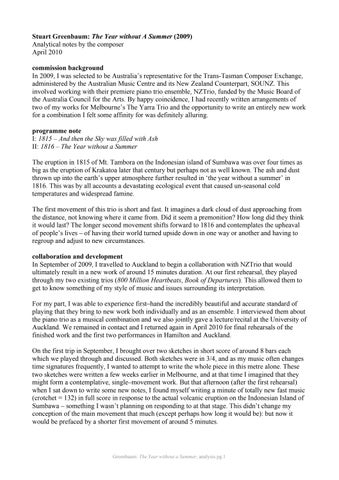
Stuart Greenbaum: The Year without A Summer (2009)

Analytical notes by the composer April 2010

commission background

In 2009, I was selected to be Australia’s representative for the Trans-Tasman Composer Exchange, administered by the Australian Music Centre and its New Zealand Counterpart, SOUNZ. This involved working with their premiere piano trio ensemble, NZTrio, funded by the Music Board of the Australia Council for the Arts. By happy coincidence, I had recently written arrangements of two of my works for Melbourne’s The Yarra Trio and the opportunity to write an entirely new work for a combination I felt some affinity for was definitely alluring.

programme note

I: 1815 – And then the Sky was filled with Ash II: 1816 – The Year without a Summer

The eruption in 1815 of Mt. Tambora on the Indonesian island of Sumbawa was over four times as big as the eruption of Krakatoa later that century but perhaps not as well known. The ash and dust thrown up into the earth’s upper atmosphere further resulted in ‘the year without a summer’ in 1816. This was by all accounts a devastating ecological event that caused un-seasonal cold temperatures and widespread famine.

The first movement of this trio is short and fast. It imagines a dark cloud of dust approaching from the distance, not knowing where it came from. Did it seem a premonition? How long did they think it would last? The longer second movement shifts forward to 1816 and contemplates the upheaval of people’s lives – of having their world turned upside down in one way or another and having to regroup and adjust to new circumstances.

collaboration and development

In September of 2009, I travelled to Auckland to begin a collaboration with NZTrio that would ultimately result in a new work of around 15 minutes duration. At our first rehearsal, they played through my two existing trios (800 Million Heartbeats, Book of Departures). This allowed them to get to know something of my style of music and issues surrounding its interpretation.

For my part, I was able to experience first–hand the incredibly beautiful and accurate standard of playing that they bring to new work both individually and as an ensemble. I interviewed them about the piano trio as a musical combination and we also jointly gave a lecture/recital at the University of Auckland. We remained in contact and I returned again in April 2010 for final rehearsals of the finished work and the first two performances in Hamilton and Auckland.

On the first trip in September, I brought over two sketches in short score of around 8 bars each which we played through and discussed. Both sketches were in 3/4, and as my music often changes time signatures frequently, I wanted to attempt to write the whole piece in this metre alone. These two sketches were written a few weeks earlier in Melbourne, and at that time I imagined that they might form a contemplative, single–movement work. But that afternoon (after the first rehearsal) when I sat down to write some new notes, I found myself writing a minute of totally new fast music (crotchet = 132) in full score in response to the actual volcanic eruption on the Indonesian Island of Sumbawa – something I wasn’t planning on responding to at that stage. This didn’t change my conception of the main movement that much (except perhaps how long it would be): but now it would be prefaced by a shorter first movement of around 5 minutes.

Greenbaum: The Year without a Summer , analysis

My experience in Auckland of writing a passage of music for the trio, emailing them a PDF, playing it through the next morning and then altering the combinations (who plays what, in what octave and in what dynamic and colouristic manner), afforded the ability to shape the music in a very heightened, immediate and particular way. We repeated this write/email/play cycle a number of times during that first visit in September 2009, and there’s no doubt that this changed the developmental course of the composition process. The ideas (rhythms, motives, pitch material) were not affected so much; but their sonic utterance, balance and the sheer surface of the sound quality took on a particularly satisfying degree of polish. The majority of the first movement was completed in this way.

1815: And then the Sky was filled with Ash

This 5–minute opening movement was composed from the first bar to the last, note-by-note, bar-bybar in an almost tunnel-visioned manner. The intention was to ignite an atmosphere of apprehension – the approaching volcanic cloud – and to maintain this energy throughout. It was also scored directly for piano trio without use of any sketches or short score.

The opening 4–bar grouping (4+3+4+4) was the compositional starting point for this movement. It was written at a piano in a rehearsal room at Auckland University and notated directly onto a laptop next to the piano. It is a beat short of a standard 16–crotchet, 4–bar phrase in 4/4 (the second bar being compressed to only 3 beats):

Ex.1

These first 4 bars may be viewed as the basic unit from which all other variations are derived. Played in unison by the trio, it is meant to be arresting, creating an alarming mood from the outset through repeated semi–quaver energy, coupled with an outwardly expanding pitch set. This can be condensed into a 3–chord reduction:

Ex.2

And this reduction can further be expressed as an 8–note scale, similar to a Dorian mode, but with both a flattened and a raised 7th:

Ex.3

metrical structure

The first 4 bars are immediately repeated in bars 5 to 8 (albeit with different harmonic direction in bar 8) and then varied in the third phrase to a metrical grouping of 4+4+4+3. This still adds up to a slightly unsettled 15–beat phrase, but the 3/4 bar has shifted to the end of the phrase. The graph below shows the metrical structure of the first movement. 4/4 bars are marked in red, 3/4 bars in blue and a couple of 2/4 bars in yellow:

2 5 4344 3 9 E 4443

4 13 4443

5 17 C# 4343

6 21 4343

7 25 4343

8 29 4343

9 33 F 4343 10 39 434343

11 45 E 4443

12 49 4344

13 49 R 4344 14 53 4344 15 57 4344 16 61 4344 17 65 4444 18 69 4443 19 73 C# 4343

82 4343

100 F 4443

104 4443

108 4443

112 4443

116 4343

120 4343

120 R 4343

124 Bb 4443

128 4443

132 434 35 132 R 434 36 135 33332 37 140 332 38 143 F 4343

39 147 333

40 150 333 * new groupings marked in bold

The most common phrase length is 15 crotchet beats. While most of the 40 phrases that comprise the first movement are 4 bars long, the metrical structure and exact number of beats to these phrases is regularly being shifted. Most phrase groupings are repeated a few times and recur elsewhere; but effectively, the music is being driven by gradual mutation through reordering, expansion and finally compression. The movement features a high density of motivic saturation (familiarity) against a relatively fast rate of mutation and re–contextualisation (unfamiliarity).

This structure, as has been noted already, was not pre–designed. It was virtually through–composed from the first bar to the last with the simple premise of constant adaptation. The motivic material is heavily repeated, but the length and direction of each successive phrase is not allowed to become predictable. While of course, material recurs and develops, this was driven by memory, intuition and sheer determination to push the music forward.

harmonic materials

The third phrase, from bar 9, introduces hurtling downward minor scales containing two augmented 2nds and sometimes an equivalent minor 3rd. These allude to an Eastern harmonic flavour (a modified Persian scale), with a highly volatile harmonic direction:

Ex.5

These augmented 2nds also connect to the bass line of the cantilena (second movement). In the cantilena they have the harmonic function of modulation by sequentially raising the 7th degree (E natural then B natural). But in the downward scales of the first movement, the two augmented 2nds are much closer together in time, effectively creating an audible harmonic flavour that does not modulate as a direct result of these augmented 2nds. The music does modulate frequently, but it does so through different harmonic means.

Once the downward scales are established in phrase 3, a melodic line emerges over its repetition:

Ex.6

This melodic line (phrase 4) provides the basis for all subsequent melodies in this first movement. It is deliberately in a clear harmonic mode (E Aeolian) as a plaintive cry against the surrounding turmoil of chromatic alteration.

further development

Phrase 5 (b.17) is a beat shorter again (14 crotchets) to form a symmetrical phrase: 4+3+4+3. Phrase 10 (b.39) elongates this symmetry to a 6–bar phrase of 4+3+4+3+4+3 (and so on). At bar 49, the opening returns, but this time set against offbeat crotchet chords in the piano which function as hammer blows. This energy gradually subsides to a solo piano utterance of the melody at bar 69 –perhaps the eye of the storm.

Other notable features in the movement include the use of the rhythmic ratio 4:3 (particularly suited to the 3/4 bar grouping). The strings highlight this syncopation in pizzicato and from bar 119, they are joined by muted piano string stabs in a 3/8 grouping, the overall effect being at once highly interlocked to the same quaver pulse, yet effectively polyrhythmic:

Ex.7

From bar 132 a process of compression ultimately leads to 2/4 bar units, and then by bar 142 this compression and close repetition is cut loose with a final, continuous downward spiral of scales toward the bottom of the instrumental ranges, leaving a cloud of saturated chromatic sound in its wake.

1816: The Year without a Summer

In contrast to the first movement, the structure of the longer second movement was mapped out in some detail based on two 8–bar sketches. The first sketch was composed at the upright piano in my office at the University of Melbourne in August 2009. These 8 bars were typed into a notation file on the same day:

Ex.8

This was the very first musical idea for the piece, and at that point in time I thought that it would be a one–movement piece. It was only later in Auckland that the decision was made to preface this main movement with a short, fast introductory movement. What I did know at this stage was that this first sketch would undergo extended repetition (albeit with variation) whereas the second sketch (discussed later) would be used more sparingly to break up longer stretches of the first sketch.

This first sketch creates forward moment with short motives in 3/4 that start with a quaver rest. The first is 5 notes long, and the second slightly abbreviated to 4 notes. Together these two bars comprise the antecedent phrase:

Ex.9

The intervallic contour features a relatively even alternation between disjunct leaps and stepwise motion. The 2nds are falling, rising, then falling again.

The consequent, or answering phrasing, repeats the opening bar but varies the next in two crucial ways. It articulates the first beat of the bar (rather than starting with a rest) and also defines a hemiola (or 6/8) grouping, in contrast to the flow of 3/4:

Ex.10

This four–bar sentence is then repeated, with further adaptation through the swapping of adjacent notes (mainly 2nds). The pitch set is virtually unaltered but this subtle change was engineered to help the motive survive long–scale repetition. These small note order inversions are not highly noticeable features but they provide a type of ‘scramble’ function that distracts the ear from locking into identical pattern recognition. The musical result is useful as a minor variation in its own right, but even more important is the potential to help sustain the scaffolding upon which other things would be built:

Ex.11

While the note–swapping is subtle, the eighth bar presents two overt, major changes. Firstly, the hemiola grouping of the fourth bar is dropped in favour of continuing the 3/4 crotchet grouping. Secondly, the Ab bass note (minor 6th) is raised to A natural (providing variation through modal alternation).

This is an example of creating unpredictability by deliberately not repeating the previous surprise element. One could even say that this is like playing ‘rock–scissors–paper’ with the listener; but I would prefer to think of it as attempting to beguile an audience surreptitiously through subtle illusions in the musical patterning.

The fourth and eighth bars provide the only downbeats to barlines, and consequently the three bars that precede both function as an extended anacrusis to these two points:

Ex.12

In all, the opening 5 notes provide the ‘DNA’ of the first sketch and the techniques of variation are there to extend the flow into an 8–bar phrase that has surface similarity – and therefore ‘flow’ while also providing subtle variation capable of sustaining interest.

second sketch (cantilena)

The second sketch was imagined in my inner ear at home in Coburg while trying to sleep. I eventually got up at around 4:30am and felt sufficiently bothered to jot it down on paper:

Ex.13

Whereas the first sketch was heavily influenced by the sound and sustain of the piano (where it was written), the second sketch (dated 1 September 2009) is a two–part linear texture of undefined orchestration. The note at the top of this second sketch labels it as a ‘B’ section, with a query as to whether it would grow or stay the same length upon recurrence. In the intermediate stages of development, I called this ‘B’ section a ‘refrain’ but ultimately, once I felt I more fully understood its nature and role in the piece, I termed it a ‘cantilena’ (or small lyrical song).

The second sketch (like the first) is also in 3/4, though initially there was a slight difference in tempo that required further contemplation. Additionally, the hand sketch progresses up to, but does not complete, the 8th bar. On further reflection it seemed not only possible, but also crucial to complete the sequence of phrases as shown in its first appearance in the strings:

Ex.14

The main melodic activity is in the upper part, which can be broken up into 4 phrases of mainly descending contour, which are subsequently sequenced higher and higher. The descending interval of a perfect 4th is prominent. The lower bass part, by contrast is generally rising upwards by step, though occasionally drops down the octave before moving up again. It starts on Bb, the subdominant of F minor, and then accidentals of E natural and finally B natural are accessed via leaps upward of an augmented 2nd, finally pushing the key up a 5th to C minor. So despite the predominance of falling tones in the upper part, the overall harmonic direction is upward via sequence and ultimately key from F minor to C minor.

While the first sketch is modal, the cantilena (second sketch) has a more tonal construction, albeit a chromatic one. Its overall function within the piece is not tonal, as such, but the cantilena is intrinsically designed to modulate upward by a 5th, whereas the first sketch loops back onto the same modality. This further presented a dilemma about recurrences of the cantilena. Would it continue to push the harmony through a cycle of 5ths, or would it always start lower in order to arrive back at the same pitch? A third possibility arose that the piece would modulate elsewhere anyway, and therefore altering the overall harmonic plan again. Once a first draft of the short score was completed, this became of pressing concern. Ultimately, it was decided to keep the cantilena at the same starting pitch in order to maximise the sense of recurrence after absence. The second appearance of the cantilena, however, pivotally leads to Eb minor (instead of C minor). Additionally, the fourth and final cantilena is extended four–fold and the 4 flats of F minor are all independently naturalised at different times (modal alternation) to add tension to each successive repeat.

I had the opportunity to experiment with the orchestration of the cantilena in Auckland in September 2009:

The first draft had the violin and cello coming together in harmony an octave and a sixth apart, with the piano doubling this line in 6ths. Having originally been conceived as a two–part invention, however, this orchestration proved to be overly ‘harmonic’. The last two bars shown above worked better with the violin and cello either 1 or 2 octaves apart (not in harmony) and the right hand of the piano also worked better (under the hands and also to the ear) without the lower notes on the offbeat quavers. Hearing this first attempt under workshop conditions was invaluable and this passage was altered accordingly:

Ex.16

The third appearance of the cantilena puts the cello up an octave for extra intensity.

harmonic structure of episodes

The second movement was originally written in short score without modulation. A sketch was then made for a sequence of modulations as follows:

Ex.17

Where reference is made (at the top) to chapters 2, 3 & 4, these ultimately refer to episodes 1, 2 & 3 (chapter 1 was re–labelled as a ‘prelude’). The intervallic contour can be expressed as follows:

Ex.18

The first episode modulates up by major 2nds and major 3rds, whereas the second episode modulates up and down by minor 2nds and minor 3rds. Episode 3 mirrors Episode 1.

Greenbaum: The Year without a Summer , analysis pg.10

The intention was to create modulations that would not become too predictable or symmetrical and that they would not be too evenly spaced apart. Each modulation, therefore, is designed to reveal a new direction and to sustain intrigue.

In all, the music modulates through 8 of 12 possible key centres. These are generally minor key centres, though this does not automatically result in an absence of major chords, merely a predominance of minor centres. Secondarily, these harmonic centres don’t follow standard tonal conventions of voice leading. The first 3 notes of the main motive (refer back to Ex.9) contain scale degrees 1, 4 & 5, with the 3rd only appearing at the end of the 5–note cell. The harmonic progressions play on ambiguity through absence of scale degrees and also through modal alternation.

overall structure of second movement

The entire second movement is comprised of 8–bar phrases (there are exactly 46 of them). On one level, this is purely a result of the two original sketches being 8 bars in length. But it is also true that the idea of using this as a restriction in the composition process was an appealing challenge (along with remaining in a 3/4 time signature throughout). The concern, obviously, was in creating a narrative that would be too predictable. There are a number of factors, however, which are brought to bear to prevent this. The first is that the 4 appearances of the cantilena are designed to be increasingly further apart. This subtle expansion of overall sections may not be obvious to the listener but it is crucial to the dramatic intent of the narrative. Secondarily, the instrumental structure was pondered in terms of internal solo and duo combinations, together with the presence of the full trio. An early hand–written sketch shows the intention here, if not the actual proportions:

Ex.19

A first draft (23 October 2009) of the structural plan for this main second movement refers to chapters and refrains; while the proportions were not quite right, it does convey the general idea of an expanding structure:

1 (intro)

(inc bridges)

chapter 2

refrain (inc bridges)

chapter 3

chapter 4 (outro)

This was then refined in terminology and also in proportion a day later as follows:

Ex.21

+ episode 1

+ episode 2

+ episode 3

/ string duo

TOTAL TIME: (not including pauses & rubato)

TOTAL BARS: (including repeats) 368

Such plans are not an exact science. One is effectively guessing at the right proportions given the material (sketches) and the likely musical devices of transformation and development. Tinkering with the numbers, as shown by comparing these two plans is important because once the plan is then realised, it is not always easy (nor desirable) to change this halfway through. Of course, if the music is not working, then one must be prepared to deviate from the path. But having said that, the gradual expansion of the episodes that separate the cantilenas needs a certain proportional arc in order to work subliminally for the musical narrative. So there is also good reason to persist with proportions – to make them work.

It is not essential for the listener to know that the episodes are getting slightly longer each time; but it is ideal if the listener is subconsciously affected by this subtle expansion. It is necessary for each successive episode to be ‘similar enough’ in length so that each further subtle delay in the appearance of the cantilena is at once familiar, yet not quite predictable. This musical illusion can best be shown as a proportional graph which reads left to right, top to bottom:

Ex.22

prelude

cant. bridge episode 1

cant. bridge episode 2

cant. bridge episode 3 cantilena extended climax postlude

In this graph, the second sketch (the cantilena) accounts for just 7 of 46 phrases (or 15%). The other 39 phrases relate to the first sketch, which is clearly dominant accounting for 85% of the movement. While the cantilena is clearly in the minority in terms of duration, its four appearances are structurally significant; and additionally, the final appearance of the cantilena is extended four–fold, growing in tension and leading to the climax of the work.

melodic invention

While the episodes are tightly structure in metre, harmonic design and motivic flow, they allow for relatively free introspective melodic invention. The first episode melodically features the solo piano, the second episode features solo violin and the third episode reprises and further develops melodic material from the first episode, this time for the whole trio.

Additionally, the cello solo (prelude) was originally written over the following short score pattern:

Ex.23

This was never intended to remain in this relatively unformed state. It was there as scaffolding to support melodic invention which would strongly relate to the first sketch motive. When the cello melody was added, the interim result looked like this:

Ex.24

And then, once the cello melody had been composed, the motivic scaffolding was removed, leaving the final solo melody thus:

It is of course possible to simply write a solo melody without going through this elaborate constructional process but the result would probably be different. The ‘virtual’ backing allows for a more spacious approach to melodic composition and this is what the piece required as an opening response to the densely packed, highly charged first movement. Bars 17 – 32 of the solo cello prelude are then reprised toward the end of the third episode (initially in the solo violin). The postlude, draws on just the two notes found in the opening 8 bars of the prelude and allows for a very quiet echo of this fragment in call and answer between the strings and piano. This compression of the narrative into a simple falling minor 3rd represents the final ebbing away of life – perhaps the last stages of starvation wreaked by the ensuing famine of 1816.

© Stuart Greenbaum, April 2010

Turn static files into dynamic content formats.

Create a flipbook
Issuu converts static files into: digital portfolios, online yearbooks, online catalogs, digital photo albums and more. Sign up and create your flipbook.