Stuart Greenbaum: Symphony No.5 – Brought to Light (2022) analysis by the composer
Background
This choral symphony was written at the invitation of Mark Shapiro, conductor and Artistic Director of Cantori New York. Toward the end of the last millennium, Mark selected a work of mine, Upon the Dark Water, from a general call for scores. And I’m glad he did! That in turn lead to the commission of The Foundling in 1997 which Cantori New York premiered the following May in NY. Many years passed, but Mark and I stayed in touch from time to time. And when the idea arose to write a major work of an hour’s length, it was an exciting proposition. Planning for the work started while I was in residence at the Visby International Centre for Composers (Sweden) in March 2020. Ross Baglin (living in London) agreed to write text and we worked through that extensively
I had to leave Sweden abruptly when the COVID 19 pandemic swept the globe. I returned home to Melbourne and straight into 14–day quarantine. Over the coming months I wrote this new work and the first draft was completed under curfew during the second wave. Further substantial revisions were made in September 2021 during Melbourne’s 6th lockdown – all the way through to early 2022 in collaboration with Mark Shapiro’s dedicated support and advice. This choral symphony was born and refined from lockdown in contemplation of our modern world.
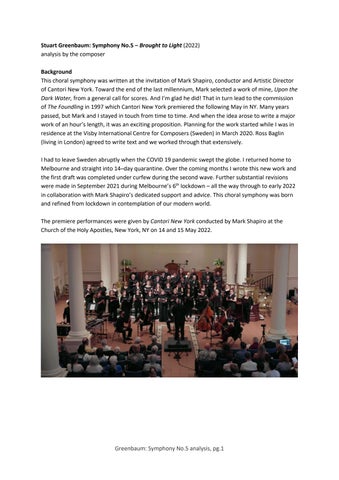
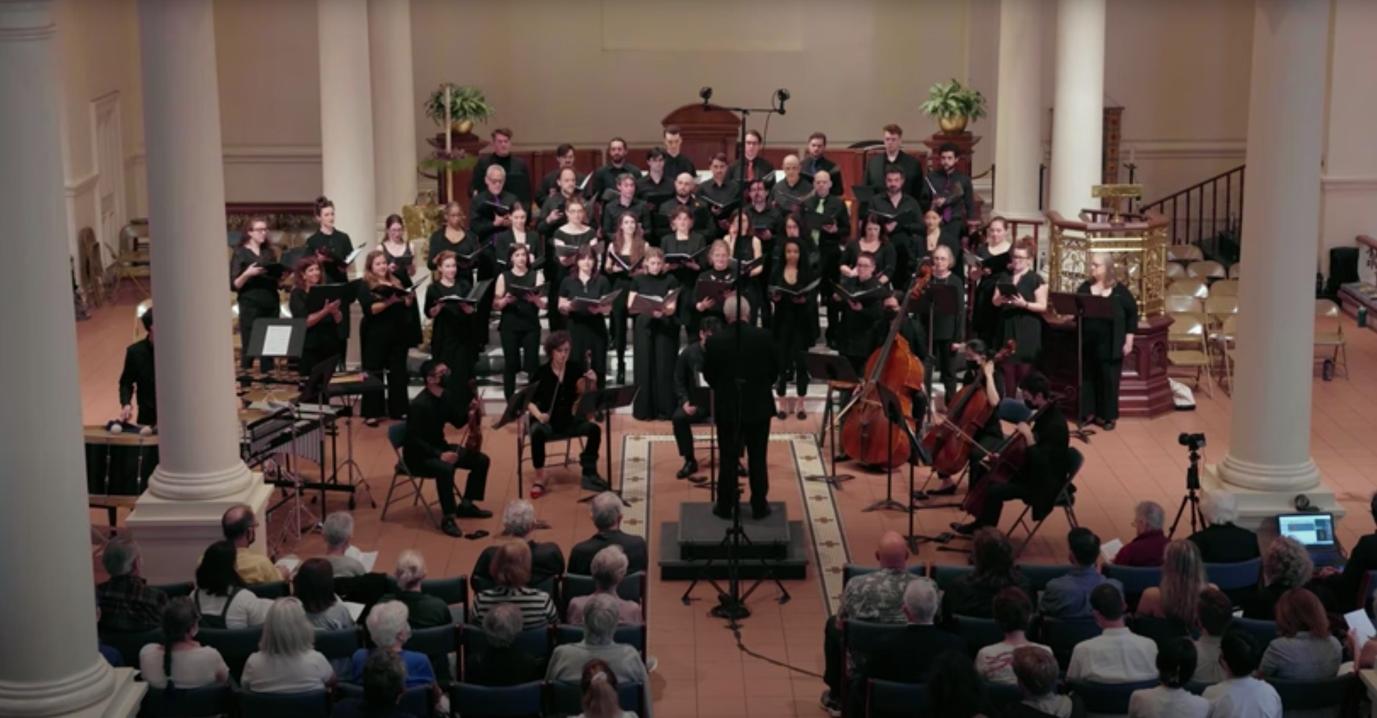
The premiere performances were given by Cantori New York conducted by Mark Shapiro at the Church of the Holy Apostles, New York, NY on 14 and 15 May 2022.
Greenbaum: Symphony No.5 analysis, pg.1
Media
The 2nd performance (15 May 2022) was captured on video, edited and uploaded to YouTube: https://www.youtube.com/watch?v=XqNjRx8iEuk
There is also an interview with composer and conductor: https://www.youtube.com/watch?v=0Nu5dxPQfEc
Text
I have worked with Melbourne poet Ross Baglin since 1985. That’s all my adult life. It is a privilege to set his words. He agreed to write a new text and we spent a lot of time talking (and on email) regarding what it would be about.
In 2016, during excavations for an extension to the London underground rail system, a pit containing 30 bodies was unearthed at Liverpool Street Station, London. The skeletons were those of bubonic plague victims, believed to have died at Bedlam mental hospital during the great London plague of 1665. This tunnel excavation formed a starting point for Ross (who lives in London); but it branches out from that into a larger metaphor of descent into darkness and the idea of being Brought to Light.
In the end, there were at least 21 drafts of the text. This might seem excessive, but it’s not just a poem or text in its own right – it’s a libretto for choral musical purposes. Ross and I talk through and test out the musical potential of the words alongside their beauty and meaning in their own right. That’s a protracted process but one that we have been through many times. In the end, we arrive at something that works for both of us. But the words belong to Ross. In some ways, my role is to be dramaturg – but from the perspective of a composer
Choral and instrumental forces
This work was commissioned for an SATB choir of around 40 voices. The sound of the full tutti choir is a certain starting point that further divides into male and female voices, the possibilities of divisi and soloists from within the choir.
The instrumental forces to accompany the voices were limited to 5 or 6 players but I got to choose the instruments. A first thought was to write for violin, 2 cellos, double bass and harp. But on further consideration I chose to write for string sextet (2 violins, viola, 2 cellos, double bass) and percussion. This septet was approved by the choir. The percussion started with vibraphone, but grew to include cymbals, crotales, bass drum, triangle, rain stick and wind chimes.
Structural architecture
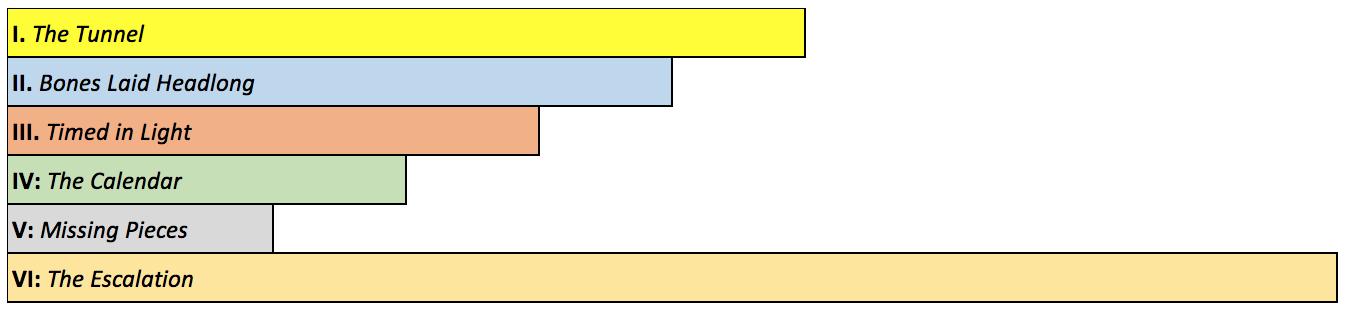
This choral symphony was conceived as an hour-long work in 6 movements:
I. The Tunnel
II Bones Laid Headlong
III. Timed in Light
IV: The Calendar
V: Missing Pieces
VI: The Escalation
Greenbaum: Symphony No.5 analysis, pg.2
A first attempt at conceiving the structure was based on movements expanding in duration separated by 2-minute instrumental interludes:
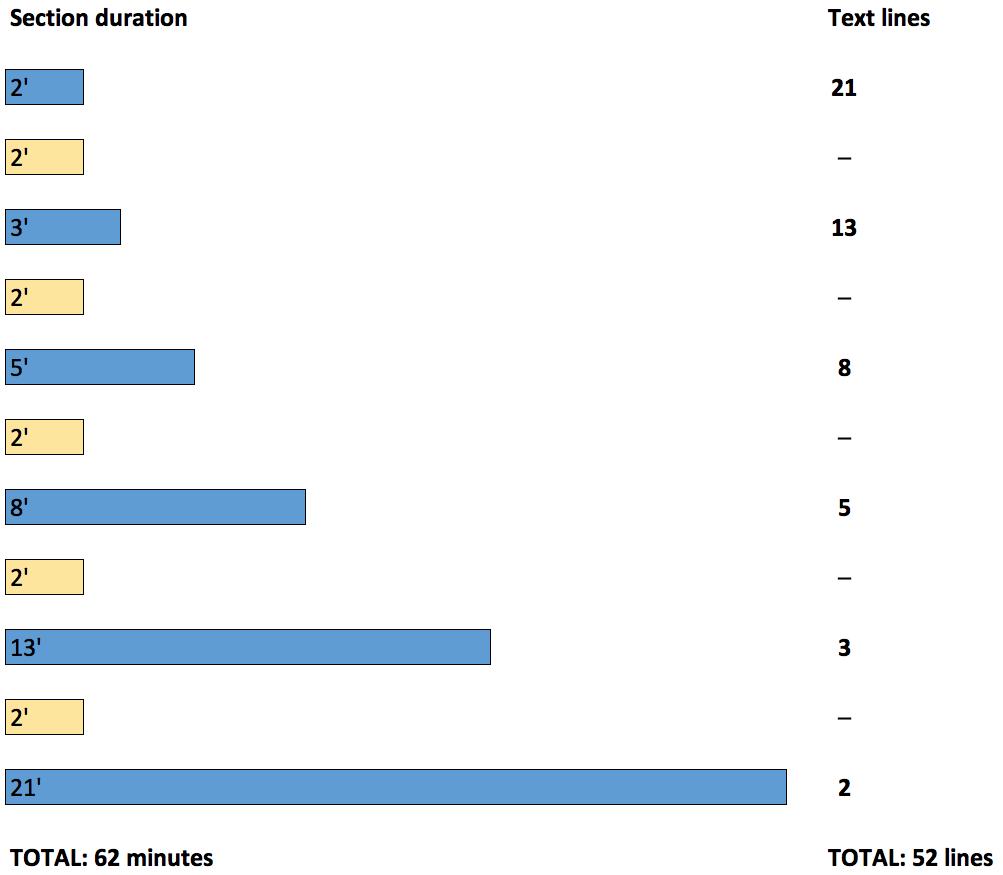
This initial draft created while in Sweden is from 10 March 2020. It shows a Fibonacci expansion of movements marked in blue (2, 3, 5, 8, 13, 21) yet inversely with less text for each subsequent movement. That looks counterintuitive – though is not impossible. It would mean a radically different approach to text setting and information rate from beginning to ending. Also, the 2–minute instrumental interludes were maybe longer than useful for the choir to remain standing and inactive for.
Upon reflection, I took an almost opposite approach: the division of the hour was planned so that each subsequent movement would systematically be shorter in duration, but the final movement to be notably longer. The 60 minutes would therefore divide into 12’ | 10’ | 8’ | 6’ | 4’ | 20’. Any instrumental interludes would be built into each movement, rather than separate. Represented graphically, it looks like this:
Greenbaum: Symphony No.5 analysis, pg.3
These proportions were adhered to fairly closely. The final score has a duration 62 minutes on paper and 68 minutes in performance. The extra minutes (around 10% longer) come from breaks between movements (including resetting of soloists and the overall choir) and the music breathing in real time in a live acoustic.
As the movements generally get shorter, the tempos get slower:
movement
tempo mood
I. The Tunnel 144 excitement and promise for the technology and infrastructure of the future
II. Bones laid Headlong 108 realities of the working day, making headway, getting to work
III. Timed in Light 80 other-worldly, distant, timeless, but an environment imperilled
IV. The Calendar 60 ageing, personal, nostalgic, the scars of time
V. Missing Pieces 48 infatuation to existential emptiness
VI. The Escalation 48 – 144 sum of capitalism versus an individual life – emergence into the light
Approaches to choral writing
The wonderful thing about writing vocal and choral music is that the text provides a structural narrative, and also helps to inspire musical material that resonates with it. Equally, though, there’s risk in purely following the text (especially when it is in free form) in that the musical result can meander and/or lack its own shape. At their best, words and music not only co-exist happily, but also resonate meaningfully to create a whole that is more than the sum of the parts. But words and music are not automatically resonant – they are not the same form. So, with this in mind, for Brought to Light, the process and intention was quite particular.
I worked with librettist, Ross Baglin on the development of the text, identifying a likely required length and the ideas that would be in play. The text for Brought to Light is 535 words in length. For an hour-long work, that equates to around 9 words a minute. That doesn’t seem much (and notably less than the average words per minute in opera, for instance). But this allows for instrumental interludes, sustained vocal notes, repetition of words and phrases and some use of non-text phonetics (such as oo and ah).
Once the text was close to a final draft, I identified the mood/atmosphere of each movement (as shown in the chart above) and wrote harmonic material (chord progressions) that worked to the mood. Rather than start with text setting, I opted to create the metrical and harmonic environment in purely musical terms. Text setting (whether in or contrary to speech rhythms) would then be overlaid – placed into the harmonic, atmospheric musical environment.
The following analysis covers each of the 6 movements in order on their own terms, starting with the text for that movement.
Greenbaum: Symphony No.5 analysis, pg.4
I: The Tunnel
It’s New Year’s eve, And they are building a tunnel Where trains will skate the quartz and glass Of their distributed abyss, Thread white light through the unknown bones Of sunken iron and clay ; Today, They’re gouging stairways, laying nerves Of polymer and cable, so that gates Will open to tomorrow’s new Exchanges, Tinder orphans orbit Ghosts of smoke, soliloquize To Twitter, fingers reaching for the codes That read the genome from the face, Or find a soulmate in a photon mask.
Repetition of text can take many shapes and forms. The opening stanza of the 1st movement is 6 lines in length. But ‘building a tunnel’ (which is arguably the central theme of the text) does not appear until bar 85 (after around 2 minutes). This is because ‘It’s New Year’s eve’ is repeated substantially – mantra-like – to simulate a kind of opening fireworks effect. The text repetition of these 4 syllables looks like this:
New New Year
It’s New
It’s New Year’s eve oo
New Year
It’s New Year’s eve
New Year
It’s New Year’s eve
New Year
It’s New
It’s New Year’s eve oo ah
It’s New Year’s eve And they are building a tunnel
The point of this repetition is partly strategic – to delay the arrival of the ‘tunnel’. But it is also intended to create a launch pad for the work through a mantra-like repetition of looking forward to what the future may bring; the excitement of anticipation.
From letter A (bar 18), a metrical pattern is established separately to any text setting. Its construction was planned around cells of either 2 or 3 quavers:
2222 33 = 4/4 + 3/4
2222 33 = 4/4 + 3/4
2222 33 = 4/4 + 3/4
3333 22 = 4/4 + 4/4 (accented across the barline)
Greenbaum: Symphony No.5 analysis, pg.5
This is first presented as a solo vibraphone line:
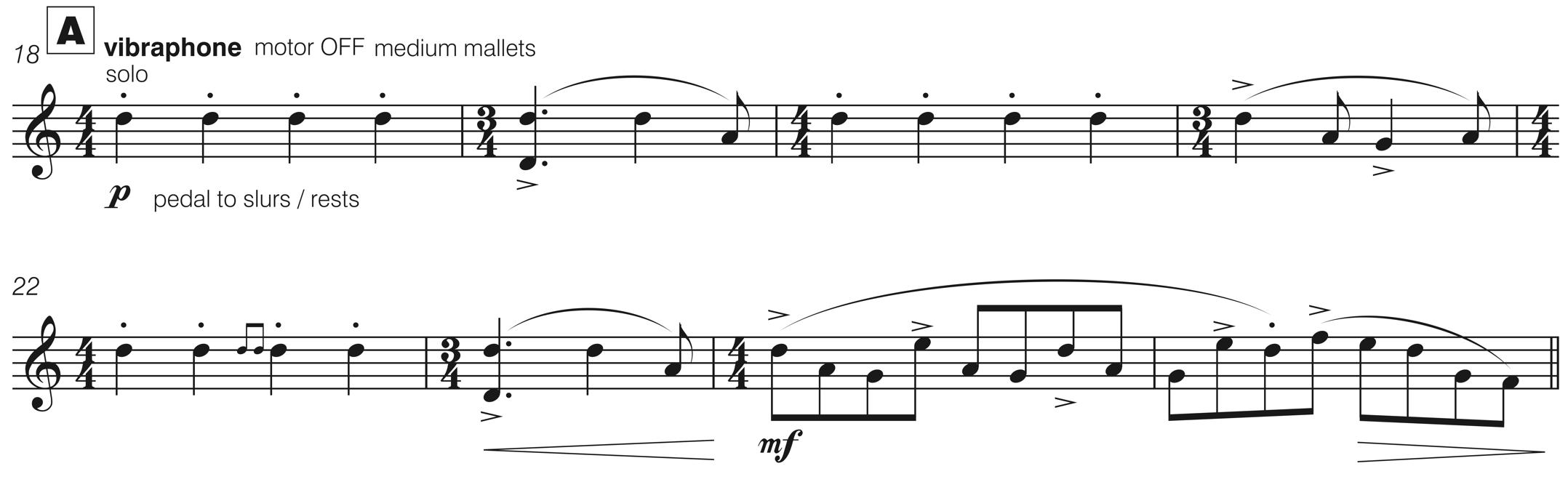
The final two bars were planned to switch the order of duple and triple cells; though in composition, there was a slight accent adjustment to the final bar, whose grouping is re-ordered to:
333 2 3 2
The minor re-ordering of the final bar slightly heightens the syncopation, but the overall 8–bar loop is still a 58–quaver cycle. The cycle is not especially binary and not divisible by either 6 or 8. It’s patterned but slightly asymmetrical. This approach to metrical form is influenced by Philip Glass. Works such as The Canyon and Powaquattsi (both from 1988) employ mixed metre in geometric ways that are built around groups of 2 or 3 quaver cells, often with repetition followed by a variation on the final turnaround phrase. The 1st movement of Bright to Light – The Tunnel – employs the vibraphone pattern above extensively, alongside use of regular 4/4 passages (often in 4-bar phrases) and a few other metrical turns for specific text-driven effect. But mostly the text is set to the musical grid (not the other way around).
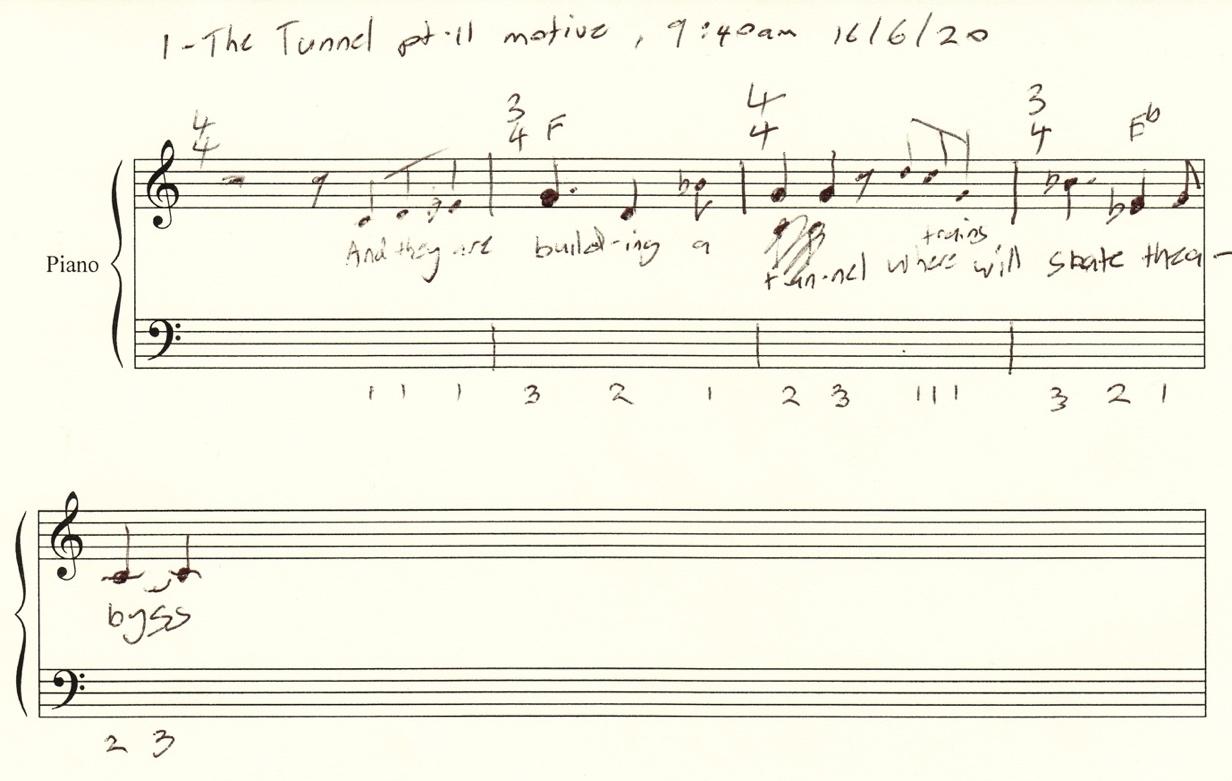
The mixture of 4/4 + 3/4 notably features the main motive for the movement (‘And they are building a tunnel, Where trains will skate the abyss’)
Greenbaum: Symphony No.5 analysis, pg.6
This was sketched in June 2020 in Melbourne in between pandemic lockdowns 1 and 2 (of 6). The numbers below the staff indicate quaver beats and highlight the mixed–metre hemiola at play. This is an example of finding a way of making the text fit a pre-established metrical pattern.
The words of Ross Baglin’s ‘Tunnel’ were written pre-pandemic; but the words took on unexpected additional relevance. The melodic sketch can be seen shifted up a tone (to D) in context with string pulsing and bass line in the choral score reduction:
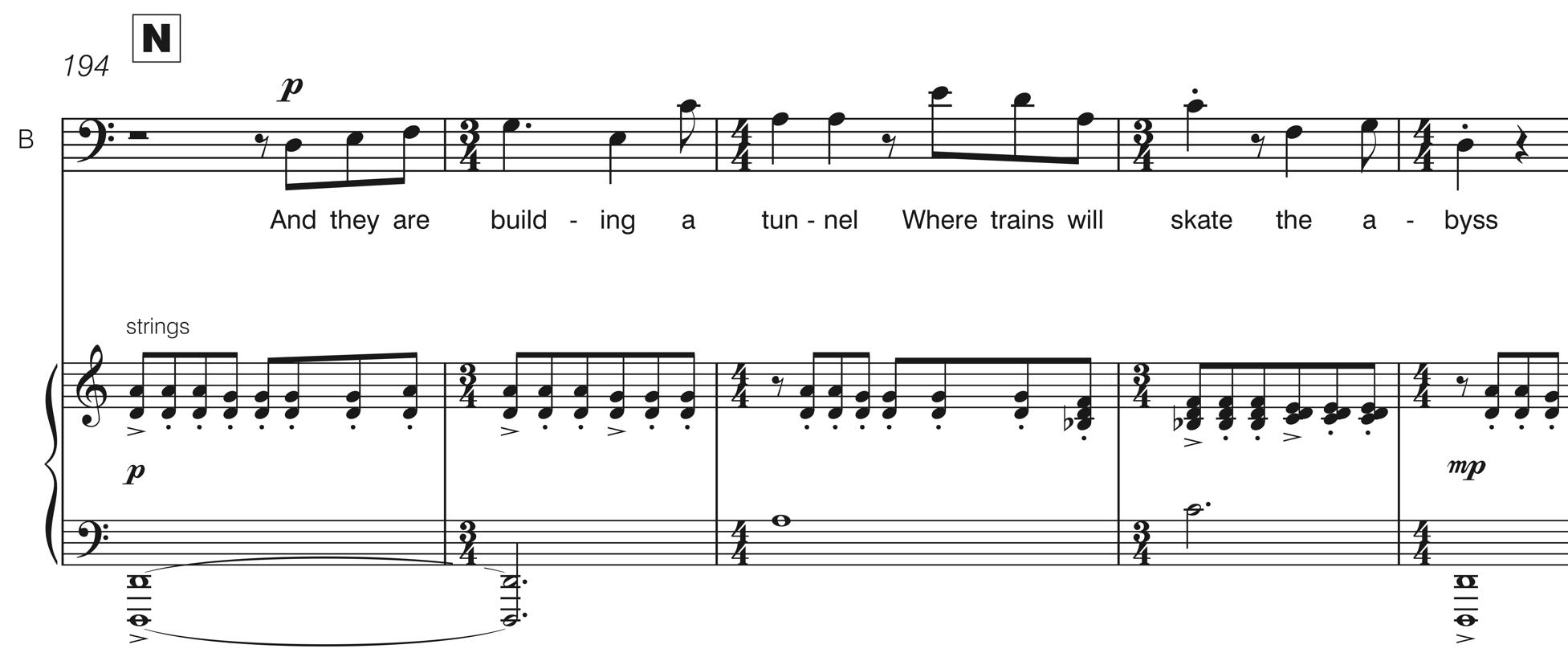
This motive at letter N is a compression or abbreviation of the full text:
And they are building a tunnel Where trains will skate the quartz and glass Of their distributed abyss
The words highlighted in red have been removed (having previously been sung in full) to create a tighter ‘chorus’ tag. It is looped, adding in the upper voices 4 bars at a time to build tension towards the climax in the middle of the 1st movement. The same motive is used again at the end of the movement.
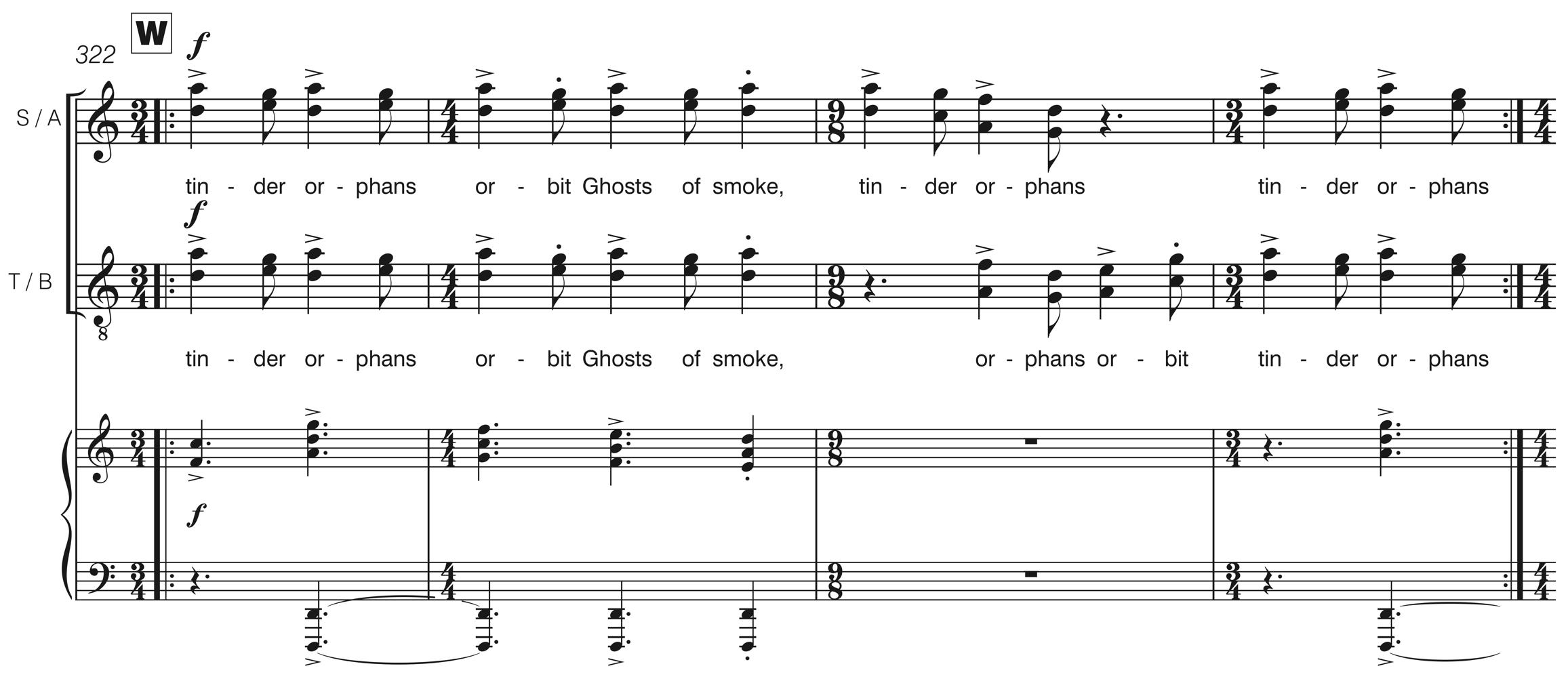
Sometimes, the text setting does drive the metre, such as at letter W (‘Tinder orphans orbit Ghosts of smoke’):
Greenbaum: Symphony No.5 analysis, pg.7
The 9/8 bar is not structural – it is a consequence of fragmented looping (glitch) on the words ‘tinder orphans orbit’. But this is less common throughout the work. Here, it is a metrical device to create phrase compression or fragmentation – the metrical units are governed fully by the syllables (words). The metrical pattern generated by this fragmented word loop is therefore:
It adds up to a very asymmetrical 29-quaver loop, and the 2-quaver cell for the word ‘smoke’ is the glitch agent – the disruptor.
II: Bones Laid Headlong
And here, in the blue, trapezium dusk Of an advertisement For fragrance, or convenience They have unearthed a corrugated husk Of bones laid headlong in a year of plague : Its transi cage of hi-vis tetrazine And broken airlock, having stood a month Below the roof tiers tagged for demolition, Attract no interest now ; the weary heels That strike across the concourse to the clocks Printing memories out to the news at six Have found no drama in the aperture And tacked across to bars or trains that split Their corporate puzzle back to jigsaw bits; A saxophone flares melody into a chord, Train door alarms deny the prying hand, And ringtones tug like tired children ; insured By microscope, vaccine, and phone, they swirl Into blue gates of glass, and step on rolling stairs That bear them into halls of ground and home.
The musical premise for the 2nd movement was to create slow music gradually transforming into fast music through the gradual introduction of shorter rhythmic units without changing tempo. Additionally, it was planned to start with strings only. The harmony is modally in D minor (aeolian), oscillating between two chord types (bVI – i) but with notable added tones and 1st inversion voicing:
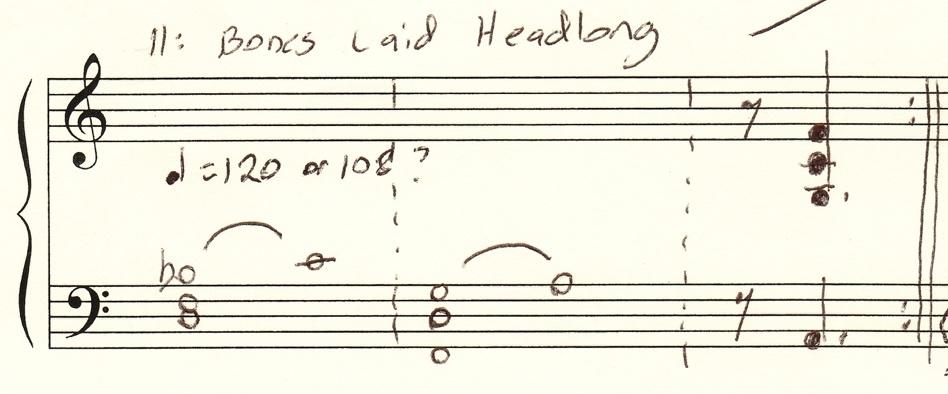
Greenbaum: Symphony No.5 analysis, pg.8
Voices enter from letter A on wordless long notes with a gradual revelation of the text:
oo – ah
oo – ah headlong aay – eee
laid headlong
Bones laid Bones laid headlong laid headlong aay – eee
A husk of Bones
A corrugated husk of Bones laid headlong in a year of plague; They have unearthed a corrugated husk of Bones laid headlong
The arrival tag is ‘Bones laid headlong’ :
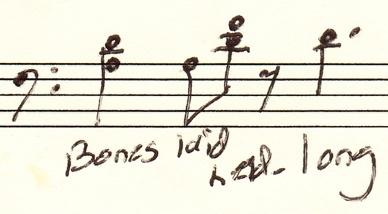
The preceding anacrusis (‘A corrugated husk of’) is gradually constructed before that to enhance the arrival:
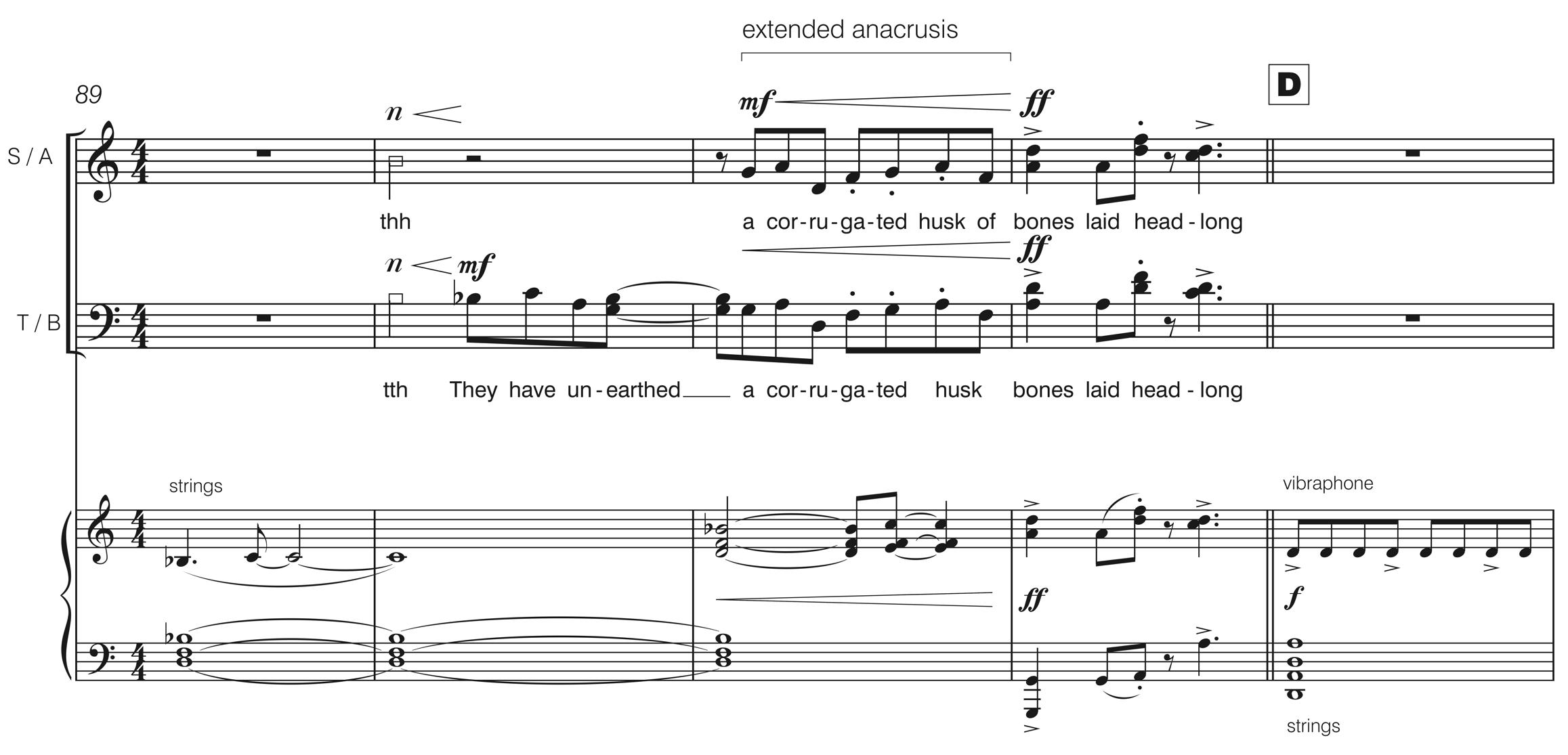
It’s an extended 7-note anacrusis, which acts like a kind of sling shot into the arrival tag to launch pulsing quaver motor rhythm in the vibraphone.
At letter E a new 8-bar theme (or riff) is introduced: 3 notes rising, then 3 notes falling looping around with some variation in the second half:
Greenbaum: Symphony No.5 analysis, pg.9
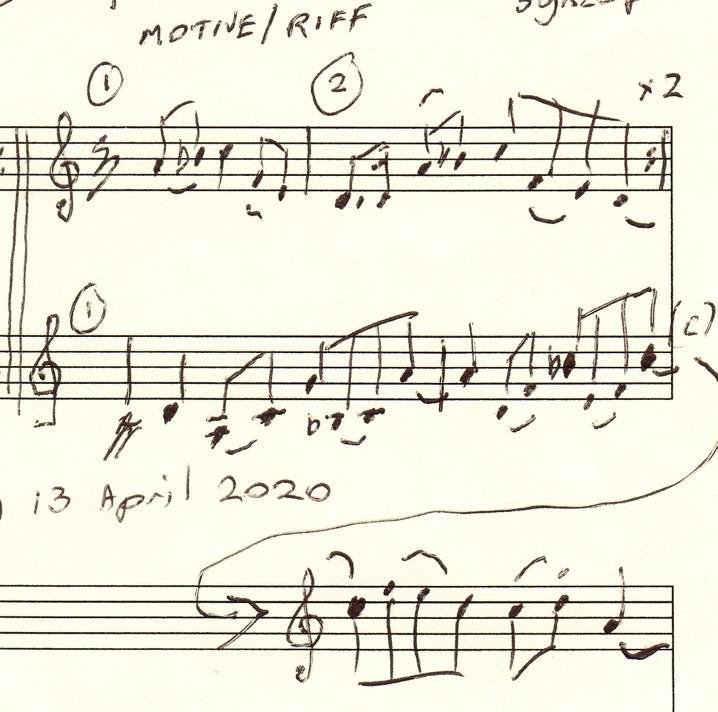
This was sketched out early on in April 2020 but further developed and refined to include some modal alternation between C# and C natural:
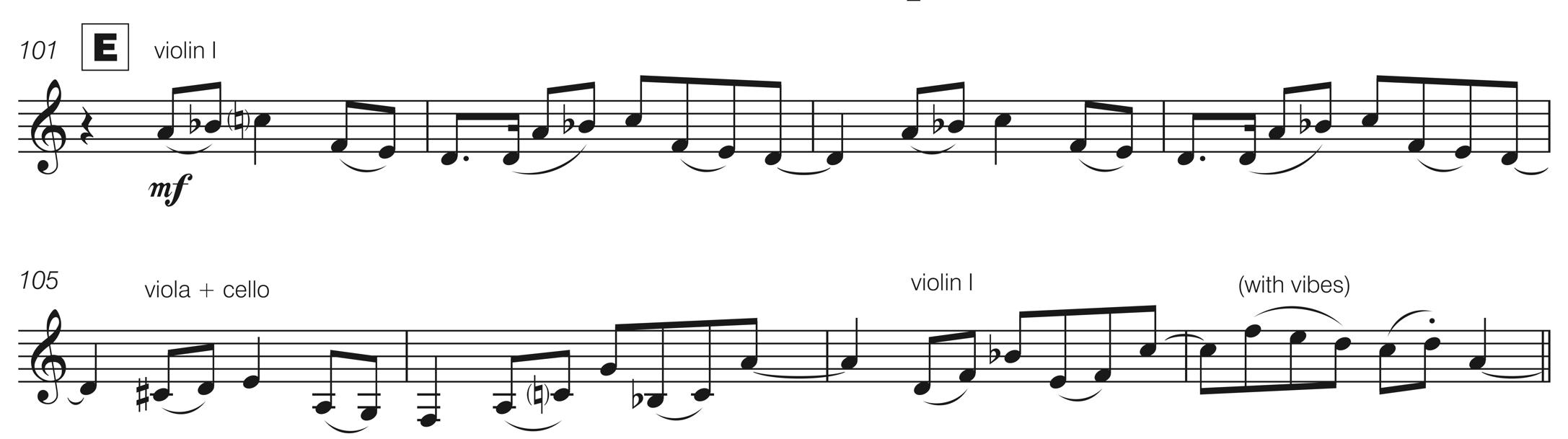
From that point the vocal lines also become more melodic employing aspects of natural speech rhythms in the text setting alongside use of soloists within the choir.
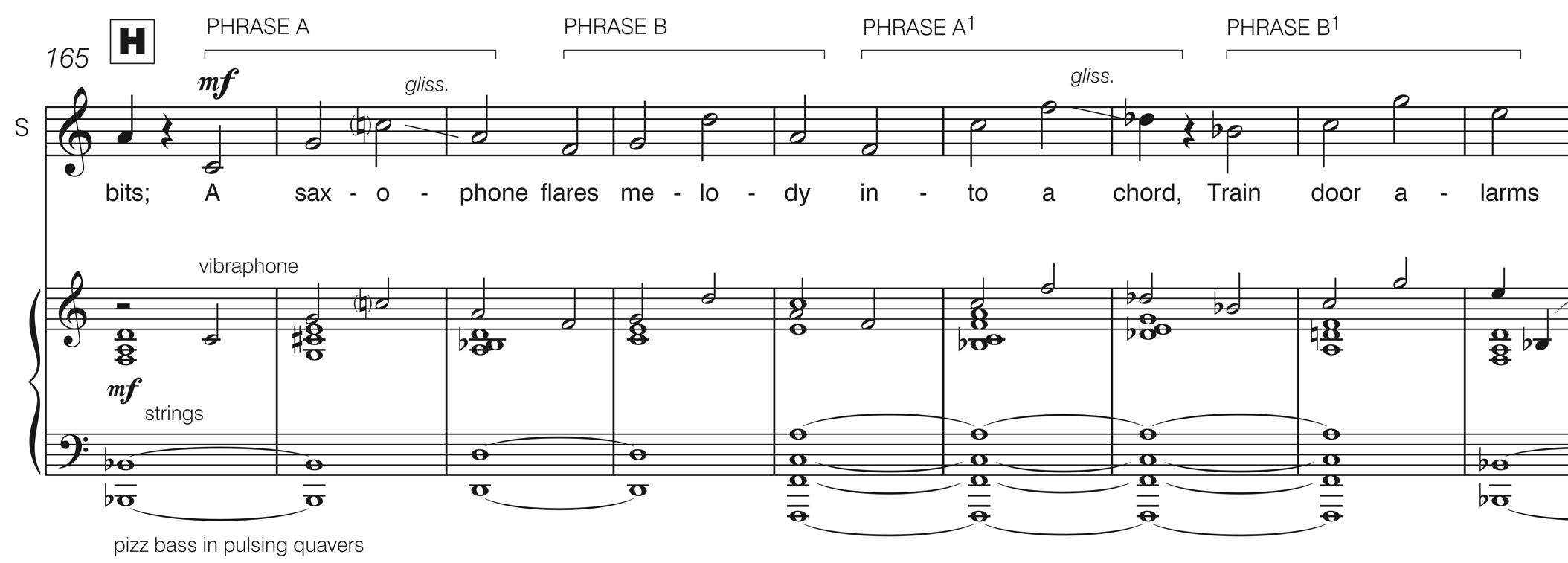
At letter H the melody rises sequentially over 4 phrases:
Greenbaum: Symphony No.5 analysis, pg.10
This is completely even in rhythm (speech rhythms ironed out) though the strong beat accents (barlines) work because the text is in 4-syllable units:
A saxophone Flares melody Into a chord, Train door alarms
So while this melody is devoid of rhythmic variety, it still works as a type of text-setting; though is actually driven more by melodic rising sequence.
By letter P, the setting of those same words is 4 times faster – the full choir pulsing harmonically in quavers, without instrumental accompaniment:
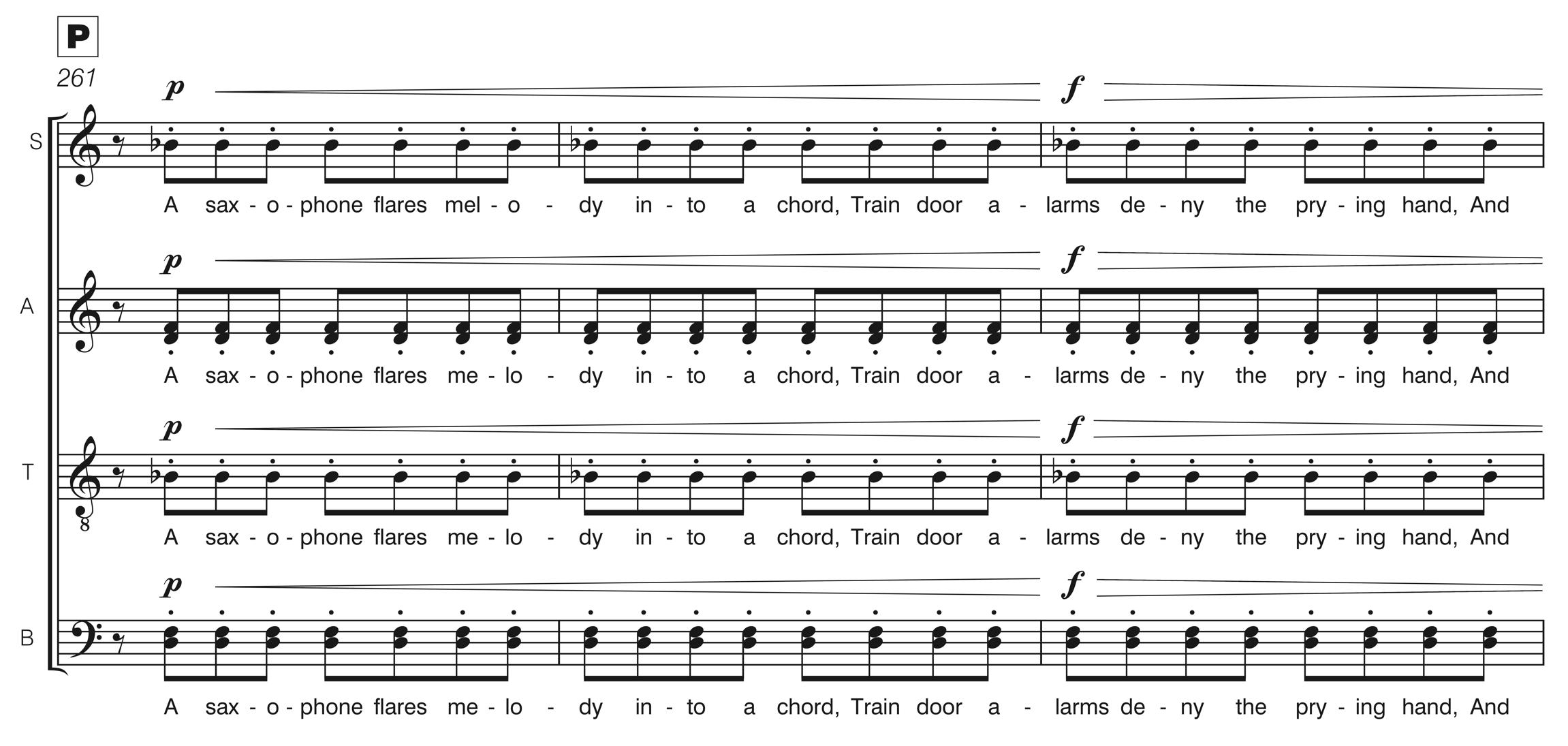
Melodic contour has been stripped away. The instruments drop out. At the end, all we are left with is an almost robotic or de-humanised declaration of the words. This bare minimalism (perhaps reminiscent of Steve Reich’s 1983 work, The Desert Music) is certainly not word painting; but it is a type of concept painting. It depicts the world of machines we rely on to take us down into the tunnels underground.
The movement ends with development of the ‘Bones laid headlong’ turnaround motive.
III: Timed in Light
Though trains obey the track And finger of the clock, The Earth is timed in light ; Its frictionless ellipse And tilt of season
Feeding sunlight into cell, From archaeon to human will. The sun, its cloud of fuel
Greenbaum: Symphony No.5 analysis, pg.11
The only measure of its end, Holds hypnotised in gravity A planet, furled and magnet-blue, And whispers down light-faulted oceans : “How long can I hold your breath Until we both are drowned ?”
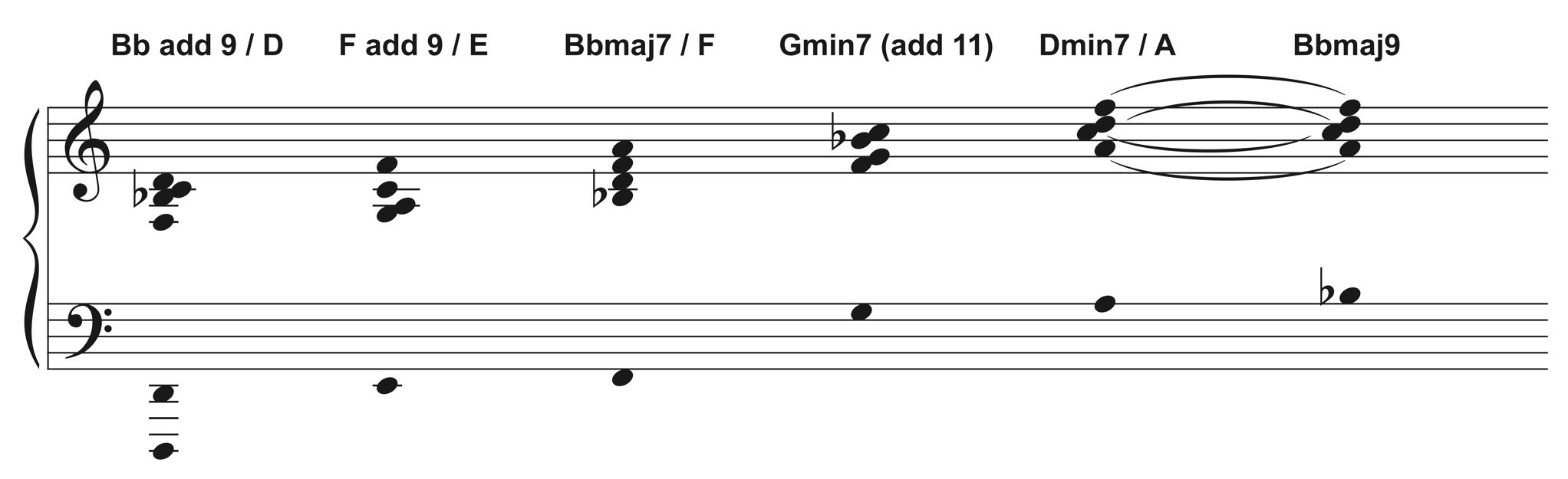
The atmosphere of the 3rd movement was planned as ‘other-worldly, distant, timeless, but an environment imperilled’. The initial musical response to this was a sequence of chords in the Aeolian mode of D, sketched in April 2020:
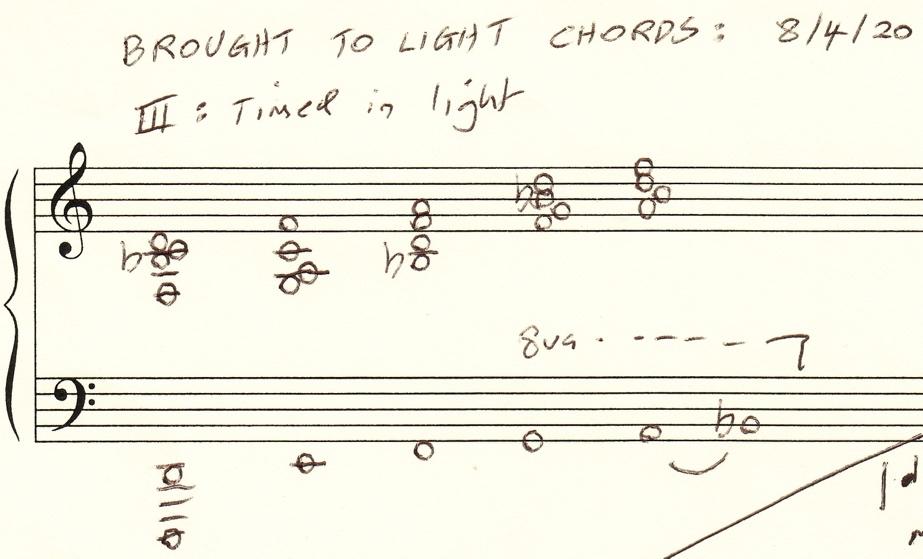
The bass line ascends in conjunct motion while the top harmonic voice ascends triadically. This is obviously influenced by Arvo Pärt’s tintinnabuli (bell-ringing) system of scale against triad, that he formulated in the mid-1970’s. I wrote my PhD thesis on his Te Deum (1984), so I had the opportunity to study that system in some detail. My intent is always to be influenced by wonderful music, but never to merely copy. And here, the difference lies in the inner voices. The outer voices are systematic and virtually ‘tintinnabuli’; but the inner voices are intuitive. Most feature added notes, but they are all a little different – chosen for a combination of their unique vertical voicing alongside their sounding progression from chord to chord.
These chords are sometimes in the strings, sometimes in solo vibraphone, sometimes presented in retrograde – and varied in either crescendo or decrescendo. Analysed as jazz chords (which are a parallel part of my harmonic thinking), the harmonic progression can be shown as follows:
Greenbaum: Symphony No.5 analysis, pg.12
On one level, it’s all just D Aeolian. But the added notes and inversions consecutively in progression are more complex and particular.
Overlaid against this complex yet modal harmonic environment is a stately melody in lower voices:
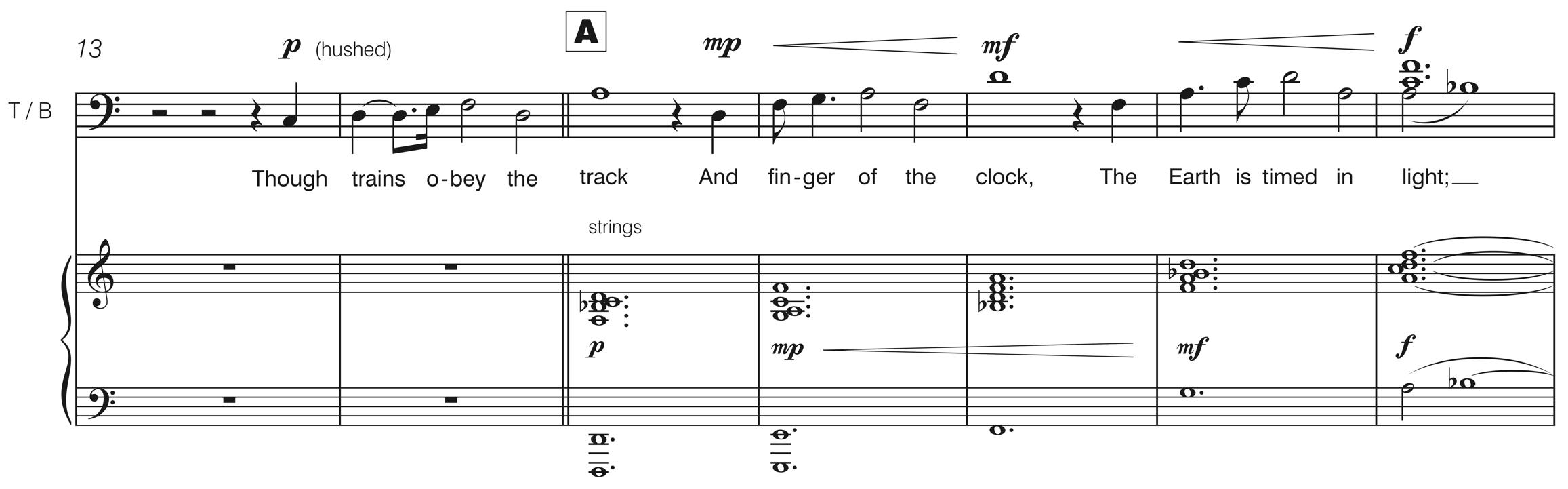
This is then doubled in canon (two parts) and then further split into 4 canonic voices:
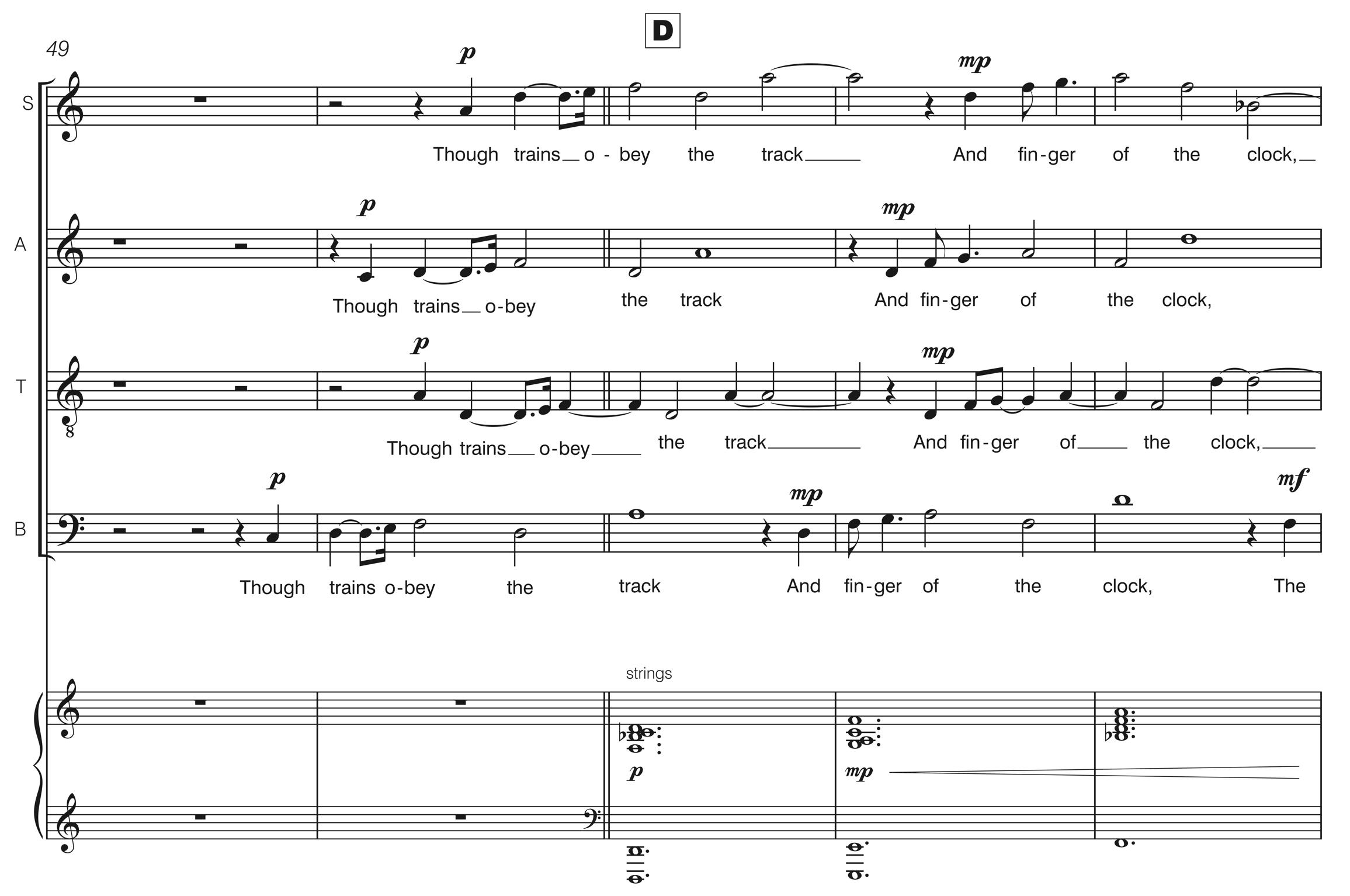
solos then lead to a mid-movement chorus at letter F:

Greenbaum: Symphony No.5 analysis, pg.13
As with the previous movement, this features an extended, even-quaver flow, mid-phrase anacrusis with more customised rhythmic phrasing either side. And this existential solar utterance further leads to a more insular human idea –‘How long can I hold your breath?’:
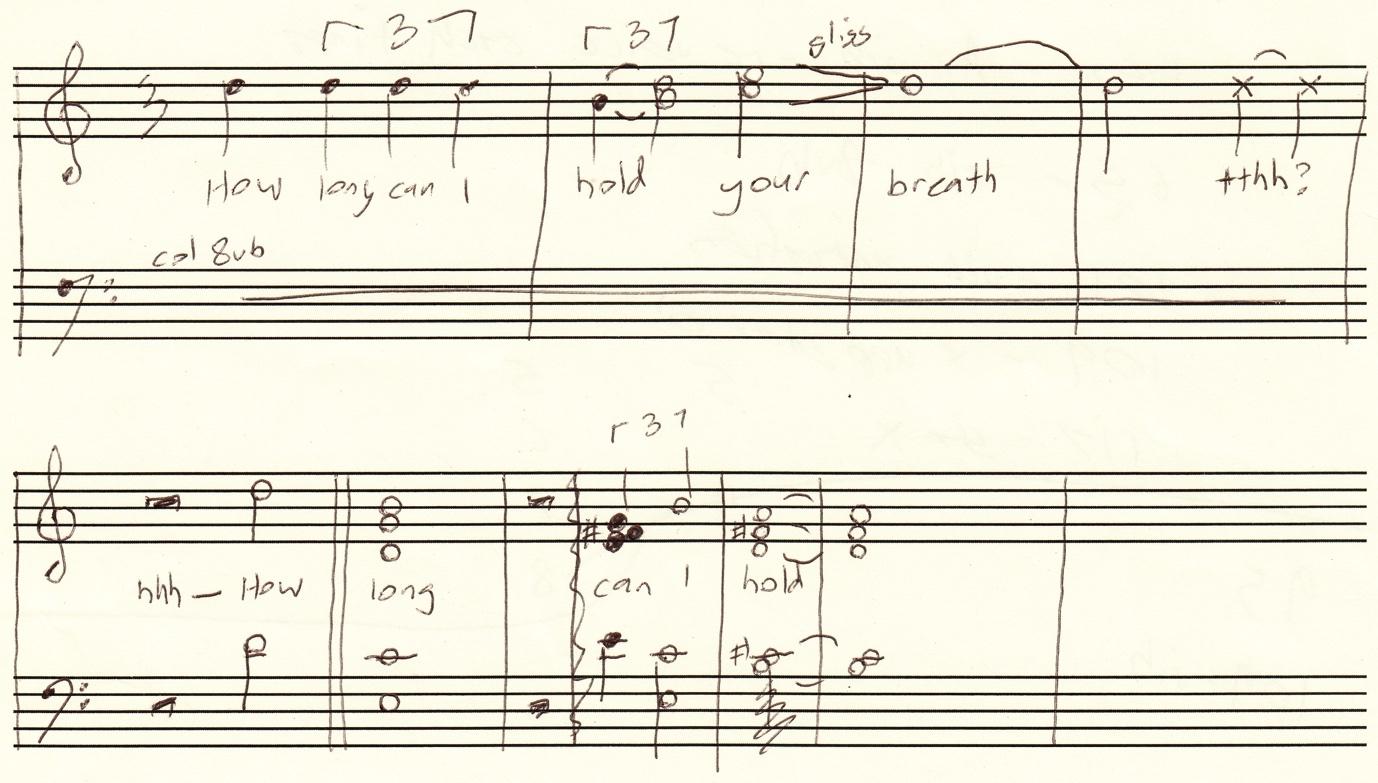
The 6th bar of this sketch (‘long’) is a very particular voicing, perhaps most famously found in Aaron Copland’s Appellation Spring (1944). It’s a C major 9 chord in 1st inversion. This forms the coda for the 3rd movement. It additionally features non-pitched breath sounds (tthh + hhh) to heighten the presence of human breathing.
IV: The Calendar It’s New Year’s eve, And popcorn fireworks are tracing Constellations in the falling snow ; Each year the calendar Is scored a little deeper on your brow And the excavating sidelight Can only mention, as it fades The archaeology Of your face.
Movements 4 and 5 (written in 2020) were later completely reset. Not edited or revised –completely and utterly set afresh. Not because I didn’t like them in their own right, but because in hindsight they didn’t sit ideally in the pacing of a major work half an hour in. After the end of the 3rd movement, what the work really needed was a ‘wake up’ moment and it was Cantori New York’s conductor (Mark Shapiro) that raised this. I believe he was right; and further – I used this to implement a more radical idea that I hadn’t pulled off first time around. I would re-write the 4th movement for male voices only – with only pizzicato strings and vibes. And the 5th movement for female voices only – accompanied just with crotales. These scoring limitations not only contrast and
Greenbaum: Symphony No.5 analysis, pg.14
freshen up the texture after the first 3 movements – they also provide a reset for the final 20-minute movement when all forces come back into play.
The ‘wake-up’ component of the 4th movement is first and foremost about tempo. In the original plan, the 4th movement tempo was to be crotchet = 60. I retained this connection but at dotted minim = 60 (effectively crotchet = 180):
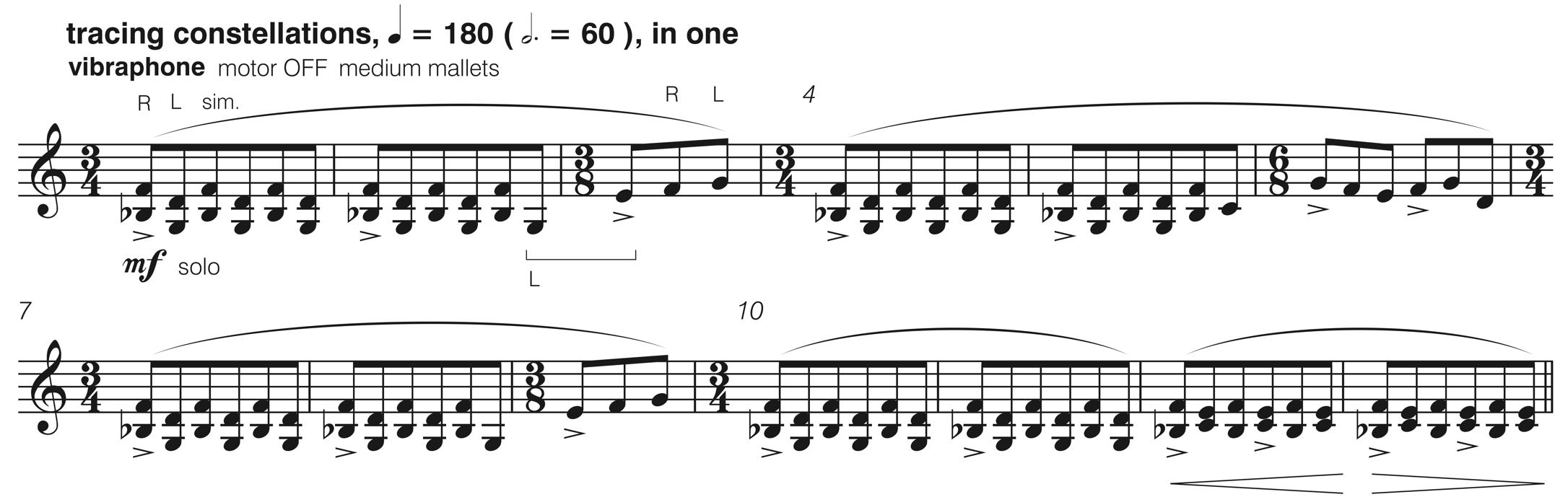
This is the metrical engine that drives the 4th movement. As with the 1st movement, it’s a metrical pattern of 13 bars that is geometric, but slightly altered. It adds up to 72 beats. The 3/8 bars are the disruptors. It clearly plays on groups of 2 or 3 quaver groupings.
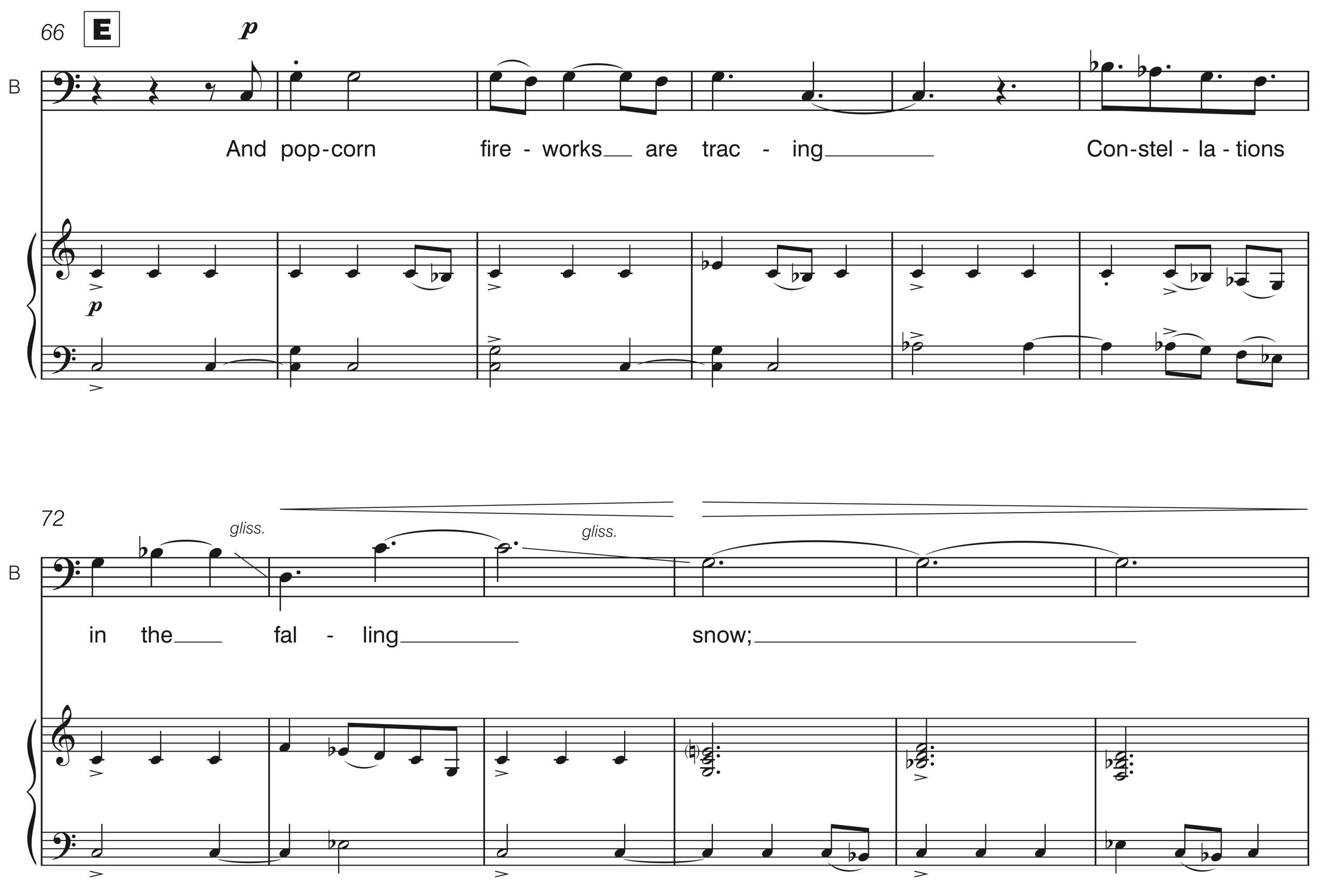
The male vocal lines (text setting) are layered on top of that shifting hemiola environment The text setting is generally accommodating of natural speech rhythms, though compound metres that work in units of 3 tend to bend or shape that in a particular way. An example can found at letter E:
Greenbaum: Symphony No.5 analysis, pg.15
The vocal line has variety of rhythmic values and notably also features downward glissandi over the words ‘the falling snow’. While the overall work is not driven by text-setting per-se, this is a clear example of word-painting along the way.
Halfway through the movement (letter N), the metre shifts to a regular 3/4 in 8 bar phrases. This has a hemiola alternation: 33 222
This grouping is perhaps most famously found in Leonard Bernstein’s West Side Story - America (1957) and likely has its roots in Latin American music.
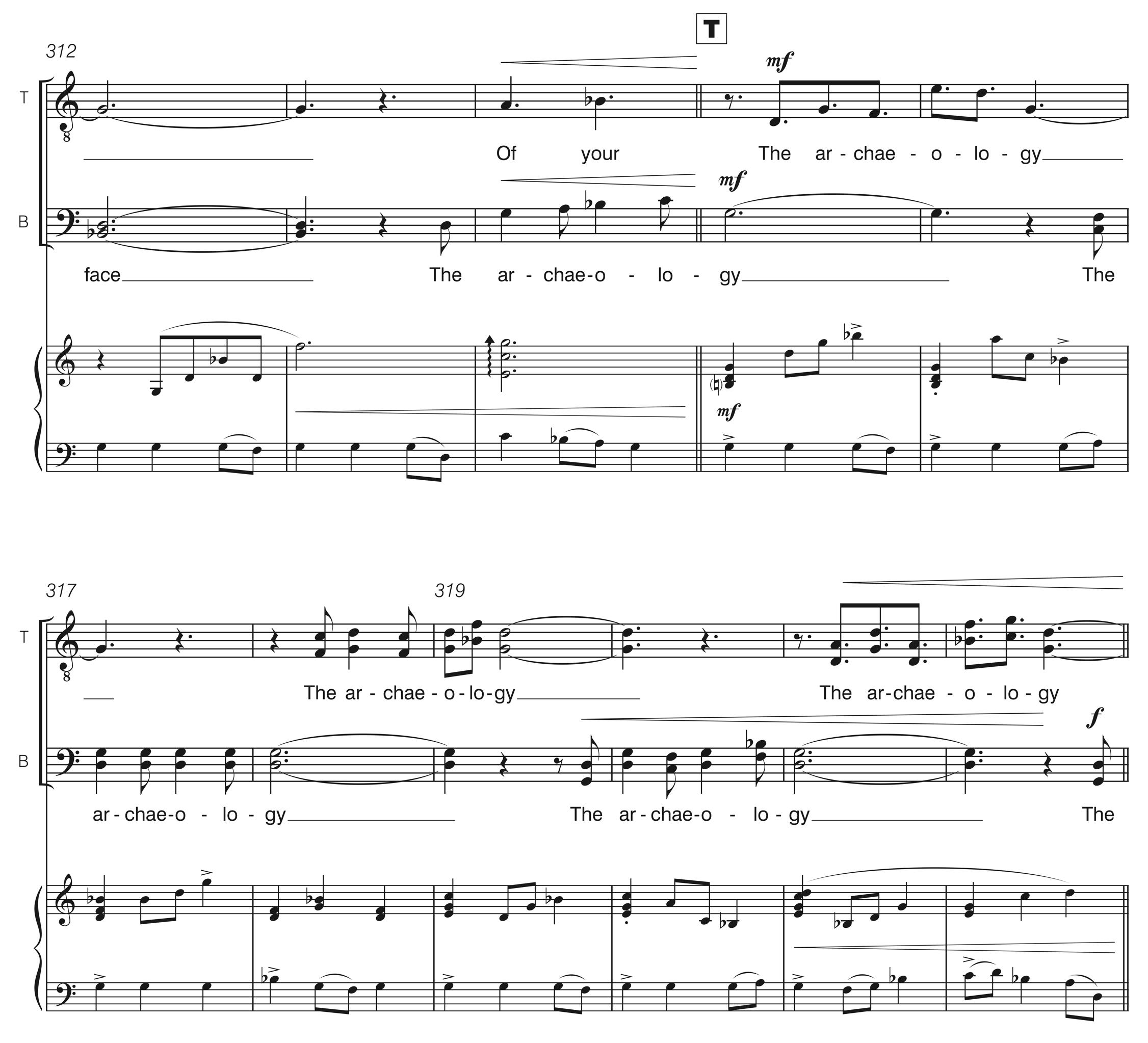
From letter R to the end, the final section of the movement builds a counterpoint between tenors and basses over the phrase ‘The archaeology of your face’.
Greenbaum: Symphony No.5 analysis, pg.16
V: Missing Pieces
Who knows, how once A swipe of light became a voice And then a kiss, until a wish Became a life of flesh and breath ? Or how, one needle-cold magnolia dawn At 4 am, the light still on, Your love, unwoven, half-revealed Before another’s naked reckoning, Would find no world could ever hold The missing pieces of your jigsaw soul ?
How long, O how long, can I hold your breath ?
The 5th movement is scored for females voices only with crotales. It is completely homophonic phrased music with only crotales for accompaniment. It follows a simple song structure:
This can be graphed proportionally:
The 2-bar introduction and interludes are instrumental (crotales solo). The verses set the words and gradually get slightly shorter (10, 9 and 8 bars). The first half of verse 1 opens in A major and gradually descends in register to F# minor. The voicing of chords also features add notes, inversions and altered bass notes (but all modally in 3 sharps):

The text setting is at first rhythmically even (bars 3–4) and then more customised to speech rhythms (bars 5–6). Subsequent verses work similarly.
Greenbaum: Symphony No.5 analysis, pg.17
The two choruses, by contrast have no text (phonetics vowels only), start on A and cadence on A major:

It functions somewhat like a secular ‘allelujah’. The second phrase reverses the vowel order of the first phrase; and the next two phrases do that again. It’s deliberately designed to finish on the most open vowel sound (ah) for the sustained chord at the end cadence (by reverse engineering).
The final coda is a reprise of from the 3rd movement (‘How long can I hold your breath?’). The scoring is different by necessity, but the melodic and harmonic shape are overtly similar
VI: The Escalation
Boxed like a picture, packed away In broken pieces of the night
Fearless, impassive offices
Turn glass-faced to the light And doze on their foundation stones : Today, you wake to the alarm’s uprising, Skim a breakfast, scan the morning news, Count stations as their names arrive and leave By windows, added to the sum of life : And as the train begins to grate and slow, A million images that interlock The mind and time are filed and put away ; The touchless gates admit your step And escalate toward the day Between the broken shells and clay Of other souls, to where New ribs of architecture rise in glass And all the sunlit, living world will pass.
The final movement is the most complex, not only for being the longest (20 minutes) but also for the gradual increase in tempo from slowest back to fastest. It essentially takes the reverse journey to the previous five movements (which gradually get slower). It also covers more harmonic ground and modulation across that span than the previous movements.
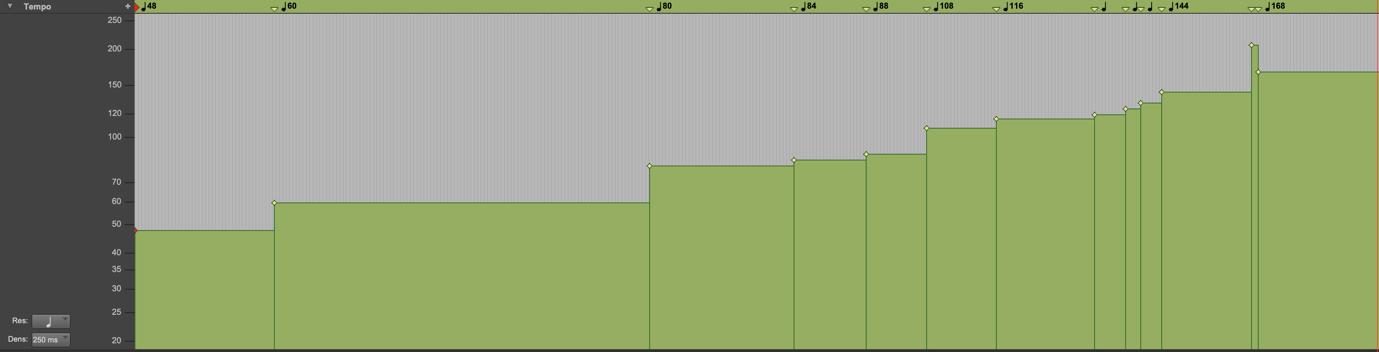
The tempo starts at crotchet = 48 and rises to 168 in the final minutes. Originally, it was planned to rise back to 144, but in discussion with the conductor, Mark Shapiro, we agreed that it could rise even higher/faster at the end. And actually, at letter V in the coda the tempo reaches crotchet = 208 (though the 3/4 metre is conducted in 1 so it is also arguably a conducted pulse of 69).
Greenbaum: Symphony No.5 analysis, pg.18
The conductor is given liberty to shape the tempo a little more beyond the score markings. But either way, the intended and actual effect is an escalation of tempo reaching an ecstatic climax. The tempo map for the final movement can be tabled:
section tempo duration
start 48 2’10
D 60 7’55
H 80 3’18
J 84 1’16
L 88 1’04
M 108 1’28
N 116 1’46
Q 120 0’32
R 126 0’16
b.289 132 0’22
S 144 1’28
V 208 0’16
W 168 1’04
There are a few accelerandos leading to some of the new tempos that aren’t shown in this table; and not all time signatures are grouped in crotchet pulse; but the overall sense of gradual escalation of tempo is noticeable. Additionally, it looks like the final tempo of 168 at letter W slows down slightly after previously reaching 208 – but in effect, it’s a gear shift that still feels like the tempo is pushing forward.
By exporting the score of the final movement from a notation program as a MIDI file, it’s possible to then open that inside a digital audio workstation and view the tempo map as a graphic. Below is a screen-shot of that rough map, revealing how the tempo map looks proportionally in real time:
The approach to text setting is also radically different because it syllabically intones the full text in speech rhythms right from the outset over a D pedal in the strings:
Greenbaum: Symphony No.5 analysis, pg.19
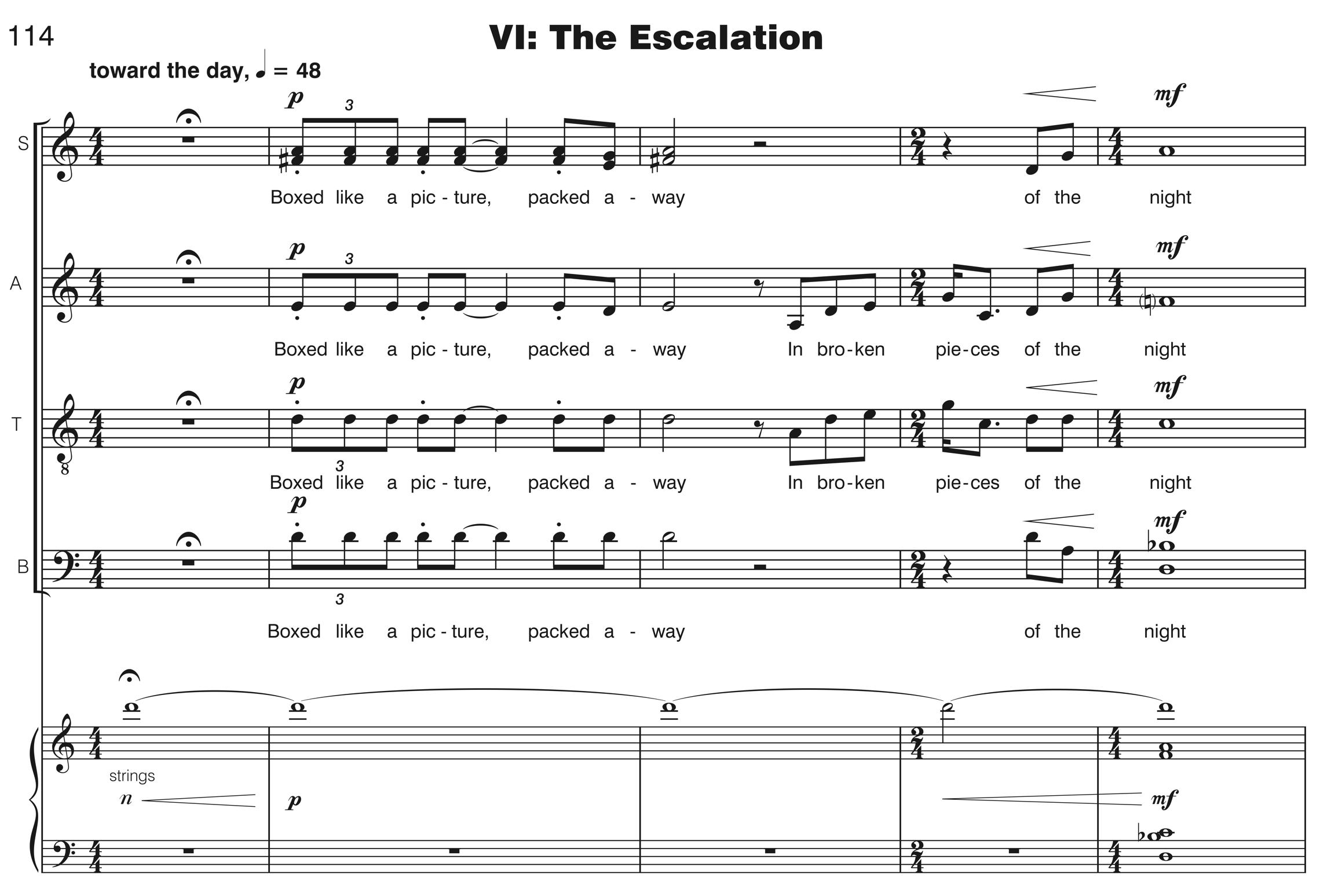
It takes 32 bars (just over 2 minutes long) to proceed through the full text of the 6th movement syllabically with no text repetition. There are connections here with Aaron Copland’s In the Beginning (1947) that employs a similar approach in the opening. This is a work I know and love –though was not consciously connecting to at the time of writing.
From letter D the 6th movement then proceeds through that same text for the remaining 18 minutes section by section, incorporating melisma, text repetition, fragmentation, canon, and instrumental interludes along the way. This is the exact opposite approach to that found in the 2nd movement where the text is only gradually revealed.
The opening 32 bars alternate major and minor modes over a D pedal, generating a sense of excitement or expectation. Letter D itself is a notable gear change. It drops a tone down to C minor and the strings are deliberately scored in their lowest possible registers to create a n atmosphere of darkness:
Greenbaum: Symphony No.5 analysis, pg.20
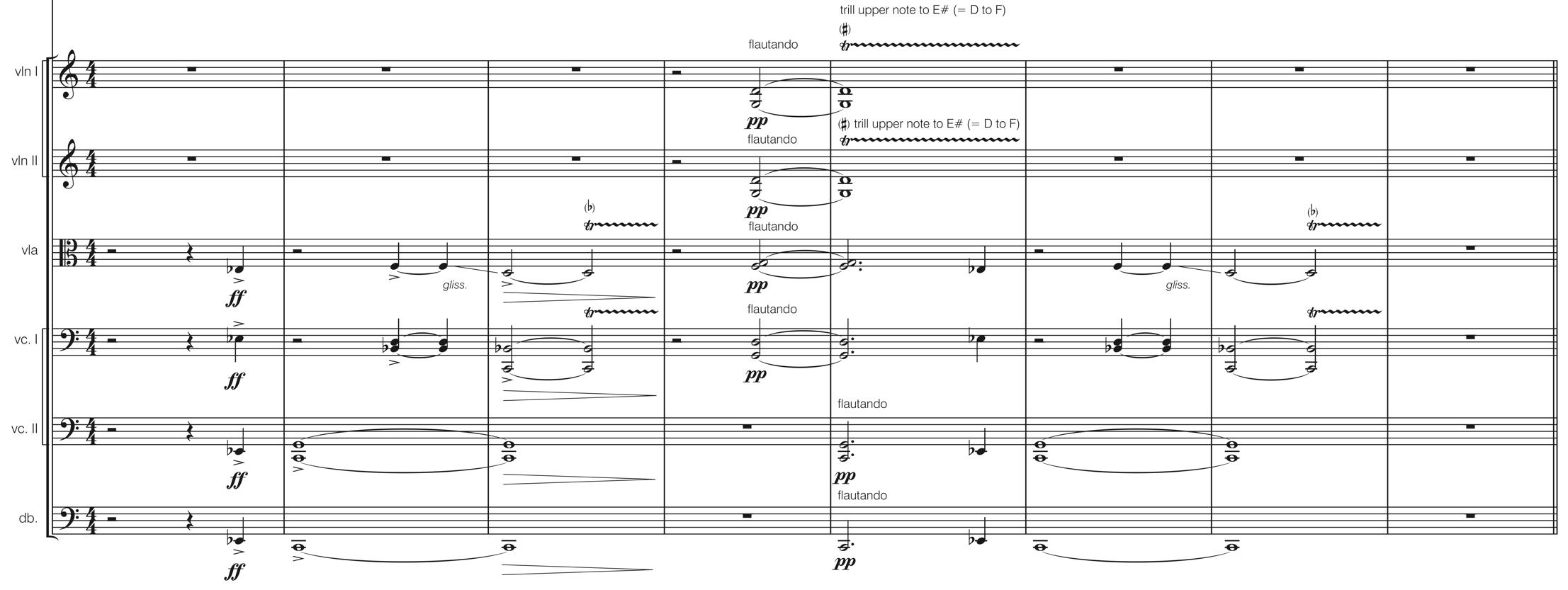
There’s an influence of Wagner in this low, dark string passage – that of the opening minute of the overture to the 3rd act of Tristan und Isolde (1859). The low register, dark scoring pushes the ‘tunnel’ metaphor to new depths and a sequence of dark episodes ensue. By bar 115, the choir is reduced down to just one repeated word –‘broken’. And this is the nadir: the darkest, lowest point.
At letter H the mood changes. A lengthy instrumental interlude between vibraphone and strings opens in high register with a lilting, gently cascading minimalist sequence. This 3-minute instrumental interlude is the longest single passage without voices in the entire work; and the intended effect is to be a distant light at the end of the tunnel – a shard of consolation in the darkness:
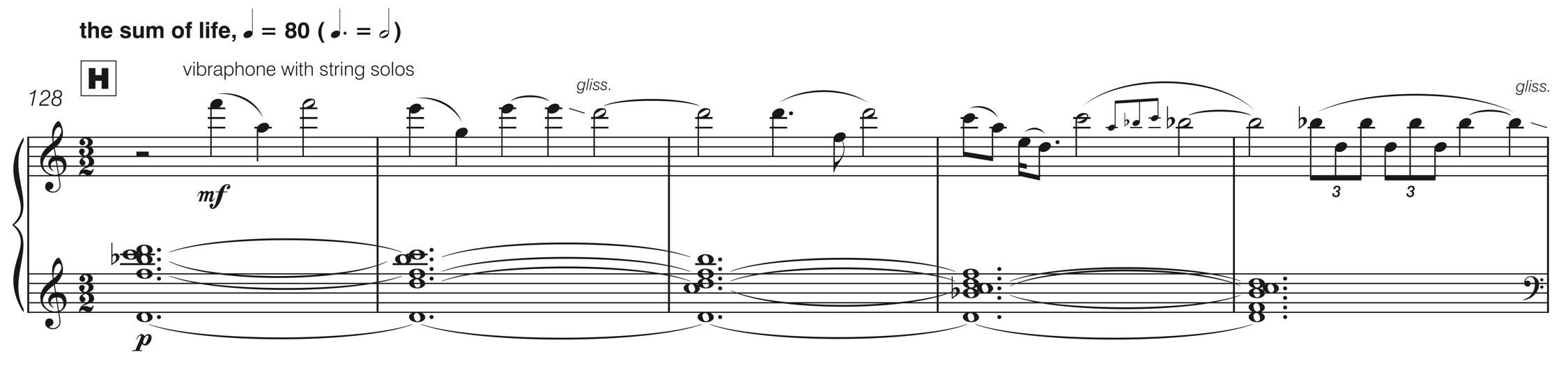
When the voices return at letter J, the basses sing “Today, you wake to the alarm’s uprising, Skim a breakfast, scan the morning news”. And there is a sense of coming back to life. The bass line rises slowly by step motion – just as it does at the opening of the 3rd movement – but this time increasingly with a sense of optimism. As the musical tempo and mood rises, the movement increasingly references music directly from previous movements – somewhat like looking out from a train window and seeing familiar scenery on a return journey. These include:
• Letter K: ‘Count stations as their names arrive and leave ’ is a re-setting of ‘its cloud of fuel The only measure of ’ from the 3rd movement
• Letter N: ‘The touchless gates admit your step ’ is a re-setting of ‘A saxophone breathes melody ’ from the 2nd movement
• Letter P: The repeated quaver pulsing (‘touchless gates…’) references the same vocal texture toward the end of the 2nd movement
Greenbaum: Symphony No.5 analysis, pg.21
In mapping this earlier material to text from the final movement, a little adjustment was required. If there are more syllables, sometimes a few extra notes are added into, before or after the reference melody. If there are less syllables, melisma can come into play. This is a similar technique used in song-writing of subsequent verses where the syllables are not necessarily exactly the same – or of the same accent pattern.
The effect in this final movement is of seeing the light at the end of the tunnel (literally and/or metaphorically) get closer. And finally, we emerge into the light at letter S, which is the coda – ‘the sunlit living world’. And this final 3-minute section is intended to be ecstatic, joyous. After all the darkness, we are ‘Brought to Light’:
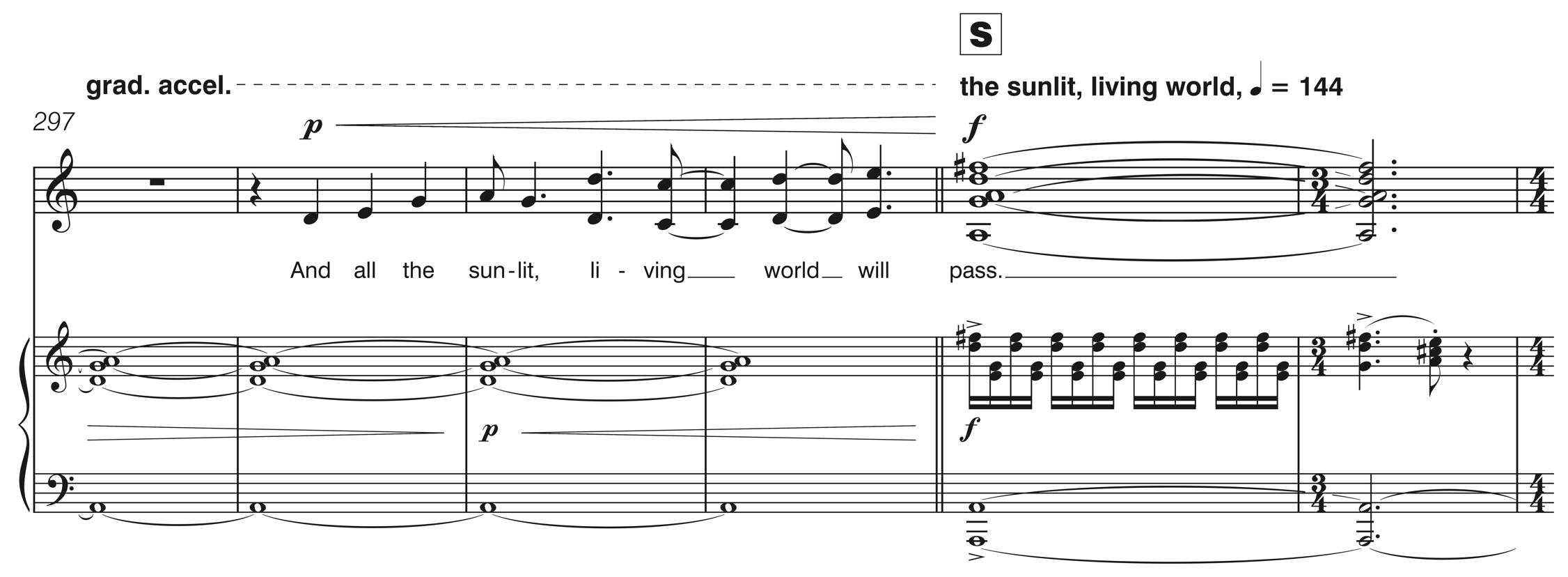
The harmonic arrival is in D major – to be precise: Dadd9,11 / A. This is also the tonality of the final page of music (still with dominant pedal). In between letter S and the end, however, there is modal alternation including notably to D minor (Aeolian) at letter V; and from letter X, the dynamic drops right down to piano and builds again. This time with rising chords sketched in April 2020:
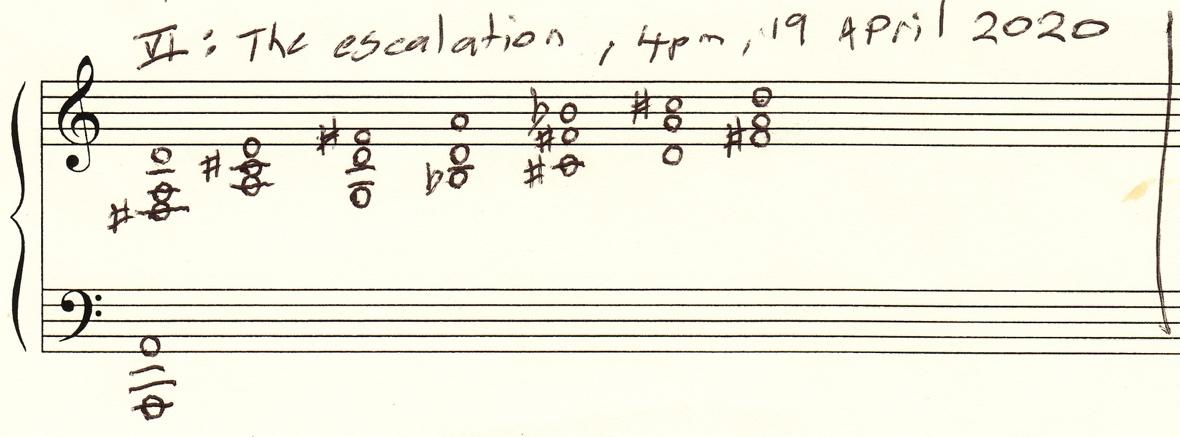
The harmony is D major over a sustained dominant pedal (A) but with a flattened 6th (Bb) which is a harmonic major scale. There is also a return to the 4/4 + 3/4 metrical grouping from the 1st movement (more organic references to the larger work) and the momentum builds and rises again:
Greenbaum: Symphony No.5 analysis, pg.22
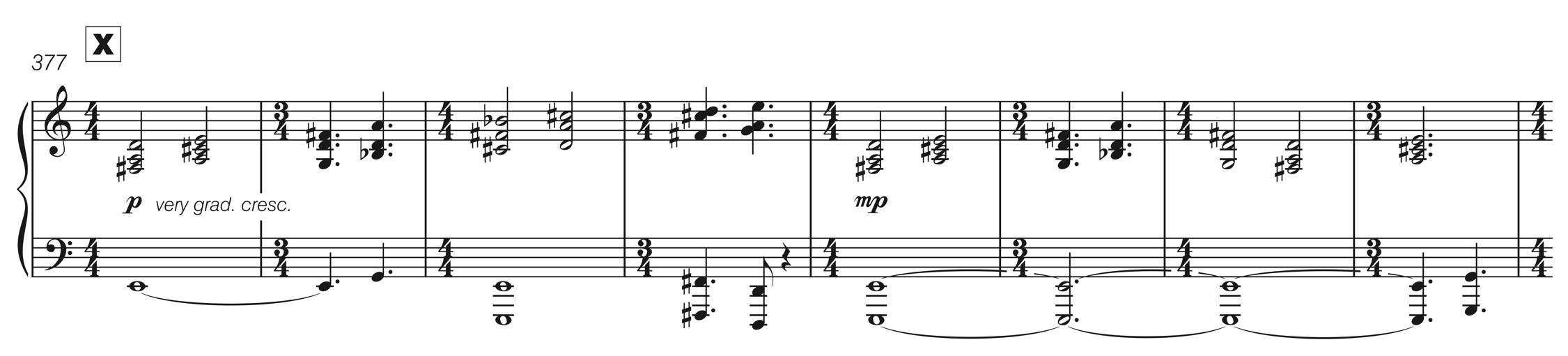
This builds further leading to the final bars:
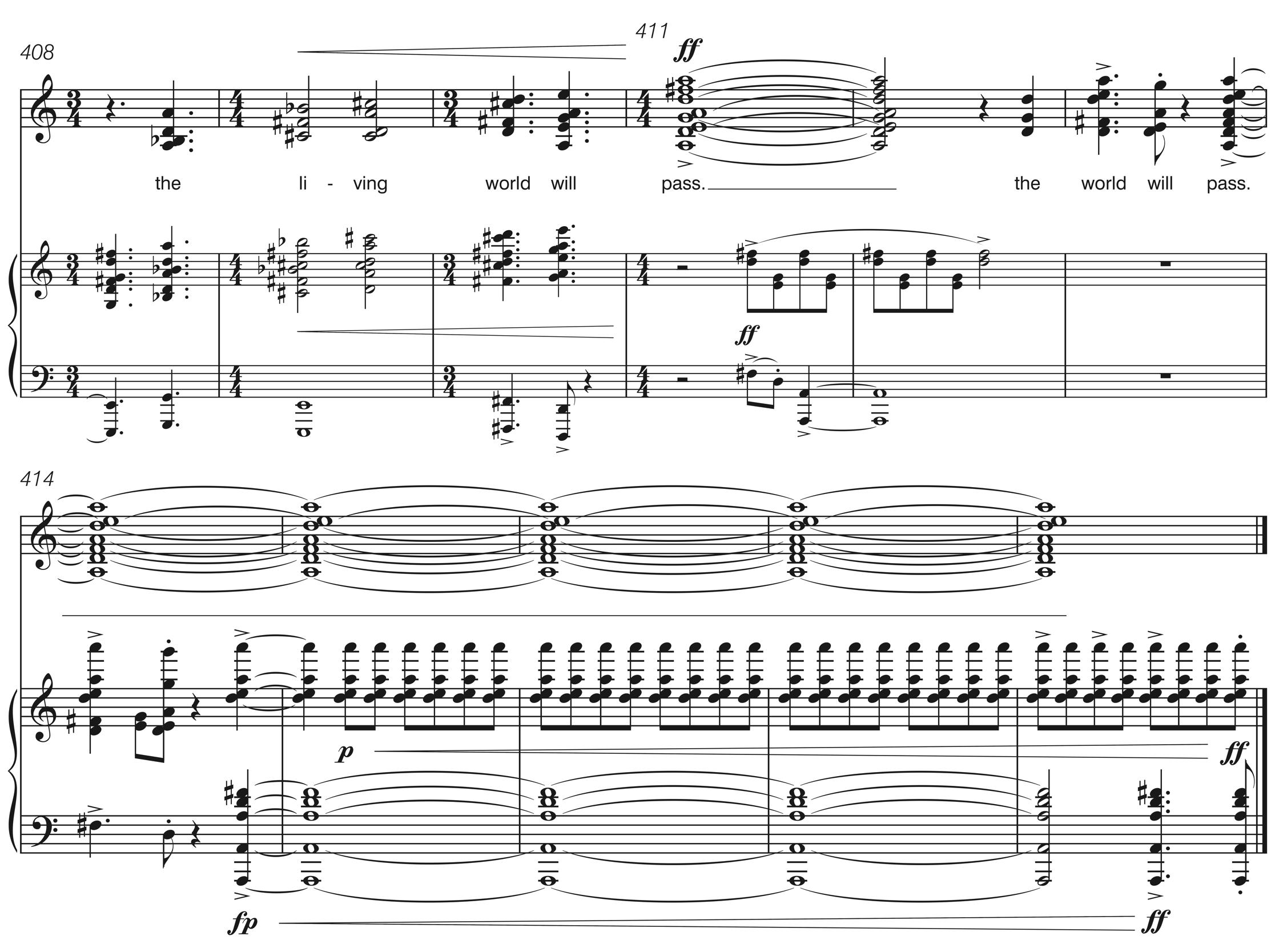
Technically, it’s an unresolved ending on the dominant pedal and a cut-off rhythmic ending. But in the context of the full work and the musical language employed, it feels complete.
Article © Stuart Greenbaum 28 March 2023
Greenbaum: Symphony No.5 analysis, pg.23