Stuart Greenbaum: Symphony No.2 ‘Double Planet’ An article by the composer Overview This symphony is scored for a chamber orchestra of 20 players, cast in 4 movements: i) Preview #1 ii) Double Planet iii) Preview #2 iv) Day and Night
2’ 8’ 1’ 4’
The work is concerned with miniaturisation, self-similarity and transformation. The shorter preview movements are ‘fast-forward’ representations of the two longer movements which themselves respond to pictures by the Dutch graphic artist, M.C. Escher whose work in general addresses these issues. Beginnings: the numbers game The first ideas for this piece concerned the duration of the proposed new work – 15 minutes. This in turn suggested the possibility of multiple movements. 15 minutes can be divided up in many ways – perhaps most typically into two or three movements of relatively equal duration. From the outset, however, I had something different in mind. In recent years I have taken a more radical approach to the proportion to multimovement works (including Chamber Concerto, Falling by Degrees, Mondrian Interiors and The Year Without a Summer). I have become interested in challenging ideas of balance in regard to both the duration and order of movements. For this new work then (and before I had either written a single note or had any programmatic ideas) I had the following simple premise: Ex.1
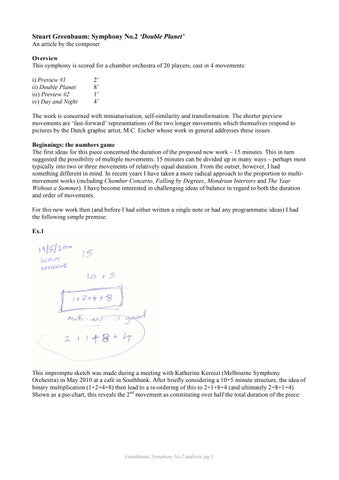
This impromptu sketch was made during a meeting with Katherine Kereszi (Melbourne Symphony Orchestra) in May 2010 at a café in Southbank. After briefly considering a 10+5 minute structure, the idea of binary multiplication (1+2+4+8) then lead to a re-ordering of this to 2+1+8+4 (and ultimately 2+8+1+4). Shown as a pie-chart, this reveals the 2nd movement as constituting over half the total duration of the piece:
Greenbaum, Symphony No.2 analysis, pg.1