Stuart Greenbaum: Sonata for Piano, 4– Hands
Analysis by the composer 23 March, 2016
background
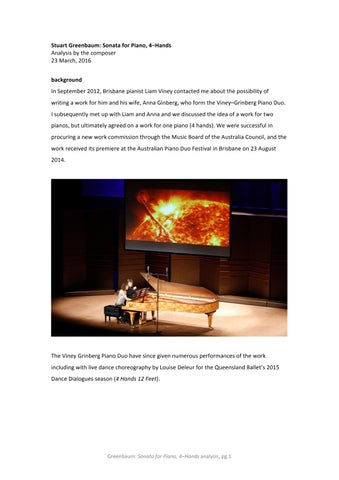
In September 2012, Brisbane pianist Liam Viney contacted me about the possibility of writing a work for him and his wife, Anna Ginberg, who form the Viney–Grinberg Piano Duo. I subsequently met up with Liam and Anna and we discussed the idea of a work for two pianos, but ultimately agreed on a work for one piano (4 hands). We were successful in procuring a new work commission through the Music Board of the Austra lia Council, and the work received its premiere at the Australian Piano Duo Festival in Brisbane on 23 August 2014.

The Viney Grinberg Piano Duo have since given numerous performances of the work including with live dance choreography by Louise Deleur for the Queensland Ballet’s 2015 Dance Dialogues season (4 Hands 12 Feet).
Greenbaum: Sonata for Piano, 4– Hands analysis, pg.1

pianos and hands
I had previously written a shorter work for two pianos – For Ever (2000) – and many works for solo piano; but at that stage not yet a work for two pianists at the one piano. This presents different opportunities and different challenges.
The advantage of the 4 –hand medium is that many venues only have one piano – or perhaps have two pianos but not both grand or matching. Rehearsal and touring are more practical if only one piano is required; and there is a long history of 4–hand arrangements and shortscores of orchestral repertoire that for many years enabled symphonies and ballet scores to be disseminated in intimate, practical ways. The 4–hand medium also encourages a wide tessitura with rich voicing.
That wide tessitura is also a challenge – especially for longer works – because it is all too easy for 4–hand writing to be texturally dense, registrally unvaried and too loud , too often.
Additionally one needs to be mindful of the bass end pianist’s right hand tangling with the treble end’s left (though some repertoire pieces play on that entanglement cleverly and entertainingly). In any event, these were welcome challenges in contemplating how best to exploit the medium. This Sonata for Piano, 4 Hands presents three different approaches to the challenges of 16 fingers and 4 thumbs playing at the one keyboard.
Greenbaum: Sonata for Piano, 4– Hands analysis, pg.2
Greenbaum Sonata Project
I did not intend to write a sonata from the outset, though as the work progressed it became clearer that the 20–minute, 3–movement form was turning out in this fashion. As with my other sonatas, none of the movements are actually in ‘Sonata Form’. Post-minimalism would be a closer (if not complete) description. I use the term sonata in the most basic sense of ‘a piece played’ (as opposed to ‘a piece sung’) and connecting to a continuum of large-scale recital works. The Sonata for Piano, 4– Hands is the 3rd in a sequence of 9 sonatas (as at the time of writing: 2016) with the ultimate aim of writing a sonata for every major orchestral instrument (of which there are around 20). Hindemith notably did this and at the halfway mark of this major undertaking, it still seems a worthy mission.
This sequence of sonatas, which for me represents the Greenbaum Sonata Project, are either programmatically concerned with our Earth and its place in the larger Universe or in some cases are more simply absolute music.
programmatic context
Running in parallel to the logistic puzzle of dealing with 16 fingers and 4 thumbs is a contemplation in 3 movements of the Sun and Earth in the context of an expanding universe:


Life on Earth is supported by the unique nature of our Sun (a yellow dwarf) and o ur distance from it. Recent observations of climate change underline the tenuous nature of this existence. It is anticipated that our sun will become a red giant in another 5 billion years and Earth would either be swallowed by the sun, or its water boiled away along with the atmosphere.
The Expanding Universe is a theoretical premise connected to the cosmological model known as the Big Bang – a continuous expansion, cooling and thinning out of the matter that constitutes the universe.
Greenbaum: Sonata for Piano, 4– Hands analysis, pg.3
Earthrise is the nam e given to a photograph of the Earth taken by astronaut William Anders in 1968 during the Apollo 8 mission. It shows just over half of the Earth above the horizon of the moon – a reversal of what we would normally see of the Moon above our own horizon. This captivating image – described as the “most influential environmental photo ever taken” – evokes a sense of the beauty (but also fragility) of our home planet.
I. Solar
The opening two bars presents a 24 –note quaver pattern created by alternating a sequence of 3 pitches in the left hand against 4 pitches in the right:
Example 1: Solar, sketch for opening

This first sketch from December 2012 shows how the notes are divided between two hands on a grand staff and then the resultant line created below.
The 7 pitches form an ascending melodic minor scale (or jazz minor scale) in C that jumps up and down in contour for the first 17 notes, then naturally (by permutation) presents the 7 pitches as a rising scale. This is a techn ique I have used previously but has its origins in Steve Reich’s Piano Phase (1967) which sets 3 notes in the left hand against 2 in the right (creating a 12–note pattern). Reich refers to this technique as ‘drumming at the keyboard’. 4 against 3 is a natural expansion of the same technique, though it does increase the complexity of the permutation.
Right from the opening bars the musical effect is intended to evoke images of solar flares bursting from the sun in radiant heat. Initially as an explosion of sound with the pedal down,
Greenbaum: Sonata for Piano, 4– Hands analysis, pg.4
and then from bars 3–4 with the pedal released, lower chord still held down and upper pattern playing softly in staccato:
Example 2: Solar, opening

This is intended to provide a ghosting halo or eclipse-like contrast. It’s also a technical response to the challenges of writing for piano 4-hands. This effect can be controlled quite easily with two players at the one piano and exploits a sort of ‘depth of field’ in the sound world, where the 4-hands medium can quickly become overly foregrounded
The sustained chords in Piano 2 are often suspended harmonies. The voicing above has an added 9th and 11th but no 3rd. These sustained chords are punctuated by syncopated anacrusis figures like that found at bar 8:
Example 3: Solar, Piano 2, syncopation

The influence of Pink Floyd, and specifically Richard Wright’s moody, atmospheric electric piano in the opening of Sheep (Animals, 1977) is apparent.
Greenbaum: Sonata for Piano, 4– Hands analysis, pg.5
The opening 24–note pattern generated from the 7 pitches (4 against 3) form s the basis of a series of variations that define the 1st movement. Three days after the composition of the pattern, ideas for possible variations were noted down:
Example 4: Solar, sketched ideas for variations

Most of these ideas found their way into the structure (including reverse note pat terns, compressed pattern length, resulting patterns, modulation and hemiola variation). Other variations arose later including augmentation and palindromic phrasing, but all material is drawn from the original 24–quaver pattern. An overview of the structu re can be seen as a proportional chart and might be viewed as a ‘developing variation’ form :
Example 5: Solar, developing variation structural chart
24-quaver motive
chords – contrary motion transition retrograde compression retrograde compression augmentation palindrome / polyphony recapitulation chords – contrary motion transition coda
The introduction of the theme in retrograde at letter D (modulation to E minor) presents the 7–note scale now in descent followed by the jumping contour of the remaining 17 notes.
Greenbaum: Sonata for Piano, 4– Hands analysis, pg.6
Additionally, after the two –bar retrograde the pattern does not repeat in the same register but continues its descent dovetailing from player 1 to player 2:
Example 6: Solar, Letter D

This creates a lon ger 4–bar phrase with bass note and upper register chords woven around the moving quaver line. At letter E, the music again modulates up a major 3 rd – this time to Ab minor. The dovetailed 4 –bar phrase remains but has been compressed so that every second bar is in 6/8 (rather than 12/8). The combination of the phrase compression and modulation are designed to keep the momentum going:
Example 7: Solar, Letter E

Letter G presents the first bar of the retrograde and then immediately presents that in reverse order to create a micro–palindrome:
Greenbaum: Sonata for Piano, 4– Hands analysis, pg.7
Example 8: Solar, Letter G, palindrome

The slurs are not palindromic, but the pitch and rhythm form an exact mirror. This is an example of ‘developing variation’ (as distinct from more traditional theme and variations) and forms the basis of a build–up in polyphony across the 4 staves (4 hands) leading to a clear recapitulation of the opening.
From letter M, an extended coda section is built around a double augmentation of the retrograde and a re-ordered retrograde (with descending scale at end):
Example 9: Solar, Letter M , double augmentation

Harmonically, the ascending minor pitch structure holds throughout, though the voicing of chords is often quartal (stacked 4ths) rather than triads and consequently the music is more modal than tonal. Diatonic clusters (stacked 2nds) are also featured prominently. The overall modulation scheme can be charted in rough proportion as follows:
Greenbaum: Sonata for Piano, 4– Hands analysis, pg.8
Example 10: Solar, modulation chart
The opening firmly es tablishes a harmonic centre of C before modulating up a major 3 rd to E and then up a further major 3rd to Ab and again back to C. The move to D halves the difference (moving by a major 2nd), but stays within a structure of centres connected by whole tones. The coda section from letter M moves back up to a harmonic centre of E, and this is intended to subtly create a ‘to be continued’ impression l eading into the second movement (whose harmonic centre is E).
The harmonic quality of minor tonalities modulatin g symmetrically by major 3rds is also found in the 3rd movement of my Sonata for Violin and Piano (2000). Without consciously copying that, the reference upon reflection demonstrates a basic truth that successful experiments are more likely to be revisited
II. The Expanding Universe
Almost two weeks after the 1 st movement was started, a pitch structure was sketched out for a 2nd movement:
Example 11: The Expanding Universe , pitch structure

Greenbaum: Sonata for Piano, 4– Hands analysis, pg.9
The structure is based on a string of 9 notes (6 different pi tches) spanning an octave and a 5th (or a perfect 12th) from E to B:
Example 12: The Expanding Universe , non–octaving mode

It is a minor scale with a minor 6th but no 7th (major or minor), so therefore either an incomplete Aeolian mode or an incomplete Harmonic minor scale. The interval of a 12 th is important because it creates a non-octaving mode that is replicated (transposed) by a 12th (not by an octave). This branches out like a cycle of 5ths creating additional pitches (C#, Bb, D and G#). In theory, that creates a set of 10 pitches – though the Bb at the very bottom of the sketch is never used. So the overall set includes 9 pitches and might theoretically be described as nonatonic.
The eventual presence of D natural at bar 15 (entry of piano 1) tem porarily establishes a complete Aeolian mode in E. The remaining two ‘outside’ pitches (C# and G#) only appear in the higher octaves (as determined by the overall pitch system as a fixed register chord) and create subtle but important cross relations. The 2nd movement never modulates – staying fixed in relation to the harmonic centre of E throughout.
The non-octaving mode spanning the interval of a 12th from E to B provides the core motivic thread for the entire movement. At first there are just 2 notes, then 3, 4, 5, 6, 8 and then (by bar 6) the full 9–note pitch span is fully revealed:
Example 13: The Expanding Universe , core motive

Greenbaum: Sonata for Piano, 4– Hands analysis, pg.10
This enfolding from 2 notes up to 9 fans out from the middle – registrally expanding both higher and lower. The first 9 semiquavers outline the non-octaving mode (from which all is built) and the following 7 semiquavers start the same sequence for the first 3 notes but then swap the order of pitches 4+5 and also swap 6+7 (pitches 8+9 are omitted second time around). This is a subtle but important variation device.
In parallel to the additive nature of pitch, the overall phrase structure of the 2nd movement is also additive:
Example 14: The Expanding Universe , phrase structure

The green sections show 4 bars of motivic expa nsion from 2 notes to 6 notes. The light blue column represents a bridging 8–note bar (2/4 metre) leading to the core motivic thread (shown in Example 13) of 9+7 notes marked in darker blue. This complete motive expands in length each time until adding expanded patterns in 5/4 (marked in orange) and then 6/4 (marked in purple).
This motivic expansion is mainly delineated in Piano 2. Piano 1 takes a different more fluid melodic role, which might perhaps be interpreted as our own human individual journeys intertwined within a larger Universal context. These upper register melodies access transpositions of the non– octaving mode that produce the ‘outside’ pitches of C# and G#. A mid–movement example of this can be seen at bars 39–40:
Greenbaum: Sonata for Piano, 4– Hands analysis, pg.11
Example 15: The Expandin g Universe, melodic invention

Here Piano 1 is moving mostly in demi-semiquaver triplets and free tremolo affording a dance–like quality.
The final section of the second movement – letter F – starts out the same as previously but leads to a final coda section from letter G in contrary motion:
Example 16: The Expanding Universe , coda

This new gesture (marked in yellow in Exam ple 14) gets abbreviated in the number of notes, but the length of sustain on the final note gets longer. This registral shape deliberately starts with both players on a unison C# and the n spreads out across the entire piano keyboard to reflect the expanding Universe.
Greenbaum: Sonata for Piano, 4– Hands analysis, pg.12
III. Earthrise
After two movements of sustained minor harmonic centres, the final movement is almost entirely in D major throughout, aiming for a reflection of joy at viewing the home planet. It starts an d ends that way and only the second and third octave episodes show modal alternation to the minor (though still firmly fixed in D). While clearly in D major, the opening chord voicings show superimposition of perfect 5ths (A major and such), which act as harmonic colour (like a 12th stop on an organ) than actual bitonality. But this colour is present throughout.
The movement is a loose theme and variations based around an 8–bar melody with harmonic accompaniment first played by piano 2 at letter A:
Example 17: Earthrise, theme (piano 2) with jazz chord symbols

Here, the melody is completely diatonic. The bass line is almost completely diatonic (except for one chromatic passing note). The harmony in between is completely diatonic. Yet, the voicing is significantly more complex. The jazz chord symbols show chords in all inversions
Greenbaum: Sonata for Piano, 4– Hands analysis, pg.13
The rhythmic phrasing moves f rom onbeat to offbeat quavers to the following two–bar phrase: ON _ ON (ON) | off off off off. The third onbeat is in brackets because at the crotchet level it is an offbeat (4th beat of the bar). The friction between on and offbeats is common in Latin rhythms though this would not appear to be an exact common pattern.
A structural chart reveals a hybrid of theme and variations, internal arch form s and an extended coda:
Greenbaum: Sonata for Piano, 4– Hands analysis, pg.14 (root, 1st inversion, 2nd inversion) and with added 7ths, 9ths + 11ths. Some chords, taken as isolated vertical sonorities are more dissonant than the overall progression seems at a surface level. The overall impression is melodic and ‘relatively’ harmonically stable: but the voicings and rhythmic phrasing are more complex – influenced by the contemporary jazz idiom of Pat Metheny and Lyle Mays and the pop sensibility of James Taylor. Additionally, the first two bars outline the intervals of a minor seventh chord, probably found in countless popular songs but Bacharach’s 1968 classic I’ll Never Fall in Love Again comes to mind. When writing this theme I was not thinking of any of those artists; but shared musical DNA can be observed
Example 18: Earthrise, structural chart

The chart shows chords based on the theme ( no melody) followed by a formal exposition of the melodic theme. The variations that follow are in an arch form, followed by a smaller arch form based on a compressed version of the theme and ultimately followed by an extended coda ultimately leading to harmonic and structural resolution.
The variations are reasonably self -evident, mostly working within 8–bar phrases. Whereas the first movement exploits the 4 hands as an integrated whole, and the second movement
Greenbaum: Sonata for Piano, 4– Hands analysis, pg.15
relies on superimposition of different layers, the final movement takes antiphony as the basis of development. Firstly at the level of phrasing (Piano 2 plays letter A by itself, answered by Piano 1 at letter B), and then at a closer level of hocket and close counterpoint found from letter C.
Two notable developmental features are an intervallic compression of the theme (letter Q) and the theme in retrograde at the coda (letter W ). The compressed interval theme at letter Q retains the main theme’s rhythm, but restricted to the first 4 notes of a major scale:
Example 19: Earthrise, melodic compression

At letter A, notes 2 to 5 span the interval of a minor 7 th. By letter Q those notes span only a major 3rd, making the theme less expansive and more anthemic. This reductive technique can also found at the end of the 1st movement of Schubert’s String Quintet in C (1828). It’s a type of boiling down to the essence of musical material. After all is said and done, this is what is left.
A first draft of the score resolved the sustained chords at the end of letter T. And my friend (and former teacher of many years) Brenton Broadstock suggested extending it on the basis of wanting to hear the theme again. I was initially concerned about redundant repetition, but Brenton’s insight lead me to treat the end of letter T as a ‘false’ ending and reprise the theme with compressed intervals, followed by the theme with altered bass notes, leading to a notable new variation in the form of a coda.
The coda presents the theme not only in retrograde (pitch only – same rhythm) and then applying isorhythmic offset, but in 3–bar phrasing – another type of compression also designed to aid momentum:
Greenbaum: Sonata for Piano, 4– Hands analysis, pg.16
Example 20: Earthrise, retrograde, isorhythm and further note–order permutation

After extensive 4 –bar binary phrasing, the impact of the 3 –bar compression has strong impact upon the narrative flow of the music. The syncopated pattern retains the rhythmic form of the first 5 notes of the main theme, but then extends the 2+3 quaver grouping as a cycle all to itself:
Example 21: Earthrise, coda rhythm
4
2 + 3
2 + 3
2 + 3
2 + 3
(= 24)
It implies 5/8 but in context the 5–quaver pattern is cycling on and off the crotchet beats of the 4/4 metre that anchors it.
The rate of variation is also turning faster than at any other stage in the entire sonata and the altered harmonic context deliberately avoids the tonic (D) in the bass until the very final chord. Coupled with the first presence of quaver pulsing, the overall modifications are designed to heighten both the tension of the coda and also (by extension) the depth of resolution for the end of the work.
The final resolution is clearly in D major, however the voicing of the final chord is again more complex, including not only the primary major triad, but also the 7th, 9th and 11th:
Greenbaum: Sonata for Piano, 4– Hands analysis, pg.17
Example 22: Earthrise, combined voicing of final chord

The combined downward rolled chord is not only harmonically rich in extensions, it also resolves the variety of contour combinations in rolled chords (up and down, simultaneous and consecutive) previously featured throughout not only the final movement, but the entire work.
Greenbaum: Sonata for Piano, 4– Hands analysis, pg.18
Works by the composer for further reference
For Ever (2000)
Sonata for Violin and Piano (2000), 3rd movement, The Infinite Heartbeat
Works by other composers for further reference
Bacharach/David – I’ll Never Fall in Love Again (1968)
Metheny and Mays – The Gathering Sky (2002)
Pink Floyd (Waters) – Sheep, from Animals (1977)
Reich – Piano Phase (1967)
Schubert – String Quintet in C, 1 st movement (1828)
Taylor – Never Say Die (1988)
Zawinal – Birdland (1977)
Terms for further reference
Arch Form
Depth of field
Developing Variation
Fixed Register Chord
Hemiola
Isorhythm
Non–octaving mode
Nonatonic
Palindrome
Post-minimalism
Quartal harmony
Sonata Form
Article © Stuart Greenbaum, 2016
Greenbaum: Sonata for Piano, 4– Hands analysis, pg.19