Stuart Greenbaum: Natural Satellite Analysis by the composer
Background
In 2013, I was approached by the Classical Guitar Society of Victoria to write a new work for Slava and Leonard Grigoryan . I had an idea to write a piece about moons; and in the ensuing discussions it was mooted that perhaps we could therefore premiere the work at the Melbourne Planetarium. We were put in touch with Dr Tanya Hill, who was very supportive of the idea and of c reating visuals in the Planetarium dome at Scienceworks to match the five movements with DigitalSky Programming. It was subsequently premiered on 15 November 2013 at Melbourne Planetarium (two shows), repeated on 16 February 2014, and then given a further two concert performances at the Melbourne Recital Centre on 17 April 2014.
A natural satellite, moon, or secondary planet is a celestial body that orbits a planet or smaller body, which is called its primary. Earth has one large natural satellite, known as the Moon. No "moons of moons" (natural satellites that orbit the natural satellite of another body) are known. In most cases, the tidal effects of the primary would make such a system unstable. The seven largest natural satellites in the Solar System are Jupiter's Galilean moons (Ganymede, Callisto, Io, and Europa), Saturn's moon Titan, Earth's Moon, and Neptune's captured natural satellite Triton.
I: The gravitational influence of Titan Most regular moons in the Solar System are tidally locked to their respective primaries, meaning that the same side of the natural satellite always faces its planet. The only known exception is Saturn's natural satellite Hyperion (the first non round moon to be discovered), which rotates chaotically under Titan’s influence. Caught together, their orbits of Saturn are in step: Titan makes three orbits, where Hyperion completes four.
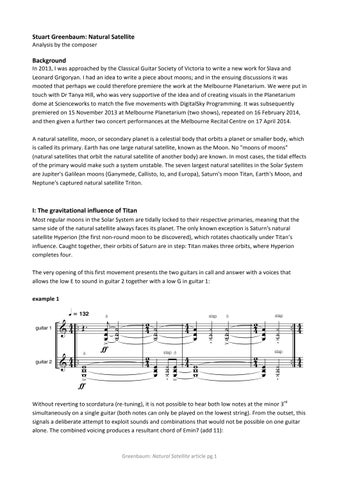
The very opening of this first movement presents the two guitars in call and answer with a voices that allows the low E to sound in guitar 2 together with a low G in guitar 1:
example 1
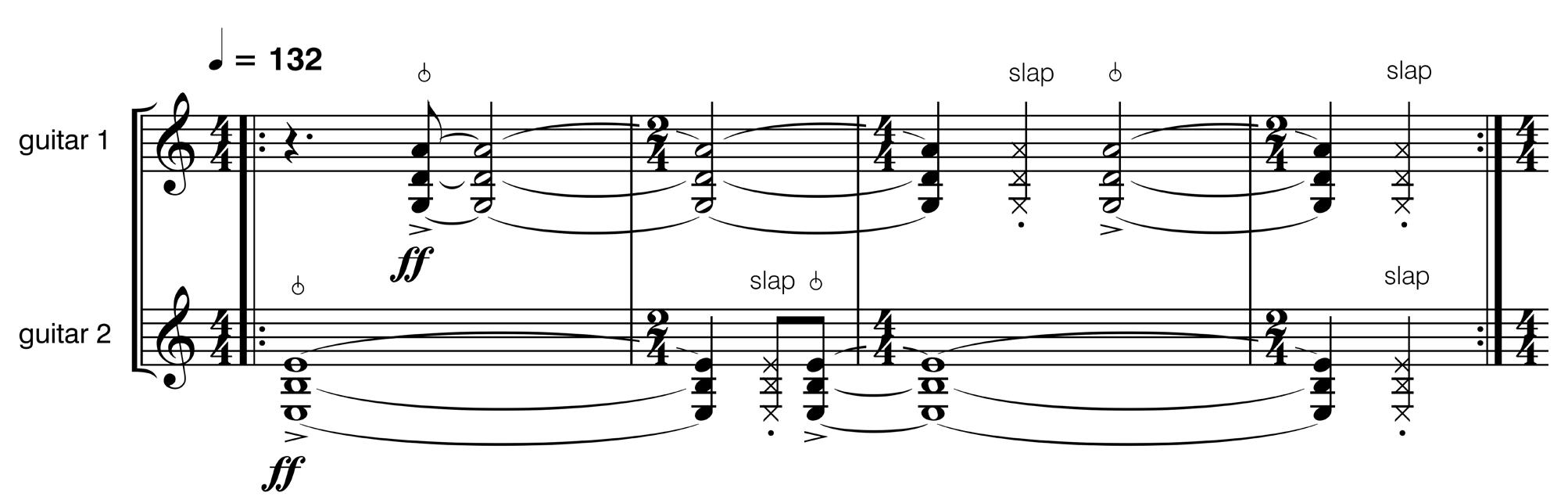
Without reverting to scordatura (re tuning), it is not possible to hear both low notes at the minor 3 rd simultaneously on a single guitar (both notes can only be played on the lowest string). From the outset, this signals a deliberate attempt to exploit sounds and combinations that would not be possible on one guitar alone. The combined voicing produces a r esultant chord of Emin7 (add 11):
Greenbaum: Natural Satellite article pg.1
example 2
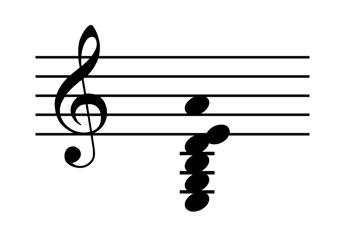
It’s a dark voicing – especially due to the low minor 3rd. Both guitars play this chord with snap pizzicato effect, interspersed with hand slaps muting the strings percussively, creating a highly charged atmosphere. At letters B + F, this material is elaborated further, with increased drumming figures requiring both hands:
example 3
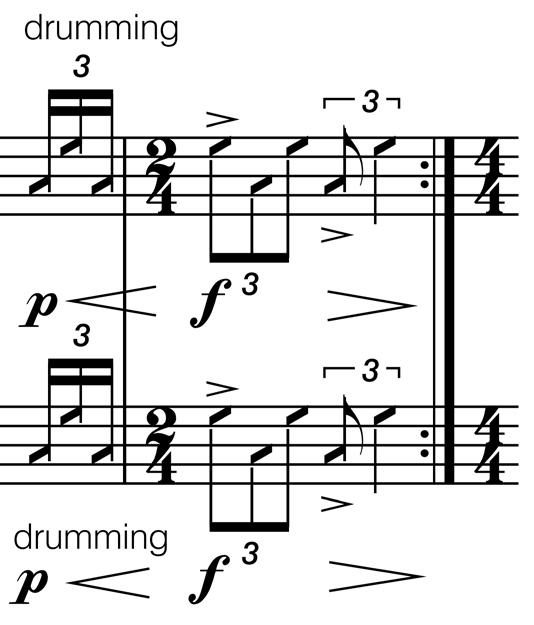
While I had previously used these effects in my solo guitar writing as early as Fairfield Days (1993), I was also influenced by hearing the Grigoryan Brothers recording of Paulo Bellinati’s classic work Jongo (1978) on their album Distance (2009). I didn’t seek to emulate Bellinati’s rhythmic figurations – but having heard these percussive effects in a duo setting was a positive reminder of how it might sound.
At letter A, the guitars come together in unison with a riff in consecutive 4ths. The 5/4 metre was a response to the idea of ‘turning’ and also of gravitational weight. On reflection, the nature of the riff is perhaps somewhere between Deep Purple and Tool:
example 4
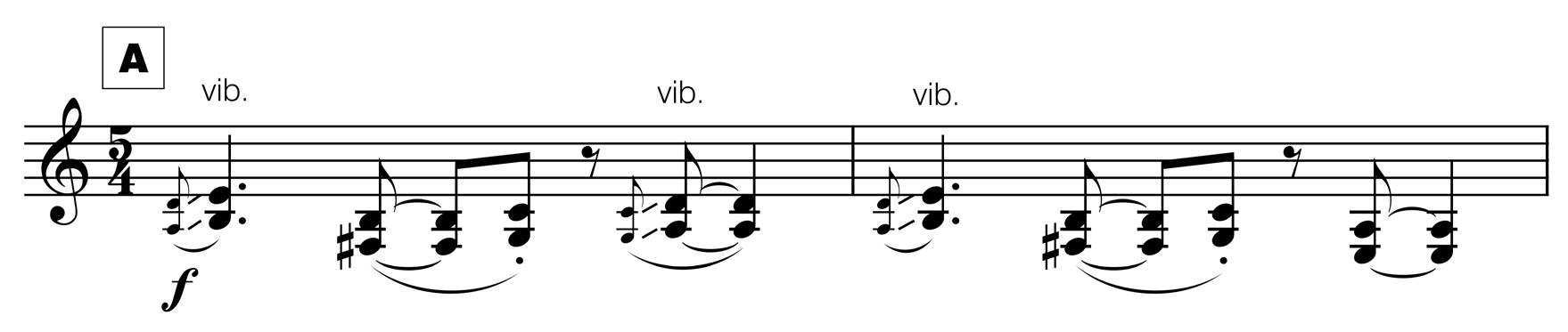
As a teenager, I grew up playing Deep Purple’s Smoke on the Water (1972) – but mistakenly learning that iconic riff in 5ths. Many years later, while arranging it for string quartet, it dawned on me that it is actually voiced in 4ths, Richie Blackmore playing it with very particular use of vibrato, staccato, glissandi and roll offs.
The syncopation outlines a 3+2+2+3 grouping but is intended to be felt against a crotchet reference pulse (thus notated in 5/4 instead of 10/8).
Greenbaum: Natural Satellite article pg.2
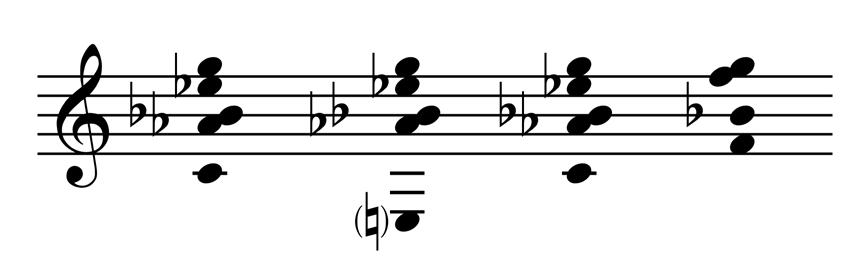
At letter C the mood changes with a cooler, more remote atmosphere. It is set as lyrical, formally phrased melody against harmonic accompaniment that is at turns modal and at times bi tonal. A harmonic reduction of the guitar 2 part from bars 43–50 shows the move into and out of bitonality – Ab belonging to C minor; and its enharmonic equivalent (G#) being the major 3 rd to the low E natural:
example 5
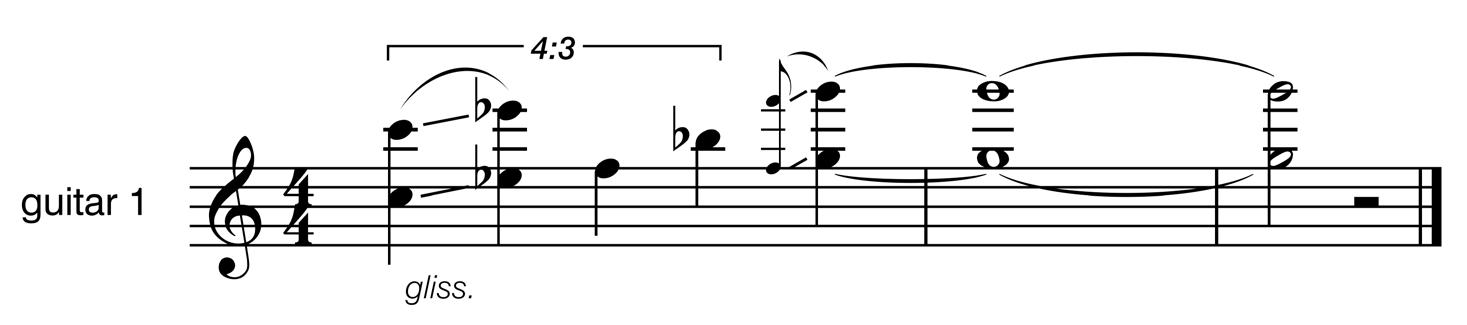
Additionally, the rhythmic feature of 4:3 in the upper melody is a deliberate nod to the 3 orbits of Titan for every 4 orbits of Hyperion:
example 6
Letter D continues in similar harmonic territory outlined in the following sketch:
example 7
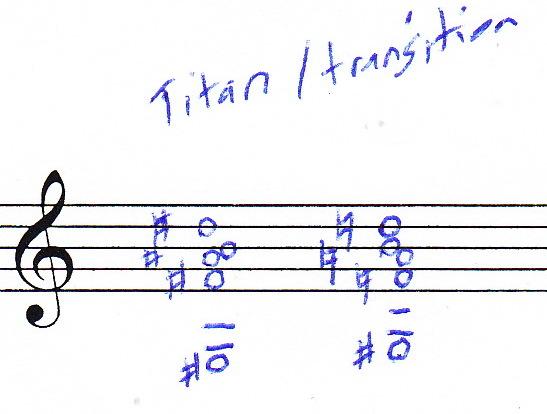
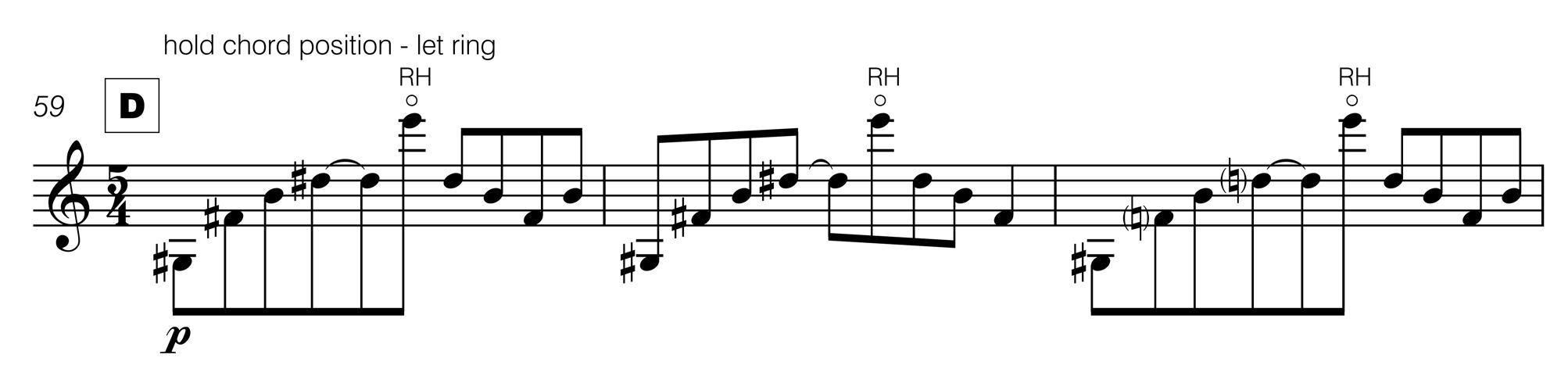
This modal alternation is cast in arpeggios in 5/4 – this time implying two groups of 5/8 to reflect the idea of moons orbiting a planet:
example 8
The structural flow and proportion of the sections within this 1 st movement can be shown in chart form:
Greenbaum: Natural Satellite article pg.3
example 9
antiphonal chords riff + melodic solo antiphonal chords melody and accompaniment arpeggios (rotation) riff
antiphonal chords dissolve
The antiphonal chord sections get a little longer each time, but then shorter again when they are dissolved at the ending – loud snap pizz chords replaced by echoing harmonics. The return of the riff is shorter but deliberately builds to the return of the antiphonal chords.
II: The moons of Jupiter
The planet Jupiter has 67 confirmed moons. The most massive of them, the four Galilean moons, were discovered in 1610 by Galileo Galilei and were the first objects found to orbit a body that was neither Earth nor the Sun. This incontrovertible discovery forever changed our awareness of the Universe. The three inner moons – Ganymede, Europa, and Io – participate in a 1:2:4 orbital resonance.
This ratio of 1:2:4 is embodied in the growing length of section within this 2nd movement:
example 10
section bars function
opening 8 episode 1
A 2 turnaround
B – C 16 episode 2
D 4 turnaround
E – H 32 episode 3
i 8 turnaround
J 11 coda
This table can be further charted to highlight the doubling and quadrupling of the sections:
example 11
episode 1
ch. episode 2
chorus episode 3
chorus
chorus / repeat (coda)
The episodes double from 8 bars to 16 and then 32 bars in length. And the chorus (or turnaround) progression that leads back into the return of these episodes also doubles from 2 bars (letter A) to 4 (letter D), then 8 (letter i) before expanding further, now functioning as a coda.
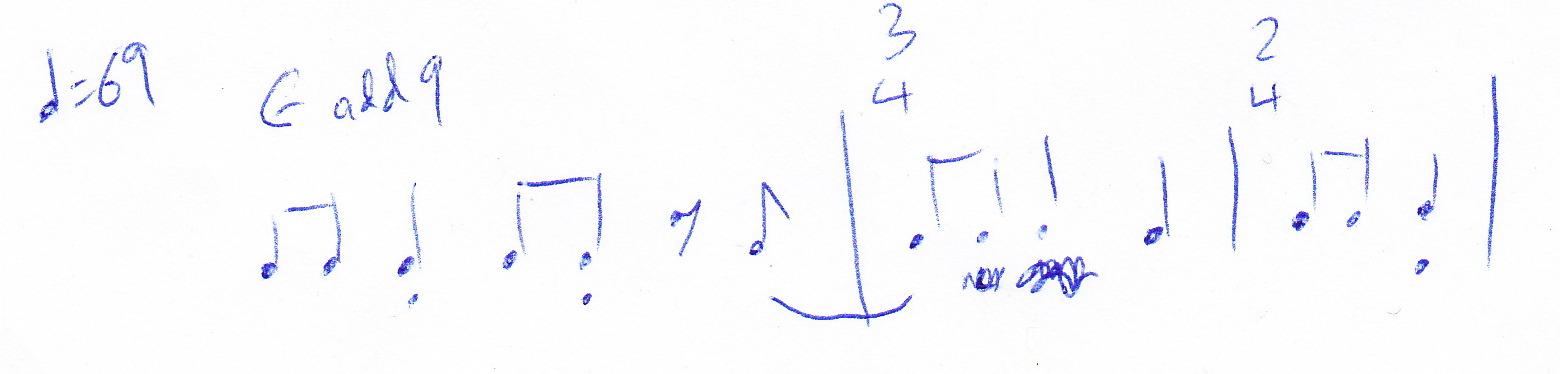
The episodes aim for a calm, warm tone in depiction of the beauty of Jupiter and its inner moons. The approach to melody is at first formally phrased (letter B) and then ornamented (letter C). But from letter F, it takes on a more improvisational feel (though fully written out). The first rhythmic sketch for the episodes (from May 2013) outlined a metrical pattern of 4/4 + 3/4
quavers):
example 12
This was further refined into a rhythmic structure built around a cycle of three bars of 4/4 followed by a bar of 2/4 (28 quavers in all):
example 13
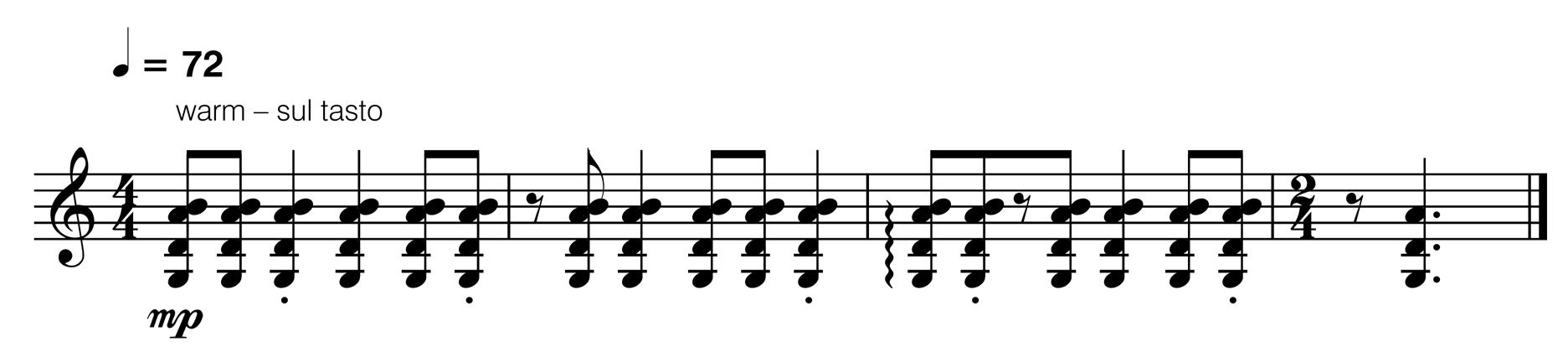
This is simplest for the duo to play, given the melodic phrasing against it. But it is syncopated and phrased asymmetrically – and could also be ‘heard’ in groups of 2 or 3 quavers notated as 2+2+3 / 3+2 / 2+2 / 2+2+3 / 2+3:
example 14

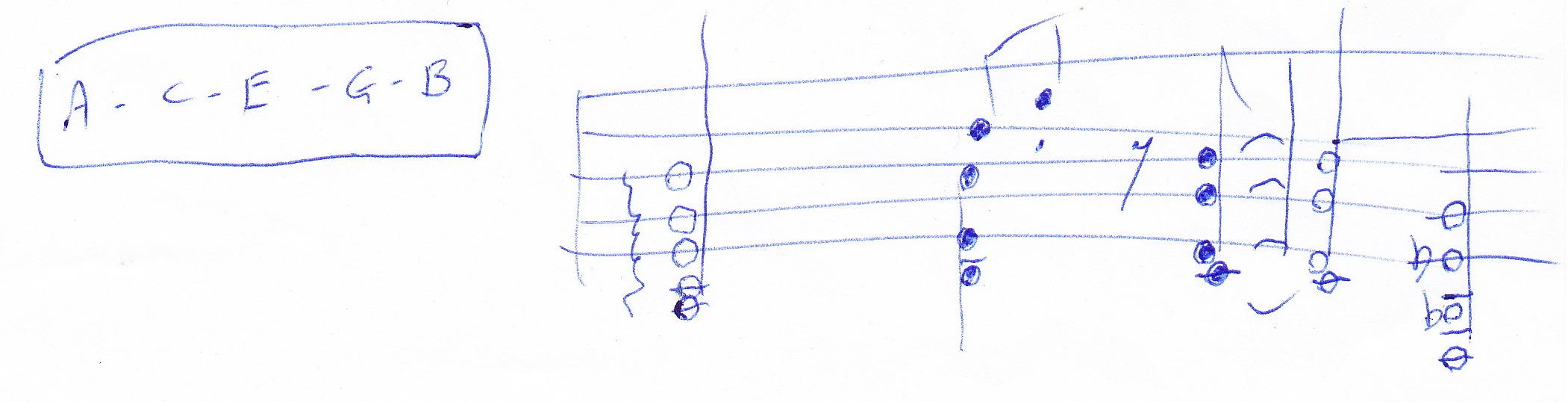
The turnaround progression is a variation on a II – iii – IV – V approach to cadence, with added jazz tones and a suspended chord substitute for the dominant:
example 15
III: Triton Captured Neptune’s largest moon – Triton – is an interloper. Captured from the Kuiper Belt, it is exposed by its orbit that runs opposite to Neptune’s rotation.
This movement opens with unison E’s, played on 5 different strings (including harmonics):
example 16

This sketch was initially pushing the technical possibilities on a single guitar, but is scored antiphonally over two guitars for addition al, subtle timbral richness. The rhythmic values were subsequently doubled and the tempo slowed down (69 doubled would have been 138) but the rhythmic proportions remained intact:
example 17
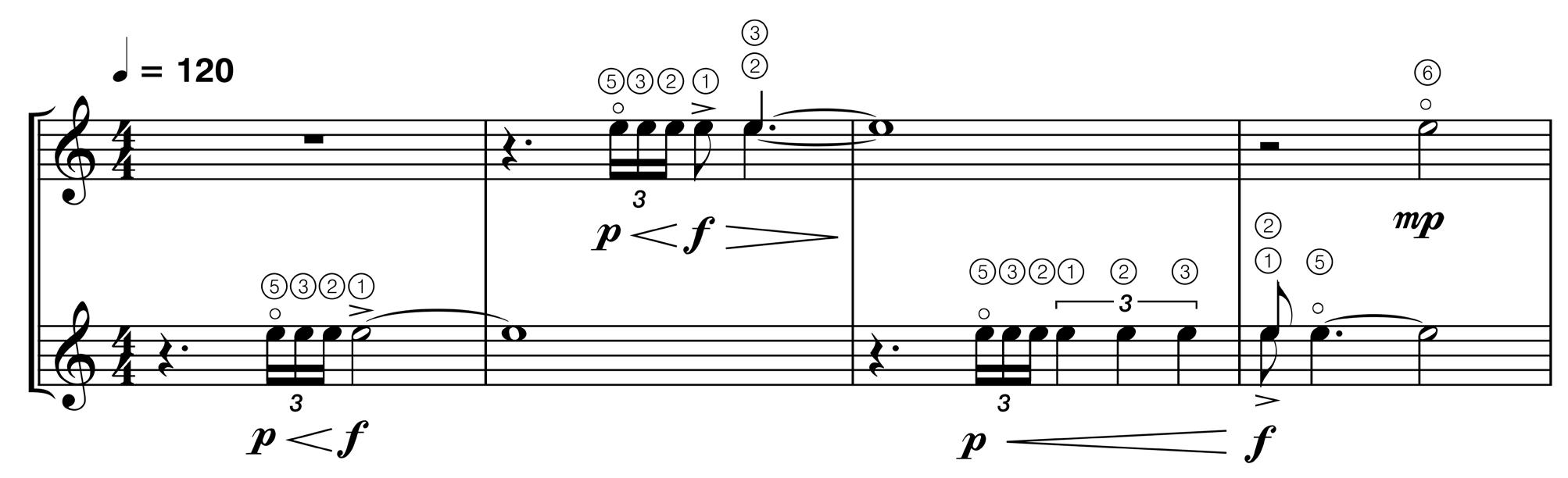
The transparency of this gesture is intended to c apture a sense of remoteness – the strangeness of an opposite orbit. From letter A another pattern is added to the dialogue. The original sketch from February 2013 shows the contour of the pattern:
example 18

The arpeggio contour largely survived, but the voicing – was recast more darkly in G# minor:
example 19

Both patterns (sketch and final) show pitch cell reduction from 5 notes to 2 notes. This is gradually filled in with semiquavers, arriving at bar 52 with a continuous stream of semiquaver arpeggios in both guitars:
example 20
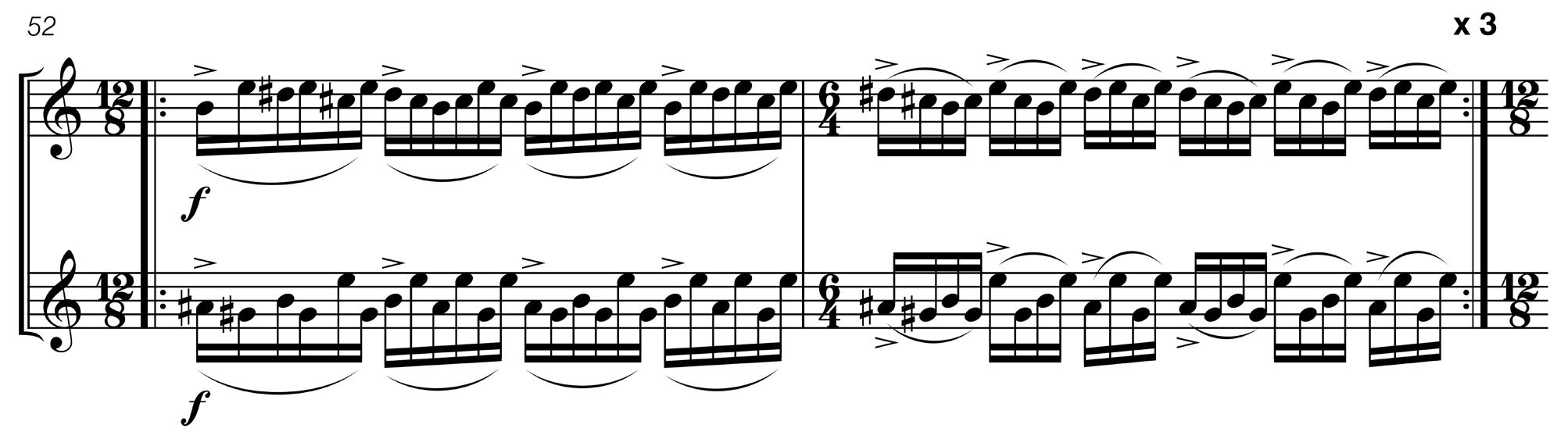
The lower part (guitar 2) corresponds to the 12/8 bar from example 19, the alternating anchor tone being below and then above.
Harmonically, this movement moves between 3 harmonic centres: E, G# + C, all symmetrically separated by major 3rds. The following diagram shows the proportional time spent in these 3 centres:
example 21
Technically, the movement starts and ends on the note E – but this is deceptive. G# forms the harmonic centre of 75% of the movement and the centres of E + C are a diversion, allowing contrast:
example 22
E (14%) G# (75%) C (11%)







IV: Within the rings of Saturn Saturn’s magnificent rings are continually being sculptured by five small shepherd moons – Pan, Daphnis, Atlas, Prometheus and Pandora. Small bodies have been observed within rings, but only a few were tracked long enough to establish orbits.
Greenbaum: Natural Satellite article pg.7
The opening gesture of this movement is essentially a melodic minor scale (with raised 6th and 7th): example 23
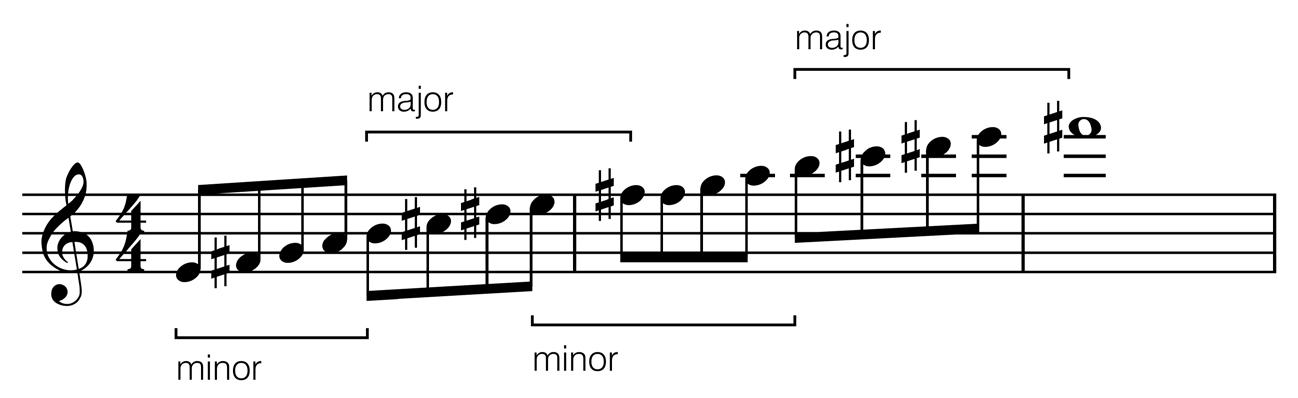
This is designed to conjure an atmosphere of calm mystery – Saturn’s rings perhaps representing the cloaking of detail. The first half of the scale is minor in quality and the second half of the scale is major in quality. This does not constitute bitonality exactly, but it creates an aural atmosphere of ambiguity.
It is written, however, for the two guitars interlocked so that their individual parts are in 3rds, but alternating rhythmically to create the impression of a scale in 2nds. A single guitar could play this; the difference is the resultant reverb, which overlaps in diatonic dissonance: example 24
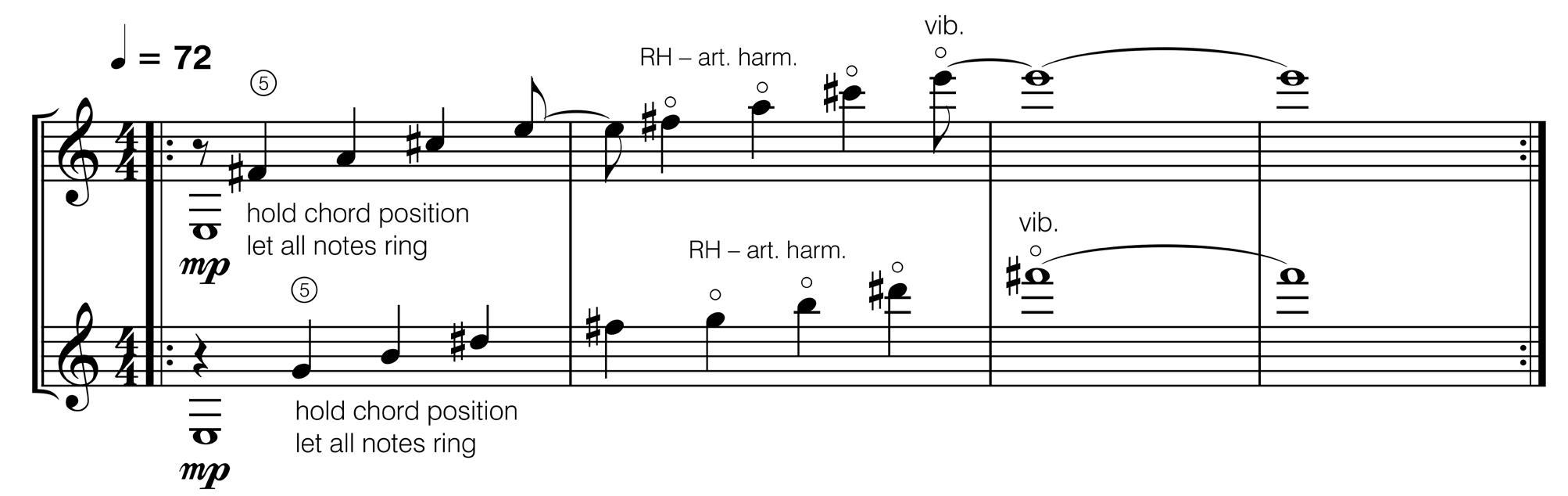
The left han d stays in position – the harmonics plucked with the right hand at the octave as an echo of the chordal pitches presented. The guitar 2 position is the same as that used in an earlier solo guitar work, Polar Wandering (1993). The figuration is different, but the mood is similar, due to the minor 3 rd and major 7th .
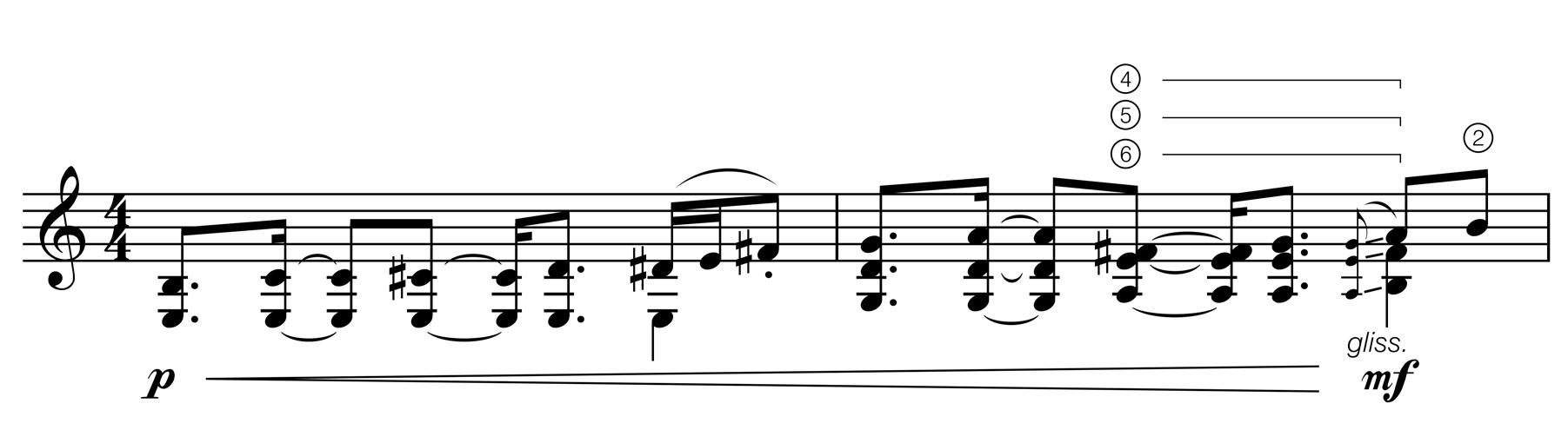
From bar 13, the mood changes with a syncopated rising chromatic line building tension:
example 25
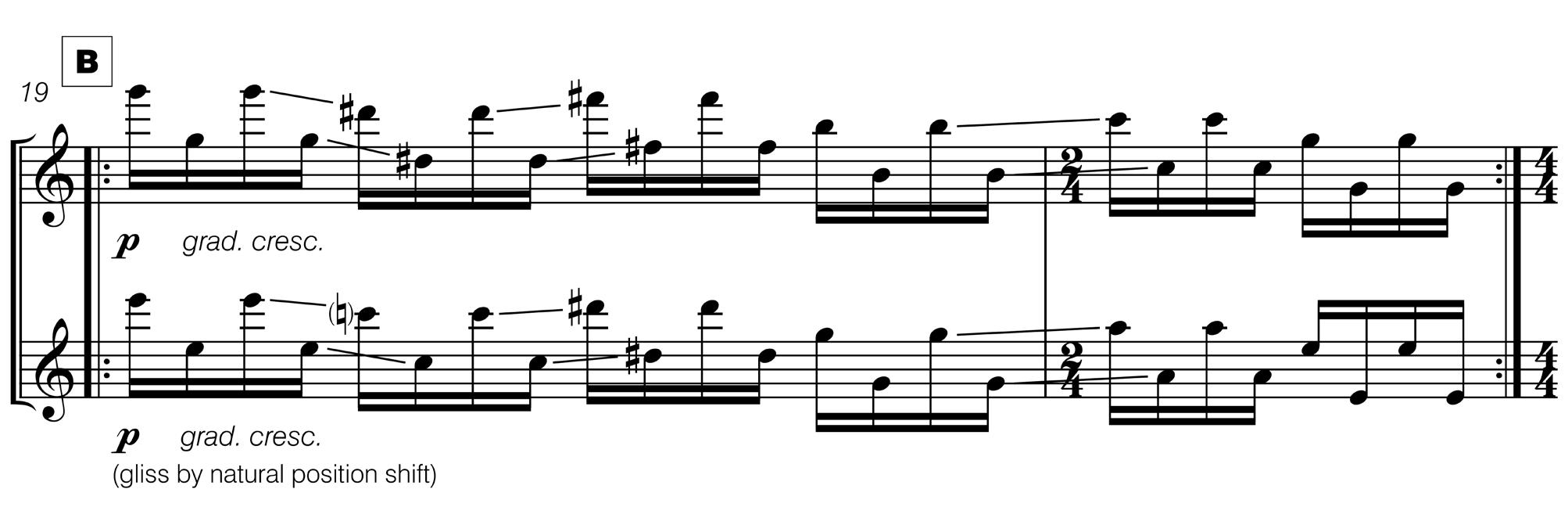
By bar 19, both guitars work in tandem to outline semiquaver octaves in shifting positions marked by glissandi:
example 26
Bar 33 brings back the rising chromatic line and bar 40 the opening ascending scale – thus outlining an arch form:
example 27
While the ordering of material is clearly ABCBA, the return of B is almost twice as long; and the return of A is over twice the original length.
V: Earth’s Moon
The Earth–Moon system is unique in that the ratio of the mass of the Moon to the mass of the Earth is much greater than that of any other natural satellite:planet ratio in the Solar System. Our Moon makes Earth a more liveable planet by moderating our home planet's wobble on its axis, leading to a relatively stable climate, and creating a rhythm that has guided humans for thousands of years.
The opening 4 bars of the final movement set the t one both rhythmically and by energy. The latter is designed to be elated and euphoric – celebrating the moon we know best and see regularly and clearly. The rhythmic form is regular in as far as being locked into a quaver grid – but irregular in predictive syncopation: example 28
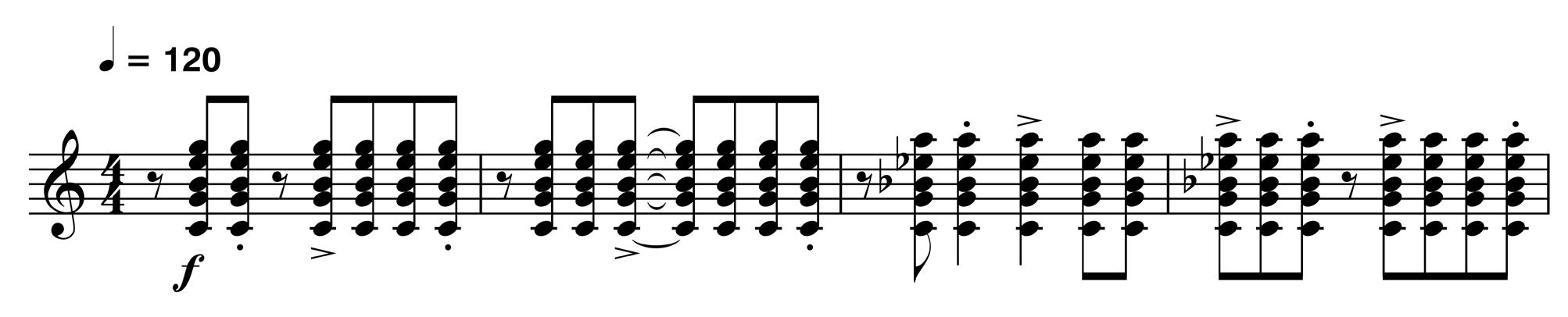
The groups of consecutive quavers are:
with unpredictable rhythmic accents found in The Augurs of Spring, Dances of the young girls from Stravinsky’s The Rite of Spring (1913), the rhythmic sequence is deliberately designed to defy prediction. In contrast to the Stravinsky example, however, this
Greenbaum: Natural Satellite article pg.9
technique is here used to delight rather than unsettle. The harmonic sequence shown above alternates Cmaj7 with Cmin7 (add13).
The entry of guitar 1 at bar 5, locks into the same rhythmic cycle as guitar 2 but adding additional diatonic cluster tones, the only note missing being the 6th degree (A or Ab) from the first chord:
example 29
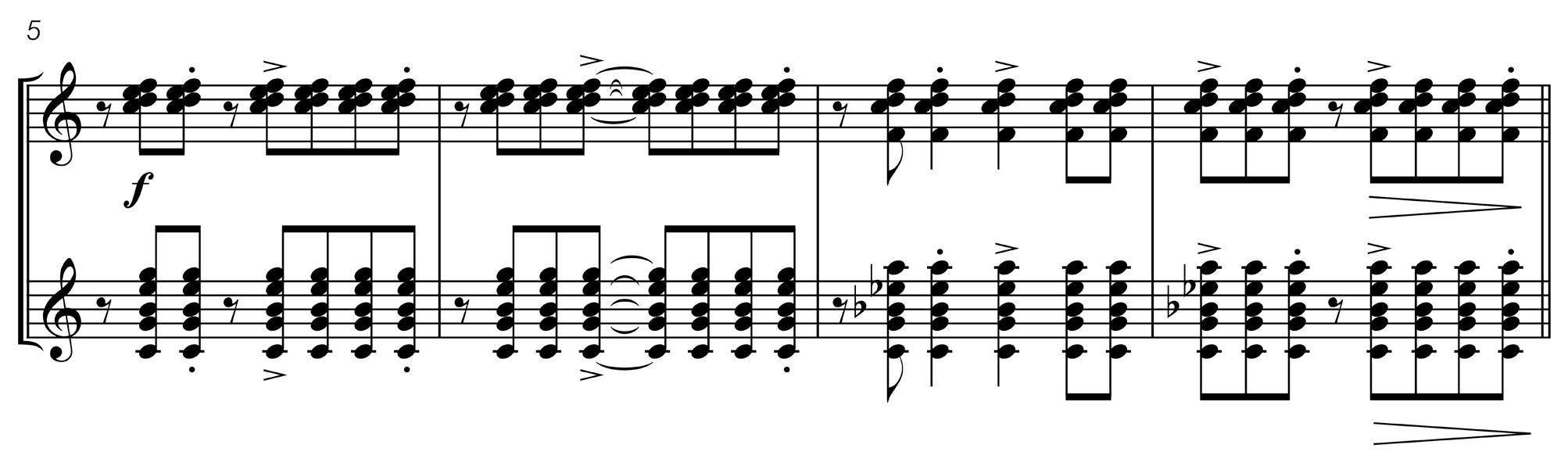
Technically, the resultant chords could be labeled 11 th and 13th chords They were conceived in stacked 3rds for the opening, played by guitar 2. But the entry of guitar 1 at bar 5 shows a different approach – a technical challenge to see how many 2nds can be played simultaneously. 4 adjacent scale tones are idiomatic when using the high open E string and fingered conventionally with the left hand. B and A could technically be added below if additionally fingered by the right hand, though that obviously then compromises how the chord can be played.
Diatonic clustering is common in minimal and post minimal music. It occurs in the music of Steve Reich in the late 1960’s by unison canons at variable rhythmic distances. It occurs in the music of Arvo Pärt from the late 1970’s also through polyphony and resultant voicings – often deliberately held in dissonant unresolved cadences. In the music of Giya Kancheli, diatonic clusters are not necessarily the result of polyphony – more a deliberate voicing from the outset and that approach has certainly been influential on my own music. Here, it is an intersection between that sound and pushing the boundaries of guitar technique. Additionally, the two guitars in combination allow for simultaneous chord voicings of 8 or 9 notes – obviously not possible on a single 6–string guitar.
The ensuing melody at letter A fills the rhythmic gaps with notes – rhythm and melody in hocket, constituting an unbroken flow of quavers: example 30
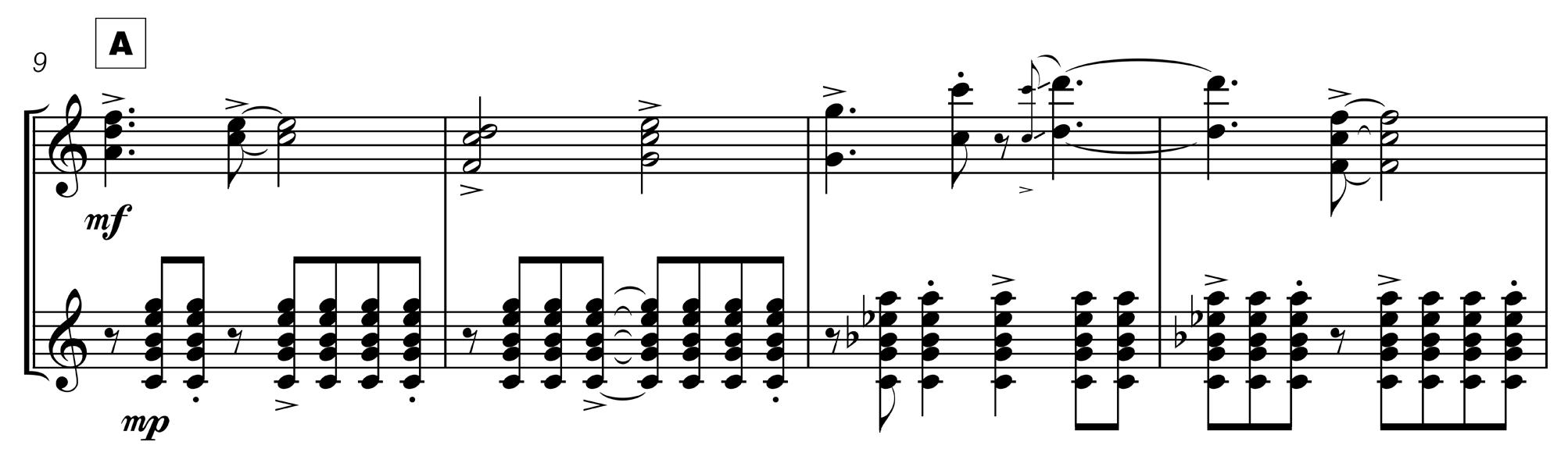
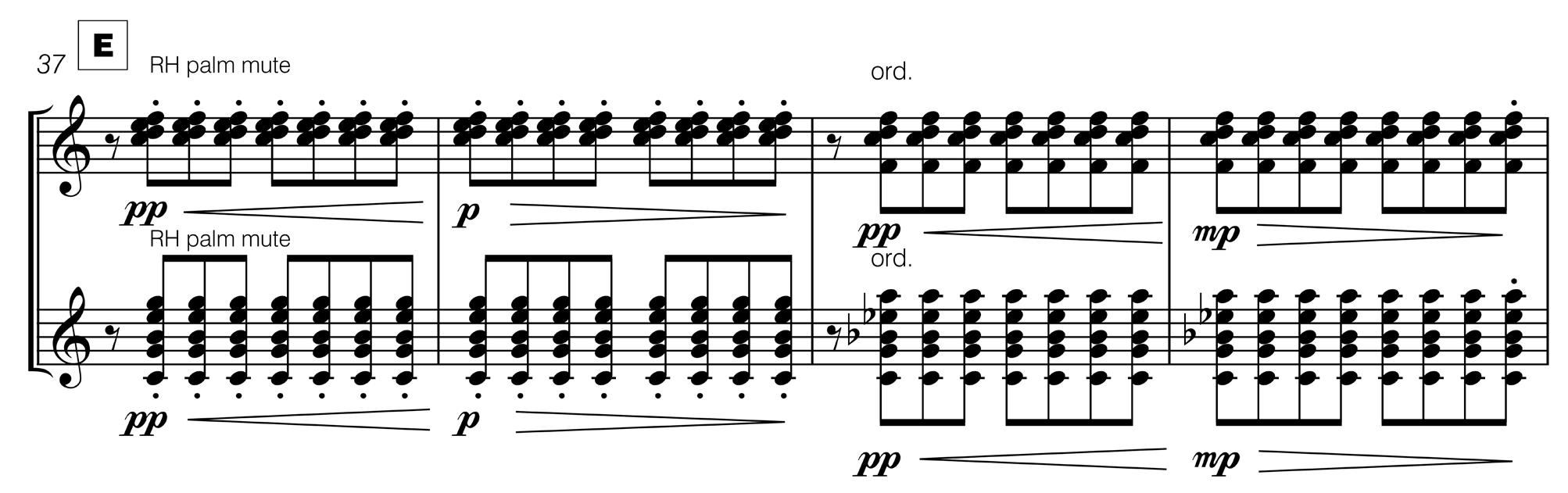
This approach to melody is influenced but contemporary North American jazz – notably Pat Metheny and Lyle Mays. After a bluegrass inspired picking variation at letter B, the opening material recurs leading to a further variation at letter E – the opening harmonic alternation now presented in regular pulsing quavers in crescendo/decrescendo waves influenced by Steve Reich:
example 31
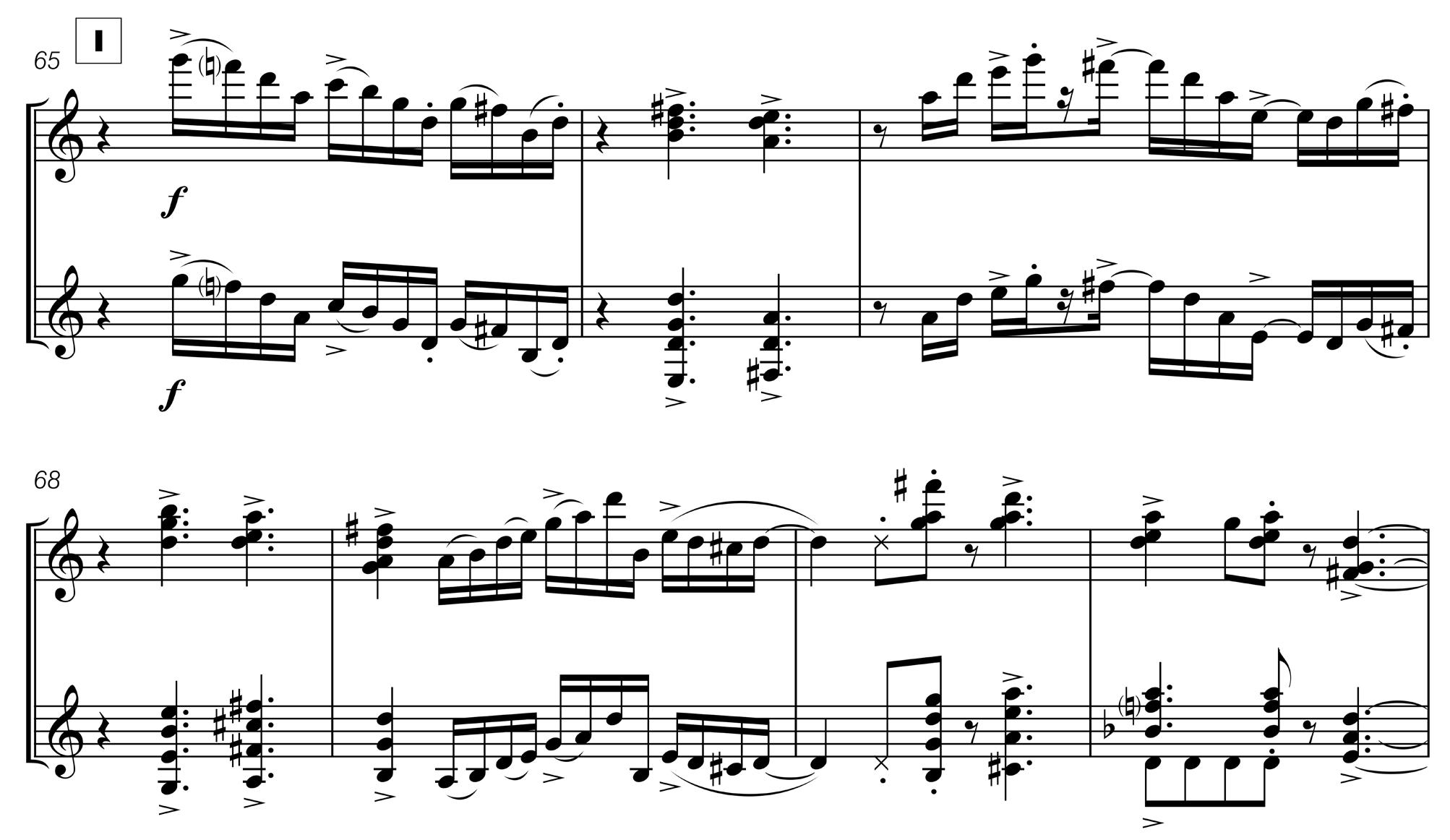
Further variations and modulation ensue, leading to a clearly contrasting motivic utterance at letter I, the two guitars ‘fill’ in rhythmic unison semiquavers – harmonically at the octave, with harmonic punctuation in between:
example 32
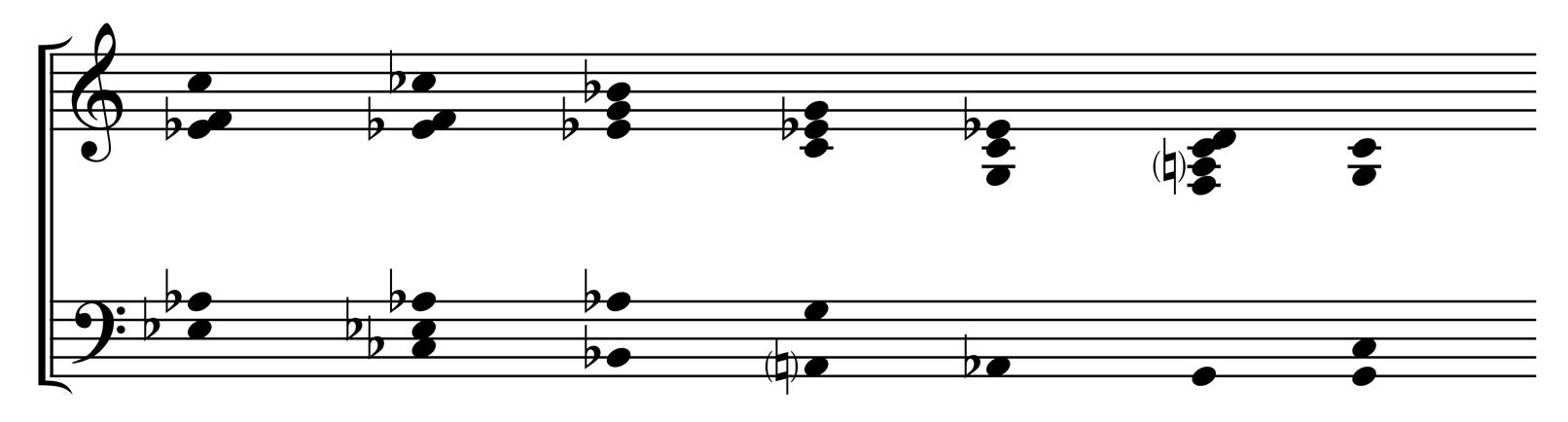
Letter M heralds not only modulation but a faster rate of harmonic change, the falling chromatic progression outlined in the harmonic reduction below:
Greenbaum: Natural Satellite article pg.11
example 33
Letter Q reprises the Reich ian waves of pulsing chords leading to a final summation of all elements in a final brief but surging coda from letter R.
The overall structure of this final movement can be laid out in diagramatic form:
example 34
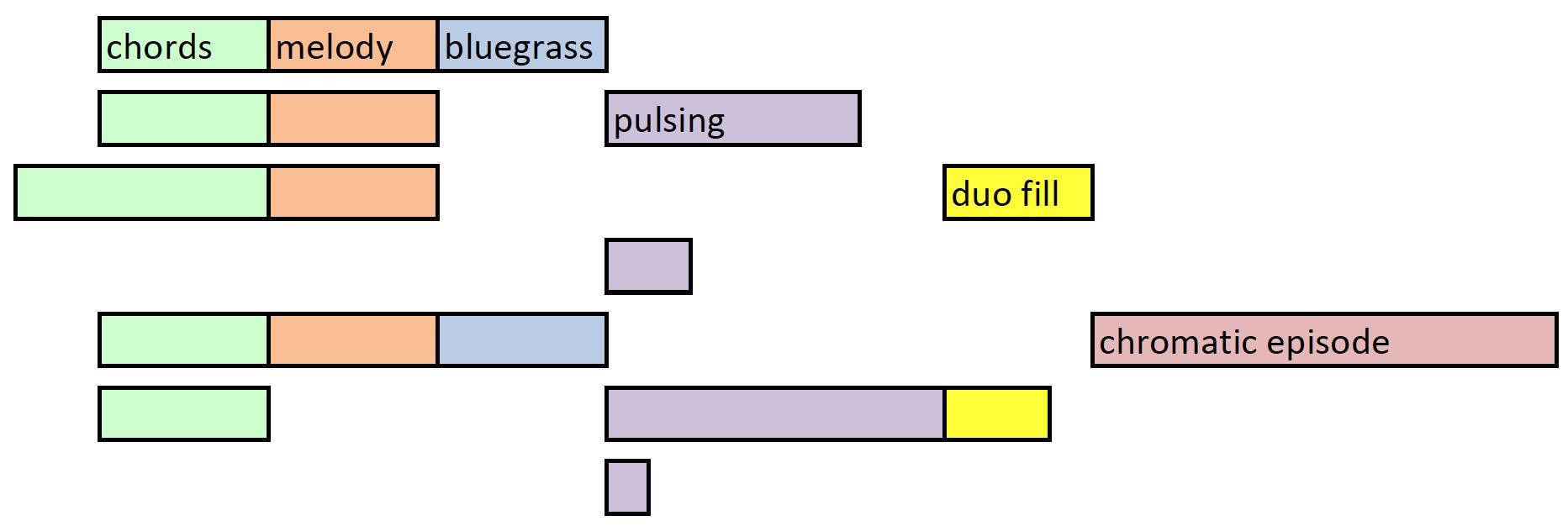
This paradigmatic chart reads left to right / top to bottom (like a book). It shows that the main melody is always 8 bars long and always preceded by the syncopated chords (also generally 8 bars long). The bluegrass variation only happens twice – but always follows the melody. The pulsing sections are variable in length and are structurally unpredictable, following or leading into different sections. At 22 bars, the chromatic episode is the longest section – designed to build tension towards return of the opening chords.
This final movement (especially) shows the influence of multiple genres of music; but the aim was not comparison or juxtaposition (in postmodern fashion). The intention was to create uplifting music that would celebrate Earth’s M oon – not as a distance remote place, but as relatively close and familiar in relation to the other moons in our solar system. In technical terms the aim was (and for me, always is) assimilation. That the disparate influences would be melted down, filtered, perhaps even re purposed with the final result approaching a homogenous musical language.
This is not the first piece I have written about Earth’s M oon. My percussion quartet, Sea of Tranquillity (2004) contem plates the enigmatic notion of Earth’s Moon, which we regularly see, but never touch. And earlier before that, the second section of my large–scale piano solo, Ice Man (1993), depicts the Moon waxing and waning. In fact, much of my output is concerned with the Earth as seen from space and the universe beyond the realm of our own home planet.
Greenbaum: Natural Satellite article pg.12
Article © Stuart Greenbaum, April 2015
Musical terms for reference arch form bitonality
call and answer diatonic cluster dominant substitute paradigmatic analysis
snap pizzicato scordatura turnaround
Works by the composer for reference
The Moon, from Ice M an (1993)
Fairfield Days (1993)
Polar Wandering (1993/1997)
Sea of Tranquillity (2004)
Works by other composers for reference
Bellinati, Jongo (1978)
Deep Purple, Smoke on the Water (1972)
Kancheli, Midday Prayers (1991)
Metheny/Mays, Cross the Heartland (1980)
Reich, Piano Phase (1967)
Stravinsky, The Rite of Spring (1913)
Tool, Schism (2001)
For more information go to: www.stuartgreenbaum.com