Stuart Greenbaum: Dance Music for Concert Halls Analysis by the composer
Commission In 2011, I was commissioned by Andrew Johnston to write a piece to celebrate the 80th birthday of his mother, Stephanie Lillian Johnston. Herself a pianist, the musical connections trace back through her father, Ray Dean (violinist, saxophonist & band leader), her mother Isabelle Dean (pianist & cellist) and sister Carol Dean (clarinetist). The new work was consequently scored to reflect this family music history, and was to be of around 20 minutes duration. Ensemble Liaison (clarinet, cello and piano) were approached and agreed to give the premiere with visiting Serbian violinist, Nemanja Radulovic, completing the quartet of instruments. The premiere performance was given at the Melbourne Recital Centre (Elizabeth Murdoch Hall) on 20 September 2012.
Concept
There is a form of ‘dance music’ in the classical tradition whose purpose does not require any dancing. And I often wonder what it means, therefore, to listen to dance music while sitting still. Of course, there’s an inner dance that lifts and moves the spirit and I have always been attracted to music of any age or genre that does that.
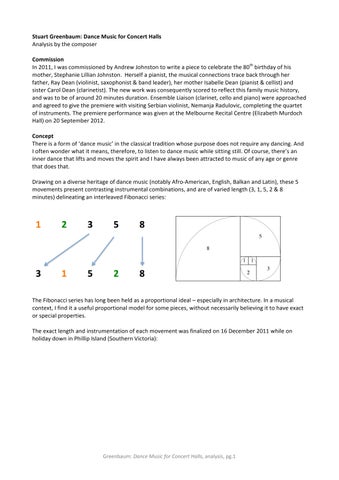
Drawing on a diverse heritage of dance music (notably Afro American, English, Balkan and Latin), these 5 movements present contrasting instrumental combinations, and are of varied length (3, 1, 5, 2 & 8 minutes) delineating an interleaved Fibonacci series:
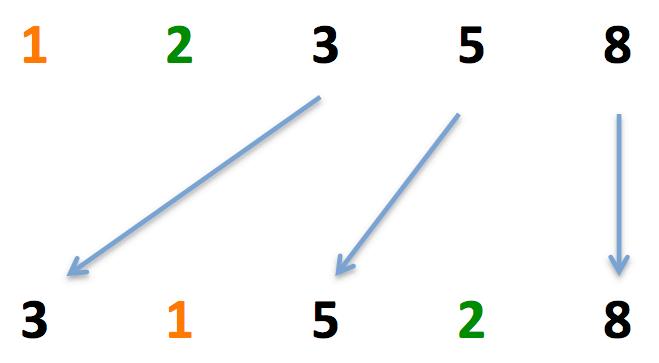
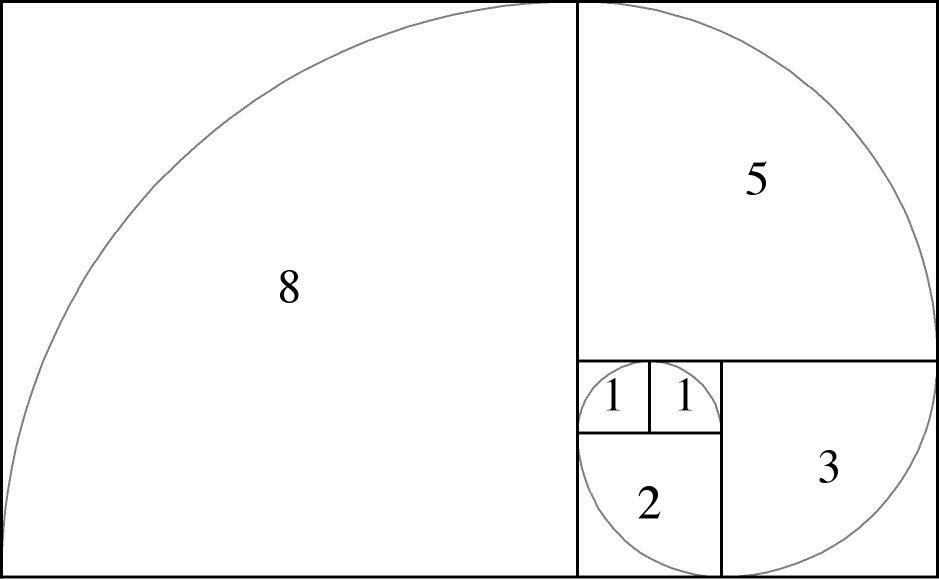
The Fibonacci series has long been held as a proportional ideal – especially in architecture. In a musical context, I find it a useful proportional model for some pieces, without necessarily believing it to have exact or special properties.
The exact length and instrumentation of each movement was finalized on 16 December 2011 while on holiday down in Phillip Island (Southern Victoria):
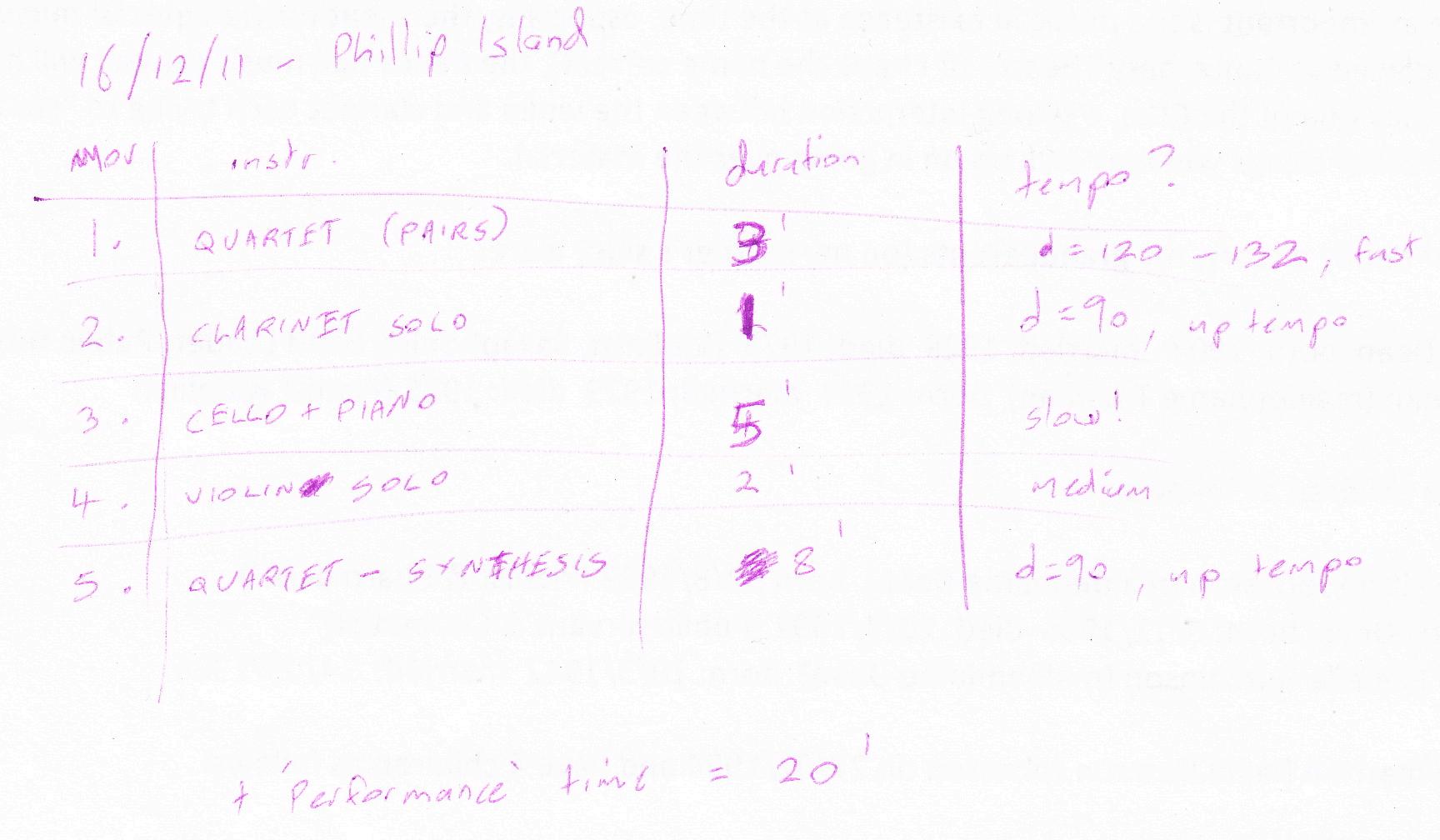
Technically , 3+1+5+2+8 = 19, though I was confident that in performance the piece would be closer to 20 or 21 minutes in duration. But at the planning stage, I attempted to adhere closel y to these proportions on paper.
1. Pairs / Doubles
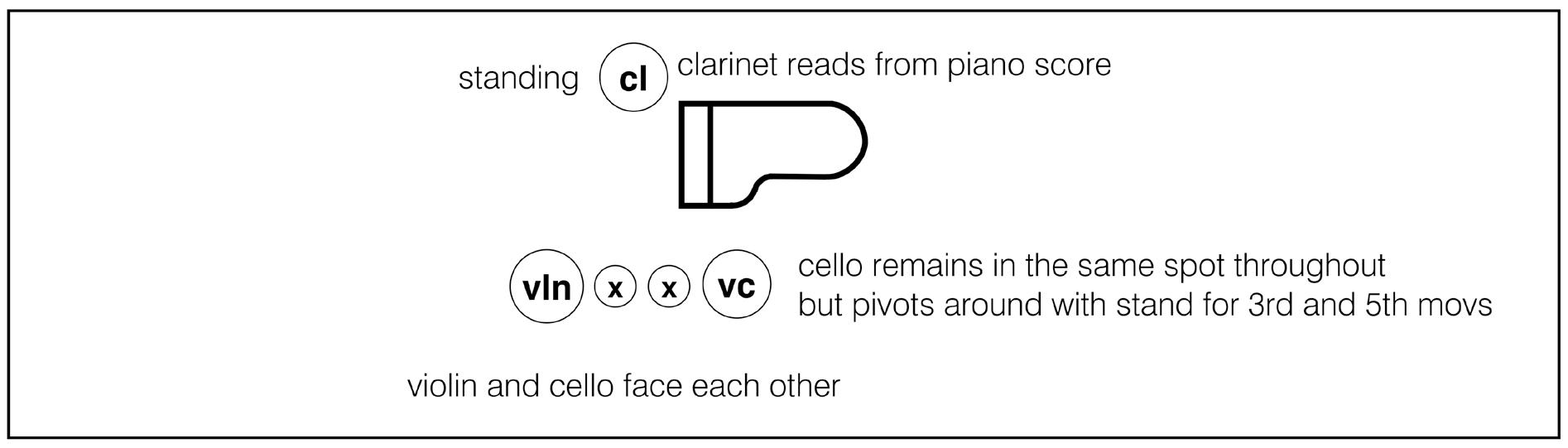
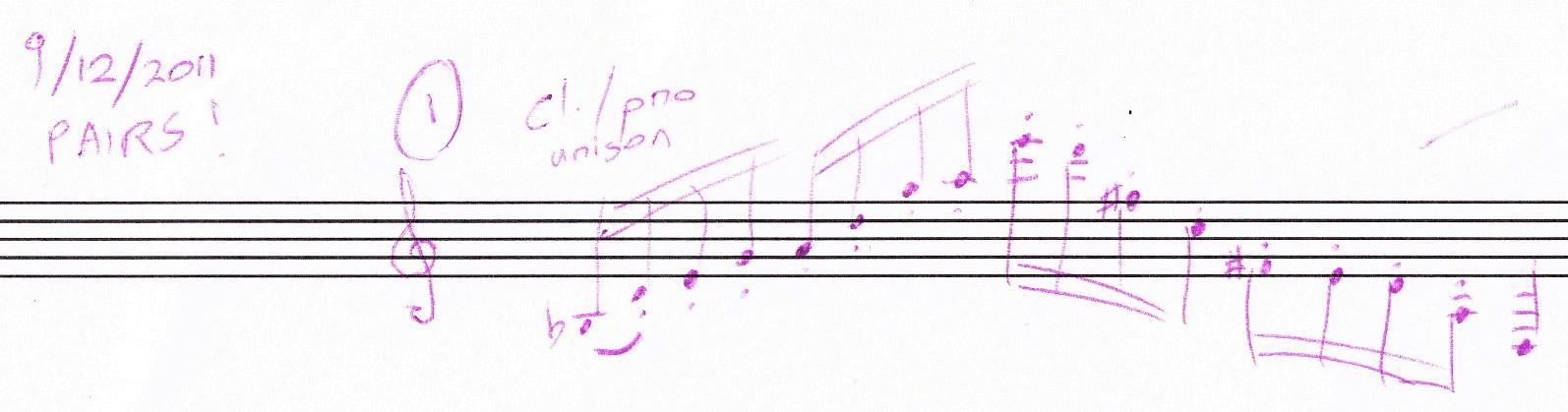
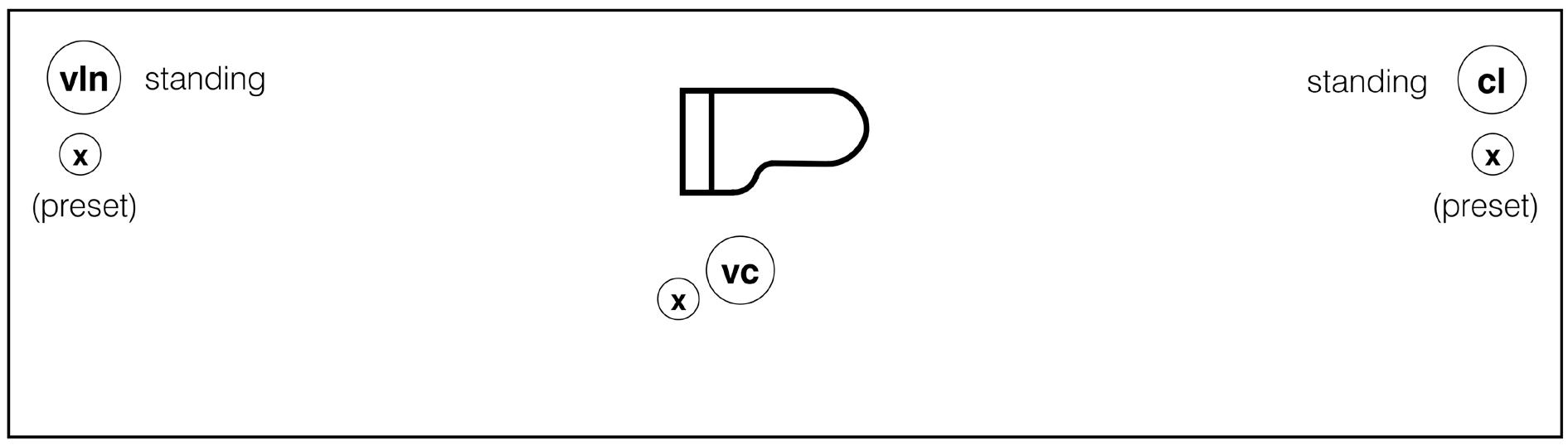
The opening movement, Pairs / Doubles, is driven by antiphonal relationships. The clarinet actually stands next to the pianist and reads off the piano score (as a nod to chamber music played in the home), both playing together in unison:

It’s effectively a monophonic line influenced by be bop styles. It implies harmonies without ever being chordal by texture. The pitches and interlocking contour are taken from a n earlier hand sketch made at the piano on 9 December 2011:
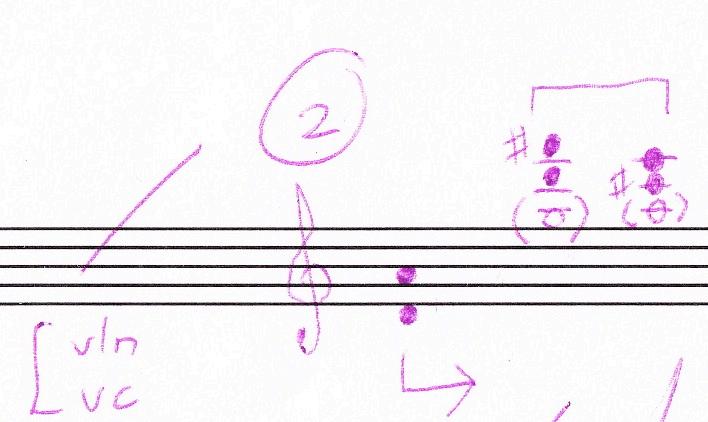
The violin and cello set up facing each other and respond with th eir own contrasting material based on a melodically falling 3rd against a perfect 5th on open strings to exploit natural resonance:
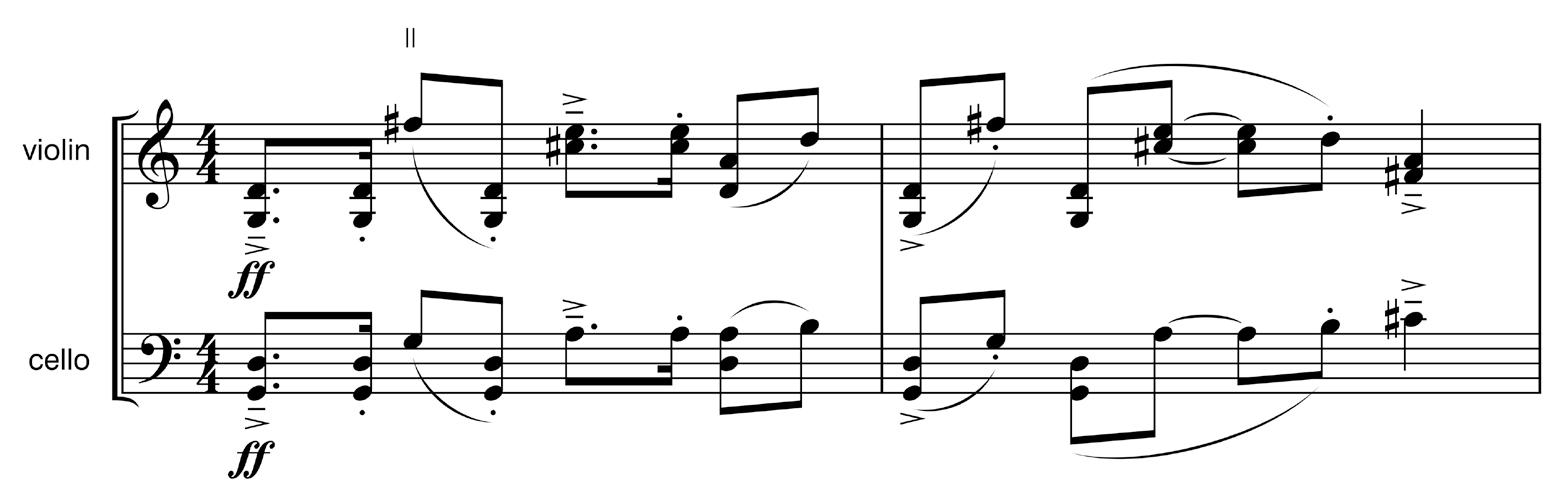
This in turn converted into a 2–bar pattern in a funk rhythm. They are also playing in rhythmic unison but the double stops and vertical combination are more harmonically developed:
Having established the two separate ‘pairs’, the pairs then double up as a quartet at bar 8 to present a 3rd idea (the first tutti statement):
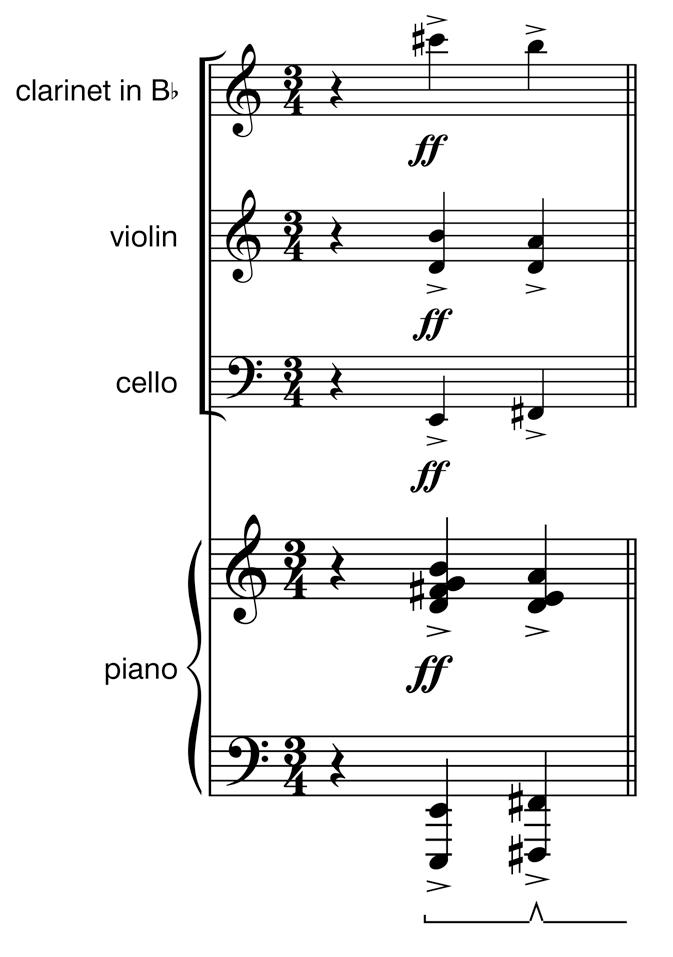
This is fully homophonic but only giving a glimpse – 2 chords – of the sequence that drives the final section of the movement. The sketch below reveals the full intended chord sequence, including the important idea of the gesture starting with a crotchet rest – as if catching a breath before letting it all out.
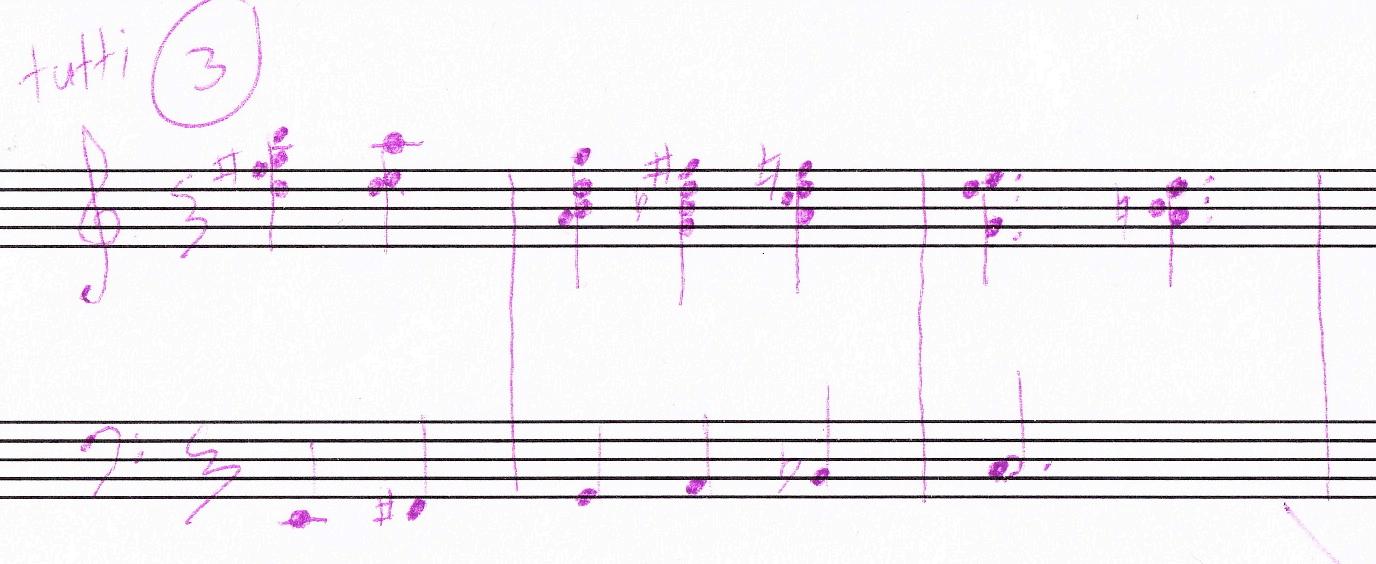
The sequence notably features contrary motion in the outer parts – collapsing inward. The chords are voiced as extended jazz chords in relation to a harmonic centre of D (allowing modal alternation):
Emin9
Dadd9/F#
Gadd9
A13 (b9, no 3rd)
Bbmaj9
Cadd9
Cmaj9 (add13, no 3rd)
The 3rd bar also shows a hemiola grouping, which is exploited in the final section. Scored for the full quartet, the chord sequence is revealed at letter K:
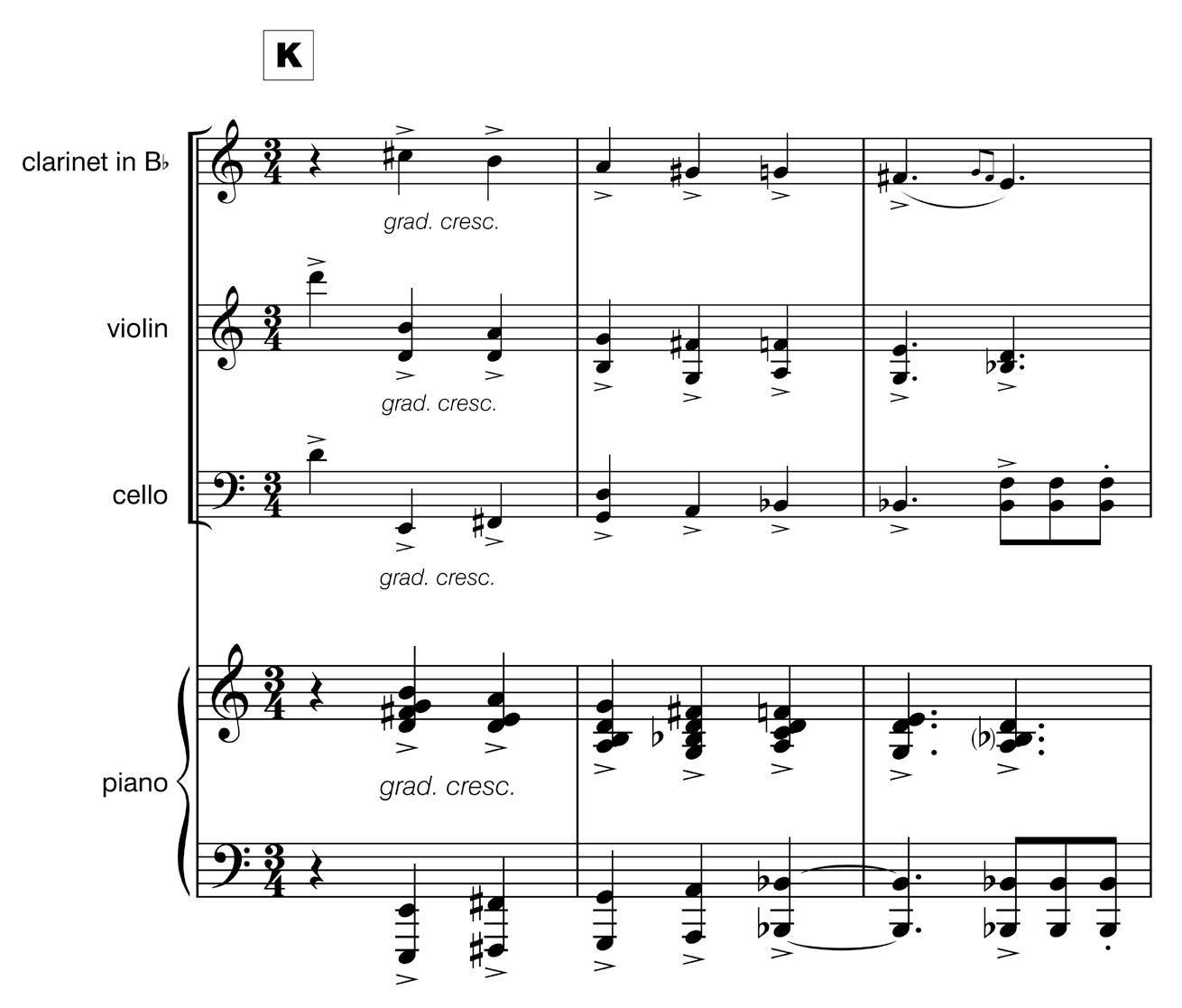
This progression references a few bars from a n earlier piece of my own, 7 or 8 to be in by 9 (Études for Daydreamers, 2006). The chords are different, but the shape and the idea are clearly connected. That work, in turn, was likely influenced by hearing contemporary American jazz (perhaps Mike Brecker). It’s important to note that this is not idle copying (of my own work, or that of others). The early stages of musical conception don’t occur in a vacuum – we belong to traditions. I have to trust that I am able to take these semi conscious references as springboards into something new.
In any event, the revelation of the full 7–chord progression is deliberately withheld at the opening, and the expansion from to 2 chords up to 7 chords is also disguised in order to surprise expectation:
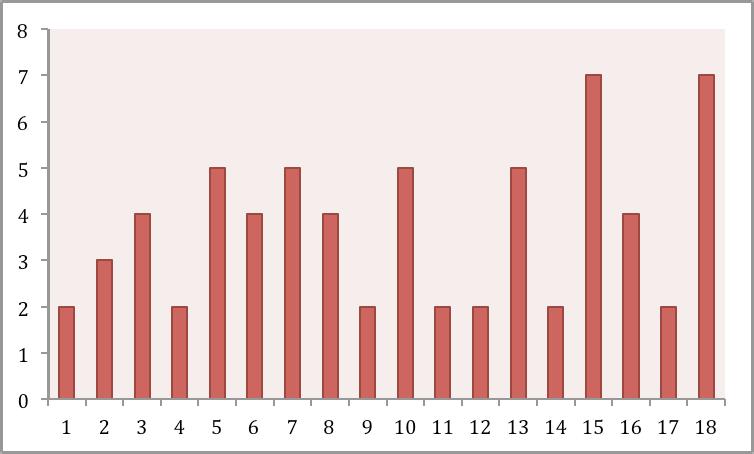
This graph shows 18 appearances of the sequence across 8 sections of tutti chords (the final 10 appearances are merged into a single extended section).
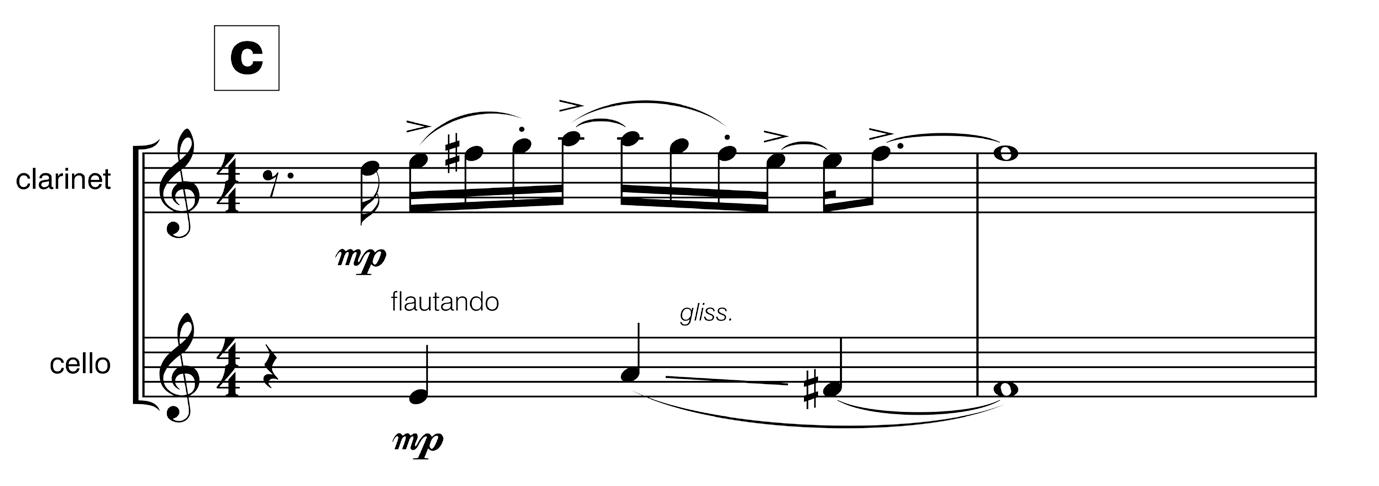
These 3 ideas (be bop line, funk pattern and tutti chords) are twice broken up by a 4th idea ‘D’ which swaps the pairing so that the clarinet and cello work together in heterophony (example shown in C):
and the violin answers melodically over sustained piano chords:
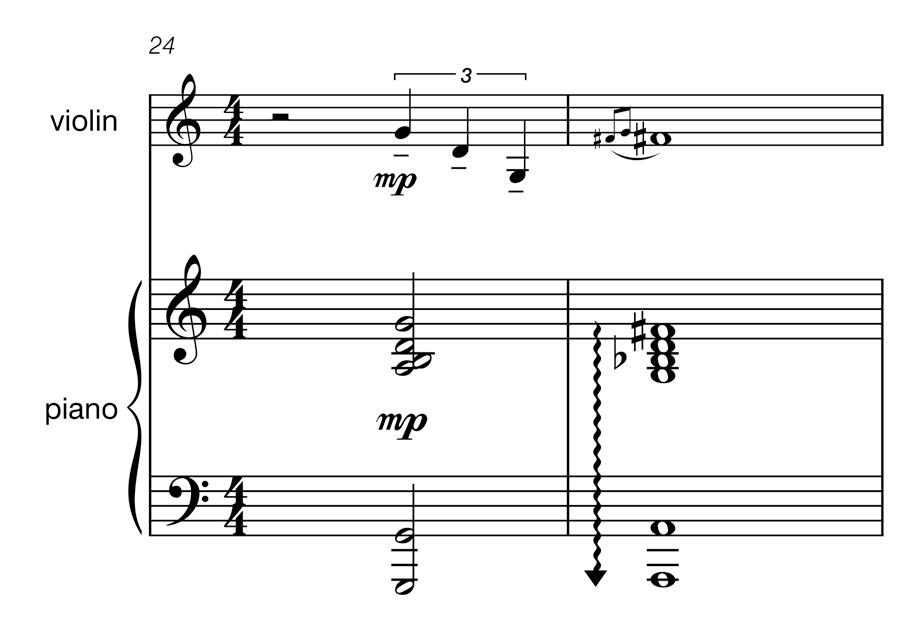
Both ‘new’ pairings are dovetailed antiphonally to create a lyrical contrast to the starkly juxtaposed scoring of the first 3 ideas. This new section clear creates a change in mood, somewhat akin to an oasis in the middle of a barrage of alternating, highly charged fragments. The tempo is the same, but the pulse moves
to more of a half time feel (minims instead of c rotchets). In all the structure of the 1st movement can be proportionally expressed as follows:
The second system of this graph shows an obvi ous recapitulation of material, but there are subtle transformations. The ‘be bop’ lines (A, green) increasingly feature octave disposition (especially in the piano) that open up the registral space. The funk rhythms in the violin and cello (B, blue) are rhythmically identical, but the open strings are shifted from a subdominant function (G+D) to a tonic function (D+A).
The third system of the graph reveals that the tutti chords (C, red) have changed from being momentary interjections into being a sustained section in its own right. The final ‘E’ section, takes the final chord –Cmaj9 (add13, no 3rd) – and repeats it in quavers, building to a sudden offbeat ‘cut off’ ending.
2. Interlude
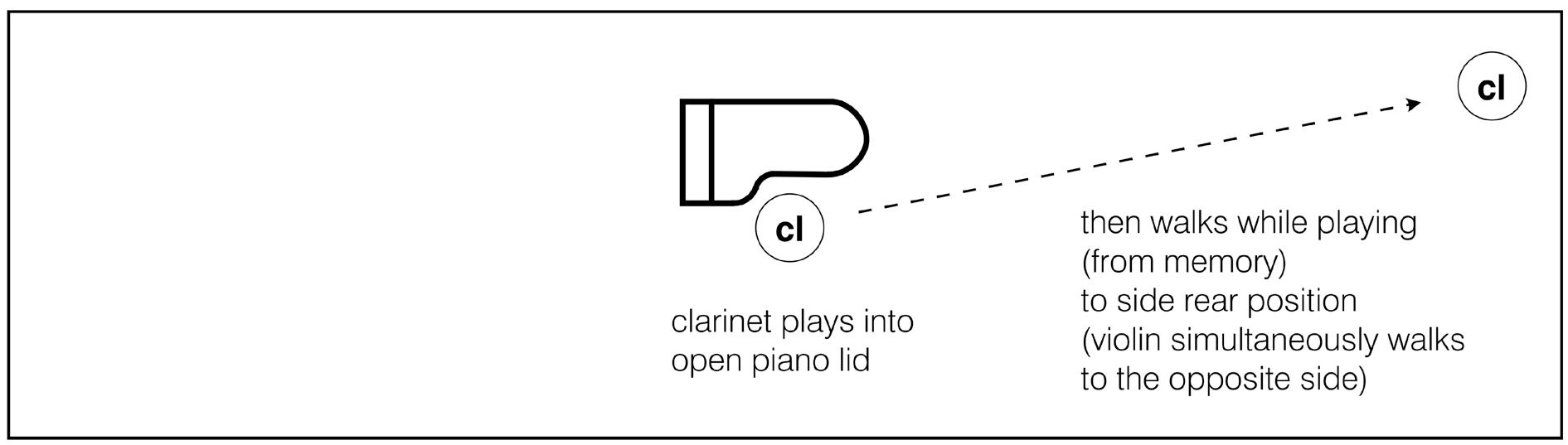
Having decided in advance the instrumentation and duration of each of the 5 movements, the idea for how to make a 1 minute clarinet solo work presented itself:
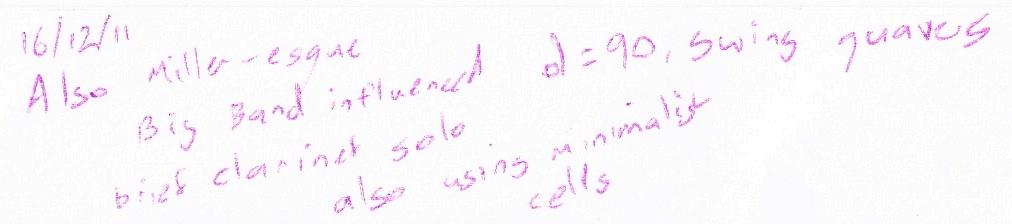
Using swing era jazz feel as a starting point, I composed the following two bar motive at a more moderate tempo:
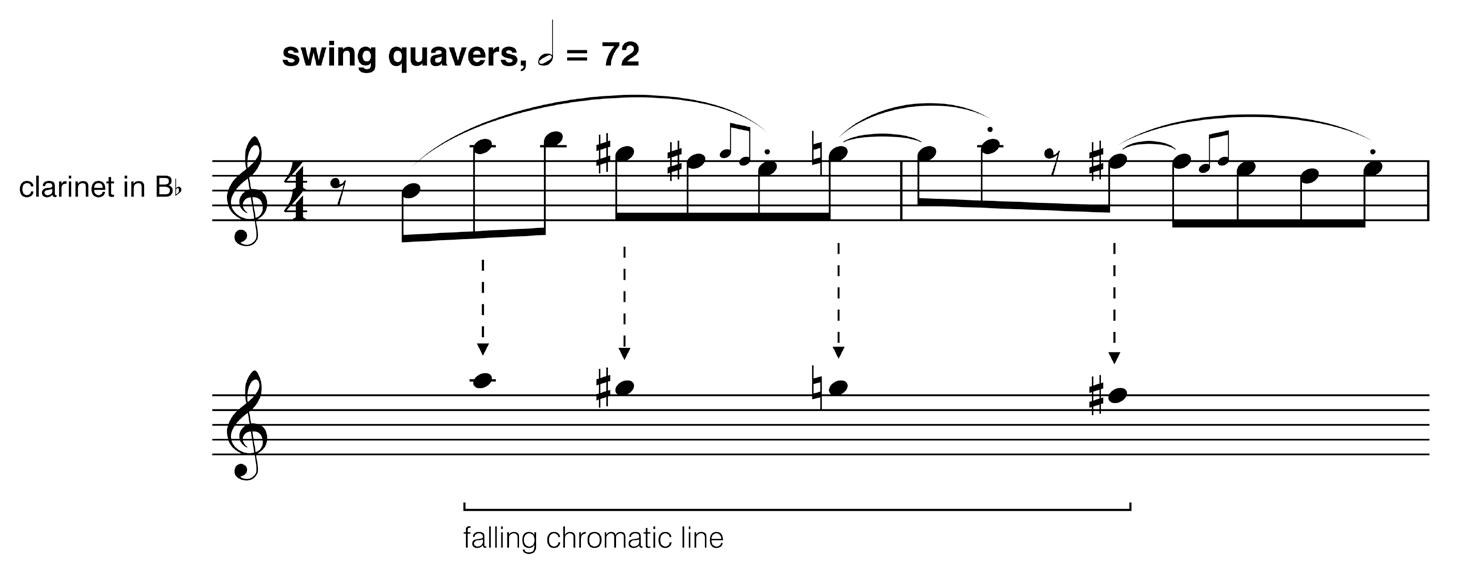
It starts and ends on offbeat quavers and features a falling chromatic line (A–G#–G–F#) as read by the Bb clarinet (and can also be found in the middle of the 7–chord sequence form the 1st movement). This forms the second half of the Interlude, played by the clarinettist while wandering off to the side of the stage (as if practicing alone). Small variations of octave displacement, grace notes and ‘straight’ feel help to keep the 2–bar loop engaging; but it is essentially a minimalist loop designed as a ‘dissolve’ or segue into the following movement.
The first half of the Interlude is much more spacious:
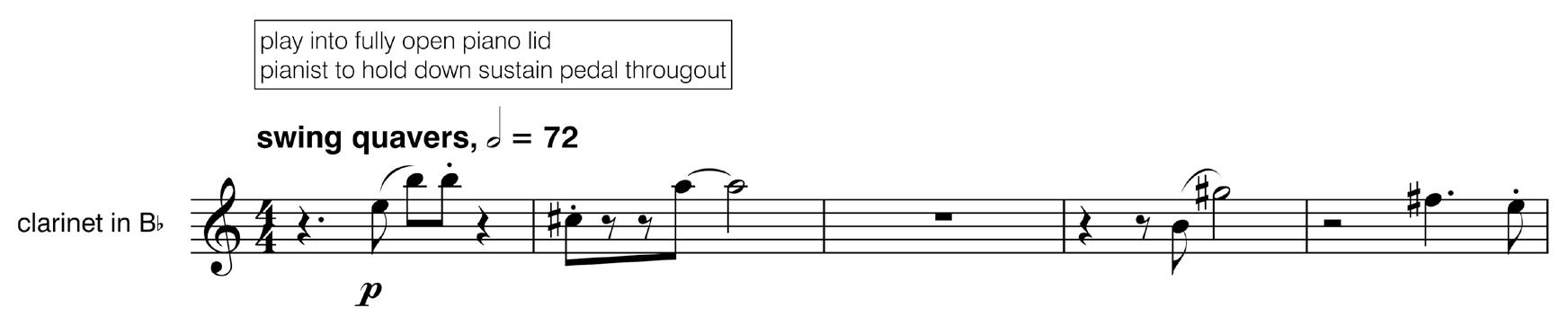
This is deliberately designed to take advantage of the sympathetic resonance of the piano (sustain pedal down), which literally acts as a sounding board for the clarinet’s notes which are played into it.
In concert sounding pitch, the Interlude might best be described as ‘in D’, though it utilises the major and minor 3rd equally and the same can be observed for the 6th and 7th degrees of the scale (modal alternation). The only two chromatic pit ches not sounded in this movement are the minor 2nd and the tritone (arguably the two most distant chromatic intervals in tonal terms).
3. Serenade
The 5–minute Serenade is the slow centre of the work and in essence is a duo for cello and piano (though the violin and clarinet play a distant cameo mid way through). I had in mind a slow compound time (perhaps 9/8) together with the use of duplets (hemiola). A reference point in this regard was a solo piano work of my own (Ice Man, 1993), and specifically the section, The Moon . Further to this, in hindsight it is
possible to locate a number of what might best be described as ‘largo’ or ‘adagio’ movements from my own work:
Dignity (from Ice Man), 1993
Sonata for Alto Saxophone and piano (2nd movement), 2001
Shadow of an Empty Cowl (from my first opera, Nelson), 2005
Another Thing Finished (from All those ways of Leaving ), 2009
These in turn surely owe a debt to a particular canon of emotional slow movements in major keys such as:
Schubert, String Quintet in C major (1st mov), 1828
Elgar, Nimrod, Enigma Variations , 1899
Rachmaninoff, Piano Concerto No.2 (2nd mov.), 1900
Barber, Adagio for Strings, 1936
Perhaps, the closest point of reference here is the Elgar. There is certainly an ‘English’ reserve to Ni mrod –an exterior calm and dignity which does not fully supress the emotion that lies beneath. English culture does not necessarily have a mortgage on this (either in life or in art), but Nimrod arguably defines it quintessentially in musical terms.
The structure of the Serenade was conceived in December 2011:
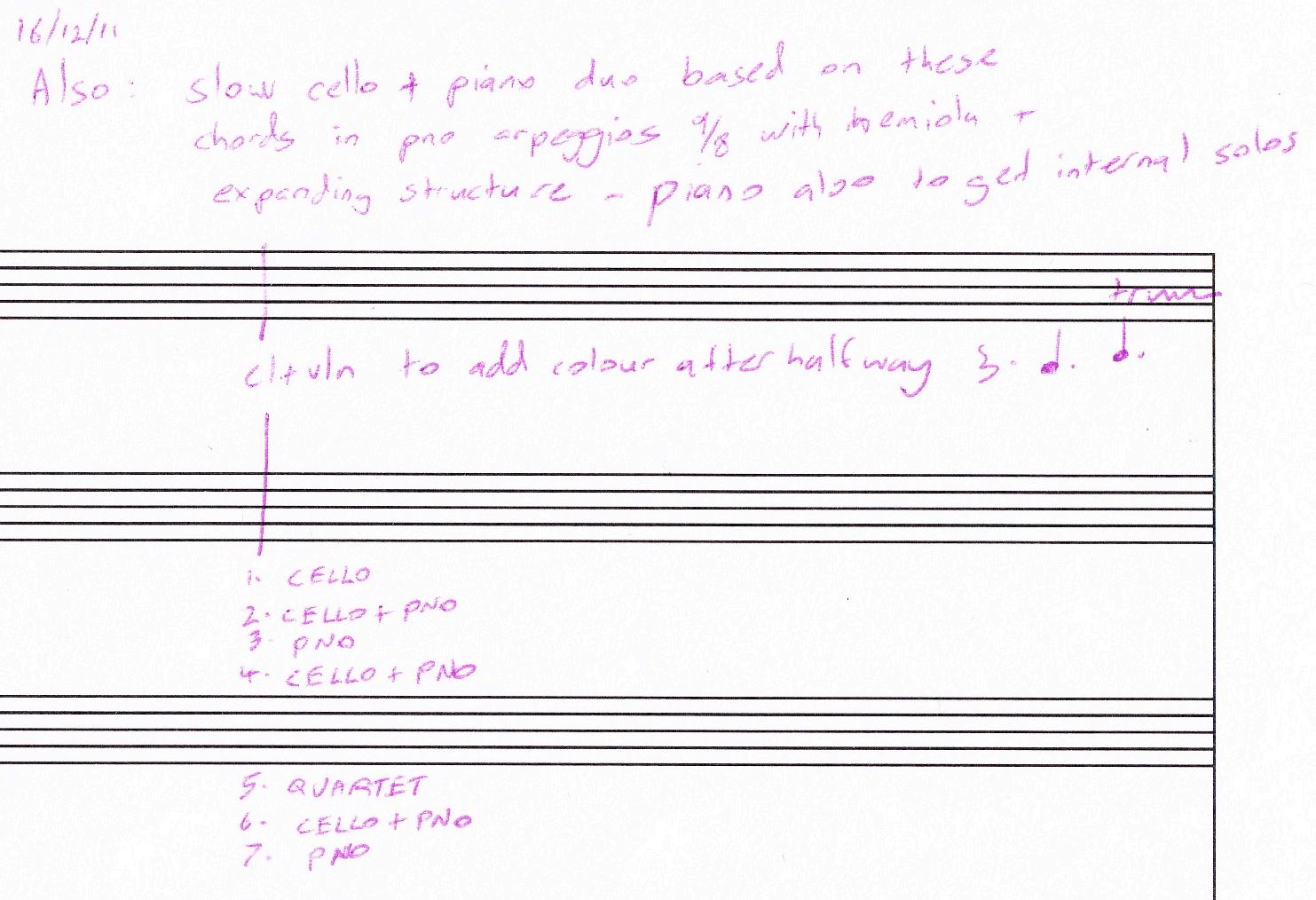
The ‘chords’ referred to are the 7 extended jazz chords from the 1 st movement. Here however those chords are stretched out in time with accompanying melody (first seen at bars 10–18, rehearsal letter A). What takes less than 5 seconds in the first movement, takes over 30 seconds in the 3 rd movement.
The 7–part instrumental structure sketched above was followed relatively closely and can be graphed proportionally:
In general terms, this reveals an opening cello solo, which is then joined by the piano in duet before the cello drops out leaving just the solo piano. The duet resum es and is briefly ‘ghosted’ by the violin and clarinet from the rear sides of the stage. At letter F the cello fades out and (as sketched above in the notes), the ending is a piano solo, though twice subtly doubled by the cello.
This structure can also be tabled, noting duration together with the role each instrument plays:
instruments duration role
intro cello 34” free solo over implied chord progression
A cello + piano 34” cello melody / piano chords
B piano 42” piano melody + chords
C cello + piano 50” cello countermelody
D quartet 42” new material – rising scales
E cello + piano 34” cello melody / piano chords
F piano (+cello) 68” piano / subtle cello doubling
Most notable is that the duration of sections A–E outline a perfect arch form (34 –42–50–42–34). The expansion all occurs over the first chord (of 7) and similarly with the corresponding reduction. The final section (F) functions as a coda and is exactly twice the length of the introduction
The melodic invention for the Serenade is highly governed by the 7–chord sequence first heard in the 1st movement. The first chord has a minor 3rd and is the most structurally extended in time. This 2–bar melody first appears at rehearsal letter A and is immediately repeated:
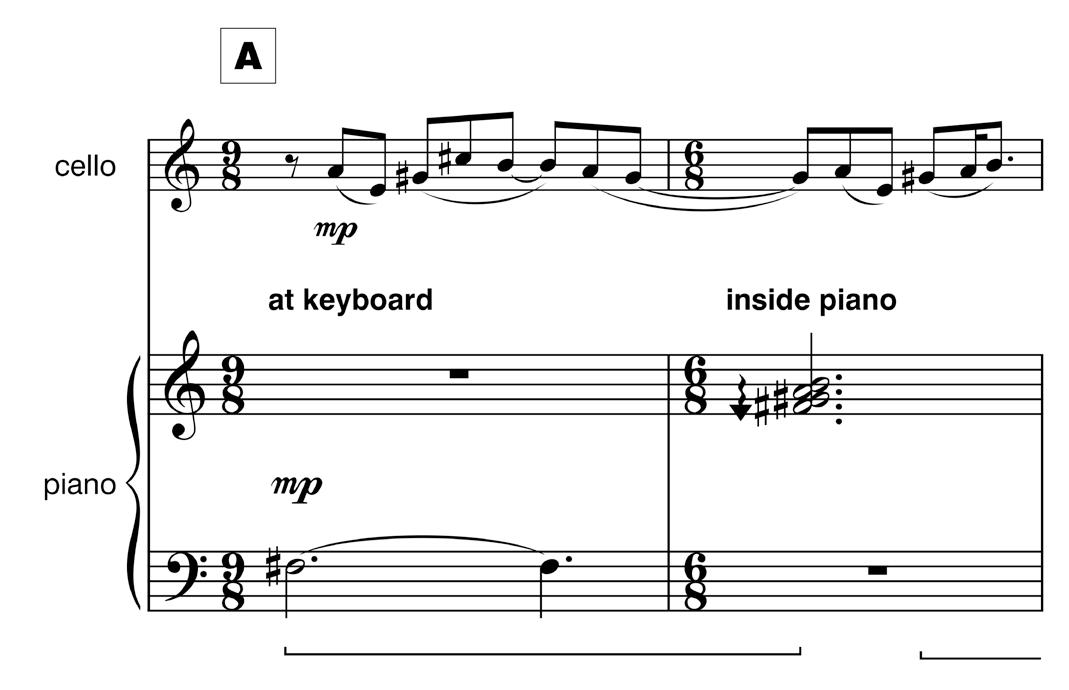
The first 4 melodic n otes are chordal notes. Then from bars 14–18, chords 2–7 are slowly revealed (all chords with major 3rds) and the melody is again drawn form the notes of those chords:
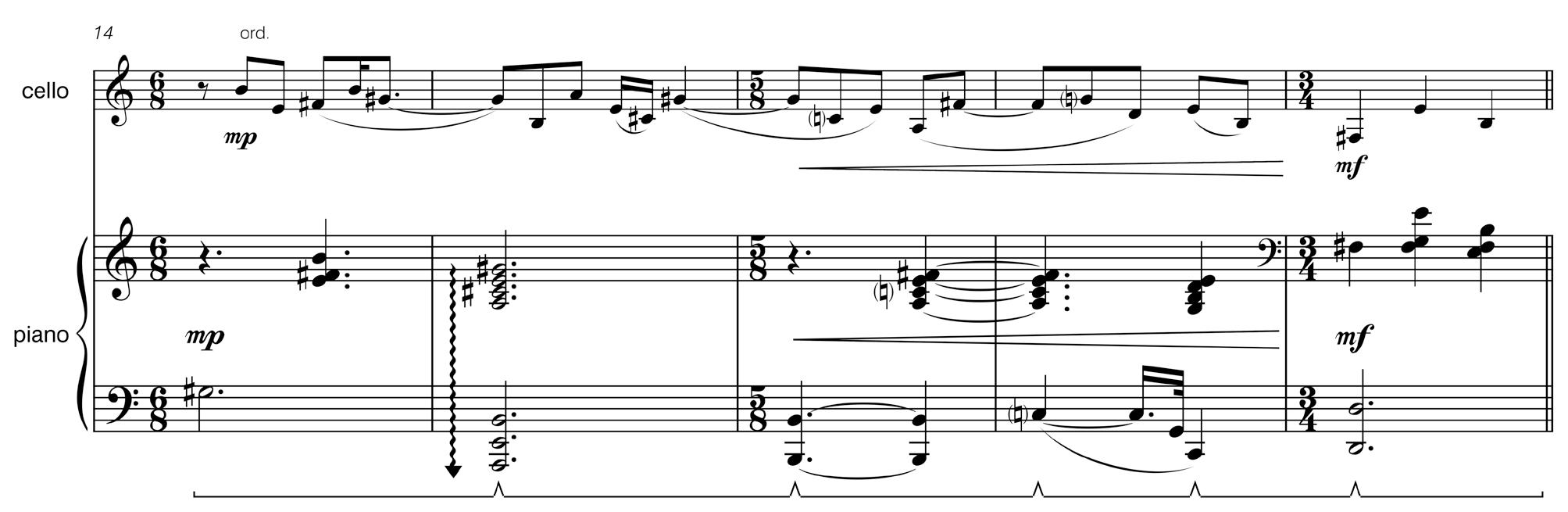
The exception is found at rehearsal letter D. Here, new material is presented for co ntrast in C# harmonic minor in rising scales:
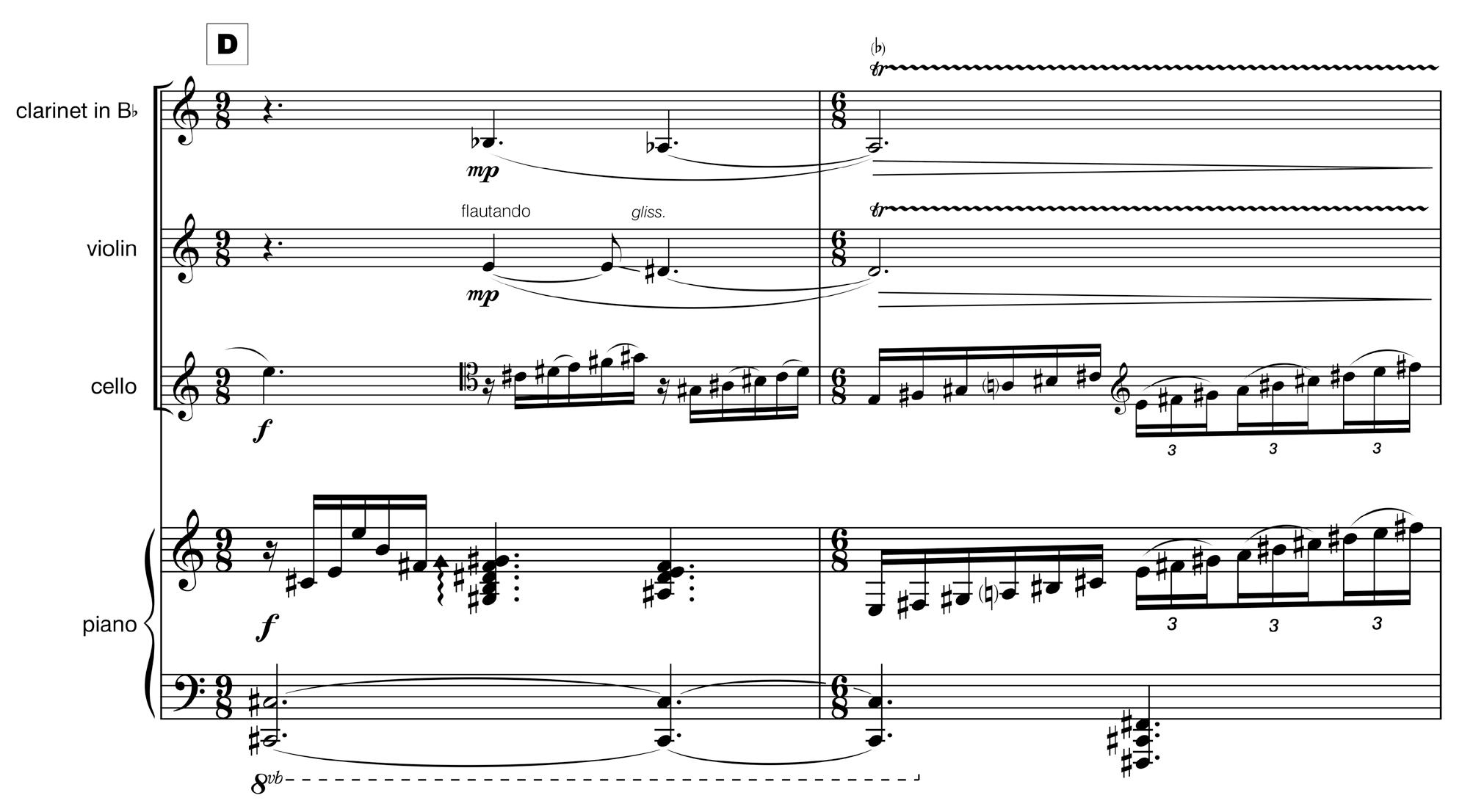
The bass pattern continues on to outline a i–iv–i–iv–VI–iv–V progression; though the upper chordal voicing is clustered and not conventionally tonal.
The ending coda (rehearsal letter F) is built around the 1st chord (minor 9th) but ends in a subtle Tierce de Picardie (G# cello harmonic). This seemed appropriate because the entire movement contrasts the static extended minor quality of chord 1 against the shifting progression of chords 2–7 that feature major thirds.
As chord 1 defines each modulation at each new rehearsal letter, a harmonic plan for the Serenade can be nominally defined by these minor chords:
harmonic centre shift
intro E min
A F# min up maj 2nd
B G# min up maj 2nd
C B min up min 3rd
D C# min up maj 2nd
E F# min up perfect 4th
F E min down maj 2nd
The shift up a minor 3 rd at letter C is deliberately designed to stretch the modulation interval of a major 2nd which had previously been established as a pattern. It the goes back to the interval of the major 2 nd before being stretched further to a modulation of a perfect 4th. The final modulation back down a major 2nd is a way of returning to the original harmonic centre while also helping to reflect the overall arch form of the
Serenade. This modulation plan can also be mapped out as a pentatonic intervallic sequence:
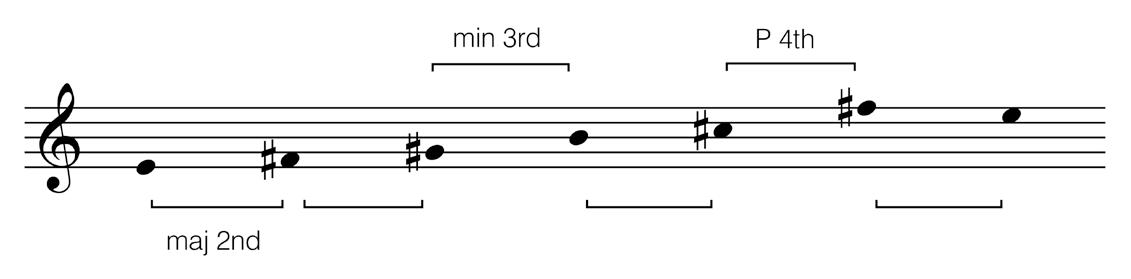
Finally, the contrasting alternation of minor and major tonalities can be graphed proportionally :
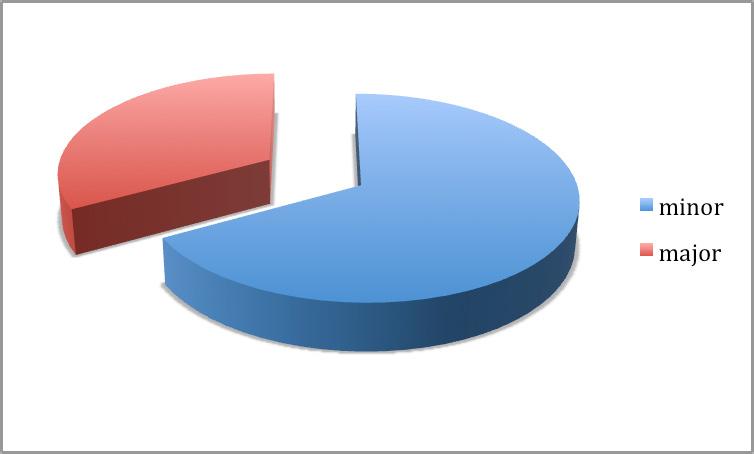
At first the minor sections (blue) are about the same length as the major sections (red). Due to the arch form expansion, however, the minor sections grow, while the major sections stay exactly the same length. The minor section s contract again but then at letter F (which functions as a coda) it is radically lengthened, and the final answering major is radically shortened – literally the final crotchet pause (Tierce de Picardie).
In all, the minor based sonorities constitute around 67% (two thirds) of the Serenade:
4. Variations
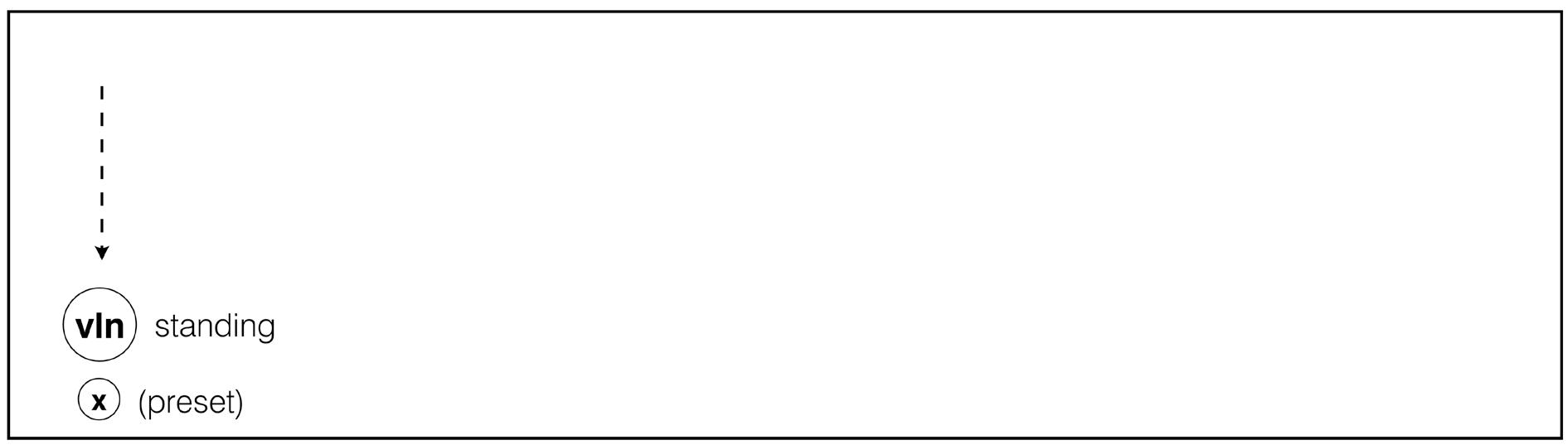
The 4th movement (solo violin) provides an antidote to the slower darkness of the 3 rd . The violinist walks to the front of the stage and plays this 2 –minute solo spatially apart from the rest of the ensemble.
The theme is set in 7/8 (2+2+3) as a nod to Balkan dance music. The singing of Bulgarian women on the re issued disc, Le Mystère des Voix Bulgares, was a wonderful and vital discovery for me in the late 1980’s. The asymmetrical rhythms, in particular were influential. And as the violinist for the premiere, Nemanja Radulovic, hails from neighbouring Serbia, this Balkan connection seemed doubly appropriate.
The antecedent of the theme constitutes three bars of 7/8 followed by a bar of 4/4; and the consequent does the same:
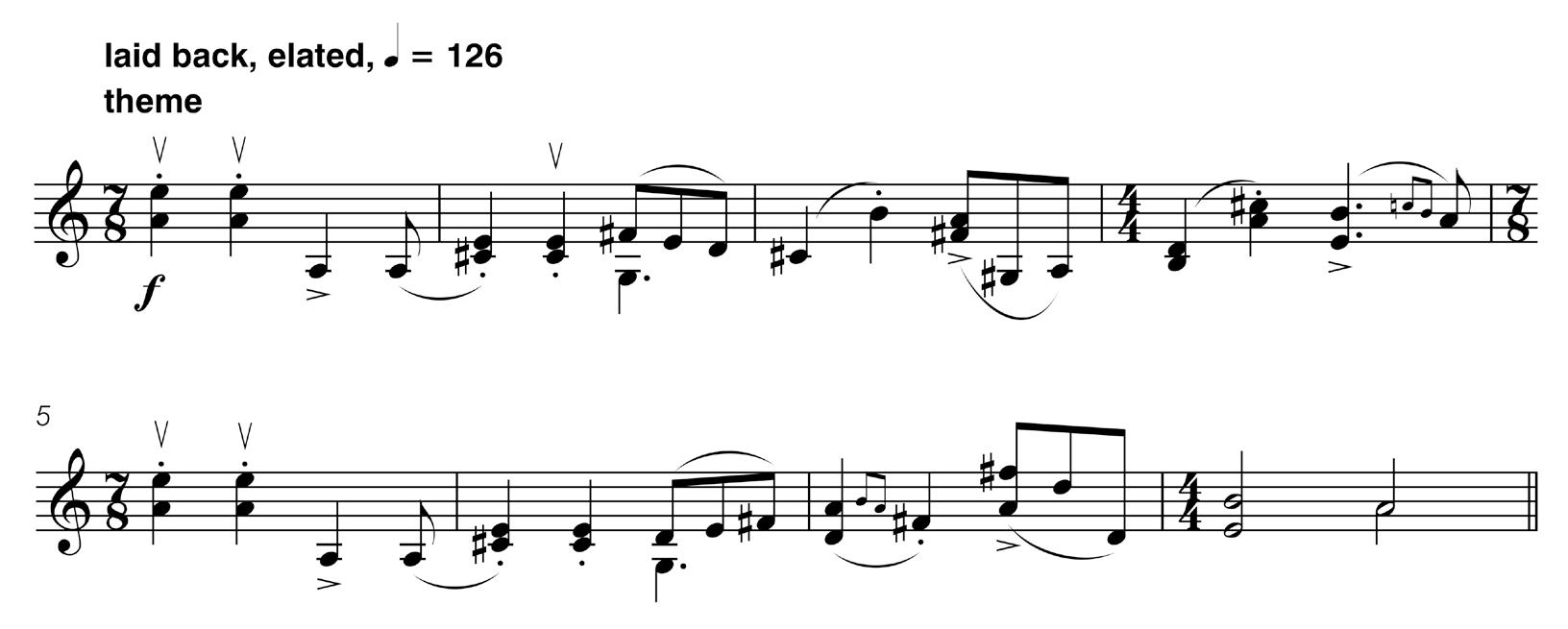
Harmonically, the theme is A based – initially M ixolydian through the G natural in bar 2, and then Ionian through the G# in the following bar (modal alternation). Added to this is the momentary C natural grace note in bar 4 (minor 3rd), which is best viewed in regard to blues related harmony (ambiguity of major and minor 3rds). This in turn relates to the falling chromatic line featured in the first two movements (both of which encompass major and minor 3rds).
The conseque nt phrase (bars 5–8) metrically follows the anteced ent. The first bar and a half are identical, but the final 3 quavers of bar 6 (upper voice) are reversed in order (retrograde) and are then more overtly varied leading to an implied V–I perfect cadence. The ensuing variations remain modally based in A, and all take place within the same 8 –bar, 58–quaver metrical pattern:
section techniques used theme characterised by rhythm in crotchets and quavers
variation I soft pan–pipe effect / stylised rhythm
variation II flowing quavers, occasional triplets and semiquavers
theme direct repeat of opening variation III semiquavers – influence of Irish‘reel’ fiddle music
theme direct repeat (but played softly)
variation IV natural and artificial harmonics
variation V triplet semiquaver cross–bowing / LH pizz + col legno punctuation theme 4x repeat of first 3 bars before slow down and cadence
This structure is an almost perfect arch form as seen from the following graph :
Variation 3 would in theory be the centre of the arch, though the final theme statement is extended – and in this regard the modified arch form relates closely to that found in the 3rd movement.
5. Synthesis

While material for the first and third movements were the first to be sketched, the fifth (and final) movement was the first to be fully written. The movement title, Synthesis, refers to the quartet spatially coming back together in the centre of the stage; and also to the bringing together and recurrence of certain music ideas presented in the previous 4 movements.
The initial impetus for this final movement is found in a hand sketch from 9 December 2011:
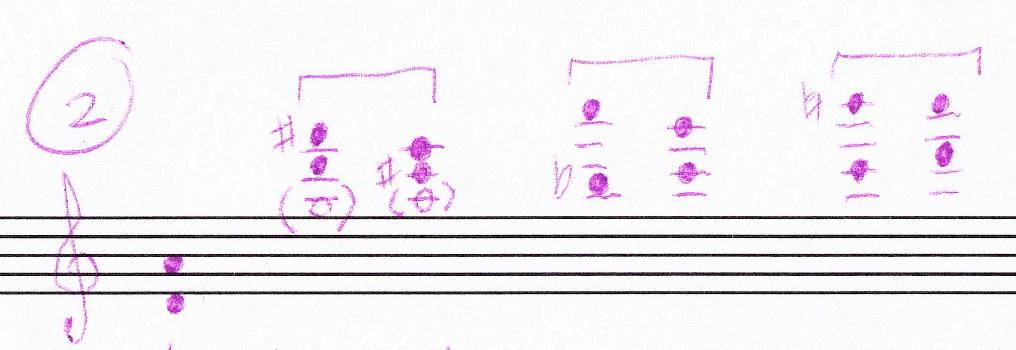
The essential characteristic of this sketch is the idea of a major 7 th folding into a perfect 5th (both outer voices moving inward by major 2nds), and that gesture in turn sequenced up a minor 3rd and again up a major 2nd. This gesture is found in the violin and cello at the opening of the first movement, but the full sequence is only revealed here in the final movement.
While the notes in the above sketch where made at the piano, they were developed 12 days later at the guitar:
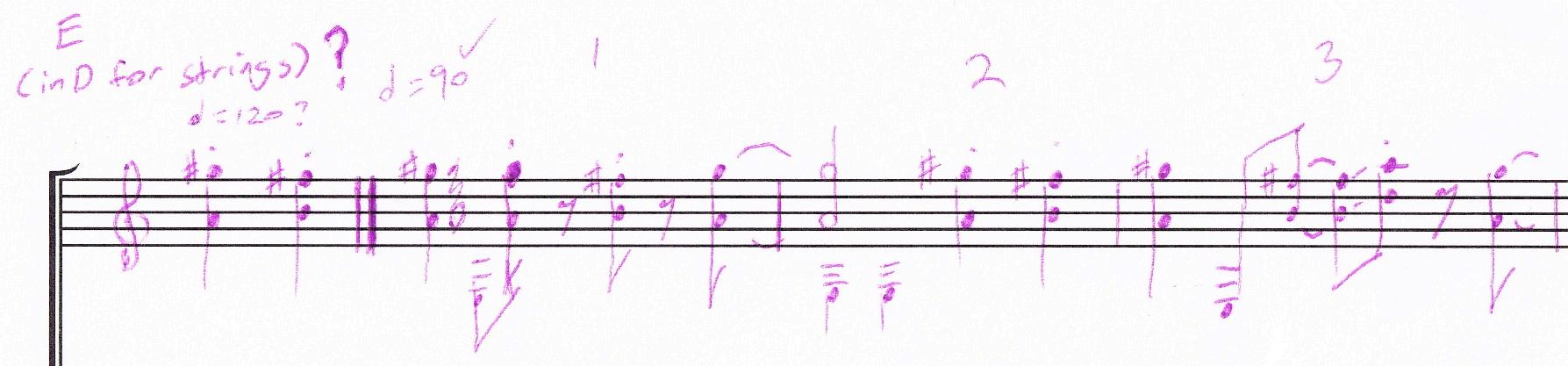
The reason for this is circum stantial in that I was then on holiday down at Phillip Island in a house with no piano, but with my 7 year old son’s half size guitar. It was transposed up a tone into E at this stage to take advantage of the open strings of the guitar (even though the instrumentation of the work does not actually include this instrument). The figuration is somewhat like a modified samba, here featuring 3 on beats followed by 3 off beats, all starting on a 2–beat anacrusis. The phrasing results in a 7+9 quaver grouping but written out in standard 4/4 time. The effect is intended to feel uplifting.
Added to this Latin groove figuration (labelled ‘B’) is a cadential phrase (‘C’) that realises the originally intended upward sequence:

The upward harmonic sequence results in a darker harmonic colour (minor 6ths and 7ths) followed by a cross–relation (C natural / C#) further upwards to the major 6th (C# in this sketch) – a new pitch that resolves to the open perfect 5th. The effect of this progression is to heighten the building harmonic and rhythmic tension; and this sometimes further lea ds to a ‘turn around’ figure (‘F’):
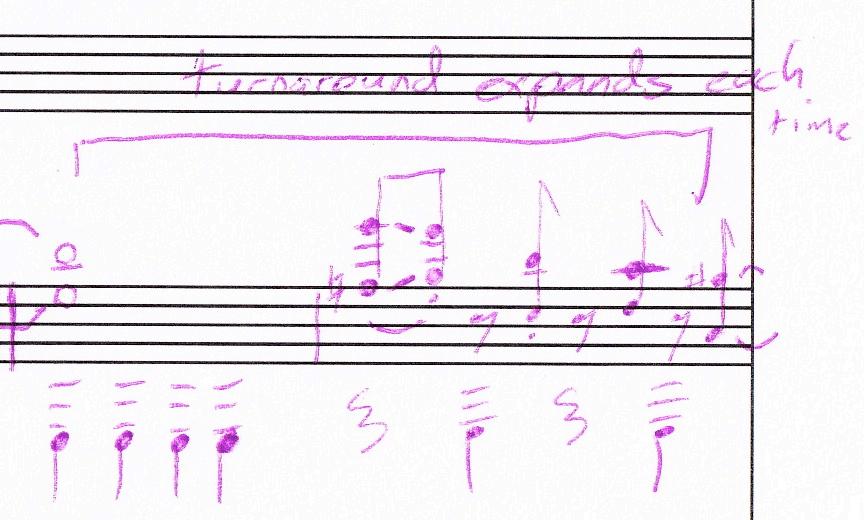
The turn around figure notably sequences back downward (by contrast) releasing tension using the exact same intervallic gesture. At the time, I wondered if the turnaround figure would expand upon subsequent appearances, but it only appears 4 times in all (getting further apart) and its function was pungent enough without requiring expansion.
With the basic idea in mind that the elated groove phrases would expand each time, I wanted something more harmonically static to interpolate between them and arrived at the idea of a mantra:

The resultant rhythm is a modified rumba, though this Latin influence more likely came to me via the Pat Metheny Group’s recording, (Cross the) Heartland (American Garage , 1980). Welded to this syncopated groove is a broodingly bi tonal harmonic colour, designed to contrast with the more ebullient, samba groove.
With these materials sketched out, I spent time simply sitting on a couch playing these elements over and over at the guitar to develop a sense of how long the phrases could be sustained for without losing interest. About 3 days later, I had settled on the proportions of the expanding phrase structure:
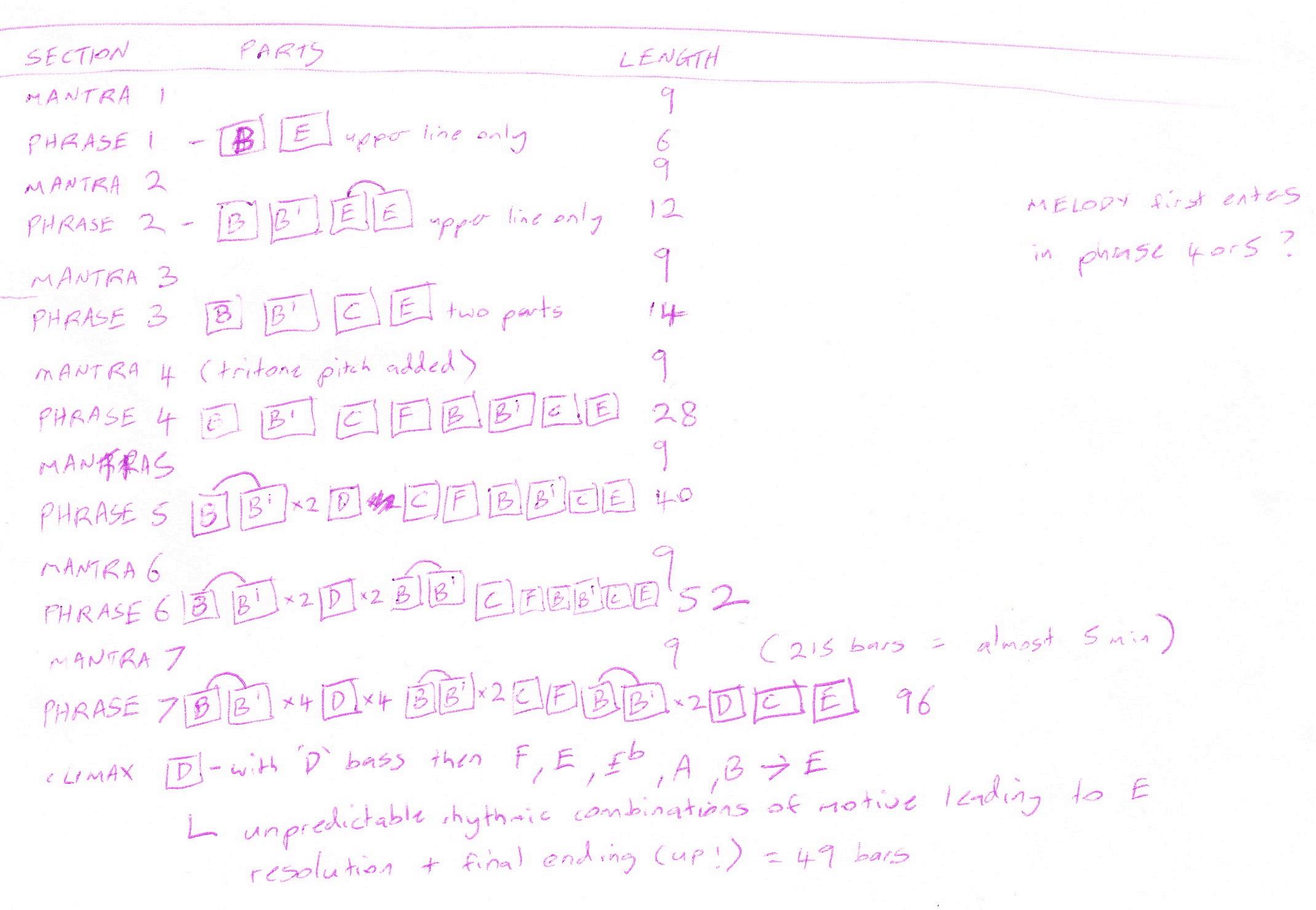
This in turn was formalised in an Excel chart , using colour to help clarify sectional design:
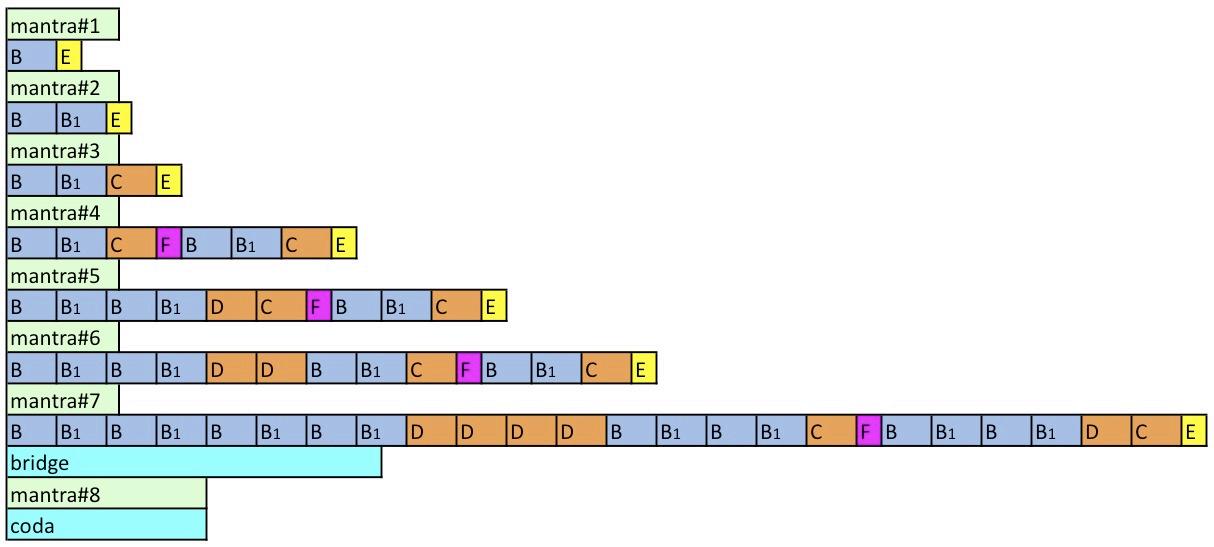
In this chart the blue and orange B, C and D sections variously represent the ongoing samba groove in expanding episodes (phrases). The yellow ‘E’ sections at the end of episodes represent space or a brief breath before the mantra sections. The 4 pink ‘F’ sections are mid episode turnarounds (designed to maintain tension).
The first 7 green ‘mantr a’ sections are all 9 bars long. The first two mantras are purely rhythmic – the clarinet and piano clapping out the modified rumba rhythm while the strings drum out the rhythmic accents on the body of their instruments:
Greenbaum: Dance Music for Concert Halls, analysis, pg.15
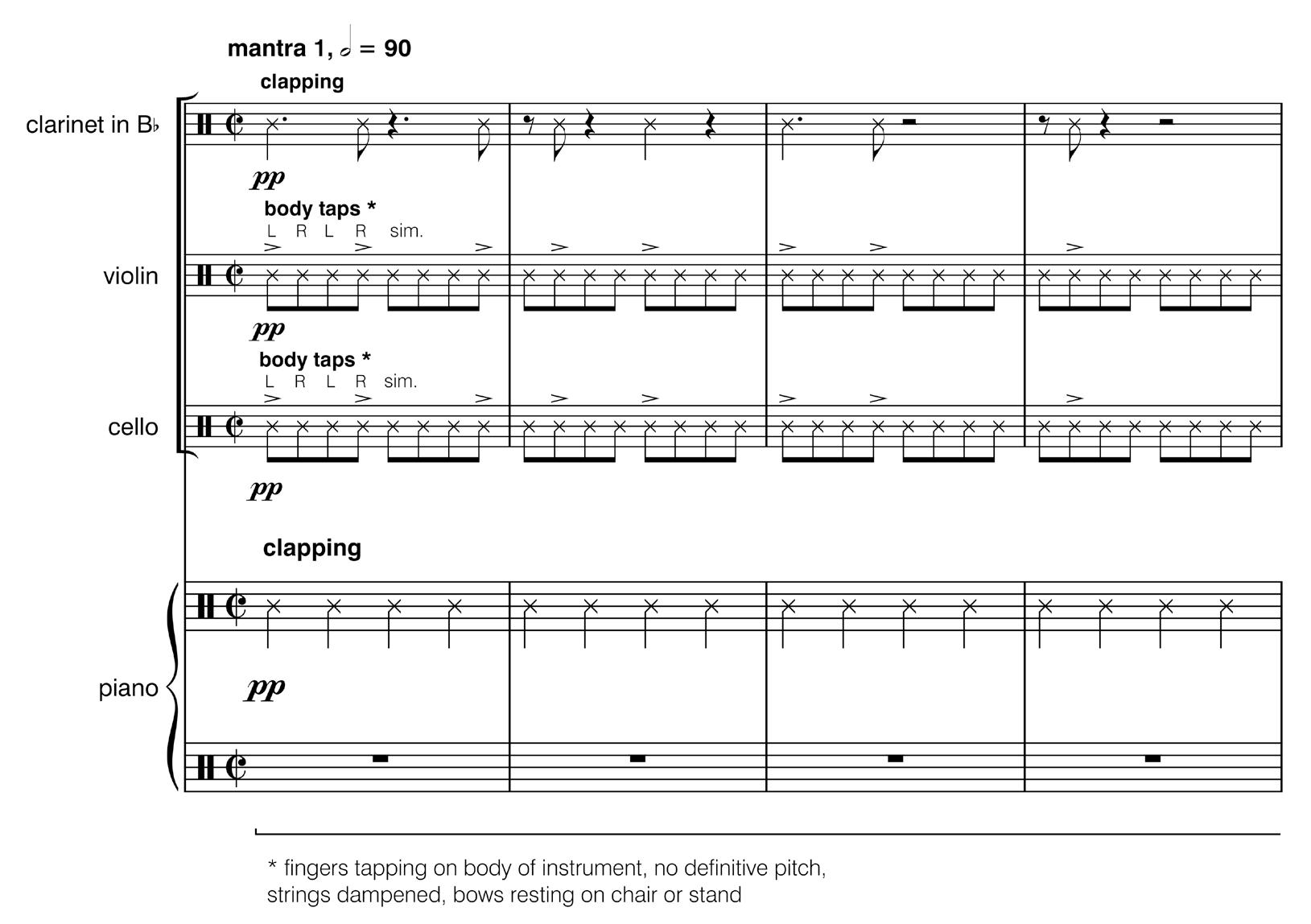
Mantra#3 introduces the tonic note, D, and from Mantra#4 the bi tonal harmony (Ab/D) is revealed. All mantras are subtly orchestrated differently, gradually growing in int ensity.
In between the mantras, all 4 instruments take turns in varying combinations to play the groove figuration, which is ‘melodic’ without actually constituting a fully phrased ‘melody’ Formal melody first appears in the clarinet in Episode 4 at bar 80, as seen in the following sketch:
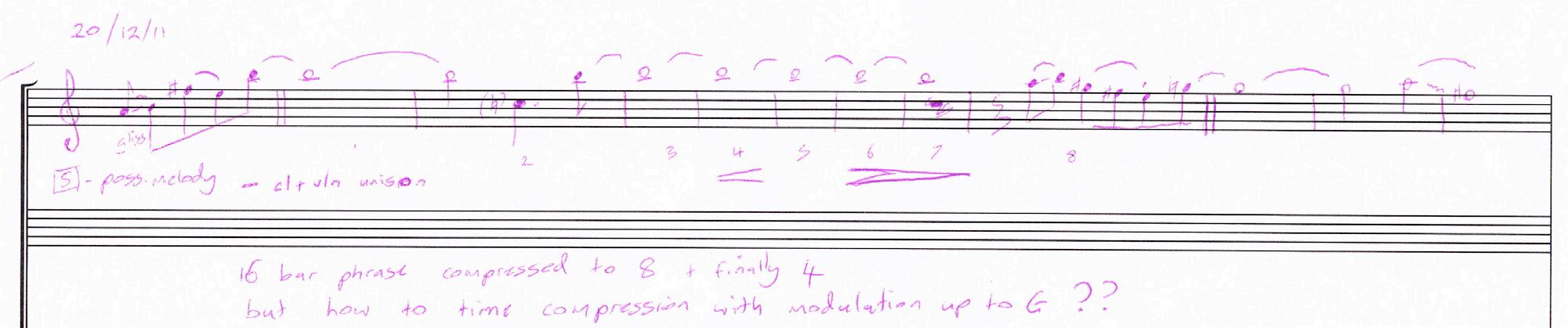
This further shows the influence of the guitar in the composition process as this melody sits comfortably under the fingers. The second half of this melody reprises the clarinet riff from the 2 nd movement (Interlude) though here it appears in even quavers (not swung) and is considerably faster in tempo. It is, however, another example of the intended ‘synthesis’ of material from previous movements.
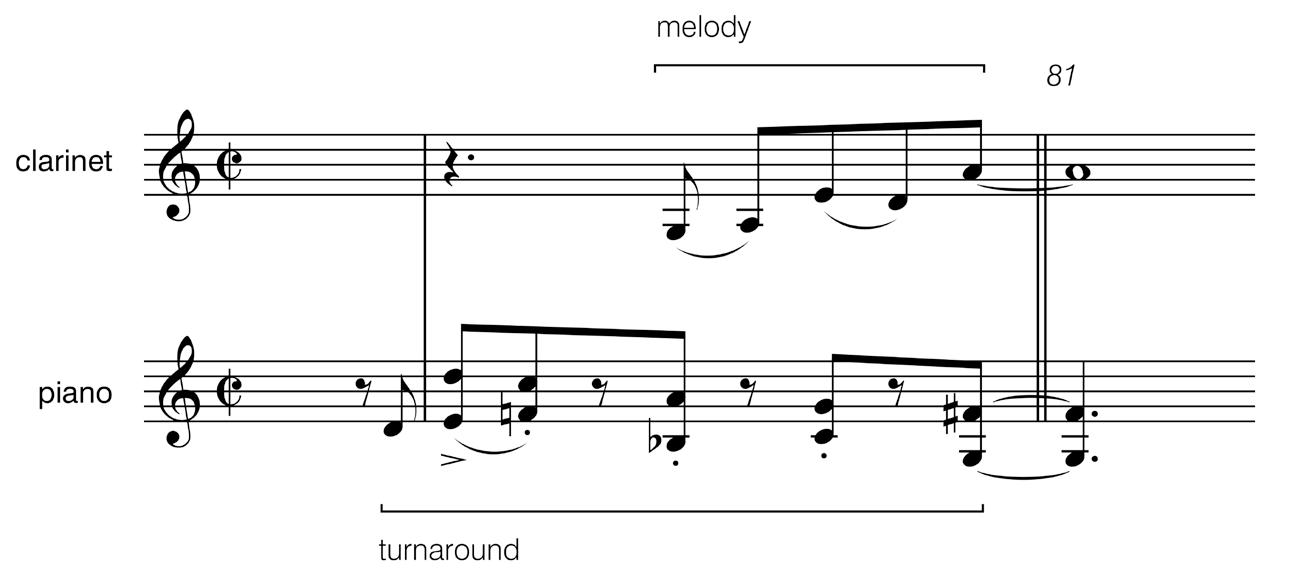
This main melody appears again in episodes 5, 6, 7 and also in the final coda. Its entry point coincides with the turnaround figure, which acts as a springboard or launching pad for the melodic entry. Both start and end on offbeat quavers, creating an ideal rhythmic dovetail (shown here in C):
Less formal melodic inven tion also appears in Episode 6 (clarinet solo) and Episode 7 (cello and violin solos). The clarinet and violin solos especi ally, take on an improvisatory feel though are fully notated, intuitively shaped from the existing material.
The final Bridge, Mant ra#8 and Coda required more customisation and alteration. What was planned to last 49 bars in the hand sketch, eventually become 67 bars through a number of small additi ons and repeats to make the end–sequence fully satisfying. The B ridge section reinterprets the samba groove figure, initially over a dominant pedal and then moving chromatically through the following progression:
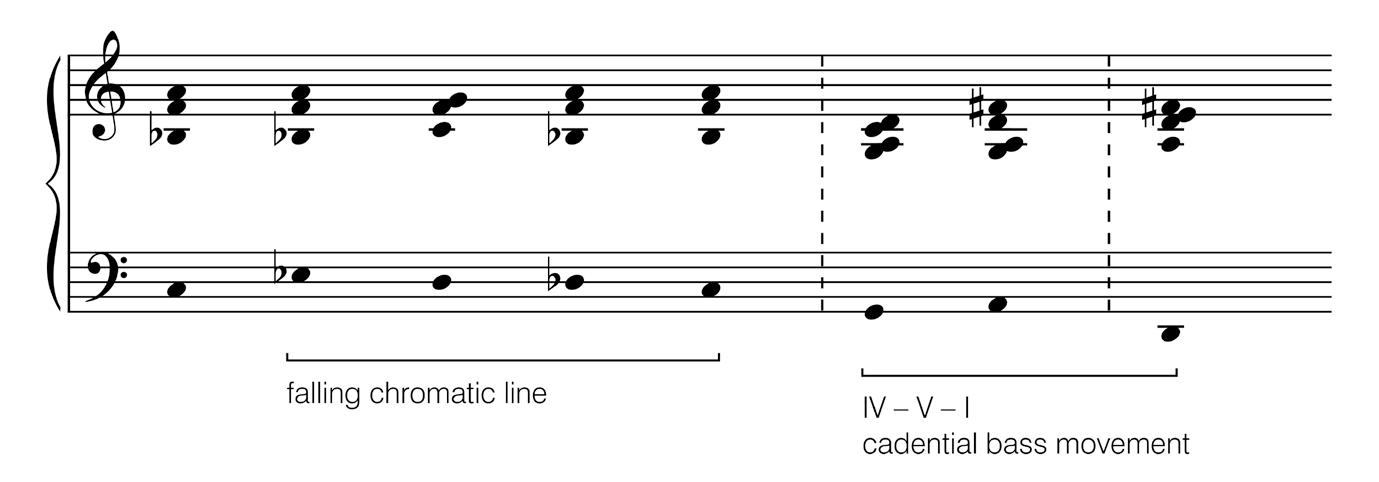
As the final movement is overwhelmingly based over a tonic ‘D’ pe dal, the principal aim of this Bridge section was to build ma ximum tension through avoiding the tonic, D, for 30 bars. Actually, it does pass briefly through D , but as it does so in the middle of a falling chromatic bass line, it doesn’t sound like a tonic.
The arrival then of Dmaj (add 9) at Mantra#8 is intended to create a powerful harmonic return; and for the first time the mantra is harmonically stable (not bi tonal) and now appears as two 8 –bar phrases, rounding off the angular 9–bar phrases that have up to now defined the mantra figure. The Coda, therefore represents one more leap into the fray – an upsurge of rhythmic and harmonic tension for the final 22 bars, punctuating the end of the work on a minim offbeat (Dadd 9, 11 – no 3rd).
Article © Stuart Greenbaum, October 2012
Musical terms for further study arch form antecedent bebop bitonality blues consequent fibonacci series funk groove hemiola heterophny Ionian Irish reel jazz
Mixolydian m odal alternation riff rumba samba swing turnaround
Tierce de Picardie
Works by the composer for reference
All Those Wa ys of Leaving Études for Daydreamers Ice Man
Nelson
Sonata for Alto Saxophone and piano
Works by other composers for reference Barber, Adagio for Strings Brecker, Original Rays Elgar, Enigma Variations Le Mystère des Voix Bulgares Metheny, Cross the Heartland Miller, In the Mood Rachmaninoff, Piano Concerto No.2 Schubert, String Quintet in C major
For more information go to: www.stuartgreenbaum.com