Greenbaum CONFESSION analysis

Page 1


Stuart Greenbaum: Electric Confession

Analysis by the composer

4 May 2022

Background to the work

Electric Confession was written in 2000 and is dedicated to Lyle Mays and Pat Metheny, co-composers of The First Circle (1984). Having analysed this piece for my Master of Music thesis back in 1990, I had long wanted to write a work that took The First Circle as its starting point. I deviated away from that model in some ways, but there are many clear, comparable aspects. The use of a consistent pulse, redefined by varied groupings of either 2 or 3 quavers, together with a middle-section improvisation that leads back to a recapitulation defines the structure of the work in similar fashion to The First Circle.

The title is indirectly an anagram: from The First Circle, I was able to derive ‘Electric Shrift’. I substituted shrift, with its synonym, confession, and thus arrived at Electric Confession. While that was fun (and somewhat arbitrary), I do feel that the title appropriately reflects my homage to Mays and Metheny’s wonderful piece.

Collaboration with guitarist, Ken Murray

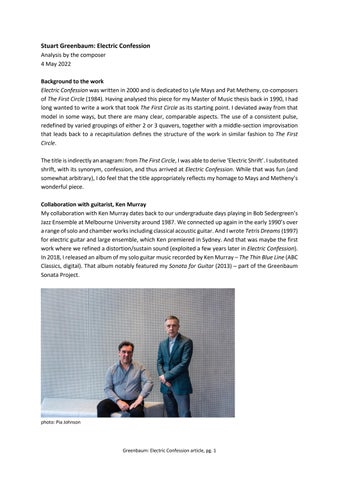
My collaboration with Ken Murray dates back to our undergraduate days playing in Bob Sedergreen’s Jazz Ensemble at Melbourne University around 1987. We connected up again in the early 1990’s over a range of solo and chamber works including classical acoustic guitar. And I wrote Tetris Dreams (1997) for electric guitar and large ensemble, which Ken premiered in Sydney. And that was maybe the first work where we refined a distortion/sustain sound (exploited a few years later in Electric Confession). In 2018, I released an album of my solo guitar music recorded by Ken Murray – The Thin Blue Line (ABC Classics, digital). That album notably featured my Sonata for Guitar (2013) – part of the Greenbaum Sonata Project.

photo: Pia Johnson

Greenbaum: Electric Confession article, pg 1

Live premiere and subsequent performances

Electric Confession was written specifically for Melbourne guitarist Ken Murray to play against a fixed media backing track. Murray also assisted with the pre-recorded guitar elements to the fixed media part and the guitar setup. Scott McIntyre assisted in 2000 with further audio rendering of sample libraries for fixed media track. The work received its premiere performance on 16 March 2001 at the Mechanics Hall in Melbourne as part of the Brunswick Festival. Ken Murray played the work again three times in 2006, notably at the Aurora Festival of Living Music in Western Sydney; and also gave the work a European premiere at the 13th Santo Tirso International Guitar Festival in Portugal.

Working toward a definitive studio recording

Many years later, in early 2021 I spent time listening through my complete catalogue of around 230 works and this retrospective evaluation led me to consider that Electric Confession was one of my strongest works – but with a few caveats. Firstly, the programmed drums and percussion had good stereo interplay and hocketting, but in places lacked live feel. Additionally, my 20-year old heritage ProTools file would not open in the current program version So I engaged Melbourne drummer, Daniel Farrugia, to overlay live drums on top of the existing programmed beats and wrote out a specific part with some room for interpretation. Farrugia played on my 2019 concept album, The Final Hour, so he was familiar with my music and chose prudently where an overdubbed live kit part would function effectively, and where he thought the programmed beats could be left by themselves. One would not necessarily record in this way from the ground up. But it’s surprising what can be achieved within that scenario.

Secondly, while Ken Murray had pre-recorded guitar parts 2+3 for the fixed media, we had never done a studio recording of the live part (guitar 1). So we went through the score in 2021 made some further refinements and recorded a definitive version. Two sessions had been cancelled due to pandemic lockdown restrictions. But on 12 November 2021, we finally made it into the MCM studios (University of Melbourne) in Southbank and put down the takes we had been working toward.

From that point, I edited an ideal full ‘performance’. And I took all that to Luke Howard to mix a month later. While Luke Howard didn’t record any further elements, he certainly did more than what might traditionally be considered mixing. The elements were reassembled including the original stereo fixed media part, Farrugia’s drum stems (in multiple tracks) and Murray’s solo guitar performance. These were not only balanced out but also enhanced with EQ adjustments, reverb and delay effects. Finally, the track was mastered by Lachlan Carrick at Moose Mastering for inclusion on the album of the same title – Electric Confession. The full process then spanned a 20-year journey; and created a definitive and very fine version of the work. The nature of the work is such that other guitarists can of course access the final mix (minus the solo part) and record their own. That would certainly be interesting and welcome. But Murray’s 2021 version is the premiere studio recording – and a reference point for that.

Fixed media

The work is scored for electric guitar and fixed media. The fixed media backing is sometimes purely sonic and atmospheric (like the opening) and at other times highly rhythmic and antiphonal. The sounds themselves are a mixture of MIDI samples, synthesis, live percussion and guitar sounds. The synthetic/sampled patches were mostly taken from a Proteus 2000 sample rack (which in 2000 was reasonably state of the art). The list of sounds utilised from that module were:

guitar: Full Nylon

wind: Pan Flute 1

wind: Ocarina 1

brass: Dizzy

brass: Sforzando

Lead: Shimmy

keyboard: And Voice

bass: Acoustic

bass: Fretless 3

bass: Spankin

percussion: Miscellany

percussion: Cymbals 2

drum kit: Kit 1

These sounds were triggered via MIDI from a notated, ‘orchestrated’ music score created in notation software (Finale)

Live and pre-recorded guitars

Guitar parts 2+3 were pre-recorded in the studio by Ken Murray as part of the fixed media backing They either harmonise the solo part (Guitar 1) or work antiphonally with it in call and response. Guitars 2+3 only play with a distortion/sustain setting.

The live solo electric guitar part alternates between a clean warm sound, and a distortion/sustain setting. The setup requires a specific preamp out to reverb before the signal comes back to the power amplifier in order to allow for reverberant fade outs.

The clean sound should preferably resemble a rich semi-acoustic jazz tone, though this should be easily accommodated on a solid-body instrument. The distorted sound should have a pure tone (on single notes) and a long sustain. This sound is well represented by notable guitarists John McLaughlin and Bill Frissell, among others. The distorted sound should be created by the following chain of connections:

• guitar

• distortion/sustain pedal (or preamp saturation)

• volume pedal

• digital reverb

• power amplifier

The importance of this specific order of connection is manifold: the volume pedal can act as a ‘gating’ mechanism (as well as for crescendos and decrescendos) so that when the guitar is not ‘singing’ it is completely quiet. Furthermore, when it fades out the signal is supported by a small amount of hall reverb before going to the power amplifier. This is designed to stop the sound from dying at phrase ends, and also to add warmth to the sound. When the distortion pedal is turned on, the volume pedal should be off to allow a seamless unnoticed setup change.

The guitar sound should emanate from the amplifier close to where the soloist sits (or stands). It is important to achieve some acoustical separation from the stereo CD playback through the PA.

Performance directions

This work contains many time-signature changes, some of which are metric modulations. In all instances, the value of a quaver should remain constant, with only the grouping and subsequent pulse changing. Single grace notes should be played on the beat. Multiple grace notes should be played as an anacrusis to the beat. Slurs indicate left hand hammer-ons or pull-offs.

Solo improvisation

The guitarist is required to improvise in the middle of the piece and also embellish the written line at various stages. The solo section (bars 133 to 157) is approximately 2 minutes in length and should be paced accordingly. The first half of the solo is ‘clean’ and the material should be taken from the opening 50 bars - perhaps even starting with harmonics. In any event, the solo should start spaciously and gradually build towards a more florid, high register texture. Similarly, the distorted section (from bar 145) should ideally connect to the thought process of the end of the clean solo. It should also allow room to rise in register so that by bar 150, the harmony is quite ‘out’ and the texture is virtuosic, possibly even including finger tapping - but leading logically into the run up at bar 157. The importance of the overall structure of the solo section cannot be underestimated. While it should leave room for spontaneity it will require preparation both harmonically (in relation to the chord symbols) and structurally in terms of the shape of the solo.

Overall structure

Electric Confession is cast in a single movement of 4 connected sections, in a duration of around 9 minutes. This duration and shape is directly modelled on Metheny and Mays The First Circle. The four sections are:

i. introduction

ii. exposition

iii. development (solo improvisation)

iv. recapitulation

As with The First Circle, the structure of Electric Confession has partial similarity with Classical Sonata Form. But there are differences. Harmony is not necessarily the prime structural determinant –rhythm and metre are more primary. And in Electric Confession, there is motivic contrast but no obvious second subject.

Seen as a graphic chart, the 4 movements can be presented as follows:

The sections gradually get shorter in length (structural compression) Each standard line or row of the graph represents 24 quaver beats, though some are a little shorter. For instance, the 1st and 3rd sections feature 3 bars of 12/8 followed by an abbreviated bar of 9/8 – so every second line is 3 beats shorter.

The impetus for the work began as a rhythmic idea: 7+10+7. These subdivide into groups of 2 or 3 quavers but because they also add up to 24, they can be regrouped as 3 bars of 4/4 or 2 bars of 12/8; and this ambiguity is exploited throughout alongside a few metrical adjustments (a very occasional 2/4 bar or 6/8 bar, and a notable use of 9/8):

The metrical structure above can therefore be divided into 4 categories: no metre (pulseless soundscape), triple metre (12/8, 9/8 or 6/8), duple metre (4/4 or 2/4) and finally mixed metre (7/8 + 10/8 + 7/8).

Greenbaum: Electric Confession article, pg 5

All these metrical bars further divide up into groups of 2 or 3 quavers – as they also do in Metheny and Mays’ The First Circle (1984); and as they also do in Steve Reich’s Tehillim (1981) For Electric Confession it looks like this:

There are long expanses of continuous triple metre feel (red) in section 1, then mostly mixed metre in section 2. That continues into section 3 but then returns to continuous triple metre. The final recapitulation section is then defined by the shift to duple metre (blue). This is a recapitulation of the main motive from the Exposition but has been metrically redefined. Mixed metre then returns again followed by a final brief triple metre coda.

i. Introduction

The work starts with a 40–second soundscape which is pulseless The idea of it was sketched on paper graphically:

Greenbaum: Electric Confession article, pg 6

The upper shaded area is an exponential curve. It’s a big gradual crescendo of sound; not linear, but escalating toward the end. And the circles and lines below it represent new layers of sound and sonic activity being added in, layer by layer. So it’s a build-up not only of volume, but also density.

Those sounds include electric guitar noises (such as scraping the low, wound strings with a plectrum and distorted glissandi) as well as isolated notes (with delay effects added) and rapid finger tapping effects. These are layered over low bass synth tones creating an increasingly chaotic over-saturated textured At the climax, the sound cuts off to digital silence (marked by a dotted crotchet rest) and then the ‘confession proper’ commences.

The first twelve bars are motivically slight and suggestive – mostly comprised of small, scale fragments. From bar 14, the solo guitar is more overtly melodic. It sounds somewhat improvised and fluid, but is completely notated as follows:

The use of tuplets, ties and varied rhythmic values are a large part of what creates a fluid solo. It raises an interesting question: does it matter if the music is improvised or not? The thoughts of the late jazz pianist and composer Joe Zawinul (Weather Report) are insightful:

“I am an improviser,…I improvise music. Whatever you want to call it, it is all improvised music. I may capture it and go back and write it down for others, but it was originally improvised.”

My own background is that I am influenced by jazz – but I am not a practicing jazz musician. I also improvise – that’s part of my artistic practice. But so too are large-scale structural forms and compositional techniques that involve numbers and planning. I’m not sure that it matters for the listener whether something is improvised or composed – the more fundamental question might be: does it sound good? Is it a great listening experience?

Electric Confession does require the soloist to actually improvise; but also has passages like the one above, that are effectively akin to a written-out, composed improvisation. And then at the other end of the spectrum there are clear motivic lines which are highly planned, shaped and arguably more ‘composed’ Of the 4 sections, this 1st section (Introduction) is deliberately fluid, yet fully notated for the soloist to create a dreamy almost spontaneous feel.

ii. Exposition

The 2nd section (Exposition) is a notable contrast. 3 bars of 7/8 + 10/8 + 7/8 mark the beginning of the Exposition from bar 56. This is at first skeletal, fragmented – just a few notes in the bass. But through a process of substituting beats for rests, the full bass motive is fully constructed (or filled in) over 21 bars by bar 77:

The three-bar 7+10+7 metrical structure can be further broken down into groups of 2 or 3 quavers thus:

2+2+3

2+2+3+3

3+2+2

The second bar augments the first bar by adding an additional 3 quaver unit. And the third is a retrograde of the first bar. The complete bass line marks groups of 2 (quavers) with a crotchet and groups of 3 are filled in with 3 quavers. It forms a D minor mode with no 7th (neither C nor C#) implying either an Aeolian or Dorian mode.

Additionally, the 6 duple cells add up to 12 quavers – and so too, the 4 triple cells also add up to 12 quavers. This helps to create a balance of ambiguity within the mixed metre sections.

The sampled bass line is offset in close hocket by sampled piano which has a rest on every strong beat in groups of 2 or 3 quavers:

This hocket line is also constructed gradually from bar 56 to 77. The upper piano line has more limited pitch profile – just 3 notes, I, IV + V (D, G + A), adding to the slightly open, ambiguous tonal effect. The piano line also shifts notably across the stereo field from left to right in a way that creates further interplay. The hocket line itself is a clear reference to the opening of The First Circle between clapping and guitar:

Greenbaum: Electric Confession article, pg 8

The clapping in The First Circle starts each group of 2 or 3 quavers with a rest, and that technique is utilised in the upper piano line in Electric Confession

Once the ostinato pattern is established, the main melody is then formally overlaid from bar 80 in the solo guitar:

This melody adds C natural to the bass ostinato confirming a Dorian mode. Rhythmically, it hits most of the strong beats but adds duplet and triplet hemiola relationships. Bars 80–82 feature six different rhythmic durations (minim, dotted crotchet, crotchet, duplet quaver, quaver, triplet quaver). This is perhaps typical of so-called ‘prog-rock’ metrical complexity.

Bars 83–85 feature an antiphonal answer in guitar 3; the pitch sequence answers identically, but the rhythmic detail is evened out (or quantised), moving in dotted crotchets that imply a 12/8 grouping against the mixed metre of the bass ostinato. The effect is bi-metrical – two different metrical groupings superimposed at the same time. This effect can also be found in The First Circle at b.55:

Greenbaum: Electric Confession article, pg 9

This is likely what the glockenspiel part would practically look like; but that’s not what the rest of the band are playing (in 22/8).

In Electric Confession, the main melody featured in the solo guitar has a gradually downward contour/trajectory with notable upward leaps:

The upward leaps (marked above the staff) feature a perfect 4th, minor 6th and minor 7th – an expanding distance of upward intervals against an overall downward direction. The downward leaps (marked below the staff) do the opposite, contracting from a minor 7th, to a perfect 5th and then two perfect 4ths. The combined effect is of relatively quartal harmony (stacked 4ths) and the presence of melodic sequence.

At bar 86 this motive is repeated, but this time harmonised by guitar 2:

The harmonies are mostly 3rds (marked in brackets above the staff) or 6ths (brackets below), but also features 4ths octaves and 10ths. The approach to harmonisation is therefore customised (oblique).

Greenbaum: Electric Confession article, pg 10

Harmonising the solo guitar line is developed further in a dramatic break-out, antiphonal fragmentation of the melody at bar 104:

The 3-part harmony is mostly diatonic/triadic, with the exception of the diatonic cluster at bar 105. Triadic harmonisation is common enough throughout the history of classical music. But for electric guitars, a little less so – maybe as most rock groups don’t have 3 guitarists. In the studio, however, one can multi-track a single electric guitar and this is, of course, precisely what Brian May (Queen) made an art form of, in songs like Killer Queen (1974). The band harmonise voices in chorus like this and do the same with guitars as well. While Electric Confession is deeply based around Metheny and Mays’ The First Circle, in this particular instance, the influence is clearly Queen’s Brian May.

In all, the main melody appears around a dozen times (with variations) but only in sections 2 (Exposition) and 4 (Recapitulation).

iii. Development: solo improvisation

A second antiphonal hocket breakout phrase (bars 127–132) creates a transition into the 3rd section (Development) which formally starts from bar 133. At this point the solo guitar part shows chord symbols and slash notation for the first time:

Greenbaum: Electric Confession article, pg 11

The chord symbols didn’t come first in the composition process. They were added after the bass and harmonic parts in the short score were written in standard notation. The example below shows 4 bars of bass and harmony from b.136. The chord symbols were derived by analysis afterwards to help the solo guitarist:

The chords in the above example show minor 7th chords interspersed with triads with altered bass notes and some use of planing in the 4th bar, where the entire chord and bass note all shift up by a tone. Bars 133–149 have plenty of colour by extensions (7ths, 9ths, 11ths + 13ths) but are relatively ‘diatonic’ or harmonically stable.

From bar 150, that changes as the harmony gets more dissonant as a deliberate strategy to build tension leading up to the climax (Recapitulation):

Greenbaum: Electric Confession article, pg 12

In this example, the Db/G is stridently dissonant (triad and bass note a tritone apart) and this leads to a sustained A pedal in the bass (dominant to D) and the triads rise up (often dissonantly) against that.

iv. Recapitulation

The Recapitulation section is defined primarily by the return of the main motive from the Exposition, but with two important differences. Firstly, it is regrouped from a mixed metre (7+10+7) into 3 bars of regular 4/4 time (8+8+8 quavers). The quavers still add up to 24 beats – but the grouping makes the same melodic rhythm feel different:

This 4/4 recapitulation of the main motive can be viewed in comparison to the mixed metre grouping of the Exposition:

The listener, of course, may still hear the motive in mixed metre on account of experiencing it that way in the Exposition. Or they might even have a fleeting sense of bi-metricallity – of feeling two different groupings simultaneously. Either way, the ambiguity is intended to create interest and momentum.

Greenbaum: Electric Confession article, pg 13

Secondly, the Recapitulation presents the main motive a 4th higher – and also with modal adjustment (F# and C#), resulting in a D major (Ionian) mode in contrast to the D minor (Dorian) mode of the Exposition. Harmonically, the piece might be considered as ‘in D’. It ends in D (the final bar not including either F natural or F#).

Furthermore, the Recapitulation emerges out of a dominant pedal on A (6 bars of rising dissonance); but at the arrival of the Recapitulation at bar 158, the dominant bass does not resolve to D – it remains on ‘A’ for twelve bars (two cycles of the main motive). Chordally, however, the upper harmony does go to D major (D/A) It emerges from the clouds like a ray of sunshine – yet sustains the forward momentum through the suspended dominant bass pedal of A. Elated – yet not resolved.

The harmonic reduction above shows a continuation of the 3-chord cycle – but from bar 170, a momentary C natural in the bass pivots down to a rising bass sequence which builds tension toward a shift of the main motive back to D Dorian. This is virtually a second ‘recapitulation’ If bar 158 is marked by motivic return, bar 183 is marked by harmonic return of the motive to how it originally appears in the Exposition.

Greenbaum: Electric Confession article, pg 14

Additionally, from bar 173, the solo guitar part allows for ‘ad lib’ improvised embellishment between the main motive phrasing. The main motive is still clearly played / sounded – but ornamented by the soloist spontaneously.

Finally, from bar 189, the motive is gradually liquidated, or dissolved; a process of fragmentation coupled with a descent in register By bar 200 the solo guitar reaches the bottom note (low E) before and final surge upwards towards the final bar punctuation:

Greenbaum: Electric Confession article, pg 15

Turn static files into dynamic content formats.

Create a flipbook
Issuu converts static files into: digital portfolios, online yearbooks, online catalogs, digital photo albums and more. Sign up and create your flipbook.