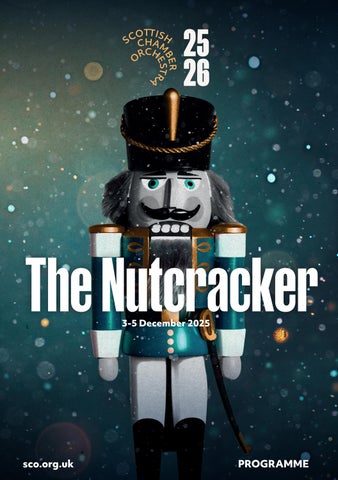
The Nutcracker
3-5 December 2025


![]()
3-5 December 2025


Wednesday 3 December, 7.30pm Perth Concert Hall
Thursday 4 December, 7.30pm Usher Hall, Edinburgh
Friday 5 December, 7.30pm City Halls, Glasgow
TCHAIKOVSKY The Nutcracker
Interval of 20 minutes after Act One
Maxim Emelyanychev conductor
Introduced by Jay Capperauld
SCO Chorus (Sopranos and Altos)
Maxim Emelyanychev

4 Royal Terrace, Edinburgh EH7 5AB
+44 (0)131 557 6800 | info@sco.org.uk | sco.org.uk
THANK YOU
Our Principal Conductor’s Circle are a special part of our musical family. Their commitment and generosity benefit us all – musicians, audiences and creative learning participants alike.
Annual Fund
James and Patricia Cook
Visiting Artists Fund
Harry and Carol Nimmo
Anne and Matthew Richards
International Touring Fund
Gavin and Kate Gemmell
Creative Learning Fund
Sabine and Brian Thomson
Conductor Emeritus Joseph Swensen
Donald and Louise MacDonald
Chorus Director Gregory Batsleer
Anne McFarlane
Principal Second Violin
Marcus Barcham Stevens
Jo and Alison Elliot
Second Violin Rachel Smith
J Douglas Home
Principal Viola Max Mandel
Ken Barker and Martha Vail Barker
Viola Brian Schiele
Christine Lessels
Viola Steve King
Sir Ewan and Lady Brown
Principal Cello Philip Higham
The Thomas Family
Sub-Principal Cello Su-a Lee
Ronald and Stella Bowie
Cello Donald Gillan
Professor Sue Lightman
American Development Fund
Erik Lars Hansen and Vanessa C L Chang
Productions Fund
Anne, Tom and Natalie Usher
Bill and Celia Carman
Scottish Touring Fund
Eriadne and George Mackintosh
Claire and Anthony Tait
Cello Eric de Wit
Jasmine Macquaker Charitable Fund
Principal Flute André Cebrián
Claire and Mark Urquhart
Principal Oboe
The Hedley Gordon Wright Charitable Trust
Sub-Principal Oboe Katherine Bryer
Ulrike and Mark Wilson
Principal Clarinet Maximiliano Martín
Stuart and Alison Paul
Principal Bassoon Cerys Ambrose-Evans
Claire and Anthony Tait
Sub-Principal Bassoon Alison Green
George Rubienski
Principal Horn Kenneth Henderson
Caroline Hahn and Richard Neville-Towle
Principal Timpani Louise Lewis Goodwin
Geoff and Mary Ball


Diamond
The Cockaigne Fund
Malcolm and Avril Gourlay
John and Jane Griffiths
James and Felicity Ivory
George Ritchie
Tom and Natalie Usher
Platinum
E.C. Benton
Michael and Simone Bird
Silvia and Andrew Brown
David Caldwell in memory of Ann
Dr Peter Williamson and Ms Margaret Duffy
Judith and David Halkerston
David and Elizabeth Hudson
Helen B Jackson
Dr and Mrs Peter Jackson
Dr Daniel Lamont
Graham and Elma Leisk
Professor and Mrs Ludlam
Chris and Gill Masters
Duncan and Una McGhie
Anne-Marie McQueen
James F Muirhead
Robin and Catherine Parbrook
Patrick and Susan Prenter
Mr and Mrs J Reid
Martin and Mairi Ritchie
Hilary E Ross
Elaine Ross
Sir Muir and Lady Russell
Jill and Brian Sandford
Michael and Elizabeth Sudlow
Robert and Elizabeth Turcan
Alan and Sue Warner
Anny and Bobby White
Robert Mackay and Philip Whitley
Finlay and Lynn Williamson
Ruth Woodburn
Gold
Peter Armit
Adam Gaines and Joanna Baker
John and Maggie Bolton
Elizabeth Brittin
Kate Calder
James Wastle and Glenn Craig
Jo and Christine Danbolt
James and Caroline Denison-Pender
Andrew and Kirsty Desson
David and Sheila Ferrier
Chris and Claire Fletcher
James Friend
Iain Gow
Margaret Green
Christopher and Kathleen Haddow
Catherine Johnstone
Julie and Julian Keanie
Gordon Kirk
Janey and Barrie Lambie
Mike and Karen Mair
Roy and Svend McEwan-Brown
John and Liz Murphy
Tom Pate
Maggie Peatfield
Sarah and Spiro Phanos
Charles Platt and Jennifer Bidwell
Alison and Stephen Rawles
Andrew Robinson
Olivia Robinson
Anne McAlister and Philip Sawyer
Irene Smith
Dr Jonathan Smithers
Ian S Swanson
Ian and Janet Szymanski
John-Paul and Joanna Temperley
Douglas and Sandra Tweddl
Bill Welsh
Catherine Wilson
Neil and Philippa Woodcock
Silver
Roy Alexander
Fiona and Neil Ballantyne
The Batsleer Family
Jack Bogle
Jane Borland
Alan Borthwick
Dinah Bourne
Michael and Jane Boyle
Mary Brady
John Brownlie
Laura Buist
Robert Burns
Sheila Colvin
Lorn and Camilla Cowie
Adam and Lesley Cumming
Dr Wilma Dickson
Seona Reid and Cordelia Ditton
Sylvia Dow
Colin Duncan in memory of Norma Moore
Raymond Ellis
Dr and Mrs Alan Falconer
Sheila Ferguson
Dr William Irvine Fortescue
Dr David Grant
Anne Grindley
Andrew Hadden
J Martin Haldane
Ronnie and Ann Hanna
Roderick Hart
Norman Hazelton
Ron and Evelynne Hill
Philip Holman
Clephane Hume
Tim and Anna Ingold
David and Pamela Jenkins
Margaret Mortimer and Ken Jobling
Ross D. Johnstone
Professor Christopher and Mrs Alison Kelnar
Dr Ian Laing
Geoff Lewis
Dorothy A Lunt
Vincent Macaulay
James McClure in memory of Robert Duncan
Ben McCorkell
Lucy McCorkell
Gavin McCrone
Michael McGarvie
Brian Miller
Alistair Montgomerie
Andrew Murchison
Pamela Andrews and Alan Norton
Gilly Ogilvy-Wedderburn
John Peutherer in memory of Audrey Peutherer
James S Potter
Timothy Barnes and Janet Sidaway
Catherine Steel
John and Angela Swales
Takashi and Mikako Taji
C S Weir
Susannah Johnston and Jamie Weir
David and Lucy Wren
We are indebted to everyone acknowledged here who gives philanthropic gifts to the SCO of £300 or greater each year, as well as those who prefer to remain anonymous.
We are also incredibly thankful to the many individuals not listed who are kind enough to support the Orchestra financially on a regular or ad hoc basis. Every single donation makes a difference.
Become a regular donor, from as little as £5 a month, by contacting Hannah Wilkinson on 0131 478 8364 or hannah.wilkinson@sco.org.uk.
“…an orchestral sound that seemed to gleam from within.”

HM The King Patron
Donald MacDonald CBE
Life President
Joanna Baker CBE Chair
Gavin Reid LVO
Chief Executive
Maxim Emelyanychev
Principal Conductor
Andrew Manze
Principal Guest Conductor
Joseph Swensen
Conductor Emeritus
Gregory Batsleer
Chorus Director
Jay Capperauld
Associate Composer
Information correct at the time of going to print
First Violin
Stephanie Gonley
Afonso Fesch
Emma Baird
Aisling O’Dea
Amira Bedrush-McDonald
Sarah Bevan Baker
Esther Kim
Wen Wang
Second Violin
Marcus Barcham Stevens
Hatty Haynes
Michelle Dierx
Rachel Smith
Kristin Deeken
Elvira van Groningen
Jess Hall
Alicia Berendse
Viola
Max Mandel
Francesca Gilbert
Christine Anderson
Steve King
Kathryn Jourdan
Marsailidh Groat
Cello
Philip Higham
Su-a Lee
Donald Gillan
Eric de Wit
Kim Vaughan
Niamh Molloy
Bass
Jamie Kenny
Ben Havinden-Williams
Marianne Schofield
Danny Vassalo
Harp
Eleanor Hudson
Sharron Griffiths
Celeste
Peter Evans
Flute/Piccolo
André Cebrián
Alba Vinti López
Adam Richardson
Oboe
Sasha Calin
Amy Turner
Cor Anglais
Katherine Bryer
Clarinet
Maximiliano Martín
William Stafford
Bass Clarinet
Calum Robertson
Bassoon
Cerys Ambrose-Evans
Alison Green
Horn
Kenneth Henderson
Andy Saunders
Gavin Edwards
Ian Smith
Trumpet
Peter Franks
Shaun Harrold
Simon Bird
Trombone
Duncan Wilson
Nigel Cox
Alan Adams
Tuba
Craig Anderson
Timpani
Louise Lewis Goodwin
Percussion
Iain Sandilands
Kate Openshaw
Colin Hyson
The Nutcracker (1892)
Miniature Overture
The Christmas Tree
March of the Toy Soldiers
Children’s Gallop and Dance of the Parents
Arrival of Drosselmeyer
Scene and Grandfather Waltz
Clara and the Nutcracker
The Battle
A Pine Forest in Winter
Waltz of the Snowflakes
Interval of 20 minutes
The Magic Castle in the Land of Sweets
Clara and the Nutcracker Prince
Divertissement
Chocolate (Spanish Dance)
Coffee (Arabian Dance)
Tea (Chinese Dance)
Trepak (Russian Dance)
Dance of the Reed Flutes
Mother Ginger and the Polichinelles
Waltz of the Flowers
Pas de Deux
The Sugar Plum Fairy and her Cavalier
Tarantella
Dance of the Sugar Plum Fairy
Coda
Final Waltz
Apotheosis
The first doors of Advent calendars will have been cracked open just a few days ago, so we can safely say that the Christmas season is upon us. And what better way to celebrate than with the music that more than any other captures all the excitement, joy and wonder of Yuletide?
Tchaikovsky’s The Nutcracker has been an indelible seasonal favourite for generations – it’s as Christmassy as bulging stockings, mince pies and turkey – whether in its original form as a staged ballet, or simply with its ravishing score brought to life in the concert hall. But that wasn’t always the case. Even at the ballet’s premiere – on 18 December 1892, in St Petersburg’s Imperial Mariinsky Theatre – it wasn’t exactly a glowing success. Critics loved Tchaikovsky’s music: one called it "astonishingly rich in detailed inspiration", another said it was "from beginning to end, beautiful, melodious, original and characteristic". But the audience seemed less impressed – they were perhaps unconvinced by the show’s mix of real-world and fantasy storylines, or by the choreography that some found a bit disappointing. " The Nutcracker was staged quite well," Tchaikovsky himself later remembered. "It was lavishly produced and everything went off perfectly, but nevertheless, it seemed to me that the public did not like it. They were bored."
Maybe bored, or maybe simply exhausted. At its first performance, the audience had had an entire opera to digest before the ballet had even started, with the result that The Nutcracker ’s second act didn’t get going until almost midnight. It was a lot for a single evening. The whole opera-ballet idea had been dreamt up by impresario Ivan Vsevolozhsky, director of St Petersburg’s Imperial Theatres, and also the man behind

Tchaikovsky’s earlier hit ballet, 1890’s The Sleeping Beauty . That previous work and its slumbering princess had been such an overwhelming success that even Tsar Alexander III summoned its composer to the Mariinsky Theatre’s Imperial box to reward him with the terse compliment "very nice". The notoriously sensitive Tchaikovsky was wounded by the faint praise – but far happier at the substantial cash payment the Tsar later sent his way in recognition of his achievement.
Perhaps unsurprisingly, Vsevolozhsky was keen to repeat The Sleeping Beauty ’s success, but on an even bigger scale.
Tchaikovsky’s operatic part of the evening – the one-act Iolanta , which would prove his final opera – still receives occasional performances. The long performance’s ballet segment, however – tonight’s The Nutcracker – has gone on to become one
Tchaikovsky’s has been an indelible seasonal favourite for generations – it’s as Christmassy as bulging stockings, mince pies and turkey.
of the world’s most adored pieces of music (even if that took until the mid-20th century).
For the new ballet, Vsevolozhsky was keen to bring together the two men who had generated such success with The Sleeping Beauty : Tchaikovsky and the French-born choreographer Marius Pepita, who’d lived in St Petersburg since 1847. Vsevolozhsky also had a clear idea of the tale he felt the two men should tell. He had in mind a story by the renowned German author of fantastical stories, ETA Hoffmann, called The Nutcracker and the Mouse King , which French novelist Alexandre Dumas had later updated as simply The Nutcracker .
Initially, Tchaikovsky wasn’t sure about the subject matter – he admitted he "liked the plot of The Nutcracker very little" –but nonetheless agreed to be involved. Pepita quickly took control, however,
delivering extremely detailed instructions to Tchaikovsky on the type of music he’d require for each scene, its specific tempo, and even the number of bars it should last.
Perhaps worried about losing his star composer, Vsevolozhsky took pains to stress that Tchaikovsky should write such music as he felt would delight and entertain audiences, rather than slavishly following Pepita’s demands. For his part, however, Tchaikovsky didn’t seem too concerned: he kept to the overall structure and requirements of Pepita’s plan. And in the end, ironically, there was even some doubt as to who actually choreographed the first production: Pepita was taken so seriously ill than he had to be removed from the project, leaving his assistant, Lev Ivanov, running the movement side of things.
Nor did Tchaikovsky’s process of composition run smoothly. Already working to a tight schedule, he faced further interruptions because of conducting engagements in Paris, Berlin and Rouen – and the small matter of a three-week trip to the United States in spring 1891 to conduct the opening concerts at New York’s brand new Carnegie Hall. That summer, he felt rather despairing about the whole thing, writing to a friend: "Remember when you were here I boasted that I had something like five days left to finish the ballet? It turned out that I only just managed it in two weeks. No! The old man is evidently declining. Not only is his hair thinning and turning silver as snow, not only are his teeth falling out and refusing to chew food, not only are his eyes weakening and becoming easily tired, not only are his feet starting to drag rather than walk – but his singular remaining faculty is starting to fade and disappear. The ballet is infinitely worse than The Sleeping Beauty – of this I’m sure."
Tchaikovsky was notoriously prone to profound self-doubt, and was fond of what we’d now term catastrophising – but in this case the rather lukewarm public response must have confirmed his own worst fears. Nonetheless, he felt proud of his music, and felt he’d devoted his craftsmanship, his heart and his soul to conjuring the colours and emotions, the charm and the sparkle of the piece (even if he was convinced that few people would want to hear it in the future).
How more wrong could Tchaikovsky have been? The Nutcracker is now a cherished Christmas tradition, and for many it epitomises all the child-like enchantment and excitement of the season. Perhaps that’s for the simple reason that we see its story through the eyes of a child: Clara, the daughter of a well-to-do family who are making their final Christmas Eve preparations. After a sprightly Overture that bubbles with expectation, the family’s adults gather to decorate the Christmas tree, while the children enter to a March, before dancing to a livelier Galop once they’ve received their presents. As the grandfather clock strikes nine, a mysterious figure makes an appearance: this is Drosselmeyer, a magician and toymaker who is also Clara’s godfather. He’s brought dolls for the children, who eagerly play with them.
But one more gift remains in his sack: a carved wooden nutcracker. The children are unimpressed – apart from Clara, that is, who’s entranced by the strange wooden figure. Her brother Fritz accidentally breaks the nutcracker by attempting to break open a nut too big for its mouth, leaving Clara heartbroken. But Drosselmeyer manages to put the nutcracker back together again.
That night, Clara can’t sleep and sneaks back alone to see her beloved nutcracker
Vsevolozhsky also had a clear idea of the tale he felt the two men should tell. He had in mind a story by the renowned German author of fantastical stories, ETA Hoffmann.

again, only to discover that the figure seems to be giving off a mysterious light. And as the grandfather clock strikes midnight, the world shifts on its axis. Mice scuttle and scurry from every corner, the Christmas tree suddenly shoots up to enormous proportions and all the toys come alive. That’s including the Nutcracker, who now leads an army of gingerbread soldiers against the mice, who have formed a fighting force under the terrifying, seven-headed Mouse King. When the rodent monarch seems about to slay the Nutcracker, Clara finds her courage and hurls a slipper at the Mouse King, killing him. As the mice retreat, the Nutcracker transforms into a human Prince and leads Clara through a snowy pine forest – whose very tumbling crystals seem to dance in the Waltz of the Snowflakes – to his magical Kingdom.
Act Two transports us to the Kingdom of Sweets, where the Sugar Plum Fairy has been
ruling in the spellbound Prince’s absence. All are overjoyed at the Prince’s return: in celebration – and also to recognise Clara’s bravery – a dance extravaganza is swiftly organised, presenting sweets and delicacies from across the world in some of The Nutcracker ’s best-loved music. Chocolate from Spain comes courtesy of the strutting, striding Spanish Dance, complete with solo trumpet, while the sultry Arabian Dance brings us coffee from Arabia. Tea from China comes with the perky Chinese Dance, offering an ornate tune for flutes and piccolo, while the very Russian Trepak, full of seething energy, celebrates Russia’s own sweet treats. The Dance of the Mirlitons (or reed-pipes) is an elegant shepherds’ dance with a trio of flutes representing the more rustic instrument, while the Old Woman Who Lived in a Shoe is joined by her children and a troupe of clowns in another rousing dance.


A string of sumptuous blooms perform the Waltz of the Flowers, one of the ballet’s stand-out numbers, and to bring the evening to a close, the Sugar Plum Fairy herself dances with the Prince in a pas de deux that incorporates the celebrated Dance of the Sugar Plum Fairy, with its unmistakable tinkling, twinkling sounds from the bell-like celesta. The instrument was still new at the time Tchaikovsky wrote the ballet score: the composer first encountered it in Paris, and urged his publisher Pyotr Jurgenson to ship one to St Petersburg for the premiere, from its inventor Auguste Mustel. It should all be kept a closely guarded secret, however, the composer urged, lest rival composers (specifically Rimsky-Korsakov and Glazunov, whom Tchaikovsky singled out for particular warning) got wind of its arrival and decided to write for the celesta before he'd had a
chance to. The ruse worked a treat, and the celesta’s delicate, playful but also wistful contributions to the Dance of the Sugar Plum Fairy form one of The Nutcracker ’s most memorable and distinctive moments.
The Prince bids farewell to Clara as she returns to her own world on a sleigh drawn by reindeer, and a sumptuous, stirring final waltz moves into the ethereal beauty of The Nutcracker ’s closing Apotheosis. In his particularly poignant conclusion, Tchaikovsky replays a melody that opened Act Two with glittering accompaniment from harps and celesta, as though the magical kingdom we’ve all just inhabited is now receding ever further into the distance.
© David Kettle

Maxim Emelyanychev has been Principal Conductor of the Scottish Chamber Orchestra since 2019. He is also Chief Conductor of period-instrument orchestra Il Pomo d’Oro, and from the 2025/26 season he becomes Principal Guest Conductor of the Swedish Radio Symphony Orchestra.
Born in Nizhny Novgorod, Emelyanychev made his conducting debut at the age of 12, and later joined the class of eminent conductor Gennady Rozhdestvensky at the Moscow Conservatoire.
Emelyanychev was initially appointed as the SCO’s Principal Conductor until 2022, and the relationship was later extended until 2025 and then until 2028. He has conducted the SCO at the Edinburgh International Festival and the BBC Proms, as well as on several European tours and in concerts right across Scotland. He has also made three recordings with the SCO, of symphonies by Schubert and Mendelssohn (Linn Records).
Emelyanychev has also conducted many international ensembles including the Berlin Philharmonic, Royal Concertgebouw Orchestra, Orchestra dell'Accademia Nazionale di Santa Cecilia, Deutsches Symphonie-Orchester Berlin, Rotterdam Philharmonic Orchestra, Finnish Radio Symphony Orchestra, Seattle Symphony and Orchestra of the Age of Enlightenment. In the opera house, Emelyanychev has conducted Handel’s Rinaldo at Glyndebourne, the same composer’s Agrippina as well as Mozart’s The Magic Flute at the Royal Opera House, Covent Garden, and Mozart’s Die Entführing aus dem Serail at the Opernhaus Zürich. He has also conducted Mozart’s Die Zauberflöte and Così fan tutte with the SCO at the Edinburgh International Festival. He has collaborated closely with US soprano Joyce DiDonato, including international touring and several recordings.
Among his other recordings are keyboard sonatas by Mozart, and violin sonatas by Brahms with violinist Aylen Pritchin. He has also launched a project to record Mozart’s complete symphonies with Il Pomo d’Oro. In 2019, he won the Critics’ Circle Young Talent Award and an International Opera Award in the newcomer category. He received the 2025 Herbert von Karajan Award at the Salzburg Easter Festival.

Born in 1989 in East Ayrshire, Jay Capperauld is one of the most distinctive voices in contemporary Scottish music. In 2022 he was appointed Associate Composer with the Scottish Chamber Orchestra; he has written a large number of new works for the SCO, as well as composing for ensembles within Scotland, the UK and internationally. He has also worked extensively with young composers and in community music-making settings, with the SCO’s Creative Learning team and others.
Capperauld has worked with a huge range of ensembles and artists; his music has been performed by the National Youth Orchestra of Scotland and by almost every professional classical ensemble in Scotland, including the SCO, BBCSSO, RSNO, Hebrides Ensemble and Red Note Ensemble and has been broadcast on BBC television and radio, and on Danish and German radio.
Among numerous commissions from orchestras, ensembles, soloists and festivals across the UK, Capperauld was commissioned by King Charles III for the Honours of Scotland celebrations in St Giles’ Cathedral, Edinburgh, in July 2023. The new piece for string orchestra – Schiehallion! – brought together three traditional Scottish tunes selected by His Majesty to reflect his personal connections with Scotland, and was broadcast on BBC1 and BBC Radio 3.
The SCO and its Principal Conductor Maxim Emelyanychev premiered Capperauld’s Scottish reel-inspired Whisky Mouth as part of a USA tour in 2022, and his showpiece The Origin of Colour launched the Orchestra’s 50th anniversary season across no fewer than ten concerts throughout Scotland in 2023, as well as being the focus of an Immerse education project for secondary school students.
For full biography please visit sco.org.uk

Chorus Director – Gregory Batsleer
Associate Chorus Master – Stuart Hope
Sopranos
Emma Aitken
Morven Chisholm
Emily Gifford
Alice Higgins
Lorna Holl
Steph Humphreys
Florence Kaiser
Kathy Miller
Jenny Nex
Annike Petin
Alison Williams
Altos
Shona Banks
Dinah Bourne
Gill Cloke
Judith Colman
Jennie Gardner
Anne Grindley
Caroline Hahn
Melissa Humphreys
Rachel Kemp
Hilde McKenna
Linda Ruxton
The SCO Chorus is a group of around 70 singers drawn from all walks of life. The Chorus was formed to perform with the Scottish Chamber Orchestra and covers a wide range of repertoire, from baroque to newly-commissioned works. Under the expert leadership of Chorus Director Gregory Batsleer, it has established a reputation as one of the UK’s finest orchestral choruses. The Chorus made a critically-acclaimed BBC Proms debut with Handel’s Jephtha in 2019 and returned to the Royal Albert Hall in July 2023 with Mendelssohn’s Elijah. For the last three years they have appeared in the Edinburgh International Festival’s Mozart opera series under Maxim Emelyanychev.
The SCO Chorus also performs a capella, both digital and live, in music ranging from Tallis and Purcell to new work by Anna Clyne and Jay Capperauld. Its annual Christmas concerts at Edinburgh’s Greyfriars Kirk have established themselves as a Season highlight.

The Scottish Chamber Orchestra (SCO) is one of Scotland’s five National Performing Companies and has been a galvanizing force in Scotland’s music scene since its inception in 1974. The SCO believes that access to world-class music is not a luxury but something that everyone should have the opportunity to participate in, helping individuals and communities everywhere to thrive. Funded by the Scottish Government, City of Edinburgh Council and a community of philanthropic supporters, the SCO has an international reputation for exceptional, idiomatic performances: from mainstream classical music to newly commissioned works, each year its wide-ranging programme of work is presented across the length and breadth of Scotland, overseas and increasingly online.
Equally at home on and off the concert stage, each one of the SCO’s highly talented and creative musicians and staff is passionate about transforming and enhancing lives through the power of music. The SCO’s Creative Learning programme engages people of all ages and backgrounds with a diverse range of projects, concerts, participatory workshops and resources. The SCO’s current five-year Residency in Edinburgh’s Craigmillar builds on the area’s extraordinary history of Community Arts, connecting the local community with a national cultural resource.
An exciting new chapter for the SCO began in September 2019 with the arrival of dynamic young conductor Maxim Emelyanychev as the Orchestra’s Principal Conductor. His tenure has recently been extended until 2028. The SCO and Emelyanychev released their first album together (Linn Records) in 2019 to widespread critical acclaim. Their second recording together, of Mendelssohn symphonies, was released in 2023, with Schubert Symphonies Nos 5 and 8 following in 2024.
The SCO also has long-standing associations with many eminent guest conductors and directors including Principal Guest Conductor Andrew Manze, Pekka Kuusisto, François Leleux, Nicola Benedetti, Isabelle van Keulen, Anthony Marwood, Richard Egarr, Mark Wigglesworth, Lorenza Borrani and Conductor Emeritus Joseph Swensen.
The Orchestra’s current Associate Composer is Jay Capperauld. The SCO enjoys close relationships with numerous leading composers and has commissioned around 200 new works, including pieces by Sir James MacMillan, Anna Clyne, Sally Beamish, Martin Suckling, Einojuhani Rautavaara, Karin Rehnqvist, Mark-Anthony Turnage, Nico Muhly and the late Peter Maxwell Davies.
1,3,4 & 5 January 2026, 3pm (7.30pm in Ayr)
Edinburgh | Aberdeen | Perth | Ayr

Andrew Manze conductor
Rachel Redmond soprano

LEARN MORE
Timeless waltzes and more by the Strauss family and Lehár.


Each year, the SCO must fundraise around £1.2 million to bring extraordinary musical performances to the stage and support groundbreaking education and community initiatives beyond it.
If you share our passion for transforming lives through the power of music and want to be part of our ongoing success, we invite you to join our community of regular donors. Your support, no matter the size, has a profound impact on our work – and as a donor, you’ll enjoy an even closer connection to the Orchestra.
To learn more and support the SCO from as little as £5 per month, please contact Hannah at hannah.wilkinson@sco.org.uk or call 0131 478 8364.
The SCO is a charity registered in Scotland No SC015039.