+91 9999168746
S 21, Greater Kailash Part 1, New Delhi - 110048
HOME
17 DEC
ABOUT
INFERTILITY TREATMENT
English
SURROGACY
PACKAGES
MEDIA
BLOG
CONTACT US
What Are the Various IVF Laboratory Procedures? m
I VF
v
NO CO MMENTS
REQUEST A CALL BACK Your Name (required)
Book an Appointment
Your Phone (required)
SEND
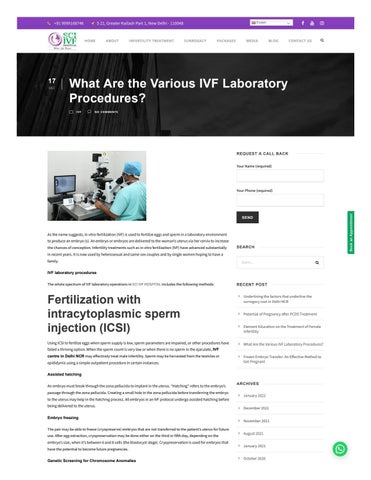
As the name suggests, in vitro fertilization (IVF) is used to fertilize eggs and sperm in a laboratory environment to produce an embryo (s). An embryo or embryos are delivered to the woman’s uterus via her cervix to increase the chances of conception. Infertility treatments such as in vitro fertilization (IVF) have advanced substantially
SEARCH
in recent years. It is now used by heterosexual and same-sex couples and by single women hoping to have a family.
Search...
IVF laboratory procedures The whole spectrum of IVF laboratory operations in SCI IVF HOSPITAL includes the following methods:
RECENT POST
Fertilization with intracytoplasmic sperm injection (ICSI)
Underlining the factors that underline the surrogacy cost in Delhi NCR
Using ICSI to fertilize eggs when sperm supply is low, sperm parameters are impaired, or other procedures have
What Are the Various IVF Laboratory Procedures?
Potential of Pregnancy after PCOS Treatment Element Education on the Treatment of Female Infertility
failed a thriving option. When the sperm count is very low or when there is no sperm in the ejaculate, IVF centre in Delhi NCR may effectively treat male infertility. Sperm may be harvested from the testicles or epididymis using a simple outpatient procedure in certain instances.
Frozen Embryo Transfer: An Effective Method to Get Pregnant
Assisted hatching An embryo must break through the zona pellucida to implant in the uterus. “Hatching” refers to the embryo’s passage through the zona pellucida. Creating a small hole in the zona pellucida before transferring the embryo to the uterus may help in the hatching process. All embryos in an IVF protocol undergo assisted hatching before being delivered to the uterus. Embryo freezing The pair may be able to freeze (cryopreserve) embryos that are not transferred to the patient’s uterus for future use. After egg extraction, cryopreservation may be done either on the third or fifth day, depending on the embryo’s size, when it’s between 6 and 8 cells (the blastocyst stage). Cryopreservation is used for embryos that have the potential to become future pregnancies. Genetic Screening for Chromosome Anomalies
ARCHIVES January 2022 December 2021 November 2021 August 2021 January 2021 October 2020