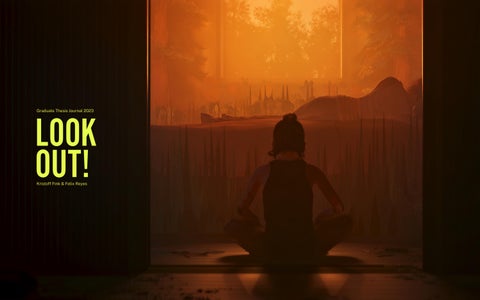
LOOK OUT!
Kristoff Fink & Felix Reyes
Graduate Thesis Journal 2023
![]()
Kristoff Fink & Felix Reyes
Graduate Thesis Journal 2023
Look Out! is an animated short film that weaves together climate fiction and drama.
In the film, a family resides within an exclusive, remote lake community nestled within the San Bernardino Valley, sold on the promise of safety and comfort in their state-of-the-art smart home. However, when a devastating forest fire rages through their surroundings, their oncesecure sanctuary transforms into a precarious refuge, revealing the fragility of their family bonds and the true cost of living in isolation.
Look Out! leverages the intimacy of 'home' as a family contends with the climactic crisis at their doorstep. As a raging inferno threatens their once-sheltered refuge, their unwavering trust is put to the test as the world they thought they knew goes up in flames.
“Since there is no Nature to which one must cleave, what matters is not an anesthetized experience of feeling part of something bigger but establishing a bond of intimacy between beings. Architecture without Nature, then, must concern itself with establishing these affiliations.”
-Timothy MortonIn this quote in Architecture Without Nature, Morton argues for a complete dismissal of the concept of ‘Nature’, which has always been envisioned as a backdrop to systemic human structures and has used methods of undermining and overmining to qualify entities that are included or excluded from this networked backdrop. This dismissal imparts a flattening effect that removes notions of foreground and background as it relates to our understanding of the ‘world’ and ‘us’, imparting a confrontation with the hyperobjects that have always existed and will continue to exist in a post-human era. This kind of architecture links entities through degrees of affiliation and ultimately flattens humankind, other living, and non-living beings, as well as the objects we manufacture into an uncomfortably infinite coexistence. The success of an ‘Architecture without Nature’ is hinged firstly on human compliance to the concept of coexisting with the ‘grey goo’ as it relates to architecture and secondly, on the ability of the architecture to foster critical awareness of its relationship to this goo.
The de-romanticization of ‘nature’ as it relates to climatic crises within architecture can be envisioned as a concession to the presence of the hyperobject. To clarify this differentiation from the current state of architecture, we can refer to what New-Territories refers to as “fossilized representations”. In a 2003 interview for Architectural Design, the group called for a more courageous architecture by stating, “I dare to hope for an architecture that would reveal the contradictions and fantasies of a society, rather than its fossilized representations.” Emphasis on architectural style and programmatic function as a means of categorizing architecture feeds into this fossilized state and impart a premature obsolescence to the architecture. The resistance to contain or subdue the existence of these forces within the building involves an adaptive acceptance responding to the simultaneity of time, degrees of affiliation between forces, and the defossilization of architecture.
Paranoia within the spaces we inhabit can serve as a productive means of understanding spaces of comfort and the forces that aim to compromise or alter this feeling. Whether through the architecture's exterior expression or by the way in which the omnipresence of these forces affects the internal user experience, the neurosis evoked allows us to be critical of the degrees of affiliation we have to the territories we inhabit. Projects like Mosquito Bottleneck(2003), by New Territories, exploit this paranoia by integrating the omnipresent danger of the West Nil virus into the design of a private home that simultaneously traps and invites the presence of mosquito. Other projects, such as the Long Line Building(1969) by architect John Carl Warnecke, propose a visual indication of its paranoia( in this case the diplomatic tensions of the Cold War between the US and Russia) through a towering monolithic and windowless facade that is both surveillance and nuclear proof. As the buildings serve to shield us from our environments we grow increasingly aware of the entities it is protecting us from as in the case of the fictional spiked homes in the film Beasts of the Southern Wild(2012), which shield the occupants from an auroch attack.
To exist within this paranoiac state is to concede to the idea that the factors inducing that paranoia are very real and very present. The project Terra Incognita (originally exhibited at the Paris Museum of Modern Art in 2006) replicates processes of instability in global warming and glacial melting as active agents within a time-based installation piece. The piece, an artificial island molded by and composed of honeycomb aluminum and liquid counterweights, tells the fictional narrative of an outcasted albino penguin and a mysterious Antarctic island known as Terra Incognita. The fictional island alludes to an existing formation known as the Island of Idleness in the Arctic region that formed slowly through continual glacial melting due to the effects of global warming. The effects of global warming and melting ice, evident within these distant and isolated ice masses in the Southern Ocean, become increasingly visceral as the evaporation of the water within the counterweights, due to similar warming effects, start to deform and flatten the mound-like island in the gallery space. As the audience gradually watches the flattening of Terra Incognita, one is reminded of the precarious instability of the Island of Idleness and its destructive consequences on the albino penguin's notion of ‘home’.
Images of being overcome and completely immersed within a pool of grey goo incite feelings of horror and anxiety as one is disillusioned by the fact that there is no such thing as an ‘away’ or ‘over yonder’ where this goo exist. Highly optimized systems of flow and exchange that circulate this grey goo (aka waste, contaminated air, heat, etc.) will eventually reach a moment of obsolescence when the overwhelming load of climactic detriment begins to outweigh the fortifying capacity of our shelled enclosures. Dusty Relief (2002), a proposal for a contemporary art museum within the city of Bangkok, exploits this cohabitation with the grey goo through a literal attraction of waste byproducts into the composition of the façade. By using a combination of aluminum cladding and an embedded electrostatic system within the exterior structure, the museum progressively transforms into a hairy blob from collected dust particulates floating in the air. The buildup of material is flaunted as a visual exposure of the goo that permeates invariably through the city, and through this exposure, good matter and bad matter become interchangeable; reduced simply to just matter. Likewise, the work of Gordon Matta Clark, employs tactics of exposure within architecture through literal acts of splicing, shifting, and removing elements within existing buildings. In the case of Splitting(1974), the slicing of the home transforms the space that was once a threedimensional array of surfaces into thresholds with layers of materials. These materials carry with them complex narratives of exchange, origins, and a vast degree of ecological implications.
A) Gordon Matta Clark, Circus, 1978.
B, D, & E) New Territories, Dusty Relief, 2002.
C) Gordon Matta Clark, Splitting, 1974.
An artificial climate is heated, cooled, pushed, pulled, filtered, and humidified. All of these actions performed by machine to adapt and modify the raw climatic conditions of the exterior and fashion it into a new atmosphere of comfort on the interior. The physicality of the systems which support our comfort already require spatial consideration. The sizing of the systems is proportional to the surrounding climate, size of the sealed space, and the desired constructed comfort level. These are the building blocks of an artificial climate. If any of these influences grow the mechanical systems must also increase in scale. To give up on or eliminate any of these influences would mean to allow a piece of our comfort go as well.
Berndnaut Smilde exposes these systems and their spatial consequences in his exhibition titled ‘Conditioner’ (2009). We lose perception of the intended scale of these ducts and instead contend with the reality that eventually our desire for comfort will contend with our desire for space. The relationship between the two desires and the consequences of comfort will bring into question how far are we willing to go to maintain it. His work titled ‘Nimbus’ (2015) explores the manual manipulation of atmosphere within a space. His interest lies in the fleeting and ephemeral nature when attempting to alter the climate and how quickly conditions change or must be maintained.
These life support systems constitute the circulatory system of the home. Transferring heat from the core to the extremities. We feed the systems with gas, electricity, coal, wood, water, and air directly to the beating machine heart of the home. Ductwork branches from the heart to the extremities as it distributes that altered climate throughout. As the environment is effected by the home it becomes unsuitable for comfortable living. The heart comes to life again and the push and pull of the circulatory system expels and refreshes the environment back to the desired comfort level.
Reyner Banham and Francois Dallegret (1965) diagram the implications of these systems by erasing away all of the characteristics of home that don't serve, transfer, or generate the life supporting systems that allow the dwelling to be comfortable and suitable for continual inhabitance. The extents of the diagram penetrate the earth and reach towards the sky harvesting and exhausting energy continually.
A) Berndaunt Smilde, Nimbus Green Room, 2013
B) Berndaunt Smilde 'Conditioner' Exhibition, 2009
C) Berndaunt Smilde and Mathew Duguid, Airbus, 2017
D) Berndaunt Smilde 'Conditioner' Exhibition, 2009
A) Reyner Banham and Francois Dallegret, Anatomy of a Dwelling, 1965
A) Carrier Company, World's Fair Igloo, 1939
B) Jay Swayze, The Underground Home, 1964
C) Jay Swayze, The Underground Home, 1964
D) Jerry Hendersen, The Underground House, Las Vegas, 1970
Artificial climate utilizes aspects of machinery, ductwork, wires, computers, algorithms, sensors, and space. All of these components work together quietly behind the scenes when a desired command is sent from the controls. Without realizing the implications of an action humans spark to life a network of interconnected devices and systems all working in harmony to produce, transport, and emulate a comfortable climate within the home.
At the world’s fair of 1964 in New York, Jay Swayze presented a new concept of the home conceived around the realities of the Cold War in the US. The underground world home was a large 6,000 square foot underground bunker home that featured air conditioning and windows with backlit murals to emulate the qualities of living on the surface.
The IPCC 2022 recognizes the ‘hot model’ problem as it uses the simulations and models predicting the future of climate to look back in an attempt to verify historical climatic evidence. Over 50 models (CMIP6) of the climate were compared by the World Climate Research Programme, with over a quarter shown to inaccurately reflect the temperatures and climate of the past.
Lacking precedent for predicting the climate and an inability to predict human behavior that is tied to the carbon saturation of the atmosphere, these models fall short when creating empathy in humans and depict a pseudo-apocalyptic world that results in a nihilistic reaction from the public.
A) Earth.nullschool.net, Climate Model Visualizer, PPM <2.5 and Wind
B) Climateclock.world, The Climate Clock
C) Philo.github.io, Temperature Anomalies, 1900-1904
D) Philo.github.io, Temperature Anomalies, 2000-2004
E) Earth.nullschool.net, Climate Model Visualizer, Surface C02 and Atmosphere Chem
A) US Navy, MASK Indoor Ocean, 1962
B) US Core of Engineers, Mississippi River Basin Model, 1949
C) NASA, Neutral Bouyancy Lab, ISS Training Pool, 1995
D) US Core of Engineers, Mississippi River Basin Model, 1949
The Mississippi River basin model (1949) was a scaled physical model of the river in response to devastating floods in the early 1900’s. The model allowed for the prototyping and development of flood control infrastructure along the river. This scale model, its experiments, and the reality of the river are all entangled as the scale of the human is dwarfed in exchange for our attempt to manipulate and unfold the natural orders of the world.
The Navy Ocean Simulator (1962) and the ISS Training pool (1995) are both examples of scaled and emulated environments that are constructed due to the difficulty of simulating in the realities they portray. Despite only being an emulation they bolster our confidence in engaging with and conquering these inhospitable environments.
The use of surveillance technology in environmental conservation has become increasingly important in recent years as the world faces a growing number of environmental challenges. With satellite imagery, drones, and other forms of remote sensing, conservation organizations and governments are able to gather data and monitor changes to ecosystems and wildlife populations in near-real time. This data is used to identify areas in need of protection, track illegal activities such as deforestation and wildlife poaching, and monitor the effectiveness of conservation efforts. Mosse’s use of high-resolution aerial photography to document the destruction of the Amazon rainforest in South America provides a bird's-eye view of the rainforest and a unique perspective on the scale and impact of deforestation in the region. These aerial images capture vast areas of land that have been cleared for agriculture, mining, and other uses. Each of these psychedelic images remains objective in its efforts to bring attention to the devastating impact that human activities are having on the Amazon rainforest and its indigenous communities. The images are both beautiful and haunting, highlighting the delicate balance between nature and human intervention.
“Every gaze is potentially indiscreet, but when it penetrates domestic interiors it becomes intrusive, a violation, even a rape.” -Georges Teyssot
In his essay Windows and Screens: A Topology of the Intimate and Extimate, Teyssot proposes that the home is analogous to the human body in that the act of discreetly looking into the home is as reprehensible as the violation of a body. To look is to sin and the voyeur’s wandering eye is to be condemned. Voyeurism is a recurring theme in various forms of media and art, including architecture, film, and visual arts. Removed from its sexual connotations, the act of voyeurism is one of observation, speculation, curiosity, and imagination. The piecing together of fragmented clues allows for a series of possible realities, each with its own experiential and design implications as it relates to architecture. The concept of voyeurism is also often intertwined with themes of surveillance and privacy. A home told through the point of view of the voyeur invites the audience to reconstruct the reality of the dwelling and its inhabitants through fragments of collected images, sounds, and movements. We are enthralled by the scenes that play out behind the curtain sliver of a window due to the sheer uninterrupted honesty in the event and the imaginative possibilities that permeate the scene. Within
In the Mood for Love, directed by Wong Kar-wai, we are immersed in the intimate yet claustrophobic world of lovers Mr.Chow and Mrs.Chan. Their cramped, communal apartments act as additional protagonists in the film through Kar-wai's employment of a frame within a frame technique. Each shot employs a framing of events through the use of objects or architectural elements within the foreground to not only place the focus on the characters but also allow the audience to speculate on the emotion and reactions of characters and events not shown within these framed vignettes. Similarly, we can look at films such as Playtime by Jacques Tati’s which serves to expose the architecture of the modernist city as a backdrop for a series of voyeuristic observations through the implementation of large transparent facades and open interior plans. Each window serves as a perfect frame filled with drama, humor, and brimming narrative potential. In this sense, architecture has the potential to invite voyeuristic acts by creating spaces with the equal and opposite ability to enable and obstruct voyeuristic acts through the design of space.
A & C) Wong Kar-wai, In the Mood For Love, 2001.
B) Jacques Tati, Hansel and Gretel, 1967.
D) Cornelius Galle, "Looking Does Harm to the Careless Person" Engraving, 1601.
E) Gasper Noe, Enter the Void, 2009.
A) Jakob von Uexkull, Figure 52 Ant and Oak, Page 130, 1934
B) Jakob von Uexkull, Figure 50 Fox and Oak, Page 128, 1934
C) Jakob von Uexkull, Figure 51 Owl and Oak, Page 129, 1934
D) Jakob von Uexkull, Figure 48 Forester and Oak, Girl and Oak, Page 129, 1934
E) Jakob von Uexkull, A Foray into the World of Animals and Humans, 1934
“Which animals have a territory, and which do not?”
-Jakob von Uexkull
Uexkull asks the question of territory and attempts to describe the complexity of that question through the analogy of an oak tree. The tree, which is populated by many different animal subjects, plays a different role for each subjective perspective. For the forester the tree is seen as a raw resource, to the girl there is personified danger, to the owl the tree is a vital perch to observe from, to the fox it is a den amongst the roots, and for the ant it is a highway aiding its search for food. All of which might call the tree ‘home’. Through understanding the extent and complexities of the question of territory allows us to redraw boundaries and redefine the stakeholders of a given ‘home’
"Within each one of us, there exist a oneiric house, a house of dream memory. Each home we live in after subsequently is a permutation of that imagined oneiric house."
-Gaston BachelardIn this quote from Gaston Bachelard’s The Poetics of Space, a definition of ‘home’ as the permutation, evolution, and multiplication of our lived experience and our imagination presents an argument for why we become deeply rooted in our dreams and ambition for ‘home’. The binary created between ‘home’ and ‘non-home’ where ‘home’ “shelters the day dreaming, protects the day dreamer, and allows one to dream in peace” (Bachelard) and ‘non-home’ represents that which doesn’t foster our endeavor to dream and find comfort.
Home as a Region by Theano S. Terkenli lays out the underlying hierarchies embedded within ‘home’ at all scales. ‘Home’ is defined as “A place where every day is multiplied by all the days before it” (Terkenli 326). The first ‘home’ is the mother and as we gain life experience the region we call home expands with it. In the way Bachelard’s Oneiric House describes ‘home’ as a shelter for continual day dreaming, Terkenli argues for the ‘home’ as a dynamic relationship between our understanding of what falls within the interior and our geographical understanding of the world.
Terkenli defines rootedness as “A state of mind or being in which a person's whole life and pursuits are centered around a broadly defined home." Our ‘home’ becomes a place where memories are created and given refuge. Our rootedness to ‘home’ derives itself from the vulnerability and intimacy of a space that becomes our own. We invest in its protection and we dream of its expansion.
To threaten or move from ‘home’ would be to displace people from their roots and memories. Subverting their intimate notions of space and sending them off to wander in search of a place that can compare. We carry the objects of ‘home’ we can hold on our journey. The desire and need for intimacy, rootedness, and a sense of place guide our movements as we carve out a new space rooted in the beauty of our first ‘home’.
In the picturesque mountains of California, a family resides within a state-of-the-art smart lake house crafted by Praesidium. This technological marvel provides unparalleled comfort and protection from the elements. But when a forest fire threatens their idyllic existence, the family's artificial haven begins to crumble, revealing a fragile family structure and their blind hope in the fortified shelter that had once safeguarded them.
As each character transforms within the home, the decline of the once-impenetrable fortress becomes more visceral. MAYA is bedridden, ADAM believes he can uphold the deteriorating home, and PHOENIX adorns the home's interior to mimic the forest before the fire. With the inferno drawing closer, the family must choose whether to persist in their battle or face the blistering reality outside.
The family bought into the illusion that this home would serve as a bastion of normalcy, shielding them from the turmoil outside. But as the flames rage, they yearn for a beacon of salvation to restore a sense of normalcy back into their lives. Will the 'home' inspire the indispensable conviction and optimism required to face the realities beyond its four walls?
Look Out! is a climate fiction narrative that integrates drama, science fiction, and social commentary elements. The story uses a speculative and near-future setting to explore the impact of climate change and the limits of technology in addressing its challenges.
The story's themes center around the fragility of human existence in the face of climate change and the importance of recognizing the interconnectedness of humans and nature. The house's construction and the family's reliance on it represent the modern-day obsession with the technologies of comfort that further insulate us from the realities outside. As we observe the family's dramatic struggle between persisting in their battle or facing the blistering reality outside, the story questions our over reliance on technologies that mask and divorce us from the looming environmental crisis.
Praesidium designs and builds bespoke homes with defense and protection systems for high-net-worth individuals. Leveraging virtual surrogates of clients' families within the simulated home aids in optimizing and personalizing the efficacy of their design. Through these simulations, the company uncovers vulnerabilities, evaluates home performance, and monitors the psychological response of its clients in crisis scenarios.
The home within the film, designed by Praesidium, is nestled in a wildfire-prone area and boasts a sophisticated network of fire protection systems incorporated into the walls and furniture. While exuding the warmth and comfort of a home, these safety measures are conspicuous, instilling a sense of security in the family. The smart home serves as a dependable refuge, a fortress of protection during crisis.
The film's visual language takes a passive, creative, and cinematic approach, using intimate and purposeful framing to convey the characters' evolution through their physical spaces and relationships. Long takes and close framing immerse the audience in a voyeuristic perspective, capturing intricate details within each scene to provide broader interpretations of the outside world and the family's psychological state. The camera's role as a tool of surveillance is emphasized, with characters often shown slightly out of frame or turned away.
Beauty is found in small details, such as the view of the backyard outside a kitchen window, a child's drawing on a wall, or a pile of discarded inhalers, which convey the characters' inner thoughts and reactions. Slow, deliberate camera movements create a haunting beauty within the mundaneness of the home's interior, and recurring depictions of domestic spaces highlight changes over time.
Through this visual language, the film transports audiences into an intimate and endangered world, as a family struggles to survive amidst external turmoil. Its cinematic approach, deliberate cinematography, and use of small details as narrative tools create a voyeuristic and emotionally resonant experience that is both hauntingly beautiful and deeply moving.
A) Wong Kar-Wai, Happy Together, 1997.
B) Wes Anderson, Moonrise Kingdom, 2012.
C) Wong Kar-wai, In the Mood For Love, 2001.
D) Bong Joon-Ho, Parasite, 2019.
E) David Fincher, Zodiac, 2007.
F) Paul Thomas Anderson, Phantom Thread, 2017.
The tone of Look Out! oscillates between idyllic and foreboding, evoking a sense of duality that permeates the film. Initially, the story emphasizes the importance of the home as a haven of comfort and safety for the family. However, as the narrative progresses, an encroaching forest fire threatens their tranquil existence, blurring the boundary between their external and internal realities. The family's precariousness becomes apparent as their insulated existence clashes with the harshness of the outside world, revealing their vulnerability. The father's practical attempts to fix the home's failing systems clash with the daughter's whimsical methods of creating an idealized natural world within their walls, masking the tumultuous reality both inside and outside. The tone is elegiac and poignant, with a hint of desperation, as the family struggles to reconcile with the disintegration of their onceimpregnable haven.
MAYA, a retired landscape artist, embodies the original notion of ‘home’ through her unwavering support and protection. ADAM, an unfulfilled novelist, is an aloof and inattentive patriarch consumed by his constant pursuit of literary inspiration. PHOENIX, the embodiment of innocence and curiosity, spends her time exploring outdoors and recording her observations through vivid illustrations.
As the fires worsen outside the home and the interior gradually deteriorates, the characters' roles undergo a profound and progressive subversion and transformation.
MAYA, 35, retired from her career as a landscape artist upon PHOENIX's birth. Her artistic pursuit was replaced with an unwavering commitment to nurture and care for her family. She is often driven to shield her daughter from the harsh realities of the world by creating a secure and comfortable haven. Despite being severely asthmatic from birth, she refuses to let her condition hinder her pursuits of life and family. Caught in nostalgic moments with her daughter, she reminisces about her former work and the natural landscapes she once dominated.
A) Adam in Den, Look Out!, 2023.
B) Adam Awards, Look Out!, 2023.
ADAM, 42, is an unfulfilled novelist who struggles to stay inspired but has had an extended career as a successful writer. As a character, he becomes easily fixated. His confidence in his ability to overcome whatever challenge he focuses on means he rarely asks for help. He is an aloof and inattentive patriarch who spends most of his days isolated in his study. He is distant from his family, and his fixation on his work means he may neglect his responsibilities as a father and husband.
A) A.N.D.Y and Phoenix in the Forest, Look Out!, 2023.
B) Phoenix in the Living Room, Look Out!, 2023.
PHOENIX, 10, an embodiment of innocence and curiosity, spends her time painting with MAYA, playing outdoors, exploring the nearby forest, and recording her observations through sketches of her family, the woods, and an array of imaginative woodland creatures. Her relationship with MAYA helps to shape the way she sees the world. Unlike ADAM, who is blinded by his study, or MAYA, limited to the views of the forest from their home's windows, PHOENIX fearlessly explores the natural surroundings, relishing in the little discoveries she makes along the way.
A) Main Control Interface, Look Out!, 2023.
B) Atrium Lockdown, Look Out!, 2023.
The home in the film acts as a visual storyteller, adapting to the family's actions and surroundings. Designed by Praesidium, the home is part of a small, remote community of similar homes, all specially designed to resist the effects of a multitude of natural disasters within the region. The interior boasts cutting-edge technology for temperature control, lighting, cleaning, organization, and entertainment. A certain uncanniness perpetuates throughout the living spaces. The room’s walls, ceiling, and floor are strangely deformed and interrupted by random extruded volumes covered in an array of vents. Furniture wraps and adjusts to these extrusions establishing a sense of normalcy to the presence of these extrusions. Overall, comfort is an everpresent theme throughout the entire residence.
This thesis explores how nihilism towards the climate crisis can physically manifest in our homes, intentionally insulating us from the harsh realities of a changing climate. Our concept of "home" and our connection with the environment have been influenced by a binary outlook that separates humans and culture from the natural world. As a result, we have come to treat the environment as an object and built homes that intentionally isolate us from the natural forces that shape them.
Although advanced climate simulations and surveillance technology provide an objective means of understanding and analyzing the state of the environment, the abstract nature and scale of these models often fall short of empathetic understanding. By reframing these models to the human scale, "Look Out!" encourages a deeper connection with the world around us, inspiring a more adaptive and resilient way of living that prioritizes our shared planetary future.
At its core, "Look Out!" poses a critical question that resonates within us all: By shifting the scale of engagement, can we foster an alternate sensibility and agency in how we engage with climate change? Positioning the home as a defining subject of the film allows us to explore the impact of shifting environmental and dwelling conditions on the values of the film’s ‘nuclear family’. This tale challenges whether the walls of the 'home' can inspire the fortitude and hopefulness necessary to confront the daunting challenges we face beyond.