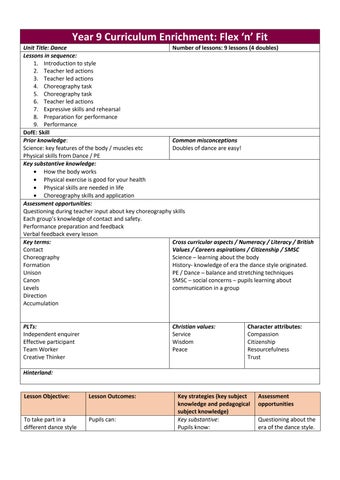
Unit Title: Dance
Year 9 Curriculum Enrichment: Flex ‘n’ Fit
Number of lessons: 9 lessons (4 doubles)
Lessons in sequence:
1. Introduction to style
2. Teacher led actions
3. Teacher led actions
4. Choreography task
5. Choreography task
6. Teacher led actions
7. Expressive skills and rehearsal
8. Preparation for performance
9. Performance
DofE: Skill
Prior knowledge:
Science: key features of the body / muscles etc
Physical skills from Dance / PE
Key substantive knowledge:
• How the body works
• Physical exercise is good for your health
• Physical skills are needed in life
• Choreography skills and application
Assessment opportunities:
Common misconceptions Doubles of dance are easy!
Questioning during teacher input about key choreography skills
Each group’s knowledge of contact and safety.
Performance preparation and feedback
Verbal feedback every lesson
Key terms: Contact
Choreography
Formation
Unison Canon Levels
Direction Accumulation
PLTs:
Independent enquirer
Effective participant
Team Worker
Creative Thinker
Hinterland:
Lesson Objective: Lesson Outcomes:
To take part in a different dance style Pupils can:
Cross curricular aspects / Numeracy / Literacy / British Values / Careers aspirations / Citizenship / SMSC
Science – learning about the body
History- knowledge of era the dance style originated. PE / Dance – balance and stretching techniques
SMSC – social concerns – pupils learning about communication in a group
Christian values: Service Wisdom Peace
Character attributes: Compassion Citizenship
Resourcefulness Trust
Key strategies (key subject knowledge and pedagogical subject knowledge)
Key substantive: Pupils know:
Assessment opportunities
Questioning about the era of the dance style.
• Explain The history of the dance style
• perform actions from the dance style
To take part in the dance style – teacher led Pupils can:
• Recall movements from previous week.
• Perform actions with accuracy
To take part in the dance style – teacher led
• Recall movements from previous week.
• Perform actions with accuracy
Choreography task Pupils can:
• List choreography skills.
• Explain safety points of contact work.
• Explore ways of creating contact safely in dance.
Choreography task Pupils can:
• Organise their group to complete the task on time.
• Improvise, select and organise actions to suit the style of the dance.
• Perform their choreographed section with confidence and accuracy
Teacher led actions Pupils can:
• Recall a large sequence of dance.
• Comment on others’ choreography section.
• Improve their choreography section
Expressive skills and rehearsal Pupils can:
• Recognise strengths and improvements for themselves
• the importance of physical skills in relation to everyday life and this dance style
Key substantive Pupils know:
• How to rehearse effectively.
• How to organise actions into a sequence for a large group of dancers
Key substantive Pupils know:
• How to rehearse effectively.
• How to organise actions into a sequence for a large group of dancers
Key substantive Pupils know:
• How to perform contact work safely.
• How to create actions in a style.
Key substantive Pupils know:
• How to link actions together to create a sequence.
• How to apply choreography skills.
• How to rehearse to improve movement memory and confidence
Key substantive Pupils know:
• How to give constructive criticism.
• How to improve their choreography.
Key substantive Pupils know:
• The expressive skills of a dancer.
Questioning about the physical skills needed for the dance style
Enquiry questions
Enquiry questions
Group verbal feedback
Enquiry questions
Group verbal feedback
Enquiry questions.
Peer feedback
Enquiry questions
Self reflection
• Set personal targets.
• Use rehearsal discipline
• List expressive skills
Preparation for performance Pupils can:
• Perform the dance with confidence.
• Use expressive skills in performance.
• Comment on their own performance
• How to apply these to parts of the dance.
• How and where to improve their performance skills within the performance.
Key substantive Pupils know:
• The dance and are able to adapt to any problems within the performance.
• How to use feedback to improve.
Teacher feedback Whiteboards
Performance for an audience
Pupils can:
• Perform for an audience
Key substantive Pupils know:
• How to make a performance adaptable for a different setting.
Self assessment via video Whiteboards
Teacher observation
Audience observation.