Number: Fractions (including Decimals and Percentages) Year 1
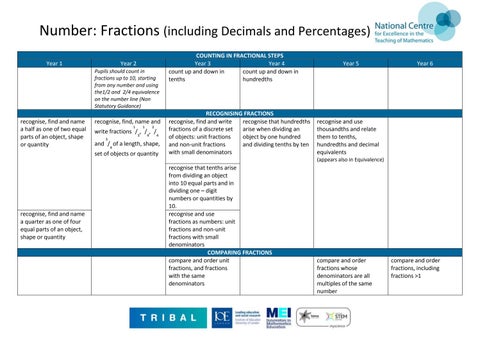
Year 2 Pupils should count in fractions up to 10, starting from any number and using the1/2 and 2/4 equivalence on the number line (Non Statutory Guidance)
recognise, find and name a half as one of two equal parts of an object, shape or quantity
recognise, find, name and 1
1
2
write fractions /3, /4, /4 3
and /4 of a length, shape, set of objects or quantity
recognise, find and name a quarter as one of four equal parts of an object, shape or quantity
COUNTING IN FRACTIONAL STEPS Year 3 Year 4 count up and down in count up and down in tenths hundredths
RECOGNISING FRACTIONS recognise, find and write recognise that hundredths fractions of a discrete set arise when dividing an of objects: unit fractions object by one hundred and non-unit fractions and dividing tenths by ten with small denominators
Year 5
) Year 6
recognise and use thousandths and relate them to tenths, hundredths and decimal equivalents (appears also in Equivalence)
recognise that tenths arise from dividing an object into 10 equal parts and in dividing one – digit numbers or quantities by 10. recognise and use fractions as numbers: unit fractions and non-unit fractions with small denominators COMPARING FRACTIONS compare and order unit fractions, and fractions with the same denominators
compare and order fractions whose denominators are all multiples of the same number
compare and order fractions, including fractions >1