Harrison News-Herald |
1
$1.25
Saturday, February 19, 2022
SATURDAY, FEBRUARY 19, 2022
Cadiz to house new bank
CADIZ — Woodsfield Savings Bank President and CEO Tracey E. Craig is pleased to announce plans for the construction of a new branch office at the corner of West Market and South Muskingum Streets in Cadiz, Ohio. The new full-service location will be the third branch office for Woodsfield Savings Bank and will offer a suite of financial services for businesses and consumers, including deposit and lending services, drive-up teller lanes, an ATM, digital banking services, and investment
services through a partnership with financial advisers. Construction on the new branch is scheduled to begin mid to late March. “We are excited to expand our services into Cadiz and Harrison County,” said Mr. Craig. “We are a true community bank in every sense of the word. Decisions are made locally with fast turnaround times, and we support our communities through donations, volunteerism, and scholarships. We look forward to offering our personalized approach to banking in the
HARRISONNEWSHERALD.COM
area.” The new branch office is being designed by APG Architects of Zanesville, Ohio and will be built by &build, a PCS company of Barnesville. Construction is expected to be completed by late fall of this year. The new branch location will represent an estimated $1.5 to $2 million investment in the Cadiz community and will employ five to seven full and part-time positions.
Cottage Hill Farm 8 generations of Merino wool
BY REBECCA BRATTEN WEISS Harrison News-Herald Reporting Journalist
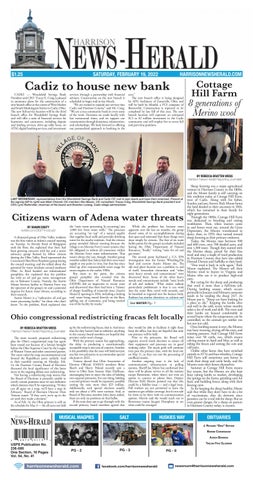
LAST WEDNESDAY, representatives from the Woodsfield Savings Bank and Cadiz CIC met to sign deeds and have them notarized. Present at the signing (left to right) was Mark Chisnell, CIC member; Ken Mason, CIC consultant; Tracey Craig, Woodsfield Savings Bank president and CEO; Lynn Riethmiller, chairman of the board; and Brandon Ludwig, Cadiz village administrator.
Citizens warn of Adena water threats BY SHAWN DIGITY twitter.com/DIGITYnodoubt A dismayed group of Ohio Valley residents was the first visitor at Adena’s council meeting on Tuesday. As Beverly Reed of Bridgeport took the floor, she explained that there had been growing concerns with her and a newer advocacy group formed by fellow citizens dotting the Ohio Valley. Reed represented the Concerned Ohio River Residents group during the council meeting, and she talked about the potential for water incidents around southeast Ohio. As Reed handed out informational pamphlets, she explained that the problem lies with an oil and gas waste management site in Belmont County. Namely, the Austin Master Services facility in Martins Ferry was the epicenter of the group’s ire and a potential impetus for future water threats, according to their research. Austin Master is a “radioactive oil and gas waste processing facility” for those who don’t know. To the problem, Reed explained that
the “toxic waste processing [is occurring] just 1,000 feet from water wells.” The processes are occurring “on top” of a natural aquifer that supplies local wells and provides drinking water for the nearby residents. And the citizens group attended Adena’s meeting because the village is on Martins Ferry’s water system; they felt obligated to inform all consumers within the Martins Ferry water infrastructure. That wasn’t always the case, though. Another group member added that Adena had their own water supply at one point in time, but that has since dried up after nonsustainable water usage for steam engines in the earlier 1900s. But more to the point, the citizens group’s pamphlet also revealed that the Ohio Department of Natural Resources (ODNR) did an inspection in recent years and discovered that there had been a “history of sloppy handling of materials since [Austin Master’s] opening in 2016, including a leaking roof, waste being stored directly on the floor, spilling out of containers, and being tracked out of the facility by trucks.”
While the problem has become more apparent over the last six months, the group shared some of its accomplishments during that span and reiterated that these things were done simply by citizens. The first of six main bullet points for the group’s accolades included having the Ohio Department of Natural Resources ”finally” writing “rules for oil and gas waste.” The second point facilitated a U.S. EPA investigation into the former Wheeling-Pitt Steel and current Austin Master site. The old steel plant location was a problem in and of itself; hexavalent chromium and “other toxic heavy metals and contaminants” were discovered there. Some of the other heavy metals and contaminants include “toxic levels of salt and radium.” What makes radium particularly problematic is that it can work into the water flow, travel with aerosols, and be breathed or ingested into the human body. Radium has similar chemistry to calcium and See WATER Pg.- 7
Ohio congressional redistricting fracas felt locally BY REBECCA BRATTEN WEISS Harrison News-Herald Reporting Journalist The most recently proposed redistricting plan for Ohio’s congressional map has again been tossed out because of a lawsuit brought before the Ohio Supreme Court by the League of Women Voters and other concerned parties. The court ruled the map unconstitutional and favored the Republican party unfairly. And at their monthly meeting on Monday, Feb. 14, the Harrison County Board of Elections discussed the local significance of this latest move in the ongoing debate over redistricting. Not having a redistricting map means that the Board of Elections is presently unable to certify certain positions since it’s not definitive which districts they’ll be representing. “If they can all agree on a map, we’ll have a map in February,” Board of Elections Director Dion Troiano stated. “If they can’t, we’re up in the air until they make a decision.” As of Feb. 14, the Ohio primary is still on the schedule for May 3 — for all races not held
up by the redistricting fracas, that is. And since thus far they haven’t had to redistrict anything in the county, board members are hopeful that precinct codes won’t change. With the primary season fast approaching, the delay in producing a constitutionally acceptable map is one area of concern. Another is the possibility that the state will hold not just one but two primaries to accommodate special elections in 2022. Troiano shared that Ohio Association of Election Officials (OAEO) members Brian Sleeth and Sherry Poland recently sent a letter to Ohio State Senator Matt Huffman, encouraging him to reject the idea of holding two separate primaries. For one thing, holding a second primary would be expensive, possibly costing the state more than $25 million. Additionally, such special elections usually only see about a 10% voter turnout. And, as Board of Elections member John Jones added, there are only six positions on that ballot. If the state does opt to go through with the second primary, board members agreed that
MUSICAL MAGPIES
they would be able to facilitate it right there from the office, but they are hopeful that only one primary will be held. Prior to the primaries, the Board will organize several mock elections to ensure all their equipment and processes are in good working order. The mock polls will continue even past the primary date, with the final one on May 11, so they can test the processing of unofficial results. Another ongoing issue is the lack of communication infrastructure at polling stations. Sheriff Joe Myers has confirmed that there will be phone service to all the stations except Bowerston, where there’s not even an option to connect to phone lines. Deputy Director Kelli Martin pointed out that this could be a liability issue — and a legal issue. Poll workers are not permitted to leave the stations to get cellular coverage, but it’s not safe for them to be there with no communication options. Martin said she would reach out to Bowerston mayor Jacquie Humphrey to see what could be arranged.
SALT
HUSKIES WAY
Sheep farming was a major agricultural venture in Harrison County in the 1800s, and the Moore family is still carrying on this tradition today at Cottage Hill Farm, west of Cadiz. Along with his father, Stanley, and son, Steven, Rick Moore farms the land deeded to their ancestors in 1816, which has remained in their family for eight generations. Through the 1800s, Cottage Hill Farm was dedicated to breeding and raising workhorses. Then, when tractors came in and horses went out, around the Great Depression, the Moores transitioned to dairy; then, in 1959, they turned toward sheep farming as their primary endeavor. Today, the Moores raise between 500 and 600 ewes, own 700 deeded acres, and rent 1,300 more. Though they started with the Merino sheep, prized for their fine wool and once a staple of wool production in Harrison County, they have also added Horned Dorsets and Suffolks to their herd. “Fine wool is back in style again,” Rick Moore explained. The Moores sell their Merino wool to buyers in Virginia and Maine who use it to produce high-end yarn. But caring for the sheep and producing that wool is more than a full-time job. During lambing season, which occurs primarily in January and February, someone needs to be tending the sheep 24/7. As Moore put it, “Sheep are born looking for a place to die.” Keeping the lambs alive and well in the cold, severe winter months takes a lot of work and skill. The ewes and their lambs are housed comfortably in several barns where the temperature can be controlled, so the animals get neither too hot nor too cold. Once lambing season is over, the Moores stay busy weaning, drying off the ewes, and rotating pastures. And Cottage Hill Farm raises over 50 cattle, too, which means calving season in April and May, as well as riding the fences and sorting the cow and calf pairs. Unlike other farms that have switched entirely to ATVs and four-wheelers, Cottage Hill Farm still sometimes uses horses to work their sheep and cattle herds, and the Moores train their horses themselves. Summer at Cottage Hill Farm means hay season, but the Moores are also kept busy taking lambs to market, developing the springs on the farms, grinding corn for feed, and building fences along with their fencing crew. As for keeping the sheep healthy, Moore said that while they don’t have to do a lot of vaccinations, they do deworm since parasites can be a real risk for sheep. But an even greater danger, for a sheep on pasture in Harrison County today, is coyotes.
OBITUARIES J. Richard “Dick” Snyder Bonnie Cunningham Aaron Bowman
USPS Publication No. 236-080 One Section, 10 Pages Vol. 54, No. 41
Thelma Faye Gladman
PG - 2
PG - 3
PG - 8