As the landscape reawakens around us, this season of fresh beginnings invites us outdoors. With longer days and warming breezes, the woods brighten, wildflowers unfurl, and signs of new life appear with each passing week.
In this issue of Panorama, delve into the delights of spring bird migration, from Great Blue Herons wading through Mystery Lake to sunshine hued warblers flitting between trees. The subtle yet unmistakable beauty of trilliums draws our attention to the forest floor. Gain new insight into the three species found here at the Center and what they tell us about ecosystem health.
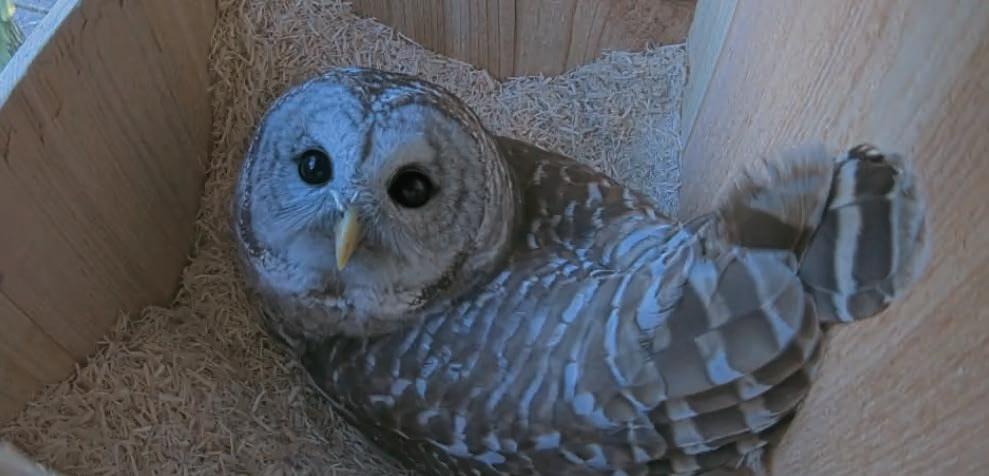
Spring also brings another nesting season for Betty and Maverick, wild owls we have been observing since 2021 through our Barred Owl Monitoring Project. Read about the initiative’s history and what we have learned about their nesting behaviors along the way. Join us for a free public discussion with Raptor Program Director Lindsay Focht on Thursday, May 12 to debrief the 2026 nesting season—visit our website to register for free!
In this issue you will also discover how beloved local artist Mary Nohl inspired our Nature School’s latest art projects and April Art Gallery Exhibit, offering enriching and joyful creation and connection for our youngest learners. Plus, read about the tremendous impact of our volunteers and how you can get involved in rewarding stewardship of our cherished 185-acre property.
As the Center’s forests, prairies, wetlands, and shoreline fill with winged travelers, make the most of spring migration with tools from our Birding Resource Center! Just across our Great Hall, watch birds in our beautiful Feeder Grover observation area, with the option to dive deeper through our educational kiosk. The Birding Academy’s spring offerings include the Introduction to the Birds of Schlitz Audubon certificate, back by popular demand, as well as a Horicon Marsh boat tour field adventure and an exciting new seminar, Field Illustration for Birders.
We also look forward to the first ever May Market on Sunday, May 3, which will feature over a dozen small and local vendors from across our community offering a wide variety of high-quality goods. This free event includes complimentary access to our trails, providing an excellent opportunity to both shop for Mother’s Day and bask in the pleasant May weather.
Finally, please save the date for our upcoming gala taking place on Friday, June 5. This year’s theme is Nature’s Palette, celebrating the many ways art and nature intersect at Schlitz Audubon to inspire our community.
From the first blossoms beneath the trees to the rhythms of wings overhead, spring offers enchanting moments at every turn. Come wander the trails, observe the changes happening day by day, and join us for the events and learning opportunities that make this season special.
Early Birding Hours
Gates open at 7am Saturday, April 18 — Sunday, May 31
1111 East Brown Deer Road | Milwaukee, WI 414-352-2880 | www.schlitzaudubon.org
Hours
Monday-Sunday | 8:30am-5:00pm
BOARD OF DIRECTORS
Officers
Evan Kirkstein
President
Joseph A. Camilli
Treasurer
Carrie Nichols
Secretary
John Schaub VP-Governance
Barbie Brennan Nelson VP-Development
Directors
Thomas Bausch
Jane Bell
Alexandra Stankiewicz
Krems
Jonathan T. Luljak
Benjamin T. Pavlik
Jeff Rusinow
Past Presidents
John H. Kopmeier, Jr.
Philip R. Smith
Dennis L. Fisher
Terrence K. Knudsen
Thomas J. McCutcheon
Thomas B. Fitzgerald
Randolph H. Dean
Stephen F. Geimer
Thomas J. Drought
David K. Hoover
John S. McGregor
Margarete R. Harvey
Timothy J. Gerend
John Grunau
Aliah Berman
Shane Delsman
Director Emeritus
Dorothy K. Vallier (1910-2013)
CREDITS FOR PANORAMA
Director of Marketing & Visitor Experience
Nancy Quinn
Creative Lead
Zoe Finney
Marketing & Communications Specialist
Anna Ostermeier
Schlitz Audubon is an independent, locally supported partner of the National Audubon Society.
The Traveling Wings of Spring
LAINE COTTELEER
Environmental Educator
Spring is coming alive at the Center! As the days get longer, the increase in daylight prompts American Robins, Northern Cardinals, and other year-round residents of Wisconsin to begin singing. It’s an exciting time to be a bird, driven largely by the need to establish territory and start reproducing. Migration is upon us as our skies fill with feathered travelers.
Lake Michigan is a bustling avian corridor, its shoreline a wayfinding landmark visible from above. Waterfowl that spent their winters along the lake’s coast, such as Red-breasted Mergansers and Common Goldeneyes, retreat up to Canada’s thawed water bodies. As bright green plants sprout and glimmering insects emerge, so too do key raptor prey species like rabbits and chipmunks. Sharp-shinned and Broad-winged Hawks arrive from South America, flying overhead in search of their next meal.
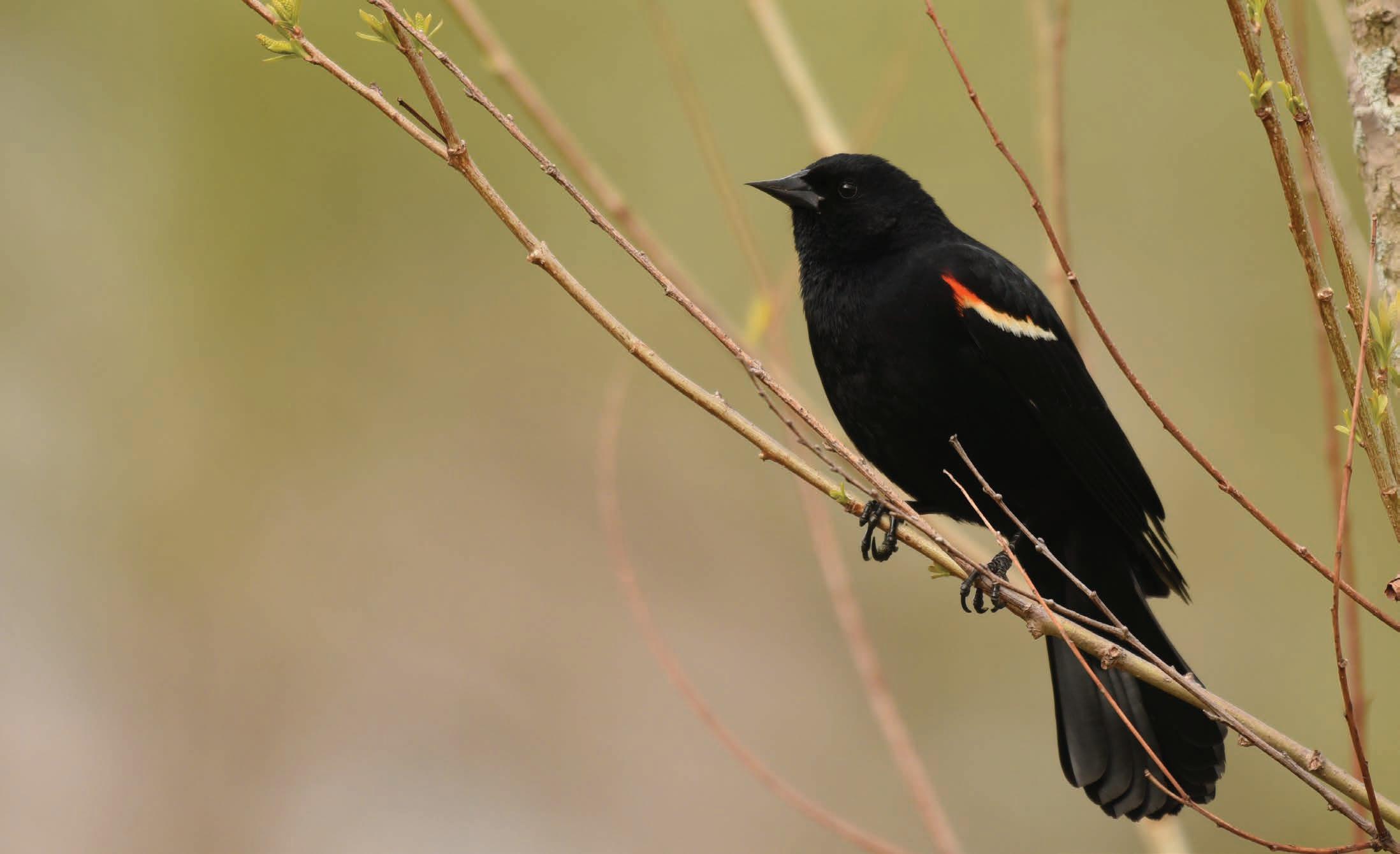
The sprouting Skunk Cabbage isn’t the only sign of life around the Center’s ponds in early spring. The male Red-winged Blackbird is one of the first birds to arrive back to Wisconsin in early March. He stakes out thawing wetlands, loudly singing his “conk-ler-reee” song to establish his territory for when the females arrive. Late March and early to mid April see the return of other pond-loving birds. Great Blue Herons wade the shallows of Mystery Lake and Tree Swallows glean bugs midair at Dragonfly Pond.
Explore the prairies of the Gateway Trail and Western Meadows during the warming days of April to hear the Song Spar-
row’s intricate melody and catch a glimpse of the American Woodcock’s unique courtship display. Performing mostly at dawn and dusk, males draw in females with a nasally “peent” call before taking off. He makes grand, sweeping circles in the sky until he reaches a height of over 300 feet in the air! Then, he plummets to the ground, catching himself just before he crashes— an astounding spring spectacle!
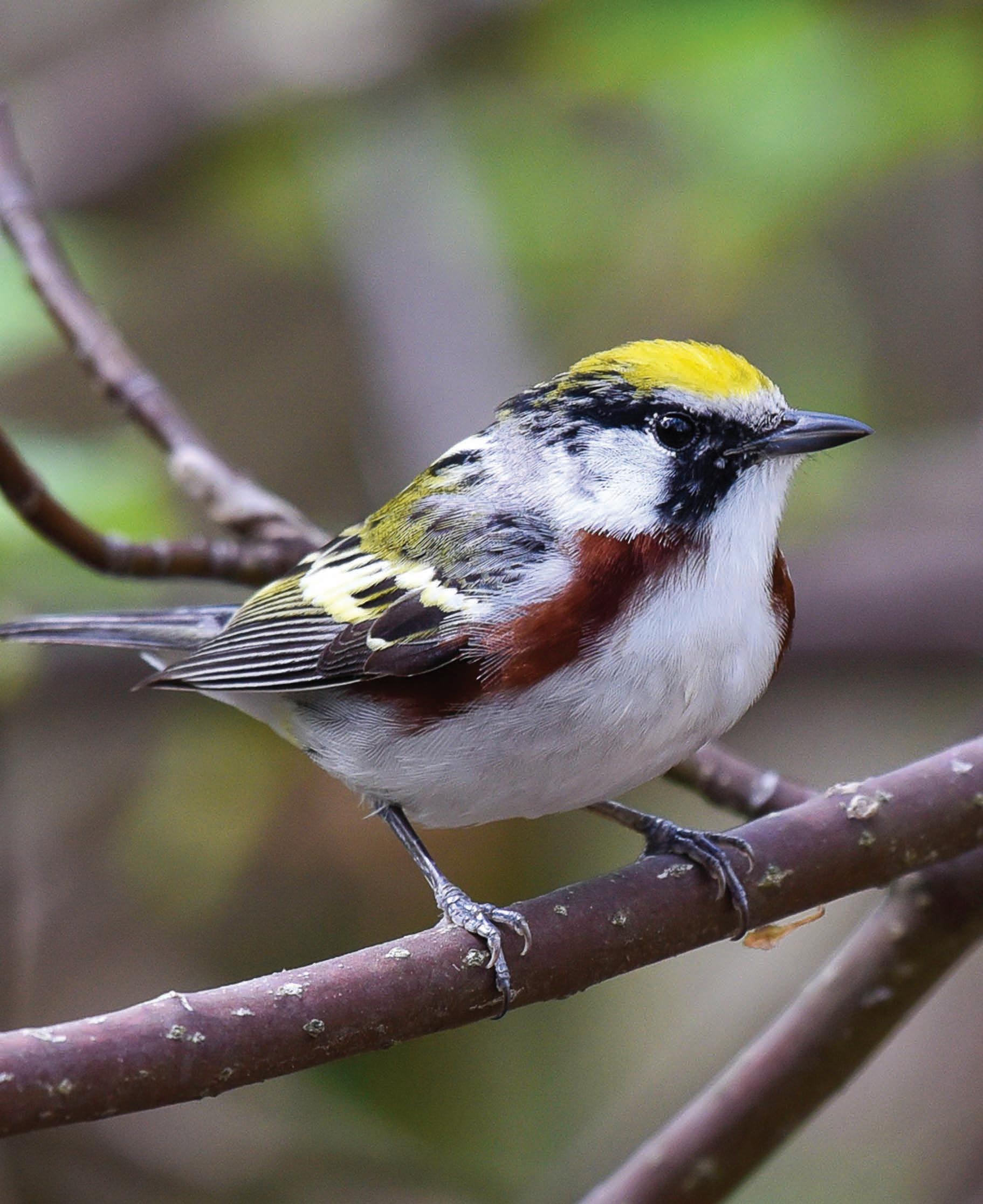
With each passing week, the Center’s forests return to their greenest glory. In May, they fill with the songs of warblers, a brief splash of color in Wisconsin’s ever-changing landscape while they stopover on their way north. With dozens of species passing through, it can be challenging to tell them apart, but knowing the forest type can help! While coniferous woods are preferred by many, like the Pine Warbler, others, like the Chestnut-sided Warbler, prefer deciduous woods. Some species, like the Blackburnian Warbler, prefer mixed woods. You can find these avian wonders in the trees surrounding the Center’s Observation Tower and along our North Ravine.
By the time June rolls around, spring migration is slowing down. Tanagers, orioles, and thrushes, some of the longest distance travelers, are settling in and constructing their nests. Insects, plants, and access to open water are all abundant, and the days are long and warm. Wisconsin’s birds can now focus on breeding until fall signals their time to return south. Visit us at the Center and experience the ephemeral delights of spring migration for yourself!
Male Red-winged Blackbird
TRILLIUMS: Treasures of Spring
ANNA OSTERMEIER Marketing & Communications Specialist
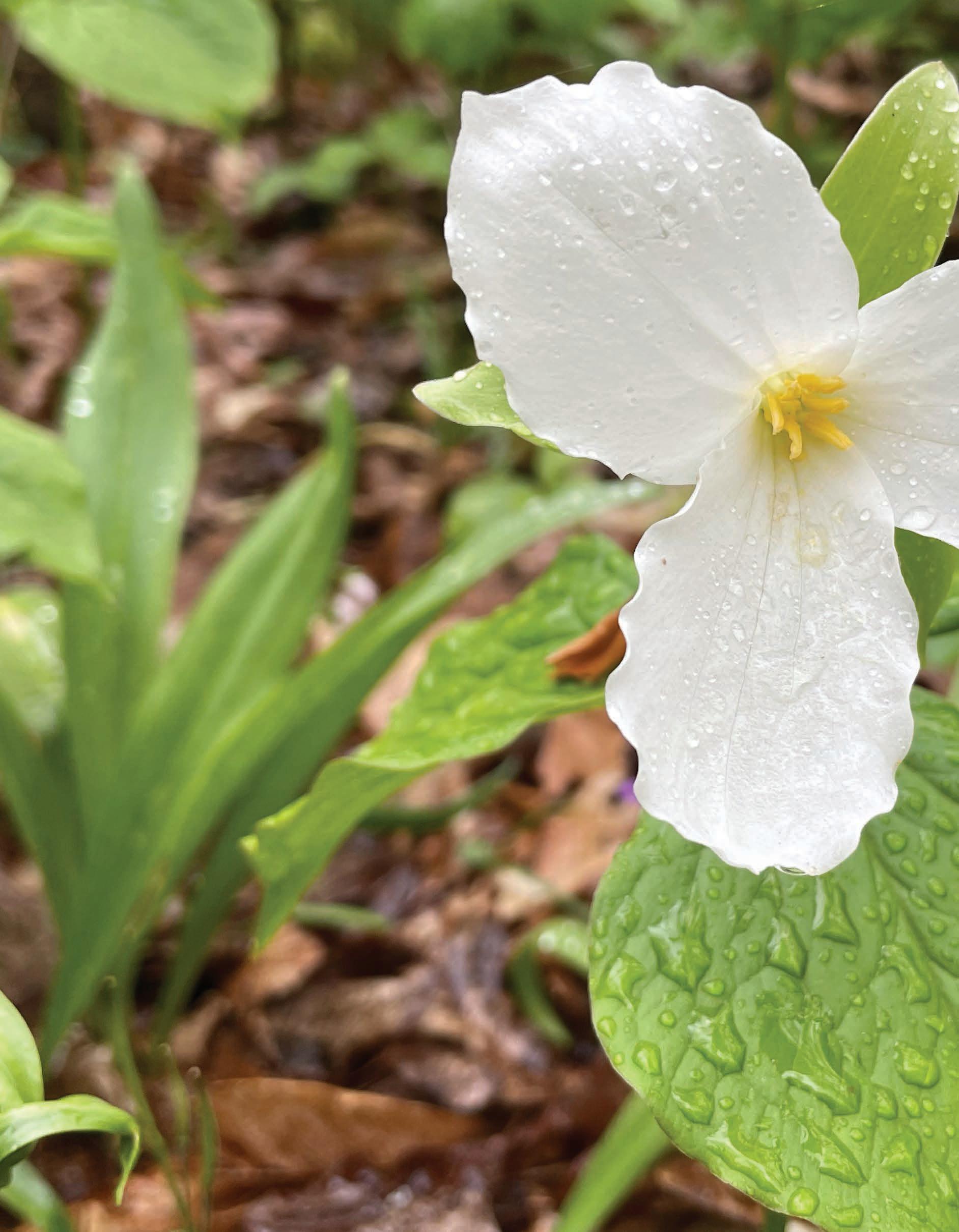
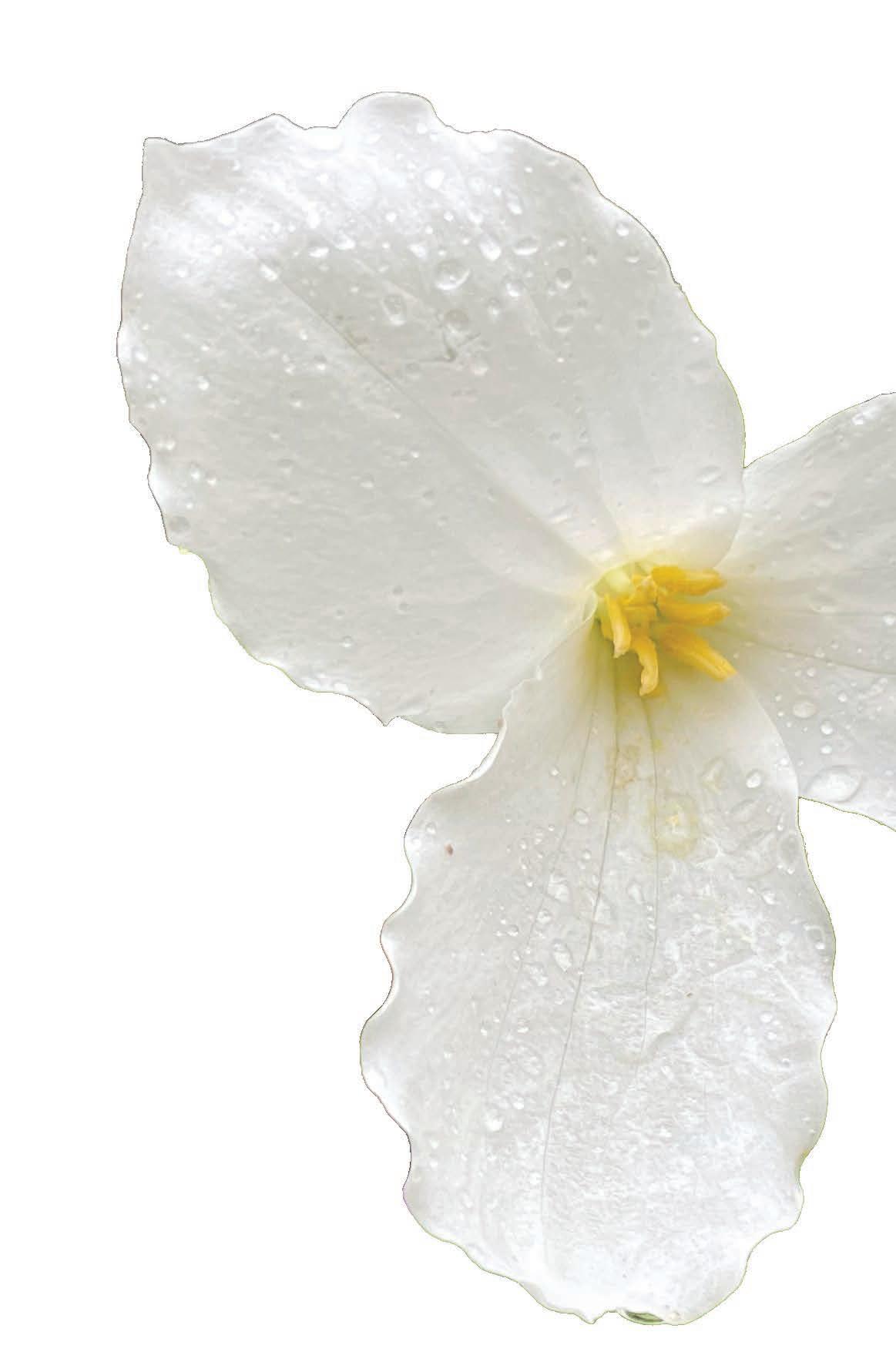
As Wisconsin’s forests wake up, trilliums quietly emerge in April through May as some of the most beloved and easy-to-recognize spring ephemerals. Their beauty is subtle but unmistakable, and their name offers a clue for identification: “Tri” means three. Each plant sends up a single stem topped with three green leaf-like bracts, supporting a flower with three petals and three sepals underneath.
TRILLIUMS OF WISCONSIN
Six of the United States’ 38 trillium species are native to Wisconsin: the giant white trillium (Trillium grandiflorum), nodding trillium (T. cernuum), snow trillium (T. nivale), prairie trillium (T. recurvatum), red trillium (T. erectum), and nodding wakerobin (T. flexipes).
Botanists divide trilliums into two main groups. Pedicellate trilliums have flowers held above the bracts on a short stalk called a pedicel, while in sessile trilliums the flower rests directly on top of the bracts.
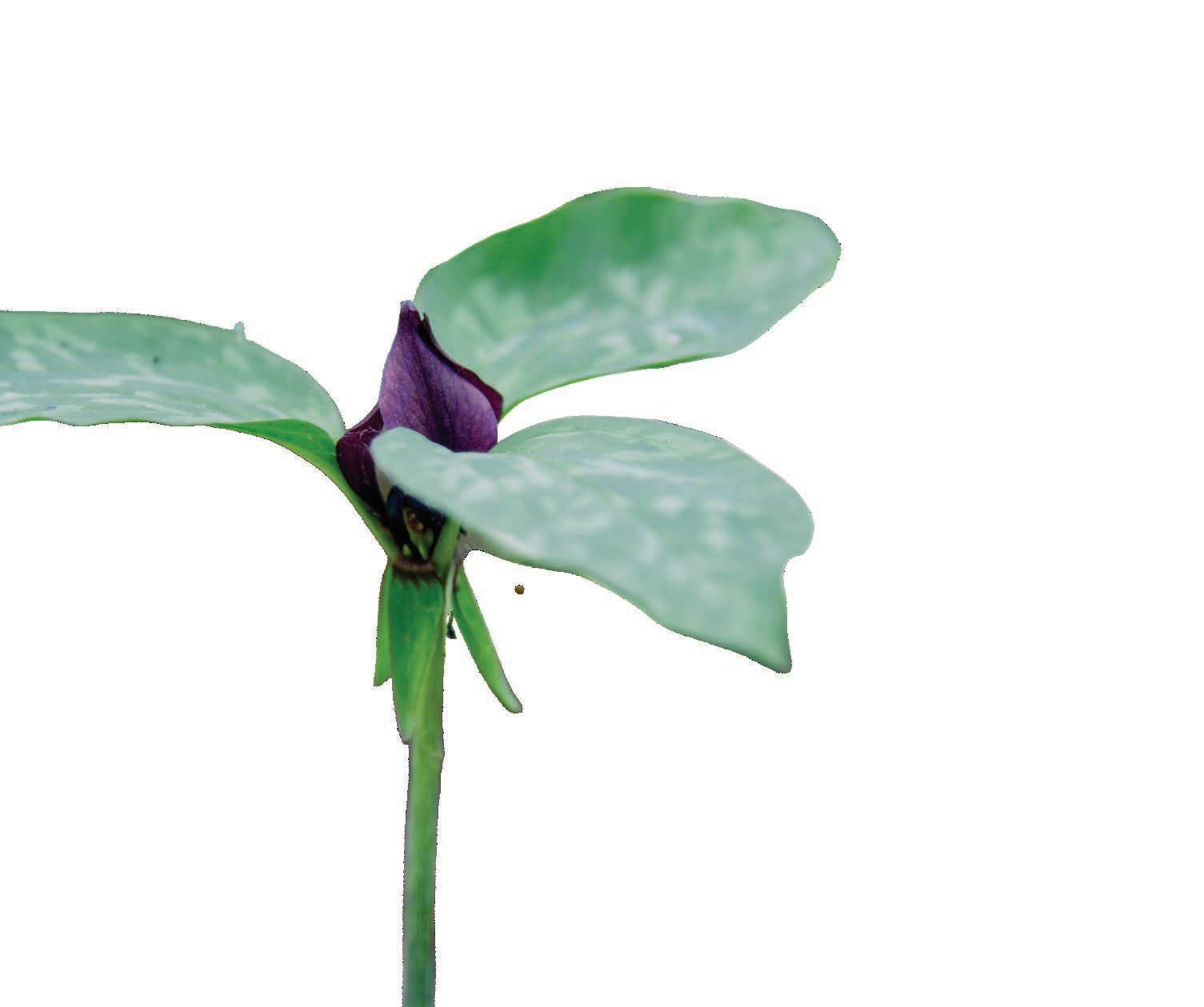
Schlitz Audubon is home to three species: great white trillium, nodding trillium, and prairie trillium. The great white trillium is the most familiar and widespread, boasting the largest flowers at about two to three inches across. Interestingly, its stark white blossom fades to pale pink in its final days. Nodding trilliums live up to their name, with a smaller white flower that droops downward on a curved stalk (the pedicel), sometimes hiding beneath the bracts. Unlike the others, the prairie trillium is sessile with a deep
wine-red flower sat atop mottled green bracts. The Center’s trilliums thrive in the high-quality forest habitats of our bluffs and ravines near the Pavilion and along the Lake Terrace Loop. Our Land Stewardship Team regularly removes invasive species like buckthorn to maintain their population and open new areas for potential growth.
REPRODUCTION
Trilliums reproduce both asexually through rhizomes and sexually through seeds. Underground rhizomes, which resemble knobby brown stems, spread from the parent plant to put down roots and send up new shoots. Reproduction through seeds requires help from pollinators such as bumblebees, flies, and wasps. Some species, including red trillium, emit an unpleasant odor compared to rotting flesh, which attracts pollinating flies.
Once seeds are produced, ants play a crucial role in dispersal. Each seed carries a fatty appendage called an elaiosome that ants collect for food, later discarding the seed in their colony’s nutrient-rich dump. Germination can take two to three years, and it may take seven to ten years before a trillium produces its first flower!
WHY TRILLIUMS MATTER
These plants have long held significance among Native American medicine women, who used them to support reproductive health and ease childbirth. Ecologically,
they are powerful indicators of ecosystem health with their slow life cycle and reliance on specific site conditions.
As you wander the spring forest, keep an eye out for the showy blooms of great white trilliums, the smaller maroon flash of prairie trilliums, and the easily overlooked nodding trilliums. When you consider the years of growth, hard work of insects, and careful stewardship by humans, a single trillium bloom feels like the triumph of a healthy ecosystem.
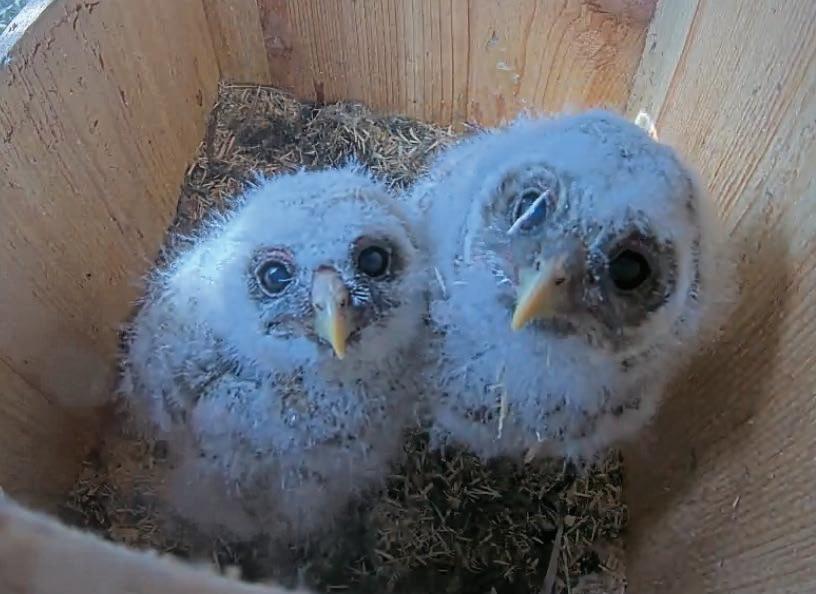
In 2025, we launched our Barred Owl nest box livestream, and the public fell in love with the wild owl family on their screens. A camera mounted in the box provided an up-close glimpse into their story—from egg laying to first flights. We watched as the owl couple successfully raised two male owlets: one who was very brave and left the nest quickly and the other who needed more coaxing. Both young owls were observed in the area after leaving the nest and were last seen in August when they set off to explore the world independently.
We received comments that classrooms, libraries, and workplaces were streaming the box! We were elated at the opportunity to interact with livestream viewers on our social media pages, answering questions about what people were seeing and celebrating collectively when the two owlets took flight. This wasn’t the owl couple’s first successful mating season—in fact, the project started years ago.
PROJECT HISTORY
In the fall of 2021, two Barred Owls moved onto a private property in the Milwaukee area— an opportunity to gain new insights into these feathered forest-dwellers! I, the Raptor Program Director, contacted Dr. Bill Stout, a licensed raptor bander and biologist who studies Cooper's Hawk, Great Horned Owl, and Red-tailed Hawk populations in the Greater Milwaukee area. Together we sought to address gaps in existing research on land use and dispersal patterns of Barred Owls in urban settings. The goal of our new monitoring project was to answer these questions: Can Barred Owls adapt to human activities? How will their presence affect other raptor species’ land use in the area? What habitats and territory sizes are preferred during breeding and non-breeding seasons?
Joined by volunteers, our research team trapped and banded both owls. With the use of a black light on their flight (wing) feathers, we determined that both were approximately two years old. We named the male ‘Maverick’, as the young owl brazenly flew close over buildings and through the forest. ‘Betty’,
the female, received her title after the passing of Betty White, a successful Hollywood star and strong advocate for animals and wildlife.
Next, our team installed a nest box on the property, and to our delight, Betty immediately flew into the box during mating season. The early stages of nest box monitoring involved a generously donated night vision camera, pointed at the box, which would record for only a few hours at a time. I then reviewed the footage daily and reset the camera for the next night. I watched excitedly as the tiny hatchlings developed flight feathers. When the owlets neared fledging, the process of a young bird learning to fly and leaving the nest, it was time to band them!
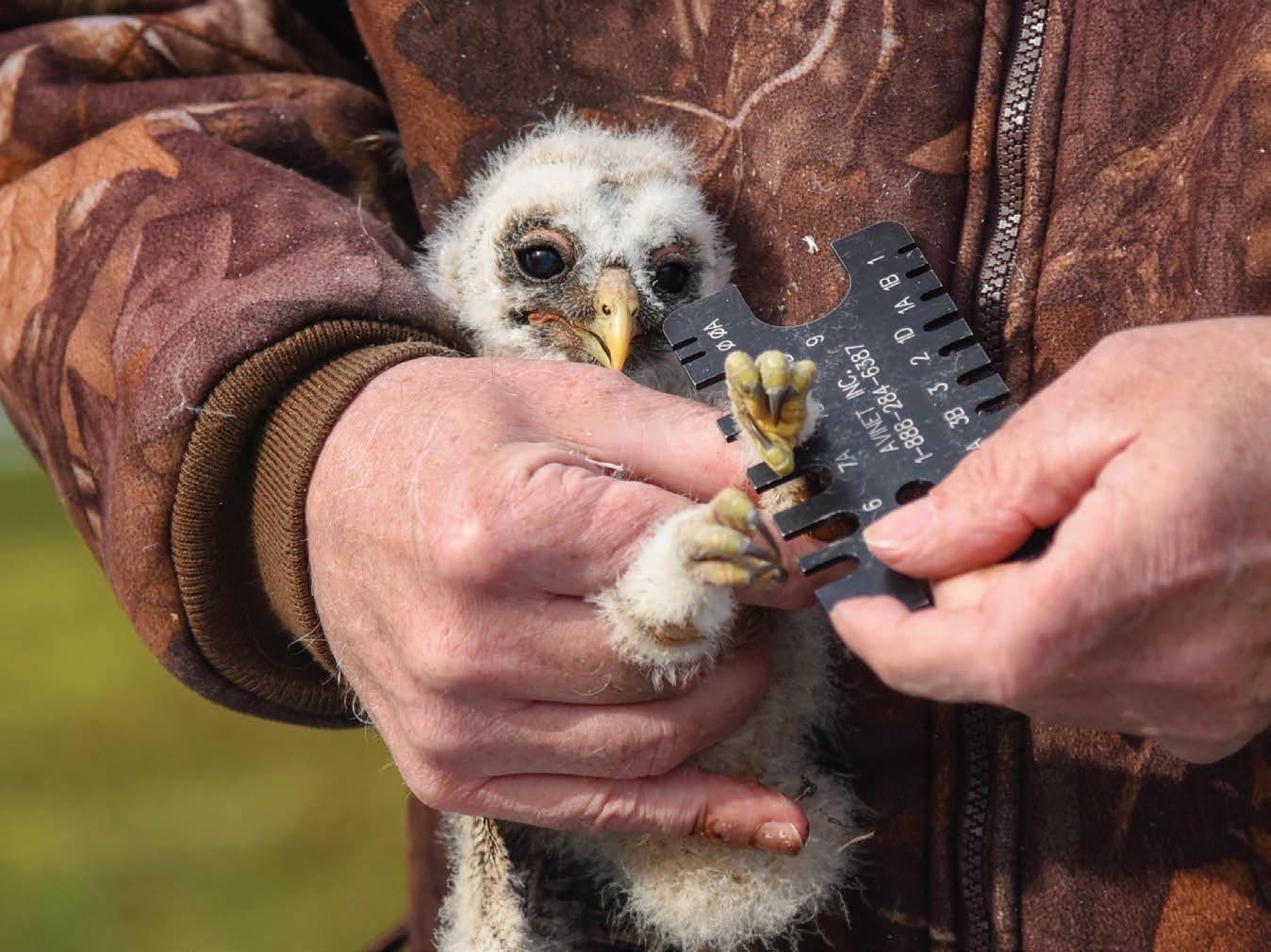
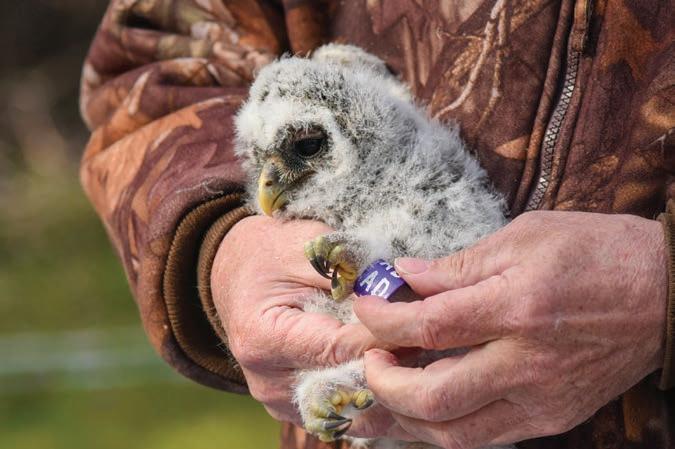
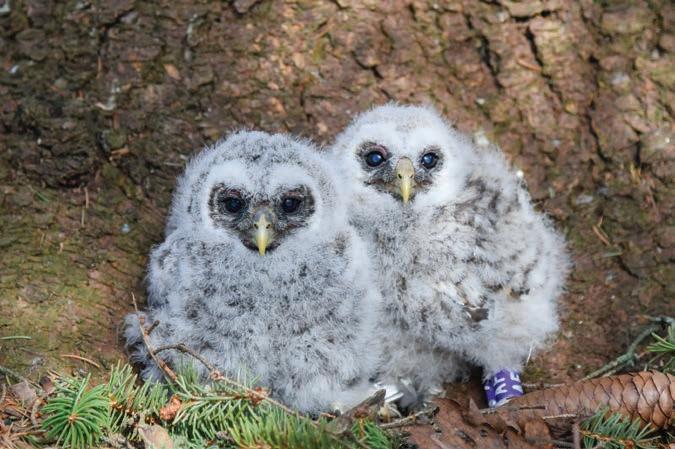
Dr. Stout carefully retrieved the young owls from the box and took measurements of wing length, weight, and collected other essential data. Like their parents, each one received two colored bands on their legs: one silver federal ID band and one purple project ID band. They were quickly returned to the box within minutes and Betty was soon back inside with them. ID numbers on the bands can be reported to the Bird Banding Lab with USGS and the location is shared with the bander. Any Barred Owl sporting a purple band in the Milwaukee area came from Betty and Maverick, and we encourage everyone to report these sightings. With this information, we can learn how far their offspring travel!
Since the first successful nesting season in 2023, Betty and Maverick have successfully produced two to three offspring every year!
NESTING SEASON
Betty and Maverick begin their annual courtship and nesting behaviors around December/January. This includes increased vocalizations between the two as well as routine checks of the nest box to ensure everything is in order. Betty begins ‘begging’ vocalizations (a higher pitched single note) to encourage Maverick to hunt for more food. She stops by the nest box, jumps in, and kicks up the substrate to create a small bowl to lay in.
As spring approaches, Betty visits the box more frequently and stays longer. On average, she lays the first eggs in mid-March. Eggs are laid in intervals, with two to four days between each egg. Incubation lasts for 28-32 days and the owlets often hatch in the order their eggs were laid in. As hatching approaches, Betty is often observed making quiet ‘clucking’ sounds to the eggs and, in response, the chicks can be heard chirping back to her (and to each other) from inside of their eggs!
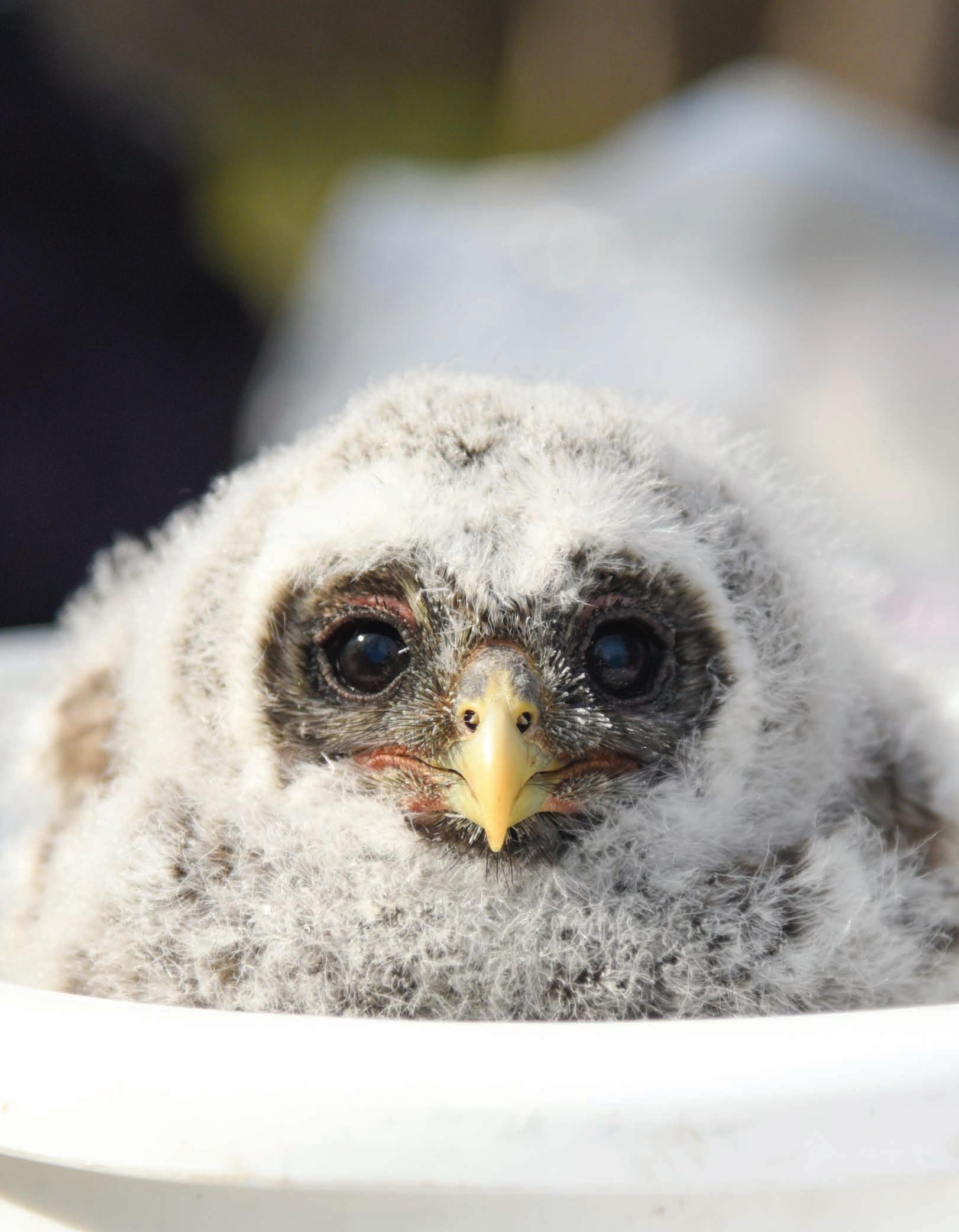
Egg hatching starts with the ‘pip’: a small hole that appears on the egg which the young chick inside uses to take its first breaths. The new babies are covered in fluffy white down feathers and cannot thermoregulate (control their body temperatures) until approximately three weeks old. Until then, Betty must in-
cubate them to keep them warm. Once they can stay warm on their own, Betty spends much more time outside of the box, coming in to feed the owlets and for occasional incubation.
After hatching, there are more hungry mouths to feed, and Maverick does most, if not all, of the hunting. He brings various prey to his family: small rodents, birds, fish, crayfish, and he has even snagged a few dragonflies. Maverick occasionally brings food directly to the box for Betty and the chicks, but also stays outside nearby and calls for her to come out to get it. Once the food has been delivered, Betty tears it into manageable pieces for the owlets. As they approach the four-week-old mark, she leaves the prey whole for them to swallow.
It’s also around this time when the research team carefully retrieves the owlets for measurements and banding. The data collected is essential for understanding the birds and their population over time. Each chick’s weight can inform the team if it’s a male or female (males are smaller while their sisters are bigger). Each receives its silver and purple bands, and then they are gently placed back into the box.
Fledging happens when the young owls are approximately five weeks old and often falls around Mother’s Day. Betty will stay outside the box during this time, en-
ticing her babies to come out to join her. These first flights are very clumsy and often include a lot of falling, but the young ones climb up the trunks and branches of trees to get back up to mom. Both parents continue watching over their offspring, feeding them and encouraging them to fly greater distances. The babies also practice pouncing and other hunting skills so they can capture their own food. Barred Owl babies grow up quickly and, unlike Great Horned Owls whose young stay around into the fall, Barred Owls disperse from their parents’ home range by mid-tolate summer. Betty and Maverick then get approximately five months to rest before starting again.
Through our Barred Owl Monitoring Project, we are learning about preferred habitat usage of urban owls, their diet, and nesting behavior and patterns. It enables us to collect a library of different vocalizations, study interspecies interactions with other neighborhood raptors, and bring the nest box livestream to our community, both local and more distant. Visit our website to learn about the project's current status and tune in March through May to see the owls for yourself! We look forward to deepening our understanding and connection to these amazing birds through this project for each nesting season to come.
Inspired by Mary Nohl's Legacy
ANNA OSTERMEIER Marketing & Communications Specialist
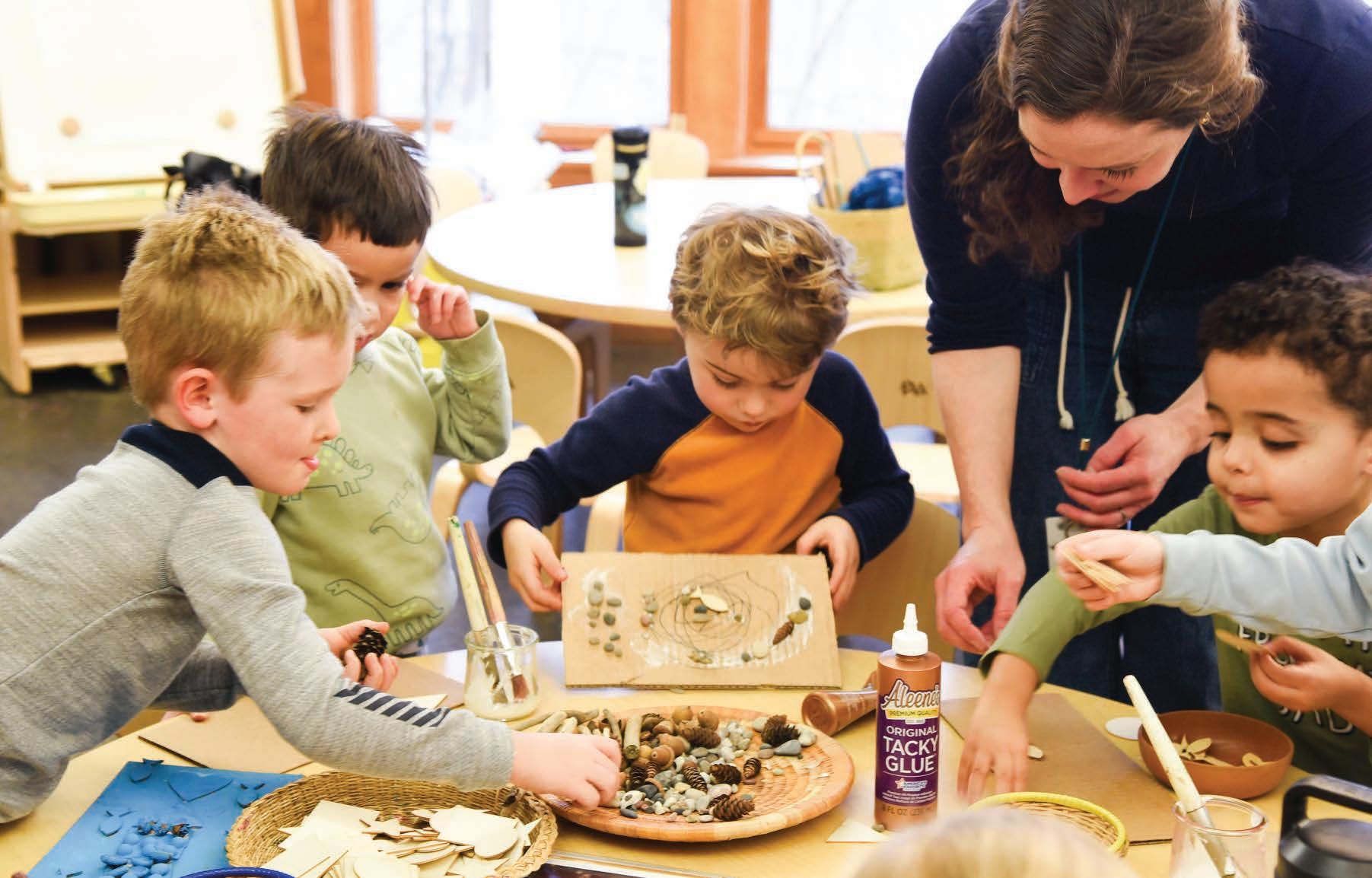
In early childhood education, art is far more than a finished product to hang on a wall. It’s a way of thinking, observing, experimenting, and expressing. At our Nature School, art making is woven into the rhythm of each week. Through painting, weaving, sculpting, and printmaking, young learners deepen their relationship with the natural world around them, developing key skills along the way.
Nature serves as both inspiration and material. Children might paint the forest’s dynamic hues, document pond life through nature journaling, or explore texture using elements gathered with intention and reverence. Repurposed wood slices from fallen ash trees, beach stones selected sparingly, and other carefully sourced items teach children that creativity and care for the land can coexist. With such a strong emphasis on place, process, and purposeful use of materials, drawing inspiration for Nature School projects from beloved local artist Mary Nohl was a natural fit.
The idea took shape through Abbey Finn, now in her second year as the Nature School’s Artist in Residence. Art has long been part of the program, with teachers regularly offering open-ended invitations to create. Finn’s background in art education has allowed the school to take art making a step further, designing more comprehensive projects with broader exploration of different mediums for all 11 classes.
Finn’s own connection to Mary Nohl began in childhood, when she heard stories about the lakefront property which was then
referred to as the “witch’s house.” Those narratives, shaped by misconceptions and rumors, lingered in community memory. As she grew older and learned more about Nohl’s life and work, a deeper understanding emerged. Nohl was an extraordinarily inventive, self-possessed, and social artist who mastered a wide range of materials. She filled her home and yard with astounding artworks, creating an immersive and ever-changing space from her own imagination. Her full-time residence from the 1960s to her passing in 2001, the Mary Nohl House featured 59 fantastical concrete sculptures, many incorporating sand and stone gathered from the nearby Lake Michigan beach. She built them herself, relying on her own two hands and driven by a tireless curiosity about how things could be made.
Inspired by a tour of the site led by Alex Gartelmann, Mary Nohl Program Director and Site Steward, Finn recognized how seamlessly Nohl’s artwork and approach connect with the Nature School. Both are rooted in the same landscape. Nohl lived and worked on the lake; Nature School children hike its trails, listen to its waves, and feel it's changing moods. Moreover, many Nature School families live in the North Shore, making that sense of place even more personal. Nohl often used found materials, recycling and reimagining what others overlooked. That spirit of resourcefulness and imagination mirrors the school’s values.
The Nature School’s second annual Art Show displays various projects inspired by Nohl in the Center's Art Gallery this April. Some pieces respond to the same surroundings that influenced
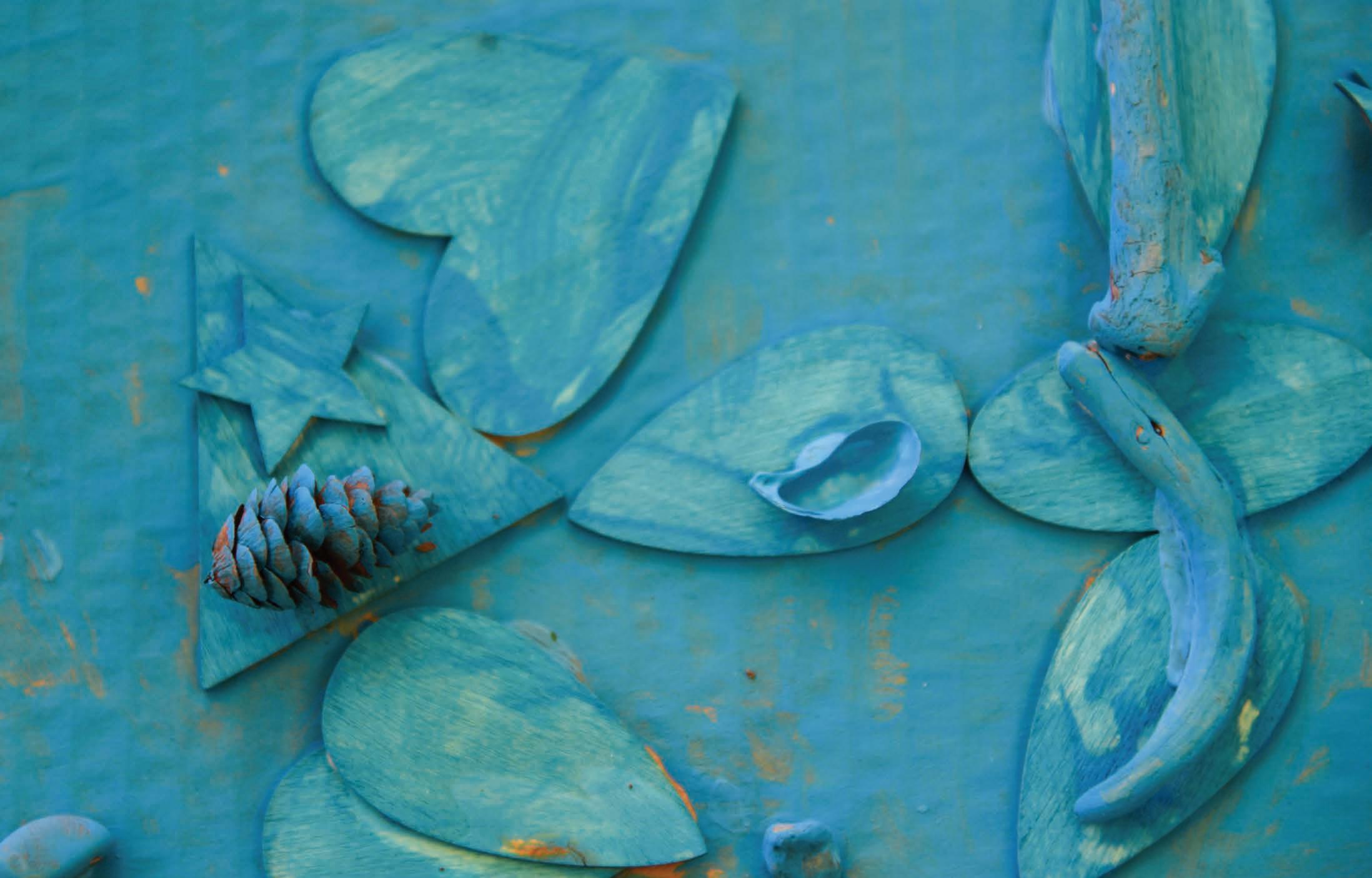
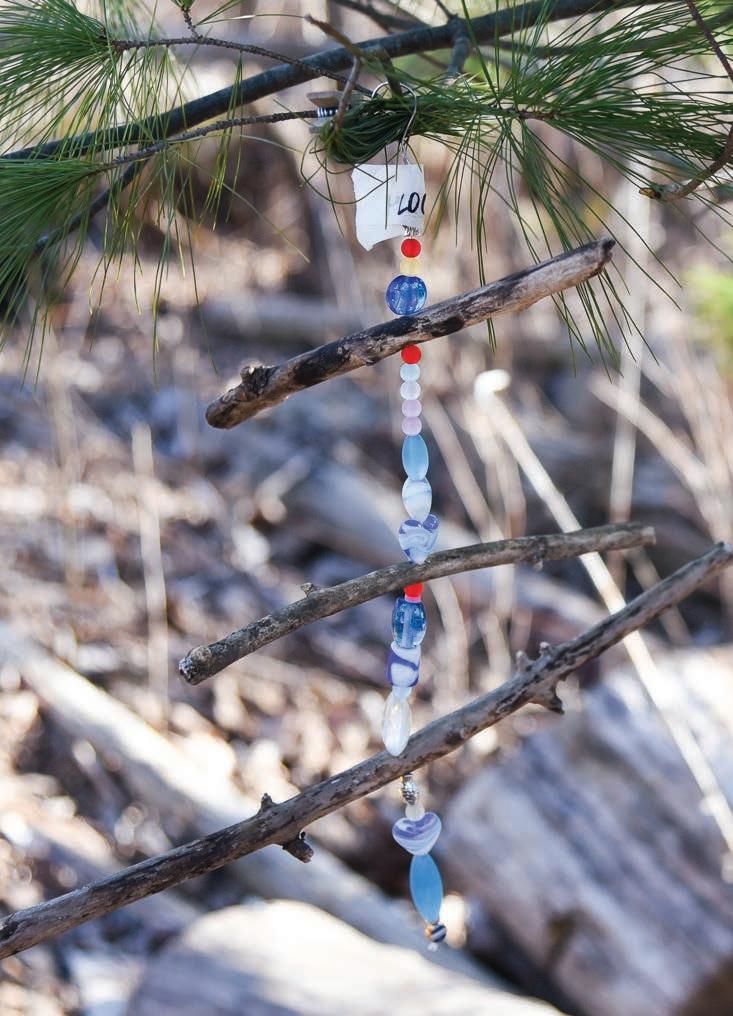
her. Students created Lake Michigan-inspired wet-felted pieces and weavings, translating the water’s movement and color into fiber. After pausing to consider its waves, children also created process paintings to capture the lake’s personality, whether it was calm and glassy or big and crashing. Other projects drew more directly from Nohl’s forms and materials. Children crafted cement stepping stones embedded with beach treasures, emulating Nohl’s shoreline sculptures. They also sculpted imaginative mini creatures with varied textures, incorporating stones, driftwood, and sand. Finn carefully planned each project to ensure it was age-appropriate, fun, and enriching for young children.
The benefits of these projects extend beyond creativity. The tactile experiences strengthen fine motor skills, developing the small muscles in chil-
dren’s hands that are essential for learning to write. Weaving, pressing, sculpting, and embedding objects builds dexterity and coordination. At the same time, learning about Nohl’s story offers important social-emotional lessons. The outdated “witch” narrative surrounding her home became an opportunity to discuss curiosity and empathy— a reminder not to judge someone without truly knowing them.
Every student is exhibiting a piece, filling the Center’s Art Gallery with an array of colors, textures, and interpretations. As children proudly guided family and friends through their work on opening night, they echoed Mary Nohl’s own love of sharing what she made. In doing so, they remind us that art is not only about what we create, but about the connections we build— to the land, to one another, and to the stories that shape our community.
Our Volunteers: A Community Rooted in Service
ANNA OSTERMEIER Marketing & Communications Specialist
Every year, volunteers offer their time, energy, and care to help us deliver on our mission of connecting people to nature and fostering conservation across the Center’s 185 acres. In 2025 alone, nearly 800 individuals generously gave 18,131 hours of service! Whether they contribute two hours or 1,000, these dedicated community members make everything we do possible.
Volunteer opportunities at the Center are as diverse as our ecosystems. Individuals can improve habitats as Land Stewards; welcome guests at the Visitor Information Desk; support teachers and children in our nationally recognized Nature School; serve as Nature Ambassadors on the trails or in the Great Hall; assist with our Raptor Program; lend their skills to facilities projects with the Ray Team; or create meaningful experiences through our SPARK! program for individuals experiencing cognitive changes. Special Events volunteers also play a vital role throughout the seasons, ensuring our largest programs run smoothly. For groups — from corporate teams to school organizations — outdoor stewardship projects offer a rewarding way to give back together.
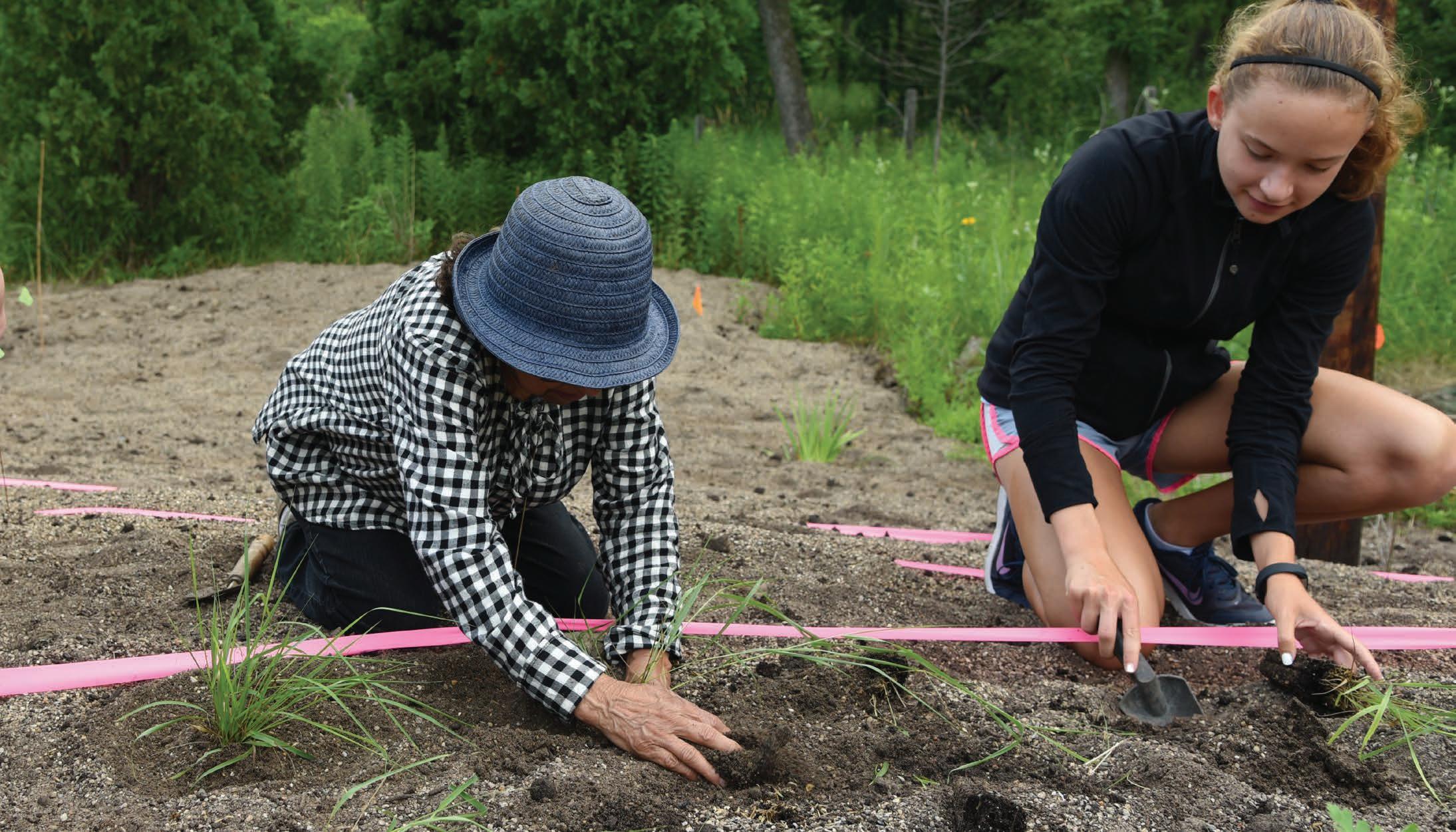
With milder temperatures and our trails coming alive with new life, spring’s arrival is an invitation to enjoy the outdoors while restoring and conserving our beautiful prairies, forests, wetlands, and Lake Michigan shoreline. Land stewardship work is hands-on, approachable, and designed for all experience and commitment levels — no prior training required! Workday activities vary by season and may include removing invasive species, planting habitat-appropriate native species, and trail maintenance. Our Restoration Ecologists share their knowledge as you work, answer ques-
tions, and can even take you on a plant walk if you need a break. If weather turns unpleasant, there are indoor options too, like seed sorting. You can always choose your own pace and mood that suits you best, whether that means lively social time with others or the serenity of working independently. Either way, seeing the immediate impact of your efforts (and knowing they make a difference in the long-term) can be extremely rewarding.
Beyond the measurable impact, volunteering builds community, grows knowledge, and supports well-being. Individuals form friendships rooted in shared purpose, gain new insights into the natural world, and many appreciate the physical and mental health benefits of spending time outdoors being active. For groups, volunteering fosters teamwork, strengthens relationships, and encourages authentic connection between colleagues or classmates.
To our current and past volunteers: Thank You! Your generosity sustains the trails, habitats, programs, and warm atmosphere that define Schlitz Audubon. For those considering getting involved, we would love to welcome you into our volunteer community! Simply visit our website and fill out a volunteer application to get started. Individuals can then join our existing land stewardship volunteer sessions offered at 9 a.m. on Monday, Wednesday, Friday, or Saturday mornings, and groups can schedule a private stewardship experience. If you are interested in other opportunities, we will work with you to find the right fit for your interests and schedule. Together, we can continue caring for this extraordinary place and providing meaningful experiences for all who visit.
In Memory Of
John Stephen Anderson
Jane Bryan-Jones
Susan and Michael Burnett
Tim Gilroy and Jill Matesic
Monica and Jim Hart
David and Diane Knox II
F. William and Peggy Russo
Sally and Justin Schuler
Twin Trees Foundation
Andrea Carroll
Jack Carroll
Mary Cofta
Katherine and Thomas Ingrassia
Jim Jahnke and Margee Claudon
Plastic Ingenuity, Inc.
Chuck Cruse
Penny Cruse
The Diggs Family
Anonymous
Laurie Good
George Lange and Marlene Melzer
Lange
Grace Haraway
Jean Farrell
Jim Stein and Ellen Schneiderman
Paul M. Hauer
Mark Hauer
Matson Brumder Holbrook
Timothy and Kathleen Carr
Daniel and Susan Minahan
Norman Huth
Saints Andrew and Mark Charitable
Gift Trust
Jean Johnstad
Ann Lederman
Patricia Kilian
Frank and Wendy Schober
Jim LaRose
Kevin Beyer and Lisa Gedes
Sara Kornetzke
Faith Miller
Richard Miller
Jean Pagel
Henry and Judy Eckstein Family
Helen Patton
Mary Ann and Charles LaBahn
William Schulte
EMC Insurance
Robertson Ryan Insurance
Patty Schuyler
Al and Kathy Krug
Dorothy K. Singer
Catherine Singer
Jackie Zachar
James and Aaron Zachar
Jessica, Jay, Zach, and Zoey Bitte r
Penny Cruse
Boomerfest
Jeff and Anne Ballentine
Daniel and Nancy Conway
Andy and Julie Gusho
Jill and Rick Hart
Dayton Hoell
Bill Pickering and Joy Tapper
Anne and Rick Reinders
John Roth
Bob Slobig
John and Julia Syburg
Jay and Madonna Williams
Joseph Camilli
Theresa and Peter Camilli
Rob DeRosia and Katherine
Schmitz
Zachary Hepner
Diane Howard
Eileen Schwalbach
Terrence Knudsen
Kay Esposito
Bob Larsen
Jean Woodmansee-Poklasny
Anne Ravanelli and Ben Dehne
Robert Ravanelli
John Schaub
Anonymous
Eileen Schwalbach
Diane Howard
Raptor & Animal Sponsorships
Eddie – Ornate Box Turtle
Jennifer Martell
Emerson – Common
Snapping Turtle
In Honor of Emmy Lalor
Leah Lalor
In Honor of Geoffrey Vitiello
Laura Braza
In Honor of Tali
Becca Hay
Harley – Spiny Softshell Turtle
In Honor of Erin Wathen
Emma Wathen
Athena – Barn Owl
Lucy Bisenius
Erin Cram
Maggie Hopkins
Paul Stillmank and Maggie Cain
Bill Stout
Atlas – Red-shouldered Hawk
Laura Braza and Geoffrey Vitiello
Taylor Kirby and William Huth
Molly and Michael Stephans
Bill Stout
Baron von Screech – Eastern
Screech Owl
In honor of Merlin Abler
Joanne, Susan, and Karen
In honor of Wynne Treco
Brian Brandstatt
Connie Beckham
Christopher Bisenius
Rhiannon Mapes
Sarah Stefaniak
Bill Stout
Amanda and Christopher Zarder
Darwin – Turkey Vulture
Anonymous
Barbie Brennan Nelson and Chad Nelson
Marcel De Ridder and Sandra Heim
Maggie Hopkins
Rhiannon Mapes
Bill Stout
Freyja – American Kestrel
Charlotte Ball
Jennifer Behnke
Sarah Stefaniak
Bill Stout
Gimli – Eastern Screech Owl
Kurt and Kim Rebarchek
Sarah Stefaniak
Bill Stout
Emma Towne
Glory – Bald Eagle
In Memory of Cathreen Clare Clark
Marjolein Iedema and Alvin Stroyny
Paul Stillmank and Maggie Cain
Bill Stout
Jim and Cathy Toohey
Sharon Zalewski
Loki – American Crow
Anonymous
Barbie Brennan Nelson and Chad Nelson
Maggie Hopkins
Jeffrey Klug
Bill Stout
Nicco – Broad-winged Hawk
Jennifer Behnke
Paul Stillmank and Maggie Cain
Bill Stout
Otis – Peregrine Falcon In Honor of Hugh Bruns
Zach and Jessica Bruns
William Abbott
Max Bisenius
Downtown Montessori Room 2
Taylor Hughes and Carolyn Smith Hughes
Jerald and Laura Skoff
Bill Stout
Perseus – Barred Owl
In Honor of Carol Roddy
Heather, Steve, Nikki, Andy and all the kids
Connie Beckham
Tracy Bisenius
Jacey Bonavia Murray and Kyle Murray
Taylor Hughes and Carolyn Smith Hughes
Chad and Krista Pankop
Leah Sleger
Paul Stillmank and Maggie Cain
Bill Stout
Saxon – American Kestrel
Anonymous
Charlotte Ball
Michelle and William Buerger
Sarah Stefaniak
Bill Stout
Amanda and Christopher Zarder
Sky Walker – Red-tailed Hawk
Marcel De Ridder and Sandra Heim
Rhiannon Mapes
Alexander and Sarah Starrett
Bill Stout
Valkyrie – Bald Eagle
In Honor of Cassi Scaife
April Scaife
Connie Beckham
Bill Stout
Sharon Zalewski
Willow – Northern Saw-whet Owl
In Honor of Ben Christensen
Kelly Christensen
Willow Aarestad
Richard Albert
Lisa Greco
Jeff Rizner
Sarah Stefaniak
Suzanne and Christopher Stone
Bill Stout
Amanda and Christopher Zarder
Zari – Great Horned Owl
In Honor of Patti Benson
Andrew Benson
In Honor of Nikolai Gardner
Peter Gardner
Heather Arena
Leah Sleger
Chris Stein
Bill Stout
Amanda and Christopher Zarder
Wedding Ceremony Trees
Anastasia Konsoer and Issac Rhodes
Trees
In Honor of the Nichols Family
Faith and Timothy Nichols
The
Barbara Stover & Susan Bell Birding Academy Honorary
In Honor of Sara and Tyler Edgren
Joni Bell
In Honor of Katie Rames
Joni Bell
Kate and Scott Stubenvoll
Gifts were received: 10/1/2025 – 12/31/2025 In Honor Of