VOLUME 13 NUMBER 6 ■ COLUMBIABUSINESSREPORT.COM
Money on the way
USC says most students will see refunds by April 22. Page 2
Part of the
APRIL 13-26, 2020 ■ $2.25
network
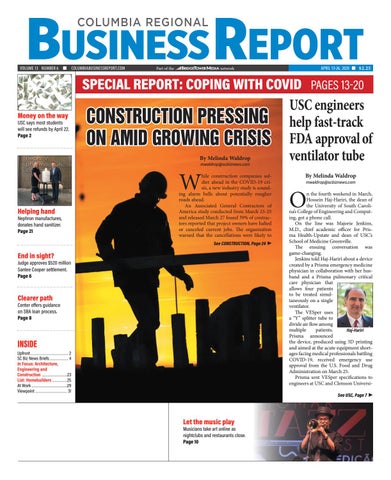
SPECIAL REPORT: COPING WITH COVID PAGES 13-20 USC engineers CONSTRUCTION PRESSING help fast-track ON AMID GROWING CRISIS FDA approval of ventilator tube By Melinda Waldrop mwaldrop@scbiznews.com
W
Helping hand
Nephron manufactures, donates hand sanitizer. Page 21
hile construction companies soldier ahead in the COVID-19 crisis, a new industry study is sounding alarm bells about potentially rougher roads ahead. An Associated General Contractors of America study conducted from March 23-25 and released March 27 found 39% of contractors reported that project owners have halted or canceled current jobs. The organization warned that the cancellations were likely to See CONSTRUCTION, Page 24
End in sight?
Judge approves $520 million Santee Cooper settlement. Page 6
Clearer path
Center offers guidance on SBA loan process. Page 8
INSIDE
Upfront................................. 2 SC Biz News Briefs................. 4 In Focus: Architecture, Engineering and Construction ......................23 List: Homebuilders..............25 At Work...............................29 Viewpoint............................ 31
By Melinda Waldrop mwaldrop@scbiznews.com
O
n the fourth weekend in March, Hossein Haj-Hariri, the dean of the University of South Carolina’s College of Engineering and Computing, got a phone call. On the line was Majorie Jenkins, M.D., chief academic officer for Prisma Health-Upstate and dean of USC’s School of Medicine Greenville. The ensuing conversation was game-changing. Jenkins told Haj-Hariri about a device created by a Prisma emergency medicine physician in collaboration with her husband and a Prisma pulmonary critical care physician that allows four patients to be treated simultaneously on a single ventilator. The VESper uses a “Y” splitter tube to divide air flow among multiple patients. Haj-Hariri Prisma announced the device, produced using 3D printing and aimed at the acute equipment shortages facing medical professionals battling COVID-19, received emergency use approval from the U.S. Food and Drug Administration on March 25. Prisma sent VESper specifications to engineers at USC and Clemson UniversiSee USC, Page 7
Let the music play
Musicians take art online as nightclubs and restaurants close. Page 10
Upfront
BRIEFS | FACTS | STATEWIDE NEWS
A LA CARTE Photo/File
Unleashing the
national stockpile
T
he U.S. has a stockpile of material and medical equipment in case of an emergency such as, say, a hurricane or even a global pandemic. The latest disaster has led the country to dip into the national stockpile for personal protective
equipment and other medical needs. The S.C. Department of Health and Environmental Control reports the state has received the first of at least two waves of deliveries as counties try to navigate the COVID-19 outbreak.
Masks and gloves The national stockpile delivered several categories of supplies to South Carolina. During the COVID-19 outbreak, N95 masks, which remove 95% of particulate matter, and gloves have become muchneeded items in short supply nationally. Here’s a breakdown of what several counties have received, sorted by the county’s share of the state’s population.
County
N95 masks
Gloves
% population
Greenville Richland Charleston Spartanburg Horry Lexington Anderson Berkeley Dorchester Sumter Orangeburg Kershaw
3,600 3,120 2,880 2,160 2,160 2,160 5,520 1,440 960 960 720 1,920
400 3,500 3,500 3,000 2,500 2,500 2,500 1,500 0 2,000 500 3,000
9.8% 8.3% 7.6% 6.1% 5.8% 5.7% 4.0% 3.8% 3.0% 2.3% 2.0% 1.3%
USC to begin issuing student refunds The University of South Carolina will begin issuing prorated refunds to students for meal plans, parking permits and on-campus residential housing. The refunds will include fees for services not received on or after March 16, the first day the campus was closed after the university’s spring break because of new coronavirus concerns, according to a news release from USC.
Source: S.C. Department of Health and Environmental Control
The school said it will begin processing refunds immediately and that most stu-
First Wave N95 respirators
Surgical masks
39,840
155,500
dents can expect to have their accounts
Face shields
Surgical gowns
Gloves
16,412
15,054
38,900
credited on or before April 22. The university said the refunds are being issued under guidance provided by the S.C. Commission on Higher
Second Wave
Education. Tuition, academic fees and
N95 respirators
Surgical masks
Face shields
Surgical gowns
Gloves
5,250
29,000
3,900
2,106
10,000
Source: S.C. Department of Health and Environmental Control
HEARD IN THE
REPORT
“As engineers, we actually do a terrible job of telling people what we do. ... This is one time that somehow, without our own doing, we are getting some credit for what we are doing. This is really what engineering is about — finding ways to solve problems.”
student support fees are not refundable. Greek housing and meal plans will be addressed by those individual organizations, according to the release, which said the school will provide details on parking refunds for faculty and staff soon. The university is maintaining a website at https://sc.edu/safety/coronavrisus/ with news related to COVID-19.
— Hossein Haj-Hariri, dean of USC’s College of Engineering and Computing
WEBSITE: www.ColumbiaBusinessReport.com
FOLLOW US:
@CRBR
facebook.com/ColumbiaBusinessReport
April 13 - 26, 2020
www.columbiabusinessreport.com 3
SC Biz News Briefs
moving business forward with people.
Spartanburg Regional Healthcare System opened the seven-story, 191,000-square-foot Gibbs Cancer Center last month. The center includes a physical therapy gym and patient-accessible kitchen. (Photo/Molly Hulsey)
GREENVILLE
GSA Business Report
Gibbs Cancer Center expands
Authorized Agent For:
With a seven-story, $72 million expansion that opened March 16, Spartanburg Regional Healthcare System’s Gibbs Cancer Center plans to offer patients treatment beyond traditional chemotherapy and radiation. At a ribbon-cutting held last month, staff unveiled the 191,000-square-foot expansion. The center includes a new physical therapy gym, patient accessible-kitchen, retail shop featuring wigs and prosthesis-fitting services and an on-site outpatient pharmacy. The facility offers radiation, medical and surgical oncology along with cyber knife technologies, centralized lab services, genetic counseling and an integrative medicine center. Kouskolekas expects that the center will bring 80 jobs to the area in its first stages but notes that there is plenty of room to grow as needed. “To be involved with the planning of this and working with our cancer team has just been another great facet, Kouskolekas said. “Our campus is poised for growth: we have plenty of land and so if we need to do something, we certainly can.” According to Dr. Michael Starnes, Gibbs Cancer Center’s radiation oncology director, 36 exam rooms have been reserved for the March 16 opening, bringing the center to 75% capacity. Starnes said the center prioritizes clinical research and holistic care alongside traditional treatment measures. The integrative medicine center will allow patients a bridge to recovery through massage and art therapy, tai chi and cooking classes recorded for outpatient survivors to follow. The new space raises the center’s capacity from less than 10 infusion treatment beds to 40 treatment rooms. Dr. Heather Allen, a radiology oncologist at Gibbs Cancer Center, noted that the new facility streamlines and strengthens collaborative treatment opportunities spearheaded by oncologists Drs. James Bearden and Julian Josey when they founded the Gibbs Cancer Center 40 years ago. “They were ahead of the game. This is the model that works, but it wasn’t in place 40 years ago. It was their vision to take a new paradigm shift in cancer treatment and bring it home to the local area,” Allen said. BEST ADVICE Mike Seekings, CARTA board chairman Part of the
APRIL 6 - APRIL 19, 2020 ■ $2.25
network
PAGE 4 VOLUME 26 NUMBER 8 ■ CHARLESTONBUSINESS.COM
SPECIAL REPORT: COPING WITH COVID PAGES 13-20 Doctoring devices
Engineers and physicians team up to create solution to national shortage in crisis. Page 12
Still solutions
When sanitizer supplies run low, Powdersville distillery changes recipes. Page 8
W DOWN NOT OUT With most of the people who live in Clemson gone, businesses reel from sudden shutdown
See Page 10
Students building with hemp Creative inquiry project puts hemp in construction project. Page 6
Unemployment soars 1,600%
After months of historic lows, jobless rate makes dramatic turn. Page 3
INSIDE
Leading Off .......................... 2 SC Biz News Briefs ................ 3 C-Suite ................................ 4 In Focus: Law.....................23 LIST:Law Firms ..................24 At Work ..............................28 Viewpoint ........................... 31
An early afternoon in Clemson finds the streets and sidewalks uncharacteristically quiet and empty. (Photo/Ross Norton)
Chamber CEOs reach out to area businesses By Molly Hulsey
T
mhulsey@scbiznews.com
he Anderson Area Chamber of Commerce CEO knew she would have to act fast to answer a host of queries about Small Business Administration disaster loans. Pam Christopher called SBA regional director Bruce Levell and Columbia’s SBA director Gregg White back-to-back for insight on how the chamber could connect members with the funding they needed to survive challenges brought by the new coronavirus. Recognizing the barriers created by social distancing, she prompted SBA to offer webinars both for small business owners and the bankers counseling them. “It can be a one o’clock with the bankers and a 1:30 or 2 with the small business people — they just need to have a headsup,” she said at the time. Levell and White brought the webinar series live statewide March 19 and 23, followed by local presentations Christopher initiated with Clemson’s Small Business Development Center, local attorneys and AnMed Health. “We are all just trying to roll with the punches,” Christopher said, adding she has been impressed by the innovation of the Anderson business community and South Carolina as a whole. “We are trying to think – well, we’ve blown that box up – See CHAMBER, Page 7
In Focus
Legal work goes remote Law firms say working remote goes with the territory. Page 23
GSABusinessReport.com
Filling the gap
Lowcountry Graduate Center continues its mission of workforce development. Page 21
Part of the
APRIL 6 - 19, 2020 ■ $2.25
network
NEW NORMAL SPECIAL REPORT: Businesses across South Carolina quickly shift to new service models to keep customers and cash flowing as the global pandemic stretches across the state. Pages 13-20
SBDC offers guidance on loans to small businesses
SPRING 2020
By Molly Hulsey
M
Teacher transition
University of South Carolina recruiting professionals to teach in rural school districts. Page 22
Port property
Lowe to prepare part of Union Pier for sale, redevelopment. Page 8
Nuclear settlement Judge gives initial approval to Santee Cooper settlement agreement. Page 12
INSIDE
phoff@scbiznews.com
ore than half of 1,500 respondents in a recent Goldman Sachs survey expect their small business to survive three months or less under current circumstances, yet more than 67% don’t know how to access emergency funding. South Carolina small-business consultants say those numbers are even more dire in a state where 99.4% of all businesses are considered small enterprises, according to last year’s U.S. Small Business Administration report. The federal government’s $2 trillion stimulus bill, signed by President Donald Trump on March 27, offers a $350 billion Paycheck Protection Program for no-fee loans up to $10 million for small businesses, with a focus on those owned by minorities, women and veterans, or enterprises in rural areas, See SBA, Page 9
Reschedule or cancel? Events groups struggle through COVID
Upfront ................................ 2 SC Biz News Briefs ................ 3 Best Advice .......................... 4 In Focus: Education and Workforce Development ..................... 21 List: Colleges & Universities .......................25 Bonus List: Computer Training Cos. ......................26 Viewpoint ........................... 31
By Shamira McCray
T
smccray@scbiznews.com
he new coronavirus has had a devastating impact on businesses such as Ooh Events owned by Lisa Thomas. Spring is always the company’s biggest season. Thomas runs a rental company and event planning service. The timing of the COVID19 outbreak has led to all of her April events
being canceled, and events planned for May are starting to cancel. But she hopes to maintain some of her May dates. With wedding season underway, Thomas said she has to think about what is best for her clients and come up with different options. “People are always still going to get married,” she said. “I started my business in 20089, which was not a good time. But people are still — they still want celebrations, you know,
especially during these times. We need things that lift us up and make us feel better.” Thomas said her clients just want to get married, and it is her company’s job to outline the best way for them to do that. Ooh Events has never experienced the type of impact that COVID-19 is having on businesses across the state and throughout
Driving forward
S.C. automotive industry prepares for a future of change
See TOURISM, Page 6
Immersed in industry
Tri-county program gives educators opportunity to connect curricula with companies. Page 21
CharlestonBusiness.com
SC Biz News 1439 Stuart Engals Blvd. Suite 200 Mt. Pleasant, SC 29464
VOLUME 23 NUMBER 7 ■ GSABUSINESS.COM
ELECTRONIC SERVICE REQUESTED
With publications in the Upstate, Columbia and Charleston, as well as a statewide magazine, SC Biz News covers the pulse of business across South Carolina. Above are excerpts from our other publications.
Clarke & Company Benefits builds informative relationships with our clients. Our experienced staff provides proactive, day-to-day employee benefit management that moves business forward.
County Spotlight: Sumter | Trending: Automotive in S.C. | S.C. Delivers
SCBIZmag.com
(803) 253-6997 www.clarkebenefits.com
Enhance your career with professional education opportunities at USC
Discover Professional Education in convenient in-classroom, online and the condensed “boot camp” formats. • Prepare for the PMP exam and pursue an advanced Project Management career.
• Earn the 35 educational hours required to sit for the PMP exam. • Enhance your resume by earning your Lean Six Sigma Green and Black Belt while improving your organization’s efficiency.
DISCOVER.SC.EDU
|
803-777-9444
4
www.columbiabusinessreport.com
MIDLANDS NEWSROOM Editor - Melinda Waldrop mwaldrop@scbiznews.com • 803.726.7542 MIDLANDS ACCOUNT EXECUTIVES
April 13 - 26, 2020
Unemployment edges upward in February; claims surge in March
Senior Account Executive - Alan James ajames@scbiznews.com • 803.726.7540 Account Executive - Lucia Smith lsmith@scbiznews.com • 803.726.7547 LOWCOUNTRY NEWSROOM Executive Editor - Andy Owens aowens@scbiznews.com • 843.849.3142 Senior Copy Editor - Beverly Barfield bbarfield@scbiznews.com • 843.849.3115 Editor, Custom Publishing Division Steve McDaniel smcdaniel@scbiznews.com • 843.849.3123 Digital Assistant Editor - Alexandria Ng ang@scbiznews.com • 843.849.3124 Staff Writer - Patrick Hoff phoff@scbiznews.com • 843.849.3144 Research Specialist - Paige Hardy phardy@scbiznews.com • 843.849.3125 Graphic Designer - Andrew Sprague asprague@scbiznews.com • 843.849.3128 UPSTATE NEWSROOM Editor - Ross Norton rnorton@scbiznews.com • 864.720.1222 Associate Editor, Custom Publishing Division Jim Tatum jtatum@scbiznews.com • 864.720.2269 Staff Writer - Molly Hulsey mhulsey@scbiznews.com • 864.720.1223
South Carolina’s Media Engine for Economic Growth
President and Group Publisher - Grady Johnson gjohnson@scbiznews.com • 843.849.3103 Vice President of Sales - Steve Fields sfields@scbiznews.com • 843.849.3110 Creative Director - Ryan Wilcox
S
Staff Report
outh Carolina’s unemployment rate ticked upward in February in the first such increase since August 2019, though the picture is likely to get much bleaker. Unemployment increased to 2.5% from January’s rate of 2.4%, according to S.C. Department of Employment and Workforce figures. The department’s monthly survey of state households found unemployment estimates increased to 58,614 people, an increase of 2,015 from January but down 21,956 from February 2019. The estimated number of South Carolinians working increased by 2,720 from January to a record 2,333,217. That number is up 43,727 since February 2019. The state’s estimated labor force, or people working plus those looking for work, climbed to 2,391,831, an increase of 4,735 from January and 21,771 from February 2019. Unemployment numbers for March are certain to look much different. For the week ending March 21, unemployment insurance claims in the state soared to 31,054, an increase of approximately 1600% from the previous week’s total of 1,996. For the week ending March 28, intrastate claims totaled 64,856, an increase of approximately 109% from the previous week and a 3,149% increase from the week ending March 14. Horry County had the most claims in the state with 9,672 as of March 28. Charleston County had 7,845 claims, followed by Greenville with 6,556 and Richland with 4,684. Lexington County had 3,112 and Spartanburg 3,104. On April 3, DEW said it had paid out $10 million in unemployment benefits from March 29-April 2. The national unemployment rate dropped to 3.5% in February from 3.6%
Photo/File
For the week ending March 28, state unemployment claims totaled 64,856, an increase of 3,149% from the week ending March 14.
in January. Unemployment in February edged up in Richland County to 2.9% from 2.8% in January. In February 2019, county unemployment stood at 3.1%. Lexington County saw an increase to 2.5% in February from 2.3% in January. Unemployment in the county stood at 2.7% in February 2019. in a news release in late March, DEW encouraged online claims filing while acknowledging issues with social securi-
ty numbers being validated. The national hub that validates the numbers is being overwhelmed, according to the release, and is working to expand its database capacity. DEW asked South Carolinians to make claims during non-peak hours. DEW has set up a website, https://dew. sc.gov/covid-hub, with answers to frequently asked questions. The site also has a list of essential businesses looking for employees. The 31,054 unemployment insurance claims for the week ending March 21 represented initial intrastate claims, or claims made by people who live and work within the state of South Carolina. In addition, for the week ending March 21, there were 772 interstate additional claims, an increase of approximately 800% from the previous week’s total of 97, DEW said. Those claims were filed by people who live in South Carolina but filed for unemployment insurance against another state.
rwilcox@scbiznews.com • 843.849.3117 Events Account Executive - Melissa Tomberg
SUBSCRIPTION INFORMATION
mtomberg@scbiznews.com • 864.720.1220 Events Manager - Kim McManus kmcmanus@scbiznews.com • 843.849.3116 Accounting Manager - Vickie Deadmon vdeadmon@scbiznews.com • 803.726.7541 Subscription Services service@bridgetowermedia.com • 877.615.9536 CUSTOM MEDIA DIVISION Director of Business Development - Mark Wright mwright@scbiznews.com • 843.849.3143 Business Development Executive Elizabeth Hodges lhodges@scbiznews.com • 843.849.3105
Columbia Regional Business Report (USPS 8400) is published twice a month except monthly in January, June, July, and August, with special supplements in May and December, by SC Biz News. 1612 Marion Street, Suite 301 Columbia, SC 29201-2938 Periodicals postage paid at Columbia, SC. Mailing address: 1612 Marion Street, Suite 301 Columbia, SC 29201-2938
POSTMASTER: Please send address changes to: Subscription Services PO Box 1051 Williamsport, PA 17703-9940
Annual subscribers receive 20 issues of the Business Report, including two special supplements: The Book of Lists and Profiles in Business One year (20 issues) for $57.95; Two years (40 issues) for $92.95; Three years (60 issues) for $129.95. Subscribe, renew, change your address or pay your invoice by credit card online at www.columbiabusinessreport.com or call 877-615-9536.
NWS Company LLC A portfolio company of BridgeTower Media
The entire contents of this newspaper are copyright by NWS Company LLC with all rights reserved. Any reproduction or use of the content within this publication without permission is prohibited. SCBIZ and South Carolina’s Media Engine for Economic Growth are registered in the U.S. Patent and Trademark Office.
©2020 NWS Company LLC
Client: FHZN
April 13 - 26, 2020
AD: KC
Job Number: FHZN0075 Job Name: 2020 Media Extension – Print Superhero Business Date Produced: 01/02/2020 Live Area: Trim: 10"×12.25" Bleed: Color: 4C
Pub: Columbia Regional
www.columbiabusinessreport.com 5
©2020 First Horizon Bank. Member FDIC.
FHZN0075_Msp_Print_SuperHero_Business_ColumbiaRegional_10x12.25.indd 1
1/2/20 11:40 AM
6
www.columbiabusinessreport.com
TOP TALENT. INDUSTRY LEADERSHIP. MARKET INTELLIGENCE.
As the global leader in commercial real estate services, CBRE delivers world-class consulting and advisory services to all of our clients in Columbia and beyond. Our unparalleled local market insight, integrated services and proven expertise continue to unlock the power and potential of real estate for everyone we proudly serve.
Learn more at cbre.us/columbia
FAST. UNFILTERED. FRESH.
SodaCityBizWire.com
Dedicated to serving up business announcements fast & unfiltered.
Get your message in front of the top decision-makers in the Midlands as they stay up-to-date on the people and businesses making moves in the Midlands. For advertising information, contact Steve Fields at (843) 849-3110 or sfields@scbiznews.com
April 13 - 26, 2020
Judge approves $520 million settlement in Santee Cooper suit By Patrick Hoff
A
phoff@scbiznews.com
judge has given preliminary approval to a $520 million settlement that would provide refunds to Santee Cooper customers whose utility rates were increased to pay for the failed V.C. Summer nuclear project. Judge Jean Toal wrote in her approval that the settlement agreement was the result of “a marathon two-day mediation session” on Feb. 18 and 19, including a 16-hour session on the second day. Toal, who is a former chief justice of the S.C. Supreme Court, was assigned to oversee all pretrial matters in the class action lawsuit in September, replacing 16th Circuit Judge John C. Hayes. The case had been scheduled to go to trial this month. “At this preliminary stage, the court finds that the proposed settlement is within the realm of a fair, reasonable and adequate resolution,” Toal wrote. The settlement includes customers who received power from Santee Cooper or associated electric cooperatives between Jan. 1, 2007, and Jan. 31, 2020. Dominion Energy, which acquired S.C. Electric & Gas parent company SCANA Corp. in early 2019, agreed to pay $320 million of the settlement funds, with Santee Cooper paying $200 million in three annual installments of $65 million, $65 million and $70 million. SCE&G co-owned twin nuclear reactors at the V.C. Summer nuclear power station in Fairfield County. The project was abandoned in July 2017 amid rising costs and mounting delays and in the face of a bankruptcy declaration by contractor Westinghouse. Recipients would receive their settlement payments by check if they are owed more than $25 or if they are no longer a Santee Cooper customer, or by bill credit if they are owed less than $25. If any settlement funds are left over after checks and bill credits are distributed, 50% will be distributed to the S.C. Bar Foundation to support access to the justice system for low-income residents and 50% will be paid to charitable organizations that provide energy assistance to low-income individuals. In addition to refunds, the settlement also requires Santee Cooper to freeze rates until the end of 2024. Dominion and Santee Cooper may not pass on the cost of the settlement to customers in the form of rate increases or other charges. Santee Cooper also agreed not to defer any costs or expenses incurred during the rate freeze period to after the rate freeze
is lifted. “It is the intent ... that the customers of Santee Cooper realize meaningful rate relief from this rate freeze and that Santee Cooper’s customers do not end up effectively paying, over time in one form or another, for the intended benefits of the rate freeze,” the settlement says. Attorneys’ fees may total up to 15% of the settlement funds, or $78 million. A fairness hearing for the settlement is set for July 20 in Richland County, after which time the settlement may receive final approval. Toal wrote in her preliminary approval that the proposed settlement compares “very favorably” to what the class of plaintiffs could have received at trial. “The common fund to be established by the settlement of $520 million is over 90% of the $541 million the class paid from the inception of the project to the date of abandonment,” Toal wrote. “This is also approximately the amount the class paid after April 2012, when defendants formally committed to continue the project.” The settlement comes as the General Assembly contemplates the future of the state-owned utility. The legislature is weighing whether to sell Santee Cooper to NextEra Energy Inc., based in Florida; to allow Dominion Energy Inc. to take over management of the utility; or to allow Santee Cooper to implement its own reform plan. NextEra’s bid to buy Santee Cooper was the only one of the three plans under consideration that spelled out a plan to settle the litigation. NextEra had planned to provide $541 million in refunds or rate credits to settle the litigation, as well as $400 million in rate credits to Santee Cooper customers. NextEra did not respond to questions about how the settlement agreement may impact its bid. Mollie Gore, spokeswoman for Santee Cooper, said the settlement agreement does not impact the utility’s reform plan. “We’re committed to the settlement, we’re committed to the reform plan,” Gore said. “And there’s some synergy between the two.” For example, Gore said, the settlement requires Santee Cooper to freeze rates for four years, but the company has committed to a seven-year rate freeze in its reform plan. “There’s other components to the settlement, but we made commitments and I think we will make sure we see them through,” she said. Reach staff writer Patrick Hoff at 843-849-3144 or @PatHoffCRBJ on Twitter.
April 13 - 26, 2020
www.columbiabusinessreport.com 7
Helping South Carolina Companies Grow
An emergency room physician and her husband developed a way to treat up to four people with a single ventilator, an innovation Prisma Health says can help during a national shortage caused by the COVID-19 pandemic. USC engineers helped fast-track FDA approval for the device. (Photo/Provided)
USC, from Page 1
ty for 3D materials testing and prototype printing. During their March 22 phone call, Jenkins asked Hossein Haj-Hariri at about 4 p.m. to assemble a team. “By 7 p.m., we had the team together, and ideas were flying around on email and telephone calls,” he said. “What I found cool was how many parallel ideas we had going on. It was truly a crystallization of an idea.” Hospitals can apply for the free VESper source code and printing specifications at https://www.prismahealth.org/ VESper. Haj-Hariri’s team is still improving aspects of the device’s design. “It’s a simple design that we have, but there are some challenges involved,” he said. “Namely, when you have multiple patients on the same ventilator, you still have one sensor regulator for pressure, and it has to manage several patients, so you don’t know what patient is getting what. So our team is working on sensors, cheap sensors or even sensors that could even be 3D printed, that they put at the end line to each patient. Then, through taking that data as well as some biometric data, the one regulator can actually manage the flow. “We could always engineer a very complex and expensive system that is attached to each patient. But a) it’s too expensive, and b) it’s not going to show up in time. So what we want to do is take advantage of the electronics that exist and maybe add affordable and simple solutions at the back end that tie into the existing electronics and give us the data.” The USC team is also developing 3D printed molds to be used for plastic mold injection. “I don’t know if you have watched something 3D printing, but it’s painful. You just sit and nothing happens,” Haj-Hariri said. “Those things (the molds) have a through-put which is hundreds of times greater than 3D printing, and these shops and facilities exist in every city. They’re like machine shops. So you give them the mold that you can 3D
print, they attach it to their machines and start spitting out these splitters.” Tarek Shazly, an associate professor in the College of Engineering and Computing, consulted on biomechanics and biomaterial aspects of the project. He offered use of his lab to test printed devices, though he said that hasn’t taken place yet. “Right now, I think the goal is just to get something out there and basically test it on the fly. It’s a bit of an unusual progression. Most projects progress a lot more gradually and slowly, but this one was obviously rushed,” Shazly said. “The people that have initiated this effort, they’re coming from the right place. They have good intentions. They’re not trying to make money or anything like that. They’re really just trying to help the situation. It’s been refreshing to be even just peripherally involved in something like that.” The consulting and design process has been complicated by the closure of USC’s campus because of the new coronavirus, though Hossein Haj-Hariri said professors and technicians — not students — do have access to labs for COVID-19-related research. He said ongoing VESper efforts are being led by the college’s chair of mechanical engineering, Jamil Khan. “The improvements to the idea and just expanding it beyond the original idea to face shields and other things — those are all activities that we’re doing,” said Haj-Hariri, adding that university partners such as GE and Johnson & Johnson are coming on board to speed up the manufacturing process. “We want to solve problems and help society,” he said. “As engineers, we actually do a terrible job of telling people what we do. Every time there is a development, some life is saved or a new cancer treatment (discovered), you see a doctor standing in front of some amazing machines with the patient. Well, the machines were developed by engineers, and this is one time that somehow, without our own doing, we are getting some credit for what we are doing. This is really what engineering is about — finding ways to solve problems.”
WE’RE HERE FOR
YOU 30
F OR OVER
YEARS
SCMEP has equipped small and medium-sized manufacturers with the resources to grow. Whether you need help reaching the next generation of skilled workers, or becoming an employer of choice, consider us the force behind your workforce.
Industry Training from Industry Professionals For more information and to register, visit www.SCMEP.org/learnmore
SCMEP is a not-for-profit 501(c)3 organization affiliated with The National Institute of Standards and Technology’s (NIST) Hollings Manufacturing Extension Partnership (MEP), a network of more than 60 MEP centers across the U.S. and Puerto Rico.
8
www.columbiabusinessreport.com
April 13 - 26, 2020
Center offers guidance amid confusion on small business loans By Molly Hulsey
mhulsey@scbiznews.com
M
ore than half of 1,500 respondents in a recent Goldman Sachs survey expect their small business to survive three months or less under current circumstances, yet more than 67% don’t know how to access emergency funding. South Carolina small-business consultants say those numbers are even more dire in a state where 99.4% of all businesses are considered small enterprises, according to last year’s U.S. Small Business Administration report. The federal government’s $2 trillion stimulus bill, signed by President Trump on March 27, offers a $350 billion Paycheck Protection Program for no-fee loans up to $10 million for small businesses, with a focus on those owned by minorities, women and veterans, or enterprises in rural areas, according to a news release. About $562 million goes toward SBA Economic Injury Disaster Loan funding, while $10 billion has been allotted for cash advances up to $10,000 for SBA disaster loan applicants. “Some businesses are better positioned
than others,” Earl Gregorich, area manager for Greenville’s S.C. Small Business Development Center, said in an interview last month. “Some by nature are in a position where they are running with a higher reserve or a better cash flow scenario. Others, those that literally are hand to mouth, are really pressed to get some of this funding to keep the doors open.” Various small business owners that have called Gregorich over the past few weeks report they can stay afloat only 45 days, others 60 days, without assistance. “Most of them that are calling right now, they’re nervous,” he said when asked if the survival of callers’ businesses hinges on the SBA disaster assistance loans approved statewide March 20. Small businesses, small agricultural co-ops, aquaculture businesses and most private non-profits with a physical presence in a declared disaster area who have affected directly or indirectly through industry losses or supply chain partners will be considered for the loan, said Savannah Wilburn, public affairs specialist at Columbia’s SBA office. She made the comments during a webinar in March. The SBA will offer loan eligibility on a case-by-case basis based upon existing assets within the company and the size
of the company as reported in forms, including the general application and disaster loan supporting information. Officers may also require a fee disclosure form and compensation agreement, a personal financial statement and tax return transcript among other filing requirements. “For most industries, you have to be making millions of dollars in revenue to not be considered a small business,” she said. Religious organizations, charities, government-owned businesses, gambling entities, as well as some agricultural enterprises and real estate developers are not eligible for the disaster loan. Nonprofits will not have a size requirement to be eligible. “They’re going to be looking at the credit history, repayment ability and eligibility. Applicants must have a credit history acceptable to SBA, which is being much more lenient on the credit requirements in comparison to your regular business loan. They are asking everyone to apply even if you think your credit is not going to be good enough to get a loan,” Wilburn said in the webinar, adding that most payments for loans will be deferred for at least the first four months.
Applicants can apply online via the SBA website or mail in paper applications that can be requested by email or through the SBA hotline. Gregorich said he and his partners can work closely with clients to provide the criteria needed for eligibility. The SBDC is also providing projection-based financial counseling for clients on whether the loan would help their business survive in the long-game or only sink it into more debt. “We have to have the discussion upfront: Is this a wise choice?” he said. “Maybe you can qualify for the money but is that the right step? If I were to inject that into a business, OK, it might be a short-term solution but the long-term impacts may not be what you expected. Frankly, what was the status of the business going into this?” He said that for many clients who were not on a firm foundation before the outbreak, the disaster loans may only worsen the situation. “We’re not here just to put people in loans because it’s available and can help for the next two or three months. We want to make sure businesses are here for the long term,” he said. Reach staff writer Molly Hulsey at 864-720-1223.
Business license renewal deadlines extended
T
Staff Report
he S.C. Department of Labor, Licensing and Regulation is extending the deadlines for licenses, registrations and permits scheduled to renew from April through August until Sept. 30. The extension, in response to new coronavirus concerns, was announced April 2 by S.C. Gov. Henry McMaster’s office.
“The agency recognizes and appreciates the sacrifices our licensees are making during this difficult time, and we want to do our part in making things easier for them,” department director Emily Farr said in a news release. Continuing education requirements may be obtained throughout the extended renewal period, according to the release. “We recognize the toll that this virus is taking on South Carolinians, and we are committed to doing all that we can
to support them during these challenging times,” McMaster said in the release. “Director Farr and her team recognized a need, acted quickly to address it, and South Carolinians are better off because of their work.” Affected licenses, registrations and permits involve the following boards: • Barbers • Cosmetology • Contractors • Dentistry
• • • • • • • • • • • •
Engineers and surveyors Environmental certification Funeral Long-term healthcare LP Gas Manufactured housing Massage therapy Nursing Pharmacy Real estate appraisers Real estate commission Residential builders
1878 Jo RogeRs JR Blvd, Manning, sC 28102
http://www.clarendoncountyusa.com/ 803.435-8813
110,437 TOTAL SF
15,663 OFFICE SF
24.36 ACRE SITE
April 13 - 26, 2020
www.columbiabusinessreport.com 9
DHEC director takes medical leave of absence
R
Staff Report
ick Toomey, director of the S.C. Department of Health and Environmental Control, is taking a medical leave of absence as the state agency continues to battle COVID-19. In a letter to DHEC staff dated March 26, Toomey referenced checking into
a hospital several weeks ago with chest pain. While cardiac tests conducted then were negative, the letter said, his blood pressure was elevated, and medication has not “achieved the desired results,” Toomey wrote. “In order to be part of Team DHEC for the long term, I need to deal with my health in the short term,” Toomey wrote.
He said he expected to be away for two to three weeks. DHEC officials said Toomey’s action is not related to new coronavirus concerns. Marshall Taylor, DHEC general counsel, will serve as acting director. Toomey was named DHEC director in December 2018. Nick Davidson, DHEC acting director of public health, is leading
the agency’s coronavirus response. As of April 6, South Carolina had reported 2,232 COVID-19 cases and 48 deaths. As of April 5, DHEC’s Public Health Laboratory had conducted 7,950 tests for COVID-19. Of these tests, 923 were positive and 7,027 were negative. A total of 21,384 tests by DHEC’s lab and private S.C. labs have been conducted.
S.C. hemp farming plan receives federal approval
S
Staff Report
outh Carolina’s hemp farming plan has been approved by the U.S. Department of Agriculture. The state plan includes several changes for 2020, the third year of the S.C.’s hemp farming program, including new lab testing methods and stricter compliance with the 0.3% THC threshold that separates hemp from marijuana. The plan also establishes new reporting and sampling requirements and mandates testing of every stat crop before har-
vest, according to a news release from the S.C. Department of Agriculture. The state agriculture department requested changes to newly established federal regulations in January. Concerns expressed included a 15-day testing period, which state officials said was too narrow. The approved plan says samples will be collected for testing within 15 days of anticipated harvest. Around 350 people applied to farm hemp in the state in 2020. The state agriculture department said it is reviewing
Photo/File
the applications and will begin contacting applicants soon.
Farmer orientations will be held and participation agreements executed remotely, with permits released by May 1, according to the release. The state farming permit application has ended, but permits for hemp handlers and processors are being accepted throughout the year. Processors permitted in 2019 must reapply before May 1, the agriculture department said. Additional information about South Carolina’s hemp farming program is available online at http://agriculture.sc.gov.
WHEN YOU’RE READY, WE’LL BE READY. Fly local. Fly with ease.
10
www.columbiabusinessreport.com
April 13 - 26, 2020
Mark Rapp, a Columbia jazz musician and founder of the ColaJazz Foundation, has organized online performances as well as an online tip jar to help fellow musicians. Closings of restaurants and nightclubs during the COVID-19 crisis has left many artists without a steady stream of income. Rapp said up to two-thirds of the muscians he’s talked to, from Charlotte to Atlanta, live “gig to gig.” (Photo/Vinicius Lubambo)
The bands play on: Local musicians take their art online By Melinda Waldrop
T
mwaldrop@scbiznews.com
he shuttering of nonessential businesses in response to the new coronavirus threat has had an obvious effect on restaurants, bars and other establishments that rely on enticing people through their doors. Perhaps less evident but equally strained is the community arts scene, including local musicians who no longer have audiences to play to. “Literally, the next two months of our gig calendars were just obliterated,” said Mark Rapp, a Columbia jazz musician and founder of the ColaJazz Foundation. “Everything was canceled, so the income that most of us rely on,
almost overnight, was taken away.” In talking with around 40 colleagues across the state and in Atlanta, Charlotte and Savannah, Rapp found that “a good two-thirds” had no savings to speak of, living gig by gig. That included a local bass player and single dad of a 2-year-old, along with multiple stories of musicians seeking temporary jobs at Amazon and the like, he said. “A lot of them are resorting to trying to get some online lessons and teach students and get some income that way,” Rapp said. “A lot of the cats are struggling. It’s tough. It’s scary.” Rapp is trying to alleviate those fears through a series of livestreamed performances, dubbed the ColaJazz Vir-
tual Crawl, streamed each Wednesday on colajazz.com and Facebook from 8 p.m. until 9 p.m. Patrons starved for live music can get a fix and donate to featured performers. “The first week we did that, things were just ramping up with the crisis and everything, so the community was really generous,” Rapp said. “We got way more donations that I ever expected.” Information is also available on the website about an online tip jar Rapp created. Artists can register there through Venmo, PayPal or Cash App, and visitors can search for favorites to tip — or utilize the “Let the Fate Decides” function, which randomly selects an artist to support with each
page refresh. “I have a background in programming,” said Rapp, who was inspired by a newspaper article about a similar effort started for service industry workers. “When I lived in New York, that was my day gig while I was practicing my trumpet at lunch and playing gigs at night. I was coding during the day. So I developed this online tip jar. It’s pretty easy to use.” Rapp said he couldn’t sit by while fellow musicians suffered. “This is my calling. It’s my love and passion. I love my community. That’s why ColaJazz exists, to help the community, serve the community, uplift the community,” he said.
April 13 - 26, 2020
“We’re the capital city and I’m damn determined to get us to the status of the likes of any big city — Dallas, L.A., New York, what have you. We’ve got the talent. We’ve got the musicians. We’ve got the poets, the artists. We’ve got all that. I’m a jazz musician, so I’m highlighting my jazz folks and all that we do. “When a crisis happens, I immediately went into overdrive, like, ‘Oh my god, how can I help you? What can I do? What can we produce?’ ” The COVID-19 crisis has affected artists throughout the state. Charlton Singleton, a Grammy-winning jazz musician with Charleston ensemble Ranky Tanky, is feeling the sting of not being able to ply his trade — and not just financially. “The hardest part as a touring musician like myself, you miss artistically just being out there in front of the crowd,” Singleton said. “I was talking with a friend of mine who is not in the arts per say but sort of understands the psyche, and she said, ‘That must be emotionally trying for you all.’ “There’s that adrenalin of being out there on the stage interacting with audience. That’s what you do. And now to not be able to do what you’ve been doing for a long time, to have that snatched away from you, that’s kind of tough, to say the least.”
www.columbiabusinessreport.com 11
“This is my calling. It’s my love and passion. I love my community. That’s why ColaJazz exists, to help the community, serve the community, uplift the community.” Mark Rapp Founder, ColaJazz Foundation
Singleton, searching for ways to help musician friends, curated a jazz concert in a series of online performances hosted by the Post and Courier. The ‘No Intermission’ episodes, which spotlight local musical and theater professionals, do more than just give area artists an outlet, Singleton said. “There are a lot of people that are consumers that like going out to hear all of these people, so it helps them as well,” he said. “You can sit at home and you can flip around and listen to concerts or watch creativity.” Online performances are part of artists’ efforts to adapt to what has become and may remain their new normal for months. “A friend of mine livestreams every Friday or Saturday night at a specific time. That’s become the gig,” Singleton said. “During this time, you’re probably going to see people that have some sort
of creativity like that. We can expect to see ‘Every Friday night at eight o’clock, live from my house’ or whatever.” While such performances help scratch the artistic itch, they also pay the bills. “There’s a lot of people that don’t think that being a performing musician or a touring musician is a job, that’s it’s a career,” Singleton said. “You’ve got a lot of people that are understanding now that I go out and play in that club and you see me having a good time, but that’s my job. That’s what pays my mortgage. That’s what pays my insurance. That’s what pays my car note. Just like you have a job, I’ve got a job. That’s some awareness that I’ve seen.” Singleton said he and other musicians have availed themselves of available resources such as MusiCares, the charitable foundation of The Recording Academy which has established a COVID-19 relief fund.
He said friends both in and out of the music industry are passing along tips like that. “There are people out there that are looking out for us, “ he said. “This is a humanity thing, so let’s all stick together and work through it together and help each other as much as we can. I know everybody is going to look out for themselves, but if you can help someone else, please do.” As bonus to his website work in Columbia, Rapp got a financial boost from a Lowcountry organization which wanted a similar site branded for its area. “I actually ended up getting some paying work out of it, which is much needed,” Rapp said. But the main goal of his efforts is to keep the music playing in some form. “As much as the guys appreciate and need the money, the next thing — or actually, the first thing that they guys are saying is: ‘I needed this so bad. I needed to play. I needed to be with my buds. We needed to make music. This was so helpful and it made my soul smile,’ ” Rapp said. “It’s really hard not to have those weekly gigs and to express yourself, or to not be in the community and have your audience there.” Reach Melinda Waldrop at 803-726-7542.
12
www.columbiabusinessreport.com
April 13 - 26, 2020
Leading
Through Tough
Times
We Can Help Because We Have Been There & Done It
Discover More - Click Here
WeGetBiz.com
www.cohncorporation.com
One Source. Total Solution. CONSTRUCTION | DEVELOPMENT | MANAGEMENT
SodaCityBizWire.com
Dedicated to serving up business announcements fast & unfiltered. Get your message in front of the top decision-makers in the Midlands as they stay up-to-date on the people and businesses making moves in the Midlands.
Miami-based private equity group Galium Capital LLC has acquired 1333 Main St., a 224,315-square-foot building in the central business district. The $29.35 million acquisition, Galium’s first in Columbia, includes a parking lot and Vista Center, a 22,035-square foot, ground-floor retail center. (Photo/Provided)
Miami-based private equity group acquires 1333 Main St.
A
Staff Report
Miami-based private equity group has acquired 1333 Main St., a 224,315-square-foot building in downtown Columbia’s central business district. Galium Capital LLC, which invests in and manages more than $350 million of commercial property in markets across the U.S., acquired the property for $29.35 million on Feb. 27. Building tenants include Ameris Bank and commercial real estate agency CBRE. Galium’s first Columbia acquisition includes a parking garage across the street and Vista Center, a 22,035-square-foot, ground-floor retail center at 1301 Assembly St. “1333 Main is a premier office building in the heart of Main Street in an irreplaceable location in downtown Columbia,” Jonathan Slomianski, acquisitions associate at Galium Capital, said in a news release. “The asset is stabilized and consists of a diverse, high-credit tenant mix from both public and private sectors. We see strong potential for the building’s longterm performance as well as the growth of the downtown Columbia market, specifically on Main Street over time, and are excited about this latest acquisition.” Huston Green from Chicago-headquartered JLL represented seller Albany Road Real Estate, a Boston-based private investment group. Jonathan Zilber from Meridian Capital secured the debt for
buyer. “1333 Main Street presented a rare opportunity to acquire a true, downtown central business district office asset just down the road from the state capital of South Carolina,” Jacques Bessoudo, managing partner of Galium Capital, said. “South Carolina is a business-friendly market with a growing economy and population.” CRBE will handle leasing and property management for the building, which was 92% leased at acquisition, as well as for Vista Center. CBRE’s Marie Dieckmann and Aaron Dupree will work with Galium to lease the Main Street property, while CBRE’s Amy Stuck will be the Vista Center leasing broker. There is currently 3,714 square feet of office space and up to 6,834 square feet of retail sace available at 1333 Main St. and 3,908 square feet of retail space available at Vista Center, according to a news release from CBRE. “We are thrilled to welcome Galium Capital to the Columbia market and are delighted for the opportunity to lease and manage the properties in the heart of Columbia’s Main Street,” Dieckmann, senior associate at CBRE, said in the release. “CBRE is a tenant at 1333 Main Street, and we know more tenants will be impressed by the property’s recent and planned renovations, access to amenities and premiere location.”
April 13 - 26, 2020
www.columbiabusinessreport.com 13
COPING WITH COVID
C
OVID-19 changed how S.C. businesses operate in the blink of an eye. The focus has shifted to staying in business, finding new customers, navigating legal and health issues and paving the way for recovery after the coronavirus outbreak subsides. The SC Biz News team talked with businesses in multiple sectors about how they are staying the course and partnered with Prisma Health for this special section on Coping with Covid.
Chairs lean against the bar at Devine Street bottle shop and tasting room Craft and Draft in Columbia. The business is providing to-go orders for customers during the COVID-19 outbreak. (Photo/Melinda Waldrop)
Stay informed about Coronavirus Visit PrismaHealth.org/Coronavirus for the most current information to help you and your family. Stay home if you have upper respiratory symptoms, and take a free Virtual Visit using promo code COVID19 at PrismaHealth.org/Virtual-Visit.
14
COPING WITH COVID
www.columbiabusinessreport.com
April 13 - 26, 2020
Small business relying on flexibility, creativity to keep customers engaged By Andy Owens
D
aowens@scbiznews.com
uring the Great Recession, Colleen Troy, the owner of Touchpoint Communications in Charleston, rolled out a marketing platform called Brand-Aid that helped companies find footing in an uncertain economy. The effort also helped put foundering marketing and public relations firms back to work. This is different. “I survived the Great Recession — that unwound over time,” she said. “There has been no time here. Over the last four days, I have seen clients go to extraordinary levels of stepping back and saying to
themselves, ‘How do I stay in business?’” She said a lot of the companies she’s in contact with are trying to find ways to battle back from extended uncertainty and navigate clients who want to suspend contracts and find ways to mitigate costs. Touchpoint has five employees, and some of their clients have asked for that same kind of considTroy eration. “I have clients who have contracts now, and they’ve asked can we pause. I’m letting them pause,” she said. “That’s affecting our business. I’m not asking people to
make long-term commitments right now. I’m saying let us help you for the next 30 days. You kind of have to disrupt your own systems in hopes that it’s the right thing to do.” Troy said her experience with recession and crisis management taught her that creativity can help businesses survive a crisis like COVID-19. She said that it requires a company to get back to why it exists, what their primary value is to customers and finding new customers they might not have considered before. “They’re asking themselves ‘What is my core business? How can I deliver it? How can I take care of my employees while I deliver it?’” she said. Because the Charleston region is such
FoodShare SC helping to keep supply line intact
Beaufort-Port Royal CVB ready to help businesses recover By Alexandria Ng
By Melinda Waldrop
F
W
mwaldrop@scbiznews.com
oodShare South Carolina’s mission has become even more critical. The Columbia-based nonprofit has been delivering healthy fruits and vegetables to Midlands residents since 2015. But COVID-19 concerns that have shuttered restaurants and closed schools have hindered access to fresh produce while also threatening the produce supply chain the organization relies on. Partnering with Senn Brothers Produce, FoodShare SC brainstormed a solution: the Farmers2Neighbors program. Customers purchase produce boxes, much like the ones FoodShare SC distributes through other community programs. Senn Brothers purchases the produce from local farmers and regional producers. It is then delivered to and distributed from a pickup point by neighborhood “captains.” S.C Farmers Market workers who were laid off are able to return to work boxing and delivering the produce. The program also provides a distribution outlet for farmers who have fresh fruit and vegetables in danger of going to waste. The boxes cost $21, or $10 for Supplemental Nutrition Assistance Program participants. “We don’t exist without our produce suppliers, without our local distributors like Senn, without our farmers,” said Michelle Troup, director of culinary medicine for FoodShare SC. “It’s really important for us to be a good partner to them in this time, to make sure that we’re doing our part.”
an event-driven economy, COVID-19 is having a fast and far-reaching economic ripple effect, Troy said. That’s going to require creativity and small businesses working together and finding different ways of doing business, she said. Troy spent time talking to business leaders about how they can help and support each other. The focus was on common survival, not how to leverage the current crisis to anyone’s advantage. “We have been very careful over the years not just focusing on one industry, and I’m very grateful for that now,” she said. “What we’re able to do is focus on businesses that are not struggling right now, that are busy now, where they need help.”
Wren Brown continues wiping surfaces, even with customers staying curbside. (Photo/Ross Norton)
Sully’s Steamers banks on scalability By Ross Norton
K
rnorton@scbiznews.com
evin Dobbs sees a few open doors and a lot that are closed on Clemson’s College Avenue. He doesn’t like the empty streets or the locked doors, but he did see an opportunity to find new customers. His Sully’s Steamers restaurant was open just two months before part of it was closed by order of the governor, who decided — and Dobbs doesn’t disagree — that dining rooms should be shuttered for health and safety. Scalability was one of the things about Sully’s Steamers that appealed to the entrepreneur. He knew he could scale up for robust times like football Saturdays and down for slower times — important flexibility in a town where the university’s student enrollment exceeds the local population. The shutdown of Clemson University and closed dining rooms were a double blow to downtown Clemson.
In a matter of days, shoulder-to-shoulder foot traffic became an occasional, lone pedestrian. The way Dobbs saw it, there was nothing else to do but keep selling his sandwiches on that first day of a dining room-less state, and every day since. “I took the menu out and went to a bunch of businesses on (U.S. Highway) 123 and College Avenue, everywhere they were open, and said hey,” Dobbs said. “I said hey and reminded them that we are open. You are always looking for differentiator in business, and if it’s as simple as we’re open and they’re not, then it keeps us ahead of the curve.” After a week without use of his dining room, Dobbs said he had managed to sell 60-80 sandwiches each day. “It’s all relative. No day has been great, but every day has been better than I would have expected under the circumstances,” he said. “Will it break even? I don’t know. but it will pay off down the road.”
ang@scbiznews.com
hen a hurricane threatens, the Greater Beaufort-Port Royal Convention and Visitors Bureau knows what to do. COVID-19 presents a different challenge. “With a storm, you know it’s coming, and you pray that it turns,” said Robb Wells, president and CEO of the convention and visitors bureau, “This is different in the sense that there’s no map for me to look at it to see how it’s making its way over. There’s a lot more unknown.” Despite the new obstacles, Wells said the bureau now needs to shift focus from generating an outbound message that emphasizes tourism to an inbound message that concentrates on the local community. “We focus on drawing visitors to Wells our region, but we actually are a public service for locals because our neighbors make up the business community,” Wells said. Wells said many businesses are asking when the pandemic will be over, how they can recover when it passes and what resources are available to assist with paying bills and covering losses. Once the pandemic passes and businesses open their doors again, it will be the job of the visitors bureau to drive markets back in and jump-start the economy, Wells said. “This is a chance to celebrate how resilient small businesses are and how resilient Beaufort-Port Royal is.”
COPING WITH COVID
April 13 - 26, 2020
www.columbiabusinessreport.com 15
HPLP’S HELPFUL TIPS TO THE COVID-19 VIRUS
Is COVID-19 considered a Workers’ Compensation issue if one of my employees contracts the disease?
Our workers’ compensation act does not provide benefits for contagious diseases. Therefore, most claims would not be compensable under the South Carolina Workers’ Compensation Act. However, medical providers may have a claim for benefits for an occupational disease claim. These claims are very fact specific and would be decided on a case by case basis. To prevail on an occupational disease claim, an injured worker must show that he/she suffers from a disease that (1) the worker was exposed to in the course and scope of his/her employment; (2) that exposure is a result of hazards in excess of those incident to the employment and (3) is specific or peculiar to the workers’ job. However, this type of claim specifically excludes exposures that occur outside of South Carolina, occur due to exposure to outside climatic conditions, and contagious diseases that are spread between co-workers. In occupational disease cases, our courts will look to determine how closely related the exposure to COVID-19 is compared to the employee’s workplace and duties. Also, the courts are going to have to address whether a workplace exposure is peculiar to the type of job and workplace environment. Using healthcare workers as an example, a receptionist may have a less convincing case than an intensive care nurse or ER physician. As you can see, you can make arguments either way for this type of claim. Ultimately, the answer to this question will be determined on a case-by-case basis after an extremely fact intensive analysis of the medical records and work environment but also the personal life of someone who seeks to recover workers’ compensation benefits for COVID-19 exposure. Some states have already tried to direct their legislatures to draft new legislation to cover COVID-19 under the state workers’ compensation laws. Thus far, South Carolina has not taken any legislative action.
If an employee thinks he or she might have early symptoms of COVID-19 or even tests positive, what are my obligations as an employer?
I recommend following the CDC guidance on this issue. In doing so, you must make sure that you maintain the integrity and privacy of your workers and workplace. The CDC recommends that someone with symptoms should avoid the workplace. Additionally, the Equal Employment Opportunity Commission has indicated that asking workers who show symptoms to leave is permissible. The CDC also recommends sending home co-workers for 14 days if they were in close contact with someone who has COVID-19.
What can I do now to honor my worker’s rights but also defend a possible compensation claim resulting from an employee’s claim for benefits from COVID-19?
From a defense perspective, we always encourage employers to investigate the claim. We recommend taking witness statements, conducting a site or workplace visit, and monitoring surveillance footage. Make sure that you do those tasks as quickly and as detailed as possible. Whether the claim is denied or admitted, we encourage employers to gather personnel file materials, job descriptions, wages, and other documents since those are very important in assessing exposure. Given that a case involving COVID-19 is fact dependent, the more thorough the investigation the better. A key factor in whether a COVID-19 exposure will be a compensable work-related injury will depend on whether the employee can prove causation. In other words, the employee
must show that he/she was exposed to and contracted COVID-19 at work. Employees now may have an easier time establishing causation since people aren’t going places outside of work. Another important factor that courts will consider is how employers respond to an employee who tests positive. Employers will want to ensure that they follow CDC and other guidance to protect their employees and maintain the integrity of the work environment. In the case of a workers’ compensation claim for COVID-19, an employer who takes precautions and follows appropriate guidance after an exposure will look more favorable to our Workers’ Compensation Commissioners than employers who do not. Unless it’s a healthcare worker, the best alternative for employees is to pursue care under their own private health insurance. Based upon our workers’ compensation laws, most employees will not have a claim for COVID-19 exposure. In those cases, employers want to avoid starting temporary compensation benefits. The employee may be entitled to unemployment benefits, not workers’ compensation benefits.
What should I do after a claim has been submitted to make sure I am in compliance and can answer any legal questions during and after?
The most important thing to do is initial reporting, especially for employers who are self-insured. Generally, the first task to complete is filling out an initial report of injury, often referred to as a Form 12A. This is an important form for not only your files but also anyone else involved in the claim because it has a lot of useful information. Once you’re dealing with an active claim, the most important step is to monitor the worker’s medical treatment, specifically his/her work restrictions. If you’ve got an employee who has restrictions, I would make certain that employee is staying within those restrictions. We often see injured workers suffer re-injuries or new injuries when they come back to work and do too much too fast. In the case of COVID-19, the biggest concern is someone coming back to soon and spreading the virus to other employees. For cases related to COVID-19, you want to make sure that symptomatic employees remain out of work until they recover fully. Lastly, stay in touch with your insurance carrier and defense attorney. Sometimes the best information we get is from supervisors and co-workers, but we often don’t get enough interaction with those folks. We really value an employer’s input in developing and executing our defense strategy. I’ve had several cases where the employer’s input helped us resolve an issue or even the entire claim.
What medical treatment or benefits are employers required to provide under the South Carolina Workers’ Compensation Act claim?
Depending on the nature of the injury, an employer generally must provide a combination of temporary compensation benefits, medical treatment, and permanent disability benefits. Not every claim requires temporary compensation benefits. The purpose of temporary compensation benefits is to provide wages to an employee who is unable to work due to a work-related injury. We focus on day seven and day fourteen. Temporary compensation benefits are triggered when an employee misses seven days of work. The seven days do not have to be consecutive. Once you hit seven days, you need to start paying temporary compensation benefits. After you reach the fourteenth day, you’re responsible for the initial seven-day waiting period. Medical benefits, especially in the context of COVID-19, might be the most important aspect or benefit involved in a workers’ compensation claim. Medical treatment moves a claim forward, and it is often a great indicator of the overall value of a claim. The law requires that an employer provide medical care that will tend to lessen the period of disability. In terms of COVID-19, the nature, extent, and duration of medical
treatment is unknown. However, treatment for COVID-19 might include costly treatment, including specialty physicians, extensive therapies and monitoring, and designer medications. Treatment for COVID-19 might also take longer than other comparable diseases, which is going to add more costs to the medical care. Permanent disability is usually the last benefit that we consider because it is paid out at the end of a claim. This benefit is meant to compensate an injured worker for the work-related accident and the lasting impairment resulting from that accident. Our state allows for several different types of permanent disability for losses to a single body part, the whole person, loss of earning capacity, and others. In the case of COVID-19, the most likely permanent impairment would be damage to the lungs or another organ and a claim that involves a fatality. Each body part, including internal organs, is worth a set number of weeks of benefits. A fatality claim is worth up to 500 weeks of benefits.
If an employee already has a workers’ compensation injury unrelated to COVID-19, how will contracting COVID-19 impact the employee’s treatment, recovery and return to work?
I think the biggest impact is time. For someone who is already treating for a work-related injury, that employee is going to encounter a lot of delays. This probably includes delays in getting treatment and returning to work. From an employer perspective, you always want to return someone to work as soon as possible after a work-related accident. However, you don’t want to introduce someone into your work environment who is suffering from COVID-19. Therefore, a worker with COVID-19 will likely be held out of work for a longer period even if they might be ready to come back from their work-related accident. In those cases, you’ll have to extend temporary compensation benefits while that worker remains out of work. From a medical care perspective, I think the biggest impact for a worker with an ongoing claim relates his or her access to care. We’ve already seen a lot of providers stop seeing non-emergent patients, which includes outpatient surgeries, follow-up visits, physical therapy sessions, which is the bulk of the medical care involved in a workers’ compensation claim. For someone who also suffers from COVID-19, I would expect that several, if not all providers, would ask that individual to avoid contact and interaction with others. This probably would include going to medical visits for workers’ compensation claims. Ultimately, a COVID-19 infection will likely prohibit a worker from progressing as quickly. Overall, COVID-19 has already had a big impact on all our environments and the workers’ compensation world is no different. We’ve had to change our approach to claims in the last few weeks with this issue. Our firm has tried to find ways to be creative and stay head of the issues as they come up, and I feel like that approach has really helped us address the everchanging nature of this crisis.
David Padgett, Shareholder HOLDER PADGETT LITTLEJOHN + PRICKETT, LLC www.hplplaw.com
Sponsored Content
16
www.columbiabusinessreport.com
COPING WITH COVID
April 13 - 26, 2020
PRISMA HEALTH’S EXPERTS ANSWER TOP COVID-19 VIRUS QUESTIONS How do you make real time decisions when a hospital moves into a health crisis? • We have activated an integrated incident command structure that establishes system-wide policies and supports local implementation and quick responses to changing conditions. The incident command structure is central to efficient and effective decision-making that is required in emergency situations. Prisma Health drills for community health emergencies like Coronavirus to be prepared for the impact these events have on patients, staff and resources. Actions that we are undertaking address areas of mitigation and containment. • We are proactively managing medical supplies and personal protective equipment (PPE) inventories to ensure that staff have resources needed for safe, effective patient care. We are utilizing predictive modeling tools to identify potential impacts on beds, medical personnel, PPE, ventilators, ICU beds, blood products, etc. With this information, management can better plan for and balance supply with forecasted demand. • We are preparing facilities in the Upstate and Midlands to house more COVID-19 patients, if needed.
How has this crisis demonstrated the advantages of a large network of healthcare providers and healthcare workers? We have a large workforce of highly trained staff which gives us the depth and breadth and stamina to survive this crisis. We have more access to suppliers for equipment and an advantage of buying in bulk. We are sharing our supplier access with smaller hospitals in S.C. What is Prisma Health doing to ensure the risk of community spread in the hospitals is minimized? First, we have closed all facilities to
visitors with the exception of 1 visitor per patient for pediatrics, obstetrics, newborn intensive care and end-of-life. We have closed all entrances except the main one at our facilities. We use CDC guidelines to check those visitors for symptoms/history of exposure before allowing admittance. Our employees follow infection prevention procedures for themselves, and we thoroughly clean rooms. We separate patients who are under investigation of COVID-19, as well as those positive for COVID-19, from the general population of patients. To practice social distancing, we have closed our cafeterias to sit-down eating with only take-out. We also are screening all team members at hospital entrances for fever and COVID-19 related symptoms before they can enter the facility. Is Prisma Health prepared to treat patients with coronavirus (COVID-19)?
Inspiring messages for our dedicated team members.
Because of our expertise, Prisma Health routinely treats patients with potentially infectious diseases and follows extensive protocols to ensure the safety of our patients, team members and community. Our Emergency Management and Infection Prevention teams had been preparing for and monitoring the COVID-19 outbreak since mid-January. We are working closely with the South Carolina Department of Health and Sponsored Content
COPING WITH COVID
April 13 - 26, 2020
www.columbiabusinessreport.com 17
PRISMA HEALTH’S EXPERTS ANSWER TOP COVID-19 VIRUS QUESTIONS Environmental Control (SC DHEC), the South Carolina Hospital Association (SCHA) and healthcare providers across the state.
provider, and together you will decide the best treatment plan based on your situation.
All of our team members at Prisma Health are rising to the occasion to serve our community and our patients during the COVID-19 outbreak. The community and the media are turning to us for information and leadership during this time of rapidly evolving events.
What is the most important thing businesses can do to protect our employees who cannot work from home? Social distance of 6 feet. Work remotely if that is possible. Practice good hand hygiene – wash for 20 seconds; avoid touching hard surfaces with your hands; avoid touching your face. Is Prisma Health collaborating with other health systems or businesses to help address COVID-19 needs? Prisma Health has launched a Rapid Innovation Taskforce – a multidisciplinary team that includes Prisma Health, Clemson University and University of South Carolina leaders and innovators
Prisma Health Full Page What are steps to take if you feel you have COVID-19 symptoms or have been exposed? Stay at home in isolation. Call your primary care doctor. If you do not have a one, use our Virtual Visits by accessing www. prismahealth.org/virtual-visit or calling 1-833-2PRISMA (277-4762). How long does it take to get the results of a COVID-19 test? That depends on where the test sample is sent. Prisma Health now has the capability in-house to test hospitalized patients with a rapid turnaround. Should people with wellness visits and elective surgeries proceed with them? This should be discussed with your
to solve front line challenges in real time. The Rapid Innovation Taskforce has convened project teams working on key areas such as:
methods to sterilize and safely reuse PPE, including N95 masks • Ventilation Committee, focused on developing ventilator-related devices such as VESper, a valve splitter device that received emergency authorization from the U.S. Food & Drug Administration (FDA) • Novel Ideas Committee and the Novel Therapeutics Committee, designed to identify and evaluate promising COVID-19 therapies. For example, Prisma Health is evaluating how we can pioneer the novel use of plasma therapy (blood plasma rich in antibodies from recovered patients) in patients admitted to our hospitals. The FDA recently allowed physicians to consider plasma therapy for critically ill COVID-19 patients on a case-by-case basis.
• Testing Taskforce, focused on identifying optimal testing strategies for patients and our workforce • PPE Committee, focused on developing sustainable single-use and multiple-use PPE solutions in collaboration with industry, academics and community • PPE Sterilization Committee, focused on identifying optimal
Sponsored Content
18
www.columbiabusinessreport.com
COPING WITH COVID
Gotcha Mobility helping businesses deliver By Patrick Hoff
A Ben Adams is changing his business model to focus on online sales. (Photo/Melinda Waldrop)
Odd Bird Books finding positives
phoff@scbiznews.com
bout 50% of Gotcha Mobility’s bicycles and scooters are sitting unused on university campuses, most of which are closed because of the new coronavirus. Founder and CEO Sean Flood said that in municipalities, however, bikes and scooters have seen a spike in ridership over the past few weeks. “Shared micro mobility is actually a better and almost safer way to travel, as opposed to car share, ride share, things like that where there’s other people in the vehicle,” Flood said. Gotcha has been regularly sending crews out to sanitize and clean the bikes
and scooters, Flood said, using products recommended by the Centers for Disease Control and Prevention. Gotcha is also allowing restaurants and retailers to use bicycles and scooters at a discounted daily rate for deliveries. Flood said with restaurants closing their dining rooms, many have had to Flood lay off employees and outsource food delivery to services such as Uber Eats and DoorDash, but he wants to try to help restaurants find an alternative. “My hope is that they will keep some of their employees working and let them
By Melinda Waldrop mwaldrop@scbiznews.com
go deliver their own food,” he said. “And then they’re not paying any markups for other companies who are delivering. ... Maybe this is a time that we can help, and they’re so much cheaper than paying for a car and gas for delivery.” Flood said it’ll be interesting to see how people take their experiences in the COVID-19 pandemic with them after the emergency is over. Flood said he took 218 flights last year and he’s now thinking about how many of those could have been virtual meetings. He said this may also force people to reassess how they travel. “It’s not a matter of like a silver lining. ... But I do think people have kind of readdressed how they interact in the world.”
Days look different at Craft and Draft
H
aving a worldwide health crisis hit less than two months after opening a shop isn’t an ideal scenario, but Odd Bird Books owner Ben Adams is finding there have been a few positives to the tweaks he’s had to make to his fledgling business model. Online orders have increased, Adams said, and he’s begun delivering books, which he hadn’t planned to do before the new coronavirus interrupted daily life around the globe but has discovered to be a good revenue generator. “Foot traffic’s down a lot, but there have been some other increases,” Adams said. “Right now, it’s kind of a mixed bag for me. It’s not all bad, though.” Adams opened Odd Bird Books in downtown Columbia’s Arcade Mall in February. “Pickups, delivery and online orders have increased by a lot,” he said. “So far, it’s increased more than the foot traffic has decreased. I anticipate that stuff will kind of trail off, too, because it’s kind of novel right now. People who want to avail themselves of it are going to do it sooner than later, so I expect that we’re going to have some really, really quiet weeks coming up. “But I realize we’re in a better position to absorb that than a lot of other businesses. ... It’s not devastating to our model to work that way, with preorders and an individual, one-customer-at-a-time basis, the way it would be with restaurants and all these other business that regularly need people to come in.” Worst-case, Adams said: “I could completely transition to just online and delivery-type stuff and still get by for a month or so. How long this gets prolonged becomes a whole different story. If it’s longer than a few weeks or a month, then I might be a lot less optimistic. But for a couple of weeks to a month, I can keep kind of treading water and playing defense like I am right now.”
April 13 - 26, 2020
By Melinda Waldrop
S Benjamin Page delivers a curbside order for a Sweetgrass Pharmacy patient in Mount Pleasant. Many businesses have shifted how they interact with customers during the outbreak. (Photo/Andy Owens)
Sweetgrass Pharmacy making hand sanitizer for contractors By Andy Owens
aowens@scbiznews.com
W
hen the coronavirus outbreak reached South Carolina, a number of things became scarce from store shelves, including hand sanitizer. Families and individuals can wash their hands with soap, but some businesses are required by state regulations to have hand sanitizer or they can’t be on job sites. But when workers went to the typical retail locations to buy hand sanitizer, the shelves were suddenly bare. Cynthia Feldman, who owns Sweetgrass Pharmacy and Compounding, realized what was happening and started making industrial-grade hand sanitizer at her business by the gallon to sell to contractors.
“We want to be known as the place to come not just for advice, but the pharmacy that’s prepared to take care of patients,” Feldman said. “For those that aren’t in health care, some of those are going to be forced to close, and it’s scary to me to think it could be do or die for a business.” Feldman and her staff understood what could happen when the coronavirus shifted toward the United States and ordered medications that she expected would be in short supply. “Mount Pleasant and Charleston as a whole is really an amazing community,” Feldman said. “If they know that a business is struggling, pull on the heartstrings of your customers once you know a business is opened back up to help fix what this coronavirus has done.”
mwaldrop@scbiznews.com
ocializing has taken on a new meaning these days for Andrew Johnson. Before COVID-19 concerns, Johnson, co-owner of Craft and Draft, could usually be found behind the bar at one of the bottle shop and tasting room’s two locations, chatting with customers and pulling taps. Now, with his shops limited to online ordering and to-go purchases, Johnson’s days look a bit different. “That’s probably, emotionally, the hardest part for me, because so much of what we do is because of customers and because of people, the social interaction,” Johnson said. “That’s so much of what we do, having conversations with folks.” However, Johnson said he has been able to spend more time with wife Sarah and their two young sons. “Ultimately, you look at it from the grander scheme, and I’ve had a lot more family time here lately,” he said. “I see my kids in the morning more because we’re not rushing to go out the door.” Business demands still require Johnson’s attention. He estimated business to be down 20% at both locations combined and is cutting costs where he can. “We’re off, like everybody else, but it’s nothing crazy,” he said. “Irmo’s kind of taking a hit, because we were only open for two months, so a lot of that is just dealing with the fact that people still don’t know we’re there. And we’re not in a neighborhood, we’re in a shopping center, so the foot traffic there has been noticeably down, but nothing we can’t deal with. ... We’re going to do what we’ve gotta do to keep things going.”
April 13 - 26, 2020
COPING WITH COVID
CPT Medical shifts to make test kits
Our Lady of Mercy continues to give assistance to needy
By Molly Hulsey
A
By Alexandria Ng
A
ang@scbiznews.com
s businesses close, nonprofits like Our Lady of Mercy Community Outreach stay open to provide assistance to those in need. The organization, which has locations on Johns Island and in Charleston, has suspended all adult and youth education programs, women’s wellness services and the dental clinic to focus efforts on higher needs, including providing food and financial assistance. “It weighs heavy on us knowing we’re one of the few places still open, but we know the work that we do is important,” said Ericka Plater, the organization’s executive director. “It’s a big responsibility and even more of a priority to stay open for the community.” Plater said the organization is focusing largely on its soup kitchen and food pantry services. Bagged lunches are now available to go. Whereas the soup kitchen might have served about 60 to 80 people on a normal day, numbers have increased to more than 100 a day consistently as more and more people are feeling the effects of the pandemic, Plater said. “We try to maintain as much of a food
www.columbiabusinessreport.com 19
Our Lady of Mercy Community Outreach offers a food pantry to those who need it. (Photo/Provided)
stock as possible,” Plater said, “but as families are getting down to their last paychecks as money begins to dry up, there will be an increase in individuals looking for additional assistance.” Plater predicts that with the rise in unemployment, more individuals will need job and financial assistance. She said the biggest concern is all the unknown factors. “We’re still at the very beginning of what the impact will be in the Charleston community,” Plater said. “But sometimes, people just need a seed of hope, and it may just be seeing that a local nonprofit still has their doors open. The community needs us to show up as much as we can right now.”
mhulsey@scbiznews.com
t least one Greenville company, CPT Medical, in conjunction with Premier Medical Laboratory Services, has heeded a call for more domestic production of testing kits for the new coronavirus. The surgical tray manufacturer expects to produce 54,000 COVID-19 test kits three weeks after Connie Liesman, CPT Medical’s CEO and founder, decided to make the commitment. “As everyone knows, the country is in trying times,” she said. “Everyone needs to look at this in a way of being a patriot: How are we going to pull together as a country to beat this enemy and to win, for the country to come out ahead of this, not only to beat the virus, but also to keep our economy moving forward and actually being stronger?” Producing 10,000 testing kits a day, the Greenville manufacturer will have
95,000 kits ready for distribution to medical facilities in South Carolina and across the nation in roughly two weeks. Liesman said CPT can double its production if needed. Being a company that customizes surgery kits to suit customers’ shifting needs, CPT Medical acquired verification from the Centers for Disease Control & Prevention and launched production in about a week without major equipment or training overhauls, Liesman said. She also credits a “very seasoned” clinical prototype specialist for the company’s swift turnaround, along with employees’ willingness to work beyond regular business hours. Management staff members have been working more than 12 hours every day to streamline the production of test kits and CPT’s regular products. “We are a nimble company, so that does assist us to be able to make those changes quickly,” she said.
Hamby Catering and Events pivots to stay afloat amid virus outbreak By Molly Hulsey
B
mhulsey@scbiznews.com
efore staff members enter the kitchen, management checks temperatures for fever. Gloves are changed much more frequently, and deep cleans are performed round-the-clock at Hamby Catering and Events. “It’s been a roller coaster of emotions around here,” said Candice Wigfield, owner and president of the Charleston company. “There have been very low lows and very high highs, but the sense of camaraderie and the willingness for everyone to get creative and to pitch in and really work harder than we have ever worked before — it brings tears to my eyes every time I just step back and just kind of take in what we are trying to do.” Wigfield said Hamby has lost over $400,000 in canceled event revenue from the new coronavirus. Still, through “contact-free” delivery and a mobile market opening in Mount Pleasant on Tuesday, Wigfield has built new avenues to
rebound from the pandemic’s blow to the hospitality industry. “Very quickly, we realized we would have to pivot the direction of our business and get really creative about our strategies if we had any hope of surviving,” Wigfield said. As events began to dry up following the first confirmed case of COVID-19 in South Carolina, Wigfield was forced to lay off or furlough over 50% of her workforce, primarily events preparation staff. Hamby retained a core food preparation and management team of 15 to 20 people. “We want Hamby ... to survive so that on the other end of all this, everyone has a job to come back to,” she said. “We just don’t have work for them, and it’s just devastating,” she said. “For me as a small-business owner to hear the stories of ‘How am I going to make my rent, how am I going to feed my children?’ it is just heartbreaking, and it all just happened so quickly. That’s the brutal part of it. There was just no real time to prepare properly.”
Cantina 76 hopes to boost to-go orders to 25% to 50% of its business. (Photo/Melinda Waldrop)
Cantina 76 deploying new strategies By Melinda Waldrop
I
mwaldrop@scbiznews.com
f you are stuck inside your house for weeks, why not fix yourself a restaurant-quality margarita? That’s one of the marketing ideas from the owners of Cantina 76 and Za’s on Devine. With dining rooms closed to try to curtail the new coronavirus outbreak, restaurant owners are brainstorming new business strategies. For Cantina 76, that means “taco survival packs” and take-home margarita recipes, said Chad Elsey, part of the ownership group of Za’s and the five Cantina 76 locations statewide. “If this continues to go on, we want to be prepared and take advantage of it and
maximize it,” Elsey said. “If to-go-only dining is the new normal for however long, then we want to facilitate that and be as good as we can at offering that.” Elsey said that to-go orders typically make up 10% to 20% of the restaurants’ business. The goal, he said, is to ramp that up to 25% to 50%. “We’re fortunate with these two concepts that they actually do translate to to-go concepts pretty well,” he said. “Mexican food is obviously very easy to pack up, and people can eat it at any time of day. They like it for lunch, they like it for dinner, they like it on the weekends. It’s affordable. The same with Za’s. Za’s menu, some of the items are a little more challenging, (but) everyone loves pizza to go.”
20
www.columbiabusinessreport.com
COPING WITH COVID
The expert in your industry is you.
April 13 - 26, 2020
f o K O O B EXPERTS
No. 8 | Volume 12, May 13, 2019
Book of Experts is an opportunity for businesses to demonstrate its specialized knowledge to our readers. Each business featured will be exclusive in their area of expertise. The narrative format is a great way to share complex information that goes beyond the usual advertising display. Your “expert story” told in an article with photograph can help businesses and consumers make wise decisions. Share the expertise of your company in the Business Report’s Book of Experts.
PUBLICATION DATE: June 26, 2020 | ADVERTISING DEADLINE: May 22, 2020 For advertising information, contact Steve Fields at (843) 849-3110 or sfields@scbiznews.com
April 13 - 26, 2020
www.columbiabusinessreport.com 21
Nephron manufactures, donates hand sanitizer in response to COVID-19 By Melinda Waldrop
N
mwaldrop@scbiznews.com
ephron Pharmaceuticals Corp. has donated 50 liters of hand sanitizer manufactured in-house at the West Columbia company to the William Jennings Bryan Dorn Veterans Affairs Medical Center as part of its response to the COVID-19 crisis. The March 20 donation came three days after Nephron CEO Lou Kennedy announced that the manufacturer of sterile respiratory medication would begin making its own hand sanitizer to help combat the new coronavirus. She said that after Nephron employees and their families had received supplies, the company would look at donating hand sanitizer to local charitable organizations. “Our veterans and their families have sacrificed for us, and we could not be more excited to lend them a hand during this difficult time,” Kennedy said in a news release from Nephron. “Americans are being challenged. We are coming together. I hope to see this spirit of community endures long after COVID-19 passes.” Nephron develops and produces generic inhalation solutions and suspension products that can be used to treat symptoms of COVID-19. In addition, the company operates a 503B Outsourcing Facility division which produces pre-filled sterile syringes and IV bags for hospitals across the country. “Nephron employees are on the front lines of the response to COVID-19,” Kennedy said. “They are standing shoulder to shoulder with health care professionals, and we are going to keep working around the clock to deliver life-saving respiratory medications to patients.” During a March 17 conference call with reporters, Kennedy said Nephron had received Food and Drug Administration approval to make the hand sanitizer. She also said she had asked the FDA for permission to add up to six filling lines to ramp up production of medication. Nephron makes bronchodilators including albuterol used to treat respiratory illnesses such as bronchial asthma, pneumonia, emphysema and croup. It also manufactures Pocket Nebs, which are portable, battery-charged nebulizers. Nephron, which Kennedy said is one of two companies in the U.S. that produce to 98% of the nebulizer solutions used in hospitals or sold in retail outlets, relocated to South Carolina from Florida in 2014. “We didn’t move all the equipment right away,” moving an additional six filling lines to South Carolina in 2019, Kennedy said. She said she had been in discussion with the FDA for permission to bring those machines online. A meeting had been scheduled for March 22 before she made another request March 17.
Nephron President and CEO Lou Kennedy (left) donated 50 liters of in-house manufactured hand sanitizer to the William Jennings Bryan Dorn Veterans Affairs Center. Kennedy also announced that the respiratory medication manufacturer has requested FDA approal to add new production lines. (Photo/Provided)
A Nephron spokesman said on April 7 that the company was still working on obtaining approval for the additional lines. The eight filling lines currently being used in production of the inhalation solutions Nephron makes typically produce 80 to 85 million doses a month “on a regular basis” and are capable of making up to 110 million monthly doses, Kennedy said. “As of (March 16), we had orders on the books for 87 million, so already a month’s
worth,” Kennedy said. “For the last two weeks, those orders have been running about 48% higher than we would normally see. … We do have backstock that we’ve built up in inventory, (but) that won’t last forever.” To maximize Nephron’s 24-hour, seven-day-a-week production schedule, Kennedy said the company has begun providing in-house childcare. Already stringent cleaning efforts have been “tripled,” Ken-
nedy said. She said the same methods used to maintain sterile facility conditions, including the use of a fogging machine and wiping down surfaces with isopropyl alcohol and hydrogen peroxide, are being deployed in the day care. “We’re really good at cleaning here, because we only make sterile drugs,” Kennedy said. “I’m very confident about making a clean environment for these children.” Kennedy said as early as December, Nephron began taking stock of things such as the resin used to make vials of its liquid medication as well as its supply of active pharmaceutical ingredients. “We are fortunate that we have more than a year’s supply of that on hand,” she said. Novel coronavirus can cause cough, shortness of breath and breathing difficulties. Severe infections can lead to complications including pneumonia, according to the World Health Organization. Increased demand during cold, cough and allergy season, as well as past experience with respiratory illnesses including SARS and H1N1, have made the company ever-vigilant, Kennedy said. “We make sure to be very rock-solid in our preparation to accommodate the needs of America,” she said.
What do you mean business interruption Insurance?
I thought we had cyber security coverage?
Be sure. Be covered. When it comes to business insurance, we see the big picture. We advise you on your risks and provide tailored coverage to protect your bottom line. Learn more | 803 733.5284 | southrisk.com
22
www.columbiabusinessreport.com
April 13 - 26, 2020
NOMINATIONS ARE OPEN!
HELP US CHOOSE THE 2020 WOMEN OF INFLUENCE! We are now accepting nominations for women who excel in their professional careers and in community involvement to be considered for 2020 Women of Influence. The information you provide in the nomination is the only information that the judges will be given to base their decisions upon. In the review process, judges consider both business accomplishments and community service. We encourage nomination of women of all ages and career stages. The honorees will be featured in a special section of the Columbia Regional Business Report on August 17 and will be recognized at a luncheon on July 22 at the DoubleTree by Hilton, 2100 Bush River Road.
Complete the online nomination form today: bit.ly/CRBRWOInoms Nominations close May 8, 2020 at 5:00 p.m.
12:00 p.m. to 1:30 p.m
Presented by:
Wednesday, July 22
Doubletree by Hilton Columbia
Sponsored by:
For sponsorship information, call Steve Fields at (843) 849-3110.
#crbrwoi
In Focus
ARCHITECTURE, ENGINEERING, & CONSTRUCTION
NEXT ISSUE’S FOCUS: Law
LIST: Home builders, Page 25
Iron Hill Brewery & Restaurant plans to open a location at the BullStreet District next summer. The Delaware-based company, which has a location in Greenville, has had its eye on BullStreet for several years, founder Kevin Finn said, and was attracted by recent retail momentum in the area. REI Co-op is scheduled to open later this year in the district, while a Starbucks is slated to open next spring. (Photo/Provided)
Iron Hill bringing new flavor to BullStreet By Melinda Waldrop
B
mwaldrop@scbiznews.com
eer and baseball. Is there a more perfect combination? Midlands-area fans of both will get a chance to test that tasty theory when Iron Hill Brewery & Restaurant opens at the BullStreet District next summer. In early March, the Delaware-based company announced plans to open its 21st location and second in South Carolina across from a planned Starbucks in the 181-acre mixed-use development. But a BullStreet branch, which will join a location in Greenville, had been on the mind of Kevin Finn, Iron Hill founder and board chair, for quite some time. “We visited it years ago. We’ve been working with and talking to them for many years,” Finn said. “Even when we were looking to do something in Greenville, we were looking at Columbia at the same time. It’s been on our radar for a while, the whole area. We looked at some sites there. They just never came
to fruition.” The Starbucks, slated to open next spring, was an indication of the rampedup BullStreet development that made Finn think the time might now be right. Iron Hill is scheduled to break ground next spring near REI Co-op, BullStreet’s first national retailer which is slated to open later this year, and Finn also took note of an ambitious redevelopment planned for the historic Babcock building, being renovated by a Virginia company into luxury apartments. “We really liked the area, but we were waiting for some momentum on their end, and it seems that they’ve gotten a lot of momentum recently,” Finn said. “I know it’s all going to be a few years out, but we thought it was time to get in, and really liked being out on actual Bull Street with the traffic. We can be seen out there and be part of the whole project.”’ The announcement of the planned 7,500-square-foot location, with an on-site brewing facility with seating for approximately 250 people, helped soften a preceding BullStreet blow. In Feb-
ruary, the district’s first and only restaurant, Bone-In Barbeque, closed less than two years after chef and Columbia native Scott Hall opened the establishment in April 2018. “We love chef Scott Hall and wish him all the best, but the restaurant business is a hard one,” said Chandler Cox, project manager for BullStreet master developer Hughes Development Corp. “We’re excited to continue to bring things to BullStreet and to the Columbia neighborhood. Iron Hill is something we’ve been working on for a while and is a really, really great fit for BullStreet.” The BullStreet opportunity puts Finn in mind of Iron Hill’s location in Wilmington, Del. “Our Wilmington restaurant is down near the riverfront here. It’s been developing over time, and a baseball stadium is one of the first things that went in,” Finn said. “It’s one of our most successful restaurants. It (baseball) doesn’t necessarily drive traffic to the restaurants, but it drives traffic to the development. In Wilmington, when we first
opened there, people only went down for the baseball games, and then hotels have opened up, office buildings have opened up, and other retail and restaurants and a move theater, and so forth.” The Iron Hill concept began fermenting in the early 1990s, when Finn’s wife bought him a home brewing kit as a birthday present. Finn’s friend, Mark Edelson, took an interest, and the pair began entering their basement brews in competitions. As awards and buzz grew around the duo, restaurant pro Kevin Davies joined the pair, and on Nov. 14, Iron hill poured its first beer and served its first dish at 147 E. Main St. in Newark, Del. The beer and the food have always gone hand-in-hand, Finn said. Iron Hill’s from-scratch menu makes up 70% of the franchise’s sales, he said, and is what he thinks keeps customers coming back. “People know us as a restaurant as much as a brewery. That’s what’s been part of our success,” Finn said. “No one’s See IRON HILL, Page 28
24
www.columbiabusinessreport.com
April 13 - 26, 2020
CONSTRUCTION, from Page 1
result in “massive” jobs losses in a statement issued just a month after it released data showing that 42 states had added construction jobs in February. Another survey released April 3 seemed to bear out those fears, finding that 27% of responding firms had laid off workers. Other numbers jumped in just a week: 55% reported halting or canceling current jobs, while 59% reported delays or disruptions, up from 45% the previous week. “The abrupt plunge in economic activity is taking a swift and severe toll on construction,” Ken Simonson, the association’s chief economist, said in a news release. “The sudden drop in demand stands in sharp contrast to the strong employment levels this industry was experiencing just a few weeks ago.” Shortages of material and parts and equipment, including personal protective equipment, were reported by 35% of respodents in the April survey, up from 23% the week before. Mark Hood, president and CEO of Columbia-based Hood Construction, has experienced some of those issues firsthand. “We have shut down some jobs,” said Hood, who said his company is operating at around 80% of its normal capacity. “We do a lot of healthcare work, and the hospitals have asked us to stop our projects and leave, and we fully understand that and endorse that. It makes me feel better not to have my people inside the hospitals right now.” The March 27 survey also found supply chain interruptions, with 35% of firms reporting that suppliers had notified them or their subcontractors that some deliveries would be delayed or canceled. That increased to 38% in April. “We’re anticipating supply chain issues,” Hood said. “We really don’t know what those are yet. We suspect that’s going to happen, because there are some manufacturing facilities that we’re getting word that will shut down at some point in time. Some already have, some for just a couple of weeks.” A lack of government workers needed for site inspections had delayed projects for 16% of the survey respondents in both March and April — a problem Paul Mashburn, president and CEO of Columbia-headquartered Mashburn Construction, can testify to. “Our biggest impact is with inspections — inspection departments that are either delaying inspections or plan reviews or they are having a third-party inspector do them,” Mashburn said. “We’ve had some delays associated with inspections, (but) we have not halted any projects. All of our projects are continuing to work.” Construction has been classified as an essential business which can continue to operate in federal, state and local emergency ordinances. A March 25 emergency ordinance ordering all nonessential businesses in Charleston to close exempted construction, and a day later, the
Mashburn Construction has kept projects, such as this one in Charleston, going on during the COVID-19 health crisis. Federal and local officials have declared construction essential. (Photo/Mashburn Construction)
Columbia followed suit, with an essentialbusiness list including the industry. On March 28, the Department of Homeland Security issued guidance clarifying construction’s role in supporting critical infrastructure, and an executive order from S.C. Gov. Henry McMaster on March 31 further emphasized construction as essential. “Big-picture, construction is 10% of the GDP each year,” Hood said. “We’ve shut down so much of the economy already with the restaurants, the bars, the entertainment venues. We’ve shut down so much of it. We’ve got to keep money flowing somewhere into the economy.” The AGC noted construction activity “can continue to occur in a way that protects workers and the general public from the spread of coronavirus,” a point echoed by Hood and Mashburn. Hood said the industry often practices social distancing as a matter of course, with a bulldozer operator grading land 50 yards away from a driver hauling debris in a dump truck. Mashburn also noted logistical reasons for construction projects to continue. “If you’re working on a road, you can’t just remove the crews and send them home and then leave a big hole in the road,” Mashburn said. “And if you’re looking at a downtown site that’s under construction, you’ve got maybe a crane set up that’s tens of thousands (of dollars to rent) every month. Do you just let that crane sit there? Then it becomes dangerous over time. There’d be all kinds of different complexities if you just shut down job sites.” Legal considerations would also come into play, Mashburn said. “Every project has delay clauses,” he said. “So if all job sites shut down right now, the court systems would be inundated a year from now with cases trying to figure out who pays for the delay and what was the cause.”
Finding a new normal
The continuing construction work doesn’t mean things haven’t changed. “We’ve changed everything in our dayto-day operations,” Mashburn said. “We’ve implemented social distancing in our corporate offices. We’ve got many people working from home, and we’ve got policies and procedures around that. Hand sanitizers have been shipped to all job sites. We’re having subcontractors come in and do wipe downs on offices and job sites. We’re changing with the times.” Both companies are also working around the changing schedules of employees who may have additional childcare responsibilities with state schools closed through April, “I’ve got a young lady that works with me that’s coming in at 5 o’clock in the morning and going home at 9 to work four hours in the office and then spend the rest of the day at home with her children,” Hood said. “We’re trying to be very flexible with those people.” Hood also anticipates accelerated changes already evident in the industry focused on addressing another finding of the AGC survey: the shortage of craftworkers cited by 18% of respondents in March and 28% in April. “We’ve been fighting the shortage of workers for three years now,” Hood said. “You can take someone who is used to working in a restaurant and you can train them to go stock shelves at Walmart pretty quickly. It’s hard to teach them how to put a duct together in a rapid form, or how to do plumbing.” While he said the construction industry has done a good job of emphasizing its competitive pay and benefits to attract younger and nontraditional workers, Hood said it had also taken steps to address that shortage, such as relying more on robotic operations and modularization of materials.
“I think it will be interesting to see what the new norm is coming out of this,” said Hood, who has also been regularly participating in online meetings in the past weeks. “That may alter the way we do business going forward, and that may be a good thing. It will be interesting to see how many businesses think people can work from home that didn’t think they could before. “It’s really hard for my carpenters to work from home. That mason actually needs to be there to lay that block, but 25 years from now, that may not be the case. We may have somebody running a robot to lay those blocks.” While day-to-day operations are largely still humming along, both CEOs are concerned about backlog, or the amount of future work measured in dollars that construction companies are contracted to perform. “Some projects that are on the horizon that may be starting in the second or third quarter, we’re seeing them being put on hold for several months until this passes. That may be the banks or the lenders just saying let’s put it on hold for 60, 90 days,” Mashburn said. “You’ve always got to build your backlog in order to keep work in the pipeline.” Hood tries to view the current concerns in a historical context. “I’m always concerned about the next project. I’ve been doing this for 34 years and I still worry about that every day,” he said. “Does this increase that worry a little bit? Yeah, but we’ve been through some tough times before. Our industry got hit so hard with the recession back in ’09 and ’10.” Even then, Hood said, his company did not lay off any workers, and it does not intend to now. “We’re dealing with employees that are reading too much at night, that are worried,” he said, adding that the company has set up a group text system to quickly disseminate information to its employees. “(We’re) going around and reassuring them: ‘Our firm has never had a layoff in the history of the company, so quit reading about everybody’s going to get laid off. That’s not what’s going to happen here.’ ” Like Hood, Mashburn takes comfort in the aspects of normalcy provided by being able to keep working. “I feel very sorry for a lot of my friends that are in the food and beverage business and other businesses that can’t work,” Mashburn said. “The school systems and restaurants and bars, any sort of social activities, convention centers … hotels. Our hotel friends — we build a lot of hotels — and they were at 90% occupancy, and now they’re down below 5%.” Mashburn, however, is working to stay positive about the construction industry and the economy as a whole. “This is America, and we’re going to get through this,” he said. “ ... I believe it’s going to be over sooner rather than later. And I strongly feel that the economy is going to bounce back.” Reach Melinda Waldrop at 803-726-7542.
April 13 - 26, 2020
www.columbiabusinessreport.com 25
Homebuilders
Ranked by No. of Permits Granted in 2019
Company
Phone / Website / Email
Top Local Official(s) / Year Founded
Great Southern Homes 90 N. Royal Tower Columbia, SC 29063
803-699-4734 www.greatsouthernhomes.com info@greatsouthernhomes.com
Michael P. Nieri, Mike Satterfield, Shelton Twine 2004
Permits / Employees
Representative Price Range
1,347 110
$120,000 - $1,000,000
Developments / Areas in South Carolina Builds new homes throughout South Carolina with operations in the Midlands, Greenville, Spartanburg, Clemson, Charleston, Myrtle Beach, Georgetown, Florence, Sumter, Aiken and Augusta
803-356-8301 Stanley Martin Homes 100 Executive Center Drive, Suite 100 www.stanleymartin.com newhomes@stanleymartin.com Columbia, SC 29210
Karl Haslinger, Walter Arnold, Mike Cancilla 1966
500 150
$150,000 - $600,000
Midlands; Lexington county, Richland county, Kershaw county, city of Columbia
HomeMax 1323 W. Main St. Lexington, SC 29072
803-898-1111 www.homemaxsc.com Info@homemaxsc.com
David P. Fautley Sr. 2009
65 4
$29,900 - $299,900
Statewide
America's Home Place 1220 Bower Parkway, Suite E8 Columbia, SC 29212
803-772-4169 www.americashomeplace.com chrisk@americashomeplace.com
Tracy Bonner, Russ Jones 1972
46 12
$110,000 - $500,000
Midlands
Executive Construction Homes 161 Pontiac Business Center Drive, Suite 1020 Elgin, SC 29045
803-748-1234 www.echouses.com info@echouses.com
Edward Yandle 1989
40 8
$215,000 - $850,000
Northeast Columbia, Lugoff, Camden, Irmo, Forest Acres, Blythewood
Blythe Building Co. LLC 1492 Lake Murray Blvd. Columbia, SC 29212
803-749-2112 www.blythebuildingcompany.com info@blythebuildingcompany.com
Lee Blythe 2004
9 2
$350,000 - $800,000
Greater Columbia area, Saluda River Club, Lexington
CGI Development Inc. 10120 Two Notch Road, Suite 2 Columbia, SC 29223
803-736-1951 www.cgi-development.com dgray@cgi-development.com
David Gray 2004
8 4
$300,000 - $500,000
Columbia and surrounding areas
Carolina Diversified Builders 3605 Augusta Highway Gilbert, SC 29054
803-996-3069 www.carolinadiversifiedbuilders.com bill@carolinadiversifiedbuilders.com
Bill Seymour, Daren K. Seymour 1999
7 -
$99,000 - $500,000
Rural areas providing modular construction; choice of modular home companies
Longfield Partners 2700 Middleburg Drive, Suite 103 Columbia, SC 29204
803-730-2044 www.longfieldpartners.net -
Deas Manning, Kaki Zeigler, McLain Manning 2017
4 3
$250,000 - $2,000,000
Lowcountry and greater-Midlands, Camden and Kershaw areas
Dick Wohlers Homes Inc. 140 Rum Gully Lane Chapin, SC 29036
803-730-0918 www.dickwohlers.com dickwohlers@aol.com
Dick Wohlers 1995
3 2
$250,000 - $1,000,000
Lake Murray and Columbia area
Because of space constraints, sometimes only the top-ranked companies are published in the print edition. View the full list online at www.scbiznews.com/buybusiness-lists. Although every effort is made to ensure accuracy, errors sometimes occur. Email additions or corrections to lists@scbiznews.com.
See who the movers and shakers of the Midlands are and what they are up to.
MORNING REPORT
Sign up today for the Morning Report email newsletter at www.SodaCityBizWire.com
Get your message in front of the top decision-makers in the Midlands as they start their morning with the top business announcements in the Midlands! For advertising information, contact Steve Fields at (843) 849-3110 or sfields@scbiznews.com
Researched by Business Report staff
Thank you to our clients for supporting us in our first year of operation!
22 YEARS OF EXPERTISE IN ALL TYPES OF ARCHITECTURE PROJECTS OUR PROJECT EXPERIENCE PORTFOLIO INCLUDES HOSPITALITY WAREHOUSE - AUTOMOTIVE - MULTI-FAMILY - HEALTHCARE CORPORATE - RETAIL - EDUCATION - COMMERCIAL - RESIDENTIAL.
LET US BRING YOUR VISION TO LIFE
We’re available to chat. Reach out to us anytime!
WE POUR OUR HEART AND SOUL INTO EVERY BUILDING WE CREATE. COUNT ON THE TEAM OF TALENTED ARCHITECTS AT STUDIO HTL TO EXCEED YOUR EXPECTATIONS
Todd Daugherty TEL: 855.852.1400 EMAIL: todd.daugherty@studiohtl.com www.studiohtl.com
26
www.columbiabusinessreport.com
April 13 - 26, 2020
COLUMBIA UNDER CONSTRUCTION SPONSORED BY:
Clemson Road Retail Spec Building 2708 Clemson Road, Columbia Developer/owner: Clemson Road Partners Architect: Seed Architecture General Contractor: Boyer Commercial Construction Engineering firms: Felkel & Hasting (mechanical, plumbing), ETI (electrical), Crescent Engineering (civil), K&P Engineering (structural) Estimated completion date: May 2020 Project description: Construction of a 8,293-square-foot speculative retail shell building to house three tenants.
7 Technology Circle Renovation 7 Technology Circle, Columbia Architect: Seed Architecture General Contractor: Landmark Builders of South Carolina Engineering firms: ETI Engineering (electrical) Estimated total cost: not supplied Project description: An existing building is being renovated with interior alterations to the grand lobby and new finishes and lighting throughout the common areas. Dreher Athletic Field Improvements 3319 Millwood Ave., Columbia
Developer/owner: Richland County School District 1 Architect: Quackenbush Architects Project Management: Cumming Corporation General Contractor: Boyer Commercial Construction Engineering firms: Swygert & Associates (mechanical, plumbing), Belka (electrical), RB Todd (civil), Johnson & King (structural), Grimball Cotterill (landscape architect) Estimated completion date: February 2020 Project description: This project covers construction of a synthetic-turf football field, bleachers, concessions building, and tennis courts as well as lighting, fencing, landscaping, and irrigation. 508 Meeting Street 508 Meeting St., West Columbia Developer/owner: 508 Meeting Street LLC Architect: Catalyst Architects LLC General Contractor: Boyer Commercial Construction
Estimated Completion: June 2020 Estimated total cost: not supplied Project description: This project comprises construction of a two-story Class A office building. Cavanaugh & Thickens 1328 Laurel Street, Columbia Developer/owner: Cason Development Group Architect: Seed Architecture General Contractor: Boyer Commercial Construction Engineering firms: Felkel & Hastings (mechanical, plumbing), John Ray Williams (electrical), Landplan Group South (civil) Estimated completion date: July 2020 Project description: Under construction is a two-story 6,788-square-foot office building. Midlands Technical College Industrial Technology Expansion and Welding Lab 1260 Lexington Drive, West Columbia Developer/owner: Midlands Technical College Architect: Watson Tate Savory
2020 | SOUTH CAROLINA
MANUFACTURING CONFERENCE AND EXPO The Most Significant Manufacturing Event of the Year
Presented by:
SAVE THE DATE
October 28th - 30th, 2020 Greenville Convention Center Greenville, SC Join manufacturing suppliers and innovators across all industry verticals at South Carolina’s Most Significant Manufacturing Event of the Year.
At Stevens & Wilkinson we create sustainable environments that are culturally and socially significant, projects that have a lasting and positive impact on our communities. #smartdesignsolutions 1501 Main Street, Suite 730, Columbia, SC 29201 - stevens-wilkinson.com
The 2019 Conference included: • 2,800+ registered attendees • 280+ Exhibitors • 16 courses taught by instructors from SCMEP • Manufacturing 4.0 Breakfast: The Rise of Technology • Aero/Auto Symposium and Industry Forecasts • Executive Women in Manufacturing and Apprenticeships in Advanced Manufacturing panel discussions For questions about exhibiting or sponsorship opportunities, please contact Melissa Tomberg at (864) 720-1220 or mtomberg@scbiznews.com
Visit www.scmanufacturingconference.com for the latest updates
April 13 - 26, 2020
General Contractor: Sumwalt Associates Engineering firms: RMF Engineering (mechanical, electrical, plumbing, fire protection), 4SE (structural), Cox & Dinkins (civil) Estimated completion date: January 2021 Estimated total cost: $3.9 million Project description: This project comprises the renovation of an existing building plus the addition of a 5,700-square-foot instructional welding lab. Included are covered canopies, exterior metal wall panels, a dust-collection system for 64 welding stations, fire protection, pervious parking stalls, and associated sitework upgrades.
MM Technics 145 Mid-Carolina Commerce Park, Prosperity Developer/owner: MM Technics Architect: GPN Architecture Project Management: THS Constructors, Greenville General Contractor: THS Constructors Engineering firms: Thomas Mechanical (mechanical), W. N. Kirkland (mechanical), West Electric (electrical), Arrowood+Arrowood (structural), Alliance Consulting Engineers (civil) Estimated total cost: $1.5 million Project description: This 18,500-square-foot stamping-plant expansion includes a stamping pit for an automotive supplier. As a preengineered metal building, it’s on a fast-track design-build. The Nail Barre – Lake Murray 2900 Dreher Shoals Road Architect: Seed Architecture General Contractor: Cohn Construction Services Estimated completion date: March 2020
www.columbiabusinessreport.com 27
COLUMBIA UNDER CONSTRUCTION
Project description: A 1,043-square-foot interior renovation of an existing building added four manicure stations, four pedicure stations, a spacious waiting area, a break room and a restroom.
Newberry Speculative Building Mid-Carolina Commerce Park, Prosperity Developer/owner: Marlboro Development Team Architect: MCA Architecture Project Management: THS Constructors, Greenville General Contractor: THS Constructors Engineering firms: Caviness Lambert (mechanical), Arrowood+Arrowood (structural), Thomas and Hutton (civil) Estimated completion date: February 2020 Estimated total cost: $4.1 million Project description: Construction of a structural-steel and precast-concrete single-story spec warehouse with single-ply membrane roofing. Patterson Fan 1110 Northpoint Boulevard Architect: Seed Architecture General Contractor: Cohn Construction Services
Engineering firms: HB Engineering Project description: Construction of a new, 15,000-square-foot building on the existing campus at Blythewood’s Northpoint Industrial Park to house manufacturing operations. Building construction includes a four-inch reinforced concrete slab on grade, exterior metal panels and a screw-down metal roof.
Project SAM Mid-Carolina Commerce Park, Prosperity Developer/owner: KRA Real Estate, Kirin America Architect: GPN Architecture Project Management: THS Constructors, Greenville General Contractor: THS Constructors Engineering firms: Jennings Dill (mechanical), Walker Whiteside (electrical), Arrowood+Arrowood (structural), Alliance Engineering (civil) Estimated completion date: January 2020 Estimated total cost: $8.4 million Project description: This project comprises full construction of a 105,000-square-foot stamping plant. Sola Station Coffee Shop 622 Canalside St., Columbia Developer/owner: The Beach Co.
Architect: Seed Architecture General Contractor: Mashburn Construction Engineering firms: Felkel & Hastings (mechanical, plumbing), John Ray Williams (electrical) Estimated completion date: April 2020 Project description: Two shells are being converted into an open-concept 1,170-squarefoot coffee shop. Because the spaces were constructed with different floor elevations, a new handicap ramp had to be installed. Included are a new service line, restrooms, janitor/electrical room, and a back-of-house closet. University of South Carolina Honors College 1215 Blossom St., Columbia Developer/owner: University of South Carolina, Columbia Architect: Garvin Design Group General Contractor: Hood Construction Engineering firms: Swygert & Associates (mechanical, plumbing), Belka Engineering Associates (electrical), Mabry Engineering Associates (structural), ADC Engineering, Columbia (civil) Estimated completion date: Summer 2021 Project description: This project adds the third and final wing to the existing honors college. Included are 147 new beds to on-campus student housing, a courtyard, and outdoor learning spaces. Williams Brice Renovations 1125 George Rogers Boulevard, Columbia Developer/owner: University of South Carolina, Columbia Architect: Garvin Design Group General Contractor: Contract Construction Engineering firms: Swygert & Associates (mechanical, plumbing, fire protection), Belka Engineering Associates (electrical), ADC Engineering (civil) Estimated completion date: Summer 2020 Estimated total cost: $22.5 million Project description: Renovations to the stadium include creation of new club spaces at the south and east sides, renovations and expansion of the club space at the west side, and new spaces within and additions to the 2001 Club.
Sustainable Energy & Lighting Solutions Your future is brighter with us!
MORNING REPORT
Sign up today for the Morning Report email newsletter at www.SodaCityBizWire.com
Get your message in front of the top decision-makers in the Midlands as they start their morning with the top business announcements in the Midlands!
For advertising information, contact Steve Fields at (843) 849-3110 or sfields@scbiznews.com
CALL TODAY FOR YOUR FREE ANALYSIS
✓ Residential & Commercial Solar Provider & Installer ✓ Commercial, Retail, & Industrial Lighting Supplier & Installer ✓ Community-based, Veteran & Family owned business ✓ All installers are experienced, trained & certified ✓ We are fully bonded, licensed, & insured ✓ We use only top grade materials w/ superior warranties ✓ FREE Site Inspection & Financial Savings Analysis to personal service & 100% customer ✓ Committed satisfaction (843) 469–5777 • theselsco.com
28
www.columbiabusinessreport.com
April 13 - 26, 2020
Target your market in an upcoming issue of the Columbia Regional Business Report
APRIL 27
LAW
List: Law Firms Advertising Deadline: April 13 MAY 11
BOOK OF EXPERTS
Advertising Deadline: April 3 MAY 25
CAYCE GROWTH REPORT List: Urgent Care Centers Advertising Deadline: May 11 JUNE 22
ARCHITECTURE, ENGINEERING AND CONSTRUCTION (AEC) List: General Contractors Advertising Deadline: June 8
For advertising information, call Steve Fields at (843) 849-3110
Renderings of Iron Hill Brewery & Restaurant’s new location in the BullStreet District, slated to open next summer. The 7,500-square-foot location will include an on-site brewing facility, a scratch kitchen and seating for approximately 250 people. (Images/Provided)
IRON HILL, from Page 23
really done it well, to the scale that we’ve been able to do, over the years. … Twenty years ago, you didn’t find a lot of scratch kitchens in casual dining. We were able to do that and bring it into our environment.” Menu items include upscale versions of pub fare such as pizza, salads and burgers. “We’re excited for the quality of the food, for the quality of the experience that they’re going to bring,” Cox said. “They’re incredibly focused on their customer experience, (and) it really does offer something for everybody. You can go as a family; you can go with friends. It really is a great mix of both entertainment and restaurant options.” Iron Hill’s brand now stretches from Atlanta to Philadelphia. With three new locations under construction and a fourth in the planning stages, Finn said the franchise is on track to achieve the goal stated on its website of 20 locations by 2020. To get down to brass taps, Iron Hill has six signature beers ranging from lagers to porters. Its head brewer produces from six to 10 seasonal beers, and Iron Hill also features Belgian varieties, including a tripel called Bedotter that Finn said is his favorite. The Pig Iron Porter, a 2010 Great
American Beer Festival gold medal winner, has remained a constant. “We don’t make a lot of changes to our signature beers, but over 20-some years, we’ve changed all of them but the porter,” Finn said. Iron Hill does can some of its beer and is building a production brewery, Finn said. “We’re doing a mobile canning line right now,” he said. “We still don’t have plans to go through retail channels to distribute, but at some point, that’s something we may end up doing.” Each Iron Hill location has a distinctive look, overseen by a full-time director of construction, Finn said. “We don’t have a cookie-cutter model,” he said. “We haven’t built a lot of standalone restaurants like this one.” Iron Hill is also heavily involved in community charities. Local nonprofits can schedule a GIVE 20 events and receive 20% of the food sales for every table presenting a coupon. A “beer geek by nature,” Finn plans to visit Columbia a few times to check in on construction progress. “I see the BullStreet District as being really exciting,” he said. “It’s going to take us a year and half probably to get open, but in another couple of years, it’s going to be a whole different scene there.”
At Work
PEOPLE, PLACES AND HAPPENINGS ACROSS THE MIDLANDS
Vino Garage finds new ways to serve customers By Melinda Waldrop
I
mwaldrop@scbiznews.com
f there’s a silver lining to present worries for Doug Aylard, it’s that some folks find wine to be an effective stress reliever. “Being sequestered for going on 14 days now … it’s a true test of a relationship,” Aylard, owner of Vino Garage in Cottontown, said. “So having wine available is always a therapeutic necessity.” Last fall, Aylard moved his shop from 2327 Main St. to 2501 Main St., at the corner of Main and Confederate streets, largely to be able to provide on-premise tastings because of proper parking availability at the new location. But with an executive order from Gov. Henry McMaster closing all sitdown restaurant dining and limiting bars to to-go orders in an effort to curb the spread of the new coronavirus, the spigot to Aylard’s wine bar has dried up. “We had to sort of retool our business model,” Aylard said in late March. “Right now we’ve gone from a wine store that has a wine bar where a good bit of our gross profit was generated (to) we’ve essentially had to switch over to 100% retail. “Our dollar volume has gone up, but our gross profits have taken a small hit. We’re about where we were, making money at the same level, it’s just we have to sell twice as much to get there.” Vino Garage pioneered the move of businesses across Elmwood Avenue to North Main Street when Aylard opened the shop in 2012. Loyal customers who supported Vino Garage from its early days followed the business down Main Street and are now emailing or placing online orders, he said. “Before all the craziness, things had gotten better than they were at the previous location,” Aylard said. Most of the customers had re-found me, and they appreciated the change, the ability to serve (alcohol). “With the craziness, we’re still seeing the same amount of people. They’re just now buying a case of wine to take home as opposed to sitting here.” While his products, which include craft beer, may help take the edge off his customers’ anxiety, the uncertainty surrounding COVID-19 has added to Aylard’s worries as a business owner. “Switching to a more retail-centric model, I’ve actually had to increase
Vino Garage patrons attend a wine and chocolate pairing this past October. Owner Doug Aylard (right, standing) has had to change his business model to focus on online and to-go sales in light of restrictions related to the COVID-19 crisis. (Photo/Joseph Vernon/Evolution through Chocolate)
“With the craziness, we’re still seeing the same amount of people. They’re just now buying a case of wine to take home as opposed to sitting here.” Doug Aylard Owner, Vino Garage
Photo/File
my inventory levels more than I would have with the model we started off with,” he said. “This is a COD business, (so) we’ve had to lay out more cash for inventory than we normally would, so that’s a stressor.” COVID-19 has also changed the way Aylard works with the beer and wine distributors who supply his shop.
“A number of them have gone down to one delivery a week, and salesmen are emailing and texting as opposed to just coming in. They’re trying to limit the amount of contact or exposure,” he said. “I have to tell my customers to wait a few extra days for their special order or something. We have to put more thought into the ordering that we do so we have enough to last the weekend, plus some days after that.”
Beverage retail shops were designated essential businesses in a city of Columbia stay-in-place order issued last month, allowing customers to continue to purchase to-go orders. While relieved by that decision, Aylard is aware things can change quickly in the new normal. “There’s no guarantee that this shelter-in-place isn’t going to change into more of militant ‘You’re on the road, so we’re going to pull you over,’ ” he said. “So that is a little stressful. “I just hope our civic leaders keep everything in an equation and make the right decisions.” In the meantime, Aylard has incorporated the uncertainty in a tonguein-cheek marketing strategy. A recent installment of the weekly email he sends to a list of customers was titled “It’s good to be an essential industry!” and advertised Vino Garage’s “apocalypse hours” of 11 a.m. until 8 p.m., Monday through Saturday. “Nothing worse than a wine-deprived mob on your hands,” the email jokingly warned.
30
www.columbiabusinessreport.com
April 13 - 26, 2020
People in the News ARTS AND ENTERTAINMENT In restructuring its television news division, South Carolina ETV has promoted Aimee Crouch to director of news and transitioned Tom Posey to director of government transparency. Crouch, who has worked for South Carolina’s public media network for more than two decades, is a four-time Southeast Emmy Award nominee and a winner for “Remembering Charleston.” Most recently, she served as SCETV’s senior producer for news and public affairs. Posey joined the SCETV team in the late 1980s.
BUSINESS SERVICES The South Carolina Chamber of Commerce has named Sam Konduros, SCBIO president and CEO, to the executive committee of its board of directors. Konduros joined SCBIO in 2017. He is a member of several boards, including the SE Life Sciences Association Konduros and Palmetto Conservation Foundation, has been designated as a Knowledge Economist by SCRA, and was awarded the Order of the Palmetto in 2018. He holds a bachelor of arts in English from Clemson University and earned his JD at the University of South Carolina School of Law.
CONSTRUCTION SERVICES Hill Construction has a new superintendent: Rich Austin. Austin is responsible for overseeing construction projects from start to finish. He brings more than 30 years of expertise in the construction industry.
Austin
At Davis & Floyd, John Redfern Jr., CPA, chief financial officer and vice president of accounting, has retired, and Travis Smith, CPA/PFS, is now CFO. Smith Redfern holds a bachelor’s degree in business from The Citadel and a master of accountancy from Clemson University.
Award from the Electric Power Research Institute for their achievements in collaborative research and development projects—specifically for implementation of advanced power-quality monitoring and analysis tools. The Dominion Energy power-quality team developed the innovative concept of an advanced analytics platform called the Power Quality Dashboard.
DESIGN Jennifer Howell, associate IIDA, has joined the Boudreaux Group as an interior designer. Howell earned her bachelor’s degree in interior design from Appalachian State University.
Howell
EDUCATION The South Carolina Sea Grant Consortium’s board of directors elected James E. Clark, South Carolina State University president, as its chair. He replaces Harris Pastides, UniversiClark ty of South Carolina president emeritus. Clark holds a bachelor’s degree in electrical engineering and computer science and a master’s degree in management/marketing from Massachusetts Institute of Technology. Carol A. Moore, PhD, has retired as president of Columbia College after four years in that role. During her tenure, Moore helped Columbia College strengthen its mission of providing a strong liberal arts education and professional programs emphasizing service, social justice, and leadership development. Peter Mitchell, EdD, who was the college’s president from 1988 to 1997, is filling in as interim president while the board searches for a permanent replacement. Sylvan Learning Center named Andrew Patrick as its Teacher of the Month for February. He earned a master of science in biology at the University of South Carolina and teaches at Sylvan’s Northeast Columbia location.
ENERGY Dominion Energy South Carolina’s Joe Hodges, manager of renewable energy programs and technical services, and Jeff Inabinet, senior engineer, won the Technology Transfer
Hodges
FINANCIAL SERVICES Melinda Davis Lux has joined the United Community Bank’s executive leadership team as executive vice president, general counsel, and corporate secretary. Lux Davis Lux holds a master of laws in taxation from New York University School of Law, a JD from Yale Law School, an MBA from Clemson University, and a bachelor of arts from Wellesley College. TD Bank’s new senior relationship manager for the Midlands market is Steven Hicks. Most recently, Hicks served as capital markets officer at AgFirst Hicks Farm Credit Bank in Columbia. He earned a bachelor of science in business administration from The Citadel and a master of accountancy from Auburn University. South Carolina Farm Bureau Mutual Insurance Company has named Darien S. Porter as its director, actuarial and regulatory services. He comes to Farm Bureau Insurance from the South Carolina Department of Insurance. Porter obtained a mathematics degree with an emphasis in actuarial sciences from the University of South Carolina. He is an associate of the Casualty Actuarial Society and member of the American Academy of Actuaries. Merrill Lynch Wealth Management’s William Velasco has earned the Certified Exit Planning Advisor designation offered by the Exit Planning Institute. A resident Velasco of Columbia, he received a bachelor’s degree from The
Citadel.
GOVERNMENT RELATIONS Myra C. Reece is the newest commissioner on the South Carolina Housing Board of Commissioners. She serves as the director of environmental affairs, overseeing Department of Health and Environmental Control environmental programs. Reece previously served as chief of DHEC’s Bureau of Air Quality. After completing a bachelor’s degree in microbiology at Clemson University, Reece earned a master’s degree in public health with an emphasis on hazardous materials management from the University of South Carolina.
LAW Steve Benjamin, mayor of Columbia, has joined The Charleston Group, one of the largest minority-owned law firms in the Carolinas. Benjamin will co-chair the firm’s public-finance and affordable-housing practices. The Mary Duke Biddle Foundation elected Joe Lucas, an attorney concentrating in public finance, development finance, and banking and Lucas underwriting at Pope Flynn in Charlotte, to serve as a trustee. Lucas also serves as the managing member of the Columbia-based law firm. He is a Fellow of the American College of Bond Counsel, class of 2016. C. D. Rhodes has been named a new member at Pope Flynn. He continues his practice in public finance and governmental law, servRhodes ing as bond counsel and providing advice and counsel to counties, municipalities, and special purpose districts. New to the McKay Firm is Alexander Zuraff, who practices in the areas of general civil defense and government defense. He graduated from North Carolina State University with a degree in political science and from the University of South Carolina School of Law with a JD.
Submit items using our online submission portal: www.SodaCityBizWire.com. Publication is subject to editorial discretion.
Viewpoint
VIEWS, PERSPECTIVES AND READERS’ LETTERS
Photo/File
Reducing costs a must for small businesses to survive
W
hen the economy is good, we all tend to be a little looser in how we spend our money. Small-business owners are no different with their business expenses. However, those times are now gone, possibly for a long time. Eliminating costs not absolutely FRANK needed for running KNAPP JR. a business is now more essential than ever for small-business owners who can’t turn to shareholders for a cash infusion. The small business loans under the Payroll Protection Program, now in effect as part of the Cares Act passed by Congress, are being approved by private lenders. These loans can be 100% forgiven if used in the correct way, primarily for payroll. Lenders have the SBA’s instructions for making this happen. These PPP loans allow the small business to bring back employees while
reducing payroll costs by up to 25%. The funds not used for payroll can then be used for rent, utilities and interest on a mortgage while still being 100% forgiven. Unfortunately, 25% of these loans probably still won’t be enough to cover all the utility, rent and mortgage interest during the eight weeks the loans are intended to cover. So small-business owners need to look at ways of reducing costs now which will also benefit them in the future. When the Affordable Care Act was passed back in 2010 and enrollment in the health insurance marketplaces started in 2012, the S.C. Small Business Chamber of Commerce advocated that this was the opportunity to have employees obtain comprehensive health insurance but not as an employee benefit. Not only could this reduce costs to the business, it could reduce costs to employees, who on average pay 35% of the employer-sponsored health plans for themselves and 75% for family members. Most workers in our state who get health insurance through the Affordable Care Act receive federal premium assis-
tance, which dramatically reduces the cost of their health insurance premiums. This premium assistance also applies to family coverage in these plans. The resulting cost savings to the average S.C. worker compared with being on a small business employer’s plan can be dramatic. The savings are realized while still having a health insurance policy as good or better than the employer’s plan. For the small-business owner with fewer than 50 employees, the savings can be significant also. How much can the employer and employee save? The health insurance broker our chamber uses to help our members save money gave instructions for small business owners with group health plans: 1. Review employer and employee costs of the current group health plan. 2. Determine the marketplace subsidy for each eligible employee. 3. Calculate savings to the small-business owner and employees. 4. If appropriate, help the small-business owner and employees enroll in a health insurance plan through the marketplace and drop the group health plan. Ultimately, uncoupling all health
insurance from employment would be in the best interest of all sizes of business in terms of costs and time administering health plans. Small businesses would then be on a level playing field with bigger businesses in attracting employees. Small businesses, which already create most net new jobs in the country, will be in an even a better position to grow our economy. Entrepreneurship would come back from the 40-year low the country now faces with new business startups. The silver lining of the COVID-19 crisis might be small businesses realizing that they and their employees have a lot to gain by using and growing the health insurance benefits under the Affordable Care Act. Frank Knapp Jr. is the president and CEO of the S.C. Small Business Chamber of Commerce.
We want to hear from you Write: Melinda Waldrop, Editor Columbia Regional Business Report, 1612 Marion St., Suite 301 Columbia, SC 29201 Email: mwaldrop@scbiznews.com
32
www.columbiabusinessreport.com
April 13 - 26, 2020
PURCHASE TICKETS TODAY!
JOIN US FOR THE 2020 ICONS & PHENOMS AWARD LUNCHEON! Please join Columbia Regional Business Report as we celebrate Icons & Phenoms. We’ll shine the spotlight on both established leaders shaping the Midlands while making time to give back to the community as well as the area’s rising stars that are already showing their impact on the Midlands. Purchase tickets online today: www.columbiabusinessreport.com/events
EVENT DETAILS: 12:00 p.m. to 1:30 p.m
Thursday, July 9
Presented by:
For sponsorship information, call Steve Fields at (843) 849-3110.
Doubletree by Hilton Columbia
Sponsored by:
#crbriconsphenoms