I S S U E 6 0 | D E C E M B E R 2 018
TO M
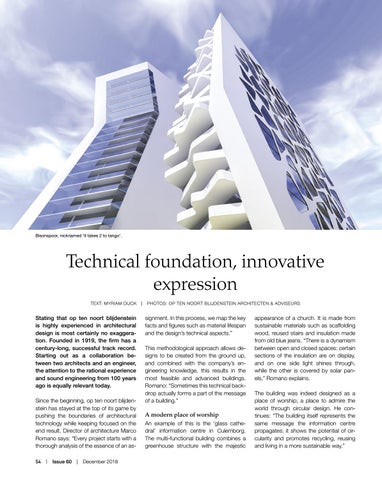
LA N OYE THE ECLECTIC WRITER WITH THE SPECTACLES P ROMOTI NG B ELGI U M,
THE
PLUS
CHRISTMAS LUXURY GIFTS AND GOURMET IDEAS THE NETHERLANDS’ TOP ARCHITECTS FLEMISH LAW SPECIAL: MEET THE WINNERS DESIGN, TOURISM AND BUSINESS
NETHERLANDS
AND
LUXEMBOURG
Balmain flamea II balmainwatches.com
Discover Benelux | Contents
Contents DECEMBER 2018
84
xx
20
COVER FEATURE 84
Tom Lanoye
46
Dutch architects are renowned across the globe. Both nationally and internationally, architecture firms from the Netherlands continue to make their mark with their innovative approach to building. In this special, we hone in on some of the country’s top architectural agencies and showcase their most impressive constructions.
Celebrating his 60th birthday this year with the publication of a new scrapbook, author Tom Lanoye is more fired-up than ever before. In the book, the Flemish literary jack-of-all-trades with his trademark spectacles is honouring the team effort behind his writing success spanning four decades.
THEMES 10
Top Fashion Brands from Dutch Soil Perhaps the Dutch are not known for being Europe’s most stylish nation. They are, however, famous for their practical dress sense. This is reflected in the Dutch fashion and accesory labels, as we show in this special theme, where we highlight some fun, functional and fashionable brands from the low countries that defy the stereotype.
62
18
Christmas Special The Ultimate Guide To Luxury Gifts In this double-length Christmas special, we first offer a glimpse behind the scenes of the Flemish jewellery industry. In time for getting some wonderful Christmas gifts, we help you find that personal piece that is sure to bring a smile to the face of whoever receives it.
28
110
Winter Gourmet Destinations and Foodie Gift Ideas Belgium and Luxemburg are a true paradise for foodies and culinary connoisseurs. They combine their natural innovativeness with respecting traditional techniques and products. Today, ‘made in Belgium’ and ‘made in Luxembourg’ are synonyms for quality. In this special we explore restaurants and food producers who show us why.
Top Architects in the Netherlands: Creating Quality of Life
88
Discover Flemish Legal Profession: Meet the Winners If you need a counsel, Flemish lawyers will guide you step-by-step through the confusing, paper labyrinth of the law. Their fields of expertise range from criminal law to European tax law and debtor management, and are united by an eternal hunger to improve and think outside the box. For this, we have selected seven of the best legal professionals from Flanders.
BUSINESS 108 Companies, profiles, regulars and more In this packed business section, our regular columnist ponders the quirks of the millennials and we feature a sound studio, a top Dutch law firm, a logistics company, a new office concept in Luxembourg and a real estate agency.
DON’T MISS 6 Fashion Picks | 8 Desirable Designs 126 Out & About | 134 Columns
Issue 60 | December 2018 | 3
Discover Benelux | Editor’s Note
Dear Reader,
Discover Benelux Issue 60, December 2018
Executive Editor Thomas Winther
Ella Put Emma Wesseling Eva Menger Frank van Lieshout Karin Venema Lidija Liegis Lorenza Bacino Martin Pilkington Matt Antoniak Michiel Stol Pauline Zijdenbos Silke Henkele Steve Finders Stuart Forster
Creative Director Mads E. Petersen
Cover Photo © ID/ photo agency - Filip Naudts
Editor Myriam Gwynned Dijck
Sales & Key Account Managers Mette Tonnessen Katia Sfihi Micha Cornelisse Petra Foster Wout Evers
Published 11.2018 ISSN 2054-7218 Published by Scan Group Print Liquid Graphic Ltd
Copy-editor Karl Batterbee Graphic Designer Audrey Beullier Mercedes Moulia Feature Writer Arne Adriaenssens Contributors Anna Villeleger Chérine Koubat Dries Luyten Eddi Fiegel
Publisher: Scan Group 15B Bell Yard Mews Bermondsey Street London SE1 3YT United Kingdom Phone: +44 (0)870 933 0423 Fax: +44 (0)870 933 0421 Email: info@discoverbenelux.com www.discoverbenelux.com
We are a media you can trust. The print circulation of Discover Benelux is audited by the Audit Bureau of Circulation (ABC), which is the UK body for media measurement.
© All rights reserved. Material contained in this publication may not be reproduced, in whole or in part, without prior permission of Scan Group – a trading name of Scan Magazine Ltd. This magazine contains advertorials/promotional articles.
4 | Issue 60 | December 2018
For this issue, I had the pleasure to speak to Flemish author Tom Lanoye, who graces our cover this month. As a self-styled ‘public intellectual’, Lanoye is interested in history, current affairs and politics in Flanders as well as the Netherlands. One of the things we spoke about during the interview, which you can read on page 84, are the differences between the two Dutch-speaking areas of the Benelux. Deeply rooted in their respective religious traditions, Lanoye believes the wealth of Flemish Catholicism and the sobriety of Dutch Protestantism still resonate within the cultures today. Exemplified by Lanoye’s works, in Flanders, people indeed enjoy a certain exuberance in their literary tradition – as well as a richness in their cuisine – which is seen as rather foreign and eccentric by the somewhat sceptical Dutch. This analogy reflects the diverse cultural abundance of the Benelux region at large, where there continue to be new and unexpected things to do and discover. Despite being a rather small region, there is always a reason to go and explore it. Why not head over this month for a charming end-of year getaway? As always, we will show you all the best places to see and visit so you do not miss out. Merry Christmas!
Myriam Gwynned Dijck, Editor
© Bal du Moulin Rouge 2018 - Moulin Rouge® - 1-1028499
LA REVUE DU PLUS CÉLÈBRE CABARET DU MONDE ! - THE SHOW OF THE MOST FAMOUS CABARET IN THE WORLD!
DÎNER ET REVUE À 19H À PARTIR DE 180E - REVUE À 21H ET 23H À PARTIR DE 77E - DINNER AND SHOW AT 7PM FROM E180 - SHOW AT 9PM & 11PM FROM E77
MONTMARTRE 82, BLD DE CLICHY 75018 PARIS - TEL : 33(0)1 53 09 82 82 - WWW.MOULINROUGE.COM
Discover Benelux | Design | Fashion Picks
DECEMBER FASHION PICKS
Shimmering elegance December is here, but instead of choosing traditional red or black dresses for your Christmas outfits, Dutch designers are giving fashion a sparkling, yet elegant twist during this year’s festive season. TEXT: ELLA PUT | PRESS PHOTOS
Subtle glistering studs A subtle sparkle is all you need to brighten up your look. This top has little blue studs on the front which will reflect the light as you move around. €35 www.missetam.nl
A December to remember Leave a sparkle wherever you go is the motto of this year’s Christmas collection from WE Fashion. This nicelycut blazer, with glittery details, is certainly the eye-catcher of the collection. Blazer: €100 Pants: €50 Shoes: €90 www.wefashion.nl
6 | Issue 60 | December 2018
The perfect purse In the world of Fabienne Chapot, colourful patterns meet sophisticated accessories and elegant designs, creating the perfect combination between contemporary looks and everlasting pieces. This elegant purse is no exception and with its eight compartments, it is the perfect gift or accessory for Christmas. €75 www.fabiennechapot.nl
Discover Benelux | Design | Fashion Picks
The season of sparkle The devil is in the detail, and so special attention must be paid to design, as such. Combining the traditional look of an elegant smoking jacket with festive sparkles, this look was designed to be bedazzling. The festive outfit promises to assist in creating a holiday season to remember. Blazer: €70 Top: €35 Pants: €50 www.wefashion.nl
The modern bronze age These shiny, ankle-length trousers give any outfit an instant wow-factor. Thanks to the stylish front press-fold, this pair will feel right at home at any festive gathering or New Year’s party. €80 www.sissy-boy.com
Take a bold step With their bold statement pieces and lively party dresses, the clothes and accessories of Steps have one goal: to stimulate women to take a step out of their comfort zone. These flowery, velvet ankle boots can perfectly be combined with a basic dress, making you Christmas-ready in just two steps. €60 www.steps.nl Issue 60 | December 2018 | 7
Discover Benelux | Design | Desirable Designs
DESIRABLE DESIGNS
Celebration of light December is the month to celebrate the gift of light. The seemingly eternal winter nights are the cold backdrop of illuminated festivals all around the globe. Brighten the Christmas tree and light the Chanukah candles to cover this month in a mesmerising glow. TEXT: ARNE ADRIAENSSENS | PRESS PHOTOS
1.
1. In the smallest of spaces Every room deserves to be lit properly. Even the smallest one. This modern, whimsical bathroom light called L-hop gives your porcelain throne some extra cachet and rocks your roll. From €250 www.dark.be
2. Breath-taking chandelier The Shanghai-chandelier is always in motion. The heavy, bronze-colour lamp opens and closes to your liking and can stop and stay in any position. It can even ‘breathe’ in and out automatically, covering the room in an ever-fading and intensifying yellow glow. Price on request www.kinetura.com
2.
3.
4.
4. In the pipeline Different rooms require different lamps. Luckily, the construction of the Light Forest easily adapts to every room and space. The basic models (for both the ceiling and the wall) can be built in four different ways. If even that is too limited, however, the designers will happily create a customised version for your interior only. From €1,080 www.ontwerpduo.nl
5.
3. A cosy countdown If you cannot wait to attack the delicious Christmas meal, then there is now a solution. This cute candle helps you to cope with the countdown to the big day. Light a little piece of it every day until the turkey appears on the table and the presents can finally be opened. €7 www.dille-kamille.nl 8 | Issue 60 | December 2018
5. Ignite the engine Ship engines get inspected with draconican precision and even the smallest irregularity can give them a single ticket to the junkyard. ES Ontwerp saves these high-quality metals from eternal damnation and reuses the engine’s valves into elegant, massive candlesticks with a fascinating story. From €32 to €180 www.esontwerp.com
Discover Benelux | Design | Structure Plus
Choose one of the superbly designed and fitted Bulthaup kitchens installed and managed by Structure Plus.
Ergonomic and aesthetic kitchens TEXT: LIDIJA LIEGIS | PHOTOS: STRUCTURE PLUS - BULTHAUP
For those who want a unique, first-rate kitchen design solution and a smooth installation process, look no further than Structure Plus. The Brussels retailer of German kitchen brand Bulthaup, offers a range of contemporary kitchens with unique designs. The Uccle-based company handles a vast array of projects, ranging from client’s houses and apartments, to corporate and development projects. Structure Plus was founded 25 years ago by Martine Ghysels and Patrice Penasse, and the company provides a top-quality service reflecting the reputation of the renowned German brand. The team works closely with customers on tailored projects, providing highend solutions within kitchen design. The company’s ethos is that ‘the kitchen should adapt to the client, and not vice versa’, and the team goes to every length to grant the wishes and incorporate a client’s needs. Bulthaup’s designs are for clients who seek to make the kitchen a space for freedom of movement and comfort. The designs offer technical perfection and innovation, all built using high-quality materials to ensure the furniture is ultra-functional, yet timeless and elegant. In addition to its kitchens, Structure Plus also sells a variety of furniture, including kitchen tables and chairs, all designed to be of the utmost comfort. A frequent request from clients, these days, is to
use energy-efficient materials and bulbs within the kitchen space, and Bulthaup is renowned for its innovative use of different materials. Structure Plus’ team of designers regularly attends training sessions at Bulthaup’s Bavarian headquarters to stay fully up-to-date with the latest designs and techniques, such as the laser technology used to bind laminated surfaces in its kitchens. In addition to working with individual customers, Structure Plus is increasingly realising largescale projects. One such example is ‘The One by Atenor’, in Brussels’ European district. The development comprises 97 luxury apartments, all featuring Bulthaup technology and designs. While Structure Plus is based in Belgium, the team can provide their services and install their kitchen systems all over the world. The company has experience working in Sweden, Spain, Italy and the UK.
Founders Martine Ghysels and Patrice Penasse.
The Structure Plus showroom in Uccle is open on Mondays to Saturdays from 10am until 6pm.
Web: www.structureplus.bulthaup.be
Discover Benelux | Dress Your Best | Top Fashion Brands from Dutch Soil
Bulaggi.
DRESS YOUR BEST
Top fashion brands from Dutch soil While the Dutch might not be famous for their stylish feeling for fashion, they are, however, known for their practical dress sense. This rational way of looking at fashion is certainly something that is often reflected in the Dutch labels. In this special, we are highlighting some fun, functional and fashionable brands from the low countries that defy the stereotype. TEXT: MYRIAM DIJCK
HUB.
10 | Issue 60 | December 2018
Discover Benelux | Dress Your Best | Top Fashion Brands from Dutch Soil
HUB.
Kicking off the special, on page 12, are the nifty bags by Bulaggi. The brand was recently re-launched under the current name to mirror the stylish bags they produce. Bulaggi bags are characterised by their colourful, eye-catching and original designs. Keep an eye out for their Celebrate collection next year, which forms a special set of bag designs to mark their 50th anniversary. Secondly, on page 13, explore how a former professional tennis player is creating a legacy in the fashion industry. Based
on the founder’s sport of choice, HUB Footwear produces tennis-inspired trainers for everyday use.Quickly expanding their foothold in the European market, HUB are launching several new collections next year. Next, we take a trip along the adventurous world of MicmacBags, from page 14. The origins of this real leather bag label date back to the late 1940s, when the company’s founder traversed the world. Today, every collection that MicmagBags produces still honours this exploratory
XPOOOS.
MicmacBags.
spirit as they all take their inspiration from Native Indian tribes from North America. Concluding this Dutch fashion special on page 17, we feature an innovative and quirky sock design company XPOOOS. In our interview with them, you can read how they found a novel way to print unusual and intricate designs onto socks. A fact that has not gone unnoticed by the world at large, as more and more people are opting for fanciful sock designs by XPOOOS in favour of a standard uni-coloured pair.
MicmacBags.
Issue 60 | December 2018 | 11
Discover Benelux | Dress Your Best | Top Fashion Brands from Dutch Soil
Perfectly nifty bags TEXT: EMMA WESSELING | PHOTOS: BULAGGI
Designing handbags and shoppers with unique prints is nothing new to Dutch brand Bulaggi. As a matter of fact, their bags have been around for 50 years. Next year, they will mark this golden jubilee with a special ‘Celebrate’ collection. Bulaggi designs bags for the modern woman. A woman who takes care of herself and her family, who takes pride in her home and has a career and an active social life. In order to make the most of this busy lifestyle, she needs an organised and practical bag that she can take with her to any occasion. “We design bags for women who wake up in the morning, make breakfast, drive their kids to school and then go off to their jobs,” says Sabrina van Wijnbergen-Fischer, Bulaggi’s sales and export manager. It is for this reason that every Bulaggi bag comes with a set of long shoulder straps and they all contain multiple pockets to keep both small or bigger items in place. That way, you will never have to endlessly 12 | Issue 60 | December 2018
search for your car keys or your phone, even if you are one of those women who carry their entire life in their purse. Next year marks their 50th anniversary, during which they will launch a unique ‘Celebration’ range. This collection will be released gradually over a 12-month period and therefore covers multiple items. With their stylish design, the Celebration collection will set the tone for the other bags that Bulaggi will launch in 2019. The company, originally called Arwa and rebranded two years ago by the founders’ daughter, started off making all kinds of leatherwear. Over the years, they switched from leather products to making high-quality polyurethane-coated leather (PU-leather) bags and wallets, and they sell these all over Europe and beyond. With Bulaggi, you can be sure to get a fashionable bag, as their patterns are one of a kind. Want to mix and match? That is no problem, as they carry multiple handbags that have a canvas counterpart.
Bulaggi also pays a great deal of attention to shoe trends, so their collections always match the latest styles and can easily be combined with a new pair of shoes. Web: www.bulaggi.com
Discover Benelux | Dress Your Best | Top Fashion Brands from Dutch Soil
Trainers inspired by professional tennis TEXT: EMMA WESSELING | PHOTOS: JUSTINE LEENARTS
A professional career in tennis might lose its shine over time, but a passion for trainers will never fade. At least, that was the case for Huub van Boeckel, former professional tennis player turned entrepreneur and founder of HUB Footwear. Since its foundation in 2004, HUB has always focused on designing high-quality footwear with a timeless character. Sander van Gelder, commercial director at HUB says: “We represent an urban lifestyle, combined with a clean look,” This means that every trainer derives from the timeless classic that a tennis shoe represents, but with a unique twist. The brand name, HUB, stands for a literal hub. A place where people meet and inspire each other. “The city is full of big and smaller hubs where people come together to share ideas, stories and passions,” Van Gelder continues. Symbolising this, every HUB shoe features a stitched orange ‘Z’, connecting all of them together as one. Some people may think the brand name, HUB, is a play on the name of the founder. It is funny, but it is not the case. During the design process, the brand takes their HUB DNA – which consists of a clean look and a high quality, sophisti-
cated feel – and translates this to on-trend shoes. All of their trainers are inspired by tennis wear, but have a very urban feel to them and provide comfort for the hectic city life. For the Spring/Summer 2019 collection, they will launch a HUBtrainers tennis pack, consisting of three tennis-inspired trainers with the characteristic white bases. But this is not the only thing HUB has in store for the upcoming year. For the Autumn/Winter 2019 collection they will launch Haghe by HUB. A collection predominantly for women that focuses on boots and other non-trainer shoes. This will be part of the HUB premium collection. Along with launching these new collections, one of HUB’s main goals for next year is to expand their European distribution network, growing their company even bigger. Right now, you can buy a pair of HUB shoes via their own website and they are also sold in several high-quality trainer and shoe shops in the Netherlands, Belgium, and several other European countries. Web: www.hubfootwear.com
Issue 60 | December 2018 | 13
Discover Benelux | Dress Your Best | Top Fashion Brands from Dutch Soil
The bag that comes with adventure TEXT: ELLA PUT | PHOTOS: MICMACBAGS
Whether it is the concrete jungle of city life, the rainforests in Panama or the outskirts of Canada, MicmacBags are faithful travel buddies that will join travellers on any adventure, wherever and whenever they go. “We’d like to call it an affordable companion,” Arnout van Nieuwaal, marketing manager of MicmacBags explains. While the company has a long and rich history, in the last few years, the leather MicmacBags are truly taking the Benelux by storm. They aim to keep the quality high and the prices affordable, which start at 20 euros for wallets and clutches. MicmacBags offers bags in all shapes and sizes, including laptop bags and backpacks, both for men and women. 14 | Issue 60 | December 2018
Honouring ancient cultures Key in the collection is the love and passion for the nomadic lifestyle, therefore, several collections are inspired by the lifestyle of Native Indian tribes by recounting their story and adventures. For example, the New Navajo collection, with its painted shoulder straps and flexible leather materials, honours the tribes in the Midwest of America. “We put a lot of thought into every aspect of the design,” Van Nieuwaal explains. “We make the bags from the same materials the tribes used to use for their clothes and focus on the area they lived in. We want the bags to tell a story and honour a tribe, and the smallest of details can make that link to the tribe that is central in the collection.”
Discover Benelux | Dress Your Best | Top Fashion Brands from Dutch Soil
MicmacBags latest addition is the collection Goldengate, which was inspired by native tribes who used to live in the area now known as San Francisco. Furthermore, there is the Everglades collection, inspired by the national park in Miami. “An adventurous destination, because of the crocodiles that live there. The subtle crocodile leather that we used for the bags in this collection was also used by the tribes themselves to make clothes, tents and small bags. They travelled around the area, which links to the adventurous aspect of our brand. We honour their adventurous spirit by creating bags that you can take everywhere you go,” he says.
The adventurous tale of the Micmac The adventure of MicmacBags itself began in 1949, when the artistic founding father of the brand went on a pioneering journey to several far-flung and – at the time – largely unknown countries. “Nowadays, people travel around the globe all the time. But like with most of what he did, the founding father of MicmacBags was one of the first,” Van Nieuwaal says. After a long and eventful time travelling, he ended his journey in India, where he discovered the perfect factory for the leather bag he had been carrying around with him the entire time. “There, in India, lies the root of our bag production. During his time travelling, he
had been inspired by the adventurous spirit of Mi’kmaq Indians in Canada. They were, just like him, always on the road. They went from one adventure to the other. The leather bag, which he called MicmacBags, became a symbol of his admiration for them.”
holds a strong vision for the future. “Sustainability is a key aspect in every product we make. We want to create bags that you never have to throw away. In fact, because we use real leather, it gets more and more beautiful as time passes,” Van Nieuwaal explains.
A sustainable journey
Designed in Holland, but produced in India, the bags go on quite an adventure themselves before travellers can take them on their own journey. Van Nieuwaal: “We are aware of the risk that comes with developing the bags and wallets in another country. However, since the beginning of MicmacBags, we have worked closely with an Indian factory which is highly praised, and certified (LWG and SA8000), for their good labour conditions. We regularly visit the factory ourselves to make sure everyone involved in the production process is content. After the production process is finished, the bags are ready to go on their biggest adventure yet.”
Nowadays, the world has become a global village where the possibilities are greater than ever before. “Entering the concrete jungle of city life can even feel like a challenge today, therefore, all bags are made to inspire people to turn life into an adventure and enjoy it. They form a part of it and, with their many functions, the bags can make life easier.” Each bag has a separate mobile-phone pocket, and there are several useful pockets of which each user can decide their the purpose for themselves. In recent years, the bags have become a growing success after many travellers took the bags with them on their adventures and shared their experiences. Van Nieuwaal: “Because of that success, we have several blogs on our website where our travellers can write about their journeys and the stories along the way.”
Web: www.micmacbags.com
Praised for the fact that the price is reasonable and the leather is strong, the products are affordable but last a lifetime. And with that idea, MicmacBags also
Issue 60 | December 2018 | 15
Discover Benelux | Dress Your Best | Top Fashion Brands from Dutch Soil
The art of socks TEXT: ARNE ADRIAENSSENS | PHOTOS: XPOOOS
Over the last few years, the colourful sock-revolution has reached millions of drawers worldwide. While marine blue used to be the most daring colour to wear to the office, leopard prints and Mickey Mouse now play the lead under many desks. As an expert in fun and comfortable footwear, XPOOOS cheers up all of Europe with their whimsical creations. The name XPOOOS, spelled with its three Os – for original, outstanding and out of this world – is as vibrant and extravagant as the socks they produce. Their story kicked off in 2014 when a desperate need for unique footwear arose. “People were fed up with classic socks,” sales manager Michiel Bierens explains. “We’ve introduced a photo printed alternative to spice things up.” This technology makes every colour and design possible, but many companies struggle with delivering a comfortable sock. “You
can only print well on polyester, yet that isn’t very soft. That’s why we add a layer of cotton on the inside as a soft surprise. To top it off, we stitch on the toes by hand and add a real cotton heel for extra comfort.” Their foremost strength, however, is their limitless fantasy and wide range of styles. “Rather than using abstract prints, we tend to work with objects, animals and people; cars, bears and cyclists, for example. With our designers spread around Europe, we notice trends in a heartbeat and quickly catch up with them.” Recently, XPOOOS launched a charming bamboo yarn collection, to offer the best quality and softest feel with high fashion value. XPOOOS will continue to innovate and invent, so be sure to keep an eye on their latest products. Web: www.xpooos.com
L’exquise saveur des Perles noires de la Mer Caspienne The exquisite flavor of Beluga Caviar from the Caspian Sea Caspian Tradition Avenue des Pâquerettes, 55 1410 Waterloo - Belgium Tel : +32 2 354 97 90.
La Maison du Caviar - Marché Matinal de Bruxelles Quai des Usines, 22-23 G302 1000 Bruxelles – Belgium Tel : +32 2 736 86 63. www.caspiantradition.com
Discover Benelux | Christmas Special | The Ultimate Guide to Luxury Gifts
CHRISTMAS GIFT IDEAS 2018
The ultimate guide to luxury gifts Christmas time is the perfect occasion to spoil a loved one with a truly wonderful present. In this guide to luxury gifts, we zoom in on a number of fantastic jewellery makers from Flanders who – for any budget – can help you find that personal piece that is sure to bring a smile to the face of whoever receives it. TEXT: MYRIAM DIJCK | PHOTO: DREAMSTIME.COM
18 | Issue 60 | December 2018
Discover Benelux | Christmas Special | The Ultimate Guide to Luxury Gifts
Issue 60 | December 2018 | 19
Discover Benelux | Christmas Special | The Ultimate Guide to Luxury Gifts
The Antonellis collection offers diamond and brilliant jewellery.
The sentimental value of jewellery TEXT: EVA MENGER | PHOTOS: JUWELIER BOSMANS
Jewellery can be of extraordinary value – not just in terms of cost, but in terms of sentiment, too. For most people, a piece of special jewellery comes to symbolise something bigger, whether that is a marriage, a huge achievement or, in the case of inheritance, someone they lost. At Juwelier Bosmans, a high-end jewellery shop in the centre of Aalst, they are more than happy to advise and support customers in order to make that piece of jewellery as personal as possible. After studying jewellery design at the Royal Academy of Fine Arts in Antwerp, 20 | Issue 60 | December 2018
Marc Bosmans started out in Halle, where he owned three medium-sized shops. He then opened up his fourth branch in Aalst, as being located in a larger city would allow him to offer his customers a wider range of international brands. Together with his son, who followed in his footsteps to becoming a jewellery designer, he designs many pieces in-house. “What I love most is helping customers turn an heirloom into something more modern. If someone doesn’t fit their grandma’s ring, we can redesign it or change it into earrings to make it wearable again, while the sentimental value
remains,” Bosmans says. “It is much easier now, too, as new 3D technology can very accurately show how a piece will come out, making it a lot less daunting for customers to entrust us with something as precious as inherited jewellery.”
One of Antonellis’ magnificent pieces.
Discover Benelux | Christmas Special | The Ultimate Guide to Luxury Gifts
Not everything in the store is designed by Bosmans, as they also sell a wide range of luxury brands including Messika, Marco Bicego, Breitling, Hermès and Antonellis. The latter is particularly worth mentioning, as Antonellis designer Anton Schellekens has recently launched his new collection of diamond and brilliant jewellery. This collection has been carefully selected and includes exclusive, high-end items ranging from 1,500 to 150,000 euros.
Diamonds and technical perfection Founded by Anton Schellekens and Linda Vanderschueren, Antonellis has managed to work its way up to the top of international jewellery in just ten years. They describe their collections as a combination of Belgian craftsmanship, technical perfection, and respect for the purity of the diamonds they work with. All diamonds are Belgian cut, fully certified by the Antwerp High Diamond Council, 100 per cent natural and free from conflict or environmentally unfriendly mining. What is more, Schellekens and Vanderschueren are both big fans of innovative design and manufacturing, which is why most of their designs are remarkably modern.
years, and their good working-relationship gives clients the opportunity to tailor their Antonellis jewellery towards their personal preferences.
A personal touch Being a jewellery store, Bosmans is, of course, the perfect place for those looking to surprise their partner with a proposal, or for those already engaged who are now looking for the perfect wedding ring. “Our Dora wedding ring collection includes over 300 different choices, ranging from classic to exclusive and fully tailored,” says Bosmans. “As people are always looking for something very
personal and a little different, the trend of personalising wedding rings is becoming increasingly popular. Using a special machine, we can take a person’s heartbeat or fingerprint, after which we engrave a copy of it on the inside or outside of their partner’s ring.” Of course, this technique can be used for other purposes as well. “During one of the most memorable moments of my career, a client came to me as he was looking to buy something really special for his wife. She had just survived a heart attack, so he felt that engraving her strong heartbeat into a ring was both suitable and very
Schellekens is a graded diamond appraiser and polisher and personally ensures that design and production processes are constantly supervised. Vanderschueren is the creative brain behind all the designs and has worked with the best Italian designers. Together, they are the perfect team, as, after working together for many years, they are now able to streamline thought and idea creation into production. Juwelier Bosmans Aalst has been working with Antonellis for many
Antonellis earrings.
The latest Antonellis collection is now available at Juwelier Bosmans.
Issue 60 | December 2018 | 21
Discover Benelux | Christmas Special | The Ultimate Guide to Luxury Gifts
Antonellis jewellery is perfect for the upcoming Christmas season.
The luxury department, including brands such as Breitling and Hermès.
22 | Issue 60 | December 2018
Discover Benelux | Christmas Special | The Ultimate Guide to Luxury Gifts
powerful. It symbolised a new beginning, and I felt honoured and touched to be able to help a client with such a beautiful, meaningful design.”
Jewellery to fit your appearance Those who are not sure of what jewellery to get will benefit from the shop’s all-round expertise. “Customers come to us for recommendations all the time,” Bosman says. “As a rule of thumb, it is good to remember that light skin tones go best with rose or white gold as this makes for a softer contrast. For darker skin tones, however, yellow gold is the way to go.”
The outside of Bosmans Juwelier, located in the centre of Aalst.
For any other questions around materials, customers can always go to one of their designated in-house specialists. “All of our employees are specialists. We have an in-house mechanical watch specialist, a specialist for diamonds and a highlyskilled expert in pearls, so if customers have queries around specific materials, they will always find an expert answer.”
Fashion meets luxury Covering 550 square metres, Juwelier Bosmans offers their customers everything they could possibly wish for. There is a luxury department, where those looking to splash out on exclusive designs will be in very good hands, but there is also a fashion department. Not that you will find high-street clothing brands here, but it does offer a slightly more accessible range of jewellery. Bosmans: “Our fashion collection is targeted at young people, with prices ranging from 15 to 500 euros.”
The relaxing atmosphere of Bosmans Juwelier. Photo: Studio Ballena.
Are you looking for a piece of jewellery to mark a special occasion? Or have you always wanted to surprise your loved one with a beautiful necklace, but do not quite know what will suit them? Then Juwelier Bosmans is the place to go. Their team of in-house specialists will do everything they can to understand what you are looking for and make it as personal as possible, as, after all, that is what creates the most special sentimental value. Web: www.juwelier-bosmans-aalst.be www.antonellis.be
Bosmans Juwelier covers 550 square metres. Photo: Studio Ballena.
Issue 60 | December 2018 | 23
Discover Benelux | Christmas Special | The Ultimate Guide to Luxury Gifts
Making jewellery design personal TEXT: MYRIAM DIJCK | PHOTOS: REGINALD TACKOEN & FRANK CROES
Sleek design with a personal, bespoke touch, this is what Kitty Spaenjers and Audi Pauwels offer in their jewellery shop in Hasselt. Designing and producing over 80 per cent of the jewellery inhouse, Huis Pauwels Spaenjers keeps the ancient craft of the goldsmith alive for people who love a unique piece of jewellery. From adjusting existing pieces to designing custom rings, necklaces and earrings, the married couple have created hundreds of unique pieces since Huis Pauwels Spaenjers first opened in 1993. Customers can walk in with a design in mind, and Kitty and Audi will do the rest. “Based on this, Audi will make a beautiful watercolour drawing. We keep every design on file, so you don’t have to pay for this,” Kitty says. With a library of over 1,200 drawings, and adding one more every week, Audi and Kitty are experts at incorporating personalised elements without making it too obvious to outsiders. “A ring of two-by-two centimetres only offers limited space for detailing and you don’t want to go overboard. So, we help customers work out 24 | Issue 60 | December 2018
what the most important elements are and include these in the design, by an engraving, for example.” The couple met “the traditional way”, Kitty smiles, when they were both studying to be goldsmiths. After graduating, they decided to move in together in Hasselt where they found a home with a downstairs shopfront. “It was the same price as the other houses, so the decision to open a shop was quickly made. We had no business plan or anything. If we had, maybe we wouldn’t have dared to do it!” The risk certainly paid off, and the shop has grown steadily over the last 25 years. Early on, they discovered their skills per-
fectly complemented each other. Kitty continues: “Although we started out designing our own pieces, we soon found out that I love the technical execution on the workbench, while Audi prefers to design.” Still located in Hasselt, they show off their beautiful, sleek and timeless pieces in two adjacent shops. Huis Pauwels Spaenjers is where they sell their jewellery and Multiple, next door, is a platform where they exhibit collections by innovative jewellery designers.
Web: www.pauwelsspaenjers.eu
Discover Benelux | Christmas Special | The Ultimate Guide to Luxury Gifts
Nature-inspired jewellery that tells the owner’s story TEXT: MICHIEL STOL | PHOTOS: KRISTA EN GRETY VANDERVELDE
Nature is a pallet of shapes, colours and motions. It is no wonder nature is a huge source of inspiration for Krista and Grety Vandevelde, sisters and goldsmiths that have been designing and creating beautiful jewellery for over 30 years.
spend a great amount of time with our clients in person to come to the right design. Here in the shop, we have a great variety of stones and jewellery, so clients can try them on. Seeing and feeling real stones and jewels gives a much stronger experience than just looking at a drawn design.”
“Stones and pearls are the treasures of nature. Their shapes and patterns are the essence of beauty and the base of our jewellery,” says Krista Vandevelde. “We are always looking for the best gems and pearls. We came across a set of pearls once, that perfectly resembled a pair of breasts. It immediately brought images of a goddess in mind. I created that image out of gold and the pearls.”
Krista and Grety design all kinds of jewellery such as wedding rings, earrings and pendants. “A uniquely designed ring, with the characteristics of the client and the loved one combined, makes it even more special,” explains Vandevelde. “Sometimes we get requests to design jewellery which contain the ashes of a deceased person. People want to have the connection they have with someone, close by. With deep respect and in all sincerity we create a precious keepsake.”
The shop of Krista and Grety is situated in an old villa called ‘Het Cederhuis’. The glass walls connect it with the nature around it. Their workshop is also situated in the villa, as well as an exhibition room. “We are a team of five goldsmiths with decades of experience in creating jewellery. We all have a passion for perfection.”
be 50 years old. We help restore and adjust them, to keep the piece timeless and in perfect condition.” Even though both sisters have their individual style, all jewellery by Krista and Grety Vandevelde has one thing in common. “Each jewel is a piece of art and perfection that will last a lifetime, and is as unique as the client.” Web: www.goudsmid.be Krista (left) and Grety (right) Vandevelde.
They also perform restorations and modifications of jewellery. “A piece handed down from a grandmother to her grandchild can
Another big inspiration are the clients. “It is their story, their personality and their style that counts as the base for a piece of jewellery. Our designs are custom-made to their wishes,” Vandevelde continues. “We Issue 60 | December 2018 | 25
Discover Benelux | Christmas Special | The Ultimate Guide to Luxury Gifts
Elegance, craftsmanship, passion and ‘joie de vivre’ TEXT: MICHIEL STOL | PHOTOS: MARTENS JUWELIER - CREATEUR
Perfection takes time. That is why Julie Martens takes her time when she designs her beautiful and unique jewels for her clients, for the store displays and for the online boutique of the family business. “Designing is my passion and my art. You should never feel rushed as an artist.”
Science and Crafts IATA in Namur, where she enrolled in courses on arts history, drawing and learned the metier of goldsmith, and was able to amplify her skills by becoming a diamond grader. “There, I found my passion for diamonds. We handpick the diamonds we use in our jewellery, because we want to be sure they tick all the right boxes.” The shops of Martens Jewellery used to carry a lot more watches, but the Martens family decided to focus mainly on jewellery. “Jewels have their own personality. They are items that make a person unique, let them shine,” she continues. “Each client has their own story and we can play a part in turning that story into a timeless piece.”
Julie is the third generation of Martens to create handmade, one-of-a-kind jewels. “My grandmother has always been active in the industry, but it was my father that opened our first store in Aalst in 1990. Five years later, he opened a second store here in Sint-Niklaas.” They also have an online shop. “We wanted to inform people about the possibilities and prices, from the comfort of their own home.”
Creating unique, handcrafted pieces
Martens learned the trade from her family and at the Institute for Arts, Technique,
The Martens collection consists of two major parts: the first is the jewellery that they design from their own inspiration.
26 | Issue 60 | December 2018
Discover Benelux | Christmas Special | The Ultimate Guide to Luxury Gifts
“That is where our artistic side can run wild. We like to sometimes create a jewel that is a bit more ‘out there’. For instance, a canary-yellow diamond with a blue sapphire from Mozambique,” she says. The second is where they create custom made jewels based on a client’s request. “It can be either that they have just an idea of what they want, or that they want to modify an existing piece that has been in the family for decades,” Martens continues. When designing a custom-made piece, it is very important to understand the person that is going to wear it. “What are they like, what kind of style do they have, what kind of cultural background is there and what kind of materials are we going to use?” If someone who works a lot with their hands, is going to wear a ring, for instance, it is better to use a stronger material like platinum. “That information is the basis for our design and from there we go to the drawing board. In a second meeting, we discuss the design and the budget.” Once that is set, the team of Martens goes to work. “We pride ourselves in our craftwork. We are extremely proud that we have been given the ‘Handmade in Belgium’ label. This is a label by Unizo, the union for small and medium enterprises in Belgium, who recognise the producers of genuine, traditional, quality products.” Besides creating their own jewels, the shops of Martens carry a selection of fine pieces from Italian, Danish and Swiss designer houses such as Chopard. “They blur the lines between watchmaking and jewellery. In the Happy Sport collection for women, it looks like diamonds move freely across the dial. They also have a range of watches for men, inspired by classic race cars, like from the Mille Miglia race.”
“Let’s say that 99 per cent of times people come to the store or place an order via our online boutique, they are happy to be here,” smiles Martens, “because they buy something to celebrate a happy occasion. We see all of life’s happy moments, from celebrating an engagement, to a wedding, the birth of a child or any other milestone. We have the privilege to design something unique and personal that is part of that celebration, and that will be part of their lives for a long time to come. What more do you want?” Web: www.juweliermartens.be www.martensjewels.com
As contemporary as it was decades ago Another big part of the work of Martens is service and restoration. “A lot of our customers bring in jewellery that once belonged to a family member and that they want to repair or modify. Sometimes, with just some little modifications, a piece can be as contemporary today as it was 30 years ago, when their grandmother wore it.” Issue 60 | December 2018 | 27
Discover Benelux | Christmas Special | Winter Gourmet Destinations and Foodie Gift Ideas
Pâtisserie Hoffmann.
CHRISTMAS SPECIAL
Winter gourmet destinations and foodie gift ideas Size does not matter. At least not in the world of gastronomy. Belgium and Luxembourg, two of Europe’s smallest countries, are a true paradise for foodies and culinary connoisseurs. Immerse yourself in the countries’ local specialities such as Jambon d’Ardenne, Sirop de Liège and Miel de Luxembourg. TEXT: ARNE ADRIAENSSENS
Notos.
28 | Issue 60 | December 2018
Discover Benelux | Christmas Special | Winter Gourmet Destinations and Foodie Gift Ideas
If it is not because of their unique location in between France and Germany – the country of quality and the country of quantity – then it is probably because of their natural innovativeness. Whatever the case, Wallonia, Brussels and Luxembourg are gastronomical paradises. Some of their local delicacies are enjoyed in all corners of the world. Indeed, you must have heard about Belgian waffles, Crémant de Luxembourg and the – confusingly named – French fries. Today, the culinary sector in the southern Benelux is still innovating and reinventing itself. While respecting the techniques and products that have been used for generations, they are not afraid to look across the borders and add an international sparkle to their dishes. With many expats going to the Benelux for business, there is no stopping this tendency.
Mirelle Oster boutique.
Central in the Belgian and Luxembourgian kitchen is the excellence of the products. Their critical taste buds are satisfied with nothing but the best, making ‘made in Belgium’ and ‘made in Luxembourg’ synonyms for quality.
UNESCO While talking about Belgian culinary specialities, beer, fries and chocolates are probably the first things that come to mind. Rightfully so, since those first two are both crowned UNESCO Intangible Cultural Heritage. Wallonia alone is the birthplace of over 500 delicious beers. Most of them are brewed in commercial breweries of various size, but up until
Jean le Chocolatier.
Chateau de Bousval.
Issue 60 | December 2018 | 29
Discover Benelux | Christmas Special | Winter Gourmet Destinations and Foodie Gift Ideas
today, three of them are made in ancient monasteries. With Orval, Chimay and Rochefort, three out of only 12 traditional Trappist beers in the world come from the south of Belgium. A visit to one of the abbeys will give you more insight into how these godly drinks are created and give you a great opportunity for an extensive tasting. In Luxembourg, they often leave the beer and drink a glass of sparkling wine instead. The so-called Crémant de Luxembourg is an exclusive drink made from hand-picked grapes from the Mosel valley only. Since the second fermentation happens in the bottle, the distinct taste of the Luxembourgian fizz is very different from what their neighbouring countries do with their Champagne of Sekt. Go for a degustation while gazing at Luxembourg’s picturesque vineyards that gave you this delicious wine.
With ketchup or apple sauce Of course, not all gastronomy in the Benelux can be bottled. In Belgium, the art of making cheese has been around for
centuries. Initially, it was mostly monks who made it. Many of these yellow delicacies can still be found at the cheese shop or the supermarket: for example, the Trappist cheeses – yes, from the same abbeys as the beer – and the very popular Maredsous. A real Belgian eats these cheeses, cut into little cubes, by dipping them in mustard and celery salt. A simple appetiser to accompany your beer. In Luxembourg, you take the edge off your hunger with some nice ‘gromperekichelchers’. It might be a bit of a hustle to order it as a non-native speaker, but it will all be worth it once you take a bite of the warm potato pancakes. This season, the best place to buy them is on a cosy Christmas market. Make sure you eat them warm and accompanied with either ketchup or applesauce.
Pâtisserie Hoffmann.
Spago.
Caspian Tradition.
Do you still have an appetite left? We have selected the very best local, culinary magicians from the southern Benelux to turn your holiday into a gastronomical experience. Jean le Chocolatier.
30 | Issue 60 | December 2018
Discover Benelux | Christmas Special | Winter Gourmet Destinations and Foodie Gift Ideas
Spago
L’Ana Thème
Chateau de Bousval
Read more from page 32 Forget Rome, forget Naples: Spago in Brussels is the place to be for great pasta and pizza, made with love. The Neapolitan artist behind the stove spoils you with delicacies from the ankle of Italy.
Read more from page 34 Rooted in the oldest district of Brussels, head chef and restaurant owner Ana prepares spectacular FrancoBelgian dishes. Pair them with a fine glass of Belgian beer of your choice to get the full experience.
Read more from page 35 Just like their southern neighbours, Belgians know how to produce wine. This year, the owners of the breathtaking Chateau de Bousval are ready to crack open the first barrel of their new wine.
Caspian Tradition
Jean le Chocolatier
Mireille Oster
Read more from page 38 After gaining experience as a dessert maker in France, Jean le Chocolatier came to Belgium. Here, he combines his endless fantasy with the country’s sweet, dark brown traditions.
Read more from page 39 Her pain d’épices – or gingerbread – is legendary all around the world. In Oster’s cute little store, you can smell and taste her mouth-watering sweet indulgences and unexpected flavour combinations.
Pâtisserie Hoffmann
Greenwich Taverne
Notos
Read more from page 40 Luxembourgers are fond of having the best and finest goods. At Pâtisserie Hoffmann they happily provide this in the shape of sweets and desserts that tickle your tongue, nose and eyes.
Read more from page 42 What better thing to do in the capital of Art Nouveau than taste a Belgian classic in a Belle Époque setting? Greenwich Taverne welcomes you for a drink, a bite or a game of chess.
Read more from page 44 With 180 nationalities living here, Brussels is a Walhalla for world-food lovers. The best Greek food you will find at Notos, in a light, airy and modern setting.
Read more from page 36 Treat yourself and your loved ones to something extraordinary this Christmas time. With over 40 years of experience in the caviar industry, Caspian Tradition, selects the finest sturgeon roe, including Beluga caviar and gold-coloured Oscietra.
Issue 60 | December 2018 | 31
Discover Benelux | Christmas Special | Winter Gourmet Destinations and Foodie Gift Ideas
Fresh Italian food prepared with love and served with a smile TEXT: SILKE HENKELE | PHOTOS: ANTOAN KURTI
It is no secret that Italian food, with its exquisite flavours and tastes, counts among the most popular types of cuisine. Pizzeria & Ristorante Spago, inarguably one of Brussels’ best pizza places, serves great Italian delicacies.
ue to the well-being of our guests,” he says. “And by greeting and serving our guests with a smile, our team makes sure that our guests feel welcomed and esteemed.”
Located in the middle of Belgium’s vibrant capital, Pizzeria & Ristorante Spago has been catering for its guests’ needs since 1998. The premises underwent a complete refurbishment in 2017. “We wanted to give the place a new feel,” explain Rosita and Valentin, the managers of Spago – a name that, by the way, originates from the Neapolitan term for spaghetti. “Our new design is sleek and modern. It radiates that certain ‘New York, big city life’ atmosphere, without, however, conveying the detached feel of urban anonymity.”
A look at Spago’s menu reveals another reason why the restaurant is one of Brussels’ best-loved Italian places: with a focus on classic pastas and pizzas, but also on novel recipes that interpret traditional food in entirely new manners, Spago is a real cornucopia of delicacies. Rosita expands: “Our chef Alfredo’s expertise is truly exceptional – which is why we offer our guests a wide choice of great food. From the traditional Neapolitan pizza with its distinguished taste, yummy pasta in many variants, but also gluten-free alternatives or meals for vegetarians, it’s all there on the menu for our guests to choose.”
The restaurant’s distinguished homely and comfy feeling has continually been remarked upon by its guests and makes Valentin very proud. “We attach great val-
Speaking of wide choices and innovations: this winter, Spago has, for the first time, prepared a cosy winter-terrace for its guests to enjoy their original Neapolitan
32 | Issue 60 | December 2018
pizza in warmth while delighting in the potential snow and undeniable beauty of a crisp winter’s evening. So why not try out this exceptional premises soon? For the upcoming festive season, Spago once again invites its guests to some exquisite culinary experiences. “We will have a special menu on 24 December as well as on New Year’s Eve. Its contents are still a secret but are certain to delight our guests’ tastes,” promise Rosita and Valentin. Web: www.spagobrussels.be
Meet Valentin and Rosita, the hosts at Spago.
DAL 1998
PIZZERIA & RISTORNATE
SPAGO
Restaurant italien de spécialité napolitaine à Bruxelles Rue du Pont de la Carpe 13, 1000 Bruxelles, Belgique +32 2 512 25 30 https://spagobrussels.be/en
Discover Benelux | Christmas Special | Winter Gourmet Destinations and Foodie Gift Ideas
A quiet treat of a restaurant TEXT: LIDIJA LIEGIS | PHOTOS: L’ANA THÈME
Searching for first-rate Franco-Belgian cuisine in central Brussels? Look no further than L’Ana Thème, a cosy restaurant in the Ilôt Sacré, a listed area close to the Grand Place. The idea behind the restaurant, explains head chef Ana Firmino, is to offer a menu focusing on the quality and freshness of the products. The restaurant is a place to relax, whether dining alone, as a couple, or with friends. People come to have a good time and get away from the stresses of day-to-day life. “At L’Ana Thème, we take the time to do things well. It’s not a place for people in a hurry,” says Ana. The clientele is made up of local regulars and business people, as well as tourists looking for a tasty meal at an affordable price. L’Ana Thème’s ethos is to provide sustainable dining by eliminating food wastage as much as possible and crafting dishes using seasonal produce, which Ana purchases locally, every day. Ana Firmino joined the team in 2016 and later bought the restaurant. “The name is a play on words: despite the word’s negative connotations, the original meaning 34 | Issue 60 | December 2018
of ‘anathème’ is an offering to the gods,” she says. Having arrived in Belgium from Brazil in 2005, she quickly fell in love with French cuisine. She studied gastronomy in Brussels and later at the École Grégoire-Ferrandi, one of France’s leading professional training schools. After having worked in several high-end restaurants as part of a team, working as the sole chef was a challenge Ana was happy to rise to. L’Ana Thème’s menu comprises four starters, four mains and three desserts, and changes monthly based on seasonal availability. Only the homemade shrimp croquettes, and the beef cheek cooked to perfection in Belgian beer for five hours, remain on the menu permanently.
For Christmas and New Year, the restaurant will serve a five-course menu priced at 60 euros. The restaurant seats 24 people, and it also has an upstairs room suitable for groups. The restaurant is open from Mondays to Saturdays from 7pm to 10pm. Web: www.lanatheme.be Owner and head chef Ana Formino.
Discover Benelux | Christmas Special | Winter Gourmet Destinations and Foodie Gift Ideas
T H E V I N E YA R D O F T H E C H AT E A U D E B O U S VA L
The promise of exclusivity and quality TEXT: ANTOINETTE VAN HAM | PHOTOS: LEOPOLD AMORY & MICHEL VERHAEGHE DE NAEYER
It is a nascent adventure whose aroma of success is already wafting about. A beautiful story and, therefore, one worth telling. With spontaneous enthusiasm and the passionate and sensitive vision of the respect we owe to nature, Michel Verhaeghe de Naeyer decided six years ago to revive his dormant lands with a new wealth: A Vineyard. It was a landowner’s dream, a crazy bet like getting into wild horse breeding without having ever ridden a horse. Yet, it was a well-thought-out challenge. Months of observation, weeks and weeks of patience, uninterrupted days of work in the vineyard, the humbling experience of the first harvest, but above all stood the desire to capture the essence of this experience in a glass of wine. Today it is a remarkable company, a brilliant team of professionals who possess the audacity to nurture the land to its most fruitful condition, through viticulture whose exceptional contributions have no higher measure than understanding nature’s demands. The vine flourishes, freely and happily, with micro-organisms, natural predators and selected companion leguminous plants and grasses.
The viticulture is done in a way that looks to the future, the vineyard employs the process of organic farming and flourishes within the footsteps of Biodynamic farming and refreshing gulps of oxygen in the form of permaculture. These few hectares in Walloon Brabant are simply breathtaking. As the new wines of Wallonia emerge on the horizon, an already discernable movement, Bousval has earned a significant place among them; the fruits of a time in which the rules are being re-examined by the development of new ‘terroirs’.
chitectural practice AWAA sitting at the border of the vines, melding with its natural surroundings. It gives a glimpse of a true coming-together of the living earth and what it produces, man and his traditions, in one word: magnificent. The harvest of 2018 was joyous and generous, its grapes of a superb quality. It began with one landowner’s original dream of a glass of wine, which is where Bousval is now – a story of which you can be sure to hear more of in the future. Web: www.chateaudebousval.be
The construction of the chai – the vineyard’s wine storage facility – due to open in May 2019, encapsulates the philosophy of the Bousval estate through its visionary, ecologically-responsible architecture. It is the dreamchild of Charly Wittock’s ar-
Issue 60 | December 2018 | 35
Discover Benelux | Christmas Special | Winter Gourmet Destinations and Foodie Gift Ideas
Sample some of Caspian Tradition’s first-rate caviar.
The ‘black gold’ of gastronomy TEXT: LIDIJA LIEGIS | PHOTOS: CASPIAN TRADITION
If you are looking for a special treat for Christmas or any other festivity, order a sample of the finest caviar from Caspian Tradition. The company sells 14 different species of sturgeon roe, ranging from the highly coveted Beluga caviar, to the gold-coloured Oscietra, which comes from sturgeons living in natural lakes. Another popular choice is Imperial Gold, a Sino-Russian hybrid, which the company describes as “exceptional this year”. Based in Brussels’ Waterloo, Caspian Tradition is Belgium’s largest and most prestigious caviar firm. Husband and wife team Arya and Ahmad Razavi founded the firm in 1995; Ahmad’s family has vast experience in the field, having worked in the caviar industry for 40 years. Caspian Tradition’s in-depth knowledge of caviar and the constant presence of the Razavis are behind the firm’s success. 36 | Issue 60 | December 2018
Arya and Ahmad Razavi work closely with their producers in the field, and they are firmly committed to supporting sustainable caviar breeding.
A range of luxury gastronomic products So what distinguishes Caspian Tradition from other caviar sellers? Not only does it provide premium products, but
Over the years, the caviar industry has undergone profound changes and traditional wild caviar has become a forbidden commodity. Wild sturgeon fishing for export has been banned in the Caspian Sea, yet the firm has managed to negotiate this shift by exploring caviar breeding of all origins and thus preserving the Caspian Sea species. The company strives to meet the highest international standards, importing, packing and distributing the luxury commodity from its high-tech centre in Waterloo. It exports 90 per cent of its produce, serving an international clientele from across Europe, and as far afield as Singapore, the UAE and New Caledonia.
Arya and Ahmad Razavi.
Discover Benelux | Christmas Special | Winter Gourmet Destinations and Foodie Gift Ideas
Arya and Ahmad Razavi personally travel around the globe to select the finest caviar for their customers. Since its founding, Caspian Tradition acquired a German company which specialises in importing Japanese sushi products, and in 2011, it acquired Brussels’ La Maison du Caviar. Both acquisitions led the company to expand its product list to include delicacies such as foie gras and smoked salmon. Other products include lumpfish roe, salmon and trout roe, king crab, truffles, saffron and pistachios, just to name a few. Arya Razavi advises first-time buyers to try Imperial or Oscietra, as they have “a light and nutty flavour which appeals to all tastes”.
holds a Self-Checking System Certificate from the Belgian Ministry of Health, and the lab has all the tools to ensure a product’s origins can be fully traced and each batch can be identified by reference numbers. According to Caspian Tradition, a key tip for serving caviar is to avoid metal utensils as much as possible, especially silver which causes the caviar to take on an oxidised flavour. Teaspoons made of mother of pearl are ideal. Always try to serve the caviar cold, for example, by placing the box on a bed of crushed ice. If you prefer it accompanying a warm dish, try to isolate it – for example, if using it as part of a potato dish, consider covering it with a layer of
lightly whipped cream, to isolate the caviar from the hot potato. The company places prime importance on the storage and handling of the caviar; it is an incredibly fragile and delicate product that should be consumed as soon as possible once opened. So how can you tell if the caviar you are sampling has been wellpreserved? A little trick, says the team, is a test of the nose. Crush a few grains on the back of your hand, at the base of your thumb and bring them to your nose – the caviar should have no smell. Web: www.caspiantradition.com
Caspian Tradition has its own fish farm on the Caspian Sea’s shores, and the Beluga caviar it produces has a guaranteed authentic taste because the sturgeons are raised with water from the Caspian Sea. The different varieties of caviar come from the best fish farms globally, with Iranian specialists playing a key role in the production chain by selecting first-rate caviar from different species and origins in accordance with its ethos of sustainable development and ecology preservation. Caspian Tradition scrupulously selects and prepares the caviar in the country of departure, and then experts in its laboratory test and condition it to guarantee the impeccable quality.
A profound expertise The Waterloo laboratory includes top-ofthe-range equipment and highly-trained staff working to stringent hygiene standards. These are comprised of multiple double-door fridges, work rooms and cold rooms, complying with European rules. It
Issue 60 | December 2018 | 37
Discover Benelux | Christmas Special | Winter Gourmet Destinations and Foodie Gift Ideas
The roasting machine.
B E L G I U M : H O M E O F G R E AT C H O C O L AT E
The fine art of combining flavour and pleasure TEXT: LORENZA BACINO | PHOTOS: JEAN LE CHOCOLATIER
A resident of Belgium since 1997, Jean le Chocolatier originally hails from southern France, where his passion for experimenting with chocolate began. “I was lucky to have a mother who adored cooking and who made the most wonderful desserts when I was little,” enthuses Jean. When he arrived in Belgium, two decades ago, Jean could not wait to uncover his adoptive country’s addiction to gastronomic delights. “I wanted to bring some southern sunshine to my work,” he laughs, “and it was my clients who helped me refine what I do, and who gave my shop its identity.” Jean le Chocolatier honed his skills in a number of Michelin-starred restaurants in the Cote d’Azur, Languedoc-Roussillon and Savoie regions. But in the end, it was Belgium’s fascination with chocolate that made Jean decide to realise his dream, and he opened his boutique chocolaterie, Jean le Chocolatier, in 2003.
A haven for chocolate lovers “I’ve created a special gourmand environment in my shop, with chocolate 38 | Issue 60 | December 2018
drops descending from the ceiling and an entire chocolate wall, through which clients can observe what is happening behind the scenes in the workshop.” Jean’s chocolate delights are produced from scratch each week on Mondays, Tuesdays and Thursdays, when the shop remains closed. Products are available to buy on Wednesdays, Fridays and Saturdays. On those days, visitors’ nostrils quiver in delight at the shop’s aromas as they are invited to sample his classic flavours as well as exotic mixtures of teas, spices and fruit chocolate melanges. Chocolates aside, Jean also produces gluten-free cakes, and, upon request, vegan, diabeticfriendly and allergy-free options.
Roasting, pairings and chocolate-flavoured Christmas This October, Jean le Chocolatier embarked on a new taste adventure. This is embodied in the introduction of ‘JC roasting’. Using the Probat brand, Jean roasts ethically-sourced cacao beans and high-end green coffee beans to offer his clients a new range of products.
“Roasting is a combination of science and art, theory and practice,” explains Jean. “I take great pleasure in developing unique ways of sublimating the cocoa and coffee beans. This way, the delicate, specialised work of the growers and the biodiversity of the land blend together, reaching new heights. I adapt my method to extract the best possible flavour from each different type of bean.” And with Christmas on the horizon, Jean’s innovative pairings will most definitely be tempting, along with the festive season’s special creations. Web: www.jeanlechocolatier.be
Discover Benelux | Christmas Special | Winter Gourmet Destinations and Foodie Gift Ideas
Add a little spice to your festive season TEXT: ANNA VILLELEGER | PHOTOS: © CHRISTOPHE URBAIN
In need of some gourmet inspiration for this month’s festivities? Culinary expert Mireille Oster — famous around the world for her pain d’épices (gingerbread) — has an array of ideas that will leave your mouth watering. From the moment you walk into Mireille Oster’s small boutique in the charming French city of Strasbourg you will be transported by the aromas of all the various spices. Next comes the chance to sample some of the shop’s famous gingerbread. “The first thing we offer customers when they walk through the door is a tasting,” smiles Mireille, who acquired her passion and talent for making pain d’épices from her grandfather. The Strasbourg boutique has been in her family for three generations – Mireille took it over from her mother in 1997. Whether you are seeking a classic or more unusual pain d’épices, you will find all manner of gourmet delights at Mireille Oster. Mireille’s
handmade varieties of the traditional winter treat include gingerbread made with figs, amaretto, cinnamon and chocolate. Mireille has taken her gingerbread outside her native France to destinations across Asia and the Middle East. Her farflung travels have had a notable influence on her recipes. “I always come back with new flavour ideas,” she explains. While Mireille admits a good pain d’épices is sometimes best enjoyed with just a slath-
ering of butter, she has many more mouthwatering and versatile ideas. “It works as a great aperitif when served with salmon and crème fraîche. Or for a quick dessert add a scoop of vanilla ice cream and hot chocolate,” she suggests. For Christmas time, Mireille’s pain d’épices goes perfectly with foie gras, fresh figs and grapes. Web: www.mireille-oster.com
Discover Benelux | Christmas Special | Gourmet and Foodie Gift Ideas
Bûche Kalinka.
A TA S T E O F T H E B E N E L U X
The sweet smell – and taste – of success TEXT: MARTIN PILKINGTON | PHOTOS: PÂTISSERIE HOFFMANN
Luxembourgers like the finer things in life. Master pastry chef and entrepreneur Jean-Marie Hoffmann has built a very special business that aims to provide not just the fine, but the finest. In his youth, Jean-Marie Hoffmann dreamed for a time of becoming a surgeon, but decided that such a life was not for him. Given the meticulous attention to detail demonstrated in his creations, his growing business empire, and his tireless drive to improve both, it is very possible he would have made a mighty medic. The path the now 51-year-old Hoffmann chose was to become a great pastry chef, learning his craft with some prestigious 40 | Issue 60 | December 2018
names before deciding that it was time to launch his own operation. “I looked seriously at Venice Beach in California as an option, but it wasn’t right for me or what I do.” He wondered about Dubai too, but finally saw that home was best. “Luxembourg has great gastronomic traditions, it’s an ever-more prosperous place where people are willing to pay for the best, and where they appreciate what top quality is,” says Hoffmann, “Like the French, eating well is a part of our culture, our heritage.” Thus, in 1991, he opened his first shop in Bonnevoie, making a name and setting it on the firm financial footing that enabled him to open a second in 2001, in Alzingen. Making a name for himself included, in 1996, coming second in the
pastry-chef world championships in Paris, the perfectionism that yielded that result is reflected in the products in his shops – ices, sorbets, chocolates, delicate pastries, gâteaux… “We set the highest standards and use the best materials, including flour and fresh cream and milk from Luxembourg; but we also search the world for the topmost
18 Avenue de la Porte-Neuve L-2227 Luxembourg.
Discover Benelux | Christmas Special | Winter Gourmet Destinations and Foodie Gift Ideas
quality ingredients, like cinnamon from Sri Lanka, and Madagascan vanilla.”
A grand expansion For some people, that relatively simple business would have been enough, especially as it evolved into what is very much a family concern: “My wife has been very important to the company since the start, and my daughter Kelly joined after she became a master pastry-chef. And now my son Dustin is working on the marketing side,” he says. But Hoffmann had other ideas. As 2017 ended, it was announced that his company was acquiring the 16 shops, restaurant and production premises of long-established Luxembourg rival Schumacher, investing 16 million euros into upgrading their facilities. “We changed overnight from around 30 employees to 230,” he states, “And to be able to achieve what we want to do with the business, we expect to increase that to 280 or 300 before too long.”
is appreciative of production director Michael Weyland. “The scale of the operation, with 18 shops, and many catering companies and other outlets in addition, could be seen as industrial,” Hoffmann says, “But this has to be artisanal, what we do is a craft with so much done by hand, reliant on human skill rather than machinery.” And Hoffmann has no intention of losing what has always been – and remains – the trump card of his business: “If I have a new idea, if we come up with a new product say, we can make it happen – and at the highest level of quality – within a day.” It is a philosophy that matches the nature of the business. In the restaurant, the mouth-watering menu du jour is now truly du jour, changing daily and using the
best seasonal produce. The wraps, sandwiches, quiches and salads that form the savoury basis of the traiteur business are truly fresh. The chocolates beneath their glass counters in the shops are miniature works of art, the great classics occasionally joined by new creations; and it is the same too with the pastries, handmade, as enticing on the shelves as they will be later in the day on the tables of Luxembourg’s discerning diners. The whole team is working tirelessly, and it is working successfully too. And they share a vision: “Our goal is to be one of the big names in our sector, not just in Luxembourg but beyond too,” Hoffmann concludes. Web: www.patisserie-hoffmann.lu
The bakery business is known for its anti-social hours, but to integrate the two parts and oversee the new investment projects Hoffmann has gone further, actually installing a camp bed in a windowless broom cupboard next to his office in his new production facility in Wormeldange, and spending most nights there.
Fresh ideas, fresh investment, fresh products
Traditional stollen, a sweet Christmas bread.
Even early on in the process, the signs were positive, sales good, and a good reaction from the workforce was evident. Because of the nature of what they produce, this is something that takes a very special approach – and Hoffmann
CEO Jean-Marie Hoffmann.
The entremets is ready for the New Year’s countdown.
Issue 60 | December 2018 | 41
Discover Benelux | Christmas Special | Winter Gourmet Destinations and Foodie Gift Ideas
The Greenwich is open to visitors from noon until midnight, and serves an array of delicious Belgian dishes.
A legendary Brussels institution TEXT: LIDIJA LIEGIS | PHOTOS: GREENWICH TAVERNE
Greenwich Taverne, a Brussels landmark, opened its doors over 100 years ago. It is loved by the city’s residents, as well as being embedded in the memories of tourists the world over. The brasserie sits on the ground floor of a building dating back to 1913, and it is one of the last remaining taverns from the Belle Époque era in Brussels. Walking past, it is hard to miss, with its impressive storefront painted and installed by the architect A. Delune in 1916. The majestic listed café has an immense and legendary main room decorated in real gold leaf. It owes its reputation in part to the fact it was a temple of chess back in the day. Members of Brussels’ surrealist circles, including Renée Magritte and Paul Nougé, often played there. Keep an eye out, particularly, for the old knight in armour and cash register dating back to the beginning of the 20th century, and have a look around and get lost in the many mirrors which adorn its walls, adjacent to the marble tables. What the Greenwich offers is simple: tasty dishes at modest prices. These include 42 | Issue 60 | December 2018
classic Belgian fare such as moules frites, tomatoes with grey shrimp, cheese croquettes and Flemish stew. Dessert highlights include speculoos mousse, dame blanche ice cream, and a wide choice of waffles and crêpes. Greenwich also has a vast selection of delicious beers to accompany dishes, or to be savoured at any time of day. Guests can even play a game of chess if it takes their fancy, as customers used to do in the past. Customers particularly value the café’s excellent service and the convivial atmosphere with its multilingual staff speaking French, Flemish, Dutch, German, English and Mandarin. Whatever they come for at the Greenwich, guests are unlikely to find it elsewhere in quite the same way. Greenwich manages to offer a truly unique experience in a city filled with brasseries. Greenwich Taverne is located at 7 Rue des Chartreux, Brussels. It is open daily from noon until midnight. As well as the main room, there is also a room available for groups of up to 60 people. Web: www.greenwich-cafe.be
Discover Benelux | Christmas Special | Winter Gourmet Destinations and Foodie Gift Ideas
PISTOLET ORIGINAL
The Famous Belgian Roll In Belgium, the pistolet is a small round bread roll that is part of our gastronomic culture. This emblematic roll is representative of our childhood memories and the taste of good things. It has a golden crust scored down the middle, a soft crumb and is served according to local recipes and local quality products. Pistolet Original is a fabulous gourmet address where you can take your friends and family. It is also the perfect place for tourists, people passing through and all those who want to share this wonderful, typically Belgian experience.The trendy decor with its signature colours of red and white, vintage stools, mosaic tables, marble counter and white tiles that are evocative of the small neighbourhood shops from our childhood, that sell cakes and cold meats… https://pistolet-original.be/en Sablon 24-26 Rue Joseph Stevens, 1000 Bruxelles open 7/7
Galeries St Hubert 44 Rue des Bouchers, 1000 Bruxelles open 7/7
Discover Benelux | Christmas Special | Winter Gourmet Destinations and Foodie Gift Ideas
Fine dining à la Grecque in the heart of Brussels TEXT: EDDI FIEGEL | PHOTOS: NOTOS
Brussels might not be the first place you would immediately associate with Greek fine dining, but Notos, in the city’s smart outer suburbs, has been making waves both amidst the local Belgian community and internationally. In the fashionable Ixelles neighbourhood, just south of Brussels city centre, chef and owner Constantin Erinkoglou dishes up superb Greek cuisine, but not as you know it. With its elegant, light and airy contemporary interior and gourmet menu, the restaurant could not be further from the plate-smashing Greek taverna stereotypes of old: and that is no accident. Erinkoglou, who was born in Greece but moved to Strasbourg in his teens to study sociology, wanted to create something that focused on the best quality produce. After spending time in Lyon and working for the European Union, he opened Notos in Brussels in 1995, creating small but authentic Greek dishes as well as sell44 | Issue 60 | December 2018
ing quality, organic Greek food and wine products. Over the years, Erinkoglou has gotten to know top independent producers throughout Greece and has started bringing over organic produce such as salt from Crete, olive oil from Thassos and saffron from Kozani. He also began importing an extensive selection of highcalibre Greek wines. Within a few years, Notos proved so successful that, in 2000, the restaurant moved to its current, larger location at Rue de Livourne. The innovative chef still scours Greece for the best produce to use in his food, and the menu is much broader in style than you might expect. “I wanted to create authentic Greek cuisine,” explains Erinkoglou, “but in an entirely un-touristy way. Greek cooking has a wealth of different influences: not only Mediterranean, but also Oriental and Balkan, and I wanted to highlight that.”
The dishes Notos has become best known for include ‘chylopites de Lesbos à l’avgotaracho’ – handmade artisan Greek pasta with a traditional, refined paste of mullet roe (often described as the Greek answer to caviar), or rack of lamb with ‘Cretian style ‘boreki’ pastry parcels’ filled with courgettes. Notos marks a new chapter in the history of Greek cuisine, marrying tradition with modernity and looking not only to the past, but also to the future. Web: www.notos.be
Discover Benelux | Top Architects in the Netherlands | Creating Quality of Life
Skyline Rotterdam.
TOP ARCHITECTS IN THE NETHERLANDS
Creating quality of life Dutch architecture is renowned across the globe. From Gerrit Rietveld to Rem Koolhaas, some of the world’s most celebrated architects hail from the Netherlands. Both nationally and internationally, Dutch architects continue to make their mark with their innovative approach to building. In the following pages, we hone in on some of the country’s top architectural agencies. TEXT: ANNA VILLELEGER | PHOTOS: NBTC HOLLAND MARKETING
Canal Houses Amsterdam. Photo: Koen Smilde
46 | Issue 60 | December 2018
Discover Benelux | Top Architects in the Netherlands | Creating Quality of Life
View of the Erasmus bridge, Rotterdam.
The Netherlands: a country of architectural gems From Gerrit Rietveld to Rem Koolhaas, some of the world’s most celebrated architects hail from the Netherlands. Pay a visit to any Dutch city and the country’s strong architectural legacy will immediately become apparent. From the capital city, whose canal houses are famous the world over, to avant-garde destinations such as Rotterdam, the architectural highlights are endless. In the latter, you will find architectural gems including OMA Timmerhuis and the Erasmus bridge.
Meanwhile, in Utrecht, do not miss Rietveld Schröder House, a 20th century architectural treasure and a UNESCO world heritage site. Designed by Rietveld, it is globally recognised as the most influential domestic building of the early modern period due to its radical approach to design and the use of space.
The Royal Institute of Dutch Architects The Royal Institute of Dutch Architects (BNA) unites almost 1,200 architectural firms. It is the sole professional associ-
ation for Dutch architects and stimulates modern, creative entrepreneurship. We spoke to Fred Schoorl, director of the BNA, who told us why Dutch architecture enjoys a world-renowned reputation. “Our architecture has always aimed to enhance the happiness of its users. Dutch people belong to the happiest in the world. Aesthetic, meaningful cities and environments contribute a great deal to that,” he explains. “Dutch architecture has always created a better quality of life, and I think that is something we can be proud of.” For more information, please visit: www.bna.nl www.dutcharchitects.org www.gebouwvanhetjaar.nl
Amsterdam.
Amsterdam.
Issue 60 | December 2018 | 47
Discover Benelux | Top Architects in the Netherlands | Creating Quality of Life
ARCHITECTURAL HOTSPOTS We spoke to NBTC Holland Marketing about the significance of architecture in the Netherlands, and they told us their top five destinations for design aficionados:
De Stijl influenced both the interior and exterior design. On display in the residence are the design drawings of Van Doesburg and works by Thijs and Evert Rinsema in the form of furniture, paintings, and other art expressions, as well as an extensive collection of publications on De Stijl and Dada. Van Doesburg was the founding member of the De Stijl art movement which began in Leiden in 1917.
Schiedam – giant windmills A city famed for its jenever production, made possible by its soaring windmills. Holland and windmills are synonymous, however, Schiedam is home to the world’s tallest windmills. These giants loom above the city; with some reaching 33 metres, only six of the area’s original 20 windmills have survived.
Utrecht – Rietveld Schröder House A 20th century architectural gem and a UNESCO world heritage site. The Rietveld Schröder House is a must for lovers of modern architecture, De Stijl, or just the quirky. Designed by Gerrit Rietveld, one of the founding members of the De Stijl, it became the architectural showpiece of the movement. It is globally recognised as the most influential domestic building of the early modern period due to its radical approach to design and the use of space.
Rotterdam – a contemporary architectural gem
Drachten – Van Doesburg-Rinsema House Drachten is the city in which Theo van Doesburg realised his first big commission, designing colour schemes for a complex of 16 middle class homes. Since last year, one of these homes is now a museum that is open to the public. The residence will illustrate how 48 | Issue 60 | December 2018
A city that is home to bold, innovative contemporary architecture including floating pavilions, OMA Timmerhuis and the iconic Erasmus bridge. Wander through the city and you will soon be overwhelmed by some of its unusual buildings. This includes the Kubuswoningen that were built in the 1980s. This is a series of unusually shaped homes inspired by the cubism art movement. Another, more recent addition, is the equally stunning Markthal, completed in 2014. The arch of the building houses over 200 apartments and is also beautifully decorated on the inside.
Amsterdam – a historic hub Amsterdam’s canal houses are famous the world over and with good reason. Dating from the Dutch Golden Age, Amsterdam’s oldest houses, with their ornate gabled façades, are a national treasure. Many of these stunning examples of architecture can be found around the city’s 17th century Canal Ring. The Canal Ring is a UNESCOdesignated world heritage site.
Discover Benelux | Top Architects in the Netherlands | Creating Quality of Life
TOP ARCHITECTS IN THE NETHERLANDS Let us introduce you to the Netherlands’ most creative, innovative and talented architects. Jos Rhemrev architectuur en stedebouw Read more from page 62 By balancing the parts she preserves with the elements she adds, Jos Rhemrev creates magnificent structures; in the Amsterdam metropole as well as on the countryside.
Mei architects and planners Read more from page 50 Mei architects and planners transform seemingly hopeless buildings into spectacular, innovative constructions. Listening carefully to their clients is their secret weapon.
Bureau MT Read more from page 64 For Bureau MT, the synergy with their clients is vital for creating the perfect building. Through collaboration, they realise their clients’ dreams.
Bureau ZWIRT Read more from page 66 Social cohesion and innovative durability are key at Bureau ZWIRT. With temporary projects like FabCityNature they strive to change the world.
op ten noort blijdenstein Read more from page 54 Despite a century of experience, op ten noort blijdenstein still manages to innovate. By distilling their assignments to their essence, they create pure and progressive beauty.
KettingHuls Read more from page 59 A building from Kettinghuis always suits its environment perfectly. Their creations are tailor-made to the wishes of their clients as well as to its location.
Hootsmans architectuurbureau Read more from page 60 The versatility of Hootsmans architectuurbureau is next to limitless. They are always hungry to sink their teeth into the next challenge.
Jo Coenen Architects & Urbanists Read more from page 76 Jo Coenen and his team work from A to Z. They come in the picture when your project is just a vague idea and take their hands off when the last curtain is hung.
JosDeVries Read more from page 78 By designing a spectacular hypermarket in the suburbs of Azerbaijan’s capital, JosDeVries heralded a new era in the local world of retail.
Architekten Cie. Read more from page 56 Architekten Cie. creates breath-taking, sustainable buildings of all sorts. Their main source of inspirations is how future users will experience their new biotope.
Voss Architecture Read more from page 58 More than just houses, Voss Architecture builds warm and homey environments. Yet, comfort and functionality are never ignored.
LEVS architecten Read more from page 74 LEVS Architecten strives towards circularity and sustainability. Not only with their building plans, but by connecting the local community as well.
Affaire d’Architecture Read more from page 68 With Imagewarf, Affaire d’Architecture creates a sustainable oasis in the harbour of Amsterdam. This way, industry and daily life can go hand in hand.
DZAP Read more from page 70 DZAP is the ideal partner for moving your business to a new venue. They take care of everything, making sure everything is exactly like you want it.
Blueroom Read more from page 80 The constructions of Blueroom are as green as they come. By carefully combining the right materials, beauty and sustainability go hand in hand.
Habi-nex Read more from page 72 In a changing world, the demand for affordable housing keeps increasing. Habi-nex reinvents what a home can be while keeping the prices democratic.
ArchSpace-M Read more from page 82 Different, better and sustainable: With these three objectives in mind, architectural lab ArchSpace-M keeps pushing society towards a better tomorrow.
Berger Barnett Architects Read more from page 73 Berger Bernett Architects has graduated cum laude this year. By implementing modern architecture in an existing institute, they have created the Dutch ‘School of the Year’.
JA arquitectura Read more from page 82 JA arquitectura translates - as its name might imply - the Mediterranean atmosphere into Dutch construction projects; creating an eternal holiday feeling.
Issue 60 | December 2018 | 49
Discover Benelux | Top Architects in the Netherlands | Creating Quality of Life
The Fenix building, seen from the water.
Blending and blurring for durable buildings TEXT: KARIN VENEMA | PHOTOS: OSSIP VAN DUIVENBODE
The architects who designed the new McDonald’s at the Rotterdam Coolsingel are not from an ordinary firm. The fast food pavilion was once proclaimed ‘the ugliest building in Rotterdam’, but after Mei architects and planners had their way, it soon became famous for being ‘the world’s fanciest McDonald’s’. Mei is wellknown for their innovative design and in-depth knowledge. Their need to understand their clients’ wishes has brought the architects to their diverse competencies. Mei architects 50 | Issue 60 | December 2018
and planners founder and director Robert Winkel explains: “I like to get under the skin of the client, to understand their identity completely. Before we took up the design of the new McDonald’s, I immersed myself in the world of McDonald’s by flipping burgers for a bit. It made me realise that there is more to it than meets the eye, and it inspired us to come up with a studious design that pleased both the franchise holder and the local council.” The instruction was to design a building that would blend into the historic
Robert Winkel.
Discover Benelux | Top Architects in the Netherlands | Creating Quality of Life
surroundings but also suit the fast food chain serving their customers in the popular ‘shopping zone’. Mei created a building that allows a view of the listed post office behind it, by constructing a compact core surrounded by six-metre-high glass panels. Thanks to the completely transparent entrance hall with three entries, it almost seems like the public space outside flows into the building. Inside, you find a neat kitchen and counter section, whilst the spacious lobby holds a steel, spiral staircase that leads up into
Fenix lofts entry. Photo: WAX.
coolest McDonald’s’. The distinctive design has stolen the hearts of locals and architecture lovers alike.
the luxurious-looking seating area. The non-transparent side of the façade is a gold coloured pane that is covered in small heart-shaped perforations to show a pixelated crowd of people from the 1950s.
Former warehouse topped with new build for mixed use
There has been a lot of media attention for the new McDonald’s, whose venues are usually simple and industrial. CNBC described it as ‘the Apple store where you can eat hamburgers’, whilst Fortune headlined ‘This is probably the world’s
The Fenix warehouses, located in Katendrecht Rotterdam, were originally built to facilitate the considerable expansion of the fleet and number of routes of the Holland-America Line. After the warehouses got abandoned, it was planned to transform them into housing, work
Fenix interior design. Photo: Mei architects and planners.
Fenix lofts and bridge. Photo: WAX.
Issue 60 | December 2018 | 51
Discover Benelux | Top Architects in the Netherlands | Creating Quality of Life Schiecentrale up close.
Schiecentrale at night. Photo: Ronald Tilleman.
spaces, a car park and leisure space. Mei designed a construction on top of the warehouse, containing 200 loft apartments. The roughness and rawness of the original sheds are preserved in the industrial design. The floor plan is arranged completely according to the wishes of the buyers. The apartments can be divided both horizontally and vertically, a unique concept in the Netherlands. “This blend of old and new, and the mix of different uses of a building is typical of this time,” says Winkel. “For a long time, the conventional assumption was that work, living and leisure should be separated. But then as soon as there was an issue like a high vacancy rate, the area would lose its attraction and sometimes even become unsafe. Because different parts of a building have different life spans, there should be options to change the shorter-lived components to fit the current demands. We try to put this element of flexibility into everything we design, helping in organising the circular economy.” 52 | Issue 60 | December 2018
An interior of the Schiecentrale.
Practice what you preach at the Schiecentrale Winkel truly believes in the mixed-use concept and lives by these convictions: the Mei office is located in their Schiecentrale building, and he lives there too. The Schiecentrale 4B is a spectacular
new building that wraps around the northwestern sides of the old Schiecentrale power plant. The unique shape means that every residential unit enjoys views of both the River Maas and the city of Rotterdam. The new building consists of 55,000 square metres of mixed use: it contains 7,000 square metres of office space, there are 156 live-work units whose floor-plans can be arranged as desired, and 20 ground-access quayside houses each with 3.5 floors. Additional amenities consist of a supermarket, a gym, 400 parking spaces, and a semi-public deck. The sun terrace, podium, playground and after-school club complete the complex. Residents were able to choose their own floor-plans, even the technical fittings are surface-mounted to create maximal flexibility. The multi-use building has the characteristics of a dock structure which is interwoven with the technology of port and processing industries. The most eye-catching aspect of the project is the sheer height of the building; it is like a 50-metre-tall slab that stretches 130 metres wide and hangs over the former power plant. Schiecentrale has received considerable praise and has many happy residents and excited visitors.
Lovely lofts in monumental cheese warehouse The cheese town of Gouda has many listed buildings that can offer a challenge
McDonald’s. Photo: Jeroen Musch.
Discover Benelux | Top Architects in the Netherlands | Creating Quality of Life
to architect firms like Mei. Local cheese warehouse, De Producent, was to be transformed into residential lofts, but any kind of demolishing, extension or alteration would require special permission from the local planning authority. “It was very important to keep the look and feel of the historical cheese warehouse,” says Winkel. “At the same time, we wanted to create modern lofts that met the wishes and requirements of this time. You have to think: cheese ripens best in a dark environment, so the building only had small windows. By removing pieces from the floor and from the outside walls on both sides of the original ventilation alleys and the addition of a glass roof, we created an atrium that brings light into the building in a different way.” Mei tried to give many original elements from the former cheese warehouse a second life. For instance, the shelves on which the cheese used to ripen were reused as a finishing on the panes in the atrium. And the trays that hung on the shelves to manage the maturation process, were re-used as house numbers.
McDonald’s golden panel. Photo: Jeroen Musch.
Every loft apartment is different, varying from 60 to 180 square metres. The internal floor plan of each loft was tailor-made to the individual resident’s wishes. “Essentially, every building is its own niche,” says Winkel. “Before we created these lofts, this was an unknown type of living in Gouda and the local real estate agents told us that we would struggle
Cheese warehouse top floor loft.
Cheese warehouse lift in atrium.
to sell it. But I strongly believed in this concept and felt that it would attract new buyers to Gouda. We were proven right when all the loft apartments were sold within three months. I love offering consumers extraordinary buildings.”
Web: www.mei-arch.eu
Cheese warehouse old and new.
Cheese warehouse old storage.
Issue 60 | December 2018 | 53
Discover Benelux | Top Architects in the Netherlands | Creating Quality of Life
Bisonspoor, nicknamed ‘it takes 2 to tango’.
Technical foundation, innovative expression TEXT: MYRIAM DIJCK | PHOTOS: OP TEN NOORT BLIJDENSTEIN ARCHITECTEN & ADVISEURS
Stating that op ten noort blijdenstein is highly experienced in architectural design is most certainly no exaggeration. Founded in 1919, the firm has a century-long, successful track record. Starting out as a collaboration between two architects and an engineer, the attention to the rational experience and sound engineering from 100 years ago is equally relevant today. Since the beginning, op ten noort blijdenstein has stayed at the top of its game by pushing the boundaries of architectural technology while keeping focused on the end result. Director of architecture Marco Romano says: “Every project starts with a thorough analysis of the essence of an as54 | Issue 60 | December 2018
signment. In this process, we map the key facts and figures such as material lifespan and the design’s technical aspects.” This methodological approach allows designs to be created from the ground up, and combined with the company’s engineering knowledge, this results in the most feasible and advanced buildings. Romano: “Sometimes this technical backdrop actually forms a part of the message of a building.”
A modern place of worship An example of this is the ‘glass cathedral’ information centre in Culemborg. The multi-functional building combines a greenhouse structure with the majestic
appearance of a church. It is made from sustainable materials such as scaffolding wood, reused stairs and insulation made from old blue jeans. “There is a dynamism between open and closed spaces: certain sections of the insulation are on display, and on one side light shines through, while the other is covered by solar panels,” Romano explains. The building was indeed designed as a place of worship; a place to admire the world through circular design. He continues: “The building itself represents the same message the information centre propagates: it shows the potential of circularity and promotes recycling, reusing and living in a more sustainable way.”
Discover Benelux | Top Architects in the Netherlands | Creating Quality of Life
Turning costumes into steel collars Being in balance with its surroundings was also paramount to the expansion of Hotel de Wielingen in Cadzand-bad, nearby the Belgian border and nature reserve Het Zwin. The hotel’s expansion would be built on top of the existing structure, which the team meticulously charted to calculate the roof’s weight-bearing capacity, anticipate the view from the new rooms and design effective connections between the corridors and floors. For some of the elements, they used local traditions as a source of inspiration. Romano: “For the new exclusive private suites, we created swirl-shaped fence structures made from Corten steel, which reference collars of the costumes originally worn by locals. The silhouette of the new building reflects the shapes of the surrounding coastal hotels, and crossed support columns create an open and inviting entrance area.”
Boosting spontaneous interactions Thanks to their engineering expertise, op ten noort blijdenstein has successfully completed many improvements and expansions of current buildings. Another example is the interior overhaul of office
Hotel de Wielingen. Photo: Nanopixel.
complex Westland Infra. One feature that summarised their innovative design solutions was the new central staircase. Romano continues: “It is a unique design that is clamped between two opposing walls and supported by its own weight. The staircase connects all levels across as well as vertically, which creates new meeting places and moments of interaction.”
An inclusive shopping experience A more complex renovation was needed in Maarssen, where a dated shopping centre from the 1980s needed to be revitalised. As the new heart of the community, the redesigned centre had to combine working, shopping, leisure and healthcare and the stores had to be reconfigured to suit the needs of a modern shopping experience. “To create a welcoming atmosphere, we used bamboo, which, as a fast-growing plant is a sustainable source to offer warmth in the interiors,” Romano says. “For the office section, we created a glass walkway which overlooks the shoppers below. So, although it is separated, office workers won’t feel removed from their surroundings.”
A tango for two These simple yet innovative solutions are characteristic of the firm. This is also seen in the building plans for two new adjacent apartment blocks. Aimed at the lower end of the housing market, the design team had to work with a restrictive budget but were able to come up with an elegant design. The project, named ‘it takes 2 to tango’, is reminiscent of a dancing couple because of the slight angles and twists of the structures. He says: “The two buildings are actually identical, which allows for a more economical design. The communal spaces, such as the stairs and corridors, sit between the two buildings, maximising space for the apartments themselves. Romano certainly has a heart for his profession. He concludes: “Architecture is like ordering a bespoke suit, you roughly know what you’ll get, but you never know exactly where the seams are going to be. That’s what is great about architecture, it is always new.” Web: www.onb.nl
Bisonspoor.
Westland Infra.
Maarssen Shopping Centre. Photo: Nanopixel.
Infocentre Parijsch, Culemborg.
Issue 60 | December 2018 | 55
Discover Benelux | Top Architects in the Netherlands | Creating Quality of Life
The Galileo Reference Center is built in the middle of a green dune landscape. Photo: Ernst van Raaphorst.
Architecture and social sustainability TEXT: EVA MENGER | PHOTOS: OSSIP VAN DUIVENBODE
Amsterdam-based architectural firm de Architekten Cie. B.V. highly values its users: the way in which users interact with their buildings is what mostly drives their design processes. In addition, they are focused on sustainability, but rather than this being a separate value, they believe the two are closely connected. Partner Pero Puljiz, who joined the firm in 1991, refers to this concept as social sustainability: “People are increasingly interested in social spaces. The latest generation of employers collaborate much more than what used to be normal, and this calls for new ways of thinking about how offices should be laid out.” In terms of technical sustainability, Cie. has been a pioneer in the implementation of circular development. ‘Circular’ refers to a building whose state is not finite: they are built in a way that ensures all materials 56 | Issue 60 | December 2018
can be recycled, which means that parts of the building can be easily adapted in the future without needing a full rebuild. The first time they were able to test the techniques behind circular development was with the new ABN AMRO headquarters, aptly named ‘Circl’. “We always knew that it was possible in theory, but the ABN AMRO Group gave us the opportunity to investigate whether it would work in practice,” associate designer Eric Van Noord says. Equally important, however, was the social aspect of the building. ABN approached Cie. as they were looking to develop a more social corporate identity, which ultimately, is what the pavilion has come to manifest. “We wanted the building to look both warm and accessible for passers-by, so we used glass to create a more open space, and warm materials to increase
the inviting atmosphere,” Puljiz explains. “The office is now a public meeting space. Everybody is welcome to unwind in the café, have dinner in the restaurant, or enjoy the view from the intimate roof terrace,” Van Noord adds. Blending-in city dwellers with ABN staff was the aim of the building, and Cie. has made that possible enacting their principles on social sustainability. “Another thing we have done to emphasise the social aspect of work is by letting ABN employees play a role in the deve lopment of the building,” Puljiz says. “To optimise the acoustics of meeting rooms, we ground-up hundreds of old pairs of jeans which we then used to cover the ceiling. As those jeans were all given to us by ABN employees, it has given the building a more personal story.” All the materials used for the pavilion are recorded in a ‘building passport’, which includes
Discover Benelux | Top Architects in the Netherlands | Creating Quality of Life
everything from the initial digital drawings to the way in which materials were sourced and how they should be treated. After Circl turned out to be a success, Cie. continued to design circular buildings. Take the Galileo headquarters, for example, which was briefed, designed and built in under a year. “It was a small competition, which we really won by thinking critically about what was realistic and feasible,” Van Noord explains. In choosing materials and construction methods that could be pre-made in factories, Cie. limited the risk of on-site construction errors and subsequent delays as much as possible. The building has modest openings facing the street, creating a homey atmosphere
inside. “Most Galileo employees are international, so we really wanted the office to be their home-away-from-home,” says Van Noord. “Another special feature is that the building’s energy consumption is fully conserved by the company’s server data. The heat generated by servers needed for the type of work that Galileo performs, is used to generate electricity for the entire building.” The concept of circular development can also be applied when renovating existing buildings, which Cie. has proven with their EDGE Olympic office design. What used to be a mail sorting space was stripped down completely and then recycled. Puljiz: “We tried to create as much space as possible within the constraints of the existing skeleton. Using lighter,
wooden constructions, we were able to add two more floors on the top, which we then made completely transparent to let in a host of natural light. The inside of the building is welcoming yet simplistic, giving users the opportunity to tailor the space to their own needs.” Celebrating their 30th anniversary this year, de Architekten Cie. are experts in everything from urban development to housing projects and office buildings. And with four different partners each overseeing a share of the portfolio, they are able to offer a range of architectural styles and endless creativity.
Web: www.cie.nl
2
4
1
3
5
6
7
1: EDGE Olympic, the large central atrium, which connects all floors. 2: EDGE Olympic, as seen from the Amstelveense Weg in Amsterdam. 3: EDGE Olympic, a range of different work and meeting spaces. 4: Galileo’s wooden interior provides a warm, homey atmosphere. Photo: Kim Zwarts. 5: The green Circl arch, as seen from the ABN AMRO headquarters. 6: The wooden interior of Circl, with a floor made of recycled wood. 7: A view of Circl from open space, with meeting rooms and basement.
Issue 60 | December 2018 | 57
Discover Benelux | Top Architects in the Netherlands | Creating Quality of Life
Voss Architecture makes you feel at home wherever you are TEXT: PAULINE ZIJDENBOS | PHOTOS: VOSS ARCHITECTURE
In an old Philips factory in Eindhoven works a dynamic design team on special renovation and new-build projects. The architects at Voss Architecture listen closely to their clients’ requirements and desires. Their clientèle ranges from private homeowners to trendy and established international companies. Together, they produce an amazing synergy in design which results in vibrant, yet functional buildings. The spaces that Bert Voss and his team create radiate style and warmth, so that their users feel truly at home. A manager at Brand Loyalty, one of Voss’ clients, states: “Where in the past, some employees preferred to work from home, in our newly refurbished office they actually love to come in: they feel welcome and appreciated. Our fluid, flexible workspace reflects our passion and brings people together.” Along with striking a delicate balance between design and natural elements, Voss is experienced at creating a feeling of space and comfort thanks to their use of light. In the case of the redesign of a building, they will focus on re-using the 58 | Issue 60 | December 2018
original features and materials to create a more sustainable result. In a former bank building, for instance, Voss retained the safe and transformed it into a tranquil area within an otherwise open-plan office. Over 12 years, Voss Architecture has completed many projects successfully within the Netherlands, Europe and Asia, for clients ranging from Philips and VDL to Fatboy and Jamie Oliver. However, they continue to keep the needs of small, local businesses and private clients in mind. Bert Voss, the energetic founder, says: “Our clients keep challenging us to push ourselves and stay flexible. We get our energy from these close relationships. It’s great to work together with a variety of clients and skilled tradesmen with so many different nationalities.”
Aside from its architectural capabilities, the studio also designs innovative furniture. Voss states: “We started creating our own designs if we could not source the desired style for our clients. These products now form a spin-off company named MrVoss, resulting in over 20 rebellious designs available at the moment.” Voss Architecture’s network keeps expanding because of their personal ‘click’. Voss’ team is full of innovative ideas for practical and aesthetically pleasing buildings and interiors. They enjoy taking on a project from the planning stage to deliver a fully-styled, turn-key building. Web: www.vossarchitecture.nl www.mrvoss.nl Facebook: VossArchitecture
TOP LEFT: The interior of the Brand Loyalty office in Den Bosch. TOP RIGHT: Voss team office. BOTTOM LEFT: Interior redesign of a farm homestead. BOTTOM RIGHT: Desque office.
Discover Benelux | Top Architects in the Netherlands | Creating Quality of Life
Metropolis, Ouder-Amstel.
Vliervelden, Almere.
Architecture of the open mind TEXT: ELLA PUT | PHOTOS: KETTINGHULS
Focused on the idea that a building should merge with its environment, KettingHuls designs architectural projects that perfectly employ contemporary design to seamlessly fit with their natural surroundings. “We believe in architecture of the open mind,” co-owner of KettingHuls, Daniëlle Huls, explains. “We don’t just create buildings for our clients, we establish a project by looking at the natural surroundings, city and the existing environment and create a plan from there.” An example of this is the Vliervelden project, which was built on farmland: with its rural landscape, KettingHuls did not find it suitable to create design apartments. Huls: “That would not fit the feeling of farm life. We recreated a beautiful farmhouse, by taking inspiration from old American farmhouses that were built by pioneers. The idea behind the plan is to recreate a certain feeling that fits the area. The future residents will behave as pioneers, because they are the first to live there. This fits the character of the environment more. Pioneers need to find their place.” This philosophy started with one of their very first housing projects. Huls: “When
entering the project’s grounds, we saw this beautiful pond with striking oak trees. We decided to keep the pond and trees, merging the new houses with the nature that was already there. The ‘old’ sometimes needs to stay to make the ‘new’ feel at home.”
“We re-created old industrial heritage, by re-designing several factory halls. The large amount of natural daylight as well as the high ceilings create a flexible work environment, housing several start-ups and other companies from the creative industry,” Huls explains.
KettingHuls never take on a particular style, but there is always a certain contemporary touch. “After all, we build for and in this era and the buildings should be a visualisation of the time we live in,” Huls explains. “As architects, we need to see that there is an unlimited amount of creativity, so long as we dare to look beyond what we think a building ‘should’ look like,” Huls clarifies.
Each project is different, depending on the wishes and needs of a client. Huls: “We try to be their eyes and ears by translating their wishes onto paper and visualising their dreams. Key is always to listen, let your creativity float along, and last, but definitely not least, to get everyone to be as enthusiastic about every project as we are.”
Another project by KettingHuls, is the striking Metropolis building, near Amsterdam.
Maakplaats Hem, Amsterdam.
Web: www.kettinghuls.com
Nobelhorst, Almere.
Issue 60 | December 2018 | 59
Discover Benelux | Top Architects in the Netherlands | Creating Quality of Life
Courthouse Zwolle. Photo: Ossip van Duivenbode.
Effective architecture is based on behavioural knowledge TEXT: EVA MENGER
Hootsmans architectuurbureau is an Amsterdam-based firm set up by Dutch architect Rob Hootsmans in 2006. While working for the Rjksgebouwendienst (Government Buildings Agency), Hootsmans – often in close collaboration with architects Daan Petri and Remco Bruggink – helped realise a number of great governmental projects. As Bruggink and Petri then decided to join Hootsmans architetuurbureau, the three have continued to work together on larger public projects, while also trying to remain versatile by taking on smaller-scale, commercial challenges every now and then. 60 | Issue 60 | December 2018
“The best thing about being an architect is that you never know what you’re going to come up with when you start a project,” Petri tells us. “Whether it’s the government or a commercial organisation, clients approach us with a challenge and certain requirements, and we always start our investigation by asking critical questions about the purpose of the building. The better we get to understand user-behaviour, the more impact we can have with our designs.”
Courthouse Breda One of the firm’s biggest, most recent projects is the courthouse in Breda. As it is a ‘public-private partnership’ project, it
was developed through a close collaboration between everyone involved, including contractors, facility service providers, designers and financial organisations. As a result, the courthouse has become a project of high societal value. As, in stark contrast to the past, most legal information is much more easily accessible to the public, the one very clear requirement that the government had for the building was that it should not be a closed bastion. “Courthouses are tense places by nature. People go there for specific, often nerve-wrecking reasons, which is why we felt it was important to soften the mood,” Petri explains. Instead of using architectural
Discover Benelux | Top Architects in the Netherlands | Creating Quality of Life
tools to enforce authority, the courthouse in Breda has become a welcoming, nonintimidating space, which subtly refers to its service duties while also bringing users and visitors together. Petri: “Courthouses are particularly interesting to design as they are logistically challenging. From the witness to the victim and the judge to the suspect, each person involved in a case needs to enter the courtroom through a separate entry. What this means is that the courtroom needs to be accessible from anywhere in the building, but it is key that corridors do not traverse each other.”
Chapel De Zande Another special project is the chapel ‘De Zande’, for which the Belgian government approached Hootsmans architectuurbureau in 2008. “They were looking to transform a monumental, gothic chapel located on the premises of juvenile prison De Zande into a school, so that those living in the institution could continue to develop themselves,” Petri explains. In order to fragment the space into separate classrooms without taking away the authenticity of the chapel, a wooden structure was added, which doubles as a cupboard for the storage of educational equipment and HVAC ducts. The staircases connecting the schools’ three floors are also enclosed
within these walls. Additional emphasis was put on the chapels’ original features by letting the light, which shines through the round windows, play with the corners of the space, creating ‘holy cheese’-like reflections on the wooden walls and floor.
Eyeworks headquarters, Raamplein A recent non-governmental project done by Hootsmans architectuurbureau is the Eyeworks headquarters, located right in the middle of Amsterdam’s historical centre. As an old, neoclassical, school building from 1901, it has a natural monumental appearance, though it was far from suitable for hosting one of the Netherlands’ largest media companies. The goal? Creating a space in which Eyeworks employees can thrive, while maintaining the building’s monumental characteristics. Petri: “While we aimed to retain the original structure as much as possible, we broke down several classroom and corridor walls to let through more light and stimulate openness. We added a glass extension to the garden-facing centre of the building, which, thanks to its transparent character and garden view, functions as a welcoming reception room. As the in-house editing department needed to be separate, we decided to make full use of the building’s spacious attic and turn it into a giant assembly room. What’s more,
we added a mezzanine floor covering the width of the whole building, which now functions as an in-house cinema.” For Hootsmans architectuurbureau, architecture is the process of open-minded investigation of and careful experimentation with the character of a certain space, as well as the rituals of its future users. “Critically questioning a project allows us to come up with a wealth of ideas, which we then use to create a clear structure that inspires perfection,” Petri explains, adding that this way of working requires professional management, constant engagement and high levels of concentration. “That’s why we typically take on no more than four projects at the same time. And that is why our employees only work four days a week, as their fifth day is used for guiding or supervising university students, or advising cultural institutions.” Web: www.hootsmans.com
LEFT & MIDDLE: De Zande, transformed from chapel to school. Photo: Frederik Vercruysse. RIGHT TOP: Courthouse Zwolle interior. Photo: Helene Binet. RIGHT MIDDLE: Courthouse Zwolle. Photo: Ossip van Duivenbode. RIGHT BOTTOM: Eyeworks headquarters. Photo: Jeroen Musch.
Issue 60 | December 2018 | 61
Discover Benelux | Top Architects in the Netherlands | Creating Quality of Life
XXXXXXXXX
Transforming an existing building TEXT: MICHIEL STOL | PHOTOS: PETER KOOIJMAN
Because of the severe housing shortage in the Netherlands, many Dutch homeowners postpone their plans to move. Instead, they look for other ways to extend their love for their current home, by expanding the living area and improving the interior. Offering help, advice and empathy for their concerns, Jos Rhemrev architects transforms existing houses into the client’s new favourite home. Always having the wishes of her clients as her top priority, Jos Rhemrev states: “I do not design for magazines. I design and create homes and places for my clients. It is most important to me that they will enjoy their renovated house once it is done. I would feel bad if I were to find out, after62 | Issue 60 | December 2018
wards, that clients would have preferred it differently.” Aside from renovating a house, or designing an extension, Rhemrev also specialises in making homes more sustainable and energy efficient. “Take, for example, a beautiful old villa where you want to keep the character but lower the energy usage. The possible measurements are insulating the existing façades, roof and floors and making it more suitable for our modern way of living, with the right details.”
Keeping old character alive The expertise of Rhemrev covers anything from modern home extensions to the refurbishment of a listed monument. The latter is something she often does
Discover Benelux | Top Architects in the Netherlands | Creating Quality of Life
in Amsterdam. She says: “The centre of Amsterdam is packed, so it is a challenge to investigate the existing constructions and identify the few options to expand. It is also very interesting to find loopholes in the law and discuss these with multiple commissions in order to accomplish your goal. Moreover, it is important to preserve the character of old homes. While starting a new project, the research into how the house was originally intended is very interesting and forms the basis for the new design.” Ultimately, the right design is a search of what the client wants. “You really have to listen to them. And advise them, for instance, on whether or not to demolish a house or a section,” Rhemrev continues. “By reusing parts of the building, you achieve interesting rooms. I enjoy seeing how my clients are surprised by the results.”
Different levels For a project in Laren, Jos Rhemrev transformed an old villa from the ‘50s into a timeless house. She says: “We replaced the original asymmetrical tiled roof with a thatched one, giving the house amazing lines. And we plastered the outside brick wall. The main building and one extension remained. We mirrored the left extension and expanded it at the rear with a roofed terrace. Because of this L-shape, we created a closed structure.”
For the interior of the home, she worked with interior designer Cornelie Pleyte. Together, they came up with a bold interior design with deep-green colours. Rhemrev often collaborates with interior designers on projects. “Clients like that, because it helps them to visualise the end-result. It is easier to do this with fabrics and floor materials that you can touch and see rather than a floor plan, even if it is in 3D.”
The Rhemrev office The sector is versatile, from design to the execution. Rhemrev and her team work together on different cases and reinforce each other in the various phases. Each employee has a specific quality. “I wouldn’t be able to work without a team, it keeps you sharp and makes you push your boundaries,” Jos Rhemrev says.
Jos Rhemrev. Photo: Frederique Vlamings.
“No assignment is too small, and it is exactly the difference in scale between the projects that makes them interesting. Besides houses, we also transformed a big office building and have just finished a school, all within an existing context. These are transformations of existing buildings that get a new life so they can live on for years to come. It continues to amaze me what we can create every time,” she concludes. Web: www.josrhemrev.nl
When extending or repurposing rooms in a building, Rhemrev pays special attention to daylight and sightlines. A room that gets sunshine in the morning, for example, is perfect as a breakfast area. Sunlight later in the day is perfect for a lounge, which was the case with the house’s half-open, south-facing extension. “The perfect place to relax in the late afternoon sun,” she adds.
Two-for-one Every project Rhemrev takes on is unique, but one of the more unusual homes she worked on was a conversion of two semidetached houses into one. “It was very important to the client that it would not feel like two separate houses. We achieved this with just a couple of changes.” Issue 60 | December 2018 | 63
Discover Benelux | Top Architects in the Netherlands | Creating Quality of Life
‘A good design is about truly knowing the client’ TEXT: MICHIEL STOL | PHOTOS: BUREAU MT
Understanding the clients’ desires, their routines and truly getting to know them in order to achieve to the perfect design, is what drives Marco Tavenier of Bureau MT as an architect. “You can create the most beautiful buildings or houses, but if they do not match with the client, you did something wrong.” The designs by Bureau MT are contemporary and modern with an emphasis on energy efficiency and sustainability. “Comfort is a big part of the design as well. It is not just about energy efficiency and materials.” Tavenier does use a lot of sustainable building materials, such as wood. “Everybody knows it can last a lifetime, but often, people do not see it in combination with contemporary design. I think it brings something unique and personal to projects.”
64 | Issue 60 | December 2018
Tavenier started Bureau MT to create unique designs that are personal to his clients. Before that, he worked for different renowned architecture agencies where he did many real estate development projects. “But I wanted to work more with end-users; going more in-depth with them and designing unique houses and buildings that reflect the client. That was not possible with the bigger projects.” Therefore, in 2010, Tavenier made the step to set up his own agency to focus on private, individual clients. They range from individuals who want to build a new house or renovate their home, to civil societies and church organisations. In Amersfoort, for instance, Bureau MT redesigned an existing building of the Protestant Church. “We modernised it and made it more welcoming. There is a lot of
glass, so people from the outside can look in and see what is happening,” explains Tavenier. “The church is now much more in contact with the neighbourhood.” This is a very important element in the designs by Bureau MT: the way a building connects with its surroundings. “The design of the outdoor space goes hand-in-hand with the design of the building. That is why I always include it in my designs.” The same goes for the interior. “A design has to be complete to make it come to life for a client.” Once the design is final, Bureau MT works with trusted partners to build the structure. “You will find me on location a lot, to coordinate the building works until it is all finished.” Web: www.bureaumt.nl TOP: Hilversum home. BOTTOM: Church De Bron.
Your dream swimming pool at home Stainless steel swimming pools Stainless steel water features Total projects & wellness
INFO@NOUV-E AU.BE » TEL 09 277 91 94 » KL APSTR A AT 10A DEURLE » WWW.NOUV-E AU.BE »
NOUVE AUPOOLS
Discover Benelux | Top Architects in the Netherlands | Creating Quality of Life
Carolien Ligtenberg. Photo: Jago Ligtenberg.
Experimenting with the city of the future TEXT: ARNE ADRIAENSSENS | PHOTOS: CAROLIEN LIGTENBERG / BUREAU ZWIRT
to reverse this process by involving the public and innovative parties long before the builders arrive. “We start exploring the potential of buildings and areas by setting up temporary, experimental projects for the public, that leads stakeholders towards a new, sustainable outcome,” founder Carolien Ligtenberg says.
Some architects only design buildings, others create entire communities or implement the latest technologies. Carolien Ligtenberg / Bureau ZWIRT proudly does it all. By involving people and introducing a temporary innovation phase, they adapt the project to its future users, boosting its permanent development and creating added value. Whether it concerns a single building or an entire town.
One-hundred per cent local
The architecture sector is reinventing itself. Not only in what they build but also how they develop concepts. Whereas ‘design first, then build and finally present it to the world’ used the be the mantra, studios like Bureau ZWIRT dare
One of the first projects she approached in this way was the transition of Rotterdam’s Afrikaander district to a vivid neighbourhood. She and her former office MEST did this by transforming the empty rooms and flats in the area into a temporary hotel: Kus&Sloop. “The rooms
66 | Issue 60 | December 2018
and apartments were spread around the neighbourhood and changed depending on which locations were vacant.” With ‘100 per cent local’ as their credo, the hotel was deeply rooted in the spirit of the area. Different multicultural entrepreneurs offered breakfast while others took visitors on a tour. This way, the hotel brought new dynamics to the neighbourhood, while giving guests a most authentic stay. “Due to its great success, the developer eventually chose to make it a permanent, 100 per cent local hotel, run by the community.”
Vintage building, new value Another great example, which caused a true local revolution, is the Kleiburg building in Amsterdam. This abandoned
Discover Benelux | Top Architects in the Netherlands | Creating Quality of Life
500-apartment behemoth from the 1970s was the last of the so-called ‘honeycomb-flats’, deteriorating the neighbourhood. “Before the redesign of the complex, we organised several events to build a community of like-minded people. Among other things, we hosted a big dinner in the inner street of Kleiburg and gave people the chance to see the complex and show them a new beauty: a vintage building with great potential.” This attracted a diverse biotope; letting companies, families, youngsters and even a monastery sat side by side in the end. Kleiburg proves how concepts like this can be of great value while transforming suburbs from the ‘60s and ‘70s all over Europe into modern, valuable and attractive neighbourhoods.
Web: www.bureauzwirt.nl www.fabcitynature.nl www.luzymontana.com
Kleiburg. Commissioned by Consortium DeFlat.
About Carolien Ligtenberg Carolien Ligtenberg is an architect and expert in sustainable urban transformation. After her architecture Master’s at TU Delft and the ETSA in Barcelona, she worked at Michael Sorkin, Neutelings Riedijk, MVRDV and OMA. Besides her offices, she is an indemand lecturer and regularly teaches topics surrounding architecture and innovation. She was director of studies and research partner at Barcelona’s Institute for Advanced Architecture Catalonia (IAAC) and recently founded Luz y Montaña, a small real estate fund, to revive fin-de-siècle and vintage houses in Barcelona.
International showcase Today, Bureau ZWIRT is leading an even bigger project: FabCityNature. Within ten years, Ligtenberg and her team will reshape IJmuiden aan Zee, as frontrunners in making it a pleasant and sustainable coastal town. “It lies on the border of the Amsterdam metropolitan area and the North Sea. Therefore, it must deal with paradoxes such as nature versus industry and rising water levels versus safety. By temporary design, community building, implementing new technologies and reinventing the way we live, we will explore how to handle these issues,” she says. As part of the worldwide FabCity-network, FabCityNature will be an international showcase for redesigning similar places elsewhere. By exchanging expertises with people all over the world, today’s and tomorrow’s challenges are faced in an intelligent, proactive way. Ligtenberg: “Our first experiment, a campsite of 20 tiny houses for future residents and other visitors, will open soon. This will reveal the strengths and flaws of the location.” After five to ten years, the permanent development will start, using FabCityNature’s conclusions, insights and innovations to create a future-proof, vivid and vibrant village. “Be welcome and join us!” Main Image: FabCityNature is commissioned by Kustplaats IJmuiden aan Zee: COUP, KondorWessels Vastgoed, Kennemerstrand, Kennemermeer, Seaport IJmuiden.
Kleiburg dinner, Amsterdam. Photo: Judith Quax.
Kus&Sloop, Rotterdam. Commissioned by Vestia.
Issue 60 | December 2018 | 67
Discover Benelux | Top Architects in the Netherlands | Creating Quality of Life
A place to work and wander TEXT: FRANK VAN LIESHOUT | PHOTOS: JEROEN MUSCH & JOHN PRINS
Set at the heart of Amsterdam’s exciting new Houthavens development, ImageWharf is a ‘working village’ for the creative industries. “The idea is to give users the freedom to make the space their own,” says its architect, Ruby van den Munckhof of Affaire d’Architecture. As I meet Ruby in front of the ImageWharf site, I am immediately struck by the building’s two large hangars rising tall from the water like dark-grey basalt blocks. Walking up the prominent central ramp with its yellow railings, we enter a large outdoor space overlooking the surrounding areas, the cranes and ships in Amsterdam’s Western Harbour. Immediately around us on this second level we see a couple of multi-storey steel super68 | Issue 60 | December 2018
structures in bright white, and a series of natural wooden lofts as their large, glass windows reflect the winter sun. Gazing at the horizon and feeling the cool breeze, it is like being on the deck of a big ship. “ImageWharf was designed as a collage of pavilions, gardens, bridges and roof spaces built on top of two large, solid, nine-metre-high hangars,” says Ruby, Affaire d’Architecture’s founder and owner. “The idea was to build a synergetic collection of offices for different-sized companies operating in the Dutch film and audio-visual industry.” Back on street level, the two hangars are surrounded by – soon to be – lush gardens with water, reeds, grasses, shrubs and trees, developed in collaboration
Ruby van den Munckhof, founder and owner of Affaire d’Architecture.
Discover Benelux | Top Architects in the Netherlands | Creating Quality of Life
with Felixx landscape designers. “The whole of the Houthaven area is almost completely concreted over with buildings and parking lots,” Ruby explains. “I felt like it was very important to landscape the village with gardens, to offer residents some softness and tranquillity, a green oasis amidst the tarmac and concrete of the surrounding area.” The largest of the two hangars houses a set-building company while the other will serve as a central hub with bar, restaurant and entertainment for the people working at ImageWharf and the surrounding area. “We hope that with its restaurant and gardens, ImageWharf will actually become a central hub for the community living and working in this area.” On top of the two hangars, Affaire d’Architecture designed an array of lighter and more playful structures with lots of glass to let in plenty of light. Housing offices, workshops, studios and a presentation venue, they are all connected by a central square. “This is where people working here can have their lunch, sit with clients, discuss plans or meet people from any of the other companies who reside here,” Ruby explains. “But it’s not only a social space, it’s also a space for inspiration. A space where you can step out of the office, take in the environment and let your mind wander.”
can be magnificent and definitely serve a purpose. But I do think office buildings can be much more than soulless tower blocks where armies of admin soldiers are confined in their cubicles, slaving away at the daily grind,” she says. “This is why, at ImageWharf, we purposely designed plenty of open spaces for the users to fill in themselves. I want to give residents a sense of freedom to make the space their own. This is not always easy, because as an architect you rely on the property developers to believe in your ideas and go along with them.” But for ImageWharf, all the pieces of the puzzle fell perfectly into place. “The developers have simply been marvellous with their support, and residents are over the moon with the whole experience. I can honestly say it’s our best building yet. Hopefully there’s a lot more like it to come.” Web: www.affairedarchitecture.nl
Ruby van den Munckhof After her graduation as an architect and interior architect from Delft University of Technology, Ruby van den Munckhof set up her own firm Affaire d’Architecture in 2009. “To me, it’s a name that perfectly reflects my way of working and my vision on architecture,” she explains. “Every project is like a passionate affair to me. This is why I prefer to be in complete control of my projects and do all the main designs myself.” Affaire d’Architecture designed ImageWharf in 2015, supported by the contractor’s Hercuton drawing department and commissioned by Ton van Oosten and Robert de Bruijn. Other notable buildings and interiors include Pon Holding Headquarters in Almere, De Knoop civil service building in Utrecht and the new Bijenkorf department store’s headquarters in Amsterdam.
Rather than following the modern trend for monumental buildings where you ‘enter as a visitor’, as she puts it, Ruby has, throughout her career, been happy to paddle against the current and design buildings for people to belong in, where they feel free to express themselves. “Don’t get me wrong, I’m not against monumentalist buildings, they
Issue 60 | December 2018 | 69
Discover Benelux | Top Architects in the Netherlands | Creating Quality of Life
Office complex Boompjes, Rotterdam.
‘We take the risk, so you don’t have to worry’ TEXT: MICHIEL STOL | PHOTOS: DZAP
Refurbishing a building or fitting out a new location involves a lot of moving parts. Having a partner in this process, who designs your office to all your wishes, makes sure that everything runs smoothly to the day of completion and takes away all your stress, is something everyone wants. DZAP in Naarden does all this for you. “If we say completion and hand-over will be on a certain date, the project will be completed by then, no matter what,” says managing director Edward Vis. “Clients do not want to have to deal with all the various aspects of a project. They want to work with a partner who fits who 70 | Issue 60 | December 2018
they are, and see them complete the project,” continues Vis. “That is why they hire us. Together with the clients we come up with a programme of requirements (PoR) and – based upon that – we put together a fit-for-purpose design, timeframe and budget. Once we have settled on that, DZAP takes control.” Their project managers effectively become the intermediary for the client. They hire the crews, find the right materials and furniture and keep the clients informed. “Our philosophy is: ‘don’t stop until you are proud.’ That goes for everything, from the design phase through to completion. If you are not proud of a project by the end
of it, you did something wrong. I can tell you, we have a very proud team,” smiles Vis. The team of DZAP consists of 50 architects, interior designers and project managers. They work on office buildings, office interiors, hospitality establishments and housing in the upper segment. The company was founded in 1995 as a project management agency. Over the years, interior design became an integral part of the work. And later on, they introduced their unique ‘result commitment’ way of working. “What that means is that we take on the risk of a project. No matter what it takes, we make sure that the deadline
Discover Benelux | Top Architects in the Netherlands | Creating Quality of Life
is made, within budget. Should something go wrong, we do whatever it takes to repair it. If that turns into a financial risk for us, we will take it,” explains Vis. “We effectively become the general contractor, and clients give us the mandate to make the necessary decisions to finish the project.”
Trust is a major factor Trust is very important. “Personal contact and good communication are crucial in that. We want to be able to shake a client’s hand and look them in the eyes. If it feels right then and there, then there is trust. If one side does not feel it, it will never work.” If everything is right, DZAP will start working with a client on the concept and strategy of the project. “We always strive to achieve the perfect balance between the emotion in design and the rationale of project management, whether our client is an organisation seeking to reflect its culture through the workplace, or an owner of a building who is looking to revitalise its asset,” elaborates Vis. “Is moving the right answer, or is refurbishing a better option? What costs do each of the choices involve, and what is the effect on the timeline? What option is going to cause the least disruption to the business?” Especially that last question is important when it comes to a refurbishment in an occupied situation. “This was, for example, the case with a refurbishment
for a renowned strategy consultant in Amsterdam, where we had to refit a 6,000-square-metre building with minimal disturbance to the employees,” says Vis. “It was a challenging project, but the completion made us really proud.” Innovation is a big deal for DZAP. “Offices today are so much more than just a boring work place. They are places where working and living come together. Employees want to feel at home.” To be able to create these combined spaces with more specialised knowledge, early this year, DZAP took over design boutique HIP Studio and established DRIVE Impact Management, a consultancy for hospitality and hostmanship. “Both HIP Studio and DRIVE are experts when it comes to hospitality. Their knowledge helps us to create even better designs for clients.” Recently, DZAP also joined forces with global real estate advisor Cushman & Wakefield. “They understand the importance of the working environment to business performance. A perfect partner.”
Yellowtail financial consulting.
Insurance firm XL Caitlin.
Property developer MPO.
DZAP likes to keep things clear when it comes to making commitments, creating transparency, and working things out right at the start of every project. “That avoids a lot of hassle and we always stick to the plan,” smiles Vis. Web: www.dzap.nl
DZAP’s own office.
Cools offices.
DZAP’s managing director Edward Vis.
Media firm BrandDeli.
Issue 60 | December 2018 | 71
Discover Benelux | Top Architects in the Netherlands | Creating Quality of Life A habi-nex township.
Habi-nex student housing.
An example of a habi-nex home for recreational purposes.
Sustainable, affordable housing for everyone TEXT: EVA MENGER | PHOTOS: HABI-NEX
As a result of rapid urbanisation, natural disasters and man-made conflict, over a billion people worldwide live in substandard housing. The demand for affordable housing has outweighed its supply for quite some time, but it was during the refugee crisis in 2015 that a group of architects, engineers, urban planners and international development professionals decided that something needed to change, and that is when habi-nex was born. Ever since, the social enterprise has been working on sustainable, affordable housing solutions in different parts of the world. While their core mission is to use their architectural and design skills to improve housing in disadvantaged communities through innovation, they also strive to design sustainable, compact housing for those who are keen to live on their own terms. Thus, they work across a wide range of market sectors. “I developed an affinity for art and architecture at a very young age,” co-founder David Dwars tells us. “I have worked 72 | Issue 60 | December 2018
globally as a registered architect for 17 years, and sustainability has always been an integral part of my design process.” Co-founder Klaas Elsinga has had an equally international and fast-paced career: “I spent 14 years at Permasteelisa Group, which included moves to New York and London to work on big-name projects. When I felt that I had achieved my goals, a desire for a new direction led me to habi-nex.” Habi-nex has changed the concept of housing in various ways. “Through our housing, we show a dedication to sustainable, innovative materials,” says Elsinga. “All materials are durable, fire resistant, waterproof and light.” Habi-nex housing systems are also flexible, which means that they can easily be adapted to different shapes, sizes and heights, depending on local or individual needs. “We also highly value human-centred design,” Elsinga continues. “We engage with our target communities to facilitate a participatory, interactive design process to ensure the result meets the needs of the users.”
This winter, for example, they are exploring two pilot projects in South Africa. Elsinga: “With potential support from the Dutch government, we will be building two habi-nex units, one in an informal settlement, and one in a township. Designed to introduce alternative housing solutions, they will both be for communal use.” The ultimate goal? Becoming the ‘Tesla’ of housing. By building a disruptive, data-driven platform where aid agencies, developers and individuals can custom-design their own ideal housing solution online, habi-nex will revolutionise the housing market. Web: www.habi-nex.com
Habi-nex homes for the displaced.
Discover Benelux | Top Architects in the Netherlands | Creating Quality of Life
The front elevation showing the main street entrance, with two-metre-deep balconies.
The Henricus school yard.
Modest, explicit and sustainable design TEXT: KARIN VENEMA | PHOTOS: LEONARD FÄUSTLE
Henricus, a listed school building from 1953, was originally designed using a special proportional system developed by De Bossche School architectural movement. This was the starting point for Berger Barnett Architects’ contemporary renovation and extension to the school. Henricus comprises two school buildings and a church. The school has adopted an ‘open education’ concept, so the renovation had to provide for this, while being sensitive to the buildings’ listed status. “It was a challenge to reconfigure the building fabric to meet the needs of a modern school,” says Hans Berger, director at Berger Barnett Architects. “It was also important to preserve the monumental qualities from the original architecture.” During the renovation, original features were discovered and restored, while new adaptations and additions were added. The original external ‘cloister’ area is now a glazed internal corridor. It provides transparent, interior routing, connecting new spaces such as the library and general art room. New interventions were made recognisable by means of colour and de-
tailing; an abstract design language was developed that differed from – but did not compete with – the existing architecture. This year, Henricus won ‘School Building of the Year’ at the Dutch Architectenweb Awards. The style was described as ‘reticent architecture that builds on the existing in a contemporary way’. The jury called the architecture both modest and explicit: ‘modest, because they show great respect for the existing building. Explicit in their clear choices, such as transforming the cloister into a corridor’. Noord4Us, another recent project by Berger Barnett Architects is a new-build, collective private client development in the north of Amsterdam. It is one of six apartment blocks in a row whose architects worked together to create sustainable solutions. Solar panels, heat and cold storage and triple glazing ensure that the Noord4Us block is energy-neutral. The close-knit community of residents was involved in the building process from the design stage. Offering a variety of apartment sizes, Noord4us also includes a collectively owned roof garden,
overnight-stay apartment, off-street parking and storage, community room and office space that is rented out to provide a shared income for running costs. Berger adds: “Our work is never boring, every project is different. It can be hard, but it’s always a welcome challenge. It is amazing to see our designs being used, it gives us all a real buzz.” Web: www.bergerbarnett.nl
Noord4us communual roof garden.
Noord4us appartment.
Issue 60 | December 2018 | 73
Discover Benelux | Top Architects in the Netherlands | Creating Quality of Life
The circular Joint Future Kommunity project will change the mindset in Luxembourg.
Testing grounds for a circular future TEXT: ELLA PUT | PHOTOS: LEVS ARCHITECTEN
The essence of LEVS’ philosophy about architecture lies in the thought that the circularity and sustainability of a building can only be truly achieved when its inhabitants are a connected community. JFK, the Joint Future Kommunity project in Luxembourg, will be the living proof of that attitude. “We always question ourselves: how can we create a project that is ready for the future?” Jurriaan van Stigt, one of the partners of LEVS architecten says. Along with Adriaan Mout and Marianne Loof, he runs the Amsterdam-based architectural design office. “In each of our assignments, we want to connect people and places and add value for the local com74 | Issue 60 | December 2018
munity. We found that in the Joint Future Kommunity project.”
Stimulating shared spaces and resources Creating adaptable buildings that integrate housing, working, shopping, leisure and culture, LEVS found a new architectural challenge along the JFK Boulevard in Kirchberg, in the heart of Luxembourg City’s business district. Together with a European team of multiple design disciplines, LEVS and Luxembourg-based STEINMETZDEMEYER designed an ensemble of buildings along the striking boulevard, thus offering a place for a community of combined usage. The design encourages social interaction and stimulates visitors and
residents to share resources, space and equipment through the use of shared rooms such as workshops, courtyards, communal roof terraces and other public spaces. “Our client FUAK, the Fonds d’urbanisation et d’aménagement du Plateau de Kirchberg, organised seven monthly workshops with three design teams for this and two other project sites on the plateau to really go all the way and search for the ultimate circular solutions. In this way, international knowledge could be combined and immediately adapted.” The social aspect is also an important part of the design, explains Van Stigt. “People mostly come to this area of Luxembourg City to work, so we were
Discover Benelux | Top Architects in the Netherlands | Creating Quality of Life
challenged to make it also liveable. Well-designed and maintained public spaces, for example, are critical to the health of any liveable city. We are convinced that a building that allows for social mingling and recreation and that offers a sense of belonging will contribute to the well-being of the community in an area such as Kirchberg.”
Circularity and sustainability on different levels The design contains proposals for sustainability and circularity on various scales from macro to micro level: healthy materials, multifunctionality and advanced building technology to an underground recycling system for paper, glass, PMC, clothes and organic waste which will be integrated in the design of the footpaths. Compost rooms and ‘worm-hotels’ in the courtyards will reduce and recover organic waste in the simplest possible manner. “The shared spaces will play an important role in that recycling system too,” Van Stigt says. The zero-energy-concept is an important feature of the project. Another one is to make people aware of the need for biodiversity by offering residents a place for gardening which will add to the richness of the local flora. Furthermore, nesting boxes for falcons, sparrows and swifts will be integrated into the building’s façade, and there will be a space for beekeeping.
columns to give it extra height. Along with the core and brace system, this creates a sustainable skeleton that will last for several decades.” In the end, the claim of the Joint Future Kommunity should be that the completed project will be a place where residents can come and go, but the materials and core values of the community will last. “Everything and everyone will find its place in the circle, it’s a design for a circular community,” says Van Stigt. “The JFK-team didn’t just work together, we also learned from each other and created something beautiful.”
A look into the future As soon as the design for the project is fully finished in 2019, the construction works will start by 2020, beginning with the creation of the east and west sides and two underground parking areas. The project is expected to be completed by 2023. Van Stigt: “Our client wants to create an example to change the mindset of people in Luxembourg. We at LEVS are very enthusiastic about that and happy to have joined the team for this client.”
Web: www.levs.nl
The project is situated between a high-urban boulevard and a quiet, green settlement.
Van Stigt continues: “By developing a multitude of habitats and introducing the facilitation for several plants, insects, birds and other species, they will hopefully accept this as their home as well.”
Bundling powers to find a place in the circle Over the course of the last year, LEVS bundled its powers with its companions to turn the innovative project into central Europe’s future ‘place to be’. “We studied endlessly to find the optimal balance between the financial recovery of efforts in the long-term, and minimisation of the use of materials. One of the results is an open and flexible building structure with a wooden wide-span construction and tall
The sum of most various, circular measures.
Issue 60 | December 2018 | 75
Discover Benelux | Top Architects in the Netherlands | Creating Quality of Life
Stibbe Headquarters | Amsterdam.
Buildings within an urban environment TEXT: EMMA WESSELING | PHOTOS: FRANK HANSWIJK, LUUK KRAMER & WE BLEND IT | RENDERS: CIID
Design on every scale is nothing new to Jo Coenen Architects and Urbanists. Their architects can easily start their day by designing a building, only to create a new urban environment by lunchtime, and move on to handpicking curtain fabrics for a hotel room before the end of the day.
very active within and is helping it to move towards a younger, more modern company. Their current team is young and ambitious but continues to work with Coenen’s expertise, which helps to push the firm into a new era.
Jo Coenen is widely celebrated in his home country of the Netherlands, for designing buildings such as the Vesteda Tower in Eindhoven or the Glaspaleis (glass palace) in Heerlen, but his firm has been involved in designing many well-known buildings internationally, among which housing projects, office buildings and villas in Germany, Italy and France.
Thomas Offermans, director of the Amsterdam office at Jo Coenen Architects & Urbanists, says: “We use the experience of Jo Coenen to move forward with the new generation. Even though he still works closely with us on many projects, we’re also keen on transitioning the firm from all the important buildings Jo Coenen has designed in the past and creating a new focus on the work we are doing right now that’s equally as impressive.”
Transition
OBA
While the firm has been around for 40 years, founder Jo Coenen himself is still
A project that beautifully sums up this transition, is the current renovation of the
76 | Issue 60 | December 2018
Openbare Bibliotheek Amsterdam (OBA), the public library of Amsterdam on the Oosterdok island. The building was originally designed by Jo Coenen himself in 2007 and is currently being renovated by the new generation of architects that work at his firm. The project demonstrates that the firm designs on multiple levels, aside from building and urban landscape design, they also focus on the interiors to make sure everything connects seamlessly. The redesign of the OBA is much needed to suit the changing times. Offermans says: “Important municipal buildings such as libraries are less subsidised now than they were in the past. This demands a new way to generate income. In this case, thanks to its central location and comfortable interior, this library could rent out meeting rooms, and they required more of them. Another important aspect of this renovation is the
Discover Benelux | Top Architects in the Netherlands | Creating Quality of Life
focus on international books to facilitate the 180 different cultures living in Amsterdam.” Besides this, they are also working on a new restaurant and café to give people a boost to hang out in the library.
OCC The Hague (together with Noahh architects) Another building that has required a lot of dedication from the firm in the last few years is the OCC The Hague, or International Education and Culture Cluster. The project turned out to be very time consuming to get right because of its unique place in the city. “Not only the location but also the function of a building is very important to incorporate in the design. In this case, it’s located right in the city centre which always makes a building more complex, but it also has a very large social function that requires a lot of attention. A new building will replace and cluster multiple cultural buildings in The Hague, and will provide accommodation for dance and theatre groups and orchestras such as the Nederlands Dans Theater, Het Residentieorkest and the Royal Conservatoire. Besides this, it will function as a meeting place for people who live in The Hague and serve as a public space,” Offermans explains.
OCC | The Hague.
Working together Jo Coenen Architects & Urbanists takes pride in their young team but also values working together with experts from outside the firm. Offermans says that the location of their office makes this possible: “Our office is located inside a building with multiple architectural firms. This allows us to interact and share information with other passionate, driven and creative architects and we can attract people from outside our own bubble to work with us.” Thomas Offermans is keen on embracing the work and philosophy of Jo Coenen. This means that every building is part of a larger environment and looked at in that way, and never as a separate object. The cultural heritage that was brought to the firm by Jo Coenen will continue to flow through their work as they take their firm onto their next adventure. Web: www.jcau.nl
OCC | The Hague.
Leidsche Rijn Centrum.
OBA | Amsterdam.
OBA | Amsterdam.
OBA | Amsterdam.
Issue 60 | December 2018 | 77
Discover Benelux | Top Architects in the Netherlands | Creating Quality of Life
Entering a new era of food retail design TEXT: MYRIAM DIJCK | PHOTOS: BRAVO AZERBAIJAN
Located in between some of Azerbaijan’s most impressive modern architectural highlights is the country’s new hypermarket concept Bravo. Standing tall along the entrance route to Baku, connecting the capital to its international airport, Bravo’s new flagship store fits perfectly between the contemporary curves and stunningly-lit buildings of its neighbours. It is no accident it blends in so well, as Bravo is the product of a meticulously thought-out brand identity to bring grocery shopping in Azerbaijan into the 21st century. The architectural flagship store, designed by retail design and architecture agency JosDeVries, was purpose-built to reflect this. Being able to shape Azerbaijan’s first modern multi-format food brand, Christiaan 78 | Issue 60 | December 2018
Rikkers, CEO of JosDeVries, was proud to be part of the project: “It was our ambition to make the most of it. Retail is an important aspect of a country’s economy, and by professionalising it, everyone will profit.”
Starting from scratch In Azerbaijan, supermarkets are typically small, offer a limited shopping experience and often shy away from fresh produce. Turning this around, Bravo tapped into this unexplored market. Rikkers says: “Azerbaijan is a country of markets. People have to go to multiple shops or stalls to get their groceries, which is impractical and time consuming. Bravo solves this problem.” Based on the European-style supermarket and hypermarket, Bravo was created entirely from scratch. This proved to be a challenge, as well as an opportunity, to deliver a strong brand story. While Azer-
baijan seems far removed from their front door, JosDeVries has an impressive international portfolio and, having worked in neighbouring Russia, they started with a cultural reference point. Rikkers: “The developers liked our brand proposal, and when it came to the design of the flagship store, they also appointed us to do that. This was a first for us.”
Lights and movement For the building design, JosDeVries formed an architectural team including young designer Steven van Beijeren: “While the structure is essentially a simple rectangle, we added an overhanging roof to create an inviting, open-ended structure resembling a market hall.” The white, softlycurved outline lights up at night and is joined by a green glow along the building’s facade. On the second floor is the Bravo headquarters which sits on the store at
Discover Benelux | Top Architects in the Netherlands | Creating Quality of Life
an angle and overlooks the crossed roof construction” Van Beijeren continues: “The location is right next to the impressive Azerbaijan National Gymnastics Arena. We wanted to match the movement of that building and the coloured lighting it has at night.”
A comfortable grocery run It is not just the impressive outside that sets Bravo’s flagship store apart. Inside, customers are welcomed into a friendly shopping environment that is easy to navigate. By using materials such as wood and incorporating round shapes, the store radiates a welcoming atmosphere. Van Beijeren: “Clear product markings, high lighting and wide isles allow for a more efficient shopping experience. This also makes it comfortable to spend a little longer in the store, so customers can stock up on their monthly essentials.”
About JosDeVries (JDV) Founded in 1986 in the Netherlands, JosDeVries started with the vision that retail businesses needed specialist designers. At the time, retail design was still largely practical and minimal attention was given to in-store branding and visual display of products. Since then, shops have evolved from purely being places of commerce to offering customers a comprehensive brand experience.
JosDeVries has completed numerous retail design projects nationally and internationally, including in Russia, Turkey, Croatia, Spain, Germany, Switzerland, Lebanon and France. Despite their global attitude, JosDeVries remains a ‘local’ company, as they always seek to connect and collaborate with the local communities to make sure their projects will be a well-received success.
Bravo, which cooperates with British Waitrose and French Casino private label distribution networks, is now also bringing exclusive European brands to Azerbaijan. This particularly caters to the country’s more internationally-minded and expanding middle class. On the other hand, JosDeVries was also keen to reflect Azerbaijan’s traditional food culture in the store. Rikkers comments: “We made a large, fresh produce section that resembles the familiar market place, with lots of colours and counters that are staffed.”
The regional domino effect Opened mid-November, the reactions to Bravo’s flagship store have been extraordinarily positive. Aside from the striking building, many shoppers have been particularly impressed by the spacious, clean and fresh interior. Rikkers concludes: “We expect this to create a domino effect in the region, and neighbouring countries such as Kazakhstan are also looking at professionalising their food retail industry in a similar way.” JosDeVries will surely be keen to assist them in their efforts. Web: www.josdevries.eu Bravo’s new flagship store at night, in front of the Azerbaijan National Gymnastics Arena.
Issue 60 | December 2018 | 79
Discover Benelux | Top Architects in the Netherlands | Creating Quality of Life Villa in Camargue, France.
Natural cemetery interior.
Blue is the new green TEXT: ARNE ADRIAENSSENS | PHOTOS: SKETCHES AND 3D-SIMULATIONS ©BLUEROOM
Building sustainably goes further than simply adding some insulation or putting solar panels on your roof. A responsible architect avoids polluting chemicals and embraces the concept of circularity. Imagine a building that is not only comfortable, unique and breathtakingly beautiful, but also sustainable and a joy for all the senses. Architect Willem van Genugten, the founder of Blueroom, is an expert in creating these multidimensional concoctions. “Architects should design sustainably and with respect for the environment,” Van Genugten says. “For me, this is not a creative limitation but rather a fascinating challenge to explore and apply new techniques.” While designing a villa in Camargue, France, Van Genugten chose to use glueless, prefabricated wooden walls and constructed the façade out of bamboo. “In buildings, we aim to limit the chemicals that pollute the air in the house. By using untreated wood, this toxic air makes room for the relaxing smell of wood. The cement production alone accounts for five per cent of the global carbon dioxide emission. That’s why we avoid using it and work with wood instead.” 80 | Issue 60 | December 2018
While sustainability and sensuality are common denominators in Blueroom’s portfolio, its creations do not have a signature look. Van Genugten has designed a modern villa with a traditionally Polish pointy roof as well as a green, sacred temple of compacted earth and trees on a natural cemetery. “I don’t want to pin myself to one style. Designing a building is a complex puzzle of the client’s taste, the technical possibilities, the location and many other factors. The look develops itself step-by-step throughout all these variables.” Together with communication expert Jan Oeij, Van Genugten founded Urban Crossovers, adapting society to a changing world on a bigger scale. “Creating a sustainable world surpasses the conventional boundaries of architecture. With Urban Crossovers, we
connect experts from various fields to tackle major global issues with the present reality as our starting point.” Today, they are coordinating the implementation of a ground-breaking technology of converting carbon dioxide from the air into synthetic kerosene which would make flight travel circular and sustainable. For another project, they developed a floating urban district for living, working and recreating, accepting the rising water levels rather than fighting them with dykes and walls. “We should have started building and living more sustainably at least a century ago. Today, our reality is already changing and we must adapt to it. That doesn’t make our job easier, but it does make it very exciting.” Web: www.blueroom.design www.urbancrossovers.com
Wasdelayed, your flight cancelled or overbooked?
Discover Benelux | Top Architects in the Netherlands | Creating Quality of Life
Then you are entitled to a compensation!
go to
www.happyflights.eu
and claim your compensation
No cure, no pay
You can receive up to €600 per person
No paperwork for you
We only receive a success fee when the airline paid your compensation. (25% of the total claim value plus 25€ administration fee per individual)
On our webite we immediately check whether your flight is eligible or not and we calculate how much compensation you'll receive.
We take care of your claim so you are NEVER bothered with all the red tape, even when we go to court.
The balcony of the Polish villa.
The view from the Polish villa.
Issue 60 | December 2018 | 81
Discover Benelux | Top Architects in the Netherlands | Creating Quality of Life
Innovation as the key to urban solutions TEXT: EVA MENGER | PHOTOS: ABHIJIT MANDREKAR
Dutch architectural lab ArchSpace-M may be many things, but it is an innovation factory most of all. From urban planning to landscape architecture and interior design: whatever the challenge, founder Abhijit Mandrekar and his experienced, forward-thinking team have been coming up with impressive solutions ever since they started in 2003. Mandrekar: “We always bring something new to the table. When Kerkrade came to us for a solution to their lack of public space, we turned the concept of urban planning upside down. Whereas public spaces are usually designed for leftover pieces of land, we made it our first priority. Only after the allocation of public space did we start thinking about ways in which buildings could also be incorporated.” Another example is the motorway office complex near Roermond. How do you make such office blocks desirable, let alone turn
them into eye-catching landmarks? Solution: change the context. “We start building below ground level to add space, but we’ve also designed a rooftop car park so that the ground floor – the most expensive level – is not just taken up by cars. This also means that traffic has to pass through the building, making for seamless integration of statics and dynamics,” Mandrekar explains. And then there is the invisible house – one of Archspace-M’s latest and perhaps most magical projects. “When building in a beautiful, luscious forest, it’s a crime to not let that environment play a central role in the architecture,” says Mandrekar. “Only using timber and transparent glass has multiple benefits: while the wood means that we don’t have to waste any cut-down trees, the glass is transparent only when there is a light source behind it. What this means is that during the day when the sun shines – when outside light is at its brightest – the house becomes invisible.”
Web: www.archspace-m.com
The office building rooftop car park.
The invisible house.
International architecture with a Mediterranean soul TEXT: SILKE HENKELE | PHOTOS: JA ARQUITECTURA
The planning and design of new buildings involves a great deal of creative thinking. Rotterdam-based JA arquitectura gives some insights into this and more. “I do not conceive building plans by JA arquitectura as mere architectural designs,” stresses Joan Alomar, the founder of JA arquitectura. “I rather see them as the product of a thorough, creative process.” Alomar divides his time between his offices in Rotterdam and the Balearic Islands − a fact that strongly influences the overarching feel of his designs. “The relationship between these two places is perfectly reflected in my work,” Alomar says. “My designs contain a variety of distinctive features. I study, for example, the traditions of the respective location and its surroundings. To this, I add my personal knowledge and inter82 | Issue 60 | December 2018
national experience – thus molding a variety of information into one comprehensive design.” The characteristics of JA arquitectura’s architectural designs are widely recognised, and one of Alomar’s latest designs has recently won a prestigious competition. “I am really proud of the fact that JA arquitectura is going to create a multifunctional roof on the building
of the Maassilo, an icon of the Dutch industrial past. I am really looking forward to seeing the public fully embrace the particularity of these premises and to enjoy their time on top of this spectacular building.” Web: www.jaarquitectura.com
LEFT: View of the access patio of the 24 dwellings in Ibiza, Spain. RIGHT: Event deck and skygarden on the 40-metre-high roof of the Maassilo building, Rotterdam, the Netherlands.
Your Shortcut to Benelux
S na cks
Me al s
Drinks
ba.com
Pap ers
Lounges
Smiles
Discover Benelux | Cover Interview | Tom Lanoye
TOM LANOYE
Flanders’ eclectic writer with the spectacles With his trademark spectacles, Tom Lanoye is a jack-of-all-trades who has turned his hand to plays, poetry, novels and more. Celebrating his 60th birthday this summer, the eclectic and culturally engaged author has only gotten more fired-up in his trade. “I want to go down fighting,” he says. TEXT: MYRIAM DIJCK | PHOTOS: DRIES LUYTEN
This year was a year to remember for the Flemish writer. Aside from his 60th birthday, he also celebrated a 40-year career and having been married for 30 of those. “All in the same year,” he says proudly. To commemorate these milestones, he published a full-colour scrapbook called Lanoye 60 – Groepsportret met Brilletje (group portrait with spectacles). With stories, letters, lists, poetry, columns and photo material, the book is an appropriate snapshot of Lanoye’s work so far. “It is all very unexpected,” he says. “You never know what you are going to get next when you turn the page.” Lanoye insists that this is not exactly a scientific overview of his life. “I want to stick around for several more decades, so it’s not a biography,” he says. One of the elements illustrated in an original way, is Lanoye’s work as Belgium’s first city poet for Antwerp. In this capacity, he wrote a
declaration of love for the cathedral of Antwerp, which is featured in the book. “Just like the centrefold of a pin-up magazine, there is a fold-out of Antwerp’s most famous tower in the book, and it features a strophe of the poem on a banner the size of a football field.”
A group effort The book was also made to honour the people around Lanoye such as directors, actors and scene arrangers who have helped him realise his work: in particular, editor Anni Van Landeghem and designer Gert Dooreman, who he has worked with for many years. “It is a really big team. The romantic idea of a writer who sits alone in his attic is everything I have always fought against.”Lanoye describes the book as kaleidoscopic, hysterical and hectic. “Just like thing always are with me,” he comments. Lanoye explains that his way of working happens in phases, and he is Issue 60 | December 2018 | 85
Discover Benelux | Cover Interview | Tom Lanoye
about to go from a relatively quiet period to a busy two-year writing phase in which he will complete three plays. “I need good deadlines,” he says, as he admits to being someone to put-off his work to the last minute. “You prepare yourself, then start slowly and then it goes increasingly fast. The final week is always one of pure euphoria and adrenaline to the max.”
Poetry weeks Having relocated for the winter to South Africa, where he spends four months of the year, Lanoye will travel back to the Benelux for a short while at the end of January. From the 31st of the month, the Netherlands and Flanders are hosting the Poëzieweek (Poetry Week), a counterpart to the Boekenweek, which promotes and celebrates new and old literary works. For the occasion, Lanoye wrote a set of ten poems as the ‘poëzieweekgeschenk’, a free gift book that everyone receives when they spend 12.50 euros or more on poetry during that week. “Almost no one on this earth believes this great tradition of the boekenweekgeschenk in the Netherlands, and this is a parallel for poems,” Lanoye says. “This is a real enrichment for the language area. Being Belgian, I can safely say that this is a particularly Dutch tradition which we are only slowly catching up on.”
Cultural engagement The theme of this year’s Poëzieweek is ‘freedom’, which is fitting for Lanoye who has always been keen to use his freedom of speech to engage in the discussion of current issues. “I think every writer should follow their own temperament, and mine is to be a public intellectual. This means that in my columns, interviews and discussions, I will mingle in the public debate, continuing an old tradition of writers to partake in this,” he says. “I would be disappointed in myself if I didn’t.” Lanoye also keenly follows the world of politics. Not just to be able to comment on relevant topics, but also to enjoy the ways in which politicians carry out their profession. “Politics is a fantastic arena in which human life, la condition humaine, is wonderfully illustrated,” he says. “We 86 | Issue 60 | December 2018
Lanoye 60 – Groepsportret met Brilletje is available now.
sometimes blame politicians for the compromises they make, even though in our day-to-day lives, we also deal with inconsistencies and compromises.” He also finds it interesting to follow individual politicians and watch how they fare in their work while constantly being pressured with public scrutiny. “I admire the engagement of politicians but not everyone has a talent for it. So you see many tragedies and tragicomedies,” he says, and adds: “I find it interesting and inspiring.”
Real-life inspirations Many of Lanoye’s stories find their inspiration in real-life events. When asked whether real life is stranger than fiction, he replies “it often is”. In his books, he sometimes even tones down the absurdity of real life to make his stories more believable. He says: “Occasionally, things happen in life and if you’d write them down, people would simply think that you are pulling their leg. Sometimes, you just can’t make it up.” Lanoye explains that this also forms a split between the way the Dutch and the Flemish read his stories. “For example, the things I wrote about my parents and my youth and the area where I grew up. The funniest thing is that the Dutch, with all due respect, often think it’s aggregat-
ed. While many Flemish know that was just the life at that time. It included plenty of misfits and stutterers in a small community with big inequalities and many carnivalesque characters who seem to have walked out of a Bruegel painting.”
Not going down without a fight One of his most famous novels is a semi-autobiographical work based on the life and death of his mother. In the book, he mixes truth with fiction as he recounts how his mother lost her capacity for speech and language from aphasia and her slow decline from thereon. He admits that writing this book has made him consider his own life in a different way. He says: “It’s brought death really close to me, and at 60, I am no longer the youngest, I realise that, and I feel it in my body. It only pushes me to try all kinds of new things, and I have a much stronger sense of urgency.” Referring to the publication of his book this summer, he adds: “It is an important celebration but also a regrouping to battle against the unfair decay of things, and the fact everything has to disappear. I want to go down fighting, and continue to work as long as I am alive.”
Looking for a unique business gift? Surprise your business relations with a gift of eternal value: a crystal object. Make it even more personal by having it engraved with your company logo or a text.
PURE DESIGN, HANDMADE SINCE 1878
Visit www.royalleerdamcrystal.nl to see our collection or inquire about the possibilities: info@royalleerdamcrystal.nl +31 345 636 550
Discover Benelux | Discover Flemish Legal Profession | Meet the Winners
De Langhe Attorneys.
DISCOVER FLEMISH LEGAL PROFESSION
Meet the winners Most of us do not visit our lawyer regularly. Yet, knowing that you can count on them in desperate times, is a comforting thought. We introduce you to Flanders’ most successful, promising and extraordinary attorneys, hoping you will never have to pay them a visit. TEXT: ARNE ADRIAENSSENS
La-On Lawyers.
88 | Issue 60 | December 2018
Discover Benelux | Discover Flemish Legal Profession | Meet the Winners
You do not have to be accused of a crime to be in need of a lawyer. An innocent mistake or small miscalculation can just as easy bury you up to your neck in legal papers and procedures. Perhaps it was even someone else’s mistake or fault that led you to court. Regardless of how it happened, you will need the right counsel on your side, guiding you stepby-step through the confusing, paper labyrinth of law.
Best in the business But how do you distinguish the great lawyers from the bad? Flanders counts over 10,500 attorneys for just 6,230,000 citizens. This means there is one for each 593 Flemings, making it the 19th country in the world ranking of most lawyers per capita. Yet, only a handful of them will be suited to sink their teeth into your case. The first – and biggest – selection you should make, is filtering out the lawyers that do not specialise in your case. Law is a very broad sector with many generic and specific branches. A criminal lawyer might be the best in the business to defend you in a murder trial but will not come in as handy when dealing with your international tax law. If you do not know where to start your research, you can look at advocaat.be. This is the official website of the Flemish Bar Association. Underneath the tab ‘zoek een advocaat’, you can find an overview of all officially registered lawyers in Flanders
Piet Van Eeckhaut Lawyers, Frank Scheerlinck.
Thomas Gillis.
De Rouck Partners Piret.
A.Lex Attorneys.
Issue 60 | December 2018 | 89
Discover Benelux | Discover Flemish Legal Profession | Meet the Winners
La-On Lawyers.
and Brussels. A handy search tool allows you to specify suited attorneys based on their specialisation, the languages they speak or the location of the firm. The profiles you stumble upon present you with a little overview of their judicial background and contact information, allowing you to act immediately. Unfortunately, the website is solely available in Dutch. A digital (or personal) translator might come in handy if you are not proficient in the language, as many Flemish lawyers also work with international clients.
The person behind the toga Once you know which lawyers operates in the field you are looking for, you must figure out which one is best suited for the job. A quick look at the firm’s website can tell you a lot already. How do they profile themselves? What does their portfolio look like? Are they a huge company or a smaller, personal firm? On some sites, you might even find the Advocaatscore-widget. This Dutch startup offers the only independent review tool for legal professionals. Former clients can grade their counsellor from one 90 | Issue 60 | December 2018
to ten, giving potential future clients a better idea of what to expect from the firm. Still not convinced? Most offices are more than happy to welcome you in for a short, introductory chat in person. In a consultation of usually an hour or less, you get to know the person behind the toga and you can figure out if he or she is the best choice for your case. Mostly, these consultations are very reasonably priced or even for free. The best thing is to ask them about the price of this meeting before going there.
Forum Advocaten.
Eternal hunger to improve Even now that you have researched and met your potential future lawyer, you might still be doubting your own judgement on this matter. Therefore, we have selected seven of the best legal professionals on Flemish soil for you. Their fields of expertise may vary from criminal law to European tax law and debtor management, but they are all united by an eternal hunger to improve themselves and think outside the box. Meet the winners!
A.Lex Attorneys.
Discover Benelux | Discover Flemish Legal Profession | Meet the Winners
Piet Van Eeckhaut Lawyers
De Rouck Partners Piret
Read more from page 92 Piet Van Eeckhaut may have passed away, but his name is still on the stationary and his spirited energy still echoes through the building. His daughter Nina and two of his former pupils continue their mentor’s legacy in a way that would make him proud.
Read more from page 97 The European Union is a complicated labyrinth, but the lawyers of DRPP know it like the back of their hand. From the capital of Europe, they are ready to assist you, within the Belgian borders and far beyond.
De Langhe Attorneys Thomas Gillis Read more from page 98 With his sharp tongue, quick mind and driven mindset, Thomas Gillis knows his way around the criminal court. Now, he and his associate explore the world of sports law as well.
Read more from page 102 With their three branches, De Lange Attorneys offers a wide range of legal assistance to Belgian corporations. Their new office in Brussels focuses mainly on European tax law.
Forum Advocaten Read more from page 96 Finally, a lawyer that speaks your language. Whether it is Portuguese, French, ‘simple, human terms’ or any of the other four languages the lawyers of Forum Advocaten are fluent in.
A.Lex Attorneys Read more from page 104 At A.Lex, you are not just a number. The young, vibrant law firm strives to be your legal sidekick, while also assisting small or medium-sized business.
La-On Read more from page 103 Debtor management expert La-On has found the holy grail. With their new algorithm, they calculate the odds of success for their clients, predicting whether a court case will help them get the money clients are owed.
Issue 60 | December 2018 | 91
Discover Benelux | Discover Flemish Legal Profession | Meet the Winners
Frank Scheerlinck.
The good lawyer TEXT: FRANK VAN LIESHOUT | PHOTOS: PIET VAN EECKHAUT LAWYERS
Continuing the legacy of their famous former mentor and patron, the firm Piet Van Eeckhaut Lawyers run their legal practice with passion, knowledge and a social conscience. Discover Benelux sat down with senior partner Frank Scheerlinck to discuss the meaning of this legacy. In other words, what makes a good defence lawyer? As we speak on the phone, Frank Scheerlinck had just returned from a trip to Cyprus. “Not for holidays,” he hastens to add. “I visited a client there who is waiting for his extradition to Belgium.” As a senior partner of one of Belgium’s most famous law firms, cross-border 92 | Issue 60 | December 2018
cases are part and parcel of his practice, as well as high-profile cases in criminal law and family law, such as murder, manslaughter and domestic violence. Frank himself has pleaded before the Belgian Court of Assizes in more than 20 high-profile cases, he was involved as a defence lawyer in the famous Castle Murder trial and, in 2015, he famously managed to secure three acquittals in a row at the Court of Assizes – a rare feat.
The firm Together with partners Nina Van Eeckhaut and Laurens van Puyenbroeck, Frank runs Piet Van Eeckhaut Lawyers, supported by a staff of seven junior lawyers. Considered the rising young stars of Belgian
law, their firm handles legal cases across a broad range of areas, including criminal, tax, financial and economic criminal law, family law, juvenile law, tenancy law and medical liability cases. Frank mainly deals with high-profile criminal cases as well as criminal tax law such as money laundering. Stepping into her father’s footsteps, Nina focuses on family law and juvenile law as well as criminal law. She pleaded more than 20 cases before the Belgium Court of Assizes, some of them alongside Frank. Laurens specialises in international and medical law. He is also an acclaimed author of a range of publications on human rights and judicial practices, and has recently been appointed special counsel to the Kosovo trials in The Hague.
Discover Benelux | Discover Flemish Legal Profession | Meet the Winners
All three became partners 11 years ago, when they founded Piet Van Eeckhaut Lawyers with Piet himself as one of the partners. Sadly, a few years later, in 2014, Piet died unexpectedly while on holiday in Turkey. The partners knew and agreed straight away that they would keep the name, in honour of their former mentor, partner, father and friend. “We felt that we needed to carry on his name and ensure his legacy lived on,” Frank explains. “All three of us are greatly indebted to him. He was a towering figure, a giant in the legal and political arena in Flanders. Not only was he the most famous defence lawyer of his generation and President of the Bar, he was also a widely respected man, known for his integrity, his erudition and his humour, and as a staunch defender of social ethics and an equal society. He taught us not only how to be a good lawyer, but also how to be a good person. He was Nina’s father, but he also treated me as his son. He took me under his wing, and made me into the lawyer I am today.”
A towering figure It is Piet’s strong sense of justice, his knowledge and his work ethic which the partners carry on in their legal practice today. “One of the most important lessons I learnt from my former mentor is his absolute dedication to his clients,” Frank continues. “He taught me the importance of knowing your client’s case’s dossier inside out, going through it with a fine comb, so you know every little detail, every little snag, issue or difficulty that can ultimately have any bearing on the case. You can only muster this kind of dedication if you have an absolute passion for the law and for the defence of your client – to the point of lying awake at night thinking through all the possible scenarios.” What it ultimately comes down to, is that a defence lawyer needs to forego his or her own ego and sensibilities, and do everything in their power to defend the client. “Of course, in our profession, serving justice does not mean defending the criminal act, but it does mean defending the person. It means defending not what the
client has been accused of, but defending their right to a fair trial and preventing the public prosecutor from leading them straight to the slaughter. Throughout this, you must preserve your independence as a lawyer, in relation to your client as well as the public prosecutor, even if you’re up against the power of public opinion and the mighty state.”
Social skills It is this tenacity that Frank has always admired in Piet Van Eeckhaut, but also in his confreres on the global stage, like John Cochran and Jacques Vergès. The former is famous for defending OJ Simpson, but also as an early advocate for victims of police brutality; the latter is known for his defence of the anti-colonial FLN activists during the war of independence in Algeria in the 1960s. “Both of these men combined their vast and in-depth knowledge of the law with smart strategies and a fearlessness to put their own reputations on the line to fight for their clients, against all odds. That requires courage, selflessness and a strong personality.”
Nina Van Eeckhaut.
Issue 60 | December 2018 | 93
Discover Benelux | Discover Flemish Legal Profession | Meet the Winners
Frank Scheerlinck.
94 | Issue 60 | December 2018
Discover Benelux | Discover Flemish Legal Profession | Meet the Winners
But a good lawyer also needs to have excellent social skills, according to Frank. “This is an often-underrated aspect among young, up and coming attorneys,” he explains, “As a defence lawyer, to have extensive and in-depth knowledge of the law and the judiciary system is not enough by itself. You also need to know how to deal with your clients, people who come from all walks of life. You need to be able to engage with them, make sure they are trustworthy and ensure they will agree with your approach in handling their case. It’s like designing a perfect costume. Even if it fits them, they need to want to wear it. Clients must be 100 per cent on board and follow the strategy that you have outlined for them.”
Pay-off Last but not least, a defence lawyer will need to be an outstanding orator to be able to plead successfully in a court of law. “Especially in a jury court such as the Court of Assizes, where a 12-strong jury will decide on the facts and give their verdict, you need talent and experience to convince the members of the jury of your account, and use the appropriate rhetorical techniques to convey a credible story. Luckily, all three of us at Piet Van Eeckhaut Lawyers actually enjoy that part of our profession. It’s not just a chance for us to shine on the big stage, but, more importantly, it’s the arena where we can finally make all the hard, preparatory work pay off: to serve justice, and to serve our clients.”
Web: www.vaneeckhaut.be
Piet van Eeckhaut.
Laurens van Puyenbroeck.
Issue 60 | December 2018 | 95
Discover Benelux | Discover Flemish Legal Profession | Meet the Winners
Team.
Law without language barriers TEXT: ARNE ADRIAENSSENS | PHOTOS: FORUM ADVOCATEN
While dealing with legal issues, it can be difficult to find a lawyer who speaks the same language as you do. Forum Advocaten likes to be the exception. Not only do they speak in human terms instead of in legal lingo, they also offer legal assistance in six different languages. “We see our clients more as people,” Jana Kern says, who is the spirit of her office. As partner at Forum Advocaten, based in Belgium, she and her team try to change the tide in the rigid world of advocacy. In its six years of existence, Forum has developed a clear view on how to practice law: with a horizontal structure and without borders. “We approach our clients in a very personal and comforting way, closing the gap between the two parties,” Kern continues. “By cooperating with them in a direct and accessible way, we look further than the legal side of the case and take the economic and social context into account as well. This way, we estimate 96 | Issue 60 | December 2018
which options are the most interesting for the client.” Yet, the secret weapon of the firm is polyglot Jana Kern herself. By providing legal assistance in six different languages, she pushes Forum to an international level. “I’m fluent in Dutch, English, French, German, Spanish and Portuguese. Since I’ve picked up most of these languages by living abroad, I’m familiar with the cultures behind the words as well.” Upon request, Kern and her colleagues can translate all legal documents in the language most convenient to the client. Even if that is ‘simple human terms’. “We know how complex legal documents can be. That’s why we often summarise the essence of it in simple words as well. We like to have transparent and comprehensible collaborations with our clientele.” Considering these qualities, Forum Advocaten is a great choice for international individuals, companies and government bodies who have issues to resolve on Belgian soil. With four partners
and nine other lawyers, the firm’s expertise is spread widely. “Our main focus is administrative, corporate and labour law. Yet, we are very qualified in multiple other fields as well.” Befitting of Forum, all cases are dealt with in meetings with the entire firm. This cross-pollination of different minds and expertises is their golden key to finding a fitting solution. “We don’t tolerate egocentricity here. We all work 100 per cent for Forum, and the happy ending of your case is our sole priority.” Web: www.forumadvocaten.be
Jana Kern.
Discover Benelux | Discover Flemish Legal Profession | Meet the Winners
De Rouck (DRPP), a Belgian law firm close to EU legislation TEXT: PAULINE ZIJDENBOS | PHOTOS: DE ROUCK PARTNERS PIRET
In recent years, Europe’s legal landscape has transitioned from a national to a more international context. This is especially the case in Belgium, whose capital hosts the EU Headquarters. Law firm De Rouck Partners Piret (DRPP), located a mere stone’s throw from the EU Headquarters in Brussels, no longer only specialises in Belgian law, but includes EU law as well, as more clients seek legal cross-border advice. EU legislation is becoming increasingly complex and with big changes such as Brexit, the legal landscape changes too. Both private consumers as well as companies need help to deal with legal complications within Europe’s highly diverse environment. DRRP is very experienced in 12 of the 14 EU guidelines and pays special attention to the protection offered by the EU where consumers, environment, common law and human rights are concerned. Companies can receive advice on corporate and contractual law, banking law, civil and commercial law, intellectual property, social and employment law and real estate/construction law. DRPP also offers fiscal advice to both private individuals and small-scale companies.
Owner Roland de Rouck leads a team of six lawyers, each with their own expertise, and offers their services in Dutch, English, French and German. The firm’s approach is to have two lawyers on each case: clients receive both the experience from an established lawyer and the specialised knowledge from a second lawyer, who will handle the case on a day-to-day basis. The lawyer’s main aims are to avoid conflict and limit costs. Therefore, DRPP is the first port-of-call for consumers who need protection, legal advice or guidance, preferably by avoiding having to go to court. In recent years, DRPP has upgraded and automated their extensive library and databases of jurisprudence. Clients can now keep track of their case online, download
forms electronically and have webcam appointments. This approach, called ‘assistance at a distance’, allows for better reachability and for tailor-made advice within a short time. The process and its costs are also more transparent and legal support can be provided quicker than ever before. By providing part of its legal aid online, Roland De Rouck and his partners want to help its customers deal with law by themselves. The DRPP lawyers will provide online defense tools and advice to strengthen both the case and the client’s negotiation skills. Their approach is accessible, personal and therefore proven to be highly efficient. Web: www.derouckenpartners.com
Issue 60 | December 2018 | 97
Discover Benelux | Discover Flemish Legal Profession | Meet the Winners
Dominique De Waele (left) and Thomas Gillis (right).
Behind the scenes of the criminal court TEXT: ARNE ADRIAENSSENS | PHOTOS: THOMAS GILLIS
Togas, pieces of evidence and a hammer: the theatre of judges, attorneys and criminals never stops tickling people’s curiosity, hence the many books, films and television shows that have been made about it. After several years in the industry, criminal attorney Thomas Gillis considers the courtroom as his natural habitat. We have called him to the stand to testify about the ins and outs of the criminal law. In his younger years, he was a prodigy on the football field: today, Thomas Gillis is a well-respected criminal lawyer 98 | Issue 60 | December 2018
in Flanders. “There are quite a few similarities between top sports and law,” Gillis explains. “In both sectors, you have to fight for what you believe in and keep working to the best of your abilities. No matter how talented or experienced you are: the moment you stop giving it your all, you lose. That pressure gets my blood pumping and pushes me to keep improving.”
itive outcome of a case and be motivated to help your client the best way possible. That is the basic principle of advocacy: helping people. If you’re brooding too much about all the ways the case could go south, you will lose your confidence, forfeiting all your chances of winning. A surgeon can’t be afraid to cut either, no matter how delicate the surgery is.”
As a criminal defender, even the smallest error can cost your client several years of freedom. Yet, that does not seem to scare Gillis. “You must always believe in the pos-
Of course, advocacy is no exact science. Each attorney must develop his own personal style according to what he believes to be an effective and moral way
No sweet-talker
Discover Benelux | Discover Flemish Legal Profession | Meet the Winners
to practice law. Gillis’ weapon of choice is eloquence in court. “My mentor, the late Piet Van Eeckhaut, was an inimitable master of the spoken word. He has taught me how a lawyer is not a writer but a speaker. Belgian criminal trials are held in front of professional judges who may or may not be accompanied by a jury. In both cases, the spoken word is a vital tool for a criminal lawyer. I, personally, tend to call a spade a spade and don’t sugar-coat the facts while addressing the judge or the jury. Otherwise, they, as well as your opponents, see right through it, jeopardising your credibility.”
young, promising lawyers. “Collaborating with recently graduated attorneys is beneficial for both parties. They get the chance to explore the business and can quickly grow in their abilities. We, on the other hand, get inspired by their youthful enthusiasm which keeps our firm dynamic.” This cross-pollination of ideas makes them an interesting party for defending both smaller and bigger cases. Having said that, Gillis cannot hide his passion for sinking his teeth into mammoth, high-
profile cases. “In an ideal world, we would work on just five big cases at a time. That would give us the opportunity to study the cases down to the last details. I love working on one case for 15 hours a day, for two weeks straight. Knowing that you understand a very complex case better than anyone else, fills me with satisfaction.” Over the years, Gillis has been able to showcase his thoroughness in 18 murder trials, with two more coming up in the next few months. In high-profile cases, media
Therefore, a lawyer’s strongest weapons are the facts as they are presented. Based on them, they establish their pleadings and strategy. “An attorney is no sweet-talker. We don’t change the facts or question the evidence, unless, of course, the evidence is not convincing beyond a reasonable doubt or fabricated. We just put all those elements in their right context, letting the judge and jury look at the case through the eyes of our clients.” That does not mean a lawyer has to sit in his office, waiting for the results of the investigation to come in the post. More and more, attorneys proactively ask the examining magistrate for an extra investigation, assuming this will expose new information which will benefit their client’s case. “This technique is far from new,” Gillis frames this tendency. “In AngloSaxon legal procedures, lawyers have been doing it for a long time already. I am happy that we, in continental Europe, have started to follow this example. If an investigator neglects certain aspects of a case or doesn’t dig deep enough to uncover the truth, it is our duty towards our clients to ask for additional inquiries. This allows us to defend them even better, but also guards the thoroughness of the Belgian judicial system, resulting in fairer trials.”
18 murder trials All this experience and knowledge, he now passes on to the next generation: as now is the case with his associate Dominique De Waele. His firm, Gillis Advocatenkantoor, has always chosen to work with Issue 60 | December 2018 | 99
Discover Benelux | Discover Flemish Legal Profession | Meet the Winners
100 | Issue 60 | December 2018
Discover Benelux | Discover Flemish Legal Profession | Meet the Winners
attention is becoming more and more of a burden. “Experience teaches you how to collaborate with the press. We, lawyers, have very different objectives than the media has. We want to defend our clients’ interests while they want to tell an interesting story. Preferably one that sells. That doesn’t mean you can’t talk with them, of course. You just need to be awake when you do.” In comparison to how the paparazzi operate on the other side of the channel, the media circus in Belgian remains rather mellow. “Even in mediatised
processes, the press usually respects the ethical boundaries.”
Sports law Alongside their main area of expertise, criminal law, Gillis Advocatenkantoor recently started exploring a second battleground: sports law. “Most members of our team have a soft spot for sports. We, therefore, know the ins and outs of the sector very well and saw how mismanagement was tainting beautiful disciplines like football and cycling. This triggered us
to immerse ourselves in the disciplines of sports law and contract law, offering a trustworthy alternative for the many obscure sports agents.” In October this year, they were proven right when the Belgian football world became the centre stage of a major corruption scandal. Some of the foremost sports agents got arrested, taking many trainers, referees and club owners with them. “This was bound to happen,” Gillis says. “Everybody knew there was corruption in the sector, we just weren’t aware of the scale of it.” By allowing lawyers to represent the players, Gillis believes malpractices like these can be avoided in the future. “Attorneys are controlled by a deontological council and have vowed to operate respecting the Belgian law. Our main priority is the wellbeing of the players, not the thickness of our own wallets.” Web: www.thomasgillis.be
Issue 60 | December 2018 | 101
Discover Benelux | Discover Flemish Legal Profession | Meet the Winners
Office Waregem.
Office Ghent. Managing partner Frank De Langhe, partner Werner Heyvaert (international tax law) and partner Sara Burm (corporate and M&A).
The right-hand man of Belgian entrepreneurs TEXT: ARNE ADRIAENSSENS | PHOTOS: DE LANGHE ADVOCATEN
By combining the best of a local law firm with the strengths of a top-tier company, De Langhe Attorneys is a trustworthy partner for many businesses presently in the Flemish market, or planning to enter. From their new office in Brussels, they work across the Belgian borders, specialising in international tax law. De Langhe Attorneys has, in its 18-year existence, developed into a substantial national law firm with branches in Eastand West-Flanders and Brussels. Partner Sara Burm explains: “Our firm was founded in Waregem, West-Flanders. Last year, we’ve spread our wings and opened a second office in Ghent, targeting the businesses of East-Flanders as well.” In September this year, a third branch opened its doors in Brussels, with seasoned attorney Werner Heyvaert at the helm of the international tax law team. 102 | Issue 60 | December 2018
“This is quite a niche within business law,” Heyvaert states. “Therefore, it is necessary to operate from the capital. That’s where the clients in this field are. That’s where we need to be.” The combined strength of all three practice groups makes De Langhe Attorneys an ideal legal partner for small, mediumsized and privately owned, large companies. “We specialise in corporate law, mergers and acquisitions, financial aspects of transactions, tax law, commercial law and contract law,” Burm sums up. “With different generations, specialisations and levels of experiences under one roof, we can offer affordable, personalised assistance, surpassing the borders of legal domains.” And even if they do not have the perfect specialist for your case in their midst, someone from their broad network of national and international contacts can join the ranks to provide a tailormade service.
To top it off, De Langhe Attorneys offers free seminars for its clients as well. “We like sharing our expertise with them,” Heyvaert says. “During an hour-and-ahalf lunch session, we explain to you the essentials of a relevant topic. This can be a general issue, such as insolvency, or a more complex and technical subject for a specific audience. These compact updates prove to have very positive effects. Not only for the know-how of the participants, but also for the transparent collaboration between us and them.” “We want to be the right-hand man of our clients,” Burm summarises. “We guide and advise them every step of the way, striving towards the best result. Not just legally, but in an operational and financial context as well.”
Web: www.de-langhe.be
Discover Benelux | Discover Flemish Legal Profession | Meet the Winners
Paul Cools (left) and Kim Wybo (right). Photo: ©Herman Selleslags.
The algorithmic, legal approach TEXT: ARNE ADRIAENSSENS | MAIN PHOTO: LA-ON
Coping with automatisation is the biggest professional challenge of this century. Lawyer Paul Cools of La-On, however, prefers to see it as something of a fascinating challenge instead. By creating an award-winning algorithm that predicts the chances of success in court, his law firm makes a giant leap into the future. “The future is digital!” While it is stating the obvious today, Antwerp-based law firm La-On pioneered with this credo already in the ‘90s. By creating a software with which their clients could consult their cases online, they heralded a new era in the advocacy. “Our sector can be very old-fashioned,” co-founder and partner Paul Cools explains. “Many of our tasks can be done by computers. The only way a lawyer can still add value is by doing those few things a robot can’t do for us. As a firm, you either choose to embrace this automatisation or you perish in your conservative determination.” Persistent to change the tide, La-On teamed up with a university scientist to create the holy grail of advocacy: an
algorithm that calculates your chances of giving your client the result they wish for. “In our niche – debtor management – we often face situations in which it isn’t clear whether the debtor can pay the money he owes to our client or not. If he can’t, it is pointless to sue him and increase his debts even more with high court fees. By calculating the likeliness of this happening, we know in advance whether it is better to go to court or to postpone the trial to next year.” The first test results of the formula are hopeful, to say the least. The success rate of the cases in which they first calculated the odds positively was 45 per cent higher than average. This breakthrough in legal tech has since been rewarded with the prestigious Credit Management Innovation Award.
Of course, debtor management is more than formulas and figures. The human aspect and impact of these cases are essential for working ethically. “Numbers and people often go hand in hand. By calculating the odds, we pursue the best solution for both parties,” Cools states. “I’m a born mediator. I always prefer to solve disputes like these outside of the courthouse. We always present multiple options to pay off these debts in stages. This way, we solve our client’s problem, while preserving the healthy business relationship between both parties.” Web: www.la-on.eu
The algorithm for success.
Issue 60 | December 2018 | 103
Discover Benelux | Discover Flemish Legal Profession | Meet the Winners
A.lex attorneys are specialised in small to medium-sized businesses.
Attorneys with a personal touch TEXT: EVA MENGER | PHOTOS: WWW.A-LEX.BE
A.lex attorneys are more than just attorneys: they are their customers’ sidekicks – their number one go-to for both legal and personal enquiries. When founding partners – and childhood acquaintances – Kevin Desmet and Julie Van Acker bumped into each other for the first time in years, they each had already had a long history in working for large, corporate law firms. As they were both seeking a change, the decision to start their own, much more personal firm, was easily made. “We were both looking for something a little more hands-on,” says Van Acker, hinting at the often long-winded, bureaucratic procedures inherent to large or104 | Issue 60 | December 2018
ganisations. “When we realised that we could complement each other rather than be one another’s competition, starting our own firm seemed a very logical thing to do.” Together, Desmet, Van Acker, and their associates Jean-Marc Simoens and Nicolas Lauwers, have become experts in supporting medium-sized businesses and entrepreneurs. “We aim to be an extension of our client,” Desmet explains. “We very much enjoy taking on an advisory role rather than just responding to our clients’ immediate needs.” Each legal action is carefully considered, and every personal, professional and financial aspect of the client is taken into account. He continues: “Though we
do assist our clients during legal procedures, we aim to prevent these long, expensive procedures from happening in the first place. It is mainly thanks to our advisory roles that we are often able to do so. As we are a small firm, we can offer our clients non-stop availability, reliable service and a very personal relationship.” And that is where their core strength lies: the ability to break down the classic barrier between client and attorney. Though the firm is slowly growing, Desmet and Van Acker are not too focused on expanding. “We are currently looking to hire a new associate, but expanding our firm is not our priority,” says Van Acker. “Adequate assistance in a
Discover Benelux | Discover Flemish Legal Profession | Meet the Winners
limited number of cases is preferred to poor assistance in hundreds of cases. Besides, the scale of our team allows us to work together without any hierarchy or communication issues.” The firm’s areas of expertise are social and commercial law, corporate and tax law and estate planning. As they are based in the ‘Texas of Flanders’, a small prosperous region in the Kortrijk area near the French border, they focus predominantly on small to medium-sized businesses (up to 150 employees) and high net-worth individuals. Still, that does not mean that client relationships are strictly juridical: “One of the best things about our approach is that every now and then, clients call up just to get something off their chest. They know what they tell us remains confidential, and experiencing that amount of trust makes us very proud of what we do,” says Desmet.
Desmet, Van Acker, Lauwers and Simoens.
While Desmet and Lauwers predominantly focus on estate planning and (corporate) tax related cases, Van Acker and Simoens are specialised in HR and commercial law. This mostly involves helping businesses set up their corporate structure, examine its tax implications, draft their terms and conditions, implement legally enforceable ordering processes and detect privacy or safety (welfare) issues. All of this, as Van Acker states, can only be done properly when you know the company inside out. “Before doing anything, I visit our clients for initial inspections. That way, I know exactly how people work, what procedures are in place, and which ones are missing. This all needs to be reflected in the terms and conditions we set up for our clients.” Ultimately, this leads to a good relationship in which both parties help each other. “I truly learn from my clients every single day,” Van Acker admits. “Social inspection is rigorous in Belgium, and it is rewarding to see that I can help take away some of my clients’ biggest worries. When we recently won a tricky and rather unreasonable case for a Flemish fire department, I was happiest about being able to make my clients’ lives easier.”
The firm has a warm and inviting reception room.
Issue 60 | December 2018 | 105
Discover Benelux | Discover Flemish Legal Profession | Meet the Winners
A.lex supports HR and commercial law, as well as estate planning and tax cases.
106 | Issue 60 | December 2018
Discover Benelux | Discover Flemish Legal Profession | Meet the Winners
Despite their modest size, A.lex is not limited to national law. As they have good multidisciplinary partnerships throughout Europe, the United States, Asia and beyond, they can find out about how international laws affect their clients’ specific circumstances at the drop of a hat. “When a new Belgian tax law was implemented recently, a client called up to ask how a foreign bank would be adapting their procedures to it. I only needed to make one quick phone call in order to find out,” Desmet says. In combination with the in-house specialties, these international, multidisciplinary partnerships make sure that A.lex can offer their clients full covering services. “When a company is restructuring, for example, we will be able to help them from start to finish,” Van Acker explains. “Essentially, this means that we offer the exact same services as all the bigger firms, though with us, clients will not have to worry about bureaucracy or a lack of transparency.” This focus on transparency means that A.lex attorneys always put honesty first. “The reason we conduct cost-benefit
analysis for all of our clients is because we want to make sure that we know exactly what is going on in order to give the best possible recommendations,” Desmet emphasises. “It is for the same reason that we often work with fixed rates. We want our clients to know exactly what they can expect when they work with us, both practically and financially.” Whether you are an entrepreneur or own a small to medium-sized business, the benefits of working with A.lex are multifold. First of all, the very reason the firm was founded is because Desmet and Van Acker wanted to take on more advisory roles. What is not to like about attorneys who go above and beyond, just so that they can properly advise you on what is best for you and your business? Second, their exceptionally personal approach will never leave you in the dark, no matter how small or big the issue, whatever the time. And lastly, they truly care about the work floor wellbeing, which means that they will not just help your business with legal matters, but will also advise you on every other aspect of HR, including employment standards and employee benefits.
The firm’s spacious yet intimate office.
Web: www.a-lex.be
Issue 60 | December 2018 | 107
Benelux Business BUSINESS COLUMN | BUSINESS CALENDAR | BUSINESS PROFILES
110
112
117
Mystifying millennials? TEXT & PHOTO: STEVE FLINDERS
“You should write about millennials,” I have been urged more than once and rather plaintively by non-millennial colleagues. What spurred me to action was a recent conference workshop where the mainly middle-aged attendees, including me, were invited by the middle-aged presenter to give their views on the generation born between 1980 and 2000, a task which they approached with gusto. Had the subject of their scrutiny been gays or Jews, they might well have questioned the legitimacy of the exercise, but as it was, people were quick to say that the younger generation were disengaged, hard to motivate, had short attention spans and so could only manage bitesized tasks, mediated their life experiences through social media, and a great deal more besides. The one or two millennials present looked resigned. I have never understood the millennial thing. Many older people seem to regard millennials as some kind of weird alien species which has somehow got in 108 | Issue 60 | December 2018
among us by suspect and not easily understandable means. This does not fit my personal experience at all. The ones I meet are invariably interesting, enthusiastic and committed people who – most amazingly and gratifyingly – seem genuinely happy to converse for a while with a pale, stale male like me. Short attention span? I would need the concentration of Einstein to progress through some of the computer games that my kids play for hours. Lack of loyalty? They know better than their elders how utterly cynically companies nowadays can repay decades of service. Lack of deference? Challenging seniority may be corporate gospel on paper but we all know how dangerous it can be in practice. If millennials can bring about less hierarchy in the workplace, all power to them. If it is at all legitimate to make generalisations, then I would argue we should be making more space for millennials, and listening to them much more. The youth unemployment rate in many EU countries is utterly shameful. Older people should pause to wonder how it feels to be materially worse off than one’s parents, unable to
afford a place to live, with expectations for working indefinitely into old age, and with huge job insecurity for many. If we, wrinkly managers, communicate respectfully with millennials in the workplace, ask more than tell, give reasons for what we ask, and consult rather than command, will they not respond positively? But then, should we not be doing this with everyone?
Steve Flinders is a freelance trainer, writer and coach, based in Malta, who helps people develop their leadership and communication skills for working internationally: steveflind@aol.com
Discover Benelux | Business | Calendar
Business Calendar TEXT: ARNE ADRIAENSSENS
notary and IT. For two days, Unleashing Innovation in Blockchain teaches sundry business leaders what it entails to implement it in their sector, preparing them for a digital future. www.unleash-blockchain.com
Emerce Engage.
The Family European Tour 5 December, Brussels, Belgium The Family is a warm, yet ambitious organisation which can help you skyrocket your start-up. After setting up offices in Paris, London and Berlin, the group is now touring through Europe, searching for the most promising entrepreneurs, concepts and businesses around. Stop by while the team is in Brussels and get inspired by the speakers and fellow audience members or – even better – inspire them yourself and become a part of The Family. www.thefamily.co
tirely. The BAM Marketing Congress gives ambitious marketeers an update on relevant topics like digitisation of the media, the increasing speed of innovation and the ever-changing relationship between a company and its clients. www.marketingcongress.be
Unleashing Innovation in Blockchain 10-11 December, Amsterdam, The Netherlands Since blockchain saw the light of day a decade ago, the digital system metamorphosed many sectors including banking,
LëtzBiz International 11-12 December, Luxembourg, Luxembourg As a wealthy, go-ahead country in the heart of the continent, Luxembourg is the perfect place to find business partners, investors or just a couple of inspiring ideas. On the LëtzBiz-fair, international entrepreneurs and other stakeholders meet each other at one of the many booths or while strolling through the corridors. www.home.b2fair.com
BAM Congress.
Emerce Engage 6 December, Amsterdam, The Netherlands The main asset of every business is its loyal client base. Emerce Engage hands you the right tools to reach, trigger and preserve an enthusiast constituency. By exploiting a multitude of channels and approaches, you will learn to use your assets and skills in the best way possible. www.emerce.nl
BAM Congress 6-7 December, Brussels, Belgium Marketing is a dynamic discipline. In the blink of an eye, it can reinvent itself en-
BAM Congress.
Issue 60 | December 2018 | 109
Discover Benelux | Business | Sonhouse
For the love of sound, music and voice TEXT: FRANK VAN LIESHOUT | PHOTOS: SARAH THEYS & KATRIEN VANDERLINDEN
Would you be able to tell what a brand sounds like? Or a film, a television series or documentary? At Belgian sound agency Sonhouse, this is precisely what they do. Tapping into a large network of talented musicians and sound engineers, Sonhouse creates music and sound identities for film, TV, branding, radio and podcasts. From film music to punctuate the drama, to sound logos that give instant positive recognition for brands, they want to make sure any production cuts through the noise. “Sound is incredibly important for any audiovisual production, whether it’s a film score or music for an ad,” says Sonhouse’s founding partner and CEO Cedric Engels. “Although it’s mostly 50 per cent of the experience for the viewer, producers often spend less than 5 per cent of a movie’s budget on sound. And once they’re in post-production, they’re out of time and over budget. The same goes for advertising and other audiovisual productions.” 110 | Issue 60 | December 2018
Cedric and his Sonhouse partners Phile Bokken and Thierry Van Durme have set out to change this and give music and sound their rightful place as central to any film, television-series or advert. “They’re just incredibly powerful and effective means to convey meaning and emotion. It’s a missed opportunity if you fail to harness this power.” While Cedric himself is a former DJ and electronic musician who also graduated in copyright law and audio engineering, Phile is a seasoned musician, who is known for his work with a range of different bands, and Thierry is a renowned expert in radio and podcast production as well as voice casting, having produced the Belgian versions of a number of international animated films such as Paddington Bear, Peter Rabbit and Despicable Me. “Together with our amazing team, we have the skills to tackle any sound production, from laptop to full orchestra, and from a two-second sound logo to a twohour film score.”
Films and TV Sonhouse’s music credits for drama include acclaimed television series such as Bevergem and The Day (De Dag), and feature films including Palme d’Or winner La Vie D’Adèle and the Oscar nominated Bullhead (Rundskop). For any film or drama series, the team can tap into an international network of some 120 talented musicians covering any genre, and create a piece of music that really adds value to the production. They will sit with the director or producer and create an initial score on the basis of script, casting and the emotions contained in the drama. “We like to be involved early in the process,” Cedric explains. “Music is there to support the visuals and the story, but it can also inspire a director or DOP in their choices or even be played on set to help actors connect with the emotion they need to convey.”
Sonic branding In advertising, Sonhouse are known for their work on adverts, songs and sound
Discover Benelux | Business | Sonhouse
logos for several industries and brands, including Spa, Coolblue, Eastpak, Proximus, Lidl, Lacoste and Jupiler. “A good sound identity will consistently make your brand stronger, but it’s equally important to avoid sound pollution and overload,” Cedric explains, when asked about his craft. “There is an awful lot of noise in modern media, and the way to cut through this is not by making more noise. We want to create sonic branding that stands out and music that is actually worth listening to. Mozart famously said that the music is not in the notes, but in the silence in between. He was right. Sound should only be used where it actually supports or reinforces.” This is why Sonhouse approaches the creation of their sonic branding in a structured, scientific way, at the same time involving their clients as much as possible. “Before hitting any note, we take the client along in workshops to translate their brand into sound, using a variety of different techniques, in an objective way,” Cedric states.
Dedication Next, they unleash their creativity to build a brand score, a piece of music that reinforces the mood and key emotions of the visual narrative. From this brand score they distil a sound logo, a short tune which uniquely identifies the brand and which can then be used for all the brand’s different touch points, from online videos to television and radio adverts, and from branded content to voice recognition systems such as Amazon Echo, Apple HomePod and Google Home. Finally, they produce a sonic brand book that the client can refer to if they need to make new versions. It is exemplary for the dedication the Sonhouse team shows to their clients and their profession. “We just love what we do, so we want as many people as possible to hear and feel the real difference a good soundtrack can make. In the end, it’s all for the love of sound, music and voice, really.” Web: www.sonhouse.com
Issue 60 | December 2018 | 111
Discover Benelux | Business | Immo & Conseil
Real estate, renovation, construction and landscaping advice TEXT: LORENZA BACINO | PHOTOS: IMMO&CONSEIL
Luxembourg-based Immo&Conseil is a small family-run business established in 2002. Founded by Marc Bemtgen, the father of the current managing director, Claudine, it started life as a real estate trading company and has been going from strength to strength ever since. Bemtgen’s extensive experience, knowhow and business acumen has enabled Immo&Conseil to evolve into what it is today – a company with a hands-on approach to all aspects of the property industry, from the construction stage through to renovation, estimation and real estate development. “We take pride in our relationship with our clients,” explains Claudine Schwartz-Bemtgen. She came on board the family business in 2011, almost by accident, after her father persuaded her to go to evening classes to learn the ropes. 112 | Issue 60 | December 2018
“Clients only ever have to deal with a very small and dedicated team,” she says, “there are just three of us including my husband Christian, a technician, my cousin Laurent and myself, now that my father has taken a back seat.” Claudine says he is always on hand, however, to offer his expert advice at any time.
Taking the stress out of buying or renovating “Our goal at Immo&Conseil is to make life as easy as possible for our clients,” says Claudine. They aim to keep up with the latest technology, laws and regulations and no detail or consideration is too small or too unimportant. “If you want advice on your tiling, for example,” she continues, “we can do that, and we can help you find the right plot of land on which to build your dream home too. We want to focus on
solutions to any obstacles or difficulties our clients may come across.” All lines of communication from client to company are open, and the team are quick to respond to changes and alterations. And importantly, the utmost discretion is used in dealings with clients. In a nutshell, Immo&Conseil takes clients through the whole process from the start to the moment the keys are finally handed over. The small team constantly think of ways of innovating and staying on top of the latest trends, all the while bearing in mind the changing needs of their clients.
Past and future projects The company’s first large, residential development took place in 2013 in Schifflange, with the construction of ten apartments with extensive outdoor areas. “We’re very
Discover Benelux | Business | Immo & Conseil
proud of this development,” explains Claudine, “as it was our very first ‘baby’. It was really special as it ended up with family members buying adjoining houses and moving to be close to each other.” And this was followed by the sale of 70 senior residential apartments in the Jardins de Schengen with special facilities such as 24/7 nursing care, restaurants, beauty parlours and specially designed bathrooms for the elderly residents using high-end equipment. The apartments measure 58 square metres and all come with their own bathroom and kitchen areas and were designed in partnership with Valentiny architects.
Claudine.
Low carbon footprint Immo&Conseil focuses on an energyefficient and low carbon-footprint approach to construction, and uses zero-CO2 emission air-water heat pump installations instead of classic gas heating, which means no chimneys are necessary. All window frames are wood-aluminium or PVC-aluminium, made in Germany and Luxembourg to the highest of standards and ensuring the shortest possible delivery routes. In 2019, construction will begin on a large project comprising three penthouses, 17 apartments and three commercial areas, again in the city centre of Schifflange. “This is really exciting for us,” says Claudine, “as we are working with the Ministry of Culture to ensure all the historic exteriors of the buildings remain the same, whilst we renovate and modernise the interiors.” This project has received a lot of interest and many enquiries, since its launch a month ago. “And being close to local amenities means this will make an ideal place to live for young and old alike.”
Claudine and her father.
Relationships Immo&Conseil is proud of its ability to maintain excellent relations with its clients, many of whom return for more advice. “That is what we hold dear,” explains Claudine. “We go hand-in-hand on the journey together and this approach enables us to remain close to the client.” Web: www.immo-conseil.lu/en/
Christian.
Issue 60 | December 2018 | 113
Discover Benelux | Business | Houthoff
Curiosity and Dutch mercantilism as a legal weapon TEXT: ARNE ADRIAENSSENS | PHOTOS: HOUTHOFF
For an international corporation doing business in the Netherlands, it could be difficult to find a strong legal partner who is rooted in Dutch law and culture and also understands your specific situations. With branches and allies all over the world, Dutch tier-one law firm Houthoff has everything it takes to help accelerate your company in the Netherlands. “Our extraordinary ambition and vibrant curiosity unite us,” managing partner Edward de Bock states, summarising the spirit of his law firm. “All lawyers at Houthoff have a passion for breaking through barriers. The recruitment of our 114 | Issue 60 | December 2018
people is very thorough. Not only do we strive to attract the best legal talent on the market, we also need them to go the extra mile for our clients and dare to think outside the box. This is heavily rooted in our company-DNA and is what clients, worldwide, appreciate.” This specific profile does not rule out diversity in the workplace though. Quite the contrary, in fact: within its main pillars of expertise – mergers and acquisitions, litigation and real estate – there is plenty of room for variety. Numerous backgrounds, characters and specialities give all the team their unique shape, equipping them to offer a broad spectrum of services to
companies in various economic sectors. “Houthoff dates back to long before the Second World War. It arose out of mergers with many smaller law firms, with the one between Houthoff and Buruma Maris in 1999 as its magnum opus. To this date, we are the sum of the specialist knowledge and visions of all these firms. That allows us to offer a full service to our highly respected clients, building long-lasting relationships of trust.” While the lion’s share of this clientele consists of internationally operating companies, who are at the top of their respective industries, the firm collaborates with them in a very personal way. No matter the timing, Houthoff always has a team ready for the client’s challenge.
Discover Benelux | Business | Houthoff
The best allies in the world
Enthusiastic as youngsters
Though the firm is 100 per cent Dutch, its arms stretch way beyond the borders of the Low Countries. Besides their offices in Amsterdam and Rotterdam, the firm has branches in Brussels, London and New York and representatives in Houston, Singapore and Tokyo, and all combined, this comes to over 300 lawyers in total. “We grew alongside our clients. The Netherlands may be a relatively small country, but it is influential on a global scale. Many multinationals attend business with the Dutch and its companies, or have offices in the Netherlands. This comes with a multitude of legal issues. With our expertise and know-how of Dutch law, legislation and mentality, we are very suited to tackle these problems and spot opportunities. To guarantee this international clientele the same personal and quality service as we offer in the Netherlands, we have opened hubs in those metropoles where our clients need them the most.”
In combination with its core value of curiosity and a drive for high quality, having a global foothold allows them to adopt the latest evolutions or even be ahead of them. While many law firms might fear the automation of the sector, Houthoff embraces this reality and invests in the opportunities that come with it. “Supercomputers are not going to replace us. Instead, legal tech is going to help us provide an even better service than we already do. We already invest a lot in the implementation of blockchain in our notary department as well as in the enhancement of document automation software. Soon, these technologies will allow us to reduce the administrative costs while providing an even better and faster service.”
In addition to their own international connections, Houthoff can count on a wide range of foreign expertise as well. As part of Lex Mundi – the most influential network of independent lawyers in the world – they maintain a direct line with the most powerful law firms in the world. “From each country of the world, only one firm can join Lex Mundi. For the Netherlands, they’ve lent us this honour. Therefore, we can join forces with the most trustworthy and capable allies in the world”.
Yet, regardless of how the wind blows in the fields of technology or internationalisation, the values that give Houthoff its unique face remain strong. “No matter how many years our firm is in business, we are still as curious and enthusiastic as youngsters. This mentality has benefited us and our clients for decades and continues to do so to date. New Houthoff colleagues notice this as well and get stimulated to walk in the footsteps of the previous generations, keeping our spirit strong and eager. Like in every field, success is addictive.” Web: www.houthoff.com
Houthoff’s managing partner Edward de Bock (left).
Issue 60 | December 2018 | 115
Discover Benelux | Business | Bolk
Combi Terminal Twente - in-house carrier.
‘We transport anything to anywhere’ TEXT: MICHIEL STOL | PHOTOS: BOLK TRANSPORT
The transportation of heavy building equipment, silos or even a train by road, requires meticulous planning, excellent drivers and the right equipment to move it. Bolk Transport in Almelo has been providing this for almost 85 years. “No matter the size or shape, we can transport everything up to 150 tonnes to anywhere in Europe and beyond,” says director Joop Savenije. Savenije has been with the company since 1978, and he has seen the company grow to over 200 trucks and 350 employees. “The strategy has always been to never bet on one horse. That is why, today, we provide national and international, conventional and distribution transportation, container transportation and open and special transportation.” Among their regular customers are Heineken, Grolsch and Apollo Vredestein. They also provide container transport as in-house carrier for Combi Terminal Twente in Hengelo, shipping the containers, that arrive by barge at the Combi Terminal Twente terminals, to their loading and unloading addresses in the hinterland. 116 | Issue 60 | December 2018
The open or special transport jobs often involve silos, big machinery and parts for windmills, which Bolk transports for GE Wind and Enercon. “Ten years ago, one blade was about 35 metres long, now they are 65 metres. Transporting them requires a lot of preparation.” Planning these special transports is meticulous work. “Our planners prepare the routes in every detail, from the necessary permits, to making sure the driver can actually drive along the route without any obstacles or, if needed, temporarily remove those obstacles. Before the convoy leaves your gate, we have already scouted the routes so that the transport arrives as easily as possible.” Bolk has its own team of piloting staff to guide oversized trucks, and they can also be hired by clients for their own projects. To make sure that the international transport runs smoothly, Bolk has branches in – among others – Ireland, the United Kingdom, France, Germany and Romania. “EU competition regulations prohibit companies to transport solely from their home base to other countries, so to operate
regularly, you have to have local branches. Also, having these branches with local, experienced drivers, provides an extra service to the clients,” explains Savenije. “And it helps that they can speak to the driver in their own language. Clients really appreciate that.” “The job of an international truck-driver is often underestimated. These guys know exactly what they do, they know all about local circumstances and routes,” says Savenije passionately. “Thanks to them, we can do our job even better, transporting your goods, no matter how big or small, to you or your clients.” Web: www.bolk.nl
Discover Benelux | Business | The Office
Experience the office of tomorrow, today TEXT: CHÉRINE KOUBAT | PHOTOS: THE OFFICE
Functionality and flexibility are the two pillars of most co-working spaces. But The Office in Luxembourg, which recently opened its second location in the capital, is taking co-working to the next level, with a keen eye for trends and design and an emphasis on community and co-creation. Set in a prime location in Luxembourg City, The Office City is spread across 1,400 square metres of open co-working space, private offices and meeting rooms. It combines high-end office infrastructure with designer furniture and acoustic elements, spiced with raw touches of concrete and upcycled pieces. Its older sister, now known as The Office Charlotte, rocks an industrial, boho-chic vibe in an airy garage conversion, but the two share many traits. “You can tell that they are from the same family, but they definitely have their own unique personalities,” says founder and CEO Gosia Kramer. The Office attracts a wide array of professionals, an impressive 47 per cent of which are women. “This ratio is amazing on a global scale,” beams Kramer. “Our
youngest member is a 20-year-old student and our oldest is over 70.” Web developers, graphic designers, content creators, coaches, jewellery makers as well as fintech (financial technology), social or logistics start-ups are all flocking to The Office for its unique brand of togetherness, collaboration and positive human connection. It hosts networking and educational events – such as workshops on company creation, tax matters and cryptocurrencies – and caters to the well-being of its members with yoga and business mindfulness classes. Start-ups who want to pitch to investors can also attend brainstorming sessions for idea validation and feedback.
ary 2019 in Wiltz. In fact, this local success story is about to get a cosmopolitan twist with the launch of offices in Barcelona and Paris, also planned for 2019.
This sense of community extends to the trendy, onsite cafés, which are open to neighbouring businesses in a bid to boost collaboration opportunities and spark creativity. “My main goal is to make it easier for people to interact and feel good while at work, which I think traditional offices have been neglecting,” explains Kramer.
Cyber-security firm for secure messaging.
The banker-turned-entrepreneur shows no signs of slowing down, with another national co-working space opening in Febru-
Start-ups to watch at The Office – Governance.com Tailored, automated corporate processes for regulated companies. – Supermiro.com App for finding activities and events near you. – Keymitt.com Smart-locking device allowing remote door control. – Secourriel.com – Mistermotion.graphics Custom-made motion-graphics videos. – Ziggu.io Real-estate development solutions. – Vezam.com Marketplace that matches senders with independent couriers.
Web: www.theoffice.lu
Issue 60 | December 2018 | 117
100 per cent quality time.
The perfect wellness gift for any budget TEXT: MYRIAM DIJCK & EVA MENGER | PHOTOS: NOOZ.BE
In the run up to Christmas, everyone is bound to ask themselves what gifts they should get their loved ones, especially for those who have it all. New wellness concept Nooz in Belgium, has the perfect answer: quality time. With five locations nearby Antwerp, Nooz specialises in offering ‘100 per cent quality time’ for any budget. With experiences such as duo massages, private dining, extraordinary heat experiences, private cinema and special overnight stays – starting from two hours to a full week – at Nooz, anything is possible. By definition, quality time means to give someone your undivided attention and take away all external stimulation. That is exactly what ‘noozing’ entails. It is available for everyone and can be tailored to anyone’s needs, from those looking for a budget get-away, to people wanting to fully indulge in luxury. 118 | Issue 60 | December 2018
A highly personal, shared experience At Nooz, it is all about sharing experiences. You and your companion – which can be anyone from your mother to a colleague – will simultaneously get the exact same experience. For example, massages are synchronised so much that masseuses switch sides halfway through – all to make sure you share an identical experience. Nooz founder Wim Vanacker compares it to watching a film. “If you don’t watch it together, it’s not really an experience you can share.” Their extraordinary sleeping arrangements run from an enormous, luxury forest to a private island lodge and a quaint fisherman’s cottage by the sea. “Staying in a hotel comes with restrictions,” Vanacker continues. “Most hotels offer breakfast until about ten in the morning, which means you might have to get up earlier than you’d like to.” In addition, the
often-standardised receptions and neutral rooms make the experience very anonymous. At Nooz, you will receive a personalised welcome, a private butler service and a room that is completely tailored
Discover Benelux | Flemish Wellness | Relax, Renew, Revive
to your personal preferences – including your favourite colours, drinks and music.
Your own private skyline Their latest addition is Sky Nooz, an exclusive, luxury penthouse on the 21st floor overlooking Antwerp with a 270-degree view of the city. It offers space for up to six guests and includes a private butler. Sky Nooz is one-of-its-kind in Europe, and the range of unique, all-inclusive experiences that it offers is overwhelming. Fancy a SkyHammam? No problem – Nooz will effortlessly transform the modern penthouse into an exotic spa. Or what about a private cinema? The HD projector and high-end speakers will allow you to watch your favourite film from anywhere, whether that is the sauna, Jacuzzi, your bed or the designated film room. “Whereas our other Nooz treatments are all about the experience itself, Sky Nooz is a tool for people to offer their guests the ultimate VIP treatment,” Vanacker says. “It’s for professionals who want to get
the most out of their business trips, or for people looking to celebrate a very special occasion, far away from reality. Either way, I believe it’s an experience that everyone should have at least once in their lives.”
A perfect gift for everyone In Nooz’s peaceful ForestLodge, surrounded by one-and-a-half hectares of nature, you can ‘nooz’ in your own private forest. Enjoy their unparalleled duo massage experiences, private dining, heat experiences, and – if you want – spend the night in the special design accommodation. Or maybe a private fisherman’s house by the sea is what you are looking for. In the Loft aan het Water, Nooz can create a budget-friendly wellness package for your friends and family, with beautiful views of the Kempen canals and forests. Nooz offers gift vouchers for any experience, allowing you to vary endlessly, without commitment or having it eat into your budget. It starts with 100 per cent quality time, and the rest is up to you. Whether
you want to focus on private dining, listening to your favourite music or treating your body to a luxurious massage, sauna or Jacuzzi: at the experiences by Nooz, it is all within hand’s reach, so that you can focus on bonding with your loved ones.
Exclusively for you Those who purchase a Nooz gift voucher in December will also receive a present themselves. In addition to the surprising look on the face of the recipient of your gift, you will get a voucher for an exclusive bottle of Nooz wine – not just once, but with every gift voucher you order. So it is a double gift to celebrate the end of the year with friends and family in a festive way. For full conditions see www.nooz.be/ gratis and www.nooz.be/schenken
Web: www.nooz.be (in the forest) www.skynooz.be (in the sky)
UNIQUE IN EUROPE
Issue 60 | December 2018 | 119
Discover Benelux | Business | xxxxxx
Lifting plastic surgery to a higher level TEXT: MICHIEL STOL | PHOTOS: COUPURE PLASTIC SURGERY
For over 20 years, doctors Patrick Tonnard and Alexis Verpaele have not only been performing plastic surgery, but have also been working to advance the science behind cosmetic procedures. They are pioneers in their field, and their scientific breakthroughs are followed closely by professionals throughout the world. “But it all starts with our patients. We want to help them the best way we can and provide the best care in the world,” says Tonnard. Two-thirds of the cosmetic procedures doctors Tonnard and Verpaele perform concern the face; the rest of the treatments involve breasts, liposuction and injectables. These can be performed in two locations, in Ghent and Sint-MartensLatem. In 1997, the physicians opened the Coupure Center for Plastic Surgery in 120 | Issue 60 | December 2018
Ghent, which was linked to the hospital. “But we felt that a hospital was not the best location for our surgical interventions as a private clinic,” explains Verpaele. “We wanted a place with the highest medical standards, as well as a location that makes patients feel comfortable.” In 2008, they opened a surgical centre in Sint-Martens-Latem, the Esthetisch Medisch Centrum 2, or E:MC2, just outside Ghent. “To us, E:MC2 stands for the unity of body and mind, with a nod to the relativity of the outer beauty.”
rooms as well as four luxurious suites, where patients can recuperate from their surgery. “It is quite unique that a private clinic has such operating rooms. But our patients deserve to be treated the best way possible, both during a procedure as well as afterwards,” continues Verpaele. “Our staffs keeps in touch with patients to make sure they recuperate well.
Inspired by patients At Coupure, patients can come for the intake, consultations and treatments with injectables. At E:MC2, Tonnard and Verpaele perform surgical treatments. E:MC2 has two fully equipped operating
Doctors Patrick Tonnard and Alexis Verpaele.
Discover Benelux | Cosmetic Surgery | Love the New You
Patients appreciate that. Not a week goes by without us receiving a ‘thank you’ note from our patients. That is why we do what we do.” Besides treating patients in their own clinic, they also help people in underdeveloped countries through the NGO See and Smile, which they co-founded in 2006. Each year, they undertake reconstructive plastic surgery missions to countries such as Myanmar to help people with cleft lip and cleft palates.
Driven by science Not only their goal to offer the best care is a huge driver for Tonnard and Verpaele, but also the science behind cosmetic surgery is extremely important to them. They both completed a PhD in medicine for cosmetic surgery related topics. “Noone has ever done that before in Europe,” says Verpaele. Throughout their careers, the physicians discovered new treatments to advance
1
the profession. In 2002, they discovered a new way to perform facelifts: minimalaccess cranial suspension, or MACS-lift. This uses a short, minimal incision to lift the skin vertically by suspending it from above. “The MACS-lift uses a shorter scar that is in front of the ear, instead of behind, which is much easier to hide,” elaborates Tonnard. “The MACS-lift surgery is safer because less skin is raised. And the results of the MACS-lift are much more natural than with a traditional facelift. Sometimes you can see from a 20-metre distance that someone has had ‘something done’. With the MACS-lift, you cannot,” he smiles. They also introduced the use of ’micro-fat’ and ’nano-fat’ as a natural filler. Verpaele: “Body fat contains stem cells. We have created a method, as well as the instrumentation, to extract those stem cells in a very easy way. We found clinical proof that these stem cells interact with the existing skin cells and regenerate them. The treatment truly rejuvenates
2
the skin. We, and others, are using our findings as the basis for further research into the stem cells and their application.” They have detailed their discoveries and their methods in a medical book, which was laureated with the prestigious Medical Book Award from the British Medical Association last September. “We have also written a layman’s version of the book which is published on our website, to explain the treatment to patients,” adds Tonnard. They are both highlyregarded speakers at scientific conferences throughout the world. “With our procedures we want to help patients in any way we can. At the same time, we want to lift cosmetic surgery to a higher level,” smiles Verpaele. “It is what drives us, it is our passion,” concludes Tonnard. Web: www.tonnardverpaele.com www.emctwee.be www.seeandsmile.com
3
Patient One: 1. The patient at 55 years old, before the rejuvenation procedure. 2. Coupure uses photographs of patients at a younger age as guidelines (here she was 28). 3. This is the one-year postoperative result. Note the natural resemblance with the patient at 28 years old. The patient was treated with a MACS-lift and short scar lifting procedure, and a centrofacial rejuvenation consisting of upper and lower augmentation blepharoplasty (skin resection and fat grafting), microfat grafting of the nasolabial folds, lips, marionette grooves, lip lift and nanofat grafting of the neck skin.
1
2
3
Patient Two: 1. The decolleté of the patient at 64 years old shows a lot of sun damage. 2. Six months postoperative, after microfat and nanofat injection of the decolleté and neck skin. 3. The patient at 65, one year after treatment. The stem cells of the nanofat have regenerated the thin and crackled skin, as is noted by the thick and healthy skin.
Issue 60 | December 2018 | 121
Discover Benelux | Cosmetic Surgery | Love the New You
Plastic surgeon without borders TEXT: ARNE ADRIAENSSENS | PHOTOS: VAN CANNEYT CLINIC
The British prices for plastic surgery exceed the European average royally. Many Brits, therefore, choose to travel abroad to give nature a little hand. By providing exquisite service for reasonable prices, Dr. Serge Van Canneyt is the Flemish saviour for many of them.
can perform surgery on very short notice. “We always leave openings in our busy agenda for people who have been to a consultation before but weren’t sure yet. When they decide to do it, we can give them an appointment in between one week and a month.”
If you decide to go under the knife, you should not be a penny pincher. Yet, choosing the most expensive option is not necessary either. Van Canneyt Clinic manages to cut costs while still providing a top-notch service. “In a regular clinic, you must always stay the night, for which they charge you high prices,” the doctor explains. “Since we use very advanced anaesthesia, you don’t feel that sick or groggy afterwards. Therefore, you can just go home after a couple of hours.”
These appealing benefits together with Dr. Van Canneyt’s craftsmanship and the considerable price-gap between British and Belgian plastic surgery, make his work very popular in the United Kingdom. “Many English people are interested in getting affordable surgery with us but don’t want to come to Belgium for a preparing consultation. That’s why I opened offices in London and Nottingham as well. There, we can have the first conversation about their expectations and the possibilities. For the surgery itself, however, they do have to cross the Channel.”
In his private clinic, Dr. Van Canneyt offers plastic surgery in the best of circumstances. With just a handful of patients a day, the institute is a relaxing environment with a very low infection-risk. To top it off, he 122 | Issue 60 | December 2018
Close to the private clinic lies a cosy bed and breakfast with whom Van Canneyt Clinic has great contacts. “Those who
want to, can stay there for a couple of days after surgery. They offer great post-operative care and prepare healthy and tasty meals to regain your strength. It’s also very close to my home so when a problem occurs, I can be there in no time.” If you bring friends or family with you to Belgium as mental support, the owner of the bed and breakfast is more than happy to recommend them the nicest spots to visit in the nearby cities of Ghent and Bruges.
Dr. Serge Van Canneyt.
Web: www.vancanneyt.com
You are unique
so is your Auping mattress
Every person, each body is different. This calls for a tailor-made solution. For freedom of choice. The renewed mattresses by Auping are available in a variety of lengths, types of supports, and levels of comfort. As a result, there is always an Auping mattress that, no matter the bed base you choose, fits you perfectly. Get inspired at the Auping store or visit www.auping.com/en/mattresses
Issue 60 | December 2018 | 123
Discover Benelux | Cosmetic Surgery | Love the New You
In expert hands TEXT: KARIN VENEMA | PHOTOS: BEEKMAN KLINIEKEN
When the International Society of Aesthetic Plastic Surgery needed an expert to lecture on their 24th Global Congress in Miami, they knew to turn to Dr. Werner Beekman. Beekman is a wellknown plastic surgeon who is pleading for a new perspective on breast augmentation. It is an easy concept which is user friendly, easy to explain to the patient and with predictable results. Apart from performing breast surgery, Beekman is well-sought after for his expert facial corrections, hand surgery and body contouring. At his clinic, Beekman Klinieken, it is all about the patient, making them feel welcome and receiving a quality treatment. The clinic boasts three locations in the Netherlands: Hilversum, 124 | Issue 60 | December 2018
Lelystad and Emmeloord, with each one working to the same quality standard and having many satisfied clients. Beekman focuses on keeping people’s natural look and helping them feel more in-tune with their body and face. One of the testimonials left in the guest book in the reception of the Hilversum clinic says: “My view of the world was limited, when someone gifted me an eyelid correction. I was well informed and decided to go for it. What a knowledgeable man, Dr. Beekman! Also, a big thank you to his staff who guided me through with a smile. I am now leaving the door happy, wishing I’d done this years ago. Not only do I have a more positive outlook on life now, Dr. Beekman has also given me a better view.”
Better breasts Beekman describes how during his formal education as a plastic surgeon, breast augmentation did not get much attention. Therefore, many breast enhancements look nice after the event, but, within a few years, need a correction. That is why he decided to focus his PhD research project on facts and fiction surrounding silicone breast implants. Now, almost 20 years later, he is considered a prominent authority on the subject. “A breast augmentation should be a custom job,” says Beekman. “Every woman is different: there is great variation in proportions, fat and tissue. This should all be considered in creating the most beautiful breasts. You need a well-designed plan
Discover Benelux | Cosmetic Surgery | Love the New You
and to have the correct protocols in place. Only then can you achieve lasting results”. Based on his extensive experience of the aesthetics of the breast, Beekman has founded the Breast Expert Centre. It is no wonder then, that Beekman’s master classes are always well attended. Here, he teaches fellow plastic surgeons from all over the world about patients and implant selection, measurements, surgical procedures, minimising contamination, post-op procedures and follow-up. Sometimes there is even live surgery, so the attendants can watch him in action. “I think it’s very important to spread the knowledge,” Beekman adds.
Introducing the Earfold
what their ears will look like after the operation. When the client decides to take the plunge, all I do is make a small cut and implant the clips on the ear. This procedure takes place under a local anaesthetic, takes half an hour and doesn’t require the removal of cartilage. They will just have a couple of small plasters on their ears afterwards.” Having an Earfold done, can be a life changing experience. The Dutch television show Life Experience (RTL 4) showed Beekman helping a young lady called Denise. When Denise was younger, she was teased a lot about her prominent
BEFORE
ears. The programme shows how Denise is quite nervous about the operation but in hindsight, she said that it was not nearly as bad as she imagined. When Denise saw the end result in the mirror, she was moved to tears and said her dream had come true. She felt better about herself and gained more confidence. And that is what counts for Beekman: “Something simple can be so important! It’s really gratifying to see what a difference I can make in people’s lives.”
Web: www.beekmanklinieken.nl
AFTER
If your ears stick out, there is a traditional ear correction available. This is quite an invasive operation with a lot of ‘down time’: you are bandaged up and have to wear a turban for several weeks; you need to rest extensively, cannot exercise and your ears need to stay dry. The so-called ‘Earfold’ technique is a relatively new procedure and Beekman is the only plastic surgeon in the Netherlands who can perform it. One of the main benefits of the Earfold, is that the result is clear upfront. Beekman explains: “In the first consultation, we discuss the client’s wishes and try the clips on. This way, they can see straight away
Issue 60 | December 2018 | 125
Discover Benelux | Culture |
Lifestyle Calendar
Gouda by Candlelight.
Out & About Put on a warm coat and fluffy woollen mittens because – despite the December frost – the Benelux celebrates the festive season’s best events in the open air. Enjoy the picturesque, candlelit holiday traditions of the historic Dutch towns, the multitude of breath-taking ice sculptures in Zwolle and conclude with the sparkling countdown to 2019 in Brussels. Do not let a few snowflakes trap you inside, because there is so much to explore. TEXT: ARNE ADRIAENSSENS
New Year’s Eve in Brussels.
126 | Issue 60 | December 2018
Discover Benelux | Culture | Lifestyle Calendar
Mariah Carey.
Christmas market in the caves Until 23 December, Valkenburg, the Netherlands In the safety of the caves, protected from the icy elements of winter, you can find the cosiest Christmas market of the Netherlands. In between the rough marl walls, delicious treats and knickknacks tempt the many attendees. Since Valkenburg is ‘Christmas city of 2018’ this year, the rest of the town is filled with must-sees for lovers of Christmas as well. www.kerstmarktgemeentegrot.nl
IJsbeelden festival 1 December – 3 March, Zwolle, the Netherlands While walking between these colossal, crystallised pieces of art, you would almost forget that it is just frozen water. Every year, the best ice sculptors in the world gather in Zwolle to create the biggest ice-exposition in Europe. With ‘world-famous stories’ as its general theme this year, over 550,000 kilogrammes of snow
and ice will be transformed into scenes from timeless tales such as Romeo & Juliet and even Harry Potter. www.ijsbeelden.nl
less classics, so expect to find yourself merrily singing along in no time. www.vorst-nationaal.be
December Dance 6-16 December, Bruges, Belgium Dance is a universal language. That is why the December Dance festival focuses on a different part of the world every year. During this edition, Australian talent takes over the historic city of Bruges, filling the stage with performances, workshops and an exposition. www.decemberdance.be
Mariah Carey 14 December, Brussels, Belgium All we want for Christmas is Mariah, and this year our wish will come true. Eleven days before Santa’s faithful day, the queen of Christmas makes a stop in Brussels to spoil us with the gift of music. On the menu is nothing but time-
IJsbeelden festival.
Issue 60 | December 2018 | 127
Discover Benelux | Culture |
Lifestyle Calendar
Kerst in Oud Kampen. Photo: © KiOK.
International Motor Show 14-16 December, Luxembourg City, Luxembourg You may love them or hate them, but eccentric cars make everyone’s head turn. At the International Motor Show, many of these exceptional beauties are united under one roof. Watch and touch the most amazing cars and motorcycles and enjoy the multitude of demonstrations. www.euro-racing-show.com
Gouda by Candlelight 15 December, Gouda, the Netherlands Though the city is mostly known for its cheese, the citizens of Gouda have also been skilled candlemakers for centuries. One night a year, they light-up their main square with candlelight while the crowd gathers around the humongous Christmas tree. Live music, poetry and inspiring speeches keep you warm during this atmospheric evening. www.goudabijkaarslicht.com
Dickens Festijn 15-16 December, Deventer, the Netherlands The bleak winter weather brings the stories of Charles Dickens alive again. Especially in the city of Deventer, where over 950 characters from the legendary novels will once again walk through the historic streets. Taste the chestnuts, enjoy the carols and get caught up by the many scenes throughout the streets. Come early though, as this way you can avoid the long waiting lines at the entrance. www.dickensfestijn.nl 128 | Issue 60 | December 2018
Winterparade. Photo: © Karen Rensma
Winterparade 19-29 December, Amsterdam, the Netherlands Entertainment and great food in a spectacular setting: that is the Winterparade in a nutshell. While enjoying a warm winter meal, a wide range of musicians and actors put on a show in front of you, right on top of the long dinner tables. Furthermore, visitors are invited to be part of the cast of a filmed adaptation of A Christmas Carol, which will be shot, edited on location and premieres on the evening itself. The event concludes with a silent disco where everyone can jump on the tables themselves. www.winterparade.nl
Kerst in Oud Kampen 22-23 December, Kampen, the Netherlands The enchanting street theatre festival of Kampen always brightens up the town during the last weekend before Christmas. With light as its theme this year, the city points its spotlights on local talent playing moving, funny and enlightening scenes in 24 different locations. Just follow the lit-up route and you will not miss a single thing. www.kerstinoudkampen.nl
Dickens Festijn. Photo: ©Ronald Hissink.
New Year’s Eve in Brussels 31 December, Brussels, Belgium You are most welcome to kick off 2019 in style in Brussels. On two squares, enormous clocks count down to the new year, after which the party starts. With the Happy Brussels-card, you can even enter all the amazing parties in the city with one single ticket. Just hop from club to club until the break of dawn. www.happybrussels.com
Christmas market in the caves.
International Motor Show.
Discover Benelux | Culture | Lifestyle Calendar Winterparade. Photo: © Aldo Brinkhoff.
IJsbeelden festival.
Issue 60 | December 2018 | 129
Discover Benelux | Culture | Christmas Markets
WINTER MARKETS
Get into the festive spirit TEXT: ARNE ADRIAENSSENS
ing ‘tartiflette’ and other goodies. Away from the shopping spree, you can witness a marvellous light show on the façades of Grand Place www.plaisirdhiver.be
Le Village de Noël de Charleroi 1 December – 7 January, Charleroi, Belgium A modern winter bar and over 50 wooden houses create a cheerful atmosphere in the heart of Charleroi. With 15 new shops on the square, every corner will be full of surprises this year. Make sure you do not miss the traditional visit of Sinterklaas and his nutty helper Black Pete on and around 6 December. www.charleroi-noel.be
Louvain la Neuve.
Marché de Noël de Amiens
Louvain-la-Neige
23 November – 29 December, Amiens, France
30 November – 20 December, Louvain-la-
The holiday season starts off wonderfully with
Neuve, Belgium
the immense market in Amiens. Two kilometres
In one of the youngest cities of Belgium, tra-
of festivities and chalets promise you a festive
dition and a modern lifestyle go hand in hand.
walk from morning till evening. After twilight, the
The two main squares become a winter won-
impressive Notre Dame Cathedral becomes the
derland where you can hunt for all your typical
backdrop of a mesmerising video projection. See
Christmas gifts. Five chalets are dedicated to
opposite page for more.
pop-up concepts, in which a rotation of bud-
www.marchedenoel.fr
ding entrepreneurs will sell their products for
Mons, Coeur en Neige
up to to three days only.
8 December – 6 January, Mons, Belgium
www.louvainlaneige.be
A little fairy dust and fake snow transform Grand
Louvain la Neuve. Photo: © Louvain-la-Neige
Place and Marché aux Herbes into magical
Noël a Lille
Christmas paradises. The artisanal market gives
23 November – 30 December, Lille, France The market of Lille now twinkles like never before.
Plaisir Hiver / Winterpret
you plenty of opportunities to find the perfect gift.
The city has invested in new lights to brighten up
30 November – 6 January, Brussels, Belgium
Your kids, however, will be even more enthusias-
the darkest days of the year. Stroll past the more
Twinkling lights guide you through Belgium’s
tic to shake Santa’s hand (if they were good this
than 80 little shops to find the perfect gifts for
beautiful capital passing the ice-skating rink, the
year, that is).
your loved ones (and a couple for yourself).
enormous Ferris wheel and the 200 chalets sell-
www.monscoeurenneige.be
www.noel-a-lille.com
Cité de Noël Béthune 24 November – 31 December, Béthune, France The Christmas fair of Béthune is a winter paradise for all ages. While you do your Christmas shopping with a jenever drink and a crepe, your offspring will gasp at the multitude of thrilling activities to tickle their imagination. www.tourisme-bethune-bruay.fr
130 | Issue 60 | December 2018
Photo: www.plaisirsdhiver.be
Photo: www.plaisirsdhiver.be
Discover Benelux | Culture | Christmas Markets
We wish you a crafty Christmas TEXT: CHÉRINE KOUBAT | PHOTOS: MAIRIE DE PLOMBIÈRES-LES-BAINS
Over the centuries, the picturesque spa town of Plombières-les-Bains has attracted the favour of Montaigne, Lamartine and even Napoleon. But for the last two decades, it is the nostalgic charm of its traditional Christmas market that has had 120,000 visitors flocking. Nestled in the lush greenery of the Vosges regional nature park, the small but idyllic Plombières-les-Bains Christmas Market is as authentic as it gets.
The 100 food and craft stalls are in the same spirit and include homemade clothes, hand-carved wooden bird houses and jewellery made out of recycled coffee pods. Foodies will find plenty to sample, from cheese, saucisson and mulled wine sourced from small producers, to escargots and locally grown saffron. Live music, a petting farm, a carousel, a living Nativity scene and a baking station with Mother Christmas add to the merriment. On the weekend of 15 December,
sky lanterns adorning the local gardens will set the night alight for a truly magical evening. The market runs every weekend in December, and daily from 26 December until 30 December. Web: www.marchedenoel-plombieres.com
“Our motto is ‘all things local’. You’ll never find anything shop-bought here, from our festive decorations to the items we sell in our chalets,” says Sandrine Lecomte, head of the Christmas Market Association. Every year, she and her team of 25 volunteers devote a full 12 months to hand-making ornaments, recycling, painting and sewing their way to Christmas. An army of 30 whimsical elves (up to 1.50 metres tall) is among the latest addition to the market’s handcrafted decor.
A magical Christmas experience in Alsace TEXT: LIDIJA LIEGIS | PHOTOS: VILLE DE MULHOUSE
Set in France’s beautiful eastern region, the Mulhouse Christmas Market sets the city alight. The market has over 90 chalets situated in the downtown historical square. Highlights include the big wheel – with a puzzle which can only be solved by seeing the chalets from above – and the array of stunning, local textiles adorning the city. Mulhouse has a history as one of Europe’s printed textile capitals, and last year, over 7,000 metres of fabric were sold at the market. It is the only French city to create a brand-new Christmas fabric annually. “The city wanted to keep the link between the textile industry and creation, which is why we highlight these in the Christmas market,” explains Nathalie Motte, Deputy Mayor in charge of the event. This year’s market gives pride of place to the Nativity saints, and events include guided tours, storytelling, carol singing, Advent concerts plus a treasure hunt. New events include
a workshop to make Christmas elves, family photoshoots (which is free on Saturdays), and a seven-step gourmet tasting tour. The market places emphasis on locals’ involvement, and over 30 artisans, including clothing, jewellery and textile designers, present their collections. The entire city gets involved, with several artists decorating buildings. One such example is the residents of skyscraper Tour de l’Europe organising for the building to be lit up to look like an Advent calendar. The city is easy to reach due to its proximity to EuroAirport, which serves Mulhouse, Basel and Freiburg. The Christmas Market runs until 27 December, from 10am to 8pm on Sunday to Thursday, and until 9pm on Fridays and Saturdays. Please check the website for full details of events. Web: www.noel-mulhouse.fr www.mulhouse.fr www.euroairport.com
Visit Mulhouse Christmas Market’s unique sights and sounds.
Issue 60 | December 2018 | 131
Discover Benelux | Culture | Christmas Beer Festival
ESSEN KERSTBIERFESTIVAL
A Belgian celebration of Christmas and winter beers TEXT: STUART FORSTER | PHOTOS: O.B.E.R. VZW
that beers are served by volunteers in 150 mililitre tasting glasses, something that enables attendees to sample a spectrum of brews.
more spiced, but there are blonde beers, lower alcohol, bitter or sour beers that call themselves Christmas or winter beer as well,” explains Mr Mertens.
Hopefully, beer lovers intent on attending will not make the mistake of heading to Essen’s namesake in Germany’s Ruhr Valley. It will be held in the Belgian town of around 17,000 people, five kilometres south of the Dutch city of Roosendal, near the border. Anyone feeling chilled upon arrival can warm themselves with Glühkriek — mulled cherry beer.
The first Essen Kerstbierfestival was held 24 years ago. “We have an incredible beer list. We try to serve every Christmas or winter beer brewed in Belgium, which led us from 39 beers at the first festival, in 1994, to 217 last year. The list includes a lot of new, seasonal, unique, ‘one-off’ beers from even the smallest Belgian breweries,” says Gunter Mertens, the chairman of O.B.E.R. (the Objective Beer-tasters of the Essen Region), the body that organises the annual event.
Each year, attendees vote to elect the tastiest beer of the festival, and Stille Nacht (‘Silent Night’) was chosen in 2017. The Christmas special was brewed in West Flanders by De Dolle Brouwers, who went home with the accolade of having brewed the event’s tastiest beer for the ninth time. The only other beer to have been awarded this distinction in the current decade is Gouden Carolus Christmas, brewed by the Het Anker brewery of Mechelen.
Last year, more than 2,300 people attended, sampling beers that soared in strength to as high as 15 per cent alcohol. The strongest beer that attendees could taste was the Jule Maelk Rhum Edition, an imperial stout from Denmark. Several of the beers served last year had an alcohol content that could be measured in double figures. No wonder, then,
Christmas beers tend to vary markedly in flavour and character. The principle criteria for selecting beers for the Kerstbierfestival is that they must be seasonal, so not available throughout the year, brewed in Belgium and mention that they are Christmas or winter beers on the label. “In general, Christmas beers tend to be higher in alcohol, dark, sweeter and
Like Rudolf, Santa’s most famous reindeer, perhaps some of the attendees of the Essen Kerstbierfestival will head home with glowing red noses! The festival’s 2018 edition will be held on 17 and 18 December.
Had your fill of traditional Christmas markets? The Essen Kerstbierfestival is an alternative likely to appeal to beer lovers looking to celebrate. Its name translates as the ‘Christmas beer festival’ and serves Christmas specials and winter beers.
132 | Issue 60 | December 2018
Web: www.kerstbierfestival.be
®
en
en
os sP Tij
os sP Tij
® ® os sP Tij en
VENI, VIDI, AMAVI TONGEREN! I came, I saw, I fell in love with Tongeren!
The first (oldest!) city of Belgium lies in the eastern portion of the province of Limburg. Tongeren is just an hour’s drive from Brussels Airport. This cultural-historic city, which is just a stone’s throw from Maastricht (the Netherlands) and Aachen (Germany), is the perfect base of operations for a last-minute city trip. Experience the rich past of this fascinating city and stand in awe of the unique heritage gems, like the Gallo-Roman Museum, the Teseum, or the impressive Basilica of Our Lady. Admire the window displays at the speciality shops and trendy boutiques, stroll atop the Roman and medieval city walls, or go in search of hidden treasure at the Benelux’s largest antiques and vintage market. Tongeren is a city made for bon vivants and a Valhalla for foodies. The hospitable Tongeren locals will be only too happy to welcome you to one of the cosy cafés, delicious hot spots, or gastronomic star restaurants. ®
Tongeren, a place to see, to experience, and to inspire tales of your travels…
Jo ers ck
Mo
TIP: TONGEREN’S BEST • Vintage & antiques: the Benelux’s largest antiques market • City of art & culture • Gastronomic rock ‘n’ roll • Gothic Basilica of our Lady • Gallo-Roman Museum – European Museum of the Year Award (2011) • Fabulous treasures and archaeological experiences at the Teseum • Beguinage: UNESCO World Heritage site ® s Tij sen Po
Discover Benelux | Culture | Lifestyle Columns
STATES OF AR T
Back from Britain TEXT: MATT ANTONIAK | IMAGE: MAURITSHUIS, THE HAGUE. | PHOTO: IVO HOEKSTRA
British painting in the 17th century was a little like British music in the ‘50s: altogether not perceived in quite the same esteem as the periods which followed. Cliff Richard and Jimmy Young before we got to the Beatles and the Rolling Stones, for example. For British aristocrats, it was much the same; commissioning provincial painters before the likes of Hogarth, Gainsborough et al came on the scene. And the final similarity in this somewhat tortured analogy, is that both worlds were dominated by foreign influence; in the ‘50s it was Elvis, in the 1600s it was the Dutch. British nobles were quick to notice the swathes of talented Dutch painters, and began buying paintings in great numbers to adorn the walls of their country homes. Prized Possessions at the Mauritshuis, The Hague is a showing of paintings exclusively from National Trust
homes. The exhibition, made up from works in houses from County Down to Devon, reads as an all-star list; Rembrandt, Steen, Ter Borch, Cuyp, de Hooch. It will be the first time that such a large group of these paintings has travelled outside the UK.
face and you reveal a more complex world of money, politics and (in)competency. A timely exhibition for the current state of affairs, Prized Possession is on show until 6 January 2019.
However, it was not just a good eye for art that led these paintings to end up in British houses. The Dutch Disaster year of 1672, an economic slump partly brought on by an AngloDutch war, meant that many artists were forced to leave the Netherlands for England in order to make a living. Indeed, some opportunistic Dutch artists made the career move earlier, aware of the lesser competition across the water. Hence, whereas Prized Possessions is on the face of it about celebrating the work of the Dutch Golden Age, scratch beneath the sur-
Matt Antoniak is a visual artist and writer living and working in Newcastle, UK. He works mainly in painting and drawing and is a founding member of the art collective M I L K.
BEER OF THE MONTH
N’Ice Chouffe Thyme for beer? The aromatic herb is just one of the ingredients used in brewing N’Ice Chouffe winter beer. Orange peel also goes into this strong dark ale that is produced in the Ardennes region of Belgium. The Brewery Achouffe’s first batch of beer was brewed back in 1982. In the intervening years it has won a reputation for quality ales and has become part of the Duvel Moortgat stable, meaning that its beers are exported to several countries, including the United Kingdom. In common with many Belgian winter specials, the volume of alcohol in this seasonal brew reaches double figures. It is punchy but pleasantly balanced. N’Ice Chouffe is one of those beers that slips down surprisingly well while sipped and savoured in a cosy room on a cold night. 134 | Issue 60 | December 2018
TEXT AND PHOTO: STUART FORSTER
Deep brown in colour, N’Ice Chouffe froths into a fawn head while being poured. It has a malty, slightly yeasty aroma with hints of dark chocolate and, I thought, a Marmite-like undertone. Some taste spice but I could not get the thyme, even after reading the label. There was, I thought, a malty, chocolatey aspect to the flavour. The mouthfeel of this beer is relatively dry but gives way to a sweet finish. This is a beer that pairs well with pungent cheeses: try it with Roquefort or Stilton. It is a brew with sufficient character to be enjoyed with game stews and roasts. Alternatively, sit somewhere comfy, load a bowl with almonds that have been roasted in cinnamon and sugar, and sip one of these winter specials. Brewer: Brewery Achouffe Strength: 10 per cent
Stuart Forster was twice named Journalist of the Year at the 2015 and 2016 Holland Press Awards. Five generations of his family have been actively involved in the brewing industry.
discover
ENSOR BOSCH PERMEKE BREUGHEL RODIN MAGRITTE and many more…
Watch the restorers of the ‘Ghent Altarpiece’ by the brothers Van Eyck live at work.
Museum of Fine Arts Ghent
Fernand Scribedreef 1 9000 Ghent Belgium