The Statesman informing stony brook university for more than 50 years
Volume LV, Issue 19
Monday, February 20, 2012
sbstatesman.com
Changes to academic calendar challenged by USG By Deanna Del Ciello Assistant News Editor
Vice President Provost Charles Robbins presented the new academic calendar to the Undergraduate Student Government Senate during their meeting this week and discussed with the group possible changes to make the calendar more agreeable with the student body. The goal is to "design an academic calendar that is consistent and predictable from year to year, with as much equal recognition and respect as possible for our diverse campus community, that provides maximum instruction for students in the most efficient and effective manner," Robbins said. The new calendar would create standardized academic breaks including having spring break after the seventh week of classes and observing contractually mandated "noclass" holidays, such as Labor Day and Martin Luther King Jr. Day. Classes will remain in session for religious holidays except those that require classes be cancelled by contract. Originally, the calendar was published on the Registrar’s website without any consultation between the administration and USG Senate. USG Executive Vice President Deborah Machalow called this act by the administration a "complete disregard of shared governance." When the senate discovered the calendar had been changed, they called upon the administration for a meeting to discuss the changes in order to make sure student’s voices were being heard. "We should be able to communicate better on things like this," Vice President of Academic Affairs Adil Hussain said. Hussain met with the administration along with USG President Mark Maloof about the changes. According to Hussain, the senate was concerned with observing religious holidays, reading days and holding final exams on weekends, which was originally proposed by the administration in the calendar published on the Registrar’s website. "A few members [of the senate] were completely outraged," Hussain said. "I believe each person had their own issue regarding the calendar." Hussain and Maloof were able to sit down with Robbins,
who, according to Hussain, was willing to work with them on the changes. Hussain described it as a "positive experience." "On our part, when we approached administration, we didn’t go with demands," Hussain said. "It was more of, ‘We’re going to get the information that supports us,' and that’s what we had done." Hussain explained that he and Maloof gathered information from Big Ten schools and the Association of American Universities about how many reading days they have and whether or not those schools have final exams on weekends. It was this information that allowed Hussain and Maloof to campaign for a new finals schedule that is now included in the changes of the calendar. The new finals schedule would possibly spread out the seven days of finals over two weeks, only hold exams during week days and add more reading days to give students more time to study. Robbins said this new calendar provides for easy planning and increased consistency from year to year while also demonstrating "equal respect for students, faculty and staff of all religions and faiths." Because the majority of religious holidays will no longer be observed, "instructors will be required to not either give exams or have assignments due on any religious holidays," Robbins said. "People will not be penalized negatively for practicing their faith. This campus is an environment where students are free to practice their faith and still get a quality education without there being any negative consequences because of that." Continued on Page 5
KEVIN YOO / THE STATESMAN
USG President Mark Maloof proposed a change to the technology fee.
KEVIN YOO/ THE STATESMAN
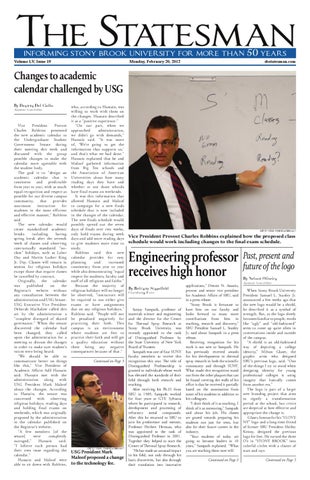
Vice President Provost Charles Robbins explained how the proposed class schedule would work including changes to the final exam schedule.
Engineering professor receives high honor By Brittany Stapelfeld Contributing Writer
Sanjay Sampath, professor of materials science and engineering and the director for the Center for Thermal Spray Research at Stony Brook University, was recently appointed to the rank of Distinguished Professor by the State University of New York Board of Trustees. Sampath was one of four SUNY faculty members to receive this recognition this year. The title of Distinguished Professorship is granted to individuals whose work has elevated the standards of their field through both research and teaching. After receiving his Ph.D. from SBU in 1989, Sampath worked for four years at GTE Sylvania where he participated in research, development and processing of refractory metal compounds. After this he returned to SBU to join his predecessor and mentor, Professor Herbert Herman, who was appointed to the rank of Distinguished Professor in 2001. Together they helped to start the Center of Thermal Spray Research. “He has made an unusual impact in his field, not only through his basic discoveries, but also through their translation into innovative
Past, present and future of the logo By Nelson Oliveira Assistant News Editor
applications," Dennis N. Assanis, provost and senior vice president for Academic Affairs of SBU, said in a press release. “Stony Brook is fortunate to have him on our faculty and looks forward to many more contributions from him in teaching, research and discovery,” SBU President Samuel L. Stanley Jr. said about Sampath in a press release. Receiving recognition for his work is not new to Sampath. He has previously received awards for his developments in thermal spray research in both the scientific community and through SUNY. What made this recognition stand out from the other plaques that can be found covering the walls of his office is that he received it partially based on the nomination from some of his students in addition to his colleagues. “I don’t think of it as teaching. I think of it as mentoring,” Sampath said about his job. His classes are geared towards preparing his students not just for tests, but also for their future careers in the industry. “Your students of today are going to become leaders in 10 years,” Sampath explained. “What you are teaching them now will
When Stony Brook University President Samuel L. Stanley Jr. announced a few weeks ago that the new logo would be a shield, he described it as a symbol of strength. But, as the logo slowly becomes familiar to people, words like “ugly” and “old-fashioned” seem to come up quite often in conversations inside and outside of the campus. “A shield is an old-fashioned way of depicting a college identity,” Milton Glaser, the graphic artist who designed SBU’s previous logo, said. “One of the things I try to avoid when designing identity for young professional colleges is using imagery that basically comes from another era.” The logo is part of a larger new branding project that aims to signify a transformation period at the school, but critics are skeptical at how effective and appropriate the change is. Glaser, famous for his “I LOVE NY” logo and a long-time friend of former SBU President Shirley Kenny, designed the previous logo for free. He turned the three O’s in “STONY BROOK” into colorful circles with a cluster of stars and rays
Continued on Page 3
Continued on Page 5