SoundBites Fall 2025

Page 1


SoundBites

ACTION FOR OUR REGION’S ENVIRONMENT

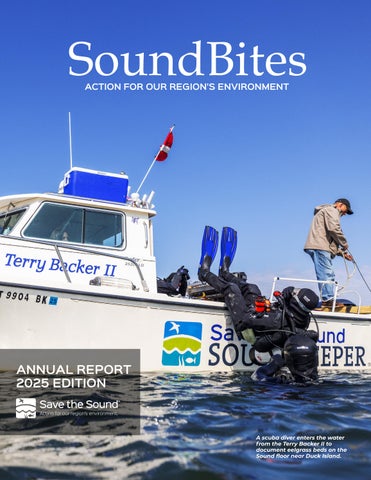
A scuba diver enters the water from the Terry Backer II to document eelgrass beds on the Sound floor near Duck Island.
Dear Friends,

Sound-wide, you are making a difference for people, wildlife, and places. You are freeing and restoring our rivers systems, like the Hutchinson in Westchester and the Naugatuck in Seymour; protecting our lands for all people, such as at Six Lakes in Connecticut; restoring habitats for endangered birds at environmentally significant places, such as at Sunken Meadow on Long Island; and ensuring healthy water for Long Island Sound in over 46 bays and harbors around the region. You are bringing communities together in the shared ethic to preserve the places we love and protecting the environment we live in. Thank you for your inspiring and impactful donations and support. We can’t do this work without you.

The Long Island Sound estuary is our home, and our quality of life is inextricably linked to its health and that of its watershed. This summer, the Sound showed further signs of the progress we have made together. There were notable sightings of marine life like a hammer head shark, a humpback whale, cownose stingrays, a pod of over 50 dolphins, and a 16-foot, 700-pound thresher shark. Cleaner water from decades of action is clearly a major driver. However, there are other factors like warming waters that highlight the work ahead as we grapple with the threat of climate change.

Painting a Water Quality Picture

Data to understanding to action. That’s basically the unofficial mantra of Save the Sound’s Healthy Waters Institute. All the monitoring conducted across Long Island Sound is designed to gather as much water quality data as possible. The resulting analysis paints a picture of the challenges a particular waterbody may be facing and informs actions necessary to resolve that problem.

For 12 weeks every summer, volunteers like Reagan Amundsen (pictured right) help Save the Sound assess water quality in our bacteria monitoring program. In 2025, we collected water

samples from 66 locations in the western Sound from Greenwich, Connecticut, through Westchester County, to Queens, and into Nassau County. Samples are analyzed in our John and Daria Barry Foundation Water Quality Laboratory in Larchmont, New York, for fecal indicator bacteria and measured against state safe-swimming criteria. This work provides timely data that protects public health and guides efforts to make every access point even safer for recreational activities. Check out the results from our 2025 season at savethesound. org/wqresults

The markers of vibrancy are worthy of celebration and excitement, and that proof of concept, coupled with the need to address climate change impacts, underscores the urgency for the work ahead to ensure our region truly thrives. This report highlights a few stories of recent accomplishments from our two environmental centers: our Alexander Center for Ecological Action, which is restoring shorelines and advocating for a more resilient region, and our Center for Water Protection, which is advancing scientific data to rid the region of water pollution, one bay and harbor at a time.

We are united as one Save the Sound community, adding more voices each year, to bring results forward for our shared environment. As we plant grasses and restore marshes, mobilize coalitions, lead legal efforts to hold polluters accountable, and advocate for regional positive change through legislation in New York, Connecticut, and Washington, we appreciate your partnership. When you love the Sound, you Save the Sound. Thank you for being with us every step of the way in that journey.

Contributors: Killian Duborg, Josh Garskof, Laura McMillan, David Seigerman, Kathryn, Stamps, Anne Urkawich, and Amanda VanDine. • Front Cover Photo Credit: © Brian Nevins/11th Hour Racing.

Legal Action to Protect Air Quality

Legend

Iroquois Pipeline System

Compressor Stations

Map and data provided by GEI Mapping

The Iroquois Pipeline runs from upstate New York through Connecticut and across Long Island Sound. When it was proposed that the Brookfield Compressor Station would be expanded to serve the Iroquois gas pipeline, the Save the Sound legal team stepped in to request an adjudicatory hearing on the significant public health and environmental impacts of this expansion. Proposed modifications to compressor stations along this pipeline would result in New York utilities receiving an additional 125 million cubic feet per day of natural gas, despite a lack of demonstrated need for this increased supply when considering the renewable resources coming online. According to Iroquois’ estimates, the modifications to the Brookfield Compressor Station will emit an additional 80,000 metric tons of greenhouse gases, 24.5 tons of NOx, 6.8 tons of particulate matter, and 0.7 tons of hazardous air pollutants in Connecticut. These emissions will impede the state’s ability to meet the greenhouse gas emissions limits set by the Global Warming Solutions Act and also to reach attainment of the National Ambient Air Quality Standards for ozone.

“Expanding the Brookfield Compressor Station to supply gas to New York places a heavy and needless burden on Connecticut residents, degrading their air quality and threatening their health and safety,” says Jessica Roberts, staff attorney at Save the Sound.

11,000 Pounds of Trash

On a sunny Saturday morning, volunteers traced the shoreline of Long Island Sound, buckets in hand, collecting cigarette butts, bottle caps, and wrappers. By day’s end, hundreds of littered items that might have drifted into the water were safely removed. That scene was repeated 92 times across Connecticut and New York in 2024, as more than 3,100 volunteers hauled out roughly 11,300 pounds of trash—protecting the Sound’s rivers, beaches, and wetlands.

Our cleanups wouldn’t be possible without the generous support of Subaru of New England, the FactSet Charitable Foundation, Beiersdorf, PKF O’Connor Davies, Neuberger Berman, Arvinas, HMTX Industries, Tauck, and supporters like you. With volunteer help from our sponsors, cleanup captains, and people of all ages around the region, our waterways shine brighter.

Bridging Restoration and Action

Healthy ecosystems are the foundation of clean water, thriving wildlife, and resilient communities. Yet across the Long Island Sound region, decades of development have fragmented habitats, degraded wetlands, and weakened nature’s ability to protect us from flooding and pollution. Ecological restoration projects repair these natural systems by reviving rivers, rebuilding coastlines, and restoring balance to the places we depend on most.

Created through a generous gift from the Libby and Robert Alexander Family, the Alexander Center for Ecological Action at Save the Sound expands our capacity to restore ecosystems, build climate resilience, and advocate for lasting policy change—creating measurable benefits for our estuary, its wildlife, and the people who call its shores home. The Alexander Center brings together our Ecological Restoration and the Doherty Climate and Resilience Institute to build a healthier future for the Long Island Sound region through innovation and leadership.

Within the Center, Save the Sound’s Ecological Restoration team leads hands-on projects that remove obsolete dams, install green infrastructure, and build living shorelines that defend coasts from rising seas. From restoring river connectivity through the Blind Brook dam removal to preventing runoff pollution from entering waterways through urban stormwater biofiltration at Haven & Exchange in Connecticut, the Alexander Center brings together science, partnerships, and communities to restore the Sound’s natural defenses.

Through this work, the Center demonstrates how strategic investment in ecological action can secure a healthier, more resilient Long Island Sound for generations to come.

The Center’s collaborative model brings people together to drive innovation and change. It unites fieldwork projects, data science, and policy action into measurable impact for the whole Sound community.

Libby and Robert Alexander sailing on the waters of Long Island Sound. Thanks to their transformational gift, vision, and commitment, the Center is already advancing critical work in our region.

Blind Brook in Rye, New York.

Advancing Resilience Policy Across the Sound

The Henry L. and Grace Doherty Climate and Resilience Institute is Save the Sound’s hub for advancing climate and resilience action across the Long Island Sound region.

This year, the Institute’s policy and advocacy work helped achieve two major legislative victories in Connecticut: the passage of Public Act 25-33 (SB 9), which strengthens the state’s resilience planning, improves infrastructure to withstand sea level rise, and requires consideration of climate impacts in water resource management, and Public Act 25-125 (HB 5004), which updates the Global Warming Solutions Act targets, promotes clean energy and workforce development , and lays the groundwork for significant greenhouse gas reductions. These bills mark

New Director for Doherty Institute

Over the past four years, Katie Friedman has led transformative naturebased projects across New York for Save the Sound—reviving rivers, building living shorelines, and implementing green infrastructure that protects communities from flooding and pollution. She is now becoming the director of the Doherty Climate and

“Resilience Institute, bringing that same expertise and collaborative spirit to a broader mission: advancing climate science, policy, and on-the-ground resilience for the Long Island Sound region. Her leadership ensures the Institute’s work remains rooted in practical, science-based solutions that deliver real impact for people and nature alike.

The Institute is a regional resource for the public and decisionmakers. Addressing climate change requires reducing emissions through policy and implementing nature-based, resilient solutions. By protecting and restoring natural systems like living shorelines and green infrastructure, we can better prepare and strengthen our communities.”

-Katie Friedman, our new Director of the Henry L. and Grace Doherty Climate and Resilience Institute

an important step toward meeting Connecticut’s climate goals and protecting residents from the growing impacts of climate change.

In addition to driving policy change, the Institute continues to expand the science, partnerships, and nature-based solutions necessary to build regional resilience —from developing the Long Island Sound Climate and Resilience Report Card to leading collaborative efforts through the Connecticut Coalition for Climate Action.

Save the Sound extends deep gratitude to the Henry L. and Grace Doherty Charitable Foundation, Inc., whose generous support made these resilience and climate successes possible.

Katie Friedman conducting a wild oyster survey at Turtle Cove in the Bronx, New York.

Restoring Eelgrass, Reviving the Sound

Eelgrass meadows once carpeted Long Island Sound’s shallow waters, providing vital habitat, absorbing carbon, and cleaning the water. But 90% of that eelgrass is now gone, due to pollution, warming water temperatures, and coastal development. With your help, we’re working to bring eelgrass back.

Together with Connecticut College, Remote Ecologist, and Rob Vasiluth of SAVE Environmental, we are using a groundbreaking method called SEAS, Seeds of Eelgrass Attached to Shellfish. Volunteers carefully glue eelgrass seeds to baby clams and spread them across the target areas. As the clams sink to the bottom and then dig themselves into the seabed, they naturally sow the seeds while filtering and clearing the surrounding water. After two years of pilot testing, we are beginning to see encouraging signs of growth. However, the real test will come in spring 2026, when results from this fall’s large planting—40,000 clams across four experimental plots off Duck Island—can be evaluated.

Our Soundkeeper team is part of a regional consortium led by the Connecticut National Estuarine Research Reserve, working with experts from the University of Connecticut, Stony Brook University, and Cornell Cooperative Extension.

Empowering Young Voices

This year the Environmental Health Ambassador program, which equips New Haven-area teenagers with community organizing training, explored the history and principles of fairness in environmental advocacy. The first cohort of ambassadors completed the program in late 2024, and several of the graduates took leading roles in advocating for climate and transit equity policy in the 2025 Connecticut legislative session. Katie Mercado, a UConn master’s student and policy intern with Save the Sound, spent the fall

transforming the curriculum of our pilot program to welcome a new cohort in the coming months. Beyond the classroom, youth advocates receive hands-on green infrastructure experience working side by side with their peers in community cleanups and rain garden installations. These activities allow them to witness firsthand the power of collective action to bring about tangible improvements in their neighborhoods.

Eelgrass near Duck Island
© Brian Nevins/11th Hour Racing
Six Lakes in Hamden, Connecticut

Park Progress After 40 Years of Delay

Momentum is strong in the fight to transform a contaminated 102-acre property into a park in southern Hamden. The Six Lakes Park Coalition, coordinated by Save the Sound, built on last year’s visioning sessions by following through on our commitment to increase outreach in Newhall, the predominantly Black, working-class neighborhood that’s connected physically, historically, and hydrologically to Six Lakes.

The coalition also forged a new partnership with the Yale Environmental Justice and Advocacy Law Clinic. Law students undertook a year-long project to uncover Six Lakes’ history, relevant regulations at the state and federal

level, and unfulfilled obligations. These findings sparked a letter-writing campaign urging Olin—the corporation that owns the property—to end its delay in cleaning up the contamination they created.

Our goal remains opening the property for public use, and to that end, we convened a special working group of professionals to start planning for land acquisition and management once the cleanup is complete.

After 40 years, progress is finally being made, and that’s thanks to supporters like you who care about local green space and use your voices to push for change.

127 Church St, 2nd Floor

New Haven, CT 06510

savethesound.org

203-787-0646

Your generosity, advocacy, and hard work power every success you’ll read about in our Annual Report. From restoring wetlands to advancing environmental justice, your actions are creating lasting change across the Long Island Sound region. Take a look at the full version online to see what you helped make possible!

Turn static files into dynamic content formats.

Create a flipbook
Issuu converts static files into: digital portfolios, online yearbooks, online catalogs, digital photo albums and more. Sign up and create your flipbook.