
HEROES UNLEASHED:
Sensory Reading Programs in Libraries
HEROES UNLEASHED:
Sensory Reading Programs in Libraries
Methodological Guide

Šiauliai, 2025

Compiled by Prof. Dr.
Bronius Maskuliūnas
Published by
Funded by

Project partners



ISBN 978-609-8237-33-7
The bibliographic information of the publication is available in the National Bibliography Database (NBDB) of the Martynas Mažvydas National Library of Lithuania.
© Šiauliai County Povilas Višinskis Public Library
Foreword (Bronius Maskuliūnas)
Dr. Margarita Jurevičienė
A Person with Autism Spectrum Disorder in the Library...........................................
Urtė Šulskienė
Sensory Reading Programmes in Libraries..........................................................
Sensory Reading Scenarios .................................................................
Igor Plohl. Helping the Bear (Vaida Antanaitienė)..................................................
Majda Koren. When I Grow Up (Giedrė Čarienė)...................................................
Sashko Dermansky. Mister Mole and the Lost and Found Office (Milda Kazernovičiūtė).......
Marta Curtis. The Colour-blind Chameleon (Giedrė Čarienė).....................................
Olga Kryshtopa. Winged Hooves (Vaida Antanaitienė).............................................
Evelina Daciūtė. Daphne Lost Her Tail (Vaida Antanaitienė).......................................
Virgis Šidlauskas. The Best Present (Giedrė Čarienė) ..............................................
Masha Ogrizek. Where are you off to, Leon? (Milda Kazernovičiūtė).............................
Rita Sineiro. Spin the Plate, Spin the World (Giedrė Čarienė)......................................
Adélia Carvalho. Yes Days and No Days (Vaida Antanaitienė)....................................
Olena Lototska. A Story about Girl Oliunia and Squirrel Pushynka (Milda Kazernovičiūtė).....
Ignė Zarambaitė. Lucy and the Butterfly (Milda Kazernovičiūtė)..................................
Foreword
The fundamental principles underpinning the creation of an inclusive society, a capable society, are mutual understanding, empathy, acceptance, positive regard, learning from each other, and meaningful participation in community and public life.
The Šiauliai County Povilas Višinskis Public Library, in carrying out its informational, educational and cultural mission, places great emphasis on the social integration of socially vulnerable groups. We are committed to remaining open to every member of the community, and we want all of our visitors to feel comfortable here, regardless of differences in ability or disability.
Guided by this commitment, in 2018 we became the first in Lithuania to declare ourselves an autism-friendly library and began organising sensory reading sessions for children with autism spectrum disorders and other forms of neurodivergence. This initiative quickly spread throughout the country, and sensory reading sessions are now organised in libraries across Lithuania.
In 2025, together with our partners the Lviv Regional Library for the Youth named after Roman Ivanychuk (Ukraine), Maribor Public Library (Slovenia), and the Municipal Public Library of Porto (Portugal) we developed the international project Heroes Unleashed: Implementing a Sensory Reading Program in European Public Libraries. The project is funded by the European Union under the Creative Europe programme. The aim of the project is to transfer the sensory reading methodology and the accumulated good practice we have developed to libraries in three countries where programmes of this kind have not previously been implemented.
This methodological guide has been prepared for that purpose — to support those wishing to organise sensory reading sessions. The publication opens with two introductory articles: one introduces readers to individuals with autism spectrum disorders, while the other presents the sensory reading programme itself.
The main part of the publication is dedicated to sensory reading sessions. To ensure consistent implementation of the methodology and to facilitate librarians’ work with sensory reading programmes, a book of literary texts adapted for sensory reading, Helping the Bear and Other Stories, was created. The original stories were written and illustrated by authors and illustrators from Lithuania, Portugal, Slovenia and Ukraine. Based on the texts of this book, twelve sensory reading scenarios have been developed and are provided in this methodological guide. They are intended both for those who are just beginning to work with sensory reading programmes and for experienced specialists seeking to expand the range of literary works used in such sessions.
Prof. Dr. Bronius Maskuliūnas Director of Šiauliai County Povilas Višinskis Public Library
A Person with Autism Spectrum Disorder in the Library*
Dr. Margarita Jurevičienė VU Šiauliai Academy
In the researchers’ (Diržytė, Mikulėnaitė, Kalvaitis, 2016) opinion, the number of children with autism spectrum disorders (ASD) is increasing in Lithuania, as well as in the world. Currently, the prevalence of the disorder in the world is 0.62–0.70%, although the latest large-scale survey results show a prevalence of this disorder of 1–2% (Vėlavičienė, Adomaitienė, Bulanovaitė, 2019).
Scientists say that people with ASD communicate and interact with others in an unusual way and perceive the environment differently. The difficulties in communication and adaptation caused by autism spectrum disorder have a significant impact on a person’s development, learning and social opportunities. In order to achieve successful socialization of these individuals, it is becoming increasingly important to overcome obstacles to learning and participation in education, to create a favourable educational and socialization environment.
Autism, as a lifelong developmental disorder, was defined in 1943 by Dr. Leo Kanner. He noted that ‘these individuals lack the usual means of social communication: they communicate mostly non-verbally or their language expression is unusual; <...> a narrow range of interests <...> poor motor coordination skills <...> have difficulty in flexibly, functionally applying skills’ (Kanner, 1943, cited from Atwood, 2013: 15). A year later, paediatrician Dr. Hans Asperger described children who had very similar personality and behavioural traits and stated that these children had delayed social maturity and thinking, and some aspects of social skills were quite unusual. At the suggestion of Wing (1981), the term Asperger syndrome was introduced; it was proposed to single out extremely gifted individuals with high intelligence and language skills as a separate group. Individuals with Asperger syndrome do not have a lack of language or cognitive skills, but they have difficulty communicating, do not fit in with others, and are characterized by a lack of mutual understanding and expression of emotions (Baron-Cohen, 2011). Atwood (2013: 15) summarized the findings of the aforementioned authors, stating that individuals with ASD ‘have difficulty making friends, have impaired verbal and nonverbal communication, especially the ability to maintain a conversation; have emotional control deficiencies, and are not empathetic; and may have motor skills difficulties – handwriting, running, and catching a ball.’ According to Mikulėnaitė and Ulevičiūtė (2004), each person with ASD perceives the world around them differently and therefore adapts to the environment differently. Early sources attribute sensory system disorders to autism (Kanner, 1943); current scientific research focuses on social disorders (Leekam, 2016). However, it is recognized that sensory processing features are one of the main distinguishing features of ASD (Baum, Stevenson, Wallace, 2015), the levels of autism complexity (Gotham, Pickles, Lord, 2012) and the impact of the disorders on daily functioning and academic achievements (Howe, Stagg, 2016) have been updated.
The expression of symptoms of autism spectrum disorders is very diverse, but the main areas where difficulties are observed are: social interaction; verbal / non-verbal communication; limited range of interests and repetitive behaviour, sensory features.
Many individuals with ASD often experience stress or anxiety. Due to sensory modulation disorders, atypical reactions to sensory stimuli are observed – 42-88% (Case-Smith, Weaver, Fristad, 2015).
The cause of the disorder, as shown by scientific research, is the result of factors that include genetics, brain structure and function, as well as environmental influences (APA, 2013).
Signs of autism usually appear in early childhood (Zwaigenbaum et al., 2015).
* The article is published in Lithuanian in the publication ‘Heroes Unleashed: Sensory Reading Sessions in Libraries. A Methodological Guide. Compiled by Bronius Maskuliūnas. – Šiauliai: Šiauliai County Povilas Višinskis Public Library, 2020.’
The first signs of autism should be observed by the age of 1.5–3 years (Thabtah, Peebles 2019).
Researchers (Lord, Risi, DiLavore, Shulman, Thurm, Pickles, 2006) have described the first signs of ASD, or the so-called warning signs (see table). Table
Early signs of ASD
By 12 months Does not respond to his/her name
By 14 months Does not point the finger at the object of interest
By 18 months Doesn’t play a role-playing game
General characteristics
Avoids eye contact and prefers to be alone.
Has difficulty understanding other people’s feelings/talking about their own feelings.
Delays in language and communication development.
Continuously repeats words and phrases heard (echolalia).
Responds inappropriately to questions (answers not what is asked).
Gets upset by even the slightest changes.
Has intrusive thoughts or actions that are unpleasant, meaningless, and distressing.
Performs repetitive movements: hand flapping, rocking, spinning, or twirling.
Responds atypically to sounds, smells, tastes, sights, or touch.
Although individuals with ASD exhibit similar characteristics (social interaction, communication, and behavioural deficits), each case is very different and unique due to the various combinations of these characteristics. The totality of various autism-specific features manifests itself very differently throughout life; Siegel (2003: 41) emphasizes ‘the difference in each profile’.
Autism is defined as a broad spectrum of non-specific disorders. The term spectrum best describes the diversity, complexity, and levels of expression of autism symptoms. According to Booth (2016), ‘the spectrum is not a straight line of abilities, the spectrum refers to the idea that a person can have low abilities in one area and extremely high abilities in another’ (Booth, 2016: 19). Some individuals with ASD may be gifted in mathematics, others in the arts, sports, languages (Peklari, 2019; Thabtah, Peebles, 2019, etc.).
Some children experience more difficulties due to impaired language, others due to lack of social communication skills (Mikulėnaitė, Ulevičiūtė, 2004).
Thus, the signs of autism spectrum disorders are very individual and different in terms of both intelligence and other signs. Autism cannot be described unambiguously, because the signs are very diverse, their levels of expression can range from mild to extreme (Farmer, Reupert, 2013; Elmose, 2016). It is no wonder that the phrase of Dr. Stephen Shore is often repeated: ‘If you’ve met one person with autism, it means that you’ve met only that person with autism’. ‘It’s like a developmental puzzle that many would like to solve’ (Hallahan, Kauffman, 2003: 273).
Traditionally, it has been assumed that approximately 45% of individuals with autism spectrum disorders may be nonverbal or have intellectual disabilities, while the remaining 55% are within the average or higher IQ range. However, some recent studies suggest that these co-occurring features vary, with intellectual disabilities or delayed language development being recorded in only 20–30% of cases. Some individuals with ASD can function independently, while others will require some form of assistance (Billstedt, Gillberg, Gillberg, 2005). In about 75% of cases, autism is accompanied by other disorders, such as attention and activity disorders, anxiety, obsessive-compulsive (obsessive
thoughts, ideas, urges or images), movement disorders, language disorders, cognitive development disorders, etc., which can lead to regression of cognitive abilities (Sharma, Gonda, Tarazi, 2018).
As stated by Pisula et al. (2018), factors such as age, gender, and intelligence may influence the expression of autism symptoms.
It is necessary to mention the strengths of these individuals:
• learning to read at an early age;
• good visual memory;
• logical thinking;
• quick memorization of information in such branches of science, the discoveries of which are based on evidence (mathematics, astronomy, etc.) and do not depend on social interaction or interpretations;
• concentration and immersion in areas of interest;
• attention to detail;
• punctuality;
• strict adherence to rules;
• tendency to perfectionism and order;
• honesty (tell the truth, do not lie, do not evade, do not use “social masks”).
Each person with ASD has individual characteristics, an individual combination of strengths or difficulties. Researchers (Courchesne, Meilleur, Poulin-Lord, Dawson, Soulières, 2015; Jokubaitienė, Ališauskas, 2019) emphasize that the potential intellectual powers of most children with autism spectrum disorder who speak little or do not speak are not utilized. According to Farmer (2013: 13), individuals with ASD are more likely to:
• learn by making mistakes rather than by observing;
• choose constructive activities rather than symbolic ones;
• express their needs through language, but not to comment, initiate a conversation, or share emotional social experiences;
• experience difficulties imitating motor actions;
• choose static rather than moving information (e.g., if there is an opportunity to choose photos or videos, they will choose photos);
• think associatively rather than relying on deduction (cause and effect relationships).
Social interaction. Individuals with ASD would like to communicate, but have not mastered appropriate communication strategies, are unable to make and maintain friendships, especially with peers (Grove et al., 2014); are often disturbed or agitated when communicating with other people (Carter et al., 2005); do not decode or do not notice social signals in the environment (McKenna, Ghosh; Aylett, Broz, Rajendran, 2018). They have difficulty understanding other people’s emotions, feelings or behaviour (Rieffe, Terwogt, Stockmann, 2000); the motives of other people’s behaviour, therefore they have particular difficulty understanding the causes and consequences of complex activities and behaviour (Navickienė, Piščalkienė, Mikulėnaitė, Grikainienė, Tender, Bukauskaitė et al., 2019); it may be difficult to view the situation through the
1 Strengths and abilities in autism (2020). Altogether Autism: https://www.altogetherautism.org.nz/strengths-andabilities-in-autism/
eyes of others (Mundy, Burnette, 2005); communicate appropriately, therefore they may touch the other person, fail to maintain personal space, etc. (Eckdahl, 2018). In social situations, these individuals can communicate without showing anxiety, although they feel it; this means that their self-control marks the achievements of the development of social skills; and the inability to control anxiety can lead to low self-esteem, which is accompanied by high levels of stress (Madriaga, Goodley, 2010).
Researchers (Matson, Cooper, Mayville, Gonzalez, 2006) also described such traits as unwillingness to communicate, preference for things over people. Siegel (2003: 48) provided an example from her research on children with ASD, who, upon arriving at the playroom, look at the objects/tools placed on the shelves and take a toy that they play with at home. The aforementioned author emphasizes the lack of curiosity and preference for what is common (familiar). Some individuals with ASD are unable to maintain eye contact and respond inappropriately to attention and feelings (Sequeira, Ahmed, 2012). According to Elmose (2016), individuals with ASD are characterized by the following: 1) they are not aware of what they do not know, which makes it difficult for them to decide when and how to deepen their knowledge; 2) they have difficulty telling about their own and others’ preferences and emotions in social situations; 3) they have difficulty relating their behaviour to environmental and social circumstances/situations and the actions of others; 4) they have difficulty understanding their own and others’ feelings and thoughts.
Characteristic features of emotional responsiveness:
• unusual mood or emotional reaction – difficulty recognizing emotions (facial expressions, body language) or the causative reasons, difficulty understanding and expressing emotions (body language and facial expressions); difficulty controlling them; lack of emotional perception and interpretation response creates the impression of lack of empathy;
• unmotivated fear of environmental objects, new environments or new activities (e.g., fear of some pink towel or black plastic bag) (Mundy, Burnette, 2005).
Summarizing the statements of many authors, it can be stated that the characteristic features of social interaction of individuals with ASD are: lack of eye contact; failure to respond when addressed by name; difficulties in perceiving social distance (at what distance to communicate with others) or personal space; lack of understanding of social communication norms.
Signs of speech development and communication disorders. One of the main signs of ASD is a speech and communication disorder, which makes communication and learning difficult (Arunachalam, Luyster, 2016). Even many of those who learn spoken language may have difficulties communicating, for example, speech is often inflexible, automatic, and does not convey appropriate feelings (Hallahan, Kauffman, 2003). Echolalia is characteristic, often saying words that have nothing to do with the context, repeating previously heard phrases that are completely unrelated to the speaking situation (Sterponi, Shankey, 2014). There is a tendency towards over-precise, pedantic speech (Giambattista, Ventura, Margari, Palumbi, Margari, 2019); errors in the use of pronouns (Novogrodsky, 2013), specificity of perception of auditory information – auditory information is perceived differently than usual, only part of the heard information is perceived, concentration is made on details rather than on essential information, etc. (Hogan, Cain, Bridges, 2012); difficulty in understanding information transmitted by another person (Notbohm, 2012), listening and maintaining a conversation (Jurevičienė, Šostakienė, 2014).
These individuals experience problems with social pragmatics (e.g., are unable to exchange information during a conversation, alternately take over the role of listener and speaker); They are characterized by poor speech prosody (poor tone and intonation accompanying verbal communication), a tendency to ‘get stuck’ on certain topics (Krasny, Williams, Provencal, Ozonoff, 2003).
They rarely initiate appropriate speech and are often unable to engage in normal social interactions, such as asking questions, requesting information or help, or expressing feelings verbally (Duffy, Healy, 2011). They are able to inform others about their needs and states through nonverbal communication (gestures, body language – nodding or shaking the head, facial expressions, crying, fidgeting, and other alternative means of communication) (Cascella, McNamara, 2005). Due to the lack of verbal and non-verbal skills, the inability to express their desires, needs, and well-being, the behaviour of these children becomes nervous, sometimes aggression or self-aggression occurs (Giambattista, Ventura, Margari et al., 2019; Keenan-Mount, Albrecht, Waters, 2016).
The most common speech characteristics of people with ASD:
• slowed speech and speaking development;
• repetitive speech and echolalia;
• difficulties in speech perception (misunderstanding of verbal speech, compound constructions, figurative words; answers that are not related to the question or topic of the conversation);
• do not follow the object shown with their eyes;
• do not engage in role-playing games;
• atypical speech expression (strange timbre or intonation, unusually slow or fast speech, monotony of voice);
• difficulties in initiating and maintaining a conversation, a tendency to speak on only one topic;
• characteristic use of the second and third person instead of the first person (I), calling oneself by name;
• poor vocabulary – a predominant noun or verb lexicon, a superficially rich vocabulary (especially in the field of interest) and at the same time the use of words without understanding their meanings (Arunachalam, Luyster, 2016; Cascella, McNamara, 2005; Giambattista, Ventura, Margari et al., 2019).
Behaviour and restricted interests and sensory. When analysing the features characteristic of autism spectrum disorder, it is necessary to mention the manifestations of strange behaviour and atypical reactions to sensory stimuli: increased and/or decreased sensitivity in all areas of the sensory system is characteristic.
Scientists have found that ‘problematic behaviour is much more characteristic of children with ASD than their typically developing peers, and unresolved behavioural problems can become chronic and limit children’s independence’ (McGuire, Fung, Hagopian, Vasa, Mahajan, Bernal, Silberman, Wolfe, Coury, Hardan, Weele & Whitaker, 2016, cited from Indrašienė, KairelytėSauliūnienė, 2018: 120).
Children with ASD have a tendency towards uniformity. According to Zander (2004), children choose stereotypical games, e.g., building towers, putting together the same puzzles, lining up objects, etc. They find it difficult to change their usual rhythm of activity and daily routine. Even minor changes in the environment cause them to experience strong outbursts of negative emotions and resistance (Navickienė et al., 2019).
Typical behavioural features: strict adherence to routine, sequence of actions, daily routine; special attachment to certain objects, toys; difficulties in adapting to new circumstances or changes; a specific circle of interests; arranging things in a certain order.
Cognitive deficits and problems with sensory information processing also lead to the fact that these children do not perceive or inadequately perceive environmental signals (Sequeira, Ahmed, 2012).
What are sensory information processing systems?
• The visual system interprets information received through images. This system receives visual information from the environment.
• The auditory system receives sound information from the environment.
• The taste system provides information about various tastes. Taste receptors are located in the skin around the mouth, in the mouth itself, in the muscles and joints of the face.
• The olfactory system provides information about various odours in the environment.
• The tactile (touch) system provides information about pressure, vibration, movement, pain and temperature. Tactile (touch) receptors are located in the skin, internal organs (pain); they provide information about the properties of an object when touched (soft, rough). From the information received by tactile receptors, it is perceived whether there are dangerous factors in the environment (e.g., a hot surface).
• The vestibular (body position and movement) system provides information about the position of the head in relation to the body and the environment.
• The proprioceptive system (sensing the boundaries of the body) provides information about the position of a body part, its movements (Goodman-Scott, Lambert, 2015), etc.
Impaired sensory integration is manifested by inadequate responses to sensory stimuli and strange behaviour (Walbam, 2014).
Sensory integration is a term that describes the processes by which the nervous system receives signals from the sensory organs; these signals are converted into appropriate motor and behavioural responses (Ayers, 2005).
Regardless of the activity (eating a sandwich, riding a bicycle, or reading a book), in order for the activity to be successfully initiated and completed, appropriate processing of sensory information, ‘sensory integration’. is required. Most people are born with the ability to receive sensory information and without much effort model behaviour and physiological responses to sensory stimuli appropriately. For example, if you smell something burning while making toast, you do not need to stop and think about what to do in this case. Such information is processed suddenly and the behaviour is modelled, i.e., you rush into the kitchen to turn off the toaster (Miller, 2006).
Due to impaired sensory integration, individuals with ASD may have heightened or diminished responses to sensory stimuli, which may result in more or less stimuli being received (Katz, 2006; Walbam, 2014). When sensory functions are impaired, it is difficult to properly interact with the environment and understand the phenomena occurring in it (Bodison, Parham, 2018).
Characteristics of the sensory system of individuals with ASD:
• avoid touching certain textures or surfaces;
• fear of the dark;
• seek visual control of the environment; are unable to perform certain motor actions without visual assistance;
• feel uncomfortable in elevators and escalators;
• fear of climbing stairs;
• may have difficulty sitting still or simply sitting;
• may be clumsy;
• have difficulty concentrating; listen to one voice or sound without paying attention to other sounds;
• may break fragile objects;
• may be irritated by sounds, bright colours, certain clothes, smells; e.g., are anxious, get irritated when sounds are heard in the environment (vacuum cleaner, siren, noise, dryer, etc.);
• some may be less sensitive to physical pain; others may experience hypersensitivity to touch;
• learning about the environment by touch – it is not enough to see an object, they must touch it (Dunn, 2007; Miller, 2006; Kranowitz, 2005).
Symptoms of sensory integration disorders, as in the case of most disorders, can vary in complexity. According to Dunn (2007), sensory integration disorders can manifest themselves differently in each sensory area or in several of them, therefore it is important to understand what kind of reactions to sensory stimuli prevail in each sensory system when they are impaired. Although most people have difficulties processing certain sensory information, for children and adults with ASD, these difficulties are persistent and interfere with daily life (Ben-Sasson, Carter, Briggs-Gowen, 2009); sensory integration disorders can affect the development of many areas –social, emotional, playing, life skills (Mishra, Anguera, Gazzaley, 2016).
As already mentioned, it is often difficult for individuals with ASD to interact meaningfully and purposefully with the environment, therefore it is very important to understand the essential problems/areas that prevent these people from fully engaging in social life.
Educational strategies for individuals with ASD. Ostmeyer, Scarpa (2012) distinguished educational strategies for individuals with ASD: organization of activities (the number of tasks during the activity is specific, there is an opportunity to choose); task content: clear; structured, visualized; safe learning environment; feedback. Jurevičienė (2012) emphasizes the identification of the individual’s strengths to overcome the difficulties experienced in social communication, behaviour, etc.; Geležinienė (2009) – positive ways of overcoming problematic behaviour.
One of the essential principles of educating children with ASD is a clearly structured environment, visualization of activities (visual structure of activities or visual agenda).
Structured teaching, etc. activity environment is a visually presented system for developing independence, communication and social skills.
The aim of visualizing activities is to provide information to a child with ASD as clearly and understandably as possible (Mikulėnaitė, Ulevičiūtė, 2004), to help them understand what needs to be done; where it needs to be done; how long it needs to be done; what will happen/ will occur after that.
Thus, it is very important to create appropriate educational spaces, select educational tools and activities suitable for the development of self-expression and natural powers of children with ASD, which would initially help compensate for the social and educational consequences of the disorder, and in the long run create the prerequisites for mitigating them.
Essential strategies for the education of individuals with autism spectrum disorders: recognition of the child’s strengths and relying on them in various activities; a systematic approach, purposefully organizing educational interactions in the child-family-educational institution system (Jurevičienė, 2017: 22). It is impossible to understand a social system without knowing how the parts of the system work, and it is impossible to understand how the individual works in a system without knowing the whole system (Wachs, 2000). The individual, as part of a system, must also change in order to adapt to the environment. A person with ASD must acquire many roles in their environment by interacting with other people. At the same time, each system and its parts must function well in order for the person to achieve the best result.
Understanding the family as a system and the processes taking place in it is helped by the fundamental statements of Campion (1985): the family can be considered a system because the actions and attitudes of each family member affect the other family members; the family’s view of the world is constructed according to the communication of family members characteristic of that family: therefore, families in which one or more family members have one or another (e.g. behavioural) problem may have a tendency to influence other family members so that they accept their undesirable roles and behaviour. These roles, supported by communication
between family members, create a family image that is characteristic of its members and even other similar families that do not belong to that particular family system. Stress and tension in the family have a significant impact on both the family and the child’s social development.
Parents are not only experts in the child’s capabilities and needs, but also equal participants in education, representing the child’s needs and able to exert a strong influence on consolidating the child’s social skills to be developed in the family and other informal environments. Together with the child and educators, they actively participate in all stages of education, highlight the child’s strengths and needs, plan and implement educational interaction in various environments, etc.
Participation and functioning of a person with ASD in social environments. Inclusion for persons with ASD means the right to participate and receive satisfaction in ordinary community places, such as the library. Effective communication methods, adaptation of the environment to persons with ASD (environmental structuring, visualization) are some of the essential factors for high-quality functioning in the environment. At the same time, the library is committed to providing all library patrons with equal opportunities to use the available resources, services and tools (Autism friendly libraries, 2018).
Libraries create the impression of an ideal environment for persons with ASD, because the environment of each library is rich in signs of logical organization of things, consistency, order, specified rules: not to make noise, wait your turn, etc. (Schlabach, 2008). Therefore, the library is often chosen as a place where all conditions are created for quiet learning (Burke, 2016). As studies show, for many persons with ASD, the library is an excellent place for work and / or education (Anderson, 2018). About 90% of persons with ASD would visit libraries more often if they adapted the physical environment more (Autism friendly libraries, 2019). As Halvorson (2006) states, “the library is a positive educational space for individuals with ASD (Halvorson, 2006: 20).
It’s a paradox, that individuals with ASD tend to prefer silence, but they can be very noisy themselves. Autism is a hidden disorder, it is not noticeable externally, so it may seem to others that the person is behaving in some strange or inappropriate way (Edwards, Landa, Frampton, Shillingsburg, 2018); it’s a challenge for libraries to recognize the needs of individuals with ASD, which may not always be obvious (Bress, 2013).
Researchers (Remy, Seaman, Polacek, 2014; Cho, 2018) argue that there is a greater need for librarians to deepen their personal and professional understanding of ASD in order to properly assist these individuals. The aforementioned authors emphasize that the first step that librarians can take is to familiarize themselves with literature sources about disabilities, more specifically – about the characteristics of individuals with ‘hidden,’ ‘invisible disabilities,’ such as autism. A librarian who has identified an individual with one or more autistic characteristics could apply general knowledge and appropriately address the individual’s needs. General knowledge could include using direct language, providing consistent written instructions, and assisting with organizational and planning skills.
The library should have a wide selection of resources that meet the diverse interests and needs of its users (American Library Association, 2018). In order to successfully collaborate, library staff should ask themselves the following questions:
What materials are likely to be of interest to individuals with ASD?
Is the information of interest presented in an understandable format?
What assistive technologies are available for these individuals?
What equipment in the library will help people with ASD to use library resources, for example, is there equipment that helps reduce sensory stimuli (headphones, screens, etc.)?
What tools will help a person with ASD understand and use information effectively? How can information be conveyed so that it is heard?
Remy et al. (2014: 26) provide recommendations for librarians:
• Supplement content with visuals, graphics, handouts and/or written explanations.
• Organize resources on specific topics to facilitate the search process.
• Offer to meet with the person with ASD in advance if their needs are more complex and require more time and attention to prepare.
• Explain library classification systems that will help find materials that may be of interest to the person with ASD.
• Provide reflective activities, such as worksheets, as an alternative to social, interactive active learning.
• Relate new information to what is already known.
• Maintain the same level of expectations as with other individuals but provide additional encouragement for the individual with ASD to increase their motivation and self-confidence and reduce anxiety.
Researchers (Douglas, Gerde, 2019; Barnhill, 2016; Grandin, Skariano, 1999; Farmer, 2013, etc.) have provided several strategies for making the experience of working with individuals with ASD less ‘pitted.’
• Create an environment with consistent and clear expectations and directions.
Example: Suppose a librarian assigns a child a specific seating area to create a sense of predictability. However, the child may not want to share that space with others. The solution to this situation is to make a name plate for the child and say that this space is his/hers when his/ her name plate is in it.
• It is important that the library environment is welcoming. Announcements, posters, signs, stickers, rules, maps will help with this.
Examples. If a child with ASD likes and understands maps, then using a map in the library will help him/her to find his/her way and be independent. The librarian may need to explain the purpose and main functions of the library spaces, how to use and return library publications or other items.
Publish the library map on the website and on the library doors. Mark the library sections with symbols, not just words. Make sure that the toilet, cloakroom, drinking water points, private spaces are clearly marked. Prepare a user manual, rules and place them in easy-to-reach places.
• Provide schedules and plan activities, as many people with ASD do not like vagueness. They need to know and understand the environment: where to go, what to do; what, why, where and when to do it.
Example. Visual cues in the library: entrance; registration; returning a book; ordering a new book; waiting; a call announcing that the ordered book can be picked up; picking up a book; leaving, etc. Activities must have a clear sequence. Visual cues can be depicted on posters and hung at the reception desk or in another clearly visible place.
Visual references help to understand the situation and independently complete the task, reducing anxiety and dissatisfaction. Visualizations help individuals with ASD not only to better understand what is expected of them but also facilitate orientation in situations that may be unclear, anxiety-provoking and confusing for them (Grandin, Skariano, 1999).
• The librarian must show how to find publications in the library, browse and use the library catalogue;
• ensure the possibility of using a computer in a private space;
• warn the person in advance if changes are expected in the normal activities of the library.
Example: Let’s say the library is closed this Friday. Then the library website should provide advance notice that the library will be closed on that Friday, the time it will reopen, etc.
• Encourage peer support and assistance.
Some individuals with ASD have in-depth knowledge of a particular field. Therefore, it is believed that they can help other learners with their knowledge (Barnhill, 2016). The library can become a mediator, providing a suitable environment for learning. This initiative would
encourage individuals with ASD to integrate more easily and purposefully into community life, learn to adapt to social interaction and develop appropriate communication skills.
Although individuals with ASD may appear to be reclusive, unwilling to interact with either their peers or library staff, this should not be interpreted as an unwillingness to communicate. Some individuals with ASD prefer to spend time alone, but a large number of them want to communicate. Therefore, it is necessary to develop alternative or additional educational resources to provide a quality learning experience in the library for everyone regardless of their abilities. Douglas, Gerde (2019) recommend adapting to the individual’s communication skills accordingly, for example:
• Changing the pace, tone of voice, using simpler and more specific words. Avoiding broad, non-specific questions.
Example. It is not recommended to ask what area of literature do you like? It is better to show a specific area: Here is a shelf of fantasy books.
• Remember that most individuals with ASD understand better what they SEE, not what they HEAR.
Remy, Seaman (2014) state that individuals with ASD may find it difficult and ‘uncomfortable’ to communicate with another person, in this case a library employee, directly, ‘face to face’. As an alternative, it is recommended to include indirect communication options, e.g. via SMS, e-mail, etc. in library consultation options. This will allow the person with ASD to receive advice from library staff in a more acceptable manner.
• Identify possible causes of inappropriate behaviour and try to avoid or mitigate them.
Example: When observing inappropriate behaviour or a person’s agitation, a librarian can simply ask: How can I help? Address the person, not the person accompanying them (if there is one). Find out their name and address them by name.
According to Barnhill (2016), being in a quiet space allows people with ASD to focus on their primary and most important purpose, why they come to the library – to find information/a book; to learn or to relax while reading. Since people with ASD are characterized by special sensitivity and specific reactions to sensory stimuli, it is especially important for them to have a space where they can relax from the stimuli in their environment. When creating a supportive environment for people with ASD, Moyes (2010) recommends setting up a separate corner where the person can rest. This space can be used as a bean bag, rocking chair, etc.
• Don’t expect the person with ASD will be aware or take positive action when they start being anxious. Instead of telling them what to do, focus on what will help them calm down and regain their balance.
Example: It is recommended to have a ‘Calm down box’ containing a tangle, a ball of rubber bands, a spiked ball, a bracelet, a small knitted toy, a bean bag, a string with pebbles, a small vibrating toy, an assemble wooden or plastic toy, a magnetic ball, a hand exerciser (or force toy), a spinner, a braided string, a pine or fir cone, a coconut shell, etc., and a sensory kit.
• Create a safe, supportive environment.
Example: Provide headphones for the person with ASD to use if the noise is too loud; turn off electric hand dryers; provide drinking water.
Murray-Slutsky, Paris (2004) recommends the following guidelines for analysing problematic situations of a person with sensory integration disorders:
• What situations, circumstances, sensations cause undesirable behaviour?
• How does the child react to similar stimuli in different environments (at home, in the library)?
• What happened, changed in the environment before the atypical reaction appeared?
• Do such episodes occur constantly?
• What are the known areas of difficulty experienced (tactile, visual, auditory, olfactory, gustatory, proprioceptive, vestibular)? What sensory stimuli do they react unusually to?
• Is it possible to avoid them? According to the authors, when observing reactions, one should consider:
• what can be changed in the environment (remove stimuli or saturate the environment);
• what changes in the environment or activities could mitigate reactions.
• Librarians can also provide adolescents with a positive work experience by helping them with library duties such as shelving and organizing, technical assistance, and other activities that adolescents with ASD enjoy.
• Be patient with others and yourself; it is important to focus on the individual and their needs, not the difficulties experienced by others due to the uniqueness of their ASD symptoms.
For individuals with ASD, it is not the disorder but their uniqueness that defines them. It should be obvious by now that the world can be a frightening, mysterious place for an individual with ASD, but that tolerant and professional support can change their perception of the world. Therefore, it is recommended that libraries consider some of the strategies to help individuals with ASD successfully integrate into the community and reach their full potential as members of the community.
References
Ayres, A. J. (2005). Sensory integration and the child. Understanding HiddenSensory Chalenges. 25th anniversary edition. Los Angeles: Western Psychological Services.
APA – American Psychiatric Association (2013). Diagnostic and statistical manual of mental disorders Washington DC: American Psychiatric Association.
Anderson, A. (2018). Autism and the Academic Library: A Study of Online Communication. College & Research Libraries, 79 (5), 645–658.
Arunachalam, S., Luyster, R. J. (2016). The integrity of lexical acquisition mechanisms in autism spectrum disorders: A research review. Autism Research, 9(8), 810–828 doi: https://doi.org/10.1002/aur.1590
Atwood, T. (2013). Aspergerio sindromas: išsamus vadovas (Asperger Syndrome: A Comprehensive Guide). Vilnius: Margi raštai.
Autism friendly libraries (2019). Autism Friendly Dimensions: https://www.dimensions-uk.org/getinvolved/ campaigns/dimensions-autism-friendly environments/autism-friendly-libraries/
Baron-Cohen, S. (2011). Esminis skirtumas. Vyriškos ir moteriškos smegenys. Visa tiesa apie autizmą (The fundamental difference. Male and female brains. The whole truth about autism). Vilnius: Baltos lankos.
Barnhill, G. P. (2016). Supporting students with Asperger Syndrome on college campuses: Current practices Focus on Autism and Other Developmental Disabilities, 31, 3–15.
Baum, S. H., Stevenson, R. A., Wallace, M. T. (2015). Behavioral, perceptual, and neural alterations in sensory and multisensory function in autism spectrum disorder. Progress in Neurobiology, 134, 140–160.
Ben-Sasson, A., Carter, A. S., Briggs-Gowan, M. J. (2009). Prevalence and correlates of sensory overresponsivity from infancy to elementary school. Journal of Abnormal Child Psychology, 37(5), 705–716.
Billstedt, E., Gillberg, C., & Gillberg, C. (2005). Autism after Adolescence: Population-based 13- to 22- year Follow-up Study of 120 Individuals with Autism Diagnosed in Childhood. Journal of Autism and Developmental Disorders, 35(3), 351–360. doi: https://doi.org/10.1007/s10803-005-3302-5
Booth, J. (2016). Autism Equality in the Workplace: Removing Barriers and Challenging Discrimination Philadelphia: Jessica Kingsley Publishers MLA.
Bodison, S. C., Parham, L. D. (2018). Specific sensory techniques and sensory environmental modifications for children and youth with sensory integration difficulties: a systematic review. American Journal of Occupational Therapy, 72(1) 7201190040. doi: https://doi.org/10.5014/ajot.2018.029413
Bress, A. (2013). Making Your School Library More Functional to Individuals with Autism. Library Media Connection, 32(1), 46–47.
Burke, J. (2016). The Neal-Schuman Library Technology Companion: A Basic Guide for Library Staff, Fifth edition. Chicago: ALA Neal-Schuman.
Campion, J. (1985). The Child in Context: Family Systems Theory in Educational Psychology New York: Methean & Co.
Cascella, P., McNamara, K. (2005). Empowering Students with Severe Disabilities to Actualize Communication Skills. Teaching Exceptional Children, 37(3), 38–43.
Case-Smith, J., Weaver, L., Fristad, M. (2015). A systematic review of sensory processing interventions for children with autism spectrum disorders. Autism, 19(2), 133–148.
Carter, A. S., Davis, N. O., Klin, A., Volkmar, F. R. (2005). Social development in autism. In F. R. Volkmar, R. Paul, A. Klin, & D. Cohen (Eds.), Handbook of autism and pervasive developmental disorders: Diagnosis, development, neurobiology, and behavior. Vol. 1 (pp. 312–334). Hoboken, NJ: John Wiley & Sons.
Cho, J. (2018). Building bridges: Librarians and autism spectrum disorder. Reference Services Review, 46(3), 325–339. doi: https://doi.org/10.1108/RSR-04-2018-0045
Courchesne, V., Meilleur, A. A., Poulin-Lord, M. P., Dawson, M., & Soulières, I. (2015). Autistic Children at Risk of Being Underestimated: School-Based Pilot Study of a Strength-Informed Assessment. Molecular Autism, 6(12), 1–10.
Diržytė, R., Mikulėnaitė, L., Kalvaitis, A. (2016). Autizmo sutrikimų turinčių vaikų situacija ir įtraukties į švietimo sistemą galimybės (The situation of children with autism and the possibilities of inclusion in the education system) Vilnius: VšĮ ‘Pažangos projektai’.
Douglas, S., Gerde, H. (2019). A Strategy to Support the Communication of Students with Autism Spectrum Disorder. Intervention in School & Clinic, 55(1), 32–38.
Duffy, C., Healy, O. (2011). Spontaneous communication in autism spectrum disorder: a review of topographies and interventions. Research in Autism Spectrum Disorders, 5, 977–983. doi:10.1016/j. rasd.2010.12.005.
Dunn, W. (2007). Supporting children to participate successfully in everyday life using sensory processing knowledge. Infants and Young Children, 20(2), 84–101.
Eckdahl, T. (2018). Autism spectrum disorder: He prefers to play alone New York: Momentum Press. Edwards, C. K., Landa, R. K., Frampton, S. E., Shillingsburg, M. A. (2018). Increasing functional leisure engagement for children with autism using backward chaining. Behavior Modification, 42(1), 9–33.
Elmose M. (2016). A conceptual framework for understanding characteristics of self-awareness associated with autism spectrum disorder. Scandinavian Journal of Child and Adolescent Psychiatry and Psychology, 4, 109–114.
Farmer, J. (2013). Library Services for Youth with Autism Spectrum Disorders ALA TechSource.
Farmer, J., Reupert, A. (2013). Understanding autism and understanding my child with autism: An evaluation of a group parent education program in rural Australia. Australian Journal of Rural Health, 21(1), 20–27.
Giambattista, C., Ventura, P., Margari, M., Palumbi, R., Margari, R. (2019). Subtyping the Autism Spectrum Disorder: Comparison of Children with High Functioning Autism and Asperger Syndrome. Journal of Autism and developmental disorders, 49(1), 138–150.
Geležinienė, R. (2009). Įrodymais grįstos mokytojo veiklos konstravimas ugdant emocijų ir elgesio sutrikimų turinčius mokinius (Constructing evidence-based teacher practice in educating students with emotional and behavioural disorders) (Nepublikuota daktaro disertacija) (Unpublished doctoral thesis). Šiaulių universitetas.
Gotham, K., Pickles, A., & Lord, C. (2012). Trajectories of autism severity in children using standardized ADOS scores. Pediatrics, 130(5), 1278–1284.
Grandin, T., Skariano, M. (1999). Opening hope doors. My experience of overcoming autism M: Tsentr lechebnoy pedagogiki.
Goodman-Scott, E., Lambert, S. F. (2015). Professional Counseling for Children With Sensory Processing Disorder. The Professional Counselor, 5(2), 273–292.
Grove, R., Baillie, A., Allison, C., Baron-Cohen, S., & Hoekstra, R. A. (2014). The latent structure of cognitive and emotional empathy in individuals with autism, first-degree relatives and typical individuals. Molecular Autism, 5(1), 42. doi:10.1186/2040-2392-5-42.
Hallahan, D. P., Kauffman, J. M. (2003). Ypatingieji mokiniai (Special students). Vilnius: Alma littera.
Halvorson, H. (2006). Asperger’s syndrome: How the public library can address these special needs. Children & Libraries. The Journal of the Association for Library Service to Children, 4(3), 19–27.
Hogan, T. P., Cain, K., Bridges, M. S. (2012). Young children’s oral language abilities and later reading comprehension. In T. Shanahan & C. J. Lonigan (Eds.). Early Childhood Literacy: The National Early Literacy Panel and Beyond (pp. 217–232). Baltimore, MD: Brookes.
Howe, F. E., Stagg, S. D. (2016). How sensory experiences affect adolescents with an autistic spectrum condition within the classroom. Journal of Autism and Developmental Disorders, 46(6), 1656–1668.
Indrašienė, V., Kairelytė-Sauliūnienė, E. (2018). Ugdytinio, turinčio autizmo spektro sutrikimą, probleminio elgesio keitimas pritaikant funkcinio elgesio vertinimo metodiką (Changing problematic behavior of a student with autism spectrum disorder by applying functional behavior assessment methodology). Socialinis ugdymas, 48 (1), 37–48.
Jurevičienė, M. (2012). Vidutiniškai sutrikusio intelekto vaikų socialinių įgūdžių ugdymo strategijos (Strategies for developing social skills in children with moderate intellectual disabilities). (Nepublikuota daktaro disertacija) (Unpublished doctoral thesis). Šiaulių univesitetas.
Jurevičienė, M. (2017). Vaikų, turinčių autizmo spektro sutrikimų ugdymosi strategijos. Tarptautinės mokslinės-praktinės konferencijos ‘Neįgalus žmogus: visuomenėje, šeimoje, bibliotekoje’ tezės (Educational strategies for children with autism spectrum disorders. Theses of the International Scientific-Practical Conference ‘Disabled Person: in Society, Family, Library’), 22–23: https:// issuu.com/savbbiblioteka/docs/tezes
Jurevičienė, M., Šostakienė, N. (2014). Expression of Social Skills of a Child With Autism Spectrum Disorder. Case Analysis. Social Welfare, 2(4), 85–98.
Jokubaitienė, T., Ališauskas, A. (2019). Vaikų, turinčių autizmo spektro sutrikimą, ugdymosi sėkmę lemiantys veiksniai (Factors determining the educational success of children with autism spectrum disorder). Specialusis ugdymas, 2 (40), 74–124.
Kanner, L. (1943). Autistic Disturbances of Affective Contact. Nervous Child, 2, 217–250.
Katz, I. (2006). Students with Sensory Integration Dysfunctions: Issues for School Counselors. Journal of School Counseling, 4(22), 1–22.
Keenan-Mount, R., Albrecht, N. J., Waters, L. (2016). Mindfulness-based approaches for Young People with Autism Spectrum Disorder and their Caregivers: Do these Approaches Hold Benefits for Teachers? Australian Journal of Teacher Education, 41(6) doi: http://dx.doi.org/10.14221/ajte.2016v41n6.5
Kranowitz, C. S. (2005). The out-of-sync child: Recognizing and coping with sensory processing disorder New York: Penguin Group
Krasny, L., Williams, B., Provencal, S., Ozonoff, S. (2003). Social Skills Interventions for the Autism Spectrum: Essential Ingredients and a Model df Curriculum. Child and Adolescent Psychiatric Clinics, 12, 107–122.
Leekam, S. (2016). Social cognitive impairment and autism: what are we trying to explain? Philosophical transactions of the Royal Society: Biological Science, B371(1686). https://doi.org/10.1098/rstb.2015.0082
Lord, C., Risi, S., DiLavore, P. S., Shulman, C., Thurm, A., Pickles, A. (2006). Autism from 1 to 9 years of age. Archives of General Psychiatry (63), 694–701.
Madriaga, M., Goodley, D. (2010). Moving beyond the minimum: Socially just pedagogies and Asperger’s syndrome in UK higher education. International Journal of Inclusive Education 14(2), 115–131.
Matson, J. L., Cooper, C. L., Mayville, B. S., Gonzalez, M. L. (2006). The Relationship Between Food Refusal and Social Skills in Persons with Intellectual Disabilities. Journal of Intellectual & Developmental Disability, 31(1), 47–52.
McKenna, P., Ghosh, A., Aylett, R., Broz, F., Rajendran, G. (2018). Robot Expressive Behaviour and Autistic Traits. 17th International Conference on Autonomous Agents and Multiagent Systems 2018 - Stockholm, Sweden. Mikulėnaitė, L., Ulevičiūtė, R. (2004). Ankstyvojo amžiaus vaikų autizmas (Early childhood autism) Vilnius: Viltis.
Miller, L. J. (2006). Sensational kids: Hope and help for children with sensory processing disorder. New York, NY: Putnam.
Mishra, J., Anguera, J. A., Gazzaley, A. (2016). Video Games for Neuro-Cognitive Optimization. Neuron, 90, 214–218.
Moyes, R. (2010). Building sensory friendly classrooms to support children with challenging behavior. Arlington, TX: Sensory World.
Mundy, P., Burnette, C. (2005). Joint Attention and Neurodevelopment. In: Volkmar, F., Klin, A., Paul, R. (Eds). Handbook of Autism and Pervasive Developmental Disorders. 3rd ed. Hoboken, NJ: John Wiley.
Murray-Slutsky, C., Paris, B. A. (2004). Is It Sensory or Is It Behavior?: Behavior Problem Identication, Assessment, and Intervention. Austin, TX: Hammill Institute on Disabilities.
Navickienė, L., Piščalkienė, V., Mikulėnaitė, L., Grikainienė, L., Tender, J., Bukauskaitė, M., Šulinskas, U., Šatė, G. (2019). Kaip padėti vaikui, turinčiam autizmo spektro sutrikimų? (How to help a child with autism spectrum disorder?) Vilnius: Ugdymo plėtotės centras: https://www.upc.smm.lt/projektai/bendal/metodiniaileidiniai/ASS_internetas.pdf
Notbohm, E. (2012). Ten things every child with autism wishes you knew. 2nd ed. Arlington, TX: Future Horizons.
Novogrodsky, R. (2013). Subject-pronoun use of Children with Autism Spectrum Disorders (ASD). Clinical Linguistics & Phonetics, 27, 85–93.
Ostmeyer, K., & Scarpa, A. (2012). Examining school-based social skills program needs and barriers for students with high-functioning autism spectrum disorders using participatory action research. Psychology in the Schools, 49(10), 932–941. doi:10.1002/pits.21646.
Peklari, E. (2019). Mathematical Skills in Autism Spectrum Disorder. Asian Journal of Applied Science and Technology (AJAST), 3(1), 111–123.
Pisula, E., Pudlo, M., Słowinska, M., Kawa, R., Strzaska, M., Banasiak, A., Wolanczyk, T. (2018). Behavioral and emotional problems in high-functioning girls and boys with autism spectrum disorders: Parents’ reports and adolescents’ self-reports, Autism, 21, 738–748.
Remy, C., Seaman, P., Polacek, K. (2014). Evolving from Disability to Diversity. Reference & User Services Quarterly, 54 (1), 24–28.
Rieffe, C., Terwogt, M., Stockmann, L. (2000). Understanding atypical emotions among children with autism. Journal of Autism and Developmental Disorders, 30, 195–203.
Schlabach, T. L. (2008). The college experience of students with asperger’s disorder: Perceptions of the students themselves and of college disability service providers who work with these students (Doctoral dissertation). Retrieved from Proquest Database (3323938).
Siegel, B. (2003). Helping children with autism learn: Treatment approaches for parents and professionals. New York: Oxford University Press.
Sequeira, S., Ahmed, M. (2012). Meditation as a potential therapy for autism: A review. Autism Research and Treatment, Article ID 835847, 11–21.
Sharma, S. R., Gonda, X., Tarazi, F. I. (2018). Autism spectrum disorder classification, diagnosis and therapy. Pharmacology 190, 91–104. doi: 10.1016/j.pharmthera.2018.05.007.
Sterponi, L., Shankey, J. (2014). Rethinking echolalia: Repetition as interactional resource in the communication of a child with autism. Journal of Child Language, 41(2), 275–304.
Thabtah, F., Peebles, D. (2019). A new machine learning model based on induction of rules for autism detection, Health Informatics Journal, 264–286.
Vėlavičienė, D., Adomaitienė, V., Bulanovaitė, E. (2019). Autizmo spektro sutrikimai: elgesio bei emocijų išraiškos ypatumai paauglystės laikotarpiu (Autism spectrum disorders: behavioural and emotional expression characteristics during adolescence). Sveikatos mokslai, 29(1), 31–34.
Wachs, T. D. (2000). Necessary but not sufficient: The respective roles of single and multiple influences on individual development. American Psychological Association. https://doi.org/10.1037/10344-000.
Walbam, K. M. (2014). The relevance of sensory processing disorder to social work practice: An interdisciplinary approach, Child and Adolescent Social Work Journal, 31, 61–70.
Wing, L. (1981). Asperger’s syndrome: a clinical account. Psychological Medicine, 11(1), 115–129. Zander, E. (2004). An introduction to autism. Stockholm: Handikapp & Habilitering.
Zwaigenbaum, L., Bauman, M. L., Choueiri, R., Fein, D., Kasari, C., Pierce, K., Wetherby, A. (2015). Early Identification and Interventions for Autism Spectrum Disorder: Executive Summary. Pediatrics, 136(1), 1–9
Sensory Reading Programmes in Libraries*
Urtė Šulskienė Culture Project Manager at Šiauliai County Povilas Višinskis Public Library
A contemporary library is rapidly modernizing and is getting increasingly universal, open to a variety of activities and initiatives. Patrons are invited not only to read or search for information, but also to participate in non-traditional events, educational activities, trainings, etc. Targeted efforts are being made to cover the general public, to create the widest possible field of interests, which would be attractive to patrons of various ages and mentalities. In most cases, a library can be rightly considered a highly sociable, freely accessible public institution, which cares not only about the dissemination of reliable information, but also about the development of people›s mental identity, community mobilization and comprehensive cultural development. The Library Bill of Rights of the American Library Association issued in 2013 states: ‘Libraries are a social equalizer. They serve people of all ages, backgrounds, and incomes. They are not concerned with race or physical ability. For many people, libraries provide resources they would not otherwise have access to—resources they need to live, learn, work, and even govern.’ This catchy motto can be applied not only to American libraries. In Lithuania, libraries are becoming increasingly socially responsible. Recently, special attention has been paid to people with disabilities, and efforts are being made to make libraries as accessible and attractive as possible to those who face specific challenges and have different, individual needs. It is of utmost importance that not only visually visible, physical disabilities, but also intellectual and developmental characteristics are finally being considered.
In 2018, Šiauliai County Povilas Višinskis Public Library was the first in Lithuania to implement the Sensory Reading Program for Children with Autism Spectrum Disorders (ASD). The biggest challenge the library team faced was (and still is) limited information about the specifics and methodology of sensory reading programs implemented in libraries. Such materials are mainly available in English, since the practice of sensory reading is widely used in the USA, Great Britain, and to a lesser extent in other countries. This article aims to provide conceptually and understandably the most important information about the implementation of the sensory reading program in libraries, to review the most important aspects, and to systematize methodological guidelines that can help librarians who intend to start implementing this initiative in their libraries.
Before starting to implement a sensory reading initiative (or a similar targeted program adapted to persons with a certain disability), it is very important to consider the arguments why such a program is needed at all, what it will bring to library patrons, library staff, and how it will enrich the library itself. Such a preliminary preparation step allows you to better delve into and analyse the essence of this practice, to consciously set yourself up for responsible, thorough, and perhaps somewhat unusual work. We will present some of these arguments.
Why is the sensory reading program necessary for library patrons?
1) It provides an opportunity to feel needed and equal participants in society - the program ensures that all individuals here will feel wanted and understood.
2) It promotes tolerance and the realization that all people are different, but all are equal; that the characteristics of autistic people that are not characteristic of neurotypical individuals cause challenges, but do not limit them.
3) It develops the social and communication skills of those participating in the program.
* The article is published in Lithuanian in the publication ‘Heroes Unleashed: Sensory Reading Sessions in Libraries. A Methodological Guide. Compiled by Bronius Maskuliūnas. – Šiauliai: Šiauliai County Povilas Višinskis Public Library, 2020.’
4) It helps to establish contact with library staff and encourages them to get to know the library as an open and friendly environment.
5) It encourages them to discover the pleasure of reading and introduces them to the benefits of books.
6) It creates an environment enriched with sensory experiences that allows you to learn about the world and learn.
7) It allows families who face similar problems and do not always have the opportunity to establish contact in other environments to get to know and communicate.
Why is a sensory reading program necessary for a library?
1) Broadens the horizons of library staff, develops tolerance and empathy.
2) Helps create a close and strong connection with patrons who may not visit the library often but decide to participate in this program.
3) Helps create the image of the library as a modern, open and tolerant institution.
4) Encourages cooperation with specialists in various fields (psychology, sociology, medicine), special schools, teachers and various closed communities.
5) Expands the range of services and enriches the variety of educational activities.
Most examples of good practice in sensory reading can be found in the context of libraries in the USA. Specialized reading programs adapted to individuals with individual needs have been implemented there for more than 15 years. In American sources, such programs are named differently: sensory readings, readings for children with special needs, adapted readings (sensory storytime, storytime for children with special needs, adaptive storytime). All these programs are united by certain factors: 1) the programs are intended for people with special needs; 2) the programs are enriched with sensory elements, interactive; 3) one or more stories are read during the programs. The programs are universal, therefore they can be adapted for children of all ages, as well as for adolescents or adults. Depending on whether the programs are created for individual work with people with special needs, or are adapted for a mixed audience, when both ordinary people and people with special needs can participate in one session, it is possible to distinguish between integrative and targeted programs. Integrative programs are useful in that they develop tolerance, promote mutual connection and understanding, and effectively deconstruct the stereotypical and still frequently encountered attitude towards disability as a certain social barrier. However, the application of integrative programs is a complex process that requires specific knowledge, constant supervision by a specialist and in-depth consultations, and a program of this type can become a difficult test not only for the participants of the readings (especially for people with ASD), but also for the librarians themselves. Some examples of integrative programs in which both neurotypical and people with individual needs can participate together: the reading challenge ‘Summer with a Book’, ‘Reading Buddies’ (a program during which neurotypical and children with individual needs read a text together, thus learning and perceiving the world through different prisms), art and craft groups in the library, treasure hunt orienteering games, gardening and nature education, music classes, creative spaces, makerspaces. These activities are especially actively used in many libraries in the USA.
Targeted programs also undoubtedly require careful advance preparation, cooperation with specialists, etc., but they are easier to coordinate. The nature of targeted programs can be very diverse: readings with therapy dogs (work with canine therapy specialists); sensory film sessions (films are shown maximally adapted to individuals with individual needs - they are shown to a small audience, light and sound stimuli are reduced, special ‘calming’ sets are prepared, etc.); life skills school (classes during which necessary daily competencies are learned – how to travel by public transport, how to make cocoa, how to behave when going to a museum, how to send a letter, etc.) and so on. These programs are created considering individuals with individual needs, who need a specific pace of classes, a clearly understandable, non-abstract topic, individual attention from educators, etc. Such initiatives are usually implemented in consultation with specialists who help librarians control the process of the activity and thus avoid certain problematic situations.
Many of the above programs do not define the age for which they can be assigned. However, sensory reading activities are most often applied to children, less often to adolescents and adults.
What are the main features of the sensory reading program?
1) This program is designed and adapted for children with ASD, sensory integration disorders, and other neurological disorders.
2) The axis of the program is purposefully selected sensory stimuli (visual, tactile, olfactory, auditory, proprioceptive, vestibular and gustatory), which illustrate the text being read.
3) The activities selected in the programs are related to the therapeutic and educational activities used by specialists.
4) The goal of the program is not to read a book, but to encourage participants to participate and enjoy the process of the activity.
5) The program is maximally flexible and open so that participants can feel comfortable and safe.
6) Children usually participate in the programs with their parents, guardians or educators.
If you have decided to develop and implement the program in your library, you should start with the following strategic steps:
1) communicate and consult with specialists - special educators, associations, doctors, parents, etc.;
2) before starting to develop the program, form a focus working group, which would include librarians, specialists and parents. Provide them with the essential questions of the program. If possible, prepare a preliminary script and plan of the program, which you can discuss with the focus group members;
3) assemble a team of librarian-educators (this should be 2, 4 or more people) who will consistently and periodically work with this program. At least 2 people are needed for one session, it is recommended that the same leaders remain throughout the program. Children with ASD adapt much easier when they see the same, already familiar faces;
4) search for useful information on the Internet, watch sample program videos on the YouTube platform and other sites; look at films and fiction about people with neurological difficulties;
5) if possible, organize training on disability for all library staff - this way the staff will know what to expect and will be able to adapt more easily to unforeseen situations;
6) consider the budget of the program; The program does not require a large budget, it is possible to get by with ordinary everyday tools (gouache paints, cereals, plush toys, paper, plasticine, etc.), but you may have to purchase items that you will not find in the library or at home (timer, cushions, tactile toys, complicated tools, etc.), so it is worth considering possible sources of financing;
7) decide in advance where the sensory readings will take place (ideally, a space as closed as possible with as few extraneous objects as possible that could distract the participants’ attention is suitable);
8) consult with librarians who have already encountered the specifics of this program.
Such consistent preliminary steps will allow you to confidently prepare for an untested program and will help you feel more confident in implementing it.
One of the most important ‘homework’ that librarians will have to do before starting to conduct sensory reading classes is the appropriate selection of literary works. Although readings are richly illustrated with various types and forms of activities, exercises, and tasks, a necessary
element of the program is the text, which will be read aloud by the educator. When choosing a work, it is important to consider the needs of children with ASD as much as possible, so we suggest paying attention to the following recommendations:
1) choose books that contain little text, it is easy to understand and specific. Various abstractions can make it difficult for children with ASD to understand the story;
2) choose books that have many illustrations, they are bright, realistic, and obvious. Illustrations help to understand the text, so the more informative and understandable they are, the easier the text will reach the listener;
3) look for works that are rich in recurring motifs. For children with ASD, any predictability and repetition provide comfort and a sense of security, so having recognized a repeating text or motif, children will be able to empathize more with the story being read;
4) It is recommended to pay attention to books that talk about experiences and situations that are close to children’s hearts, with which they could identify, recognize motifs they have heard or seen before. For example, stories about animals, colours, food, sleep, vehicles, family, toys, and so on can be particularly suggestive;
5) When choosing a book, consider what sensory inserts you can use to illustrate it. The plot should suggest what activities and games children will engage in at one point or another in the text. The planned activities expand and repeat the content of the book (e.g., if the story is about a boy going to bed, the librarian can invite the participants to lie down for a while, put their heads on a pillow, and close their eyes; or if the story is about a bear licking honey, the children can be offered to pet a teddy bear, etc.).
After selecting the books, specific scenarios can be prepared according to which the activities will be conducted. Scenarios are a convenient way to structure the sensory insert program according to the flow of the plot. Remember that it is not necessary to read the entire text - it can be purposefully adapted and shortened as needed. It is important that the adapted version of the text does not deviate from the essence of the work, remains intriguing and reveals the main idea of the story. Examples of sensory reading scenarios, as well as lists of books suitable for this program, are provided in the last chapter of this publication.
A flexible structure is recommended for sensory reading programs, but with specific elements. These elements determine the effectiveness of the program and the success of working with individuals with ASD.
What are the main elements of a sensory reading program that should be considered when implementing it?
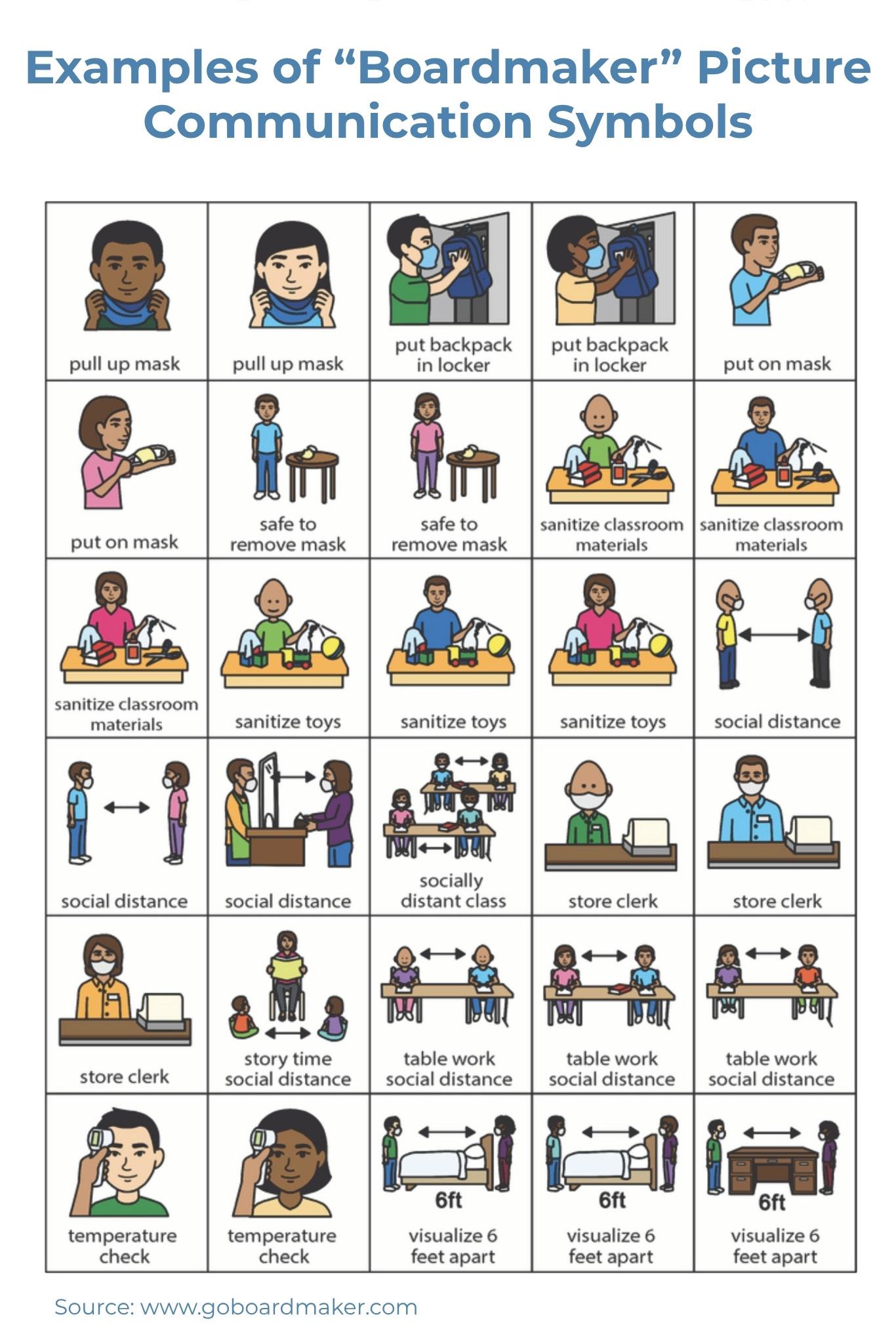
1. Visual activity schedules and social history. It is advisable to ‘frame’ each sensory reading session with a visual schedule of activities for the session. It is extremely important for individuals with ASD to know the sequence of actions in which they will have to participate, and any deviation from the usual routine can cause them great stress and dissatisfaction. When starting the session, the librarian should greet the participants and, using video cards, name what will be done and in what order. (Sample templates for these cards can be found at the end of the publication and can be printed out). For example: Hello,
Cards created using the Boardmaker program.
my name is Urtė. Now we will all sing a greeting song. After that, we will sit on cushions. Then I will read you a story about a bear, and you will listen. Then... and so on.
After presenting this sequence of actions, you can start the activity, and after completing each step, it is recommended to demonstratively turn the card over and emphasize that the participants can prepare for the next action. Cards explaining such actions can be created using pictures directly from the Internet, other freely available sources, or with professional, specialized Boardmaker graphic text interpretation software. This program is widely used in working with individuals with ASD and provides several thousand specially designed, clearly understandable communication symbols (author MayerJohnson). It is recommended to laminate these cards for sustainable and convenient use.
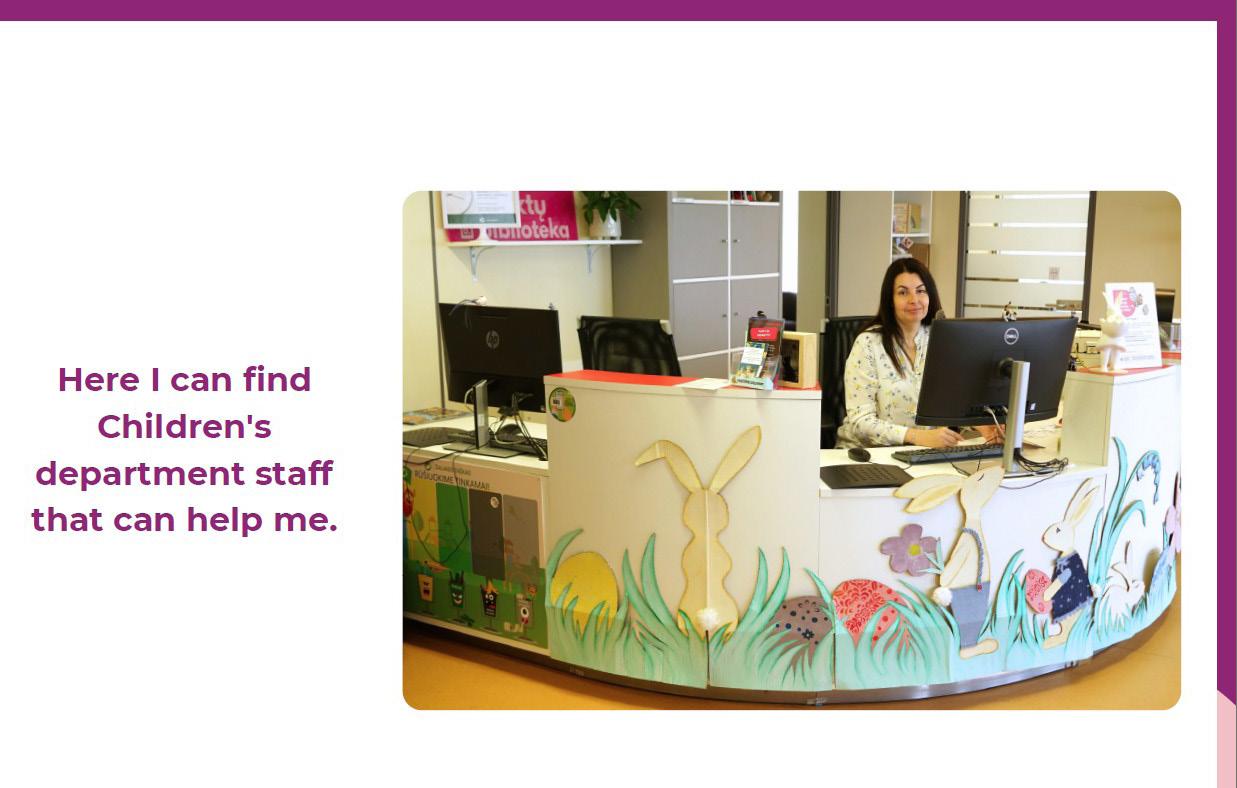
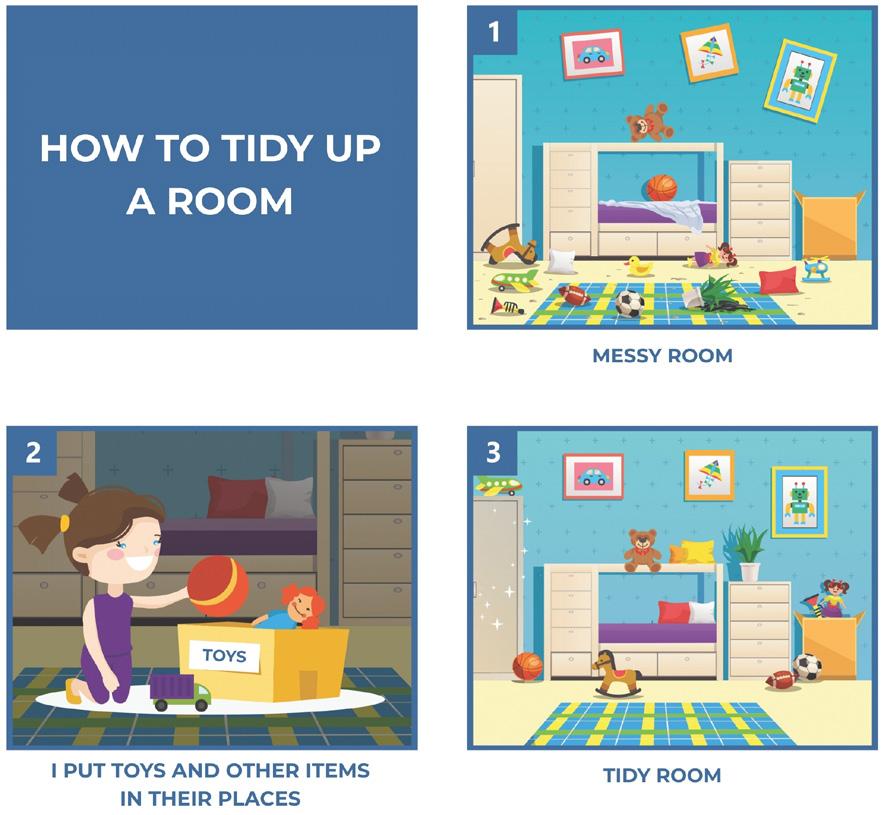
In order for sensory reading participants to feel as comfortable as possible, it is highly recommended to create a library social story that parents and children can review before arriving at the session (therefore, it is most convenient to publish it on the library website so that parents can freely access it from home). The author of the idea and method of social stories is Carol Gray. An important aspect of social stories is visuality, when actions are explained not only verbally, but also illustrated through the prism of augmentative and alternative communication, i.e. with specific drawings, photographs, etc. Social stories are characterized by first-person speaking, specificity, clarity, and the desire to describe and explain situations that can cause unexpected reactions in people with ASD (stress, fear, panic, etc.). Social stories can be intended for people of various ages, and their complexity should depend on the audience for which they will be intended.
Additional tips: separate short social stories can also be used to explain various side actions, such as how to clean up the room after the activity, how to wash your hands after colouring or playing modelling games, and so on. Instead of regular social stories, less commonly used, but equally effective, game-like instructions in a comic format can be used here, which visually tell children in what order the corresponding actions should be performed.
2. Sensory elements, or engaging inserts The story being read during the activity must be enriched with various, purposefully planned sensory inserts. There should not be too many such inserts during one activity, because too much use of sensory elements can cause chaos and distract the participating children. Engaging story inserts encourage children not only to listen, but also to actively participate and perform certain actions themselves - touch, smell, taste, listen, look, and so on. It is very important to keep in mind that some sensory stimuli may not only cause a positive reaction in people with ASD, so before the session, it should be clarified which stimuli the participants may not tolerate (this information can be provided to librarians by parents, guardians or educators accompanying the children). Many examples of various sensory activities and games can be found on the Internet, but the success of this part of sensory reading is largely determined by the imagination of librarians and their ability to select and adapt various examples of activities already tested by other specialists to their session. Specialized stores are full of various tools and equipment that can enrich your activity - these include scent diffusers, weighted blankets, light projectors, Lego boards, bubble pools, etc. However, in addition to these ‘luxury’ tools, there are many simpler, economical options that can become indispensable when creating sensory story elements - these include various cereals, water, flour, soap bubbles,
Fragment of the social history of the Šiauliai County Povilas Višinskis Public Library.
Example of a short social story explaining a specific task.
Christmas garlands and tinsel, sponges, food colouring, plasticine, foam rubber, paper, plush toys (and non-plush) toys, spotlights, pebbles, and so on. Using these or many other materials, you can create playful, engaging, and sensory-stimulating activities for your child. The most important thing is to make sure that the program activities are safe for your child’s health and do not pose any risks.
Additional tips: a fun and successful sensory activity can often be a bit ‘messy,’ so if you want to protect the floor from paint or scattered sand, we recommend purchasing a film that you can use during games. It is also worth keeping in mind that participants may insist on taking one or another object or toy used during the session home, so you should consider purchasing spare, replacement inventory (it may come in handy, at least temporarily). If you have the opportunity, purchase a magnetic board or any other board on which you can stick visual elements that you will use during the story (the board will be useful not only for social history, but also for demonstrating book illustrations, if you use copies of illustrations, etc.).
3. Reading the story aloud During the activity, all participants must clearly see and hear the educator, so you need to speak loudly, slowly and clearly. It is very important to read the text clearly, use different intonations, enrich the text with as many emoticons, exclamation points, and other expressive words as possible, even if there are none in the original text. The librarian can adapt the text at his discretion and make it as vivid and lively as possible. It is recommended to include musical and singing interludes in the reading text, which is a very effective way to encourage children to actively participate - many children with ASD will gladly hum along or even sing along if you invite them to do so with you. It is ideal if the activity is led by two leaders. Then one of them is the reader, who sits statically in one place and allows the children to concentrate on the audible text or the illustrations being shown (very good, when the book is large in format and each page with illustrations can be shown directly to the children). The other presenter is a kind of assistant who, if necessary, can approach the children, give them something to touch that illustrates the story, or offer a tactile toy that may be needed if the child has difficulty sitting down. Two presenters are also needed for sensory inserts, the coordination of which may require several pairs of hands.
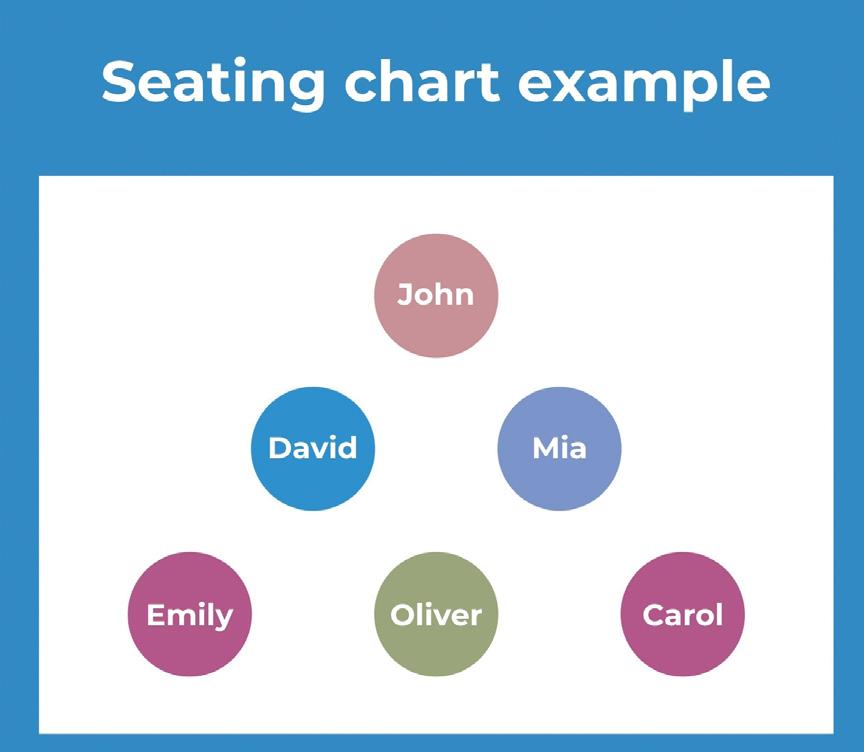
Additional tips: musical audio or video recordings can also be included in the text being read, which can also effectively arouse the attention of the listeners (sounds of a fireplace, rain, thunderstorms, birds chirping, a spring, the rustle of the wind and other sounds). Instead of paper books, you can also read electronic, interactive books, the advantage of which is the ability to demonstrate illustrations on a projector screen. If you do not have such books, but you want to update the book’s illustrations (which are also a very important element of the story), it is recommended to demonstrate the illustrations on a projector screen or simply make physical, paper copies of the illustrations and, turning the pages, distribute them to children so that they can study them more consistently.
Google Docs registration form
Example of a seating chart for children.
Other important aspects that should not be forgotten:
• If you are going to start a sensory reading program, we recommend that you announce pre-registration It is necessary for several reasons: 1) you will be able to manage the flow of participants in the session (no more than 6-7 children with their parents, guardians or teachers should participate); 2) you will be able to find out all the important and necessary information about the participants in the session (what children are afraid of, what they like, what they should pay attention to, etc.). One of the most convenient ways of such registration, which we also use in our library, is the universal Google Docs registration form.
• As the session approaches, meet the participants at the reception desk Ideally, if the information in the social story illustrations is more or less feasible (for example, if the social story pictures show the librarian greeting the children as they arrive, she will actually greet them).
• Usually, parents of children with ASD enjoy chatting with each other and with the librarians after the session, and the children will play a little more, so plan some extra “free” time after the sensory readings, which will allow everyone to relax a little.
• You need to be prepared for small ‘mistakes’. It is likely that some children will not want to listen to you during the sensory readings and may not listen at all. However, it is very important to keep in mind that hyperactive, constantly running around, or seemingly unfocused children can hear you much better than they seem. The goal of sensory readings is not to force participants to listen quietly. They may become interested in one activity or another, or they may only like the story after the third reading. Look at it positively and remember that the most important thing is that they came and participated.
• If you have a group of children who attend sensory reading sessions regularly, you can prepare a special seating chart for the participants - this can be useful to reduce chaos and facilitate the seating process at the beginning of the session.
• If possible, have clear, colourful name cards on the hook or pin during the sessions.
This article is based on the personal and professional experiences of foreign librarians, information heard during various distance learning courses, and our own accumulated and acquired knowledge over the past years. We hope that the information provided will facilitate the implementation of a sensory reading program in your libraries. Although the process may seem complicated or raise many questions at first, it is important to try. The best motivation you will receive when implementing this type of program will be a sincere hug from your class participant. It will be stronger and more eloquent than hundreds of words.
References:
Targeting Autism For Libraries – https://targetingautismlibs.com/ WebJunction: The Learning Place for Libraries – https:// www.webjunction.org/home.html American Libraries Magazine –https://americanlibrariesmagazine.org/ Serving Library Patrons with Autism Spectrum Disorders. Conference video record – https://www. youtube.com/watch?v=_VivZGdcjxU&t=1793s)
Sensory Storytime at Northwest Akron Library. Video record – https://www.youtube.com/ watch?v=R9Y8pcyNyj0
Lynn Akin, Donna MacKinney, ‘Autism, Literacy, and Libraries. The 3 Rs = Routine, Repetition, and Redundancy,’ Children and Libraries, Summer / Fall 2004; p. 35–43.
Amelia N. Gibson, Dana Hanson-Baldauf, ‘Beyond Sensory Story Time: An Intersectional Analysis of Information Seeking Among Parents of Autistic Individuals,’ LIBRARY TRENDS, Vol. 67, No. 3, 2019 (‘Disabled Adults in Libraries,’ edited by Jessica Schomberg and Shanna Hollich), p. 550–575. United Kingdom National Autistic Society – https://www.autism.org.uk/
Sensory Reading Scenarios
To support librarians in delivering and organising sensory reading sessions in libraries — selecting suitable literature and developing session scenarios — the project ‘Heroes Unleashed: Implementing a Sensory Reading Program in European Public Libraries’ produced a children’s fiction book specially created for sensory reading, ‘Helping the Bear and Other Stories’. This methodological publication presents twelve session scenarios, each based on a story from that book.
The scenarios are divided into two levels of complexity: Level I (basic level) and Level II (advanced level).
Level I scenarios are designed for children who may experience difficulties in understanding written texts, adapting to new situations, or completing assigned tasks. These scenarios provide clearer structure, simpler language, and more guided activities.
Level II scenarios are intended for participants who are able to comprehend more complex texts and successfully complete more demanding tasks. They encourage higher-level thinking, greater independence, and deeper engagement with the content.
Session plan:
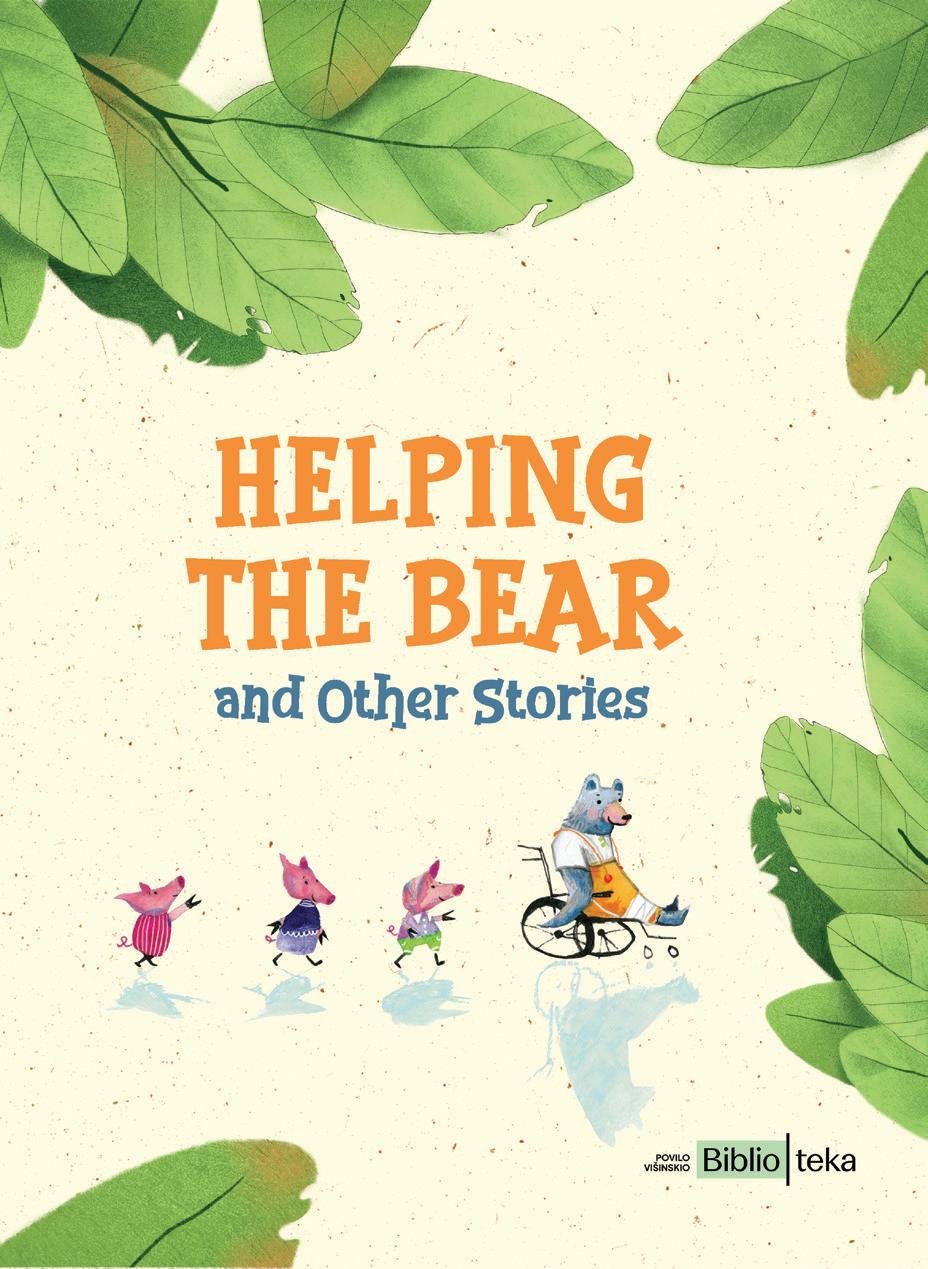
1. Children are guided into the sensory reading space and invited to sit in a semicircle facing the educators.
2. Greeting and Introduction. The session leaders (educators) approach each participating child, introduce themselves by name, and ask, ‘What’s your name?’ If the child is open to interaction, they may shake hands, give a high five, or share a friendly hug.
3. The sequence of the upcoming activity is introduced using visual action cards. Each separate activity is represented by its own card. When an activity is completed, the corresponding card is turned over. (For example, the card ‘We will introduce ourselves‘ is turned over after all children have become familiar with the educators leading the sensory reading session.)
4. A countdown timer or sand timer (set for approximately 35 minutes) is started and placed in a visible location, so children can observe the passing of time during the session.
5. The book is presented clearly and audibly, including the author’s name and the book title.
6. The story is read expressively, integrating sensory tasks and interactive actions throughout the reading.
7. If, after reading, the children remain attentive and focused, an additional hands-on activity or game may be offered.
8. Free time is given for relaxation and unstructured play.
9. A goodbye ritual.
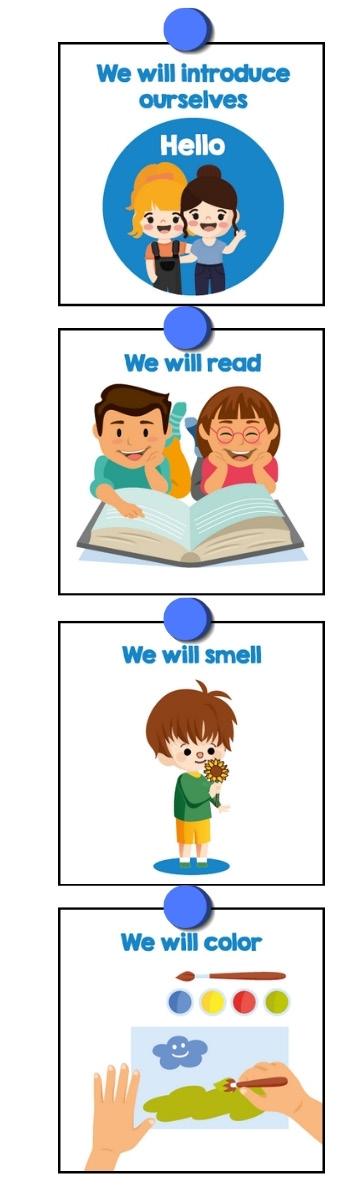
‘HELPING THE BEAR’
Igor Plohl, illustrated by Vítor Hugo Matos
Written by Vaida Antanaitienė LEVEL I
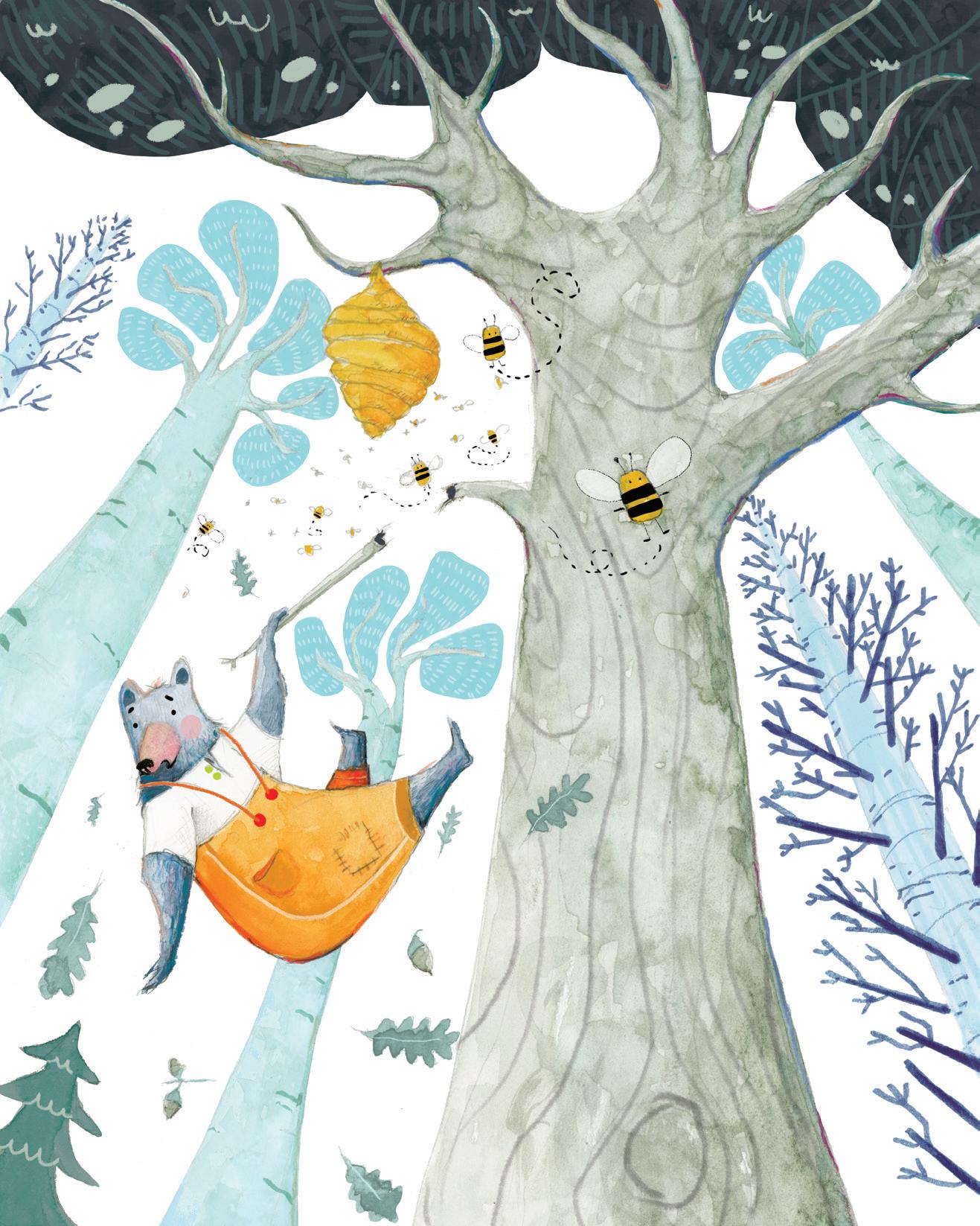
Target Audience: Children aged 5–10 with autism spectrum disorder, sensory integration or emotional expression challenges, developmental challenges, or other neurodivergent traits.
Duration: 40–45 minutes.
Group Size: Up to 8 children.
Location: Private, quiet educational space adapted for sensory activities.
Facilitators: 2 educators (reader and assistant).
Table of the Program’s Sensory Activities Impact
Sense Activity Objective
Smell + Tactile sense
Vestibular system
Smelling honey and squeezing a honeyfilled pouch.
Walking on a balance path and moving along a narrow track.
Proprioception + Balance
Eyesight + Hearing + Touch
Jumping into hoops.
Exploring natural materials while listening to music and watching projector visuals.
Tactile sense
Tactile sense + Smell
Digging or ‘excavating’ in pretend mud to find hidden items.
Playing with wooden treats and smelling different scents.
To develop the sense of smell and tolerance to sensory input, and to strengthen fine motor skills and squeezingcontrol abilities.
To promote coordination, sense of direction, and attention control.
To develop gross motor skills, proprioception (body position awareness), and balance.
To encourage attentiveness, slow and mindful movement, and to develop visual, auditory, and tactile senses.
To support sensory relaxation and encourage conscious tactile exploration.
To develop fine motor skills, encourage communication, sharing skills, and sensory exploration.
Benefit for the Child
Improved sensory integration – the child experiences different scents and textures.
Enhances gross motor skills. Strengthens spatial orientation and awareness of body position changes.
Strengthens leg muscles and coordination. Improves body awareness.
Improves concentration and emotional relaxation.
Improves fine motor skills, builds sensory courage, and helps overcome aversions through play.
Strengthens social skills (sharing, politeness). Enhances the ability to identify and describe sensory experiences.
Story Excerpts and Activity Prompts
Story
Excerpt Activity Materials needed
‘Once, a bear fell from a tall oak tree. He’d wanted to treat himself to some bee honey, but he slipped.‘
Children are given honey scent samples (you may use real honey). The educator lets each child smell the honey and explains that they will now smell and touch something the bear loves very much. ‘What does honey smell like?’
Then the children are given bags filled with a thick liquid (gel bags with yellow, honey-like contents, or real honey) that they can squeeze with their hands. After the activity, the educator asks the children whether honey feels thick or sticky.
Honey (honey scent samples) bags filled with honey (or yellow liquid).
‘At first, the path was level and well-trodden, but soon they reached the first little hill. The bear pushed the wheels hard.‘
The educator invites the children to climb a small hill. A symbolic hill is created in the space: soft blocks, a sand snake, a small mattress, or a sloped path. The children walk or climb through the ‘flat path’ and then ‘up the hill’ (slowly, one at a time, with assistant support if needed). You may add step-counting, a chant, or a rhythm song.
Soft blocks, a path, a sand snake.
‘Can I help you?’ the rabbit offered. ‘My legs are strong and fast.’
The educator invites the children to sit in a circle or around it and tells a short story: ‘One day, a rabbit heard that his friend was in trouble. He wanted to help because his legs were strong and quick! Would you like to become rabbits and help the friend?’
The children perform simple movements with the educator: stomping their feet
‘Are our rabbit legs strong?’; lifting their knees ‘Lift your legs like a rabbit’; stretching their legs ‘Look how quick we are!’
You may invite them to hop into hula hoops (or walk, crawl, roll a ball) along the track like a rabbit.
Colorful hula hoops (to jump into).
Story Excerpt Activity
‘In the dark forest a doe noticed the little procession.’
The educator invites the children to imagine a forest. Background forest sounds are played. The children slowly walk along a ‘forest path’ (made of mats or markers), moving like a deer quietly and carefully. They observe ‘tall trees’ (via projector). The educator prompts: ‘Look up… How many trees do you see? Where are their tops?’
They listen to sounds ‘Can you hear the leaves rustling? Who is chirping?’
They touch various forest objects: pinecones, leaves, tree bark.
Materials needed
A speaker with forest sounds, a light source or a light projector (to create a ‘forest’ atmosphere), artificial (or real) leaves, pieces of tree bark, pine cones.
‘In the afternoon, they reached a broad field. The pigs happily buried their snouts in the soil. Nom nom nom!’
Children are given a box with kinetic sand (wet sand, clay). The educator invites them to dig or scoop the ‘soil’ with their hands — searching for vegetables or fruits they could ‘eat.’ Every time they find something, they imitate a sound: ‘Yum yum, a carrot! ’ ‘Crunch crunch, what’s this an apple?’ The activity ends with hand-washing.
A sensory bin or a larger container filled with pretend ‘mud’ (e.g., coffee grounds, damp sand, wet clay, playdough, kinetic sand), along with vegetable or fruit figurines (carrots, potatoes, corn — ‘what piglets eat’). You can also include acorns, chestnuts, and a bowl of water.
‘Excited, the squirrel clapped her paws and shared tasty treats with all the guests, while the old oak rustled its leaves loudly.’
The educator lays out a tablecloth and arranges plates, cups, wooden play food, and napkins. Each child chooses ‘what they want to eat,’ describes the food, and passes something to a friend. They pretend to taste, chew, and describe the flavors.
The educator asks: ‘What did you try? What does it taste like?’ ‘Would you like to offer something to a friend?’ ‘How do we say THANK YOU?’
Selected scents from the scentrecognition game (cake, lemon, cookies, etc.) are offered for smelling. The children help ‘clean up’ the table a symbolic ending to the activity.
Tips for the Librarian / Educator
A set of wooden play food and dishes (plates, cups, fruits, pastries, etc.), a scent-recognition game, napkins, and a small tablecloth.
• Allow children to choose whether they only want to smell the honey or also touch it. If a child avoids a scent or sensory input, do not insist; offer an alternative (e.g., a card or picture).
• Model movements slowly and clearly, using verbal cues: ‘We walk on flat ground… now up… the hill!’ Allow each child to move at their own pace avoid comparisons.
• Adapt the activity to the child’s abilities: if the child cannot jump, they may crawl, move while seated, or move a small toy with their hands. Use clear, visual instructions: demonstrate the movement yourself or use pictures.
• Introduce each sensory experience as a discovery: ‘What do your hands feel when they touch the leaf or pinecone?’ Turn off bright lights and use gentle sounds.
• Demonstrate — touch the ‘soil’ and say: ‘Look, the little pig found a carrot! Crunch, crunch yum yum!’ End the activity with a hand-washing ritual this helps children regain sensory comfort, especially those with sensory sensitivities.
• Offer each child a choice of scent: ‘Which smell would you like to try today? ’
This supports autonomy and independence. You may also hand them a matching wooden ‘treat’ (e.g., apple scent → a wooden apple).
‘WHEN I GROW UP’
Majda Koren, illustrated by Greta Alice
Written by Giedrė Čarienė LEVEL I
Target Audience: Children aged 5–10 with autism spectrum disorder, sensory integration or emotional expression challenges, developmental challenges, or other neurodivergent traits.
Duration: 40–45 minutes.
Group Size: Up to 8 children.
Location: Private, quiet educational space adapted for sensory activities.
Facilitators: 2 educators (reader and assistant).
Table of the Program’s Sensory Activities Impact
Sense Activity Objective
Sight / Imagination
Touch / Tactile sense
Children observe space projections and imagine a journey to the stars.
Children explore different textures (cotton, fur, foil, eggshell, balloon, feathers, paper, fabric).
Smell / Taste
Movement / Nature
Movement / Motor skills
Children mix, whip, or decorate cakes, smell cinnamon or vanilla.
Children plant, water, and replant flowers.
Traffic light game – children move according to colors (green – go, yellow – slow down, red –stop).
Touch / Emotions
Children hug or touch a warm object (heating pad, warm water).
To improve imagination, introduce the concept of space, and foster curiosity about the world.
To develop tactile perception, distinguish between different textures, and enrich vocabulary.
To stimulate creativity, to introduce scents, to develop imagination and role play.
To encourage caring behavior, introduce nature and growth cycles.
To introduce traffic rules, develop movement control and self-regulation.
To create a sense of closeness and safety, and encourage emotional expression.
Story Excerpts and Activity Prompts
Benefit for the Child
The child learns to relax, dream, imagine, and broaden horizons.
The child learns to identify objects through touch and strengthens sensory awareness.
The child experiences a variety of smells, strengthens memory of scents and tastes, also develops creativity.
The child develops responsibility, fine motor skills, and understanding of natural processes.
The child learns to follow instructions, control movements, and understand rules.
The child experiences the comfort of warmth and touch, feels safe and loved.
Story Excerpt Activity Materials needed
‘We race past thousands of suns and planets. Some stars are small and white, others are larger and yellow. The largest ones are red.‘
The educator dims the lights, turns on the astronaut projector, and invites the children to imagine a journey into space. The children name the planets they know, watch the projections, and learn that stars are distant suns, while the Moon shines by reflecting the light of the Sun.
Astronaut light projector.
Story Excerpt Activity
‘Some are furry, some are scaly.
Some have bare skin, and others have colourful feathers.‘
The educator prepares a variety of textures and invites the children to explore them by touch.
Pieces of cotton, fur, foil, eggshell, balloon surface, feathers, colored paper, and shiny fabric are placed on the table.
The children take turns touching each material and discussing how it feels — soft, rough, cold, or smooth.
Materials needed
Furry: cotton wool, piece of fur.
Scaly: foil, eggshell (clean and safe).
Bare / slippery: balloon surface.
Colorful like birds: feathers, colored paper, shiny fabric.
‘Then I’ll be a pastry chef! I’ll knead dough, beat eggs, bake cakes and biscuits, decorate them, make creams, and cook marmalade.‘
‘I close my eyes and MMMMM, I smell vanilla and cinnamon.‘
The educator arranges a wooden dessert play set.
The children pretend to be pastry chefs – they ‘mix,’ ‘whip,’ and ‘decorate’ cakes and cookies.
The educator prepares several different scents such as vanilla, cinnamon, and others. The children take turns smelling them and trying to identify each one. This activity helps them explore various scents and develop their senses and curiosity.
Large wooden dessert set in a box.
‘I stop when the traffic light turns blue. I go again when the pink light shines.‘
The educator prepares a paper traffic light or a slide showing the colors in sequence. When the green light appears, the children can move, dance, and laugh. When the yellow light shows, they begin to calm down and move more slowly. When the red light appears, they stop completely and relax.
Through this fun activity, children learn about basic traffic rules while engaging with the story.
Scent recognition game.
Paper traffic light.
Slide.
Projector.
‘I’ll grow potted plants, water them and transplant them.‘
‘You know what, Mum? When I grow up, I’ll be your child and you’ll be my mum. I’ll come to hug you, just like I’m hugging you today!‘
The educator prepares a potted plant and a container of water. The children take turns using a watering can or a small cup to carefully water the plant.
The game “Little Windmills” can be used for this activity.
The educator may invite the children to give a hug—only if they feel comfortable doing so.
A warm object, such as a heat pack or a bowl of warm water, can also be introduced for the children to touch. This simulates the warmth of a gentle human touch, helping them feel comforted and calm.
Plant (artificial or potted).
Watering can.
Water.
A heat pack.
Warm water (in a bowl).
Tips for the Librarian / Educator
• You can include the question: ‘What will you be when you grow up?‘ in the story.
This question can be repeated together with all the children in chorus.
This creates a special atmosphere children feel that it is an important question, that others truly care and are curious about what they will become when they grow up.
• Combine the story with movement.
For example, when the story mentions a rocket, children can ‘take off‘ by raising their hands; when it mentions a pastry chef, they can ‘mix the dough in the air.‘
This helps maintain focus and engagement.
• Use sounds and movements.
The text contains many expressive sounds (VROOOOM, VHOOSH, OUCH).
Invite the children to repeat them all together.
• Play during the story.
In the story, the mother often asks: ‘What if not? ‘
You can ask the children: ‘What if Zagi wasn’t an astronaut what else could it be? ‘
Let them guess before reading the next page.
‘MISTER MOLE AND THE LOST AND FOUND OFFICE’
Sashko Dermansky, illustrated by Lisa Penedo
Written by Milda Kazernovičiūtė
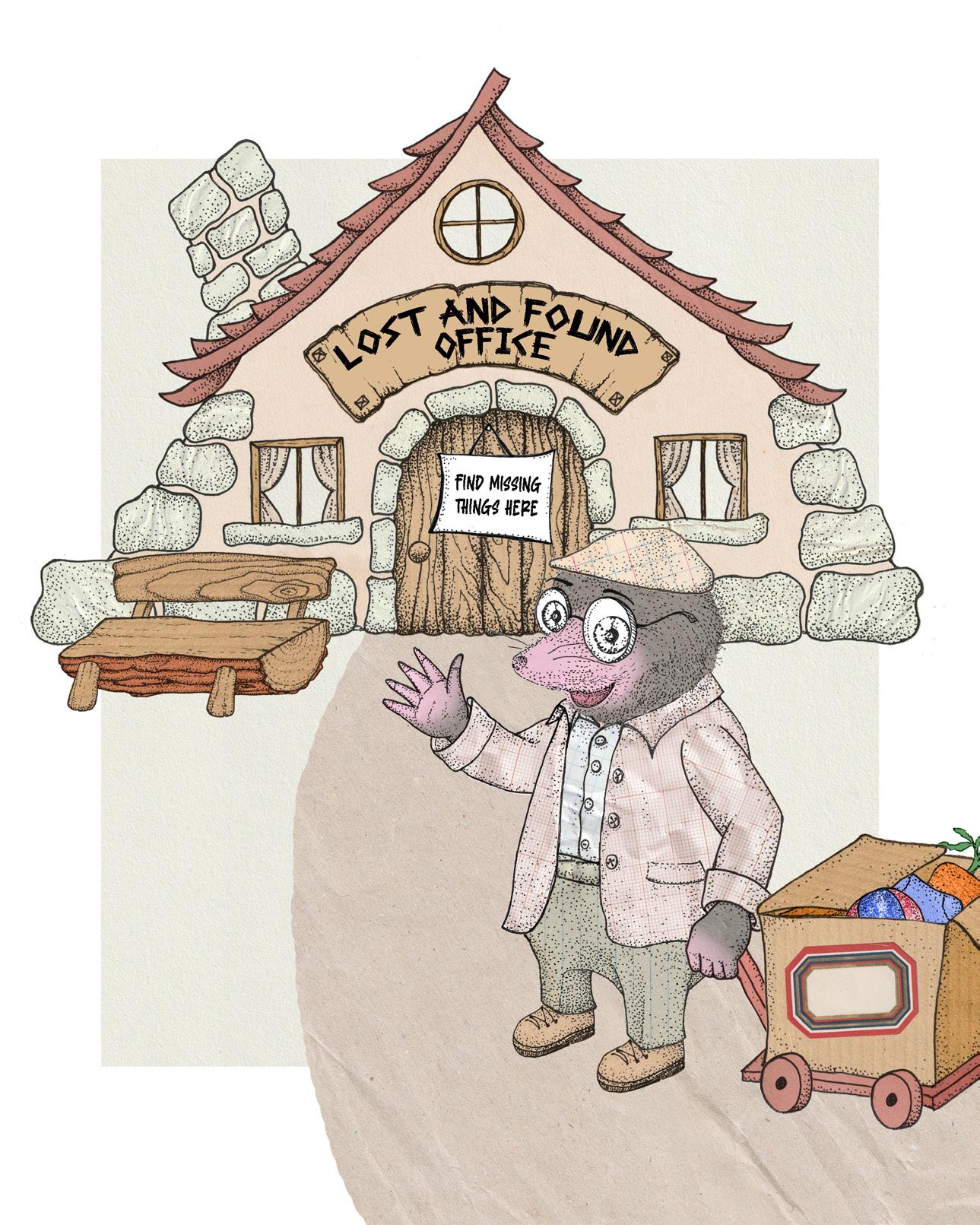
Target Audience: Children aged 5–10 with autism spectrum disorder, sensory integration or emotional expression challenges, developmental challenges, or other neurodivergent traits.
Duration: 40–45 minutes.
Group Size: Up to 8 children.
Location: Private, quiet educational space adapted for sensory activities. Facilitators: 2 educators (reader and assistant).
Table of the Program’s Sensory Activities Impact
Sense Activity Objective
Tactile sense (touch)
Eyesight
Children touch various objects (long ears – a scarf; fluffy tail – a soft plush toy; prickly surface – an Ayurvedic head massager).
Children experience a ‘storm cloud’ – a foil emergency blanket is held and waved above their heads.
’Close your eyes – like the Mole without his glasses.’ Children close their eyes; the educator asks: ’What do you see? How do you feel?’
Movement / Proprioception
Hearing/ Sound environment
Everyone stomps like an elephant while shouting ’HOP! HOP! HOP!’
Children recreate sounds using instruments (rattling, clinking), while storm and forest sounds play in the background.
Emotional literacy + Social skills
Smell / Olfaction
Children do a breathing exercise using squeeze balls.
Aromatherapy diffuser with nature scents; smelling banana scent.
To develop tactile senses and connect sensations with the story’s character.
To create a sensory experience illustrating how the Mole could mistake an Elephant for a cloud.
To develop empathy and help children understand the feeling of vision loss and the emotions tied to it.
To encourage integration of movement and sound, fostering involvement in the activity.
To develop sound perception and attention to environmental sounds.
To teach emotional regulation, calming strategies, and selfcontrol.
To create an atmospheric sensory background and develop olfactory differentiation.
Benefit for the Child
Encourages sensory exploration and imagination.
Promotes creative engagement with the story.
Encourages emotional awareness, imagination, and self-expression.
Improves coordination, rhythm, and a sense of community.
Enhances sound differentiation and attention to the environment.
Improves the ability to recognize, name, and manage emotions.
Encourages recognition and differentiation of smells.
Story Excerpts and Activity Prompts
Story Excerpt Activity
‘They are nowhere to be found…’ Mister Mole said, confused. ‘What shall I do? I can barely see anything without my glasses.’
‘Suddenly, his house shook. Dishes clanked, windowpanes clattered, and something outside stomped: –‘THUD! THUD! THUD!’
‘Mister Mole looked out, but he did not have his glasses on. Something big and grey was outside.
‘Looks like a storm cloud,’ Mister Mole decided.’
‘It was me walking so loudly.’
And the elephant stomped in place, ‘THUD! THUD! THUD!’
‘Mister Mole was annoyed and angry. He clenched his fists, his heart started beating really fast and his face got flushed. <…>
The Mole took a few deep breaths and counted from one to ten: ‘One... two... three... four... five... six... seven... eight... nine... ten.’ Then the Mole’s fists unclenched, his heart slowed down and his face returned to its normal colour. Yet he was still sad.’
‘You can recognize me easily by my ears. Here, touch them.’
Mister Mole touched the ears. They were long and warm.’
‘Close your eyes — just like the Mole without his glasses.’
The children close their eyes, and the educator asks:
‘What do you see? How do you feel? And how do you think the Mole felt?’
The children use musical instruments to recreate sounds rattling, jingling, tapping.
The educator plays a storm sound.
The educator and assistant walk around the children holding a first-aid foil blanket above their heads so they can feel the ‘storm cloud’ and experience how the Mole could have mistaken something Big and Grey for a cloud. Then the educator asks:
‘How would you react if you saw something big and unfamiliar?’
Movement imitation: everyone stomps like an elephant and says: ‘THUD! THUD! THUD!’
Children perform a breathing exercise using squeezable sensory balls they squeeze the ball as they inhale and release it as they exhale, while a calming sound plays in the background (you may keep the forest sound or switch to another soothing sound). This helps them relax and notice how their emotions gradually soften.
While the children are doing the breathing activity, the educator asks: ‘What do we feel when we get angry? How can we calm down?
Have you ever tried breathing the way Mr. Mole does?’
Touch activity: with eyes closed, the children touch a pair of ‘ears’ (a scarf) and guess whose they are.
Materials needed
No additional materials are required.
Musical instruments, a sound device (storm sound).
First-aid foil blanket.
No additional materials are required.
Soft sensory balls, a sound device (nature sounds).
Chiffon scarf.
Story Excerpt Activity Materials needed
‘I am more recognizable by my tail,’ Someone Red said.
Mister Mole touched the tail; it was very soft and fluffy.
‘You must be the Squirrel.’ Mister Mole guessed. <…> Mister Mole found something round in the box.’
‘Better not, I’m all prickly,’ the stranger said. ‘Here, listen to what I can do, and you will immediately recognize me.’
‘The Elephant’s trunk came through the entrance and put down new glasses into Mole’s hands!
‘This is a gift from us all!’
Touch activity: with their eyes closed, the children touch the ‘tail’ a soft, fluffy piece of fabric or an animal from the finger-puppet set and guess which animal it belongs to. (If you have a plush squirrel, you may use it.)
An animal from a fingerpuppet set or a piece of fluffy fabric.
‘Mister Mole put on the glasses. Suddenly, everything around became clear, colourful, and familiar.’
Touch activity: with their eyes closed, the children touch the ‘spikes’ (a head massager) and guess which animal it might be.
The educator demonstrates the movement: stretching a hand forward, bending the wrist, and wiggling the fingers to imitate an elephant’s trunk, then gently passing the symbolic glasses to the nearest child, saying, ‘This is our gift for you!’ Each child repeats the movement in turn and passes the gift along.
Light-therapy experience: the educator turns on the LED star projector, creating a colorful, shimmering, dynamic field of light in the room. The children watch in silence or with soft music playing in background. The educator asks: ‘How does Mr. Mole feel now? How do you feel?’
Tips for the Librarian / Educator
Ayurvedic head massager.
Real or paper glasses.
Children’s night projector.
• Sound background: gentle nature music birds, rustling leaves, soft wind strengthens the atmosphere and creates the feeling of being in a forest. This sound can be used throughout the session.
• Aromatherapy background: use a diffuser with a pine scent.
• Read with expression – use different voices, gestures, and sounds (‘THUD! THUD! THUD!’, ‘KNOCK KNOCK’) to help children engage and maintain attention.
• Additional reflection questions
• How did Mr. Mole feel when his glasses disappeared? How do you feel when you can’t find something?
• Have you ever felt angry like the Mole? What helps you calm down?
• Why did Mr. Mole forgive the elephant? Do you find it hard to forgive?
• How did the elephant feel when he broke the glasses?
• What do you think was more important to the Mole his glasses or his friends?
• Be flexible. Let the children participate in their own way – some will be active, others will observe. All ways of participating are valid.
‘THE COLOUR-BLIND CHAMELEON’
Marta Curtis, illustrated by Raimonda Nabažienė
Written by Giedrė Čarienė LEVEL I
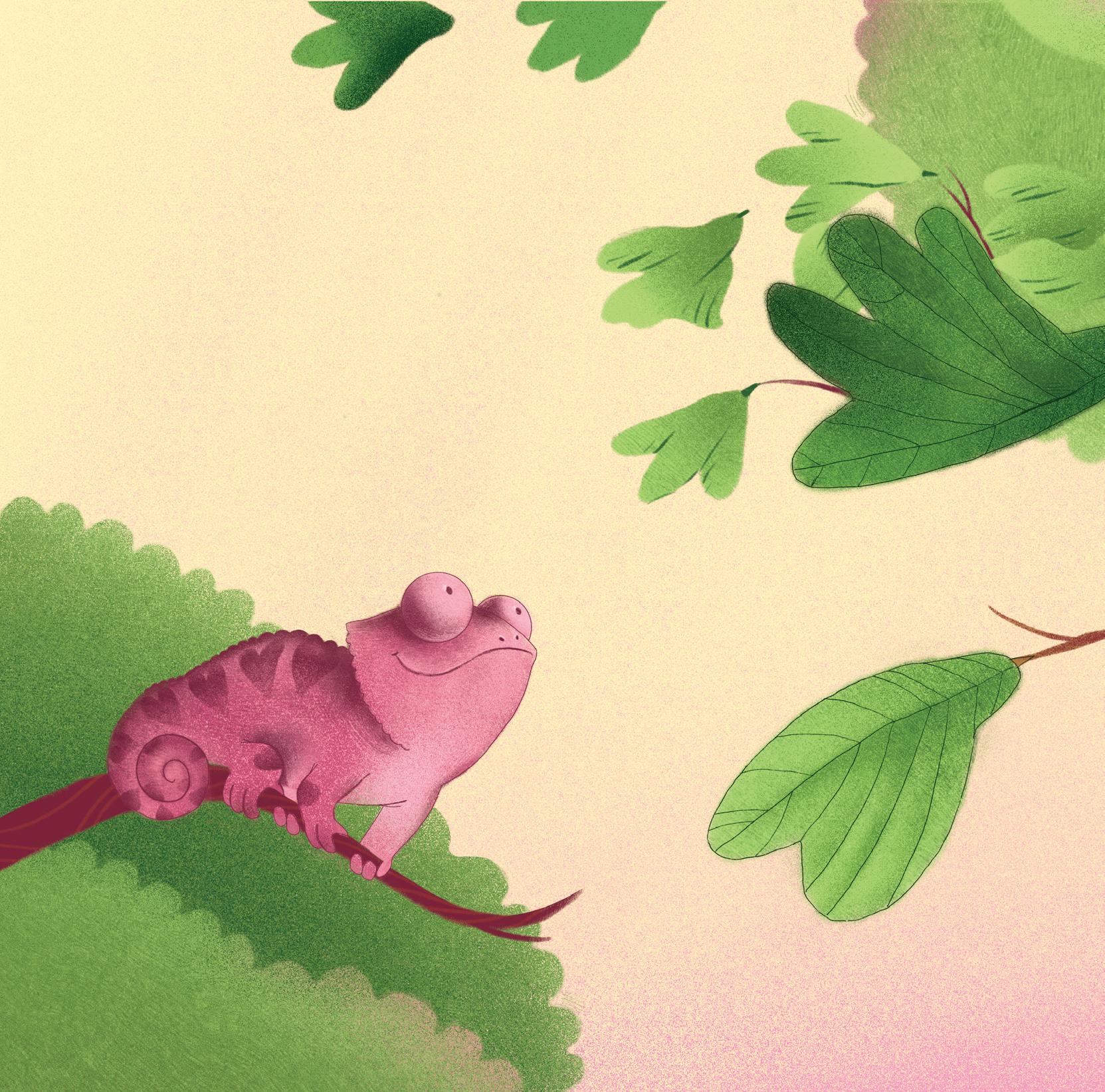
Target Audience: Children aged 5–10 with autism spectrum disorder, sensory integration or emotional expression challenges, developmental challenges, or other neurodivergent traits.
Duration: 40–45 minutes.
Group Size: Up to 8 children.
Location: Private, quiet educational space adapted for sensory activities.
Facilitators: 2 educators (reader and assistant).
Table of the Program’s Sensory Activities Impact
Sense Activity Objective
Smell / Color perception
The educator assigns a scent to each color (green – eucalyptus, red – strawberry, blue –lavender, yellow – vanilla). The child inhales the scent and tries to guess which color it represents. Afterwards, the feelings evoked by the scent are discussed and linked to the chameleon’s ability to sense moods beyond colors.
To encourage the association between scents and colors, and to develop the sense of smell and imagination.
Benefit for the Child
The child develops sensory perception, the ability to associate scents with colors and emotions, and improves attention.
Sight / Touch / Motor skills
Sight / Creativity
Children play at a light table covered with sand. They can blow the sand through straws or draw with their fingers. The educator changes the light colors from bright to dark, imitating the chameleon’s changing moods.
Children color a sunshaped stencil with paints, crayons, or markers, creating various patterns.
Touch/ Movement
The educator creates a wind sensation using a fan, asking children to perform a short “leaf or tree dance“.
Touch / Hearing
Hearing / Rhythm
Children walk through a tent-tunnel, imagining rain. The educator adds sounds of rainsticks; children close their eyes and listen.
Children create a “forest orchestra” using percussion instruments, imitating sounds of nature.
To develop handeye coordination, creativity, and sensory integration.
Encourage creative expression and fine motor skills.
Develop sensory perception and encourage free movement.
Develop visual and auditory skills.
The child experiences a combination of color, light, and touch, enhances fine motor skills and creativity, and relaxes.
The child develops visual imagination, hand movement precision, and color coordination skills.
The child experiences the sensation of wind, develops body coordination, and emotional expression.
The child improves listening, calms emotions, and trains visual imagination.
Encourage listening, rhythm, and collaborative skills.
The child develops a sense of rhythm, learns to express emotions through sound, and practices group work.
Story Excerpts and Activity Prompts
Story Excerpt Activity
‘…for the sun to rise and watch the drawings made by the rays of light on the giant leaves.‘
‘Sometimes, it awoke with such force that the whole forest danced.‘
Before the activity, the educator prepares a sunshaped stencil (the size can vary).
During the activity, children are provided with materials such as paints, pencils, markers, or other coloring tools.
The children are encouraged to color the sun and its background, creating various patterns and shapes.
Materials needed
Sun-shaped stencil (cut out of cardboard or thick paper).
Drawing/painting materials: colored pencils, markers, crayons, gouache, or watercolor (with brushes and small containers of water).
‘– It’s making a tunnel, so the ants don’t get rained on.‘
During the activity, the educator moves around with a portable fan, approaching each child. If a child feels confident and not afraid, they can be invited to create and perform a short “tree or leaf dance,” as if the wind is moving them.
The educator invites the children to walk through a set-up tent tunnel.
As they go through it, the children imagine they are hiding from the rain—like ants in their safe underground home.
The children walk one after another in a calm line, without pushing or rushing.
Additional activity, if the children remain focused:
The educator approaches each child with a “rain stick” (a musical instrument that makes the sound of rain).
The child closes their eyes and listens carefully to “hear the rain.”
After listening, there is a brief discussion: ‘What was the rain like? Strong or gentle? What feelings does it bring?‘
The educator invites the children to create a “forest orchestra.”
Portable fan.
tent tunnel.
‘Djeco‘ rain stick.
‘And suddenly, the forest would become an orchestra, with the sound of drops falling on the branches, leaves, and even on him — splash, bang, bang, splash.‘
Each child is given a musical instrument (shakers, drums, rain sticks, bells, etc.).
Together, the children play and create forest sounds: the rustling of the wind, the pattering of rain, birds singing, and the movements of animals.
The educator can demonstrate how a particular nature sound might be played and invite the children to imitate it.
The orchestra finishes the piece quietly, as if the forest is settling down in the evening.
‘Song’ musical instrument set.
Double
Story
‘C didn’t know the green of plants and hope, or the red of anger and strawberries. He didn’t know the blue of the sea or the blue of serenity, nor the yellow of the sun and joy.‘
The educator assigns a specific scent to each color.
For example: Green – eucalyptus scent; Red – strawberry scent; Blue – lavender scent; Yellow – vanilla scent.
The educator approaches each child and allows them to smell the scent. The child tries to guess what it is.
It is possible to discuss what feelings the scent evokes and compare it to the story’s chameleon, who can recognize moods without colors.
Materials needed
Scent recognition game: ‘NATURE SCENTS LOTTO‘
‘If they were angry, they dressed in dark colours, and if they were happy, they dressed in bright colours.‘
Before the activity, the educator prepares a light table that can glow in different colors. Sand or another fine, loose material is spread on the table.
Children are invited to approach the table one at a time. Disposable straws can be used to blow the sand, or they can draw with their fingers on the sand’s surface.
During this time, the educator changes the colors of the light—from light to dark—imitating how a chameleon changes its colors according to its mood.
Tips for the Librarian / Educator
‘JonEly’ round light table. Sand. Disposable straws.
• Music instrument activity. Demonstrate in advance how to use each instrument to avoid overly loud or chaotic playing. You can start with one instrument and gradually introduce others so that children learn to listen to each other.Aromatherapy background: use a diffuser with a pine scent.
• Tent tunnel activity with the rain stick. First, explain how to walk through the tunnel calmly and without pushing. If a child does not want to go through, they can simply listen to the rain sounds next to the tunnel.
• A practical activity for reflection (if the children are focused).
Children can color a chameleon silhouette on a sheet of paper using colors that reflect how they feel after the activity. The drawings can be collected as a chameleon album and displayed in the library.
• If a child does not want to participate, that’s completely fine. Allow them to observe others from the side, or choose another sensory activity or part of the session that appeals to them. It is important to maintain a positive experience, even if their participation is passive.
‘WINGED HOOVES’
Olga Kryshtopa, illustrated by Teja Milavec
Written by Vaida Antanaitienė LEVEL I
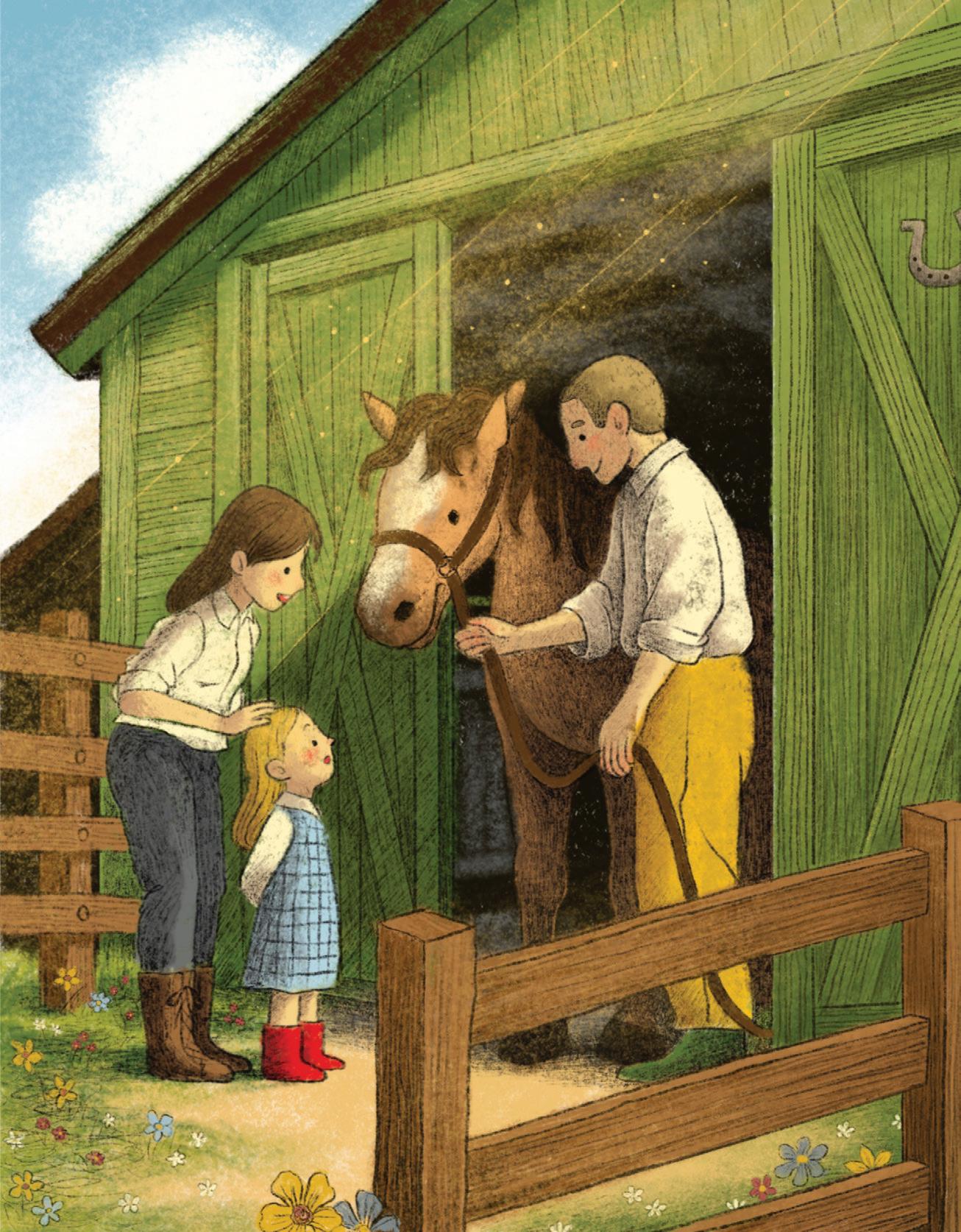
Target Audience: Children aged 5–10 with autism spectrum disorder, sensory integration or emotional expression challenges, developmental challenges, or other neurodivergent traits.
Duration: 40–45 minutes.
Group Size: Up to 8 children.
Location: Private, quiet educational space adapted for sensory activities.
Facilitators: 2 educators (reader and assistant).
Table of the Program’s Sensory Activities Impact
Sense/ Competence
Hearing
Imitating a horse’s movement through sound and rhythm.
Smell + Tactile sense Touching and smelling hay and grass.
Objective
To develop a sense of rhythm, attention, and motor skills.
Benefit for the Child
The child learns to focus on sound and recognize rhythm. Hand–movement coordination and muscle strength are improved.
To strengthen sensory awareness through natural materials (hay, grass).
Tactile sense + Emotional awareness Healing/caring for the horse.
Smell + Tactile sense Stroking a puppet toy and identifying scents.
Temperature + Tactile sense Exploring ‘warm and cold’ in sensory bowls.
Eyesight + Tactile sense Mane trimming.
Helps the child adapt to different sensory stimuli (rough, soft, fragrant, dry) and better understand sensations through touch and smell.
To foster empathy and self-confidence through tactile and pretend-play activities. Supports confidencebuilding through helping another. Develops fine motor skills, tactile awareness, and emotional understanding. Encourages empathy.
To develop the sense of smell and support self-regulation and empathy through nonverbal interaction.
To encourage sensory exploration through touch and help children understand temperature differences.
To develop fine motor skills, hand-eye coordination, and tactile perception.
Enhances empathy and understanding of nonverbal communication. Improves scent recognition and helps the child find calming sensory stimuli.
Improves concentration through a focused sensory task. Provides a safe way to explore and regulate reactions to sensory input.
Strengthens fine finger movements needed for later independence skills. Encourages visual attention and focus as the child follows where to cut or pull.
Story Excerpts and Activity Prompts
Story Excerpt Activity Materials needed
‘Sonia traces a line, as though the horse in her drawing hits the ground with its hooves — clip-clop, clip-clop. She shades – and seems to be able to touch the smooth hair.’
A slide showing a horse is displayed in the background. The sound of hooves is played (clip-clop). The children can tap their fists on the table (the ‘ground’) to imitate horse hooves. Wooden blocks may be used to enhance the sound.
Introduce the activity calmly, using short sentences, for example: ‘Now we will be horses. These blocks are your hooves.’ The educator says or plays the sound: ‘Clip clop! Clip clop!’ (rhythmically, 2–3 times).
The children rhythmically tap the blocks together or against the table. Before ending the activity, give a warning: ‘Two more times… and the horse will stop.’
This helps to avoid sudden changes that may cause stress.
A slide with a picture of a horse and the sound of hooves.
Wooden blocks.
‘Sonia does her homework sitting comfortably in hay heaps. Lately, Sonia lingers by the stall of a newcomer named Thunder.’
The educator invites the children to explore what hay looks like. A small bundle of hay is shown and given to touch: ‘Here is hay. And here is green grass. Different textures.’
Children are allowed to squeeze, stroke, crumble: ‘Is the hay scratchy or soft? And the grass wet or dry?’ They are invited to smell each one: ‘How does the hay smell? Which scent do you like more?’ The educator uses words, gestures, or cards such as: ‘Smells / doesn’t smell / like / soft / tickly / rough.’
An inflatable mat is used for placing the hay or grass.
Small bundles of hay (or dried grass), fresh grass.
An inflatable mat.
‘If we don’t treat Thunder’s injuries today, they will get infected,’ the doctor tells Petrovych. ‘We might lose the horse like this.’
The educator demonstrates how Thunder (the horse) is gently treated with cotton, a tissue, a bandage. Each child is invited to help:
• clean the wound;
• put on ‘medicine’ (cream);
• place a bandage;
• comfort the horse (stroke, say ‘It’s going to be okay’).
After the task, the educator asks: ‘What did you do? How did the horse feel? How did Sonia feel?’
A toy or cardboard horse (or a doll).
Cotton wool, napkins, gauze, bandages, fabric scraps.
Baby cream / Vaseline.
Spray bottle with water (preferably warm).
Disposable gloves.
Story Excerpt Activity
The children are invited to sit quietly next to the toy animal or soft doll, or gently hold it. Later, they receive scented bags or cotton balls with essential oils.
Materials
needed
‘The colt is already used to her. She has been sitting near him for a week. He knows her, knows her smell. We should try it. We will stay close and, if necessary, hold the horse.’
They smell and talk about the sensations: ‘How does it smell? Does it remind you of something?
Is this smell friendly or sharp?’
‘This is our friend Thunder the horse. He is very close to Sonia he recognizes her by scent! Would you like to try becoming friends with an animal through smells?’
The educator hands out one scent bag per child.
Children choose a favorite scent: ‘Which smell do you and your animal friend like the most?’
The educator presents the bowls of water. Children take turns dipping their hands into warm and cool water. They may also use a sponge or a stone to feel the temperature through an object.
Toy animals for roleplaying.
Dried herbs (chamomile, mint).
Linen sachets with herbs, a set of essential oils.
‘She feels warm, wet breath on her palm, and soft lips carefully picking up the sugar.’
Children show or say which water is warmer and which is cooler.
The educator offers choices:
‘Would you like to dip only one hand?
Would you prefer to use a sponge instead of touching the water directly?’
Afterwards, children dry their hands and move on to a calmer activity this helps end the sensory experience positively.
A bowl with warm water, a bowl with cool water.
Various items for tactile exploration: sponges, fabric balls, stones that retain temperature, a towel for drying hands.
‘Sonia continues treating Thunder for a few days, cleans him, brushes and cuts his mane.’
The educator shows the ‘mane’ (for example, glued yarn or paper strips on a horse outline).
Children are invited to cut or tear the ‘mane’. The cut pieces can be glued onto a separate sheet to create a ‘new hairstyle’ or picture. After finishing, discuss whether it was easy to stay focused and careful.
Colored threads, paper strips, or wool yarn symbolizing the horse’s mane.
Children’s scissors, alternatively tearable paper strips (suitable for more sensitive children).
Adhesive paper or a glue sheet for ‘attaching the cut mane.’
Tips for the Librarian / Educator
• Observe sensory sensitivity. Some children may be sensitive to sound or vibration. Offer alternatives: tap more quietly, use softer blocks, tap only on the table. If a child becomes overwhelmed — allow them to step aside.
Some children need active physical engagement, others prefer watching or minimal involvement. Allow children to choose: ‘Do you want to be the horses or the observers?’ – this gives them a sense of control.
• Pay attention to body language – If a child pulls away, goes limp, or closes their eyes the sensory input may be too strong. Offer alternatives: touching through fabric or gloves, smelling from farther away or from a closed container.
• Allow individual participation. Not all children will want to ‘treat’ the horse observing or mimicking the action nearby is fine. Avoid ‘pain’ imitation if a child is very sensitive; focus attention on care rather than injury.
• If a child is non-verbal, use emotion cards or simple gestures: ‘like’ thumbs up.
Do not pressure children to name everything the experience itself is what matters. Offer choices: Give children the opportunity to choose their favorite scent: ‘Which one would you like to share with a friend?’ Let the children bring the scent to the toy: ‘Let’s let him smell it. Does he like it?’
• Safety comes first: Warm water must be comfortable, never hot. Use calm, clear words: ‘This is warm like the sun’, ‘This is cool like the shade.’
• Offer choices: ‘Do you want to cut or tear? Do you want to comb or glue?’ This increases engagement.
If not all children can safely handle scissors, choose tearing tasks instead. Tearing paper strengthens finger muscles.You can also offer pulling yarn through holes (supports fine motor control) or gluing the ‘mane’ instead of cutting.
• Have a ‘calm basket’. If a child needs a break, offer a basket with soothing items (soft fabric, small sensory balls, a scented pillow). This helps regulate emotions and return to the group.
‘DAPHNE LOST HER TAIL’ Evelina
Daciūtė, illustrated by Catarina Glam
Written by Vaida Antanaitienė LEVEL II
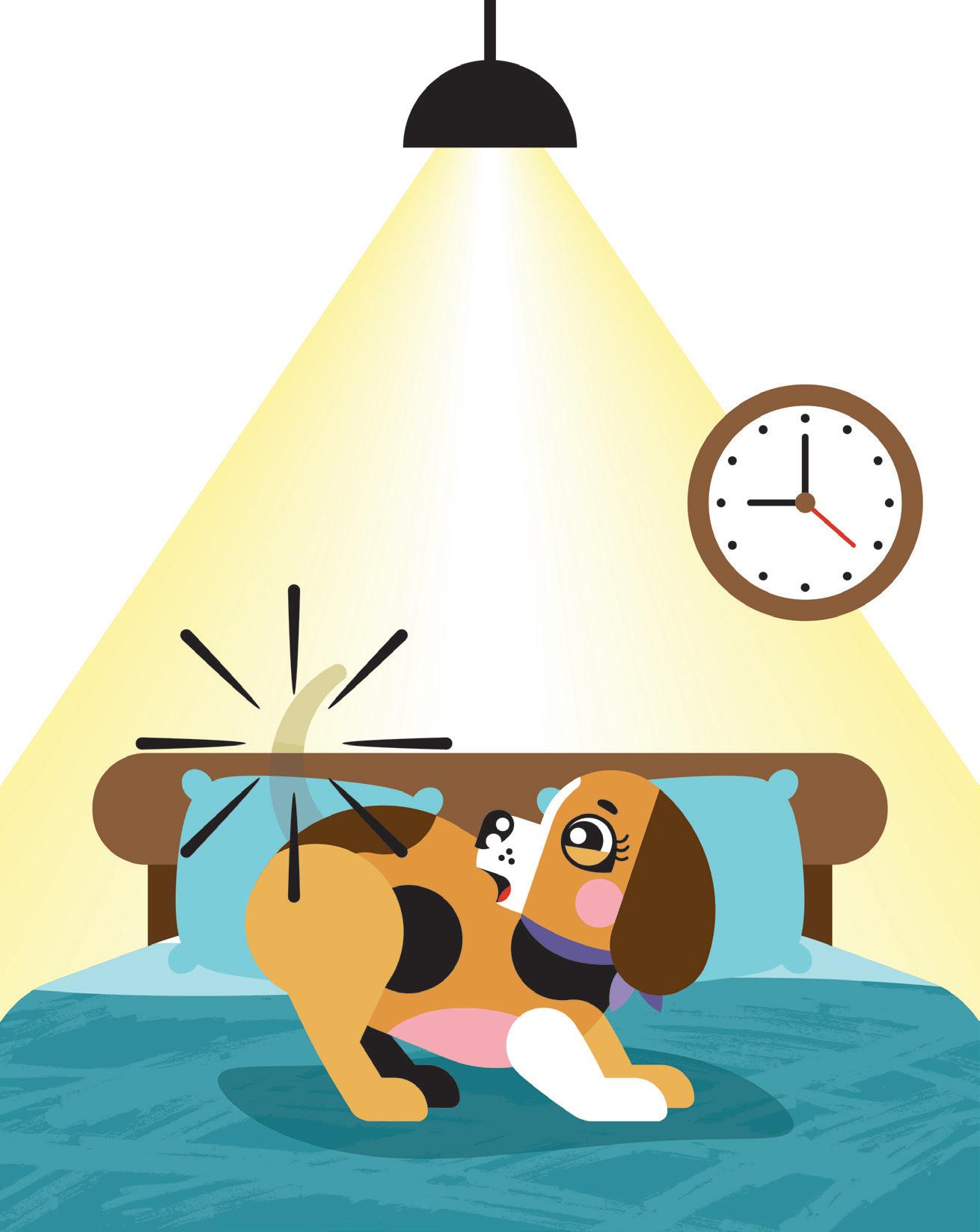
Target Audience: Children aged 5–10 with autism spectrum disorder, sensory integration or emotional expression challenges, developmental challenges, or other neurodivergent traits.
Duration: 40–45 minutes.
Group Size: Up to 8 children.
Location: Private, quiet educational space adapted for sensory activities.
Facilitators: 2 educators (reader and assistant).
Table of the Program’s Sensory Activities Impact
Sense/ Competence Activity Objective
Benefit for the Child
Smell / Olfaction
Proprioception + Vestibular sense
Smelling and identifying different scents.
Eyesight + Tactile sense
Crawling through a tunnel which imitates a trench.
To develop children’s sense of smell and sensory skills. To encourage language development, curiosity, and experiential learning.
To develop motor skills through active movement and spatial exploration, enhancing body awareness, coordination, and sensory integration.
Touching a luminous fiber.
Tactile sense+ Proprioception + Eyesight
Screwing colored nuts onto bolts following a three-color sequence card.
To stimulate visual and tactile sensory development, strengthen fine motor skills, sensory attention, and emotional security.
To develop fine motor skills, finger strength, ability to follow visual instructions, color recognition, and concentration.
The child learns to recognize, accept, and regulate sensory information. Emotions and memories are stimulated through olfactory experiences.
Improves emotional regulation through movement and sensory experience. Builds confidence in body and surroundings.
Encourages curiosity and joy of exploration. Helps to relax and feel calm.
The child improves finger strength and coordination, focuses on the task, works purposefully, builds self-confidence, and experiences success in performing a task.
Touch + Eyesight + Hearing + Proprioception / Vestibular system
Eyesight + Hearing + Proprioception + Emotional selfawareness
Listening to wind sounds and moving accordingly.
Observing a starry sky, dancing, and listening to music.
To stimulate sensory perception, creative movement, and emotional expression.
To help children express emotions through movement, develop coordination and body awareness, encourage self-expression through physical activity.
The child processes and integrates multiple sensory inputs, strengthening both fine and gross motor skills.
The child becomes more aware of the body and environment through sight, sound, movement, and emotional reflection. Sensory balance and adaptation are encouraged.
Story Excerpts and Activity Prompts
Story Excerpt Activity
‘Daphne looked under the bed. Under the table. Between the sofa cushions. Nothing. She rummaged through the toy and shoe boxes. She poked her nose into the most deliciously smelling cupboard. But there, too, she couldn’t find the tail.’
The slide shows a cupboard, either as a book illustration or a real photo. The educator asks: ‘What do we keep in kitchen cupboards?’ (Spices, tea, sweets, flour, jars of jam, etc.)
Each child is invited to smell one or several scents from a ‘Scent Recognition Game’ set (or natural scents such as cinnamon sticks, cloves, coffee, lemon peel, etc.).
Tasks for children:
Smell the scent.
Say whether they like it.
Try to name it (if familiar).
Share what it reminds them of (e.g., grandma’s cake, Christmas, tea).
The educator includes physical activities such as crawling, tiptoeing, and small jumps. Afterward, the children are asked:
Materials needed
The slide that shows a cupboard, a scent recognition game, natural scents, spices (cinnamon, cloves, coffee, etc.).
‘In the meadow near the city park, the piglet Foggy was digging a trench.’
‘A pony named Whereride was nibbling on the grass in the city park.
“Hi, Whereride. How beautifully you wag your tail”, Daphne praised the pony.’
‘How did you feel crawling through the tunnel?
What was the most fun part?’
‘Was anything difficult? Which part?’
If a child is afraid to go through the tunnel, offer an alternative:
‘You can crawl next to the tunnel or around it.
We’ll try the tunnel next time.’
A slide shows a picture of a pony.
Children are shown a glowing optical fiber and asked to find similarities with the pony’s tail. The educator helps the children explore the glowing fibers touch them, observe the color changes, and gently run their fingers along them.
Together they watch how the ‘tail’ begins to glow even brighter – like a real magical pony!
What was the fiber like when you touched it?
(Soft, smooth, cool, tickly, etc.)
Were the lights bright or light?
Which color did you like best? Why?
Kids’ double tent with a tunnel.
Slide photos.
A glowing optical fiber.
Story Excerpt Activity
The educator shows an example of a color sequence card (e.g., ) and says the colors aloud with the children.
Materials needed
‘Soon its color began to change: first to red, then to orange, and then to purple.
“Hello, chameleon Oni. What a beautiful tail you have. How wonderfully its colors change.’
Each child receives their own card with three colors sequence. Their task is to screw the nuts onto a bolt in the same sequence as shown on the card. Children name the color aloud (‘This is red’) and screw it on. They continue until all colors are in place.
When children complete the task, the educator asks what feelings they associate with the colors. Which color was the hardest to screw on?
Which is your favorite color?
How do you feel when you manage to get the order right?
The educator turns on a gentle breeze (e.g., from a fan).
Children stand in the airflow and respond with body movements raising their hands, turning, or swaying.
Then, the educator gives each child a silk scarf or fabric piece.
Set of nuts and bolts (or other larger plastic bolts and nuts).
Cards with a color sequence (e.g., red, yellow, blue).
‘The first thing Daphne saw when she entered her home yard was the laundry fluttering in the wind. Hanging between her mother’s blouse and her father’s pajama pants was... Daphne’s tail.’
Children listen to wind sounds, feel the air movement, and dance with the scarves to match the rhythm of the wind.
Breathing exercises can also be included blowing air onto the scarves.
After this sensory and movement-based activity, it is useful to ask children questions that encourage reflection, emotional expression, and communication. The questions should be simple, clear, and appropriate for the children’s language level, for example:
Did you enjoy feeling the wind?
Was it gentle or strong?
What do clothes do when the wind blows?
Did your scarf flutter like real laundry?
How do you feel now – calm, happy, tired?
Portable fan, scarves, portable white noise machine-lamp, (wind sound).
‘Daphne glanced out the window. A star was crying in the sky.
‘Why are you crying, star? What is your name?’ she asked.
‘I am not a star. I am Comet Mint. I lost my tail. Can you lend me yours?’
The educator turns on a star projector. Children are encouraged not only to watch, but also to move gently to soft music, imitating the motion of planets and comets. Together, they discuss:
How did the comet Mėta feel?
Can stars and comets have feelings?
How did Daphne feel when she heard the sad new?
The educator shows emotion cards – sad, happy, scared, surprised, joyful – and children choose which emotions the characters might have felt.
Emotion cards, a star projector, a portable white-noise machine–lamp (with a slow melody).
Tips for the Librarian / Educator
• When organizing the scent recognition activity, choose gentle, natural scents and avoid very strong or sharp ones (e.g., garlic, vinegar).
Use clear, uniform containers for scents so that children know what to expect.
Prepare an alternative for children who refuse scents they can simply look at or touch the container instead.
• Begin with a warm-up: march in place, walk on tiptoes, then on heels, and make light jumps (e.g., up and down or on the spot).
Afterward, crawl through a short path or tunnel.
If a child is afraid to go through the tunnel, respond respectfully to their fear encourage but never force.
Such situations are excellent for strengthening trust and fostering emotional safety.
• Start with a clear demonstration. Show the sequence slowly and say the color names aloud.
Begin with two colors, then move on to three or more. Allow the child to choose from two or three cards too many options may be distracting. Encourage children to connect colors with emotions, for example:
‘When do you feel like the red nut?’
‘Today I feel blue because…’
• Wind and Laundry Activity
Create a calming atmosphere: play gentle background music (e.g., wind sounds, flute, or soft instrumental music).
Use a variety of materials scarves, feathers, silk fabrics, soap bubbles, or light ribbons anything that moves easily in the air.
• Create a safe and soothing environment.
Dim the lights so the star projector is clearly visible.
Play quiet, wordless music (e.g., space-inspired sounds or soft instrumental tones).
Make sure the environment is appropriate for children who become easily overwhelmed by sounds or lights (especially autistic children be prepared to quickly stop the projection or sound if needed).
‘THE BEST PRESENT’
Virgis Šidlauskas, illustrated by Iryna
Biluta
Written by Giedrė Čarienė LEVEL II
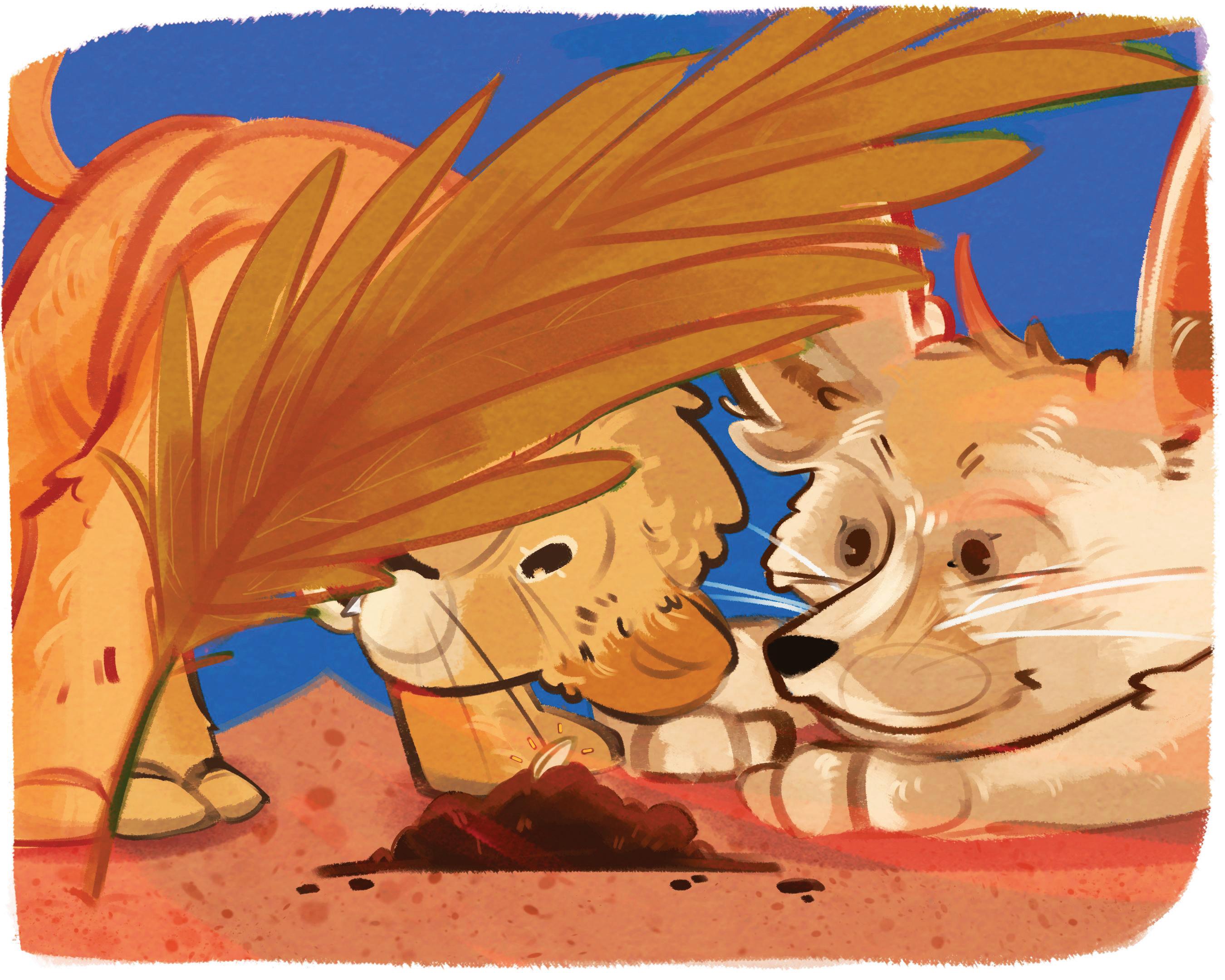
Target Audience: Children aged 5–10 with autism spectrum disorder, sensory integration or emotional expression challenges, developmental challenges, or other neurodivergent traits.
Duration: 40–45 minutes.
Group Size: Up to 8 children.
Location: Private, quiet educational space adapted for sensory activities.
Facilitators: 2 educators (reader and assistant).
Table of the Program’s Sensory Activities Impact
Sense Activity Objective
Sight / Creativity
Touch / Hearing
Children observe ‘stars’ from an LED projector, daydreaming and hanging their own star.
Children feel the ‘wind‘ from a fan and hear the sound of rain from a rain stick.
Hearing / Sounds
Children listen to the sounds of percussion instruments (drum, shakers).
Hearing and Sight Integration
Tactile Sense / Blowing Sense
Movement / Motor Skills
Smell / Olfaction
Children hear animal sounds and identify them using picture cards.
Children blow through a straw to help animals escape from a box of grains.
Children plant a seed in the soil, water it, and place the plant in a sunny spot.
Aroma diffuser with natural scents.
Stimulate imagination, emotional reflection, and a state of calm.
Help children relax, focus, and listen attentively.
Introduce different sounds and develop rhythm.
Stimulates the association of sounds with visuals and explore the animal world.
Develop breath control, concentration, and motor skills.
Foster a sense of care, attentiveness, and connect the story to nature.
Create an atmospheric sensory background.
Benefit for the Child
The child learns to relax, dream, imagine, and create a safe personal space.
The child experiences the calming effects of wind and rain, enhancing sensory awareness.
The child learns to play rhythmically, distinguish sounds, and express emotions through sound.
The child learns to recognize and identify sounds, improving attention and memory.
The child learns to blow purposefully, reveal the animal, and engage in play.
The child learns to nurture, plant, and understand the growth cycle.
The child associates scents with emotional calmness.
Story Excerpts and Activity Prompts
Story Excerpt Activity Materials needed
The educator invites the children to sit comfortably (for example, on a carpet, cushions, or simply in a circle).
They are encouraged to calm down for a moment and quietly look ‘at the sky.‘
‘And at night the stars light up cozily between the branches. You can secretly watch them and purr peacefully.’
The educator gently invites the children to dream for a bit and asks a few questions, such as:
Have you ever seen a starry sky?
Do you know any constellation or planet?
If you could, what wish would you make to a star right now?
Each child is given a pre-prepared star (for example, made of paper with adhesive on the back).
The educator explains that now everyone can choose a place in the room (on the wall, board, or another designated area) where they would like to ‘hang‘ their star.
The educator then approaches each child individually and gently blows air with a small fan.
Astronaut – white star projector (for observing stars).
Star cutouts, sticky tack.
‘The wind could gently caress it. The rain could wash it.’
‘And a drum made of oxhide. When someone beat the drum, the whole savannah resounds.’
(It is important to do this calmly, slowly, and without startling the children.)
After the ‘breeze,‘ the educator takes a rain stick (an instrument that imitates the sound of rain) and slowly walks around the children, letting them hear the ‘rain.‘
The educator shows the children a small drum or a similar percussion instrument (such as shakers, small tambourines, or homemade drums from a musical instruments kit).
Then briefly explains how to use it:
– ‘To drum means to tap gently but rhythmically.‘
Small fan.
Rain stick.
– ‘Let’s listen to how the sound changes when we drum softly… and when we drum louder.‘ A musical instruments kit.
Story Excerpt Activity
The educator prepares cards with pictures of animals and birds (e.g., lion, elephant, monkey, parrot, eagle, etc.).
– It is recommended to have one card per child or a set (if there are fewer participants).
Materials needed
Colorful animal pictures (e.g., lion, elephant, zebra, monkey, parrot, eagle, etc.)
‘The Lion cub needs to get acquainted with the neighborhood of animals and birds.’
‘The kind Elephant helps them by holding onto his trunk.’
– The cards should be plain, colorful, and easily recognizable.
A recording is also prepared, featuring the sounds of the selected animals or birds.
– Each sound should be played separately, with a short pause in between.
The first sound is played (for example, a lion’s roar).
The children raise the card with the animal they think they heard.
The educator prepares a sensory box filled with grains or sand and hides small jungle animal figures inside (e.g., monkey, parrot, tiger cub, snake, etc.).
– It is recommended to use easily recognizable animals.
Each child is given a straw their ‘elephant’s trunk.‘
– The children use the straw and gently blow through it to ‘rescue‘ an animal from the box.
Audio recordings (animal and bird sounds)
– A phone, tablet, computer, or speaker can be used.
Sensory box (plastic container, box, or other vessel).
Grains or sand (e.g., millet, semolina, etc.).
Disposable straws.
Small animal figures.
‘Nothing grows in the sand. But they still climb to the top. They put a handful of soil there. And plant a seed. There is just enough light here. And they stick a palm branch next to it so that the shadow falls.’
The educator prepares small pots, a container of soil, and seeds (e.g., beans, peas, or sunflowers).
– It is recommended to have one pot per child.
– Seeds should be large enough for children to easily pick up and plant.
Water for watering should also be prepared — this can be small watering cans or household spray bottles.
Children scoop soil with their hands, plant the seed in the pot, water it, and place the pot in a sunny spot.
– The educator briefly explains that the seed ‘drinks light‘ and warmth, just like in the story.
Tips for the Librarian / Educator
Small plastic pots (one per child).
Soil (in a bucket, box, or bowl).
Seeds (e.g., beans, peas, or sunflowers –large and easy to plant).
Small spray bottles or watering cans for watering.
• Encourage children’s self-expression and emotions. Let the children create their own stars, plant their own seeds, and recognize their own emotions.
Allow them to make their own ‘best gift‘ it might be a smile, a drawing, or a friend’s hug. After the session, the children can take their pot home, keep it in their classroom or kindergarten group, or donate it to the library.
• Use story fragments. During the activity, fragments from The Best Gift story can be used playfully and interactively, engaging children’s bodies and imagination.
For example:
– When the story says ‘boom boom boom,‘ children can clap their hands on the floor or table to imitate the sound.
– When ‘mom stretches well,‘ everyone can stretch and raise their hands high.
– The phrase ‘thud thud‘ invites them to jump like little animals.
– ‘Sniff sniff‘ is a fun way to pretend to sniff left and right with their noses.
• Stories as a reflection tool. Ask the children: When have they felt like the little lion?
Have they ever received a gift that seemed useless at first but later became precious?
This helps children understand their emotions, behavior, and reactions the first step toward emotional literacy.
• Be flexible. Not every child will engage in the same way. Some will talk, others will observe, and some will only touch or move. Every form of participation is valuable the most important thing is that they experience joyful and meaningful moments.
‘WHERE ARE YOU OFF TO, LEON?’
Masha Ogrizek, illustrated by Khrystyna Valko
Written by Milda Kazernovičiūtė LEVEL II
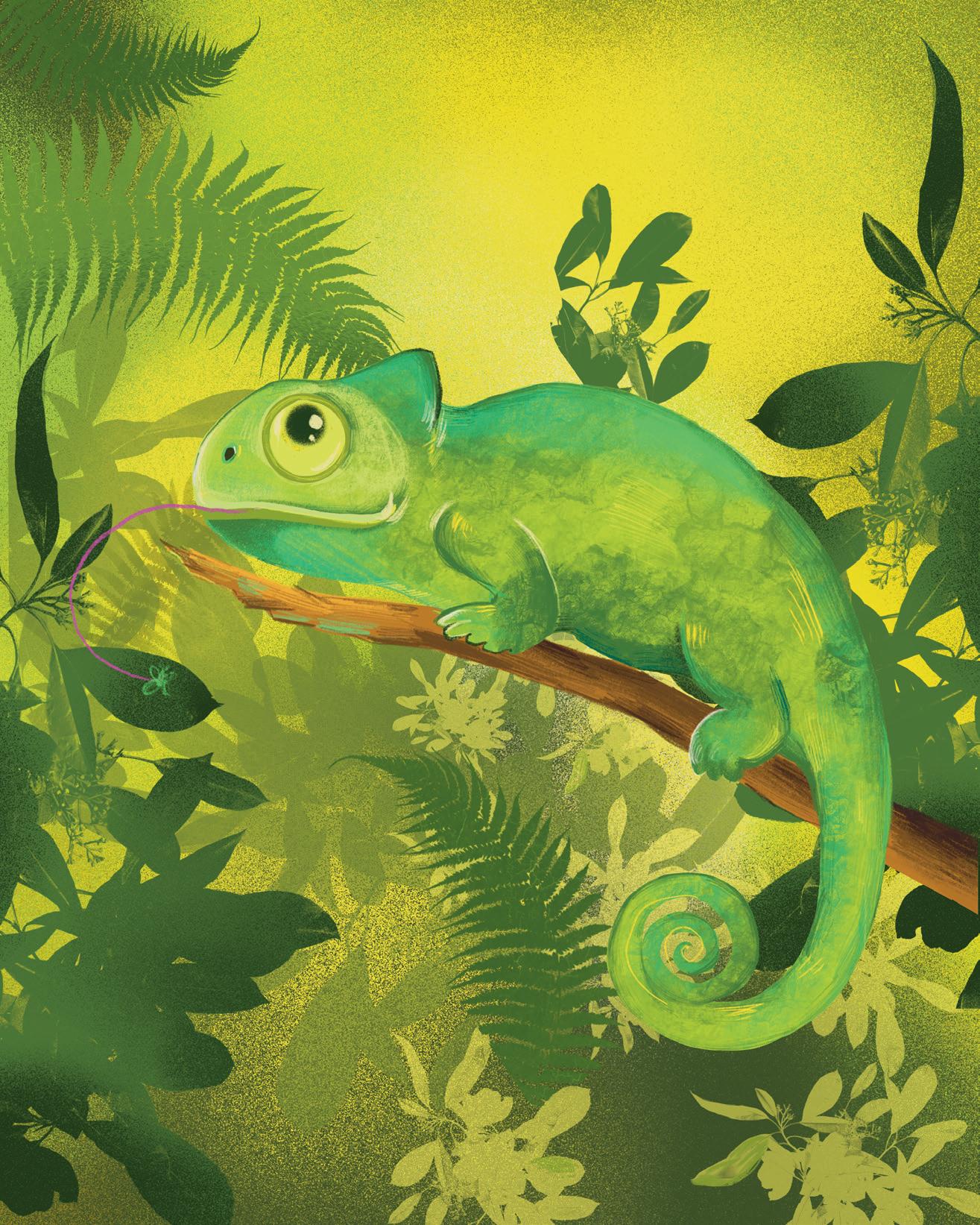
Target Audience: Children aged 5–10 with autism spectrum disorder, sensory integration or emotional expression challenges, developmental challenges, or other neurodivergent traits.
Duration: 40–45 minutes.
Group Size: Up to 8 children.
Location: Private, quiet educational space adapted for sensory activities.
Facilitators: 2 educators (reader and assistant).
Table of the Program’s Sensory Activities Impact
Sense Activity Objective
Tactile sense (Touch)
Eyesight / Visual Analysis
Exploring various textures: tree bark, sticky pads, wooden blocks, modelling clay, green plants (leaves, moss).
Observing colours, shapes and lights: light table, colour projector, different colour-based activities.
Eyesight + Tactile sense
Smell / Olfactory Sense
Hearing
Drawing objects in red using different tools; making small balls from crepe paper.
Smelling scents (strawberry, rose, plant aromas).
Listening to nature sounds, rain stick, music.
Movement Sense / Proprioception
Eye-movement exercises imitating Leon.
Encourage conscious tactile experience and develop tactile differentiation.
Develop colour recognition, contrast and light perception, and emotional associations with colour.
Develop integration between touch and eyesight.
Encourage scent recognition and association-building.
Develop attentive listening, relaxation, and focus through sound.
Develop eyemuscle mobility and coordination; improve visual focusing and tracking.
Benefit for the Child
The child explores surfaces, develops motor skills and tactile awareness, and forms connections between sensations and meaning.
The child enhances attention, visual curiosity, colour recognition, and activates imagination.
Strengthens connections between visual input and understanding.
The child develops olfactory differentiation.
Emotional stability, ability to calm down, improved sound recognition.
The child improves eyemovement control and coordination, supports attention concentration and the ability to maintain visual focus.
Story Excerpts and Activity Prompts
Story Excerpt Activity Materials needed
‘Leon liked to roll his big eyes. No one was better at it than he was! He could also stretch his tongue very, very far. His skin resembled tree bark, as if he were very old – though he was actually young. He could coil his long tail into a ball, just like a young fern coils its leaves. And, like all chameleons, he could change his colour.‘
The educator invites the children to ‘roll their eyes‘ like Leon. Then the educator gives them an ‘eye ball‘ – an anti-stress toy that the children can twist or stretch.
The children are invited to touch the tree bark so they can imagine what Leon’s skin might feel like.
The children are given a sensory toy that can be twisted or bent, helping them imagine how Leon’s tail might move.
Anti-stress toy.
Tree bark (skin).
Calming toy.
‘Soon, he reached Yellow Town, which was surrounded by city walls made entirely of corn cobs.
– Yellow’s the flag, and we’re all the same hue, Who stands at the gate –pray, tell, who are you?.‘
Children are encouraged to explore and experience the atmosphere of the Yellow City through touch and visual sensations. Each child receives one yellow sensory item – this may be a wooden block, a nut, a bolt, a silicone suction toy, a sensory ball, or any other yellow object.
The educator invites the children to take part in a collaborative creative activity –building the ‘Yellow City‘ on the light table, arranging their items and creating their own building or part of the city.
The educator encourages the children to describe what they feel when touching different materials, what the textures are like, and what associations the colour yellow brings to them.
Silicone suction toys
Nuts and bolts.
Wooden blocks.
Round light table.
‘One morning, Leon really wanted some strawberries. And roses. He set off for the market very early, hoping to avoid meeting anyone. But as he approached a stand piled high with deliciously fragrant strawberries, he immediately … changed colour, of course!‘
The educator presents strawberry and rose scents and reminds the children to smell carefully – not too strongly, but to take a gentle breath so the scent feels pleasant and not overwhelming. The children take turns smelling the scents, trying to recognise whether it is strawberry or rose.
Additionally, the educator may ask the children to describe the scents: Are they sweet, fresh, pleasant?
A scent recognition game.
Story Excerpt Activity Materials needed
‘Everyone in Red Town was indeed red – first and foremost the Queen of Hearts, who could not stand anyone different from herself. Leon now only ate strawberries, cherries, tomatoes, and red bell peppers. He drank beetroot juice and kept roses in a vase on his table. But sooner or later, one gets tired even of roses –and of sweetheart queens.‘
Children are invited to draw red-coloured fruits, vegetables and flowers –strawberries, cherries, roses, tomatoes. The educator provides various drawing tools: markers, pencils, crayons, and a large sheet of paper for a collective red artwork.
A large sheet of paper, Red-colored drawing materials: crayons, pencils, markers, gouache, or watercolor.
‘“Go to Green Town!” he shouted. So Leon did. He walked for seven long days and seven nights. Finally, he found himself beneath city walls built from giant watermelons.‘
The educator turns on a light projector that fills the room with a soft green glow and plays forest and nature sounds –birdsong, gentle rustling leaves, the murmur of a stream. Children are invited to settle in comfortably and set off on an adventure through the Green City. The educator invites the children to close their eyes, take a deep breath and feel the colours, sounds and scents of the environment. The educator approaches each child and offers a scented leaf to smell. (Children may also be given green leaves, moss or other natural materials to explore their texture.)
The educator encourages the children to share what they feel and what thoughts or emotions this experience brings.
Ocean projector with green light and nature sounds.
Scented leaf: cut a leaf shape from a dish sponge, attach a stem, and pour on essential oil (eucalyptus or another green plant scent).
‘Thus, he was sent away to Blue Town. The queen there was not very wise and not very fair, just like the rulers of the other towns.‘
Children are offered to create their own inhabitant of the Blue City using blue modelling clay or plasticine. Ocean or rain sounds play in the background. The educator walks around with a rain stick, moving it gently to create a calm, dreamy atmosphere. At the end of the activity, the children briefly present their character: what it looks like, what it feels, how it lives.
Blue modelling clay or plasticine, activity tray, rain stick.
Story Excerpt Activity Materials needed
‘As he held a large glass full of colourful fruit, he instantly became multicoloured himself. But in Colourful Town nobody was bothered by that. “How nice!” you might think. And it was nice indeed.‘
Children are invited to decorate the chameleon as in the Multicoloured City. The educator prepares a chameleon outline and coloured crepe paper. The crepe paper is torn into small pieces and distributed to the children. They roll small colourful balls from the paper. The educator applies glue to the chameleon outline, and the children take turns sticking their paper balls onto it until the entire chameleon becomes colourful.
Tips for the Librarian / Educator
Chameleon outline, coloured crepe paper, glue.
• Introduce children to basic chameleon biology: briefly explain that chameleons can change colour, which helps them hide or show their emotions. Describe how their eyes move independently and how their tongue is very long and fast – this will help children better understand Leon’s characteristics.
• Use visual aids: show photos or short video clips of chameleons changing colour, moving their eyes and catching prey with their tongue, so children can form clear visual associations.
• Adapt activities to the children’s age:
– for younger kids, provide more sensory-based activities and fewer verbal tasks;
– for older kids, include activities that incorporate emotional content (‘When do you feel like Leon?‘) and encourage storytelling.
• Encourage cooperation: during collaborative tasks, such as creating a group poster or building the city, promote idea-sharing and collaboration.
• Use aromatherapy: because the session has an atmospheric tone, you can enrich it with a subtle scent background. Throughout the reading and activities, diffuse gentle, calming aromas – forest notes or lavender. The scent should be very light and unobtrusive.
• Prepare printed and laminated chameleon figures: have a large-format illustration of chameleon to show in each new city. For every city prepare a differently coloured chameleon (yellow, green, blue, red, multicoloured). When introducing a new part of the story, ‘change’ the chameleon by showing its new colour. This helps children follow the storyline visually, maintains their attention, and strengthens emotional engagement with Leon’s journey.
• Use walking as a transition between the cities: this ‘travel ritual’ helps children refocus, shift from one city atmosphere to another, and immerse themselves more deeply in the story.
‘SPIN THE PLATE, SPIN THE WORLD’
Rita Sineiro, illustrated by Tamara Rimele
Written by Giedrė Čarienė LEVEL II
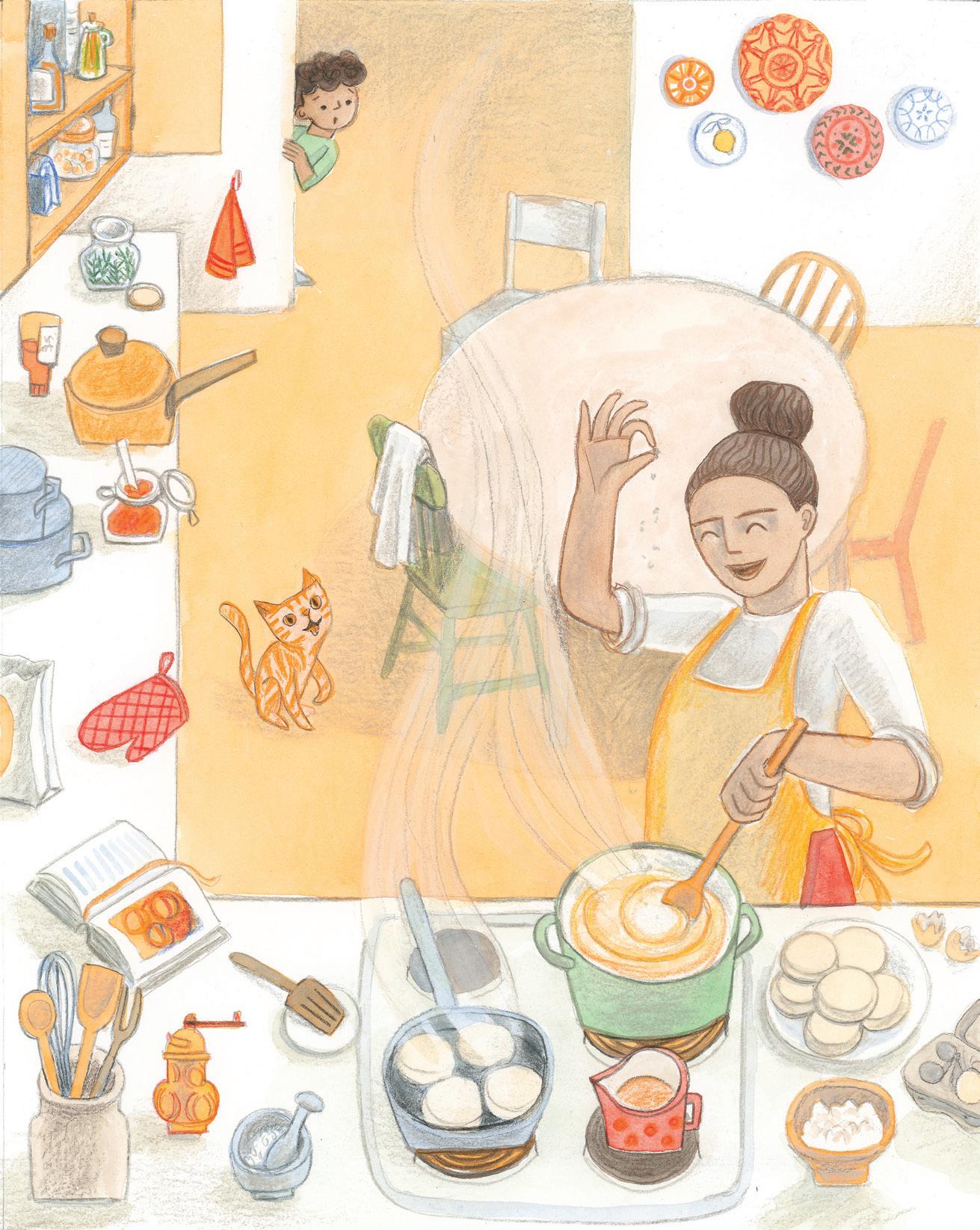
Target Audience: Children aged 5–10 with autism spectrum disorder, sensory integration or emotional expression challenges, developmental challenges, or other neurodivergent traits.
Duration: 40–45 minutes.
Group Size: Up to 8 children.
Location: Private, quiet educational space adapted for sensory activities.
Facilitators: 2 educators (reader and assistant).
Table of the Program’s Sensory Activities Impact
Sense Activity
Eyesight / Cognition
Showing a map and talking about countries and their traditions.
Tactile sense / Movement Building a tower from sticky pieces.
Eyesight / Cognition
A plate with cards –children assemble a food surprise.
Eyesight Recognizing photos (from near and far).
Color symbolism / Eyesight
Smell / Olfaction
Sorting colored objects into matching color spots.
Scent lotto –identifying smells, including a mystery scent.
Emotional / Tactile Sense
Hugging or gently stroking a soft toy or scarf.
Objective
To encourage cultural curiosity, geographical awareness, and language expression.
To promote cooperation, creative engagement, and proprioception.
To stimulate creativity, introduce food concepts, and encourage social interaction.
To develop visual analysis, curiosity, and cognitive skills.
To support color recognition, organization, and focus.
To develop the sense of smell, attention, and the ability to connect sensory input with experience.
To foster emotional literacy, self-acceptance and acceptance of others, to create a sense of calm.
Benefit for the Child
The child develops environmental awareness, shares personal experiences, and connects stories with the real world.
The child improves fine motor skills, experiences a sense of community, and learns to create together.
The child learns to make choices, share experiences, and engage in group discussions.
The child learns to notice details and recognize food from different perspectives.
The child enhances visual perception and classification skills and connects colors with emotions
The child learns to differentiate scents, builds curiosity, and strengthens memory.
The child experiences gentleness, develops empathy, and discovers inner peace.
Story Excerpts and Activity Prompts
Story Excerpt Activity Materials needed
Prior to the activity, the educator prepares a world map (a larger printed format may be used).
The countries mentioned in the story are marked on the map: Ukraine, Lithuania, Slovenia, Portugal.
‘Sis, who is much older than me, has traveled the world.’
‘This is the first Sunday, and on my plate sits a tower so high that it touches a creamy sky with tiny blue fruit balloons.’
The educator invites the children to gather around the map, points to the marked countries, and may ask:
– ‘Do you know where this country is?’
– ‘Has anyone been there?’
– ‘What do you know about this country?’
Together with the children, the educator can discuss what foods or traditions might be associated with these countries.
Prior to the activity, the educator prepares a base for building the tower (e.g., connecting several suction toys into a firm foundation).
Each child receives 1–3 pieces of toy.
The educator reminds the children of the story episode: ‘This is the first Sunday, and on my plate sits a tower so high that it touches a creamy sky with tiny blue fruit balloons.’
The children take turns coming up and sticking their sticker onto the shared tower.
World map or world globe with stand.
‘It’s the second Sunday, and my plate is full of surprises. I wonder if I can guess. It tastes like cheese, it tastes like mushrooms.’
‘Sis spins a record, and it’s like a lively band is playing in our kitchen.’
The educator prepares paper or plastic plates and makes cards with drawings of various foods (e.g., cheese, mushrooms, berries, vegetables, bread).
The cards are mixed into small sets.
Each child receives a plate and a shuffled set of cards.
The children place the cards on their plates in any way they like.
Each child looks at their own ‘food surprise.’
Together, the group discusses which plates look the most delicious and which ones look the funniest.
Silicone suction toys.
Paper or plastic plates.
A set of cards (can be printed out).
While completing the task, cheerful Lithuanian music can be played (e.g., folk music or a popular children’s song).
Story Excerpt Activity Materials needed
The educator prepares slides or photos of various foods.
The first photo shows food in close-up (e.g., orange peel, strawberry seeds, holes in cheese).
The educator shows the close-up photo and asks: ‘What could this be?’
The children guess.
‘Eating is like exploring.’
‘Sis fills the kitchen with color, and outside she launches a glowing balloon into the sky.’
‘And inside the bonbons, we hid... Strawberrypepper, chili and caramel, lettuce filling with orange, honey cream with olive, crunchy almond and onion.’
After several guesses, the full photo is shown, revealing the answer.
The educator invites children to share whether they have tasted that food and whether they like it.
The next slide shows a zoomed-out photo of the same food item so the whole object is visible.
The educator arranges ‘color spots’ on the table or floor (e.g., red, green, yellow, blue).
Pre-prepared colored objects are placed together in one basket.
Children take turns choosing one object from the basket and placing it in the correct color spot.
The educator prepares different scents. Children take turns smelling a jar and guessing the scent.
If guessing is difficult, the educator offers a hint:
‘You might smell this in the kitchen... ’
The educator also prepares one ‘mystery scent’ that was not mentioned earlier.
The children try to guess it as well.
Children are invited to hug.
If they feel comfortable, they may also hug the friend next to them.
Slides of various foods.
Projector.
A basket for putting items in.
Various colorful objects.
Scent recognition game.
‘Eating is like giving hugs.’
Another option is to take a soft toy, cushion, or scarf and gently stroke it.
Everyone pauses for a moment, closes their eyes, and feels calmness and warmth.
Tips for the Librarian / Educator
Soft toy.
A scarf.
• Use a song or rhythm at the beginning of the session. Start the activity with a simple song or a rhythmically repeated phrase, such as ‘Spin the plate, spin the globe.’ You may add clapping or gentle movements. This helps children understand that the session is starting, focuses their attention, and adds a playful tone to the story.
• Use kitchen-themed symbols in the activity. The educator may put on an apron and prepare a few kitchen-themed items in the space (e.g., a spoon, bowl, or pan). This helps children feel as if they are in a home kitchen, strengthens sensory engagement, and supports immersion in the story’s atmosphere.
• Include the recurring phrase ‘Spin, spin, spin’ in the activity. Each time this phrase appears in the story, invite the children to say it aloud together, clap, or make circular hand motions.
This becomes an additional engaging action that helps maintain attention, builds a sense of togetherness, and adds rhythm and playfulness to the story experience.
• World Disco.
After the reading (if time allows and children remain focused), you can play short music pieces from different world cultures and organize a fun dance game.
This gives children a joyful way to move after sitting and allows them to experience different cultures through sensory exploration—through both hearing and movement.
‘YES DAYS AND NO DAYS’
Adélia
Carvalho, illustrated by Maria Kozyrenko
Written by Vaida Antanaitienė LEVEL II
Target Audience: Children aged 5–10 with autism spectrum disorder, sensory integration or emotional expression challenges, developmental challenges, or other neurodivergent traits.
Duration: 40–45 minutes.
Group Size: Up to 8 children.
Location: Private, quiet educational space adapted for sensory activities.
Facilitators: 2 educators (reader and assistant).
Table of the Program’s Sensory Activities Impact
Sense / Competence Activity
Tactile sense
Auditory sense
Exploring sensory materials in a cozy hideout.
Listening to bird sounds.
Objective
To provide a safe and calm space where the child can observe, touch, and explore the environment.
To strengthen children’s auditory perception, sound recognition, attention, and calm presence.
Benefit for the Child
The child develops a sense of emotional security. The activity stimulates imagination and curiosity.
Develops the child‘s auditory perception and sound differentiation. Encourages patience and attentive listening.
Proprioception
Throwing and catching ‘clouds‘
Eyesight + Tactile sense
Drawing the sky.
Vestibular system (sense of balance)
Breathing (oral motor skills)
Stacking balancing stones.
To stimulate visual and proprioceptive senses through play with a soft, air-filled white bag.
To develop fine motor skills, color perception, and imagination.
To develop balance, hand coordination, focus, and patience through play.
Blowing feathers.
To develop oral motor skills and breath control.
Improves coordination (throwing and catching). Enhances body awareness (proprioception).
The child expresses himself/herself through colors and shapes. Strengthens fine motor skills (drawing, gluing).
The child improves balance and hand coordination. Attention and focus are encouraged. Fine motor skills are developed.
Improves breathing, which supports speech development. Can be a calming sensory activity.
Story Excerpts and Activity Prompts
Story Excerpt Activity
‘Lia really likes silent days.
Lia likes to watch everything but doesn’t want to be seen herself.
Lia likes to listen, but she doesn’t like having to reply.
Lia likes safe places that are hers alone.’
Create a small ‘hideaway’ or tent corner – it can be a covered box, a little tent, or a cozy area with soft cushions.
Inside: a soft blanket, a gentle light source (e.g., a warm LED lamp, sensory balls), silicone suction toys, and tactile boxes.
The educator introduces the space:
‘This is your magical hideaway. You can simply be here. No one will disturb you.’
Children are invite d to explore quietly. Provide a variety of materials: tactile bags (warm, rough, soft, cool), silicone suction toys, small chains, sensory balls, and scented pouches (lavender, vanilla – only natural, soothing scents).
Children sit or lie down quietly. Only bird sounds are played – one bird call at a time, for a short period.
Materials needed
A tent, sensory balls, silicone suction toys and other sensory toys.
‘There, Lia saw things that nobody else saw.
The wind lifting the leaves into the air.
The rain falling gently, without wetting her hair.
The birds sang, and she enjoyed their music.’
The educator invites them to close their eyes and listen.
After each sound, a card with the bird’s image is shown.
Simple reflection questions:
• ‘How did this bird sing?’ (the child may respond through movement or facial expression, not necessarily words)
• ‘Was the sound high or low? Fast or slow?’
After listening, children are invited to ‘fly like birds’, moving according to what they heard (e.g., slowly like an owl, quickly like a titmouse).
The educator or children blow air into a plastic bag (using breath or a small fan).
The bag is tied tightly so the air stays inside.
You can name it – for example, ‘Lija’s Cloud.‘
Recordings of real bird calls, and cards with bird illustrations or symbols.
‘On those days, the ball was her favorite home. It was like a safe shell, it was like a soft cloud.’
Children touch the bag:
‘How does it feel? Cold? Soft?‘
They throw the cloud up in the air and observe:
‘How does it fall? Does it come down fast or slowly?‘
They can toss and catch it alone or in pairs.
White (light blue) garbage bags (large, sturdy), string or tape.
Story Excerpt Activity
Each child receives a sheet of paper (A4 or larger) and art materials: pastels, crayons, markers, or watercolor.
Materials needed
‘Noa drew a dinosaur and gave it to her. Lia picked up a blue pencil and drew the sky onto Noa’s drawing.’
Invite everyone to draw only the sky no other objects unless they wish to add the sun, stars, rain, or a bird.
When everyone finishes, connect all sheets into one long sky panorama using tape or by arranging them on the wall.
This creates a single, colorful sky made of many unique pieces.
Short reflection:
‘All our skies are different. But do you see any similarities?‘
Each child receives several small stones.
Sheets of paper, roll paper (wallpaper), glue, pastels, crayons, markers, watercolor.
‘Another day, Noa brought pebbles. They counted them together and stacked them up.
One, two, three, four, five, six, seven... Noa also loved counting and gathering things.’
‘On another day, Lia brought something else.
She brought a light green, very soft feather.
— Look, Noa, see how it flies — she said, and blew.’
The educator demonstrates how to build a stone tower — stacking one stone on top of another carefully.
The goal is to stack as many as possible without collapsing.
If vertical stacking is too hard, children can arrange them horizontally focusing on shape and balance instead.
Afterward, count how many stones were used and observe their colors.
The educator can use number or symbol cards to help visualize results.
The educator shows feathers and invites each child to take one and explore it.
Children try to blow the feather off the table or their hand.
If needed, the educator demonstrates how to blow gently.
For children who avoid direct blowing, provide straws instead.
You can use straws of different thicknesses to change the airflow and make the activity more engaging.
Tips for the Librarian / Educator
Balancing stones, number cards.
Feather, straws.
• Do not place too many stimuli in the hideouts – choose 3–5 sensory items, taking into account the children’s sensitivity levels. Do not force children to speak or share if they do not want to. Silence and observation are valid forms of participation. Observe, but do not interfere.
• The sound should be gentle. No background noise – only natural bird sounds. Let the children listen first. No pressure to speak or react.
• After each activity, have a prepared phrase to help reinforce the experience and naturally transition to the next step.
For example, after listening to bird sounds: ‘We listened to and recognised the bird sounds. Now we can continue reading and find out what Lija was doing.‘
This structure helps children feel safe and reduces the risk of chaos during transitions.
• Use only clean, new white bags for the ‘clouds’ – hygiene and safety are essential. This activity is suited for a calm, slow pace – do not rush, and do not force children to ‘play actively’ if they prefer to observe. Add gentle music or wind sounds – this enhances the calming effect.
• Use a visual sequence (pictograms/cards): ‘Pick up a sheet → Draw the sky → Stick it onto the group poster.’ Clearly indicate the start, steps and end of the activity, e.g.: ‘Now we are drawing the sky, then we will stick it onto the poster, and after that we will continue reading.’
• Do not emphasise ‘winning’. For example, when finishing a stone-stacking activity, highlight the process rather than the result: ‘You built 4 – wonderful!’
Children are free to choose which stone to use, which hand to use, and how to build. Children learn through trying – collapsing and instability are part of the process.
• Let the child choose what to blow with – this gives a sense of control. Some children need to visually see air movement – use brightly coloured feathers. If children have difficulty with breathing exercises, use alternative methods that do not require blowing through the mouth (e.g., a fan or a hand pump).
‘A STORY ABOUT GIRL OLIUNIA AND SQUIRREL PUSHYNKA’
Olena Lototska, illustrated by Marija Smirnovaitė
Written by Milda Kazernovičiūtė LEVEL II
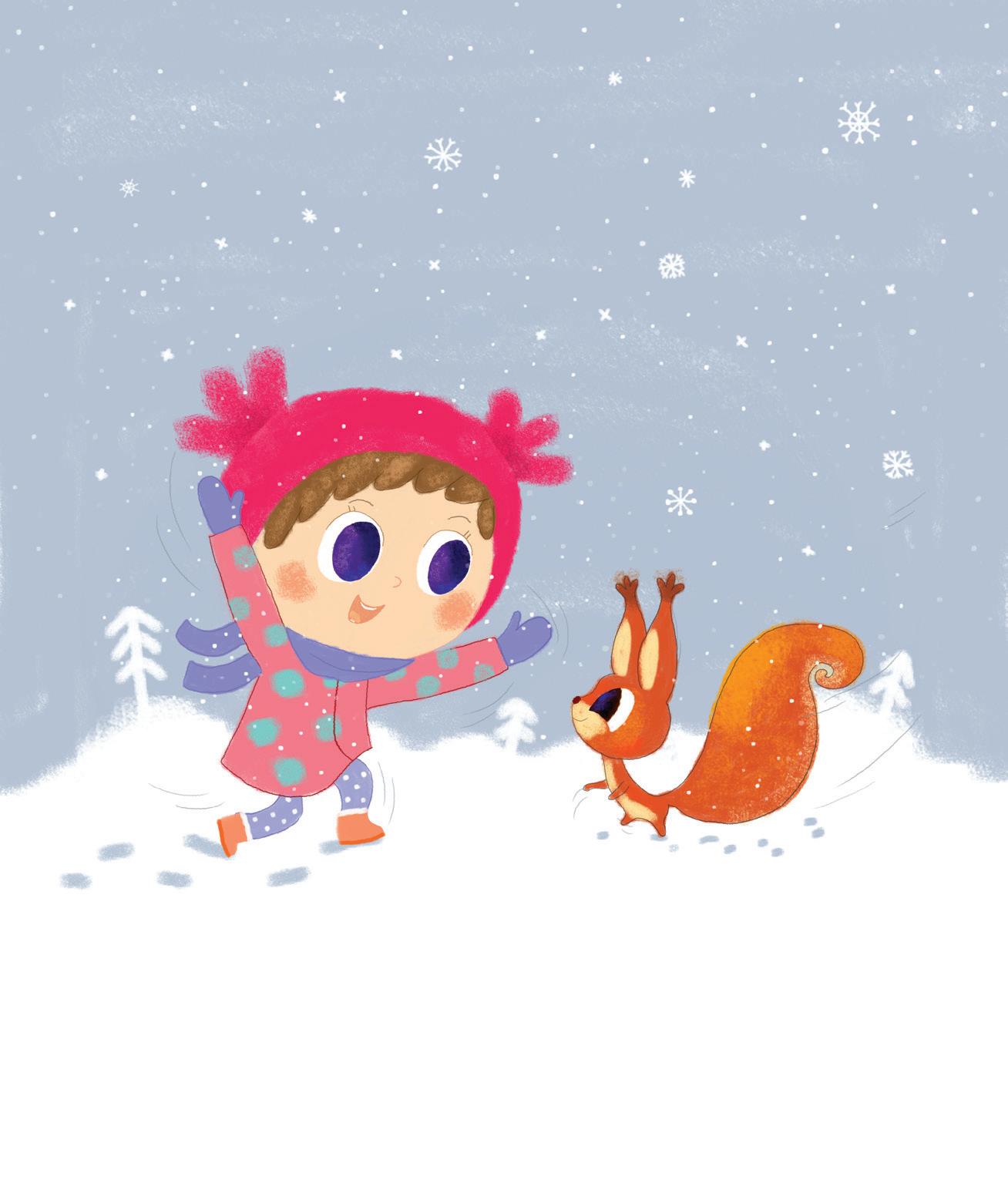
Target Audience: Children aged 5–10 with autism spectrum disorder, sensory integration or emotional expression challenges, developmental challenges, or other neurodivergent traits.
Duration: 40–45 minutes.
Group Size: Up to 8 children.
Location: Private, quiet educational space adapted for sensory activities.
Facilitators: 2 educators (reader and assistant).
Table of the Program’s Sensory Activities Impact
Sense Activity
Tactile sense / Temperature perception
Tactile sense (touch)
Auditory sense / Proprioception
Smell / Olfaction
Tactile sense/ Movement
Eyesight + Fine motor skills
Touching agrotextile imitating a snow layer and cold ice cubes.
Sorting nuts, acorns, chestnuts, and pinecones into different categories.
Rhythmic beating while saying ‘cok cok cok’.
Scent game – smelling tangerine, cinnamon, vanilla, and pine aromas.
Crawling into a play tent and hiding ‘nuts’ (sensory balls or natural materials).
Children draw or write a wish for animals and fold an envelope following a sample.
Eyesight + Touch
Eyesight
Children unwrap ‘surprises,’ exploring their shape, texture, color, and weight.
Children quietly observe nature objects through imitation binoculars (pictures, figurines).
Objective
To stimulate sensory exploration and perception of coldness.
To stimulate fine motor skills and nature awareness.
To develop motor coordination and sense of rhythm.
To train scent recognition and olfactory attention.
To promote physical activity, role play, and creativity.
To enhance visual and tactile coordination.
To stimulate sensory exploration, recognize different materials and focus on tactile experiences.
To foster attention to detail and teach quiet, careful behavior in nature so as not to scare animals.
Benefit for the Child
Develops tactile perception and strengthens sensory awareness.
Improves hand coordination, attention, and recognition abilities.
Enhances rhythm perception and body movement awareness.
Strengthens scent memory.
Develops motor skills, encourages imaginative play, improves social interaction and focus.
Improves fine motor skills, visual coordination, imagination, creativity, and empathy.
Improves sensory sensitivity, curiosity, and ability to distinguish textures, colors, and object properties.
Strengthens focus, visual acuity, patience, and understanding of respect for nature.
Story Excerpts and Activity Prompts
Story Excerpt Activity Materials needed
-‘You won’t believe what happened!’ the girl exclaimed.
‘I befriended a squirrel! And talked with her!’ Parents shared a look.
-‘What do you mean, “talked”?’
-‘I’ll wash my hands and tell you everything!’
In a moment, Oliunia ran out of the bathroom, shook the water off her hands, and enthusiastically chattered, ‘Chik-chik-chik!’
The educator demonstrates the following movements to the children: 1) Imitates shaking off water drops from their hands – shaking hands to the sides.
2) While saying ‘Chik-chik-chik’, everyone claps their hands rhythmically.
No additional materials are required.
-‘It’s likely. Squirrels have many treasures: in tree hollows, rotten tree stumps, and burrows. They probably hide something and then forget. Deep snow is another reason why the animals cannot reach their food.’
The educator explains that squirrels hide nuts in different places for the winter – in tree hollows, stumps, or burrows – and that snow sometimes makes it difficult for them to find their food later on.
Each child receives a ‘nut’ – this can be a natural material (such as chestnuts, acorns, pine cones) or soft sensory balls. One by one, the children crawl into a small play tent and leave their ‘nut’inside (the ‘burrow’), pretending to be squirrels hiding food for winter. During the activity, the educator encourages the children to act like squirrels and talk about how animals prepare for the cold season.
Play tent, natural materials, sensory balls.
Story Excerpt Activity Materials needed
The educator briefly explains the change from autumn to winter – how the weather becomes colder, the trees lose their leaves, animals prepare for winter, and the surroundings turn white and frosty.
‘After early autumn warmth, late October’s snow covered the signs marking squirrels’ stockpiles. The girl got nervous – what would Pushynka eat? Dad calmed her down.’
Then, the educator and assistant gently walk around the children holding a piece of white fabric (for example, agro-fiber) stretched out to imitate snow. The children can watch and touch it. The fabric is then softly lowered to the ground, creating the effect of a snow layer. The children are invited to touch the ‘snow’ while the educator explains how it covers the garden and makes life harder for animals in winter.
Next, the educator gives the children pieces of ice to touch and encourages them to describe what they feel – the cold, smoothness, and hardness. The group discusses how cold weather affects animals and plants in winter.
A large piece of white agro-fiber, a bowl with ice cubes.
‘The girl put hazelnuts, acorns, and walnuts into the plate Dad carried to the garden.’
The children are invited to touch and explore different natural objects –nuts, acorns, seeds, chestnuts, pine cones, and beans. Each type is placed into a separate small box or container. The educator asks the children to say their names aloud.
Various natural materials (nuts, acorns, chestnuts, beans, pine cones), 5 containers for sorting.
‘She also mentioned her dream: binoculars to watch animals from afar without scaring them.’
The educator hands out binocular imitations made from cardboard toilet paper rolls and explains how important it is to observe animals in nature quietly and carefully so as not to scare them away. The children look through their ‘binoculars’ to observe pictures or real objects – animals, trees, birds, and nature scenes. They are encouraged to share what they see, how they feel while observing, and to imagine how the animals live in their habitats.
Binocular imitations made from cardboard toilet paper rolls. Figurines or pictures of animals, trees, and birds.
Story Excerpt Activity Materials needed
‘The family council decided to write another letter on behalf of the birds and animals, describing how useful they are for nature and people. There was only one request: let everyone get through winter safe and well-fed.’
‘The long-awaited holiday morning arrived. The air was filled with the aroma of tangerines and Mom’s linden tea. This year, everyone behaved well and received their gifts.’
The group briefly discusses what animals need most in winter and what the children themselves would wish for if they were animals. Each child is invited to come up with one wish for animals or birds – that they stay warm, safe, and well-fed during winter. They write or draw their wish on a small piece of paper and fold it into an envelope following the educator’s example.
The educator offers the children several scents to smell: mandarin, cinnamon, vanilla, pine, and linden blossom tea. The children try to identify which scent reminds them most of mandarins and talk about the smell of linden tea.
Then the educator says: ‘Pushynka brought a present! Maybe she left some surprises for you too?
White and colored paper, writing and drawing tools.
A scent-recognition game, or real tangerines, a pine twig, or linden blossom tea can be used.
‘-Hazelnut in its shell!’ Oliunia continued excitedly. But we put cleaned ones into the feeder! This means Saint Nicholas also visited Pushynka! She brought the gifted nuts to thank us for taking care of her!’
The educator gives each child a small sensory surprise wrapped in foil or paper.
The children unwrap their little gifts – sensory balls or small tactile toys (for example, antistress toys, silicone suction toys, wooden screws, or miniature wooden desserts) – and explore their shapes, textures, colors, and weight. They can play briefly or describe how the object feels to touch.
Tips for the Librarian / Educator
• Repetitions
Silicone suction toys.
Soft sensory balls. Antistress toys.
Each time the words ‘Chik-chik-chik!’ appear in the book, the educator and the children repeat the sound together, clapping rhythmically.
This encourages active engagement with the story, develops rhythm, and stimulates sensory activity.
• Sound and Visual Background: Before reading the paragraph ‘After early autumn warmth, late October’s snow covered the signs marking squirrels’ stockpiles.’ project an autumn scene and play the sound of rustling leaves.
After reading this paragraph, change the projection to a winter landscape and play winter sounds, such as snow crunching or wind whistling.
This helps the children experience the change of seasons and feel the atmosphere of the story.
• Character – The Squirrel
To help the children identify with the story’s main character, use a plush squirrel toy.
It helps them visualize the squirrel’s world and serves as a fun educational aid during the activity.
(If you have a character puppet or toy, you can include a short greeting interaction, for example, letting the squirrel ‘say hello’ to the children.
This encourages emotional connection and enhances engagement.)
• Transition Phrases
After each activity, have a short prepared phrase that helps the children reflect on what they’ve done and smoothly move to the next task.
For example, after the children hide the ‘nuts’ inside the tent, you might say:
‘You’ve hidden your food perfectly, just like real squirrels! Now let’s see how snow can make it harder to find it…’
• Additional Reflective Questions
• Why do you think the squirrel hides nuts?
• How do you think the squirrel feels in winter when the snow covers her hiding places?
• What could we do to help forest animals and birds during the winter?
• What did we learn from the squirrel’s preparations for winter?
‘LUCY AND THE BUTTERFLY’
Ignė Zarambaitė, illustrated by Darka Erdelji
Written by Milda Kazernovičiūtė LEVEL II
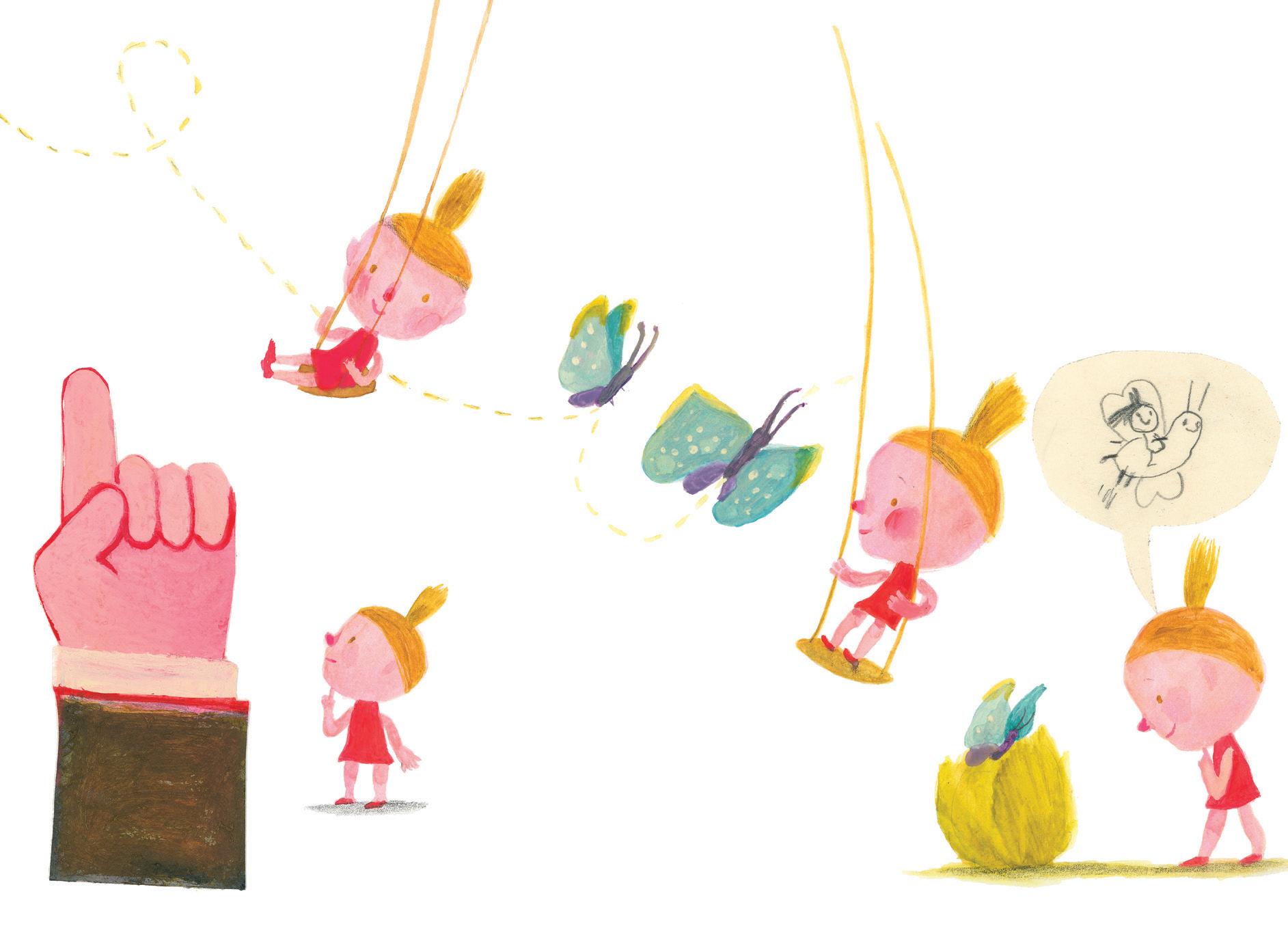
Target Audience: Children aged 5–10 with autism spectrum disorder, sensory integration or emotional expression challenges, developmental challenges, or other neurodivergent traits.
Duration: 40–45 minutes.
Group Size: Up to 8 children.
Location: Private, quiet educational space adapted for sensory activities.
Facilitators: 2 educators (reader and assistant).
Table of the Program’s Sensory Activities Impact
Sense Activity Objective
Tactile sense (touch)
Touching objects with different textures (fabrics, glass, a squishy ‘strawberry’ toy, artificial grass, real grass.
Smell / Olfactory Sense
Eyesight
Exploring scents (rose, strawberry, natural scents) using natural or artificial aroma sources.
Watching colourful video clips, using colourful materials to create a butterfly.
Hearing (Auditory Sense)
Movement (Proprioception)
Listening to nature sounds, background music, sound imitation (‘crack‘,‘boom’); flapping arms when hearing ‘FLAP FLAP’.
Crawling, creeping, tiptoeing, flapping arms like a butterfly
Emotional Awareness
Multimodal Integration
Reflecting on loneliness, joy, anger, reconciliation.
Activities combining visual, auditory, olfactory and movement elements (e.g., nature visuals + nature sounds + plant scent + animal movements).
Explore different surfaces, develop sensory awareness, understand tactile differences.
Activate scent recognition and connect sensory experience with the story.
Encourage attention, colour recognition, and emotional response to visual stimuli.
Develop attentive listening, distinguish sounds, and respond to auditory cues.
Body movement control and involvement in the story’s action.
Recognise and name emotions, develop empathy.
Benefit for the Child
The child improves fine motor skills, enriches vocabulary through descriptive language, develops tactile sensitivity
Enhances memory and associative thinking, calms the nervous system, strengthens the link between scents and emotions, develops attention to olfactory stimuli.
Develops aesthetic awareness and imagination.
Learns to react to sound signals, recognises calming sounds.
Expresses themselves through movement, improves coordination, practices role-play through motion.
Strengthens emotional intelligence, selfawareness, and the ability to talk about personal feelings and experiences.
Enhance understanding by integrating sound, sight, smell and movement.
Builds confidence, develops imagination, supports acceptance of personal uniqueness and expression.
Story Excerpts and Activity Prompts
Story Excerpt Activity Materials needed
Emotion cards.
• Loneliness – when Lucy feels alone without friends.
• Sadness – when the butterfly keeps flying away.
‘She doesn’t know her neighbors yet. Lucy is bored at home. She needs a BEST FRIEND to play with after school. The cat doesn’t make the best friends because it only cuddles around her brother. It doesn’t pay attention to her. Lucy calls out, “KITTY-KITTY! PUSS-PUSS!”
The cat pretends not to hear. Or deliberately goes in the opposite direction. Her brother does the same. He’s always busy with his own business.’
The educator reads an excerpt from the story in which Lucy feels lonely, ignored, and without friends. Children are given emotion cards with various visually appealing emotions. They should choose the card that best represents Lucy’s feelings in that part of the story (e.g., ‘Loneliness’). Then the educator asks: ‘How do you think Lucy feels when no one wants to play with her? Has this ever happened to you? What did you do then? How could we help a child who feels lonely?’
• Frustration – when Lucy doesn’t achieve her goal (e.g., when she sneezed).
• Anger – when she falls from the tree and blames the butterfly.
• Joy – when the butterfly appears again or when she meets the boy.
• Curiosity / Interest –when she notices the butterfly for the first time.
• Hope – when she tries again to befriend the butterfly.
• Regret / Understanding –when she lets the butterfly out of the jar.
• Pride – when she draws and improves her skills.
• Friendliness – when she invites the boy to look at her drawings.
‘<...> a BUTTERFLY landed on the rose bush. Lucy had never seen such a big, beautiful butterfly! A fluffy body, long antennae, and such beautiful wings! Blue, purple, and yellow. Black striped and white dotted.’
The educator gives the children a box filled with materials of different textures, patterns, and colors. The children explore them by touching and looking at them. The educator hands out butterfly templates prepared in advance. Using different sensory materials—cotton balls (softness), glitter (sparkle), crepe paper (smoothness), and various fabric scraps—the children decorate their butterflies. The educator asks: ‘Do you think your butterfly would feel happy? Why?’
Materials of different textures, patterns, and colors (cotton, glitter, colored fabrics, colored paper, crepe paper), glue, butterfly templates.
Story Excerpt Activity
‘The fragrant roses attracted more and more butterflies, but THIS one was the most beautiful of all.’
‘She took off her shoes and with bare feet SLUNK towards the bench. As if she was not a person, but a FOX. The grass tickled her feet so much that she could not help but - HEE-HEE-HEE - began to giggle. There were only a few steps left, but the butterfly, frightened by the noise –FLAP-FLAP – and flew away. What a shy little butterfly!’ ‘Later, Lucy noticed it resting on the lawn. Maybe now she will succeed? She CRAWLED on all fours like a CAT, then GLIDED on her belly like a SNAKE. The butterfly did not suspect anything, it was still warming itself in the sun. But the clover was so irritating to Lucy’s nose...’
‘And the next day the butterfly landed on a wooden bench near the strawberry field.’
The educator lets the children smell a rose scent from the scent game.
Materials needed
Scent recognition game (rose scent).
To help children see what a rose looks like, you can use a real rose or an artificial one.
‘She was climbing down and just – CRACK, CRACK, BOOM!’
A video showing nature scenes (fields, grass, etc.) is displayed on the screen. Nature sounds are played (birds chirping, wind). A diffuser with plant scents is turned on. The educator invites the children to walk on an artificial grass mat (they may take off their socks).
While walking, the children try to imitate movements: ‘freeze like a stone,’ ‘crawl like a cat,’ ‘slither like a snake.’
After the walk on the grass, the children are invited to return to their seats (and put their socks back on).
• Artificial grass mat or separate pieces that children could walk on.
• Video of nature scenes.
• Aroma diffuser with plant scents (lemongrass, lavender, eucalyptus).
• Speaker for playing nature sounds.
‘She was already lying on the grass, and a little further away – an empty net.’
On one side of the circle, the educator passes around a strawberry scent from the scent recognition game, and on the other side, an anti-stress toy is passed so that the children can squeeze it and exercise their hands.
Using various objects, the educator creates the following sounds: CRACK-CRACK (breaking a small twig; using a musical instrument), and BOOM (by hitting a drum).
The educator approaches the children with a bowl filled with fresh grass and flowers. The children touch the grass, smell it, and name any plants or flowers they recognize.
Scent recognition game, anti-stress toy.
Wood twig, musical instruments – drum, instrument for the CRACK sound.
Bowl filled with plants (grass and flowers).
Story Excerpt Activity Materials needed
‘She caught the butterfly and put it in a jar.’
‘She took the jar back to her room and carefully watched the butterfly.
“I am Lucy”, she introduced herself. “And what is your name? If you don’t have a name yet, I can choose one for you.”’
‘FLAP-FLAP – and the butterfly flew off the bench. But Lucy knew that it would fly back whenever it wanted. A boy sat where the butterfly had been.’
The educator gives each child a jar with a lid. The children place their butterfly inside a jar and close it. Each child comes up with a name for their butterfly and shares it. The educator asks the children: ‘How would you feel if you were a butterfly inside a jar? Why did Lucy want to close it? Is it possible to be friends when one of them is trapped?’
Guided by the educator, children flap their butterflies in a circle to calm music. Then the educator asks: ‘Why did Lucy let the butterfly go? What did she learn about friendship? Do you think Lucy will become friends with the boy?’
Tips for the Librarian / Educator
Jars with lids big enough for a butterfly.
Audio player (sound –‘lullaby 5’) with a night light for rest (green).
• Invite the children to take their butterfly home. This will strengthen their personal connection to the activity and encourage them to share their experience with family members.
• Each time the words ‘FLAP, FLAP’ are read, invite the children to lift their arms to the sides and gently flap their hands—like butterfly wings.
• Background sound: soft nature music, birdsong, and a gentle breeze to enhance the atmosphere.
• Characters – Lucy and the butterfly: to help children engage more deeply with the story and connect with the main characters, Lucy and the butterfly, use a small doll (Lucy) and a colorful butterfly (e.g., made of felt or plush). These props help the children visualize the story world and serve as emotional ‘bridges’ linking the child’s experience with the narrative. (If you have character dolls or toys, you can include a moment where Lucy and the butterfly greet the children—this creates a sense of closeness, encourages engagement, and strengthens the emotional connection to the activity.)
• Emotion cards can be used not only in the first (loneliness) scene, but also in other parts of the story—giving children the opportunity to identify Lucy’s feelings as they change throughout the narrative (e.g., when she is disappointed, angry, happy, or hopeful). This allows them to follow the character’s emotional journey and develop emotional intelligence throughout the story.
• Additional reflective questions
• Why did Lucy want so badly to become friends with the butterfly?
• Do you think the butterfly symbolizes something more than just an insect?
• How did Lucy’s emotions change from the beginning to the end?
• What does it mean to be a good friend?
• When can friendship be genuine, and when is it forced?
• What did Lucy draw in her picture?
• Let the children simply be. Not all children will engage actively right away. Some may prefer just to watch, listen, or touch only a few of the materials.
Recommended Books
Recommended reading list for sensory reading programmes:
1. Adam Guillain, Charlotte Guillain, Spaghetti with the Yeti
2. Benji Davies, The Storm Whale
3. Ciara Flood, Those Pesky Rabbits
4. Deborah Underwood, The Quiet Book
5. Emma Yarlett, Orion and the Dark
6. Eric Clarle, The Very Hungry Caterpillar
7. Julia Donaldson, Axel Scheffler, The Gruffalo
8. Julia Donaldson, Axel Scheffler, The Gruffalo’s Child
9. Marta Altés, Five More Minutes
10. Rob Scotton, Russell the Sheep
11. Stella Gurney, Rabbit and the Big Red Scooter
12. Stephanie Stansbie, What’s That Noise, Little Mouse?
13. Thierry Robberecht, The Wolf Who Fell Out of a Book
14. Tom Fletcher, There’s a Monster in Your Book
15. Valerie Thomas, Winnie the Witch
Examples of Graphics Cards
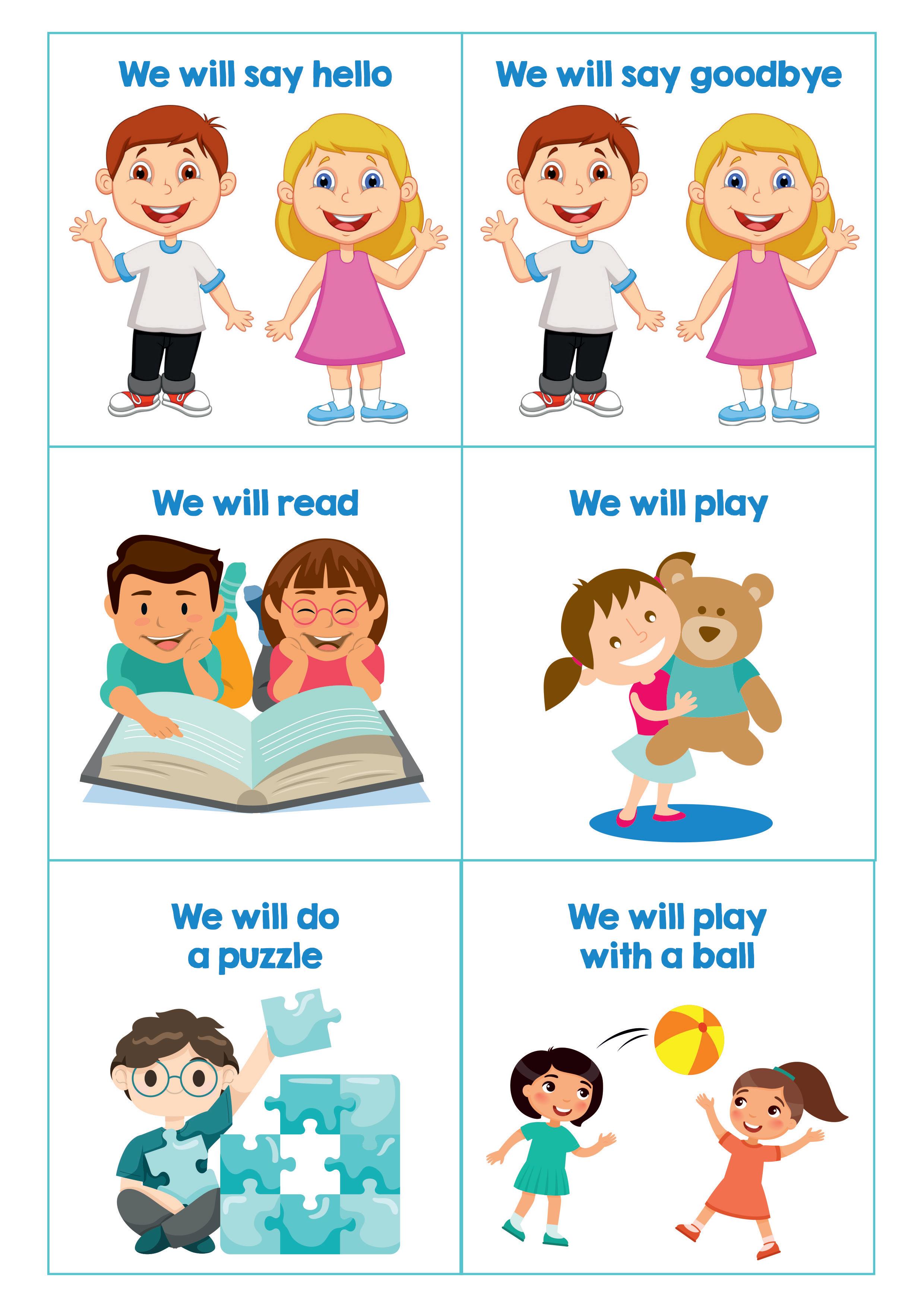
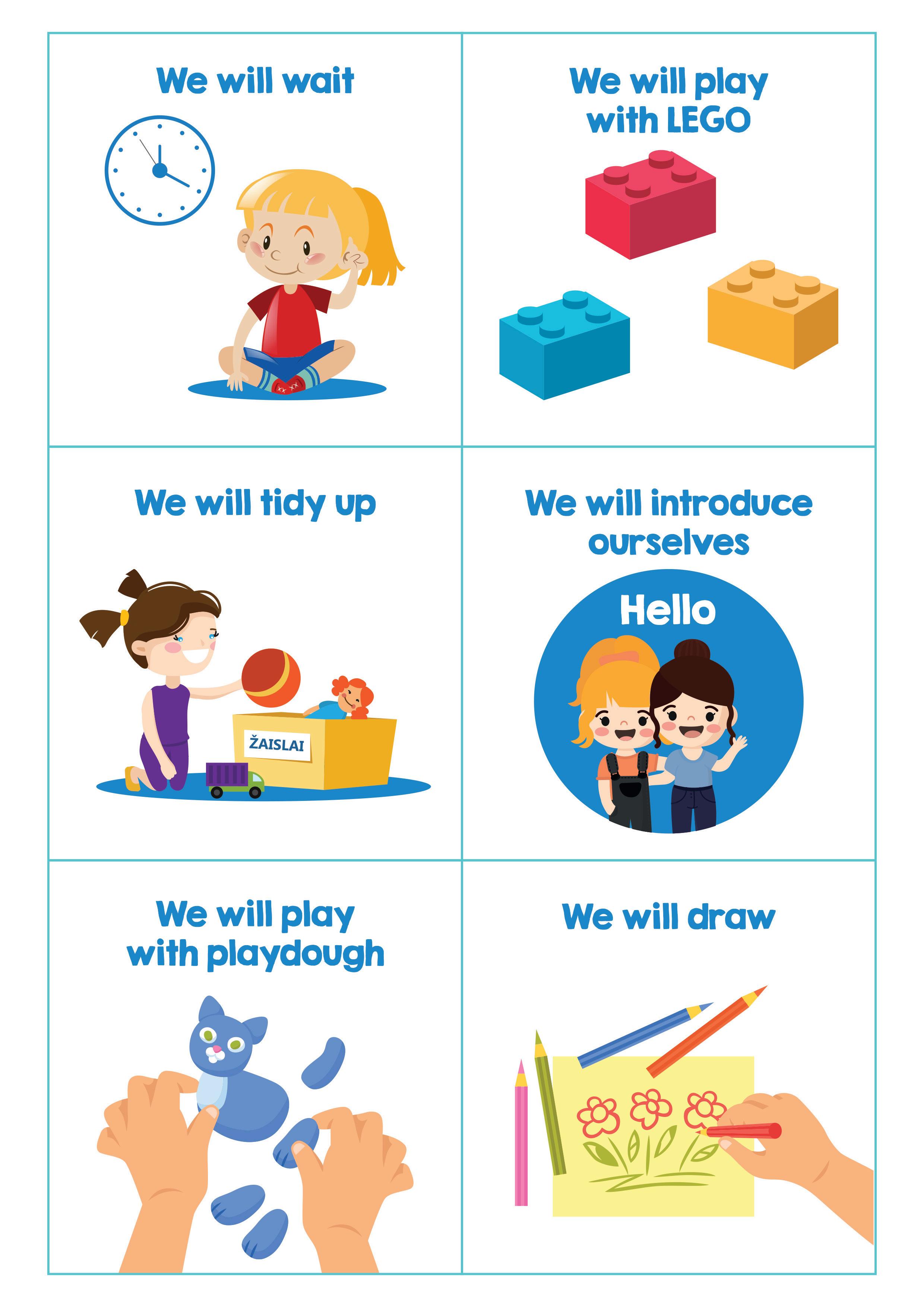
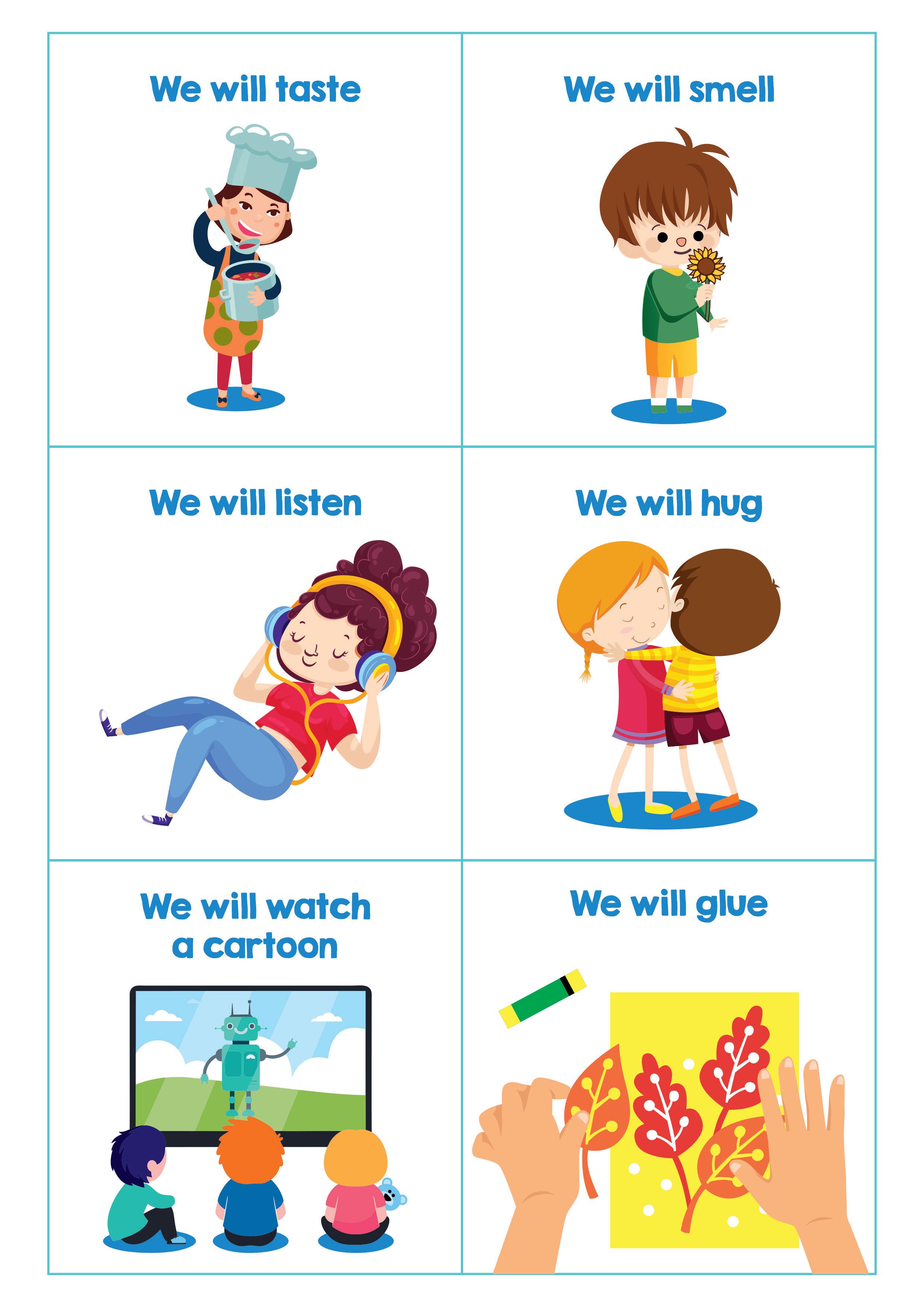
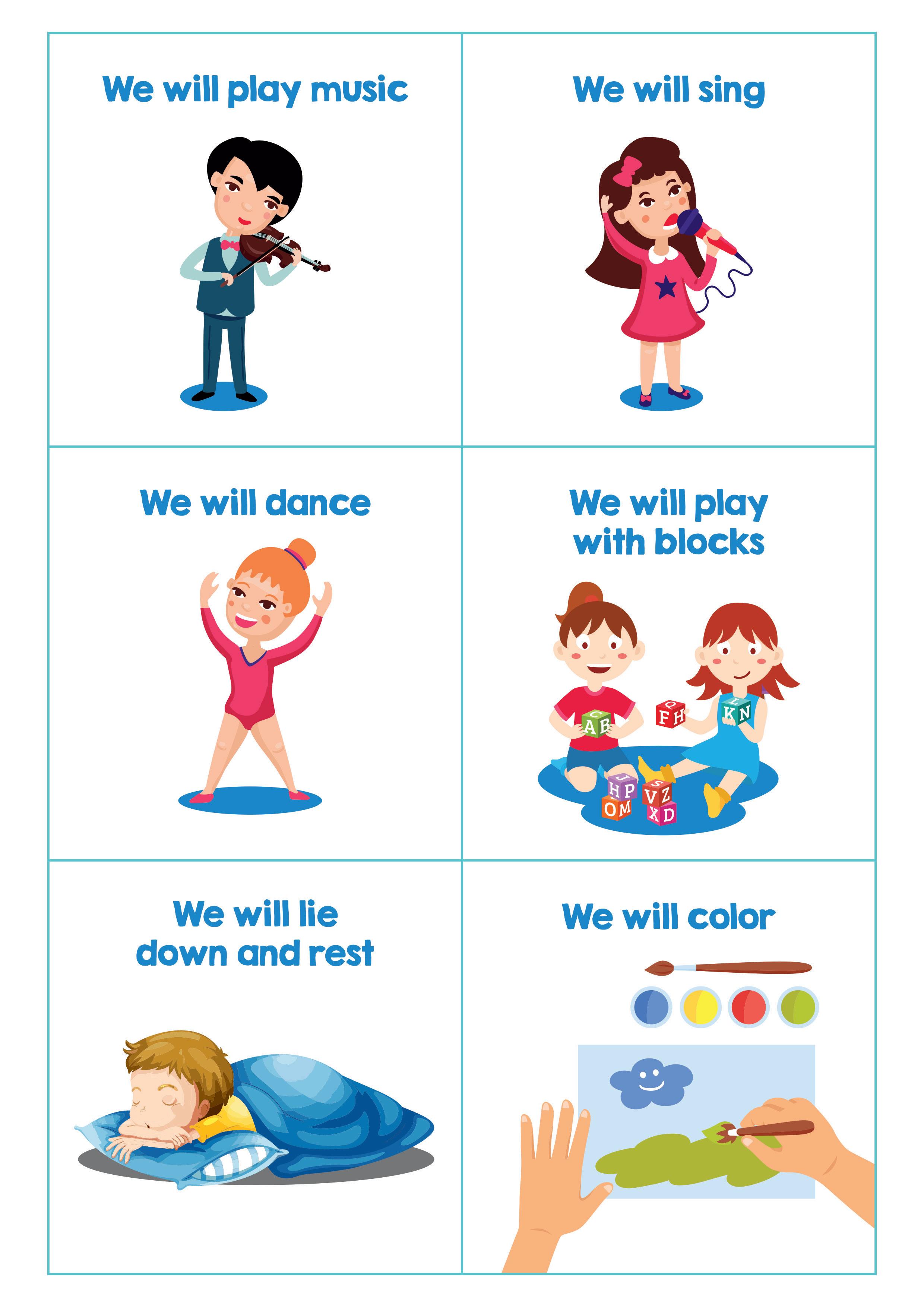
‘Heroes Unleashed: Sensory Reading Programs in Libraries’. Methodological Guide. Compiled by Bronius Maskuliūnas. – Šiauliai: Šiauliai County Povilas Višinskis Public Library, 2025. – 98 p.
ISBN 978-609-8237-33-7
This methodological guide has been prepared as part of the international project Heroes Unleashed: Implementing a Sensory Reading Program in European Public Libraries.
The main aim of the guide is to share good practices in sensory reading, enabling children with autism spectrum disorders and other forms of neurodivergence to better understand and experience texts through reading sessions.
The guide consists of two introductory articles, twelve sensory reading session scenarios, a list of recommended literature, and examples of graphic cards.
This guide is intended both for librarians and for anyone interested in organising sensory reading sessions.
Compiled by Translators
Language editor
Illustrator and designer
Publisher Funded by
Prof. Dr. Bronius Maskuliūnas
Germantas Barkauskis, Kamilė Kasparienė
Kamilė Kasparienė
Vaiva Kovieraitė-Trumpė
Šiauliai County Povilas Višinskis Public Library
Aušros al. 62, LT-76235 Šiauliai, Lithuania
www.savb.lt