Case Study: The Farnsworth House By Mies Van Der Rohe
Sarah Garba
How did Mies’ Farnsworth House prototype a new future of living using glass walls?
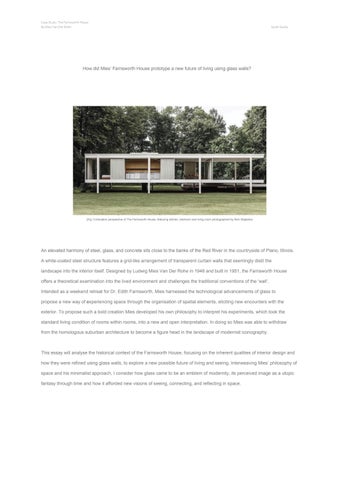
[Fig.1] Elevation perspective of The Farnsworth House, featuring kitchen, bedroom and living room photographed by Rich Stapleton
An elevated harmony of steel, glass, and concrete sits close to the banks of the Red River in the countryside of Plano, Illinois. A white-coated steel structure features a grid-like arrangement of transparent curtain walls that seemingly distil the landscape into the interior itself. Designed by Ludwig Mies Van Der Rohe in 1948 and built in 1951, the Farnsworth House offers a theoretical examination into the lived environment and challenges the traditional conventions of the ‘wall’. Intended as a weekend retreat for Dr. Edith Farnsworth, Mies harnessed the technological advancements of glass to propose a new way of experiencing space through the organisation of spatial elements, eliciting new encounters with the exterior. To propose such a bold creation Mies developed his own philosophy to interpret his experiments, which took the standard living condition of rooms within rooms, into a new and open interpretation. In doing so Mies was able to withdraw from the homologous suburban architecture to become a figure head in the landscape of modernist iconography.
This essay will analyse the historical context of the Farnsworth House, focusing on the inherent qualities of interior design and how they were refined using glass walls, to explore a new possible future of living and seeing. Interweaving Mies’ philosophy of space and his minimalist approach, I consider how glass came to be an emblem of modernity, its perceived image as a utopic fantasy through time and how it afforded new visions of seeing, connecting, and reflecting in space.
Case Study: The Farnsworth House By Mies Van Der Rohe
Sarah Garba
“It is not possible to go forward while looking back.” Mies
Utopia and Time In the period immediately after World War II, there was a heightened desperation for a new and peaceful future that infected the realm of architecture. The effects of time had a major influence on the possibility of realising utopic designs and can be characterised by the crystallisation of technology and an expedition into the unknown. With an exciting period of innovation, the space-age ushered an analysis of the future, capitalising on a visionary scheme that brought about ambitious promises of a newly imagined world. The voyage of space accounts similar associations with the Farnsworth house, as the post-war eagerness for change presented an optimal condition to explore the unknown. Stating in his 1924 manifesto ‘Construction and contemporaneity’, Mies declared that “it is not possible to go forward while looking back”, which set out to explore the juxtaposing states of continuity and historicism.1 Such an early statement helped to define his architectural style as he worked to establish a conceptual framework for his designs and moved towards a determined and conscious refined standard of living through the consideration of materials. His examinations of the traditional conventions of space-challenged notions of the speculative, imaginative and rational thought. A vision that was rooted in a post-war sentiment offered society a new appreciation for openness, honesty, clarity and refined precision 2. However, could this otherwise utopic, dream-like state become an excepted norm in a realised manifested state? Perhaps the social structures that constituted the ideals of space were too wayward in accepting a utopic experiment. Mies rethought what was, to reconsider what could be 3 contrasting a modernist symbol by inserting it into a natural, undisturbed environment. The time and temporal conditions presented an ideal terrain for change. [Fig.2] The Farnsworth House in the conceptual phase of precision and refinement.
Technology Innovations represent a response to the changing experiences of space and
“Architecture is the will of an epoch translated into space.” Mies 4
movements throughout time. The machine age became instrumental in the development of glass architecture through the interplaying themes of innovation and technology. The advancements of glass became a prevalent example of change from handmade to machineproduced, transcending from a fragile state to ubiquitous in application.5 This development of the quality and transparency of glass can be seen in the 1851 Crystal Palace, an exemplar embodiment of the technology, innovation and imagination. It explored the expansive use of glass as façade, wall and window simultaneously, and set a precedent into the dissolution of
1 2 3 4 5
Jean-Louis Cohen, Mies Van Der Rohe, Pp. 8 Nigel Whiteley, Intensity of Scrutiny and a Good Eyeful: Architecture and Transparency, Pp. 8 Nathaniel Coleman, Imagining and Making the World: Reconsidering Architecture and Utopia, Pp. 10 Archdaily.com: Material Masters: Glass is more with Mies van der Rohe Nathaniel Coleman, Materials and Meaning in Modern Architecture, Pp. 249
Case Study: The Farnsworth House By Mies Van Der Rohe
Sarah Garba
walls.6 A collective analysis of materials by Nathaniel Coleman explores how the crystal palace introduced a new vision of seeing, with perspectives whose lines diminished into a thin layer of light7 transmitting a kaleidoscope of reflections in the horizon. Where the passage and Mies appear to intersect is in the theory and unwavering courage to expand the application of glass to explore nature and human interactions in space. The Farnsworth House assisted in the transformation of
windows through the industrial advancements of glass sheets, which moved away from fitting glass in the predetermined window openings.8 This influenced the development and exploration of ideas and meant that more experiments could come to fruition from otherwise imaginative theories.
Universal space A universal space can be characterised by the amalgamation of organised elements that respond in the creation of one fluid encounter with the exterior. Mies drew on the transparent properties of glass in place of walls, to unite the bodily encounter with the organic flowing landscape, romanticising the connection between structure and nature. In Mies’ 1924 manifesto he states: “We should attempt to bring nature, houses, and human beings together in a higher unity.”
9
A unified vision of the future attests to a developed consciousness of an open plan concept. Mies comments on the potential of promoting the exploration of nature through a glass façade that encircles one elongated room and frames the exterior at every glance. How space is read is defined by the organised hierarchy of elements in the creation of interactions and exchanges. By exposing the innermost private nature of the abode an introduced sense of honesty and appreciation of self and nature is formed, with every element capable of sliding unadorned in time and space. A design research outcome that I conducted examines the theory of universal space through the process of continuous line drawings. This revealed an appreciation of how a continuous flow of space with minimal materials can be expressed as one dynamic whole. It follows the thought of Mies, whereby “Architecture should embody a continuous flow of space, blurring
the lines between interior and exterior” 10. This embodiment of space enables the distinction of the boundary to be expanded into a new meaning. Coupled with the thought, Professor of Architecture Alan Colquhoun notes that only way of achieving an overall sense of universal space is ... ‘by piercing walls with wide openings’ House.
6 Nathaniel Coleman, Materials and Meaning in Modern Architecture Pp. 250
7
Nathaniel Coleman, Materials and Meaning in Modern Architecture, Pp. 256
8 Frank Lloyd Wright, In the Cause of Architecture: The meaning of materials, Glass, Pp. 11 9 Adelyn Perez, The Farnsworth House, AD Classics article
10 Archdaily.com: Material Masters: Glass is more with Mies van der Rohe 11 Alan Colquhoun, Modern Architecture. Pp. 82
11
, exemplified in the case of the Farnsworth
Case Study: The Farnsworth House By Mies Van Der Rohe
Sarah Garba
[Fig.3] Universal space, design research
Explored in figure. 4, The Farnsworth House stands in constant flux between foreground, middle ground and background, symbolising the peripheral of a universalised space, with all elements existing
in a constant dialogue where the individual is outside but, in a room. Mies' philosophy of 'skin and bones' amounts to a metaphoric understanding and focus on the associations between the place’s humans inhabit and the encounters that form.
[Fig .4] The Farnsworth House, Photography by Rich Stapleton
The ‘wall’ Present in the Farnsworth House is a junction between the interior and exterior structural elements. The enclosure is not denoted by a thick façade, but rather by a transparent film of glass that screens the perimeter of the structure in the creation of one continuous window. Absent is the presence of solid walls that feature designated voids for the placement of windows. The value of the wall through time has become accustomed to the ephemeral nature of ideals and styles in a cultural and social context. Despite this, it could be said that the Farnsworth House amongst other Modernist buildings, began venturing into a new realm of
architecture that redefined the potential of the wall and reflected the technological advancements of the time. Mies probed into the conventional state of walls as an associative image of security and protection. However, with no war in sight, renewing the values of the interior would evoke a sense of freedom, dissolving ancient notions of space. Explored in a design research in figure 5, the creation of voids contributes to the notion of seeing, encountering and considering ‘space’. [Fig 5] Design research collage
The enclosure establishes how culture and society can evolve and transform the course of architecture, from the encounters of places we inhabit to the people that inhabit them. To think towards the future is a reason to transform the dwelling. In Paul Scheerbart’s reader, Glass! Love!! Perpetual Motion!!! He emphasises, “We live for the most part within enclosed spaces. These form the environment from which our culture grows. Our culture is in a sense a product of our architecture. If we wish to raise our culture to a higher level, we are forced for better or worse to transform our architecture" 12. Scheerbart simplifies and condenses the notion of a utopic future, in a humanised, attainable approach. Where Scheerbart and Mies meet is in [Fig .6] Intersecting detail between interior and exterior
the theory that architecture when given full autonomy, has the potential to change a society.
“Less is more”13
12
13
Scheerbart, Paul, Christine Burgin, and Josiah McElheny. Glass! Love!! Perpetual Motion!!! A Paul Scheerbart Reader. Chicago: pg26-25
Archdaily.com: Material Masters: Glass is more with Mies van der Rohe
Case Study: The Farnsworth House By Mies Van Der Rohe
Sarah Garba
The philosophical concept of ‘less is more’ creates a state of heightened ambition to evolve from traditional customs of the past and into a new world. Figure 7 emphasises Mies’ efforts to distil elements of the interior into simple forms that relate to the aesthetic of the structure. Furniture pieces feature an organic influence of nature in the form and are paired with silk
curtains that afford a sense of privacy, conscious in not alienating the occupant. The steel dwelling features voids that are enclosed by glass and sandwiched between two plains, facilitating the ultimate living for a modernist sensibility. The curtain walls function as façade, window and wall simultaneously with ease and simplicity. Mies uncovers the value of the wall by framing a new image of a future that unites nature houses and human beings.
[Fig .7] Interior perspective
A precedent for modern architecture and design, the Farnsworth House challenged the rational and conceptual value of space, through a mix of architectural theory, culture and criticism. The precedent confronts the traditional conventions of the wall and proposes a new vision of living, free from the architectural relics of the war. A new design language was required to interpret the progress of time, technology and culture, with glass curtain walls affording new modes of seeing and experiencing space. Mies' philosophy examined the notions of unity, openness and minimalism in the effort to prototype a new standard of living.
Bibliography: Cohen, Jean-Louis. 2018. Mies Van Der Rohe. Switzerland, Birkhauser. Pg. 8 Coleman, Nathaniel. 2019. Materials and Meaning in Architecture. “Chapter 12 Transparency: A Darker Shade of Glass”. London, Bloomsbury Visual Arts. Coleman, Nathaniel. 2011. Imagining and Making the World: Reconsidering Architecture and Utopia. Oxford: Peter Lang. Colquhoun, Alan. 2002. Modern Architecture. Oxford University Press. Pp. 82 Hartoonian, Gevork. 1989. Mies Van Der Rohe: The Genealogy of Column and Wall. “Journal of Architectural Education”, Pp 43-50. McCarthy, Christine. 2005. Toward A Definition of Interiority. “Space And Culture”, Pp 112-125. Schulze, Franz, and Edward Windhorst. 2012. Mies Van Der Rohe - A Critical Biography. Chicago, Ill.Univ. of Chicago Press. Rowe, Colin and Slutzky, Robert, 1963. Transparency: Literal and Phenomenal. “Perspecta”, Pp. 45-54 Scheerbart, Paul, Christine Burgin, and Josiah McElheny. 2014. Glass! Love!! Perpetual Motion!!! A PaulScheerbart Reader. Chicago: The University of Chicago Press. Pp 26-25
Wendl, Nora. 2015. “Sex and Real Estate Reconsidered: What Was The True Story Behind Mies Van Der Rohe’s Farnsworth House? Edith B. Farnsworth 1960 unpublished poem”. Archdaily, 2015. Whiteley, Nigel. 2003. “Intensity of Scrutiny and A Good Eyeful”, Journal of Architectural Education”. 8-16. Wright, Frank Lloyd, “In the Cause of Architecture: The meaning of materials : Glass”, pg. 11
Images: [Fig. 1] ‘Elevation perspective of The Farnsworth House, featuring kitchen, bedroom and living room’, UP: Interiors, 2017. ‘Farnsworth House By Ludwig Mies Van Der Rohe’, photographed by Rich Stapleton for Cereal [video] <https://www.youtube.com/watch?v=YEAn-rnn8mo&t=1s> [Accessed 23 May 2020]. [Fig. 2] ‘Farnsworth House Mies Van Der Rohe Plano USA 1951 Houses Architecture. 2020. Image. Archived by Architectural Models, https://architecturalmodels.tumblr.com/post/141848730740.
Case Study: The Farnsworth House By Mies Van Der Rohe
Sarah Garba
[Fig. 3] ‘Continuum’, Design research exploration, Sarah Garba [Fig. 4] ‘Interior and Exterior, The Farnsworth House, UP: Interiors, 2017. ‘Farnsworth House By Ludwig Mies Van Der Rohe’, photographed by Rich Stapleton for Cereal [Fig. 5] ‘Interior perspective, UP: Interiors, 2017. ‘Farnsworth House By Ludwig Mies Van Der Rohe’, photographed by Rich [Fig .6] Intersecting detail between interior and exterior, ‘Farnsworth Chicago’, posted by Instagram user ‘farlie1’,2017 [Fig. 7] ‘Utopian Visions’, Design research exploration, Sarah Garba