UNIVERSITY NEWS 64 (02) JaNUaRY 12–18, 2026
Intra-National Mobility: India’s Next Mega Trend in Higher Education through Inter-Institutional Mobility
Sagar Bahadur*, Bhawna Kumar** and Nikunj Agarwal***
India stands at the threshold of an educational transformation. While global discourses on student mobility have focused largely on International Branch Campuses (IBCs), transnational education (TNE) partnerships, and the outward flow of students, the reality is that over 98 per cent of Indian students pursue their higher education within India itself. With more than 42 million students enrolled in Indian higher education institutions (AISHe 2022) and ambitious national goals articulated under NEP2020 and Viksit Bharat 2047, India requires bold and innovative approaches to reimagine student mobility not only across borders, but also within them.
This article introduces the concept of IntraNational education Mobility (INe): a policy and institutional framework designed to enable structured, credit-recognised student mobility across Indian states, regions, and institutions.
INe proposes that Indian students should have the opportunity to complete parts of their academic programmes at different universities within India, thereby leveraging the country’s extraordinary cultural, linguistic, disciplinary, and institutional diversity. Such mobility strengthens academic flexibility, broadens student exposure, and unlocks the full potential of India’s vast higher education landscape.
At Acumen, our experience working at the nexus of global higher education policy and operationalising complex Transnational Education (tNe) partnerships for over a decade provided the foundational insight for INe. We recognised that the logistical, governance, and academic challenges faced in building tNe pathways between India
*Executive Director, Asia and Head of Regional Strategy,Acumen, Part of Sannam S4, Acumen India Private Limited, Unit No. 301 & 302, 3rd Floor, Eros Corporate Tower, Nehru Place, New Delhi - 110019. E-mail:sagar.bahadur@ sannams4.com
**Director - TNE & Institutional Partnerships, Acumen, Part of Sannam S4, Acumen India Private Limited, Unit No. 301 & 302, 3rd Floor, Eros Corporate Tower, Nehru Place, New Delhi - 110019. E-mail: bhawna.kumar@sannams4.com
***Business Development Officer - UK, Europe and North America. E-mail: nikunj.agarwal@sannams4.com
and the world are the same challenges now solved domestically by the Academic Bank of Credits (ABC) and the National Credit framework (NCrf). INe is thus a framework derived from global best practice, adapted and perfected for the unique scale and diversity of the Indian system.
INe is not merely a logistical possibility. It represents a new mega-trend in global higher education, recognising that countries as large, diverse, and multi-layered as India can themselves serve as internal ecosystems of mobility: offering scale, affordability, interdisciplinarity, and immersion comparable to transnational education models.
this vision of mobility is now an operational imperative, not merely a future aspiration. the foundational policy architecture, specifically the Academic Bank of Credits (ABC) and the National Credit framework (NCrf), are active and rolling out nationwide. these mechanisms provide the vital digital and academic scaffolding necessary for seamless credit recognition and student progression.
furthermore, INe directly addresses the challenge of enhancing the Gross enrolment Ratio (GeR) while simultaneously ensuring quality and accessibility. By democratising the opportunity for mobility, INE makes exposure to high-quality, diverse institutions an affordable reality for the millions of Indian learners who pursue their higher education domestically.
If even one in eight higher education students (around 12 per cent) participate in structured interinstitutional and interstate pathways, enabled by the Academic Bank of Credits (ABC) and the National Credit framework (NCrf), India could see over five million students participating in domestic mobility annually by 2032. this number is nearly equivalent to the total annual global outbound student population, positioning India, through INe, as the world’s largest mobility hub within its own borders.
this approach ensures that the pursuit of Viksit Bharat 2047 is supported not just by high-skill graduates, but by culturally fluent and adaptable citizens.
complete the first two at University A, coursework, core multidisciplinary exposure
The Idea of INE
the concept of INe is built on a simple but transformative idea: a student in India should be able to begin their degree at one institution and complete part of it at another, with full credit recognition, seamless academic continuity, and equitable student support.
This aligns directly with the flexibility envisaged under the Academic Bank of Credits (ABC) and the National Credit framework (NCrf) and mirrors global best practices adapted to India’s federal and cultural context.
INe mobility pathways can take two primary forms:
Joint Programmes :
• Where two (or more) institutions co-design curricula, co-deliver teaching, and contribute academic oversight. these require high levels of alignment on academic standards, curriculum design, and governance.
Progression Pathways
• : Where the “sending” institution provides a partial programme and students advance into a “receiving” institution that awards the final degree. These are administratively lighter and can scale rapidly through articulation agreements and credit transfer.
Both approaches can coexist, with joint programs signaling deeper partnerships (often between research-intensive or globally positioned institutions), while progression pathways offer a practical and scalable mechanism for student mobility.
Possible Models within India
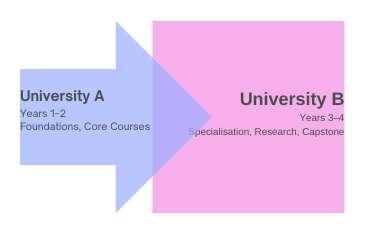
2+2 Model
they then • progress to University B for the final two years, where they undertake advanced disciplinary coursework, specialisations, research projects, and capstone requirements.
the degree is awarded by the receiving institution • (University B), while all credits from the first two years are formally recognised through the Academic Bank of Credits (ABC) and the National Credit framework (NCrf).
the 2+2 model is especially suitable for engineering, business, liberal arts, design, and emerging interdisciplinary programmes.
from a strategic perspective, the 2+2 model allows the 'sending' University A to focus on delivering high-quality foundational, multi-disciplinary, and skill-building curricula. The 'receiving' University B benefits by gaining a guaranteed cohort of academically vetted students, ready to immediately immerse themselves in advanced, specialised coursework, research projects, and capstone requirements. This structure is not just a credit transfer; it is a strategic partnership for optimising talent development.
1.5+1.5
Model
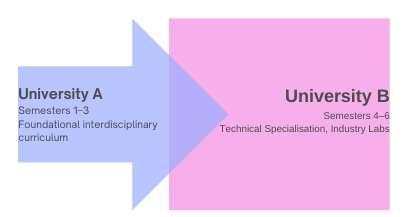
Under this model, the undergraduate degree is • divided equally between two institutions. Students complete 18 months (3 semesters) at University A and another 18 months (3 semesters) at University B, enabling an integrated learning experience (fig 2).
Credit mapping and curriculum alignment
• are essential, but the model enables deeper collaborative teaching, shared faculty input, and more robust multidisciplinary pathways.
In this model, students complete the first two years
• of their programme at University A, focusing on foundational coursework, core subjects, and broad multidisciplinary exposure (Fig 1).
Model
● Under this model, the undergraduate degree is divided equally between two institutions. Students complete 18 months (3 semesters) at University A and another 18 months (3 semesters) at University B, enabling an integrated learning experience (Fig 2)
University B for the they undertake coursework, projects, and capstone by the receiving while all credits from the first two years are formally recognised through (ABC) and the National Credit Framework (NCrF).
● Credit mapping and curriculum alignment are essential, but the model enables deeper collaborative teaching, shared faculty input, and more robust multidisciplinary pathways.
for engineering, business, liberal arts, design, and emerging
this structure is well aligned with modular and competency-based curricula, making it ideal for professional programmes such as design, media, business, data science, public policy, environmental studies, and applied sciences.
2: 1.5+1.5 Model
This structure is well aligned with modular and competency-based curricula, making it ideal for professional programmes such as design, media, business, data science, public policy, environmental studies, and applied sciences.
model allows the 'sending' University A to focus on delivering high -
1+1 PG Model
Fig 1: 2+2 Model
Fig 1: 2+2 Model
Fig 2: 1.5+1.5 Model
1.5+1.5
Fig
1+1 PG Model
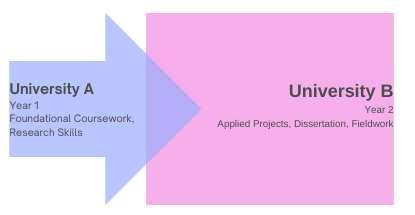
In the postgraduate 1+1 format, students • undertake the first year of a master’s programme at University A, focusing on coursework, foundational research training, or sectoral specialisation. they then complete the second year at University B, where they may pursue a dissertation, industry placement, international labs, or advanced electives (fig 3).
modular and competency-based curricula, making it ideal for media, business, data science, public policy, environmental
undergraduate degree between two institutions. months (3 semesters) at another 18 months (3 University B, enabling an experience (Fig 2) curriculum alignment are model enables deeper shared faculty input, multidisciplinary pathways.
Depending on regulatory permissions, the degree • is awarded either jointly (allowed only when one institution is foreign) or solely by the receiving institution domestically.
aligned with modular and competency as design, media, business, data science, public policy, environmental
students undertake at coursework, sectoral second year pursue a international labs, or advanced electives (Fig 3). the degree is awarded either jointly (allowed only when one receiving institution domestically.
3+1 Model
and can serve as a structured progression route from state public universities into nationally recognised private or central institutions.
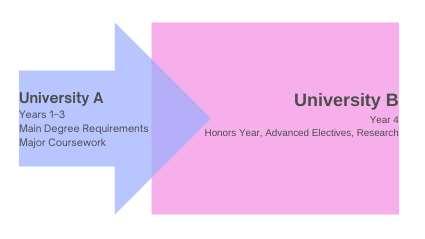
The 3+1 pathway offers a clear mechanism for enhancing the final-year experience for students from large public university systems. for University A, it reinforces its core mission of providing foundational disciplinary depth and broad access. for the 'receiving' University B, it provides an opportunity to offer a high-value, specialised final year focused on research training, advanced electives, or industrylinked modules, which may be resource-intensive to replicate at every institution. this is one of the most practical pathways for scaling public-to-private progression in India.
A Four-layer Impact Framework for IntraNational Education Mobility (INE)
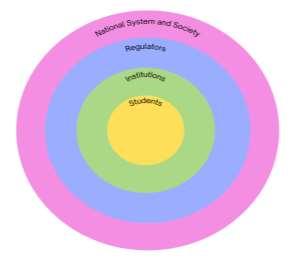
The concept of Intra-National Education Mobility (INe) generates value at multiple levels of India’s higher education ecosystem. This can be understood through a four-layer impact framework, represented in the concentric-circle diagram (Fig 5).
Students (Core Beneficiaries)
this model is particularly relevant for public policy, international relations, management, education, development studies, SteM, and emerging interdisciplinary PG programmes.
format, students undertake master’s programme at on coursework, training, or sectoral then complete the second year they may pursue a placement, international labs, or advanced electives (Fig 3) regulatory permissions, the degree is awarded either jointly (allowed only when one solely by the receiving institution domestically.
Students (Core Beneficiaries)
Fig 4: 3+1 Model degree institutions. semesters) at months (3 enabling an alignment are deeper faculty input, pathways.
the 3+1 pathway allows students to spend three • years completing the majority of their coursework at University A, followed by a final year at University B (fig 4).
The final year may include advanced electives, • research modules, project-based learning, internships, or an honours thesis.
relevant for public policy, international relations, management, education, and emerging interdisciplinary PG programmes.
policy, international relations, management, education, interdisciplinary PG programmes. spend followed
This model is well-suited for institutions looking to offer an enriched “final-year experience”
At the centre of the model are students, who stand to gain the most immediate benefits from INE. Structured interstate mobility expands academic choice, improves access to high-quality programmes, enables interdisciplinary exposure, and builds the adaptability and cultural fluency needed for a dynamic labour market. INe democratizes mobility by making it accessible and affordable to millions of learners who may never study abroad.
allows students to spend the majority of University A, followed University B (Fig 4).
At the centre of the model are students, who stand to gain the most immediate benefits from INE. Structured interstate mobility expands academic choice, improves access to high-quality programmes, enables interdisciplinary exposure, and builds the adaptability and cultural fluency needed for a dynamic labour market. INE democratizes mobility by making it accessible and affordable to millions of learners who may never study abroad.
Institutions (Enabling Environment)
The next layer represents universities and colleges. INE allows institutions to diversify their student cohorts, share faculty and curricular strengths, collaborate on joint and progression pathways, and extend their academic footprint beyond geographical boundaries. Instead of capital-heavy branch campuses, institutions can leverage mobility partnerships to enhance visibility, quality, and competitiveness.
Fig 2: 1.5+1.5 Model
Fig 3: 1+1 PG Model
Fig 5: Four-layer Impact Framework
Fig 5: Four-layer Impact Framework
Case Study: IIT Gandhinagar (IITGN) → IISc Bangalore
This high-value progression pathway is already being championed by premier institutions and serves as a powerful validation of the INe model. the collaboration, established via an MoU, features the following structure:
Years 1-3 (IIT Gandhinagar): High-performing BTech students at IIT Gandhinagar complete the first three years of their undergraduate program. they focus on foundational engineering, core disciplinary knowledge, and developing the academic base required for advanced study.
Progression and Final Year (IISc Bangalore): After a competitive selection process, these students transition directly to an MTech program at IISc Bangalore. The final requirements of their BTech degree (often a finalyear project or advanced course credits) are completed while they simultaneously begin their Master’s degree coursework at IISc.
Outcome: the student ultimately receives two degrees: their Btech degree from IItGN and their Mtech degree from IISc.
this model provides an accelerated, highly selective academic progression. It demonstrates how INe can leverage the complementary strengths of two elite Central institutions: IITGN, providing high-quality foundational cohorts, and IISc, providing specialised Mtech and research environments.
Four-key Pillars for Intra-National Education Mobility
Source:https://iisc.ac.in/events/iisc-and-iit-gandhinagar-join-hands-to-foster-unique-academic-exchange/
Institutions (Enabling Environment)
Institutional Partnerships and Governance
The next layer represents universities and colleges. INe allows institutions to diversify their student cohorts, share faculty and curricular strengths, collaborate on joint and progression pathways, and extend their academic footprint beyond geographical boundaries. Instead of capitalheavy branch campuses, institutions can leverage mobility partnerships to enhance visibility, quality, and competitiveness.
Regulators and Policy System
the third layer captures the role of regulators such as UGC, AICte, state councils, and accrediting bodies. INe directly aligns with national reforms like the Academic Bank of Credits (ABC), the National Credit Framework (NCrF), and NEP 2020’s emphasis on flexibility, multidisciplinary learning, and seamless progression. Regulators provide the policy architecture and quality assurance mechanisms that allow mobility to function smoothly across states and institutions.
National System and Society (Macro-level Outcomes)
The outermost circle represents India’s broader social and economic system. At this level, INe contributes to national cohesion, regional development, and economic upliftment. Interstate student flows create significant multiplier effects through housing, transport, local services, and talent distribution. INe also strengthens India’s position as
Effective intra-national mobility depends on strong partnerships between universities that share academic standards, transparent governance structures, and mutually agreed responsibilities. Institutions must collaborate on curriculum design, learning outcomes, quality assurance, and assessment practices to ensure a smooth student transition. Clear governance mechanisms, including articulation agreements, programme boards, and shared review processes, create predictability and trust, making mobility scalable and sustainable across diverse Indian institutions. However, achieving this requires a standardised approach to quality assurance and assessment equivalences, ensuring that a credit earned for a specific learning outcome in one state is reliably recognised and valued across the country. Drawing on our experience at Acumen, in formalising TNE agreements, we are actively supporting institutions in developing the necessary legal frameworks, academic governance protocols, and articulation agreement templates required to launch these complex inter-institutional pathways at scale.
National Coordination and Policy Alignment
6: Pillars for Intra-National Education Mobility
6: Pillars for Intra-National Education Mobility
A coherent mobility system requires national-level alignment with regulatory frameworks such as the Academic Bank of Credits (ABC), the National Credit Framework (NCrF), and NEP 2020. National coordination ensures uniform standards, transparency in credit transfer, and inter-state portability of academic records. By establishing policy clarity, common digital infrastructure, and financial or
Fig
Fig
a global innovator by pioneering a domestic mobility framework comparable to the Bologna Process.
Four-key Pillars for Intra-National Education Mobility
Institutional Partnerships and Governance
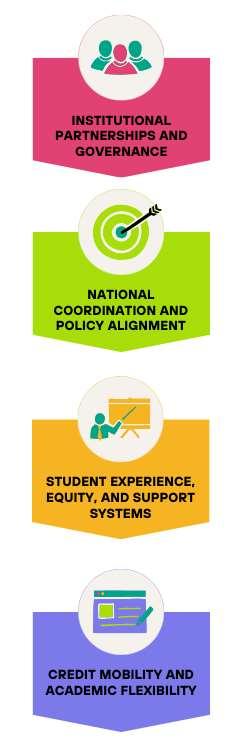
Effective intra-national mobility depends on strong partnerships between universities that share academic standards, transparent governance structures, and mutually agreed responsibilities. Institutions must collaborate on curriculum design, learning outcomes, quality assurance, and assessment practices to ensure a smooth student transition. Clear governance mechanisms, including articulation agreements, programme boards, and shared review processes, create predictability and trust, making mobility scalable and sustainable across diverse Indian institutions. However, achieving this requires a standardised approach to quality assurance and assessment equivalences, ensuring that a credit earned for a specific learning outcome in one state is reliably recognised and valued across the country. Drawing on our experience at Acumen, in formalising TNE agreements, we are actively supporting institutions in developing the necessary legal frameworks, academic governance protocols, and articulation agreement templates required to launch these complex interinstitutional pathways at scale.
National Coordination and Policy Alignment
A coherent mobility system requires nationallevel alignment with regulatory frameworks such as the Academic Bank of Credits (ABC), the National Credit Framework (NCrF), and NEP 2020. National coordination ensures uniform standards, transparency in credit transfer, and inter-state portability of academic records. By establishing policy clarity, common digital infrastructure, and financial or administrative incentives, India can enable mobility at scale while ensuring equity and consistency across regions and institutions. the primary challenge here is ensuring seamless policy coherence and operational synergy between Central, State, and private regulatory frameworks. National coordination must actively mitigate administrative burdens that could otherwise slow inter-state academic record portability.
Student Experience, Equity, and Support Systems
for INe to succeed, students must have access to robust support systems throughout their mobility journey. This includes transparent information
on pathways, housing assistance, orientation programmes, counselling services, linguistic and cultural support, and mechanisms to ensure financial affordability. Prioritising equity ensures that students from smaller towns, first-generation learners, and underserved regions can benefit equally from mobility opportunities. A strong student experience fosters confidence, encourages participation, and enhances learning outcomes. A key enabler for ensuring this equity is the establishment of a centralised digital portal. this platform must provide transparent, standardised information on all approved INe pathways, housing assistance, and financial support mechanisms, serving as a single point of entry for all prospective mobility students.
Credit Mobility and Academic Flexibility
the heart of INe lies in seamless credit mobility. A flexible academic architecture, built on ABC, NCrF, CBCS, and competency-based curricula, allows students to transfer credits across institutions without loss of progress or academic disadvantage. Flexibility in course structures, elective options, assessment equivalences, and recognition of prior learning ensures academic continuity. When credit transfer becomes predictable and transparent, mobility becomes an accessible, mainstream feature of Indian higher education. this demands rigorous adherence to the National Credit framework (NCrf) by all participating institutions. the policy focus must now shift to resolving common academic implementation challenges, such as reconciling differences in course naming conventions, assessment methodologies, and the accurate recognition of prior learning.
Policy Opportunity
As India moves toward a more integrated national higher education system, there is an opportunity to examine the feasibility of collaborative or co-branded degrees between accredited Indian institutions, supported by robust quality assurance mechanisms. At present, UGC regulations allow joint degrees only in partnerships with foreign universities. Expanding this provision, in a carefully regulated form, to include domestic higher education institutions could significantly enhance academic integration. Such a reform would be especially valuable within HeI clusters and INe mobility networks, where institutions already share aligned curricula, credit transfer systems, and academic governance structures. It would strengthen institutional collaboration, create clearer pathways
Table 1: Intra-national Mobility Model
Region/Country Mobility Model
United States Community College to University 2+2 Pathways
European Union Erasmus Plus Intraeuropean Mobility
China Joint and Progression Programs (2+2 and 3+1)
United Kingdom Articulation Agreements between Colleges and Universities
Australia and New Zealand TAFE and Polytechnic to University Credit transfers
Relevance for INE in India
Demonstrates how structured domestic mobility can scale nationally. Supports millions of students through credit transfer, lower cost entry points, and clear progression routes. Shows that mobility within one country can be large, affordable, and student-friendly.
Illustrates the power of automatic credit recognition across institutions. Normalises mobility as part of a degree, even when short-term. Shows how regional mobility frameworks can be harmonised and institutionalised.
Models how a large country can operate thousands of coordinated mobility pathways. Regional colleges feed into top ‘Double first Class’ universities. Shows how tiered mobility can increase access and improve quality nationally.
Provides a mature system of progression from Higher National Diplomas (HNDs) into second or third year of university degrees. ensures structured pathways with curriculum alignment and predictable credit transfer.
Shows strong integration of vocational and academic streams. Preagreed credit recognition allows students to move smoothly across institutions. Demonstrates how mobility can connect diverse types of institutions.
for students, and offer nationally recognised qualifications that formally acknowledge multiinstitution learning. We, at Acumen, stand ready to partner with regulators to develop the essential quality assurance and governance frameworks needed to safely pilot and scale these new domestic collaborative degrees.
Global Parallels
India is not starting from zero. Several established mobility systems around the world offer strong proof of concept for an intra-national model (table 1).
Paving the Way for a National Mobility Ecosystem
Intra-National Education Mobility (INE) is the essential next phase in India’s higher education reform journey. By strategically combining the regulatory scaffolding of the Academic Bank of Credits (ABC) and the National Credit framework (NCrF) with the aspirational goals of NEP 2020 and Viksit Bharat 2047, India has a unique opportunity
to create the world’s largest and most democratic student mobility ecosystem within its own borders.
Moving forward requires the concerted effort of all stakeholders: institutional leaders must champion new partnerships and governance models, regulators must swiftly address implementation challenges such as assessment equivalences and policy coherence, and the government must invest in the digital infrastructure necessary to support equity and student experience.
At Acumen, we are committed to supporting this transformative policy agenda. Our operational expertise has proven that structured, scalable INE pathways are not only feasible but are the most powerful mechanism for leveraging India’s vast cultural and institutional diversity for the benefit of its 42 million students. By actively partnering with institutions and regulators, Acumen aims to ensure that by embracing this next mega-trend, India can secure its position as a global innovator and ensure that academic quality and opportunity are accessible across every state and region.