Overview of Fly Ash Bricks

Page 1


Overview of FlyAsh Bricks:Applications andAdvantages

The construction industry is constantly evolving with innovative building materials that are stronger, more sustainable, and cost-effective. Among these, fly ash bricks have gained significant popularity in recent years. Known for their durability, environmental benefits, and

wide range of applications, fly ash bricks are fast becoming a preferred choice for builders and architects alike.

What Are Fly Ash Bricks?

Fly ash bricks are made using fly ash, a byproduct of coal combustion in thermal power plants. These bricks are manufactured by mixing fly ash with cement, sand, and water, then molded under high pressure. Unlike traditional clay bricks that require high-temperature kilns for burning, fly ash bricks are cured through a process of steam curing, making them more eco-friendly and energy-efficient.

Key Applications of Fly Ash Bricks

1. Residential Construction

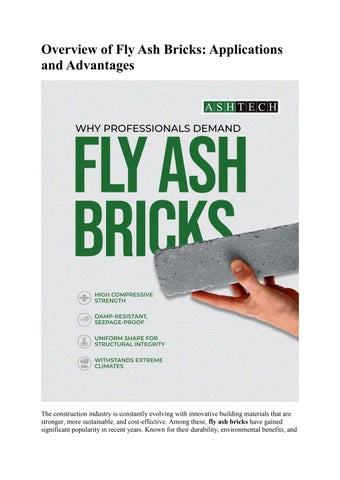
Fly ash bricks are extensively used in housing projects for walls, foundations, and partitions. Their smooth finish and uniform size reduce the need for excessive plastering, saving both time and money.

2. Commercial Buildings

Offices, shopping complexes, and institutional structures often use fly ash bricks due to their load-bearing capacity and superior insulation properties.

3. Industrial Structures

Warehouses, factories, and manufacturing units benefit from fly ash bricks because they are resistant to heat, fire, and moisture – ensuring long-lasting structural integrity.

4. Infrastructure Projects

Fly ash bricks are also used in roads, pavements, and boundary walls. Their durability and cost-effectiveness make them suitable for large-scale infrastructure development.

Advantages of Fly Ash Bricks

1. Environmentally Friendly

One of the most important advantages is sustainability. Fly ash bricks utilize industrial waste that would otherwise contribute to pollution. By replacing clay, they also help preserve fertile topsoil.

2. High Strength and Durability

These bricks have high compressive strength and low water absorption, making them strong, less porous, and resistant to wear and tear. Structures made with fly ash bricks are known to last longer.

3. Thermal and Sound Insulation

Fly ash bricks offer better insulation compared to traditional bricks. This helps maintain indoor temperatures, reducing the need for artificial heating or cooling, while also providing soundproofing benefits.

4. Cost Savings

Due to their uniform shape and smooth finish, fly ash bricks require less mortar during construction and reduce plastering costs. Their lightweight nature also makes handling easier, cutting down on labor expenses.

5. Fire and Moisture Resistance

Fly ash bricks are non-combustible and protect buildings from fire hazards. They are also less prone to water seepage, making them ideal for areas with high humidity.

6. Dimensional Accuracy

Unlike traditional clay bricks, fly ash bricks are machine-made and consistent in size. This ensures neater construction and better finishing.

Conclusion

Fly ash bricks represent a perfect blend of strength, sustainability, and cost-effectiveness Their ability to recycle industrial waste into a valuable construction material makes them an eco-conscious choice for modern builders. With applications ranging from residential homes to massive infrastructure projects, these bricks are paving the way for a greener future in construction.

As the demand for environmentally friendly building solutions continues to grow, fly ash bricks are poised to become a cornerstone of sustainable development in the construction sector.

Turn static files into dynamic content formats.

Create a flipbook
Issuu converts static files into: digital portfolios, online yearbooks, online catalogs, digital photo albums and more. Sign up and create your flipbook.