SSZA0126

Page 1


SOUTH-AFRICA

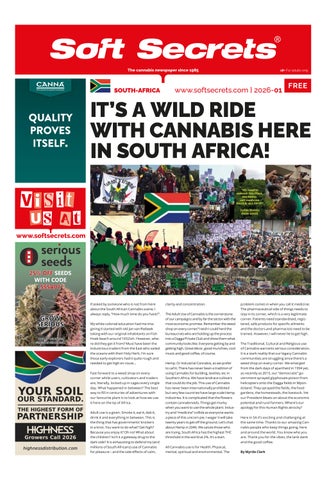
IT’S A WILD RIDE WITH CANNABIS HERE IN SOUTH AFRICA!

If asked by someone who is not from here about the South African Cannabis scene, I always reply, “How much time do you have?”.

My white colonial education had me imagining it started with old Jan van Riebeek toking with our original inhabitants on Fish Hoek beach around 1652ish. However, where did they get it from? Must have been the industrious traders from the East who sailed the oceans with their Holy Herb. I’m sure those early explorers had it quite rough and needed to get high en route…

Fast forward to a weed shop on every corner while users, cultivators and traders are, literally, locked up in cages every single day. What happened in between? The best way to fill in centuries of adventures with our favourite plant is to look at how we use it here on the tip of Africa.

Adult use is a given. Smoke it, eat it, dab it, drink it and everything in between. This is the thing that has governments’ knickers in a knot. You want to do what? Get high? Because you enjoy it? Oh no! What about the children? Isn’t it a gateway drug to the dark side? It is exhausting to defend my (and millions of South Africans) use of Cannabis for pleasure – and the side effects of calm,

clarity and concentration.

The Adult Use of Cannabis is the cornerstone of our campaigns and by far the sector with the most economic promise. Remember the weed shop on every corner? I wish I could herd the bureaucrats who are holding up the process into a Dagga Private Club and show them what community looks like. Everyone getting by and getting high. Great décor, good munchies, cool music and good coffee, of course.

Hemp. Or Industrial Cannabis, as we prefer to call it. There has never been a tradition of using Cannabis for building, textiles, etc in Southern Africa. We have landrace cultivars that could do the job. This use of Cannabis has never been internationally prohibited but very few countries have large scale Hemp industries. It is complicated that the flowers contain cannabinoids. Things get murky when you want to use the whole plant. Industry and “medicine” collide as everyone wants a piece of this unicorn pie. I wager it will take twenty years to get off the ground. Let’s chat about Hemp in 2046. We salute those who are trying. South Africa has the highest THC threshold in the world at 2%. It’s a start.

All Cannabis use is for Health. Physical, mental, spiritual and environmental. The

problem comes in when you call it medicine. The pharmaceutical side of things needs to stay in its corner, which is a very legitimate corner. Patients need standardised, registered, safe products for specific ailments and the doctors and pharmacists need to be trained. However, I will never lie to get high.

The Traditional, Cultural and Religious use of Cannabis warrants serious consideration. It is a stark reality that our legacy Cannabis communities are struggling since there’s a weed shop on every corner. We emerged from the dark days of apartheid in 1994 yet, as recently as 2015, our “democratic” government sprayed glyphosate poison from helicopters onto the Dagga fields in Mpondoland. They sprayed the fields, the food gardens, the homesteads, the livestock. Yet our President bleats on about the economic potential and rural farmers. Where’s our apology for this Human Rights atrocity?

Here in SA it’s exciting and challenging at the same time. Thanks to our amazing Cannabis people who keep things going, here and around the world. You know who you are. Thank you for the vibes, the lank dank and the good coffee.

Edibles, reimaginedfamiliar ��avours made exceptional with premium ingredients.

Supplying full spectrum food and beverages to retail stores nationwide since 2020.

WHOLESALE

SMOKING PARAPHERNALIA

As a specialist importer and distributor of major international brands, our curated portfolio offers our clients a comprehensive range of high-quality rolling papers, cones, storage solutions, vaping devices, hookahs and glassware, along with a wide selection of premium

Page 10

Making the best of indoor Hydroponics

Page 12

Proposed Cannabis Regulations: Why Public Comments Matter!

Page 14

Drying Cannabis: Traditional & Modern Methods

Page 18

Weird Cannabis by Cervantes

Page 22

Korean Farming Natural by Ed Rosenthal

Products

Terra Aquatica: TRIPART®

TriPart®, a complete fertilizer that is easy to use and incredibly effective. Three parts designed to precisely meet the needs of your plants, whether grown in soil, hydroponics, or coco.

TriPart® offers more than just basic nutrients. It includes a full range of trace elements and micronutrients, chelated for optimal absorption and stability.

TriPart® is available in formulations adapted to soft or hard water. TriPart® Micro optimizes the calcium content of the solution, helping to prevent deficiency issues commonly encountered with universal fertilizers.

Available in: 0.5 L, 1 L, 5 L, 10 L, 60 L, and even 1000 L. https://www.terraaquatica.com/mineral-fertiliser-solutions/tripart/

Monkey King Cookies Rolling papers

Elevate your rolling experience with Monkey King Cookies King Size Papers & Tips Full Box, a premium set of king-size slim rolling papers and tips featuring innovative Smell & Touch technology. Scratch the booklet to release a delightful cookie aroma, masking smoke odors on your fingers while enhancing the ritual. Made from ultra-thin, slow burning unbleached paper with natural gum and prepunched tips, this pack delivers smooth, even burns and effortless rolling.

Stylish and sensory-rich, it transforms every smoke into a sweet, playful moment fit for connoisseurs and casual users alike.

www.cannakingdom.co.za

NutriGold – Premium South African Nutrients

Most nutrients overpromise. NutriGold delivers. It’s the 3-part system designed to give everything your plants need from seed to harvest - without the guesswork.

Here’s what you can expect:

Bigger buds and stronger roots

• Better potency and more resin Higher yields and more profit

The only genuine NutriGold products are those sold via NutriGold.co.za and directly through authorised channels, beware of inferior knock off products. Get your FREE 250ml trial pack of NutriGold by emailing ‘GROW’ to sales@ nutrigold.co.za

PUFFCO PEAK PRO 3DXL

The Puffco Peak Pro 3DXL is the latest premium electric dab rig redefining concentrate vaporization with cutting-edge tech and robust performance. Boasting a 78 % larger 3DXL ceramic chamber for bigger hits and twice the vapor, it combines precise real time temperature control with intuitive singlebutton operation and Bluetooth app customisation for tailored sessions.

Engineered for smooth, flavour-rich draws and longer sessions with enhanced water filtration and airflow via a joystick cap, this smart rig heats quickly and delivers consistent results for both seasoned enthusiasts and newcomers alike.

www.cannakingdom.co.za

Cosmocel Frutex

Fruiting Enhancer

Designed for the moment plants shift focus from growth to production. Built around polysaccharides and humic acids, Frutex improves the internal flow of sugars and nutrients during flowering.

Low-molecular carbohydrates support nutrient movement inside the plant, strengthening flower priority, while larger polysaccharides work in the root zone to unlock nutrients and support biological activity. The improved transport helps plants cope better with stress and supports higher sugar accumulation where it matters most.

Frutex helps the plant use its own energy more efficiently, resulting in firmer structure, better flavour development, and a more consistent finish.

Hydroponic.co.za

Taxi Jack column

TAXI COLUMN NEWEST

Before Taxi Jack was a name, it was a necessity. Before it was a brand, it was a man.

And before it became the backbone of black South Africa on the move, it was born in the cracks of a system designed to keep people standing still.

In the late 1970s, movement in South Africa was never neutral. Under apartheid, transport was policy. Who moved, how far, how often, and at what cost were all carefully engineered. Cities were built for white productivity; townships were built to contain black labour. Distance was not an accident it was control. Buses came late, overcrowded, if they came at all. Trains were dangerous, unreliable, and indifferent to human consequence. Miss a connection and you missed a day’s wages. Miss too many and you lost your job. Time was taxed hardest on those who could least afford it. In the kasi, people adapted because they always had to. Walking long distances became routine. Bicycles were shared between households. Wheelbarrows, pushcarts, and improvised trolleys moved goods, water, building materials, even the sick.

Transport was not convenience; it was endurance.

Jack saw it every morning. He saw men leave before the sun rose, hoping today the bus would show mercy. He saw women balancing groceries because no vehicle would turn into their street. He saw potential delayed not by ability, but by access. And he understood something simple and dangerous: If the system won’t move us, we will move ourselves.

Jack didn’t set out to start an industry. He set out to solve a problem.

He bought an old car a big American body,

thirsty engine, bench seats worn smooth by time. A Ford Valiant, like many of the first. It wasn’t elegant. It wasn’t legal in the way the state cared about. But it could carry people. And people needed carrying.

He fixed it himself. Reinforced the seats. Learned which roads police watched and which ones they ignored. He listened more than he planned. Routes were shaped by need, not maps. He charged less than the buses and delivered more than the trains ever could: time.

The first day he filled the car, something shifted.

People didn’t just climb in they trusted him. They paid willingly, not because it was cheap, but because it respected them. He stopped where they needed to stop. He drove into the kasi, not around it. He waited when someone was late. He moved when people were ready. That was the difference.

Others followed. Old Chevrolets. Fords. Repurposed vehicles never meant for public transport. Soon, small vans appeared carrying 15, sometimes 16 passengers. Efficiency increased. Fares dropped. Money circulated locally. The black rand began moving with intention. TaxiJack wasn’t written on the door yet. But the idea was alive.

The state reacted, as it always did late and heavy-handed. Licensing laws were introduced

not to support the movement, but to restrain it. Crackdowns followed. Vehicles impounded. Fines issued. Harassment normalised. But regulation couldn’t keep up with reality. Because reality had passengers waiting. Too many people depended on taxis. Shut them down and factories stalled. Offices emptied. Cities froze. The system needed what it refused to recognise.

Jack learned fast. Which officers wanted bribes. Which routes needed protection. Which drivers could be trusted. Informal associations formed not for profit, but for survival. Routes became livelihoods. Livelihoods became worth defending. What outsiders called chaos, insiders called structure. By the early 1980s, the black taxi was no longer a workaround. It was infrastructure. It carried labour to factories, cleaners to offices, nurses to hospitals, students to schools. It carried news, music, language, politics. Resistance rode in taxis long before it reached microphones. Hope did too. Jack never called himself a revolutionary. But revolutions don’t always arrive with slogans. Sometimes they arrive with steering wheels.

TaxiJack became more than a man. It became a symbol of self-help over permission, of movement over waiting, of building where nothing was provided. It was never about defying the law for its own sake. It was about refusing to be paralysed by it. Even today, critics still ask, “What have black South Africans built?” Taxi Jack answers without speaking.

Look at the ranks before sunrise. Look at the millions arriving at work. Look at the country moving every single day. We move you. We always have. Taxi Jack was born in the gaps left by exclusion. Built under pressure. And forged into the backbone of black South Africa on the move.

Umlomo Poem

Five senses we've got to perceive ourselves and the world we've landed in

Five senses to get through reality and come back

inner meanings, symbols stand, power and weakness in their hands

Eyes to feel the closest pleasure next to mine

Ears to observe languages from other times

Fingers to grab an overwhelming abscence beyond the lines

Nose to catch wisdom through the scent of your prime

Umlomo to erase uncertainty and build it back

Five Totem, an ancien pack to fulfill purity out of your lack

Regulation

South African Constitutional Rights & Cognitive Liberty

What’s the Deal with Dagga?

South Africa has a world-renowned Constitution and Bill of Rights. We have the most progressive Cannabis laws in Africa. Yet we continue to go around and around, mired in uncertainty when it comes to the hopes and aspirations of our beloved Cannabis Communities. What happened to our cognitive liberty in the meantime? What is cognitive liberty and why does it matter?

This is a subject close to my heart. When Julian, my late partner, and I were first arrested and looking for a way forward with the dilemma of facing serious Dagga dealing charges (yes, it says on the charge sheet “Dealing in Dagga”) we came across this term that I suppose we had known about, in our hearts, for many years. Together with important angles for our legal argument such as Human Rights, Harm Reduction and Drug Policy Reform, our case was born.

When we finally engaged with the legal team who would take us all the way to the Constitutional Court, we made a very special connection with them because they just “got it”. The foundation of our case was built on rights, big ones.

For such a vast subject as Cannabis, I think it

is appropriate that we all understand what it means to be a human who uses a psychoactive plant or substance. Cognitive Liberty has been said to be “the right underlying all other rights” – the right to think what you want, alter your consciousness and not be forced into thinking or feeling a certain way.

In South Africa, Constitutional Rights and freedoms are not absolute, and rightly so. In a big fat 5th Edition of the Bill of Rights book given to us by the head of our legal team, Paul-Michael Keichel, it states that these rights “have boundaries set by the rights of others and by important social concerns such as public order, health, safety and democratic values”.

Today we call those boundaries Harm Reduction.

“It will forevermore be unfinished business that Jules never took the stand to teach South Africa about cognitive liberty” – we quote Paul-Michael on our website. Jules was murdered in a house robbery during the peak of the Covid-19 pandemic in July 2020. As his next of kin, and together with his sister in the UK, it is our right to have that murder investigated. This is unlikely to happen,

ever. Going after the cops for Jules’ murder is guaranteed to be a long, messy and personally traumatic exercise for me. I have other plans that are far more sustainable and that I know will make Jules proud.

The first is to do everything we can to put as much distance between SAPS and the Cannabis plant, its users, cultivators and traders. This plan is well under way and a story for another day.

The ultimate would be to go back to Pretoria High Court to reinforce our cognitive liberty. Written into case history for ALL. This might still happen, in one way or another. The legal appetite is still there. Recently I went to a gathering to celebrate the life of Maurice Crespi, the captain of our ship for many years, who died a year ago this month. The last discussion Jules and I had with Maurice was around free will. I joked with the gathering that when Jules and Maurice got together there was always some intense conversation to be had as we had debated ways and means of getting cognitive liberty into a legal precedent, for many years.

In order to rid South Africa of the prohibition of Cannabis in all its forms, forever, I

implore South Africans to remember their right to cognitive liberty. Understand the limitations of this right. If the lawmakers cannot justify those limitations, then nothing they write will pass the test of our Constitution.

As we wait (and wait) for the Regulations that will bring the Private Purposes Act into force, there’s likely to be a hoo-haa around the number of plants allowed for private cultivation. We know this issue is central to the delays – the SAPS and NPA want to be able to “still do their jobs”. What jobs? Counting plants? Really? The harm of growing too many plants may be described as “then they will go sell it on the street to children”. Well, where is the system in place for our “snymanne” (street dealers) to continue to put food on the table without selling to children? Give us that system and we’ll talk about the “illicit” market.

It is only when we keep our right to cognitive liberty at the centre of our thinking that we can make sense of what we want. Medicine, Hemp, all that noise will quieten down and find its rightful place in the scheme of things, as long as we remember our fundamental rights.

Grow with Stony Tark

10 TOP TIPS FOR GERMINATING CANNABIS SEEDS

If you have just received your cannabis seeds in the post and can’t wait to get them germinated, then this is the perfect article for you. Below are 10 top tips to consider to make sure that you get a 100% germination rate and give your plants the best possible start in life!

Top tip #1 - Keep germinating seeds in darkness

This tip applies when germinating seeds inside a cup of water or using two dinner plates and wet tissue paper. The perfect place to put them would be a kitchen cupboard or desk draw and to make sure they stay clear of sunlight. Ideally, a cool and dark space where the temperature and humidity levels can stay consistent.

Top tip #2 - Change the water every 24 hours

For those who like the idea of dropping the seeds into a cup of water, and letting it sit for 48-72 hours undisturbed, a top tip is to change the water in the cup every 24 hours. However, you should be extra careful that the seeds do not pour over the edge when topping up or fall out when emptying the cup. Avoid letting seedlings sit in stagnant water for more than 48 hours, and aim to provide the seeds with fresh water.

Top tip #3 - Don’t over-saturate tissue paper

As a beginner grower, knowing how wet to keep the tissue paper that acts as a bed for the seeds can be difficult to guess. If the tissue paper is too dry, then the seeds will not have the necessary amount of moisture needed. Then again, if the tissue paper and plate are too wet, the seeds will not germinate and you may end up with bad bacteria in the tissue paper. My tip here is to use kitchen-grade tissue paper, as it is thicker and holds moisture better than toilet tissue paper.

Top tip #4 - Use bottled water

This tip is a great way for growers who do not have access to good quality tap water and do not want to use water with a high E.C level. Simply buy bottled drinking water from your local supermarket, and use it for the germination stage and to foliar spray the seedlings when they emerge from the soil.

Top tip #5 - Avoid cold temperatures

You will find that cannabis seeds will sprout with no problems at all when the temperature and humidity levels are balanced. If you are using a cup of water or plates and tissue paper, then avoid cold environments, and consider using a small reptile heat mat to raise the temperatures and keep the seeds cosy and warm. 22-25 degrees Celsius will typically be the optimal range.

Top tip #6 - Plant directly into the soil

One of my favourite way to germinate

mycorrhizae inoculant. The reason why these beneficial fungi are so helpful is down to the fact they form a harmonious symbiotic relationship with the roots and the soil. Think of them as Nature’s little helpers and give your precious seedlings all the help and support they need.

Top tip #9 - Label your pots

This tip is only for growers who prefer growing multiple feminized seeds at once. My tip here is to buy some sticky labels write the names of the strains you are growing, and put them on the pots. You would be surprised how many times I have heard a grower mix up their seedlings and clones because they did not label them. Keeping your plants labelled will also make life easy later on when taking clones and allow you to be more organized.

Top tip #10 - Propagation

An easy way to create a secure area that will be temperature controlled will be to use a plastic propagator and a low-powered LED or compact fluorescent strip light. You can simply spray inside to increase humidity levels if needs be, and my top tip here is to use a digital hygrometer that can be placed inside the propagator and clearly seen at any time. Once the seeds have sprouted, you can keep them growing under low lighting and lightly water them. This grower finds that this temperature and humidity are ideal for germination.

cannabis seeds is to simply place them into the soil. This method saves time, using cups, plates, or tissue paper. As long as the soil has good aeration and drainage, then there is no reason the seeds won’t sprout 4-5 days from planting. My tip here is to make an entry point using a match stick and insert the seed 1 cm from the surface level. Make sure the seed is firmly fit into the soil and always insert the pointy tip downwards.

Top tip #7 - Old seeds take longer

One thing I have learnt over the last 15 years of growing, is that old seeds can take much more encouragement and time to sprout than new seeds. There are ways to push stubborn older seeds to germinate and one of those is to scratch the outside of the shell using sandpaper. Once you do manage to get the seeds to start opening. Then be patient and remember old seeds may take almost twice as long to germinate and sprout.

Top tip #8 - Mycorrhizae fungi

There is one easy and highly effective way to increase the root mass and support of your germinating seeds and that is to use a

A bag of feminized seeds ready to be germinated.

Living the dream From passion to profession

William Fournier’s journey into cannabis began not in a boardroom or a lab, but in the quiet corners of his teenage years. At just 18, he was already working in hydroponics stores in Eastern Canada, immersing himself in the science and art of plant cultivation. By 2007, he had secured his medical growing license and over the next two decades, he honed his craft—studying plant production, landscape architecture and the nuances of indoor horticulture. His career took him from managing indoor gardening centers, working at a hydro shop and wholesaler to consulting for some of Canada’s largest licensed producers, where he helped design and build state-of-the-art grow facilities. When eventually joining CANNA they gave William room to fulfill his ultimate dream; building something of his own: a place where passion, innovation and quality could flourish together.

In 2019, that dream became reality with the founding of Mauve et Herbes, a fully licensed cannabis production facility in Quebec. What started as a vision for a small micro facility quickly evolved into a standard-licensed operation, complete with an indoor grow room, a four-season greenhouse and two outdoor fields. The facility is not just a business; it’s a testament to William’s belief in the power of hands-on craftsmanship and the pursuit of excellence in cannabis cultivation.

A family affair

Mauve et Herbes is a family-run business, with William and his wife at the helm. Their approach is deeply personal: every plant is hand-tended, every process is carefully curated and every decision is made with an eye toward sustainability and quality. “We

never spray anything on our flowering plants, even if some products are allowed,” William explains. “Our message to the consumer is simple: you can trust this.” This commitment to clean, high-quality cannabis has earned Mauve et Herbes a reputation as a premium brand, known for its small-batch, craft dried flowers and innovative cultivation techniques. Also resulting in several Cup wins at the Canadian Cannabis Cup as well as the famous Karma Cup.

Innovation at the heart

William’s facility is a hub of innovation. He has partnered with industry leaders like to establish the CANNA Canada Research & Knowledge Center, a space dedicated to product development, field testing and knowledge sharing. Here, William and his team conduct research, analyze plant needs and develop new cultivars, all while hosting seminars and workshops to advance the industry as a whole. The facility’s use of vertical double-tier grow racks, advanced LED lighting and a hybrid greenhouse system sets it apart in a crowded market, allowing for year-round production and unparalleled control over growing conditions.

But innovation for William isn’t just about technology—it’s about the plant itself. He is passionate about pheno-hunting and breeding, with a focus on sensory experiences: taste, aroma and appearance. “I live for weed,” he says. “I am very passionate about growing it and breeding it.” With CANNA on my side we always look for opportunities to improve cultivation techniques and search for products that assist LP’s being more efficient.

Building community and knowledge

Beyond cultivation, William is a mentor and

ambassador. As a Cultivation specialist for CANNA Canada, he works with growers around the world, sharing his expertise and helping others navigate the complexities of the cannabis industry. His facility serves as a living classroom, where he collaborates with universities, other licensed producers and industry partners to push the boundaries of what’s possible in (future) cannabis cultivation.

For William, the dream isn’t just about growing cannabis; it’s about growing a legacy. “My wildest dream would be to be recognized as someone who’s created a legendary strain that people will remember for decades,” he says. With Mauve et Herbes, he’s well on his way.

As the cannabis industry continues to evolve, stories like William Fournier’s remind us that the heart of this business isn’t just profit—it’s people, plants and the relentless pursuit of excellence. What’s your dream for the future of cannabis?

• 2023 Karma Cup: 2nd place indica Ripped off Runtz

• 2024 Karma Cup: 1st place Indica (Ripped off Runtz) and 2nd place Sativa (Jack Herer)

• 2024 Grow up Canadian Cannabis Championship: 2nd place Indica Ripped off Runtz

• 2025 Grow Up Canadian Cannabis Championships: 3rd place Ripped off Runtz

Quality proves itself. Cup after cup.

Growing

MAKING THE BEST OF INDOOR HYDROPONICS

What is hydroponics? In a nutshell, it is a way of growing plants in an inert substrate such as coconut fiber, rock wool, or simply bare roots. Food is provided to the plants by a nutrient solution, none comes from the substrate; one completely controls the plant nutritional diet. For this technique to give its maximum potential, it is necessary to use dynamic systems, operating in a closed circuit for maximum water savings. Hydroponic techniques provide maximum oxygenation to the roots and therefore accelerates plant growth.

One of the many advantages of hydroponics is that plants grow very fast; but this advantage can sometimes become a disadvantage. If you grow from seed indoor, under a lamp, the plant will be far too big by the time it reaches flowering age. It will have invaded the entire vertical space; this is even truer in grow tents, which don't offer the same height as a room. Artificial light loses much of its effectiveness with distance, so it's a good idea to keep the lamp as close to the plants as possible, hence the interest in small specimens. For indoor cultivation large plants are more of a handicap, as any plant parts not directly exposed to light will yield a worthless crop in terms of both quantity and quality. To reap the full benefits of hydroponics, you need to adapt your cultivation to this situation: when you start your growing operation by germinating a seed, the plant that emerges from it is not destined to produce flowers.

Step-by-step hydroponics

Let's take, as an example, a 1m2 flowering area (a single lamp). We'll start with a seed, choosing a variety suited to indoor cultivation, i.e. one that won't grow too tall nor flower over a very long period, preferably a hybrid with a rather indica genetic base, so that the plant remains relatively small and stocky, and the flowering cycle doesn't exceed 6 weeks at most. Today, there are many delicious indica-sativa hybrids well suited to this type of cultivation. The seed is placed in a substrate that allows the roots to be easily washed away. This can be coconut fiber, perlite, very light potting soil, or just plain water.

Mother Plant

When the seedling has about two sets of true leaves, carefully dig it up, taking care not to damage the roots. You can use a spoon to do this and scoop out the plant with a little substrate rather than pulling on it. Carefully rinse the roots in a glass of water, then place the plant in the hydroponic system. I like to use a CultiMate system at this stage, which offers good volume for the roots and protection from the clay pebbles against temperature variations. I place it under a weak Turbo neon lamp with a 18h light cycle. This plant will grow but will never flower; it's a “mother plant”, that is a source for cuttings, which will produce the flowers. When the mother plant reaches 80cm -1 M, I attach small neon lights to the tent frame to illuminate the lower parts which are not in direct contact with the light. It wouldn't do much good to put a more powerful lamp above the plant, it would only increase the difference in quality between top and bottom. If the plant is in a 1.2X1.2 tent, it will quickly take up all the space. Now's the time to make clones.

Cloning

The cuttings will be transplanted into a hydroponic system, so it’s best to root them

without substrate, or with a substrate that’s easy to clean. Perlite or coco fiber work well for rooting. Personally, I use the Terra Aquatica hydro cloner, a vortex system that has no equal in terms of success rate and rooting times. We will be flowering small plants, so we need a large number per M2. Depending on the growing system and personal preference, one can use 20 to 30 seedlings per M2.

My flowering system is a Terra Aquatica GrowStream20 perfectly adapted for a 1.2X1.2 tent. I need 20 healthy cuttings, but I prefer to root many more, at least double, and choose the best ones. The key word for successfully growing this way is uniformity. You need to have seedlings that are similar in size and root quality. Choose plants that have root starts all around the stem, that have a bushy root mass and lateral hairs on the roots. With a little experience, you can easily recognize the best clones. This cutting stage will last about fifteen days in good conditions, sometimes more. It is important to keep high humidity around the clones. If your seedlings are rooted in a hydroponic system, you will be surprised to see them grow before they even have roots. During this whole process, your plants will develop

and at the end of rooting, they will no longer look like they did at the beginning. This is another advantage of hydroponics, at no time is there a moment wasted.

Preflowering

We will now transplant our rooted cuttings into the flowering area, under a 600-w lamp or higher. Special feature: you start directly with 12 hours of light, there is no vegetative stage strictly speaking in this type of cultivation. Once again, plants grow very quickly in hydroponics, and having a vegetative cycle would be making the same mistake as trying to flower a plant from seeds; you would get plants that are much too tall, which would go for the lamps, and with such a high number of plants per m2, you would get an unmanageable jungle, a tangle of branches, hotbed for pathogens or insects.

When you put the plants in the flowering area, they seem very small and certainly do not fill all the growing space, but there is a period in the life cycle of cannabis called pre-flowering of about fifteen days during which the plants will grow and modify their structure to accommodate the future inflorescences. By the end of this period,

Here again, use your judgment, some lower branches rise quickly and have good potential. After that, not much to do for several weeks, just check the parameters (pH, EC, temperature, humidity) and make sure that no mold comes to wilt the flowers.

This is the growing method I use and recommend for hydroponics. You won't get the most grams per watt with this technique, but the fact that there is no vegetative stage makes the cycle very short. What's more, the phenomenal acceleration of growth and ripening provided by a truly active hydroponic system shortens the process still further. I save around 2 weeks on the flowering time indicated on the seed packet. I achieve a cycle in less than two months, from 6 to 7 weeks depending on the variety, with the possibility of 5 harvests a year (and a month's vacation). This technique was developed for commercial production, it brings a very high yield in M2/ year. With a minimum yield per harvest of 500g/M2, easily achievable, one produces a minimum of 2.5 Kg per M2 per year.

they will occupy all the space reaching a size of about 40 - 50 cm. The length of the pre-flowering cycle and the final size can vary depending on the plant varieties. During this cycle, one must continue to feed the plant with a vegetative solution, at least for the first 10 days, then it is the eye and experience of the grower that will judge the right moment to change the solution. In all cases, when the first pistils appear it is imperative to switch to a flowering solution. To do this, empty the system and prepare a new solution. To make this process easier, you can let the level drop in the reservoir during the last week of pre-flowering (do not top up) so that you only have to manage a minimum volume of solution.

Flowering.

After about 15 days, the plants show clear signs of flowering, with the appearance of the first pistils. By then, the young plants fill the entire growing space. From this moment, the plants still grow a little but in much less proportions than during the first phase. It is time to give them some air; with such a plant concentration, good ventilation is necessary. Cut all the branches that are not directly exposed to light, basically all the low branches.

Ideally, the space should be divided into three parts. One for the mother plant, one for the cutting and one, by far the largest, for flowering. A mother plant giving enough cuttings for 2 to 3 m2 of flowering, occupies less than 1m2.

Personally, I have no space for cuttings. I don't keep the mother plant, but rather I select the best clone to be the new mother plant for the next generation. This saves space and electricity, and the new clone will be the perfect size when it's time to take cuttings again. Each cutting is the same age as its mother. When cloning, you don't reset the clock to zero; the plant ages, each generation is older than the last one, and you can observe the aging process, mainly through the roots, which gradually change until they become the large, gnarled roots of an older plant.

I encourage you to try this growing method for yourself. Even if you don't want to go for five annual harvests, which takes time and work, the “cutting technique” is still interesting for one or two consecutive harvests. There's something called “clone vigor”; it's strange, but a cutting is more vigorous than the plant from which it comes, an added advantage. Growing indoors is expensive, especially nowadays with the high price of electricity; anything that makes the process faster results in big savings of money.

Legalize

Proposed Cannabis Regulations Why Public Comments Matter!

PROP OS E D C AN N ABI S

RE G U LATI ONS PROP OS E D C AN N ABI S RE G U LATI ONS

South African cannabis users are rightfully huffing and puffing about the proposed regulations for the Cannabis for Private Purposes Act (CfPPA). Gazetted on 2 February 2026, the proposed regulations are hazy with ambiguity, constitutional contradiction, and lack of evidence.

From the limit on possession at only 750 grams of cannabis to the restriction of only growing 5 plants at a time regardless of where plants are at in their growcycle, it is clear that if these proposed regulations pass that cannabis users and growers of all kinds face being criminalised once again.

Transportation of cannabis appears lenient and sensible enough. That is until it gets to the part where drivers and passengers have to disclose to each other that they are carrying cannabis.

Expungement of certain cannabis-related criminal records is now a deeply bureaucratic process that was initially set to be automated, as seen in the first draft bill (2020) of what became the CfPPA.

It is fair to assume that those in the Department of Justice and Constitutional Development responsible for promulgating the regulations have not properly consulted the 2018 Constitutional Court Ruling that sought to ensure the privacy, and indeed dignity, of South Africa’s cannabis users.

Thankfully, public comments are open until 5 March 2026. Now is the time for the wider South African cannabis community to make

our voices heard and ensure that we do not face Prohibition 2.0.

Let’s break the proposed regulations down, and the reasons they need to be challenged through our public comments.

Arbitrary Quantities

According to the proposed regulations, the “amount of cannabis that may be possessed by an adult person in a private space for private purpose may not exceed 750 grams at any given time during the course of a single day”. The same maximum amount of 750 grams extends to cannabis possessed in public for private purpose in a single day.

While this amount may seem fair to non-users, it is not based on evidence, nor does it speak to the many, varied use needs. For example, extracting cannabis for FECO or dab leaves one with a meagre 10% of the starting amount. Indeed, extracts are not even provisioned in the proposed regulations.

A blunt oversight in this proposed regulation is that there is no clear definition if the maximum amount is for just harvested flower, or dried and cured flower.

Plant Counting

The proposed regulations state that the “num-

ber of cannabis plants that an adult person may cultivate in a private place for private purpose may not exceed 5 cannabis plants at any given time, regardless of the size, shape or strain of the cannabis plant”.

Arbitrarily limiting how many plants can be cultivated is also not founded on evidence. It is unknown if only 5 plants can be grown in private space, or if each adult in that private space can grow 5 plants. Ensuring a successful growing season through any means - clones, starting with enough to cover losses - will effectively criminalise private cultivators.

Transporting Cannabis

The draft regulations outline that the “amount of cannabis, including cannabis that has not been removed from the cannabis plant, that any adult person may transport for private purpose may not cumulatively exceed 750 grams at any given time during the course of a single day”.

This is highly concerning. Years of unlawful action by the police has taught cannabis users not to trust them to discern what is ready for harvest and what is not.

The CfPPA defines cannabis as the “flowering or fruiting tops of a cannabis plant [...] but ex-

cludes any seed, seedling, the stalk, leaves and branches without any fruit or flower, and the roots of a cannabis plant”. However, trusting the cops on this should they find cannabis of any kind in the private space of one’s vehicle remains risky business.

The proposed regulations further outline restrictions, obligations, and standards for transporting cannabis like properly concealing cannabis from public view and that cannabis may not be handled, held, examined, or inspected during transport.

While this makes sense on the surface, concerns abound on the requirement for drivers and passengers to disclose to each other how much cannabis they may be carrying. Civil society should not have to police each other on what they do with their private space, which includes one’s car and person.

Raising our Voices

If these proposed regulations cannot pass constitutional and legal muster, they cannot be enacted. We do not need to be re-criminalised for how many plants we cultivate, how much cannabis we possess, or how much we transport. It is up to us to make sure we get regulations that are reasonable, constitutionally sound, and inclusive.

Email your public comments to Mr M Mokulubete, Minister of Justice and Constitutional Development at MMokulubete@justice.co.za by 5 March 2026.

Growing

Cannabis Gardening in South Africa

It’s

flower season

What a great time to start a new outdoor growing column right in the deep end of the season. By the time you read this, most outdoor growers will have their plants well into flower with the day length dropping rapidly across the country. We are blessed with a range of climatic zones in South Africa, and each area brings its own unique challenges and benefits.

I stand amazed at the ingenuity of South African Cannabis growers, and we have found ways to hack the climate from Cape Town to Thohoyandou. Like they say: “Boer maak ‘n plan”!

In the Western Cape, our biggest challenge this time of the year is the wind. Making sure your plants are staked, trained and tied down from the day of planting saves many tears later. Some local invasive forests keep the local youths busy and us stocked with enough poles to stake each tree with 4 stakes and multiple cross braces. Special care must also be taken to support the crown and bottom forks by stringing them up. We use waste cotton strips from our local agricultural supply store as a soft and flexible tie-down. Vertical windbreaks strategically placed throughout your garden help also, but ultimately, you want to invest in a netted greenhouse if you

are in a very windy area. It will also provide some cover against rogue pollination, which is another challenge many peri urban growers still struggle with.

Unlike our northern counterparts, our rains should stay away until Easter, which makes the Cape one of the best summer harvest areas in the country; provided you have water, shelter and security. The dry conditions keep most diseases at bay, but a few cooler mornings might wake up powdery mildew spores. We use a natural bacterium [Ndr. Ampelomyces quisqualis, known as AqSf in the market] that interacts and feeds on mildew and is safe to use during flower. There are some pests to look out for, with spider mites and bollworm probably your biggest threats. Red spider mites seem to get an advantage on very hot days, and it is worth thinking preventatively against them when heat wave conditions are forecast. Regular spraying with insecticidal bacteria and applications of predatory mites assists in keeping a balance in your garden, mitigating the impact of an outbreak. Scouting the garden at different times of the day is also important. An application of Bacillus thuringiensis is needed when you see the first bollworm moths flying around, often only in the early evening. Water plants deep and regularly and mulch with well rotten compost up to about 10cm from the crown.

The bulk of our country sits in a summer rainfall area, though, and it takes a brave soul to flower outdoors in some of our subtropical areas. Not only are you battered by vicious thunderstorms with hail and torrential rain, but you often get stagnant, hazy, hot and humid conditions for days on end. Septoria,

botrytis, powdery mildew and all sorts of rot and mould will be everywhere with not much to spray once infection has set in. Some growers get good results from a wood ash extract, whilst others swear by plant metabolites and compost teas. The most important is to keep your plants healthy and actively growing. A stunted plant is a sick plant. Keeping the rain off your plants will be a challenge in absence of a greenhouse, but a leaf blower can do wonders to dry off soaked plants after a shower.

For the outdoor grower, soil health means plant health. We feed the soil, not the plant. As we move into the deeper flowering phase of the plant, the nutritional needs also shift. Phosphorous and especially potassium becomes crucial whilst not forgetting about calcium and magnesium. A fruit ferment is naturally high in potassium and various metabolites that will aid flower set. Drop nitrogenous compost tea feeding right down, but keep an eye on your plants as the needs of different varieties differ. We only use naturally chelated fertilisers and always combine it with a good microbe blend and a carbon source like molasses. This way we feed the rhizosphere, the magical microbial wonderland surrounding the roots of our plants where true alchemy happens.

Remember to start planning for your next grow. Look after your mother plants so that you can take cuttings in time for a light-assisted winter harvest. Such a winter grow out is not recommended in the Western Cape, but coastal growers from the Eastern Provinces often get their best results finishing their plants into the drier and sunnier winter months. Having an area under cover will help to keep your plants healthy as you veg them to the desired size under supplementary lighting. We’ll talk more about the use of lights outdoors in a later article.

Here’s to a great season to all our readers. Growing Cannabis is a constitutional right in South Africa, Give Thanks.

Growing

Drying Cannabis: Traditional & Modern Methods

All growers know that the quality of the harvest does not depend solely on the cultivation cycle but also to a large extent on how the cannabis is processed, dried, and subsequently stored. Drying plays a crucial role in this process. In this article, I will focus on both traditional and modern drying methods and attempt to evaluate their advantages and disadvantages as accurately as possible.

The drying process can either elevate the quality of harvested cannabis or completely ruin it. The main objectives are to preserve as many terpenes as possible, prevent cannabi -

noid degradation, achieve even drying, and suppress the growth of unwanted microorganisms, particularly molds. Additionally, when growing cannabis for the commercial market, the drying process needs to be standardized to ensure long-term product consistency and stability.

That’s quite a number of challenges for a single step in processing – especially when some of these goals require contradictory conditions. For instance, to achieve even drying and retain the highest possible terpene content, higher humidity would be beneficial. However, to pre-

vent mold growth, lower humidity is necessary. Growers around the world are continuously testing optimal drying methods. Let’s take a closer look at the fundamental drying approaches and their specific characteristics.

Traditional Air Drying

The most common drying method is the wellknown air drying. It is the least demanding technique and can be used for drying both whole plants and individual flowers without larger sugar leaves. The cannabis is simply left to dry in the dark at an air temperature of 16–20°C (61–68°F) and relative humidity of 45–

55%. Home growers often dry at slightly higher temperatures, sometimes reaching up to 24°C (75°F). In such cases, it is recommended to increase relative humidity to around 60% to prevent overly fast drying.

One of the main advantages of this method is its low technical requirements. The target temperature and humidity levels are relatively common environmental conditions, so achieving optimal drying parameters is not overly costly. In regular growing spaces, these conditions can be easily adjusted, even inside grow chambers, allowing growers to dry their harvest in the same space where it was cultivated. The entire process typically takes one to two weeks, depending on specific conditions.

The main disadvantage of air drying is the higher risk of terpene evaporation. Terpenes contribute significantly to the therapeutic properties, flavor, and aroma of the final product. For example, β-myrcene and α-pinene start to volatilize as early as 21–25°C (70–77°F). In general, slower drying at lower temperatures is preferable for preserving the full range of active compounds in cannabis.

Air Drying at Lower Temperatures

A solution to preserve terpenes and improve the final product quality is drying at lower temperatures, specifically 10–16°C (50–61°F) with relative humidity maintained at 55–60%. As with standard air drying, it is crucial to ensure even air circulation. However, airflow should be gentle rather than strong. Excessive airflow can lead to uneven drying, where the outer layers of the flowers dry too quickly while the inner parts retain excess moisture.

For optimal results, it is recommended to filter circulating air through a HEPA filter to prevent the spread of mold spores within the drying space. No matter how careful you are, mold spores are naturally present in any cultivation environment. Your primary goal is to minimize conditions that promote their growth within the harvested flowers.

With this low-temperature drying method, the process takes about two to three weeks. The key advantages of this approach are: 1) Reduced terpene evaporation, resulting in better flavor and aroma retention. 2) Lower temperatures inhibit the development of Botrytis (gray mold), reducing the risk of contamination.

However, strict humidity control is essential. Relative humidity must not exceed 65%, as excessive moisture can promote mold growth. Additionally, condensation inside the drying room or on the plants must be prevented to maintain a safe drying environment.

Lyophilization – Freeze Drying

Now we come to less common but highly interesting drying methods. While these require specialized equipment, they can yield remarkable results. This is not something most home growers will experiment with, but in commercial cannabis production, it offers a unique

Traditional air drying is the most common method for drying cannabis.

way to stand out from the competition. The process begins by freezing fresh cannabis at temperatures as low as -80°C (-112°F), causing all the water in the plant to turn into ice. Next, a vacuum is created inside the freeze-drying chamber, and the ice undergoes sublimation, meaning it transitions directly from a solid to a vapor without passing through a liquid phase. Essentially, the moisture evaporates straight from the plant.

Cannabis flowers dried by this method retain almost the same appearance and color as when freshly harvested. The buds look as if they were just clipped from the plant, but without water content, they become extremely lightweight. Some people appreciate this aesthetic, while others prefer the traditional look of air-dried cannabis.

Advantages of Freeze-Drying Cannabis are: 1)

Preservation of cannabinoids and terpenes – Lyophilization prevents degradation and evaporation, resulting in enhanced aroma and potency. 2) Significantly faster process – The entire drying and curing phase is completed in just 48 hours. 3) Chlorophyll degradation occurs rapidly, eliminating the harsh taste associated with freshly dried cannabis. In conventional drying methods, chlorophyll breaks down over several weeks. 4) Minimal risk of mold or microbial contamination due to the absence of free moisture during the process.

While freeze-dried cannabis offers many benefits, its texture and appearance may not appeal to all users, as many prefer the dense structure of traditionally dried buds. However, for commercial producers looking to optimize terpene retention and efficiency, lyophilization presents an exciting alternative.

In addition to the necessary equipment, some technical knowledge is required for successful lyophilization. For example, it is ideal to freeze-dry buds of similar size simultaneously to ensure even drying. Another challenge is that it is relatively easy to over-dry the flowers, reducing the moisture content below 5%, whereas the optimal moisture content in dried cannabis flowers is around 10–12%.

A lower moisture content means lighter buds, which is not desirable in commercial operations, as weight reduction directly affects profitability. Additionally, overly dry buds tend to become more brittle, making them prone to crumbling during handling. However, overdried buds can be rehydrated using two-way humidity control packs, such as Boveda. On the other hand, if your goal is to extract cannabinoids using CO2, ethanol, or butane, a low moisture content is actually an advantage, as freeze-dried cannabis is ideal for producing high-quality extracts. If you are considering experimenting with lyophilization, I strongly recommend investing in a professional-grade freeze dryer and obtaining as much practical advice as possible from the manufacturer or supplier to optimize your drying process.

Controlled Atmosphere Drying

Another method aimed at preserving the highest possible terpene and cannabinoid content in cannabis is controlled atmosphere drying. This approach involves not only monitoring and maintaining the proper temperature (12–18°C / 54–64°F) and relative humidity

(55–65%), but also reducing the oxygen concentration in the drying environment to 2–10%, compared to the normal atmospheric level of approximately 21%.

I recently came across a study in the scientific journal Plants, in which researchers dried cannabis in an atmosphere containing 5% CO2, 5% O2, and 90% N2. The low oxygen levels and high nitrogen content reduced oxidation of cannabinoids and terpenes, while limited oxygen availability and increased CO2 levels inhibited mold and bacterial growth.

In these controlled conditions, cannabis dried at 15°C (59°F) reached its optimal moisture content in just six days, whereas cannabis dried at the same temperature under normal atmospheric conditions (0.04% CO2, 21% O2 and 78% N2) took two weeks to reach a 10% moisture content.

Benefits of Controlled Atmosphere Drying are:

1) Significantly shorter drying time compared to traditional methods. 2) Higher retention of terpenes and cannabinoids due to reduced oxidation. 3) Reduced risk of mold and bacterial contamination. However, the effectiveness of this method varies depending on the strain. The authors of the study concluded that different cultivars may respond differently to controlled atmosphere conditions.

No matter which drying method you choose, I wish you success in your process and hope you get the maximum benefit from your harvest!

Well air-dried cannabis.
Freeze-dried cannabis retains a shape and structure similar to freshly harvested buds while preserving a high content of cannabinoids and terpenes.

THE POWER OF CONSISTENT QUALITY

How SANlight tests lighting performance under research-grade

conditions

For professional cannabis growers, lighting is one of the most decisive factors in cultivation. Yield, plant structure, terpene development and consistency all depend on light that performs exactly as intended, day after day.

Few companies understand this better than SANlight. The Austrian manufacturer has built a reputation as a leading player in high-performance horticultural lighting, driven by engineering, efficiency and longterm reliability. In a market crowded with assembled fixtures and short-lived trends, SANlight has taken a different route: designing, testing and producing its technology entirely in-house.

That philosophy extends beyond product development. Inside its officially approved research facility in Austria, SANlight runs controlled cannabis trials to study how lighting performs when conditions are kept deliberately stable.

When precision reveals itself Plants always communicate. When conditions are right, those responses become readable: compact growth, firm stems and a canopy that develops evenly.

That clarity depends on stability. With EC and pH held steady, the influence of lighting can

be isolated and measured, shaping growth behaviour and development. Nutrition defines the plant’s capacity to grow; lighting determines how that capacity is expressed.

“You can’t validate lighting performance on a moving baseline.”

Engineering meets plant science SANlight approaches lighting as engineering. Every optic, spectrum and component is designed, tested and produced in-house. In the lighting industry, that level of vertical control is rare, but for SANlight it is essential. Precision only has value when it can be verified.

This requirement shaped SANlight’s approach to plant nutrition. The company worked with CANNA, whose products were used to ensure stable and predictable growing conditions.

CANNA brings the same philosophy to plant nutrition. The company stands out in an indus-

try where most rely on external labs or blended supply chains; CANNA maintains control over every step, from raw-material selection and formulation to bottling, regulatory work and rigorous internal testing. Their research division operates microbiological, molecular and chemical laboratories, allowing every product to be developed and validated under their own roof.

“Reliable inputs are the foundation of reliable results.”

Inside SANlight’s research facility

SANlight’s research facility in Austria forms the practical core of its lighting development. The environment is clean, tightly controlled and designed to minimise variability. Climate, irrigation, airflow and lighting are regulated so that even subtle plant responses can be accurately observed.

Within this setting, SANlight runs seed-to-harvest trials across multiple genetics, analysing how plants develop under high-intensity ligh-

ting. To maintain consistent conditions across experiments, the trials are conducted using CANNA Terra Professional Plus.

Facilities built to this standard are uncommon, and fewer still are designed with the explicit purpose of making lighting performance directly observable.

“Stable conditions turn plant response into measurable data”

What stability reveals

In a setting where variables no longer compete for attention, plant behaviour becomes a reliable source of information. Growth stabilises, structure evens out and performance reflects genetic potential rather than environmental correction. Under these conditions, SANlight can assess lighting on its own merits. Supported by nutrition that remains constant throughout the process.

Scan and watch the video 

AFRICAN SALES MANAGER

is not a standard sales role. This is a continental challenge.

We are launching something new-and we’re looking for the person who will lead its commercial growth across Africa.

As African Sales Manager, you will build markets, open doors, lead partnerships, and shape how our brand grows across the continent.

 Proven senior

 Comfortable

You’ll work from South Africa, but your impact will be felt far beyond its borders.

 instinct

 Ambition to , not just manage

 Knowledge of South-African Cannabis Market across cultures build Scan to apply Your

Grow with Jorge Cervantes

WEIRD CANNABIS

ODDBALLS AND MUTATIONS

Mutant cannabis plants are fun to grow and interesting to look at, but do not expect a high yield of potent compact flowers. Mutant plants are more common today because so many people are making unstable genetic crosses. For example, in 2021, three mutant varieties are growing in my friend´s 20-plant garden. He purchased all the seeds on the commercial market. Another breeder friend in Oregon is growing 60,000 plants and finally found two mutant plants. Stable genetics breed stable plants.

A quick search for “buy mutant cannabis seeds” will net pages of companies offering “mutant” seeds. The term “mutant” is used by some seed companies as a catch-all word that describes the variety they offer. Most mutant plants make very poor breeding specimens and should be discarded. But a few companies such as, https://kalyseeds. eu/, specialize in mutant varieties. Many seed companies offer relatively stable Australian Bastard, Ducksfoot and Freakshow cultivars. Oregon CBD Seeds is considering releasing an ornamental fasciated variety too.

Cultivation inconsistencies and stress can lead to odd growth that is not a product of genetics. For example, dynamic temperature fluctuations can cause stems to stretch. Roots can form along stems in humid environments. Both “popcorn” buds and wispy, lightweight flowers are caused by cultural stress. Revegetating a plant causes inconsistent leaf growth. See chapter six, Flowering, for more information. Changing the photoperiod from 12-hour nights and days to 6-hour nights and 18-hour days after a couple of weeks confuses cannabis plants. See chapter twenty, Light, Lamps and Electricity, for more information. Most oddball growth is caused by hormonal imbalances and stress including diseases, pests, chemical exposure and temperature extremes. Mutations are a function of genetics. A small percentage of plants with genetic mutations are beneficial, but very difficult to incorporate into a breeding program. Most often, mutants and oddballs are best discarded and destroyed.

According to Seth Crawford, Oregon CBD, albinos are super efficient at photosynthesis and if moved to the shade from a sunny location, thery will turn greem

Intersex (AKA hermaphrodite) plants inherit genes that trigger both male and female flowers on the same plant. Environmental stress promotes more pronounced intersex characteristics in plants. However, intersexuality is the product of genetics and is passed on from one generation to the next. Cannabis can demonstrate a high or a low degree of intersexuality. The ratio of male to female flowers varies according to genetic makeup. In some cases, intersexuality is very pronounced; many male and female flowers grow on the same plant. Other times just a few male flowers grow on a predominately female plant. A few male flowers on an intersex plant are difficult to find. A single intersex male flower can pollinate female flowers and produce many, many seeds. Intersex plants are very, very poor choices for a breeding program. Intersex plants are often called by the misnomer “hermaphrodite.”

This intersex plant is full on! It is packed with both male and female flowers. Seldom do growers let intersex plants advance to the stage where they can shed pollen to fertilize nearby flowering females.
Albino cannabis and variegated marijuana are caused by a lack of chlorophyll in all or part of leaves. In albino cannabis entire leaves lack chlorphyll. Parts of leaves lack chlorophyll in varigated cannabis. Green pigment in a leaf denotes chlorophyll, the product of photosynthesis. Without photosynthesis cannabis cannot convert sunlight into energy, food. Cannabis suffering from total albinism starve and die. A few leaves enduring variegation on a few leaves grow OK. The white and yellowish parts of leaves produce no chlorophyll.

Ducksfoot is a webbed leaf variety that originated in Australia. Leaves are joined together along the base rather than connecting at the petiole. Even though leaves edges are serrated, the odd shape does not look like the classic cannabis leaf. The webbed leaf characteristic is dominant and carries through to offspring when crossed. Due to Ducksfoot´s low cannabinoid profile it is usually crossed with more potent varieties that are commercially available.

Fasciation, AKA cresting, is a relatively rare condition that manifests as an extra tissue growth on an elongated female flower, typically at the tip (apical meristem) of the tallest flower. The multiple flowers grow and become flattened and elongated, growing into a thick flat ribbon-like or “crested” contorted shape. The flowers are generally heavier than normal with an exaggerated number of stigmas. Fasciation can occur in any part of the plant – leaves, stems, and roots.

Caused by a hormonal imbalance in cells, an infection and of course genetic mutation. Environmental stress including cold temperatures, disease and pest attacks also cause fasciation. It can occur in any garden in any climate. The good news is that it is not fatal

Flowers on leaves, AKA leaf buds and piggyback buds, are a relatively common mutation. Flower buds grow at the base of leaf blades where they connect to the petiole. Although interesting, flowers are extremely small and difficult to manicure. You may find it easiest to remove the mutated leaves so that plants can focus on growing big flowers.

Stringy flowers separated from one another form along stems. The well-known cultivar, ´Dr. Grinspoon´ is the best example of stringy flowers. Sativa varieties originating in Southeast Asia and slow to mature. Production is low and ratios of intersexuality are high. Aromatic and fun psychoactive qualities make these varieties worth all the hassle.

Trifoliate plants are somewhat common. Three sets of leaves and branches grow instead of two opposing sets. They will pop up occasionally when growing unstable seed. Trifoliate mutations should be removed from the garden because they have a very high tendency to grow into male plants and plants with intersex (both male and female) flowers.

Magnus

a flower!

Dr. John McPartland (Hemp Diseases and Pests) calls the plants a “morphological chimera”. A chimera is a plant that contains cells from two or more plants. The cells contain the DNA of two or more plants. Professional breeders are interested in chimera mutations to expand into the ornimal plant market. Most growers weed out these plants because they set small leafy flowers with low levels of cannabinoids. I always cull them out.

This plant showed up as a volunteer in my Northern California garden. As you can see, the branching is very dense and so is the leaf formation. The plant never produced descent flowers. They were all small, not to resinous and difficult to harvest around the leafy foliage.

This article is supported by the Cannabis Encyclopedia, ¡¡FREE!! in Eleven (11) languages –Czech, Dutch, English, French, Italian, Japanese, German, Portuguese, Russian, Spanish, and Ukrainian at, www.marijuanagrowing.com.

A top view of this plant will show you the leafy mainstem. Try to find
This variety named
got its wires crossed. The result of releasing a seed variety before it has been completely tested and proven. The leafy sporadic growth grows small flowers.

Growing

HLVd: The ‘HIV’ of Cannabis Wreaking Havoc Among Eastern Cape Legacy Growers

A rule long upheld by experienced South African growers is simple: start each year from seed, then take clones, but never keep clones indefinitely! The practice of maintaining a perpetual mother plant has grown increasingly rare, especially since cannabis was decriminalised in South Africa.

Growers have noticed a peculiar phenomenon. Year after year, their plants maintain much of the same vigor throughout the summer vegetative season. Yet, when autumn arrives and the flowering cycle begins, both yields and quality steadily decline, leaving even the most seasoned cultivators puzzled.

Before exploring these mysterious declines, it’s important to understand the culprit behind them: Hop Latent Viroid (HLVd). HLVd is a microscopic plant pathogen, smaller than a virus and made up of a tiny strand of RNA without a protective protein coat.

Its name tells the story of what it is and how it behaves. “Hop” refers to the plant in which it was first discovered, though it now infects cannabis as well. “Latent” highlights its stealthy nature: infected plants often show few or no visible symptoms during the vegetative stage, making the infection easy to miss (worse still, “dudding” does not occur in its origin plant Hops at all.) “Viroid” identifies it as a type of infectious agent even simpler than a virus, which spreads primarily through cloning and contaminated tools, quietly undermining plant vigor, yield, and quality over time.

In many ways, HLVd behaves like HIV in humans. Just as HIV can remain in the body for years without obvious symptoms, silently weakening the immune system, HLVd can persist in cannabis plants without immediately noticeable effects. By the time its impact becomes clear—reduced yield, lower potency, and diminished plant vigor—the infection has already spread and entrenched itself, making it extremely difficult to eradicate.

When life was sweet:

The Glory days of Sunset Sherbert Sunset Sherbert, bred by Mr. Sherbinski , was introduced to South African growers in the late 2010s and quickly became a cult classic. Since 2018, the strain has commanded unprecedented profits in some of the country’s poorest regions, such as Mpondoland in the Eastern Cape, transforming the local cannabis economy.

A cross between Girl Scout Cookies (itself descended of Durban Poison - a cousin of the Mpondo landrace - and OG Kush) on one side, and Pink Panties, on the other. Sunset Sherbert produces plum-coloured buds and a candy-like aroma reminiscent of grape flavoured bubblegum.

Its appearance and effects allowed subsistence growers to produce cannabis that could rival hobbyist-grown indoor cannabis and even outperform black market indoor facilities. For the first time, decades of local cultivation knowledge enabled growers across the socioeconomic spectrum to turn their expertise into significant income, making Sunset Sherbert a true game-changer for legacy cultivators.

Has the Sun set on Sunset Sherbert?

Yet, by the summer of 2025, tens of thousands of Mpondo growers simultaneously lost the original cut of Dr. Sherbinski’s celebrated Sunset Sherbert. Over the preceding years, the sustained introduction of viroids had quietly undermined the strain. A single cut, which had

been a cornerstone of the coastal production areas of Mpondoland’s east coast—a plant that had delivered unprecedented wealth since 2018—yes was now lost.

For many legacy growers, the collapse of Sunset Sherbert marked the end of an era, leaving a landscape of empty gardens and dashed livelihoods where a single strain had once rewritten the economic fortunes of an entire community.

Right now, family-run cannabis nursery Dagga Farmacy, alongside growers across the country, is phenohunting backcrosses of Sunset Sherbert, as well as hybrids like Sunset Sherbert x Slurricane and Sunset Sherbert x Gorilla Glue. These efforts not only give hobbyists and growers a way to give back to a region that has cultivated cannabis since the 17th century, but also allow them to test these genetics across different climates and growing methods, from indoor hydroponics to outdoor living soil, ensuring the plants thrive no matter how or where they are grown.

How Can you Help?

You can play a crucial role in preserving Sunset Sherbert and protecting growers from HLVd. First, grow responsibly: whenever taking clones, make sure to sterilize scalpels in a 10% bleach solution, as HLVd can survive alcohol-based cleaners. Using seeds instead of perpetually cloned plants is also strongly recommended. Second, get in contact with Dagga Farmacy at their website www.dagga. farm. By connecting with them, you can participate in testing resilient genetics, provide feedback, or support the ongoing mission to safeguard both the plants and the legacy of Mpondoland’s growers.

This crisis is not limited to a single cultivar or region. HLVd represents a broader warning to the global cannabis community: genetic stewardship, clean propagation practices, and respect for legacy cultivation knowledge are no longer optional. Without collective action, irreplaceable genetics—and the cultures that sustained them for centuries— risk being quietly erased.

Home Grow

KOREAN NATURAL FARMING

Sunnabis Farms in Humboldt County, California, produces all of its cannabis outdoors under natural sunlight using Korean Natural Farming (KNF) methods. Although widely practiced in Asian countries for hundreds of years, KNF methods are starting to be used in Western countries as well. It is notable that most of the world simply calls this methodology Natural Farming.

At the heart of this style of farming is the practice of learning how to make all the nutrients, or inputs, that one needs for a successful crop. Most of the ingredients for these inputs can even be found around the garden.

The reason this is important is threefold:

(1)The cultivator can control what goes on the crop and knows exactly where everything came from, so there are no surprise pesticides, poisons, or test failures; (2) the environmental impact is extremely low when sourcing and making one’s own nutrient line; and (3) the cost to make a year’s supply of KNF nutrients is pennies on the dollar compared with traditional fertilizers that are purchased at a grow store.

KNF improves the fungal diversity and density in soils. Cannabis loves a 30+:1 fungal to bacterial ratio, and with natural farming this is achievable. Properly balanced living soil produces a very high quality product, as plants with symbiotic root relationships are able to thrive in environments with greater nutrient density, and thus express the full range of the biochemicals that the cultivar is capable of expressing. This full expression of biochemicals provides the best experience possible to the consumer, as opposed to a narrow expression of one or two biochemicals in high percentage.

KNF uses the micronization achieved through fermentation to provide a full suite of highly available plant nutrients. The method is, in part, a bringing together of enzymatic theory from Japan, long-used traditional agriculture, and methods developed by Master Cho HanKyu in the last 60 years.

One of the greatest strengths of KNF is in the cultivation and application of indigenous microorganisms to condition soil and add indigenous microbial diversity. Soil that has high density and diversity of indigenous microorganisms helps plants to be resistant to disease. At the same time, the nutrient cycling that occurs in these systems gives plants access to nutrients through symbiotic exchanges in the root zone.

One of Master Cho’s first teachings is “the farmer must first farm himself.” This means if farmers are not taking care of themselves, then

the farm will eventually suffer; it isn’t sustainable. Another core philosophy of Master Cho is, “A farmer should have parental love towards their crop and livestock. This is the heart of a true farmer.” This links to the psychology of animals and has a direct connection to the yield/profitability and health of a livestock farm, with some implications for plants, that is, a happy chicken produces more with the same inputs than an unhappy chicken.

A third core philosophy of Master Cho’s is the concept of nutrient application/fertilizing and the three rights of natural farming: right nutrient, right time, right dose. With the high availability of homemade nutrients, farmers are able to increase yields while using far less total amounts than other agricultural systems.

THERE ARE FIVE CORE PRINCIPLES OF KNF

Follow the laws of nature.

What you need is what’s around you.

Enjoy the process.

Start with an empty mind.

A farmer is to foster a healthy relationship between all beings.

Practitioners agree that learning from experienced natural farmers is the most effective way to acquire proper technique that leads to success; the system works, but there can be a learning curve, as it is a skill-based system.

Natural farming has a pesticide suite in an iteration called JADAM, a natural farming offshoot developed by Cho Youngsang. In large-scale production an effective liquid indigenous microorganisms (IMO) application was developed in Hawai‘i (where natural farming first landed in the United States) that reduces costs while remaining highly effective, and this solution has proved highly beneficial in creating a strong plant that can better withstand attack from pests and pathogens.

OVERVIEW

OF BASIC INPUTS

Indigenous Microorganisms (IMO)

Natural farming is all about IMO collections. They are used to make true living soil by inoculating the ground with diverse microbes, including fungi. The microlife is collected for propagating. Most crops prefer a soil that is mostly

colonized by fungi rather than bacteria, with the possible exception of the brassica family. The relationships that the plants build with the microorganisms in the soil are complicated, but as a group they work together synergistically to provide the needs of all the organisms.

A simplified view of this is that the plants send out signals to the microbes when a specific nutrient is in need, and the microbes go and gather it for the plant. In exchange the plant feeds the microbes sugars and carbohydrates created through photosynthesis.

Cannabis prefers a highly fungal-dominant soil with ratios above 30:1 fungi to bacteria. To achieve this balance, the soil is inoculated with a diversity of fungal propagules, or spores that capture the diversity of undisturbed nature and bring it into grow spaces.

The best places for an IMO collection are the places that are undisturbed by human interactions. Sometimes we’re lucky enough to own such land, but sometimes one has to get creative and go for a drive to a pristine forest or wild open space. These areas are ideal to place an IMO box to capture the diversity that

is there. This must be done more than once a year. The ideal IMO collections will include at least three different habitats taken during at least three seasons.

This ensures that IMO2 to IMO3 will have incredible diversity of fungi that will sporulate into the substrate. As this is broadcast into the garden or grow space, all those fungal species will be spread out over the soil. Because of the diversity, several fungal species will thrive in their new environment regardless of the heat, humidity, or light.

Traditionally a wooden IMO collection box or basket is filled to two thirds with short-grain undercooked white rice, covered with a cloth or paper, and placed in the pristine area for five days.

Then the box is collected. If properly inoculated, it will be full of fluffy white fungal bodies. This is mixed 1:1 by weight with raw or brown sugar to create a shelf-stable product, called IMO2, that can be used to propagate out into IMO3–IMO5.

The ideal IMO3 pile is made up of a few small IMO2 samples and a balance of carbon and carbohydrates such as whole or milled rice, wheat, oats, or barley, and hardwood wood chips. The fungi will sporulate and inoculate the entire pile when kept below 120°F (50°C), which is generally achieved by consistent turning, much like a compost pile. IMO4 takes the process one step farther by utilizing IMO3 and the garden soil, and IMO5 brings it to the final step by incorporating a high nitrogen source, such as an animal manure.

Fermented Plant Juice (FPJ)

FPJ is used throughout the plants’ life cycle. This is one of the staples of natural farming inputs. It’s made from the fresh, young, growing tips of different plants. While it can be made from almost any nontoxic plant material, FPJs are full of growth hormones, nutrients, and microbial life, which are found predominantly in the fresh growing tips of plants before sunlight hits them.

The microbial life that is present on the leaf surface of the plant then breaks down and ferments the nutrients, making them bio available.

FPJ is generally used at a 1:500 ratio, and it’s shelf stable for up to six months when properly stored. This is one of the inputs that should be made fresh, stored with a breathable lid to protect microbial life, and utilized on the farm where it was made. Fermented plant juice should never be used alone, but always in conjunction with brown rice vinegar and oriental herbal nutrient (OHN). All KNF recipes start with these three inputs as a base.

Oriental Herbal Nutrient (OHN)

OHN is a tincture composed of five herbs: angelica, cinnamon, licorice, ginger, and garlic. OHN is one of the staples of natural farming and is used in every recipe. The blend is based in Chinese medicine. The five herbs were chosen because of their warming properties as well as how they work synergistically.

If one of the herbs is unavailable it can be left out, but the addition of any other herb creates a tincture that is not considered OHN.

tely 1:1000 ratio before use. As with all other inputs, this should not be used alone but in conjunction with FPJ, OHN, and BRV.

Water Soluble Calcium (WCA)

WCA is a solution made from charred eggshells and vinegar. The charring of the eggshells efficiently breaks down the calcium, and when added to an acid such as vinegar, the resulting solution is an easily absorbed form of calcium. This input is usually used during blooming, but can be added whenever the plants need a calcium boost. It is generally used at a 1:1000 ratio in conjunction with FPJ, BRV, and OHN.

Water Soluble Calcium Phosphate (WCAP)

WCAP is created using charred bones and vinegar. Much like WCA, WCAP utilizes acidic vinegar to break down bones into bioavailable calcium phosphate. Once large animal bones have been charred to charcoal that is blackened all the way through, they are added at a 1:10 ratio to vinegar and soaked for a week to 10 days. The calcium phosphate is dissolved by the vinegar. This solution is used as a foliar spray at a 1:1000 ratio. The spray should also include FPJ and OHN. It is primarily applied during the transition period, one week before the light cycle changes and one week after.

Fermented Fruit Juice (FFJ)

This input is an immunity booster and has antipathogenic properties that support and increase the health of the soil, plants, and animals. It is generally used at a 1:1000 ratio. However, the older the tincture, the more diluted it can be while still maintaining efficacy.

Fish Amino Acid (FAA)

FAA is the natural farming solution to provide nitrogen that plants need during vegetative growth. It is made from fish waste, including heads, fins, guts, and other refuse. It becomes a high-quality fish fertilizer that is used at a ratio of 1:1000 to 1:500.

FAA takes time to create. The fish refuse is mixed with an equal weight of brown sugar, and ideally a skosh of OHN and a sprinkle of IMO4. After mixing thoroughly, it is left to ferment for six months to a year.

Because cannabis is a heavy feeder, FAA can be used at higher ratios, but first it should be tested for phytotoxicity using a plant or as a foliar spray on a single branch.

Water Soluble Potassium (WSK)

WSK is made by charring plants that are potassium accumulators. Sunflowers are an excellent example. Traditionally, it’s been made from tobacco stalks, but any plants that make a good biochar and are high in potassium will work well.

This input is very simple to make: biochar from the plant material is added to water at a 1:10 ratio and left to sit for a couple of weeks before it is strained and diluted at approxima-

FFJ is one of the least-used inputs by cannabis farmers. It consists of one to three types of ripe fruit fresh from the farm, mixed with an equal weight of brown sugar, and left to ferment in a dark location for 7 to 10 days. The ferment retains high levels of enzymes and is used for enhancing fruit ripening. Because cannabis is sinsemilla, or without seeds, the jury is still out whether FFJ actually enhances the cannabinoid or terpene profile of cannabis.

Seawater

Seawater is an important part of natural farming. It’s the source of micro nutrients and minerals. It can be collected from the ocean and stored in a reservoir tank. This can be added to the other inputs on a 1:30 ratio and included in any or all foliar or soil drench applications. If one does not live near the ocean, then sea salt can be substituted. Sea salt is added to the final solution at the rate of 1 g/L.

Lactic Acid Bacteria (LAB)

This input has probiotic qualities and is helpful in creating healthy human and animal intestinal tracts. It is also beneficial when added to soil or leaves. It is made by collecting the LAB that is naturally occurring in water that has been used to rinse rice. The rice water wash is left in a container loosely covered with paper or cloth to collect the initial LAB and then added to milk, which provides a source of food for the bacteria. After 3–5 days the milk solution will separate into curds and the LAB serum. The solids are separated off. They can be seasoned and eaten or fed to animals. The serum is used in conjunction with the other supplements at a 1:1000 ratio.

SEASON 2

CANNABIS EXPERT VS BEGINNER IN EIGHT EPISODES

Legalize

THE ETHICAL RESPONSIBILITY TO INCLUDE & PROMOTE THE LEGACY MARKET

A New Dawn for the Amapondo Cannabis Farmers

While many across South Africa enjoy their Constitutional right to grow, have, and use cannabis in private, this victory is not shared by the Legacy Market. This is especially true for the Amapondo Cannabis Farmers of the Mpondoland Cannabis Belt. Their livelihoods were once sustained by the illicit market of the prohibition era but thwarted by decriminalisation. The ethical responsibility to include and promote the Legacy Market is therefore dire. The Mpondoland Plug Project (MPP) provides one such solution, and much needed hope to the Amapondo people it supports.

Officially registered as a Non-Profit Company in 2025, the MPP was founded by Marleen Theunissen and Brett Pollack of Harambe Solutions, Bonke Mfanekiso, and Magan Govender following two years of consultations with the Amapondo Cannabis Farmers. Most of these generational growers had their livelihoods diminished with the 2018 Privacy Judgement. Most South Africans now either cultivate for themselves or support social clubs and dispensaries instead of the Legacy Market.

“The Mpondoland Plug Project aims to address the gap by plugging the original ‘plug’ (dealer) back into the network by developing private, co-operative pathways to restore livelihoods to the people of Mpondoland”, Marleen explains.

Although in its pilot phase, the MPP has a

strong and growing foundation. Central to it are the rural Amapondo Cannabis Farmers, mostly women and youth, who will ideally and ultimately be organised into farmer-led co-operatives to manage collective decision-making. They receive support from Farmer Support Officers, made up of local cultivators who provide hands-on technical and quality support. Harambe Solutions is a key enabling partner to the MPP, providing the needed funding, compliance architecture alongside intellectual property, quality control, and operational support. Local formal and informal businesses provide support and resources to the MPP.

With this foundation, the MPP is able to plug into urban areas through participating social clubs or private cannabis clubs where the Amapondo Cannabis Farmers are appointed as cultivating members.

The social clubs integral in plugging the MPP into the emerging new market are: Jozi Joint Private Cannabis Collective, Dixie Jane Private Cannabis Collective, and Maluti Muti Club NPO. These Social Clubs prove that it is possible to thrive through supporting the original custodians of the plant. The Mpondoland Plug Project extends its heartfelt thanks to these pioneering participants for exactly that reason.

Marleen indicates that the MPP is still in its pilot phase, and once finalised, “other social clubs

will be invited to join as responsible partners that commit to consistent supply rather than opportunistic buying”.

Currently, the Cannabis for Private Purposes Act (7 of 2024) is still lacking supporting regulations while making no provision for trade. In effect the Amapondo farmers and their families will continue to be treated as criminals without enabling regulations that support them and other similar communities. This is likely to continue despite a market developing under legal uncertainties.

Notably, Marleen explains that “there are no clear, fit-for-purpose legal pathways for this type of rural, private, co-operative model. This means that the MPP relies on experience and good practices to create the necessary systems and structures to support its stakeholders.

Marleen highlights that the “MPP exists precisely to help navigate this tension responsibly, without criminalising families or pretending these realities don’t exist”. She continues, “Our hope is that regulations are participatory, proportional, and reflect the lived reality on the ground in Mpondoland. That way it can strengthen projects like MPP rather than displace them”.

Donations are crucial to the pilot, currently underway in the surroundings of the remote

village of Mngcibe, over two hours and mostly on dirt roads from the nearest town. Funding will ensure the longevity of the MPP beyond the pilot. To that end, the MPP is working to obtain its status as a Non-Profit Organisation and Public Benefit Organisation in 2026.

Donations need to go paired with educating the members of social clubs on the ethical responsibility to include the Legacy Market. The Amapondo Cannabis Farmers are often spoken about but not considered in key decisions that drive the cannabis industry in South Africa forward. The MPP is clear that they “would love to see people on the ground here with us, trying to make an actual difference instead of talking about making a difference”.

Ultimately, the Mpondoland Plug Project hopes to succeed so they can “create strong, self-governing farmer co-operatives that they can sustain and manage themselves” and a “Cannabis sector where heritage farmers are recognised and treated as equal contributors” to a sustainable and inclusive cannabis industry.

We can only enjoy our victory to have and use cannabis once we can all share in it. It is time to choose ethics over convenience through including and promoting the Legacy Market that sustained us through the prohibition era as we welcome our newfound freedoms.

Legalize

From Mentorship to Movement: Building a Soweto Cannabis Economy by the People

SOWETO

cally excluded, stepping forward to shape their own future. We, Michael Mabusela and Tshepo Modikoane from Soweto, are proud to be part of that journey as black entrepreneurs who chose to learn first, build slowly, and uplift collectively. Our journey began through mentorship under 420 Central, owned by Mr Rory Taylor, one of the early pioneers in South Africa’s regulated cannabis space. Under his guidance, we were exposed to the development of compliant cannabis social clubs and later to a cannabis management software system known as Cannasoft, which was designed to help track operations, memberships, and legal compliance within cannabis establishments. Through this mentorship, we did not only gain technical knowledge, but also insight into how structure, systems, and ethics can coexist with culture. After years of learning and observing, the Cannasoft system and three 420 central outlets were eventually acquired by us, marking a turning point in our journey from students of the industry to contributors within it. However, our goal was never just to own software or operate businesses.

CANNABIS ASSOCIATION

Our deeper mission was to ensure that Soweto and township communities like it are not left behind in the legal cannabis economy. For over four years, we remained under mentorship, refining our understanding of compliance, supply chains, community governance, and business sustainability.

During this time, one truth became clear: while cannabis legalization is progressing, many people who carried the industry through prohibition street sellers (snymans), backyard growers, small-scale farmers, healers, and facilitators remain excluded from formal participation. Not because they lack experience, but because they lack representation, resources, and a collective voice.

This reality pushed us to act. We began gathering Sowetans who have historically existed on the margins of the cannabis industry. These are people who understand cannabis deeply but have never had access to formal routes to market, policy discussions, or structured opportunities. Our aim was not to replace their systems, but to protect and uplift what already exists, while guiding it toward safer, more sustainable pathways. This effort led to the formation of a community-driven vision rooted in inclusion over unity. Inclusion means that every role-player has a seat at the table: growers, street sellers, backyard cultivators, processors, healers, tour operators, and local influencers. No one must be neutralized or forced into a corporate mold. Instead, their contributions are recognized as part of Soweto’s living cannabis economy.

Our work focuses on building: ethical and community-based supply chains, local cultivation partnerships, processing cooperatives, shared drying and curing spaces, training and compliance support, community cannabis markets and culturally rooted cannabis tourism routes.

All of these are designed to ensure that when regulation expands, Soweto’s people are not pushed out but rather guided in. We believe cannabis should be a tool for local economic upliftment.

Soweto has long been a center of informal entrepreneurship. Cannabis offers a rare opportunity to convert survival economies into dignified micro-enterprises. When structured properly, this industry can create jobs, attract tourism, support healers and farmers, and open doors for youth who currently see no entry point into formal business. Our

work is also grounded in social justice.

Township sellers kept cannabis culture alive through decades of criminalization. As laws change, it would be unjust for them to be erased from the future they sustained. We advocate policy pathways that recognize legacy participants and create space for township-based micro-licenses, cooperative models, and protected routes to market. We envision a Soweto cannabis ecosystem that is community-owned, legally conscious, culturally rooted, economically empowering and socially responsible. This vision is not abstract. It is already taking shape through workshops, community dialogues, skills development programs, and plans for structured cannabis integration tours that will showcase Soweto’s growers, healers, and cultural spaces.

Our long-term goal is to see Soweto develop its own recognized cannabis chamber, supported by partnerships with academic institutions, policymakers, and ethical private-sector players. A future where community-owned products exist alongside formal businesses, and where informal knowledge is respected rather than replaced. From mentorship under 420 Central, to acquiring Cannasoft, to mobilizing Soweto’s cannabis community our journey reflects a simple belief: access must replace exclusion, and structure must serve people, not displace them. We are not here to speak for the community. We are here to help the community speak for itself. And in doing so, we hope to ensure that Soweto is not just part of the cannabis economy but one of its architects.

Water Hash Strains

How to choose the most suitable strain

Not all marijuana strains are suitable for water hash extraction, many varieties that are great to smoke do not always give good results when washed.

In particular, WPFF extracts, made with fresh and frozen flowers, deserve greater attention. In fact, the still living resin behaves differently from its dried version which is much easier to work and collect.

When you decide to wash a new strain whose characteristics are unknown, such as yield and quality, you need to evaluate very carefully whether it is suitable for the purpose before making irreparable mistakes. Some varieties give such a low return that they do not justify the effort, running the risk of wasting entire crops. What are the characteristics to evaluate and the tests that can be performed to choose the most suitable strain?

RETURN PERCENTAGE

To be considered suitable for the production of water hash, a marijuana strain must provide a minimum return of 4%. The return percentage indicates the quantity of water hash obtained from a given batch of inflorescences and is easily calculated with the following formula:

(weight in grams of hash/weight in grams of marijuana) x100 = %

Example: (150 g hash/3200 g marijuana) x100 = 4.68%

The best varieties have a return that exceeds 5% up to 8% in the most incredible strains. Often the yield is also associated with a good quality of the final product. Strains with a yield that is around 3% can barely guarantee a return on investment compared to the value that the flowers would have had if they had been dried.

STRUCTURE OF GLANDULAR TRICHOMES

The highest quality water hash is made up exclusively of the heads of glandular trichomes, and cannabis plants have different types of them. Capitate-stalked trichomes are the ones that hashmakers are interested in; their shape is similar to that of a mushroom, characterized by a large head supported by a thin stalk. The head of glandular trichomes is the part that contains the majority of cannabinoids and terpenes. Trichomes that have a weak connection between the heads and stalks are perfect because the heads detach more easily. It is very important that the cuticle of glandular trichomes, a waxy layer that surrounds the head, is thick enough and resistant; trichomes that have a weak cuticle break easily during washing, releasing oils into the water and are not easy to wash at all. Observing the inflorescences with a microscope before harvesting them is very useful

for understanding which strains are best. The best resin shines like diamonds.

DENSITY OF GLANDULAR TRICHOMES

Plants that have the surface of the flowers completely covered by trichomes without leaving any space between one structure and another could be ideal for the production of water hash. Some plants are so dense with trichomes that they give them a whitish and apparently frosty appearance, in jargon marijuana flowers that have this characteristic are called frosty bud.

SMELL

It is very important to choose cannabis strains that have a very strong scent. The amount of terpenes present in the resin greatly influences the quality of a water hash. By smelling the plants you can evaluate which ones release the strongest smell and that you like the most.

FINGER TEST

This type of test is not 100% reliable but it provides useful information for choosing the ideal cannabis strain. Rub an inflorescence with your fingers to collect a little resin from the surface and evaluate its consistency. The best resin has a grainy consistency and does not get lost when touched, unlike the oilier ones that disappear quickly. Another test is to squeeze the resin between two fingers and observe how it reacts to their opening. A good resin elongates creating micro filaments between the two fingertips.

JAR TEST

The glass jar test is useful for getting an idea of the quantity and quality of the water hash that could come out. To perform the jar test you need about 30 grams of freshly harvested inflorescences, some ice cubes and a 500 milliliter glass jar. Here’s how to proceed:

1. Collect the marijuana and freeze it in the freezer

2. Wait at least 6 hours for the inflorescences to completely freeze

3. Fill the glass jar halfway up its volume

4. Add 4-5 ice cubes

5. Add the frozen inflorescences

1. Shake the contents for 10 minutes

2. Wait 30 minutes for the resin to settle on the bottom of the jar

Observing the resin collected at the bottom of the jar is a great help in deciding whether to wash an entire batch of marijuana. To get a more complete picture, you can perform a further test. Filter the contents of the jar with mini bubble bags, collect the resin from the bags and dry it to evaluate the result.

Without a shadow of a doubt, the most efficient method for evaluating a new strain is to perform the entire extraction process with small quantities of marijuana, a batch of about 500 grams is enough to obtain precise results.

Jar test
Individual glandular trichomes suspended in water
Resin deposited at the bottom of the jar

Legalize

The Janus Paradox of South African Cannabis Reform

South Africa is trying to walk in two directions at once

On one side is reform: constitutional rights, legislative change, and political promises of a booming hemp and cannabis economy that could create jobs, stimulate rural development and generate millions in new economic activity.

On the other side is enforcement: undercover operations, criminal prosecutions, and asset-forfeiture proceedings that still reach deep into ordinary households.

The Romans had a name for this condition. Janus — the two-faced god of transitions, looking simultaneously to the past and the future. Few cases capture this contradiction more starkly than that of a woman in the Northern Cape whose home was forfeited after an undercover police officer purchased R300 worth of cannabis inside her residence.

A

Small Transaction, Vast Consequences

The sequence is not disputed. In 2020 — two years after the Constitutional Court ruled that adults may possess and cultivate cannabis in private — SAPS conducted an undercover operation. A small quantity of cannabis was purchased for R300. Two people were arrested. Charges of dealing followed.

Prosecutors later applied for the forfeiture of the property under the Prevention of Organised Crime Act, arguing that the house had been

an “instrumentality” of the offence. A court agreed. The woman lost her home. In a town like Upington, even modest residential properties can approach a million rand in value: R1 000 000 ≈ $61 000 | €52 000 | £45 600 | ¥9.65 million. This was not a fine or a sentence. It was the removal of the roof over someone’s head.

The Industry That Is “Ready to Grow”

The timing is what unsettles critics.

In his 2025 State of the Nation Address, President Cyril Ramaphosa again highlighted hemp and cannabis as part of South Africa’s growth agenda — a sector positioned to unlock rural development, attract investment and form part of a new agricultural economy. Public messaging increasingly frames cannabis as an opportunity rather than a threat: regulated production, downstream manufacturing, exports and employment.

Against that backdrop, the image of a family home being forfeited over a R300 sale feels jarringly out of step. This is not because commercial dealing has suddenly become legal. It has not. Selling cannabis without authorisati-

Alongside the personal toll is the public one.

Estimated state expenditure from investigation through prosecution and forfeiture in a matter of this kind sits around: R125 000 ≈ $7 600 | €6 500 | £5 700 | ¥12 million That includes police resources, forensic processes, court time and asset-forfeiture procedures. In institutional terms, that is the price of enforcement. In political terms, it invites scrutiny about priorities in a sector supposedly being repositioned as a future engine of growth.

Two Legal Worlds at Once

Supporters of strict enforcement argue that police cannot selectively ignore the law simply because reform is under way. Until full regulatory systems are in place, selling cannabis remains illegal, and courts are empowered to apply forfeiture statutes.

"THAT SENTENCE CAPTURES LEGALITY. IT DOES NOT CAPTURE WHAT IT MEANS TO LIVE INSIDE THE PROCESS"

on remains a criminal offence. The question raised by cases like this is subtler — and more uncomfortable: Is it proportionate? Is an undercover operation, a multi-year prosecution and the seizure of a primary residence the best deployment of state power for a transaction measured in hundreds of rand?

What the Record Shows — and What It Does Not

In official language, the case is summarised efficiently:

An undercover operation resulted in two arrests for drug-related offences, the seizure of cannabis, and the forfeiture of immovable property under POCA.

That sentence captures legality. It does not capture what it means to live inside the process. Court proceedings stretched across several years. Bail applications, postponements, repeated appearances, legal costs, and the permanent uncertainty that accompanies criminal charges became part of daily life.

Critics counter that transitional periods demand restraint — that tools designed to dismantle organised crime may produce distorted outcomes when aimed at household-scale transactions. Both arguments exist simultaneously. That is what makes this a Janus moment. South Africa has not yet finished leaving prohibition behind, but it is already advertising a post-prohibition economy.

One face promises expansion. The other still prosecutes with the machinery of the past.

The Question That Will Not Go Away

Cases like this do not provoke legal debate. They shape public trust. For communities watching from the sidelines, the contradiction is hard to ignore: how can cannabis be framed as tomorrow’s growth industry while today it still costs someone a home over R300?

That tension between aspiration and application, reform and repression, is the fault line running through South Africa’s cannabis transition. Until those two faces are reconciled, the Janus paradox will remain. So will the uncomfortable question at its centre: in a country preparing for a legal cannabis future, was this really the best use of undercover policing and the courts?

Lifestyle

Stoner Mamma

I am Generation X. The generation that grew up half-raised, half-forgotten, and fully expected to cope. We were the kids with keys on strings around our necks, riding BMXs until the streetlights came on. We lived in caravan parks and red brick houses, places where adults were busy surviving and children learned early not to need too much. No wellness language. No emotional scaffolding. Just figure it out. Cannabis wasn’t legal when we came of age. It wasn’t aesthetic. It wasn’t discussed in parenting forums or wellness blogs. It was illegal, quiet, hidden, and you treated it with respect because the consequences were real.

I didn’t start smoking until I was eighteen. That matters. I grew up first. I learned responsibility without chemical assistance. Cannabis didn’t raise me. I raised myself. And only then did I choose it, like the good girl I was, the one my mom raised. My first time wasn’t curated or clever. There was no playlist. No lounge. No intention beyond curiosity and courage. I was sitting in a bush, on a rock, smoking out of a matchbox, one of those old ones with the red lion on it. Stuffed fat, almost turning round, because dealers used to give a little extra back then. Manners, man. You rounded up. You shared. You remembered. Before I knew it, my senses stopped agreeing with each other. The grass turned into fireworks. No jokes. Long streaks of yellow, red, blue, exploding right

alive. So if anything, I’ve come to the conclusion that a stoner mamma is not reckless. She is regulated. She brings snacks because she remembers what it felt like when no one did. She understands nervous systems because hers had to grow up fast. She doesn’t smoke to disappear. She smokes to arrive. Cannabis for her is not rebellion. It’s integration.

It’s the quiet moment after the house finally sleeps. The joint that softens the sharp edges of a day filled with responsibility, logistics, emotional labour, and a world that still expects women to hold everything together without complaint. It’s not broadcast. It’s not branded. It’s private, intentional, and deeply boring to anyone looking for spectacle. And here’s

"STONER MAMMA KNOWS THAT PLEASURE CAN COEXIST WITH

RESPONSIBILITY"

there in the bushes, like the earth had decided to throw a party without warning anyone. After that, for some odd reason, I couldn’t feel what wet felt like. I was so high I stopped feeling moisture. Not dryness. The complete absence of it. My skin forgot how to register itself. And of course I was thirsty. Very. Like I’d been sucking on antiperspirant. So I drank. Probably a Black Label lager. Practical. I tipped it to pour it down my throat, but it spilled down my chest instead, like a waterfall. Not for drama, but because I didn’t even register that my mouth was already full.

That first high wasn’t about escape. It was about threshold. Or peer pressure. Or maybe curiosity. Who knows. I ate everything I could find. Whatever food was there didn’t stand a chance. Eventually, gravity won. I passed out, wet, smelling of beer, clothes clinging. Zero elegance. Zero insight beyond this: Dude. What a gateway. Not to addiction. To perspective. That’s the thing about Gen X cannabis stories. They weren’t marketed. They were earned. Sometimes clumsily. Often messily. Always without safety rails. We learned limits the hard way. We learned grounding because we needed it. We learned that altered states are powerful and should be treated carefully, not casually. Fast forward. Now I’m a mother. And this is where the story gets uncomfortable for some people, because they want motherhood to come with sainthood, erasure, or apology. Sorry, no.

My kids are grown. They don’t use. They’re

the truth no one likes to say out loud: Gen X mothers who use cannabis are often the most contained people in the room.

We learned early how to read danger. How to regulate ourselves. How to function even when no one was watching. That doesn’t disappear when you have kids. It sharpens. She doesn’t smoke to avoid her children. She smokes so she doesn’t become hardened by the world they’re inheriting.

Stoner Mamma isn’t trying to be cool. She doesn’t need permission. She’s not here for validation from younger generations who grew up with legal weed and therapy language and think visibility equals wisdom. She knows better. She knows that softness is earned. That pleasure can coexist with responsibility. That care doesn’t have to look like sacrifice. The bush. The rock. The matchbox. That girl didn’t vanish. She grew up. She learned boundaries. She learned when to stop. Now she gardens. She pays bills. She lights up occasionally and remembers that the world can still turn into fireworks if you let it.

Stoner Mamma isn’t a trend. She’s a survivor who learned how to rest, slow down, and smoke the flowers.

BIO OF THE AUTHOR

"

Lize Farah is a South African writer and mother with a background in professional and regulatory work. Her work explores adult life, responsability and everyday humanity through humor and observation. She writes lifestyle and culture pieces where cannabis exists in the background, part of ordinary life rather than the point of it. "

Soft Secrets is published by

Discover Publisher BV

Bruistensingel 400, 5232 AG ‘s Hertogenbosch

Netherlands

Telephone: +31(0)6 13 00 65 33

E-mail: info@softsecrets.nl

Web: www.softsecrets.com

Contributors: Myrtle Clark, Tshepo Modikoane, Stoney Tark, William Texier, Leela Baer, Natie Ferreira, Mr. José, Jorge Cervantes, Nabeel Khan, Ed Rosenthal, Sudest Farm, Charl Bota, Lize Farah, Michael Sello Mabusela and Mr. Amazinyo amacane

Photography:

depositphotos.com - Genereative AI.

Editorial adress:

E-Mail: info@softsecrets.nl

Advertisements:

E-Mail: fabrizio@softsecrets.nl

Soft Secrets is printed by novus print, Paarden Eiland www.novusprint.co.za

Distributed throughout Denmark, Finland, Georgia, Germany, Greece, The Netherlands, Malta, Slovenia, Spain, Switzerland, Thailand, United Kingdom (England and Ireland) and South-Africa.

A word from the publisher: World wide there is a process going on of relative liberalisation towards the use of cannabis, be it for medicinal or recreational purposes. Several countries legalised cannabis as a way of separating soft and hard drugs, as it has proven to do in Holland. Other countries legalised the use of medicinal cannabis, including the right to grow cannabis plants for one’s own use. The publisher wants to highlight the process of normalisation of cannabis use. This assumes that the publisher does not necessarily agree with everything that appears in articles and advertisements. The publisher therefore distances himself explicitly from published statements or images that might give the impression that an endorsement is being made for the use and/or production of cannabis.

Nothing from this publication may be copied or reproduced in any format without prior permission from the publisher and other copyright holders. The publisher is not responsible for the content and/or point of view of advertisements. The editor takes no responsibility for unsollicited submissions.

The publisher has endeavored to reach all copyright holders of photos and/or images. Those who still believe they are entitled to these rights may contact the publisher.

Next issue out

18th of May 2026

Where Quality Reigns.

Parkhurst
Hillfox
Malibongwe
Glenhazel
Fourways
Paarden Eiland
Dolphins Leap Online

Turn static files into dynamic content formats.

Create a flipbook