Power concedes nothing without a demand. It never did and it never will. Find out just what people will submit to and you have found out the exact amount of injustice and wrong which will be imposed upon them and these will continue till they have resisted either with words or blows or with both. The limits of tyrants are prescribed by the endurance those of whom they suppress. —Fredrick Douglass (1849)
Race Shadows Every Assault on the Affordable Care Act
By Stacy M. Brown, NNPA Newswire
The battles over the Affordable Care Act were never only about policy or the price of insurance. They were never simply arguments about federal subsidies, individual mandates, or the markets that hold the system together. From the moment America elected a Black president and that president dared to place the health of the poor and the marginalized at the center of national law, a deeper truth rose to the surface. That truth has followed the country for centuries. It was waiting for its next target. The target became Barack Obama. The instrument became Obamacare.
Long before Republicans vowed to “repeal and replace,” the lines were already drawn. The same forces that spent years questioning Obama’s citizenship, intellect, and legitimacy turned their fury toward the most expansive health care protections in generations. Black lawmakers and health equity advocates understood the stakes. They had spent years shaping the Affordable Care Act so it would cut into the country’s long trail of racial health disparities.
Daniel Dawes, a leading figure in that fight, stated that the ACA was “the most comprehensive minority health law” in United States history and identified sixty-two provisions that “directly address inequities in health care.”
The law carried the fingerprints of the people who fought for it. For African Americans who had faced a lifetime of inequitable access, predatory pricing, and the cruel arithmetic of race and illness, the ACA was a rare affirmation. Obama spoke about it using language palatable to a country still clinging to the mythology of a post-racial nation, but the communities that long suffered under the weight of
2025
in
and prescription medication
Affordable Care Act of the United
across the country.
indifferent systems knew exactly what the law meant.
The backlash knew it, too.
Republican attacks intensified the moment the bill became law, but the pursuit of its destruction began before a single vote was cast. It followed the same path as the claims that Obama was not born in the United States. It echoed the same insistence that he was foreign, illegitimate, clever enough to reach the White House only through something other than talent or discipline. It came from the same places that insisted affirmative action must explain the achievements of a man who graduated from Columbia University and Harvard Law School.
Trump nurtured those claims for years, and he used them as a launchpad for his political identity. He became the chief promoter of birtherism. As The Independent reported, Trump spent years asserting that Obama
was secretly born in Kenya and that he only ended the crusade when confronted with the longform birth certificate. But even then, he would not release his grip. At the White House Correspondents Dinner in 2011, Obama addressed the conspiracy with biting precision, noting that Trump could “finally get back to the issues that matter.” Footage from the event captured Trump staring ahead as the audience laughed. Those close to him have said that night marked the moment he decided to run for president.
The resentment did not fade. According to Michael Cohen’s memoir, Trump held “hatred and contempt” for Obama and even hired a man who resembled the 44th president so he could “ritualistically belittle the first Black president and then fired him.”
Trump continued his public fixation, calling Obama “the most ignorant president in our history” and declaring that he
“founded ISIS.” He accused Obama of wiretapping him. He mocked him repeatedly, even years after leaving office. The Independent documented that Trump “repeatedly called Obama a jerk” and continued to attack him at rallies.
This hostility toward Obama cannot be separated from the fury directed at the ACA. Obamacare became a symbol of something beyond policy. It became a symbol of a Black man’s authorship over the nation’s moral priorities. In a country still wrestling with its stitched-in contradictions, the ACA represented a rebuke of the belief that the poor must earn their right to live. It dared to reduce disparities. It dared to remove barriers. It dared to place humanity above profit.
Republicans answered year after year with votes to dismantle it. They drafted lawsuits aimed at wiping it from the books.
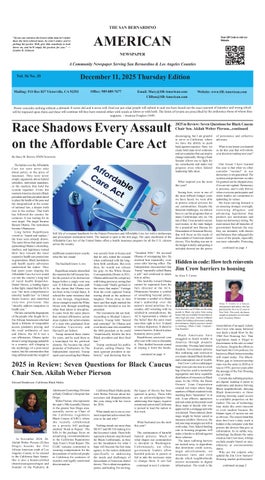
Review: Seven Questions for Black Caucus
Chair Sen. Akilah Weber Pierson
|
board-certified obstetrician/gynecologist and founder of the Pediatric &
Adolescent Gynecology Division at Rady Children’s Hospital-San Diego. Weber Pierson, who represents the state’s 39th Assembly District in the greater San Diego area, currently serves as Chair of the California Legislative Black Caucus (CLBC), where she recently collaborated on a priority bill package entitled ‘Road to Repair.’ The bills in the package focus on actualizing recommendations in the California Reparations Task Force’s Final Report. The CLBC remains committed to securing compensation for the descendants of enslaved people in California for centuries of injustice and legally sanctioned discrimination.
California Black Media spoke with Weber Pierson about her successes and disappointments this year, along with her vision for 2026.
What stands out to you as your most important achievement this year so far and why?
Nothing stands out more than SB 437 and SB 518 making it to the Governor’s desk. These bills represent a historic step forward for Black Californians, as they set the foundation for what I hope will become the first state agency in the nation dedicated specifically to addressing the needs and challenges of descendants of American chattel slavery. This is about recognition, justice, and healing. For too long,
the legacy of slavery has been ignored in policy. These bills are an acknowledgment that addressing that legacy requires intentional action and California is poised to lead the nation in this work.
What frustrated you the most this year?
The continuation of harmful federal policies. Much of what shapes our communities is decided in Washington. Unfortunately, too often, government leaders allow harmful policies to persist or fail to take the necessary steps to change them. It can feel
2025 in Review: Seven Questions for Black Caucus Chair Sen. Akilah Weber Pierson...continued discouraging, but I am grateful to serve in California, where we have the ability to push back against injustice. Here, we create bold state-level solutions and set examples that can inspire change nationally. Being a State Senator allows me to fight for my constituents and make real progress even when federal leadership falls short.
What inspired you the most this year?
What is one lesson you learned so far this year that will inform your decision-making next year?
One lesson I have learned this year is that what we often consider “normal” in our democracy is not guaranteed. The systems and protections we take for granted can be chipped away if we are not vigilant. Democracy is precious, and it only thrives when everyone participates and when leaders are committed to upholding its values. My focus moving forward is on ensuring stronger oversight, exercising diligence, and advancing legislation that protects our institutions and keeps our democracy strong. We must ensure that all branches of government function the way they are intended, with checks and balances that safeguard the voices of the people, especially our most vulnerable. Protecting
Seeing how, even in one of the most difficult budget years we have faced, we were able to protect critical services for our communities. Despite the financial challenges, we did not have to cut the programs that so many Californians rely on. On top of that, I was proud to secure seed money in the state budget for a potential new Bureau for Descendants of American Slavery that will focus on the needs of descendants of American chattel slavery. This funding was not in the budget initially and getting it included showed me the power of persistence and collective advocacy.
Hidden in code: How tech reinvents Jim Crow barriers to housing by Alice
T. Crowe
(Photo Credit: Unsplash / Tom Rumble)
Black Americans have struggled to build wealth in America through property ownership. Owning land meant freedom. Government policies like redlining and restrictive covenants cheated Black families and communities out of wealth.
Jim Crow’s color-coded paper maps were just one ruse in a trick bag of tactics used to normalize segregation and deny equitable distribution of resources to Black areas. In the 1930s, the Home Owners’ Loan Corporation created red zones where large numbers of Black residents lived, marking them “hazardous” or at risk. Loan officers, appraisers and real estate professionals used these maps to decide who was approved for a mortgage and who was denied. Those tattered, dusty maps might be better suited to museum exhibits. However, the red zone map strategies are still at work today. Now, federal funding cuts to housing programs will make it harder to defend against these schemes. The latest redlining barriers are tucked away in algorithms that determine credit scores, target advertisements, set insurance rates and even decide which neighborhoods receive investment in digital infrastructure. The result is the
resuscitation of an aged, rickety Jim Crow who many believed was dealt a death blow by the 1968 Fair Housing Act. That legislation made it illegal to discriminate in the sale or rental of a home. Despite the efforts to beat back Jim Crow policies, his barriers to Black homeownership still stand today. The BlackWhite gap in homeownership rates was the same in 2020 as it was in 1970, just two years after the passage of the Fair Housing Act of 1968. Current-day redlining practices are digital, making it easier to undermine and destroy thriving Black neighborhoods, denying Black homeowners or those seeking housing equal access to available properties on the market. The use of technology may make this seem innocent or even random because the blatant signs of racism are not as obvious. The unseen hand that does Jim Crow’s dirty work is hidden in the computer code that powers the devices that give us information. In its subtle way, technology facilitates the same result as Jim Crow laws; it helps exclude people based on race, ethnicity or socioeconomic status. Who are the culprits who uphold the Jim Crow barriers? Housing market professionals.
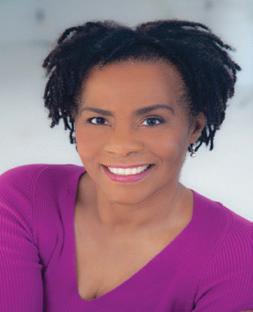
Alice T. Crowe is a lawyer, entrepreneur and author who has practiced law for over 25 years in New York. This week, she shares insight on prejudice in real estate tech. (Courtesy Photo)
Thursday, December
BERNARDINO AMERICAN NEWS -
A World Pulled Backward: Child Deaths Rise as Global Health Collapses Under Funding Cuts
By Stacy M. Brown
medical technology, health services, worldwide support. Futuristic style vector illustration.
The signs were visible to anyone willing to look. Clinics running out of medicine, health workers sent home in silence, and governments bracing for a wave they could no longer afford to stop. Now the evidence is written in hard numbers. For the first time this century, the number of children dying before their 5th birthday is rising. The Gates Foundation’s 2025 Goalkeepers Report states that 4.6 million children died before age 5 in 2024 and projects that the total will reach 4.8 million this year, reversing decades of progress in child survival.
The report’s modeling, completed by the Institute for Health Metrics and Evaluation, warns that the coming decades could bring even heavier losses. If recent global health funding cuts continue, as many as 16 million more young children could die by 2045. The findings show that development assistance for health fell 26.9 percent below the previous year, leaving already strained health systems exposed in regions where clinics were fragile long before budgets began tightening.
“We have to do more with less, now,” Bill Gates wrote in the Goalkeepers Report. “I wish we
were in a position to do more with more because it’s what the world’s children deserve.”
The projections grow heavier when paired with the collapse of programs once funded through the U.S. Agency for International Development. A Lancet analysis cited by NBC News shows that the Trump administration’s 83 percent cancellation of USAID programs could lead to more than 14 million deaths over five years, including 4.5 million children under age 5. “The numbers are striking,” Davide Rasella told NBC News. He said multiple research teams reached similar conclusions: “Millions and millions of deaths that will be caused by the defunding of USAID.”
Before the cuts, USAIDfunded programs prevented nearly 92 million deaths from 2001 through 2021 across 133 countries. NBC News reported that once the programs shut down, food kitchens, HIV clinics, malaria treatment sites, and maternal health centers went dark. “If you wanted to reduce USAID funding, it could have been done in a more gradual manner,” Amira Albert Roess told NBC News. She said the sudden closures left people
Head Start Ignites the Fire to Learn
By Dr. John Wallace
Dr. Wallace shared his success story with the National Head Start Association.
I am from Homewood, a predominantly African American neighborhood in Pittsburgh, Pennsylvania. Homewood is where I was enrolled in Head Start in 1967. Like many other neighborhoods across the country, it was once a vibrant place to live; however, it has suffered the downward spiral that happens due to decades of disinvestment. For so many kids in my neighborhood, the value of education was not in question. The barriers were the lack of opportunity and access. Attending Head Start gave me a boost to cross some of those barriers, energizing an inner zeal for learning.
After high school, I earned a bachelor’s degree at the University of Chicago and then a master’s and a Ph.D. from the University of Michigan, all in sociology. I settled in Michigan and began my career and family. An opportunity arose to join the faculty at the University of Pittsburgh. At that time, I had spent my career committed to researching the social and economic challenges that disproportionately impact neighborhoods like Homewood. It made sense to accept the post. It allowed me to return home, leverage my work in higher education, and mobilize resources and interventions to strengthen and create more opportunities for my community. Today, through key
unable to refill lifesaving medications, adding, “That’s creating a situation where the individual can start to deteriorate fairly rapidly.”
The workforce behind these programs also collapsed. Newsweek reported that about 50,000 jobs were disrupted worldwide. “These were the most educated people … and then ‘poof’ overnight they don’t have an income and a livelihood,” Lara Andes told Newsweek. U.S.based nonprofits endured deep layoffs, some cutting 40 to 60 percent of their staff. “It has been nothing short of devastating,” Christy Grimsley told Newsweek after losing her job and health insurance during the cuts.
On the ground, the unraveling is visible in communities already carrying heavy burdens. In Nigeria’s Gombe State, Governor Muhammad Inuwa Yahaya described taking office in 2019 amid a historic deficit and failing clinics. He discovered 500 ghost workers on the state payroll and spent ₦2.8 billion (US$1.8 million) saved from payroll reform on training and rehiring. “You don’t need perfect conditions to make progress,” Yahaya told the Goalkeepers Report. “You need clarity, and the courage to stick to it.”
In Kenya, community health worker Josephine Barasa received an abrupt email ending her employment after years spent mentoring young mothers and survivors of violence. “They could take away the money, but they couldn’t take me away from my women,” Barasa said. She returned to her work unpaid, gathering donations from churches, mosques, and community centers to continue screenings, health lessons, and support for children who lost access to services when the
funding ended.
The stakes remain high in Uganda, where malaria still threatens millions. Entomologist Krystal Mwesiga Birungi recalled her younger brother falling ill with fever when her family could not afford mosquito nets. “Nets are for rich people,” Birungi remarked, describing what her mother often said. Now she develops next-generation tools aimed at reducing mosquito populations and preventing infections that continue to claim lives. “Ending malaria is not only possible, it is urgent,” Birungi stated.
The Goalkeepers Report details solutions that could save millions of children. Next-generation vaccines for pneumonia and RSV, new malaria-prevention technologies, maternal immunization programs, and strong primary care systems that cost less than $100 per person per year and can prevent up to 90 percent of child deaths. Every $1 invested in vaccines returns $54 in economic and social benefit.
Gavi has already helped deliver vaccines to more than 1.2 billion children since 2000.
Still, even the most promising innovations cannot overcome systems deprived of resources. “It takes infrastructure to get an organization and keep it going,” Andes said. “And all that infrastructure has collapsed.”
At the end of the road — beneath the numbers, the projections, and the policy reversals — are the people still trying to hold the line. Their work carries a reminder that even when global systems falter, individuals continue to move forward on determination alone.
“The support systems may have disappeared, but the need has not,” Barasa explained. “And neither have I.”
The San Bernardino AMERICAN News Submission Deadline Is On Mondays By 5 pm
Hidden in code: How tech reinvents Jim Crow barriers to housing...continued
dealings steal resources from Black communities and expand the wealth gap. Private listing networks and IP targeting undermine fair housing and increase the risk of steering and discrimination based on race or other protected traits.
Alice T. Crowe is a lawyer, entrepreneur and author who has practiced law for over 25 years in New York. This week, she shares insight on prejudice in real estate tech. (Courtesy Photo) The federal rollback of fair lending enforcement, funding cuts and the focus on debanking, (the denial of banking service to a customer) and special-purpose credit programs make it easy for these schemes to get away with their racist agenda. The Black community must bank in Blackowned banks and credit unions. And require these institutions
to provide capital where other financial institutions refuse. Black community members can create business districts within the Black community to circulate dollars and create jobs. Create land trusts and cooperative housing arrangements to enable Black communities to collectively own property, build wealth and keep housing affordable. Still, states will have to fill in the gap. Individuals harmed by the new housing schemes must request explanations for automated decisions (like loan denials or low appraisals). They must continue to report discrimination, file lawsuits and not let lenders off the hook. The opinions expressed in this commentary are those of the writer and not necessarily those of the AFRO.
Victorville Senior Citizens Club
14874 S. Mojave Dr. Victorville CA 92395
BINGO: Saturday December 13 & 27,
BUY IN $25 Pay Out $75-$200
Doors open 10:15am / game start 11:00am
The Way World Outreach Ministry
Toys for Tots December 20 @ 9am-12pm
Bid Whist Fundraiser: Saturday January 31, 12:30pm
Buy in $15 in Advance - $20 at the Door ALL ABOVE EVENTS OPEN TO PUBLIC For additional information regarding Membership & Hall Rental Availability Call 760-245-5018
The Numbers Behind the Myth of the Hundred Million Dollar Contract
By Stacy M. Brown
partnerships, we are helping make Homewood a desirable place to live again. We are investing in the people who live there and creating pathways to vitality from cradle to career.
Two of these efforts are the Homewood Children’s Village (HCV) and the Oasis Project. HCV is a two-generational approach to weaving community partners together to deliver integrated educational support, economic opportunities, and social-emotional development throughout the entire life journey from birth to young adulthood.
The Oasis Project is the community development arm of the Bible Center Church, where I am the senior pastor. Rooted in the centrality of faith-based organizations — particularly in historically Black neighborhoods—the Oasis Project leverages the church as a trusted institution. The project’s focus is on building opportunities across education, employment, entrepreneurship, and the physical environment. Oasis manages social enterprises like a shared-use community kitchen and a coffee house, community education programs like an urban garden, an entrepreneur training program, and a Science, Technology, Engineering, Agriculture, and Mathematics (STEAM) after-school program.
There are many parallels between the work of Head Start and my work in Homewood, and that makes me proud. Head Start ignites the fire to learn among low-income children, like myself, who go on to ignite that fire for others who will go on to illuminate the world.
Hidden in code: How tech reinvents Jim Crow barriers to housing...continued from page 1
Housing market professionals are the gatekeepers of the housing market.
According to Elizabeth Korver-Glenn, author of Race Brokers and assistant professor of sociology at the University of North Carolina – Chapel Hill, “Housing market professionals are race and racism brokers. They subvert real estate business as usual. Housing market professionals, especially those who are White, actively create racially unequal housing markets and urban landscapes. They do so by using racist ideas to inform how they implement professional norms and policies and how they distribute their professional resources, including authority, knowledge and capital.”
Here’s how digital redlining works. Black people who live in a specific zip code searching online for housing will never see all of the available listings in their feeds. They were redlined out and never knew it. Zip codes are used to target people within specific demographics. This is called IP targeting, and it allows companies to show advertisements to specific IP addresses from their lists. An ad may show up to everyone in a particular area, except in specific zip codes where there are mostly Black residents.
Businesses can focus their advertising on specific homes or groups of dwellings within defined locations. This seems harmless, but it’s not. Three housing organizations filed a
lawsuit in 2018 against Facebook, alleging its advertising platform helped landlords and real estate brokers exclude people of color, families with children, women, people with disabilities and other protected groups from receiving ads. The lawsuit was settled.
With the hidden hand of technology, private listing networks do the dirty work of restrictive covenants —clauses in deeds that barred homeowners from selling to Black people. Homes listed on private listing networks are marketed outside public platforms and made available only to a select group of agents and brokers within the network. Some are even by invitation only. These networks are not transparent. They deny equal access and make sure that White homeowners can sell their houses exclusively to other Whites.
Of course, real estate clients should be able to keep their business dealings private from public exposure of personal or financial matters. People going through divorce, bankruptcy or lawsuits shouldn’t have to deal with their business being put out on the street. Private networks enable sellers to test the market without exposure. Yes, they connect unique properties to serious buyers. The fallout to the Black community from decades of redlining has been irreparable. Secret unfair
Odell Beckham Jr. did not spark controversy on purpose. He sat on The Pivot Podcast and tried to explain the math behind a deal that looks limitless from the outside but shrinks fast once the system takes its cut. He looked into the camera and tried to offer a truth most fans never hear. “You give somebody a five-year $100 million contract, right? What is it really? It is five years for sixty. You are getting taxed. Do the math. That is twelve million a year that you have to spend, use, save, invest, flaunt,” said Beckham. He added that buying a car, buying his mother a house, and covering the costs of life all chip away at what people assume lasts forever
The reaction was instant. Many heard entitlement. Many heard a millionaire complaining. What they missed was a glimpse into a professional world built on big numbers up front and a quiet erasing of those numbers behind the scenes.
The tax data in Beckham’s world is not speculation. SmartAsset’s research shows that top NFL players often lose close to half their income to federal taxes, state taxes, and local taxes. The analysis explains that athletes in California face a state rate of 13.3 percent and that players are also taxed in every state where they play road games, a structure widely known as the jock tax. For many players, that means filing up to ten separate returns and facing a combined tax burden that reaches or exceeds 50 percent.
A look across the league paints the same picture. The research lists star players in New York, Philadelphia, Chicago, Detroit, and Cleveland, all giving up between 43 and 47 percent of their football income before they ever touch a dollar. Star quarterback Phillip Rivers, at one point, was projected to lose half of his playing income to taxes alone.
A second financial breakdown from MGO CPA shows that the problem does not only affect the highest earners. A $1 million salary falls to about $529,000 after federal taxes, state and city
taxes, an agent fee, and a contract deduction. According to that analysis, professional athletes typically take home around half of their contract value, and that is before rent, meals, training, travel, and support obligations are counted.
The structure of professional sports contracts adds another layer. A study of major deals across MLB, the NBA, and the NFL notes that long-term agreements lose value over time because the dollar today has more power than the dollar paid in the future. Even the largest deals shrink once adjusted for time. The study explains that contract size alone does not guarantee financial success and that structure and timing play a crucial role in a player’s long-term outcomes.
Beckham has also faced headlines claiming he is “on the brink of bankruptcy despite earning over one hundred million” in his career. Those reports repeated his statement that “after taxes, it is only sixty million” and captured the disbelief from fans who could not understand how money at that level could ever tighten. Other reactions lacked nuance. One article wrote that no one could relate to any struggle on eight million dollars a year. Another described his approach as “the definition of a new-money move” and argued that it signaled poor financial choices and inflated spending.
But the underlying truth reaches far beyond Beckham. Professional athletes enter sudden wealth without preparation. They carry the weight of family support. They navigate teams, agents, advisors, and expectations from every direction. Their earning window is brief. Their career can end in a moment. Their income is fragmented, taxed, and carved up before the public ever sees the real number.
The math is unflinching. Twenty million dollars becomes something closer to $8 million after federal taxes, state taxes, jock taxes, agent fees, training costs, and family responsibilities. Over five years, that is about $40 million of real, spendable income. It is transformative money, but not infinite. Not guaranteed. Not protected.
Beckham offered a question at the heart of this entire debate. “Can you make that last forever?”
Global healthcare concept with glowing Caduceus symbol above Earth on dark blue background. Innovation,
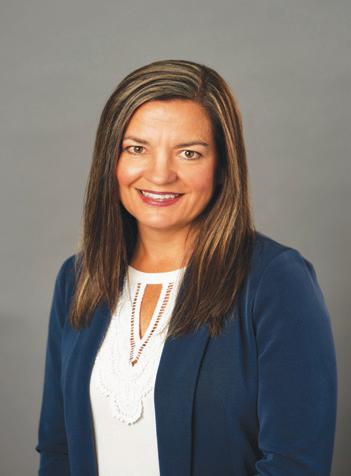
Rachelle Román Appointed as New Director of the Office on Aging by Riverside County Board
of Supervisors
The County of Riverside Board of Supervisors appointed Rachelle Román, a seasoned executive with 23 years of public service, as the new Director of the Office on Aging (OOA). Román brings extensive experience in strategic planning, administrative leadership, and cross-sector collaboration across aging and public health services.
“Rachelle’s many years of service and expertise are an asset to the Office on Aging," Supervisor V. Manuel Perez, Chairman of the Riverside County Board of Supervisors.
“We look forward to her new role leading this department and continuing the efforts to support our seniors in making Riverside County and all our communities a great place to live.”
The Office on Aging carries a countywide mandate to develop a home and community based system of services that supports dignity, well-being and independence for older adults and individuals with disabilities. With more than 550,000 residents over age 60, 280,000 households that include a senior, and a rapidly growing population of older adults from diverse backgrounds, Riverside County faces increasing demand for accessible, consumer-focused support.
Román’s service with the County of Riverside began in the Auditor-Controller’s Office, where she served as Chief Accountant. In 2013, she joined the Office on Aging as Deputy Director of Administration, overseeing budget and fiscal operations, contracts and grants, human resources, information technology, and senior nutrition
programs. Following a stint in Public Health where she administered a $220 million budget, she rejoined OOA as the Assistant Director July of this year. Román’s background in aging services, fiscal stewardship and large-scale program administration aligns with the agency’s mission and positions her to strengthen service delivery, expand outreach, and guide the department in meeting the needs of the county’s aging and disability communities.
Román holds a Master of Public Administration; a Bachelor of Science in Business Administration with a concentration in accounting; and is certified in Healthcare Compliance.
Outside of her professional achievements, Román enjoys spending quality time with her husband and family, finding balance and inspiration in their shared moments together.
"I am honored to lead the Office on Aging and to continue supporting the seniors who are the foundation of our communities," said Román. "With a dedicated team and strong partnerships across the county, we will expand innovative, accessible services that promote dignity, independence, and quality of life for Riverside County’s older adults."
Her appointment follows the retirement of the former Office on Aging Director, Jewel Lee, who held the position for eight years.
For more information on the Riverside County Office on Aging and its programs, please visit rcaging.org.
Thursday, December 11, 2025
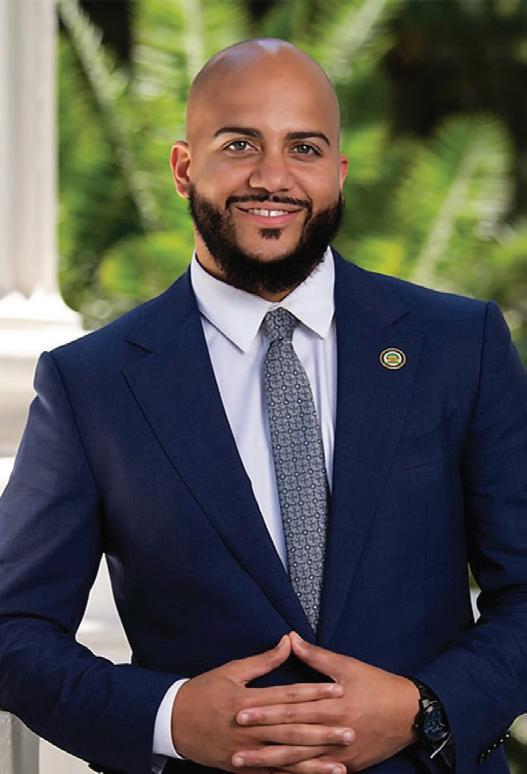
2025 in Review: Seven Questions for Black Caucus Vice Chair
Assemblymember Isaac Bryan
Joe W. Bowers Jr. | California Black Media
Assemblymember Isaac Bryan (D-Ladera Heights) represents California’s 55th Assembly District — which also includes Baldwin Hills, Leimert Park, the Crenshaw Corridor, Culver City, Del Rey, and parts of Mid-City — an area long recognized as the political and cultural center of Black Los Angeles.
At 33, Bryan is already one of Los Angeles’ more seasoned state lawmakers. Elected in 2021, he quickly became one of the Legislature’s leading voices on democracy protection, economic mobility, and justice reform. Vice Chair of the California Legislative Black Caucus (CLBC), he also serves on key Assembly committees — including Natural Resources (which he chairs), Judiciary, Governmental Organization, and Privacy and Consumer Protection — where many of the state’s major equity and civil rights debates take shape.
In 2025, Bryan was at the forefront of several defining state battles — advancing the CLBC’s Road to Repair agenda, safeguarding political representation, and pushing for overdue respect for incarcerated firefighters.
Bryan sat down with California Black Media to reflect on the year. Here are his responses to seven key questions, edited for length and clarity.
Looking back on 2025, what do you see as your biggest win — the thing you're proudest of getting done or moving forward?
There are two. One, incarcerated firefighters have been fighting wildfires in California for 100 years, and they have made slave wages that entire time. When the Palisades Fire and the Eaton Fire were raging this year, there were incarcerated people on the front lines making a $1 an hour. We raised those wages to the federal minimum wage (Assembly Bill (AB) 247). It is the first time an incarcerated person in California will earn a minimum wage for their labor. If not now, when?
And the second is Proposition
50. It was uniquely targeting Black representation in Texas and throughout the South to push the President’s agenda, and it’s an agenda that we know is anti-Black. We helped organize the state to send a resounding message with Prop 50, and I am incredibly proud of that.
How do you think your leadership, the laws you worked on, and the initiatives you championed helped make life better for Californians this year?
Every single thing that I was a part of this year has a disproportionately positive impact on people who look like us. As Vice Chair of the Legislative Black Caucus, we were very focused on improving life for people who rely on social safety nets. We protected a lot of that from federal cuts.
AB 246 prevents seniors from losing their housing if their Social Security income drops. AB 248 removes wage caps for incarcerated people who are working in county facilities. AB 1299 lets cities reduce or waive parking penalties for people facing homelessness or financial insecurity, and we know who is most likely to face those challenges and who is most likely to be living in their car.
We can’t always explicitly name race in legislation, but we made sure the work was targeted toward folks who are struggling the most. Unfortunately, as has been the case for the last several hundred years, it is our people.
continued on page 6
As Epps Trial Draws to a Close, Equal Justice Concerns Emerge
By Eric Arnold
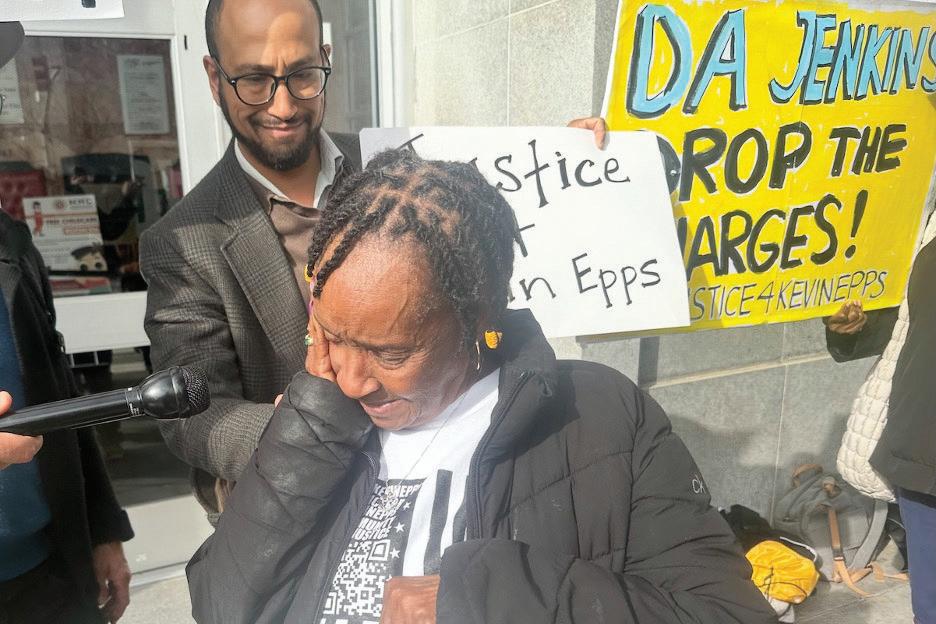
mother of Kevin Epps, on trial for the 2016 murder of Marcus Polk, in front of the Hall of Justice in San Francisco.
(Credit: Eric Arnold)
The defense in the Kevin Epps murder trial presented just one witness, Dr. Judy Melinek, an eminent forensic pathologist whose testimony appeared to supercede the expert witnesses who had testified for the prosecution earlier in the trial – including San Francisco Chief Medical Examiner Dr. Christopher Liverman.
Melinek, regarded as something of a celebrity in the field of forensic pathology – has specialized training in gunshot trajectory analysis and has testified in more than 300 trials.
A Harvard graduate who went to medical school at UCLA, worked as a medical examiner in San Francisco and Alameda County, and authored two books,
not to mention playing a cameo role on the television show “E.R,” Melinek is best known for her work in New York during the aftermath of 9/11, when she conducted hundreds of autopsies. She is currently an Associate Professor at UCSF, and runs her own forensic consulting firm.
Earlier in the trial, SFPD CSI Lt. Patrice Heath and Dr. Liverman had testified about the trajectory and approximate distance of the gunshots Epps, 57, fired that killed Marcus Polk, 49 at the time of the shooting. Their answers to the direct examination of prosecutor Jonathan Schmidt were often approximate or inconclusive, compared to Melinek’s, which were decisive and authoritative. At one point, she left the witness box to physically demonstrate the
path of a bullet, using her body and a pen so the jury could more easily visualize what she was talking about.
Melinek confidently stated that an autopsy photo with a trajectory rod inserted to show the path of a bullet that struck Polk was incorrect, because the medical examiner did not account for the bullet’s deflection. “This path is not the path the bullet traveled — (the rod) isn’t following the point where it hit the rib.
“If this bullet had gone straight back to front, I would expect to see a round punched out hole. It’s hitting the hardest part of the rib and deflecting outward.”
The trajectory, she said, “would not have been a straight line. The bullet got deflected inward through the torso.”
Forensic pathologist Dr. Judy Melinek has specialized training in gunshot trajectory analysis and has testified in more than 300 trials. (Credit: Eric Arnold)
The implications of the deflection represent the difference between Polk being shot in the back, as the prosecution has contended, or from a more front-facing direction, as the defense has attempted to show.
In Melinek’s opinion, the bullet “was going more left to right and then it got deflected to go back to front.” This assertion contradicts Liverman’s finding that the bullet traveled back to front, with no
As Epps Trial Draws to a Close, Equal Justice Concerns Emerge...continued
Melinek’s insistence the bullet had been “absolutely” deflected. “I can’t answer the question the way you asked it,” she said when asked about the trajectory rod.
After Schmidt quoted a “general rule” of deflected bullets from a forensic pathology reference text, she replied, “I completely disagree with that… the problem is the (phrase) general rule. I wouldn’t have phrased it that way because I’ve seen too many exceptions.”
Unable to impeach Melinek, the prosecutor indicated he had no further questions. The defense then rested its case.
Many questions remain, leaving Epps’ supporters to question whether Epps was receiving a fair trial. Most concerning was why Judge Brian Ferall ruled in pretrial motions in favor of the prosecution that much of Polk’s past history was inadmissible. This effectively kneecapped the intended defense.
Julian Davis, an attorney and 20-year friend of Epps, said he believes this trial signifies “a matter of public concern that touches on “…how selfdefense laws are prosecuted and interpreted by our legal institutions.”
One key issue is whether the judge will allow Epps’ attorney to claim the “Stand Your Ground” defense, also known as the Castle Doctrine, in his closing argument. Davis questions whether “our self-defense laws, stand your ground, Castle Doctrine laws, et cetera, apply equally to somebody like Kevin as they would to any other more affluent or more privileged member of society.”
Davis said another issue has been Farrell’s limited experience in criminal court. “The prosecutor has been able to get away with far more than you would’ve (seen)
with a more experienced judge in criminal matters,” he asserted. Tobee Vanderwalk, a textile and performing artist and mother of three, who got involved with Epps’ defense around the time of his 2019 preliminary hearing, wonders why the case was reopened at all.
“My question still is, what happened in 2019 in the DA’s office?”
Wanderwalk finds the DA office’s commissioning of a digital animation by Jason Fries of 3-D Forensic inc. to be highly problematic. The animation, she explained, was “the way they hooked this whole case together” – but was ruled inadmissible in pretrial hearings. In hindsight, she says, “if it was inadmissible (in 2025), I don’t think a judge should’ve signed a warrant in 2019 to arrest Kevin.” Tabari Morris, a journalist for the SF Bayview newspaper (where Epps serves as editor-inchief) and the news editor of the City College of San Francisco Guardian, is also a longtime friend of Epps. Excluding Marcus Polk’s past history and including “red herrings that don’t matter” like the marijuana found on the scene, add up to selective and unequal justice. “How this is even allowable is part of the bigger problem and the bigger issue, no matter who it applies to.”
The trial’s next phase, jury instruction, which will determine what jurors can and cannot consider, could well prove pivotal in a case that increasingly appears to have larger implications for how the criminal and court system treats Black defendants. This story was produced in collaboration with California Black Media. It is part of ACoM’s ongoing coverage of the Kevin Epps trial.
2025 in Review: Seven Questions for Black Caucus Chair Sen. Akilah Weber Pierson... continued from page 1
democracy requires constant effort.
In one word, what is the biggest challenge Black Californians are facing currently?
deflection.
Polk had two separate entry and exit wounds, which could have been from a single bullet or two. The forensic geometry, Melinek said, would mean that the bullet that stuck Polk in the arm could then have continued into his torso and chest cavity before exiting. This would mean his arm was outstretched, which would be consistent with Epps saying Marcus Polk came at him, as Melina Polk testified. If the arm was in a different position, it conceivably weakens the defense’s contention and strengthens the prosecution’s account.
During Schmidt’s crossexamination, Melinek repeatedly turned the tables on the veteran prosecutor by questioning his questions. “I can’t agree with that (question) the way you’re asking,” she said at one point. When Schmidt posed a hypothetical about various positions Polk’s arm could have been in, Melinek replied, “You can’t just do that. You’d run up to the limits of what the shoulder joint can do.”
Visibly flustered, Schmidt called for lunch break five minutes early.
When the cross-examination resumed, the exchange between the two remained contentious, as Schmidt attempted to undercut
Inequality. When you look at the wealth gap between Black and White families in California, it’s clear there’s a deep economic divide. Black families earn about 63 cents for every dollar earned by White families. Housing is another major factor. Black Californians make up only about 6 to 7% of the state’s population but account for roughly a quarter of those experiencing homelessness. Then, there are the health disparities, driven by social determinants like housing, food access, and environmental conditions. All of this shows that inequality continues to shape the lives of Black Californians across every area of life.
What is the goal you want to achieve most in 2026?
In 2026, my goal is to build healthier communities in every sense. True health is not just going to the doctor, it's safe housing, quality education, affordable living, access to healthcare, healthy food, clean air, and a commitment to addressing climate change. These social determinants shape our well-being in ways we often do not notice until problems arise, such as chronic illness, unsafe living conditions, wildfires, lack of healthy food, poor air quality, and limited access to care. My work will focus on advancing policies that strengthen these foundations so every family, regardless of income or zip code, can live, learn, grow, and thrive in a healthy community.
Brenda Epps,
Thursday, December 11, 2025
With Seats of Congressional Black Caucus Members Under Attack, Trump Again Targets Rep. Ilhan Omar
By Lauren Burke
On December 4, during a White House cabinet meeting, President Trump launched into a hateful, racist rant against Congressional Black Caucus member Rep. Ilhan Omar (DMN).
“Those Somalians should be out of here. They’ve destroyed our country. And all they do is complain, complain, complain. You have her – she’s always talking about ‘the constitution provides me with uhhhh,’” Trump ranted, speaking of Congresswoman Omar.
Trump has targeted Rep. Omar and other members of Congress’s “Squad” before and during his first term in office. Those attacks by Trump included Reps. Ayanna Pressley, Alexandria OcasioCortez. Many political observers wonder if Trump’s latest rant was a strategy to deflect from bad economic news. Either way, Trump’s latest racist tirade isn’t new.
Rep. Omar’s family fled Somalia during a war and then earned asylum in the U.S. in 1995. She became a U.S. citizen at age 17 and has represented Minnesota’s 5th congressional district since 2019.
In 2019, Trump said that the congressional group nicknamed “the squad” should “go back and help fix the totally broken and crime-infested places from which they came.” During his 2024 campaign for the White House, Trump made anti-immigration rants a predictable part of his campaign rallies.
The Congressional Black Caucus responded to the latest attacks by Trump and other Republicans in an era of brazen anti-Blackness.
“From the recently leaked texts of Republican officials using the n-word and praising Hitler to President Trump’s comments in the Cabinet Room, it’s beyond clear that the Republican Party’s racism truly knows no bounds,” wrote the Congressional Black Caucus in a press release in defense of Rep. Omar on December 4.
The attacks heighten the tension of national political discourse. The level of political vitriol would appear to have real-world applications. Great Britain’s paper The Independent exclusively reported on Dec. 8, a
serious threat to Rep. Omar. The Congresswoman has had to add personal security to her team in recent years.
“A 30-year-old Florida man is facing up to a half-decade in federal prison after confessing to posting violent threats on social media that promised to decapitate Democratic Rep. Ilhan Omar, murder her ‘monkey children,’ then eat the kids ‘for protein,’ according to plea agreement papers reviewed by The Independent,” the Dec. 8 post by the newspaper relayed. The news arrived days after Trump’s attacks, though the matter appeared to be related to comments the Congresswoman may have made after the murder of Charlie Kirk.
The latest attack on Rep. Omar is only one of a series of pressures on the Congressional Black Caucus. Several members are now facing challenges to their power as several members are facing sudden redistricting changes in states with Republican Governors. These include Missouri, Texas, and Indiana.
In August, Texas Republicans began the back-and-forth onslaught that became the current partisan redistricting fight.
California answered the call by passing a ballot initiative that will likely lead to the elimination of several GOP congressional seats. In Virginia, there is open talk by Democrats of altering the congressional delegation in a way that could produce ten Democrats in the Virginia delegation out of eleven.
Several members of the CBC, including Rep. Emanuel Cleaver (D-MO), Al Green (D-TX), Andre Carson (D-IN), Jasmine Crockett (D-TX), and Marc Veasey (D-TX) are dealing with the special challenge of chasing district lines for partisan reasons.
Rep. Crockett was drawn out of her own district during the GOPdriven map redraw in Texas.
On the evening of December 8, Crockett announced she would be running against Republican Senator John Cornyn for U.S. Senate in 2026.
The race was forced in part by the onslaught of redistricting fights that are likely to get more complicated in the early part of next year.
Settlement with Cracker Barrel over allegations, disability discrimination involving students with autism at Waldorf restaurant
Barrel Old Country Store, Inc., resolving allegations that the company discriminated against a group of students from Dr. James Craik Elementary School based on their disabilities during a visit to its Waldorf, Md., restaurant. The incident occurred in December 2024 when 11 students and their teachers from two special education programs visited Cracker Barrel as part of a community-based instruction program designed to help students practice social and
skills. Teachers alleged that the group experienced delays and mistreatment because of the
Settlement with Cracker Barrel over allegations, disability discrimination involving students with autism at Waldorf restaurant...continued students’ disabilities. Under Maryland law and the federal Americans with Disabilities Act, public accommodations are prohibited from denying individuals with disabilities the full and equal enjoyment of goods and services.
Following the incident, the Civil Rights Division opened an investigation and MCCR issued a Commission-initiated complaint against Cracker Barrel. The Civil Rights Division and MCCR joined forces to conduct the investigation.
Cracker Barrel denied the allegations but agreed to resolve the matter voluntarily and without litigation.
Under the terms of the settlement:
Cracker Barrel will revise and strengthen its public accommodation policy nationwide to ensure compliance with state and federal disability rights laws.
Cracker Barrel will pay a total of $75,000 to the affected students, allocating $7,500 per child.
Cracker Barrel will donate $17,500 to the Dr. James Craik Elementary School SORE and ACHIEVE programs to expand classroom technology, including adaptive learning tools, communication devices, and interactive software designed to support students with developmental disabilities.
Cracker Barrel will reimburse $446.56 for the school’s cost of meals purchased and transportation on the day of the incident.
Cracker Barrel will contribute $9,000 to the Civil Rights Enforcement Fund, supporting education, outreach, and enforcement efforts across Maryland.
“When businesses break the law and fail to treat people with disabilities with the dignity and respect they deserve, my Office will step in and hold them accountable,” said Attorney General Brown. “This settlement compensates these students and their school while requiring Cracker Barrel to update its policies – advancing inclusion and accessibility not just across Maryland, but across the entire country.”
“This agreement is a reminder that every child, every family, and every Marylander deserves to move through our communities with dignity, respect, and full inclusion,” said MCCR Executive Director Cleveland L. Horton II. “When harm occurs, we do not look away—we confront it with truth, with accountability, and with a steadfast commitment to building a state where our shared humanity is never in question. Today’s resolution is not the end of a case; it is a reaffirmation of our collective responsibility to ensure that equity is practiced, not promised, and that every public space in Maryland welcomes all of us, without exception.”
In making today’s announcement, Attorney General Brown and the Maryland Commission on Civil Rights applaud the parents of the children for their tireless advocacy and thank Charles County Public School leadership. Additionally, Attorney General Brown and the MCCR thank Chief Jonathan M. Smith, Assistant Attorney General Janee Fountain, Deputy Chief Rashida Ogletree-George, Assistant Attorney General Julianne Cozzetto, and Chief Investigator Latonya Bishop of the Civil Rights Division, as well as MCCR Civil Rights Officer Lead Rafiel Bowen for their work. This matter reflects the strong partnership between MCCR and the Attorney General that works to safeguard all Marylanders’ civil rights.
LEASE SUPPORT
Journalism & Advertising in The Black Press
AMERICAN News (San Bernardino) Community Newspaper
You never know where your big Hollywood break will come from. But it probably won’t start with an unexpected text message about a virtual casting call. That’s likely a scam. Learn the cues to avoid this type of phishing scam.
We’ve heard from people who’ve gotten text messages from a “talent scout” offering auditions for a well-known movie like “The Devil Wears Prada 2” or a show like “Ted Lasso.” The unexpected text message might ask if you’re still available tomorrow for a virtual open call (you never were). If you respond, you might end up in a virtual “audition” that’s actually a highpressure sales pitch to sign up for bogus photo shoots or fake acting classes. But first, the plot twist: There’s always a reason you have to pay or hand over bank information before you participate in the casting. Paying to get a job is always a sign of a scam. Real companies won’t
Rep. Jasmine Crockett Announces Run for Senate, Rev. Frederick Haynes, III Files to Run for Her Old Seat
By Lauren Burke
“We need to stop all the hell that is reigning down on all of our people,” said Rep. Jasmine Crockett from a Dallas stage to a cheering standing-room-only crowd.
On December 8, Rep. Crockett, who has built a reputation as a firebrand in Congress in the fight against Trump’s MAGA Republicanism, announced she would run for the U.S. Senate in 2026.
Rep. Crockett will be competing to take on veteran Republican Senator John Cornyn, but there is also a competitive primary. Regardless, Rep. Crockett is likely to be viewed as the frontrunner.
Additionally, nationally known Pastor Dr. Frederick Haynes III, of Friendship West Baptist Church, who introduced Rep. Crockett, will also be running for Congress in 2026. Rev. Haynes has filed to run to be the Democratic nominee in Texas’ 30th congressional district — Crockett’s old district, though redrawn.
In another development, former Congressman Colin Allred announced he is dropping out of the race for U.S. Senate to run in the 33rd congressional U.S. House seat in Texas.
There’s no surprise there’s a flood of political news out of Texas because the filing deadlines for congressional races to be
decided by voters in November of 2026 are this week. Last week’s decision by the Republican controlled U.S. Supreme Court in favor of the congressional maps drawn by Texas Republicans in August of this year also reset the deck chairs in Texas politics.
“We need a fighter today in light of what’s happening in Washington DC. In light of what’s happening in Austin. We need someone who ain’t scared — we need someone who is ready to fight,” Rev. Haynes told the crowd as he introduced Crockett to the stage in front of a packed room.
A video played beginning with the voice of President Donald Trump making several negative statements about the Congresswoman with the image of a Crockett in profile and then looking straight on into the camera. The Texas Congressman and former prosecutor has never strayed from direct political confrontation with Trump during her time in Congress. She has often won his negative attention.
“There is a responsibility that lies with all of us — especially in this moment,” Congresswoman Crockett started as she took the stage standing at a podium with the words “CROCKETT TEXAS TOUGH” on it.
“There are those who say ain’t no way we tried it 50 kinds of ways — let me be clear y’all have never tried it the JC way,” Crockett confidently told the audience. She also focused on her consistent and energetic pushback on President Trump and his agenda.
The congressional primaries in Texas are March 3, 2026.
Courage is Contagious
Elizabeth Dilley
Imagine one of your great grandparents toiled over a handwritten, illustrated copy of the Gospel of John for many years, creating radiant and reverent art to accompany the vivid imagery of John’s words, hand-scribed in script from a relative you barely knew. This labor of love was stolen years later, when your entire neighborhood was ransacked and your extended family was driven out and forced to live apart from one another, apart from the land your great grandparents and their children toiled on, and apart from all they’d known for many generations. And now imagine that you are thousands of miles from home, and you see your ancestor’s gospel in a museum attributing the work to “an unknown primitive artist” as part of a “reviving cultural heritages” art exhibit.
ask you to pay anything upfront. Here are things you can do to avoid a casting call text scam: Don’t respond to unexpected text messages. Never reply or click links in unexpected messages. You might end up engaging with a scammer. Do some research. Search online for the casting call or casting director’s name with words like “scam,” “review,” or “complaint.” See what others are saying.
Never pay to get paid. Scammers will try to charge you for test shoots, head shots, or to “secure your spot” for a job. A real talent agency finds jobs for you and pays you after the client pays them. Send unwanted texts to 7726 (SPAM) or use your phone’s “report junk” option. Once you’ve reported it, delete the message. And if you spot a scam, tell the FTC at ReportFraud.ftc. gov.
This is not a made-up scenario, but describes the many sacred Indigenous artifacts that thousands of museums in the United States currently have their possession. Often acquired “generations ago through exploitative purchases or grave looting,” museums hold community objects and religious relics of Native American tribes without permission. Worse yet, many museums hold onto bones or other funerary remains of Indigenous folk, having literally robbed graves to obtain them.
A 1990 federal law known as NAGPRA (Native American Graves Protection and Repatriation Act) requires institutions to make a record of their holdings available to tribes and the federal government and to work diligently towards repatriation of those items. As you might well imagine, the work is slow-going, meets with nearcontinual institutional resistance rooted in white supremacy, and
is grossly underfunded. As a local example, the Cleveland (Ohio) Museum of Natural History has made available 0% of the more than 400 Native American remains it has reported to the government. (You can find information on institutions near you at this ProPublica site.)
Reasons for these delays given by various institutions include, “We don’t have local tribes here to communicate with”; “we don’t know precisely who these remains are of, so we don’t want to return them to a non-family or incorrect tribe”; “this is too expensive”; “they will degrade if they leave the careful curation of our institution.” Again, imagine that they are talking about your great grandparents’ hand-written Gospel of John (and maybe even the bones of your ancestors). What do those excuses sound like in your ears?
In a time where Indigenous communities are calling for land return, I hope to respectfully add to that chorus a call to return the bones of ancestors to their people and the return of sacred objects to their rightful communities. If those communities want to work with museums to co-create culturally sensitive exhibits, let that be a decision of the tribes rather than the white institutions that currently hold possession of these objects. And if you want to learn more, I highly recommend reading from ProPublica’s massive reporting, contained in The Repatriation Project, and finding ways to connect with tribal communities near you to listen and learn about their goals and priorities related to NAGPRA. Not all tribes agree on what needs to be done, but all them affirm that their voices need to be included in these conversations, and their wisdom respected about their sacred objects and ancestors.
Rep. Jasmine Crockett
By Maryland Office of the Attorney General
UAB Researcher Awarded $2M to Study Acute and Chronic Pain Patients Face After Surgery
By Emme Stewart | UAB News
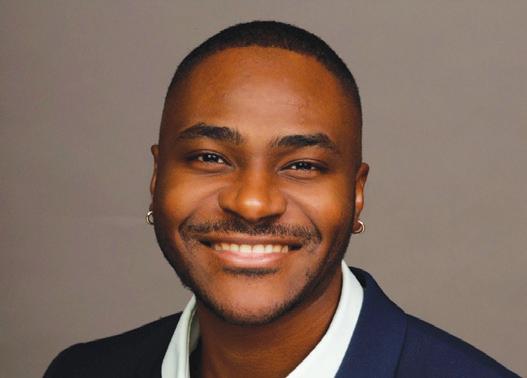
Demario Overstreet, Ph.D.,
an assistant professor in the University of Alabama at Birmingham Division of Gastrointestinal Surgery, has been awarded substantial funding through the National Institutes of Health for his innovative research program, titled “Contemporary human models of postoperative pain: A biopsychosocial investigation in general surgery.”
The award, totaling over $2 million through 2030, will support Overstreet’s investigation aimed at uncovering the factors that determine patients’ experiences of acute and chronic pain during their healing journeys after surgery. The primary focus of the research is to better understand the transition from acute to chronic pain.
“This research will help us rethink the healing process for patients and explore how pain manifests differently across individuals,” Overstreet said. “It provides an opportunity to develop translational, evidencebased strategies to predict, prevent and treat postoperative pain, ultimately improving the quality of life for the surgical patients we serve.” Overstreet explicitly investigates factors often undetectable by traditional scans or testing methodologies. His research examines biomarkers of inflammation and pain regulation,
employs quantitative sensory testing, integrates psychosocial assessments, and considers social determinants of health that contribute to variations in postoperative pain and recovery.
This marks Overstreet’s fifth major NIH award. He has received continuous support since 2018, including the predoctoral NIH Health Services Research T-32 Service Award (2018-2021). This highly selective program recognizes trainees whose scholarship is poised to shape the nation’s health-related research for generations to come.
A prolific contributor to pain literature, recent scholarship from Overstreet has examined biopsychosocial factors that are associated with complications after colorectal surgery, methodologies of quantitative sensory testing, the potential role of adverse childhood experience and emotion dysregulation in modulating pain, and most notably, inflammatory mediators that underlie the pain experience in idiopathic chronic low-back pain.
Overstreet expresses his gratitude to co-investigators Lily Gutnik, M.D., and Daniel Chu, M.D., for their essential support and clinical expertise, which will be crucial for carrying out this work in mastectomy and colorectal surgery.
“Dr. Overstreet is providing invaluable insights into how we approach pain in the postoperative setting,” said Chu, director of the Division of Gastrointestinal Surgery. “His research is pivotal in helping surgeon-scientists shape the methodologies we use to help patients feel better faster and sustain better surgical outcomes.”
Arrowhead Regional Medical Center
Partners with Public Health to Receive Quality Leader Award for Population Health
Arrowhead Regional Medical Center has been awarded the 2025 Quality Leader Award for Population Health by the California Association of Public Hospitals and Health Systems and the California Health Care Safety Net Institute. The recognition highlights ARMC’s innovative, measurable and equity-driven efforts to reduce the spread of communicable diseases through a strong partnership with the San Bernardino County Department of Public Health.
“This award reflects what’s possible when hospital and public health teams work side by side,” said ARMC Chief Executive Officer, Andrew Goldfrach, FACHE. “Embedding communicable disease navigators into our workflows has transformed how quickly we can identify, treat and prevent the spread of infection. This achievement belongs to the physicians, nurses, investigators and support teams from ARMC and Public Health whose collaboration and dedication
Thursday, December 11, 2025
Arrowhead Regional Medical Center Partners with Public Health to Receive Quality Leader Award for Population Health...continued
Disease Section, Dr. Wang helped spearhead the development of the onsite navigation model that now serves as a foundation for rapid testing, treatment and follow-up.
“Having worked both inside ARMC and within Public Health, I’ve seen firsthand how much patients benefit when our systems move in unison,” said Wang. “By embedding communicable disease navigators directly into the emergency department, we’re able to diagnose earlier, treat sooner and ensure patients don’t fall through the cracks.”
The initiative was developed in response to rising communicable disease trends identified between 2020 and 2022, including a 36% increase in syphilis, a 3% increase in congenital syphilis and a 5% increase in HIV and chlamydia. ARMC Emergency Medicine Physician Carol Lee, M.D., noted that early testing and universal screening offered in the emergency department allowed patients—regardless of their reason for visit—to receive immediate testing, treatment and linkage to care.
Public Health communicable disease investigators, typically stationed offsite, were embedded onsite at ARMC to rapidly contact patients, provide guidance during business hours
and ensure smooth linkage to care. The integrated model has demonstrated measurable improvements, including a documented drop in disease rates within the community. By removing barriers to testing and treatment, the program reduces delays, prevents further spread and strengthens long-term health outcomes for patients.
“We are grateful to partner with ARMC on this life-saving work,” said Public Health Director Josh Dugas. “Embedding our communicable disease staff onsite strengthens our ability to protect residents, reduce transmission and close critical gaps in care. This collaboration shows how unified systems can drive real improvements in the health of our communities.”
For more than two decades, the Quality Leader Awards have recognized public health care systems that champion innovative, equitable approaches to improving care and strengthening California’s safety net. ARMC’s award underscores San Bernardino County’s leadership in population health and its commitment to confronting emerging public health challenges with datadriven solutions and strong partnerships.
2025 in Review: Seven Questions for Black Caucus Vice Chair Assemblymember Isaac Bryan ...continued from page 3
What was the most frustrating challenge for you this year?
It was frustrating to work so closely with the governor on something like Prop 50 and then watch him veto five priorities of the Legislative Black Caucus, including my AB 7, which would have created priority admissions for the descendants of American chattel slavery at California’s public universities. It was incredibly frustrating and disheartening. But he is still our governor for another year, and I plan on having a productive relationship with him into the next legislative session as well.
What gave you the most hope or inspiration in 2025?
The exit polls show that voters in our community are anchoring democracy. About 91% of Black men supported Prop 50 — the strongest support of any group in the state. There was so much criticism of Black men earlier in the year and seeing that data made me proud.
What’s one lesson from 2025 that will shape how you approach decisions in the year ahead?
drove this work forward.”
The award honors ARMC’s collaborative program that embeds Public Health communicable disease navigators directly into the emergency department and inpatient units. The model has strengthened early detection, accelerated treatment, and significantly reduced transmission of diseases such as syphilis, HIV, chlamydia and others within San Bernardino County.
Recognizing the need for a more coordinated approach, San Bernardino County Health Officer Sharon Wang, D.O., who previously served as an infectious disease physician at ARMC before transitioning to Public Health, played a key role in identifying gaps between hospital-based and communitybased disease response. Working in collaboration with ARMC’s Infection Control Department, the Emergency Department, and Public Health’s Communicable
5 Tips for Strengthening Social Bonds During the Holidays...continued
strengthens relationship quality. For young adults especially, data highlights that those who talk more frequently with their parents about mental well-being report feeling more supported, understood, and connected. Taking time to ask thoughtful questions and truly listen may make a lasting difference this season.
Revisit or Create Traditions: Shared rituals and traditions, whether large or small, may help promote belonging and strengthening of family bonds as routines and traditions may provide structure, enhance resilience, and support children’s mental health. Therefore, consider reviving old traditions or creating new ones, such as cooking together, storytelling or neighborhood walks.
Reach Out to Those Who May
Feel Lonely: Loneliness and isolation are linked to increased risk of depression and anxiety. The holidays can be particularly difficult for those living alone or far from friends or family. A phone call, card or small gesture of inclusion may help someone feel remembered and cared for.
Move Together: Physical activity supports both body and mind, and it’s even more powerful with friends. Research shows that exercise in general reduces stress, boosts mood, and strengthens focus, while group activities, such as walking with
Don’t rest on your laurels and don’t trust that anybody else is going to come in and do the work for you. You can accomplish tremendous things, but there is always more work to do. Stay active and stay vigilant in 2026 and don’t slow down.
If you had to sum up the biggest challenge facing Californians this year in one word, what would it be?
Authoritarianism.
What’s the number one goal you want to accomplish in 2026 to create more opportunity and justice for Californians?
I want to make sure that the state budget reflects our values and that we don’t let the federal government dictate how we love and protect our own people. We have to make sure this deficit is not balanced off the backs of people who are already struggling. That is what I am focused on.
It feels like a moment where we’ve got to be all in and really be ready for it.
5 Tips for Strengthening Social Bonds During the Holidays
By Dr. Nicole Brady, Chief Medical Officer, UnitedHealthcare Student Resources
For many, the holiday season provides a unique opportunity to pause from daily responsibilities and focus on the people who matter most. While gift-giving and festivities are often the center of celebrations, the true value of the season lies in nurturing meaningful connections with friends, family, and community. Research shows that strong social ties are associated with improved mental and physical health, making connection powerful and lasting gifts we can share.
Additionally, UnitedHealthcare’s recent College Student and Graduate Behavioral Health Report found that 60% of college students reported that they or a peer encountered a behavioral health concern over the past year, far more than most parents believe. This gap underscores why intentional connection may matter now more than ever. Here are a few ways to help foster connection during the holidays: Engage in Intentional Conversations: High-quality conversations, actively listening, asking open-ended questions, and validating feelings, may reduce stress and build resilience. Research finds that strong communication supports both emotional well-being and
others, may also sharpen memory and thinking skills. Whether it’s a walk, run, or casual game, shared movement creates space for conversation, laughter, and healthy connection during the holiday season.
Utilize Support Resources: If you or a loved one finds the holiday season overwhelming, remember that help is available. Talking with a primary care provider or a mental health professional can be an important first step in addressing stress, loneliness, or other concerns. For everyday support, digital tools and virtual resources through your health plan may also provide convenient ways to help boost well-being. For example, some insurers such as UnitedHealthcare offer Calm Health, virtual behavioral coaching, and 24/7 in the moment support lines. Checking in with these resources can help you or your family members feel more supported and connected throughout the season. The holidays are about more than gifts or busy schedules. They are a reminder of the power of human connection. Whether through meaningful conversations, family traditions or leaning on available resources, even small acts of connection can leave a lasting impact and help make this season brighter for ourselves and those around us.
Race Shadows Every Assault on the Affordable Care Act...continued from page 1 They promised its end during the campaigns. Not once have they produced a plan that meets or exceeds its reach.
Politico, academic researchers, and public opinion studies have all shown that the hostility toward Obamacare has remained strongest among groups where resentment of Obama himself was strongest. The Kaiser Family Foundation’s polling showed that support for ACA tax credits drops sharply among Republican and MAGA voters, even as the same benefits remain popular when described without Obama’s connection. These conflicting responses reveal a political truth that is not accidental. It is structural.
The hatred of Obama and the hatred of Obamacare live in the same house.
The ACA confronted the very inequalities that race created. It attempted to relieve the burden placed on Black Americans by centuries of withheld care and denied treatment. It reduced racial gaps in health insurance coverage. It expanded Medicaid in states willing to accept it. It forced the country to look directly at disparities instead of treating them as the natural order.
Those gains came from a president who carried the weight
of history and the expectations of a community often ignored until the moment it becomes politically convenient. Obama knew the country he led. He knew the contradictions. He once noted that if he had a son, “he’d look like Trayvon,” and the words drew a fiery response. Every policy he touched carried the shadow of race, whether he said so publicly or not. A nation that has never resolved its fear of Black advancement reacted the only way it knows. It tried to destroy the work because it could not destroy the man. Republicans continue their assault on the Affordable Care Act, not because the law failed but because the law succeeded. It made the country fairer. It made the poor healthier. It gave millions access to care they had long been denied. And it stands as evidence that a Black president changed the material conditions of people who were never meant to be served.
One of the clearest explanations still comes from Daniel Dawes, who called the ACA “the most inclusive health law” in American history. He said, “It directly addresses inequities in health care.” The law did exactly what its creators set out to do. The fight against it did too.
How to protect — and improve — your credit score in 2026
by Megan Sayles AFRO Staff Writer
Credit scores affect everything from interest rates to major purchases, like houses and cars, but the rules that shape them continue to evolve. This week, the AFRO spoke with Bonita Grant, founder and owner of Cure My Credit Score, about changes in 2026 and the smartest strategies to stay on track.
AFRO: What are the most important factors that will determine a person’s credit score in 2026, and have any of these changed in recent years?
Bonita Grant: I’ve noticed in the past that it was a lot easier to pay down your credit card, and then your scores will go up. Right now, payment history—
time— is very
Demario Overstreet, Ph.D., an assistant professor in the University of Alabama at Birmingham Division of Gastrointestinal Surgery, has been awarded substantial funding through the National Institutes of Health. (Adobe Stock)
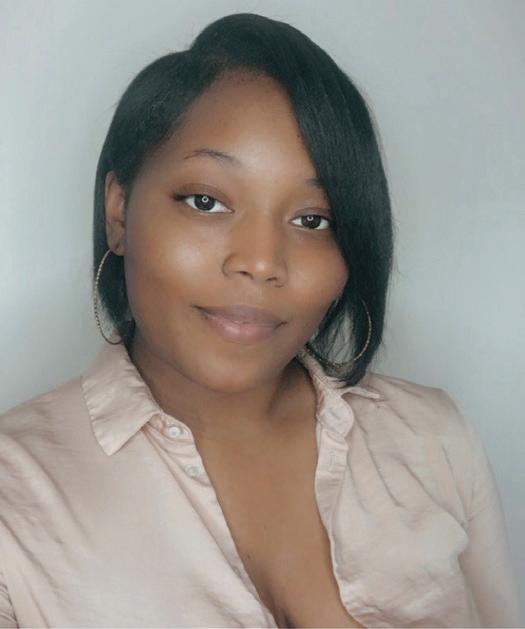
Bonita Grant is the founder and owner of Cure My Credit Score, a credit repair company based in Pikesville, Md. Grant started the business after her own journey with credit repair. (Photo courtesy of Bonita Grant)
Thursday, December 11, 2025
Platform Helps Black Salon Owners Earn Revenue Helping Their Customers Learn English
Nationwide -- The owners of a minority-owned company
called TutorABC Global Talent, has launched a new initiative to help Black, Haitian, and other immigrant hair and nail salon owners to create extra income by offering their clients the opportunity to learn English. The program, which is an officially licensed Oxford and Cambridge curriculum, is designed to enhance communication with immigrant business owners and their customers, and many of the participants are learning to speak English within months.
When Miami salon owner Keisha Brown first heard she could help her clients learn English and earn money at the same time, all from her phone, she was curious but skeptical. Then she clicked.
As soon as the next screen opened, she was already registered and ready to do business. Within minutes, she invited her stylists to join and each stylist instantly received a personal QR code and link. By the end of the day, her team was sharing those links with clients.
One of them, María Lopez, paused during her haircut and said with a smile, “I really appreciate you connecting me with this program. It’s helping me so much at work. I’m able to communicate better with customers and my manager even told me it made a difference. I recently got a small promotion because of it.” Keisha nodded.
“That’s exactly why we’re doing it. We’re here to support our community – it’s not just
Buys T.D.s and Buys/Lends on Partial Interests
Rising costs push Black households to cut back on everyday comforts
By Andrea Stevens AFRO Staff Writer
In cities across the country, many Black households say rising prices are reshaping their daily routines. Costs for food, housing and health care continue to rise faster than wages. People are now making difficult choices about expenses that once felt ordinary.
According to the September 2025 Consumer Price Index from the Bureau of Labor Statistics, Americans are paying more for gasoline, energy, food and the price increases don’t stop there. The latest report shows an uptick in costs associated with “shelter, airline fares, recreation, household furnishings and operations, and apparel.”
For a Prince George’s county native Sydney Robinson, a single woman with an associates degree and a career in finance, the shift has been sharp. Yet even with making changes, the reality of inflation hits her in small– but painful–ways.
“I’ve opened a high yield savings account to stack my savings in order to grow my money faster,” she said. “I have had to cut back on some of my simple pleasures like solo dates, eating out and beauty supply trips. I tend to wear longer lasting hairstyles instead of switching it
about cutting hair.”
That kind of moment is what the new nationwide initiative from TutorABC Global Talent aims to multiply – effortless, zero-cost opportunities that uplift small businesses and the people they serve.
How it works:
• Each salon receives a unique link and QR code that are automatically activated – no extra registration required.
• Owners and stylists simply show the QR code or share their link from their phones.
• Clients tap or scan to explore TutorABC’s live, 24/7 English and Chinese learning platform featuring officially licensed Oxford and Cambridge curriculum.
• Every enrollment credit is tracked automatically for both the salon and the referring stylist.
• Salon owners can decide how commissions are shared with staff through a simple setting in their dashboard.
• Each client receives a free live trial class, so there is no sales pressure – just a chance to learn and grow.
Zero cost. Zero risk. Instant activation.
Participation costs nothing and takes seconds. Once a salon clicks its invitation link, it can begin operating immediately. Flyers and optional digital materials are available for salons that want them, but everything can happen right from a phone.
A community-based movement
“Salons are natural centers of connection and culture,” said Janelle Carter, Program Outreach Coordinator at TutorABC Global Talent. “We created a way for owners, stylists, and clients to grow together – with one click and you’re done.”
Available nationwide
Salon and beauty professionals across the United States can register now to receive their personalized activation link and dashboard access at: TutorABCGlobalTalent.com/ salon-activation
For general questions: help@ TutorABCGlobalTalent.com
Rising costs push Black households to cut back on everyday comforts...continued
“My income has increased, but not as much as the cost of living. I work more to maintain the same standard of living I already had,” she said.
Like Robinson, Olivia Dreux, a junior at Morgan State University, is also cutting where she can from her budget. The 22-yearold Baltimore native purchased her first home this year. Dreux said rising prices forced her to tighten her budget. She has made changes to how she maintains her appearance. What was once routine maintenance has turned into a category many now treat as a luxury.
“I have been doing my own hair a lot more. Spending money on my hair had to go,” she said. “It shocked me how something that used to be simple now feels like a financial decision.”
Dreux said the housing market offered another surprise when she was required to put down more money than planned. Family inheritance helped, but she noted that her situation was rare.
“It is not realistic anymore
up like I used to.”
For Robinson, the most immovable cost is health care.
“Health insurance has been the biggest most important cost that I have to maintain no matter what. It is not something you can’t compromise on because of the risk that comes with not having it,” she said.
She said the gap between her pay and expenses continues to widen.
to see people in their early 20s move out,” she said. “Rent prices are out of this world.”
For Baltimore locals Rya and Eric Greene, as newly weds, new parents and homeowners, rising prices forced a similar reset. Eating out was the first cut.
“One thing we have changed is how we use consumer credit and how we save. We had to make sure we had enough accessible funds in case of an emergency,” Rya said. “Meals at home can be just as good and much more budget friendly,” she said.
Rya added that she wishes she had been taught more about financial tools earlier in life.
“I would have liked better guidance on responsible credit card use and the value of maintaining a strong savings account,” she said.
Many Black families are rethinking the basics and wondering how much further they can stretch, but across different households the message remains consistent: Everyday costs are rising faster than wages.
For Race and Country: Buffalo Soldiers in California at the Ontario Museum of History & Art Explores the Legacy of Black Soldiers in the U.S. Military
Buffalo Soldiers have been mythologized in movies, television, and popular songs. Despite this romanticism, their history is complex, and their stories are worthy of deeper understanding. For Race and Country: Buffalo Soldiers in California, a new exhibition from the Ontario Museum of History & Art, explores the surprising history surrounding all-Black US Army regiments whose members—both in and out of uniform—left powerful traces in the Golden State. The show runs from December 4, 2025, to March 1, 2026.
Venturing beyond myths, the exhibition confronts the role of Black soldiers in the Army’s history of violence against Native American people, explores historical debates in the Black community over participation in wars, and exposes cracks in a society permeated by racism, in which African American soldiers faced the searing conflict between commitment to equality for their people and to the country they chose to serve. Such is the “double life” African Americans live, in the
For Race and Country: Buffalo Soldiers in California at the Ontario Museum of History & Art Explores the Legacy of Black Soldiers in the U.S. Military... continued Soldier Heritage Association and Buffalo Soldiers 9th & 10th Horse Cavalry Association of Greater Los Angeles.
For Race and Country: Buffalo Soldiers in California is based on the California African American Museum exhibition of the same name, curated by Susan D. Anderson, and tours through Exhibit Envoy.
Additional related programming includes:
Studio Saturdays: Storytime in the Galleries, The Buffalo Soldier Saturday, December 20 | 12 PM – 2 PM | All Ages Step into the galleries for a special reading of The Buffalo Soldier by Sherry Garland, illustrated by Ronald Himler. Follow the powerful story of a young man who, after gaining his freedom, joins an all-Black cavalry regiment and helps shape American history. After the reading, visitors are invited to participate in a hands-on art activity and guided reflection inspired by the themes of resilience, land, and identity. This program is open to all ages, with content designed especially for those ages 8 and up. The program begins promptly at the stated time. Please plan to attend the full duration of the program. Registration is recommended but not required. All materials are provided.
Film Night: Buffalo Soldiers: Fighting on Two Fronts Thursday, January 8 | 5 PM – 7 PM | Ages 14 +
Experience an evening screening of Buffalo Soldiers: Fighting on Two Fronts, presented in conjunction with the exhibition For Race and Country: Buffalo Soldiers in California. The film examines Black soldiers’ service, segregation, and identity, highlighting their lasting impact on California and the nation. A facilitated discussion will follow the screening to explore the film’s themes and their connection to the current exhibition. Light refreshments provided.
First Thursdays: Buffalo Soldiers History Discussion Thursday, February 5 | 4 PM – 5:30 PM | Ages 15 + Join the Museum for an afternoon discussion of the exhibition For Race and Country: Buffalo Soldiers in California. In this introductory lecture, we will examine the legacy of the Buffalo Soldiers and highlight the individuals and communities working to preserve their memory. Light refreshments will be provided.
Studio Saturdays: Black History Month Collective Saturday, February 7 | 12 PM – 4 PM | All Ages Celebrate Black History Month at the Museum and engage with local artists through interactive activities, creative projects, and inspiring conversations that honor and explore Black heritage and culture.
Chargers Defense Asserts Dominance In Tough Monday Night Win
By: Korbin McCarthy
Fans were in for a great matchup Monday night as Sofi Stadium hosted two 8-4 teams, both battling within their respected divisions as the Chargers hosted the Philadelphia Eagles. The Eagles, losers of their last two games, looked to return to their winning ways while the Chargers winners of four of their last five games looked to continue to chase the division lead.
Through photographs, objects, historical records, newspapers, musical scores, and media representations, the exhibition presents a sweeping narrative of Black soldiers and their families who made California home during the era of governmentsanctioned racial segregation in the US military. For Race and Country highlights Californians, from Northern California to the Mexican border, whose littleknown influence transformed the state, and the nation. The presentation of the exhibition at the Ontario Museum of History & Art also includes special contributions from the Inland Empire Buffalo
Justin Herbert showed zero signs of slowing down after having surgery on his none throwing hand last week. The sixth-year quarterback led his team to a first drive touchdown that included a 60-yard pass to Kimani Vidal. The Chargers were also happy to welcome back rookie running back Omarion Hampton, who missed several weeks with a high ankle sprain. The rookie wasted no time making his impact felt, receiving a 4-yard touchdown pass from Herbert on the Chargers first drive. “He is very tough, we’re so glad to have him back. He made a bunch of big plays for us. It’s just good to see him back out there on the field. The energy and the juice he brings to our offense is important, you can never have enough weapons like him” is how Justin Herbert described the importance and value Hampton brings to the team.
The Chargers’ defense led the way as they were able to force five turnovers on the night including 4 interceptions, with one of them being a game ending interception by Safety Tony Jefferson, and recovering a Jalen Hurts fumble.
The Chargers’ defense was absolutely locked in, but what
makes a defense strong and successful?
“Hearing the call, processing it, everybody going to their spots and us playing team defense. If we play team defense, it’s hard to beat us and we came out today and played team defense tonight”. That’s what makes a great defense if you ask star Safety Derwin James Jr. The first half of the game was a little sloppy for both teams as they combined for 6 turnovers in the first half. The Chargers were locked in on both sides of the ball once they returned for the second half. As the season continues this Chargers’ defense is getting stronger. What elements make a strong defense? Chargers linebacker Daiyan Henleys says, “The game plan, the coaches, we came and executed. We had enough days to prepare for a team, as good as they were but at the end of the day it comes down to execution, so that’s what you saw out there”. This game also saw the return of local product Jaelen Phillips who made his return to Southern California, now Philadelphia Eagles Linebacker, who attended Redlands East Valley High School and UCLA. Phillips has been a standout for the Eagles’ defense since joining them midseason in a trade from the Miami Dolphins. The Chargers now improve to 9-4 and look to extend their winning streak when they travel to Kansas City to face the 6-7 Chiefs. These two division rivals always battle it out, so this Sunday is sure to be no different. With a win over the Chiefs, the Chargers will overtake the AFC West.
Sydney Robinson says rising living costs have pushed her to cut back on small comforts and rethink how she saves. (Photo Courtesy/ Sydney Robinson)
Olivia Dreux, a 22-year-old student and new homeowner in Baltimore, says inflation has changed how she cooks budgets and maintains her hair. (Photo Courtesy/ Olivia Dreux)
Rya and Eric Greene say they have adjusted their savings credit use and spending habits to keep up with rising expenses since welcoming a new baby into their family. (Photo Courtesy/ Rya Greene)
words of scholar W.E.B. Du Bois, including in the armed forces.
2025 in Review: Seven Questions for California Black Health Advocate
Rhonda Smith
Edward Henderson | California Black Media
Rhonda Smith is an experienced leader with a diverse background spanning nonprofit leadership, cancer advocacy, health equity, corporate consulting and international business.
Smith is currently the Executive Director of the California Black Health Network(CBHN), a trusted resource conducting outreach, education and advocacy to achieve health equity for African Americans and Black immigrants.
CBHN’s mission is to ensure that all Black Californians, regardless of their education, socio-economic class, sexual orientation, gender identity, housing, or immigration status have access to high quality and equitable primary and behavioral healthcare and are not forced to suffer or die from preventable diseases.
Smith spoke with California Black Media about her successes and frustrations in 2025, along with her hopes for 2026.
Looking back at 2025, what stands out to you as your most important achievement and why?
This year, one of the most important achievements has been our Health Equity Advocacy Training (HEAT) Program and Black Health Equity Advocacy Week (BHEAW). We completed training for our third cohort and have trained over 60 people from across the state including physicians, medical school students, doulas/midwives and community leaders, community health workers, and health advocates. We are aiming to build a statewide network of health equity advocates who can amplify their voices, engage in community
organizing, and participate in driving policy change locally and statewide.
We are gaining greater visibility and engagement with BHEAW, which I think is more important than ever before to mobilize community voices to influence local health equity policies and have created greater visibility for the need for Black-led health initiatives. That kind of power-building is what leads to sustainable systems change.
I’m also happy that we have surpassed 800 Black Health Network (BHN) members across the state. Having started from ground zero about three years ago. This is something to be proud of.
How did your leadership, efforts and investments with CBHN contribute to improving the lives of Black Californians in 2025?
Through our leadership, we’ve advanced policies, programs, and partnerships that center Black voices and dismantle structural barriers to healthcare. Whether it was advocating for Black maternal health legislation, increasing mental health access, or strengthening our statewide member network, we’ve been intentional about investing in solutions by and for Black Californians.
What frustrated you the most over the last year?
What frustrated me the most is how the current federal administration has, in a very short time, undermined, dismantled, and reversed decades of progress in advancing health equity for vulnerable communities and is creating a system and infrastructure that is inhumane when it comes to health, healthcare access, and the overall well-being of our communities.
What inspired you the most over the last year?
I’m constantly inspired by the resilience and brilliance of Black
2025 in Review: Seven Questions for California Black Health Advocate Rhonda Smith...continued
community leaders across the state. Seeing our BHN members being so committed to the work and support of CBHN. It’s a reminder of why we started the network and its importance in power building. We need to come together and work together to solve our won community’s problems.
What is one lesson you learned in 2025 that will inform your decision-making next year?
I’ve learned that no matter how bad things seem to be. there are always opportunities to be discovered and leveraged. Despite the impact of the “One Big Beautiful Act” (OBBBA) and its deep budget cuts, I believe that this, like COVID-19 back in 2020, is another moment in time for us
to pivot and figure out how we can find the upside in all of this for our community. It’s just going to take a bit more effort, innovation and creativity.
In one word, what is the biggest challenge Black Californians faced in 2025?
Politics.
What is the goal you want to achieve most in 2026?
In 2026, I want CBHN, working collaboratively with our health equity partners, to help drive a statewide policy win that protects our health and healthcare and mitigates the impact of the OBBBA and budgets cuts on California and our most vulnerable communities.
2025 in Review: Seven Questions for Non-Profit Executive Kaci Patterson
Edward Henderson | California Black Media
Kaci Patterson is the founder and Chief Architect of the Black Equity Collective (BEC). This network of funders and nonprofit leaders is committed to investing in the long-term sustainability of Black-led organizations in Southern California.
A graduate of Pepperdine University, Patterson holds an MBA in Organizational Management & Leadership from the University of La Verne.
Patterson takes pride in her commitment to human and community development. Also the Founder and Chief Architect of Social Good Solutions (SGS), a Black woman-owned and operated boutique social impact consulting firm, Patterson serves as an advocate for Black creatives and thought leaders. She encourages them to “know their worth” and to never compromise when it comes to the value of their intellectual property.
Patterson spoke to California Black Media about her successes, disappointments throughout the
year and plans heading into 2026.
Looking back at 2025, what stands out to you as your most important achievement and why?
Our most important achievement this year as the BEC has been balancing responding to our external environment (attacks on equity-centered work, pullback in public and philanthropic funding, wildfires, ICE raids, and everything in-between) with the discipline of exercising restraint. We have resisted being pulled in every direction. This has allowed us to continue to focus on building a future full of Black possibilities. On the program implementation level, we onboarded 20 new organizations into the BEC's membership, hosted our largest annual symposium to date, released a groundbreaking report on the economic benefits of Black-led nonprofits in California, launched a series of community listening sessions and completed a pilot of a pioneering model on inclusive fiscal sponsorship. We did this while simultaneously supporting wildfire recovery efforts, making solidarity grants to organizations focused on immigrant justice,
2025 in Review: Seven Questions for Non-Profit Executive Kaci Patterson...continued
establishing new collaborative efforts with our ecosystem partners and trying to fundraise in an environment that is increasingly more restrictive of equity-centered work.
How did your leadership, efforts and investments in 2025 contribute to improving the lives of Black Californians?
Since our founding in 2021, BEC has regranted over $7 million to over 40 Black-led organizations (BLOs). In 2024 alone according to our most recent member survey data, the $1.7 million we regranted was leveraged to raise an additional $6.1 million from 44 unique public and private funders. This is significant given the fundraising climate. In May of this year, in partnership with the Nonprofit Finance Fund, BEC released the first-of-its-kind report studying the economic impact of BLOs on California's economy. Julio Marcial, Chief Impact Officer at Liberty Hill Foundation, called the report: “a roadmap for investment.” This report provides a new narrative framework that ties investment in BLOs to not only community impact, but economic vitality as well for the state. With over 4,000 jobs created, $335 million paid in salaries and over $22 million paid in payroll taxes, BLOs are providing an economic lifeline to thousands of Californians and helping to build a more vibrant and thriving Black economy.
What frustrated you the most over the last year?
I've been frustrated by how quickly some funders have turned their backs on equity broadly and the Black community, more specifically. The politics of fear has crippled courage, caused retreat
and made many in philanthropy afraid to stand in true partnership with community, leaving many organizations to wonder if they really do have to fight these battles alone.
What inspired you the most over the last year?
Honestly, nature. I have looked to nature more than ever this year to learn lessons of resilience, adaptability, community care, defiant determination, beauty and joy in the face of unspeakable manufactured chaos.
What is one lesson you learned in 2025 that will inform your decision-making next year?
This has been a year to lean into the wisdom of our ancestors. Mama Harriet Tubman created a secret society to liberate our people by moving in strategic silence with a network of partners and allies who were willing to boldly follow the leadership of a Black woman. Dr. King used direct action-strategic, visible defiance in the face of immoral and unjust laws. Both were effective for their time. Knowing which strategies are most effective for our time is what I'm carrying with me into 2026.
In one word, what is the biggest challenge Black Californians faced in 2025?
Erasure.
What is the goal you want to achieve most in 2026?
Helping our organizations to survive -- to live to fight another day, another year, another battle. So, together, we can harness our collective quantum intelligence to create Black PermanencyTM in California.
AFRO: What are the best ways for someone to check their credit report without hurting their score?
BG: There’s apps, like Credit Karma. Or, if you have a credit card or even a bank account, most bank accounts allow you to see your credit score every month. Sometimes they don’t allow you to see your credit report, but at least knowing your score will tell you if there’s something that’s impacted it. When you pull your own credit, it does not impact your credit score. It’s called a soft pull. A hard pull is when a bank pulls your credit to see if they can approve you for whatever loan product they have or credit card product they have. A hard pull can affect your credit score.
AFRO: What are the most effective strategies for someone looking to improve their credit score?
BG: One of the best ways to boost your scores is by paying down your credit card. We hear that we’re supposed to keep our credit cards at 30 percent utilized. Thirty percent is the maximum they want to be on your credit card. They really want you to be closer to 10 percent of the limit. When you’re at 10 percent of your limit on your credit cards, that’s how you get to, like the 700 and 800 scores. They want you to keep your credit card balances extremely low, and the good number is between one and 10 percent of the limit.
They don’t want you to be at zero because it looks like you’re not using the card, and they can’t really score you. . If you’re trying to buy a house or a car or do anything strategic with your credit, you want to get all your cards down to 10 percent as soon as possible and leave them there.
AFRO: Are there common mistakes or misconceptions people make that actually hurt their credit score more than they realize?
BG: One of the craziest things I’ve heard was the, “waterfall effect,” where you get six credit cards in one day to raise your credit score. Don’t do that, it hurts your credit. The reason why it hurts your credit is because you have all these new inquiries that are showing up. After getting the second credit card, it alerts other banks that you’re doing this. A lot of times, your limits are also going to be really low. You might get six $300 credit cards, which doesn’t help you at all and damages your average age of file—a big part of your credit score. They take all of your open cards or open accounts, and they average the age. Most people who have 800 credit scores have an average age of file that is older than seven years. If you have a 10-year old card and a two-year old auto loan, that’s 12 years over two accounts, which gives you an average age of six years. If you do the waterfall effect and get six new cards that show up on your credit report, they’re